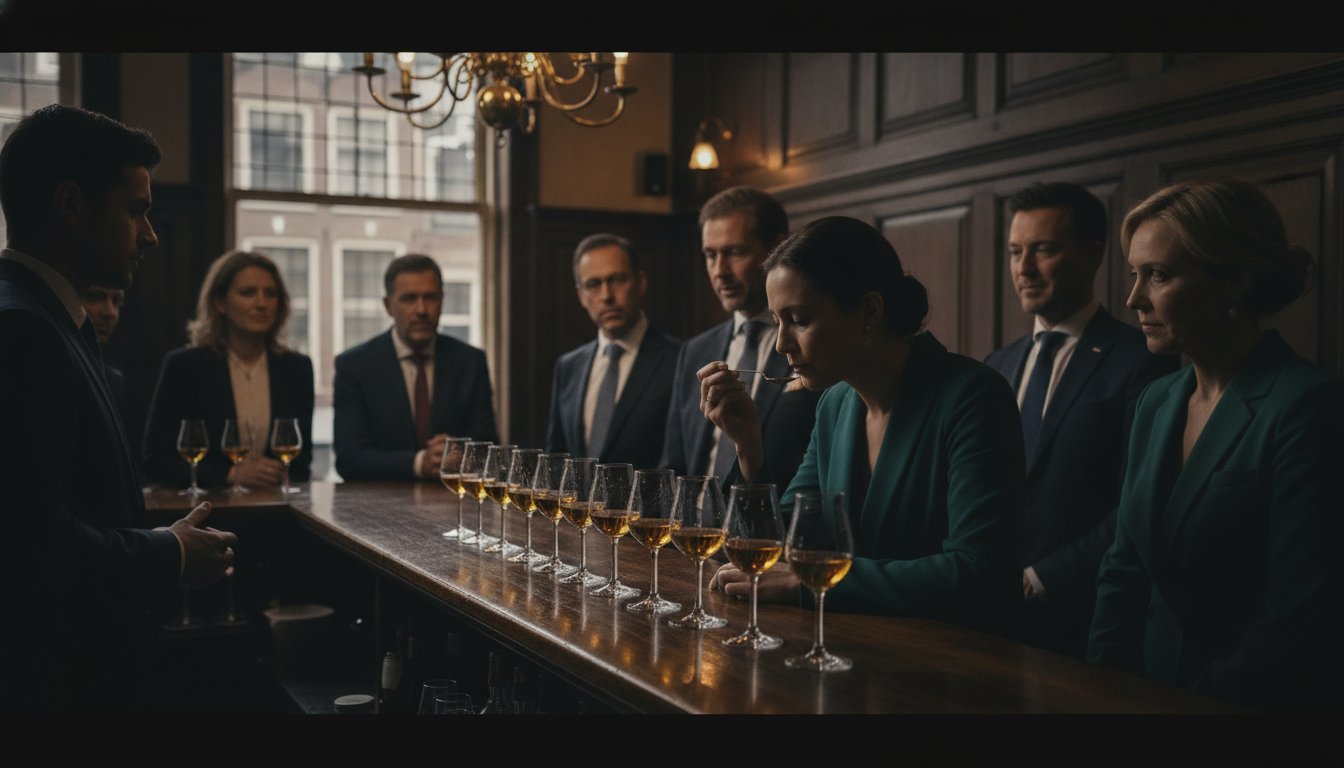
What if the true essence of the Dutch Golden Age isn’t found in a museum, but within the amber depths of a tulip-shaped glass? With Amsterdam reaching over 23.7 million tourist stays in 2025, finding an authentic amsterdam jenever tasting for groups that feels exclusive rather than crowded has become a sophisticated art form. You understand that your clients crave more than a drink; they’re looking for a sensory journey into the heart of Dutch heritage.
It’s a delicate balance to strike. You need the historic charm of a 17th-century proeflokaal, yet you’re managing the logistical weight of 20 or more guests, coach drop-off restrictions, and a shifting regulatory landscape. We’ve curated this 2026 guide to help you navigate these complexities with the precision of a seasoned strategist. You’ll discover how to secure venues that honor the craft of the “little headbutt” ritual while ensuring every operational detail, from transport to educational depth, is executed with effortless elegance. Let’s transform a standard itinerary into a masterclass of Dutch spirit and culture.
Key Takeaways
- Deepen your cultural narrative by distinguishing between jonge and oude jenever styles, ensuring a tasting that values craft over simple consumption.
- Identify venues that provide an authentic amsterdam jenever tasting for groups without compromising on the intimacy of historic 17th-century tasting rooms.
- Master the sensory rituals of the tulip glass and the traditional “slurping” technique to offer your clients a truly immersive Dutch experience.
- Solve the logistical puzzle of Amsterdam’s 2026 coach regulations through expert planning and coordinated staggered arrivals for larger parties.
- Leverage specialized industry partnerships to access exclusive distilleries and manage complex transport requirements with effortless precision.
The Essence of Dutch Spirit: Understanding Jenever Culture
Jenever is not merely a spirit; it is a liquid chronicle of the Low Countries. To truly appreciate an amsterdam jenever tasting for groups, one must first understand the botanical architecture of the drink itself. It is the sophisticated ancestor of modern gin, yet it possesses a soul entirely its own. Born from the distillation of malt wine and infused with juniper berries, its identity is defined by a delicate balance of rustic grain and refined aromatics. This spirit represents a bridge between the medieval apothecary and the modern connoisseur.
The journey of this Dutch icon began as a medicinal tonic in the 16th century. Through centuries of refinement, it evolved into the national spirit, shaping the social fabric of the Netherlands. Understanding the history and culture of Jenever is essential for any professional itinerary. It serves as a foundational element of regional identity, often acting as the intellectual and sensory cornerstone of a broader Belgium gastronomy tour or a deep dive into Benelux heritage.
To better understand the atmosphere of a traditional tasting room, watch this helpful video:
The Production Process: From Grain to Glass
The heart of traditional jenever lies in “Moutwijn,” or malt wine. This heavy, aromatic base is crafted from a mash of rye, corn, and malted barley. Artisanal producers employ a triple distillation process to achieve a characteristic smooth finish without losing the grain’s inherent character. The final stage often involves oak barrel aging. This transformative period in the wood introduces smoky, complex profiles and notes of vanilla, turning a clear spirit into a golden masterpiece of technical mastery and patience.
Distinguishing Jonge, Oude, and Korenwijn
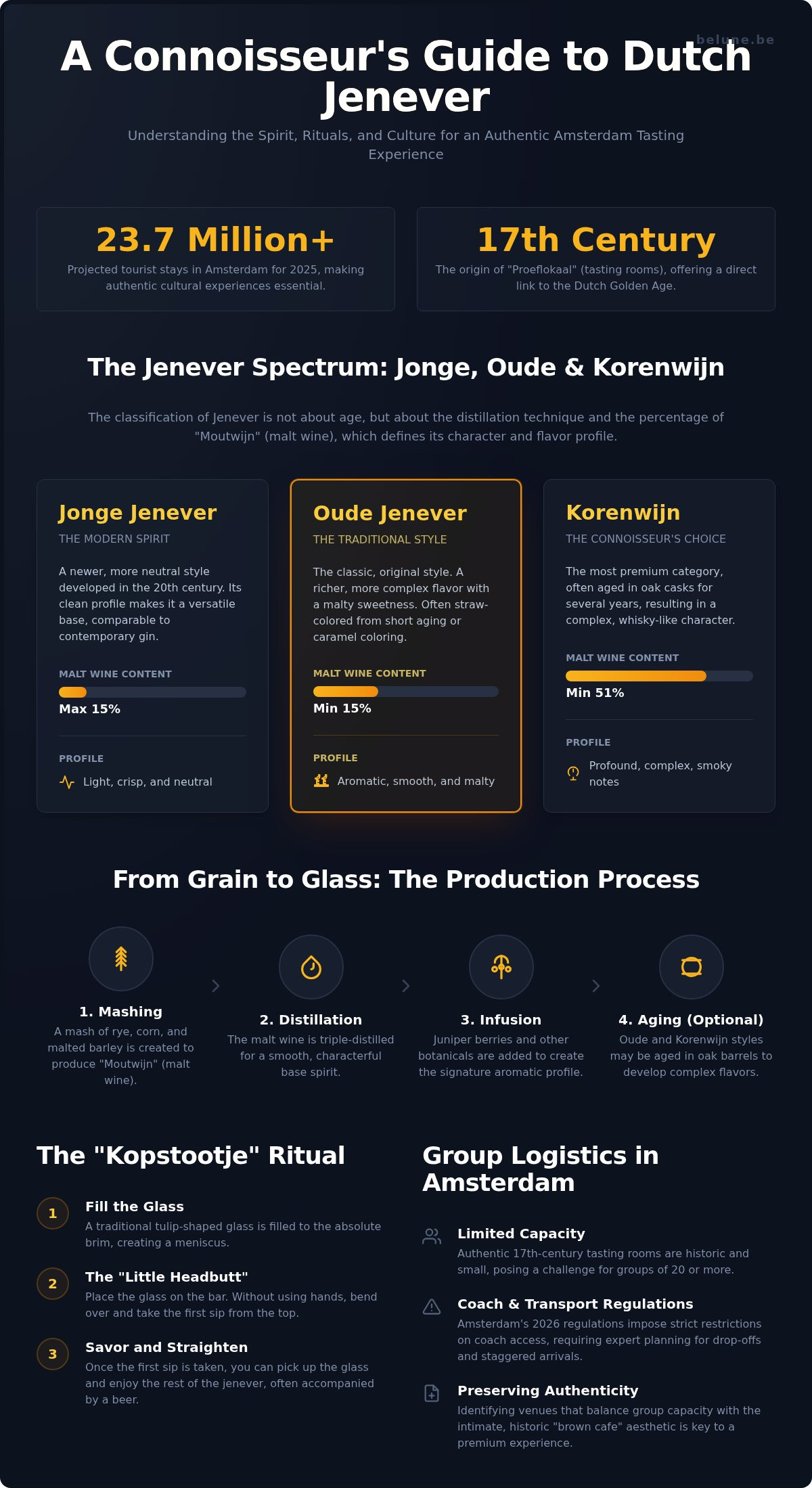
For your clients, the terminology can be deceptive. These names refer to the distilling technique rather than the chronological age of the spirit. We categorize them by their malt wine content, which dictates the intensity of the experience. An amsterdam jenever tasting for groups should ideally explore all three to showcase the full spectrum of the craft:
- Jonge: A modern, neutral style. It contains a maximum of 15% malt wine, resulting in a light, crisp profile that appeals to those who enjoy contemporary gin.
- Oude: The traditional choice. It requires a minimum of 15% malt wine. It’s straw-colored, aromatic, and carries a richer, more malty presence on the palate.
- Korenwijn: The premium selection for true connoisseurs. With a minimum of 51% malt wine and usually aged in small casks, it offers a profound, whiskey-like depth that demands slow appreciation.
Selecting the Right Proeflokaal for Professional Groups
Selecting an amsterdam jenever tasting for groups requires more than a simple reservation. It demands a discerning eye for architectural heritage and operational flow. In a city where 17th-century buildings offer limited square footage, the distinction between a commercialized trap and an authentic proeflokaal lies in the subtle layers of history. Authentic spaces prioritize the preservation of the “brown cafe” aesthetic. Think dark, tobacco-stained wood, sand-dusted floors, and a notable absence of neon or aggressive modern branding. These environments foster a sense of timelessness that resonates with high-end clients seeking a genuine connection to the city’s past.
Capacity remains the primary hurdle for the modern tour operator. Most historic rooms were designed for the intimate social circles of the 1600s, not travel groups of forty. Success depends on identifying venues that maintain their soul while accommodating professional volume. This is where technical expertise meets creative vision. If you’re seeking a strategic ally to manage these delicate on-site logistics, our team at BELUNE specializes in curating these exclusive environments for professional partners.
Top Historic Venues for Group Reservations
- Proeflokaal A. van Wees: This venue stands as a cornerstone for larger delegations. It offers a rare combination; a traditional tasting room paired with a full-service kitchen. It’s the premier choice for groups that wish to balance their spirits with substantial, traditional Dutch cuisine.
- Wynand Fockink: Tucked away in a narrow alleyway behind Dam Square, this distillery provides an unparalleled sense of discovery. It’s best suited for standing tastings where the 1679 interior provides a dramatic backdrop for the tasting ritual.
- De Drie Fleschjes: Established in 1650, this venue offers the most serene atmosphere in the city center. It’s perfect for groups seeking a quiet, museum-quality environment where the focus remains entirely on the liquid heritage and vintage casks.
Criteria for B2B Venue Selection
A professional amsterdam jenever tasting for groups must meet several technical benchmarks. First, prioritize venues that offer dedicated private or semi-private spaces. This ensures your guests aren’t disrupted by the city’s general bustle. Second, the expertise of the bartenders is paramount. They must be capable of delivering a passionate narrative in multiple languages, making the heritage accessible to international guests. Finally, never overlook the “Hapjes.” The inclusion of artisanal bitterballen and high-quality aged cheese is essential. These elements transform a simple session into a sophisticated gastronomic experience. It’s these details that reassure your clients they’ve found the true heart of the city, delivered with professional precision.
The Ritual: Etiquette and the “Kopstootje” Experience
The ritual of consumption is where the technical craft of the distiller meets the social artistry of the host. An authentic amsterdam jenever tasting for groups isn’t merely a lecture; it’s a choreographed performance that honors centuries of Dutch social history. The centerpiece of this experience is the tulip-shaped glass. This specific geometry serves a technical purpose. The narrow rim concentrates the volatile aromatics of the juniper and botanicals, while the wider bowl allows the spirit to breathe. For a professional group, this vessel becomes a tool for sensory discovery, grounding the experience in physical tradition.
Managing the “Kopstootje,” or “little headbutt,” for a large assembly requires a rhythmic approach. When thirty guests stand before glasses filled to the absolute brim, the transition from observation to participation must be seamless. A skilled guide transforms this precarious surface tension into a moment of collective focus. This is the ultimate social lubricant, shifting the group dynamic from passive listening to shared cultural immersion. It’s a participatory spectacle that ensures your clients don’t just learn about Amsterdam; they feel its pulse.
Step-by-Step: The Traditional Dutch Sip
To facilitate a successful group session, the guide must lead the “bowing” ritual with precision. This tradition prevents the loss of a single drop from the overfilled tulip glass. The process follows a strict etiquette that guests find both challenging and memorable:
- The Pour: The bartender fills the glass until the liquid forms a convex meniscus at the rim.
- The Bow: Guests place their hands behind their backs and lean forward, bringing their lips to the glass.
- The Slurp: The first sip is taken without lifting the glass, a mandatory gesture of respect for the distiller’s work.
- The Release: After the sip, guests stand tall and exhale slowly to release the deep botanical aromas across the palate.
Pairing Jenever with Dutch Gastronomy
The culinary dimension of a tasting adds a layer of sophistication that professional groups expect. The high malt wine content in traditional jenevers provides a robust structure that stands up to bold flavors. We often recommend pairing “oude” styles with fatty, salt-cured snacks like herring, where the spirit’s grain notes cut through the richness. Conversely, aged jenevers with oak-driven profiles complement the sharp, crystalline textures of vintage Dutch cheeses. Integrating these sessions into a broader culture group tour in Benelux allows guests to appreciate how spirits and snacks form a cohesive part of the region’s historical identity. This holistic approach ensures the tasting is perceived as a high-end gastronomic event rather than a simple drinking session.
Logistical Excellence: Managing Large Groups in Amsterdam
Amsterdam’s historic core is a beautiful labyrinth, but for tour operators, it presents a complex logistical puzzle. In 2026, the city’s commitment to managing tourist flow has resulted in even stricter coach access and parking regulations. Orchestrating an amsterdam jenever tasting for groups requires more than just a reservation; it requires a tactical strategy that respects municipal boundaries while preserving the guest’s sense of wonder. The challenge is to bridge the gap between a modern coach and a 17th-century tasting room without the friction of traffic or delays.
A specialized Benelux incoming tour operator serves as the invisible architect of this experience. We don’t just book a venue; we manage the rhythm of the day. For larger delegations, we often implement “staggered arrivals.” This technique ensures that the intimate atmosphere of a historic proeflokaal remains intact, allowing each guest to receive the personal attention of the master distiller. This level of precision transforms a simple transfer into a masterclass in professional hospitality.
Coach Transport and Drop-off Strategy
The 2026 urban landscape favors agility and foresight. Our approach centers on identifying the most efficient “Kiss & Ride” points near the central canal belt, minimizing the transit time for your guests. We pay particular attention to the “last mile” of the journey. For VIP clients or elderly guests, we coordinate short, scenic walks that serve as a prelude to the tasting rather than a logistical hurdle. Our private fleet of modern coaches provides the flexible scheduling necessary to navigate Amsterdam’s real-time traffic shifts, ensuring your group arrives with the serenity that a high-end tour demands.
Itinerary Integration
Timing is the most critical component of a successful group itinerary. To avoid the peak public crowds, we recommend scheduling tastings during the late afternoon. This creates a sophisticated transition between a morning visit to the Rijksmuseum and a twilight canal cruise. By integrating these elements into a single, fluid narrative, the jenever tasting becomes a cultural highlight rather than an isolated activity. For our professional partners, we simplify the administrative process through fixed-price group packages and centralized billing. This transparency allows you to focus on client satisfaction while we handle the technical intricacies of the Dutch capital.
Why BELUNE is Your Strategic Partner for Amsterdam Group Tours
Over two decades of industry experience allows us to view travel management through a lens of both technical precision and artistic vision. We don’t just facilitate itineraries; we curate narratives. Our deep-rooted expertise in themed group travel in Benelux ensures that every amsterdam jenever tasting for groups is positioned within a larger, cohesive cultural framework. We understand that for a professional partner, the value lies in the details that cannot be found in a standard brochure. It is about the subtle alchemy of atmosphere and logistics.
Direct relationships with historic distilleries and hidden tasting rooms are the foundation of our service. These aren’t mere business transactions; they’re long-standing partnerships built on mutual respect for craft and heritage. This proximity allows us to secure access that remains elusive to others. We provide your clients with a sense of exclusivity that defines high-end travel, ensuring that even the largest groups feel like invited guests in a private world.
Tailor-Made Gastronomic Experiences
We elevate the standard session into a masterclass of sensory exploration. Our programs move beyond the glass, offering behind-the-scenes distillery tours where the scent of fermenting grain and aged oak tells a story of survival and innovation. We engage professional local guides who don’t just recite facts. They translate the soul of Dutch heritage for an international audience. This ensures the experience remains educational and deeply human. By providing exclusive access to venues not typically open to large delegations, we maintain the intimacy required for a truly authentic amsterdam jenever tasting for groups.
Seamless B2B Coordination
Efficiency is the silent partner of elegance. We provide a single, dedicated point of contact for every aspect of the journey, from our private fleet of modern coaches to luxury hotel management. This centralized approach eliminates the friction of multiple vendors. It ensures that transport, timing, and activities are perfectly synchronized. We offer transparent pricing and expert logistical planning to simplify your budgeting and operations. BELUNE acts as the vital conduit where the historic charm of a candlelit tasting room meets the uncompromising logistical requirements of the modern travel industry.
Elevating the Dutch Group Experience for 2026
Crafting an authentic amsterdam jenever tasting for groups is an exercise in balancing historic soul with modern logistical rigor. We’ve explored how the ritual of the “kopstootje” and the selection of a truly traditional proeflokaal can transform a standard tour into a profound cultural immersion. Navigating Amsterdam’s strict 2026 coach regulations requires a partner who treats every detail as a structural component of success. Success isn’t found in the generic; it’s found in the precision of the pour and the timing of the arrival.
With over 20 years of specialized DMC experience and our own private fleet of modern coaches, we provide the infrastructure necessary for excellence. Our expert local guides across every major Benelux city ensure your clients experience the true heart of each destination with effortless precision. Partner with BELUNE for your next custom group itinerary and let’s create a journey that resonates long after the final sip. Your vision deserves a strategic ally who values excellence as much as you do.
Frequently Asked Questions
What is the best group size for a jenever tasting in Amsterdam?
The optimal group size for a guided session ranges between 8 and 15 participants to maintain the intimacy of the historic proeflokaal. However, larger assemblies of up to 45 people can be accommodated through careful venue selection or staggered arrival times. Managing these numbers requires a technical approach to space that preserves the sensory quality of the amsterdam jenever tasting for groups.
Is jenever tasting suitable for corporate groups and team building?
Jenever tastings are exceptionally well-suited for corporate groups seeking a culturally rich alternative to traditional team building. The experience focuses on the technical mastery of distillation and the social etiquette of the “kopstootje” ritual. It offers a refined environment where professionals can engage with Dutch history while enjoying a high-end sensory experience that values quality over volume.
How long does a typical group jenever tasting session last?
A standard group tasting session typically lasts between 60 and 90 minutes. This timeframe allows the master distiller to explain the heritage of malt wine and lead guests through three to five different varieties. It’s the perfect duration to integrate into a busy day of sightseeing without overwhelming the schedule, leaving room for a subsequent meal or museum visit.
Can we combine a jenever tasting with a canal cruise for our group?
Combining a spirit tasting with a private canal cruise is a signature logistical move for a sophisticated itinerary. We often coordinate a drop-off at a canal-side tasting room, allowing guests to transition directly from the water to the bar. This creates a seamless narrative flow that highlights the city’s architectural beauty and its gastronomic heritage in a single afternoon.
Do we need to book in advance for group tastings in Amsterdam?
Booking in advance is mandatory for any professional amsterdam jenever tasting for groups. With Amsterdam’s 2026 tourism forecast reaching up to 25.1 million overnight stays, historic venues reach capacity months in advance. Securing your reservation early ensures access to private rooms and allows for the coordination of specialized multilingual guides who can translate the nuances of the craft.
Are there non-alcoholic alternatives available at traditional tasting rooms?
Traditional tasting rooms offer limited but high-quality non-alcoholic alternatives, such as artisanal Dutch fruit syrups or local juices. While the focus remains on the spirit, these options ensure that every guest feels included in the social ritual. It’s a thoughtful detail that reflects a commitment to professional hospitality and inclusive group management during your cultural tour.
How do we handle coach parking near the historic Red Light District?
In 2026, coach parking near the historic center is strictly regulated to manage urban flow. Coaches must use designated “Kiss & Ride” points on the city’s perimeter, such as Prins Hendrikkade, to drop off passengers. From there, a short walk or private shuttle brings guests to the tasting room. This prevents congestion in narrow streets and ensures a smooth arrival.
Is food always included in a jenever tasting package?
Food is not always included by default, but we highly recommend adding a selection of traditional “hapjes.” Pairing spirits with aged Dutch cheese or warm bitterballen is a structural component of the experience. These savory elements balance the malt wine’s complexity and transform the session into a complete gastronomic event that satisfies both the palate and the intellect.
Leave a Reply