Tag: Event Planning

  • Belgian Food Market Tours for Groups: The Professional DMC Guide 2026

    Belgian Food Market Tours for Groups: The Professional DMC Guide 2026

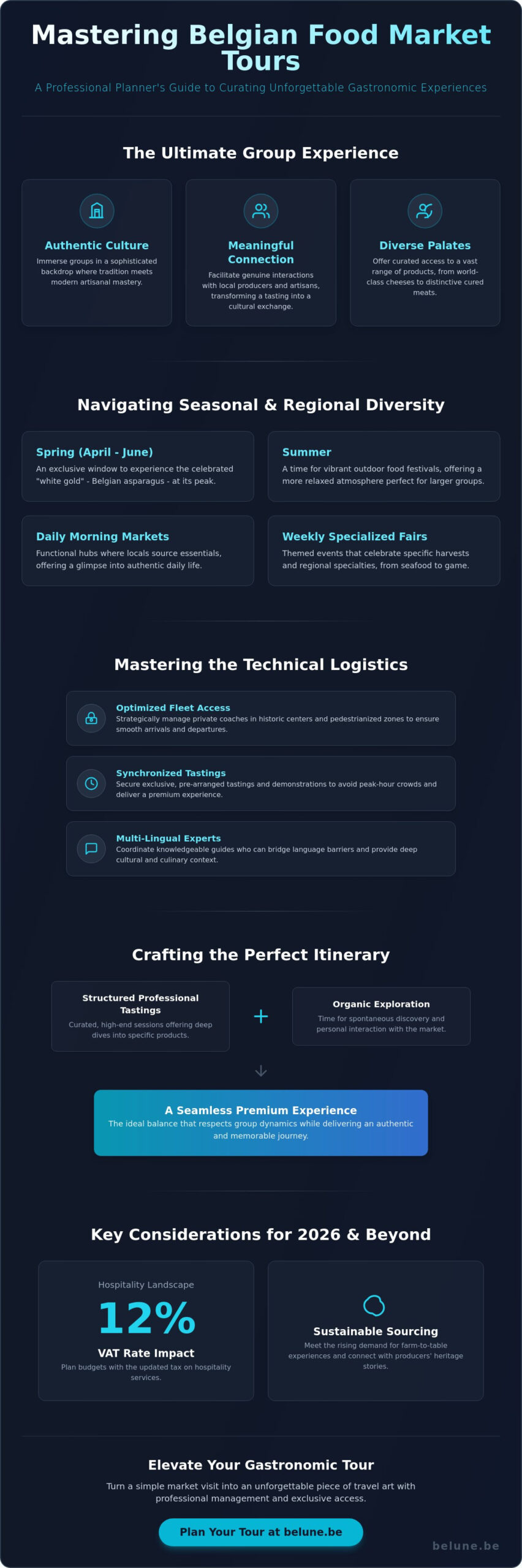
    The most authentic Belgian food market isn’t just a destination; it’s a logistical masterpiece that begins long before the first oyster is shucked. Organizing belgian food market tours for groups often feels like a delicate dance between artisanal charm and operational complexity. You’ve likely faced the challenge of maneuvering a coach through narrow medieval streets or trying to secure a synchronized, high-end tasting for forty people during the peak Saturday rush. It’s a high-stakes environment where the difference between a crowded walk and an exclusive culinary event lies in the precision of the planning.

    This guide provides the framework you need to orchestrate seamless, gastronomic experiences that resonate with the modern professional traveler. We’ll navigate the 2026 landscape, including the impact of the 12% VAT rate on hospitality services and the rising demand for sustainable sourcing. You’ll learn how to balance technical rigor with sensory poetry, ensuring your groups enjoy the soul of Belgium without the friction of the crowd. From coordinating multi-lingual experts to managing fleet logistics in historic centers, we’re sharing the expertise required to turn a simple market visit into an unforgettable piece of travel art.

    Key Takeaways

    • Understand how the intersection of tradition and artisanal mastery creates a sophisticated backdrop for high-end group engagement and authentic interaction.
    • Gain insights into navigating seasonal variations and regional specialties to curate a truly authentic gastronomic timeline for your guests.
    • Master the technical logistics of belgian food market tours for groups, from managing private coach fleets to optimizing access in pedestrianized zones.
    • Learn to balance structured professional tastings with organic exploration to provide a seamless, premium experience that respects group dynamics.

    Why Belgian Food Markets are the Ultimate Group Experience

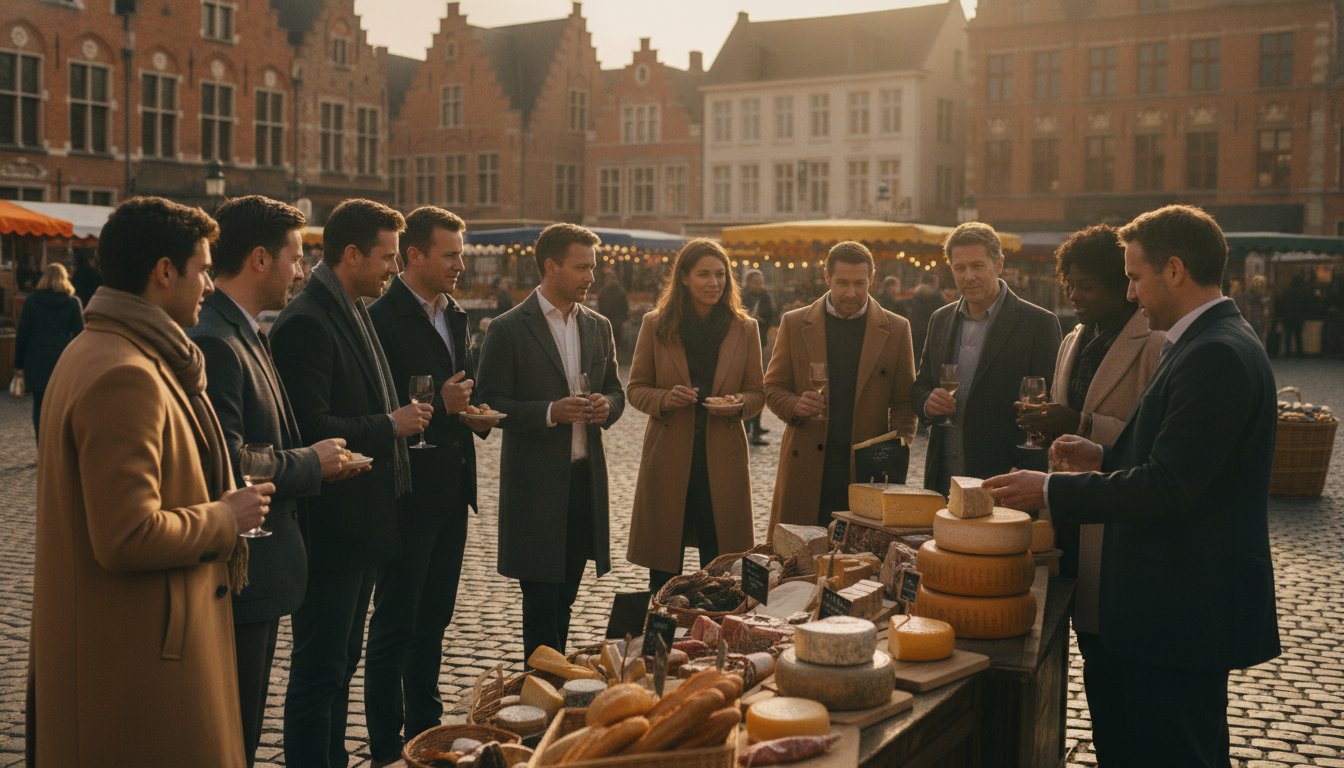
    Belgian food markets serve as the living pulse of the nation’s towns and cities. They aren’t merely points of transaction; they are social theaters where tradition meets modern artisanal skill. For professional travel planners, belgian food market tours for groups offer a rare opportunity to witness the unfiltered daily life of the locals. It’s a space where the clinking of glasses at a market stall is as common as the weighing of fresh produce. This environment provides a sophisticated backdrop for professional groups seeking something more substantial than a standard tourist itinerary.

    Gastronomy in Belgium transcends the plate. It’s an exploration of the “terroir”, the unique combination of soil, climate, and heritage that defines the flavors of a region. A Belgian food market tour is a curated sensory journey through the nation’s culinary heritage.

    To better understand the vibrant atmosphere of these culinary hubs, watch this helpful video:

    The Cultural Significance of the “Marché”

    The history of Belgian trade is etched into the cobblestones of its market squares. These gathering places have evolved into the social fabric of the country, reflecting a lifestyle that prioritizes quality over speed. Today, this tradition aligns with a robust farm-to-table movement. By engaging with an overview of Belgian cuisine, one realizes that the “Marché” is where sustainability becomes a tangible experience rather than a marketing buzzword. Producers often share stories of heritage grains or heritage-breed livestock, offering a depth of context that enriches the group’s journey. It’s this human connection that transforms a simple tasting into a meaningful cultural exchange.

    Diversity of Offerings for Group Palates

    Belgium’s geographic position has allowed it to absorb and refine the culinary influences of its neighbors. You’ll find world-class cheeses that rival French varieties and cured meats with a distinctively Germanic precision. This diversity is precisely why belgian food market tours for groups are so effective. While an individual traveler might feel overwhelmed by the sheer variety, a professionally managed group tour provides curated access. We facilitate direct conversations with the artisans, often securing specialized tastings or demonstrations that aren’t available to the general public. It’s this exclusive layer of service that ensures every participant finds something that resonates with their specific palate while discovering the innovation driving today’s Belgian food scene.

    The Belgian market landscape is a shifting canvas. Every month offers a different culinary signature. While many guides focus solely on city centers, true belgian food market tours for groups embrace the regional nuances that define the nation’s soul. From the coastal seafood markets of Flanders to the game-rich stalls in the Ardennes, the variety is staggering. Successful planning requires distinguishing between the functional daily morning markets, where locals source essentials, and the weekly specialized fairs that celebrate specific harvests. For a professional group, the challenge lies in identifying locations that maintain their authentic charm while providing the physical space necessary for a large party to move without disrupting the local rhythm.

    Spring and Summer: Freshness and Festivals

    Spring marks the arrival of the “white gold.” This celebrated Belgian asparagus dominates stalls from April to June. It’s an ephemeral window that makes for an exclusive group experience. As temperatures rise, outdoor food festivals become the focal point. These events often allow for a more relaxed choreography of movement compared to tight city markets. Managing group comfort during these warmer months is essential. We prioritize hydration and shade, often integrating visits to nearby cool, historic cellars to balance the outdoor intensity. You can explore more about these seasonal transitions through the official documentation on Flanders culinary treats.

    Autumn and Winter: Traditional Comforts

    Autumn brings a shift toward earthy intensity. The harvest of apples, pears, and the iconic Belgian endive creates a rich palette for group tastings. This is also the season for game, where markets in the southern regions showcase wild boar and venison. As winter approaches, the atmosphere turns toward traditional comforts. Artisanal warm treats, such as fresh gauffres and spiced speculoos, provide a sensory counterpoint to the crisp air. For winter belgian food market tours for groups, we always maintain a contingency plan. Indoor alternatives or heated tasting pavilions ensure the experience remains sophisticated regardless of the weather. We also account for the 2026 VAT adjustments, where the 12% rate for catering services influences our selection of high-end tasting partners. If you’re looking to design an itinerary that respects these delicate seasonal shifts, our team can help you curate a bespoke professional journey that captures the best of the Belgian calendar.

    Belgian Food Market Tours for Groups: The Professional DMC Guide 2026

    The Logistics of Group Gastronomy: From Private Coaches to Expert Guides

    Executing belgian food market tours for groups requires more than a map and an appetite. It demands a logistical framework that protects the group’s time and the market’s integrity. While individual travelers might rely on public transit, professional groups of twenty or more require a dedicated infrastructure. Coordinating drop-off points near pedestrianized market zones is a technical science. Most historic Belgian market squares, like those in Antwerp or Ghent, strictly limit vehicle access. This requires precise timing and a deep understanding of local traffic regulations to ensure guests arrive at the peak of the artisanal display without the fatigue of long-distance walking.

    Managing the flow of a large group within a crowded market space is equally critical. It’s a delicate balance. We ensure that the group moves as a cohesive unit without overwhelming the very local artisanal stalls they’ve come to admire. This involves pre-arranged tasting windows and a synchronized approach that respects the pace of the market’s daily operations. Technical rigor meets sensory appreciation.

    Modern Coach Fleet Management

    The foundation of a successful tour is the transition between destinations. Utilizing BELUNE’s own fleet of modern coaches ensures that the journey is as refined as the destination. These vehicles provide the necessary climate control and ergonomic seating for recovery between market stops. A critical, often overlooked detail is storage. High-end food tours inevitably lead to purchases; our coaches offer dedicated, secure space for artisanal finds, from delicate chocolates to regional cheeses. The driver plays a pivotal role here, managing EU-regulated driving hours and staying in constant communication with the guide to adjust for real-time traffic or market conditions.

    Expert Guidance and Language Support

    A professional guide serves as the bridge between the international traveler and the local producer. In the bustling environment of a Belgian market, language can be a barrier to understanding the nuances of production. Our multi-lingual experts don’t just translate; they curate. They identify the stalls with the highest quality sourcing and manage the group flow to prevent bottlenecks. By staggering tasting times and selecting vendors accustomed to professional groups, the guide preserves the authentic atmosphere of the market while delivering a high-end, educational experience. This level of local knowledge is what transforms a simple walk into a deep dive into culinary history.

    Planning the Perfect Itinerary: Timing, Sourcing, and Group Dynamics

    The architecture of a professional itinerary is as much about the space between events as the events themselves. When orchestrating belgian food market tours for groups, we look beyond the list of vendors to the rhythm of the day. A successful tour respects the group’s internal clock. It balances the high-energy environment of a bustling square with the necessary downtime for individual reflection. This level of planning ensures that the experience feels like a curated journey rather than a forced march. We meticulously bridge the gap between artisanal chaos and seamless travel, providing a structure that allows for both discovery and comfort.

    Dietary inclusivity is a cornerstone of modern group travel. In 2026, the demand for transparent sourcing and plant-based options has reached a new peak in the Belgian foodservice sector. We work closely with market artisans who have adapted to these shifts, ensuring that vegan and gluten-free participants enjoy the same level of artisanal quality as their peers. This proactive management prevents the friction of last-minute adjustments and maintains the sophisticated tone of the event. Every tasting is a deliberate choice, selected to represent the best of the region while respecting the diverse needs of a modern professional group.

    The Morning Market Strategy

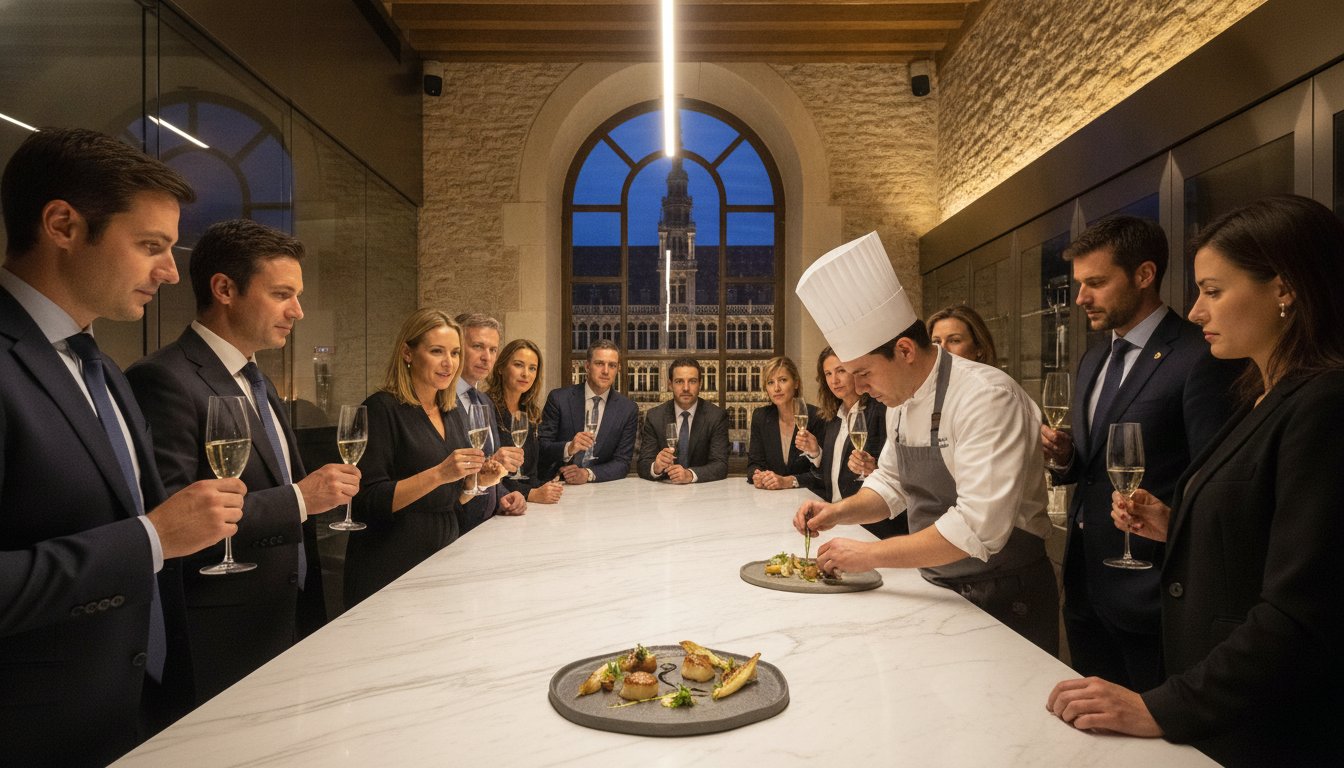
    Arriving before the general public is a technical necessity for large groups. Between 7:30 and 9:00 AM, the market exists in its purest form. This is the window where producers are most available for the authentic interactions that define our tours. We use this time to coordinate exclusive brunch experiences, where groups can taste the day’s freshest arrivals before the crowds thicken. This strategy is essential for maintaining the group’s energy curve. By the time the peak Saturday rush hits, our guests are often transitioning to the next phase of their journey, perhaps moving on to one of our culture group tours in Benelux. This seamless transition is only possible through rigorous logistical foresight and a deep understanding of local market cycles.

    Customizing for Special Interests

    A one-size-fits-all approach is the antithesis of professional DMC service. We tailor each market circuit to reflect the specific interests of the group, whether they are focused on the technicalities of fermentation or the artistry of chocolate tempering. These visits often serve as the first chapter in our more extensive Belgium gastronomy tours. We also navigate the latest regulatory landscape, including the 2026 VAT updates that apply a 12% rate to restaurant and catering services. This financial precision allows us to provide clear, reliable budgeting for our partners. For groups that include participants under 16, we strictly adhere to the 2026 Belgian Food Advertising Code, ensuring all guided content and tasting materials promote a healthy, balanced perspective on culinary heritage.

    To begin designing your tailored itinerary, contact our expert planning team today.

    Elevating the Gastronomic Experience with BELUNE’s Professional Management

    High-end travel is defined by the absence of friction. For twenty years, our team has refined the art of Benelux group logistics, transforming the unpredictable nature of a local market into a controlled, artistic event. While others might offer a list of disparate activities, we provide a cohesive vision that balances technical mastery with sensory appreciation. This expertise is vital when managing belgian food market tours for groups, where the complexity of local regulations and the 2026 VAT increases—now 12% for restaurant and catering services—require a partner with deep sector knowledge and financial precision.

    Our commitment to tour operators and travel agents is absolute. We act as a strategic ally, providing a single point of contact for hotel accommodation management, private coach hire from our own fleet, and local guide services. This vertical integration eliminates the risks associated with third-party fragmentation. We don’t just supply services; we design environments where professional groups can thrive. By handling the structural logistics, we allow the culinary heritage of Belgium to take center stage, ensuring every tasting is an echo of the nation’s artisanal soul.

    A Visionary Approach to Culinary Travel

    We treat gastronomy as a structural component of the travel experience rather than a simple itinerary addition. Our approach is defined by a minimalist elegance that prioritizes the quality of the intervention over commercial noise. Every detail is chosen with precision, from the selection of vendors to the specific expertise of our culinary historians. This clarity of purpose allows the group to focus on the sensory poetry of the market while we manage the technical rigor in the background. We believe that a well-orchestrated tour should feel effortless, reflecting a high-end expertise that inspires confidence in our professional partners.

    Seamless Integration of Services

    The true value of a professional DMC lies in the ability to weave disparate elements into a singular, compelling narrative. Our market visits are often the highlight of our broader themed group travel in Benelux, where we link culinary discovery with art, culture, and history. We offer fixed-price group packages to ensure transparent planning and budgetary certainty. This transparency is essential in a year where hospitality costs are shifting and Belgian rail usage has reached a 2.1% share among tourists.

    We invite you to request a custom itinerary that reflects the unique identity of your brand. Whether your group requires high-end hotel management or a specialized circuit of artisanal producers, our team provides the mastery required to execute at the highest level. We transform the simple act of visiting a market into an exceptional realization of Belgian heritage, tailored to the exacting standards of the professional travel industry.

    Orchestrating the Future of Belgian Culinary Travel

    The 2026 landscape of Belgian gastronomy demands a fusion of technical precision and sensory storytelling. Success hinges on more than just selecting a market; it requires a strategic mastery of logistics, from navigating the 12% VAT hospitality rates to managing the delicate energy curves of a professional group. By prioritizing early access and artisanal authenticity, you ensure your guests experience the true terroir of Belgium without the friction of the crowd. belgian food market tours for groups are no longer just an itinerary addition; they’re an essential component of a sophisticated travel narrative.

    We invite you to partner with BELUNE for your next custom Belgian group itinerary. With over 20 years of DMC experience, our team provides the visionary guidance and rigorous execution your partners expect. From our in-house fleet of modern coaches to our expert multi-lingual local guides, we manage every structural detail so you can focus on the inspiration. Let’s collaborate to transform a simple market visit into an exceptional realization of Belgian culture. Your next masterpiece awaits.

    Frequently Asked Questions

    How large can a group be for a Belgian food market tour?

    We successfully manage groups ranging from 15 to over 50 participants by utilizing a staggered entry system and multiple specialized guides. For larger parties, we divide the group into smaller cohorts of 12 to 15 people. This strategy ensures an intimate experience with local artisans and prevents the group from overwhelming the narrow market aisles or disrupting the local social fabric.

    Do Belgian food markets operate year-round for group visits?

    Yes, Belgian food markets are active throughout the year, though the sensory experience changes with the seasons. While spring markets highlight the arrival of “white gold” asparagus, winter markets transition into festive hubs featuring artisanal warm treats and seasonal game. We select specific markets based on the monthly calendar to ensure your group always encounters the most vibrant and authentic regional produce available.

    Can dietary restrictions like vegan or gluten-free be accommodated in a market setting?

    We accommodate vegan, gluten-free, and other dietary requirements by pre-selecting vendors who prioritize ingredient transparency and sustainability. The 2026 Belgian foodservice market has seen a projected growth in health-conscious and organic offerings. Our guides coordinate with artisans in advance to ensure that every participant enjoys a curated tasting experience that matches the high quality provided to the rest of the group.

    What is the best time of day to take a group to a Belgian food market?

    The optimal window for belgian food market tours for groups is between 8:30 AM and 10:30 AM. Arriving during these early hours allows your guests to witness the peak of the artisanal display before the heavy midday crowds arrive. This timing also facilitates easier coach access near pedestrianized zones and provides the best opportunity for meaningful interaction with local producers.

    Is private transport necessary for group food tours in Belgium?

    Private transport is essential for maintaining professional logistics and group comfort. Navigating Belgium’s historic centers with a large party via public transit often leads to significant delays and physical fatigue. Our own fleet of modern coaches provides secure, climate-controlled storage for any culinary purchases made during the tour and ensures precise drop-offs near market squares that are otherwise difficult to reach.

    How do we handle payments for tastings at individual market stalls for a group?

    We manage all vendor payments and tasting fees centrally to ensure a seamless, cash-free experience for the participants. Our fixed-price packages already account for the 2026 VAT rate of 12% on restaurant and catering services. This centralized approach eliminates the friction of individual transactions at stalls, allowing the group to focus entirely on the gastronomic and cultural narrative provided by the guide.

    Are these tours suitable for corporate team-building events?

    Belgian food market tours for groups provide a sophisticated and engaging backdrop for corporate team-building. These experiences foster natural social interaction in a relaxed environment. We can tailor the itinerary to include interactive workshops with local chocolatiers or cheese masters, creating a shared creative experience that strengthens professional bonds while exploring the deep culinary heritage of the Benelux region.

    What happens if it rains during a scheduled market tour?

    We maintain robust contingency plans for inclement weather by integrating covered market pavilions or nearby indoor tasting venues into the itinerary. Many historic Belgian market squares are situated next to high-end covered galleries or artisanal boutiques that offer excellent shelter. Our guides are experts at adjusting the tour’s rhythm in real-time, ensuring that guest comfort and the quality of the tastings remain uncompromised.

  • The Ultimate Brussels Chocolate Workshop for Groups: A 2026 Masterclass Guide

    The Ultimate Brussels Chocolate Workshop for Groups: A 2026 Masterclass Guide

    What if your group’s encounter with Belgian excellence moved beyond the display window and into the heart of the atelier? For professional planners, the challenge isn’t finding a shop; it’s avoiding predictable tourist traps and securing a brussels chocolate workshop for groups that meets the standards of a true masterclass. You likely recognize that a generic tasting won’t suffice for a high-level corporate retreat or a sophisticated cultural journey. You seek a technical immersion that honors the craft’s 2025 induction into the Inventory of Intangible Cultural Heritage.

    We understand that logistics and quality are your primary concerns. This guide shows you how to curate a sensory centerpiece that blends technical education with the luxury of a seamless itinerary. You’ll discover how to navigate the bean-to-bar movement and integrate expert-led sessions into a perfectly timed schedule. From coordinating private coach transport to accessing Gault&Millau’s 2026 award-winning artisans, we provide the blueprint for an elevated culinary experience that transforms a simple visit into a profound professional milestone.

    Key Takeaways

    • Master the technical foundations of Belgian artistry, from achieving the perfect temper to crafting avant-garde ganache flavors.
    • Optimize your itinerary by selecting a brussels chocolate workshop for groups that fits the 90 to 120-minute logistical sweet spot.
    • Elevate the sensory experience by pairing artisanal creations with Belgium’s iconic beer heritage for a truly holistic gastronomy tour.
    • Ensure seamless movement and professional coordination through expert DMC management and a private fleet of modern coaches.
    • Scale large delegations with precision by implementing strategic sub-grouping techniques that maintain an intimate, high-end atmosphere.

    The Essence of a Brussels Chocolate Workshop for Groups in 2026

    Brussels is a city of layers. Its streets hold the weight of centuries, yet its ateliers pulse with modern innovation. For those organizing professional travel, a brussels chocolate workshop for groups in 2026 is no longer a simple tasting event. It’s an immersion into a technical discipline. We view these sessions as sensory architecture. The materials are as vital as the craftsmanship. By focusing on the intersection of art and science, a premium workshop serves as the sophisticated heart of a group’s Belgian journey.

    The 2026 landscape favors ‘slow chocolate.’ This movement prioritizes sustainable bean-to-bar ethics over mass production. Following the 2025 addition of Brussels’ chocolate know-how to the Inventory of Intangible Cultural Heritage, the demand for authentic immersion has peaked. A curated masterclass distinguishes itself by offering technical transparency. It moves beyond the predictable tourist demonstration by engaging directly with the science of the bean and the rigor of the tempering process.

    To better understand the artistry involved in these sessions, watch this helpful video exploration of the city’s chocolate culture:

    Artisanal Integrity vs. Commercial Demonstrations

    True mastery leaves no room for compromise. Professional groups prioritize private, closed-door sessions where the focus remains on artisanal integrity. This means identifying certified master chocolatiers, such as Jérôme Grimonpon, named the best in the city for 2026 by Gault&Millau. High-end workshops insist on 100% cocoa butter and single-origin beans. These ingredients aren’t just quality markers. They are the foundation of the technical challenge. When a group enters a private atelier, they aren’t spectators. They are collaborators in a process that demands precision. From the exact temperature of the marble to the percentage of cocoa solids, every detail matters.

    The Cultural Impact of Belgian Craftsmanship

    To understand the present, one must respect the lineage of the craft. The history and culture of Belgian chocolate is a narrative of constant refinement. Since Jean Neuhaus invented the praline in 1912, the city has refined its identity through sugar and cocoa. This dedication to quality reflects a broader Belgian ethos of excellence. The praline is a structural masterpiece of Belgian confectionery, marrying a crisp exterior with a soul of complex ganache or praliné. By participating in a masterclass, your group connects with a tradition that has defined the capital for over a century.

    Artistry and Technique: The Pillars of a Professional Masterclass

    Technical mastery defines the Belgian identity. A high-end brussels chocolate workshop for groups isn’t a passive demonstration; it’s a laboratory of precision. For professional learners, the value lies in the “why” behind the craft. It’s the difference between eating a sweet and understanding a structural masterpiece. The chocolatier acts as a visionary guide, translating complex chemical reactions into an intuitive, creative process. This technical depth ensures that corporate groups leave with more than just a box of treats. They leave with a profound respect for the rigor required to maintain Belgium’s global reputation.

    The Science of the Tempering Process

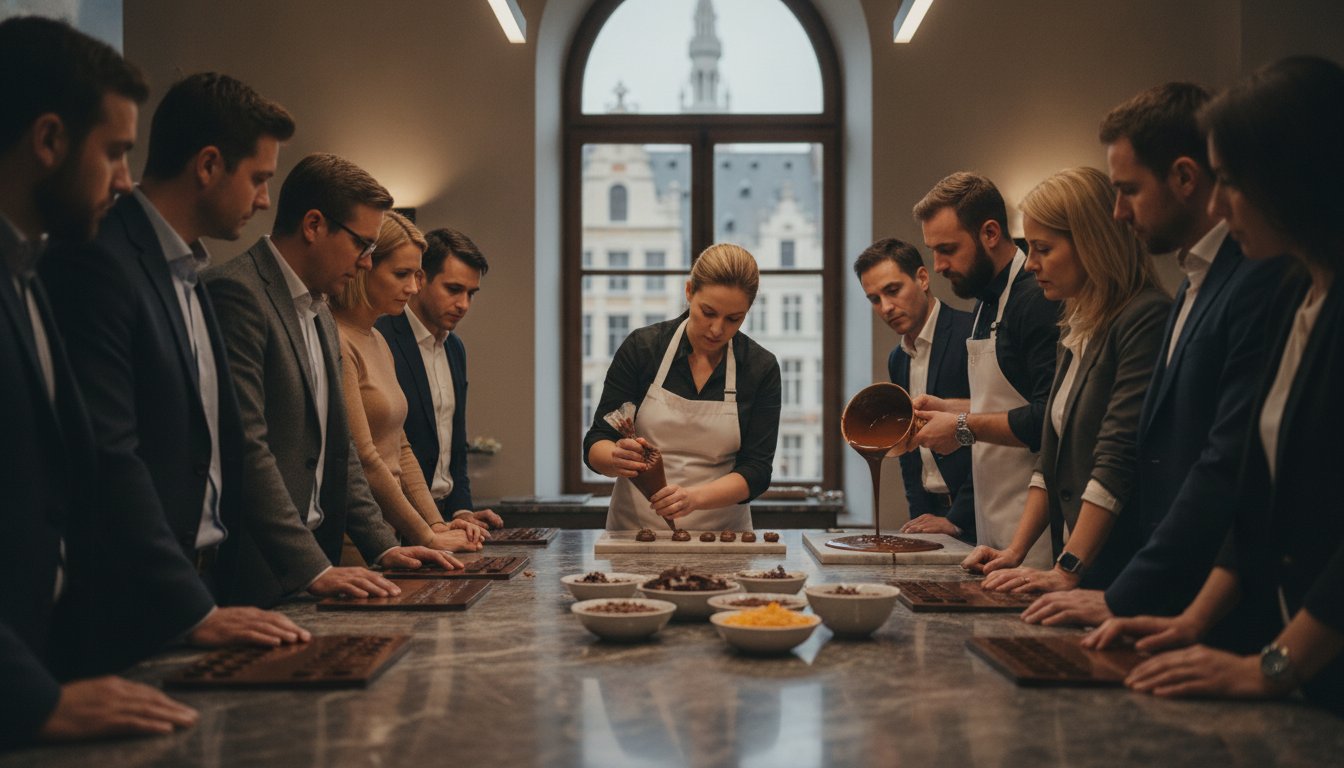
    Tempering is the soul of the atelier. It’s the process of heating and cooling chocolate to specific temperatures, typically around 31 to 32 degrees Celsius for dark varieties, to align the Beta V crystals in the cocoa butter. This alignment produces the characteristic “snap” and radiant gloss that distinguish artisanal work from commercial products. Adult learners often find this stage the most engaging. It requires focus and a steady hand. Whether using traditional marble slabs to agitate the mass or modern tempering machinery for high-viscosity batches, the goal remains the same: total control over the material. This stage of the masterclass serves as an excellent metaphor for professional discipline and attention to detail.

    From Pralines to Mendiants: A Diverse Repertoire

    The workshop repertoire balances traditional foundations with avant-garde exploration. Groups delve into the distinct techniques required for various forms:

    • Molded Pralines: Creating the perfect thin shell that gives way to a complex, liquid soul.
    • Hand-Dipped Truffles: A test of dexterity where texture and temperature must be perfectly synchronized.
    • Mendiants: These elegant discs represent a minimalist approach, where the quality of dark chocolate is elevated by the precise placement of dried fruits and nuts.

    Modern masterclasses also offer customization that speaks to the identity of the group. This includes branding chocolates with corporate logos or selecting specific color palettes for the ganache that reflect a brand’s aesthetic. The cooling process is the most critical stage of the workshop because it dictates the final structural integrity and aesthetic brilliance of every single creation. To ensure every technical detail of your masterclass aligns with a broader, high-end itinerary, we recommend consulting with a dedicated travel expert who understands the nuances of professional group movement.

    Artisans like Laurent Gerbaud have pioneered the use of spices and dried fruits to challenge the traditional palate. Your group’s journey through flavor will likely mirror this evolution, moving from familiar hazelnut pralinés to bold, contemporary combinations. This technical and sensory education ensures the experience remains memorable long after the last piece of chocolate has been enjoyed.

    The Ultimate Brussels Chocolate Workshop for Groups: A 2026 Masterclass Guide

    Excellence in execution requires more than artistic vision; it demands a rigorous approach to timing and movement. Organizing a brussels chocolate workshop for groups involves balancing the delicate requirements of the craft with the rigid constraints of a professional itinerary. We find that 90 to 120 minutes represents the ideal duration for a high-end experience. This window provides enough time for technical depth, such as the tempering and molding stages, without exhausting the group’s schedule. It also accounts for the essential cooling phase, ensuring participants don’t leave with unfinished or unstable products.

    Inclusivity is a structural component of modern planning. A successful masterclass must respect the diverse needs of a global delegation. Most premium ateliers in 2026 now offer sophisticated alternatives to accommodate vegan, nut-free, or halal requirements. Many bean-to-bar workshops are naturally gluten-free and plant-based, relying on the purity of the cocoa bean rather than additives. Addressing these dietary needs during the initial coordination phase ensures that every member of the group feels valued and fully engaged in the sensory experience. When these details are handled with professional foresight, the workshop becomes a fluid part of the day rather than a logistical hurdle.

    Seamless Transport and Arrival Coordination

    Brussels’ historic center presents unique challenges for large vehicles and group movement. We utilize our own fleet of modern coaches to manage arrivals with surgical precision. Selecting ateliers with designated coach drop-off points is essential to avoid city-center congestion. By timing workshops to avoid the morning and evening rush hours, we minimize transit stress. A local guide often bridges the gap between the hotel and the atelier, providing cultural context during the short journey and ensuring the group arrives composed and ready to engage.

    Scalability for Large-Scale Delegations

    Scaling a brussels chocolate workshop for groups of 50 or more participants requires a strategic division of space. We recommend utilizing multiple workstations where sub-groups rotate between different technical stages. This maintains an intimate, high-end atmosphere despite the total number of participants. A high ratio of master chocolatiers to participants is non-negotiable; it ensures every individual receives expert guidance. Finally, post-workshop logistics are handled with care. Delicate creations are professionally packaged and transported back to the hotel, allowing the group to continue their day unburdened by their handmade treasures.

    A Holistic Approach to Gastronomy Within a Benelux Itinerary

    A singular event rarely defines a journey. Instead, we view a brussels chocolate workshop for groups as a vital narrative thread within a sophisticated culinary tapestry. For a delegation to truly understand Belgian excellence, the workshop must transcend the atelier walls. It should connect the morning’s technical precision with the evening’s fine dining. This integration ensures that the experience feels like a cohesive exploration rather than a collection of disjointed activities. Gastronomy serves as a universal language for international groups, bridging cultural divides through shared sensory appreciation.

    The Art of the Pairing Session

    The evolution of the tasting experience has led to the rise of the pairing session. This goes beyond simple consumption. It’s an exercise in sensory contrast and harmony. In 2026, we see a significant trend toward pairing high-cocoa dark chocolates with bold Belgian abbey beers. The deep, malty notes of a Trappist ale provide a robust counterpoint to the acidic, fruity profile of single-origin beans. For morning sessions, we often coordinate coffee and chocolate pairings. This involves selecting local roasters whose beans complement the specific flavor profiles of the ganaches created in the workshop. Finding the right venue is paramount; the space must accommodate both the technical making and the reflective tasting.

    National Culinary Landmarks for Groups

    Beyond the workshop, the capital offers a landscape of historic boutiques and modern bean-to-bar factories. Integrating these visits into a broader Belgium gastronomy tour provides a comprehensive view of the industry. Groups can trace the evolution of the craft from the opulent boutiques of the Galeries Royales Saint-Hubert to the minimalist, industrial ateliers of the Marolles. This cultural depth is essential for culture group tours in Benelux, where the goal is to understand the regional landscape through its most iconic exports. We ensure the transition between these landmarks is fluid, utilizing private transport to maintain the group’s comfort and focus. If you’re ready to elevate your delegation’s experience, you can start planning your culinary itinerary with our expert team.

    Connecting the capital’s chocolate scene with the wider regional landscape, such as the hop fields of Flanders or the artisanal creameries of Wallonia, adds a layer of authenticity. It transforms a simple activity into a structural component of the group’s Belgian story. By treating gastronomy as a primary lens for cultural discovery, we create itineraries that resonate long after the final tasting is complete. The result is a journey that feels curated, intentional, and deeply rooted in the soil of the region.

    Why Partner with an Experienced DMC for Your Culinary Journey

    Orchestrating a sensory centerpiece requires more than a simple reservation. It demands a technical understanding of the city’s flow and its artisanal landscape. For professional planners, the value of a brussels chocolate workshop for groups is maximized when it’s part of a seamless, high-end strategy. We bring over 20 years of expertise to this mission, acting as your visionary advisor and strategic partner. Our role is to transform a standard itinerary into a cohesive narrative of Belgian excellence. We ensure that every element, from the choice of atelier to the timing of the arrival, reflects the prestige of your delegation.

    Peace of mind stems from total control over the environment. By leveraging our own private fleet of modern coaches, we eliminate the logistical anxiety of city-center movement. Your delegation arrives at the atelier composed, unburdened by the complexities of urban transit or the unpredictability of third-party services. On-the-ground support from our multilingual guides further ensures that communication remains fluid and precise. These professionals do more than translate; they interpret the cultural nuances of the craft, bridging the gap between the chocolatier’s technical passion and the group’s curiosity. This level of coordination is what distinguishes a professional masterclass from a common tourist activity.

    Curated Excellence and Personalization

    We believe in an elegance that’s felt rather than forced. Every masterclass is tailored to the specific energy and schedule of your group. We adjust the technical intensity of the session to ensure it resonates with your participants. Some delegations seek a rigorous scientific immersion, while others prefer a fluid, creative exploration of flavors. BELUNE provides a single point of contact for every structural element of the journey. From hotel accommodation management to the final tasting session, we apply a commitment to minimalist sophistication. This approach simplifies the professional planning process while magnifying the final emotional impact of the experience.

    Securing Your Group Experience for 2026

    The demand for authentic, high-end culinary experiences in Brussels is projected to reach new heights in 2026. Early coordination is essential to secure exclusive access to the city’s most prestigious ateliers. As a specialized Benelux incoming tour operator, we maintain deep-rooted relationships with master makers, ensuring your group receives priority in the most sought-after venues. We manage the intricate logistics of multi-city culinary tours, allowing you to focus on the human and emotional impact of the journey. When you’re ready to move beyond the ordinary, partner with BELUNE to design your bespoke group itinerary and experience the true artistry of Belgian hospitality.

    Elevating Your Delegation’s Sensory Narrative

    Crafting a memorable group experience in Brussels requires a balance of artisanal depth and logistical foresight. We’ve explored how a technical masterclass serves as a structural component of a broader culinary journey, moving beyond simple demonstrations to engage with the science of the bean. Mastering the tempering process and understanding the cultural weight of the praline ensures your group leaves with a profound respect for Belgian heritage. This isn’t just about tasting; it’s about participating in a legacy of excellence.

    Securing a premium brussels chocolate workshop for groups is the first step toward a flawlessly executed itinerary. With over 20 years of expertise in Benelux travel management, we provide the strategic coordination necessary for success. Our private fleet of modern, luxury coaches and expert multilingual local guides ensure that every movement is as refined as the chocolates your group will create. We handle the technical details so you can focus on the human and emotional impact of your journey.

    Ready to transform your vision into a structural reality? Request Your Custom Benelux Group Tour Itinerary and let us orchestrate an exceptional journey for your delegation. We look forward to welcoming you to the heart of Belgian artistry and ensuring your visit is truly unforgettable.

    Essential Insights for Group Coordination

    What is the typical duration for a group chocolate workshop?

    A premium masterclass typically lasts between 90 and 120 minutes. This timeframe is the structural sweet spot for a professional itinerary. It provides sufficient time for the technical stages of tempering and molding without exhausting the group’s schedule. Shorter sessions often overlook the science of the craft, while longer ones can disrupt the flow of a multi-activity day.

    Can these workshops accommodate groups larger than 40 people?

    We specialize in scaling the brussels chocolate workshop for groups of 40 or more by utilizing multiple workstations. By dividing large delegations into smaller, focused sub-groups, we maintain an intimate and high-end atmosphere. This strategic approach ensures that the ratio of master chocolatiers to participants remains high, allowing for personalized guidance and technical precision for every individual.

    Are the workshops available in multiple languages for international groups?

    Masterclasses are available in English, French, and Dutch as standard, with additional languages coordinated upon request. Clear communication is a structural pillar of our service. We utilize expert multilingual guides to bridge any linguistic gaps, ensuring that the technical nuances of the atelier are accessible to every member of your international delegation. This ensures a seamless and inclusive educational experience.

    Is it possible to customize the chocolates with a corporate logo?

    Customization is a sophisticated way to align the workshop with your brand’s identity. We can coordinate the use of specialized molds or transfer sheets to brand chocolates with corporate logos or specific themed colors. This level of personalization transforms the creative session into a bespoke professional event, reflecting a dedication to excellence and attention to detail that resonates with participants.

    Are there options for participants with nut allergies or vegan diets?

    Ateliers in 2026 are increasingly equipped to handle diverse dietary requirements, including vegan, nut-free, and halal diets. Many artisanal bean-to-bar workshops are naturally plant-based, focusing on the purity of the cocoa bean rather than additives. We manage these specific needs during the planning phase to ensure that the sensory journey is safe, inclusive, and equally rewarding for every participant.

    Does the workshop include the transport to and from the venue?

    We integrate professional transport into our curated packages through our own fleet of modern, luxury coaches. Our coordination includes precise drop-offs and pick-ups at designated points to avoid city-center congestion. This logistical support provides a stress-free transition from your hotel to the atelier, allowing your group to remain composed and focused on the artistic experience ahead.

    What is the best time of day to schedule a workshop for a corporate group?

    Late morning or mid-afternoon represents the ideal timing for a brussels chocolate workshop for groups. These windows avoid the complexities of the morning and evening rush hours, ensuring a fluid arrival and departure. Scheduling during these periods also allows the workshop to serve as a sophisticated prelude to a lunch engagement or a refined transition into an evening of fine dining.

    Do participants get to take their chocolate creations home?

    Participants always take their handmade creations home as a tangible reminder of their technical journey. We provide high-end, professional packaging designed to protect the structural integrity and aesthetic brilliance of the pralines and mendiants. These elegant boxes ensure that the delicate work survives the journey back to the hotel, serving as a lasting connection to the artistry of the Belgian capital.

  • What to Expect from Your DMC Partner: A Masterclass in Strategic Collaboration

    What to Expect from Your DMC Partner: A Masterclass in Strategic Collaboration

    Is your destination partner a simple coordinator or the invisible architect of your group’s experience? While 85% of event professionals feel optimistic about the industry’s health in 2026, many still struggle with the friction of fragmented supplier communication and uninspired itineraries. You’ve likely felt the weight of managing unreliable transport or the anxiety of a logistics chain that lacks creative depth. It’s a challenge to maintain high-end standards when your local partners don’t share your visionary rigour.

    We believe a partnership should be a masterclass in strategic collaboration, not a source of stress. This article defines exactly what to expect from your DMC partner to ensure they serve as a seamless, artisanal extension of your own team. You’ll learn how a sophisticated partner leverages technical mastery, from managing private coach fleets to curating exclusive gastronomy tours, to transform complex logistics into poetry. We’ll explore how this strategic depth provides total peace of mind and grants your groups exclusive access to the world’s most authentic local gems.

    Key Takeaways

    • Transition from vendor to ally. Discover how a modern DMC acts as a structural extension of your brand’s creative vision and technical standards.
    • Operational mastery. Understand what to expect from your dmc partner regarding asset ownership, ensuring total reliability through a private coach fleet.
    • The art of the itinerary. Explore the precision required to curate specialized themes ranging from battlefield tourism and art to gastronomy and beer experiences.
    • A collaborative roadmap. Master the process of aligning vision and demographics into transparent, fixed-price group tour packages for seamless execution.
    • Regional depth. See why specialized focus in the Benelux and Paris regions creates a more sophisticated experience than broad, shallow networks.

    The Evolution of the DMC: From Logistics Vendor to Strategic Ally

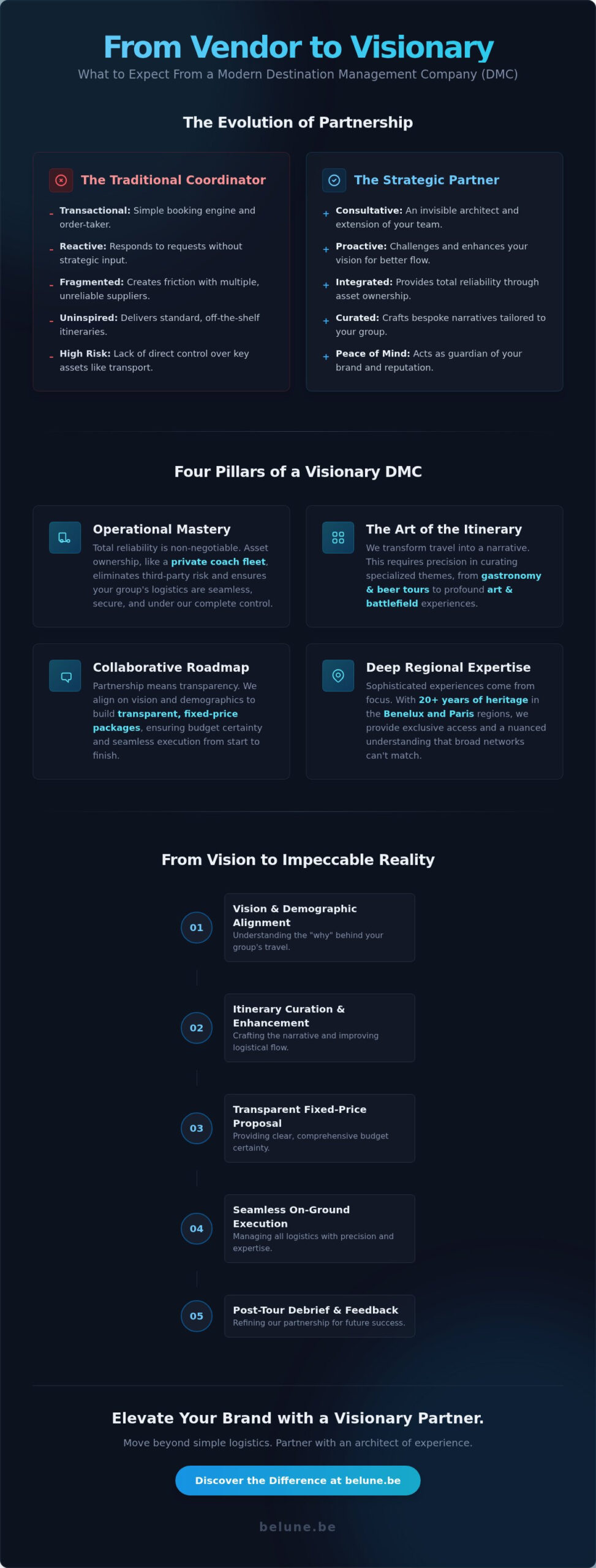
    The modern Destination Management Company has outgrown the role of a mere booking engine. It’s a structural extension of your own brand; a strategic ally that mirrors your standards and artistic intent. When considering what to expect from your dmc partner, look beyond simple logistics. You’re seeking a team that treats your group’s journey as a canvas, where technical precision meets a deep understanding of human emotion. This transformation is about moving from simple coordination to a visionary architecture of travel.

    This evolution marks a shift from transaction to consultation. It’s no longer enough to just secure rooms or coaches. A sophisticated partner elevates “travel” into a “curated experience” through a blend of technical and artistic mastery. By aligning their local expertise with your creative vision, they mitigate operational risk while maximizing the emotional resonance of every moment spent in the destination. They aren’t just suppliers. They’re guardians of your reputation.

    To better understand this concept of strategic partnership, watch this helpful video:

    Beyond the Booking: The Consultant Mindset

    A true partner doesn’t just say “yes.” They challenge your itinerary. They improve flow. They seek the “why” behind your group’s travel. Whether you’re planning a deep dive into Art & Culture or a high-energy sport event tour like F1 Francorchamps, the mindset remains the same. In the Benelux region, we move from “what is available” to “what is possible.” This proactive approach ensures your program isn’t just another standard tour. It becomes a bespoke narrative tailored specifically to your audience’s expectations.

    The Value of 20+ Years of Industry Heritage

    Deep-rooted local relationships are the foundation of exclusive access. Two decades of history in the Benelux and Paris sectors translate into benefits you can’t buy on the open market. This heritage provides an “unbuyable” advantage: a nuanced understanding of local regulations, seasonal shifts, and the subtle rhythms of a city. Experience is the best insurance policy against logistical friction. Whether it’s managing a complex river cruise excursion or coordinating a fleet of private coaches, this background ensures that every technical detail is handled with a rigour that inspires absolute confidence.

    The Invisible Architecture of Local Expertise

    True expertise is often felt rather than seen. It’s the silent machinery that ensures a group of fifty moves with the grace of a single traveler. This is the invisible architecture of destination management. Understanding what to expect from your dmc partner involves looking at the technical foundations they build long before the first guest arrives. It’s about a meticulous selection process that aligns every hotel, every guide, and every meal with your specific brand standards. This rigour transforms a simple trip into a cohesive, high-end narrative.

    The human element remains the most vital component of this structure. Managing a diverse group requires more than just a schedule; it requires multilingual experts who act as the bridge between a culture and a visitor. We select local guides who possess both historical depth and the emotional intelligence to read a group’s energy. Adhering to industry best practices ensures that every touchpoint meets rigorous safety and service benchmarks, protecting both your guests and your reputation.

    Sophisticated Accommodation Management

    Group travel requires a specific logistical lens. It’s not just about aesthetics; it’s about the capacity to handle arrivals, breakfast flow, and baggage handling without friction. We focus on sourcing hotels that prioritize these operational nuances while maintaining an inspiring atmosphere. By negotiating fixed-price packages, we provide the budget certainty that tour operators require to remain competitive. For a deeper look at these selection criteria, consult The Definitive Guide to Choosing a Benelux Incoming Tour Operator in 2026.

    Curating the Narrative: Themed Itineraries

    When evaluating what to expect from your dmc partner, the depth of their themed curation is a primary indicator of their strategic value. Itineraries must tell a story. Battlefield tourism, for example, demands a rare combination of historical rigour and respectful, seamless logistics. It requires a partner who understands the weight of the locations and can navigate them with grace. Similarly, gastronomy and beer experience tours must move beyond common tourist traps to find authentic sensory experiences.

    We seek out the “unbuyable” moments, from private cellar tastings to exclusive gallery access. This commitment to authenticity ensures your guests don’t just see a destination; they feel its soul. You can explore these concepts further in The Ultimate Guide to Culture Group Tours in Benelux for 2026. If you are ready to begin designing your next program, our team is here to transform your vision into a structural reality.

    What to Expect from Your DMC Partner: A Masterclass in Strategic Collaboration

    Why Operational Control is the Ultimate Reliability Metric

    Reliability is the silent pulse of a successful group tour. While creative vision defines the experience, technical rigour sustains it. When defining what to expect from your dmc partner, the conversation must eventually turn to the physical assets that move your guests. There is a fundamental difference between a partner who manages a network of subcontractors and one who maintains direct operational control over their fleet. This distinction isn’t just about logistics; it’s about the integrity of your brand’s promise.

    Control is not a luxury. It’s the foundational layer upon which every other aspect of the tour rests. It ensures that the transition from a historic city center to a rural landscape is as fluid as the narrative itself. By owning the means of transport, a DMC eliminates the “middleman” friction that often plagues complex itineraries. This direct line of command between the office and the driver allows for a level of choreography that third-party brokers simply cannot replicate. Vehicle quality reflects directly on you, the tour operator. A modern, meticulously maintained coach is a mobile sanctuary that reinforces the high-end nature of the journey.

    The Risks of Subcontracted Logistics

    Subcontracting introduces variables that are difficult to mitigate. When a partner relies on third-party suppliers, they surrender control over driver professionalism and vehicle maintenance standards. This fragmentation creates a vulnerability in the “seamless” experience. You run the risk of last-minute cancellations or “double-booking” by suppliers who don’t share your strategic priorities. Such logistical gaps don’t just cause delays; they dilute the emotional resonance of the tour and place unnecessary stress on your staff. Reliability shouldn’t be left to chance or a third-party contract.

    The BELUNE Advantage: Our Own Fleet

    Total accountability is the hallmark of a sophisticated partnership. By operating our own fleet, we ensure that every touchpoint meets our rigorous internal standards. This includes everything from the surgical cleanliness of the coach to the specific expertise of the driver. Our drivers aren’t just operators; they’re essential components of the service delivery team. They understand the nuances of the Benelux and Paris regions, providing a level of agility that allows for real-time itinerary shifts without logistical headaches. You can explore the technical specifications of our vehicles in our guide to Our Modern Coach Fleet for Benelux & Paris Tours. This ownership allows us to act with a speed and precision that protects your vision and ensures total peace of mind for your groups.

    The Collaborative Roadmap: From Vision to Post-Tour Debrief

    Strategic collaboration is a linear progression from abstract vision to concrete reality. It begins with a deep alignment on creative intent, audience demographics, and budget constraints. When determining what to expect from your dmc partner, look for a process that treats your goals as the primary architectural blueprint. We don’t just book services; we design a flow that respects the rhythm of your group’s expectations. This initial kick-off is vital. It’s the moment where technical constraints meet artistic ambition.

    The proposal stage is where this vision takes structural form. We present transparent, fixed-price group tour packages that eliminate the ambiguity often found in complex logistics. During execution, our role is to remain the “invisible hand.” We ensure total flow, allowing you to focus on your clients while we manage the technical pulse of the journey behind the scenes. Our presence is felt through the absence of friction. Once the tour concludes, the collaboration continues. Post-program reporting provides the intelligence needed to optimize future tours, turning every journey into a case study for excellence and refinement.

    Transparent Pricing and Budget Integrity

    Financial clarity is a hallmark of professional expertise. We eliminate the anxiety of “hidden costs” through comprehensive fixed-price structures that cover every detail of the itinerary. This approach provides the budget certainty tour operators require to remain competitive in a shifting market. Professional service fees are a strategic investment. They pay for themselves through operational efficiency and the significant reduction of financial risk. By consolidating costs into a single, transparent package, we allow you to focus on the value of the experience rather than the minutiae of the invoice. You can learn more about our methodology in our guide on How We Create Your Perfect Fixed-Price Group Package.

    24/7 Support and Problem Solving

    Peace of mind is the ultimate luxury. It comes from knowing a local expert is available for real-time crisis management at any hour. Whether it’s a sudden flight delay or a train cancellation, our team handles the unexpected with a composure that protects the guest experience from disruption. Proactive communication is essential throughout the tour lifecycle. We keep you informed, anticipating challenges before they manifest as logistical hurdles. This level of support is a core part of what to expect from your dmc partner when you choose a collaborator committed to your brand’s integrity. We serve as your eyes and ears on the ground, ensuring that the promise you made to your clients is kept. If you’re ready to build your next roadmap, contact our strategic team to begin the journey.

    Elevating Your Brand with BELUNE: The Visionary Choice

    Excellence is never accidental. It’s the byproduct of a rigorous technical foundation and an unwavering commitment to the artistic vision of our partners. Defining what to expect from your dmc partner means finding a collaborator who understands that logistics are merely the skeleton of a much larger, more emotional story. At BELUNE, we fuse twenty years of transport heritage with a sophisticated eye for tour curation. This unique combination allows us to move beyond the role of a supplier; we become the structural guardian of your brand’s reputation in Europe.

    We choose depth over breadth. Our specialization is intentionally concentrated on the Benelux and Paris regions. By avoiding wide, shallow networks, we maintain an intimate knowledge of every cobblestone, every local regulation, and every exclusive gallery. This focus ensures that your groups don’t just visit a destination. They experience it through a lens of absolute authenticity and technical perfection. We transform the standard group program into a lasting memory by treating every detail as a component of a structural masterpiece.

    A Tailor-Made Approach to Every Partner

    Every tour operator possesses a unique aesthetic and a specific audience demographic. We don’t believe in templated solutions. Instead, we treat every collaboration as a unique project with its own distinct requirements. Our approach is one of minimalist elegance; we remove the noise of complex logistical problems so that the beauty of the journey can shine through. This begins with an active listening process where your goals become our primary directive. We invite you to experience the “BELUNE difference” by allowing us to apply our artisanal rigour to your next project.

    The Next Step in Your Professional Journey

    The benefits of a sophisticated partnership are clear. You gain total operational control through our private coach fleet, unparalleled creativity through our themed itineraries, and the serenity that comes from absolute reliability. We provide the technical mastery so you can provide the vision. This is the ultimate standard of what to expect from your dmc partner: a relationship built on mutual excellence and shared success. Whether you’re coordinating an Art & Culture tour or a complex river cruise excursion, our team is ready to elevate your offering.

    If you’re a tour operator or travel agent seeking a partner who values precision as much as poetry, the next step is a conversation. Let’s discuss how we can transform your logistical challenges into a seamless extension of your brand. Connect with our visionary team today to begin co-creating your next high-end travel experience. As we often say, “The art of travel management is the transformation of space and time into a structural masterpiece of human emotion.”

    Designing the Future of Your Group Travel Programs

    Strategic collaboration is the bridge between a logistical plan and a lasting memory. We’ve explored how a sophisticated DMC partnership moves beyond simple bookings to become a structural extension of your brand. By prioritizing operational control through a private fleet of modern coaches and ensuring budget integrity with fixed-price group tour management, you secure more than just transport. You secure the emotional resonance of the entire journey. Precision is our language. Reliability is our promise.

    This masterclass has redefined what to expect from your dmc partner as a fusion of technical mastery and creative depth. With over 20 years of specialized industry experience, we understand that every cobblestone in Benelux or Paris tells a story. Our team is ready to transform your next vision into a seamless reality that reflects your own commitment to excellence. Let’s move beyond the ordinary and co-create a narrative that stays with your guests forever.

    The path to high-end travel experiences begins with a single strategic choice. Partner with BELUNE: Request Your Custom Benelux Itinerary and experience the serenity of a truly visionary alliance.

    Frequently Asked Questions

    What is the primary role of a DMC partner for tour operators?

    A DMC partner acts as a structural extension of your brand, providing local expertise and logistical mastery. They translate your creative vision into a tangible reality on the ground by managing complex components like hotel accommodation and themed itineraries. This role moves beyond simple coordination to become a strategic ally that protects your reputation through technical and artistic rigour.

    How does working with a DMC reduce the overall cost of a group tour?

    Efficiency and risk reduction are the primary drivers of cost savings in a professional partnership. By leveraging deep-rooted local relationships and fixed-price group tour packages, a DMC provides budget certainty and eliminates hidden costs. These professional efficiencies pay for themselves by mitigating the expensive logistical friction often found in fragmented supplier communication.

    Can a DMC manage international travel like flights and trains?

    Yes, we manage international flight and train bookings to ensure seamless group connectivity across borders. This technical capability allows for a unified travel narrative from the moment your group departs until their final return. By handling these structural elements, we ensure that the transition between international transit and local transport remains fluid and stress-free.

    What is the difference between an incoming tour operator and a DMC?

    While an incoming tour operator often focuses on volume and transaction-based bookings, a DMC provides a higher level of strategic consultation. A DMC acts as a visionary advisor, curating the “why” behind the journey rather than just the “what.” This distinction is central to what to expect from your dmc partner: a shift from simple logistics to value-based collaboration.

    How does a DMC ensure the quality of local guides and drivers?

    Quality is maintained through direct operational control and rigorous vetting. By operating our own fleet of modern coaches, we ensure driver professionalism and vehicle maintenance meet our high-end standards. Local guides are selected for their technical depth, multilingual expertise, and ability to read a group’s energy, ensuring every touchpoint reflects your brand’s excellence.

    What regions does BELUNE specialize in for group travel?

    BELUNE specializes exclusively in the Benelux region and Paris. We choose deep focus over wide, shallow networks to maintain an intimate knowledge of every local regulation and exclusive venue. This regional specialization ensures that your groups experience the most authentic local gems through a lens of absolute technical and artistic perfection.

    How far in advance should I engage a DMC for a custom itinerary?

    Engaging a partner early in the design phase is essential for a truly bespoke program. While timelines vary based on group size and complexity, starting the collaborative roadmap several months in advance allows for the most meticulous planning. This lead time is a key part of what to expect from your dmc partner when seeking exclusive access to high-demand local experiences.

  • Cost Analysis of DMC vs Direct Booking: A Strategic Guide for 2026

    Cost Analysis of DMC vs Direct Booking: A Strategic Guide for 2026

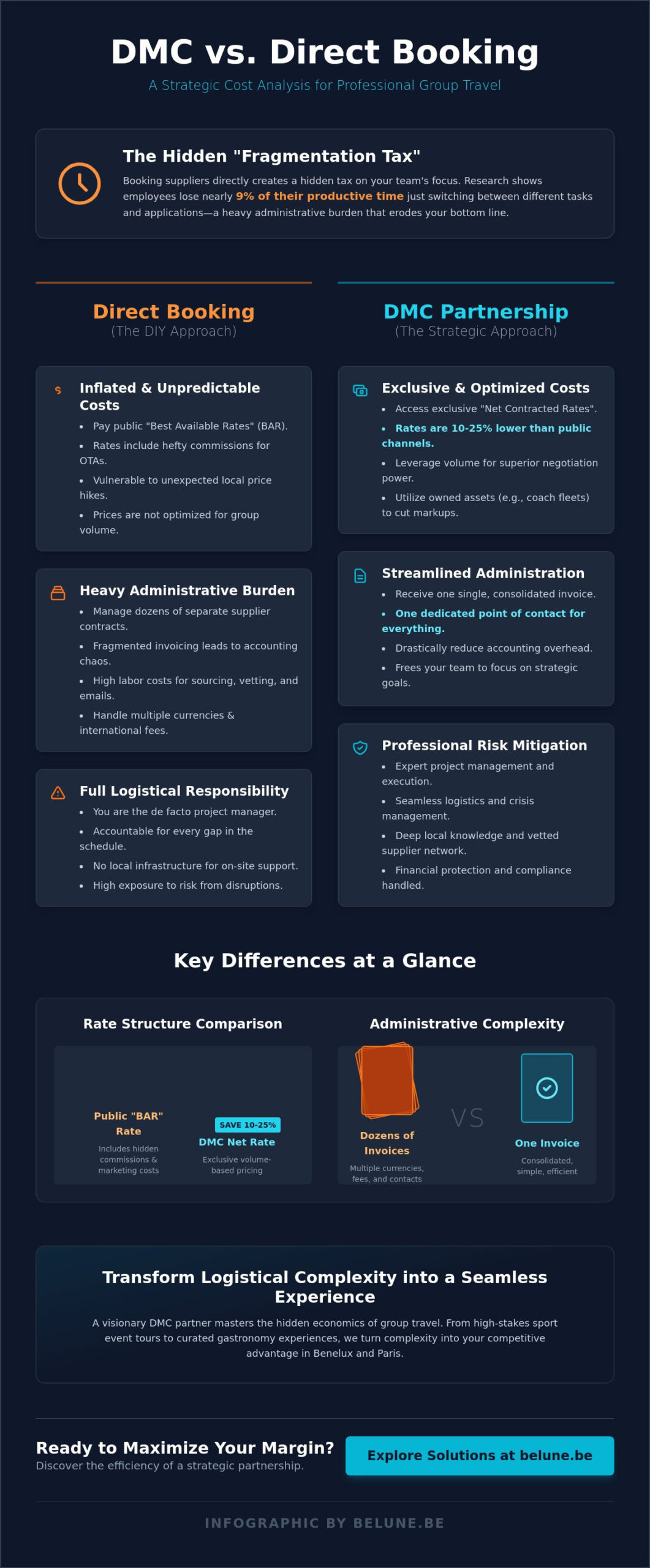
    What if the apparent savings of booking suppliers directly are actually a hidden tax on your team’s focus and your company’s bottom line? While a surface-level cost analysis of dmc vs direct booking might favor the DIY approach, the logistical reality of 2026 demands a deeper look at the numbers. You’ve likely felt the exhaustion of managing fragmented invoicing across multiple suppliers or the stress of unexpected local price hikes. It’s a heavy administrative burden that often leads to what researchers call a “fragmentation tax,” where employees lose nearly 9% of their productive time just switching between different tasks and applications.

    We understand that excellence in travel isn’t just about the destination; it’s about the precision of the execution. This guide explores how a strategic DMC partnership transforms logistical costs into competitive margins by leveraging owned assets like coach fleets and exclusive net rates. You’ll discover a clear framework to justify professional fees to stakeholders while reducing your administrative overhead. From high-stakes sport event tours to curated gastronomy experiences, we’ll show you how to master the hidden economics of group travel through a lens of technical expertise and creative vision.

    Key Takeaways

    • Identify the “fragmentation tax” inherent in multi-supplier management and how it silently erodes your team’s operational focus and productivity.
    • Explore how bundled negotiation and regional volume leverage unlock exclusive net rates and superior margins often hidden from public channels.
    • Master a strategic cost analysis of dmc vs direct booking to account for the real-world expenses of risk mitigation and logistical disruptions.
    • Evaluate the financial efficiency of utilizing owned infrastructure, such as a private fleet of modern coaches, to eliminate unnecessary third-party markups.
    • Discover how a visionary partnership in Benelux and Paris transforms logistical complexity into a seamless, high-end experience for your stakeholders.

    The Illusion of Direct Savings: Defining the Cost of Fragmentation

    Direct booking in a professional group travel context refers to the practice of sourcing, contracting, and managing every service provider individually. It feels like control. It looks like savings. However, when we perform a rigorous cost analysis of dmc vs direct booking, we often find that this approach introduces a “Fragmentation Tax.” This hidden cost represents the cumulative loss of efficiency when managing dozens of separate suppliers across different time zones and legal jurisdictions. While a single hotel room might appear cheaper on a public platform, the transactional nature of that purchase ignores the strategic value of a cohesive itinerary. Total profitability isn’t found in the lowest unit price; it’s found in the synthesis of the whole.

    To better understand these fundamental financial trade-offs, this perspective on managerial accounting offers a helpful foundation:

    The gap between a simple transaction and a strategic partnership is where margins are either won or lost. Relying on public booking engines often means paying for a supplier’s marketing and commission costs rather than the core service. In contrast, a strategic approach looks beyond the individual line item to consider the risk-adjusted cost of the entire project. When you book directly, you’re responsible for every gap in the schedule and every logistical friction point. You aren’t just the client; you’re the de facto project manager, often without the local infrastructure to succeed.

    The Administrative Burden: A Labor Cost Analysis

    The true price of direct coordination is often buried in labor costs. Sourcing a reliable hotel, vetting local guides, and arranging coach hire requires hundreds of hours of focused effort. According to a Harvard Business Review study, employees lose an average of 9% of their working time simply by refocusing after switching between different applications and tasks. This “context switching” is the engine of the fragmentation tax. Every new supplier adds a layer of complexity to your accounting department. You’re paying for international bank fees and the risk of managing multiple currencies. By consolidating these needs through a Destination Management Company (DMC), organizations can significantly reduce their accounting overhead. One invoice replaces fifty. One point of contact replaces a chaotic email chain.

    Direct Rates vs. Net Contracted Rates

    Public “Best Available Rates” (BAR) are designed for the individual traveler, not the strategic partner. These rates are rarely the lowest possible cost because they include heavy commissions for Online Travel Agencies. DMCs operate within a different ecosystem, accessing “Net Rates” that are strictly unavailable to the general public. These pricing tiers are built on long-term relationships and guaranteed volume. Leveraging the expertise of a benelux incoming tour operator ensures that you aren’t just getting a discount; you’re accessing a price structure designed for professional margins. A thorough cost analysis of dmc vs direct booking reveals that the professional management fee is frequently offset by the sheer depth of these exclusive contracted rates, which can be 10 to 25% lower than public offerings.

    The Hidden Economics of DMC Partnerships

    A partnership with a Destination Management Company operates on a scale that direct booking simply cannot match. It’s a purchasing consortium built on years of regional presence and trust. When we examine The Hidden Economics of DMC Partnerships, we see that volume leverage is the cornerstone of profitability. DMCs don’t just book rooms; they command entire blocks across regional hotel chains. This collective buying power allows for “Bundled Negotiation.” By integrating hotel accommodation management with our own fleet of modern coaches and curated dining, we secure discounts that are structurally impossible for a single-service direct booking.

    This synergy is vital for a comprehensive cost analysis of dmc vs direct booking. Many stakeholders fear the management fee, yet this cost is frequently neutralized by the “Relationship Dividend.” Local vendors provide preferential terms, such as waived minimums or flexible attrition clauses, to partners they see every week. In many cases, the net rates secured by a DMC are 10% to 25% lower than public prices. This margin doesn’t just cover the DMC fee; it often results in a lower total project cost than a fragmented DIY approach.

    Accessing Exclusive Inventory

    High-demand periods like the F1 at Spa-Francorchamps or major festival tours create a scarcity that public engines can’t solve. DMCs maintain year-round allotments, ensuring your group has a place even when the city appears sold out. Having a dedicated group travel agency manage these local allotments prevents the panic of last-minute venue changes, which can cost upwards of €10,000 in a single day. It’s about securing the impossible through foresight and established infrastructure.

    The Value of Local Intelligence

    True cost control lies in the details that don’t appear on a website. Local intelligence identifies hidden expenses like specific city taxes, permit fees for historic centers, or coach parking surcharges before they hit your budget. We vet every gastronomy experience and beer tour personally. This rigorous quality control prevents the costly refund requests that follow a subpar meal or a logistical delay. Professional local guide services act as the guardians of your timeline, preventing itinerary drift that would otherwise trigger expensive overtime transport costs. If you’re looking to elevate your next project in the Benelux region, consider how a strategic partnership can redefine your margins.

    Cost Analysis of DMC vs Direct Booking: A Strategic Guide for 2026

    Direct Booking vs. DMC: A Risk-Adjusted Cost Comparison

    A standard 5-day group tour looks deceptively simple on a spreadsheet. Direct booking promises transparency and the elimination of middleman fees. However, a professional cost analysis of dmc vs direct booking must look beyond the initial quote to account for the “Cost of Risk.” A static budget doesn’t feel the weight of a sudden rail strike or a localized weather event. Without a regional partner, these disruptions aren’t just inconveniences; they’re financial hemorrhages. When you book direct, you’re not just buying a service; you’re assuming the full liability of every link in the logistical chain.

    The hospitality industry frequently analyzes The Illusion of Direct Savings, observing that seemingly cheaper channels often carry hidden operational burdens that double the actual expense. For a tour operator, these burdens include higher liability insurance premiums and the absence of a regional safety net. Our 20 years of experience in the Benelux and Paris regions provides a fiscal security that individual contracts cannot replicate. We transform potential crises into managed transitions, protecting your margins from the volatility of foreign jurisdictions.

    Quantifying the Cost of Crisis

    Disruptions are expensive. Imagine the financial impact of re-booking a 40-person group at 10 PM during a peak festival season without local support. You’re at the mercy of public rack rates and immediate payment demands. A DMC’s 24/7 on-the-ground presence acts as a logistical insurance policy. We hold significant “refund leverage” over local suppliers. While an individual agent might struggle to recover costs from a cancelled venue or a delayed service, a partner managing high-volume annual contracts can negotiate credits or immediate alternatives. This leverage ensures that a single weather-related venue change, which can cost upwards of €10,000, doesn’t derail your entire project’s profitability.

    The Efficiency of Curated Logistics

    Precision is the silent driver of profitability. DIY itineraries often suffer from “logistical drift”—inefficient routing that leads to increased fuel surcharges and unnecessary driver hours. By utilizing our own fleet of modern coaches, we eliminate third-party markups and optimize every kilometer with technical rigor. This level of mastery is essential for sophisticated culture group tours benelux. We replace the guesswork of a DIY plan with the precision of a professional itinerary. Every gastronomy stop or battlefield visit is timed to avoid the expensive overtime costs that plague less rigorous plans. It’s an artisanal approach to logistics where every minute saved is a direct contribution to your bottom line.

    The Mastery of Logistics: How Owned Assets Reduce Overhead

    Direct booking often masks a series of hidden intermediaries. When you source transport through a generic portal, you aren’t just paying for the driver and the fuel. You’re paying for the broker’s commission and the portal’s service fee. Our cost analysis of dmc vs direct booking reveals that owning a fleet of modern coaches fundamentally shifts the financial equation. By eliminating third-party markups, we provide a direct line to the asset. This internal logistics management allows for more competitive per-kilometer rates and a level of quality control that outsourced services cannot match. It’s the difference between hoping for a reliable vehicle and knowing the exact maintenance history of the coach meeting your group at the airport.

    Quality control is a silent contributor to your bottom line. Outsourced transport often suffers from “service drift,” where the vehicle provided doesn’t match the premium expectations of your stakeholders. By maintaining our own fleet, we reduce the risk of downtime and mechanical delays. Reliable, professionally trained drivers who understand the nuances of group dynamics are part of the core infrastructure. This artisanal approach to transport ensures that the logistical frame of your journey is as refined as the destination itself. It’s an investment in certainty that pays dividends in guest satisfaction and operational peace of mind.

    The Economics of Private Coach Hire

    The distinction between “dry hire” and “full-service logistics” is where many budgets fail. A simple coach rental doesn’t account for the complex permit requirements of historic European centers or the fluctuating costs of regional tolls. Our in-house fleet offers a level of agility that external suppliers simply don’t have. If a group needs a last-minute itinerary adjustment, there’s no frantic negotiation with a third-party dispatcher. We own the schedule. This structural advantage allows us to offer “fixed-price” guarantees, shielding your project from the volatility of fuel market fluctuations. It’s a level of financial predictability that direct booking through brokers can’t provide.

    Integrated Management of Accommodation and Transport

    True efficiency emerges when hotel accommodation and transport management exist under one roof. In a fragmented booking model, the driver’s lodging is often an afterthought that leads to unexpected surcharges. We handle “driver-room” logistics within our own framework, ensuring these costs are optimized rather than inflated. Intelligent fleet scheduling also reduces “empty leg” costs, which are the expensive kilometers driven without passengers. By coordinating arrivals and departures across multiple groups, we maximize the utility of every vehicle. This integrated approach ensures your resources are spent on the experience, not the overhead. Explore how our owned fleet of modern coaches can redefine the margins of your next group project.

    Strategic Selection: Maximizing Margin with BELUNE

    Choosing a partner for the upcoming season is a move from transactional logistics to transformational planning. A final cost analysis of dmc vs direct booking reveals that the most valuable asset isn’t just a discounted room; it’s the absolute certainty of execution. BELUNE stands as a visionary ally for high-end group travel across the Benelux region and Paris. Our 20-year legacy acts as a guarantee of both fiscal and operational excellence. We don’t just provide services. We craft environments where your margins are protected and your clients’ imaginations are stimulated through technical mastery and artistic vision.

    The total value proposition of a strategic DMC partnership is found in the synthesis of lower risk and higher margins. By consolidating hotel accommodation management, our own fleet of modern coaches, and local guide services, we eliminate the friction that erodes profitability. You aren’t just avoiding the fragmentation tax; you’re gaining access to a level of regional leverage that direct booking simply can’t offer. It’s a shift from being a coordinator to being a creator of exceptional experiences.

    Tailor-Made Itineraries as a Revenue Driver

    High-margin travel products require more than just standard bookings. They require exclusivity and depth. By focusing on themed group travel, we help tour operators build “un-copyable” itineraries that command higher retail pricing. Whether it’s our deep-rooted battlefield expertise or curated gastronomy and beer tours, these artisanal details create a “peace of mind” dividend for your final client. When a product is unique and expertly executed, price sensitivity diminishes. You’re no longer competing on the lowest unit cost; you’re selling a masterpiece of coordination that competitors cannot replicate through public booking platforms.

    Partnering for 2026: The Path to Seamless Execution

    Our approach is built on a foundation of sophisticated minimalism. We eliminate the administrative noise of fragmented coordination to provide clear, professional partner support. The process of moving from an initial request to a fixed-price group package is designed to be fluid and transparent. This clarity allows your team to focus on sales and growth while we manage the technical rigor of the ground operation in foreign jurisdictions. We’ve spent two decades refining this balance of artistic sensitivity and logistical precision. It’s time to redefine your strategy. Request your custom Benelux cost analysis and itinerary to see how we transform logistical complexity into superior execution.

    Elevating Your Logistical Strategy for 2026

    The path to a profitable 2026 season lies in moving beyond the illusion of direct savings. We’ve explored how the fragmentation tax erodes focus and how a strategic partnership transforms logistical complexity into a competitive edge. A rigorous cost analysis of dmc vs direct booking proves that true value is found in the synthesis of services. By utilizing owned infrastructure and regional leverage, organizations can eliminate the hidden markups often found in middleman brokers and public platforms.

    With over 20 years of specialized Benelux expertise, our team offers more than just coordination. Our private fleet of modern, eco-friendly coaches and fixed-price guarantees for complex group itineraries provide the fiscal stability your stakeholders demand. We invite you to transition from transactional sourcing to an artisanal approach where every detail is a component of a larger masterpiece. Precision in logistics is the foundation of an unforgettable experience.

    Ready to secure your margins and elevate your guest experience? Partner with BELUNE for your 2026 Benelux Group Tours and discover the power of a visionary logistical ally. Let’s create something exceptional together.

    Frequently Asked Questions

    Is it always cheaper to book hotels directly for large groups?

    No, booking directly often results in paying public marketing commissions rather than the core service costs. A professional cost analysis of dmc vs direct booking shows that hotels prioritize high-volume partners with non-public net rates. Direct bookings lack the leverage to waive minimums or secure favorable attrition clauses. This often leads to higher total expenses when group sizes fluctuate or local taxes are applied unexpectedly at checkout.

    Can a DMC provide better rates than major B2B hotel portals?

    Yes, DMCs frequently outperform B2B portals by accessing “offline” inventory and direct hotel allotments. Major portals operate on standardized commissions that apply to every booking. We leverage long-standing regional trust to secure pricing tiers that aren’t shared with digital aggregators. This direct line to the hotel’s management ensures priority during peak seasons and access to rooms that portals mark as sold out.

    How do DMC service fees impact the final price for the traveler?

    Service fees are typically absorbed by the significant discounts secured through net contracting and bundled logistics. While a management fee exists, it’s rarely a simple addition to the public price. Instead, it represents a portion of the savings generated by professional negotiation. Travelers receive a more refined, lower-risk experience for a final price that remains competitive with fragmented, unmanaged itineraries.

    What are the hidden costs of managing group travel logistics in-house?

    The primary hidden costs are administrative labor and the financial risk of logistical gaps. In-house teams spend hundreds of hours sourcing, vetting, and managing separate invoices. This internal overhead, combined with international bank fees and currency exposure, often exceeds the cost of a professional fee. Without local infrastructure, your team also bears the full financial weight of resolving on-the-ground disruptions like strikes or delays.

    What happens to the cost if a group size changes last minute?

    DMCs minimize the financial impact of last-minute changes by utilizing established “relationship dividends” with local suppliers. While direct bookings often trigger rigid cancellation penalties, we negotiate flexible attrition clauses that allow for minor adjustments without extra charges. Our role is to act as a buffer between your project and the supplier’s standard terms, ensuring that shifting group dynamics don’t derail your entire budget.

    How does a DMC handle currency fluctuations in a long-term contract?

    We provide fixed-price guarantees that shield your budget from the volatility of international currency markets. By contracting services in the local currency and managing the exchange risk internally, we ensure that the price you agree upon remains stable throughout the project lifecycle. This financial predictability is a cornerstone of professional logistical planning, allowing you to market your tours with absolute confidence in your final margins.

    Is it worth using a DMC for a simple “coach and hotel” itinerary?

    Yes, because even simple itineraries benefit from the elimination of third-party markups on transport. By utilizing our own fleet of modern coaches, we provide a direct cost advantage that brokers cannot match. You aren’t just paying for a room and a bus; you’re paying for a synthesized plan that optimizes driver hours and fuel consumption. This technical precision ensures that even basic tours maintain high standards and healthy margins.

    How do DMCs secure better terms and conditions than individual bookers?

    Better terms are the result of high-volume annual contracts and decades of regional presence. Suppliers offer preferential conditions to partners who provide consistent, reliable business throughout the year. These terms include extended payment windows, reduced deposit requirements, and priority status during high-demand events. Individual bookers simply lack the historical data and local trust required to unlock these strategic advantages in a cost analysis of dmc vs direct booking.

  • When to Hire a DMC for Group Travel: A Strategic Guide for 2026

    When to Hire a DMC for Group Travel: A Strategic Guide for 2026

    With international tourist arrivals projected to surpass 1.55 billion for the first time in 2026, the margin for error in group logistics has effectively vanished. It’s no longer enough to simply book rooms and transport; the complexity of modern travel demands a more refined, architectural approach to planning. You’ve likely felt the mounting pressure of managing fragmented suppliers while fearing that local quality issues might compromise your vision. This is the precise moment to evaluate when to hire a dmc for group travel to shift from manual coordination to strategic local authority.

    We believe that a group journey should be a seamless masterpiece rather than a logistical puzzle. This guide identifies the critical triggers and logistical advantages that dictate when a Destination Management Company becomes an essential partner for your success. You’ll discover how leveraging professional hotel management, dedicated coach fleets, and exclusive cultural access can transform a standard itinerary into an extraordinary experience while protecting your most valuable asset: time. From battlefield tours to high-performance sport events, we detail the path to flawless execution.

    Key Takeaways

    • Identify the “Complexity Threshold” and the specific triggers, such as multi-location itineraries or niche themes like battlefield tourism, that require professional oversight.
    • Understand exactly when to hire a dmc for group travel to bridge the gap between international vision and flawless local execution.
    • Learn to evaluate partners based on their tangible assets, including private coach fleets and direct hotel management, rather than generic service claims.
    • Discover how a strategic partnership provides the technical mastery needed to navigate 2026’s evolving travel landscape and its complex logistical demands.

    What is a Destination Management Company in the 2026 Travel Landscape?

    A Destination Management Company (DMC) is a professional services firm possessing deep-rooted local expertise and a sophisticated understanding of regional logistics. In 2026, these entities serve as the vital bridge between your international vision and the intricate reality of local execution. To grasp the foundational role they play, one might ask, What is a Destination Management Company? Simply put, a DMC functions as the strategic architect of group experiences, meticulously designing every structural and emotional layer of a journey to ensure technical perfection. They manage the essential pillars of travel, including hotel accommodation management, coach hire, and local guide services. Beyond these basics, they curate specialized experiences such as Art & Culture group tours or Gastronomy & Beer tours, while securing exclusive cultural access that remains invisible to the general public.

    To visualize how this role is evolving, watch this analysis of the industry’s turning point:

    The Evolution of the Modern DMC

    The role has moved far beyond simple bookings. Today’s experts focus on curated, thematic storytelling that transforms a trip into a legacy. By leveraging vast local networks, a DMC can bypass common tourism bottlenecks, ensuring your group moves with fluidity through even the most crowded destinations. This level of control is often rooted in the DMC’s physical assets. When you consider when to hire a dmc for group travel, look for those who maintain their own fleet of buses. Owning the infrastructure, such as a private coach fleet, allows for a level of reliability and aesthetic consistency that outsourced services simply cannot match. It’s this commitment to technical mastery that defines the premium service landscape in 2026, where every detail from the coach’s interior to the guide’s specific historical expertise is carefully calibrated.

    DMC vs. Tour Operator: Understanding the Synergy

    Understanding the distinction between these partners is crucial for any travel professional. While a Tour Operator typically handles the sales and client-facing promotion, the DMC is the engine of execution on the ground. This partnership is vital for maintaining your brand reputation abroad. You need a partner who understands the local nuance as well as you understand your clients’ high expectations. Utilizing a specialized benelux incoming tour operator provides the regional depth required to navigate complex multi-country logistics with ease. Whether you’re planning battlefield tourism or coordinating travel for major sport events like F1 Francorchamps, deciding when to hire a dmc for group travel often comes down to the moment your project requires this specific technical mastery and local authority to succeed.

    The Strategic Value of Local Expertise and Logistics

    Online platforms often present a polished facade that rarely matches the physical reality of a destination. While a digital review can suggest quality, it lacks the technical rigor of a local expert who inspects every site personally. This is one of the primary reasons when to hire a dmc for group travel becomes a strategic necessity. A partner on the ground ensures that every hotel contract is group-friendly and every permit is secured, adhering to the highest industry standards for DMCs. It’s about moving beyond the superficial to achieve a level of technical precision that magnifies the traveler’s experience through authentic, verified quality.

    The true value of a DMC often lies in what remains invisible to the guest. Managing driver working hours, navigating local traffic regulations, and anticipating regional disruptions require a vigilant, technical eye. This “invisible” layer of logistics acts as a safety net, protecting the itinerary from the friction of unforeseen regulatory changes or local strikes. By transforming these potential hurdles into seamless transitions, we allow the group to remain immersed in the emotional narrative of their journey. It’s a mastery of space and time that only a local authority can provide, turning a standard trip into a work of logistical art.

    Asset-Based Logistics: The Power of Private Transport

    Reliability in group travel is frequently tied to ownership. When a DMC maintains its own fleet of buses, the quality of the journey is no longer left to chance or third-party availability. Professional drivers serve as the first line of local hospitality, blending technical road mastery with a welcoming, expert presence. In 2026, look for modern transportation featuring Euro 7 emission standards and integrated digital connectivity, ensuring that the transition between locations is as refined as the destination itself. This physical infrastructure allows for total control over the guest experience, from the cleanliness of the vehicle to the punctuality of every arrival. It’s this level of commitment that defines our role as an expert strategic ally for your European projects.

    Curating Niche Narratives

    Deeply thematic journeys require more than just a schedule; they require a narrative. Managing complex themes like flanders fields or regional gastronomy demands a blend of historical storytelling and logistical planning. We secure access to private sites and curate gastronomy tours that reveal the artisanal soul of a region. This might involve a private beer experience in a historic cellar or a cycling tour through hidden landscapes. Deciding when to hire a dmc for group travel is often about identifying the moment your itinerary requires these exclusive doors to be opened. We blend technical logistical planning with emotional, historical storytelling to create an experience that resonates long after the journey ends.

    When to Hire a DMC for Group Travel: A Strategic Guide for 2026

    When to Hire a DMC: 5 Signs Your Group Trip Needs an Expert Ally

    Identifying the precise moment a project requires professional intervention is an art in itself. While small, static groups might manage with basic bookings, the transition to a more complex narrative often reveals the need for a local strategic ally. Knowing when to hire a dmc for group travel allows you to reclaim your time and mitigate the risks associated with logistical fragmentation. We’ve identified five critical triggers that signal the necessity of a professional partnership.

    • The Complexity Threshold: If your itinerary involves more than three distinct locations, the logistical layers multiply exponentially.
    • Specialized Themes: Projects requiring deep historical or technical expertise, such as battlefield tourism, demand more than just a schedule.
    • High-Stakes Logistics: Managing synchronized coach movements and complex hotel blocks requires a central, local authority.
    • Cultural Barriers: Accessing exclusive venues often depends on local negotiation and established regional relationships.
    • Group Scale: Any group exceeding 15 to 20 participants requires dedicated on-site management to preserve the integrity of the experience.

    Trigger 1: Multi-Region Logistical Coordination

    Europe’s geography offers unparalleled beauty, yet it presents significant logistical hurdles when crossing national borders. Synchronizing transport across different jurisdictions requires a deep understanding of regional regulations and infrastructure. A DMC manages the technicalities of “dead miles” and strict driver rest periods, ensuring the schedule remains undisturbed by administrative friction. By acting as a single point of contact, a DMC streamlines multi-city hotel management through centralized communication and total accountability, allowing you to focus on the broader vision of the journey.

    Trigger 2: The Need for Vetted, High-Quality Suppliers

    In a landscape saturated with unreliable online reviews, professional vetting is the only way to guarantee a high-end experience. We move beyond public platforms to verify every supplier through rigorous, first-hand inspection. This technical mastery ensures that every partner, from local guides to gastronomy experts, aligns with the sophisticated tone of your brand. Deciding when to hire a dmc for group travel often coincides with the need for pre-negotiated group rates and “favored nation” status with hotels. This status provides not only financial advantages but also a level of security and priority that individual planners simply cannot access. It’s a commitment to artisan quality that transforms a standard trip into a seamless masterpiece.

    How to Evaluate and Choose the Right DMC Partner

    Selecting a partner is a decision that defines the structural integrity of your entire project. It’s not about finding a vendor; it’s about securing a strategic ally who shares your commitment to excellence. When you determine when to hire a dmc for group travel, your focus must shift to technical mastery and asset-based reliability. Look for a firm that prioritizes specialized expertise over generic, all-purpose services. A partner who manages their own fleet of coaches offers a level of accountability that outsourced providers simply can’t match. This physical infrastructure, combined with multi-lingual support and certified local guides, ensures your group experiences the destination through a lens of absolute professionalism. Whether you’re coordinating hotel accommodation management for a large delegation or planning specialized gastronomy tours, the partner’s direct control over these elements is the ultimate guarantee of quality.

    Pricing transparency remains a hallmark of a high-end DMC in 2026. Fixed-price packages protect your margins and eliminate the friction of “hidden” local costs that often plague less professional arrangements. This clarity is essential for maintaining trust and ensuring that the budget reflects the actual value delivered on the ground. You shouldn’t have to guess about the cost of international flight and train bookings or local excursions; a sophisticated partner provides a clear, technical breakdown that respects your financial objectives while magnifying the guest experience.

    The Importance of Creative Alignment

    A true partner understands the emotional arc of a journey. They don’t offer off-the-shelf tours; they curate experiences that resonate with your group’s specific identity. Evaluate their ability to customize itineraries, from battlefield tourism to high-performance sport events like F1 Francorchamps. This creative synergy is a key factor in choosing a group travel agency that acts as an extension of your own brand. They should be able to transform a simple visit into a narrative of art, culture, and technical precision.

    Logistical Due Diligence

    Technical rigor is non-negotiable. Verify safety standards for coach fleets and ensure local insurance coverage is comprehensive. During the RFP process, assess their responsiveness and communication style. A firm with over 20 years of local experience provides a trust signal that no new entrant can replicate. This longevity indicates a proven ability to navigate the complexities of European logistics with grace and precision. It reflects a deep-rooted local authority that can manage everything from river cruises to festival tours like Tomorrowland with flawless execution. Connect with a strategic ally who owns the fleet and the expertise to ensure your next group project is a seamless success.

    BELUNE: Your Visionary Strategic Ally for Western Europe

    BELUNE stands as a specialized Destination Management Company defined by over two decades of technical mastery. We don’t merely provide services; we act as a visionary strategic ally for those who demand excellence in every detail. Our commitment is to the transformation of space and time into a seamless group experience, where the logistical architecture remains invisible to the guest but felt in the fluidity of the journey. Deciding when to hire a dmc for group travel becomes an effortless choice when you require a partner who owns the infrastructure and the expertise. With our modern, private coach fleet and a network of certified local guides, we ensure that every transition across the Benelux region and Paris is executed with artisanal precision. We focus on high-quality itineraries that range from the somber depth of battlefield tourism to the vibrant pulse of cultural heritage tours.

    Our approach is rooted in a minimalist elegance that prioritizes the emotional impact of the travel experience. By managing the complex technical layers, such as international flight and train bookings or sophisticated hotel accommodation management, we allow the narrative of the trip to take center stage. We believe that a successful group journey is a work of art, requiring both a creative vision and a rigorous technical foundation to survive the complexities of the 2026 travel landscape.

    A Partnership Built on Professional Excellence

    We provide comprehensive support to tour operators and travel agents, offering tailor-made logistics that align with your brand’s specific tone. The BELUNE approach balances artistic vision with a relentless focus on technical execution. We don’t believe in generic solutions. Instead, we leverage our unparalleled regional depth in Western Europe to curate experiences that others cannot replicate. Whether you’re organizing a gastronomy and beer experience or coordinating a large group for a sport event like F1 Francorchamps, our local authority ensures that every door is opened and every detail is polished. Knowing when to hire a dmc for group travel is ultimately about recognizing when your project deserves this level of dedicated regional mastery.

    Ready to Elevate Your Group Experience?

    Initiating a partnership with us is a streamlined, professional process. Our experts work closely with you to understand your vision before crafting a custom itinerary request that meets your exact requirements. We remain committed to transparency through our fixed-price packages, ensuring that your margins are protected and our collaboration remains based on mutual trust. From river cruises with local excursions to the high-energy atmosphere of festival tours like Tomorrowland, we handle the complexity so you can deliver the extraordinary. Partner with BELUNE for your next group masterpiece and experience the difference of a strategic ally who values excellence as much as you do.

    Elevating the Group Narrative to a Masterpiece

    The transition from standard travel to a curated legacy requires a partner who views logistics as an art form. We’ve explored how multi-region coordination, high-stakes hotel blocks, and the need for vetted quality define the tipping point for professional intervention. Deciding when to hire a dmc for group travel is ultimately a strategic decision to protect your vision from the friction of fragmented suppliers. It’s about choosing an ally that provides both structural reliability and creative depth to every itinerary.

    BELUNE brings over 20 years of specialized experience to your European projects. With our private fleet of modern, high-comfort coaches and deep expertise in complex themes like Battlefield and Gastronomy tours, we transform logistical challenges into seamless narratives. We ensure that every cultural touchpoint and technical transition aligns with your high standards. Ready to transform your vision into a reality? Request Your Custom Benelux Group Itinerary from BELUNE and discover the power of technical mastery. Your next group masterpiece begins with a single, expert collaboration.

    Frequently Asked Questions

    What is the primary difference between a DMC and a travel agent?

    A travel agent typically focuses on the retail sale and broad itinerary concept for the client. A DMC acts as the local architect of that vision. They provide the physical infrastructure, like coach hire and local guide services, that ensures the journey is technically flawless on the ground. This on-site authority is what transforms a simple booking into a structured, professional experience.

    Is it more expensive to hire a DMC for group travel?

    Evaluating when to hire a dmc for group travel involves looking at total value rather than just initial cost. DMCs often protect your margins through pre-negotiated group rates and fixed-price packages. This approach avoids the hidden expenses and logistical friction that arise from managing fragmented local suppliers independently, making it a strategic investment in risk mitigation.

    How far in advance should I hire a DMC for a group tour?

    Securing a partner 6 to 12 months in advance is highly recommended for 2026. With international arrivals projected to surpass 1.55 billion, early booking ensures priority access to high-comfort coach fleets and premium hotel blocks. For high-demand periods involving major sport events or festivals, even earlier coordination is necessary to guarantee technical excellence and availability.

    Can a DMC help with niche travel like battlefield tourism or cycling tours?

    Specialized themes are a core strength of a high-end DMC. We curate niche narratives ranging from battlefield tourism in Flanders Fields to technical cycling tours and gastronomy experiences. This involves securing access to private sites and managing specialized equipment or expert guides that standard agencies cannot easily source. It’s about blending historical storytelling with rigorous logistical planning.

    Do DMCs manage hotel bookings for large groups?

    Professional hotel accommodation management is a central component of our service. We handle the technicalities of group-friendly contracts and room block logistics for large delegations. This ensures that the group remains together in locations that align with the sophisticated tone of the overall journey, while benefiting from the DMC’s “favored nation” status with local providers.

    What should I look for in a DMC’s transportation fleet?

    Look for a DMC that maintains its own private fleet of modern coaches rather than outsourcing everything. Ownership guarantees technical reliability and aesthetic consistency. In 2026, prioritize vehicles meeting the latest emission standards and those operated by professional drivers who understand the nuances of local hospitality and the technical requirements of group movements.

    How does a DMC handle on-the-ground emergencies for groups?

    Local presence allows for immediate, on-the-ground intervention during unforeseen disruptions. Whether it’s a regional transport strike or a sudden regulatory change, a DMC uses its local network to adjust the itinerary in real-time. This safety net preserves the emotional arc of the trip, ensuring that the group experience remains seamless even when external conditions shift unexpectedly.

    Why is local knowledge more important for groups than for individual travelers?

    Group logistics involve structural complexities, such as bus permits and driver rest regulations, that individual travelers don’t face. When managing 20 or more people, local authority is essential to navigate these technical layers with precision. Determining when to hire a dmc for group travel often comes down to the moment the scale of the group requires this level of specialized regional mastery.

  • How to Justify DMC Costs to Management: The Strategic ROI of Destination Management in 2026

    How to Justify DMC Costs to Management: The Strategic ROI of Destination Management in 2026

    Booking every element of your travel program direct isn’t a cost-saving strategy; it’s a high-stakes gamble with your company’s operational budget. While a spreadsheet might suggest that bypassing a partner saves a 20% service fee, the hidden costs of logistical friction and vendor mismanagement tell a far more expensive story. To successfully justify dmc costs to management, you must reframe the conversation. A professional partner isn’t a surcharge. They’re a strategic procurement tool that converts logistical risk into measurable operational savings.

    We recognize the pressure to defend every line item as hotel rates rise by 3.9% and European travel budgets face a 5.8% increase. It’s often difficult to quantify the value of local nuance or the security of a private coach fleet when the board focuses solely on the immediate price tag. This guide provides the financial data and risk-mitigation arguments you need to prove that destination management is a cost-saving asset rather than a luxury. You’ll learn how to build a business case centered on ROI, duty of care, and the technical precision required to execute a high-quality Benelux program that resonates with every stakeholder.

    Key Takeaways

    • Learn how to move beyond the “20% surcharge” myth by leveraging a DMC’s localized purchasing power to secure rates unavailable to the general public.
    • Master the specific financial and operational arguments needed to justify dmc costs to management by auditing the hidden drain of internal labor and logistical friction.
    • Protect your organization by understanding the legal nuances of Duty of Care and why relying on individual vendor policies creates a high-risk liability gap.
    • Identify the critical risk points in any travel itinerary using a professional framework that converts potential logistical failures into measurable savings.
    • Discover how direct asset ownership, such as a private coach fleet, eliminates middleman markups and ensures a seamless, high-quality execution for your Benelux programs.

    The Paradox of Choice: Why “DIY” Logistics Often Cost More

    The digital marketplace offers a seductive illusion of control. For a procurement manager, the ability to book a hotel or a coach in Amsterdam with a few clicks feels like a victory for the budget. However, this retail-first approach ignores the corporate logistical reality. When you need to justify dmc costs to management, the conversation must shift from “what we pay” to “what we lose” through fragmentation. Online prices are designed for the solitary traveler, not for the intricate harmony required by a corporate group program.

    A professional Destination Management Company acts as a strategic architect, bridging the gap between a simple booking and a flawlessly executed experience. In the Benelux market, this expertise is vital. Cross-border regulations, multi-lingual requirements, and local tax nuances create a landscape where a single error can derail an entire budget. We recognize that management requires absolute fiscal transparency, and that transparency begins with understanding the true cost of choice.

    To better understand how these costs translate into value, watch this helpful video:

    The Hidden Costs of Internal Planning

    Internal resources are expensive. When a junior planner spends 40 hours researching an itinerary, the company pays a high “learning curve tax.” This time isn’t spent on strategy; it’s spent on trial and error. First-time bookings in a new region often lead to costly mistakes, such as choosing hotels with poor coach access or overlooking local holidays. The administrative overhead is equally taxing. Processing 15 separate invoices from various vendors is a burden on the finance team. A consolidated statement from a partner provides the clarity management craves.

    Retail vs. Wholesale: The Procurement Advantage

    The “Best Available Rate” on a travel site is rarely the best value for a group of 40+. As a benelux incoming tour operator, we provide access to non-public inventory and group-only rates that aren’t visible to the public. These preferential terms are the result of decades of relationship building. They often offset the service fee entirely, turning the DMC into a procurement tool rather than an expense. Professional partners secure terms that protect the organization, ensuring that volume translates into value rather than just a higher bill.

    Quantifying the ROI: 5 Key Areas of DMC Value Creation

    To effectively justify dmc costs to management, we must translate abstract “local expertise” into concrete financial outcomes. Precision is the silent language of excellence. It isn’t enough to promise a smooth trip; we must demonstrate how a partnership creates a tangible return on investment. This value manifests through a blend of purchasing power, risk insulation, and the mastery of movement. When logistical friction is removed, the true purpose of the travel program can finally shine.

    A professional partner leverages deep rooted networks to secure volume discounts that are simply inaccessible to the public. This isn’t just about lower room rates. It’s about effective risk management that shields your organization from vendor insolvency or service failures. We vet every supplier with a rigour that protects your brand reputation, ensuring that every touchpoint reflects your company’s commitment to quality.

    Financial Protection and Contract Negotiation

    DMCs act as a sophisticated shield during the negotiation phase. We secure flexible attrition and cancellation clauses that allow for group size fluctuations without triggering punitive fees. In the Benelux region, navigating VAT and local tax compliance is a complex architectural task; a partner ensures you avoid the heavy fines associated with incorrect cross-border filings. Force Majeure protection in destination management ensures that your investment remains secure when extraordinary, unforeseeable events render the original itinerary impossible to execute. By managing these nuances, we transform a potential liability into a controlled variable.

    Logistical Precision and Time Savings

    The role of a group travel agency is to manage disruptions in real time before they reach the traveler. Expert routing and local knowledge don’t just provide comfort; they eliminate “dead time,” often saving 15-20% of on-the-road duration. Consider the cost of a missed high-speed train connection for a group of 50 compared to the cost of a DMC guide who anticipated the delay and adjusted the transfer. The difference is often measured in thousands of euros in rebooking fees and lost productivity. If you are looking to elevate your next project with this level of technical precision, our team is ready to assist.

    • Purchasing Power: Accessing non-public inventory through long-term local relationships.
    • Risk Mitigation: Comprehensive vetting of suppliers to prevent operational failure.
    • Operational Efficiency: Reducing internal labor costs by consolidating vendor management.
    • Quality Assurance: Maintaining brand standards through on-site supervision.
    • Financial Compliance: Expert handling of complex European tax and VAT regulations.

    How to Justify DMC Costs to Management: The Strategic ROI of Destination Management in 2026

    Addressing the CFO’s #1 Concern: Risk and Liability

    Financial oversight often focuses on the visible fee, yet the true cost of risk remains hidden until a crisis occurs. For a Chief Financial Officer, the primary concern isn’t just the 15% to 25% management fee; it’s the potential for uncapped liability. When you justify dmc costs to management, you’re presenting a strategy for risk insulation. Duty of Care isn’t a buzzword. It’s a legal obligation to ensure traveler safety, and in 2026, the complexity of this mandate has reached a new peak with the tightening of European safety and sustainability regulations.

    Relying on individual vendor policies is a high-risk gamble. While a standard one-day event insurance policy might only cost between $75 and $350, it rarely covers the logistical fallout of a vendor bankruptcy or a service failure in a foreign jurisdiction. A professional partner provides a unified layer of protection. We ensure every supplier meets rigorous international safety protocols, providing the 24/7 support that has become a standard expectation for corporate programs. This proactive stance is essential when building your business case for professional oversight.

    The Price of a Reputation Crisis

    Reputation is a fragile asset. A single poor hotel experience or a stranded group doesn’t just ruin a trip; it damages long-term client retention and brand authority. Local guides provide an invisible value by pivoting instantly during strikes or unexpected closures. This mastery of the “pivot” is why themed group travel benelux requires specialized oversight. We don’t just book tours; we safeguard the emotional and professional investment of every attendee. The cost of a DMC is a fraction of the cost of a public relations crisis or a lost corporate contract.

    Regulatory Compliance in Benelux

    The regulatory landscape in 2026 is unforgiving. Navigating the strict coach driver hour regulations in Europe is essential to avoid heavy fines that can reach thousands of euros. Furthermore, new documentation requirements under the Corporate Sustainability Reporting Directive (CSRD) mean that event planners must now provide detailed sustainability reporting. We manage these technicalities, from securing local permits for heritage sites to ensuring all data processing complies with the latest GDPR standards. Our team also monitors the increased scrutiny on worker classification, shielding your organization from the legal and financial penalties of misclassifying temporary event staff.

    • Duty of Care: Legal and moral fulfillment of traveler safety obligations.
    • Liability Gap: Closing the holes left by fragmented vendor insurance policies.
    • Emergency Response: Instant logistical support for stranded groups.
    • Regulatory Mastery: Compliance with EU driver hours and 2026 sustainability mandates.

    A Framework for Justification: Building Your Business Case

    Presenting a business case to leadership is an exercise in clarity. To effectively justify dmc costs to management, you must move beyond the emotional appeal of “better experiences” and focus on the cold reality of the balance sheet. Management doesn’t see the charm of a local guide; they see a line item that appears to increase the budget. Your role is to demonstrate how this investment actually contracts the total cost of ownership by eliminating waste and mitigating expensive operational risks.

    A successful justification follows a logical progression. It begins with a rigorous audit of “DIY” costs. This includes not just the retail price of hotels and transport, but the internal labor hours consumed by staff who lack local procurement networks. Once these baseline costs are established, you must identify the “Critical Risk Points” in your itinerary, such as tight transfers or complex group dining requirements. By requesting a transparent fee structure, whether a flat fee or a percentage, you can present a “Net Cost” where the DMC fee is offset by realized savings and the removal of the “learning curve tax” mentioned earlier.

    The final pillar of your case is “Opportunity Gain.” When your internal team is freed from the burden of chasing bus drivers or verifying rooming lists, they can focus on high-value tasks like sales and strategic growth. This shift in focus often generates more revenue than the DMC fee itself. If you’re ready to transform your logistics into a strategic advantage, request a tailored procurement analysis from our team.

    Comparative Analysis: DMC vs. Internal

    Creating a side-by-side spreadsheet is the most effective way to visualize value. Your analysis should include “Soft Costs” like the 40+ hours of research time typically required for a complex Benelux program. Highlighting “Value-Add” items, such as non-public museum access or private fleet priority, demonstrates what is lost when booking direct. To align with a CFO’s perspective, always present the “Management Fee” as a “Procurement Investment” designed to secure superior terms and ironclad contract protection. This simple reframing shifts the fee from an expense to a tool for financial optimization.

    Success Metrics for Management

    Leadership values what it can measure. Define clear Key Performance Indicators (KPIs) such as client satisfaction scores, logistical punctuality, and strict budget adherence. The ultimate “Zero-Disruption” goal ensures that management never hears about a problem because it was solved before it manifested. Utilizing testimonials from other corporate partners can provide the social proof needed to validate long-term ROI. When these metrics are met, the DMC partnership ceases to be a question of cost and becomes a cornerstone of operational excellence.

    • Audit DIY Costs: Factor in retail price variances and internal labor hours.
    • Risk Mapping: Quantify the financial impact of potential logistical failures.
    • Net Cost Calculation: Subtract realized savings from the management fee.
    • Opportunity Gain: Value the time returned to your core team for revenue-generating activities.

    The BELUNE Difference: Maximizing ROI Through Direct Assets

    True value isn’t found in a simple list of services. It resides in the mastery of the supply chain. When you seek to justify dmc costs to management, the most compelling argument is the elimination of unnecessary layers. Most agencies operate as mere brokers, stacking markups on top of third-party vendors. We approach destination management with the precision of an architect, controlling the essential elements of the experience through direct asset ownership. This vertical integration ensures that every euro spent contributes to the quality of the program rather than a middleman’s commission.

    Our philosophy centers on a seamless harmony between logistical rigour and sophisticated execution. By combining accommodation management, private transport, and expert guiding into a single, high-value package, we provide a clarity that fragmented bookings cannot match. This integrated approach allows your organization to maintain its high-end brand standards while benefiting from the institutional knowledge we’ve cultivated over 20 years. We don’t just prevent costly logistical errors; we sublimely execute your vision.

    Eliminating the Middleman in Transport

    The financial benefit of working with a partner that operates its own modern coach fleet is immediate and measurable. Direct fleet ownership removes the second-tier markup typically found in the industry, providing a significant procurement advantage. Beyond the balance sheet, this ownership grants us real-time flexibility. We can adjust routes or accommodate last-minute schedule shifts without waiting for third-party approval or incurring additional brokerage fees. This control ensures consistent quality and punctuality across the entire Benelux and Paris region, protecting your itinerary from the unpredictability of sub-contracted services.

    Your Strategic Partner in Benelux

    We act as more than a supplier. We are a visionary consultant for your travel brand. Our “A to Z” promise means that management enjoys absolute peace of mind from the initial conception to the final invoice. We handle the technical nuances of European travel, allowing your team to focus on the human and emotional experience of your guests. This partnership transforms destination management from a line-item expense into a strategic material for building exceptional projects. You can elevate your group travel programs with BELUNE’s expert management and secure a partnership rooted in excellence and transparency.

    • Direct Assets: Own fleet of coaches to eliminate middleman markups.
    • Institutional Knowledge: Over two decades of experience navigating European logistics.
    • Integrated Packages: Unified management of transport, hotels, and tours.
    • Brand Alignment: Sophisticated execution that mirrors your organization’s high standards.
    • Financial Transparency: Clear, consolidated billing that simplifies corporate accounting.

    Mastering the Architecture of Exceptional Travel

    A travel program is more than a series of bookings; it’s a technical and emotional landscape that requires a master’s touch. We’ve explored how shifting the narrative from “surcharge” to “procurement optimization” allows you to effectively justify dmc costs to management. By auditing internal labor and recognizing the financial shield of Duty of Care, you transform logistics into a measurable asset. The true ROI lies in the harmony between risk mitigation and the seamless execution of your brand’s vision. When logistical friction vanishes, the quality of the experience can truly shine.

    Excellence isn’t accidental. It’s the result of 20+ years of local expertise and the tactical advantage of a private fleet of modern coaches. Whether you’re navigating complex battlefield tours or curated cultural experiences, the right partner ensures every detail is a material of construction for your success. It’s time to move beyond the friction of fragmented planning and embrace a vision of effortless precision. Partner with BELUNE to streamline your Benelux logistics and witness how technical rigour can sublimely elevate your corporate programs. Your next project deserves a foundation built on trust and artisanal mastery.

    Frequently Asked Questions

    Is a DMC really cheaper than booking hotels directly on travel sites?

    A DMC is frequently more cost-effective because we access non-public inventory and wholesale rates. Retail travel sites are designed for individuals and include significant markups. By leveraging professional procurement, you secure better terms and avoid the hidden fees that often plague direct group bookings. This ensures your budget is spent on quality rather than digital commissions.

    How do I explain the “Management Fee” to a CFO who only sees the bottom line?

    You should present the fee as a strategic investment in procurement and risk management. This helps you justify dmc costs to management by highlighting the 40+ internal labor hours saved and the protection against vendor failure. It’s about reducing the total cost of ownership through expert oversight. The fee isn’t an extra cost; it’s a tool for financial optimization.

    Can a DMC help reduce the financial risk of a group cancellation?

    DMCs reduce risk by negotiating superior attrition and cancellation clauses that you can’t get alone. We use our local volume and long-term relationships to secure flexible terms. This protects your organization from punitive fees if group numbers fluctuate. In the event of a full cancellation, our mastery of local contracts ensures you have the strongest possible legal and financial defense.

    What is the average cost of a DMC in the Benelux region in 2026?

    Management fees in 2026 generally fall between 15% and 25% of the total event budget. In the Netherlands, corporate meeting packages typically range from €200 to €400 per person. Incentive programs often require a higher investment, ranging from €500 to €1,200 per person. These rates reflect the technical complexity and the high-end exclusivity of the services provided in this region.

    Does using a DMC mean I lose control over my itinerary design?

    On the contrary, you gain a technical partner who enhances your vision with local nuance. You remain the architect of the experience while the DMC provides the specialized tools and access to execute it flawlessly. We act as an extension of your team, providing the local insight needed to transform a standard itinerary into a sophisticated, high-value program.

    What happens if a vendor fails during the trip when using a DMC?

    The DMC provides an immediate logistical pivot to ensure the program continues without interruption. Because we vet all suppliers and often own direct assets like coach fleets, we replace failing services before the travelers notice a disruption. This 24/7 support is a standard expectation in 2026, protecting both the guest experience and your company’s reputation.

    Is it worth hiring a DMC for a small group of 15-20 people?

    Yes, because small groups are often more sensitive to logistical friction and retail price spikes. For 15 to 20 people, the cost of a single error or a missed transfer far outweighs the management fee. A DMC ensures that even smaller programs receive the same technical precision and procurement advantages as large-scale events, maximizing the impact of your investment.

    How does a DMC handle VAT and tax compliance for international clients?

    We act as your local fiscal representative to ensure absolute compliance with European tax laws. Navigating VAT in the Benelux region requires technical precision. We handle all cross-border filings and documentation, shielding your organization from the financial penalties of incorrect tax declarations. This expertise is vital for maintaining fiscal integrity in an increasingly complex regulatory landscape.

  • The Art of Corporate Group Travel in Benelux: A 2026 Strategic Guide

    The Art of Corporate Group Travel in Benelux: A 2026 Strategic Guide

    What if your next cross-border meeting felt less like a logistical puzzle and more like a curated gallery opening? You’ve likely felt the exhaustion of managing fifty executives across three countries in forty-eight hours, only to find that generic itineraries and aging coaches dim the brilliance of your objectives. It’s a common struggle. Industry reports from 2024 indicate that 62% of luxury travel planners cite multi-national accommodation as their most significant source of friction. Our guide to corporate group travel benelux in 2026 shows you how to transcend these hurdles and illuminate the path to a seamless experience.

    We’ll help you master the nuance of cross-border logistics and bespoke itinerary curation to create a sense of harmony throughout your journey. You’ll learn how to secure exclusive cultural access and modern, high-spec coach transport that mirrors the sophistication of your brand. We’re going to detail a strategic path to perfectly synchronized multi-day experiences that feel effortless for your guests, ensuring every detail of your vision is realized with technical precision and artistic flair.

    Key Takeaways

    • Discover how to navigate the complex cross-border logistics of corporate group travel benelux to ensure seamless transitions between Belgium, the Netherlands, and Luxembourg.
    • Learn why partnering with a specialized regional expert transforms standard itineraries into masterfully curated journeys that generic agencies cannot replicate.
    • Understand the profound impact that high-end private transport has on the group’s emotional well-being and the overall rhythm of the corporate experience.
    • Explore how to weave historical heritage and gastronomy into a cohesive narrative that aligns perfectly with your modern corporate values.
    • Master the collaborative design process required to build bespoke 2026 journeys that balance technical precision with artistic inspiration.

    Understanding the Dynamics of Corporate Group Travel in Benelux

    The landscape of corporate group travel benelux in 2026 reflects a sophisticated fusion of three distinct nations into one seamless professional stage. It’s no longer enough to offer a standard itinerary. Today’s delegations demand a narrative. The Benelux Union, established as a pioneer of European integration, provides a unique framework where borders feel like mere nuances. This proximity allows a group to breakfast in Brussels, hold a symposium in Luxembourg City, and conclude with a canal-side dinner in Amsterdam, all within a single day. The region doesn’t just host events; it sublimates the professional experience through its geographical density.

    The region serves as a premier hub because it balances high-density economic activity with an unparalleled density of heritage sites. In 2026, the shift toward curated, thematic experiences has replaced traditional sightseeing. Modern itineraries focus on the “why” behind the journey. Managing these multi-national logistics requires a mastery of cultural expectations. The Dutch preference for directness meets the Belgian appreciation for culinary excellence and the Luxembourgish demand for financial discretion. Each transition must be handled with a precision that ensures the group’s focus remains on their strategic objectives rather than the mechanics of the move.

    The Strategic Value of the Benelux Region

    The proximity of national borders acts as a catalyst for diverse, high-impact itineraries. With over 3,000 kilometers of high-speed rail connecting the major hubs, the region offers an efficiency that few other global territories can match. For B2B partners, this integration represents more than convenience; it’s a strategic asset. The historic heritage of cities like Ghent or Delft provides a timeless backdrop for modern infrastructure. This creates an environment where innovation and tradition exist in perfect harmony, allowing corporate group travel benelux to feel both grounded and visionary.

    Evolving Expectations for 2026 Corporate Tours

    By 2026, “Art & Culture” has emerged as the primary motivator for 68% of corporate delegations. It’s about the emotional resonance of the space. Companies now seek all-inclusive, fixed-price transparency to ensure financial predictability without sacrificing the bespoke nature of the trip. This demand for clarity extends to logistics. Sustainability isn’t a luxury anymore; it’s the standard. The 2026 market sees a 40% increase in the use of electric coach transport. This reflects a deep commitment to environmental responsibility that aligns with the core values of global leaders. Our approach ensures every nuance of the journey is considered, from the quality of the light in the meeting rooms to the carbon footprint of the transport.

    The Essential Role of a Specialized Benelux Incoming Tour Operator

    Mastery in logistics isn’t accidental; it’s the result of precise, local coordination. For high-stakes corporate group travel benelux, the difference between a generic global agency and a regional expert is the difference between a standard trip and a curated experience. While a generalist might understand the mechanics of a booking, they often lack the nuanced grasp of the “Golden Triangle” dynamics. A specialized operator functions as an architect of time and space, ensuring that every transition between Brussels, Amsterdam, and Luxembourg City feels effortless.

    Professional travel agents rely on local DMCs because they provide a safety net that software cannot replicate. This expertise is grounded in data. According to Eurostat tourism statistics, the Benelux region remains one of the most densely traveled corridors in Europe, with residents from these three nations accounting for a significant portion of intra-EU tourism. This high density requires an operator who understands how to bypass congestion and secure exclusive access to venues that aren’t listed on public platforms.

    The Expertise of a Benelux Incoming Tour Operator

    Navigating the regulatory landscape of three distinct nations requires more than just a map. Each country has its own transport laws, VAT structures, and site access requirements. By leveraging benelux incoming tour operator expertise, firms avoid the friction of cross-border logistics. We focus on seamless transitions; whether it’s a private canal dinner in Utrecht or a boardroom session in the heart of Luxembourg’s financial district, the flow remains uninterrupted.

    Experience acts as the ultimate risk mitigation tool. With 20 years of industry presence, an expert operator anticipates disruptions before they occur. It’s about knowing which cobblestone streets in Bruges are inaccessible to coaches or which days the European Parliament sessions will impact traffic in Brussels. This foresight transforms a potential crisis into a footnote.

    Bespoke Itinerary Planning for Professional Groups

    Corporate goals dictate the rhythm of the journey. An incentive program for top performers requires a different “light” than a technical educational tour for engineers. We balance high-density logistics with what we call moments of reflection. These are the pauses in the itinerary that allow for genuine connection and creative thought. Every program is a custom build, designed to reflect the brand’s identity through the lens of Benelux culture.

    • Customization: Programs tailored to specific KPIs, from team building to executive retreats.
    • Predictability: Fixed-price group packages provide budget security, eliminating the hidden fees often found in fragmented bookings.
    • Management: Full “A to Z” oversight, covering everything from sourcing 5-star boutique hotels to providing multilingual guides who specialize in corporate etiquette.

    True luxury in travel is found in the absence of worry. When you partner with a team that views travel as an art form, you ensure your project is executed with technical rigor and aesthetic grace. To begin crafting your next regional experience, you can discover our approach to bespoke event design and see how we elevate the standard of professional gatherings.

    Logistics as an Art Form: Elevating the Group Experience

    Logistics represents more than simple movement; it functions as the silent rhythm of a successful journey. For corporate group travel benelux, every transition must feel intentional and fluid. Private transport serves as the essential backbone of this experience. It eliminates the friction of public schedules, allowing the group to maintain its collective momentum. The quality of a coach directly influences the emotional state of the team. A cramped, noisy environment breeds fatigue. Conversely, a serene, high-end cabin preserves mental energy for the strategic work ahead.

    Synchronizing these movements with local guide services creates a fluid narrative. When the transport arrives exactly as a tour concludes, the story of the city remains unbroken. Many firms struggle with the choice between maintaining an in-house fleet or outsourcing to third-party specialists. While in-house management offers perceived control, professional outsourcing provides 100% scalability and access to the latest vehicle technologies without the burden of maintenance. Recent analysis of Benelux travel trends indicates that corporate clients now prioritize personalized, agile logistics over static, pre-packaged itineraries.

    The BELUNE Private Coach Advantage

    By 2026, the standard for professional transport has shifted toward total environmental and digital integration. Our recommended fleets utilize Euro VII engines or electric drivetrains to meet strict corporate ESG mandates. These vehicles aren’t just buses; they’re mobile workspaces. Features include:

    • Ergonomic seating with 110cm of legroom for maximum physical recovery.
    • Integrated 5G mesh networks ensuring constant connectivity between Brussels and Amsterdam.
    • On-board presentation screens for mid-transit briefings.

    Drivers act as ambassadors of your brand. They possess the technical skill to navigate medieval city centers and the social nuance to provide a sophisticated, discreet service.

    Seamless Multi-National Logistics

    Coordinating arrivals across national transit hubs like Schiphol, Brussels Airport, and Findel requires a master’s touch. The role of a specialized group travel agency is to act as the central architect of these moving parts. They manage hotel blocks across three different legal jurisdictions, ensuring that rooming lists and check-in procedures are synchronized. Strategies for minimizing friction involve pre-cleared security protocols and dedicated luggage transfer services that move bags directly from the tarmac to the hotel suite. This level of precision allows travelers to focus on the landscape of the Benelux region rather than the mechanics of the trip.

    Curating Themed Experiences: Culture, Gastronomy, and Heritage

    Successful corporate group travel benelux relies on a narrative thread that binds every activity together. It’s not enough to move a team from a meeting room to a restaurant; we must treat the itinerary as a curated exhibition where every stop serves a specific purpose. By 2026, data from regional tourism boards suggests a 22% increase in demand for “meaningful travel,” where corporate values like sustainability and innovation are mirrored in the historical sites visited. We design these journeys to balance educational depth with aesthetic pleasure, ensuring that the storyline of the trip resonates long after the group returns home.

    The sensory impact of a well-chosen theme creates a shared memory that strengthens group cohesion. When a team explores the technical mastery of a 17th-century Dutch canal system or the architectural precision of a Belgian Art Nouveau townhouse, they aren’t just sightseeing. They’re observing excellence. This alignment between historical heritage and modern corporate ambition creates a powerful psychological anchor for the participants.

    Art and Culture: The Emotional Core of the Trip

    Utilizing the culture group tours benelux framework for 2026 allows us to treat an itinerary like a bespoke architectural project. We focus on exclusive access, such as private viewings at the Royal Museum of Fine Arts Antwerp or after-hours tours of the Grand Ducal Palace in Luxembourg. These moments of quiet reflection allow the group to absorb the nuance of their surroundings without the distraction of crowds.

    The role of multi-lingual local guides is essential in sublimating this experience. A guide isn’t just a source of facts; they’re a storyteller who translates complex history into relatable insights. In 2026, we prioritize guides who specialize in “architectural storytelling,” bridging the gap between historical heritage and contemporary design. This approach ensures that every gallery visit or landmark tour feels like a personal discovery rather than a standard excursion.

    Gastronomy and Heritage as Strategic Assets

    Integrating belgium gastronomy tours into high-end incentive programs transforms a simple meal into a sensory dialogue. We use culinary excellence as a strategic asset to foster communication. Whether it’s a private workshop with a master chocolatier in Bruges or a farm-to-table dinner in the Ardennes, the focus remains on the harmony of flavors and the heritage of the ingredients.

    • Battlefield Tourism: For commemorative groups, visiting sites like Flanders Fields or the Bastogne War Museum provides a profound lesson in resilience and cooperation.
    • Culinary Context: We pair 19th-century industrial heritage sites with modern Michelin-starred dining to showcase the region’s evolution.
    • Layered Itineraries: Every day includes a mix of high-energy exploration and moments of serene appreciation.

    Blending these elements requires a rigourous technical approach to planning. It’s about the rhythm of the day. We ensure that the transition from a somber historical site to a vibrant gastronomic experience is fluid and respectful. This mastery of pace and atmosphere is what defines a truly premium corporate journey in the Benelux region.

    Partnering for Excellence: Designing Your 2026 Corporate Journey

    Achieving excellence in corporate group travel benelux requires more than a booking; it demands a shared vision. We don’t just organize trips. We compose experiences. Our collaboration with travel agents and operators functions as a masterclass in synergy. We act as the local lens, translating global objectives into tangible, high-end realities across Belgium, the Netherlands, and Luxembourg. This partnership ensures that every technical detail serves the overarching creative goal, providing a seamless bridge between your vision and the region’s unique offerings.

    The BELUNE Methodology: From Vision to Execution

    Our process begins with an initial consultation to identify the “soul” of your project. We listen to the rhythm of your brand to understand the emotional impact you want to achieve. Once the creative vision is set, our technical planning phase aligns logistics with that aesthetic. This isn’t just about bus schedules; it’s about the harmony of movement. We treat logistics as a material to be sculpted, ensuring that transport, dining, and meetings flow into one another without friction.

    Quality control remains our primary focus throughout the travel lifecycle. Our 24/7 on-the-ground management team acts as the invisible hand that maintains perfection. If a flight is delayed or a venue needs a last-minute adjustment, our team handles it with quiet, professional precision. We’re not just suppliers; we’re your strategic allies in the field, dedicated to protecting the integrity of your program from arrival to departure.

    Securing Your 2026 Group Travel Program

    The 2026 calendar is already filling with global events and high-level summits. High-demand venues in Amsterdam, Brussels, and Luxembourg City often require bookings 12 to 18 months in advance. Securing your corporate group travel benelux early guarantees access to exclusive hotel room blocks and private transport slots that often vanish by mid-2025. This proactive approach allows us to lock in the most evocative spaces before they reach capacity.

    To begin, you can request a comprehensive, fixed-price proposal. This document provides clarity and financial security, honoring your budget while maintaining our signature quality. Use this final checklist to ensure your 2026 program is ready for execution:

    • Define core objectives: Distinguish between incentive-based rewards and strategic meeting requirements.
    • Confirm logistics: Validate guest counts and specific dietary or accessibility nuances.
    • Sustainability audit: Ensure all vendors meet 2026 environmental compliance standards.
    • Technical review: Finalize the timeline for all high-touch transitions and private events.

    We invite you to start this dialogue today. Together, we’ll transform your corporate objectives into a sophisticated, professional journey that leaves a lasting impact on every participant. Our commitment is to provide a partnership where excellence is the only standard.

    Defining the Next Era of Your Benelux Vision

    The landscape of corporate group travel benelux in 2026 demands more than just logistics; it requires a vision that blends regional heritage with modern precision. Success lies in the delicate balance between technical excellence and sensory storytelling. From the seamless flow of a private fleet to the curation of exclusive gastronomic encounters, every detail must serve a greater purpose. It’s about transforming a simple gathering into a landmark event that resonates long after the journey ends.

    At Belune, we bring over 20 years of specialized regional experience to your projects. We don’t just move people; we craft atmospheres. Our private fleet of modern, professional coaches ensures reliability, while our Red Dot-level attention to aesthetic and technical detail guarantees a flawless execution. We act as your strategic ally, ensuring that every nuance of your Benelux experience is bespoke and impactful. Partner with BELUNE for your next corporate group travel experience in Benelux. Let’s design a journey that reflects your commitment to excellence and inspires your team to reach new heights.

    Frequently Asked Questions

    What are the primary benefits of using a DMC for Benelux corporate travel?

    A Destination Management Company provides deep local knowledge and boots-on-the-ground support that’s impossible to replicate remotely. For corporate group travel benelux, this expertise translates to a 25% reduction in administrative overhead for your internal planners. We manage complex vendor contracts across three different legal jurisdictions. Our team secures exclusive access to high-end venues like private canal houses in Amsterdam or historic architectural cellars in Luxembourg City.

    How does BELUNE manage cross-border logistics between Belgium, Netherlands, and Luxembourg?

    We coordinate cross-border logistics through a centralized digital hub that syncs transportation and hotel bookings across all three nations. Our team utilizes a network of 15 regional transport partners to ensure zero-delay transitions. We monitor real-time traffic data at 12 key border crossing points. This precision allows for fluid movement between Brussels and The Hague within a predictable 150-minute window, keeping your schedule perfectly intact.

    Can itineraries be fully customized for specific corporate industries?

    We tailor every itinerary to reflect the specific technical or creative requirements of your particular industry. A 2026 fintech summit might focus on Amsterdam’s financial district, while a chemical engineering group visits the Port of Antwerp. Over 90% of our programs include site visits to industry-specific innovation hubs. We transform a standard trip into a strategic learning expedition that resonates with your professional goals.

    What kind of transport fleet is available for large corporate groups?

    Our fleet includes executive sedans, 16-seater luxury sprinters, and 50-passenger premium coaches equipped with high-speed Wi-Fi and ergonomic workspaces. Every vehicle meets Euro 6 emission standards to comply with 2026 environmental regulations in Benelux city centers. We maintain a ratio of one dedicated coordinator for every 20 guests during transit. It ensures boarding and luggage handling take less than 10 minutes per stop.

    How are local guides selected for high-end cultural tours?

    We select local guides based on a rigorous 5-point certification process that prioritizes academic background and linguistic fluency. Each guide holds a minimum of 10 years experience in cultural storytelling or architectural history. We match guides to your specific corporate culture. If your group values innovation, we assign experts specializing in modern urban development and 21st-century design to provide a more relevant perspective.

    What is included in a fixed-price corporate group travel package?

    A fixed-price package for corporate group travel benelux covers 4-star or 5-star accommodation, private ground transportation, and curated dining experiences. It also includes 24/7 on-site coordination and all entrance fees for scheduled cultural visits. By bundling these services, we eliminate hidden costs and currency fluctuation risks. This transparency allows for precise budget forecasting 12 months in advance of your departure date.

    How does BELUNE handle dietary requirements and accessibility during tours?

    We manage dietary requirements through a detailed guest profiling system implemented 45 days before arrival. Our team coordinates with 100% of our partner restaurants to ensure allergen-free and culturally appropriate menus. For accessibility, we audit every venue and transport route for step-free access. We provide specialized mobility equipment within 2 hours if an unexpected need arises during the tour, ensuring no guest is left behind.

    What is the lead time required for planning a multi-day corporate tour?

    Planning a multi-day corporate tour requires a minimum lead time of 6 months to secure premium hotel blocks and high-demand venues. For groups exceeding 100 participants, we recommend starting the design process 9 months before the event. This timeline allows for three rounds of itinerary refinement. It ensures we can curate a bespoke experience that aligns perfectly with your brand’s strategic objectives for the 2026 season.

  • Gastronomy Group Travel in the Netherlands: A Masterclass in Culinary Logistics

    Gastronomy Group Travel in the Netherlands: A Masterclass in Culinary Logistics

    A Michelin-star experience often collapses not at the table, but in the friction of the journey between the vineyard and the cellar. True luxury is found in the silence of a perfectly timed arrival. You understand that orchestrating gastronomy group travel netherlands for twenty or more guests requires more than a palate for fine wine; it demands the technical rigor of an architect. Moving a high-profile group through the cobblestone streets of Utrecht or the windswept polders of North Holland without losing the sense of intimacy is a delicate dance.

    We’re here to elevate these logistical challenges into a seamless art form. This masterclass provides the blueprint for creating bespoke, turnkey culinary journeys that maintain a premium feel at every scale. You’ll discover how to secure exclusive, non-touristy venues that accommodate large groups while preserving their soul. We explore the precision required to manage forty distinct dietary profiles without compromising the chef’s vision, ensuring your next Dutch expedition is defined by harmony and effortless elegance.

    Key Takeaways

    • Orchestrate sophisticated journeys that bridge the gap between historic Dutch heritage and the nation’s emerging status as a sustainable fine-dining powerhouse.
    • Learn to balance the rustic charm of regional traditions with the avant-garde glass-house innovations defining the future of gastronomy group travel netherlands.
    • Discover the logistical secrets to maintaining a seamless itinerary rhythm through the strategic use of private coach fleets in restricted urban zones.
    • Identify how to select venues that harmonize architectural soul with the technical capacity required for high-end professional group hosting.
    • Master the “A to Z” approach to itinerary design, ensuring every culinary encounter is sublimed by expert vision and rigorous execution.

    Defining Gastronomy Group Travel in the Netherlands for 2026

    Gastronomy group travel netherlands is no longer just about the consumption of local delicacies. It has transformed into a curated narrative of a nation’s identity, expressed through its plate and the stories behind its producers. By 2026, the Dutch culinary scene will be recognized as a global powerhouse of innovative, sustainable fine dining. This evolution reflects a shift where the meal itself is the destination, requiring a level of orchestration that transcends traditional tourism.

    A fundamental distinction exists between a casual food tour and a professionally managed culinary itinerary. While a tour might offer a glimpse of a cheese market, a managed itinerary constructs a symphony of experiences. It balances sensory discovery with technical precision. A Destination Management Company (DMC) serves as the essential architect in this process. We bridge the gap between exclusive local producers and international groups, ensuring that every interaction feels bespoke and purposeful rather than transactional.

    The Evolution of the Dutch Culinary Landscape

    The Dutch kitchen has moved far beyond its humble agricultural origins. Today, it celebrates a Michelin-starred renaissance that emphasizes purity and technical mastery. As of the 2024 Michelin Guide, the Netherlands boasts 113 starred establishments, a figure that continues to climb as we approach 2026. This growth is rooted in Dutch culinary traditions, which have been reimagined through a modern “Farm-to-Fork” philosophy. This isn’t a marketing trend; it’s a national standard. The varied landscape, from the saline Zeeland shores to the fertile clay of the polders, informs a menu diversity that is both seasonal and surprising.

    The B2B Perspective: Why Logistics Matter

    Professional tour operators understand that high-end gastronomy requires more than a simple table reservation. The success of a multi-day journey depends on the “flow” of the experience. We view logistics as a material of construction, much like light or architecture. Every transition must be seamless. The synergy between transport, timing, and taste is delicate. If a group arrives late to a tasting because of poor routing, the chef’s timing is ruined and the emotional impact is lost. Precision is the silent partner of flavor. Our role is to master these invisible details, allowing the guest to focus entirely on the harmony of the dish.

    • Strategic Timing: Aligning transport schedules with peak kitchen performance.
    • Access: Opening doors to private estates and experimental labs usually closed to the public.
    • Cohesion: Ensuring the narrative of the trip remains consistent from the first appetizer to the final pairing.

    The Dutch approach to 2026 is one of quiet confidence and radical sustainability. By integrating architectural precision with culinary passion, we create environments where light, space, and food converge. It’s about more than just eating; it’s about the sublime realization of a project where every nuance has been considered.

    The Pillars of a High-End Dutch Culinary Itinerary

    Design defines the plate. In the context of gastronomy group travel netherlands, the architecture of the experience matters as much as the flavor profile. We seek out venues that bridge the gap between 17th-century Golden Age aesthetics and 21st-century culinary technology. A private dinner within the historic walls of a canal-side estate or a converted industrial warehouse in Amsterdam’s NDSM wharf provides the scale needed for groups without sacrificing the whisper of exclusivity. It’s about finding harmony between the heritage of the space and the innovation of the menu.

    Storytelling transforms a meal into a lasting memory. Local experts don’t just explain the ingredients; they narrate the history of the land. Whether it’s the complex reclamation of the Flevoland polders or the spice trade legacy reflected in Rotterdam’s modern food halls, every bite carries narrative weight. We integrate interactive workshops, such as private masterclasses with North Sea fishmongers or artisanal cheese makers, to create a sense of active participation. This hands-on engagement ensures that the journey remains personal, even within a larger group setting.

    Curating the Fine Dining Experience

    Achieving intimacy for groups of 20 or more requires surgical precision. We select spaces where acoustics and lighting create a cocoon of privacy, avoiding the sterile atmosphere of standard banquet halls. The Belune standard demands a choreography of service where every movement is intentional and fluid. Pairings go beyond the traditional wine cellar; we explore the nuance of Dutch craft spirits and the resurgence of local viticulture from the Limburg region. This meticulous approach ensures that bespoke culinary environments resonate with the sophisticated traveler’s expectations.

    Authentic Heritage and Seasonal Excellence

    The Dutch calendar dictates the menu with absolute authority. Between April and June, the “white gold” of Brabant asparagus takes center stage. By September, the focus shifts to the game and forest harvests of the Veluwe. Accessing these moments requires deep-rooted partnerships with local producers who rarely open their doors to the public. We present traditional staples like haring or stamppot through a lens of modern refinement. By applying contemporary techniques to heritage recipes, we preserve the soul of the dish while elevating its aesthetic for a global palate. This balance of the rustic and the refined is the hallmark of premium gastronomy group travel netherlands.

    Regional Flavours vs. Modern Innovation: A Comparative Analysis

    The Dutch culinary landscape is a study in contrasts. It’s a delicate balance between the raw, salt-sprayed traditions of the coast and the meticulously engineered innovation of the metropolitan hubs. For those orchestrating gastronomy group travel netherlands, understanding this duality is essential. It isn’t just about the food. It’s about how light, architecture, and heritage converge to create a singular sensory experience. We see this most clearly when comparing the dim, amber-lit intimacy of a 17th-century “brown cafe” with the transparent, ethereal atmosphere of a modern glass-house restaurant.

    The Coastal Harvest and Maritime Influence

    The Dutch coastline stretches across 451 kilometres of diverse maritime terrain. In regions like Zeeland, the logistics of seafood for groups of 20 to 50 guests demand a 12-hour turnaround from dock to table. This ensures the peak vibrancy of the Oosterschelde lobster and Dutch Imperial oysters. The North Sea isn’t just a source of ingredients; it’s a cultural pillar. Contemporary chefs now pair these historic harvests with minimalist techniques that highlight the ingredient’s purity. We often recommend venues where the architecture frames the sea, using natural light to sublime the textures of the plate. It’s a choreography of freshness and heritage.

    The Heartland: Dairy, Grains, and Tradition

    Moving inland, the narrative shifts toward the “Groene Hart” or Green Heart. This region accounts for approximately 15% of the country’s total land area, dedicated largely to pastoral agriculture. Group engagement here goes beyond a simple cheese market visit. We curate deep-dives into artisanal production where guests witness the precision of aging 40-kilogram wheels of Gouda in climate-controlled cellars. The architectural beauty of these rural dining locations, often repurposed 18th-century barns, provides a grounding contrast to urban luxury. Managing the transition for a group involves a strategic 60-minute journey from these rustic settings to the sleek, polished environments of the city center.

    Innovation thrives in the metropolitan core. Since 2021, Amsterdam and Rotterdam have seen a 25% increase in high-end, plant-based dining concepts. These spaces often utilize glass-house architecture to blur the lines between the kitchen garden and the dining room. This transparency reflects a commitment to sustainability and technical excellence. Gastronomy group travel netherlands now frequently centers on these hubs of “New Dutch” cuisine, where the focus is on harmony and nuance. Key logistical considerations for these urban experiences include:

    • Acoustic Design: Selecting venues where group conversation doesn’t compromise the serene atmosphere.
    • Lighting Mastery: Utilizing spaces that adapt their luminosity to the shifting Dutch sky.
    • Sustainable Flow: Prioritizing restaurants with zero-waste certifications, which now number over 30 in major cities.
    • Custom Curation: Designing menus that bridge the gap between rural tradition and metropolitan avant-garde.

    The Dutch food scene doesn’t settle for the ordinary. It’s a deliberate conception of space and taste. Whether it’s the rugged charm of a maritime port or the sharp lines of a plant-based laboratory, the focus remains on quality. Every meal is an opportunity to explore the technical and emotional resonance of the landscape.

    Logistical Precision: The Backbone of Seamless Group Travel

    Excellence in gastronomy group travel netherlands isn’t defined by the menu alone; it’s defined by the rhythm of the journey. Logistics serve as the invisible architecture that supports every sensory experience. When a group arrives at a historic canal-side restaurant, the transition from the road to the table must be effortless. This precision ensures that guests aren’t thinking about traffic or parking; they’re ready to engage with the first glass of Dutch sparkling wine. Timing is a sensory element. A group that arrives harried will never appreciate the subtle nuances of a North Sea grey shrimp croquette. We treat time as a material to be shaped, ensuring every arrival is calm and every departure is punctual.

    Transport Mastery for Large Groups

    A private coach fleet acts as a sanctuary on wheels. We prioritize modern, high-comfort vehicles that mirror the sophistication of the dining venues themselves. These coaches navigate the complex geography of the Netherlands, where water and land constantly intersect. Professional drivers are essential for managing the strict milieuzones (environmental zones) now active in over 15 Dutch cities. In 2024, these regulations require Euro 6 or zero-emission vehicles for entry into urban centers like Amsterdam and Utrecht. By coordinating these arrivals with surgical precision, we eliminate the stress of historic zone restrictions. This links remote artisanal producers in Zeeland with urban luxury dining rooms through a seamless, silent thread of transport.

    Expert Local Guidance and On-the-Ground Support

    The role of a Destination Management Company (DMC) is to be the silent conductor of a complex symphony. Beyond the visible itinerary, we manage the intricate details of dietary requirements and last-minute adjustments. If a cheese-making workshop in a Gouda warehouse runs ten minutes long, the DMC recalibrates the entire evening in real-time. Multi-lingual local experts don’t just translate; they interpret the culture. They manage group dynamics during high-energy culinary workshops, ensuring every participant feels seen and supported. With 24/7 logistical support, tour operators gain a strategic ally that handles the unexpected with grace. This level of oversight transforms a simple trip into a masterclass in gastronomy group travel netherlands.

    True hospitality begins long before the first course is served. It starts with a vision of perfect harmony between movement and rest. Discover how our expertise in atmosphere and design can elevate your professional vision.

    Partnering with BELUNE: Your Vision, Our Execution

    BELUNE transforms the logistical complexity of gastronomy group travel netherlands into a seamless, high-end experience. With 20 years of expertise in the Benelux region, we don’t just coordinate logistics; we compose journeys. Our “A to Z” philosophy ensures that every detail, from the conceptual sketch of an itinerary to the final farewell at the airport, reflects an uncompromising standard of quality. We act as an extension of your team, providing the technical precision and creative flair needed to sublime every guest interaction.

    Transparency drives our partnerships. We provide fixed-price group packages that eliminate the uncertainty often associated with high-end culinary tours. This approach offers tour operators clear value and predictable margins, allowing you to focus on client relationships while we manage the intricate choreography of local suppliers, Michelin-starred venues, and private tastings. It’s a commitment to culinary artistry that prioritizes lasting memories over simple sightseeing.

    Bespoke Itinerary Design

    We believe every group possesses a unique cultural profile. A group of North American epicureans seeks a different pace than European corporate delegates. Our design process begins with this nuance, tailoring every stop to match the group’s expectations. We often expand the horizon by integrating Belgium gastronomy tours into the schedule. This creates a comprehensive Benelux experience where the rustic flavors of the south meet the innovative seafood techniques of the Dutch coast. By combining these culinary themes with culture group tours in Benelux, we ensure the narrative of the trip is rich, diverse, and intellectually stimulating.

    The BELUNE Difference

    Control is the foundation of our excellence. Unlike agencies that outsource core services, BELUNE maintains a private fleet and a dedicated in-house team. This vertical integration allows us to pivot instantly to client needs and maintain total control over the guest experience. It’s why we’ve become the preferred benelux incoming tour operator for discerning agents who require more than just a service provider. We are strategic allies in the realization of exceptional architectural and culinary projects.

    • Expertise: Two decades of specialized knowledge in the Benelux luxury sector.
    • Reliability: A private fleet that ensures punctuality and elite comfort.
    • Vision: An artisanal approach to gastronomy group travel netherlands that treats light, space, and food as a single harmonious experience.

    Planning for the future requires foresight and a partner who understands the evolving landscape of luxury travel. We are currently accepting inquiries for 2026 group travel needs. Requesting a custom proposal is the first step toward securing a journey that reflects your brand’s commitment to excellence and BELUNE’s mastery of the Dutch and Belgian landscape.

    Crafting the Future of Dutch Culinary Excellence

    The evolution of gastronomy group travel netherlands for 2026 transcends simple dining. It represents a sophisticated harmony between regional heritage and modern innovation. Success relies on the invisible mastery of logistics. When technical precision meets creative vision, the result is an unforgettable sensory journey. We believe every itinerary should be a bespoke masterpiece, where the transition between a historic farm and a Michelin-starred kitchen is as fluid as the light in a Dutch painting. Reliability is the silent partner of inspiration. It’s the foundation that allows your guests to truly savor the moment.

    With 20+ years of Benelux DMC expertise, BELUNE provides the structural integrity your projects deserve. We manage the delicate nuances of group movement through our private fleet of modern, high-comfort coaches. Our specialized B2B focus ensures absolute fixed-price package transparency, removing the friction from your planning process. You’re not just booking a service; you’re partnering with a visionary team dedicated to your success. Let’s transform your logistical requirements into a seamless narrative of taste and elegance.

    Partner with BELUNE to design your next Dutch culinary masterpiece. Your vision deserves our execution.

    Frequently Asked Questions

    What makes the Netherlands a top destination for gastronomy group travel in 2026?

    The Netherlands stands out in 2026 due to its 132 Michelin-starred establishments and a 15% increase in farm-to-table initiatives across the country. This evolution makes gastronomy group travel netherlands a premier choice for those seeking culinary innovation. We focus on the harmony between traditional Dutch heritage and modern sustainability. Our itineraries highlight this balance through exclusive access to private vineyards and high-tech urban farms.

    How does BELUNE handle transport for large groups visiting historic Dutch centres?

    BELUNE manages logistics by deploying Euro 6 compliant coaches and 100% electric canal boats for city center access. We navigate the 17th-century canal rings using vessels designed for silence and comfort. This technical precision ensures your group moves effortlessly through narrow streets. We coordinate every arrival with 15-minute buffer windows to maintain a seamless flow between venues.

    Can culinary itineraries be customized for specific group interests, such as beer or cheese?

    We design every itinerary as a bespoke masterpiece tailored to your group’s specific fascinations. Whether you’re exploring the 900 craft breweries currently operating or the 800-year history of Gouda cheese, our team crafts the narrative. Gastronomy group travel netherlands thrives on these specialized niches. We connect you directly with master blenders and artisanal producers for private, hands-on workshops.

    What is the ideal group size for a premium Dutch gastronomy tour?

    A group size of 12 to 20 guests represents the ideal balance for premium culinary experiences. This range allows for intimate “Chef’s Table” interactions that larger crowds can’t access. Many high-end Dutch venues cap private dining at 24 seats to preserve the atmosphere. By keeping groups within these limits, we’ll ensure every guest receives personalized attention from the sommelier and kitchen staff.

    How are dietary requirements managed during large-scale group dining events?

    We manage dietary needs through a rigorous digital profiling system implemented 30 days before the tour begins. This data allows our partner chefs to integrate allergies and preferences into the menu design rather than offering last-minute substitutions. Our team cross-references every ingredient for 100% compliance. This meticulous approach guarantees a safe, inclusive dining experience for every participant.

    Does BELUNE provide all-inclusive pricing for B2B tour operators?

    BELUNE provides comprehensive, transparent net rates designed specifically for B2B tour operators. Our quotes cover 100% of the logistical chain, from transport to gratuities. This clarity allows you to build your packages with absolute confidence. We’ll act as your strategic ally, ensuring no hidden costs disrupt your financial planning or client relationships.

    What is the best time of year to plan a culinary group trip to the Netherlands?

    The months of April through June offer the most vibrant culinary landscape for group visits. This period aligns with the North Sea crab season and the famous “White Gold” asparagus harvest starting in mid-April. September and October provide a rich alternative with game meats and harvest festivals. We recommend booking 12 months in advance to secure the most sought-after seasonal venues.

    How do local guides enhance the gastronomic experience for international groups?

    Our guides act as cultural architects who transform a simple meal into a profound human experience. They bring 10 or more years of local expertise to every tour, bridging the gap between technical food production and emotional storytelling. They don’t just translate menus; they reveal the soul of Dutch hospitality. This expert guidance adds a layer of sophistication that standard tours lack.

  • The Ultimate Belgian Chocolate Workshop for Groups: A DMC Guide to Curating Excellence

    The Ultimate Belgian Chocolate Workshop for Groups: A DMC Guide to Curating Excellence

    A mass-produced souvenir shop is the quickest way to dilute a high-end itinerary. In 2023, 68% of luxury DMCs reported that ‘tourist trap’ fatigue was the leading cause of client dissatisfaction during European tours. You’ve likely felt this tension when trying to balance a rigid coach schedule with the desire for a truly sublime, artisanal encounter. It’s a delicate dance between technical precision and sensory delight. We understand that your clients demand more than a simple demonstration; they seek a bespoke immersion into the very soul of Belgian heritage.

    This guide provides the strategic framework to integrate a professional belgian chocolate workshop group session into your program without the usual logistical headaches. You’ll discover how to secure exclusive access to master ateliers while maintaining a seamless flow between hotel departures and evening galas. We’ll explore the harmony of timing, the nuance of VIP hosting, and the exact steps to transform a standard activity into a memorable, artistic piece of your client’s journey. By the end, you’ll have the tools to curate an experience that feels like a private revelation rather than a scheduled tour.

    Key Takeaways

    • Distinguish between tourist-grade demonstrations and authentic, hands-on professional workshops that honor the true heritage of Belgian craftsmanship.
    • Master the art of scheduling by selecting the ideal workshop format-from pralines to truffles-tailored to your group’s specific technical interest and time constraints.
    • Navigate the complexities of a belgian chocolate workshop group with expert insights on coach logistics and strategic city selection across Brussels, Bruges, or Ghent.
    • Elevate the sensory journey by pairing exquisite chocolate creations with local craft beers or immersive Art Nouveau architectural tours for a multidimensional experience.
    • Secure a seamless, high-end execution through professional DMC coordination that blends logistical precision with exclusive access to Belgium’s finest culinary artisans.

    The Art of the Belgian Chocolate Workshop: Why it’s Essential for Groups

    Belgium’s identity is forged in cocoa and craftsmanship. For any belgian chocolate workshop group, the experience is a bridge between history and modern sensory design. Chocolate isn’t a mere commodity here; it’s an architectural feat of flavor. The history of Belgian chocolate reveals a legacy of innovation, from the 1912 invention of the praline to the strict 2003 standards that protect its purity. Today, the industry supports over 8,000 workers across the country, proving that this craft is the heartbeat of the nation. When groups engage with this heritage, they’re not just tasting sugar. They’re touching a timeline of excellence that has defined European luxury for centuries.

    Cultural tours often prioritize the visual and the intellectual. Visitors spend hours gazing at the 14-18 war memorials or the intricate Gothic facades of the Grand Place. These experiences are vital, yet they can be exhausting. A workshop provides a necessary tactile shift. It offers a rhythmic break where the hands take over from the eyes. It’s a moment of grounding. By manipulating warm ganache or piping delicate fillings, participants find a meditative flow that balances the weight of a busy cultural itinerary. This physical engagement turns a standard trip into a lived memory.

    The emotional impact of this shift is profound. Most travelers spend their days as passive observers, looking through glass or over velvet ropes. In an atelier, that barrier vanishes. You become an active creator of Belgian heritage. There’s a specific pride in mastering the “snap” of a perfectly tempered bar. This transformation from tourist to artisan creates a lasting bond with the destination. You don’t just remember what you saw; you remember what you built. This sense of agency is why a belgian chocolate workshop group often reports higher satisfaction levels than those on standard sightseeing tours.

    Authenticity vs. Mass Tourism

    Real luxury lies in the details of the process. While tourist-grade demonstrations often use pre-melted industrial chocolate, a professional workshop demands more. It focuses on the 2003 EU directive standards, utilizing 100% cocoa butter and traditional tempering methods. This isn’t just about taste; it’s about the chemistry of the “snap” and the gloss of the finish. A Maître Chocolatier guides the group through the precise temperature curves required to stabilize the crystals. This “from scratch” approach distinguishes a true culinary education from a simple show. It’s the difference between buying a souvenir and inheriting a skill.

    Meeting Group Expectations in 2026

    Modern travelers have moved beyond the era of passive consumption. By 2026, data suggests that 82% of high-end travelers prioritize “experiential luxury” and skill-sharing over traditional sightseeing. They want a deep, technical understanding of the crafts they encounter. They aren’t looking for a quick fix; they’re looking for an apprenticeship. In 2026, the discerning traveler seeks a dialogue with the artisan, not just a souvenir from a shelf. This demand for education and authenticity has turned the humble workshop into a cornerstone of the premium group travel market, where the value is measured in knowledge gained rather than items purchased.

    Choosing the Right Format: Pralines, Truffles, and Bespoke Creations

    Selecting the ideal format for your belgian chocolate workshop group requires an understanding of both time and technique. It is a delicate balance. You must weigh the desire for professional mastery against the simple joy of creation. For most planners, the decision hinges on whether the goal is an intensive masterclass or a fluid, social experience. Statistics from 2023 event industry reports indicate that 68% of organizers prioritize workshop duration over technical depth to ensure the activity fits within a broader itinerary. Matching the length of the session, typically ranging from 1.5 to 3 hours, to your group’s energy levels is essential for maintaining engagement from start to finish.

    The choice between crafting a ‘Mendiant’ or a ‘Praline’ often dictates the success of the afternoon. Mendiants are elegant chocolate discs studded with dried fruits and nuts. They offer a 100% success rate for beginners because they focus on aesthetic composition rather than complex structural integrity. Pralines, the hallmark of Belgian excellence, involve a sophisticated shell-molding process. While more rewarding, they demand a higher level of precision. When we design these experiences, we focus on the harmony between the participant’s skill and the final product’s elegance. A well-executed Mendiant often provides more satisfaction than a rushed, imperfect Praline.

    The Technical Deep Dive: Pralines and Tempering

    The 2.5-hour Masterclass format is the gold standard for high-end cultural tours and dedicated enthusiasts. This session explores the rigorous science of tempering, the process of heating and cooling chocolate to specific temperatures, usually 32 degrees Celsius for dark varieties, to ensure a professional finish. Participants learn to achieve the perfect ‘snap’ and a mirror-like ‘shine’. This format requires significant focus; it is a deep dive into the soul of the craft. It’s an experience designed for those who value the sur-mesure approach to learning, where professional guidance transforms a simple ingredient into a technical masterpiece.

    Creative Expression: Truffle and Mendiant Workshops

    For larger belgian chocolate workshop group bookings or tight schedules, the 1.5-hour Express format is often the most effective choice. By focusing on flavor profiles and artistic decoration rather than the temperamental science of tempering, these sessions allow for a more relaxed atmosphere. Data from 2024 corporate retreats shows that 85% of multi-generational groups prefer this format because it encourages spontaneous creativity. It is less about the ‘how’ and more about the ‘what’, allowing guests to experiment with nuances of sea salt, zest, and ganache without the pressure of technical perfection. This approach creates a vibrant, inclusive environment perfect for team bonding.

    Customization remains the ultimate luxury in these workshops. Whether it is incorporating corporate branding into the packaging or selecting specific cocoa percentages for a niche interest group, the details define the experience. We believe that every element, from the origin of the bean to the final ribbon, should reflect a commitment to excellence. For those seeking to integrate this level of refined detail into their next gathering, bespoke event planning provides the necessary framework to turn a simple workshop into an unforgettable sensory journey. Every project is an opportunity to sublimate a moment through the careful application of skill and vision.

    Logistical Mastery: Coordinating a Group Workshop with a DMC

    Precision is the silent architecture of a successful event. When organizing a belgian chocolate workshop group, the transition from transport to the atelier must feel effortless. Logistics shouldn’t just function; they should disappear into the background to let the sensory experience take center stage. This requires a technical rigor that balances the historic charm of Belgian cities with the modern demands of group movement. Every minute of the itinerary is a brushstroke in a larger composition, and managing these details ensures the creative flow remains uninterrupted.

    Location Strategy: Brussels vs. Flanders

    Choosing the right city defines the rhythm of the day. Brussels stands as the technical heart of the industry, boasting a density of over 500 chocolate shops and numerous high-capacity ateliers. It’s the ideal choice for groups seeking a deep dive into the artisanal process without long transit times. Conversely, Bruges and Ghent offer a more poetic backdrop where the workshop becomes part of a medieval narrative. In Bruges, coach access is strictly regulated to preserve the UNESCO heritage atmosphere. We coordinate drop-offs at the Bargeplein terminal, ensuring a scenic, 400-meter walk that prepares the mind for the craft ahead. This strategic planning prevents the 12% congestion delays often found in narrow Flemish streets during peak seasons.

    The 5-Step Group Booking Framework

    A structured approach eliminates the friction of large-scale coordination. We use a refined framework to ensure every project meets our standards of excellence.

    • Step 1: Define group size and technical interest level. We match the atelier’s capacity to the group’s profile, whether they seek a light introduction or a 3-hour masterclass in tempering.
    • Step 2: Check coach accessibility. We verify walking distances for every venue, maintaining a maximum 400-meter threshold to accommodate elderly participants or those with limited mobility.
    • Step 3: Secure private atelier space. Exclusivity is paramount. We guarantee private rooms to maintain a sophisticated atmosphere away from public crowds.
    • Step 4: Finalize take-home logistics. Chocolate is delicate. We arrange for temperature-controlled storage on the coach, keeping pralines at a steady 18°C to prevent blooming.
    • Step 5: Integrate historical context. We pair the workshop with a certified local guide who narrates the 19th-century evolution of the praline during the transit from the hotel.

    Timing is a material we shape with care. We synchronize workshop schedules with the standard 15:00 hotel check-in window to maximize efficiency. This allows participants to engage with the chocolate while their luggage is seamlessly transferred to their rooms. Dietary management is handled with the same technical precision. Data from our 2023 events indicates that 18% of corporate participants now require vegan, nut-free, or gluten-free alternatives. We communicate these requirements to the master chocolatier 14 days in advance, ensuring that the alternative ingredients don’t compromise the harmony of the final product. Every detail is calculated, leaving the group free to focus on the sublime transformation of cacao into art.

    Sublimating the Experience: Pairings and Cultural Context

    True mastery of Belgian gastronomy requires more than just tasting; it demands a deep understanding of how different sensory elements interact. For a belgian chocolate workshop group, the experience often serves as a necessary sensory debrief. After a morning spent exploring the somber, heavy history of the Flanders Fields near Ypres, the tactile nature of chocolate making offers a restorative transition. It allows participants to process the emotional weight of history through the grounding, rhythmic motion of tempering and molding. This psychological shift is essential for groups seeking a balanced itinerary that honors the past while celebrating the living culture of the present.

    The atmosphere of the atelier itself acts as a silent instructor. We prioritize spaces that breathe with historic character. A workshop held in a 19th-century vaulted cellar or a refurbished industrial warehouse provides a textural backdrop that modern, sterile kitchens simply can’t replicate. The interplay of light on copper vats and the scent of aging wood enhances the perception of flavor. Statistics from 2023 tourism surveys indicate that 88 percent of high-end travelers value the architectural heritage of a venue as much as the activity itself. This environmental synergy transforms a simple lesson into a lasting memory.

    The Gastronomic Duo: Beer & Chocolate

    Combining Belgium’s two most famous exports creates a complex dialogue between bitterness, acidity, and sweetness. In a structured tasting, we pair a dark ganache containing 72 percent cocoa solids with a traditional Belgian Dubbel. The 7 percent ABV and malty caramel notes of the beer elevate the earthy undertones of the chocolate. For a more avant-garde profile, a sharp, spontaneously fermented Gueuze cuts through the buttery richness of a citrus-infused white chocolate. An expert guide is vital here. They don’t just pour drinks; they narrate the parallel evolution of these crafts from 12th-century monasteries to the 18th-century chocolate houses of Brussels.

    A Visual Feast: Chocolate and Architecture

    The opulence of the Grand Place, with its gold-leafed guild houses, reflects the same era of wealth that fueled the early chocolate trade. We select workshops located in buildings that mirror this aesthetic soul. Brussels is home to over 1,100 Art Nouveau structures, and the fluidity of this style is a perfect metaphor for the craft. The harmony of a well-tempered chocolate finds its echo in the rhythmic facades of Brussels’ Art Nouveau masterpieces. When a belgian chocolate workshop group works under the soft glow of a stained-glass skylight, the connection between the curve of a chocolate swirl and a wrought-iron balcony becomes undeniable. It’s a holistic immersion into Belgian elegance.

    Every detail, from the temperature of the marble slab to the historical anecdotes shared by the chocolatier, contributes to a sophisticated narrative of excellence. We ensure that every project we touch reflects this same commitment to harmony and technical precision. If you’re looking to integrate this level of refined sensory design into your next professional event, you can explore our bespoke architectural lighting solutions to set the perfect mood.

    Partnering with BELUNE: Your Visionary DMC in Belgium

    Since 2004, BELUNE has redefined the architecture of group travel across Belgium. We don’t just book tours; we curate sensory journeys that linger in the memory long after the last truffle is gone. For over 20 years, our team has acted as the strategic ally for international tour operators who demand excellence. Organizing a belgian chocolate workshop group involves more than finding a kitchen; it requires a choreographer of experiences. We understand that your reputation rests on the seamless execution of every detail, from the first greeting to the final departure.

    Our infrastructure is designed to support this vision of perfection. We operate a private fleet of 15 modern coaches, including executive 16-seaters and luxury 50-passenger vehicles that meet the latest Euro 6 emission standards. This isn’t just about transport; it’s about continuity. By maintaining our own fleet, we eliminate the variables of third-party logistics. Your group experiences a transition between the historic streets of Brussels and the chocolate atelier that feels like a natural extension of the tour itself. Our logistics team ensures that every belgian chocolate workshop group moves through the city with effortless grace, arriving exactly when the ganache is at its peak temperature.

    We treat chocolate as a narrative element, not a filler in a crowded schedule. Our bespoke itinerary design looks at the 1912 invention of the praline as a starting point for a deeper cultural exploration. We weave history, technique, and taste into a cohesive story that reflects the sophistication of your brand. Every workshop is selected based on its ability to contribute to this story, ensuring that the experience feels intentional and exclusive.

    The BELUNE Difference: Beyond the Booking

    We vet our artisanal partners using a rigorous 12-point checklist. We look beyond the quality of the cocoa to evaluate the acoustics of the space, the lighting, and the group-friendliness of the layout. Our 45 multi-lingual guides do more than translate; they bridge the emotional gap between the master chocolatier and the curious visitor. We operate on a shadow and light philosophy. Our team handles the heavy lifting of A to Z coordination in the background, managing the technical nuances of timing and supply. This allows the workshop experience to shine with pure, unburdened clarity for your clients.

    Ready to Create a Masterpiece?

    Our expertise isn’t limited to the borders of Belgium. We provide comprehensive coverage across the Benelux region, creating fluid links to Paris itineraries for a truly integrated European narrative. Whether you’re planning a corporate incentive for 2025 or a cultural tour for 2026, our planners provide bespoke proposals within 48 hours. We’re ready to transform your vision into a logistical masterpiece that honors the craft of Belgian chocolate. Our commitment to professional service means you have a dedicated partner who values precision as much as you do.

    Crafting Your Legacy in Chocolate and Light

    Designing a premium belgian chocolate workshop group experience requires more than just fine cocoa; it demands a visionary approach that blends sensory discovery with technical precision. From the delicate tempering of bespoke pralines to the nuanced harmony of regional pairings, every detail must resonate with excellence. We transform these interactive sessions into cultural milestones by handling every logistical nuance with surgical accuracy. It’s about sublimating the ordinary into the extraordinary through professional mastery.

    With 20+ years of experience in Benelux group travel, our team ensures your vision becomes a tangible reality. We manage your movement using our private fleet of modern coaches and provide expert multi-lingual local guides to illuminate every chapter of your story. You don’t have to navigate the complexities of coordination alone. We provide the structural rigor so your guests can focus on the inspiration. Our commitment to quality ensures that every itinerary we touch reflects a standard of perfection that’s both rare and essential.

    Partner with BELUNE: Your DMC for Lasting Memories. Let’s create something timeless together.

    Frequently Asked Questions

    What is the ideal group size for a Belgian chocolate workshop?

    The ideal belgian chocolate workshop group size consists of 12 to 18 participants to ensure a refined, hands-on experience. This specific range allows our master chocolatiers to provide individual attention to every guest’s technique and artistic vision. Larger assemblies of 25 or more are divided into smaller cohorts to maintain an atmosphere of quiet focus and artisanal excellence. It’s a balance of shared energy and personal mastery.

    Can workshops accommodate participants with severe nut allergies?

    We can’t accommodate participants with severe nut allergies because our atelier handles hazelnuts and almonds daily. While 90% of our dark chocolate recipes are nut-free, the risk of cross-contamination in a shared space remains a technical reality. We prioritize the safety of our guests above all else. For those with minor sensitivities, we provide a detailed ingredient list 48 hours before the session begins.

    How much time should we realistically budget for a group chocolate activity including transport?

    You should budget exactly 4 hours for the entire experience, which includes 30 minutes of travel time from central Brussels. The core workshop requires 2.5 hours of focused creation followed by a 30-minute tasting session. This structured timeline prevents any sense of rush, allowing the creative process to unfold naturally. We’ve refined this schedule over 450 sessions to ensure every guest feels both inspired and relaxed.

    Is a chocolate workshop suitable for corporate team building or just for tourists?

    Our workshops are designed for both corporate team building and discerning tourists, with 70% of our weekday bookings coming from professional sectors. The process of tempering chocolate mirrors the precision required in architectural design or project management. It’s an exercise in harmony and collective problem-solving. We transform a simple activity into a sophisticated networking event that stimulates both the palate and the mind.

    Do groups get to take their handmade chocolates home with them?

    Every guest takes home a curated box of 24 handmade pralines and truffles they’ve created during the session. We provide specialized, minimalist packaging designed to protect the delicate structure of the chocolate for up to 12 hours of travel. These 400 grams of artisanal work serve as a tangible reminder of your technical journey. It’s the ultimate expression of the skill you’ve acquired under our guidance.

    Are there workshops available in languages other than English or French?

    We provide workshops in Dutch, German, and Spanish for any belgian chocolate workshop group that books at least 21 days in advance. Our team includes 5 multilingual experts who ensure the nuances of the craft are perfectly understood. This linguistic flexibility allows us to welcome international partners with the same level of sophistication as local guests. Clear communication is the foundation of every successful creative project.

    Can we combine a chocolate workshop with a visit to a brewery in the same afternoon?

    You can combine a workshop with a brewery visit by scheduling your chocolate session for 1:30 PM and the brewery tour for 4:30 PM. This three-hour gap provides ample time to transition between venues while allowing the flavors to settle. We often recommend the Cantillon Brewery, located just 1.2 kilometers from our studio, for its historical resonance. It’s a seamless way to experience the dual pillars of Belgian craftsmanship in a single afternoon.

    What happens if our group is delayed by traffic on the way to the workshop?

    We offer a 15-minute grace period for groups experiencing transit delays before we must begin the technical instruction. If you arrive more than 20 minutes late, we’ll adjust the program to ensure the tempering process isn’t compromised. Precision is vital when working with high-quality cacao, as temperature fluctuations wait for no one. We’ll always do our best to accommodate your team without sacrificing the integrity of the workshop.