Tag: Amsterdam

  • Mastering the Dutch Capital: Avoiding Common Group Tour Mistakes in Amsterdam

    Mastering the Dutch Capital: Avoiding Common Group Tour Mistakes in Amsterdam

    What if the very charm that draws your clients to Amsterdam’s historic canal belt is exactly what makes their journey fail before it begins? We understand that organizing a high-end group experience is an art form; it requires a delicate balance between logistical precision and cultural harmony. Avoiding group tour mistakes in Amsterdam has become significantly more complex since the city implemented its 7.5-tonne coach ban in the center on January 1, 2024. Without a strategic approach, your carefully planned itinerary can quickly lose its luster.

    You’ve likely felt the pressure of securing one of the limited time slots at the Rijksmuseum, where demand often exceeds capacity by 40% during peak seasons. We’ll show you how to navigate these technical hurdles to ensure your clients enjoy a friction-free experience that respects the local rhythm. You’ll discover the specific strategies needed to transform potential logistical headaches into a seamless, sophisticated journey. This guide provides the expert insights required to master the Dutch capital while maintaining the highest standards of client satisfaction and local respect.

    Key Takeaways

    • Master the art of arrival by navigating Amsterdam’s unique spatial constraints to ensure a seamless and sophisticated first impression for your clients.
    • Discover the “decentralized” approach to itinerary planning, moving beyond saturated tourist hubs to prioritize client comfort and exclusive atmosphere.
    • Refine your professional strategy by avoiding group tour mistakes in amsterdam through a deeper understanding of local cultural etiquette and group footprints.
    • Learn to scale the Dutch dining experience by securing authentic gastronomy that maintains a high-end feel without falling into the “tourist menu” trap.
    • Leverage the artisan expertise of a local DMC to provide visionary on-the-ground support and ensure technical excellence during peak travel seasons.

    The Art of the Amsterdam Arrival: Navigating Group Logistics

    The first hour of arrival serves as the architectural blueprint for the entire Dutch experience. Most organizers fail to grasp that Amsterdam’s beauty lies in its intimacy, a quality that directly contradicts the needs of a large group. This leads to the most common group tour mistake: treating the canal ring like a standard metropolitan grid. Avoiding group tour mistakes in amsterdam requires an early commitment to precision. While a solo traveler navigates the Centraal Station crowds with ease, a group demands a structured, almost poetic approach to movement.

    Logistical harmony is our guiding principle. It represents the delicate balance between technical necessity and sensory delight. Given the scale of tourism in the Netherlands, which saw over 20 million international visitors in 2023, the pressure on Amsterdam’s infrastructure is immense. A successful arrival doesn’t just happen; it’s designed. It’s about ensuring the transition from the airport or highway to the hotel feels like a natural evolution of the journey, not a series of obstacles. When logistics are handled with such nuance, the traveler’s imagination is free to engage with the city.

    The Coach Dilemma: Parking and Drop-off Realities

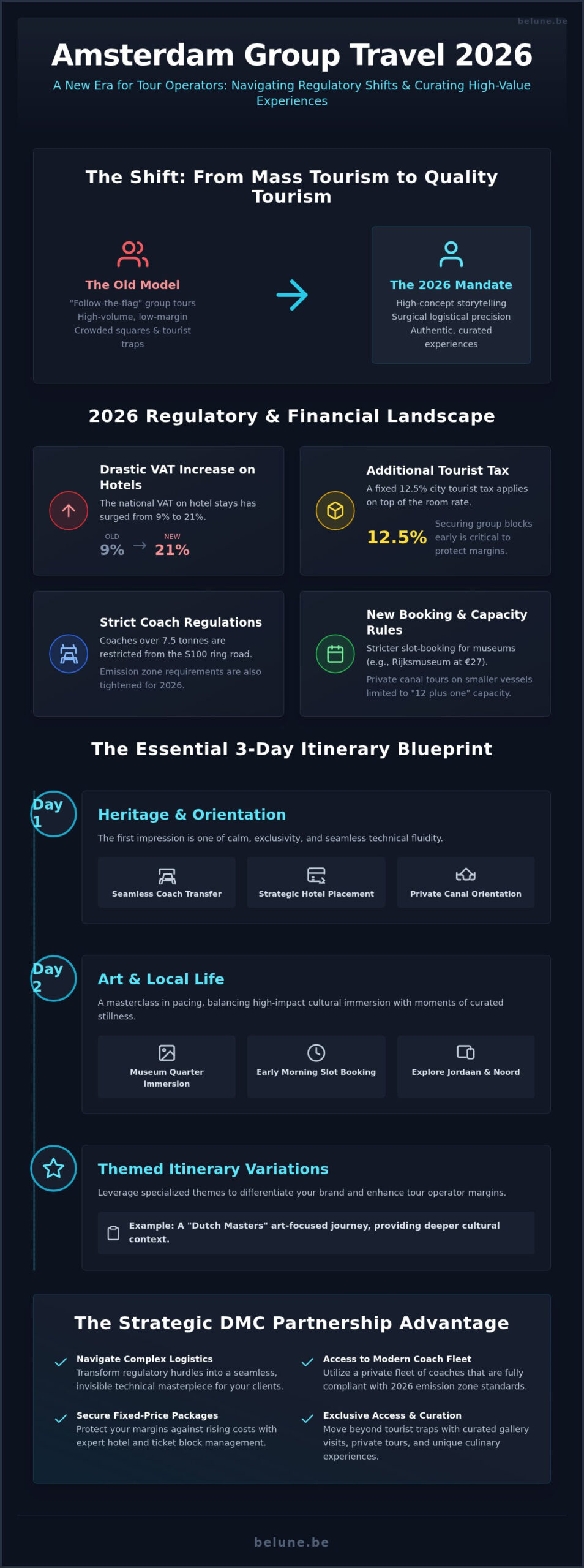
    The city’s relationship with heavy vehicles is one of strict boundaries. Since the implementation of the 2023 “Agenda Touringcar,” coaches weighing over 7.5 tonnes are barred from many central arteries. This isn’t a mere inconvenience; it’s a legal mandate. Organizers must utilize designated “Haltes” for drop-offs, often limited to a strict 10-minute window. Using P+R hubs like Zeeburg or the RAI complex is essential for long-term parking. Professional drivers don’t just steer; they navigate a complex web of permits and prohibited zones to avoid the city’s €95 fines and the frustration of a blocked canal street. Avoiding group tour mistakes in amsterdam starts with respecting these spatial limits.

    The Last Mile: Transferring Groups to the Canal District

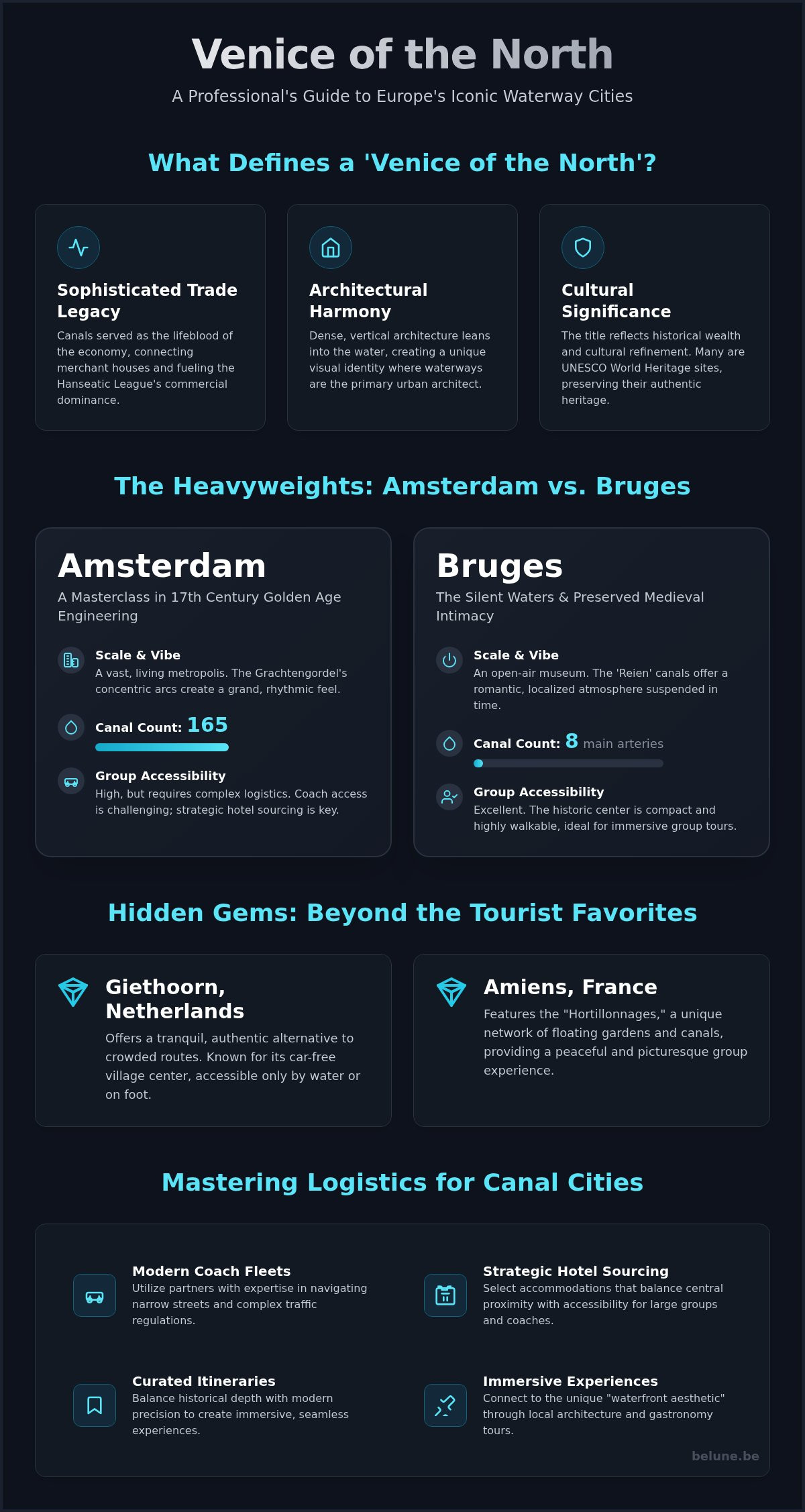
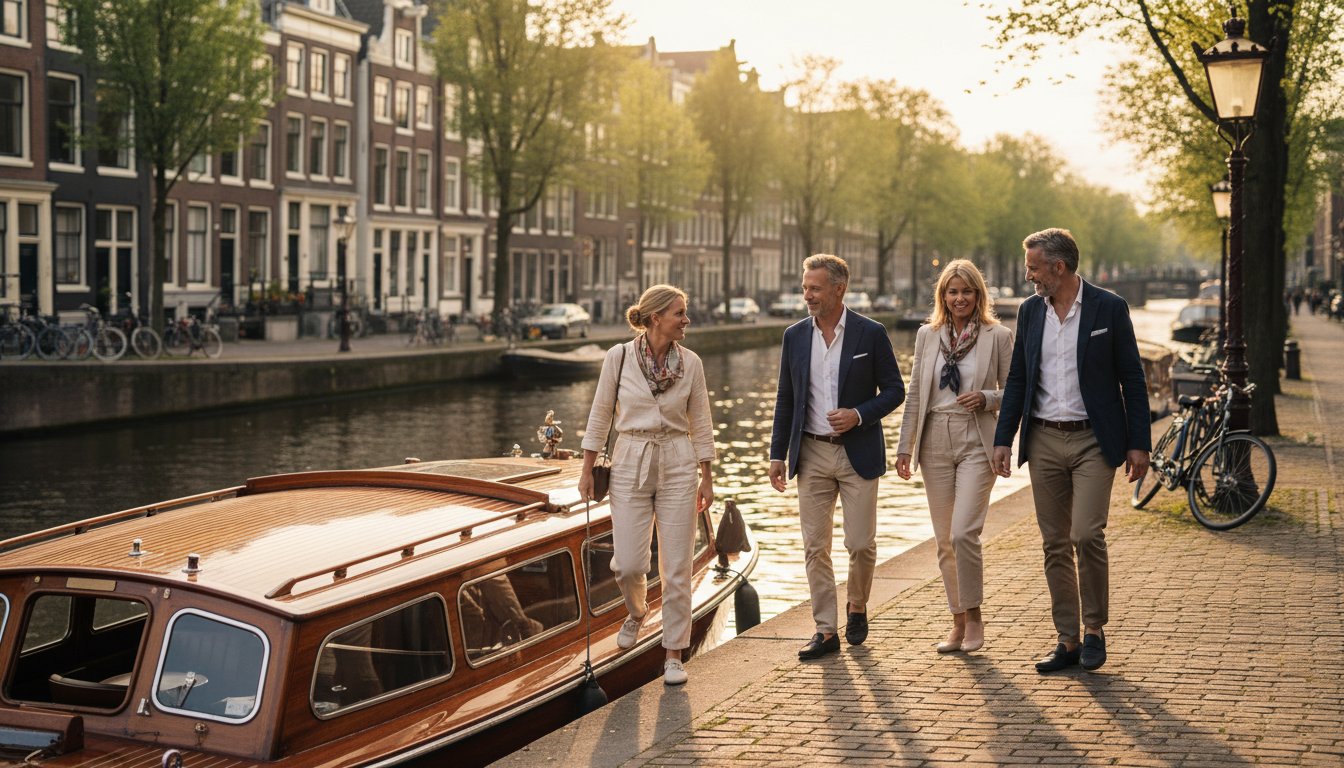
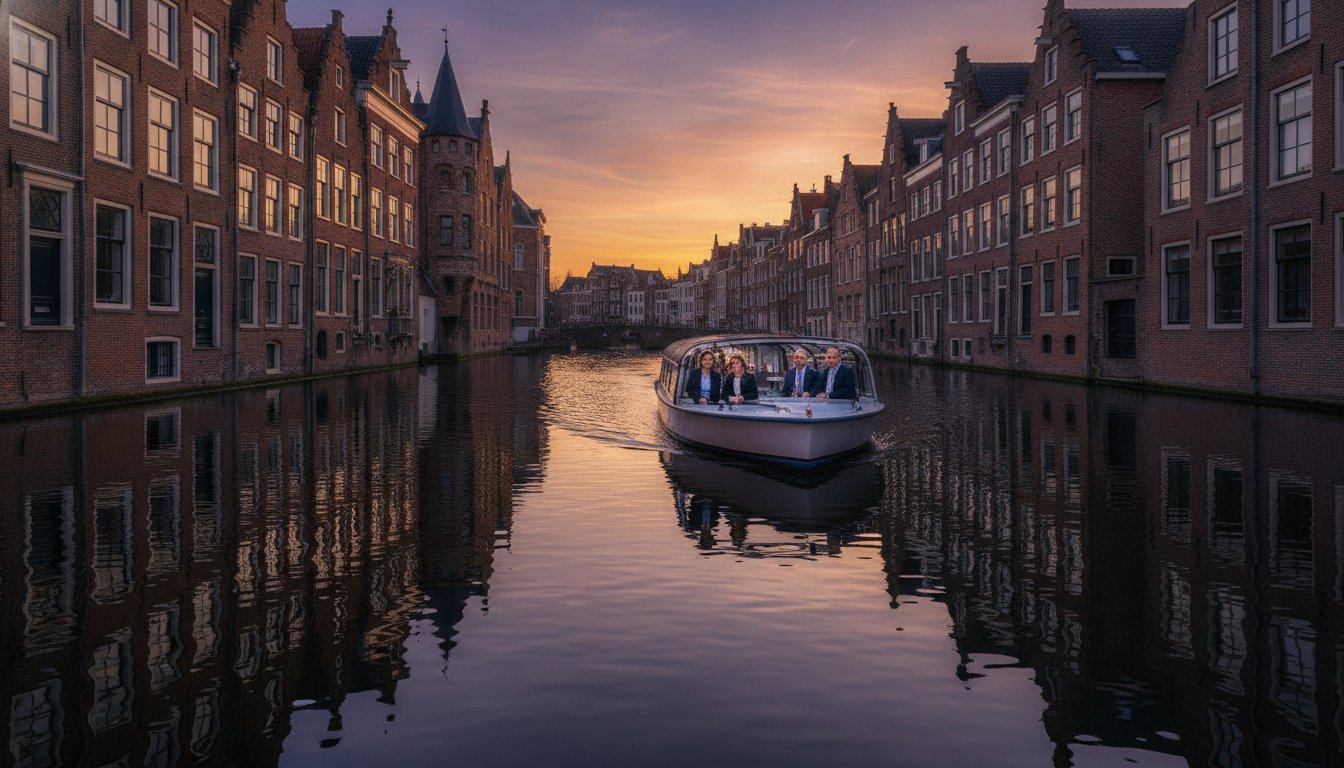
    The final stretch to a historic hotel is where the vision often falters. Moving forty suitcases through the narrow, pedestrian-heavy streets of the Jordaan or the Grachtengordel is a logistical nightmare. We favor the elegance of the private shuttle boat. It’s a functional masterpiece. By utilizing the city’s 165 canals, groups bypass the traffic and noise of the Spui. This method ensures a seamless transition where luggage is handled discreetly, allowing guests to focus on the play of light on the water. It transforms a transfer into a bespoke experience, grounding the group in the city’s unique atmosphere from the very first moment. Consider these elements for a refined arrival:

    • Strategic luggage portage: Utilizing dedicated van transfers for bags while guests arrive by boat.
    • Timed entry: Coordinating arrival times to match hotel check-in windows, preventing lobby congestion.
    • Bespoke welcome: Utilizing the boat transfer as a curated introduction to the city’s history.

    A seamless transition is the hallmark of a professional itinerary. It’s the difference between a group that feels like an intrusion and one that feels like a natural part of the city’s vibrant tapestry. By mastering these logistics, we create the space for true inspiration to take root.

    Strategic Itinerary Planning: Avoiding the “Center Trap”

    True mastery of Amsterdam’s urban layout requires a shift in perspective. Many organizers fall into the “Center Trap” by anchoring their entire itinerary within Dam Square and the Red Light District. These zones saw nearly 20 million visitors in 2023, leading to a density that often compromises group comfort. A decentralized approach is the hallmark of a sophisticated tour. By moving activities toward the Eastern Docklands or Amsterdam Noord, you create a sense of exclusivity and space. This isn’t just about avoiding crowds; it’s about curating a professional atmosphere where your clients can actually hear the narrative you’ve built for them.

    Modern logistics in the Dutch capital have become increasingly technical. Time-slot management is now the most critical skill for any coordinator. Since the 2024 regulations restricted group sizes in the historic core to 15 people, every minute must be accounted for. Avoiding group tour mistakes in Amsterdam requires balancing these logistical constraints with moments of architectural beauty. We recommend weaving iconic sites with lesser-known gems like the Tuschinski Theatre’s Art Deco facade. This creates a rhythmic contrast between the city’s historical weight and its modern, innovative spirit.

    Museum Management: Beyond the Rijksmuseum

    The “early booking” myth often leads to disappointment. Standard consumer tickets don’t offer the flexibility required for professional groups. Instead, use specialized B2B portals that allow for volume management and easier rescheduling. To prevent museum fatigue, diversify the cultural menu. The Straat Museum in Noord offers 8,000 square meters of industrial space, providing a breathable alternative to the dense galleries of the Museumplein. Limit indoor sessions to 90 minutes to maintain high engagement levels and prevent the sensory exhaustion that often plagues large-scale cultural tours.

    Timing the City: Peak Hours vs. Quiet Windows

    Light dictates the emotional resonance of a space. We suggest scheduling canal cruises during the twilight window. This “Golden Hour” strategy transforms the canal belt into a glowing, reflective canvas as the city’s 1,200 bridges begin to illuminate. Conversely, steer your group away from the 9-Streets (De Negen Straatjes) between 11:00 and 16:00. These narrow corridors become impassable for groups during midday peaks. For floral markets, an 08:30 arrival is mandatory to capture the authentic trade atmosphere before the tourist rush begins. Just as we utilize bespoke lighting solutions to define the character of an architectural project, smart timing defines the character of a group’s journey. Precision in the schedule allows the beauty of the city to remain the primary focus.

    Cultural Etiquette and the Group Footprint

    Amsterdam is a living masterpiece. It functions as a delicate ecosystem where historical preservation meets modern urban vitality. To walk its streets is to enter a shared space defined by unwritten codes. True mastery of the city involves more than just seeing the sights; it requires an appreciation for the local rhythm. Avoiding group tour mistakes in amsterdam begins with acknowledging that the city is not a stage, but a home for 821,000 residents. A professional guide acts as a conductor, ensuring the group’s presence remains a harmonious addition rather than a disruptive force.

    The Dutch perspective on over-tourism has shifted toward high-quality engagement. In 2023, the city launched campaigns to discourage nuisance-driven travel, emphasizing a “visitor-resident” balance. For a group, this means adopting a smaller, more respectful footprint. We view the tour not as a conquest of landmarks, but as a sublime immersion into a breathing landscape. This mindset transforms a standard excursion into an elegant exchange of cultures.

    The Bike Lane Boundary: A Safety Essential

    Safety in Amsterdam is color-coded. The red asphalt belongs to the 881,000 bicycles that dominate the city’s pulse. Group leaders must provide a technical briefing before the first step is taken. Pedestrians often mistake the smooth red paths for sidewalks, a lapse in judgment that disrupts the flow of 60% of daily inner-city trips made by bike. When moving a group of 20 or 30 people across a major cycling artery, the guide must manage the crossing like a choreographed sequence. Splitting the group into smaller clusters prevents bottlenecks and respects the transit rights of locals. It’s about precision and timing.

    Respectful Engagement in Sensitive Districts

    The city’s allure often centers on its more provocative areas, yet these require the highest level of professional conduct. In the Red Light District, or De Wallen, a strict no-photo policy is enforced to protect the dignity and privacy of workers. Since 2020, the city has implemented bans on guided tours in specific parts of this district to curb “gawking.” Professional guides must navigate these boundaries with factual, sober guidance rather than sensationalism.

    • Coffee shop curiosity: Address legal nuances and social expectations with clinical accuracy.
    • Residential canals: Maintain low volume levels. The UNESCO World Heritage site is a residential neighborhood where noise echoes off the water.
    • Dining etiquette: Ensure large group reservations don’t overwhelm the intimate atmosphere of local eetcafés.

    By respecting these invisible boundaries, you ensure that avoiding group tour mistakes in amsterdam becomes a natural part of the journey. The goal is to leave the city exactly as you found it: luminous, orderly, and profoundly welcoming. True sophistication lies in the ability to move through a space without disturbing its inherent beauty.

    Dining and Hospitality: Scaling the Amsterdam Experience

    Excellence in group travel requires a delicate balance between scale and intimacy. In Amsterdam, the culinary landscape often feels polarized. You either find tiny, Michelin-starred gems seating twelve, or cavernous tourist halls serving uninspired fried snacks. Avoiding group tour mistakes in amsterdam starts with rejecting the “tourist menu” entirely. These pre-packaged meals prioritize speed over soul. High-end hospitality isn’t found in a crowded square; it’s found in the quiet elegance of a private vault or a glass-fronted pavilion. Authentic Dutch gastronomy is found in the harmony of seasonal produce and architectural atmosphere.

    Curating Group Dining in Historic Venues

    Repurposed industrial heritage sites offer the volume needed without sacrificing character. The Westergasfabriek, a former gasworks complex dating back to 1885, provides vast architectural canvases for bespoke events. These spaces allow us to play with shadow and light, creating an atmosphere that feels exclusive despite the headcount. Fixed-price packages here aren’t about cutting corners; they’re about precision. By pre-selecting a menu that highlights Dutch artisanal cheeses or craft beers from local breweries like Brouwerij ‘t IJ, you ensure a fluid service. Managing dietary requirements is simpler in these controlled environments. Data from 2023 indicates that nearly 40% of Dutch diners now request plant-based or allergen-specific options. Private catering allows for this necessary nuance, ensuring every guest feels seen and valued.

    Hotel Selection: Logistics vs. Luxury

    A common error is booking a large group into a 17th-century canal house. The streets are too narrow for coaches. Check-in becomes a bottleneck that drains the group’s energy. Sophisticated planners look toward the Zuidas district or the NDSM area. These locations offer “group-ready” infrastructure. They provide dedicated check-in desks, digital key distribution, and ample space for luggage handling. While a canal view is tempting, the 20-minute delay caused by a trapped bus in the Jordaan ruins the morning’s momentum. Choose properties that blend modern architectural luxury with functional accessibility. Your choice of stay should reflect a commitment to both comfort and efficiency, avoiding group tour mistakes in amsterdam that stem from poor spatial planning.

    Transform your next professional gathering into a masterpiece of light and shadow. Discover how our lighting expertise can sublime your event spaces.

    The DMC Advantage: Elevating the Professional Itinerary

    True mastery of a destination lies in the details that remain invisible to the untrained eye. For travel professionals, avoiding group tour mistakes in amsterdam is often a challenge of balancing scale with intimacy. We position the Destination Management Company as the artisan of the itinerary, where every transfer and reservation is a brushstroke in a larger cultural portrait. It’s about more than simple scheduling; it’s about the harmony of timing and atmosphere.

    During the high-pressure months of the Tulip Festival or the busy summer peaks, local on-the-ground support becomes the bridge between a chaotic schedule and a seamless flow. BELUNE transforms a standard tour into a curated cultural pilgrimage. We ensure every movement feels intentional. By anticipating bottlenecks before they occur, we allow our partners to maintain their reputation for excellence even in the busiest seasons.

    Bespoke Solutions for Discerning Clients

    Building a custom Benelux incoming tour operator partnership is a process of collaborative creation. We believe the human element defines the journey. This is why we deploy multi-lingual, expert guides who are deeply rooted in the culture group tours benelux sector. These specialists do more than recite history; they translate the atmosphere of the Low Countries for a global audience.

    Our team manages the technical nuances of Benelux logistics from A to Z. This includes:

    • Securing exclusive museum time slots during peak hours.
    • Managing private dock access for canal cruises to avoid public congestion.
    • Coordinating complex hotel allotments across multiple cities.
    • Providing 24/7 technical support for real-time itinerary adjustments.

    Partnering for Success in 2026

    As we look toward the 2026 season, the landscape of group travel continues to evolve with new sustainability standards and urban mobility policies. Partnering for success means designing itineraries that are resilient and sophisticated. Our modern coach fleet serves as a cornerstone of this reliability, providing a sanctuary of comfort that meets the latest environmental regulations in restricted city zones. Avoiding group tour mistakes in amsterdam starts with choosing a partner who understands these shifting regulations.

    We invite professional partners to leverage our local expertise to create projects that stimulate the imagination. For a deeper look at our methodology and how to select the right partner, consult our definitive group travel agency selection guide. Your vision deserves a foundation of technical rigour and artistic sensitivity. Let’s design the next chapter of European travel together.

    Elevating the Amsterdam Perspective

    Amsterdam demands more than a generic itinerary. It requires a vision that balances logistical precision with cultural harmony. Successfully avoiding group tour mistakes in amsterdam begins with moving beyond the crowded center and respecting the city’s delicate social fabric. True mastery lies in the nuances of the arrival and the choice of sustainable transport. These elements transform a standard trip into a sophisticated journey.

    Since 2004, BELUNE has acted as a visionary partner for professional tour operators. Our team brings 20 years of Benelux logistical expertise to every itinerary. We manage a private fleet of modern, eco-friendly coaches tailored for specialized B2B needs. It’s about more than just transport; we curate a seamless flow that reflects the highest standards of excellence. Let’s create an experience that resonates. Partner with BELUNE for your next Amsterdam group itinerary to ensure your project reaches its full potential. The path to a flawless Dutch experience is now within your reach.

    Frequently Asked Questions

    What are the coach parking regulations for group tours in central Amsterdam?

    Coaches exceeding 7.5 tons cannot enter the city center within the S100 ring as of January 1, 2024. Drivers must utilize designated “P+R” locations like Zeeburg or Sloterdijk for long-term parking. This regulation is a critical part of avoiding group tour mistakes in Amsterdam by ensuring your itinerary accounts for transfer times from these peripheral hubs. It’s a logistical shift that requires precise planning to maintain the rhythm of your day.

    How far in advance should I book group tickets for the Anne Frank House or Rijksmuseum?

    Secure Anne Frank House tickets exactly six weeks in advance at 10:00 CET via their official portal. Availability often vanishes within minutes. For the Rijksmuseum, group reservations for 15 to 20 people require a minimum of eight weeks lead time to guarantee entry. Precision in timing ensures your group experiences these cultural landmarks without the friction of last-minute unavailability. We recommend setting digital reminders to capture these windows.

    Can large groups take canal cruises together in Amsterdam?

    Large groups can definitely cruise together by chartering private salon boats designed for 50 or more passengers. Standard tour boats often cap group bookings at 20 guests to maintain a quiet atmosphere. Opting for a private vessel allows for a bespoke experience. It transforms a simple transit into a curated journey through the city’s aquatic architecture. The light reflecting off the water creates a sublime backdrop for a shared professional moment.

    Is it possible to organize a group bike tour without disrupting local traffic?

    Organizing a successful bike tour requires splitting your party into smaller clusters of 10 to 12 riders per guide. Amsterdam municipal guidelines strictly limit group sizes to prevent congestion on narrow cycle paths. This structured approach respects the local flow. It maintains the harmony of the streets while ensuring every participant remains safe and engaged. Small groups allow the beauty of the city’s nuances to shine through without causing frustration for residents.

    What are the best neighborhoods for group-friendly hotels outside the city center?

    Amsterdam Noord and the Zuidas business district offer the most sophisticated accommodations for large parties. These areas provide the spatial volume that central canal houses lack. A 15-minute metro ride from Station Zuid or a 5-minute ferry from Noord connects your group to the heart of the city. These locations balance logistical efficiency with modern architectural elegance. They offer a serene retreat from the crowded medieval center.

    How does the city tax for tourists apply to large group bookings?

    The city tax for 2024 is fixed at 12.5 percent of the overnight accommodation price. This rate applies uniformly to all group members regardless of the booking size. Transparency in budgeting is vital. You should ensure this percentage is clearly articulated in your financial planning to avoid unexpected costs during the final reconciliation. It’s a significant figure that directly funds the city’s infrastructure and preservation efforts.

    What is the “Oude Kerk” protocol for group visits in the Red Light District?

    Guided tours are strictly prohibited in the Red Light District and around the Oude Kerk since April 1, 2020. Groups can still visit the area independently, but they must respect the “no photography” rule and maintain silence. This regulation protects the privacy of residents and workers. It’s a fundamental step in avoiding group tour mistakes in Amsterdam and respecting the city’s delicate social fabric. Professionalism here means leading by example through quiet observation.

    How do I manage group dining for 40+ people in a city of small restaurants?

    Managing a dinner for 40 guests requires booking spacious venues like Grand Café Restaurant 1st Class or industrial spaces in Amsterdam Noord. Most city center establishments cap tables at 8 to 10 people due to historical floor plans. Selecting a venue with the architectural capacity for large gatherings ensures a seamless, communal dining experience. It’s about finding that perfect harmony between a grand setting and intimate service. Plan these reservations at least three months out.

  • The Ultimate Amsterdam Art Tour: A B2B Guide to Curating Group Cultural Experiences

    The Ultimate Amsterdam Art Tour: A B2B Guide to Curating Group Cultural Experiences

    What if the true masterpiece of your next corporate retreat wasn’t the canvas on the wall, but the seamless rhythm of the journey itself? For high-end travel planners, the challenge of a 2024 amsterdam art tour often lies in the friction between vision and reality. You understand that your clients demand more than a ticket to the Rijksmuseum; they seek an emotional resonance that only an expertly curated experience can provide. Yet, the 17th-century logistics of the canal district often clash with the needs of a modern coach or a 30-person delegation.

    We’ve refined the art of the itinerary to eliminate these traditional pain points. This guide reveals how to orchestrate a sophisticated cultural experience that balances Dutch Masterpieces with the raw energy of contemporary urban movements. You’ll discover our framework for bypassing 45-minute entry queues and securing guides who possess both academic depth and linguistic fluidity. From coordinating restricted-zone coach drop-offs at the Museumplein to accessing three private galleries hidden within the Jordaan, we provide the logistical backbone your high-end projects require.

    Key Takeaways

    • Master the art of narrative by bridging the gap between 17th-century opulence and the raw, creative energy of contemporary urban movements.
    • Elevate your amsterdam art tour by moving beyond the surface of the Rijksmuseum to explore the technical mastery and sensory depth of the Dutch Masters.
    • Identify the new frontiers of creativity, from the design-focused Stedelijk Museum to the industrial rebellion found within the NDSM Wharf.
    • Solve the logistical complexities of high-end group travel, including strict coach regulations and the sourcing of architecturally significant accommodations.
    • Discover how professional DMC expertise provides a seamless transition from a visionary concept to a flawlessly executed cultural masterpiece.

    The Narrative of Light and Legacy: Why Amsterdam is the Ultimate Art Destination

    Light is the primary architect of the Dutch capital. It reflects off the surfaces of 165 canals, bounces between 1,500 bridges, and illuminates the facades of 7,000 registered historic buildings. In this city, art isn’t confined to a canvas; it’s woven into the urban fabric. For the discerning traveler, Amsterdam functions as a continuous, living exhibition where the distinction between the street and the gallery dissolves. It’s a place where 17th-century merchant wealth created the foundation for a global cultural powerhouse.

    The “Amsterdam Art Narrative” follows a specific, compelling trajectory. It begins with the Golden Age’s obsession with realism and domesticity, then pivots sharply toward the 20th-century rebellion of the CoBrA movement and contemporary street art found in the NDSM Wharf. This evolution makes an amsterdam art tour more than a simple sightseeing exercise. It’s a technical study in how a society uses aesthetic expression to define its identity. For B2B groups, this journey requires a sophisticated touch to transform a standard itinerary into a masterclass of cultural immersion.

    The Artistic Identity of the Dutch Capital

    The UNESCO-protected canal ring, finalized in the late 17th century, serves as the structural skeleton for Amsterdam’s artistic heritage. These waterways aren’t merely infrastructure; they’re the stage for a century of unprecedented creative output. During the 1600s, the Dutch Republic produced an estimated 5 million paintings, a staggering volume that democratized art ownership. This legacy persists today. The city maintains a unique equilibrium, balancing the heavy chiaroscuro of Rembrandt with the vibrant, avant-garde spirit of the Stedelijk Museum. It’s this duality between classical mastery and modern experimentation that gives the city its enduring relevance in the global art market.

    Why Group Art Tours Require a Professional Lens

    Designing a high-end cultural experience for a group involves more than securing entry tickets. Research into visitor psychology shows that “museum fatigue” typically sets in after just 45 minutes of unstructured browsing. To prevent this, professional curation is vital. We believe that a successful amsterdam art tour must be treated as a bespoke architectural project. It’s about the harmony of space, the nuance of lighting, and the rhythm of the narrative. A professional guide doesn’t just point at a painting; they dissect the social and technical conditions that allowed that masterpiece to exist.

    • Technical Expertise: Selecting guides who specialize in specific eras, from the 1650s Dutch Masters to the 1920s De Stijl movement.
    • Sensory Pacing: Balancing the intense emotional weight of the Anne Frank House with the airy, expansive light of the Rijksmuseum’s Great Hall.
    • B2B Exclusivity: Leveraging DMC partnerships to facilitate “closed-door” access, such as private viewings of the Six Collection or after-hours tours of the Van Gogh Museum.

    For professional partners, the value lies in these invisible details. In 2024, luxury travel is defined by access and insight rather than mere proximity. By utilizing a dedicated Destination Management Company, B2B clients gain entry to private ateliers and conservation labs that remain hidden from the general public. This level of curation ensures that the group doesn’t just see Amsterdam; they understand the technical and emotional resonance of its light and legacy. It’s a commitment to excellence that transforms a trip into a profound professional asset.

    The Dutch Masters: Orchestrating a Deep Dive into the Golden Age

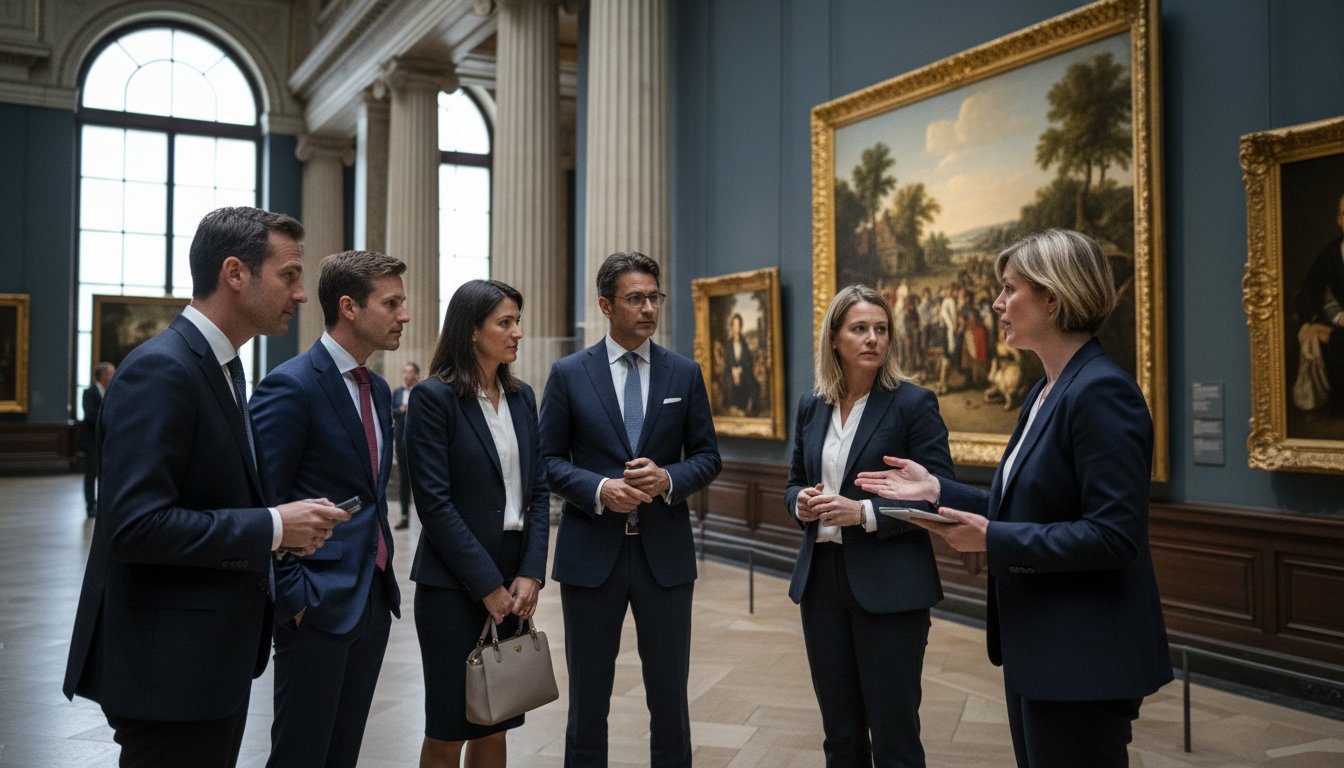
    Light defines the Dutch Golden Age. It isn’t merely a tool for visibility; it’s the primary narrator of 17th-century Dutch life. For any curated amsterdam art tour, the Rijksmuseum stands as the essential anchor. This architectural masterpiece, designed by Pierre Cuypers and opened in 1885, houses over 8,000 objects that chronicle a nation’s soul. A sophisticated itinerary moves beyond the surface of the canvas to explore how light and shadow create emotional resonance. We see this most clearly in the works of Rembrandt van Rijn. While The Night Watch commands the room, his true genius lies in his technical mastery of chiaroscuro. He didn’t just paint people; he sculpted them using light, a precision that mirrors our own philosophy of spatial transformation.

    Johannes Vermeer offers a profound contrast through the quietude of domesticity. His paintings, such as The Milkmaid, capture a stillness that feels almost architectural. The way light enters a window in his work creates a sense of harmony and balance. While the Masters provide the foundation, the city’s legacy continues to evolve through the vibrant contemporary art galleries in Amsterdam that bridge the gap between tradition and modernity. Managing the flow of a large group through these hallowed halls requires a rhythmic approach. The Museumplein district is a sprawling cultural hub, yet it can feel intimate if navigated with foresight. Success lies in balancing the heavy emotional weight of the art with moments of spatial reflection.

    The Rijksmuseum Strategy for Tour Operators

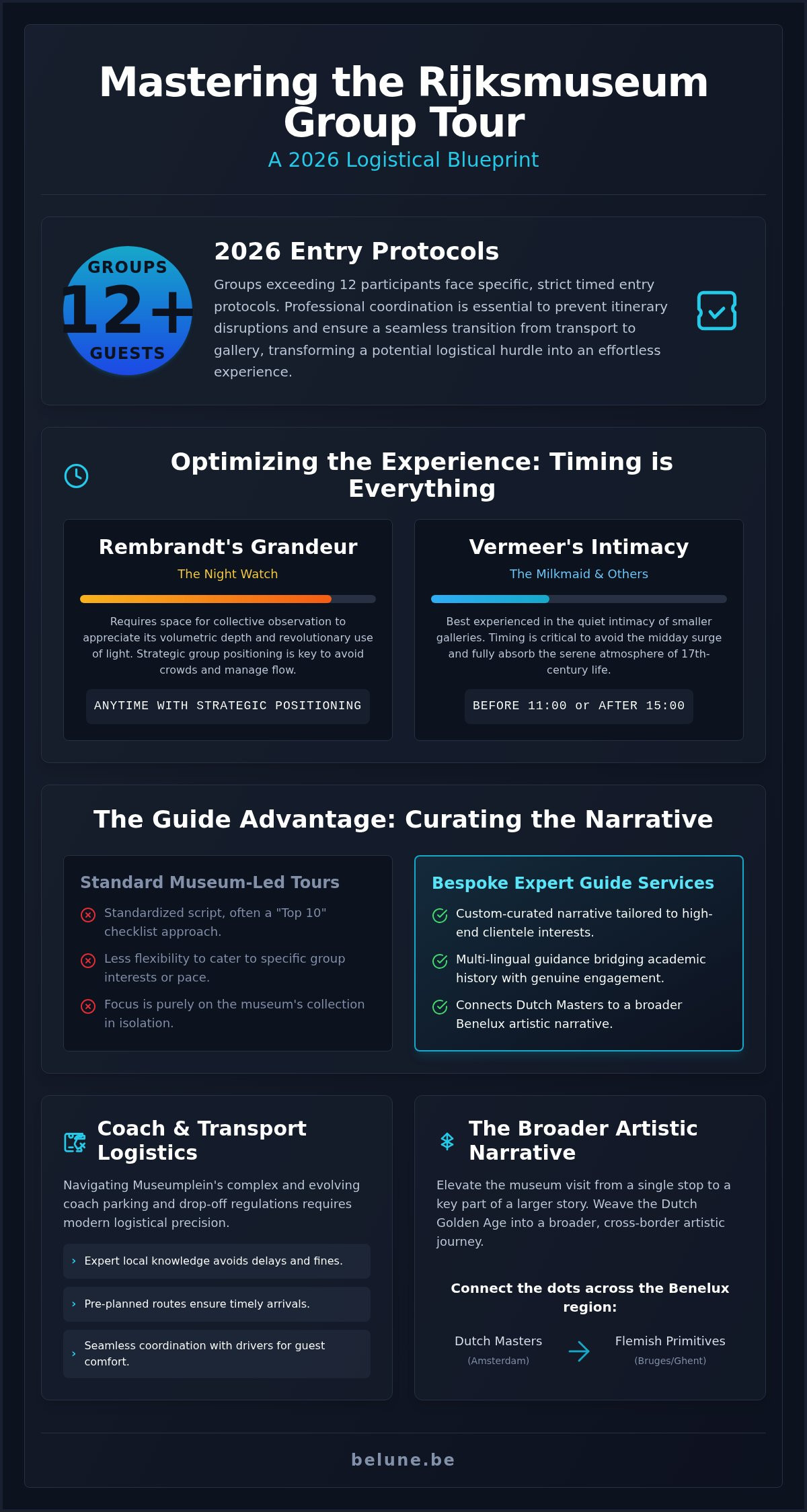
    Precision timing is the hallmark of a professional operator. For 2026, group entry slots are expected to open 270 days in advance, and securing the 09:00 or 15:30 windows is vital to avoid the midday surge. The Gallery of Honour serves as the tour’s crescendo, but we recommend starting in the lesser-known 17th-century wings to build a narrative arc. This allows guests to appreciate the museum’s neo-Gothic architecture before reaching the heavy hitters. Designing an itinerary requires the same technical rigor we apply when we sublime architectural spaces through the power of light.

    The Van Gogh Experience: A Study in Emotion

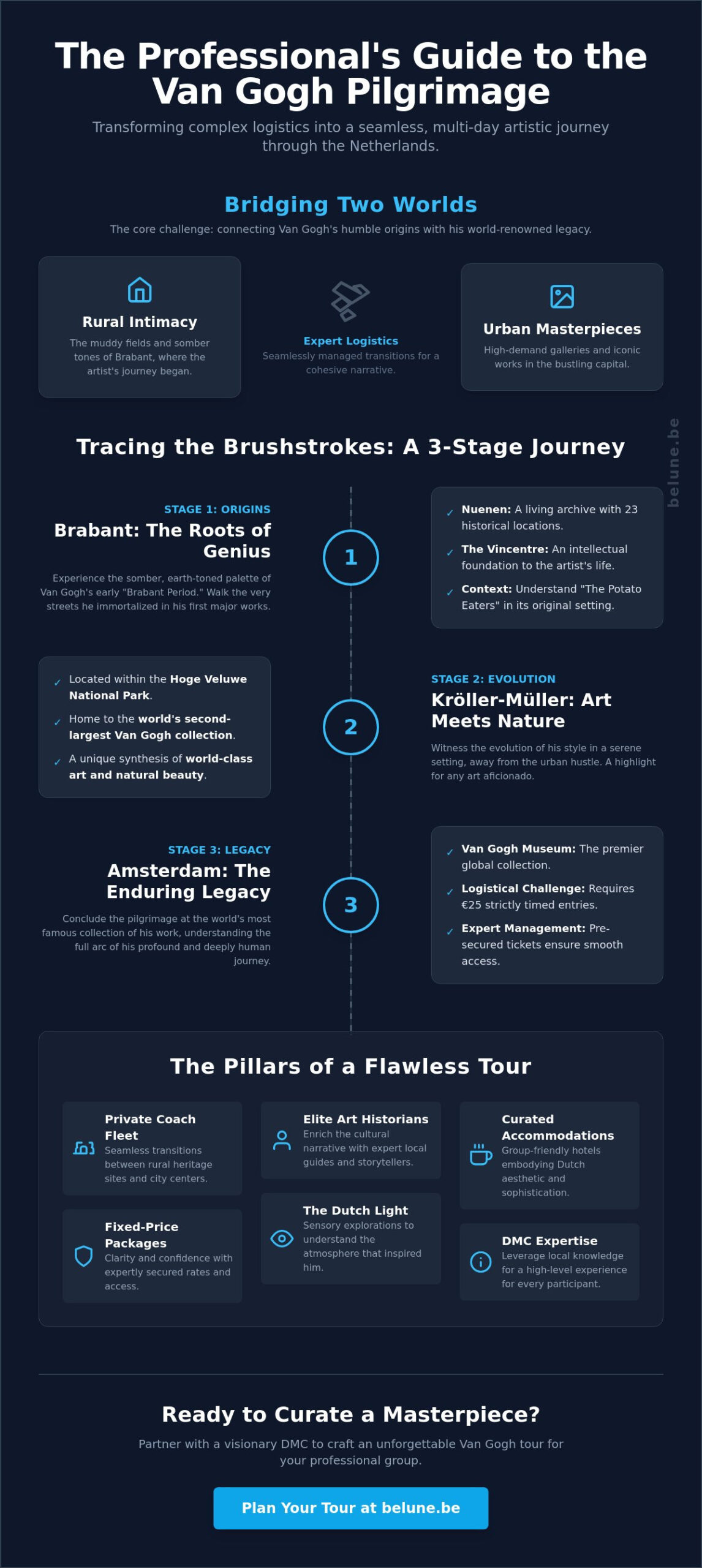
    Transitioning from the Golden Age to Post-Impressionism requires a shift in perspective. A chronological journey through the Van Gogh Museum reveals Vincent’s turbulent evolution from the dark, earthy tones of The Potato Eaters (1885) to the vibrant, frantic energy of his final works in Auvers-sur-Oise. Demand for group tickets remains at 95% capacity year-round, making six-month advance bookings mandatory. To elevate the experience, pair the walk-through with a private lecture on how Van Gogh used color as a visceral language. This intellectual layering transforms a simple visit into a profound study of human emotion and artistic courage.

    • 2026 Group Booking Window: Slots typically released 9 months prior.
    • Peak Flow Management: Utilize the 15:30 “Golden Hour” for quieter galleries.
    • Technical Focus: Prioritize Rembrandt’s shadow techniques and Vermeer’s light composition.
    • Educational Pairing: Integrate a 30-minute expert briefing before museum entry.

    Beyond the Canvas: Contemporary Galleries and Urban Art Movements

    Amsterdam’s artistic identity didn’t stop with the Golden Age. It evolved into a bold, experimental dialogue between historic preservation and avant-garde expression. For a truly comprehensive amsterdam art tour, groups must transition from the oil-painted shadows of the 17th century into the stark, white-cube brilliance of the Stedelijk Museum. This institution houses a collection of 90,000 objects, ranging from the primary color blocks of De Stijl to the industrial aesthetics of Bauhaus. The 2012 expansion, often called the Bathtub for its sleek white exterior, serves as a masterclass in how modern architecture can redefine a city’s skyline through minimalist elegance.

    Including contemporary stops in a group itinerary provides a necessary counterpoint to the traditional museum experience. It transforms the tour from a history lesson into a living exploration of social change. Street Art Museum Amsterdam (SAMA) exemplifies this shift. Rather than confining art within four walls, SAMA treats the Nieuw-West district as a living gallery, featuring over 300 murals that tackle themes of migration and urban identity. This democratization of art ensures that every member of your group finds a personal connection to the city’s current pulse.

    NDSM Wharf: Where Industrial Heritage Meets Art

    The journey to Amsterdam North begins with a 15-minute free ferry ride from Centraal Station. This short transit offers groups a panoramic view of the IJ river, setting the stage for the NDSM Wharf’s raw, industrial atmosphere. At the heart of this creative frontier lies the STRAAT Museum, an 8,000 square meter former warehouse dedicated to graffiti and street art. Since its opening in 2020, it has showcased more than 150 site-specific works that reflect the city’s political climate. The Kunststad (Art City) nearby provides a workspace for 400 artists, offering a rare glimpse into the active production of Dutch contemporary culture.

    Boutique Galleries in the Jordaan District

    Walking the labyrinthine alleys of the Jordaan district allows for intimate, small-group breakout sessions. This area is home to approximately 40 independent galleries that specialize in photography and digital media. We recommend coordinating with spaces like Galerie Ron Mandos for private B2B viewings, where curators often discuss the technical nuances of their latest installations. The focus here is on bespoke experiences. Digital art and high-end photography galleries like Foam provide a sharp, modern contrast to the brick-and-mortar history of the neighborhood. These smaller venues allow for a slower pace, where the harmony of light and space can be fully appreciated by discerning travelers.

    Modern art in Amsterdam isn’t just about the visual. It’s about the atmosphere. By integrating these contemporary sites, your amsterdam art tour achieves a perfect balance between the heritage of the past and the innovation of the future. We see this blend as essential. It’s the difference between seeing a city and understanding its soul. The curated contrast between the Stedelijk’s precision and the NDSM’s grit creates a narrative arc that keeps participants engaged from the first gallery to the last mural. This approach ensures your group leaves with a sophisticated, multi-layered perspective on Dutch creativity.

    The Logistics of Inspiration: Managing Large Group Art Tours in Amsterdam

    Orchestrating a sophisticated amsterdam art tour for a large group requires more than a passion for Vermeer; it demands a surgical approach to the city’s complex infrastructure. We view logistics as the invisible canvas upon which the travel experience is painted. If the frame is weak, the masterpiece falters. True luxury lies in the absence of friction. For a group of 25 or more, this means anticipating the constraints of a medieval city layout while maintaining the rhythm of an artistic pilgrimage.

    Coach Transport and City Access

    Amsterdam’s commitment to sustainability has transformed group transit into a technical challenge. Since January 1, 2024, the city has enforced a strict ban on heavy coaches weighing over 7.5 tons within the S100 inner ring. This regulation protects historic canal bridges but requires precise planning. We utilize the ‘P-Bus’ system, directing vehicles to designated hubs like the Museumplein drop-off zone. This isn’t a mere stop; it’s a strategic transition point.

    • Private Fleet Excellence: BELUNE’s private fleet of Euro 6 compliant vehicles ensures seamless transfers across the Benelux region, meeting the highest environmental standards.
    • The Last Mile: We coordinate synchronized luggage transfers and short, curated walks from the drop-off point. This 500-meter transition becomes a thematic introduction to the museum’s architecture.
    • Timed Entry Precision: With Rijksmuseum slots often booking out 4 months in advance, coach arrivals are timed to a 15-minute window to avoid group congestion.

    Group-Friendly Luxury Accommodation

    Finding 20 or more rooms without losing a boutique essence is a delicate balance. We prioritize properties that offer architectural integrity alongside high-volume capacity. Staying near Museumplein provides a strategic advantage over the crowded Canal Belt. It allows guests to walk to the Van Gogh Museum in under 5 minutes, eliminating morning transit stress. By 2025, the city’s “no new hotels” policy will make existing strategic partnerships even more vital for large groups.

    We manage the “behind-the-scenes” details to preserve the guest experience. This includes pre-keyed arrivals and dedicated luggage porters who ensure bags reach rooms in under 12 minutes. The goal is to maintain the feeling of a private gallery visit rather than a mass-market excursion. We select hotels where the lighting design and spatial harmony reflect the Dutch Masters’ own obsession with nuance and atmosphere.

    This commitment to detail can even extend to curated welcome gifts that reflect the tour’s sophistication. For those seeking inspiration on luxury accessories that align with a high-end European aesthetic, you can visit Millo Beauty.

    Clarity is non-negotiable in a museum setting. We employ professional “whisper” audio systems with a 200-meter range and 99% interference-free transmission. This technology allows the guide’s insights to reach every guest with poetic precision without disrupting the museum’s contemplative silence. Our dining selections follow the same rigorous standard. We curate experiences at venues like RIJKS® or the Hermitage’s café, where the culinary presentation mirrors the city’s artistic flair. Every element, from the coach seat to the dinner plate, is a deliberate choice in a larger composition.

    To ensure your next cultural project is executed with technical perfection and artistic vision, explore our bespoke group management services at Belune.

    Designing Your Masterpiece: How BELUNE Curates B2B Art Experiences

    Crafting a memorable journey requires more than a schedule; it demands a mastery of detail. Since 2004, BELUNE has served as a specialist DMC in the Benelux region, marking 20 years of creating sophisticated group experiences. We don’t believe in off-the-shelf solutions. Every amsterdam art tour we design is a unique project, curated with the same precision an artisan brings to a gallery installation. Our ‘A to Z’ approach covers the entire spectrum of travel needs. We coordinate luxury coach transport that prioritizes comfort and style, alongside multilingual guides who offer deep intellectual engagement rather than just scripted facts.

    We tailor every itinerary to reflect the specific cultural curiosity of your group. Whether your clients are focused on 17th-century portraiture or the technical brilliance of the Rijksmuseum restoration, we adjust the pace and focus accordingly. This bespoke methodology ensures that the final itinerary is a masterpiece of balance and elegance. Having a local partner with deep roots means you have a guardian on the ground. We provide a level of security and insight that international agencies cannot replicate, allowing you to focus on your clients while we manage the complexity of the region.

    • Expert Logistics: Seamless transitions from luxury airport transfers to private gallery entrances.
    • Bespoke Curation: Itineraries built around the specific artistic movements your clients value most.
    • Multilingual Mastery: Guides who navigate the nuances of art history in the client’s native tongue.
    • Local Authority: Two decades of established relationships with museums and private venues.

    The BELUNE Difference in Art & Culture

    Our strength lies in our network. We collaborate with specialized art historians and local experts who transform a museum visit into a profound sensory encounter. In October 2023, we executed a complex 5-day Dutch Masters tour for a luxury US-based operator. When a sudden logistical shift threatened a private viewing, our team leveraged local connections to arrange a private talk with a lead conservator within four hours. This ability to pivot without compromising the aesthetic quality of the trip is what defines our service. We handle the unforeseen with quiet rigor, ensuring the client’s journey remains seamless and sophisticated.

    Start Planning Your Amsterdam Itinerary

    The path to a successful amsterdam art tour begins with a clear vision and early action. We provide bespoke, fixed-price group packages that allow for transparent budgeting and premium quality. For those looking toward the future, it’s vital to recognize that 2026 museum allocations for major exhibitions are already being discussed. Early booking is the only way to guarantee access to the most coveted time slots and private viewing windows. Don’t leave your masterpiece to chance; excellence requires preparation. Partner with BELUNE for your next Amsterdam Art Tour and let us refine every detail of your group’s cultural journey.

    Elevate Your Vision for a Masterful Group Experience

    Curating a high-level corporate journey requires a delicate balance between historical heritage and modern innovation. You’ve discovered how the 17th-century precision of the Rijksmuseum harmonizes with the bold energy of Amsterdam’s contemporary street art scene. Organizing these complex layers for professional groups demands a technical mastery of timing and logistics. We don’t just provide a schedule; we design an atmosphere where every detail feels intentional.

    BELUNE brings 20+ years of DMC experience to your project, ensuring your amsterdam art tour exceeds the highest professional standards. Our specialized Art & Culture experts understand the nuance of elite curation. We utilize our private fleet of modern coaches to provide seamless transit, allowing your guests to focus entirely on the inspiration at hand. It’s time to transform your next group event into a bespoke work of art.

    Request your custom Amsterdam group itinerary from BELUNE

    We look forward to crafting something extraordinary together.

    Frequently Asked Questions

    What is the best time of year for an Amsterdam art tour for groups?

    Spring and autumn offer the most evocative light for an amsterdam art tour. From late March to May, the city experiences 14 hours of daylight, illuminating the canal houses with a crisp, clear glow. We recommend these shoulder seasons to avoid the 20 million visitors who arrive during the peak summer months.

    This timing ensures your group experiences the museums with 30 percent less crowding. It allows for a deeper, more silent connection with the Dutch Masters. The soft light of September also provides a perfect palette for architectural walks.

    How far in advance should a tour operator book Rijksmuseum group tickets?

    You should book Rijksmuseum group tickets at least 4 months before your arrival date. Demand is exceptionally high, especially for the Gallery of Honour where Rembrandt’s Night Watch resides. The museum enforces a strict limit of 15 participants per guided group to maintain a respectful atmosphere.

    Securing slots 120 days in advance guarantees your preferred entry time. It prevents the 45 minute wait times common for walk-in visitors. Early booking also allows us to pair your group with the most sought after art historians in our network.

    Are there specific coach parking regulations in Amsterdam I need to know?

    Amsterdam enforces strict regulations that prohibit heavy coaches from entering the historic center’s narrow streets. Since January 2024, vehicles weighing over 7.5 tonnes are restricted to the S100 ring road. Drivers must use designated drop-off points like the Museumplein or the Passenger Terminal Amsterdam.

    We coordinate with drivers to use the 5 main P-R coach parks located on the city outskirts. This ensures a seamless transition for your guests from the vehicle to the gallery entrance. Our team manages these logistics to maintain the rhythm of your itinerary.

    Can BELUNE provide French or Spanish speaking art guides in Amsterdam?

    We provide highly qualified art historians who are fluent in French, Spanish, and English. Our network includes 12 specialized guides who understand the subtle nuances of Dutch Golden Age techniques. These experts don’t just translate; they interpret the cultural context for your group with technical precision.

    By matching your party with a native speaker, we ensure that 100 percent of the artistic narrative is communicated with passion. This bespoke approach transforms a standard visit into a profound intellectual exchange. We prioritize guides who blend academic rigor with a visionary perspective.

    What are the best ‘hidden gem’ art locations for groups outside the main museums?

    Museum Van Loon and Our Lord in the Attic provide an intimate glimpse into 17th-century life. These sites offer a refined contrast to the scale of the national museums. Van Loon preserves the original 1672 architecture and a private collection of 150 family portraits in a canal-side setting.

    Our Lord in the Attic features a hidden Catholic church built in 1663 within a residential house. These locations allow groups to escape the 5 million annual visitors at larger institutions. They offer a quiet harmony that’s essential for appreciating the artisanal details of the Golden Age.

    How does BELUNE handle group dining for art-focused itineraries?

    We curate dining experiences that mirror the aesthetic quality of your amsterdam art tour. Our team selects venues like the RIJKS or De Kas, where the light and architecture enhance the culinary journey. We manage every detail, from 3-course bespoke menus to specific dietary requirements for 100 percent of your guests.

    These spaces are chosen for their ability to accommodate groups of 20 to 50 while maintaining an atmosphere of sophisticated tranquility. We believe that a meal should be a continuation of the artistic experience. Each venue reflects our commitment to excellence and sensory harmony.

    Is it possible to combine an Amsterdam art tour with a trip to Paris or Brussels?

    Integrating Amsterdam with Paris or Brussels is a seamless process using the high-speed rail network. The journey to Brussels takes exactly 1 hour and 50 minutes, while Paris is reached in 3 hours and 20 minutes. This allows for a multi-city itinerary that traces the evolution of European art across borders.

    We handle all logistics, ensuring your group transitions from the Dutch Masters to the Impressionists without any technical friction. Our team manages the transfers and luggage, letting you focus on the cultural narrative. This cross-border approach offers a comprehensive vision of Western art history.

    What is the typical group size BELUNE manages for cultural tours?

    We typically manage groups ranging from 15 to 25 participants to maintain an atmosphere of exclusivity. This size ensures that every guest receives personalized attention and a clear view of the masterpieces. For larger delegations of 50 or more, we divide the party into smaller cohorts.

    This 1:15 guide-to-guest ratio preserves the intimacy of the experience and adheres to the capacity limits of Amsterdam’s historic sites. It allows for a more fluid movement through the galleries. We focus on quality over quantity to ensure the emotional impact of the art remains central.