What if the most profound way to honor the 110th anniversary of the Somme in 2026 isn’t just to stand at a memorial, but to understand the tactical heartbeat of the ground beneath your feet? For professional organizers, the challenge is rarely finding a destination; it’s securing expert-led ww1 history tours that capture the soul of the story without the friction of logistical failures. You’ve likely felt the frustration of oversimplified narratives or the logistical strain that often plagues large group bookings. We believe a commemorative journey requires more than just a seat on a bus. It demands an intentional blend of academic rigour and refined, technical execution.
This guide reveals how to curate profound commemorations that balance historian-led depth with the seamless management of transport and accommodation. We’ll explore the essential shift toward exclusive site access and the mastery required to navigate the 2026 landscape. From the ceremonies at Thiepval on July 1 to managing the impact of site closures like Fort Vaux, we provide the blueprint for a sophisticated group experience that respects both the weight of history and your participants’ expectations.
Key Takeaways
- Learn how to distinguish between general sightseeing and truly expert-led ww1 history tours that leverage the deep academic insights of dedicated researchers and storytellers.
- Master the complexities of group logistics by integrating a private coach fleet with specialized hotel accommodation management near key Western Front sites.
- Discover the art of structuring a commemorative program that balances solemn battlefield visits with local gastronomy and refined cultural experiences.
- Understand the strategic advantage of partnering with a Benelux-based DMC to navigate local logistics and secure exclusive access to historical landmarks.
The Evolution of Expert-Led WWI History Tours
The landscape of remembrance has undergone a profound transformation. We no longer settle for the surface-level anecdotes that once defined battlefield visits. A look into the history of war tourism reveals a shift from simple curiosity toward a deep, intellectual necessity for connection. Today, expert-led ww1 history tours represent a sophisticated bridge between archival data and the physical reality of the Western Front. This evolution reflects a modern audience that prizes technical accuracy as much as emotional resonance.
To better understand how deep-dive historical analysis enriches the travel experience, watch this session with a leading historian:
From Sightseeing to Scholarly Pilgrimage
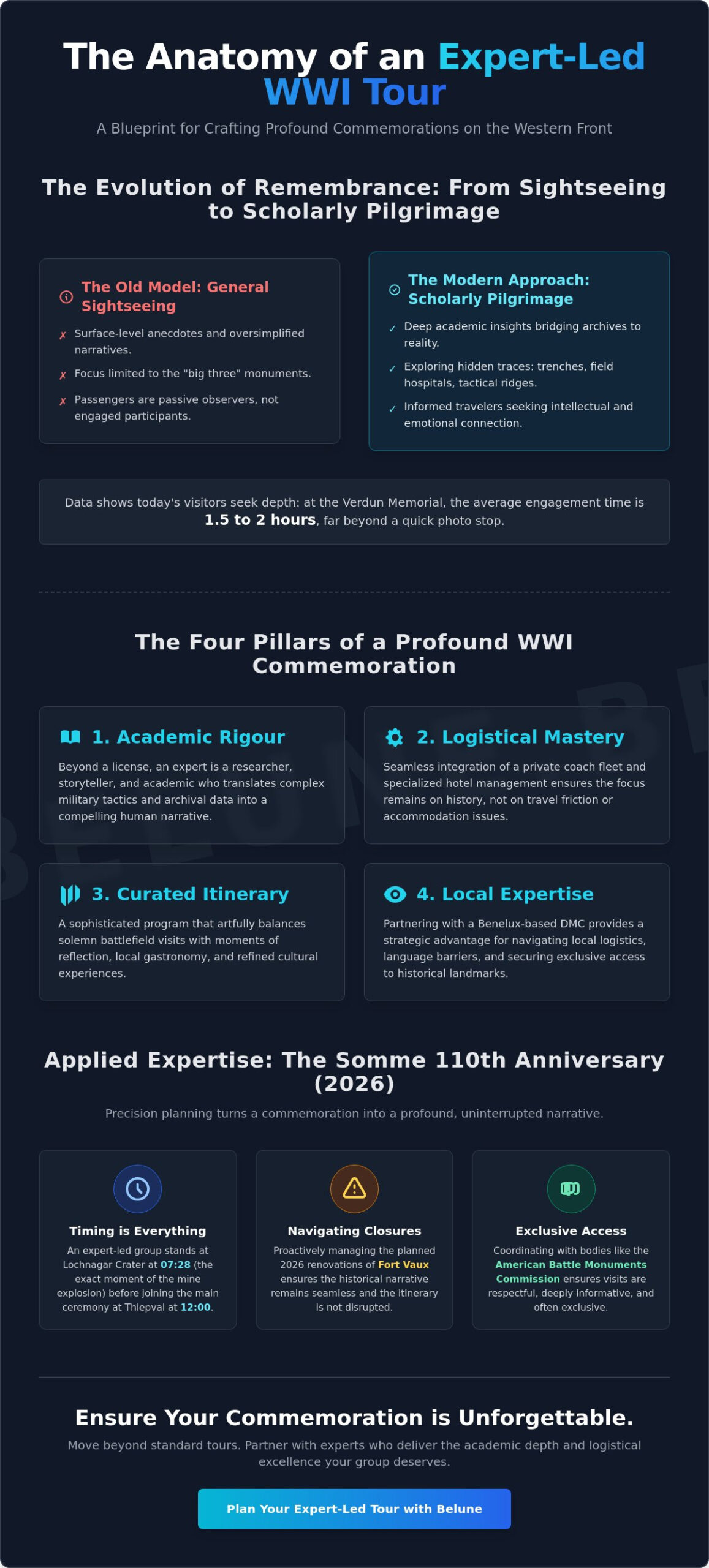
Digital archives and genealogy platforms have empowered travelers. They don’t just arrive at a cemetery; they arrive with a map, a service record, and a specific coordinate. This informed perspective has pushed expert-led ww1 history tours to move beyond the “big three” monuments. While the Thiepval Memorial remains essential, modern groups seek the hidden traces of the front line. They look for the specific ridge where a diversionary attack failed or the cellar where a field hospital once stood. Data from the Verdun Memorial shows that visitors now spend an average of 1.5 to 2 hours engaging with exhibits, seeking a depth of context that a standard tour simply cannot provide. We focus on this granular detail, turning a journey into a scholarly pilgrimage.
The Value of Academic Rigour in 2026
As we approach the 110th anniversary of the Battle of the Somme in 2026, the “centenary effect” continues to elevate expectations. Accuracy isn’t optional; it’s an ethical responsibility. An expert in this field isn’t just a guide with a license. They’re a researcher who can interpret the landscape through the lens of 1916 tactics. For example, on July 1, 2026, while many will gather for the 12:00 ceremony at Thiepval, an expert-led group will have already stood at Lochnagar Crater at precisely 07:28 to mark the mine’s explosion. This level of precision requires navigating complex logistics, such as the scheduled 2026 closure of Fort Vaux for renovations. We manage these technical shifts so the historical narrative remains uninterrupted and the group’s engagement stays focused on the profound human story.
Defining the Expert: Historians, Researchers, and Storytellers
The success of expert-led ww1 history tours hinges on a specific type of alchemy. It’s the ability to synthesize cold military data with the warmth of human narrative. Expertise isn’t a monolith; it exists in tiers. A general guide might know the dates, but a specialist researcher understands why a specific battalion was positioned in a certain wood. This distinction is vital for groups seeking a profound connection to the past. We believe that true mastery requires a guide who can navigate both the complexity of a battle map and the delicate emotions of a commemorative service.
What Makes a WWI Historian-Guide?
Identifying the right lead means looking beyond a title. Academic credentials provide the foundation, but field experience builds the structure. A true expert translates complex maneuvers into relatable experiences. They don’t just talk about the creeping barrage at the Somme; they explain the sensory overload of the men waiting for the whistle. The Historian-Guide is a dual-role academic and logistical lead who maintains the intellectual integrity of the tour while anticipating the physical needs of the group. This includes coordinating with organizations like the American Battle Monuments Commission to ensure visits to sites like the Meuse-Argonne American Cemetery are both respectful and deeply informative.
The Importance of Local Language Expertise
Authentic research often lives in the margins of local archives. In the Benelux region, the most compelling stories are frequently tucked away in French or Dutch municipal records. Local guides bring a layer of nuance that international experts might overlook. They understand the regional folklore and the specific civilian impact of the occupation. This linguistic bridge is a cornerstone of high-quality expert-led ww1 history tours, turning a standard itinerary into a bespoke investigation of the territory. It allows for a richer exploration of the landscape that feels both intimate and authoritative.
Managing these delicate layers of storytelling requires a partner who understands the rhythm of the Western Front. Our local guide services ensure your group isn’t just seeing the sites, but experiencing them through the eyes of those who have dedicated their lives to preserving these stories.
Experts also serve as facilitators of emotion. They know when to speak and when to allow for the heavy silence of a cemetery to take hold. This emotional intelligence is what separates a lecture from a pilgrimage. It ensures that every participant leaves with more than just facts. They leave with a transformed perspective on the cost of conflict and the value of remembrance.
The Logistics of Remembrance: Navigating the Western Front
Navigating the Western Front requires more than a map; it demands a technical mastery of geography and group movement. The physical landscape of the Somme and Verdun is often rural and restrictive. Large vehicles face challenges that standard itineraries frequently overlook. We approach these hurdles with a vision that prioritizes the group’s comfort and the historian’s narrative flow. A seamless journey is the canvas upon which the history is painted. Without logistical precision, the most profound academic insights can be lost to the fatigue of travel.
Modern Coach Hire and Specialized Transport
Our fleet is not just a means of transport; it’s a mobile lecture theatre. We utilize a private fleet of busses designed to navigate the narrow lanes of the Meuse or the ridges of the Ypres Salient. A battlefield driver is a specialist who understands the specific rhythm of these sites. They know exactly where to drop a group to minimize walking distances while ensuring the coach remains accessible at all times. On-board amenities support the academic depth of expert-led ww1 history tours, allowing for briefings between sites that maximize every minute of the day. This technical coordination ensures that the transition from the coach to the trench remains fluid and respectful.
Strategic Accommodation Management
Selecting the right base for a large group is a delicate art. We focus on hotel accommodation management that places guests near the heart of the historical action. Staying in Arras, Ypres, or Verdun reduces transit times, allowing for more contemplative visits and less time on the road. This proximity is essential for avoiding tour fatigue, a common pitfall in over-scheduled programs. We manage these complex logistics through fixed-price group packages that eliminate hidden costs. This provides a reliable structure for our international partners. Understanding WWI battlefield tourism as a cultural phenomenon helps us design itineraries that respect the sanctity of the sites while meeting high modern travel standards.
Accessibility is a structural component of our planning, not an afterthought. We ensure that groups with varied physical requirements can experience the same depth of insight. This involves pre-vetting paths at sites like Lochnagar Crater and ensuring our coaches are equipped for all participants. By removing logistical friction, we allow the group to focus entirely on the profound history of the Great War. It’s about the technical precision of being in the right place at the right time, especially when managing the 1.5 to 2 hours typically required for a meaningful visit to the Verdun Memorial.
Designing a Meaningful Itinerary for Group Commemoration
Creating a truly impactful itinerary is an exercise in narrative architecture. It isn’t enough to simply list destinations; one must compose a journey that breathes. For expert-led ww1 history tours, the structure of a 3-to-5 day program must respect the emotional weight of the subject matter while maintaining a logical, technical flow. We see the itinerary as a structural component of the experience, where every stop serves a specific purpose in the broader story of the Great War. A well-designed path allows for moments of intense academic discovery followed by the necessary space for quiet reflection.
The Architecture of a Great Battlefield Tour
Every successful commemoration begins with a clear objective. Is the group tracing the footsteps of a specific regiment, or exploring the evolution of medical care on the front? Defining this “why” early allows for a thematic flow that keeps participants engaged. We often structure these journeys chronologically, starting with the initial movements of 1914 before moving into the static trauma of the trenches. Customization is the hallmark of excellence. We can pivot the focus toward medical history, aviation milestones, or the literary legacy of the war poets. Planning for downtime is equally vital. Groups need room to process the history they’ve just witnessed, ensuring that the experience remains profound rather than overwhelming.
Beyond the Trenches: Culture and Gastronomy
A journey through the Western Front is also a journey through modern European identity. To provide a complete perspective, we integrate belgium gastronomy tours into our historical programs. This isn’t a distraction; it’s a sensory bridge. A meal in a historic Flemish square or a local brewery visit provides a moment of communal reflection that military sites alone cannot offer. Our art and culture group tours complement the battlefield visits by highlighting how the war transformed the creative landscape of the 20th century. This holistic approach ensures that participants understand not just how the war was fought, but what was at stake for the civilization that survived it.
Incorporating specific ceremonies, such as the Last Post at the Menin Gate in Ypres, adds a layer of solemnity that defines the trip. We also facilitate private remembrance moments at smaller, less-frequented cemeteries, providing an exclusive experience away from the crowds of the major memorials. Balancing these heavy moments with the refined pleasures of local hospitality creates a rhythm that sustains the group’s energy and focus. To begin crafting your own bespoke battlefield itinerary, consider how these technical and emotional layers can be woven into a single, seamless narrative.
Partnering with a Benelux DMC for Unrivalled Battlefield Experiences
For international travel agents and professional organizers, the Western Front represents more than a historical site. It’s a logistical puzzle requiring absolute precision. Partnering with a local expert transforms this complexity into a strategic advantage. We provide the technical backbone that allows your brand to lead with authority. By consolidating specialized transport, expert guides, and hotel management, we eliminate the friction that often erodes both profit margins and client trust. A local Destination Management Company (DMC) isn’t just a supplier. It’s a visionary partner in the art of remembrance.
Professional service fees for itinerary planning are an investment in certainty. They save hundreds of hours in coordination and prevent the costly errors associated with poor site timing or restricted vehicle access. We leverage over 20 years of local transport and hotel relationships to secure the most refined assets for your group. This deep-rooted network acts as the ultimate safeguard. It ensures that even when technical shifts occur, such as the 2026 closure of Fort Vaux for renovations, your program remains fluid and impactful. We manage the variables so you can focus on the narrative.
White-Label Solutions for Tour Operators
Our role as a benelux incoming tour operator is to act as your invisible ally. We provide white-label solutions that ensure absolute brand consistency across every logistical touchpoint. From the moment your group boards our private coach to the final commemorative dinner, the experience reflects your high standards. Fixed-price certainty is a cornerstone of our B2B partnership. It allows you to market expert-led ww1 history tours with total confidence, knowing that hidden costs won’t emerge in the rural reaches of the Somme or the Meuse.
The BELUNE Difference: Sophistication and Expertise
We don’t just supply services; we curate environments. Our approach combines a visionary creative lens with a rigorous technical execution. This balance is critical for expert-led ww1 history tours, where the emotional depth of the history must be supported by flawless logistics. With two decades of experience, we’ve mastered the art of group travel within the Benelux region. We understand the rhythm of the landscape and the expectations of a sophisticated audience. It’s time to elevate your offering through a partnership built on excellence and trust. Request a custom itinerary today and discover how we can transform your next commemorative project into an exceptional journey.
Mastering the Art of Historical Commemoration
The journey across the Western Front is a delicate balance of academic depth and logistical precision. We’ve explored how the shift toward scholarly pilgrimages requires a guide who is both a researcher and a storyteller. True expert-led ww1 history tours don’t just happen. They are curated through a deep understanding of the landscape and a commitment to historical accuracy. This technical mastery ensures that the emotional weight of the story remains the group’s primary focus throughout the journey.
BELUNE provides the structural integrity needed for these profound experiences. With over 20 years of Benelux logistics expertise and a private fleet of modern, high-specification coaches, we ensure every detail is managed with technical rigour. Our specialized DMC services allow tour operators to deliver sophisticated, seamless itineraries that honor the past while meeting the highest modern standards. Partner with BELUNE for your next expert-led group tour to transform your vision into a landmark commemorative event. Let’s create a legacy of remembrance that resonates for generations.
Frequently Asked Questions
What is the difference between a battlefield guide and a military historian?
A military historian provides deep academic context and archival research, while a battlefield guide often focuses on site-specific anecdotes and general navigation. Our expert-led ww1 history tours utilize historians who bridge this gap. They translate complex tactical data into human narratives, ensuring that every location is understood within the broader structural evolution of the conflict. This academic rigour transforms a simple visit into a profound intellectual pilgrimage.
How large can a group be for an expert-led WWI tour?
Group sizes typically range from small private delegations of 10 to full coach parties of 50 participants. We manage these variations by scaling our logistical support and guide-to-guest ratios. For larger groups, we often deploy multiple historians to maintain the intimacy and depth of the narrative. This ensures that every individual can engage with the expert and the landscape without the dilution of the experience often found in mass tourism.
Can WWI history tours be customized for specific regiments or family histories?
Yes, bespoke itineraries can be designed to trace the specific path of a regiment or a family member’s service record. We utilize archival research to pinpoint exact locations, such as specific trench sectors or field hospital sites. This technical precision allows groups to hold private commemorations at the very spot where their ancestors stood. It’s a deeply personal way to experience history, moving beyond the general narrative to find a unique, structural connection to the past.
What are the essential sites to include in a first-time WWI group tour?
A foundational journey should include the Ypres Salient, the Somme battlefields, and the Verdun Memorial. Key landmarks like the Menin Gate, Thiepval Memorial, and the Lochnagar Crater provide the essential framework for understanding the war’s scale. We also recommend including the Verdun Memorial, where visitors typically spend 1.5 to 2 hours exploring the technical and human aspects of the battle. These sites offer a comprehensive introduction to the Western Front’s diverse history.
How far in advance should we book group accommodation for battlefield sites?
We recommend booking group accommodation at least 12 to 18 months in advance, especially for anniversary years like 2026. High-quality, group-friendly hotels near key sites like Arras or Ypres are limited and in high demand. Early booking ensures your group stays close to the historical action, reducing transit times and preventing tour fatigue. Our hotel accommodation management services focus on securing these prime locations to safeguard the integrity of your itinerary.
Are WWI battlefield tours suitable for students and educational groups?
Battlefield tours are highly effective for educational groups, provided they are led by historians who can adapt the narrative for different learning levels. These journeys turn abstract history into a tangible reality. We structure student programs to focus on the technical evolution of warfare and its lasting impact on European identity. By standing on the actual ground where history was made, students gain a perspective that no textbook can replicate.
What logistical support is provided for coach transport on rural battlefield roads?
We provide a private fleet of modern coaches specifically chosen for their ability to navigate the narrow, rural roads of the Western Front. Our battlefield drivers are specialists who understand the unique constraints of these historical areas. They coordinate closely with our historians to ensure seamless drop-offs and pick-ups at every site. This technical mastery of local geography is a core component of our coach hire services, ensuring safety and efficiency.
How do expert-led tours handle the emotional sensitivity of remembrance sites?
Our experts are trained to facilitate moments of reflection with the necessary gravity and silence. They understand that a cemetery visit is not just a history lesson; it’s an experience of profound remembrance. We carefully pace our expert-led ww1 history tours to allow for quiet contemplation. By balancing academic insights with the space for personal emotion, we ensure that the sanctity of these sites is always respected and preserved.
Leave a Reply