Tag: Western Front

  • Expert-Led WWI History Tours: The Definitive Guide for Group Travel in 2026

    Expert-Led WWI History Tours: The Definitive Guide for Group Travel in 2026

    What if the most profound way to honor the 110th anniversary of the Somme in 2026 isn’t just to stand at a memorial, but to understand the tactical heartbeat of the ground beneath your feet? For professional organizers, the challenge is rarely finding a destination; it’s securing expert-led ww1 history tours that capture the soul of the story without the friction of logistical failures. You’ve likely felt the frustration of oversimplified narratives or the logistical strain that often plagues large group bookings. We believe a commemorative journey requires more than just a seat on a bus. It demands an intentional blend of academic rigour and refined, technical execution.

    This guide reveals how to curate profound commemorations that balance historian-led depth with the seamless management of transport and accommodation. We’ll explore the essential shift toward exclusive site access and the mastery required to navigate the 2026 landscape. From the ceremonies at Thiepval on July 1 to managing the impact of site closures like Fort Vaux, we provide the blueprint for a sophisticated group experience that respects both the weight of history and your participants’ expectations.

    Key Takeaways

    • Learn how to distinguish between general sightseeing and truly expert-led ww1 history tours that leverage the deep academic insights of dedicated researchers and storytellers.
    • Master the complexities of group logistics by integrating a private coach fleet with specialized hotel accommodation management near key Western Front sites.
    • Discover the art of structuring a commemorative program that balances solemn battlefield visits with local gastronomy and refined cultural experiences.
    • Understand the strategic advantage of partnering with a Benelux-based DMC to navigate local logistics and secure exclusive access to historical landmarks.

    The Evolution of Expert-Led WWI History Tours

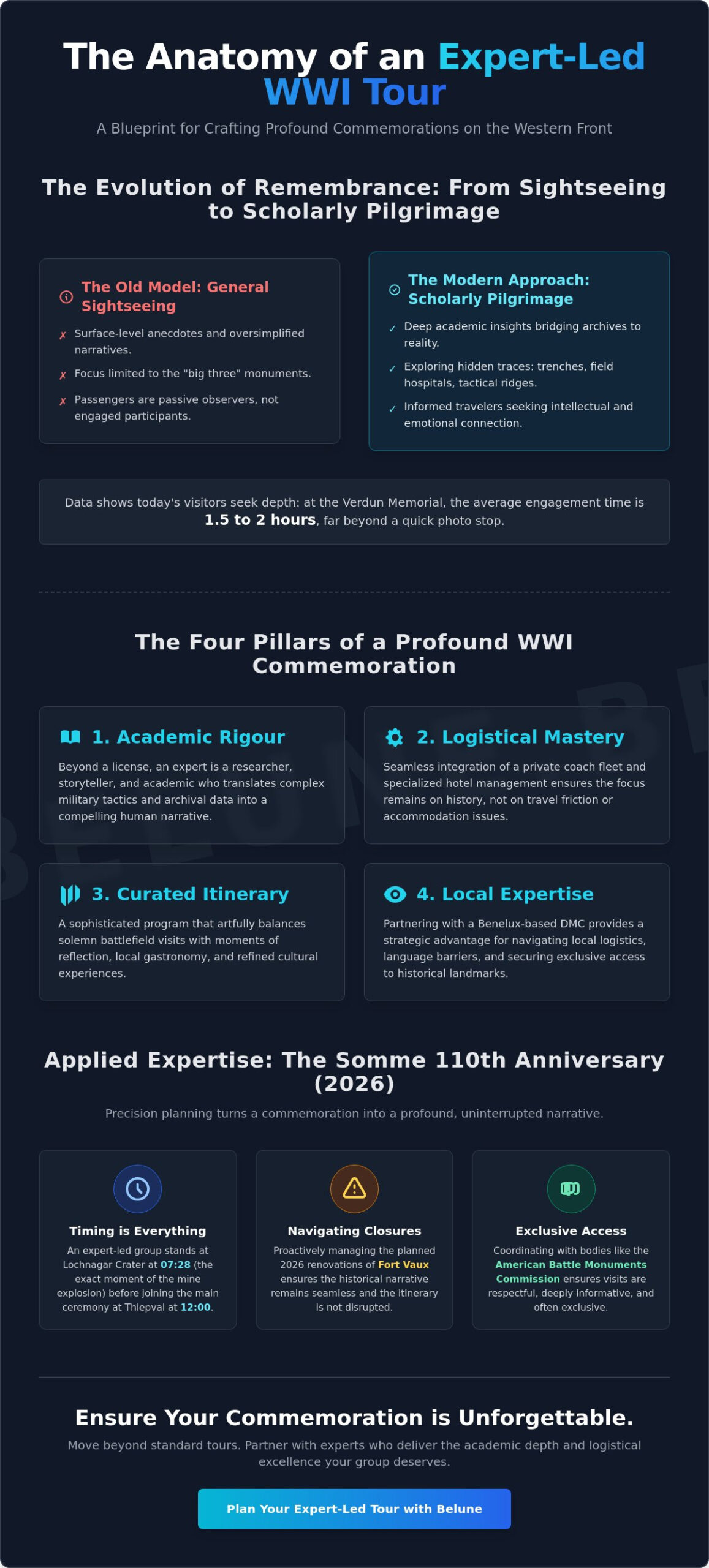
    The landscape of remembrance has undergone a profound transformation. We no longer settle for the surface-level anecdotes that once defined battlefield visits. A look into the history of war tourism reveals a shift from simple curiosity toward a deep, intellectual necessity for connection. Today, expert-led ww1 history tours represent a sophisticated bridge between archival data and the physical reality of the Western Front. This evolution reflects a modern audience that prizes technical accuracy as much as emotional resonance.

    To better understand how deep-dive historical analysis enriches the travel experience, watch this session with a leading historian:

    From Sightseeing to Scholarly Pilgrimage

    Digital archives and genealogy platforms have empowered travelers. They don’t just arrive at a cemetery; they arrive with a map, a service record, and a specific coordinate. This informed perspective has pushed expert-led ww1 history tours to move beyond the “big three” monuments. While the Thiepval Memorial remains essential, modern groups seek the hidden traces of the front line. They look for the specific ridge where a diversionary attack failed or the cellar where a field hospital once stood. Data from the Verdun Memorial shows that visitors now spend an average of 1.5 to 2 hours engaging with exhibits, seeking a depth of context that a standard tour simply cannot provide. We focus on this granular detail, turning a journey into a scholarly pilgrimage.

    The Value of Academic Rigour in 2026

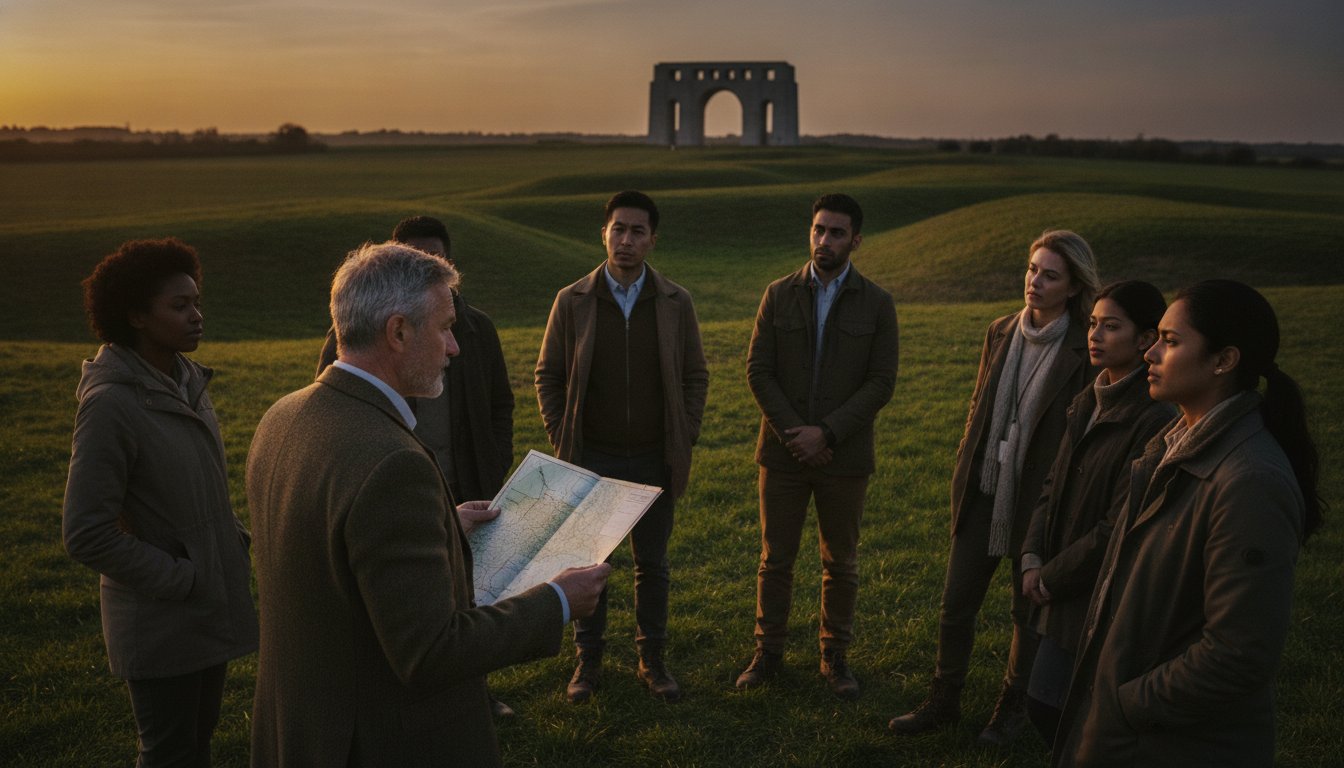
    As we approach the 110th anniversary of the Battle of the Somme in 2026, the “centenary effect” continues to elevate expectations. Accuracy isn’t optional; it’s an ethical responsibility. An expert in this field isn’t just a guide with a license. They’re a researcher who can interpret the landscape through the lens of 1916 tactics. For example, on July 1, 2026, while many will gather for the 12:00 ceremony at Thiepval, an expert-led group will have already stood at Lochnagar Crater at precisely 07:28 to mark the mine’s explosion. This level of precision requires navigating complex logistics, such as the scheduled 2026 closure of Fort Vaux for renovations. We manage these technical shifts so the historical narrative remains uninterrupted and the group’s engagement stays focused on the profound human story.

    Defining the Expert: Historians, Researchers, and Storytellers

    The success of expert-led ww1 history tours hinges on a specific type of alchemy. It’s the ability to synthesize cold military data with the warmth of human narrative. Expertise isn’t a monolith; it exists in tiers. A general guide might know the dates, but a specialist researcher understands why a specific battalion was positioned in a certain wood. This distinction is vital for groups seeking a profound connection to the past. We believe that true mastery requires a guide who can navigate both the complexity of a battle map and the delicate emotions of a commemorative service.

    What Makes a WWI Historian-Guide?

    Identifying the right lead means looking beyond a title. Academic credentials provide the foundation, but field experience builds the structure. A true expert translates complex maneuvers into relatable experiences. They don’t just talk about the creeping barrage at the Somme; they explain the sensory overload of the men waiting for the whistle. The Historian-Guide is a dual-role academic and logistical lead who maintains the intellectual integrity of the tour while anticipating the physical needs of the group. This includes coordinating with organizations like the American Battle Monuments Commission to ensure visits to sites like the Meuse-Argonne American Cemetery are both respectful and deeply informative.

    The Importance of Local Language Expertise

    Authentic research often lives in the margins of local archives. In the Benelux region, the most compelling stories are frequently tucked away in French or Dutch municipal records. Local guides bring a layer of nuance that international experts might overlook. They understand the regional folklore and the specific civilian impact of the occupation. This linguistic bridge is a cornerstone of high-quality expert-led ww1 history tours, turning a standard itinerary into a bespoke investigation of the territory. It allows for a richer exploration of the landscape that feels both intimate and authoritative.

    Managing these delicate layers of storytelling requires a partner who understands the rhythm of the Western Front. Our local guide services ensure your group isn’t just seeing the sites, but experiencing them through the eyes of those who have dedicated their lives to preserving these stories.

    Experts also serve as facilitators of emotion. They know when to speak and when to allow for the heavy silence of a cemetery to take hold. This emotional intelligence is what separates a lecture from a pilgrimage. It ensures that every participant leaves with more than just facts. They leave with a transformed perspective on the cost of conflict and the value of remembrance.
    Expert-Led WWI History Tours: The Definitive Guide for Group Travel in 2026

    The Logistics of Remembrance: Navigating the Western Front

    Navigating the Western Front requires more than a map; it demands a technical mastery of geography and group movement. The physical landscape of the Somme and Verdun is often rural and restrictive. Large vehicles face challenges that standard itineraries frequently overlook. We approach these hurdles with a vision that prioritizes the group’s comfort and the historian’s narrative flow. A seamless journey is the canvas upon which the history is painted. Without logistical precision, the most profound academic insights can be lost to the fatigue of travel.

    Modern Coach Hire and Specialized Transport

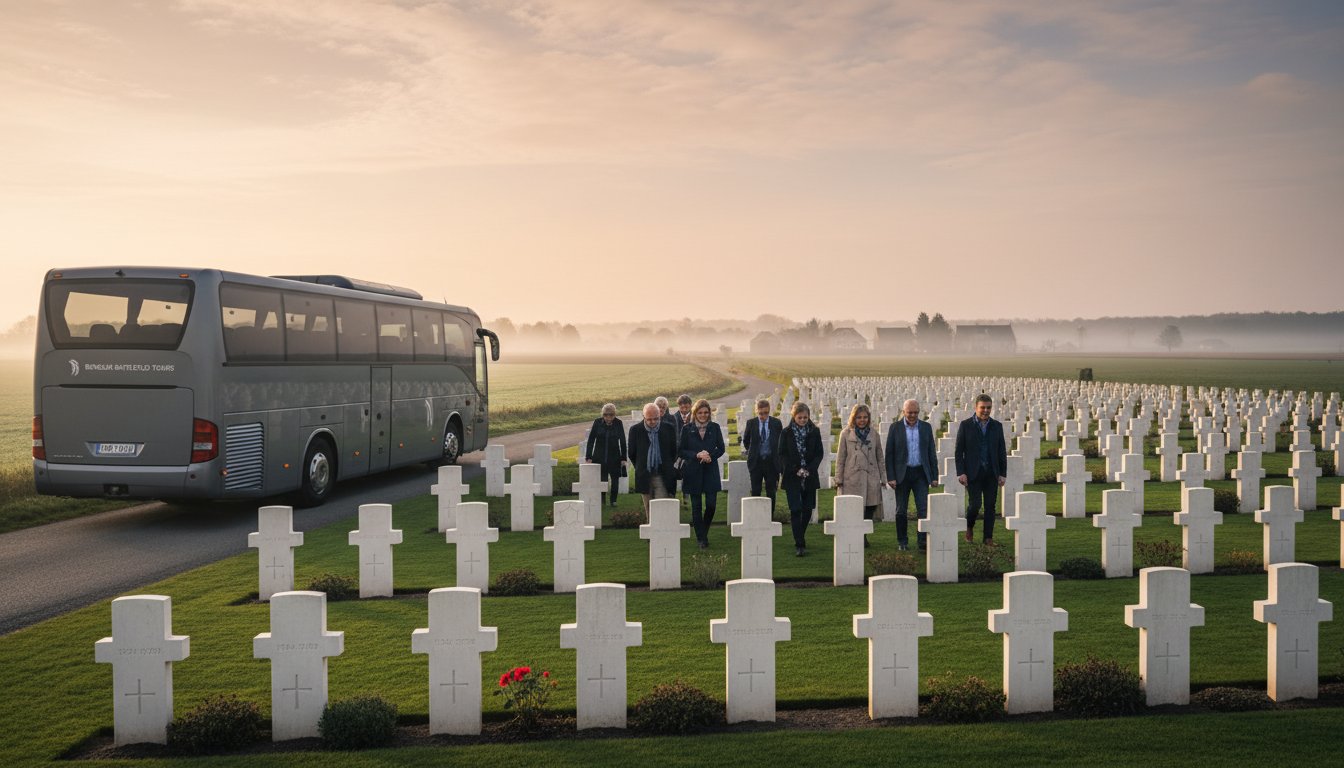
    Our fleet is not just a means of transport; it’s a mobile lecture theatre. We utilize a private fleet of busses designed to navigate the narrow lanes of the Meuse or the ridges of the Ypres Salient. A battlefield driver is a specialist who understands the specific rhythm of these sites. They know exactly where to drop a group to minimize walking distances while ensuring the coach remains accessible at all times. On-board amenities support the academic depth of expert-led ww1 history tours, allowing for briefings between sites that maximize every minute of the day. This technical coordination ensures that the transition from the coach to the trench remains fluid and respectful.

    Strategic Accommodation Management

    Selecting the right base for a large group is a delicate art. We focus on hotel accommodation management that places guests near the heart of the historical action. Staying in Arras, Ypres, or Verdun reduces transit times, allowing for more contemplative visits and less time on the road. This proximity is essential for avoiding tour fatigue, a common pitfall in over-scheduled programs. We manage these complex logistics through fixed-price group packages that eliminate hidden costs. This provides a reliable structure for our international partners. Understanding WWI battlefield tourism as a cultural phenomenon helps us design itineraries that respect the sanctity of the sites while meeting high modern travel standards.

    Accessibility is a structural component of our planning, not an afterthought. We ensure that groups with varied physical requirements can experience the same depth of insight. This involves pre-vetting paths at sites like Lochnagar Crater and ensuring our coaches are equipped for all participants. By removing logistical friction, we allow the group to focus entirely on the profound history of the Great War. It’s about the technical precision of being in the right place at the right time, especially when managing the 1.5 to 2 hours typically required for a meaningful visit to the Verdun Memorial.

    Designing a Meaningful Itinerary for Group Commemoration

    Creating a truly impactful itinerary is an exercise in narrative architecture. It isn’t enough to simply list destinations; one must compose a journey that breathes. For expert-led ww1 history tours, the structure of a 3-to-5 day program must respect the emotional weight of the subject matter while maintaining a logical, technical flow. We see the itinerary as a structural component of the experience, where every stop serves a specific purpose in the broader story of the Great War. A well-designed path allows for moments of intense academic discovery followed by the necessary space for quiet reflection.

    The Architecture of a Great Battlefield Tour

    Every successful commemoration begins with a clear objective. Is the group tracing the footsteps of a specific regiment, or exploring the evolution of medical care on the front? Defining this “why” early allows for a thematic flow that keeps participants engaged. We often structure these journeys chronologically, starting with the initial movements of 1914 before moving into the static trauma of the trenches. Customization is the hallmark of excellence. We can pivot the focus toward medical history, aviation milestones, or the literary legacy of the war poets. Planning for downtime is equally vital. Groups need room to process the history they’ve just witnessed, ensuring that the experience remains profound rather than overwhelming.

    Beyond the Trenches: Culture and Gastronomy

    A journey through the Western Front is also a journey through modern European identity. To provide a complete perspective, we integrate belgium gastronomy tours into our historical programs. This isn’t a distraction; it’s a sensory bridge. A meal in a historic Flemish square or a local brewery visit provides a moment of communal reflection that military sites alone cannot offer. Our art and culture group tours complement the battlefield visits by highlighting how the war transformed the creative landscape of the 20th century. This holistic approach ensures that participants understand not just how the war was fought, but what was at stake for the civilization that survived it.

    Incorporating specific ceremonies, such as the Last Post at the Menin Gate in Ypres, adds a layer of solemnity that defines the trip. We also facilitate private remembrance moments at smaller, less-frequented cemeteries, providing an exclusive experience away from the crowds of the major memorials. Balancing these heavy moments with the refined pleasures of local hospitality creates a rhythm that sustains the group’s energy and focus. To begin crafting your own bespoke battlefield itinerary, consider how these technical and emotional layers can be woven into a single, seamless narrative.

    Partnering with a Benelux DMC for Unrivalled Battlefield Experiences

    For international travel agents and professional organizers, the Western Front represents more than a historical site. It’s a logistical puzzle requiring absolute precision. Partnering with a local expert transforms this complexity into a strategic advantage. We provide the technical backbone that allows your brand to lead with authority. By consolidating specialized transport, expert guides, and hotel management, we eliminate the friction that often erodes both profit margins and client trust. A local Destination Management Company (DMC) isn’t just a supplier. It’s a visionary partner in the art of remembrance.

    Professional service fees for itinerary planning are an investment in certainty. They save hundreds of hours in coordination and prevent the costly errors associated with poor site timing or restricted vehicle access. We leverage over 20 years of local transport and hotel relationships to secure the most refined assets for your group. This deep-rooted network acts as the ultimate safeguard. It ensures that even when technical shifts occur, such as the 2026 closure of Fort Vaux for renovations, your program remains fluid and impactful. We manage the variables so you can focus on the narrative.

    White-Label Solutions for Tour Operators

    Our role as a benelux incoming tour operator is to act as your invisible ally. We provide white-label solutions that ensure absolute brand consistency across every logistical touchpoint. From the moment your group boards our private coach to the final commemorative dinner, the experience reflects your high standards. Fixed-price certainty is a cornerstone of our B2B partnership. It allows you to market expert-led ww1 history tours with total confidence, knowing that hidden costs won’t emerge in the rural reaches of the Somme or the Meuse.

    The BELUNE Difference: Sophistication and Expertise

    We don’t just supply services; we curate environments. Our approach combines a visionary creative lens with a rigorous technical execution. This balance is critical for expert-led ww1 history tours, where the emotional depth of the history must be supported by flawless logistics. With two decades of experience, we’ve mastered the art of group travel within the Benelux region. We understand the rhythm of the landscape and the expectations of a sophisticated audience. It’s time to elevate your offering through a partnership built on excellence and trust. Request a custom itinerary today and discover how we can transform your next commemorative project into an exceptional journey.

    Mastering the Art of Historical Commemoration

    The journey across the Western Front is a delicate balance of academic depth and logistical precision. We’ve explored how the shift toward scholarly pilgrimages requires a guide who is both a researcher and a storyteller. True expert-led ww1 history tours don’t just happen. They are curated through a deep understanding of the landscape and a commitment to historical accuracy. This technical mastery ensures that the emotional weight of the story remains the group’s primary focus throughout the journey.

    BELUNE provides the structural integrity needed for these profound experiences. With over 20 years of Benelux logistics expertise and a private fleet of modern, high-specification coaches, we ensure every detail is managed with technical rigour. Our specialized DMC services allow tour operators to deliver sophisticated, seamless itineraries that honor the past while meeting the highest modern standards. Partner with BELUNE for your next expert-led group tour to transform your vision into a landmark commemorative event. Let’s create a legacy of remembrance that resonates for generations.

    Frequently Asked Questions

    What is the difference between a battlefield guide and a military historian?

    A military historian provides deep academic context and archival research, while a battlefield guide often focuses on site-specific anecdotes and general navigation. Our expert-led ww1 history tours utilize historians who bridge this gap. They translate complex tactical data into human narratives, ensuring that every location is understood within the broader structural evolution of the conflict. This academic rigour transforms a simple visit into a profound intellectual pilgrimage.

    How large can a group be for an expert-led WWI tour?

    Group sizes typically range from small private delegations of 10 to full coach parties of 50 participants. We manage these variations by scaling our logistical support and guide-to-guest ratios. For larger groups, we often deploy multiple historians to maintain the intimacy and depth of the narrative. This ensures that every individual can engage with the expert and the landscape without the dilution of the experience often found in mass tourism.

    Can WWI history tours be customized for specific regiments or family histories?

    Yes, bespoke itineraries can be designed to trace the specific path of a regiment or a family member’s service record. We utilize archival research to pinpoint exact locations, such as specific trench sectors or field hospital sites. This technical precision allows groups to hold private commemorations at the very spot where their ancestors stood. It’s a deeply personal way to experience history, moving beyond the general narrative to find a unique, structural connection to the past.

    What are the essential sites to include in a first-time WWI group tour?

    A foundational journey should include the Ypres Salient, the Somme battlefields, and the Verdun Memorial. Key landmarks like the Menin Gate, Thiepval Memorial, and the Lochnagar Crater provide the essential framework for understanding the war’s scale. We also recommend including the Verdun Memorial, where visitors typically spend 1.5 to 2 hours exploring the technical and human aspects of the battle. These sites offer a comprehensive introduction to the Western Front’s diverse history.

    How far in advance should we book group accommodation for battlefield sites?

    We recommend booking group accommodation at least 12 to 18 months in advance, especially for anniversary years like 2026. High-quality, group-friendly hotels near key sites like Arras or Ypres are limited and in high demand. Early booking ensures your group stays close to the historical action, reducing transit times and preventing tour fatigue. Our hotel accommodation management services focus on securing these prime locations to safeguard the integrity of your itinerary.

    Are WWI battlefield tours suitable for students and educational groups?

    Battlefield tours are highly effective for educational groups, provided they are led by historians who can adapt the narrative for different learning levels. These journeys turn abstract history into a tangible reality. We structure student programs to focus on the technical evolution of warfare and its lasting impact on European identity. By standing on the actual ground where history was made, students gain a perspective that no textbook can replicate.

    What logistical support is provided for coach transport on rural battlefield roads?

    We provide a private fleet of modern coaches specifically chosen for their ability to navigate the narrow, rural roads of the Western Front. Our battlefield drivers are specialists who understand the unique constraints of these historical areas. They coordinate closely with our historians to ensure seamless drop-offs and pick-ups at every site. This technical mastery of local geography is a core component of our coach hire services, ensuring safety and efficiency.

    How do expert-led tours handle the emotional sensitivity of remembrance sites?

    Our experts are trained to facilitate moments of reflection with the necessary gravity and silence. They understand that a cemetery visit is not just a history lesson; it’s an experience of profound remembrance. We carefully pace our expert-led ww1 history tours to allow for quiet contemplation. By balancing academic insights with the space for personal emotion, we ensure that the sanctity of these sites is always respected and preserved.
  • The Australian Battlefield Trail in Flanders: A Group Pilgrimage Through History

    The Australian Battlefield Trail in Flanders: A Group Pilgrimage Through History

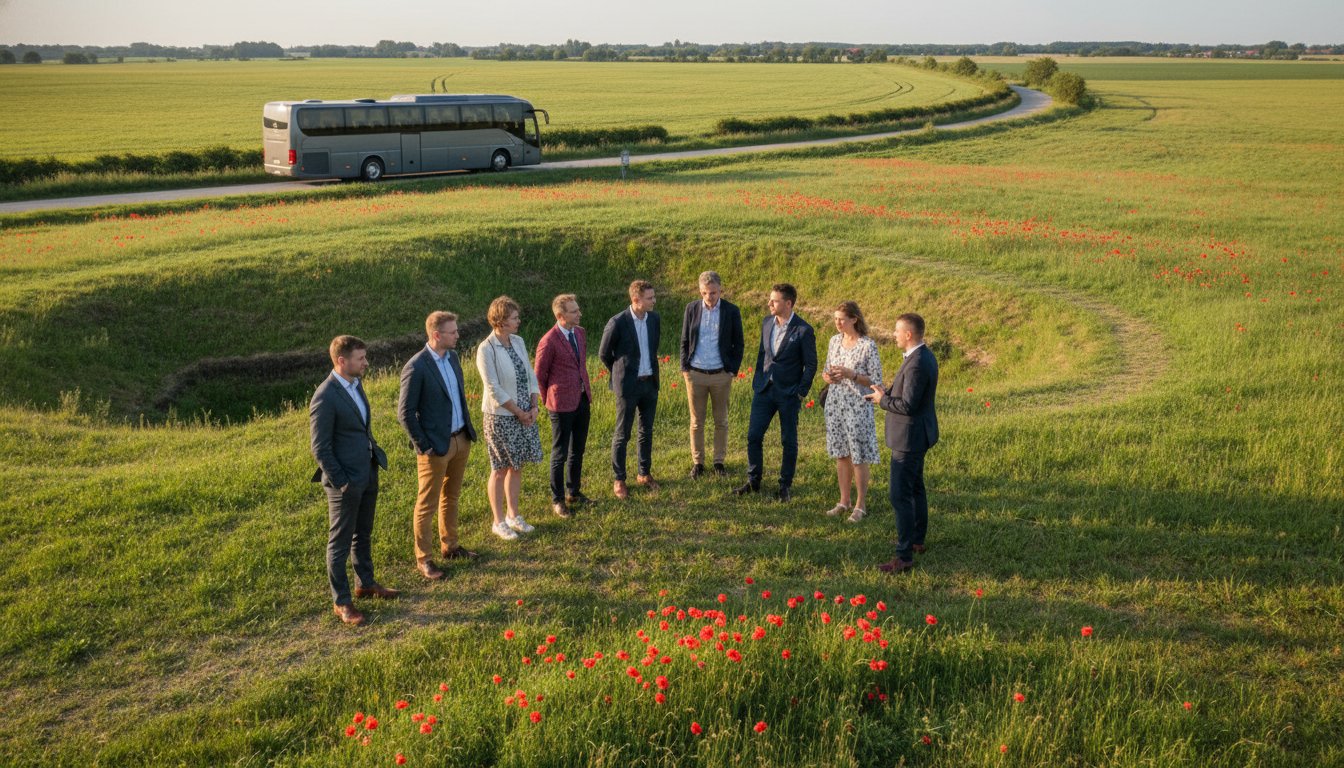
    Nearly 300,000 Australians served on the Western Front, leaving behind a legacy that still breathes through the quiet fields of Belgium and France. For those organizing professional group tours, the australian battlefield trail flanders isn’t just a route on a map; it’s a narrative thread that transforms the landscape into a living classroom. You likely recognize that a pilgrimage of this magnitude requires more than just a list of stops. It demands a sophisticated blend of historical accuracy and logistical grace to ensure the emotional weight of the journey isn’t lost in the details of travel.

    Planning for 2026 requires navigating specific museum schedules and the unique requirements of rural sites like the In Flanders Fields Museum or the Memorial Museum Passchendaele 1917. This guide provides the essential framework to help you master these complexities. We’ll explore the logistical requirements for coach transport, the selection of group-friendly accommodations near the front lines, and the historical depth needed for a truly resonant itinerary. You’ll discover how a professionally managed approach turns complex site management into a seamless, deeply moving experience for your clients.

    Key Takeaways

    • Master the narrative thread of the australian battlefield trail flanders by identifying the essential stops that define the Australian experience on the Western Front.
    • Optimize your 2026 itinerary by leveraging strategic base locations in Flanders to manage complex cross-border logistics with France.
    • Secure high-comfort coach hire and group-friendly accommodations that align with the technical and emotional requirements of a high-end pilgrimage.
    • Elevate your tour’s impact through a reliable local partnership that balances historical precision with flawless operational execution.

    What is the Australian Remembrance Trail in Flanders?

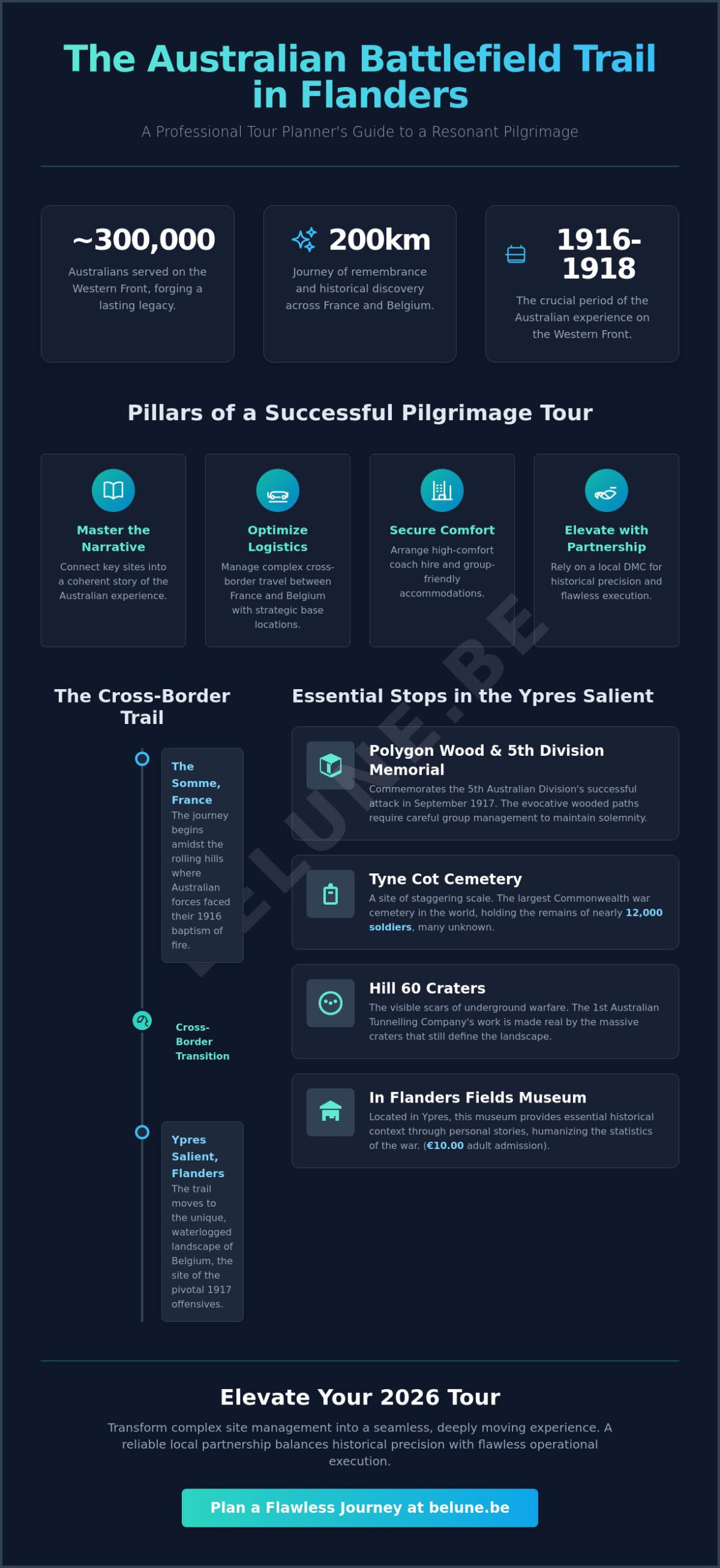
    Memory has a physical presence in the soil of Northern Europe. The Australian Remembrance Trail is a formal commemorative route established to honor Australian service on the Western Front. It represents a deliberate, cross-border effort to preserve the sites where history was forged. Spanning from the Somme in France up through the Ypres Salient in Flanders, this journey offers a structured way to explore the 1916-1918 Australian experience. The trail is a 200km journey of remembrance and historical discovery. For professional groups, the australian battlefield trail flanders serves as a curated tapestry of memory, linking isolated cemeteries, preserved trenches, and world-class museums into a single, coherent narrative.

    The Significance of the Flanders Landscape

    The “Flanders Fields” aesthetic resonates deeply with Australian visitors. There is a haunting beauty in the rows of white headstones set against the low, heavy skies of Belgium. In the Ypres Salient, the Australian Imperial Force (AIF) faced a landscape defined by waterlogged craters and the relentless pressure of high ground. Transitioning from the rolling hills of the Somme to the unique challenges of the Belgian front requires an appreciation for the geography of war. Flanders was a test of technical mastery and human endurance. Grasping this environmental reality is the first step toward understanding the tactical decisions that defined the later years of the conflict.

    A Narrative Approach to Group Itineraries

    A successful group itinerary moves beyond a simple recitation of dates and names. It seeks to illuminate the stories of individual soldiers, giving a face to the vast statistics of the Great War. Curated journeys provide emotional peaks at key locations, such as the Villers-Bretonneux Australian National Memorial, where the narrative of the trail often finds its most powerful expression. Local context is vital for understanding the 1917 offensives. Without it, the complex maneuvers at Menin Road or Broodseinde remain abstract concepts. By grounding the Australian story in the specificities of the Flemish earth, we create an experience that is both technically precise and deeply resonant. This narrative depth ensures the australian battlefield trail flanders remains a vital pilgrimage for generations to come.

    Essential Stops on the Australian Trail in Flanders

    The geography of the australian battlefield trail flanders is remarkably intimate. Unlike the vast, rolling plains of the Somme, the Flemish landscape concentrates its history into a few critical kilometers. This proximity allows for a deep, reflective exploration of the 1917 offensives without the exhaustion of long transit times. Every ridge and wood in this sector tells a specific story of the Australian Imperial Force (AIF) and their technical mastery of a brutal environment.

    Polygon Wood and the Buttes New British Cemetery

    The 5th Australian Division’s successful attack in September 1917 is memorialized at Polygon Wood. The 5th Division Memorial stands as a stark, vertical landmark overlooking the Buttes New British Cemetery. For groups, this site requires careful choreography. The wooded paths are evocative but narrow; managing the movement of a large group through these trails ensures the solemnity of the visit remains intact. The emotional weight of the Dawn Service locations here is profound. When the morning mist still clings to the trees, the landscape looks much as it did a century ago, providing a powerful connection for your clients.

    Tyne Cot Cemetery represents a site of staggering scale. As the largest Commonwealth war cemetery in the world, it holds the remains of nearly 12,000 soldiers. Many are “Unknown” Australians, their headstones bearing only the moving inscription chosen by Rudyard Kipling. Nearby, Hill 60 offers a different perspective on the conflict. Here, the 1st Australian Tunnelling Company engaged in a claustrophobic, underground struggle. The massive craters left by the mines are physical scars that make the technical reality of the war visible to modern visitors.

    The Ypres Salient: A Concentrated Geography of Memory

    The compact nature of the Ypres Salient means your group can transition between sites with ease. This efficiency allows for a more contemplative pace, leaving room for reflection rather than rushing between monuments. Integrating the In Flanders Fields Museum in Ypres provides the necessary historical framework before visiting the sites themselves. The museum, with its adult admission of €10.00, uses personal stories to humanize the statistics of the Great War.

    The day inevitably culminates at the Menin Gate. The nightly Last Post ceremony is a mandatory experience for any group following the Australian Remembrance Trail. It is a moment of communal silence that bridges the gap between the past and the present. To ensure your group experiences these sites with the respect and precision they deserve, consider our tailored battlefield itineraries which balance historical depth with seamless logistical execution.

    The Australian Battlefield Trail in Flanders: A Group Pilgrimage Through History

    Connecting Flanders and the Somme: Cross-Border Logistics

    The narrative arc of the australian battlefield trail flanders doesn’t respect modern administrative borders. It officially begins its journey in the Somme valley of France, specifically at the Sir John Monash Centre in Villers-Bretonneux. This geographical reality makes meticulous cross-border coordination a vital element of professional group planning. Transitioning from the defense of Amiens in 1918 back to the 1917 offensives in Belgium requires a logistical bridge that keeps the historical context clear and the travel experience effortless.

    Strategic base locations are the foundation of a successful multi-day pilgrimage. While the trail spans approximately 200 kilometers, establishing a base in the Flanders region is often the most effective choice for those exploring the australian battlefield trail flanders. It allows groups to immerse themselves in the atmosphere of Ypres while remaining within striking distance of the French sites. This stability is key. It prevents the logistical clutter of daily hotel changes, leaving more room for the quiet reflection these sites demand.

    From Villers-Bretonneux to Ypres

    Linking the 1918 defense of Amiens to the earlier battles in Flanders is essential for a coherent itinerary. We treat the journey between Villers-Bretonneux and Ypres as a narrative progression rather than a simple transfer. This involves incorporating “missing link” stops such as Fromelles and Bullecourt. These sites provide critical context for the Australian experience on the Western Front. By carefully optimizing travel times, we protect groups from “battlefield fatigue.” It’s about finding the right rhythm between intensive historical site visits and the restorative flow of the journey through the countryside.

    Unified Logistics for Multi-Day Pilgrimages

    Consistency is the hallmark of a high-end tour. Utilizing a specialized benelux incoming tour operator provides the regional expertise necessary for such a complex undertaking. We ensure that every component of the trip, from the technical quality of the coaches to the historical depth of the guiding, remains uniform across both the French and Belgian sectors. Coordinating local guides who understand the nuances of both regions is a priority. This unified approach extends to hotel management. Streamlining bookings across two countries for large groups requires a reliable local partnership that understands the specific needs of historical tourism. We handle these technical details so the focus remains entirely on the emotional and educational outcomes for your clients.

    Professional Planning for Battlefield Group Tours

    Expertise in the australian battlefield trail flanders requires more than historical knowledge. It demands a flawless technical infrastructure. For professional planners, the challenge lies in translating a somber pilgrimage into a comfortable, high-end experience. We believe that the quality of transport and the choice of sanctuary at the end of the day are structural components of the journey’s emotional success. A well-managed itinerary allows guests to focus entirely on the narrative without the distraction of logistical friction.

    Coach Hire and Accessibility in Flanders

    The rural roads of Flanders are beautiful but demanding. Navigating these narrow lanes with a private fleet of modern, high-comfort coaches requires both technical skill and local foresight. We ensure that driver hours and route planning align perfectly with the strict timing of the Last Post ceremony in Ypres. Parking at major memorials like Tyne Cot or the Menin Gate can be complex during peak commemorative periods. Our strategies for drop-offs and parking are designed to minimize walking distances for guests while maintaining the flow of the day’s events. This level of detail is essential for groups with varying mobility needs.

    Accommodation Management for Large Groups

    Securing high-quality room blocks during periods like Anzac Day or Armistice is a significant hurdle for many planners. We prioritize hotels that reflect a sense of minimalist elegance and refined comfort. These sanctuaries provide a necessary space for reflection after intensive site visits. Proximity to historic centers is vital. It gives your clients the freedom for evening exploration in Ypres or Arras, where the atmosphere of the past is most palpable. Managing these bookings requires a deep understanding of local hospitality and the foresight to secure space years in advance for the 2026 season.

    Integrating Local Flavors and Culture

    A pilgrimage shouldn’t be defined solely by the weight of history. Including belgium gastronomy tours provides a necessary counter-balance to the somber nature of the trail. We arrange group lunches at historic “estaminets” near the battlefields, where the rustic charm and local cuisine offer a moment of respite. Customizing itineraries with craft beer tastings or artisanal chocolate experiences adds a layer of sensory engagement that enriches the overall journey. Balancing the technical demands of the australian battlefield trail flanders with these cultural highlights creates a truly holistic experience. Partner with our specialists to design your 2026 Australian group pilgrimage.

    Why Partner with a Specialized DMC for the Australian Trail?

    Navigating the australian battlefield trail flanders requires a partner who understands that every detail carries the weight of history. A pilgrimage of this magnitude isn’t a standard tourism product; it’s a profound responsibility. We bring over 20 years of experience in high-quality Benelux group travel to this delicate task. Our role is to act as a bridge between the technical requirements of modern travel and the deep emotional journey your clients expect. We don’t simply manage bookings. We craft an environment where the story of the AIF can be told with the respect and clarity it deserves.

    A deeply professional approach is the only way to mirror the solemnity of the trail. From the initial itinerary design to the final on-the-ground execution, we provide comprehensive support that anticipates the unique challenges of battlefield tourism. By managing all logistical volumes with technical mastery, the australian battlefield trail flanders becomes an artistic and technical masterpiece of travel. This allows your group leaders to focus on the narrative while we ensure the machinery of the tour remains invisible and flawless.

    Our Vision for Battlefield Tourism

    We treat each itinerary as a curated experience rather than a standard package. This is the “Belune touch.” It’s a philosophy that balances technical precision with emotional resonance. We understand that a visit to a cemetery at dusk or a ceremony at the Menin Gate requires a specific kind of atmosphere. Our team works to ensure that the transition between these moments is seamless. We support tour operators in delivering once-in-a-lifetime pilgrimages by providing the high-end infrastructure that discerning clients expect. This commitment to excellence ensures that the legacy of the soldiers remains the central focus of every journey.

    A Strategic Ally in Flanders Fields

    Leveraging our local network allows us to provide insights that standard guides often overlook. We aren’t just a supplier; we’re a strategic ally. Our deep roots in the region mean we can secure exclusive access or identify quiet moments at busy sites that others might miss. This local expertise provides the peace of mind that comes from knowing every logistical detail is managed by experts. Whether it’s coordinating with local authorities for a special wreath-laying or ensuring a private coach can navigate a restricted rural path, we handle the complexities. Partner with BELUNE for your next Australian battlefield tour and experience the difference that professional dedication makes to your 2026 program.

    Crafting the Future of Remembrance

    The landscape of Flanders holds a silence that only deepens with time. Mastering the australian battlefield trail flanders requires more than a map; it demands a vision that respects the technical complexity of large group movements and the artistic weight of historical storytelling. We’ve explored how essential stops like Polygon Wood and the Menin Gate form a narrative thread, and why seamless cross-border logistics are the bedrock of a successful 2026 pilgrimage.

    True excellence in battlefield tourism lies in the invisible details. With over 20 years of Benelux travel expertise and a private fleet of modern, high-comfort coaches, we specialize in high-end B2B group logistics that transform travel into a profound experience. We’re ready to serve as your strategic ally, ensuring every hotel booking and guide selection mirrors the quality your clients expect. It’s time to elevate your next tour from a standard route to a curated masterpiece of remembrance.

    Request Your Custom Australian Battlefield Itinerary for 2026

    Let’s work together to create a journey that honors the past with the precision and grace it deserves.

    Frequently Asked Questions

    What is the best time of year for a group to visit the Australian Battlefield Trail in Flanders?

    Late spring and early autumn offer the most balanced conditions for a professional group pilgrimage. While April is significant for Anzac Day, the months of May, June, and September provide milder weather and longer daylight hours for exploring the australian battlefield trail flanders. These periods avoid the harshest winter weather while ensuring that major museums and memorials are fully accessible and operating on standard schedules.

    How many days are needed to cover the main Australian sites in Flanders and the Somme?

    A minimum of four to five days is recommended to provide a comprehensive and respectful experience. This timeframe allows for two dedicated days in the Somme region and two to three days within the Ypres Salient. It ensures that your group can maintain a contemplative pace, leaving room for emotional engagement at sites like Tyne Cot and the Sir John Monash Centre without the pressure of a rushed schedule.

    Are the Australian battlefield sites in Flanders accessible for large coaches?

    Major memorials and museums are fully accessible, though the rural geography of Flanders requires expert navigation. While sites like the Menin Gate and Tyne Cot have established coach parking, smaller memorials often sit on narrow country lanes. Our private fleet of modern coaches is specifically selected to manage these technical constraints, ensuring that drop-offs and pick-ups are handled with professional precision and minimal walking for guests.

    Can BELUNE arrange specialized guides for Australian military history?

    We provide local guide services with a specific focus on Australian military history to elevate the guest experience. These specialists are experts in the 1916-1918 campaigns and are skilled at weaving individual soldier stories into the broader tactical narrative of the australian battlefield trail flanders. Their expertise ensures historical accuracy for discerning clients and provides the deep context necessary for a meaningful pilgrimage.

    Is it possible to include the Menin Gate Last Post ceremony in every itinerary?

    The Last Post ceremony is a nightly event at 8:00 PM and can be seamlessly integrated into any Flanders itinerary. We structure our logistics, including coach transfers and group dining, to ensure that guests arrive at the Menin Gate with sufficient time to secure a respectful position. It serves as a powerful and mandatory conclusion to a day of remembrance in the Ypres Salient.

    What are the accommodation options for large groups near the Ypres Salient?

    High-quality hotel options for large groups are concentrated in Ypres and nearby historic hubs like Lille or Arras. We manage hotel accommodation that balances the technical needs of group check-ins with the refined comfort required by high-end travelers. Because the 2026 season will see high demand for commemorative dates, we secure blocks of rooms well in advance to ensure central, convenient locations.

    How does a DMC help with cross-border logistics between France and Belgium?

    A specialized DMC acts as a strategic ally by managing the different transport regulations and hospitality standards of both countries. We provide a single point of contact for coach hire, guiding, and hotel management across the border. This unified approach eliminates the complexity of coordinating multiple international suppliers, ensuring regional consistency and a flawless flow for the entire multi-day tour.

    Are there specific sites on the trail dedicated to the Australian 1st, 2nd, 3rd, 4th, and 5th Divisions?

    Each of the five Australian divisions has a dedicated memorial site along the Western Front. The 1st Division is commemorated at Pozières, the 2nd at Mont St Quentin, and the 3rd at Ploegsteert. The 4th Division memorial is situated at Bellenglise, while the 5th Division is honored at Polygon Wood. We can customize itineraries to focus on specific divisional histories based on your group’s particular interests or family connections.

  • WW1 Battlefield Tours for School Groups: A Masterclass in Educational Remembrance

    WW1 Battlefield Tours for School Groups: A Masterclass in Educational Remembrance

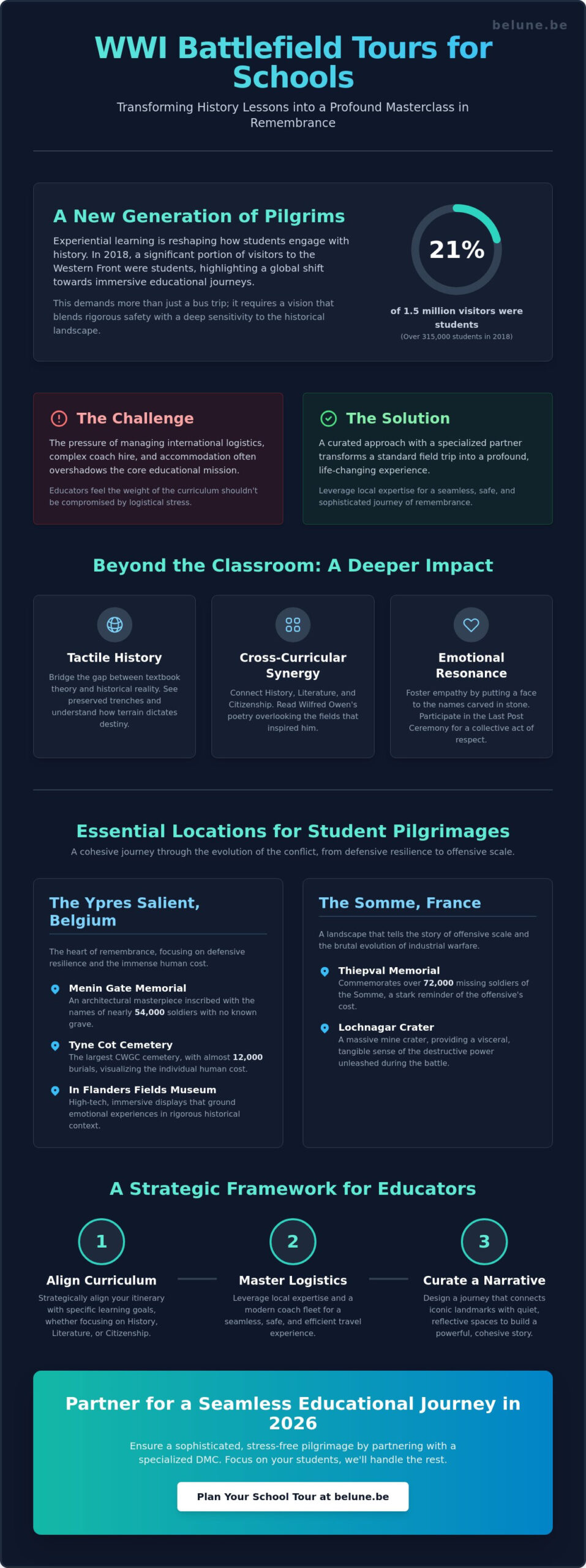
    Did you know that students represented 21% of the 1.5 million visitors to the Western Front in 2018? This striking figure highlights a global shift toward experiential learning, yet organizing ww1 battlefield tours for school groups remains a complex technical craft. It requires more than just a bus; it demands a vision that blends rigorous safety standards with a deep, poetic sensitivity to the history of the landscape.

    We understand that the pressure of managing international logistics can often overshadow the educational intent of the journey. You likely feel that the weight of the curriculum shouldn’t be compromised by the stress of coach hire or accommodation management. We promise to show you how a curated approach transforms a standard field trip into a profound, life-changing masterclass in remembrance. This guide explores the essential components of a successful journey, from high quality transport to expert local guides who bring the silent fields of the Western Front back to life through immersive storytelling.

    Key Takeaways

    • Discover how to bridge the gap between textbook theory and historical reality through curated visits to emotive memorial sites across the Western Front.
    • Master the logistics of ww1 battlefield tours for school groups by leveraging local expertise and a modern coach fleet for a seamless, safe experience.
    • Learn a strategic planning framework to align your itinerary with specific curriculum goals, whether focusing on history, literature, or citizenship.
    • Identify the essential locations in Ypres and the Somme that offer the most profound educational impact for students in 2026.
    • Understand the technical and emotional value of partnering with a specialized DMC to ensure a sophisticated, stress-free pilgrimage.

    Beyond the Classroom: The Educational Impact of WW1 Battlefield Tours

    History often feels like a series of static numbers and monochrome images. For a student, the year 1914 is a distant, abstract concept. Standing on the actual soil where those events unfolded changes everything. This transformation is the core value of ww1 battlefield tours for school groups. It’s where the abstract becomes architectural. The geography of the Western Front isn’t just a map; it’s a living archive of human experience. By analyzing the physical contours of preserved trenches and the placement of artillery, students develop a critical eye for how terrain dictates destiny.

    To better understand how these physical journeys impact learning, watch this helpful video:

    Curriculum Alignment and Key Learning Objectives

    Educators often seek ways to bridge the gap between distinct subjects. These tours offer a rare cross-curricular synergy. When a student reads the poetry of Wilfred Owen while overlooking the very mud that inspired his visceral imagery, the literature gains a haunting clarity. We see history not as an isolated timeline, but as a global event reflected in diverse memorials. From the Indian Memorial at Neuve-Chapelle to the Canadian monument at Vimy Ridge, students grasp the staggering scale of the conflict. They witness the tactical evolution of warfare, observing the shift from 19th-century cavalry maneuvers to the industrial attrition of 1918. This turns a complex syllabus into a visible, tactile narrative.

    The Emotional Resonance of Remembrance

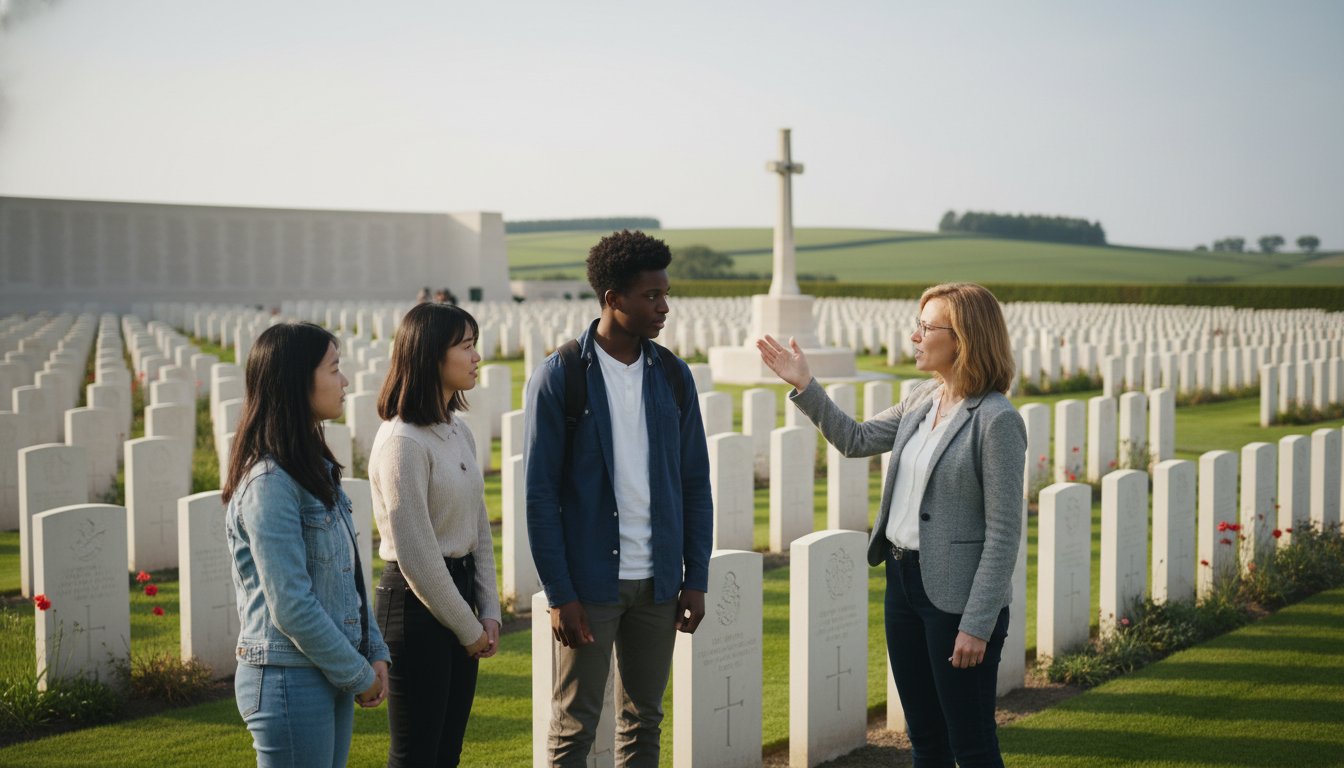
    Beyond the academic, there’s a deeper, more personal dimension. Remembrance is an active, creative process. We encourage students to conduct personal research into their own family histories before the trip. Finding a name on a headstone in a quiet cemetery creates a connection that no textbook can replicate. Participating in the Last Post Ceremony at the Menin Gate isn’t just a scheduled stop. It’s a collective act of respect that resonates long after the bus returns home. In the silence of the cemeteries, students find the space to reflect on citizenship and the cost of peace. These ww1 battlefield tours for school groups foster empathy by putting a face to the names carved in stone, ensuring the lessons of the past are felt as much as they are learned.

    Essential Locations for Student Pilgrimages on the Western Front

    Selecting the right sites for ww1 battlefield tours for school groups is a balancing act between iconic landmarks and quiet, reflective spaces. The geography of the Western Front is a sequence of stories, yet many itineraries fail to connect them with a logical narrative. We view these locations not as isolated stops, but as a cohesive journey through the evolution of the conflict. The success of the UK government’s centenary education programme proved that when students visit these sites in a structured way, their grasp of historical complexity deepens significantly. The transition from the defensive resilience of Ypres to the offensive scale of the Somme provides a clear, visceral framework for learning.

    The Ypres Salient: From Menin Gate to Tyne Cot

    Ypres remains the heart of remembrance in Belgium. The Menin Gate Memorial to the Missing is an architectural masterpiece of loss, its walls inscribed with the names of nearly 54,000 soldiers whose graves are unknown. It’s a powerful introduction to the scale of the war. A short drive away, Tyne Cot Cemetery offers a different perspective. As the largest Commonwealth War Graves Commission cemetery in the world, it holds nearly 12,000 burials. Navigating its rows of white headstones allows students to grasp the individual human cost behind the massive casualty figures. For a high-tech perspective, the In Flanders Fields Museum uses immersive displays to ground these emotional experiences in rigorous historical context.

    The Somme: Thiepval and the Lochnagar Crater

    The landscape of the Somme tells a story of industrial attrition and sacrifice. The Thiepval Memorial stands as a monumental tribute, dominating the horizon with the names of over 72,000 men missing from the 1916 battles. It’s a site that demands silence and reflection. Nearby, the Lochnagar Crater provides a visceral look at the war’s physical legacy. This massive hole in the earth, 91 meters wide, was created by a mine explosion on the first day of the Somme. It serves as a tangible reminder of the sheer power of the weaponry used. At Beaumont-Hamel, the preserved trenches of the Newfoundland Memorial allow students to walk the actual ground where international forces faced impossible odds, bridging the gap between historical maps and physical reality.

    Finding the right balance between these major sites and smaller, hidden memorials is where local mastery becomes essential. For educators seeking a more sophisticated approach to these historical routes, our expertise in battlefield tourism ensures a journey that respects both the curriculum and the students’ emotional journey. Whether it’s a quiet stop at a village cemetery or a visit to a private museum, these smaller moments often provide the most profound insights into the lived experience of the Great War.

    WW1 Battlefield Tours for School Groups: A Masterclass in Educational Remembrance

    The Logistics of Remembrance: Why Local Expertise Matters

    Moving a large group across the historic landscapes of Belgium and France requires more than a map and a schedule. It demands an invisible architecture of technical precision. The emotional depth of ww1 battlefield tours for school groups can only be fully realized when the logistics are flawless. If a coach is late or a hotel check-in is chaotic, the mental space required for remembrance evaporates. We view logistics as a structural component of the educational experience itself. It’s about crafting a serene environment where the only thing a student needs to focus on is the story being told.

    The BELUNE Advantage: Owning the Journey

    Reliability is born from direct control. Unlike many providers who rely on fragmented third-party contractors, we maintain oversight of the entire travel experience through our own fleet of modern coaches. This ownership represents a commitment to safety and comfort that is non-negotiable. It allows us to be agile, adapting to the rhythm of the group in real-time. With over two decades of expertise as a benelux incoming tour operator, we’ve refined the art of group movement across borders. This mastery extends to hotel accommodation management, where we prioritize properties that offer the specific security, spatial requirements, and dietary flexibility necessary for school groups. Every booking is a deliberate choice, intended to support the pedagogical goals of the trip without the friction of logistical uncertainty.

    Professional Local Guidance and Storytelling

    The true value of local expertise lies in the ability to translate the silent landscape for a modern audience. Our local guide services are selected for their rare combination of technical historical knowledge and engaging pedagogical skills. They don’t just recite facts; they weave narratives that resonate with young minds, making the past feel immediate and relevant. These experts are multi-lingual and deeply familiar with the nuances of site access and local regulations, ensuring the journey remains fluid even during peak commemorative periods. By utilizing frameworks similar to those found in ABMC’s WWI educational resources, our guides ensure that every stop has a clear learning objective. Whether it’s a primary school group’s first introduction to the Great War or a senior history class’s deep dive into military strategy, the narrative is always tailored for maximum impact. This seamless coordination between transport, accommodation, and expert guidance is what transforms a simple trip into a profound educational pilgrimage.

    Designing a Curated Itinerary: A Planning Framework for Educators

    Planning ww1 battlefield tours for school groups is an exercise in curation. It’s about more than just a chronological list of stops; it’s about the emotional and intellectual rhythm of the day. A well-designed itinerary balances the weight of historical facts with the mental space required for student reflection. Educators must first define their primary lens. A history-focused tour might prioritize tactical sites and trench geography, while a literature-based pilgrimage seeks out the landscapes that birthed the visceral imagery of war poetry. Citizenship-focused journeys often highlight the diverse international backgrounds of those who served. We believe in a transparent, fixed-price approach. This ensures school boards have absolute budgetary certainty without the friction of hidden costs mid-journey.

    Step-by-Step Coordination with your DMC

    The process begins with deep collaboration. We align every mile with your specific curriculum requirements to ensure the trip is an extension of the classroom. This includes managing hotel accommodation management to ensure safety and dietary standards are met long before the group arrives. We finalize logistics by securing museum entry time-slots that avoid the midday rush, utilizing our private coach hire fleet to maintain total schedule control. This technical precision allows teachers to focus on their students rather than the clock. Every route is mapped to minimize transit times, maximizing the hours spent on the ground where history happened.

    Maximizing the Student Experience

    A masterclass in remembrance requires active engagement. It’s not just listening; it’s doing. We integrate workshops and student-led presentations at specific memorials to deepen the personal connection. This is where sensory history happens. Hearing the profound silence of a cemetery or touching the cold, weathered stone of a monument creates a memory that textbooks can’t replicate. Our local expertise allows us to find unique vantage points away from the typical tourist routes, providing a more intimate atmosphere for your group to process the scale of the sacrifice. Ready to design a journey that resonates? Explore our approach to bespoke battlefield tours for your next school excursion.

    Partnering with BELUNE: Seamless Educational Journeys in 2026

    Choosing a partner for a commemorative journey is a strategic decision. It’s an act of trust. We offer a sophisticated approach to flanders fields pilgrimages that transcends the standard tour model. For educators, ww1 battlefield tours for school groups are not just excursions; they are legacies of understanding. We transform historical data into a vivid, shared human experience. Our fixed-price packages provide absolute clarity, ensuring that quality and educational depth remain the priority from the first consultation to the final mile. This is where technical mastery meets the art of remembrance.

    Our Commitment to Safety and Excellence

    Safety is the silent foundation of every successful trip. We don’t outsource our responsibility. By maintaining our own private coach fleet, we ensure rigorous maintenance standards and total control over student safety. Our experienced Benelux team provides on-the-ground support, acting as an agile ally in the field. We only collaborate with verified hotel partners who specialize in student group hospitality. These properties are selected for their security, spatial logic, and ability to handle complex dietary requirements with professional precision. This commitment to excellence allows teachers to lead with confidence, knowing the logistical infrastructure is flawless.

    Begin Your Group’s Historical Narrative

    Every school brings a unique vision to the Western Front. We leverage 20 years of experience in high-end group travel management to bring that vision to life. As a specialized group travel agency, we bridge the gap between complex international logistics and the poetic resonance of the landscape. We don’t just provide transport; we curate an environment for learning. This is the final step in moving beyond the classroom and into the heart of history. It’s time to create an indelible memory for your students. Request Your Custom Benelux Group Tour Itinerary today and begin the journey toward a truly life-changing educational experience.

    Creating Lasting Legacies through Historical Pilgrimage

    Transforming a syllabus into a profound human experience requires a blend of artistic vision and technical precision. We’ve explored how moving beyond the classroom fosters deep empathy and how the right sites anchor historical narratives in reality. A successful journey depends on the invisible architecture of local mastery. With over 20 years of local DMC expertise, we ensure every logistical detail supports the educational mission. Our private fleet of modern, high-safety coaches and specialized hotel accommodation management provide the security necessary for teachers to lead with peace of mind. Organizing ww1 battlefield tours for school groups is a significant responsibility; it’s a commitment to ensuring the past remains a vivid teacher for the next generation. We invite you to Request your bespoke school group itinerary from BELUNE today and begin crafting a journey that will resonate for a lifetime. Your students don’t just deserve a trip. They deserve a masterclass in remembrance.

    Frequently Asked Questions

    What is the best time of year for a WW1 battlefield tour for school groups?

    Spring and early autumn offer the most balanced conditions for these pilgrimages. March to May and September to October provide milder temperatures and better visibility for landscape analysis. We recommend avoiding peak commemorative dates in July or November if you prefer a quieter, more reflective atmosphere for your students.

    How do you ensure student safety during transport and site visits?

    Safety is managed through direct control of our private coach fleet and rigorous risk assessment protocols. We align with standard safety expectations, including the 1-for-10 chaperone ratio common for school group visits. Every vehicle is maintained to high standards, and our drivers are specifically trained for group travel across the Western Front.

    Can the tour itinerary be customized to match our specific school curriculum?

    Every itinerary is a bespoke creation tailored to your specific curriculum goals. Whether your focus is the poetry of the trenches or the tactical evolution of 1918, we curate the route accordingly. This ensures ww1 battlefield tours for school groups remain academically rigorous and personally relevant to your students’ studies.

    What kind of accommodation do you provide for large student groups?

    We utilize a curated network of hotel partners who specialize in large-scale student group hospitality. These properties are selected for their enhanced security features, spatial logic for group briefings, and flexible dietary management. Our hotel accommodation management team ensures every booking meets the specific safety and comfort standards required by educational institutions.

    Do you assist with the booking of the Last Post Ceremony at the Menin Gate?

    We provide complete coordination for the Last Post Ceremony at the Menin Gate, including registration for wreath-laying. This is a central pillar of many ww1 battlefield tours for school groups, and we manage the technical details to ensure your students can participate with the respect the occasion demands.

    How many students can your coaches accommodate for a single tour?

    Our modern coach fleet includes vehicles of various sizes, typically accommodating between 49 and 57 passengers. This flexibility allows us to manage large cohorts efficiently while maintaining a high standard of comfort. Owning our fleet means we can guarantee the availability and technical condition of the transport for your entire journey.

    Are your guides experienced in working specifically with school-aged children?

    Our local guides are selected for their ability to translate complex history into engaging narratives for younger audiences. They combine deep sector expertise with pedagogical sensitivity, ensuring the content is accessible without losing its historical precision. They’re experts at managing the emotional rhythm of the tour for school-aged children.

    What is included in your fixed-price group tour packages?

    Our fixed-price packages typically include private coach transport, hotel accommodation, local guide services, and museum entry fees. We provide a transparent breakdown of costs to ensure absolute budgetary certainty for your school board. This all-inclusive approach covers the essential logistics, allowing you to focus entirely on the educational experience.

  • WWI Battlefields in Belgium: A Masterclass in Group Remembrance and Logistics

    WWI Battlefields in Belgium: A Masterclass in Group Remembrance and Logistics

    Organizing a pilgrimage to the wwi battlefields belgium is not merely a travel exercise; it’s an architectural feat where technical precision must elevate human emotion. You know that coordinating a coach through the narrow lanes of Ypres or securing a group-friendly hotel that respects the somber nature of the Westhoek requires more than just a booking. It requires a vision. With 365,000 visitors arriving in the Westhoek in 2025, the demand for excellence in remembrance tourism has never been more vital.

    We believe that every detail, from the timing of the 8:00 PM Last Post ceremony to the specific accessibility of Tyne Cot Cemetery, should feel effortless. This article provides the blueprint for orchestrating these journeys with masterclass precision. You’ll discover the definitive 2026 UNESCO site status updates, professional logistical frameworks for coach-based travel, and how a dedicated DMC partner sublimates historical data into a profound human experience. We’re here to help you bridge the gap between complex technical requirements and the quiet, powerful moments your group expects.

    Key Takeaways

    • Navigate the tactical geography of the Ypres Salient to identify landmarks that define the Western Front’s enduring legacy.
    • Tailor your itineraries to specific national narratives, ensuring British, American, and ANZAC groups find deep personal resonance at every stop.
    • Master the technical nuances of navigating the wwi battlefields belgium, from managing sensitive coach access to selecting hotels that respect the journey’s somber tone.
    • Leverage twenty years of regional expertise to transform complex logistics into a seamless, emotionally resonant pilgrimage for your clients.

    The Eternal Echo of WWI Battlefields in Belgium

    The soil of Flanders doesn’t just hold history; it breathes it. The wwi battlefields belgium represent a unique intersection where the echoes of 1914 meet the technical demands of modern travel. For the 365,000 visitors who journeyed to the Westhoek in 2025, these sites serve as a physical bridge between ancestral memory and contemporary peace. This isn’t just tourism. It’s a precise orchestration of remembrance where every stop is a deliberate act of honoring the past through sophisticated planning.

    The Western Front’s presence in the Belgian landscape remains a permanent scar turned into a sanctuary. To grasp the strategic weight of these locations, a look at an Ypres Salient overview reveals how the terrain dictated the lives of millions. Belgium has become the global epicenter for this commemoration because the scars are still visible. They’re preserved with a technical rigour that respects the gravity of the events while allowing modern groups to reflect in silence. Remembrance Tourism has evolved into a specialized sector, blending historical expertise with high-level logistical coordination.

    To better understand the physical reality of this subterranean conflict and its impact on the landscape, watch this insightful exploration of the front lines:

    The Symbolic Power of Flanders Fields

    John McCrae’s “In Flanders Fields” didn’t just capture a moment; it defined a region’s identity for eternity. The poppy, once a simple wildflower, became a universal symbol of sacrifice that still blankets the landscape today. We view this terrain as a living museum. It’s a fragile environment that requires delicate professional handling. Every cemetery and memorial site is a nuance in a larger story of harmony and loss. For tour operators, the challenge lies in sublimating these historical facts into a profound human experience without disturbing the site’s inherent sanctity.

    Why 2026 is a Landmark Year for Pilgrimage

    By 2026, the legacy of the Centenary has matured into a permanent, sophisticated commemorative culture. We’re seeing a distinct shift in visitor behavior. Travelers aren’t just looking for general history anymore. They’re pursuing personalized genealogies and ancestral research, seeking the exact spot where a relative once stood. This deeper connection drives a need for absolute precision. Navigating the wwi battlefields belgium in 2026 requires professional DMC guidance to manage the crowds while maintaining the quiet intimacy required for a private pilgrimage. Our role is to act as the craftsman of this journey, ensuring the logistical framework remains invisible so the emotion can take center stage.

    Mapping the Ypres Salient and Flanders Fields

    The geography of the Western Front is a masterclass in tactical geometry. To understand the wwi battlefields belgium, one must first visualize the Ypres Salient. This wasn’t a straight line. It was a stubborn, vulnerable bulge that pushed into German-held territory, surrounding the city of Ypres on three sides. For four years, this curve of earth became the most contested ground in Europe. Today, the contrast is striking. The once-shattered landscape has transformed into a serene tapestry of Flemish farmland, yet the underlying scars remain preserved for those who know where to look.

    Planning a 3-day group tour requires a focus on the Salient’s most evocative sectors. We prioritize the southern ridge for its panoramic views, the central city for its symbolic weight, and the northern flats for their harrowing stories of attrition. Balancing these sites requires a deep understanding of the local roads. What looks like a short drive on a map can become a logistical challenge for a 50-seater coach navigating rural lanes. For a seamless flow, we recommend aligning your visit with our flanders fields guide to ensure no critical landmark is overlooked.

    The Ypres Salient: A Crucible of History

    Ypres was a focal point. It was a place where the landscape itself became an enemy. The high ground was everything. The Battle of Passchendaele stands as the ultimate testament to this struggle for elevation. Groups shouldn’t miss the In Flanders Fields Museum, located within the reconstructed Cloth Hall. It serves as a high-tech narrative hub, using personal stories to ground the technical scale of the war. Each day concludes at the Menin Gate. Since 1928, the 8:00 PM Last Post ceremony has remained a non-negotiable experience for any pilgrimage. It’s a moment where the technicalities of travel fade into a profound silence.

    UNESCO World Heritage Sites in Flanders

    The year 2026 marks a new era for the region. The recent recognition of 27 funerary and memorial sites as UNESCO World Heritage status has elevated the wwi battlefields belgium to a global stage of preservation. This isn’t just a title. It’s a commitment to protecting the harmony of these sensitive locations. For tour operators, this means stricter access protocols and a need for precise timing. If you’re looking to optimize your group’s itinerary around these protected zones, consider these essential UNESCO landmarks:

    • Tyne Cot Cemetery: The largest Commonwealth War Graves Commission cemetery in the world, holding nearly 12,000 graves.
    • The Menin Gate: A monumental arch inscribed with the names of over 54,000 soldiers whose graves are unknown.
    • Langemark German Cemetery: A somber, wooded site that offers a powerful contrast to the open Commonwealth memorials.
    • Ploegsteert Memorial: Located in the southern sector, honoring those who fought in the woods of “Plugstreet.”

    This global recognition ensures these sites remain living monuments. They require an artisan’s touch to navigate, ensuring that the logistical framework of a group visit never overshadows the historical depth. By prioritizing these sectors, you offer your clients a journey that is both technically flawless and emotionally resonant.

    National Perspectives: Tailoring Tours for Global Groups

    Every nation views the wwi battlefields belgium through a unique cultural prism. It’s not a one-size-fits-all journey. British and Commonwealth visitors often seek the meticulous “English Garden” aesthetic maintained by the Commonwealth War Graves Commission. This design philosophy uses light, soft flora, and uniform headstones to create a sanctuary of harmony. In contrast, American groups often prioritize the bold, neoclassical architecture of their own memorials. For tour operators, understanding these nuances is the difference between a standard trip and a profound pilgrimage. We approach these differences as a craftsman approaches a bespoke project, ensuring the logistical framework supports the specific emotional weight of each nation’s story.

    Ancestral Mapping has become the definitive trend for 2026. Modern groups no longer settle for general history; they demand personal precision. In 2025, archival requests for specific soldier “coordinates” increased by 18% compared to previous years. This technical shift requires tour operators to integrate genealogical data into their itineraries. It’s about finding the exact field where a grandfather stood. This level of customization transforms a coach tour into a deeply personal mission, requiring a DMC partner who can bridge the gap between military records and the physical landscape of Flanders.

    The Commonwealth and the ANZAC Trail

    For British, Australian, Canadian, and New Zealand groups, Tyne Cot Cemetery is the emotional anchor. As the largest Commonwealth cemetery in the world with nearly 12,000 graves, its scale is breathtaking. We also prioritize the Island of Ireland Peace Park in Messines. Its round tower design offers a unique architectural nuance that resonates with groups from both the North and South of Ireland. Coordinating ANZAC Day commemorations on April 25th requires extreme logistical precision. With the 2026 UNESCO status protecting these sites, early booking for coach access is now a technical necessity to ensure your group can participate in the dawn services without disruption.

    American Remembrance: The Flanders Field American Cemetery

    The American narrative in Belgium is often overlooked, yet it’s incredibly powerful. The Flanders Field American Cemetery in Waregem is the only American WWI cemetery in the country. It holds 368 graves of soldiers who fell during the Ypres-Lys Offensive in late 1918. The site’s white Carrara marble headstones and quiet chapel offer a stark, beautiful contrast to the surrounding Flemish countryside. Groups following the American Expeditionary Forces need specialized guides who can articulate the specific US military contributions to the liberation of Belgium. We ensure these tours highlight the unique bond between the US and the local population, a connection that remains vibrant over a century later.

    Orchestrating the Pilgrimage: Logistics for Tour Operators

    Logistics are the invisible architecture of remembrance. When moving large groups through the wwi battlefields belgium, technical precision must remain hidden to allow the emotional narrative to breathe. It’s a delicate balance. A single delay in a 50-seater coach schedule can disrupt the quiet reflection at a cemetery or cause a group to miss the precisely timed 8:00 PM Last Post ceremony. We view itinerary planning as a form of spatial design. Every turn on a rural road and every hotel check-in is a nuance that contributes to the overall harmony of the journey. Professional service fees for this level of coordination aren’t just costs; they’re investments in a seamless, bottleneck-free experience.

    To deliver a truly sophisticated journey, the human element is paramount. Multi-lingual local guides act as the bridge between cold historical data and the human heart. They don’t just recite dates. They interpret the landscape, explaining how the mud of 1917 shaped the architecture of modern Flanders. With 14.9 million visitors arriving in Flanders in 2024, the region is bustling. Navigating this volume requires a strategic partner who understands the rhythm of the Westhoek. If you’re ready to elevate your tour’s technical execution, you should partner with a specialized DMC to ensure every detail is handled with artisan rigour.

    Coach Hire and Transport Logistics

    The narrow, winding lanes of the Ypres Salient weren’t designed for modern tourism. This makes having a private fleet of modern vehicles a critical competitive advantage for a benelux incoming tour operator. Technical mastery of driver hours is essential. For example, a driver’s mandatory rest periods must be meticulously aligned with the late-night return from Ypres after the Menin Gate ceremony. We recommend avoiding the peak “Remembrance season” around November 11th. Instead, consider the late spring or early autumn months when the light sublimates the landscape and site congestion is significantly lower, allowing coaches easier access to sensitive UNESCO zones.

    Group-Friendly Accommodation Management

    Sourcing the right hotel is a matter of atmosphere and geography. We look for properties that understand the somber nature of a battlefield pilgrimage. A group returning from a day of ancestral research doesn’t want a generic, noisy lobby; they need a space that respects their reflection. Strategic placement is key. We prioritize hotels within a 20-minute radius of Ypres to minimize daily travel time and maximize the group’s presence at the sites. As your DMC, we negotiate fixed-price group packages that protect your margins while ensuring your clients receive a high-end, tailored service that feels personal from A to Z.

    Crafting History: The BELUNE Approach to Battlefield Tourism

    We approach history as a material to be shaped. For more than 20 years, our team has acted as the craftsman of light and shadow, transforming the somber landscape of the wwi battlefields belgium into a nuanced journey of remembrance. We don’t just provide a service; we offer a vision. Our expertise in Benelux group travel logistics allows us to sublimate the technical challenges of a tour into an effortless human experience. Every itinerary we design is a bespoke project, built with the same rigour and artistic sensitivity that a visionary architect brings to a landmark building. Our commitment to high-quality B2B partnerships ensures that you have a strategic ally who values excellence as much as you do.

    Our Fixed-price Group Tour Packages are designed to provide absolute clarity and confidence. In an industry where hidden costs can often disrupt a project’s harmony, we offer a transparent framework that protects your margins and respects your clients’ expectations. We believe that professional remembrance tourism requires a delicate balance of technical mastery and emotional intelligence. By choosing to work with us, you aren’t just booking a tour; you’re commissioning a masterclass in historical travel that has been refined over two decades of local operation.

    The Art of the Custom Itinerary

    A list of landmarks is merely a sequence; a BELUNE itinerary is a narrative. We strive for a harmonious flow that respects the gravity of the wwi battlefields belgium while celebrating the resilience of the Flemish spirit. This means integrating local gastronomy and cultural heritage into the journey. A lunch at a traditional estaminet or a visit to a local brewery provides a necessary pause, allowing the group to process the day’s historical depth in a balanced environment. Our travel experts provide cradle-to-grave support, managing every technical nuance from the first draft of the itinerary to the final farewell. This personalized accompaniment ensures that the logistical framework remains invisible, leaving only the emotion of the experience.

    Your Strategic Ally in Western Europe

    Efficiency is the ultimate form of respect for your group’s time. By leveraging our private transport fleet and our network of specialized local guides, you gain a single-point-of-contact for all Benelux and Paris logistics. We handle the complexities of driver regulations, UNESCO site access, and multi-country coordination with technical fail-safety. This streamlined approach allows you to focus on your clients while we manage the rigour of the road. We invite you to transform your vision of a battlefield pilgrimage into a technical and emotional masterpiece. To begin your collaboration with a partner who understands the art of the journey, Request your custom WWI battlefield group itinerary from BELUNE.

    Designing the Future of Remembrance

    Transforming a journey through the wwi battlefields belgium into a profound human experience requires more than just a map. It demands an artisan’s touch. We’ve explored how the technical mastery of the Ypres Salient and the 2026 UNESCO recognition of 27 memorial sites require a sophisticated logistical framework. With 14.9 million visitors arriving in Flanders in 2024, the difference between a standard tour and a masterclass in remembrance lies in the precision of the planning. It’s about creating harmony between the weight of history and the needs of a modern group.

    We invite you to leverage our 20 years of DMC expertise and our private fleet of modern, high-capacity coaches to elevate your next project. We specialize in sophisticated, multi-day itineraries that bridge the gap between historical data and emotional resonance. Let’s collaborate to ensure your group’s pilgrimage is seamless from the first mile to the final Last Post ceremony. Partner with BELUNE for your next professional group tour to Flanders Fields and discover the art of technical excellence in historical travel. Your vision deserves a strategic ally who values precision as much as you do.

    Frequently Asked Questions

    What are the most important WWI battlefield sites to visit in Belgium?

    The Ypres Salient contains the most critical sites for any comprehensive tour of the wwi battlefields belgium. You should prioritize the Menin Gate for its symbolic weight, Tyne Cot Cemetery for its sheer scale, and the Langemark German Cemetery for its somber contrast. The In Flanders Fields Museum in Ypres provides the necessary narrative depth to ground these physical locations in human history.

    Is the Menin Gate Last Post Ceremony open to large groups in 2026?

    The Last Post ceremony remains a daily, public event held at 8:00 PM and is fully accessible to large groups in 2026. There’s no admission fee or reservation required, but groups should arrive at least 45 to 60 minutes early to secure a view. For those wishing to lay a wreath, we recommend coordinating through a local partner to manage the specific protocols and local purchase requirements.

    How far in advance should a tour operator book WWI group accommodation?

    We recommend securing hotel blocks at least 12 to 18 months in advance, especially for travel during peak commemorative months. With 365,000 visitors traveling to the Westhoek in 2025, the demand for group-friendly hotels in Ypres and the surrounding countryside is intense. Early booking ensures you find a location that balances logistical proximity with the quiet atmosphere your clients expect.

    What is the best way to transport a group of 40+ people between Flanders battlefields?

    A modern, high-capacity coach is the most efficient way to move large groups across the wwi battlefields belgium. The region’s narrow rural roads require experienced drivers who understand the local topography and parking constraints at sensitive memorial sites. Using a private fleet ensures your schedule remains fluid and avoids the technical bottlenecks often found with standard public transport or multiple smaller vehicles.

    Can WWI battlefield tours be combined with other Belgian cultural experiences?

    Integrating Belgian gastronomy and medieval heritage creates a more balanced and harmonious itinerary for your group. Many operators combine battlefield visits with brewery tours in the Westhoek or evening excursions to the historic centers of Bruges and Ghent. This approach allows guests to process the somber history of the front line while appreciating the vibrant, living culture that has flourished in Flanders since the war.

    Are the WWI cemeteries in Belgium accessible for people with limited mobility?

    Most major WWI cemeteries and memorials maintained by the Commonwealth War Graves Commission are designed with accessibility in mind. Sites like Tyne Cot and the Menin Gate feature level paths and ramps, though some smaller, original trench sites may have uneven terrain. As your DMC, we verify the specific accessibility nuances of every stop to ensure a seamless experience for every member of your group.

    What is the significance of the UNESCO World Heritage status for Belgian WWI sites?

    The 2026 recognition of 27 funerary and memorial sites as UNESCO World Heritage status provides a new layer of global protection and prestige. This designation confirms these locations as sites of universal value, which often leads to stricter visitor management and enhanced preservation efforts. For tour operators, it highlights the need for precise logistical planning to respect the increased technical requirements for group access to these protected zones.

    How does a DMC help with the logistics of a school or military history group?

    A DMC acts as your technical architect, managing everything from specialized guide sourcing to complex transport manifests. For school or military groups, we align the itinerary with specific educational objectives or regimental histories, ensuring every site visited has direct relevance. Our 20 years of expertise allow us to anticipate logistical challenges before they occur, providing a fail-safe framework that lets you focus on the educational narrative.

  • Benelux Battlefield Tours for Groups: A Masterclass in Remembrance and Logistics

    Benelux Battlefield Tours for Groups: A Masterclass in Remembrance and Logistics

    A pilgrimage to the Western Front is not a mere vacation; it’s a masterclass in architectural memory. For professional tour operators managing benelux battlefield tours for groups of 35 or more, the challenge lies in weaving technical precision with emotional depth. You know that navigating the narrow, rural roads of the Ardennes or the Ypres Salient requires a delicate, expert touch. It’s about more than just moving people. It’s about creating a harmonious space where the history of the 1940s can be felt with absolute clarity. We respect the weight of this task and the need for a bespoke approach that honors every participant’s journey.

    We’ll guide you through orchestrating a journey that bridges the gap between complex multi-country logistics and profound storytelling. This article previews the essential elements of a turnkey itinerary, from securing a private coach fleet to selecting high-capacity hotels that maintain a sense of elegance and nuance. You’ll find the technical rigor needed to transform a logistical puzzle into a seamless, evocative experience of remembrance. We’re here to help you design a pilgrimage that is as logistically flawless as it is spiritually significant.

    Key Takeaways

    • Uncover the strategic layers of the “Cockpit of Europe” through a curated exploration of Flanders Fields and the Ardennes.
    • Navigate the unique logistical challenges of historic rural sectors with a private coach fleet designed for reliability and group flexibility.
    • Elevate your itinerary by balancing somber remembrance with local gastronomy and culture to prevent “museum fatigue.”
    • Secure the success of your benelux battlefield tours for groups by leveraging 20 years of expertise and fixed-price B2B packages.
    • Transform historical pilgrimages into seamless, high-end experiences through the art of professional itinerary design.

    The Benelux Region: A Crossroads of European Military History

    The Benelux region serves as more than a collection of borders. It’s the “Cockpit of Europe.” For centuries, the rolling hills of Wallonia and the flat polders of the Netherlands have dictated the fate of empires. These landscapes witnessed the final defeat of Napoleon at Waterloo in 1815 and the brutal endurance of the Western Front. Planning benelux battlefield tours for groups requires a deep understanding of these overlapping layers. We don’t just visit sites; we interpret the silence of the fields. Every itinerary must balance historical accuracy with a profound respect for the human cost. This is where the expertise of a Destination Management Company (DMC) becomes essential. We transform a list of monuments into a cohesive, emotional narrative that resonates with every participant.

    The Strategic Significance of the Low Countries

    Geography defined the tragedy of the region. The flat terrain of the Meuse valley and the coastal plains of Flanders offered the most direct routes for invading armies. The German Invasion of Belgium (1914) marked a violent transition from 19th-century cavalry charges to the mechanized, industrial slaughter of the 20th century. By 1944, the dense Ardennes forest became the focal point for the Battle of the Bulge, proving that even difficult terrain couldn’t escape the reach of conflict. Today, these sites represent the global epicenter for remembrance. Over 1.2 million people visit the Menin Gate in Ypres annually to hear the Last Post. This density of history demands a technical precision in planning that honors the gravity of the past while ensuring a seamless experience for large parties.

    The Evolution of Battlefield Tourism for Groups

    Group travel has matured significantly over the last 20 years. It’s no longer just about solitary mourning or static displays. Modern benelux battlefield tours for groups focus on “living history” and immersive education. Academic organizations, military units, and heritage societies now seek a sophisticated harmony between reflection and modern comfort. We design journeys that integrate the following elements:

    • High-tech museum experiences like the Bastogne War Room or the In Flanders Fields Museum.
    • Private, bespoke ceremonies at Commonwealth War Graves Commission sites or American Battle Monuments Commission cemeteries.
    • Expert-led discussions on the tactical evolution of warfare from the 1800s to the 1940s.

    Successful tours provide the necessary space for emotional resonance while maintaining a fluid, professional logistical pace. We curate every detail to ensure the history remains the protagonist of the journey.

    Essential Sites for Group Remembrance: From Flanders Fields to the Ardennes

    The Benelux landscape serves as a living canvas, where layers of history intersect with modern geography. Each era demands a specific logistical approach and a unique emotional sensitivity. Designing successful benelux battlefield tours for groups requires a deep understanding of these distinct chapters, from the saturated mud of 1914 to the frozen forests of 1944. The terrain doesn’t just host monuments; it tells a story of resilience and liberation that we must approach with technical precision and artistic reverence.

    WWI: The Immortal Legacy of Flanders Fields

    Ypres stands as the emotional epicenter of the Great War. The In Flanders Fields Museum provides the necessary human context, using interactive technology to bridge the gap between historical data and personal narrative. For groups, the nightly Last Post ceremony at the Menin Gate at 8:00 PM is an essential pillar of remembrance. It’s a moment where collective silence creates a powerful harmony among participants. To truly grasp the visceral reality of the Ypres Salient, we recommend exploring the preserved trenches at Sanctuary Wood. Integrating Flanders Fields into your itinerary ensures a comprehensive understanding of the 1914-1918 conflict, balancing the scale of the cemeteries with the intimacy of the trenches.

    WWII: The Liberation of Western Europe

    The Ardennes region offers a starkly different atmosphere, defined by the dense woods and steep ridges of the 1944 Battle of the Bulge. Bastogne remains the vital stop for Allied groups, where the Mardasson Memorial and the foxholes of Bois Jacques provide a tangible link to the “Greatest Generation.” Further north, the Netherlands hosts the legacy of Operation Market Garden. The bridge at Arnhem and the stretch of “Hell’s Highway” illustrate the daring, often tragic ambition of airborne history. In Luxembourg, the American Cemetery houses 5,076 graves, including that of General Patton. The site’s meticulous design and quiet beauty sublime the weight of sacrifice, making it a necessary stop for benelux battlefield tours for groups seeking a moment of reflection.

    Napoleonic History: The Lion of Waterloo

    Waterloo represents the 1815 campaign that acted as a precursor to modern European cooperation. Managing large groups at the Butte du Lion requires careful timing to avoid the midday rush, but the view from the summit is unparalleled for visualizing the tactical movements of Wellington and Napoleon. The site offers a distinct “art and culture” perspective, especially within the immersive Panorama building. This circular painting captures the chaos of the cavalry charges with a nuance that rivals modern cinematic experiences. It’s a study in how light and perspective can transform military history into a profound aesthetic encounter. If you’re looking to sublime your next group project with expert logistical support, our team provides the technical vision needed to navigate these complex historical sites.

    Logistics serve as the invisible framework for remembrance. Moving forty people through the dense foliage of the Ardennes or the windswept polders of Flanders requires more than a map. It demands a choreography of movement that respects both the history and the participants. Orchestrating successful benelux battlefield tours for groups depends on the seamless integration of transport, shelter, and scholarship. Precision is the ultimate mark of respect for the subject matter.

    Transport Excellence: The Private Coach Advantage

    A private coach isn’t a luxury. It’s a strategic necessity. Relying on third-party transport or fragmented rentals jeopardizes the rigid timing required for commemorative ceremonies. In historic sectors like Bastogne, roads often narrow to less than 3.5 meters. This requires drivers with specific expertise in navigating rural terrain where modern GPS often fails. Modern, high-capacity coaches provide the comfort needed for cross-border travel between Belgium, the Netherlands, and Luxembourg, ensuring the group arrives at sites like the Menin Gate or the Henri-Chapelle American Cemetery exactly on schedule.

    • Reliability: Dedicated fleets eliminate the risk of late arrivals that can ruin a scheduled wreath-laying ceremony.
    • Accessibility: Coaches equipped with modern lifts ensure that older veterans or those with limited mobility can access remote memorial sites.
    • Flexibility: Private transport allows for spontaneous stops when a guide identifies a significant, off-path foxhole or monument.

    Group Accommodation and Hospitality Management

    Selecting the right base of operations is a delicate task. The atmosphere of a hotel must mirror the somber, reflective tone of the itinerary. We prioritize establishments that offer quiet communal spaces for evening briefings and reflection. Managing large groups in regions like the Ardennes, where many villages have fewer than 500 residents, requires deep local roots. During peak periods, such as the 80th anniversary of the Battle of the Bulge in 2024 and 2025, securing room blocks becomes a competitive endeavor.

    This is where the expertise of a benelux incoming tour operator becomes vital. They manage the complex web of dietary requirements and group dining in historic inns that aren’t always equipped for high-volume service. It’s about creating a bespoke experience where every meal and every night of rest contributes to the overall narrative of the tour. Professional management ensures that the focus remains on the history, not the headaches of room assignments or buffet lines. For benelux battlefield tours for groups, the transition from the battlefield to the hotel should feel like a continuation of the masterclass, not a disruption of it.

    Crafting a Meaningful Group Itinerary: Beyond the Trenches

    Designing benelux battlefield tours for groups requires a delicate balance between somber remembrance and the vibrant pulse of local life. The Belune Approach rejects the notion of a dry, academic trek. We view history as a living narrative, one that is best understood when paired with the cultural and culinary identity of the land. Our goal is to sublime the weight of the past through moments of beauty and reflection.

    The Sensory Itinerary: Balancing History and Culture

    History shouldn’t feel like a weight; it should feel like a discovery. We prevent museum fatigue by alternating intensive site visits with sensory pauses. Imagine standing in the dense forests of the Ardennes where the 1944 Battle of the Bulge unfolded, then transitioning into a traditional Belgian beer tasting. These belgium gastronomy tours serve a dual purpose. They provide a necessary moment of reflection while celebrating the very freedom and heritage that was fought for on these grounds.

    In the Netherlands, the history of liberation is etched into the art and architecture of the cities. By integrating culture group tours benelux, we provide the essential context that battlefield sites alone cannot offer. A 90-minute walking tour of Rotterdam’s post-war reconstruction offers a powerful visual testament to resilience. This approach transforms a list of dates into a tangible human experience, ensuring that benelux battlefield tours for groups remain engaging from the first day to the last.

    Bespoke Planning for Diverse Group Profiles

    Every group possesses a unique objective, and our role is to act as a visionary advisor. For school and university groups, our logistics prioritize educational curricula. We focus on the 1940-1945 timeline through interactive storytelling and primary source analysis. These tours are designed to spark curiosity rather than just deliver facts.

    • Educational Focus: Specialized logistics for student groups, emphasizing the 1944 liberation of the Scheldt.
    • Pilgrimage Focus: Tracing specific ancestral footprints for family groups using military records and archival data.
    • Corporate Focus: Leadership and strategy lessons derived from the 1944 Operation Market Garden, focusing on communication and tactical execution.

    Corporate retreats find a different value in these landscapes. The historic battlefields of the Benelux provide a raw, high-stakes backdrop for studying leadership. Analyzing the logistics of the 1944 Ardennes Offensive offers lessons in resilience that remain relevant for modern executive teams. We tailor every detail to ensure the itinerary resonates with your specific mission, whether it’s a deep academic dive or a personal family journey. Our expertise ensures a harmony between the technical requirements of the trip and the emotional needs of the participants.

    Partner with our specialists to design an itinerary that honors the past while inspiring the future.

    Partnering with BELUNE: Your Specialist DMC for Benelux Group Tours

    Mastering benelux battlefield tours for groups requires a partner who treats logistics as a fine art. BELUNE brings over 20 years of experience to the “art of the itinerary,” where we meticulously balance historical gravity with modern comfort. For our B2B partners, we provide the essential security of fixed-price group packages. This financial stability is vital in a fluctuating market. We handle the complexities of multi-border travel, ensuring an all-inclusive experience from A to Z. It’s a commitment to excellence that allows you to present a flawless product to your clients. Our team focuses on the nuances, from the precise timing of a wreath-laying ceremony to the selection of a hotel that reflects the region’s heritage.

    We don’t just coordinate transport; we orchestrate a narrative flow that respects the solemnity of the sites. This professional approach is why travel agents across the globe trust us to represent their brand in Belgium, the Netherlands, and Luxembourg. We act as an extension of your team, providing the technical rigor needed for high-stakes group travel.

    The DMC Advantage: Local Expertise, Global Standards

    We function as a visionary creator for your group travel brand. Our role goes beyond the standard duties of a Destination Management Company. We provide a sophisticated multi-lingual guide network and 24/7 on-the-ground support. This ensures that every group feels supported and inspired throughout their journey. By choosing BELUNE, you’re partnering with the ultimate group travel agency for Western European excellence. We understand that a battlefield tour is a journey through time. We use our local expertise to navigate the technical challenges of the Benelux region, allowing the emotional and historical narrative to take center stage. Our approach is artisanal. We tailor every project to meet the specific aesthetic and educational goals of your organization, ensuring harmony between the itinerary and the traveler’s expectations.

    Next Steps: Designing Your 2026 Battlefield Program

    The year 2026 represents a pivotal moment for remembrance travel. It marks the 81st anniversary of the liberation of Western Europe, a time when interest in these hallowed grounds will peak. Designing your 2026 benelux battlefield tours for groups requires early collaboration to secure the best guides and prime locations for ceremonies. Our expert team is ready to help you craft a bespoke itinerary that stands out in a crowded market. We invite you to request a custom proposal for your next group. Let’s work together to create a program that honors the past while providing a world-class experience for the modern traveler. We ensure availability for major anniversaries, giving your clients the opportunity to be part of history.

    Honoring the Past with Technical Excellence

    Creating a meaningful pilgrimage to the Western Front or the Ardennes requires more than a simple itinerary. It demands a delicate balance between historical reverence and logistical mastery. From the silent memorials of Flanders to the dense forests of the Ardennes, the Benelux region serves as a profound classroom for collective memory. Successfully managing benelux battlefield tours for groups involves navigating complex border crossings and coordinating large-scale site access. We transform these challenges into a seamless experience through 20 years of specialized DMC expertise. Our private fleet of modern coaches provides the comfort your guests deserve, while our specialized B2B fixed-price packages ensure transparent planning from the start. We act as your visionary partners, crafting a journey where every detail reflects a commitment to excellence. It’s time to turn these historic landscapes into a lasting legacy for your travelers.

    Request your bespoke Benelux group tour itinerary from BELUNE

    We look forward to bringing your vision of remembrance to life with the precision and respect it deserves.

    Frequently Asked Questions

    What are the best battlefield sites in the Benelux for large groups?

    The Menin Gate in Ypres, the Bastogne War Museum, and Arnhem’s John Frost Bridge represent the most impactful sites for large groups. These locations offer the spatial capacity required for 50-person coaches and provide immersive educational facilities. We design these visits to ensure a harmony between historical depth and modern accessibility, allowing for a profound collective experience.

    Our selection focuses on sites where the infrastructure supports groups of 40 or more without sacrificing the intimacy of remembrance. Locations like the Tyne Cot Cemetery provide the necessary scale for reflection while maintaining a sense of individual connection to the past.

    How far in advance should I book a group battlefield tour in Belgium?

    You should book your tour 9 to 12 months in advance to secure preferred dates and premium accommodation. Demand for historical sites in Belgium peaks during the spring and autumn months. Data from local tourism boards shows that 85% of specialized group hotels in Ypres reach full capacity a year before major anniversaries.

    Early planning is essential for coordinating bespoke logistics and securing expert guides who specialize in specific regiments or battles. It’s the only way to ensure every nuance of your itinerary is perfectly aligned with your group’s expectations.

    Can you provide multi-lingual guides for international group tours?

    We provide accredited guides fluent in English, French, Dutch, and German to accommodate international delegations. Our team acts as a visionary bridge between cultures, translating complex military history into a shared human experience. This bespoke approach ensures every participant feels a personal connection to the landscape regardless of their native tongue.

    Each guide is chosen for their ability to blend technical accuracy with evocative storytelling. They don’t just recite facts; they transform the environment through their mastery of historical narrative and linguistic precision.

    Is it possible to combine WWI and WWII sites in a single 5-day itinerary?

    A 5-day itinerary seamlessly integrates WWI and WWII history by splitting time between West Flanders and the Ardennes. You can spend 48 hours exploring the Ypres Salient before traveling to Bastogne for the final 72 hours. This structure is a hallmark of our benelux battlefield tours for groups, offering a complete narrative of 20th-century conflict.

    By using a central hub or a logical linear route, we minimize travel time and maximize the emotional impact of each site. It’s a sophisticated way to witness the evolution of warfare and the enduring spirit of the region.

    Do you handle hotel bookings and transport for groups larger than 40 people?

    Our team manages all logistics for groups of 40 or more, including 50-seater executive coaches and block hotel reservations. We partner with established venues like the Ariane Hotel in Ypres to ensure your stay is refined and stress-free. Every detail is curated to provide a professional experience where the logistics disappear into the background.

    We act as your strategic ally, overseeing everything from luggage transfers to dietary requirements. This all-encompassing service allows group leaders to focus entirely on the commemorative aspect of the journey.

    What is the best time of year to visit Flanders Fields with a group?

    April through June offers the most temperate conditions and evocative lighting for visiting Flanders Fields with a large party. While November 11th holds immense symbolic weight, the spring months provide a 30% increase in daylight hours for outdoor exploration. This timing allows for a more nuanced appreciation of the landscape’s transformation and natural beauty.

    September and October are also excellent choices, offering a crisp atmosphere that suits the somber nature of the sites. Avoiding the peak summer heat ensures your group stays comfortable during long walks through the trenches and cemeteries.

    How do you handle the Last Post ceremony logistics for tour groups?

    We coordinate directly with the Last Post Association to manage your group’s presence at the 8 PM ceremony under the Menin Gate. Groups wishing to lay a wreath should submit their request at least 6 months before their arrival date to ensure inclusion in the official program. We handle the technical timing to ensure your party arrives with the quiet dignity this ritual requires.

    Our guides provide a detailed briefing before the ceremony, explaining the history and protocol of the event. It’s a moment of profound harmony that requires expert management to be truly felt.

    Are there specific grants or supports for school groups visiting battlefields?

    School groups can often access financial support through regional initiatives like the Flemish Government’s “Vlaanderen Herdenkt” program. Certain educational grants can cover up to 50% of transport costs for qualifying institutions visiting the Westhoek region. We act as a consultant, helping you navigate these administrative requirements to make remembrance accessible to the next generation.

    Beyond government aid, various veterans’ associations and historical societies offer bursaries for specific commemorative projects. We’ll help you identify these opportunities to ensure your educational goals are met with the necessary financial backing.