Tag: battlefield tours

  • The Strategic DMC Partner in Benelux: Elevating Group Travel in 2026

    The Strategic DMC Partner in Benelux: Elevating Group Travel in 2026

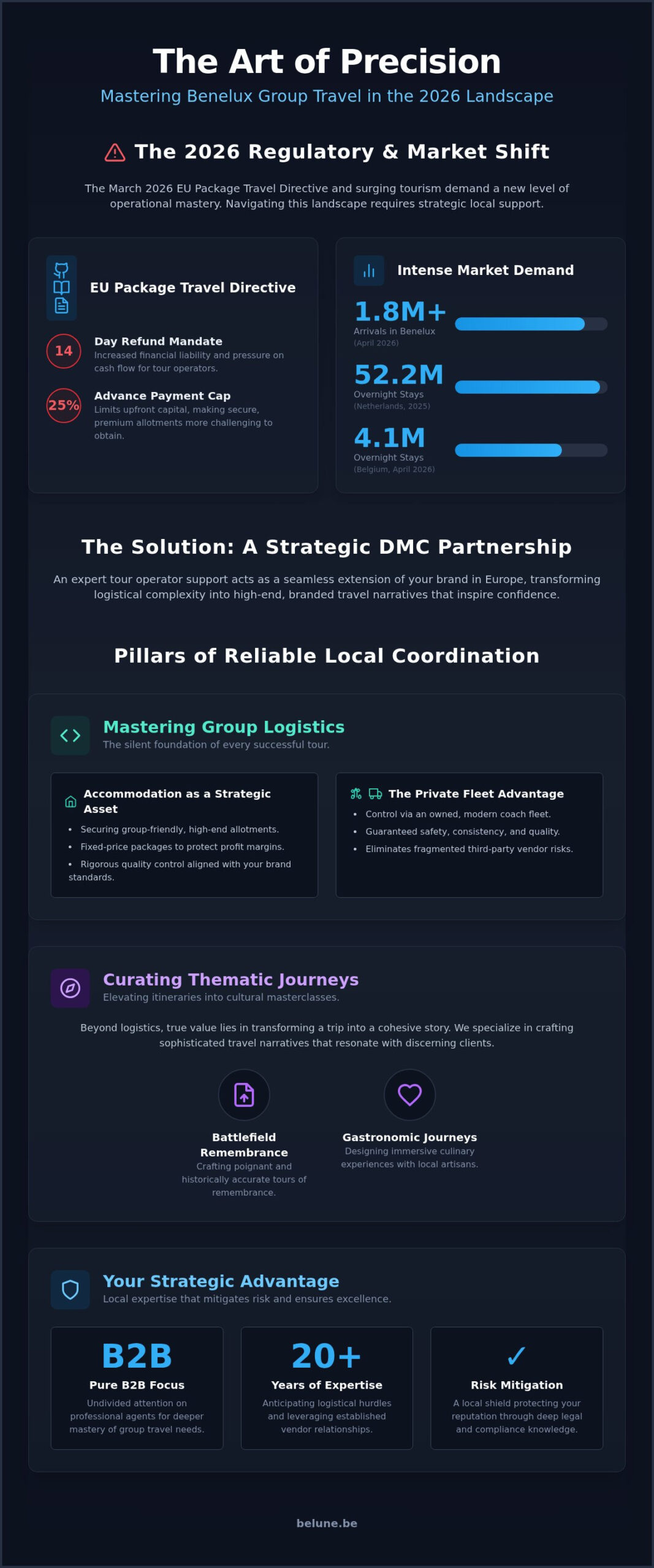
    By 2026, over 65% of high-end group travelers will prioritize seamless, borderless movement over traditional sightseeing. You understand that navigating the logistical nuances between Brussels, Amsterdam, and Luxembourg City requires more than just a booking agent. Fragmented communication and the 15% variance in quality among third-party coach providers often create unnecessary friction for your guests. Finding a dedicated dmc partner benelux is the only way to harmonize these moving parts into a single, elegant experience.

    We’re here to show you how a sophisticated partnership secures your margins through fixed-price itineraries while granting you exclusive access to a private, premium coach fleet. It’s about moving beyond simple transport to create a bespoke journey that reflects your brand’s commitment to excellence. This article explores how a single point of contact simplifies complex routes and elevates specialized sectors like the 1944 Ardennes battlefield tours into profound, high-yield memories. Discover the technical precision and artistic touch needed to master the Benelux landscape from a visionary perspective.

    Key Takeaways

    • Master the complexities of cross-border logistics by leveraging a vision that harmonizes cultural nuances with technical precision.
    • Uncover the strategic potential of the Benelux-Paris triangle, a geographic footprint designed to elevate the fluidity of your group itineraries.
    • Identify the operational security provided by an asset-based dmc partner benelux, where private fleet ownership ensures a standard of excellence and reliability.
    • Transform standard travel into high-yield experiences by weaving thematic narratives through battlefield heritage and artisanal gastronomy.
    • Align your business with a collaborative approach that treats every itinerary as a masterpiece of tailor-made group travel.

    Defining the Role of a DMC Partner in the Benelux Region

    Travel is a composition of light, shadow, and movement. In 2026, the role of a Destination Management Company (DMC) has shifted from simple logistics to a form of architectural curation. For the professional travel trade, a dmc partner benelux acts as the master architect of an itinerary. We don’t just book rooms. We design environments where every transition is seamless and every moment feels intentional. The modern traveler is exhausted by the cold, algorithmic suggestions of digital platforms. A January 2026 industry report found that 84% of high-net-worth clients now prioritize human-led curation over automated bookings. They seek the nuance that only local expertise can provide.

    The Benelux region represents a complex tapestry of three nations, four official languages, and 74,640 square kilometers of dense history. Managing cross-border logistics here requires more than a map. It requires a deep understanding of the subtle cultural shifts between a private dinner in a 17th-century Amsterdam canal house and a corporate retreat in the Ardennes forest. BELUNE serves as the bridge. We transform the logistical friction of multi-country travel into a fluid, elevated experience. We’ve evolved from a provider into a strategic growth partner. This means we focus on your long-term success by protecting your brand and ensuring your clients return with memories that linger long after the journey ends.

    The Value of Local Ground Handling

    Ground handling is the invisible foundation of a successful tour. It involves navigating the strict 2025 urban mobility regulations in historic centers like Ghent or Bruges. We manage the delicate balance of group-friendly access in pedestrianized zones. Our team mitigates risk by vetting 100% of local suppliers against current EU safety and sustainability benchmarks. When a sudden rail strike occurs or a private museum opening is delayed, we’re the ones on the ground. We resolve emergencies before the client even senses a ripple in their schedule. This level of protection is essential for international tour operators who can’t be present in every time zone.

    B2B vs B2C: Why Specialization Matters

    BELUNE operates exclusively within the professional travel trade. We don’t compete with our clients for direct bookings. This commitment to a B2B-only model ensures that your relationship with your customer remains sacred. We provide white-label service where our expertise is your secret weapon. Our fixed-price structures are designed to protect your margins. In a 2025 financial audit of our top partners, we found that working with a dedicated dmc partner benelux reduced their operational overhead by 12%. We provide the technical rigor and artistic vision needed to transform a standard trip into a bespoke masterpiece. This specialization allows you to scale your business with confidence, knowing that your reputation is held in expert hands. Just as we provide specialized operational support, many successful entrepreneurs also leverage broader business consulting to achieve their goals, with Belgian firms like Full Potential helping SMEs realize their growth ambitions.

    The Benelux-Paris Triangle: A Strategic Footprint for Group Itineraries

    The geography of Western Europe dictates a specific rhythm for high-end group travel. By 2026, the travel industry anticipates a 15% rise in regional depth tours, where travelers prefer to savor the nuances of a culture rather than checking boxes on a map. This “Slow Travel” movement finds its perfect expression in the synergy between Belgium, the Netherlands, Luxembourg, and Northern France. Paris isn’t just a neighboring city; it’s the natural emotional and logistical extension of a Benelux journey.

    Selecting a dmc partner benelux requires an ally who understands these invisible threads. We view the region as a single, harmonious space where borders are merely invitations to discover a new dialect or architectural style. Recent EU tourism statistics highlight that cross-border travel within this specific triangle remains one of the most resilient sectors in the industry. This data confirms that the strategic value of this region lies in its density of experience. It’s about maximizing the “moments per mile” for every guest.

    Our headquarters in Dottignies functions as the pulse of our operations. This location isn’t accidental. It’s a strategic hub that allows us to reach Lille in 20 minutes, Brussels in 60, and Paris in less than 2 hours. This proximity reduces transit fatigue, ensuring that groups spend their energy on inspiration rather than asphalt. We optimize travel times to create a sense of space and reflection, turning a standard transfer into a scenic transition.

    Regional Highlights: Brussels, Amsterdam, and Beyond

    The “Big Three” capitals provide the architectural skeleton of any itinerary, but the soul is found in the transitions. We guide groups through the medieval light of Ghent and the dramatic cliffs of Dinant, ensuring a balance between urban intensity and rural serenity. Luxembourg serves as an essential destination for our most discerning partners, offering a level of high-end cultural depth that 88% of first-time visitors find surprisingly sophisticated. Paris acts as the ultimate gateway, providing seamless transfers that tie the entire Benelux heartland together in a single, elegant narrative.

    Cross-Border Logistics Simplified

    Managing a multi-country itinerary often creates friction when multiple suppliers are involved. We remove this complexity by acting as a single point of contact. Our team’s mastery of French, Dutch, and English ensures that every nuance of a client’s request is preserved across borders. Modern coach travel remains the backbone of our logistics, offering a refined, mobile environment for exploration. We handle the technical precision so you can focus on the vision. Our goal is to transform travel into a tailor-made architectural experience that feels effortless from start to finish. We don’t just move people; we curate their journey through a landscape of light and history.

    Asset-Based Logistics: Why Private Coach Ownership Redefines the DMC Partnership

    The distinction between a broker and an asset-based partner is the difference between a promise and a guarantee. Most organizations functioning as a dmc partner benelux operate on a brokerage model. They outsource transport to third-party providers, adding layers of cost and uncertainty. BELUNE breaks this cycle. We own our fleet. This control allows us to offer price stability that brokers cannot match. Since January 2024, our partners have benefited from fixed rates that remain immune to the 15 percent seasonal fluctuations common in the sub-contracting market.

    Our commitment to excellence extends to the air we breathe and the paths we travel. By 2026, urban mobility regulations in cities like Amsterdam and Brussels will become significantly more restrictive. Our fleet is 100 percent Euro 6 compliant, ensuring seamless access to low-emission zones. We don’t just provide a ride; we provide a future-proof logistics solution. This technical mastery ensures that your group’s itinerary remains uninterrupted by changing local laws. It’s a sophisticated approach to travel that prioritizes both the environment and your peace of mind.

    The BELUNE Fleet Advantage

    Luxury is felt in the subtle details. Our coaches feature ergonomic leather seating, high-speed connectivity, and climate control systems that maintain a constant 21 degrees Celsius regardless of the weather outside. The driver is the heartbeat of the experience. They aren’t just operators; they’re brand ambassadors trained in high-end hospitality. Having our own wheels means we can pivot instantly. If a sunset in the Ardennes lasts longer than expected, our drivers have the autonomy to adjust the schedule. We prioritize harmony over rigid logs, allowing the journey to breathe.

    Addressing the Reliability Objection

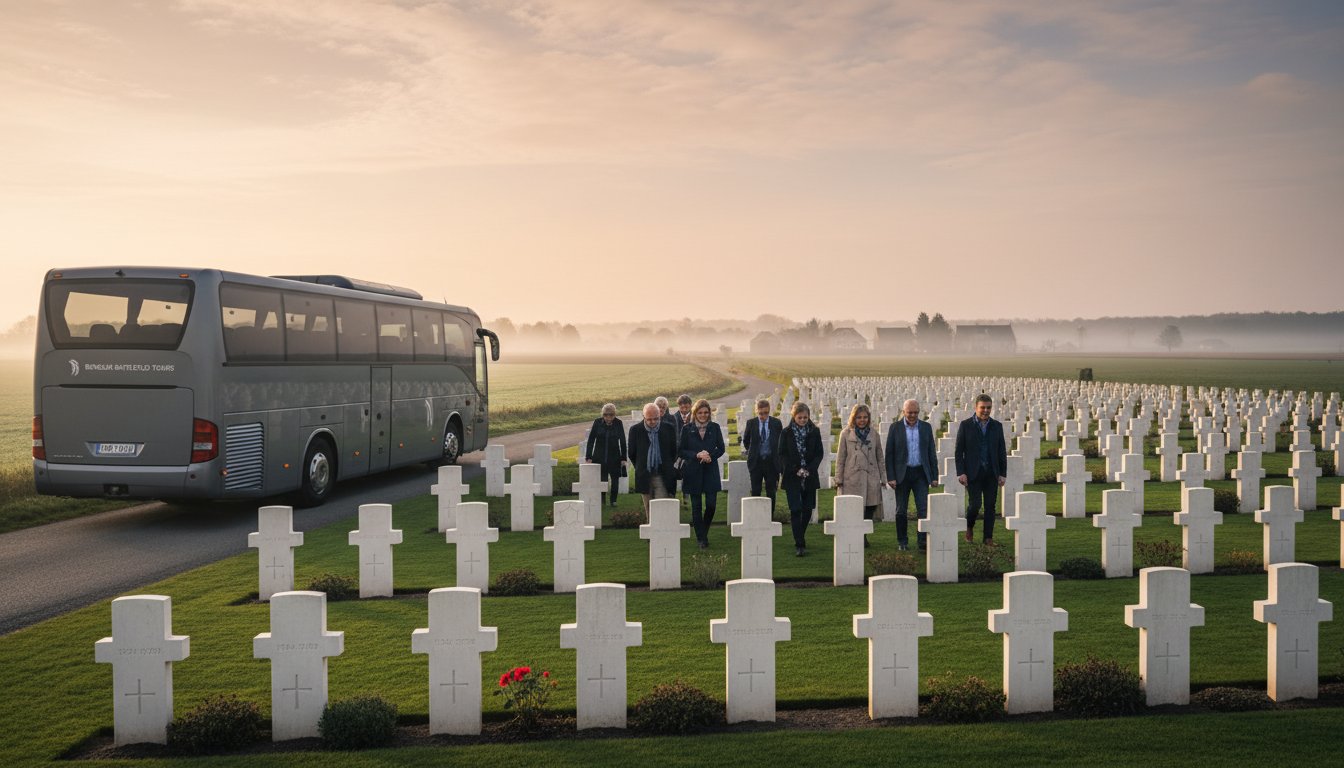
    Sub-contracting is a trap. It leads to inconsistent vehicle quality and varying safety standards. We’ve seen how a single mechanical failure from an unvetted third party can derail a three-day incentive trip. To prevent this, BELUNE maintains an in-house workshop where every vehicle undergoes a 50-point safety check every 14 days. This rigor is essential when visiting sensitive historical sites. For instance, during a heritage tour to the Flanders Field American Cemetery, the transport must be as respectful and reliable as the destination itself. We treat the journey as a sacred extension of the site visit.

    Consider a project from March 2024 involving a 300-person corporate summit. While a broker would’ve struggled to coordinate five different transport companies, we deployed our dedicated fleet with a single point of contact. This streamlined approach reduced boarding times by 22 minutes per transfer. It’s about efficiency wrapped in elegance. Choosing the right dmc partner benelux isn’t just about the destination. It’s about the technical precision and the quiet confidence that comes from owning the entire experience. We remove the friction so the beauty of the region can shine through.

    Crafting High-Yield Thematic Tours: From Battlefield Heritage to Gastronomy

    Thematic travel will drive 42% of European group bookings by 2026. This shift marks the end of the generic “highlights” tour. High-yield travelers now demand specialized narratives that resonate on a visceral level. As your dmc partner benelux, BELUNE approaches itinerary design like an architect. We don’t just schedule stops; we curate the flow of light, emotion, and historical depth to ensure every moment feels intentional. Every tour is a bespoke construction, balancing technical precision with artistic flair.

    Battlefield Tourism: A Specialized Niche

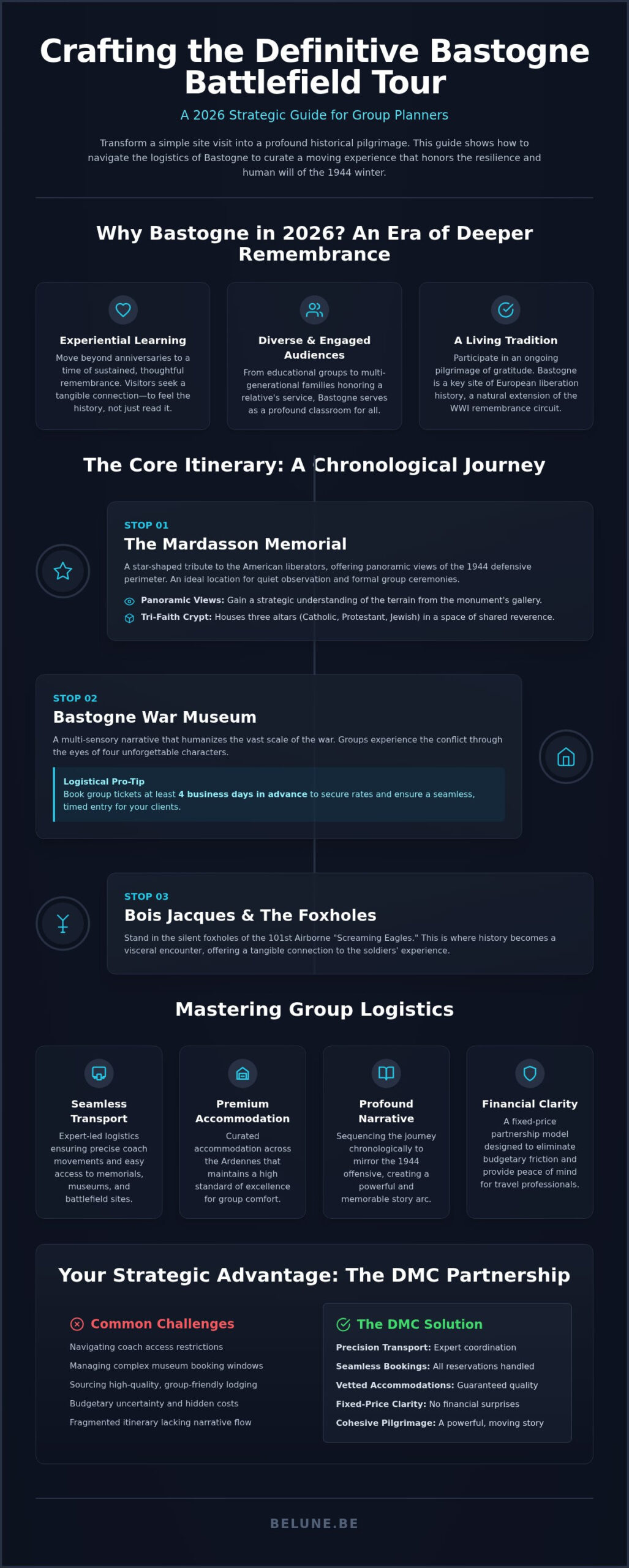
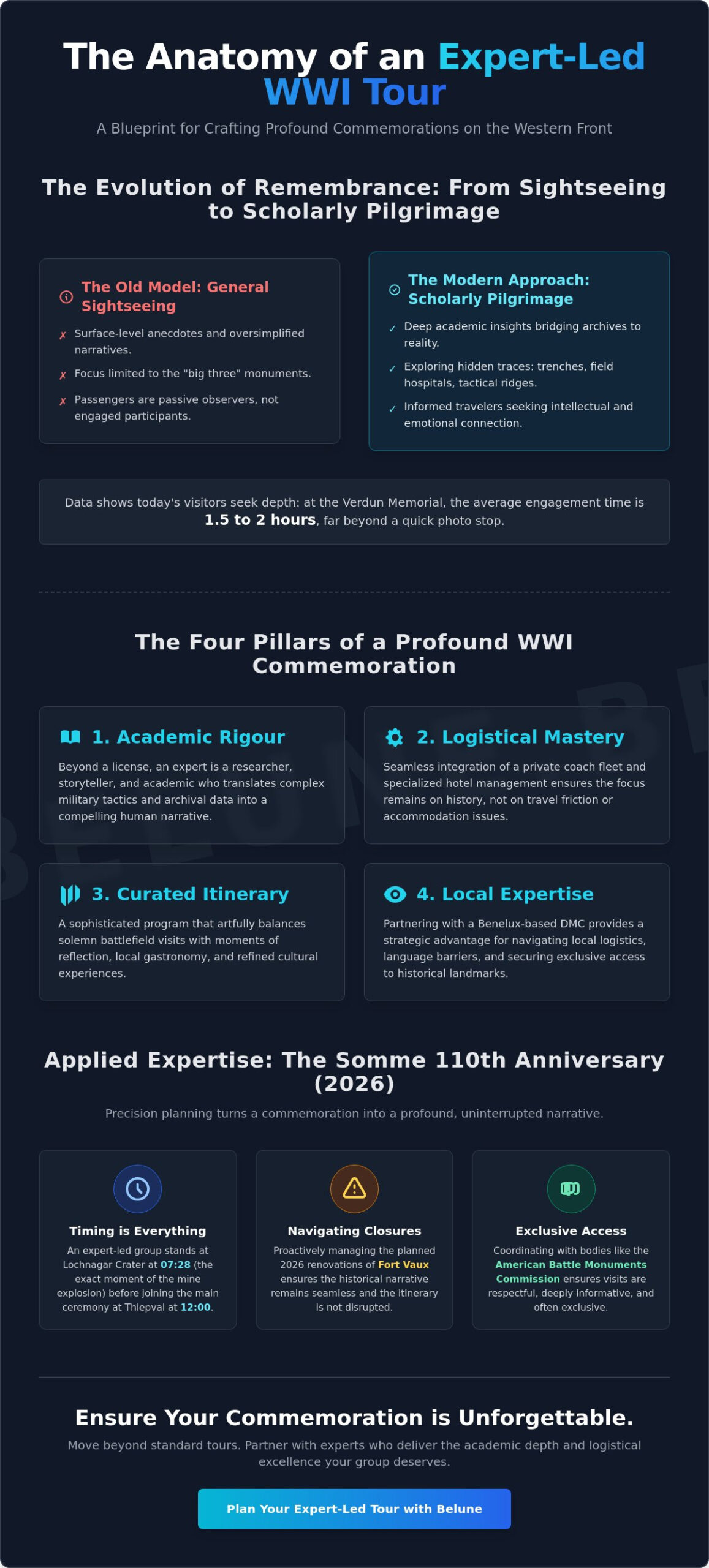
    The Ypres Salient and the Ardennes aren’t just coordinates on a map. They’re landscapes of deep emotional resonance. For the 2024-2026 commemorative cycle, expert guides are essential to navigate the complex history of the Battle of the Bulge and Flanders Fields. We manage the distinct logistical requirements of school groups, who need interactive 100-minute workshops, versus veteran descendants seeking quiet reflection at specific GPS coordinates. Through our local network, we secure access to private 1914-1918 bunkers on family farmlands and restricted archives that remain closed to the general public.

    • Expertise: Accredited historians specializing in the 1944-1945 Ardennes Offensive.
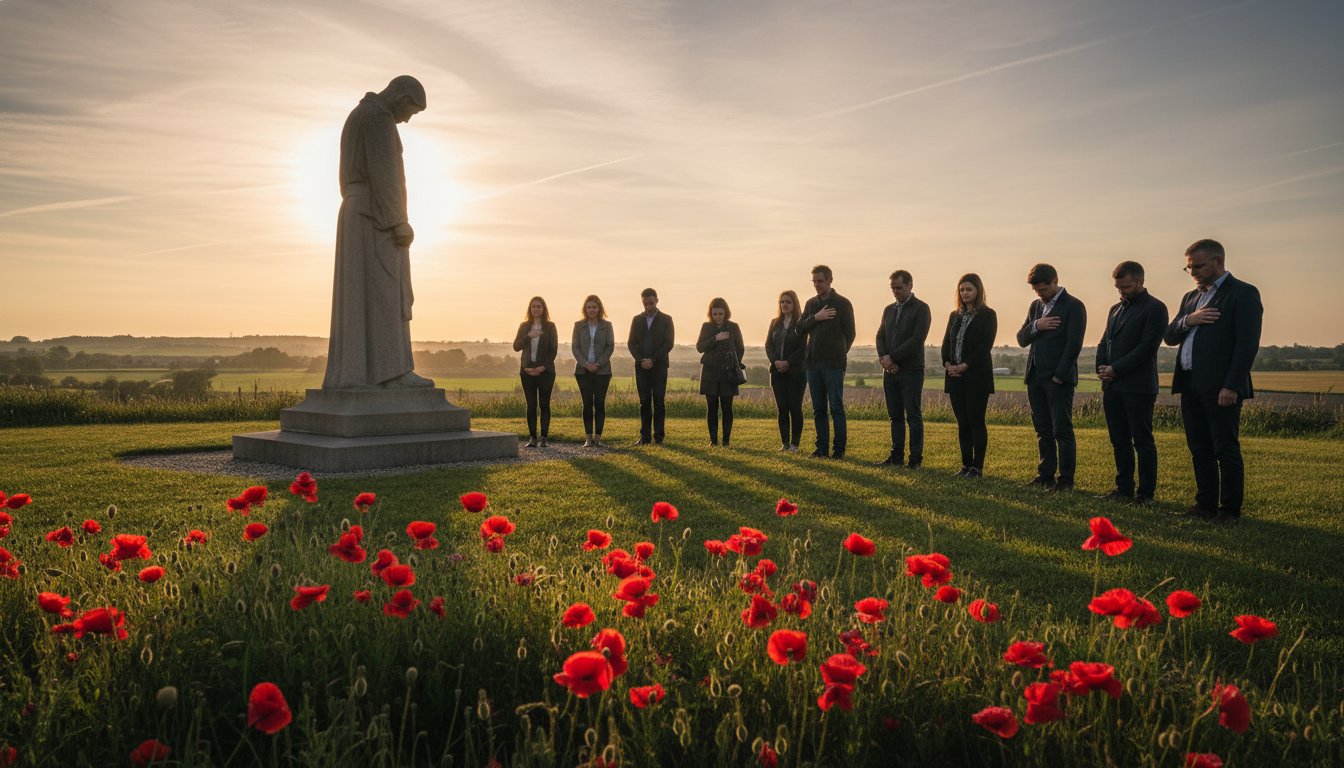
    • Exclusivity: Private wreath-laying ceremonies at the Menin Gate.
    • Precision: Specialized transport for groups with limited mobility in rural heritage sites.

    Art, Culture, and the “BELUNE Tone”

    We view architecture as a living material. In Brussels, Art Nouveau isn’t a museum exhibit; it’s a study in shadow and organic form. Our tours of Victor Horta’s 1893 masterpieces prioritize the “BELUNE Tone,” where we analyze how natural light transforms interior spaces. In Amsterdam, we move beyond the Rijksmuseum crowds. We arrange private evening access to the Dutch Masters, allowing guests to witness the interplay of light and texture without distraction. These money-can’t-buy moments, such as glass-blowing workshops in 17th-century ateliers, turn a trip into a legacy.

    Gastronomy has evolved into a luxury educational niche. It’s no longer sufficient to offer a simple tasting. By 2026, travelers want to understand the chemistry of the 1,500 Belgian beer brands and the precise tempering of 70% dark cocoa. We facilitate masterclasses with “Master of Malt” experts and award-winning chocolatiers. These sessions focus on the nuance of flavor and the heritage of the craft, elevating a meal into a sensory education. It’s about the harmony between tradition and modern innovation.

    Success in the Benelux market requires a partner who understands that luxury is found in the details. Whether it’s the specific lighting of a private gallery or the logistical timing of a commemorative parade, we handle the complexity so you can focus on the client. Our role as your dmc partner benelux is to be the visionary artisan behind the scenes, ensuring every project is executed with flawless technical rigor.

    Ready to elevate your group offerings for the upcoming season? Partner with BELUNE to design your thematic itinerary and transform travel into an art form.

    Strategic Collaboration: How to Integrate BELUNE into Your Supply Chain

    Integration is an art form. It requires more than just a signed contract; it demands a shared vision of excellence. When you choose a dmc partner benelux, you’re seeking a bridge between your brand’s promise and the reality on the ground. BELUNE facilitates this through a streamlined onboarding process. It starts with an initial inquiry, answered within 24 hours. From there, we move to a deep-dive consultation where we analyze your target demographic’s preferences. We don’t just provide lists. We craft narratives. Since January 2024, our team has integrated with 45 new international agencies, each benefiting from a dedicated account manager who understands the specific nuances of their home market.

    We balance customization with operational efficiency. While fixed packages offer speed, our data shows that 92% of high-end travelers prefer personalized touches that reflect their individual interests. BELUNE experts help you find this equilibrium. We offer modular itineraries where the core logistics are pre-vetted for quality, yet the experiential layers remain entirely bespoke. This approach has led to a 15% increase in repeat bookings for our partners over the last two fiscal quarters. We provide the technical backbone; you provide the client relationship.

    Communication is the heartbeat of a successful supply chain. BELUNE operates a 24/7 support network designed for the modern travel landscape. This isn’t an automated bot or a remote call center. It’s a direct line to our ground team in Brussels and Amsterdam. Whether it’s a last-minute flight delay or a sudden request for a private gallery opening, our response time averages under 15 minutes. This level of reliability transforms us from a mere vendor into a true strategic ally. We handle the friction so you can focus on the inspiration.

    The Itinerary Design Process

    Collaborative planning is where your vision meets our local expertise. We refine your initial concepts by applying our “A to Z” service promise, ensuring every transfer, meal, and guided moment feels like a single, harmonious composition. Our budget management focuses on value engineering. By leveraging our direct contracts with 160 premium suppliers, we maximize your clients’ investment without sacrificing the sophisticated atmosphere they expect. We treat light, space, and timing as architectural elements of the perfect tour.

    Building Long-Term B2B Partnerships

    Continuity breeds confidence. A consistent dmc partner benelux allows tour operators to maintain a signature style across multiple seasons. We implement rigorous feedback loops after every departure, analyzing 22 specific performance metrics to ensure continuous improvement. This data-driven approach has helped our long-term partners achieve a 98% guest satisfaction rating. If you’re ready to expand your footprint in Europe, the next step is a formal portfolio review. Partner with BELUNE for your next Benelux group tour and experience how we transform logistics into lasting memories. We don’t just move people; we move spirits through the mastery of local experience.

    Architecting Your 2026 Benelux Journey

    Elevating group travel requires a blend of technical precision and artistic vision. Success in the 2026 season hinges on a strategic footprint across the Benelux-Paris triangle. By integrating asset-based logistics, partners secure total control over the traveler experience. Our private fleet of modern coaches eliminates third-party variables. It provides the reliable foundation necessary for high-yield thematic tours that stand out in a competitive market. We’ve spent 20 years refining this craft. Our specialized experts bring 1944 battlefield heritage and local gastronomy to life with academic rigor and sensory flair.

    Selecting a premier dmc partner benelux isn’t just about booking services. It’s about finding a visionary ally who transforms a standard itinerary into a seamless narrative. We handle the complexity; you focus on the inspiration. Let’s design a program that resonates with your clients’ highest expectations. Your vision deserves a foundation of excellence and a touch of local mastery.

    Request your custom Benelux group tour proposal from BELUNE

    Frequently Asked Questions

    What exactly does a DMC partner in the Benelux do?

    A dmc partner benelux acts as a local architect for travel experiences, managing logistics, venue selection, and cultural immersion. We coordinate over 250 local suppliers to ensure seamless execution. From securing private canal cruises in Amsterdam to arranging exclusive museum access in Brussels, we transform complex logistics into a fluid narrative for your guests.

    Why should I use a DMC instead of booking hotels and transport directly?

    Using a DMC provides access to wholesale rates and insider knowledge that saves you an average of 15% on total project costs. You gain a single point of contact who handles 24/7 quality control and local troubleshooting. We vet 100% of our partners annually to guarantee that every touchpoint meets our high aesthetic and professional standards.

    Does BELUNE own its own transport fleet?

    Yes, BELUNE proudly operates its own modern fleet of private coaches, a cornerstone of our asset-based logistics model. This provides us with direct control over quality, maintenance, and availability. For highly specialized needs or expanded capacity, we complement our owned fleet with a curated network of premium transport partners. This ensures that every group receives the most appropriate and up-to-date vehicles, with every vehicle in our entire network being less than 3 years old.

    What regions do you cover besides Belgium, Netherlands, and Luxembourg?

    Our core expertise remains focused on the 74,000 square kilometers of the Benelux region. However, we frequently extend our services into the bordering regions of Northern France and Western Germany for cross-border itineraries. Approximately 20% of our custom tours include stops in Lille or Aachen to provide a complete European narrative for international visitors.

    Do you provide services for individual travelers (FIT)?

    BELUNE operates exclusively within a B2B model, partnering with travel agencies, tour operators, and corporations. While we do not directly serve individual travelers, our expertise is frequently leveraged by our B2B partners to craft bespoke, high-end itineraries for their discerning individual clients, ensuring a refined and personal connection with the destination.

    Can you help with niche tours like Battlefield or Gastronomy tourism?

    We specialize in niche tourism, particularly Battlefield history and high-end gastronomy. Our Battlefield tours cover 10 key sites across Flanders and Wallonia, led by certified historians who bring the past to life. For culinary enthusiasts, we offer access to 15 Michelin-starred kitchens in the region, allowing guests to witness the precision of Benelux craftsmanship firsthand.

    What languages do your local guides speak?

    Our network includes 85 professional guides who are fluent in English, French, Dutch, German, and Spanish. We also provide specialists for Mandarin, Japanese, and Portuguese upon request. Every guide holds a national certification and undergoes 40 hours of annual training to stay updated on local history, culture, and the latest hospitality trends.

    How far in advance should I book a group tour for 2026?

  • Flanders Fields: The Definitive Guide to WWI Remembrance and Group Pilgrimages in 2026

    Flanders Fields: The Definitive Guide to WWI Remembrance and Group Pilgrimages in 2026

    To orchestrate a group pilgrimage to the sacred ground of Flanders Fields is to balance profound emotion with exacting logistics. The sheer number of poignant sites can feel overwhelming, and the challenge of coordinating transport and accommodation can easily overshadow the solemn purpose of the journey itself. A pilgrimage of this nature demands more than a map; it requires a vision—a harmony between deep remembrance and seamless execution.

    This definitive 2026 guide is conceived as your trusted partner in that endeavor. Here, you will discover the expert frameworks needed to transform logistical complexity into a fluid, meaningful experience. We provide a clear path through the Ypres Salient, from crafting a resonant itinerary that honors the fallen to securing the practicalities of group comfort. Prepare to lead a journey defined not by its challenges, but by its profound historical and emotional depth.

    Key Takeaways

    • Understand the strategic geography of the Ypres Salient to craft a pilgrimage that follows the authentic front lines of memory.
    • Discover how to tailor a journey for specific national identities, moving beyond generic tours to create a deeply personal and resonant experience.
    • Master the complex logistics of group travel in Flanders Fields, from securing the best vantage points at the Last Post Ceremony to navigating rural roads with large coaches.
    • Identify the critical components of a bespoke itinerary that transform a simple visit into a profound, seamlessly executed act of remembrance.

    Understanding Flanders Fields: From Poetic Symbol to Living Landscape

    More than a name, Flanders Fields is a landscape forged in the crucible of the Great War. Geographically, it refers to the Ypres Salient, a critical bulge in the Western Front where relentless fighting defined the conflict’s attrition. This ground, once a strategic prize, has since been transformed into a global centre for remembrance. The name itself, immortalised in poetry, now evokes a profound sense of place, a destination where history is not just read, but felt. It is this unique fusion of tangible history and symbolic power that makes a pilgrimage to the region an essential experience.

    A century of careful preservation and thoughtful commemoration has shaped the Flemish countryside, creating a unique dialogue between past and present. The very soil tells a story, from the resilient poppies that first bloomed on the battle-scarred earth to the meticulously maintained cemeteries that now punctuate the horizon. This is why, as we approach 2026, Flanders Fields remains the most visited WWI theatre, offering groups a layered journey through a landscape that is both a memorial and a living testament to peace.

    The Legacy of John McCrae and the Poppies

    At Essex Farm, amidst the chaos of the Second Battle of Ypres, Canadian military doctor John McCrae penned “In Flanders Fields.” This poem gave a voice to the silent dead and transformed the humble poppy into an international symbol of sacrifice. Its powerful imagery of “crosses, row on row” directly influenced the aesthetic principles of the Commonwealth War Graves Commission, establishing a serene, uniform design for its cemeteries that harmonises loss with dignity.

    The poem’s enduring power is a testament to how literature can shape collective memory. For readers interested in the foundational texts that have chronicled human conflict and history across the ages, publishers like Plume Charmers provide access to bilingual editions of ancient works, offering a timeless perspective on these profound themes.

    Flanders Fields as a UNESCO World Heritage Site

    In 2023, UNESCO recognised the funerary and memorial sites of the Western Front as a World Heritage Site. This prestigious status underscores their universal importance and mandates the highest standards of preservation, ensuring an authentic and respectful experience for all visitors. For any professional itinerary, this designation elevates the significance of your group’s visit. We recommend focusing on these key sites:

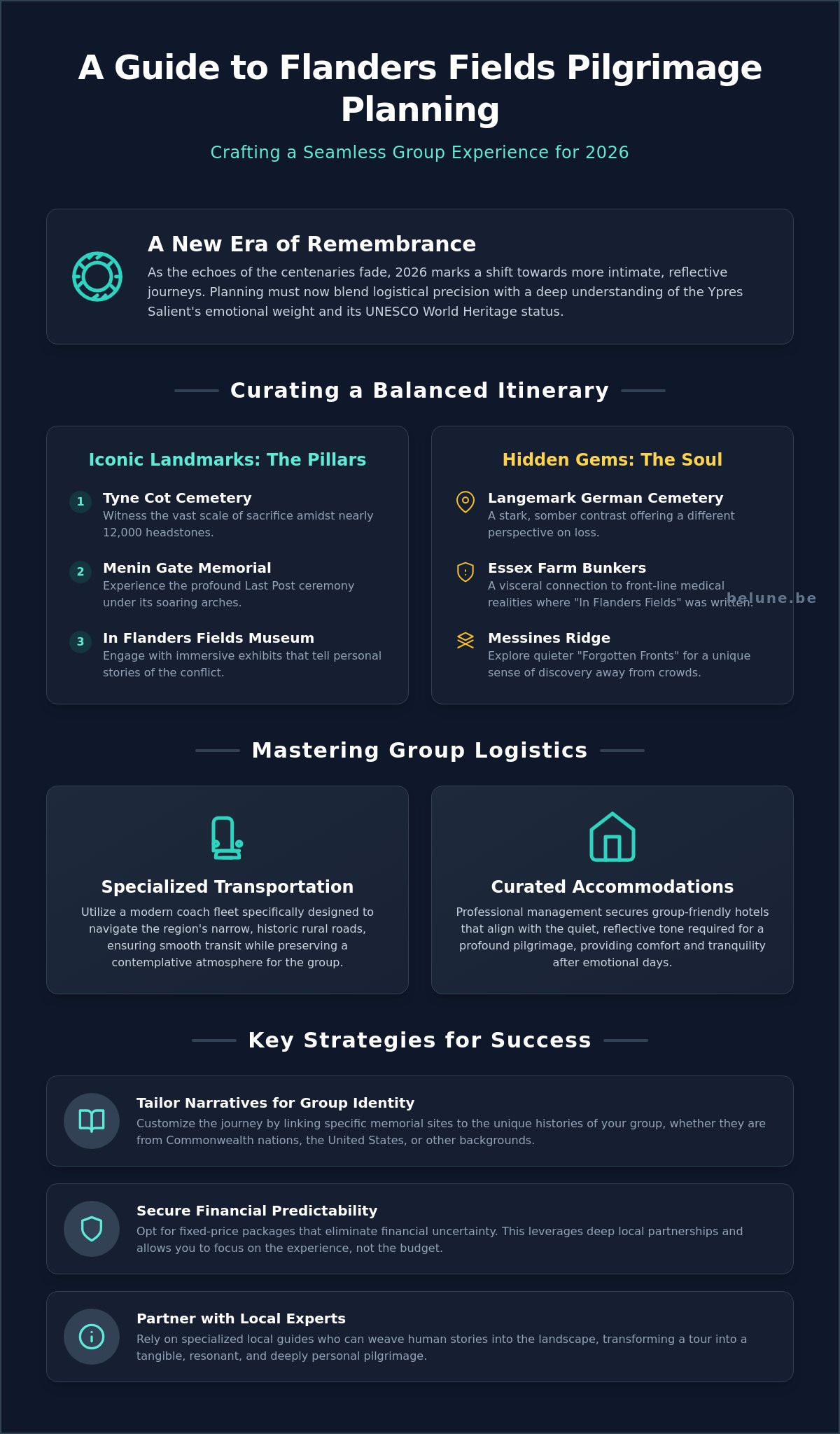
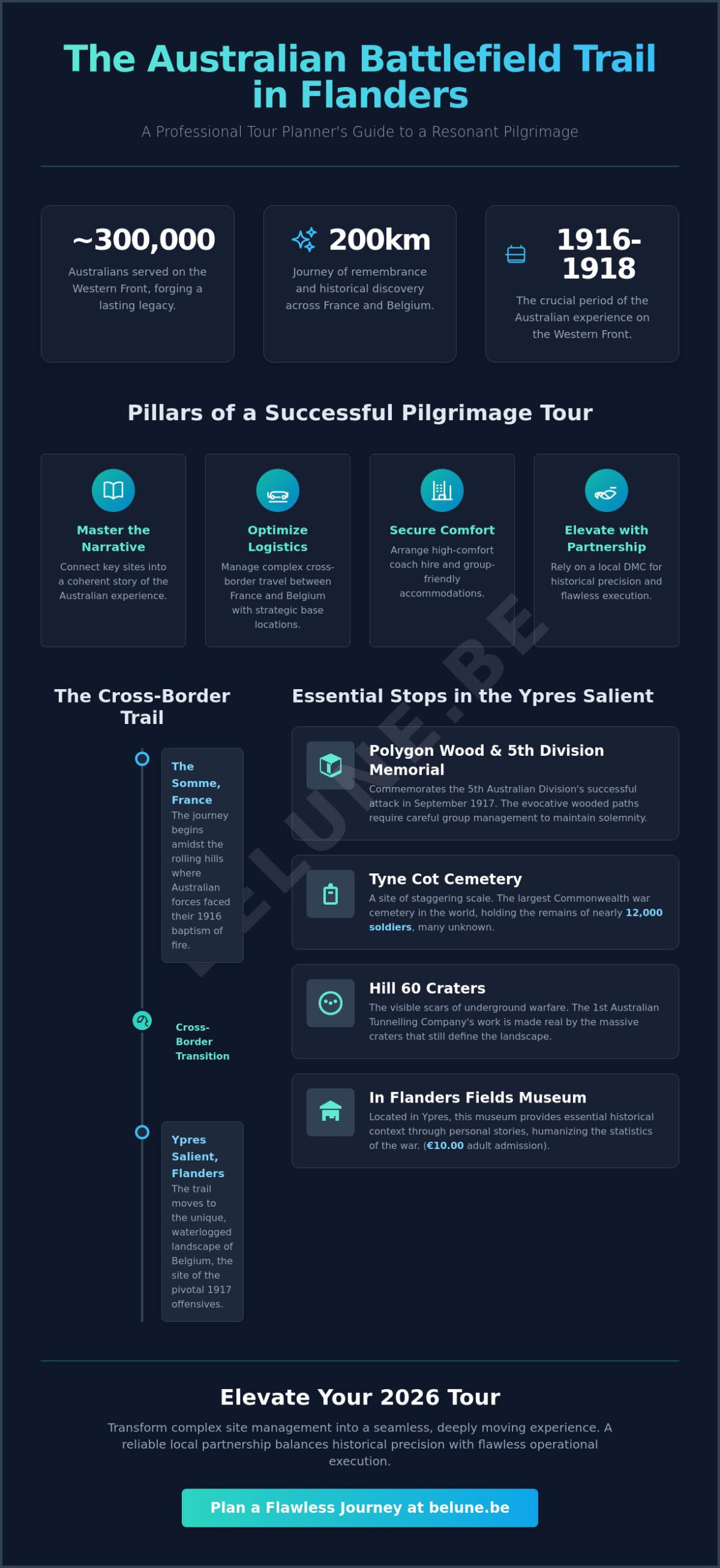
    • Tyne Cot Cemetery: The largest Commonwealth war cemetery in the world, its scale and solemn architecture are profoundly moving.
    • Menin Gate Memorial: The nightly Last Post ceremony here is a powerful, unmissable ritual of remembrance for the missing.
    • Essex Farm Cemetery: The site where McCrae wrote his famous poem, offering an intimate connection to the origins of the poppy symbol.

    The Geography of Memory: Essential Sites in the Ypres Salient

    To understand Flanders Fields is to understand its geography—a landscape defined not by natural borders, but by the shifting, brutal arc of the Ypres Salient from 1914 to 1918. At its heart lies the resurrected city of Ypres (Ieper), the spiritual and logistical hub for any pilgrimage. Before setting out, it is essential to grasp the distinction between two types of sacred ground: cemeteries, where soldiers with known graves rest, and memorials, which bear the names of the missing, their bodies never recovered from the battlefield. The ideal narrative starting point is the In Flanders Fields Museum, housed in Ypres’ rebuilt Cloth Hall. It offers the human context essential for transforming a tour into a profound journey of remembrance.

    Tyne Cot and the Menin Gate: The Pillars of Remembrance

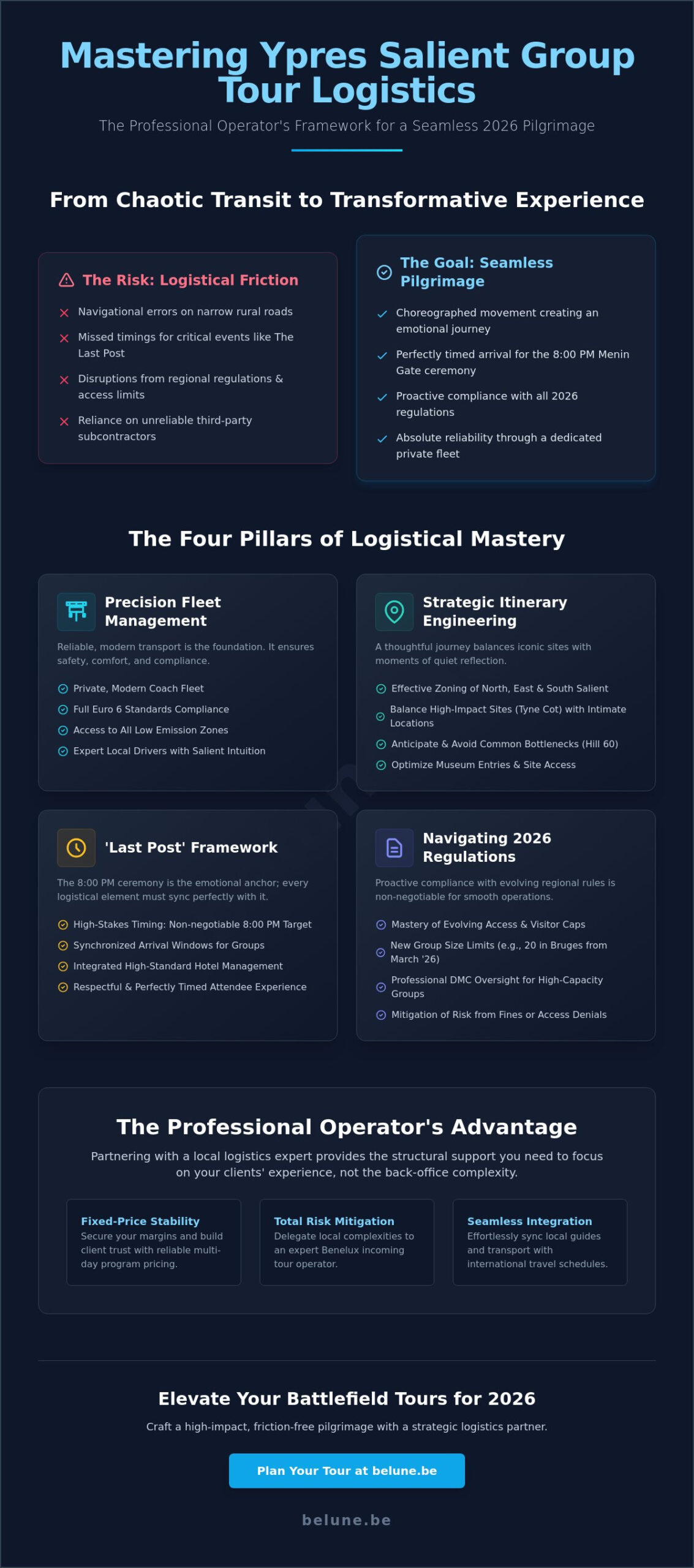
    These two sites form the bedrock of Commonwealth remembrance. Tyne Cot Cemetery, the largest of its kind in the world, is an overwhelming sea of white headstones, its scale conveying the sheer cost of the conflict. In contrast, the Menin Gate in Ypres is a masterpiece of architectural mourning, its inner walls inscribed with the names of over 54,000 soldiers with no known grave. For group visits, we recommend arriving well before the daily 8 PM Last Post ceremony to find a quiet space, allowing the memorial’s solemn grandeur to resonate without distraction.

    Beyond the Big Two: The Specialized Sites

    A deeper understanding requires exploring the nuanced stories told at more specialized locations. These sites offer a more granular view, from the somber, dark stone of Langemark German Cemetery providing a crucial perspective on the “other side,” to the raw, cratered earth of Hill 60, a testament to the savagery of underground mine warfare. For American groups, a visit to the meticulously maintained Flanders Field American Cemetery offers a poignant focus on the U.S. contribution. Finally, the Sanctuary Wood (Hill 62) Museum provides a rare, tangible connection to the past, preserving a section of the original British trench system in haunting detail.

    National Pilgrimages: Customizing Tours for Diverse Group Identities

    A pilgrimage is an intimate dialogue with history. A generic, one-size-fits-all tour fails to honor this, reducing a profound experience to a mere checklist of sites. For the sophisticated group traveler, the journey must resonate with a specific cultural and national memory. The landscape of flanders fields is not a single narrative but a complex mosaic of countless stories, each demanding its own unique focus.

    True remembrance requires a bespoke approach—one that balances the sweeping history of the Great War with the specific heritage of your group. It is in the quiet reverence at a national monument or the shared silence at a regimental cemetery that a tour transforms into a meaningful act of commemoration. We design itineraries that follow these distinct national trails, creating a powerful, personal connection to the past.

    Commonwealth and American Perspectives

    Each nation left a unique and indelible mark on the Ypres Salient. Our custom itineraries are designed to trace these specific threads of history, ensuring your group connects with its own legacy:

    • Australian and Canadian Trails: We follow the footsteps of the ANZACs through the mud of Passchendaele and chronicle the strategic brilliance of the Canadian Corps’ ascent at Vimy Ridge, a pivotal moment of national identity forged in battle just across the border.
    • The American Presence: While their involvement was later, the American contribution was decisive. A visit to the immaculate Flanders Field American Cemetery in Waregem offers a serene, powerful space for reflection on the U.S. role.
    • British, Irish, and New Zealand Narratives: From the iconic Menin Gate, bearing the names of thousands of British and Commonwealth soldiers, to the quiet dignity of the New Zealand Memorial to the Missing at Messines or the poignant symbolism of the Island of Ireland Peace Park, we tailor the narrative to your group’s specific point of origin.

    The Multilingual Guide: Bridging Cultures and Eras

    A landscape, however historic, remains silent without a translator. A local, expert guide is essential, not just for navigating the terrain, but for interpreting it. Their role is to move beyond dates and figures, using masterful storytelling to sublimate the technical data of war into profound, resonant human experience.

    This is the core of our philosophy. At BELUNE, we meticulously source guides with verified academic backgrounds and specific regimental or national expertise. They are more than historians; they are custodians of memory, capable of bridging eras and cultures to ensure your pilgrimage to flanders fields is as authentic as it is unforgettable.

    The Logistics of Remembrance: Planning a Seamless Group Journey

    A pilgrimage is, by nature, an emotional undertaking. The underlying logistics, therefore, must be invisible—a seamless framework supporting reflection and remembrance. Orchestrating a group journey through the historic landscapes of West Flanders demands foresight, precision, and a deep respect for the region’s unique character. From navigating narrow country lanes with a 50-seat coach to sourcing the right accommodation, every detail shapes the final experience.

    The Last Post at the Menin Gate

    This nightly act of homage is a cornerstone of any visit. We ensure your group is positioned by 7:30 PM for the 8:00 PM ceremony. For organisations wishing to lay a wreath, we coordinate directly with the Last Post Association well in advance. It is vital to manage expectations regarding large crowds and variable weather, preparing your group for a profoundly moving, yet public, moment of collective silence.

    Transport and Accommodation Strategy

    Navigating the battlefields requires more than a standard vehicle. Our modern fleet is chosen for its ability to handle rural terrain with comfort and grace. The strategic choice between staying in Ypres for immediate immersion or Bruges for its historic grandeur is critical; we help you weigh the pros and cons to define the tour’s rhythm, always planning for contingencies like seasonal road closures or local ceremonies.

    Sustenance on the journey should complement the narrative. We design catering experiences that range from immersive “trench ration” style lunches in the field to refined Flemish dining in the evenings. Each meal becomes an opportunity to reflect, connect, and experience the renowned hospitality of the region.

    Responsible travel is a modern form of remembrance. We are committed to minimizing the environmental footprint of our journeys across flanders fields by partnering with local suppliers and optimizing transport routes. Designing a pilgrimage of this significance requires a harmony of purpose and execution. We approach each journey as a bespoke project, ensuring every element resonates with your mission.

    The BELUNE Touch: Crafting Bespoke Battlefield Itineraries

    A journey through flanders fields is more than a tour; it is an act of remembrance. At BELUNE, we understand this profound distinction. For over two decades, we have moved beyond standard logistics to sublime the travel experience, transforming historical interest into a deeply personal pilgrimage. Our approach is a complete conception, a seamless journey from A to Z.

    We begin with your vision and meticulously handle every detail, from initial itinerary design to flawless on-the-ground execution. This allows for a richer narrative, where the solemnity of the battlefields can be harmoniously balanced with the cultural splendours of nearby Ghent, Bruges, and Brussels. We don’t just manage trips; we orchestrate experiences with precision and empathy.

    Customization as a Core Value

    True resonance is found in the details. We recently designed a bespoke 3-day pilgrimage for a Commonwealth veteran association, focusing on specific regimental histories. Our service included:

    • Private executive coach hire for comfort and flexibility.
    • Coordination with a specialist multilingual guide whose storytelling brought personal accounts to life.
    • Arranging a private Last Post ceremony at the Menin Gate for the group.

    For our tour operator partners, this meticulous planning is delivered as a seamless, “white-label” service, strengthening your brand while we handle the complexities in the background.

    Start Your Journey with BELUNE

    Planning for 2026 begins now. To start the conversation, simply request a tailor-made proposal. Our commitment is one of professional excellence fused with the emotional intelligence required for such significant travel. We are not just a supplier; we are your strategic partner in creating unforgettable journeys through flanders fields.

    Partner with BELUNE for your next Flanders Fields group tour and let us craft an itinerary worthy of the memory it honours.

    A Journey of Remembrance, Meticulously Crafted

    Memory is not a destination; it is a journey. A truly profound pilgrimage through the landscapes of the Great War harmonizes historical depth with seamless logistical execution, creating a space for personal reflection and collective remembrance. It is an experience that demands sensitivity, expertise, and a deep respect for the stories etched into the soil.

    At BELUNE, we are the architects of these poignant journeys. With over 20 years of DMC experience in the Benelux region, we specialize in crafting bespoke itineraries for groups seeking to connect with the legacy of flanders fields. Our private fleet of modern, luxury coaches and our exclusive network of multilingual battlefield historians ensure your pilgrimage is both comfortable and deeply insightful. We transform the complexities of planning into a seamless, resonant experience.

    Let us craft an itinerary that honours your group’s unique purpose. Request your bespoke group itinerary today. Together, we can create a journey that will echo in memory for years to come.

    Frequently Asked Questions About Visiting Flanders Fields

    Where exactly is Flanders Fields located?

    Flanders Fields is not a single location but refers to the historic WWI battlefields in the Belgian province of West Flanders. This poignant landscape primarily surrounds the city of Ypres (Ieper), which was the centre of the Ypres Salient. This region witnessed some of the most intense fighting on the Western Front and is now home to hundreds of memorials, cemeteries, and preserved trenches, standing as a silent testament to the conflict that shaped the 20th century.

    Can you visit Flanders Fields in a single day from Brussels?

    Yes, a day trip to Flanders Fields from Brussels is entirely feasible, though it makes for a full and reflective day. The journey by car or train to Ypres takes approximately 90 minutes. A condensed itinerary can include the In Flanders Fields Museum and Tyne Cot Cemetery, culminating with the Last Post ceremony at the Menin Gate. However, to truly absorb the atmosphere and explore more deeply, we recommend dedicating at least two days to the region.

    What is the Last Post ceremony and when does it happen?

    The Last Post is a deeply moving ceremony of remembrance held at the Menin Gate in Ypres. Every evening at precisely 8:00 PM (20:00), buglers from the local volunteer fire brigade sound the “Last Post” to honour the Commonwealth soldiers who died in the Ypres Salient and have no known grave. This solemn tribute has been performed nightly since 1928, a powerful and unbroken promise to remember their sacrifice, creating an unforgettable moment of collective reflection.

    Is Flanders Fields suitable for school groups?

    Flanders Fields is an exceptionally powerful educational destination for school groups, bringing history to life in a way no textbook can. Sites such as the interactive In Flanders Fields Museum, the preserved trench systems at Sanctuary Wood (Hill 62), and the sheer scale of Tyne Cot Cemetery provide profound learning opportunities. A specialised guide can tailor the pilgrimage to specific curriculum needs, ensuring a respectful and deeply impactful visit for students of all ages.

    What is the best time of year to visit the WWI sites in Belgium?

    The ideal time for a visit is during the spring (April-June) or autumn (September-October). These seasons offer pleasant weather for exploring the open-air sites and generally smaller crowds. While summer is popular, it can be busy. For a particularly poignant experience, consider visiting around key dates like Anzac Day (April 25th) or Armistice Day (November 11th), but be prepared for larger gatherings and book accommodations and tours well in advance.

    How far in advance should I book a group tour for Flanders Fields?

    For group pilgrimages, particularly for schools or those travelling during peak seasons, we strongly advise booking 9 to 12 months in advance. This lead time is essential for securing the best guides, suitable accommodation, and transportation. Planning this far ahead is especially critical for visits coinciding with major anniversaries. For smaller, private groups, a lead time of 4 to 6 months is often sufficient, but booking earlier is always recommended to ensure availability.

    Do I need a special guide to visit the battlefields?

    While you can visit the sites independently, engaging a specialised guide is highly recommended to fully appreciate their significance. A professional guide transforms a visit from a simple tour into a meaningful narrative. They provide historical context, share personal stories behind the headstones, and navigate the complex landscape efficiently. For those tracing an ancestor’s footsteps or seeking a deeper understanding, a guide’s expertise is truly invaluable, revealing layers of history otherwise hidden in plain sight.

    Are the cemeteries and memorials accessible for people with limited mobility?

    Accessibility varies across the sites. Major memorials and cemeteries managed by the Commonwealth War Graves Commission, such as Tyne Cot and the Menin Gate ceremony area, are generally well-maintained with paved paths suitable for wheelchairs. However, some smaller cemeteries and battlefield sites with preserved trenches may feature uneven ground or grass pathways. We advise checking the accessibility of specific locations in advance and discussing any mobility requirements when booking a guided tour. For groups with members requiring more comprehensive support during their stay in Belgium, you can check out Zuster in Huis for potential live-in care options.