
The most memorable journeys are those where the mechanics of travel remain entirely invisible to the guest. A truly exceptional experience isn’t found in a packed schedule, but in the deliberate space between destinations. When optimizing a group tour itinerary, the challenge lies in transforming a rigid sequence of events into a fluid narrative that respects both the clock and the human spirit.
It’s a common frustration to see participants overwhelmed by itinerary fatigue or delayed by the subtle friction of coach logistics and hotel check-ins. We agree that a high-impact tour should feel like a curated performance rather than a logistical hurdle. This guide provides the tools to master the balance of technical precision and emotional resonance, ensuring your fixed-price packages deliver maximum value. We’ll explore how to orchestrate a seamless flow between destinations while navigating the 2026 landscape, including the new Entry/Exit System (EES) implemented on April 10 and evolving tourist levies. You’ll discover how to create a journey that feels both effortless and deeply significant for every traveler.
Key Takeaways
- Understand why the Packing Paradox suggests that adding more sites often reduces the emotional depth of the travel experience.
- Master the Golden Ratio of transit to activity when optimizing a group tour itinerary to ensure participants remain engaged rather than exhausted.
- Discover the Palate Cleanser technique for balancing intense historical themes with lighter gastronomy and beer experiences.
- Implement a structured 3-Pillar Framework to capture morning momentum and create meaningful midday transitions.
- Learn how professional orchestration manages technical driving regulations and local logistics to maintain a seamless, invisible flow.
The Philosophy of Itinerary Optimization: More Than a Schedule
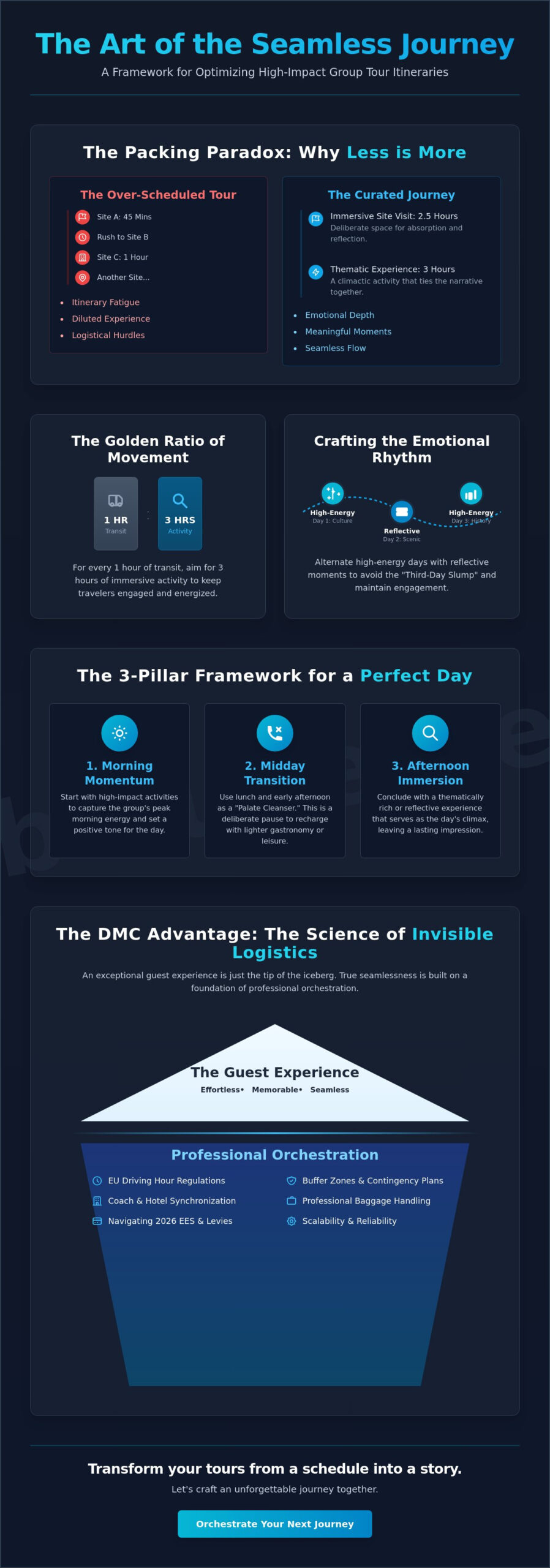
True optimization isn’t a mere list of times and coordinates. It’s the harmonious balance between movement and stillness. In the pursuit of value, many planners fall into the “Packing Paradox,” believing that more stops equal more worth. In reality, over-scheduling dilutes the experience. It creates noise where there should be resonance. When we focus on optimizing a group tour itinerary, we aren’t just filling hours; we’re protecting the traveler’s ability to actually see what’s in front of them.
An exceptional trip follows a narrative arc. It needs a beginning to set the tone, a climax that leaves guests breathless, and a resolution that allows for reflection. This complex logistical choreography ensures that the path taken is as meaningful as the destination reached. It’s about the transition as much as the arrival.
To better understand how these elements come together, watch this helpful video:
Raw logistics are the clay; the group travel agency is the sculptor. We don’t just book coaches and hotels. We refine the experience by removing the friction that often plagues large groups. By prioritizing flow over mere volume, we transform a standard trip into a curated journey that feels effortless for the participant.
The Emotional Rhythm of a Group Tour
A journey has a pulse. We identify “High-Energy” days, such as an immersive day of art and culture, and balance them with “Reflective” moments. This strategic pacing is essential to avoid the “Third-Day Slump,” a common point where physical and mental exhaustion begins to set in for participants. Narrative pacing is the secret to high participant satisfaction. It’s the difference between a group that’s merely present and one that’s truly engaged.
B2B vs. B2C Optimization Perspectives
Professional tour operators must view optimization through a lens of scalability and reliability. While an individual traveler might chase a “hidden gem” down a narrow, inaccessible alley, a group coach requires proven infrastructure. We build “buffer zones” into every professional plan. These aren’t wasted hours; they’re the safety net that allows the group to remain calm when the unexpected occurs. We balance the client’s ambitious wish list with the hard reality of operational constraints. This ensures that the final result isn’t just a beautiful concept, but a reliable reality that protects your reputation and the guest’s experience.
The Logistics of Movement: Masterclass in Coach and Transit Timing
Movement is the invisible skeleton of travel. When optimizing a group tour itinerary, we apply a specific cadence known as the Golden Ratio. Ideally, for every hour of transit, participants should enjoy at least three hours of immersive activity. This prevents the feeling of being ‘trapped’ on a bus while maintaining a steady forward momentum through the region. It’s a delicate balance. It ensures the journey never feels like a commute.
Technical constraints often dictate the success of this rhythm. European driving hour regulations are non-negotiable; they require precise rest periods that, if ignored, can derail an entire afternoon. Sophisticated algorithmic tour planning takes these legal mandates into account from the very first draft. By utilizing our own fleet of modern coaches, we maintain total control over these variables. Reliability isn’t just a promise; it’s a structural component of our operation.
The choreography continues at the hotel door. Coordinating a coach drop-off for thirty or more guests requires a synchronized effort between the driver, the guide, and the front desk. We prioritize properties that specialize in baggage handling and efficient room distribution. If you’re looking for a partner to manage these complexities, our specialized coach hire and logistics services provide the necessary foundation for excellence.
Optimizing Transit Corridors
Strategic routing minimizes dead-time on highways. We view transit as an opportunity, not a delay. A drive through the Flemish countryside can become a guided lecture on local architecture or a scenic detour through rolling hills. Professional coach hire ensures these transitions are seamless, turning the space between hubs into a highlight of the tour. It’s about making every mile count.
Hotel Accommodation Management for Large Groups
The ‘Hub and Spoke’ model is our preferred approach for minimizing group fatigue. By selecting a central, high-quality hotel and conducting day trips from that base, we reduce the constant cycle of packing and unpacking. Precise room block management is essential. We ensure every guest is accounted for long before the coach pulls into the driveway, allowing for a swift, dignified check-in process. This attention to detail transforms a simple stay into a refined hospitality experience.
Thematic Optimization: Battlefield, Gastronomy, and Culture
Thematic depth shouldn’t come at the cost of emotional exhaustion. A successful journey layers specialized interests, such as battlefield tourism, within a broader cultural narrative. This requires a nuanced understanding of how different subjects interact with the traveler’s psyche. When we’re optimizing a group tour itinerary, we treat the schedule as a composition where heavy, somber notes are balanced by moments of levity and sensory delight. It’s about resonance, not just repetition.
We utilize the “Palate Cleanser” technique to maintain engagement. After a morning spent at moving historical sites, we transition the group toward gastronomy and beer experiences. This isn’t just about food; it’s a strategic reset. It allows the group to process complex history in a relaxed, social environment. Applying a rigorous methodology for route optimization allows us to thread these sensitive locations into a broader cultural fabric without the logistics feeling forced or clinical.
Success in this area relies heavily on the quality of local guide services. We curate experts who don’t just recite facts but adapt their narrative to the group’s specific knowledge level. This is particularly vital because themed group travel in Benelux requires a deep understanding of local regional nuances. A guide must know when to lean into the technical details of a battle and when to pivot toward the artistic heritage of a nearby village.
The Battlefield Pilgrimage Framework
Effective battlefield tours require a choice between chronological and geographic routing. For WWI and WWII sites in Flanders or Normandy, we often prioritize the narrative sequence to help guests grasp the historical scale. We also build in “Personal Connection” time. Many groups seek specific memorials or gravesites. Our logistics must remain flexible enough to accommodate these private moments of remembrance while ensuring the coach can navigate often rural or sensitive historical zones without delay.
Gastronomy as a Logistical Tool
Meals serve as cultural anchors. They’re the punctuation marks of the day. We select venues that can comfortably house thirty guests while maintaining the intimate feel of a boutique establishment. This balance is difficult to achieve but essential for high-end group travel. Our local guides play a crucial role here, navigating complex dietary requirements and regional specialties across international borders. They ensure the dining experience reinforces the day’s theme rather than interrupting it. It’s a seamless extension of the tour’s artistic vision.
The 3-Pillar Framework for a Perfect Day
A single day within a journey is a microcosm of the entire trip. It requires its own beginning, middle, and end. When optimizing a group tour itinerary, we divide the day into three distinct pillars to ensure energy remains high and the narrative remains clear. This structure isn’t just about efficiency; it’s about respecting the natural ebb and flow of human attention and physical stamina.
The first pillar is Morning Momentum. We schedule the “Must-See” site as the very first stop. This is when energy levels are at their peak and natural light is optimal for both photography and appreciation. By securing early entry slots, we avoid the mid-morning rush, allowing the group to experience iconic locations with a sense of exclusivity. This sets a tone of excellence for the remainder of the day.
The second pillar is the Midday Transition. Lunch shouldn’t be a pause in the experience but a curated extension of it. We select venues that reinforce the day’s theme, whether it’s a traditional brewery in Brussels or a historic inn near a battlefield. This transition serves as a bridge, allowing guests to refuel while processing the morning’s discoveries in a social, relaxed setting.
The final pillar is the Afternoon Discovery and Evening Reflection. The afternoon offers a choice: a secondary, lower-intensity site or structured free time. We conclude with a communal dining experience or a cultural event that provides a sense of closure. This final act allows the group to decompress and share their experiences, cementing the day’s memories before returning to the hotel. For those seeking to implement this level of precision, you can partner with our expert logistics team to design your next high-impact journey.
The Power of ‘White Space’
The most valuable part of an optimized itinerary is often the time where nothing is scheduled. We believe that sixty minutes of unstructured time is essential. We strategically place these gaps in pedestrian-friendly areas where guests can explore at their own pace. This prevents the feeling of being “herded” and allows for personal serendipity. Thoughtfully placed white space is the essential valve that prevents group burnout and directly increases repeat bookings.
Managing the ‘Group Gravity’
Keeping thirty to fifty people moving in unison requires technical finesse. We use “whisper” radio systems in crowded museums and city centers. These allow the guide to speak at a natural volume while guests listen through earpieces, maintaining an intimate connection even in a throng of tourists. We also eliminate “waiting-in-line” fatigue by pre-booking every entry slot. This ensures the group moves with a constant, effortless flow, never losing momentum to administrative delays or ticket queues.
The DMC Advantage: Why Professional Orchestration Wins
Professional orchestration is the final layer of refinement. While a basic schedule provides a map, a Benelux incoming tour operator provides the pulse. We act as the “Invisible Hand,” managing the complex variables that can disrupt even the most carefully planned journey. From sudden rail strikes to the biometric processing delays at borders following the April 10, 2026, EES implementation, we solve logistical hiccups before the group even notices a delay. This level of on-the-ground support is what truly defines the art of optimizing a group tour itinerary.
Beyond risk management, we offer access that remains closed to individual planners. This includes private museum viewings and after-hours cultural experiences that elevate a tour from standard to extraordinary. Partners benefit from the financial security of fixed-price group packages. This transparency allows tour operators to market with confidence, knowing every technical detail is accounted for within a stable budget. It’s a partnership built on reliability and shared vision.
Integration of Fleet and Expertise
There’s a unique synergy in owning the coach fleet while designing the path it travels. Real-time communication between our drivers, local guides, and the management office ensures that every transition is fluid. We don’t rely on third-party availability. Instead, we leverage over twenty years of regional experience to find logistical shortcuts that save hours over the course of a week. This technical mastery transforms transit from a necessity into a seamless component of the narrative. It ensures the group stays focused on the destination, not the drive.
Finalizing the Itinerary: A Collaborative Vision
Every project undergoes a rigorous “Itinerary Audit.” We review every turn, every timing, and every transition to eliminate potential friction points. Customization is our standard approach. We adjust the flow based on whether we’re serving a student pilgrimage or a luxury corporate retreat. The result is a bespoke experience that reflects your specific goals and respects the traveler’s time. Request your custom Benelux group tour itinerary from BELUNE today.
The Future of Curated Group Travel
A truly exceptional journey is more than the sum of its destinations. It’s a carefully composed narrative where technical precision serves as the foundation for emotional resonance. By embracing the Golden Ratio of movement and the strategic inclusion of white space, you transform a standard trip into a profound human experience. Mastering the art of optimizing a group tour itinerary requires a deep understanding of both the landscape and the traveler’s rhythm. It’s about ensuring every transition feels like a natural progression rather than a logistical necessity.
With over 20 years of regional expertise and a private fleet of modern, luxury coaches, we specialize in high-complexity thematic tours that challenge the ordinary. We invite you to Partner with BELUNE for your next masterpiece in group travel. Our team stands ready to serve as your strategic ally, turning complex logistics into a seamless, inspiring reality. Let’s create a journey that stays with your guests long after they’ve returned home.
Frequently Asked Questions
What is the ideal group size for an optimized coach tour?
The ideal group size typically ranges between 25 and 35 participants. This number allows for a comfortable atmosphere on a standard 50-seater luxury coach while maintaining the economic efficiency of the tour. When optimizing a group tour itinerary, this range ensures that museum entries and restaurant seating remain manageable without sacrificing the intimate feel of a curated journey.
How much ‘free time’ should be included in a 7-day group itinerary?
We recommend at least sixty to ninety minutes of daily “white space” and one full free afternoon mid-week. This prevents the physical and mental exhaustion often associated with rigid schedules. Strategic free time in pedestrian-friendly city centers allows guests to explore personal interests, which significantly improves overall satisfaction and repeat booking rates.
How do you account for coach driving regulations when planning long-distance tours?
European Union mandates require specific rest periods for drivers, such as a 45-minute break after four and a half hours of driving. We treat these technical requirements as structural pillars rather than obstacles. By aligning these breaks with scenic stops or guided lunches, the flow of the tour remains uninterrupted while ensuring full legal compliance and passenger safety.
What are the benefits of using a DMC for Benelux group travel?
A Destination Management Company provides the “invisible hand” that navigates regional complexities like the new Entry/Exit System (EES) implemented in April 2026. Our local presence allows us to manage hotel blocks, coach logistics, and guide services with a level of precision that individual planners can’t replicate. We transform raw logistics into a refined, professional experience through constant on-the-ground support.
How do you balance niche themes like battlefield tours with general sightseeing?
The secret lies in the “Palate Cleanser” technique. We follow somber, high-intensity visits to WWI or WWII sites with lighter cultural or gastronomy experiences. This balance respects the emotional weight of historical pilgrimages while providing the necessary contrast to keep the group engaged. It ensures the itinerary feels like a complete narrative rather than a repetitive sequence.
What happens if a site is unexpectedly closed during the tour?
Our management office and local guides maintain real-time communication to pivot instantly if a closure occurs. Because we understand the regional landscape intimately, we can redirect the group to a secondary site of equal cultural value. This orchestration happens behind the scenes, ensuring the guest’s experience remains seamless and stress-free regardless of external disruptions.
Is it better to stay in one central hotel or move between cities?
The “Hub and Spoke” model is generally superior for optimizing a group tour itinerary in regions like the Benelux. Staying in a central city like Brussels or Ghent for several nights reduces the fatigue of constant packing and unpacking. This approach allows for deeper immersion in a single base while providing efficient access to surrounding historical and cultural hubs.
How do you manage dietary restrictions for a group of 40 people?
We manage dietary requirements through a rigorous pre-screening process conducted weeks before arrival. This data is shared with our curated network of restaurants to ensure that every guest enjoys a high-quality meal. Our guides double-check these arrangements on-site, making the dining experience a seamless cultural anchor rather than a logistical hurdle.
Leave a Reply