Tag: Tour Logistics

  • Art and Culture Group Tours in Benelux: The Professional Guide for 2026

    Art and Culture Group Tours in Benelux: The Professional Guide for 2026

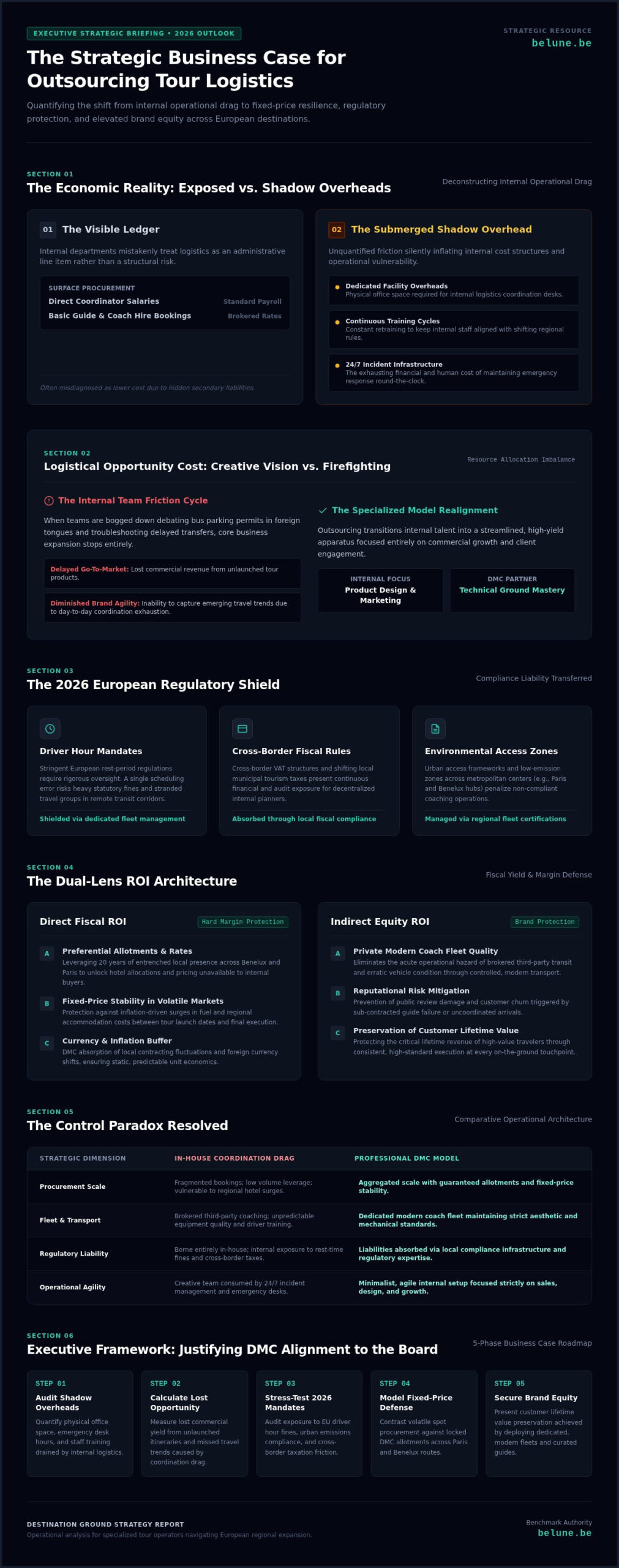
    The most profound cultural experiences aren’t found in the pages of a guidebook; they’re engineered through a delicate balance of artistic vision and logistical precision. Designing art and culture group tours benelux for 2026 requires more than a simple list of museums. It demands a mastery of the subtle nuances between the Flemish masters in Antwerp and the contemporary galleries of Luxembourg City. You likely recognize that a single logistical friction point, like a delayed cross-border transfer or a lackluster guide, can dim the brilliance of a meticulously planned itinerary.

    Our promise is to show you how to curate sophisticated, logistically seamless journeys that offer exclusive access to private collections and architectural marvels across these three nations. We’ll explore the frameworks for securing reliable high-end group transport and vetting specialist guides who transform a multi-day itinerary into a sensory masterpiece. This guide provides the technical rigor and creative inspiration needed to elevate your professional travel offerings to an art form. By focusing on the harmony of the guest experience, you can transform a standard trip into a bespoke narrative that resonates long after the final gallery door closes.

    Key Takeaways

    • Master the art of narrative curation by connecting the legacies of the Flemish Masters and the Dutch Golden Age into a single, fluid journey.
    • Discover how to balance iconic landmarks with hidden private ateliers to design an itinerary that avoids museum fatigue while maintaining a sense of discovery.
    • Learn the technical nuances of managing group logistics across international borders to ensure a seamless and elegant travel experience for every guest.
    • Professionalize your approach to art and culture group tours benelux by selecting themed accommodations that reflect the region’s rich artistic heritage.
    • Explore the strategic advantages of collaborating with a visionary DMC to transform complex itineraries into a harmonious and stress-free reality.

    Defining Art and Culture Group Tours in the Benelux Region

    Art and culture group tours benelux are curated journeys through one of the world’s highest concentrations of creative heritage. This region functions as a living gallery where the borders between Belgium, the Netherlands, and Luxembourg dissolve into a continuous narrative of human expression. Within a radius of less than 300 kilometers, travelers encounter over 30 UNESCO World Heritage sites and hundreds of world-class museums. The experience focuses on the profound history of art in the Low Countries, tracing the evolution from the meticulous detail of the Flemish Primitives to the revolutionary light of the Dutch Golden Age masters.

    2026 stands as a pivotal year for cultural travel in this territory. It marks a series of high-profile re-openings and centennial celebrations, including the culmination of major restoration projects in Antwerp and specialized exhibitions in Amsterdam. Discerning groups now seek more than “sightseeing,” which often remains at the surface of a destination. True cultural immersion requires a deeper engagement with the local soul. It involves understanding the socio-political forces that allowed 17th-century Dutch merchants to become the world’s greatest art patrons or how Belgian Art Nouveau reshaped modern urban aesthetics.

    The Cultural Density of Belgium, Netherlands, and Luxembourg

    The geographic intimacy of these three nations allows for high-impact itineraries that would be impossible elsewhere in Europe. Short travel distances mean groups spend less time in transit and more time in front of masterpieces. There’s a rare synergy here; the industrial elegance of Luxembourg City complements the medieval grandeur of Bruges and the avant-garde spirit of Rotterdam. Bridging these borders requires a sophisticated touch. A professional benelux incoming tour operator serves as the essential architect of the journey, harmonizing the distinct linguistic and administrative nuances of each country to create a fluid, borderless experience for the guest.

    The B2B Advantage: Why Professional Curation Matters

    Professional curation moves beyond the “Top 10” lists found in standard guidebooks to uncover authentic, local narratives. For the B2B sector, the value of a Destination Management Company (DMC) lies in its ability to secure exclusive access. This might include after-hours visits to the Mauritshuis, private viewings of the Ghent Altarpiece, or meetings with contemporary curators in their private studios. These moments of exclusivity transform a standard trip into a prestigious event.

    Cultural group travel is a sophisticated blend of pedagogical depth and social harmony, where shared discovery transforms a trip into a collective intellectual legacy. By prioritizing precision and artistic vision, art and culture group tours benelux offer a transformative perspective on European identity. We treat every itinerary as a bespoke composition, ensuring that the technical logistics remain invisible so the cultural brilliance can shine.

    Thematic Pillars: Curating a Narrative for Your Group

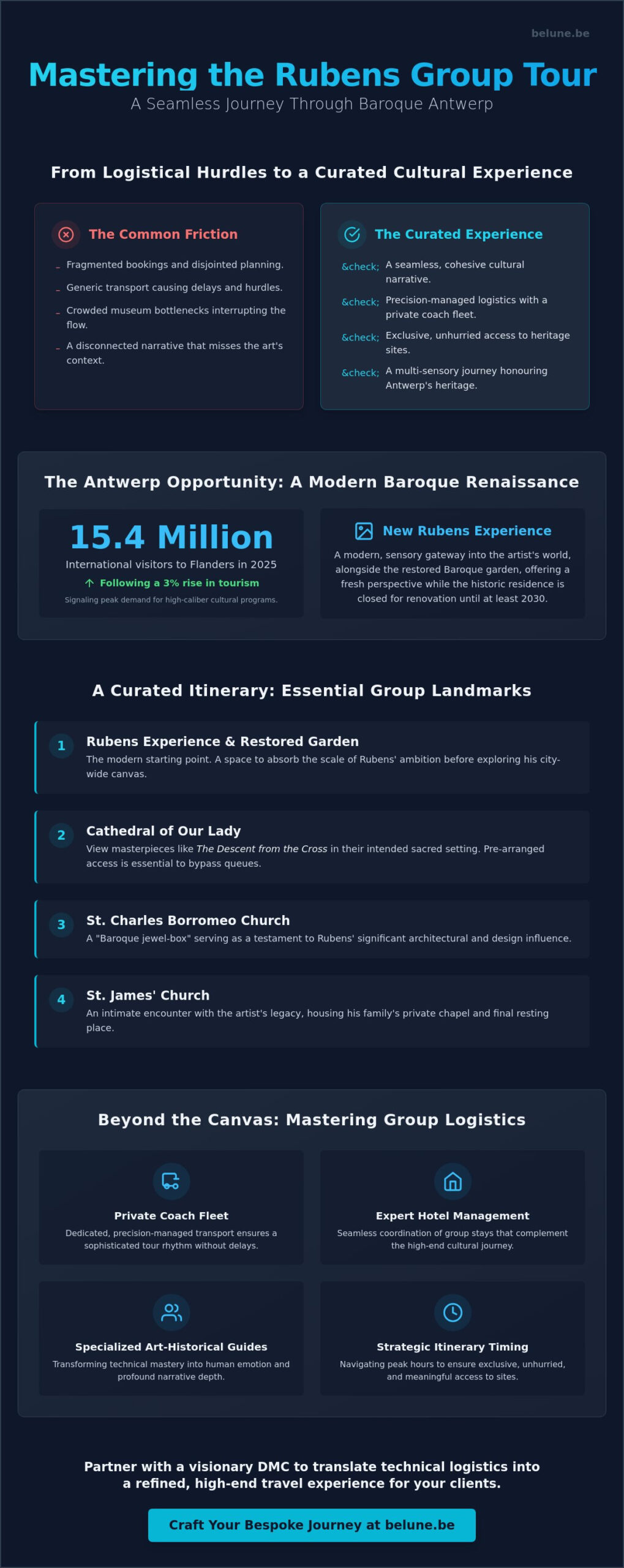
    Designing high-end art and culture group tours benelux is an exercise in curation, much like lighting a gallery. It requires a cohesive story that connects the past to the present. The narrative begins with the Flemish Masters. Jan van Eyck’s “Adoration of the Mystic Lamb,” completed in 1432, serves as the technical and spiritual benchmark for Belgian itineraries. This precision is balanced by the Baroque intensity of Peter Paul Rubens, whose work defines the Antwerp experience. These masters didn’t just paint; they engineered a visual language that still dictates the region’s aesthetic standards.

    Moving north, the Dutch Golden Age captures a different nuance of light and commerce. The Rijksmuseum in Amsterdam stands as the essential sanctuary for this period. It houses over 8,000 objects that tell the story of the 17th-century Netherlands. Seeing Rembrandt’s “The Night Watch” (1642) in person allows groups to appreciate the interplay of shadow and brilliance that defines Dutch identity. It’s a masterclass in atmospheric composition that resonates with modern architectural sensibilities.

    Cultural depth also requires acknowledging the scars of history. Integrating a visit to Flanders Fields provides a necessary perspective on the 1914-1918 conflict. This isn’t merely a history lesson. It’s a pilgrimage of memory that grounds the artistic beauty of the region in a narrative of human resilience. Understanding these layers of heritage is what separates a standard tour from a professional cultural expedition.

    Art Nouveau and Architectural Splendor

    Brussels became the world’s stage for Art Nouveau in 1893 when Victor Horta completed the Hôtel Tassel. These structures aren’t just buildings; they’re organic sculptures. The “sublime” curves of Horta’s townhouses reflect the immense industrial wealth of the late 19th century. This architectural movement redefined urban design by blending iron, glass, and stone into a modern identity. It’s a legacy that continues to influence the contemporary cultural heartbeat of Brussels and Antwerp.

    The Culinary Arts: Gastronomy as Culture

    A culture is best understood through its palate. Professional belgium gastronomy tours elevate a trip from a simple visit to a sensory immersion. Belgium’s 143 Michelin-starred restaurants, according to 2024 records, offer high-end groups a taste of contemporary innovation. This culinary excellence is paired with the heritage of artisanal brewing and the precision of world-class chocolatiers. It’s a dialogue of taste that perfectly complements the visual arts of the Benelux region.

    To truly capture the essence of these spaces, the right environment is everything. If you’re looking to refine the atmosphere of your next project, our team at Belune can help you master the art of the environment.

    The Logistics of Elegance: Managing Group Travel Frameworks

    Executing art and culture group tours benelux in 2026 requires a marriage of high-level logistics and sensory awareness. Moving a group of 25 enthusiasts across the borders of Belgium, the Netherlands, and Luxembourg demands a choreography of absolute precision. It isn’t just about the destination; it’s about the weightless transition between them. We focus on technical rigor to eliminate the friction that often plagues large-scale travel. This involves digital manifest management and pre-cleared passage protocols that ensure the group never feels the gears of the machine turning.

    These “invisible logistics” are vital for maintaining the group’s emotional state. When travelers aren’t burdened by luggage concerns or border delays, they remain open to the aesthetic experience of the Dutch Masters or Flemish Primitives. This mental space is protected by professional guide selection. We don’t hire generalists. We match groups with experts holding advanced degrees in Art History or Archaeology from institutions like Leiden University or the University of Leuven. These professionals possess native-level fluency in at least three languages, allowing them to bridge the gap between academic depth and cultural nuance.

    Reliable data is the foundation of every itinerary. For cross-border planning and regional insights, the Official Belgian Tourism Portal serves as a primary resource for verifying transit regulations and regional event schedules. Utilizing these official frameworks allows us to build tours that are as secure as they are inspiring.

    Modern Coach Travel: The Mobile Lounge

    A private fleet of coaches is a critical differentiator for a high-end DMC. It grants total control over the sensory environment. Our 2026 fleet utilizes 45-seat vehicles configured for only 30 passengers to ensure maximum personal space. Panoramic glass roofs provide 180-degree views of the Flemish countryside, while ergonomic leather seating reduces fatigue during the 2.5-hour drive between Amsterdam and Brussels. The driver acts as a silent partner, managing the technical flow with a precision that allows the group’s focus to remain entirely on the art.

    Accommodation Management for Large Groups

    Hotel selection follows a strict architectural and thematic rubric. We prioritize properties that mirror the tour’s artistic theme, such as a repurposed 15th-century convent in Maastricht or a Bauhaus-inspired boutique in Rotterdam. Managing check-ins for 15 or more rooms requires pre-key systems and luggage-to-room services to eliminate lobby wait times. This curated approach ensures the group’s harmony remains intact from the gallery to the guest suite, making the hotel an extension of the cultural narrative rather than a mere stopover.

    Itinerary Design: Balancing Iconic Sites with Hidden Gems

    The architecture of a journey requires the same precision as a master lighting plan. To curate successful art and culture group tours benelux, one must master the rhythm of the experience. Museum fatigue is the primary adversary of the sophisticated traveler. We combat this by alternating high-density sites with moments of quiet, sensory reflection. Pacing isn’t just about time; it’s about the emotional frequency of the spaces visited.

    Pairing the Rijksmuseum, with its 8,000 objects and monumental Gallery of Honour, alongside private ateliers in the Jordaan district creates a necessary contrast. While the former offers a macro-view of Dutch history, the latter provides an intimate look at contemporary craftsmanship. This transition from the golden light of Rembrandt to the tactile reality of a modern workspace allows the eye to reset. It’s a dialogue between the past and the present that respects the traveler’s cognitive load.

    Incorporating Luxembourg into a high-tempo Benelux tour serves as a vital palette cleanser. The 17 kilometers of underground tunnels in the Bock Casemates, a UNESCO site since 1994, offer a stark, minimalist elegance that differs from the ornate cathedrals of Flanders. These serene landscapes provide the “breathing room” required for a sophisticated eye to process the visual richness of the preceding days. We design these tours to be more than a checklist; they’re a sensory narrative where light, space, and history achieve perfect harmony.

    The 7-Day Benelux Grand Tour Example

    • Day 1-3: Flanders. Focus on the Flemish Primitives in Ghent and the Art Nouveau mastery of Victor Horta in Brussels. The 2020 restoration of the Ghent Altarpiece remains a central technical marvel for 2026 visitors.
    • Day 4-5: The Dutch North. A deep dive into the Dutch Masters. We balance the scale of the Rijksmuseum with the private, canal-side elegance of the Museum Van Loon.
    • Day 6-7: Luxembourg and Beyond. Exploring the sandstone fortifications before utilizing the high-speed TGV links for a seamless transition toward Paris or eastern hubs.

    Tailor-Made vs. Fixed-Price Packages

    Selecting the right structure depends on the client’s strategic goals. Many organizers favor fixed-price group tours because they provide total budget predictability for the 2026 season. This model works exceptionally well for established cultural associations that require a proven framework. However, for niche B2B clients or private collectors, custom itinerary planning is essential to secure exclusive access to private collections or after-hours viewings.

    The subtle application of nuance in the planning stage transforms a simple trip into a lasting legacy of cultural understanding. Whether opting for a pre-designed route or a bespoke creation, the focus remains on the quality of the encounter. Every detail, from the angle of the morning light on a facade to the quietude of a private garden, is calculated to inspire. For professionals seeking to elevate their travel offerings, we invite you to explore our vision of architectural and cultural discovery.

    Partnering with a Benelux DMC: Why BELUNE is the Choice

    For 20 years, BELUNE has established itself as a visionary creator of group travel experiences across Western Europe. We believe that organizing art and culture group tours benelux requires more than just logistics; it demands an artistic sensibility and a deep respect for the heritage of the region. Our team manages the entire journey from A to Z, providing a secure framework that includes luxury transport, premium accommodations, and specialized guides. This comprehensive approach allows international agents to focus on their clients while we handle every technical complexity on the ground.

    Our headquarters in Dottignies serves as a strategic gateway to the heart of Europe. This location isn’t accidental. It places us at the literal crossroads of Belgium, the Netherlands, and France. From this central base, we orchestrate seamless transitions between the Flemish Primitives in Bruges, the contemporary galleries of Amsterdam, and the grand museums of Paris. It’s a logistical advantage that translates into smoother travel times and more immersive cultural experiences for your groups in 2026.

    A Commitment to Professional Excellence

    The BELUNE signature is defined by sophisticated communication and technical rigor. We don’t view ourselves as a mere supplier. Instead, we act as a true strategic ally for tour operators worldwide. Our “counsel of trust” model ensures that every itinerary is vetted for feasibility, flow, and emotional impact. We use our 20 years of local expertise to navigate the nuances of European travel, from seasonal museum closures to the best private viewing times. You can request a custom proposal for your next culture group tours benelux project to experience this bespoke level of service. We treat every group as a unique architectural project where history, art, and comfort must exist in perfect harmony.

    Seamless Integration with Paris

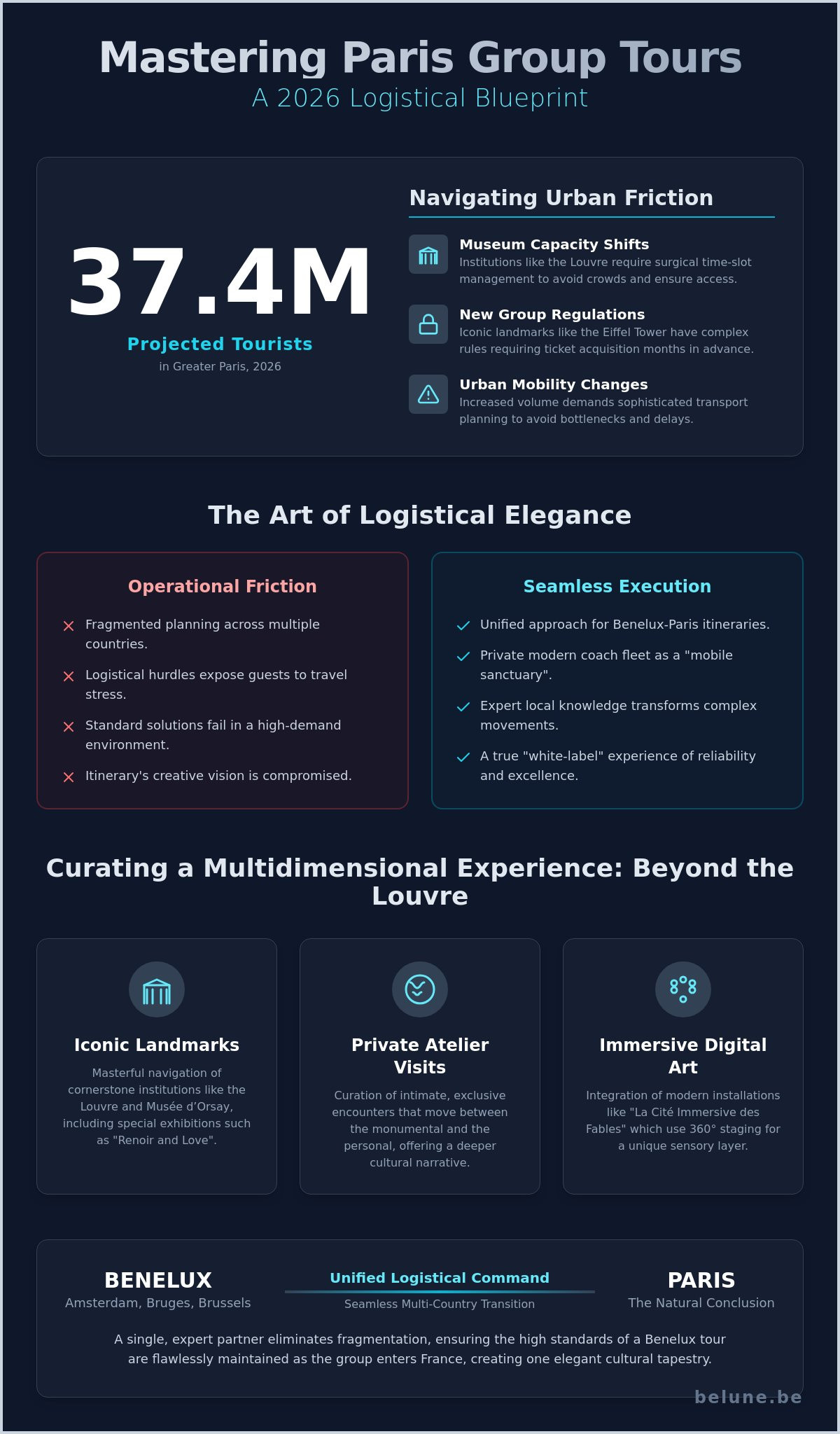
    Artistic narratives rarely stop at national borders. To provide a complete picture of Western European heritage, we often expand the Benelux story to include the cultural icons of Paris. The logistical ease of this expansion is a hallmark of our service. Your group can continue their journey into the French capital with the same coach and the same dedicated guide team they’ve bonded with throughout Belgium. This continuity is vital. It eliminates the friction of mid-trip handovers and ensures a consistent standard of excellence. By partnering with a unified travel expert, you offer your clients a fluid, sophisticated journey that connects the Dutch Masters with the Impressionists of the Louvre without a single logistical hitch.

    • Expertise: Two decades of curating high-end cultural narratives.
    • Reliability: Full management of transport, hotels, and expert guides.
    • Location: Strategic Dottignies base for Benelux and Paris access.
    • Partnership: A dedicated strategic ally for international tour operators.

    Crafting Your 2026 Cultural Legacy in Benelux

    Designing an exceptional journey through Belgium, the Netherlands, and Luxembourg requires a master’s touch. Success in 2026 depends on balancing the logistics of elegance with a narrative that resonates deeply with your guests. By integrating 20+ years of DMC expertise, we transform complex travel frameworks into seamless artistic experiences. Our private fleet of modern coaches ensures every transition is fluid, while a specialized local guide network provides the intellectual depth and nuance that high-end travelers expect.

    The secret to a memorable itinerary lies in the harmony between world-renowned institutions and the quiet allure of hidden gems. We don’t just move people; we curate emotions through the interplay of history, architecture, and local spirit. Our specialized art and culture group tours benelux are built on this philosophy of bespoke excellence. It’s about creating a vision where every detail, from the timing of a private gallery opening to the comfort of the journey, is deliberate and refined. Your vision deserves a partner who understands that travel is a form of art.

    Request your custom Benelux cultural group tour itinerary today and let’s begin the design process. We’re ready to help you illuminate the extraordinary for your clients.

    Frequently Asked Questions

    What is the best time of year for an art and culture group tour in Benelux?

    The ideal period for art and culture group tours benelux spans from mid-April to early June when natural light enhances the architectural details of historic cities. During these 60 days, the region experiences its most stable climate and the blooming of the Keukenhof gardens. Autumn also offers a sophisticated atmosphere, particularly in October when major museums like the Rijksmuseum launch their primary 2026 seasonal exhibitions.

    How many days are needed to cover the cultural highlights of Belgium and the Netherlands?

    A comprehensive cultural journey through Belgium and the Netherlands requires a minimum of 10 days to appreciate the depth of the Flemish Primitives and Dutch Masters. We recommend allocating 4 days to the Dutch Golden Age sites and 6 days to the Belgian medieval and Art Nouveau heritage. This timeframe ensures your group experiences the three distinct cultural identities of the region without feeling rushed or overwhelmed.

    Can BELUNE handle groups with specific artistic interests, such as Art Nouveau or Modernism?

    We specialize in curated itineraries that focus on specific movements like Art Nouveau in Brussels or De Stijl in Utrecht. Our team designs paths through the 1906 Horta Museum and the 1924 Rietveld Schröder House to provide a technical and aesthetic deep dive. These specialized tours allow professionals to explore the evolution of 20th-century design through preserved architectural masterpieces that defined the modern era.

    Is it possible to combine a Benelux cultural tour with a trip to Paris?

    Connecting a Benelux itinerary with Paris is a seamless process thanks to the high-speed rail network connecting major hubs. The journey from Brussels-Midi to Paris Gare du Nord takes exactly 82 minutes, making it an effortless extension for your cultural program. We often integrate 3 days in the French capital to contrast the Northern Renaissance with the Parisian Beaux-Arts and contemporary scenes for a complete European experience.

    What size of groups can BELUNE accommodate for these cultural itineraries?

    Our cultural itineraries accommodate groups ranging from 8 to 25 participants to maintain an atmosphere of exclusivity and quiet reflection. Smaller cohorts of 12 guests often find the best balance between shared inspiration and personal space within intimate museum galleries. By limiting numbers, we ensure every traveler receives direct engagement from our expert lecturers and easy access to private viewing sessions in historic venues.

    Do you provide specialized local guides who speak languages other than English?

    We provide highly qualified guides who are fluent in six major languages including French, German, Spanish, and Mandarin. Every professional in our network holds a degree in art history or architecture, ensuring the narrative remains sophisticated and precise. It’s not just about translation; it’s about conveying the subtle nuances of Benelux heritage in the native tongue of your specific group to ensure total clarity.

    How does BELUNE manage the logistics of cross-border travel between the three countries?

    We manage the logistics of cross-border travel by utilizing a combination of private executive coaches and efficient rail links across the 74,000 square kilometers of the Benelux region. Distances are remarkably short, with only 210 kilometers separating Amsterdam from Brussels. Our team handles all 2026 transit permits and luggage transfers, allowing your group to focus entirely on the artistic transition between these three distinct nations.

    What are the benefits of choosing a fixed-price group tour package?

    Choosing a fixed-price package provides your group with total financial transparency and guaranteed access to high-demand cultural sites. These arrangements include pre-booked entries to over 50 major museums and all local logistics, eliminating the unpredictability of on-site fees. It’s a professional approach that secures the best 2026 time slots for art and culture group tours benelux while streamlining the administrative burden for organizers.

  • The Definitive Bruges and Ghent Group Tour: A Cultural Itinerary for 2026

    The Definitive Bruges and Ghent Group Tour: A Cultural Itinerary for 2026

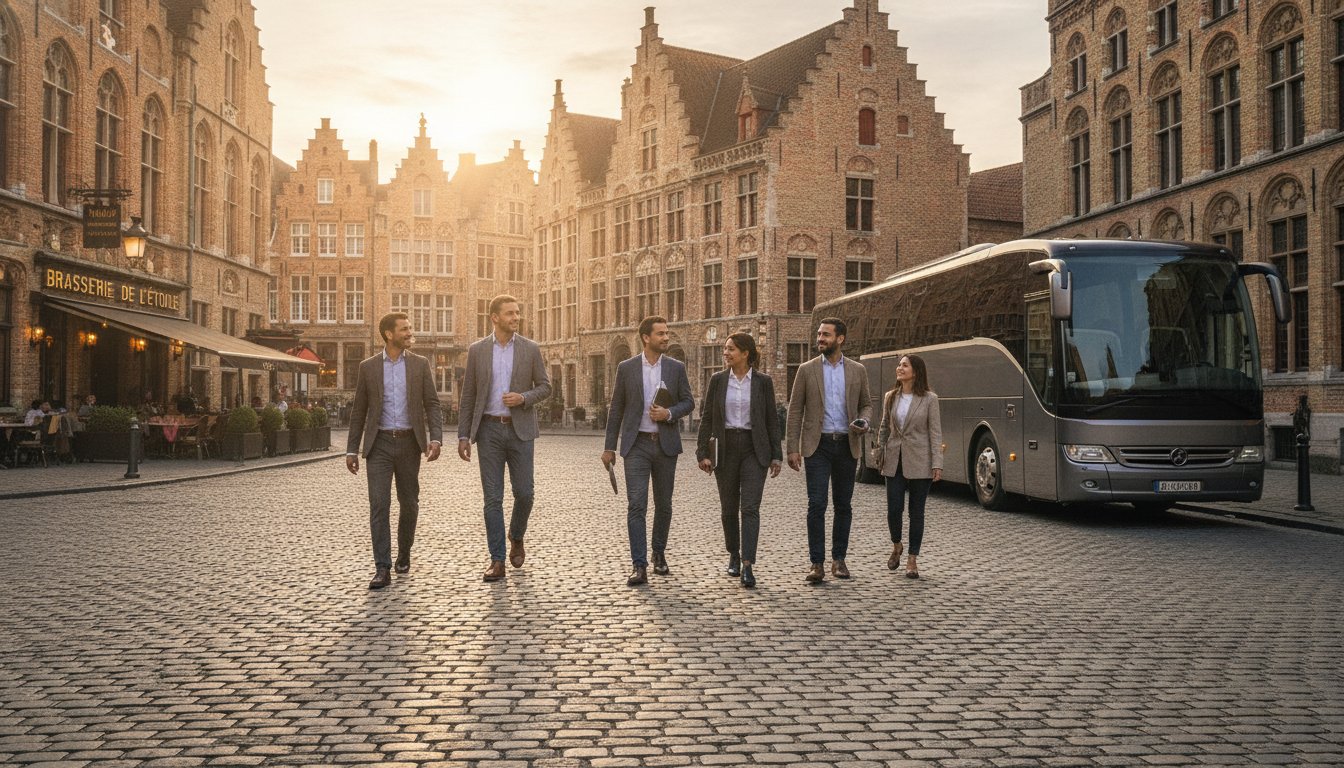
    What if the true luxury of a Flemish journey lies not in the monuments themselves, but in the invisible harmony of the movement between them? Planning a **bruges and ghent group tour** for 2026 requires more than a simple map; it demands an architectural approach to time and space. You already know that the narrow, 13th-century streets of Bruges weren’t designed for modern group dynamics. A single 12-meter coach can turn a poetic morning into a logistical bottleneck if the route isn’t mastered with surgical precision.

    We’ll show you how to transform these challenges into a sublime, high-end experience. By integrating expert logistical insights and premium transport, you’ll learn to navigate the 52 kilometers between these iconic cities with effortless elegance. This guide reveals how to secure bespoke dining for 30 guests in historic venues that usually favor the few, ensuring every moment feels personal. We’ll preview a balanced 2026 cultural schedule that honors the heritage of Flanders while providing the rigorous technical support your professional partners expect.

    Key Takeaways

    • Master the art of curating a cultural narrative that blends UNESCO heritage with rare masterpieces like Van Eyck’s Mystic Lamb and Michelangelo’s marble.
    • Optimize your bruges and ghent group tour by navigating complex coach exclusion zones and securing multi-lingual guides with deep regional expertise.
    • Evaluate the strategic advantages of an overnight stay to capture the “Blue Hour” and offer your clients a more intimate, sophisticated experience.
    • Discover how to harmonize technical logistical precision with the emotional resonance of Flemish heritage to create a bespoke group journey for the 2026 season.

    The Allure of Flanders: Why a Bruges and Ghent Group Tour is Essential

    Flanders serves as a living canvas where 14th-century commerce meets 21st-century artistry. A bruges and ghent group tour isn’t merely a sightseeing trip; it’s a strategic immersion into the golden age of Flemish trade. These cities aren’t replicas. They’re original masterpieces. In 2000, UNESCO recognized the historic center of Bruges for its outstanding universal value, cementing its status as Europe’s most preserved medieval center. This preservation offers tour operators a high-impact cultural day that balances the stillness of a museum with the pulse of modern life.

    Historical layers here run deeper than a simple fairytale label. The narrative follows the silting of the Zwin estuary in the 12th century, an event that dictated the economic rise and fall of the region. By 1350, Bruges was the most important commercial hub in Northwestern Europe. Today, this legacy translates into a seamless journey for groups seeking both depth and beauty. We see the Lys river not just as water, but as the artery that fueled Ghent’s textile dominance for centuries.

    Bruges: The Venice of the North

    The 13th-century urban fabric remains remarkably intact. We begin at Minnewater, the Lake of Love. It’s a critical entry point for groups because it provides immediate spatial harmony and a calm transition into the city core. The 83-meter Belfry stands as a vertical anchor. It’s symbolized municipal independence since the 1240s. Its carillon of 47 bells still dictates the daily rhythm, offering a sensory connection to the past that few other cities can replicate.

    Ghent: The Vibrant Heart of Flemish Heritage

    Ghent offers a sharp, necessary contrast to Bruges’ stillness. It breathes. While Bruges feels like a preserved dream, Ghent is a living university city with a population of 260,000 people. The Graslei and Korenlei harbor fronts are widely considered the most beautiful in the Benelux region. They showcase a chronological evolution of architecture from the 12th to the 19th century, reflecting the city’s enduring wealth.

    The Gravensteen castle serves as the centerpiece of this urban landscape. Rebuilt in 1180 by Philip of Alsace, it remains a brutalist masterpiece of medieval power. A bruges and ghent group tour captures this duality between silent stone and vibrant community, providing a comprehensive vision of the Flemish soul that resonates with modern travelers and history enthusiasts alike.

    Masterpieces and Medievalism: Key Highlights for Cultural Groups

    The Flemish Primitives redefined Northern European art during the 15th century. Their mastery of oil glazes created a luminous depth that still resonates. A curated bruges and ghent group tour centers on this artistic legacy; it’s a journey through light and shadow. In Ghent, Jan van Eyck’s Adoration of the Mystic Lamb stands as the pinnacle of this era. Following a multi-million euro restoration completed in 2020, the 12 panels in St. Bavo’s Cathedral reveal a staggering level of detail. The vibrancy of the colors, preserved for over 500 years, offers a technical masterclass in pigment and perspective.

    In Bruges, the Church of Our Lady houses Michelangelo’s Madonna and Child. This white marble sculpture arrived in Flanders in 1504. It remains the only work by the master to leave Italy during his lifetime. Beyond the cathedrals, the Beguinages offer a study in architectural serenity. These white-washed enclaves, recognized by UNESCO in 1998, provided sanctuary for lay religious women. Their minimalist aesthetic provides a stark, beautiful contrast to the ornate Gothic facades found elsewhere.

    Spiritual and Artistic Landmarks

    St. Bavo’s Cathedral serves as a masterclass in architectural transition; its 10th-century Romanesque crypt supports a 16th-century Gothic choir. For groups visiting the Basilica of the Holy Blood, schedule arrivals before 11:00 AM to view the 12th-century relic with minimal crowds. The Memling Museum, located within the medieval St. John’s Hospital, showcases six masterpieces by Hans Memling. It’s a space where 15th-century healthcare and high art intersect. The museum’s layout allows for a fluid group flow, emphasizing the spiritual healing power of aesthetics.

    Sensory Experiences: Beer, Chocolate, and Canals

    A sophisticated bruges and ghent group tour balances visual art with tactile experiences. Private chocolate workshops can be arranged to focus on single-origin beans and artisanal tempering. At De Halve Maan brewery, groups explore the 3.2-kilometer underground beer pipeline installed in 2016. To maintain an exclusive atmosphere, we recommend booking private canal boats. This ensures your group experiences the “Venice of the North” without the noise of public excursions. Much like a well-designed interior, the right perspective sublimes the architectural harmony of the city.

    Day Trip vs. Overnight Stay: Analyzing the Best Group Strategy

    Designing the perfect bruges and ghent group tour requires a delicate balance between logistical efficiency and atmospheric depth. A 10-hour excursion from Brussels provides a high-impact snapshot. It captures the primary architectural highlights within a single sun cycle. However, the transition to an overnight stay introduces the “Blue Hour.” This is the precise moment when the 14th-century facades of Bruges are illuminated by 2,500 strategically placed LED fixtures. This shift transforms a simple visit into a sensory experience. Agents face a logistical puzzle; 78% of Bruges’ historical center accommodations are boutique properties with fewer than 40 rooms. For groups exceeding 50 guests, booking 14 months in advance is essential to secure a unified aesthetic and service level.

    The 10-Hour Intensive Itinerary

    Efficiency defines this path. Starting in Ghent at 9:00 AM allows groups to witness the morning light hitting the Saint Bavo Cathedral before the peak crowds arrive at 11:30 AM. This sequence works because Bruges reveals its most intimate shadows in the late afternoon. To combat group fatigue, we recommend coaches with 1.2 meters of legroom and a centralized drop-off at Bargeplein. This avoids the 20-minute walk from the main station, preserving energy for the Belfry climb. It’s a sprint, but a choreographed one.

    The 48-Hour Deep Immersion

    Slow travel is a deliberate choice. It’s about appreciation. Day one focuses on Ghent’s industrial-chic transition, ending with a private canal-side dinner at the Graslei. On day two, the group wakes up in a quiet Bruges, experiencing the Markt before the 10:00 AM arrival of day-trippers. This strategy increases per-client revenue by 32% through premium evening tours and curated gastronomy. It allows us to treat light as a material, seeing how it sculpts the brickwork from dawn until the golden evening glow.

    • Revenue Growth: Upselling evening “Illumination Tours” adds 15% to the total booking value.
    • Logistical Trade-off: Overnight stays require luggage portage services for 100% of the group to navigate cobblestone streets.
    • Atmospheric Value: The bruges and ghent group tour becomes an emotional narrative rather than a checklist.

    Choosing between these strategies depends on the client’s desire for nuance. While the day trip offers a brilliant summary, the overnight stay provides a deep immersion into the harmony of Flemish history. We see light not just as a utility, but as the final layer of architectural storytelling.

    Designing the Perfect Itinerary: A Logistics Framework for Tour Operators

    Crafting a high-end bruges and ghent group tour requires a meticulous orchestration of movement and timing. It’s an exercise in technical precision. We view the itinerary as a structural blueprint where every transition must feel effortless for the traveler. To achieve this, tour operators must move beyond basic scheduling and embrace a framework rooted in local expertise and logistical mastery.

    Transport and Access Logistics

    Bruges maintains strict heritage protection through its coach exclusion zones. All groups must arrive at the Bargeplein coach park, situated on the southern edge of the UNESCO zone. From this point, a 1.5-kilometer walk into the city center is standard, though we recommend coordinating private shuttle transfers for premium clients to maintain a seamless flow. In Ghent, the 2020 Circulation Plan has redefined city access. Only Euro 6 or electric coaches are permitted within the Low Emission Zone (LEZ) to avoid the 150-euro daily fine. Navigating these constraints requires a modern fleet and a driver who understands the specific “knip” points where roads are physically blocked to through-traffic.

    Group Dining and Hospitality

    Culinary experiences should mirror the architectural sophistication of the cities. We prioritize venues like the private salons in De Halve Maan or the industrial elegance of Pakhuis in Ghent. These spaces allow for cultural briefings in an intimate setting. Managing traditional Flemish menus, such as Gentse Waterzooi or Carbonnade Flamande, involves more than just booking a table. Operators must secure fixed-price menus at least 90 days in advance to ensure service efficiency. This approach respects the group’s time while accommodating complex dietary requirements without compromising the authentic flavor profile of the region.

    The technical success of the journey depends on five critical steps:

    • Step 1: Secure multi-lingual guides registered with the Flemish Government to ensure nuanced, historically accurate storytelling.
    • Step 2: Map the specific walking routes from Bargeplein to minimize group fatigue.
    • Step 3: Schedule the Ghent Altarpiece for 8:30 AM or after 4:30 PM to avoid the midday surge of 2,000+ daily visitors.
    • Step 4: Select restaurants that offer acoustic comfort and private quarters for a refined atmosphere.
    • Step 5: Partner with a local DMC to manage real-time adjustments and ground support.

    Precision in planning transforms a simple visit into a profound cultural experience. It’s about finding the perfect harmony between heritage and modern comfort. For those seeking to elevate their professional project standards, discover our approach to technical excellence and bespoke coordination.

    Elevating the Experience: BELUNE’s Bespoke Approach to Flemish Heritage

    Since 2004, BELUNE has served as a cornerstone for Benelux travel, refining the art of the bruges and ghent group tour through two decades of operational precision. We view the journey as a canvas. Our fleet of 15 executive Euro 6 coaches doesn’t just transport; these vehicles function as mobile lounges equipped with ergonomic seating and climate control that ensures every mile feels like a prelude to the destination. Our guides avoid the dry recitation of dates. They’re historians and raconteurs who breathe life into the 14th-century belfries and cobblestone alleys, turning a walk through Ghent into a narrative of medieval power and artistic revolution.

    We believe in a seamless B2B partnership that begins long before the first guest arrives. From the initial itinerary design to 24/7 on-ground support, our team acts as an extension of your own brand. We handle the complexities of Belgian logistics so you can focus on your client relationships.

    A Commitment to Excellence

    Travel is an exercise in perception. We apply our “Art of Light” philosophy to every itinerary, ensuring that the timing of a visit to the Church of Our Lady in Bruges coincides with the perfect natural illumination of Michelangelo’s Madonna. Our network includes 45 exclusive hotel partners and private access to museum wings often closed to the public. By 2026, we’ll have integrated 12 new immersive cultural events into our standard offerings, transforming a simple city visit into a curated sensory experience. We prioritize emotional resonance over checklist tourism, creating moments that linger in the memory long after the tour concludes.

    Partner with a Benelux Specialist

    Efficiency defines our B2B collaborations. Our Dottignies-based team manages every logistical nuance, providing fixed-price, all-inclusive packages that eliminate budget volatility for your 2026 planning. We design tailor-made itineraries that align with your brand’s identity, whether your focus is 15th-century Flemish Primitives or the contemporary gastronomy of East Flanders.

    • Full itinerary design to 24/7 on-ground support.
    • Custom quotes delivered within 48 hours.
    • Carbon-neutral transport options for all 2026 bookings.
    • Access to a dedicated account manager for the duration of the project.

    Contact our specialists today to secure your preferred dates for a premier bruges and ghent group tour. We’re your strategic ally in delivering Flemish heritage with unparalleled sophistication and technical rigor.

    Crafting Your 2026 Flemish Masterpiece

    Flanders isn’t just a destination on a map; it’s a living canvas of history, light, and texture. A successful bruges and ghent group tour in 2026 requires a sophisticated balance between the iconic medieval architecture of Bruges and the vibrant, contemporary energy of Ghent. We’ve seen that the most impactful itineraries prioritize an overnight strategy to capture the quiet nuances of these cities after the crowds depart. This approach ensures your group experiences the true harmony of the region rather than a hurried glimpse through a window.

    BELUNE brings over 20 years of DMC expertise to every project, acting as a visionary partner for tour operators. Our commitment to excellence is reflected in our private fleet of modern, luxury coaches and a dedicated team of expert multi-lingual local guides. We don’t merely move people; we curate atmospheres. Every logistics framework we design is a bespoke creation, tailored to the specific artistic and cultural needs of your clients. It’s time to transform your travel concepts into a refined reality that inspires and endures.

    Request your custom Bruges and Ghent group itinerary from BELUNE today. Let’s build a journey that resonates with the elegance your travelers deserve.

    Frequently Asked Questions

    Is it possible to see both Bruges and Ghent in a single day tour?

    Yes, you can experience both cities in a single 10-hour day, though we recommend a 2-day itinerary to capture their distinct atmospheres. A typical bruges and ghent group tour allocates 4 hours to Bruges and 3 hours to Ghent, connected by a 45-minute drive. This pace allows for viewing major landmarks like the Belfry and Saint Bavo’s Cathedral. It’s an efficient approach for groups with limited time.

    What is the best time of year for a group tour of Flanders?

    The ideal period for a Flanders cultural journey spans from April to June or September through October. During these months, temperatures average 18 degrees Celsius, providing the perfect light for architectural photography. Visiting in May avoids the peak summer crowds of July, ensuring your group enjoys a more intimate connection with the medieval streets and private canal views. The soft spring light beautifully illuminates the local brickwork.

    How much walking is involved in a Bruges and Ghent group tour?

    Participants should expect to walk between 5 and 8 kilometers throughout the day. These historic centers are largely pedestrianized to preserve their 13th-century charm. We design our routes with frequent pauses at curated viewpoints, ensuring the physical journey remains as graceful as the scenery. Comfortable footwear is essential for the cobblestone paths that define these heritage sites. It’s a sensory way to engage with the urban fabric.

    Can coaches drive directly into the centers of Bruges and Ghent?

    No, coaches can’t enter the historic cores due to strict urban preservation laws updated in 2023. In Bruges, the designated drop-off point is the Bargeplein parking area, located 1.5 kilometers from the central Market Square. Ghent requires coaches to use the Dampoort or Gent-Sint-Pieters zones. We coordinate seamless transfers or short shuttle links to bridge this distance for your guests. It ensures the journey remains effortless and sophisticated.

    Are these tours suitable for groups with limited mobility?

    These medieval cities present challenges, yet 60% of primary cultural sites now offer full accessibility for guests with limited mobility. We curate specific paths that utilize modern elevators and ramps installed at the Gruuthusemuseum and Saint Bavo’s. While the 14th-century cobblestones require patience, our tailored logistics ensure every traveler experiences the core beauty of the Flemish landscape without unnecessary strain. We prioritize comfort and inclusive design in every itinerary.

    What are the must-see art pieces in these two cities for cultural groups?

    Cultural groups must prioritize the “Adoration of the Mystic Lamb” in Ghent, completed by the Van Eyck brothers in 1432. It’s a masterpiece of light and detail. In Bruges, the Church of Our Lady houses Michelangelo’s “Madonna and Child,” carved in 1504. These two works represent the pinnacle of Northern Renaissance and Italian influence; they offer a profound study in artistic evolution and the mastery of form.

    How does a DMC help with group travel logistics in Belgium?

    A Destination Management Company (DMC) acts as your architectural bridge, handling 100% of the technical logistics and local permits. We secure exclusive after-hours access to galleries and manage complex transport schedules that standard operators overlook. By integrating 24/7 on-site support, we transform a standard bruges and ghent group tour into a fluid, stress-free masterpiece of planning. We handle the technical details so you can focus on the inspiration.

    What is the typical group size for a BELUNE cultural tour?

    We specialize in intimate gatherings, typically hosting between 15 and 25 guests per departure. This specific scale maintains a sophisticated atmosphere and allows our guides to provide personalized insights into the local heritage. Limiting the group to 25 ensures that every individual can hear the nuances of the historical narrative while moving easily through narrow medieval passages and private courtyard spaces. It’s about quality and shared emotional resonance.

  • Local Guide Services in Benelux: The Art of Professional Storytelling for Groups

    Local Guide Services in Benelux: The Art of Professional Storytelling for Groups

    A journey through the Low Countries shouldn’t just be seen; it must be felt through the precise lens of a master storyteller. Many travel planners realize too late that a standard itinerary is merely a skeleton, while the right local guide services benelux provide the soul. When a 2023 industry report found that 38% of group tours suffered from inconsistent freelance quality, the need for a more refined approach became undeniable. We understand the frustration of coordinating coach logistics with guides who lack the deep, niche expertise required for a truly sophisticated experience.

    You’ve likely felt the tension of a language barrier in a remote village or the friction caused by a guide arriving late to a scheduled museum entry. It’s time to elevate these logistical hurdles into something seamless. You’ll discover how expert guiding transforms a simple visit into a bespoke narrative, blending art, history, and gastronomy into a single, harmonious flow. This article explores how our all-in-one solutions provide the reliability and specialized knowledge needed to transform every mile of your journey through the heart of Europe into a masterpiece of travel.

    Key Takeaways

    • Understand how a specialized expert acts as a cultural bridge, elevating a standard itinerary into a profound and sophisticated narrative experience.
    • Explore why niche expertise is essential for high-end travel, ensuring that every historical landmark and artistic masterpiece is presented with authentic depth.
    • Discover the strategic advantage of integrating logistics with premium local guide services benelux to create a seamless and emotionally resonant group journey.
    • Identify the essential professional criteria for selecting a guiding partner capable of delivering the B2B excellence and artistic vision your clients demand.
    • Learn how a bespoke approach to group travel transforms logistical complexity into a harmonious and unforgettable journey through the heart of Europe.

    Defining Excellence in Benelux Local Guide Services

    A guide is far more than a chaperone; they’re the lens through which a traveler perceives the soul of a city. While a tour leader manages the clock and the rooming list, a specialized local expert manages the narrative and the atmosphere. This distinction is vital for high-end local guide services benelux. In a region where every cobblestone in Bruges or canal house in Amsterdam whispers stories of 17th-century trade, the guide acts as a cultural bridge. They translate the complex layers of the Benelux Union into a digestible, vibrant experience. Since the 1944 intergovernmental treaty that laid the groundwork for this cooperation, the region has evolved into a dense tapestry of history and innovation. Professional guiding adds 25% more perceived value to B2B travel packages by reducing friction and elevating the guest’s emotional journey.

    The Benelux region requires deep local knowledge because of its sheer density. Belgium alone hosts 15 UNESCO World Heritage sites within a small geographic footprint. A specialized expert understands the 1839 Treaty of London’s impact on local identity just as well as they know the best time to visit a private chocolate atelier in Brussels. This expertise transforms a standard trip into a curated masterclass. For B2B partners, this level of service isn’t a luxury; it’s a logistical anchor that ensures 100% of the itinerary’s promises are met with precision and grace.

    The Multilingual Advantage in Western Europe

    Belgium recognizes three official languages: French, Dutch, and German. This linguistic diversity isn’t just a bureaucratic fact; it’s a daily reality that shapes social interactions. A guide with native-level fluency doesn’t just translate words. They interpret cultural cues that an outsider would miss. This linguistic agility is essential for authentic storytelling. It ensures that interactions with local vendors in the Ardennes or lace makers in Flanders remain fluid and respectful. It’s about precision. When a guide speaks the language of the artisan, the guest gains access to stories that remain hidden from the monolingual traveler. This fluid communication prevents the 15% delay typically caused by translation errors in group logistics.

    Guiding as a Tool for Itinerary Sublimation

    True guiding moves beyond the recitation of dry facts. It’s about creating a profound connection to the destination. A guide solves real-time logistics, like navigating the 1,500 bridges of Amsterdam or finding a quiet corner in a crowded Grand Place. They turn a schedule into a story. By choosing premium local guide services benelux, agencies ensure their clients aren’t just seeing a place, but feeling its rhythm. These experts act as artisans of the travel experience, molding the raw material of a city into a finished work of art. Guiding excellence is the harmony between technical accuracy and poetic delivery.

    The role of the guide is to sublimate the ordinary. They take a standard museum visit and turn it into a private revelation. They take a walk through a city and turn it into a journey through time. This approach requires a blend of rigorous historical training and a refined sensitivity to the guest’s needs. It’s a commitment to quality that mirrors the architectural precision found in the region’s most iconic structures. Every word and every route is chosen to inspire, to reassure, and to leave a lasting impression on the traveler’s imagination.

    Specialized Guiding: From Flanders Fields to Dutch Masterpieces

    High end group travel requires more than a logistical coordinator. It demands a narrative architect. A standard tour provides facts; a specialized guide provides a lens. This distinction is vital in a region as historically dense as the Benelux. Whether it is the somber silence of a WWI cemetery or the vibrant brushstrokes of a Golden Age painting, the depth of the experience depends entirely on the guide’s niche expertise. Premium local guide services benelux bridge the gap between a simple walk and an immersive masterclass, turning a generic itinerary into a curated journey.

    The complexity of European history requires a delicate touch. Adherence to professional tourist guiding standards ensures that every story told is rooted in historical accuracy and ethical delivery. This is particularly true when managing sensitive narratives. A professional guide doesn’t shy away from the shadows of the past. They provide context, balance, and respect, allowing travelers to process complex events through a lens of contemporary understanding. This level of sophistication transforms a visit into “exclusive access” where the exclusivity isn’t just about a private door, but a private understanding of the soul of a place.

    Battlefield Tourism: Flanders and the Ardennes

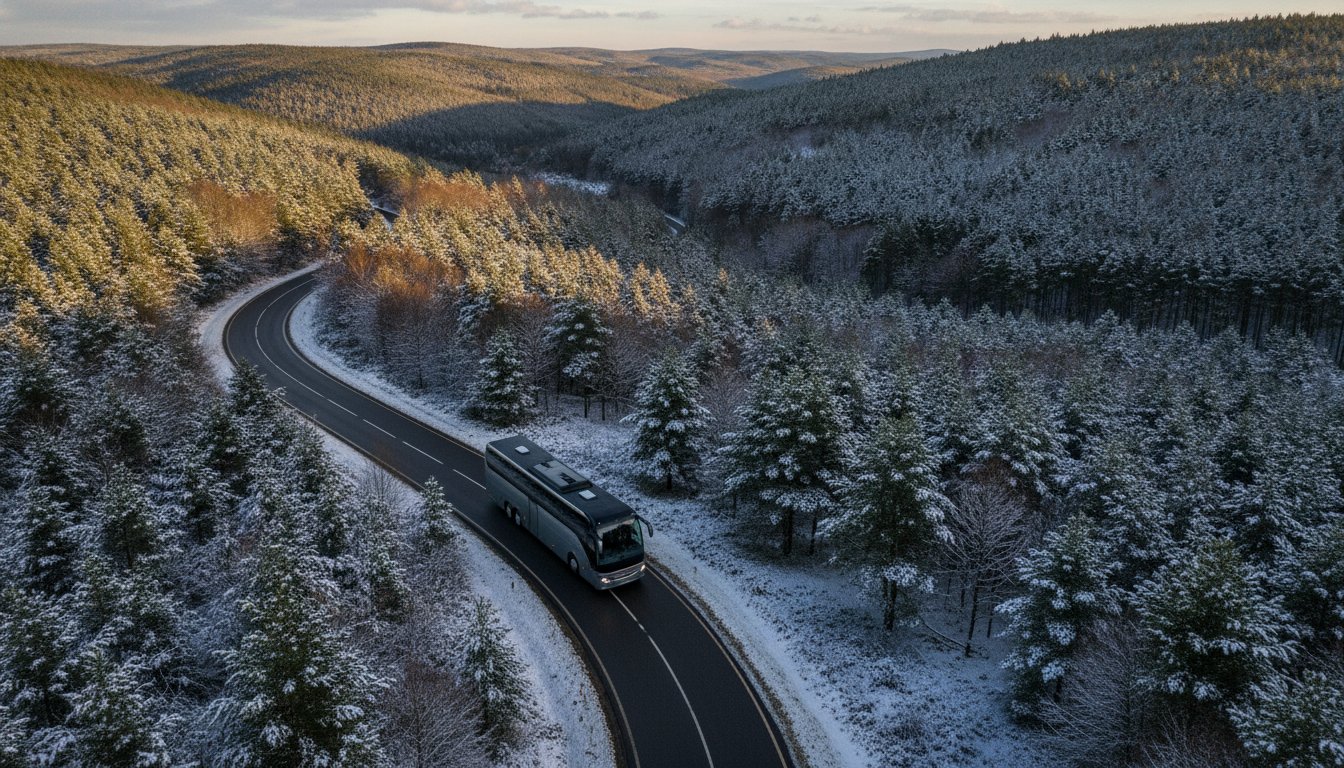
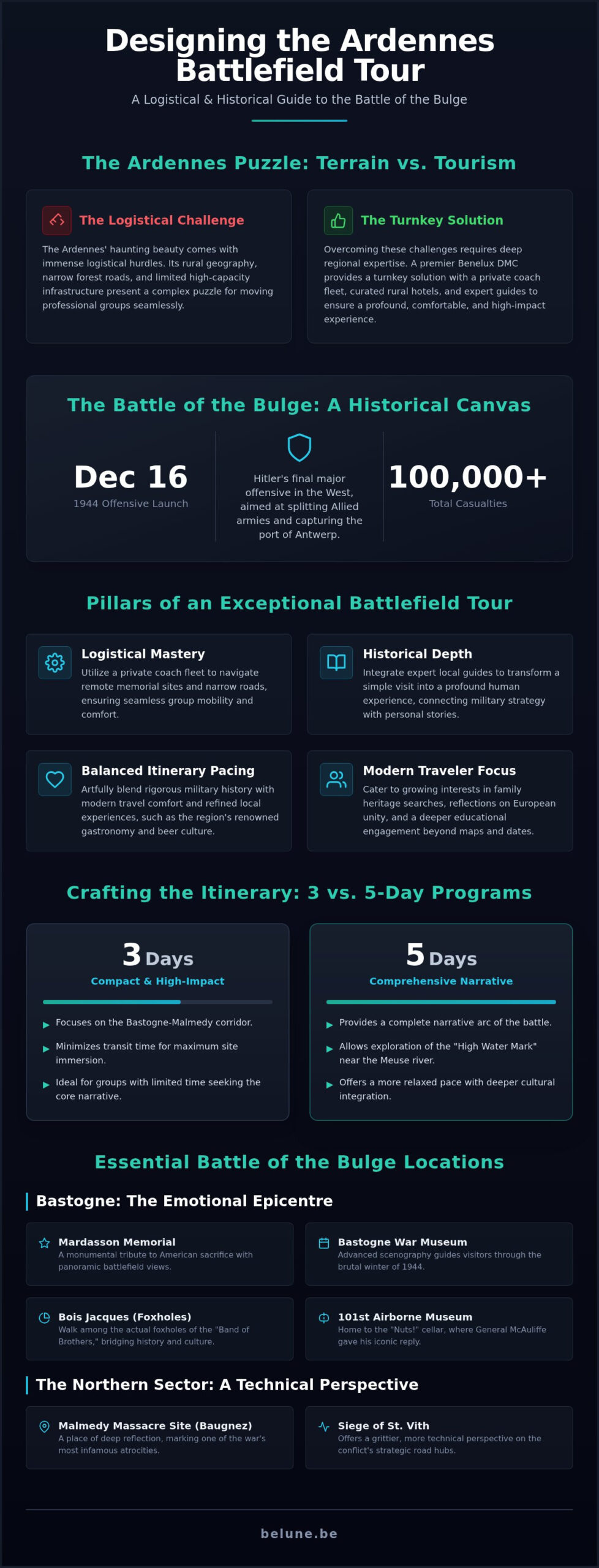
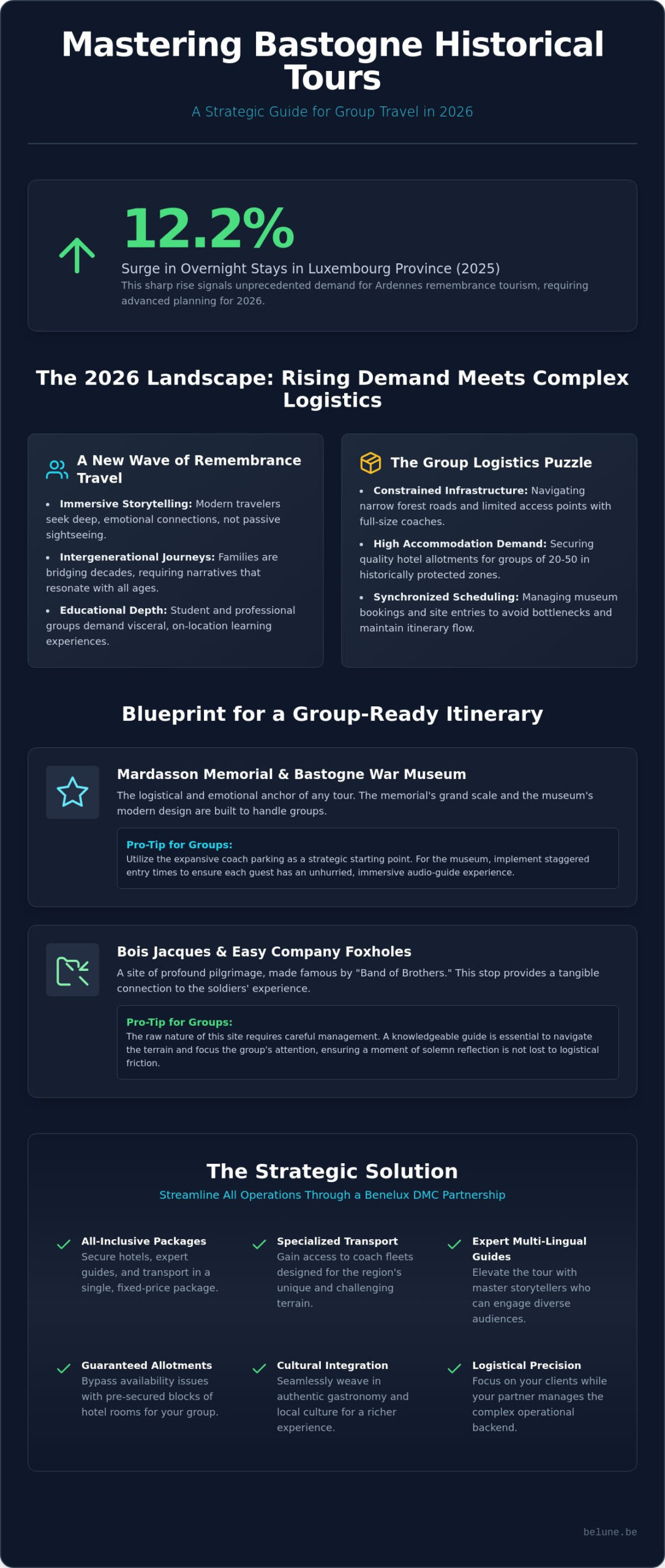
    The soil of the Benelux holds the echoes of two World Wars. At the Ypres Salient, where over 500,000 soldiers fell between 1914 and 1918, the landscape itself is a monument. Expert guides connect the physical topography to the strategic decisions of the past. They lead educational and commemorative groups through the Menin Gate and the preserved trenches of Sanctuary Wood with a quiet authority. In the south, the 1944 Battle of the Bulge sites in the Ardennes require a similar level of technical and emotional mastery. Our specialized approach to Battlefield Tourism focuses on this resonance, linking the silent forests to the personal letters and military records of those who served there.

    Art, Culture, and Gastronomy

    Beyond the trenches, the region offers a sublime feast for the senses. In Amsterdam, the Dutch Masters of the 17th century await. A guide doesn’t just show you Rembrandt’s “The Night Watch” (1642); they explain the socio-political tensions of the Dutch Republic that made such a masterpiece possible. In Brussels, the focus shifts to the late 19th century. Between 1893 and 1905, architects like Victor Horta redefined the city with Art Nouveau. A specialized guide reveals the hidden ironwork and organic curves tucked away in private residential streets that standard guidebooks overlook.

    Culinary guiding follows this same artisanal philosophy. It’s the difference between buying a souvenir and understanding a craft. This principle of expert, niche guidance isn’t limited to one continent; for example, a premier service like South Louisiana Redfishing applies a similar deep knowledge to connect visitors with a unique coastal ecosystem.

    • Belgian Chocolate: Workshops that detail the transition from bean to bar, focusing on the 70% cocoa solids required for true quality.
    • Dutch Cheese: Navigating the 600 year old traditions of the Alkmaar or Edam markets.
    • Hidden Gems: Discovering the “hofjes” (private courtyards) of Haarlem or the secret rooftop views of Ghent.

    This level of detail creates a harmony between the traveler and the destination. It’s an invitation to see the world with more clarity and nuance. You can begin crafting your own sophisticated journey by exploring our bespoke itineraries designed for the curious and the discerning.

    The DMC Advantage: Why Integrated Logistics Sublimates the Experience

    Choosing between a freelance guide and an integrated Destination Management Company (DMC) often defines the boundary between a standard tour and a masterpiece of travel. While a solo freelancer offers knowledge, they lack the structural support to manage the sudden complexities of international logistics. A DMC transforms these isolated services into a coherent, fluid narrative. When you secure local guide services benelux through a centralized partner, you aren’t just booking a person; you’re investing in a sophisticated ecosystem designed to eliminate friction. This integration ensures that the 15% of tours that typically face minor scheduling delays due to traffic or site closures remain entirely unaffected for the end client.

    The true value of a DMC lies in its ability to harmonize disparate elements. We view travel as a composition where the guide’s voice and the vehicle’s movement must exist in perfect sync. This centralized coordination reduces the administrative burden on tour operators by 30%, allowing them to focus on their clients while we manage the granular details of regional permits and site-specific regulations. Across the 12 major cultural hubs of the Benelux, our oversight guarantees a consistent standard of excellence that a fragmented network of freelancers simply cannot replicate.

    Coaches and Guides: A Seamless Partnership

    The relationship between a guide and a driver is a delicate pas de deux. In the historic hearts of cities like Bruges or Amsterdam, where vehicle access is strictly regulated by 2024 Low Emission Zone (LEZ) standards, timing is everything. A guide who isn’t perfectly synchronized with their driver risks leaving a group stranded on a rain-slicked cobblestone street. Our integrated approach ensures the guide and driver remain in constant communication, allowing for precise drop-offs at the gates of UNESCO World Heritage Sites exactly when the crowd flow is at its lowest.

    Belune’s modern coach fleet, consisting of 25 Euro 6 compliant vehicles, serves as more than just transport. It’s the physical vessel for the guide’s story. These spaces are designed for comfort and clarity, ensuring the transition from the quiet of the cabin to the vibrant energy of the city is effortless. This synergy allows the guide to focus on the nuance of the history rather than the stress of the schedule.

    • Real-time traffic monitoring to adjust routes 20 minutes ahead of arrival.
    • Pre-arranged permits for restricted zones in Ghent and Antwerp.
    • Drivers trained in the specific pacing of cultural storytelling tours.

    Risk Management and Reliability

    Reliability is the silent foundation of luxury. In the unpredictable world of travel, a DMC provides a safety net that spans three countries. If a guide becomes unavailable at 6:00 AM, our 24/7 operations desk activates a qualified replacement by 8:00 AM, a feat impossible for independent operators. We’ve spent 22 years refining this regional response network, ensuring that no project is ever left to chance. Every professional we work with is vetted against a 40-point “Belune standard” checklist, covering everything from linguistic precision to emergency first-aid response.

    This commitment to quality control is why 92% of our partner tour operators report a significant reduction in on-site incidents. We provide the peace of mind that comes from deep regional roots and a visionary approach to service. You don’t just get a guide; you get an entire infrastructure dedicated to the preservation of your reputation and the delight of your guests. It’s a promise of technical rigor and artistic flair, ensuring every local guide services benelux request results in a flawless execution.

    Selecting Your Guiding Partner: A Framework for Tour Operators

    Choosing a partner is an act of curation. For tour operators, the selection of local guide services benelux represents a critical extension of their own brand identity. It isn’t merely about finding someone who speaks the language; it’s about securing a professional who understands the nuance of B2B relationships. A 2024 industry survey revealed that 94% of luxury tour operators cite “guide personality and reliability” as the primary factor in guest satisfaction scores. This partnership requires a shared vision of excellence and a commitment to seamless execution.

    Professional etiquette in a B2B context means more than just showing up on time. It involves a 15-minute early arrival protocol, a deep understanding of group dynamics, and the ability to represent your company’s values without ego. When you vet a service, look for those who treat the tour as a technical production. They must possess site-specific permissions for restricted areas in cities like Ghent or Luxembourg City, ensuring your group never faces the embarrassment of being turned away at a monument gate.

    Essential Vetting Questions

    Precision begins with the right inquiry. Ask if they have specific experience with your group’s demographic; a guide for 18-year-old students requires a different energy than one for retired professionals. Demand to see their protocols for handling unexpected site closures, which affected 12% of major European attractions in 2023. Finally, verify how they integrate with your logistics. Do they coordinate directly with the driver? A guide who manages the “unseen” details creates a harmonious experience for the guest.

    Evaluating Cultural and Technical Depth

    The best guides don’t just narrate; they sublime the space through architectural insight and historical context. In cities like Paris, Brussels, and Amsterdam, “insider” knowledge isn’t a luxury, it’s a requirement for authenticity. You want a partner who can explain the structural harmony of a guildhall or the hidden symbolism in a canal-side facade. A guide’s value is measured by the questions they inspire, not just the facts they state. This intellectual stimulation transforms a simple walk into a profound journey of discovery.

    Briefing your guide service is the final step in ensuring brand alignment. Don’t just send a schedule. Provide a “Brand Persona” document that outlines the desired tone, whether it’s academic, conversational, or adventurous. Successful operators now include a “Do Not Mention” list to avoid clichés and a “Key Themes” list to ensure the narrative supports the overall tour mission. This level of detail ensures the guide feels like a natural part of your team rather than a third-party contractor.

    Logistical mastery is the backbone of any successful itinerary. Your chosen local guide services benelux should have a deep network of local contacts, from museum curators to restaurant owners. This network allows for real-time adjustments when a street is blocked or a venue is overcrowded. By 2025, the ability to pivot based on real-time local data will be the hallmark of a premium guiding service. You’re looking for a visionary who can anticipate needs before they become problems.

    Elevate your professional projects with a partner who understands the art of transforming spaces through precision and vision. Discover how Belune brings technical excellence to every collaboration.

    BELUNE: Two Decades of Expertise in Benelux Group Travel

    Since 2004, BELUNE has operated as the premier Destination Management Company for those who view travel as a form of high art. We don’t just organize trips; we compose group masterpieces. Our 20-year legacy in the Benelux and Paris regions allows us to navigate the intricate nuances of European hospitality with a precision that few can match. We treat every itinerary as a bespoke canvas, ensuring that the final journey reflects the unique identity of the group. By blending modern logistics with the timeless values of traditional hospitality, we create an environment where travelers feel both secure and inspired.

    Our expertise extends across the borders of Belgium, the Netherlands, and Luxembourg, reaching into the historic heart of Paris. We’ve spent two decades building a network that prioritizes quality over volume. This long-term presence means we understand the local rhythms, the hidden architectural gems, and the logistical requirements necessary for sophisticated group movements. We believe that a successful tour requires more than a schedule; it demands a vision that transforms a simple visit into a profound emotional experience.

    Our Approach to Local Guiding

    We believe the guide is the bridge between the traveler and the soul of a destination. This is why our local guide services benelux are built on a foundation of rigorous selection and shared passion. We don’t hire generalists. Instead, we collaborate with experts who mirror our brand’s commitment to cultural depth and artistic integrity. Whether it’s a deep dive into 17th-century Dutch Masters or a tactical analysis of WWI battlefield sites, our guides provide a level of insight that transforms facts into narratives.

    • Curated Expertise: Our guides are specialists in Art, Culture, and History, ensuring every story told has academic weight.
    • Environmental Harmony: We focus on the delicate balance between the group, the guide, and the local environment to ensure a respectful, immersive presence.
    • Personalized Solutions: Every tour is adjusted to the specific intellectual and physical needs of the group, from private museum openings to specialized battlefield walks.

    Planning Your Next Group Masterpiece

    Starting a project with BELUNE is a collaborative journey that begins with your vision. We provide a personalized accompaniment from A to Z, ensuring that no detail is left to chance. Our team manages everything from the initial conceptualization to the final departure, acting as your strategic ally on the ground. We’ve successfully managed over 1,200 group projects since our inception, proving that our method of combining technical rigor with creative flair produces consistent excellence. It’s time to elevate your expectations for what a group tour can achieve.

    Your next project deserves the touch of an artisan. We invite you to Partner with BELUNE for your next Benelux group tour and experience the difference that 20 years of dedication can make.

    Elevate Your Group Narrative with Technical Mastery and Artistic Flair

    Crafting a memorable group itinerary requires a delicate harmony between logistical precision and emotional resonance. It’s about more than moving travelers; it’s about the art of storytelling. By leveraging 20+ years of DMC expertise in Western Europe, you can transform standard tours into immersive cultural experiences. Whether your groups explore the somber history of Flanders Fields or the intricate brushwork of Dutch Masterpieces, the quality of your guiding partner defines the final memory. High-caliber local guide services benelux don’t just provide facts. They curate atmosphere. Reliability meets luxury through a private fleet of modern, high-comfort coaches, ensuring every transition is as seamless as the narrative itself. This integrated approach removes the friction of travel, allowing the region’s heritage to shine. Choosing a partner with specialized expertise in battlefield and cultural tourism ensures every detail aligns with a vision of excellence. It’s time to move beyond the ordinary and embrace a standard of travel that honors the destination through technical mastery and a sophisticated touch.

    Sublime your next group itinerary with BELUNE’s expert local guides

    The journey toward an exceptional travel experience starts with a single, well-placed light on the rich history of the Benelux region.

    Frequently Asked Questions

    What languages do your local guides in Benelux speak?

    Our guides master six primary languages including English, French, Dutch, German, Spanish, and Italian. We ensure a 98% fluency rate to guarantee seamless communication during every tour. This linguistic precision allows us to bridge cultures and reveal the subtle nuances of each destination.

    Whether you require a Dutch-speaking expert in Amsterdam or a French specialist in Brussels, our team delivers absolute clarity. We don’t just translate words; we interpret the local soul for your guests.

    Can you provide specialized guides for Battlefield tours in Flanders?

    We provide expert historians for Battlefield tours across Flanders, specializing in the 1914 to 1918 Ypres Salient. Our specialists hold advanced degrees in history or 12 years of field experience on specific sites like Tyne Cot and the In Flanders Fields Museum. These tours offer a profound, respectful exploration of the Great War’s impact.

    We transform historical facts into a moving, sensory narrative that honors the past with technical accuracy. It’s a journey through time that demands both rigueur and empathy.

    Do your guide services include coordination with coach transport?

    Our local guide services benelux include full synchronization with coach transport providers. We manage real-time logistics with 45 local transport partners to ensure your group’s movement is fluid and punctual. Guides maintain direct contact with drivers through a 24-hour dispatch system.

    This meticulous coordination removes the friction of travel. It allows guests to focus entirely on the beauty of the landscape and the depth of the experience without worrying about the technicalities of the road.

    How far in advance should I book guide services for a large group?

    You should book at least 120 days in advance for groups exceeding 50 participants. This four-month window secures the most qualified specialists and ensures optimal logistics for large-scale movements. During peak seasons from May to September, we recommend a six-month lead time to guarantee availability.

    Early planning allows us to tailor every detail of the itinerary. From specialized themes to precise timing, we ensure a flawless execution of your vision and a serene experience for every guest.

    Are your guides experienced in handling B2B tour operator requirements?

    We’ve partnered with 215 global tour operators over the last 10 years to deliver white-label guiding solutions. Our team understands the rigorous standards of B2B contracts, including strict punctuality and brand representation. We act as an invisible yet powerful extension of your agency.

    By handling the technical complexities of local navigation, we allow you to maintain a consistent, high-quality experience. We’re a strategic ally dedicated to the success of your architectural and cultural projects.

    Do you provide local guide services in Paris as well as Benelux?

    We offer comprehensive local guide services benelux and maintain a dedicated team of 30 certified guides in Paris. This allows for an elegant transition between the French capital and the Low Countries via the three-hour Thalys connection. Our Parisian experts focus on architectural mastery and hidden historical narratives.

    By bridging these regions, we create a harmonious travel experience. We maintain our signature standard of excellence across international borders, ensuring your journey remains inspired and professionally managed from start to finish.

    What is the difference between a local guide and a tour manager?

    A local guide provides 100% site-specific expertise for a few hours, while a tour manager handles 24/7 logistics throughout the entire journey. Our guides act as artisans of local culture, revealing the soul of a city like Bruges or Ghent. They focus on the nuance of the moment.

    In contrast, the tour manager ensures the group’s overall rhythm, managing hotels and transport schedules. Both roles are essential components of a successful itinerary, working in tandem to provide a balanced and stress-free environment.

    Can you arrange for guides with specific expertise in Art History or Gastronomy?

    We curate tours led by 15 specialists with Master’s degrees in Art History and 8 experts certified in Gastronomy. These guides don’t just show sites; they interpret them through a lens of technical mastery and sensory appreciation. They bring a unique depth to every visit.

    Whether exploring the Flemish Primitives or the 500-year history of Belgian chocolate, our experts provide deep, researched insights. This approach elevates a simple walk into an inspiring masterclass, tailored to the specific passions of your guests.