Tag: tour management

  • Optimizing a Group Tour Itinerary: The Art of Logistical Choreography

    Optimizing a Group Tour Itinerary: The Art of Logistical Choreography

    The most memorable journeys are those where the mechanics of travel remain entirely invisible to the guest. A truly exceptional experience isn’t found in a packed schedule, but in the deliberate space between destinations. When optimizing a group tour itinerary, the challenge lies in transforming a rigid sequence of events into a fluid narrative that respects both the clock and the human spirit.

    It’s a common frustration to see participants overwhelmed by itinerary fatigue or delayed by the subtle friction of coach logistics and hotel check-ins. We agree that a high-impact tour should feel like a curated performance rather than a logistical hurdle. This guide provides the tools to master the balance of technical precision and emotional resonance, ensuring your fixed-price packages deliver maximum value. We’ll explore how to orchestrate a seamless flow between destinations while navigating the 2026 landscape, including the new Entry/Exit System (EES) implemented on April 10 and evolving tourist levies. You’ll discover how to create a journey that feels both effortless and deeply significant for every traveler.

    Key Takeaways

    • Understand why the Packing Paradox suggests that adding more sites often reduces the emotional depth of the travel experience.
    • Master the Golden Ratio of transit to activity when optimizing a group tour itinerary to ensure participants remain engaged rather than exhausted.
    • Discover the Palate Cleanser technique for balancing intense historical themes with lighter gastronomy and beer experiences.
    • Implement a structured 3-Pillar Framework to capture morning momentum and create meaningful midday transitions.
    • Learn how professional orchestration manages technical driving regulations and local logistics to maintain a seamless, invisible flow.

    The Philosophy of Itinerary Optimization: More Than a Schedule

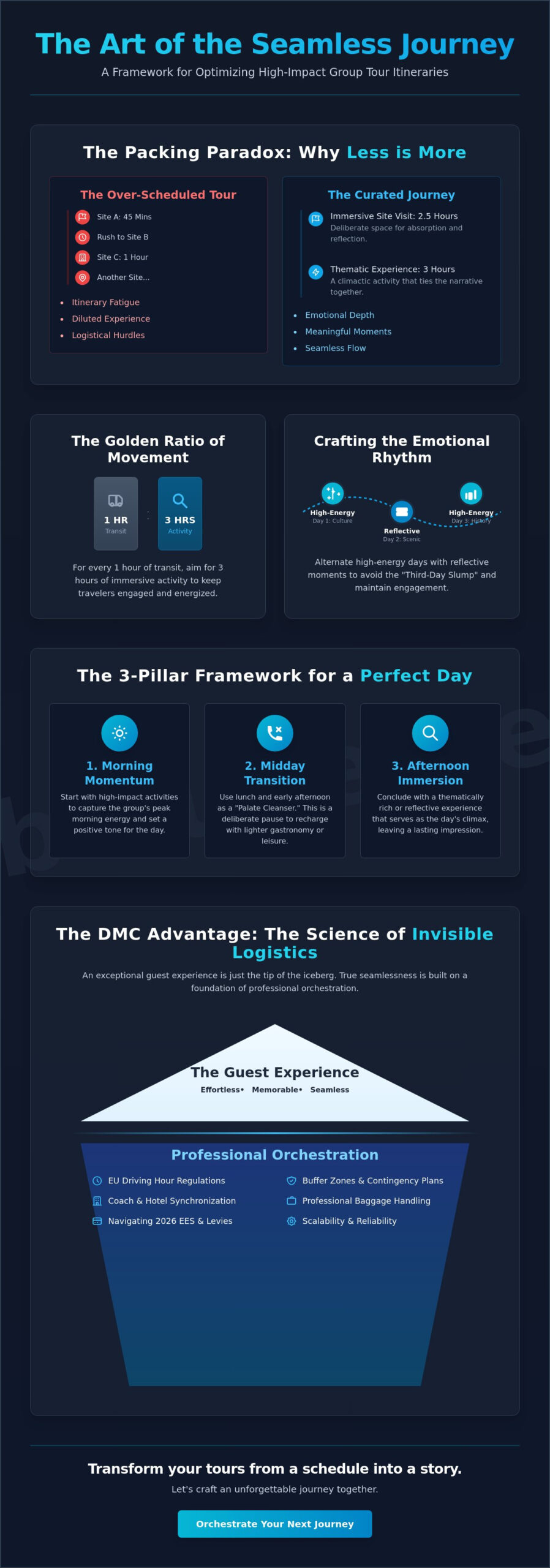
    True optimization isn’t a mere list of times and coordinates. It’s the harmonious balance between movement and stillness. In the pursuit of value, many planners fall into the “Packing Paradox,” believing that more stops equal more worth. In reality, over-scheduling dilutes the experience. It creates noise where there should be resonance. When we focus on optimizing a group tour itinerary, we aren’t just filling hours; we’re protecting the traveler’s ability to actually see what’s in front of them.

    An exceptional trip follows a narrative arc. It needs a beginning to set the tone, a climax that leaves guests breathless, and a resolution that allows for reflection. This complex logistical choreography ensures that the path taken is as meaningful as the destination reached. It’s about the transition as much as the arrival.

    To better understand how these elements come together, watch this helpful video:

    Raw logistics are the clay; the group travel agency is the sculptor. We don’t just book coaches and hotels. We refine the experience by removing the friction that often plagues large groups. By prioritizing flow over mere volume, we transform a standard trip into a curated journey that feels effortless for the participant.

    The Emotional Rhythm of a Group Tour

    A journey has a pulse. We identify “High-Energy” days, such as an immersive day of art and culture, and balance them with “Reflective” moments. This strategic pacing is essential to avoid the “Third-Day Slump,” a common point where physical and mental exhaustion begins to set in for participants. Narrative pacing is the secret to high participant satisfaction. It’s the difference between a group that’s merely present and one that’s truly engaged.

    B2B vs. B2C Optimization Perspectives

    Professional tour operators must view optimization through a lens of scalability and reliability. While an individual traveler might chase a “hidden gem” down a narrow, inaccessible alley, a group coach requires proven infrastructure. We build “buffer zones” into every professional plan. These aren’t wasted hours; they’re the safety net that allows the group to remain calm when the unexpected occurs. We balance the client’s ambitious wish list with the hard reality of operational constraints. This ensures that the final result isn’t just a beautiful concept, but a reliable reality that protects your reputation and the guest’s experience.

    The Logistics of Movement: Masterclass in Coach and Transit Timing

    Movement is the invisible skeleton of travel. When optimizing a group tour itinerary, we apply a specific cadence known as the Golden Ratio. Ideally, for every hour of transit, participants should enjoy at least three hours of immersive activity. This prevents the feeling of being ‘trapped’ on a bus while maintaining a steady forward momentum through the region. It’s a delicate balance. It ensures the journey never feels like a commute.

    Technical constraints often dictate the success of this rhythm. European driving hour regulations are non-negotiable; they require precise rest periods that, if ignored, can derail an entire afternoon. Sophisticated algorithmic tour planning takes these legal mandates into account from the very first draft. By utilizing our own fleet of modern coaches, we maintain total control over these variables. Reliability isn’t just a promise; it’s a structural component of our operation.

    The choreography continues at the hotel door. Coordinating a coach drop-off for thirty or more guests requires a synchronized effort between the driver, the guide, and the front desk. We prioritize properties that specialize in baggage handling and efficient room distribution. If you’re looking for a partner to manage these complexities, our specialized coach hire and logistics services provide the necessary foundation for excellence.

    Optimizing Transit Corridors

    Strategic routing minimizes dead-time on highways. We view transit as an opportunity, not a delay. A drive through the Flemish countryside can become a guided lecture on local architecture or a scenic detour through rolling hills. Professional coach hire ensures these transitions are seamless, turning the space between hubs into a highlight of the tour. It’s about making every mile count.

    Hotel Accommodation Management for Large Groups

    The ‘Hub and Spoke’ model is our preferred approach for minimizing group fatigue. By selecting a central, high-quality hotel and conducting day trips from that base, we reduce the constant cycle of packing and unpacking. Precise room block management is essential. We ensure every guest is accounted for long before the coach pulls into the driveway, allowing for a swift, dignified check-in process. This attention to detail transforms a simple stay into a refined hospitality experience.

    Optimizing a Group Tour Itinerary: The Art of Logistical Choreography

    Thematic Optimization: Battlefield, Gastronomy, and Culture

    Thematic depth shouldn’t come at the cost of emotional exhaustion. A successful journey layers specialized interests, such as battlefield tourism, within a broader cultural narrative. This requires a nuanced understanding of how different subjects interact with the traveler’s psyche. When we’re optimizing a group tour itinerary, we treat the schedule as a composition where heavy, somber notes are balanced by moments of levity and sensory delight. It’s about resonance, not just repetition.

    We utilize the “Palate Cleanser” technique to maintain engagement. After a morning spent at moving historical sites, we transition the group toward gastronomy and beer experiences. This isn’t just about food; it’s a strategic reset. It allows the group to process complex history in a relaxed, social environment. Applying a rigorous methodology for route optimization allows us to thread these sensitive locations into a broader cultural fabric without the logistics feeling forced or clinical.

    Success in this area relies heavily on the quality of local guide services. We curate experts who don’t just recite facts but adapt their narrative to the group’s specific knowledge level. This is particularly vital because themed group travel in Benelux requires a deep understanding of local regional nuances. A guide must know when to lean into the technical details of a battle and when to pivot toward the artistic heritage of a nearby village.

    The Battlefield Pilgrimage Framework

    Effective battlefield tours require a choice between chronological and geographic routing. For WWI and WWII sites in Flanders or Normandy, we often prioritize the narrative sequence to help guests grasp the historical scale. We also build in “Personal Connection” time. Many groups seek specific memorials or gravesites. Our logistics must remain flexible enough to accommodate these private moments of remembrance while ensuring the coach can navigate often rural or sensitive historical zones without delay.

    Gastronomy as a Logistical Tool

    Meals serve as cultural anchors. They’re the punctuation marks of the day. We select venues that can comfortably house thirty guests while maintaining the intimate feel of a boutique establishment. This balance is difficult to achieve but essential for high-end group travel. Our local guides play a crucial role here, navigating complex dietary requirements and regional specialties across international borders. They ensure the dining experience reinforces the day’s theme rather than interrupting it. It’s a seamless extension of the tour’s artistic vision.

    The 3-Pillar Framework for a Perfect Day

    A single day within a journey is a microcosm of the entire trip. It requires its own beginning, middle, and end. When optimizing a group tour itinerary, we divide the day into three distinct pillars to ensure energy remains high and the narrative remains clear. This structure isn’t just about efficiency; it’s about respecting the natural ebb and flow of human attention and physical stamina.

    The first pillar is Morning Momentum. We schedule the “Must-See” site as the very first stop. This is when energy levels are at their peak and natural light is optimal for both photography and appreciation. By securing early entry slots, we avoid the mid-morning rush, allowing the group to experience iconic locations with a sense of exclusivity. This sets a tone of excellence for the remainder of the day.

    The second pillar is the Midday Transition. Lunch shouldn’t be a pause in the experience but a curated extension of it. We select venues that reinforce the day’s theme, whether it’s a traditional brewery in Brussels or a historic inn near a battlefield. This transition serves as a bridge, allowing guests to refuel while processing the morning’s discoveries in a social, relaxed setting.

    The final pillar is the Afternoon Discovery and Evening Reflection. The afternoon offers a choice: a secondary, lower-intensity site or structured free time. We conclude with a communal dining experience or a cultural event that provides a sense of closure. This final act allows the group to decompress and share their experiences, cementing the day’s memories before returning to the hotel. For those seeking to implement this level of precision, you can partner with our expert logistics team to design your next high-impact journey.

    The Power of ‘White Space’

    The most valuable part of an optimized itinerary is often the time where nothing is scheduled. We believe that sixty minutes of unstructured time is essential. We strategically place these gaps in pedestrian-friendly areas where guests can explore at their own pace. This prevents the feeling of being “herded” and allows for personal serendipity. Thoughtfully placed white space is the essential valve that prevents group burnout and directly increases repeat bookings.

    Managing the ‘Group Gravity’

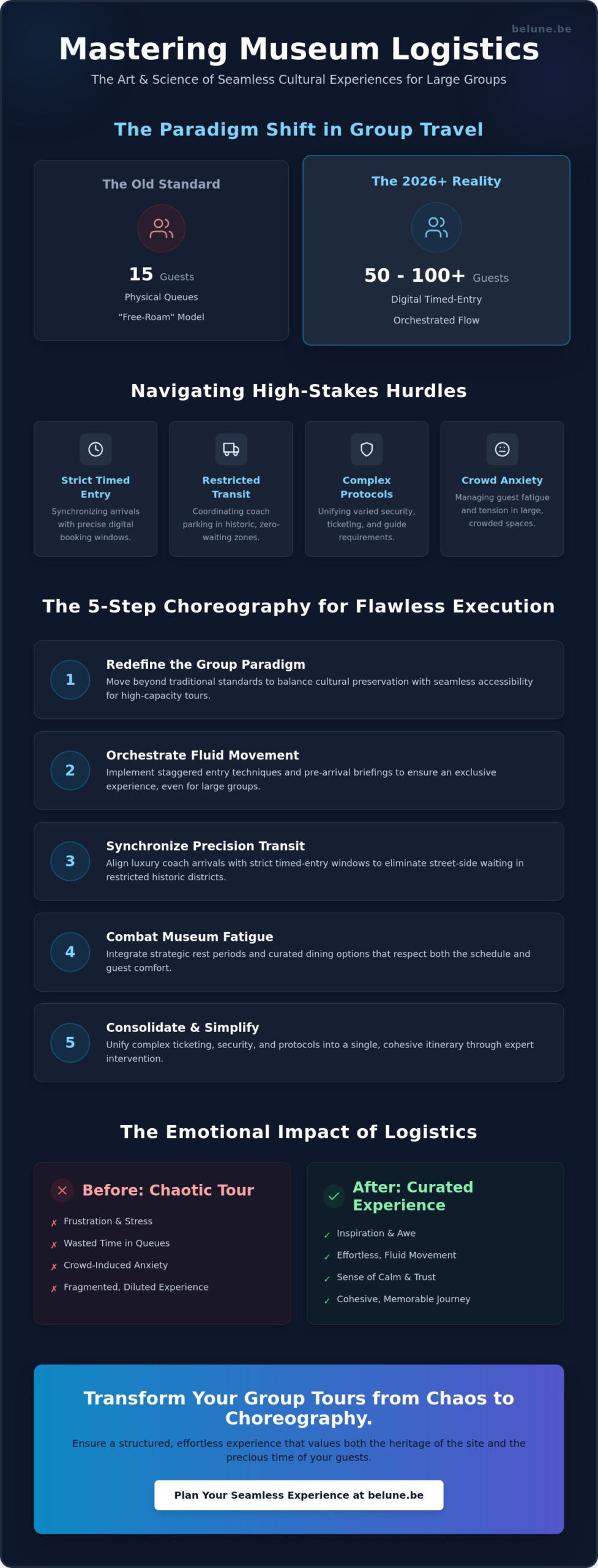
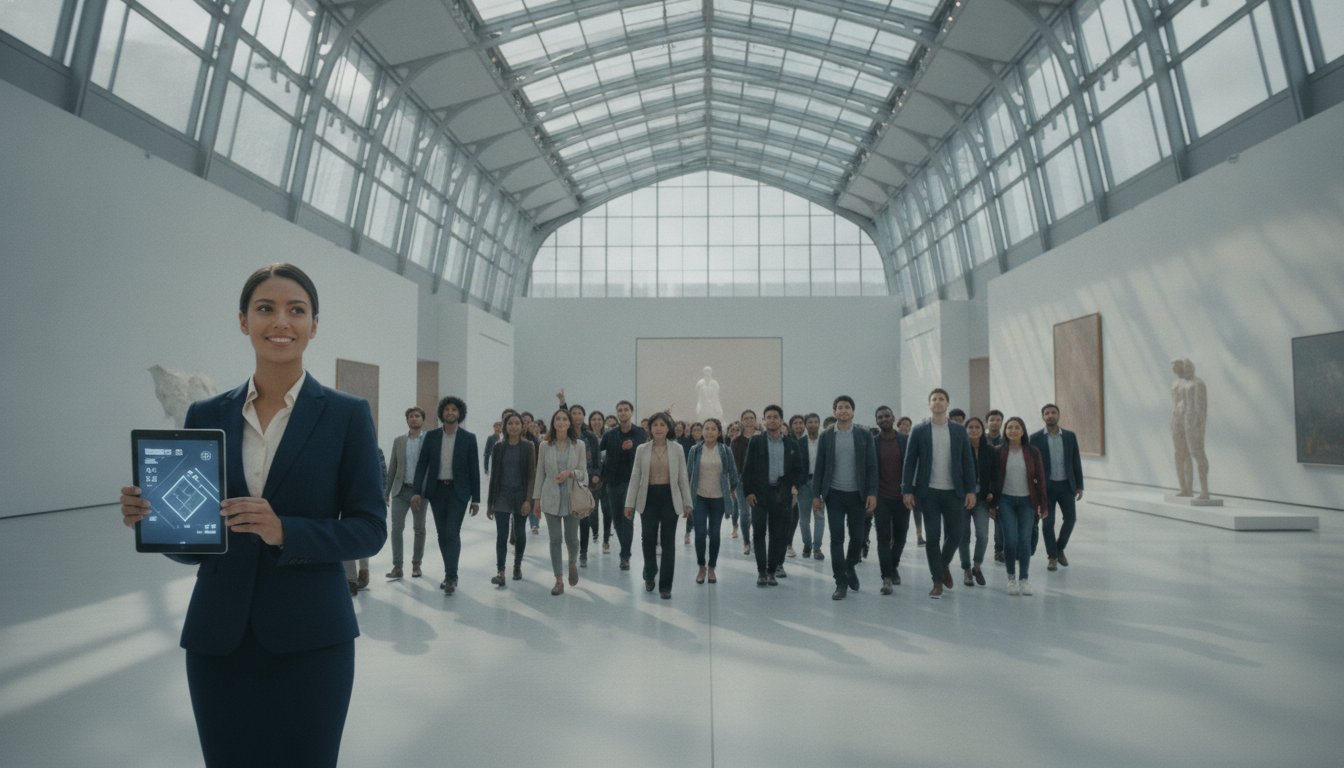
    Keeping thirty to fifty people moving in unison requires technical finesse. We use “whisper” radio systems in crowded museums and city centers. These allow the guide to speak at a natural volume while guests listen through earpieces, maintaining an intimate connection even in a throng of tourists. We also eliminate “waiting-in-line” fatigue by pre-booking every entry slot. This ensures the group moves with a constant, effortless flow, never losing momentum to administrative delays or ticket queues.

    The DMC Advantage: Why Professional Orchestration Wins

    Professional orchestration is the final layer of refinement. While a basic schedule provides a map, a Benelux incoming tour operator provides the pulse. We act as the “Invisible Hand,” managing the complex variables that can disrupt even the most carefully planned journey. From sudden rail strikes to the biometric processing delays at borders following the April 10, 2026, EES implementation, we solve logistical hiccups before the group even notices a delay. This level of on-the-ground support is what truly defines the art of optimizing a group tour itinerary.

    Beyond risk management, we offer access that remains closed to individual planners. This includes private museum viewings and after-hours cultural experiences that elevate a tour from standard to extraordinary. Partners benefit from the financial security of fixed-price group packages. This transparency allows tour operators to market with confidence, knowing every technical detail is accounted for within a stable budget. It’s a partnership built on reliability and shared vision.

    Integration of Fleet and Expertise

    There’s a unique synergy in owning the coach fleet while designing the path it travels. Real-time communication between our drivers, local guides, and the management office ensures that every transition is fluid. We don’t rely on third-party availability. Instead, we leverage over twenty years of regional experience to find logistical shortcuts that save hours over the course of a week. This technical mastery transforms transit from a necessity into a seamless component of the narrative. It ensures the group stays focused on the destination, not the drive.

    Finalizing the Itinerary: A Collaborative Vision

    Every project undergoes a rigorous “Itinerary Audit.” We review every turn, every timing, and every transition to eliminate potential friction points. Customization is our standard approach. We adjust the flow based on whether we’re serving a student pilgrimage or a luxury corporate retreat. The result is a bespoke experience that reflects your specific goals and respects the traveler’s time. Request your custom Benelux group tour itinerary from BELUNE today.

    The Future of Curated Group Travel

    A truly exceptional journey is more than the sum of its destinations. It’s a carefully composed narrative where technical precision serves as the foundation for emotional resonance. By embracing the Golden Ratio of movement and the strategic inclusion of white space, you transform a standard trip into a profound human experience. Mastering the art of optimizing a group tour itinerary requires a deep understanding of both the landscape and the traveler’s rhythm. It’s about ensuring every transition feels like a natural progression rather than a logistical necessity.

    With over 20 years of regional expertise and a private fleet of modern, luxury coaches, we specialize in high-complexity thematic tours that challenge the ordinary. We invite you to Partner with BELUNE for your next masterpiece in group travel. Our team stands ready to serve as your strategic ally, turning complex logistics into a seamless, inspiring reality. Let’s create a journey that stays with your guests long after they’ve returned home.

    Frequently Asked Questions

    What is the ideal group size for an optimized coach tour?

    The ideal group size typically ranges between 25 and 35 participants. This number allows for a comfortable atmosphere on a standard 50-seater luxury coach while maintaining the economic efficiency of the tour. When optimizing a group tour itinerary, this range ensures that museum entries and restaurant seating remain manageable without sacrificing the intimate feel of a curated journey.

    How much ‘free time’ should be included in a 7-day group itinerary?

    We recommend at least sixty to ninety minutes of daily “white space” and one full free afternoon mid-week. This prevents the physical and mental exhaustion often associated with rigid schedules. Strategic free time in pedestrian-friendly city centers allows guests to explore personal interests, which significantly improves overall satisfaction and repeat booking rates.

    How do you account for coach driving regulations when planning long-distance tours?

    European Union mandates require specific rest periods for drivers, such as a 45-minute break after four and a half hours of driving. We treat these technical requirements as structural pillars rather than obstacles. By aligning these breaks with scenic stops or guided lunches, the flow of the tour remains uninterrupted while ensuring full legal compliance and passenger safety.

    What are the benefits of using a DMC for Benelux group travel?

    A Destination Management Company provides the “invisible hand” that navigates regional complexities like the new Entry/Exit System (EES) implemented in April 2026. Our local presence allows us to manage hotel blocks, coach logistics, and guide services with a level of precision that individual planners can’t replicate. We transform raw logistics into a refined, professional experience through constant on-the-ground support.

    How do you balance niche themes like battlefield tours with general sightseeing?

    The secret lies in the “Palate Cleanser” technique. We follow somber, high-intensity visits to WWI or WWII sites with lighter cultural or gastronomy experiences. This balance respects the emotional weight of historical pilgrimages while providing the necessary contrast to keep the group engaged. It ensures the itinerary feels like a complete narrative rather than a repetitive sequence.

    What happens if a site is unexpectedly closed during the tour?

    Our management office and local guides maintain real-time communication to pivot instantly if a closure occurs. Because we understand the regional landscape intimately, we can redirect the group to a secondary site of equal cultural value. This orchestration happens behind the scenes, ensuring the guest’s experience remains seamless and stress-free regardless of external disruptions.

    Is it better to stay in one central hotel or move between cities?

    The “Hub and Spoke” model is generally superior for optimizing a group tour itinerary in regions like the Benelux. Staying in a central city like Brussels or Ghent for several nights reduces the fatigue of constant packing and unpacking. This approach allows for deeper immersion in a single base while providing efficient access to surrounding historical and cultural hubs.

    How do you manage dietary restrictions for a group of 40 people?

    We manage dietary requirements through a rigorous pre-screening process conducted weeks before arrival. This data is shared with our curated network of restaurants to ensure that every guest enjoys a high-quality meal. Our guides double-check these arrangements on-site, making the dining experience a seamless cultural anchor rather than a logistical hurdle.

  • Brugge Group Tours for Travel Operators: A Masterclass in Professional Logistics

    Brugge Group Tours for Travel Operators: A Masterclass in Professional Logistics

    A successful itinerary in Bruges is no longer just about the scenery; it’s a rigorous exercise in logistical precision. With eight million annual visitors and new March 2026 regulations limiting walking groups to exactly 20 participants, the margin for error has vanished. You likely already know that organizing Brugge group tours for travel operators has shifted from simple planning to a complex puzzle of licensing and restricted zones. From the ban on sound amplification to the €4.20 per person nightly accommodation tax, the details now define the quality and profitability of the entire guest experience.

    We share your belief that a professional travel operator shouldn’t have to choose between authentic local charm and operational reliability. This guide reveals how a specialized DMC transforms these logistical hurdles into a seamless, white-label extension of your own brand. We’ll explore the strategic benefits of fixed-price certainty, expert guide management under the new 2026 mandates, and the masterclass in coordination required to handle everything from coach parking at Kanaaleiland to exclusive museum access for your clients.

    Key Takeaways

    • Master the complexities of the “last mile” in medieval city centers by leveraging a private coach fleet for seamless group transitions.
    • Elevate your Brugge group tours for travel operators by integrating specialized gastronomy and heritage programs that transcend standard sightseeing.
    • Discover how professional DMC oversight mitigates hidden costs and manages last-minute disruptions to protect your brand reputation.
    • Transition from a supplier-client relationship to a strategic partnership that offers fixed-price reliability and deep local expertise across the Benelux region.

    Optimizing Brugge Group Tours for International Travel Operators

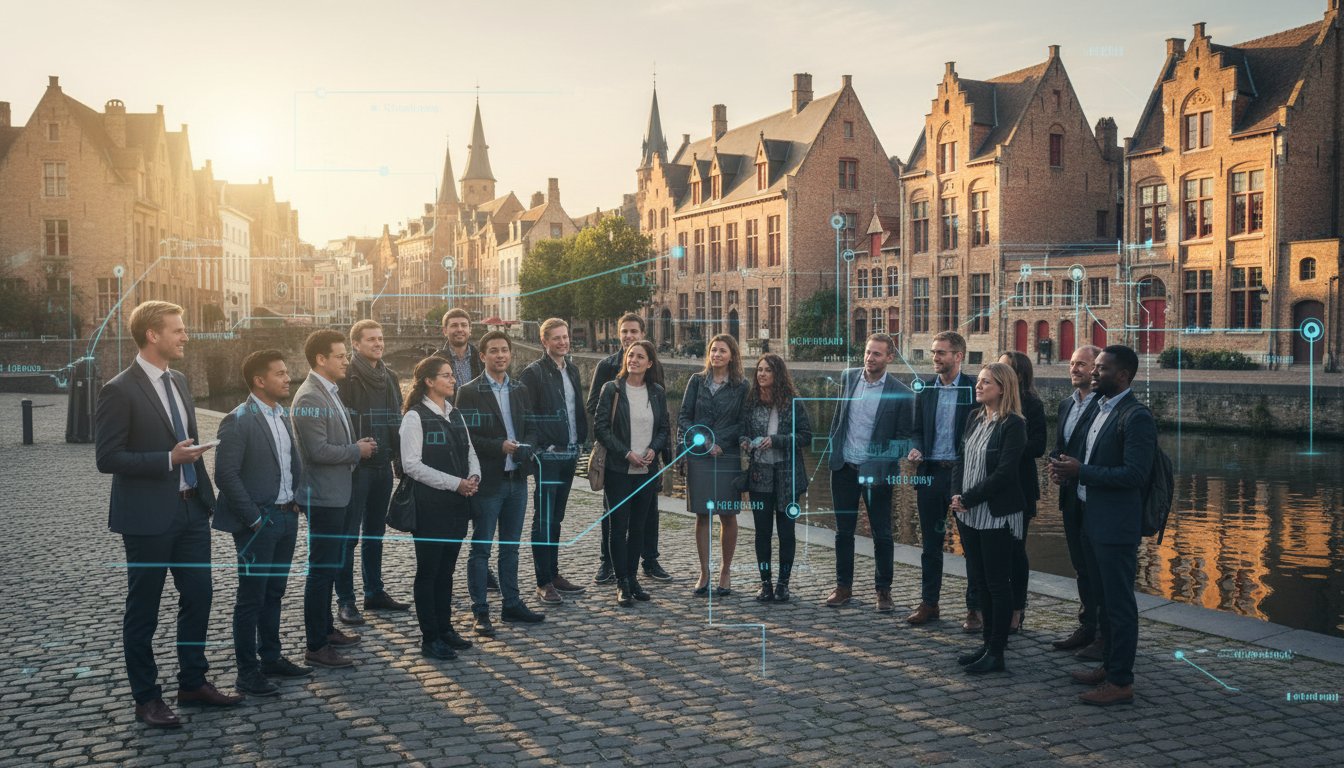
    Bruges is no longer a mere stopover on a European circuit; it’s the centerpiece of a sophisticated Benelux itinerary. For global agencies, Brugge group tours for travel operators represent a high-stakes environment where logistical precision meets cultural heritage. In 2026, the city’s appeal remains undeniable, yet the complexity of managing groups has reached a new peak. Standard retail tours designed for the mass market often fail to provide the “white-label” discretion and technical rigor that professional travel agents require. Success in this market demands a partner who understands the architectural and historical nuances of this UNESCO World Heritage site.

    To grasp the city’s profound significance, one can explore a comprehensive overview of Bruges, which details its evolution from a medieval trade hub to a global tourism icon. With approximately eight million visitors annually, the pressure on local infrastructure is immense. This reality necessitates a shift from basic sightseeing to a curated, logistical masterclass. A specialized benelux incoming tour operator acts as the visionary behind the scenes, ensuring that every movement within the city’s narrow streets feels effortless rather than crowded.

    To better understand the requirements of modern group travel, watch this helpful video:

    The 2026 Landscape for European Group Travel

    The travel industry has entered an era of “slow travel” where quality of immersion outweighs the quantity of stops. Since March 1, 2026, Bruges has implemented strict regulations limiting walking tours to 20 participants, excluding the guide. These mandates, along with the ban on sound amplification, require a complete rethink of group dynamics. High-efficiency logistics are now mandatory. Operators must navigate the new 12% VAT on accommodations and the €3.75 nightly tax per person with total transparency. We don’t just follow these rules; we use them to refine the guest experience, ensuring that Brugge group tours for travel operators remain both sustainable and exclusive.

    DMC vs. DIY: The Operator’s Dilemma

    Managing a network of local vendors from a distant headquarters is a risk that many global agencies can’t afford. The hidden complexity of Bruges, from restricted traffic zones to specific coach drop-off points at Bargeplein, creates a logistical maze. A DIY approach often leads to fragmented service and brand inconsistency. By contrast, our 20 year legacy in the Benelux region provides a foundation of trust. We function as a strategic ally, providing a seamless “white-label” service that protects your brand’s reputation. This artisanal approach to travel management ensures that every technical detail, from coach hire to hotel access permits, is handled with a craftsman’s precision.

    The “last mile” in Bruges isn’t just a distance; it’s a technical challenge that demands a craftsman’s precision. Navigating a modern coach through a UNESCO World Heritage Site requires more than a standard GPS. It requires an intimate knowledge of the city’s circulatory system. For global agencies, the success of Brugge group tours for travel operators hinges on the invisible thread of logistics that connects the arrival at Bargeplein to the hotel lobby. We don’t just move people; we orchestrate a transition that respects both the medieval architecture and the traveler’s comfort.

    While many providers rely on third-party rentals, we maintain an exclusive private fleet to ensure total control over the guest experience. This is the cornerstone of premium coach hire belgium services. Managing the transition from the designated coach park at Kanaaleiland, where 2026 rates range from €29.00 for four hours to €55.00 for overnight stays, requires meticulous timing. Coaches must secure specific permits from hotels to even enter the historic center for luggage drop-off. Without this level of coordination, a group’s arrival can quickly descend into a chaotic trek through cobblestone streets.

    Modern Coach Fleet Management

    Precision in transport is our signature. Our fleet meets the highest technical specifications for long-haul Benelux journeys, ensuring that every mile is as smooth as the last. We prioritize safety and reliability by strictly adhering to European driver hour regulations, removing the risk of delays or non-compliance. On-board, the experience is elevated with ergonomic seating and modern amenities, transforming transit into a period of reflection and rest. This commitment to quality ensures your brand’s standards are upheld from the moment your clients land until their final departure.

    Sourcing Group-Friendly Hotels

    Selecting the right accommodation is an exercise in balancing atmosphere with accessibility. We partner with hotels that understand the unique rhythm of large groups and the administrative rigor required in 2026. With the VAT on tourist accommodations now at 12% and the nightly tax at €4.20 per person (including VAT), financial transparency is paramount. We manage these details alongside complex check-in procedures and luggage logistics. Our established relationships allow us to bridge the gap between central proximity and the practical realities of coach access. For those seeking a truly harmonious travel experience, our local expertise becomes your most valuable asset.

    Curating High-Value Itineraries: From Gastronomy to Heritage

    Crafting a memorable itinerary is an exercise in storytelling through space and time. Within these medieval walls, the difference between a standard visit and a transformative journey lies in the selection of details. Designing Brugge group tours for travel operators requires an artisanal touch that balances technical precision with emotional resonance. We don’t simply list highlights; we curate a sequence of experiences that sublimer the city’s unique character. The Official Bruges Tourism Portal provides the necessary logistical foundation, but our role is to add the layer of exclusivity that global travelers expect.

    A sophisticated program must move beyond the predictable. By weaving together the threads of culinary mastery and architectural history, we create a narrative that reinforces your brand’s authority. Every tour is a “white-label” masterpiece, designed to feel like a natural extension of your own agency’s vision. We prioritize harmony between structured exploration and the quiet moments of reflection that make a journey feel personal.

    Gastronomy and Beer Experience Modules

    True immersion begins with the senses. Integrating belgium gastronomy tours into a broader itinerary allows groups to connect with the soul of Flanders. We avoid the common “tourist traps,” choosing instead to collaborate with local artisans and world-class chocolatiers who value quality over volume. For the discerning international group, the Belgian beer experience is approached with the same reverence as a fine wine tasting. We arrange private sessions in historic cellars where the nuance of fermentation meets centuries of brewing tradition. These modules are designed to be scalable, ensuring that even with the 2026 group size regulations, the intimacy of the experience remains intact.

    Art & Culture: A Masterclass in Curation

    The artistic heritage of Bruges is a material of construction for any high-value tour. Our culture group tours benelux provide deep-dives into the world of the Flemish Primitives, led by expert guides who possess a sensitivity to both history and aesthetics. We navigate the 2026 Musea Brugge regulations with ease, managing the 15-person group limit to ensure each guest receives personalized insight. Whether it’s a private viewing of Jan van Eyck’s masterpieces or a technical study of the city’s medieval urban design, our curation is precise. This rigorous approach to Brugge group tours for travel operators ensures that every cultural encounter is both profound and perfectly synchronized with the broader travel schedule.

    Mitigating Risk: Why Professional DMC Oversight is Essential

    The perceived cost of a Destination Management Company is often the primary objection for international agencies. We challenge this perspective. In the complex landscape of 2026, the real expense lies in logistical failure. Organizing Brugge group tours for travel operators involves navigating a minefield of potential disruptions, from sudden road closures in the historic center to the strict enforcement of new guide licensing laws. We act as your strategic ally, an invisible architecture that absorbs these shocks before they reach your clients. Risk management is not a secondary service; it’s a material of construction for every successful itinerary.

    Relying on a fragmented network of local vendors leaves your brand vulnerable. If a third-party guide fails to secure the mandatory March 2026 authorization or a coach driver is unaware of the specific Bargeplein drop-off protocols, the reputational damage falls on you. Our role is to provide a safety net of professional oversight that ensures brand consistency. We don’t just plan; we protect the integrity of the guest experience through rigorous technical control and local presence.

    Fixed-Price Group Tour Packages

    Financial volatility is a significant risk for any global operator. Our fixed-price models serve as a tool for precision budget planning, shielding you from seasonal spikes and currency fluctuations. We provide total transparency regarding the 12% VAT on accommodations and the €4.20 nightly tourist tax. Looking ahead, we’re already integrating the €4.00 day-tripper tax for bus tourists, effective January 1, 2027, into our long-term projections. This reliability allows you to sell with confidence, knowing that your margins are protected by an expert who understands the local fiscal landscape. The ROI of outsourcing logistics is found in the elimination of hidden costs and administrative burden.

    On-the-Ground Support and Expertise

    Disruption doesn’t follow a schedule. Our team provides 24/7 support for groups navigating the Benelux region, ensuring that last-minute changes are handled with elegance rather than panic. This expertise is particularly vital when managing transitions between diverse locations. Whether your group is moving from the somber reflection of flanders fields to the vibrant atmosphere of the Bruges Markt, we ensure the narrative remains fluid. Our multi-lingual local guides do more than translate; they bridge cultural nuances and navigate regional regulations that an overseas operator simply cannot see. To ensure your next project is built on this foundation of certainty, you should secure your logistical foundation with a partner who values precision as much as you do.

    BELUNE: Your Strategic Partner for Seamless Benelux Travel

    At BELUNE, we don’t view travel as a commodity. We see it as a material of construction, much like an architect uses light and shadow to define a room. Our role is that of a craftsman, shaping the technical complexities of Brugge group tours for travel operators into an experience that feels effortless and inspired. With a 20 year legacy in Benelux transport and management, we’ve refined the art of the “white-label” partnership. We don’t just provide services; we provide a vision that reinforces your brand’s authority while allowing your clients to immerse themselves in the soul of Flanders.

    The technical rigor we’ve discussed, from navigating the 2026 walking tour limits to managing the 12% VAT on accommodations, is merely the foundation. The true value lies in how we translate these logistics into emotional resonance. A journey shouldn’t be a sequence of transfers; it should be a fluid narrative where every transition is handled with a technician’s precision and a poet’s sensitivity. We act as the silent partner, ensuring that your agency’s reputation is sublimed through every interaction on the ground.

    Our Collaborative Process

    We’ve designed our roadmap to be a natural extension of your own team’s workflow. From the initial conception of an itinerary to the final execution at Bargeplein, our collaboration is built on listening and technical excellence. We understand that global travel agents require flexibility. Whether you’re designing specialized cycling tours through the Flemish countryside, managing high-stakes logistics for festivals like Tomorrowland, or coordinating group access for the F1 Grand Prix at Francorchamps, we adapt our expertise to your specific goals. Our sur-mesure approach ensures that no two programs are identical, reflecting the unique nuance of your brand’s identity.

    Request Your Custom Itinerary

    Precision planning requires time and a shared vision. We recommend initiating the itinerary design process at least six to twelve months in advance, especially for peak seasons where hotel availability and guide authorizations are at a premium. By defining your group’s thematic preferences early, whether they center on Battlefield tourism or the intricate world of Belgian gastronomy, we can secure the most competitive rates and exclusive access points. Our travel experts are ready to transform your logistical requirements into a masterpiece of European travel. We invite you to contact us today to sublime your next group project and discover the serenity that comes from a partnership built on excellence.

    Elevating Your Vision in the Heart of Flanders

    The medieval architecture of Bruges demands more than a simple itinerary; it requires a masterclass in logistical coordination. We’ve explored how navigating the 2026 group size limits and the new tourist tax structures is no longer a choice but a necessity for operational success. Mastering Brugge group tours for travel operators means transforming these technical constraints into a seamless, high-value narrative for your clients. Each detail must be handled with a craftsman’s precision to ensure the guest experience remains undisturbed and inspired.

    With our 20 year legacy as a specialist DMC, we offer the technical rigor of a private coach fleet and the creative sensitivity of expert local guides. We handle the high-stakes B2B logistics so you can focus on your brand’s growth and reputation. Our expertise acts as the invisible architecture that ensures every tour remains a work of art. The path to a flawless season starts with a strategic ally who understands the nuance of the Benelux landscape. We invite you to partner with BELUNE to curate your next exceptional group tour. Let’s design a journey that reflects your commitment to excellence and inspires your most discerning travelers.

    Frequently Asked Questions

    What are the specific coach parking regulations for group tours in Bruges?

    Coaches are required to use the designated parking area at Kanaaleiland on Bargeweg. For 2026, the municipal rates are €29.00 for up to four hours and €55.00 for stays exceeding 12 hours. All passenger drop-offs and pick-ups must occur exclusively at Bargeplein. This centralized system ensures a fluid transition into the historic center while respecting the city’s vehicle restrictions.

    How does a DMC handle group hotel bookings during peak festival seasons?

    We secure room blocks through established local partnerships that bypass the volatility of peak seasons. Our team manages the administrative rigor of the 12% VAT and the €4.20 nightly accommodation tax per person for 2026. This technical oversight allows your agency to offer guaranteed availability and fixed rates even during high-demand events like Tomorrowland or the Bruges Triennial.

    Can BELUNE provide white-label itinerary planning for our travel agency?

    We operate as a seamless, invisible extension of your travel agency by providing comprehensive white-label services. Every detail of our Brugge group tours for travel operators is designed to reflect your specific brand identity and quality standards. From the initial concept to the final execution, we act as your strategic ally to ensure brand consistency across the Benelux region.

    What themes are available for specialized group tours in the Benelux region?

    Our portfolio includes diverse thematic modules ranging from Flemish Primitive art history to specialized gastronomy and beer experiences. We also curate high-stakes itineraries for Battlefield tourism, cycling expeditions, and major sporting events like the F1 at Spa-Francorchamps. Each theme is developed with technical precision to ensure a deep, authentic cultural immersion that matches your clients’ specific interests.

    How does the fixed-price model work for multi-day group packages?

    Our fixed-price model provides total financial certainty by shielding your margins from currency fluctuations and seasonal price spikes. We provide a transparent breakdown that includes all mandatory local taxes and service fees. This approach allows your team to plan annual budgets with absolute precision. It eliminates the risk of hidden costs that often arise in DIY planning.

    Do you provide multi-lingual guides for international group tours?

    We provide a network of local, authorized guides fluent in multiple international languages to ensure every story is told with nuance. Following the March 2026 regulations, all our guides possess the mandatory city authorizations for groups of up to 20 participants. This ensures your clients receive expert insight while remaining fully compliant with the latest municipal by-laws and group size limits.

    What is included in the BELUNE coach rental and management service?

    Our coach management service includes access to a private fleet of modern vehicles equipped with premium on-board amenities. We strictly enforce European driver hour regulations and handle all necessary city permits for luggage drop-offs at hotels. This holistic approach ensures that the “last mile” of group transit is handled with the same care and reliability as the long-haul journey.

    How far in advance should a travel operator book a Bruges group tour?

    We recommend initiating the planning process six to twelve months before the intended travel date. This timeline is essential for securing high-quality hotel allotments and specialized guides, particularly for Brugge group tours for travel operators during the busy summer months. Early engagement allows us to craft a sur-mesure itinerary that meets your exact technical and aesthetic requirements with total harmony.

  • Mastering Group Travel Logistics: A Professional Guide for the Benelux Region

    Mastering Group Travel Logistics: A Professional Guide for the Benelux Region

    A disjointed schedule. A missed connection. The subtle friction that erodes a perfect group experience. These are the challenges that separate a standard tour from a truly exceptional one. Orchestrating a journey through the Benelux requires more than a simple checklist; it demands a masterful approach to group travel logistics, where every detail contributes to a harmonious whole. It is an art of precision, nuance, and deep local knowledge.

    This guide is crafted for the professional who views travel not as a series of bookings, but as a curated experience. We will move beyond the common pitfalls-from the complexities of European transport regulations to the frustrating inaccessibility of historic city centers. Here, you will discover the framework to design and execute flawless, high-impact journeys. The result? Zero-friction transit between cities, itineraries that breathe with real-time elegance, and the foundation for lasting client loyalty and repeat business.

    Key Takeaways

    • Adopt a “logistics-first” mindset to build resilient itineraries that anticipate challenges in high-density regions like the Benelux.
    • Reframe your approach to group travel logistics from a mere checklist into a strategic art that synchronizes transport, accommodation, and storytelling.
    • Learn to master the unique challenges of the Benelux, from orchestrating fluid cross-border travel to navigating its dense historic infrastructure.
    • Discover why partnering with an asset-based DMC is the definitive way to ensure absolute reliability and quality control for your group’s transport.

    The Core Pillars of Modern Group Travel Logistics

    Mastering group travel logistics is far more than a checklist of bookings. It is the strategic synchronization of transport, accommodation, and storytelling-the invisible architecture that supports a flawless collective experience. This discipline elevates the foundational principles of coordinating complex operations into the realm of human connection, ensuring every moment flows with purpose and ease.

    In high-density regions, from historic city centres to bustling event venues, a “logistics-first” approach is non-negotiable. This applies globally, from European tours to sourcing a top-tier Bangkok event venue rental for a corporate function. It is the proactive strategy that prevents itinerary collapse, transforming potential friction points into seamless transitions. This marks the essential shift from simple booking services to comprehensive Destination Management, where the focus moves from securing rooms to architecting the entire journey.

    The success of this intricate work is measured by three key performance indicators:

    • Punctuality: Ensuring the group’s time is respected at every turn.
    • Comfort: Curating every detail, from vehicle quality to room accessibility, for effortless ease.
    • Flexibility: The capacity to adapt to unforeseen changes without compromising the experience.

    Transport Coordination and Fleet Management

    Moving groups of 20 to 50+ people requires more than just a large vehicle; it demands a modern, meticulously maintained fleet. Vehicle age and amenities directly impact passenger comfort and project an image of quality. The professional driver acts as the first point of logistical contact-an ambassador for the journey whose expertise is paramount. This orchestration must seamlessly integrate with international arrival hubs like Brussels Airport or Schiphol, transforming a potentially stressful arrival into a smooth, welcoming first impression.

    This focus on high-quality, bespoke transportation is a hallmark of premium service providers worldwide. While the context here is large group travel in Europe, the principles of fleet quality and professional chauffeur-driven experiences are universal. A prime example in the U.S. luxury market is LEEMO, a Miami-based black car service renowned for setting a high standard for seamless airport transfers and executive transport.

    Accommodation and Group-Friendly Lodging

    Sourcing the right hotel is a delicate art. It requires identifying properties that understand the specific cadence of group arrivals, offering streamlined check-ins, efficient porterage, and adequate private dining spaces. The true challenge lies in balancing a coveted central location with the practical necessity of coach parking and accessibility. A skilled DMC ensures the grandeur of the destination is felt from the moment of arrival, not hindered by it.

    A region of immense charm. A puzzle of profound complexity. The Benelux countries-Belgium, the Netherlands, and Luxembourg-present a unique tapestry of high population density, historic infrastructure, and seamless international borders. This intricate dance of movement, often complicated by excursions to nearby Paris, is where expert group travel logistics becomes an art form. Navigating this landscape requires more than a map; it demands a deep, localized understanding of its rhythm and rules.

    The primary challenge lies in bridging centuries of history with modern transport. Imagine guiding a luxury coach through the narrow, cobbled streets of Bruges or Ghent. This “last mile” problem is a classic example where local expertise is indispensable, transforming a potential bottleneck into a graceful arrival. It’s about ensuring the experience remains elevated, from the motorway right to the medieval city center.

    Regulatory Compliance: EU Driver Hours and Tachographs

    Precision on paper. Perfection on the road. European Union regulations on driver hours are non-negotiable, designed to ensure safety and prevent fatigue. A miscalculation can lead to significant delays, steep fines, or even vehicle impoundment. Meticulous planning is essential, creating itineraries that respect mandatory rest periods without compromising the guest experience. This is the foundation of Designing Itineraries Around Logistical Reality, a discipline where a local DMC’s foresight in managing permits, road tolls, and compliance is invaluable.

    City Access and Environmental Zones

    The heart of Europe’s oldest cities is now protected by a modern shield: the Low Emission Zone (LEZ). Gaining access for a group coach to the historic centers of Brussels, Antwerp, or Amsterdam requires navigating a complex web of environmental regulations and securing the correct permits in advance. A DMC manages this entire process, ensuring your vehicle meets the stringent criteria for entry. Looking ahead, by 2026, coaches entering major Benelux Low Emission Zones will be required to meet zero-emission standards or, at a minimum, the latest Euro VI norms with specific city-by-city registrations.

    Risk Management: Pre-empting Logistical Failures

    Exceptional travel is defined not by the perfection of its plan, but by the elegance of its response to imperfection. The most critical aspect of group travel logistics is often invisible: the meticulous, proactive management of risk. This goes far beyond simple scheduling. It involves crafting robust contingency plans for traffic jams on the Brussels Ring, sudden transport strikes, or unexpected weather. For B2B partners, this assurance is paramount; knowing there is a 24/7 on-the-ground team operating in your destination’s time zone transforms uncertainty into absolute confidence. This level of foresight is a hallmark of professional planning, echoing the standards required for complex international group travel logistics, where anticipating failure is the first step toward guaranteeing success.

    The Tech-Human Hybrid in Logistics

    We harmonize advanced technology with irreplaceable human insight. While GPS and real-time fleet tracking allow us to dynamically optimize routes across Flanders and Wallonia, software alone cannot account for a last-minute road closure in rural Luxembourg for a local festival. This is where our network excels. A multi-lingual guide on the ground can instantly liaise with drivers and our back-office, smoothing over logistical friction and turning a potential disruption into a charming, spontaneous detour that enhances the group’s experience.

    Insurance and Liability in Group Travel

    A DMC acts as your primary shield against liability, insulating your brand from the unforeseen. We conduct rigorous due diligence, ensuring every vendor-from coach companies to activity providers-meets stringent safety and insurance standards. This risk assessment is nuanced, differentiating between the specific needs of a high-activity cycling tour in the Ardennes versus a cultural heritage tour in Bruges. This meticulous vetting extends to our human resources, where our expert local guide services become an essential risk-mitigation tool on the ground, providing both expertise and oversight.

    Ultimately, a DMC’s value shines brightest during a logistical pivot. When plans inevitably change, our role is not just to find a new route, but to manage group dynamics with clear, calm, and decisive communication. This proactive approach to group travel logistics transforms a moment of potential stress into a demonstration of seamless control and care, solidifying the trust your clients have placed in your brand and ensuring the journey continues flawlessly.

    Designing Itineraries Around Logistical Reality

    An exceptional group tour is a masterpiece of timing and flow. The difference between a memorable journey and an exhausting marathon lies in the “golden ratio”-the delicate balance between travel time and immersive sightseeing. A Destination Management Company (DMC) excels at this, transforming a list of destinations into a seamless narrative. This expertise extends to every detail, from navigating complex group travel logistics to securing reservations for 40+ guests at restaurants that maintain culinary excellence under pressure.

    A great itinerary is built on a foundation of practical, on-the-ground knowledge. It anticipates challenges before they arise, ensuring the group’s energy is spent on discovery, not delay.

    The Battlefield Tourism Framework

    For emotionally resonant tours, such as those through the Ypres Salient or around Bastogne, precision is paramount. A DMC’s plan accounts for coach parking limitations at key monuments and museums-a detail that can otherwise derail a schedule. Critically, it structures the day to culminate in the Last Post Ceremony at Menin Gate, ensuring your group arrives with ample time for reflection, not in a last-minute rush. For more detailed site information, consult our Flanders Fields guide.

    The Art and Culture Itinerary

    In cultural capitals, timing is everything. We manage the complexities of securing pre-booked, timed-entry tickets for entire groups at world-class venues like the Rijksmuseum or Magritte Museum, avoiding long queues. For experiences like an Art Nouveau walking tour in Brussels, we coordinate precise coach drop-off and pick-up points in pedestrian-heavy areas. This meticulous planning makes ambitious additions, like an efficient high-speed train day trip to Paris from Brussels, not just possible, but comfortable and rewarding.

    Why an Asset-Based DMC is the Ultimate Logistical Partner

    While many travel agencies act as coordinators, an asset-based Destination Management Company (DMC) operates on a foundation of direct control. This is the fundamental difference. Where others outsource and hope for the best, we own the critical components of your journey. This model transforms the complex challenge of group travel logistics from a series of dependencies into a seamless, controlled, and harmonious experience.

    At BELUNE, this philosophy is embodied by our two decades of operational mastery. This isn’t just experience; it’s a curated network of deep-rooted relationships with premier hotels, exclusive restaurants, and cultural sites across the Benelux region. This “hidden” knowledge allows us to anticipate needs, solve problems before they arise, and secure access that others cannot. The result is a sophisticated, tailor-made group package with the clarity and security of a fixed price.

    The BELUNE Fleet Advantage

    Direct ownership of our transport fleet is the cornerstone of our promise. It eliminates communication breakdowns with third-party suppliers, ensuring every movement is executed with precision. Our modern, eco-friendly coaches are meticulously maintained and equipped for long-distance comfort, providing a serene environment for your group. From our strategic “Dottignies Hub,” we are perfectly positioned to serve the Benelux and Northern France with unmatched efficiency.

    Expertise in Crafting Experiences

    Twenty years in the field translates into more than just knowledge; it’s the art of crafting bulletproof itineraries. We design journeys where every transfer, meal, and activity flows together seamlessly. Our dedicated team provides personalized support throughout the entire process, from the initial spark of an idea to the final farewell. We are not just a supplier; we are your strategic partner in creating exceptional travel moments. Request your custom Benelux group travel logistics plan today.

    The Art of Flawless Group Travel

    Mastering travel in the Benelux region is not a matter of chance, but of design. As we have explored, the foundation of any unforgettable journey lies in its invisible architecture: a framework built on proactive risk management and itineraries grounded in logistical reality. True success is born from a deep understanding of the region and absolute control over every moving part.

    Ultimately, excellence in group travel logistics is achieved when every variable is managed with precision. This is the distinct advantage of an asset-based partner. With over 20 years of dedicated Benelux expertise and our private fleet of modern, high-spec coaches, we orchestrate every detail to ensure absolute quality, specializing in immersive Battlefield, Art, and Gastronomy experiences.

    Your vision for an exceptional group journey deserves a logistical counterpart of equal caliber. Allow us to translate your concept into a flawlessly executed reality. Request a Professional Logistical Proposal for Your Group and discover the art of seamless travel.

    Frequently Asked Questions

    What is the difference between travel logistics and a travel agency?

    A travel agency primarily sells pre-defined travel products like flights and hotel packages. A travel logistics partner, such as a DMC, is the architect of the journey’s execution. We focus on the operational masterpiece: harmonizing ground transport, timing, and local realities to create a seamless flow. It is the distinction between booking a trip and designing a flawless on-the-ground experience from start to finish.

    How do EU driver hour regulations affect our group itinerary?

    EU regulations are a cornerstone of safety and are meticulously integrated into any itinerary design. Drivers are limited to specific daily driving hours and mandated rest periods, which directly influences the tour’s pace and structure. Our role is to craft an elegant journey that respects these essential rules while optimizing your group’s time, ensuring the experience is both compliant and perfectly paced for maximum enjoyment.

    Can large coaches access historic city centers like Bruges or Amsterdam?

    Direct access to the historic hearts of cities like Bruges and Amsterdam is rightly restricted for large coaches to preserve their unique character. Our solution is one of finesse: we utilize strategic peripheral drop-off points and arrange for elegant transfers via smaller vehicles or private canal boats. This transforms a logistical challenge into an immersive part of the destination experience, revealing the city as it was meant to be seen.

    What are the benefits of using a DMC for Benelux group travel?

    Engaging a DMC for Benelux travel elevates the entire experience from standard to exceptional. We provide unparalleled local insight, from navigating complex regulations to securing exclusive access. Our expertise in group travel logistics means every detail is harmonized into a seamless whole. You gain a single, dedicated partner committed to flawless execution, proactive risk management, and the creation of a truly bespoke journey that resonates with your group’s vision.

    How do you handle group travel logistics for multi-country tours?

    Multi-country tours demand a sophisticated, unified vision. Our approach to managing logistics across borders is comprehensive, ensuring a consistent standard of excellence and a fluid travel experience. We coordinate everything from cross-border driver regulations to our network of trusted local partners in each country. Your group can therefore enjoy the richness of diverse cultures without the friction of fragmented logistical management.

    What happens if our group transport breaks down or is delayed?

    Contingency is an integral part of our planning. In the rare event of a transport issue, our on-ground team responds immediately, activating our extensive network to dispatch a replacement vehicle swiftly. We proactively communicate with all stakeholders-your tour leader, onward venues, and guides-to seamlessly adjust the itinerary. This ensures minimal disruption and maintains the absolute integrity of the travel experience.

    How far in advance should we plan group travel logistics for the Benelux?

    For a journey of distinction, we recommend beginning the planning process 9 to 12 months in advance. This foresight is particularly crucial for travel in the Benelux, especially during peak seasons. An early start allows us to secure the finest transport, guides, and accommodations. More importantly, it provides the necessary space for meticulous, creative itinerary design, ensuring every element is perfectly aligned with your objectives.

    Are your coaches equipped for long-distance travel to Paris?

    Absolutely. Our fleet is curated for superior comfort on long-distance journeys, including popular routes to Paris. Each coach is a modern sanctuary, impeccably maintained and equipped with amenities such as reclining seats, onboard restrooms, climate control, and Wi-Fi. We believe the journey is a vital part of the experience, and our vehicles are designed to ensure your group arrives feeling refreshed, relaxed, and ready to explore.