
A tour itinerary doesn’t pause when an office closes. The value of 24/7 on-ground support for tour groups is having access to live, informed help when a flight changes, local conditions disrupt plans, or a traveler needs assistance outside normal business hours. For international groups moving across time zones, that continuity can help keep a small problem from unsettling the wider journey.
Reliable support is about more than an always-open phone line. It means help that understands the group’s itinerary and can respond with relevant context, alongside a clear backup contact if the usual point of contact is unavailable. This guide explains how to assess an operator’s support reputation, what to look for in live, itinerary-aware assistance, and how contact arrangements can make urgent requests easier to handle. You’ll also see how local knowledge and practical coordination contribute to a more composed group experience, even when plans need to change.
Key Takeaways
- Assess an operator’s support reputation through its service history, client feedback, and clarity about how urgent requests are handled.
- Look for live assistance that can interpret a request in the context of the group’s itinerary, rather than relying only on generic responses.
- Agree on a primary contact, alternative ways to reach support, and a backup person so travelers know where to turn if plans change.
- Local partner relationships and a documented approach to urgent requests can help tour organizers evaluate how support contributes to traveler safety.
Competitive advantage and customer retention
For an international tour operator, support can shape the experience after the itinerary is booked. A 24/7 service means travelers can reach live customer care around the clock, including weekends and holidays. That matters when a group crosses time zones and a question arrives outside the operator’s traditional office hours. The value of 24/7 on-ground support for tour groups is not simply extended availability. It is continuity between the promised journey and the help travelers can access while taking it.
Consider a group arriving after a delayed connection. A traveler may need guidance while the tour leader coordinates the rest of the party. If support is unavailable until morning, questions can go unanswered overnight, leaving travelers uncertain. A prompt response can clarify the next step and help the group stay informed. Support is part of the travel experience, not just a back-office function.
For tour operators, support feedback can reveal whether arrangements match travelers’ needs. Review when requests arrive, what they concern, and whether customers comment on support hours. Repeated late-night requests or complaints about closed contact channels may point to a gap in coverage. Use that information to assess whether the support plan fits the itinerary and travelers’ expectations.
Some operators offer round-the-clock assistance as a premium service tier. If so, explain the coverage clearly before booking: how travelers reach a live person, what information to provide, and how urgent requests are prioritized. A premium label alone does not tell travelers what to expect during a disrupted transfer or an unfamiliar arrival.
To assess the retention value, compare feedback and repeat-booking patterns across tour experiences, while noting the support arrangements each group received. Look for specific comments about response, clarity, and confidence during unexpected changes. This is more useful than treating “24/7” as a badge on its own. A dependable support experience can strengthen trust, while a poorly explained or hard-to-reach service can weaken it.
Live, itinerary-aware 24/7 support
Live support is most useful when the person responding understands the group’s actual itinerary. A traveler calling at 3 a.m. in a foreign country may need more than a generic customer service line. They may need help related to a scheduled transfer, an upcoming visit, or the group’s current location. Itinerary context makes an immediate response more relevant and gives the team a clearer starting point.
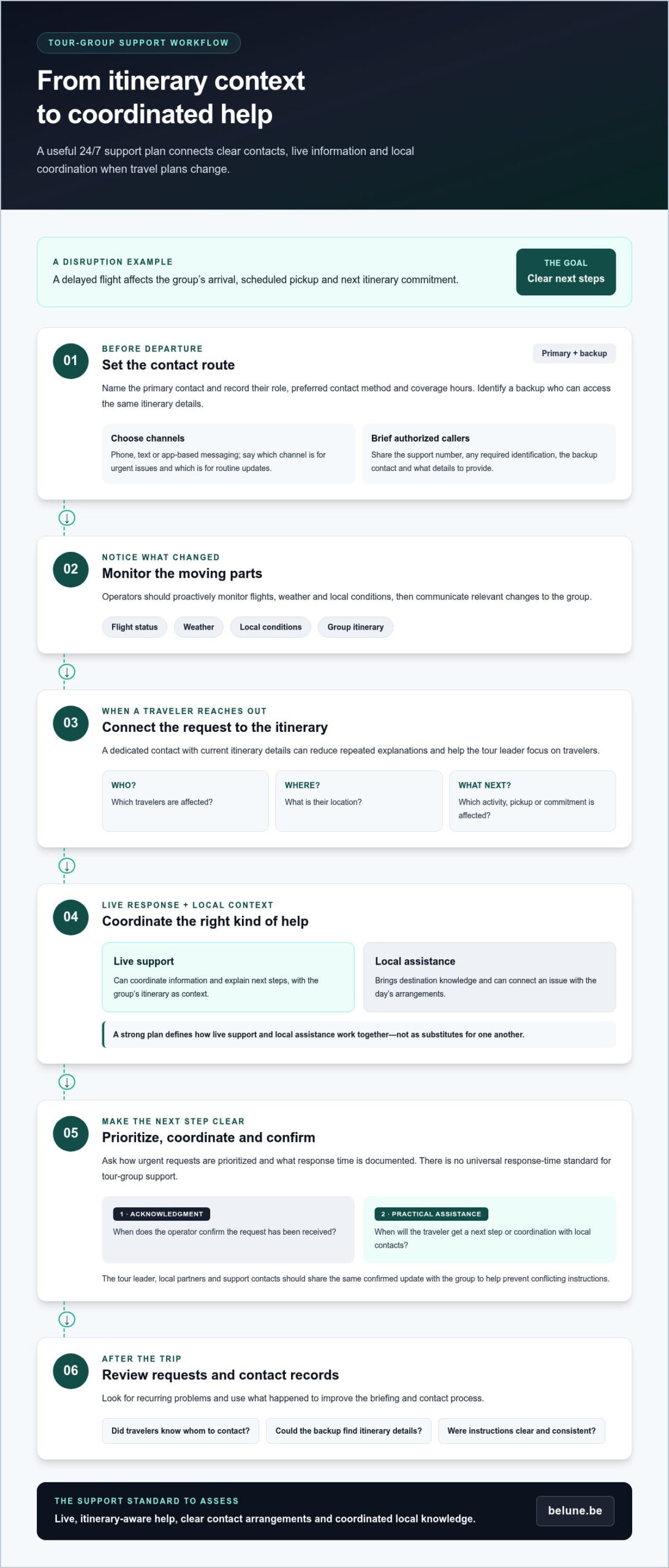
On-ground support brings local context to a traveler’s situation and can connect an issue with the day’s arrangements. A remote helpline can also coordinate information and explain next steps, but may not have the same direct knowledge of the destination. A strong plan defines how live support and local assistance work together, rather than treating either as a substitute for the other.
Ask how the operator handles a practical disruption. If a flight delay affects an arrival, for example, support should understand the affected travelers, scheduled pickup, and next itinerary commitment. Operators should proactively monitor flights, weather, and local conditions, then communicate relevant changes to the group. A dedicated contact with current itinerary details can reduce repeated explanations and help the tour leader focus on travelers.
There is no universal response-time standard for tour group support. It depends on the urgency of the request and the operator’s stated commitment. Ask how urgent requests are prioritized and what response time the operator documents. The answer should distinguish an initial acknowledgment from practical assistance, such as explaining the next step or coordinating with local contacts.
Assess the process before travel: identify who answers overnight calls, whether the response is live or automated, and how itinerary updates reach that person. A late-evening inquiry can reveal whether the channel provides a useful human response. For journeys shaped by local interpretation, local guide services can bring destination knowledge into the travel experience.
Single point of contact and backup contacts
A named contact gives the tour leader a clear first point of coordination. Before departure, record the person’s name, role, preferred contact method, and coverage hours. Identify a backup who can access the same itinerary details. If the primary contact is handling a delayed arrival, the backup can take a separate urgent request without leaving travelers unsure where to turn.
Set a simple contact protocol for the channels travelers can use, such as phone, text, or app-based messaging. Explain which channel to use for urgent issues and which suits routine updates. For example, a traveler who cannot join a scheduled pickup might call, while a non-urgent question about the next day’s meeting point could be sent by text. Keep instructions concise enough to follow under pressure.
- Share the support phone number with authorized callers.
- Explain any identification or credentials callers need to provide.
- Give the backup contact’s name and an alternate communication method.
- Tell travelers what details to include, such as their location and itinerary activity.
Consistency matters across the tour network. The tour leader, local partners, and support contacts should know who records an issue and who communicates the next step. If a coach pickup changes, the person coordinating the update should share the same confirmed information with the group and relevant partners. A shared process helps prevent conflicting instructions.
After each trip, review support requests and contact records to identify recurring problems. Did travelers know whom to contact? Could the backup find the relevant itinerary details? Use the answers to improve the briefing, clarify contact instructions, or refine handoffs with partners. A contact card in the traveler information pack can make names, channels, and escalation steps easy to find when plans change.
How does on-ground support improve traveler safety and emergency response?
Local support connects the tour leader with people who know the destination and itinerary. If a traveler becomes separated near a meeting point, that local context can help clarify where the group is and what assistance is needed. Strong local partnerships also give operators practical contacts for coordinating a response. Ask how local knowledge is incorporated into the support plan.
Effective emergency coordination starts with clear information. The tour leader should be able to share the traveler’s location, situation, and relevant itinerary details with the support contact. The operator can then assess the request, explain next steps, and coordinate with appropriate local partners. Clear information helps avoid repeated explanations when several people are involved.
- Identify the primary contact and backup before departure.
- Give authorized callers the support number and any required credentials.
- Agree how urgent requests are prioritized and communicated.
- Ask for a documented average response time for urgent requests.
Response-time transparency matters because teams may define “urgent” differently. Ask what the operator’s documented response measure covers, such as an initial reply or progress toward practical assistance. Clarify how the tour leader will receive updates if resolving an issue requires coordination with local partners.
Use a scenario exercise before travel. Ask how the team would handle a traveler missing a meeting point during a city visit, who receives the initial call, and how the group gets an update. The answers show whether everyone understands their role and the communication steps. Clear procedures support calmer decisions, while local knowledge helps make those decisions relevant to the place and itinerary.
Planning a group itinerary where local coordination matters? Explore group travel planning options.
BELUNE: Hotel Accommodation Management
BELUNE provides Hotel Accommodation Management to help tour operators coordinate lodging within a group itinerary. This can be planned alongside Coach Hire with own fleet of busses, Local Guide Services, and Art & Culture Group Tours, bringing key travel arrangements together. It is especially relevant when an itinerary includes several stops and accommodation needs to fit the group’s movements and scheduled visits.
BELUNE helps tour operators and travel agents organize group journeys around the experience they want to create. Contact BELUNE to discuss your group travel plans or visit belune.be.
Build the Support Plan Into Your Next Itinerary
Make support planning part of itinerary design, not an afterthought. Before confirming a tour, identify when travelers may need guidance: arrivals, transfers, changes between destinations, and time away from the main group. Match contact instructions and escalation steps to those moments so travelers and tour leaders know what to do.
That preparation is where the value of 24/7 on-ground support for tour groups becomes practical. It connects a carefully designed journey with a clear way to address unexpected needs, while helping organizers set expectations before departure. BELUNE works with tour operators and travel agents on group travel planning, including accommodation, transport, and local guidance.
Planning a group itinerary and considering how its arrangements fit together? Contact BELUNE about your group travel plans. A thoughtful plan creates room for travelers to focus on the experience, with greater clarity around the support structure behind it.
Frequently Asked Questions
Why Does 24/7 Support Matter for International Travel?
Round-the-clock support can help travelers when their tour leader is occupied or local offices are closed. A traveler arriving separately after a missed connection, for example, may need guidance while the leader coordinates the group’s next move. A reachable contact can clarify who should respond and what information the traveler should share, reducing uncertainty at a stressful point in the journey.
What does 24/7 on-ground support for tour groups include?
Support arrangements may include access to a live contact, channels such as phone, text, or app-based messaging, and assistance informed by the group’s itinerary. Before departure, explain what callers should share, such as their name, location, and scheduled activity. Clarify who is authorized to call and how travelers can reach a backup contact if the primary route is unavailable.
How much does 24/7 on-ground support cost per traveler or group?
There is no single cost that applies to every tour; the price depends on the scope of coverage, itinerary complexity, destinations, and whether support is arranged for a group or per traveler. For BELUNE’s group travel planning, pricing depends on the requested arrangements and is provided after a quote request. Specify the support scope and itinerary needs when requesting one.
How does on-ground support help with itinerary changes, delays, and cancellations?
Support can help coordinate practical next steps when a disruption affects the schedule. If a transfer is delayed, for instance, the team can clarify the revised pickup plan and help communicate it to affected travelers. If an activity is cancelled, organizers can identify which bookings or scheduled plans are affected and coordinate clear updates so the group knows what to do next.
What risks and limitations come with relying on local support teams?
On-ground support should not be treated as a complete substitute for live support. Without clear responsibilities and handoffs, travelers may receive conflicting instructions, or the team may not have the itinerary details it needs.
Leave a Reply