
Tag: itinerary management

  • 24/7 On-Ground Support for International Tour Groups

    24/7 On-Ground Support for International Tour Groups

    A tour itinerary doesn’t pause when an office closes. The value of 24/7 on-ground support for tour groups is having access to live, informed help when a flight changes, local conditions disrupt plans, or a traveler needs assistance outside normal business hours. For international groups moving across time zones, that continuity can help keep a small problem from unsettling the wider journey.

    Reliable support is about more than an always-open phone line. It means help that understands the group’s itinerary and can respond with relevant context, alongside a clear backup contact if the usual point of contact is unavailable. This guide explains how to assess an operator’s support reputation, what to look for in live, itinerary-aware assistance, and how contact arrangements can make urgent requests easier to handle. You’ll also see how local knowledge and practical coordination contribute to a more composed group experience, even when plans need to change.

    Key Takeaways

    • Assess an operator’s support reputation through its service history, client feedback, and clarity about how urgent requests are handled.
    • Look for live assistance that can interpret a request in the context of the group’s itinerary, rather than relying only on generic responses.
    • Agree on a primary contact, alternative ways to reach support, and a backup person so travelers know where to turn if plans change.
    • Local partner relationships and a documented approach to urgent requests can help tour organizers evaluate how support contributes to traveler safety.

    Competitive advantage and customer retention

    For an international tour operator, support can shape the experience after the itinerary is booked. A 24/7 service means travelers can reach live customer care around the clock, including weekends and holidays. That matters when a group crosses time zones and a question arrives outside the operator’s traditional office hours. The value of 24/7 on-ground support for tour groups is not simply extended availability. It is continuity between the promised journey and the help travelers can access while taking it.

    Consider a group arriving after a delayed connection. A traveler may need guidance while the tour leader coordinates the rest of the party. If support is unavailable until morning, questions can go unanswered overnight, leaving travelers uncertain. A prompt response can clarify the next step and help the group stay informed. Support is part of the travel experience, not just a back-office function.

    For tour operators, support feedback can reveal whether arrangements match travelers’ needs. Review when requests arrive, what they concern, and whether customers comment on support hours. Repeated late-night requests or complaints about closed contact channels may point to a gap in coverage. Use that information to assess whether the support plan fits the itinerary and travelers’ expectations.

    Some operators offer round-the-clock assistance as a premium service tier. If so, explain the coverage clearly before booking: how travelers reach a live person, what information to provide, and how urgent requests are prioritized. A premium label alone does not tell travelers what to expect during a disrupted transfer or an unfamiliar arrival.

    To assess the retention value, compare feedback and repeat-booking patterns across tour experiences, while noting the support arrangements each group received. Look for specific comments about response, clarity, and confidence during unexpected changes. This is more useful than treating “24/7” as a badge on its own. A dependable support experience can strengthen trust, while a poorly explained or hard-to-reach service can weaken it.

    Live, itinerary-aware 24/7 support

    Live support is most useful when the person responding understands the group’s actual itinerary. A traveler calling at 3 a.m. in a foreign country may need more than a generic customer service line. They may need help related to a scheduled transfer, an upcoming visit, or the group’s current location. Itinerary context makes an immediate response more relevant and gives the team a clearer starting point.

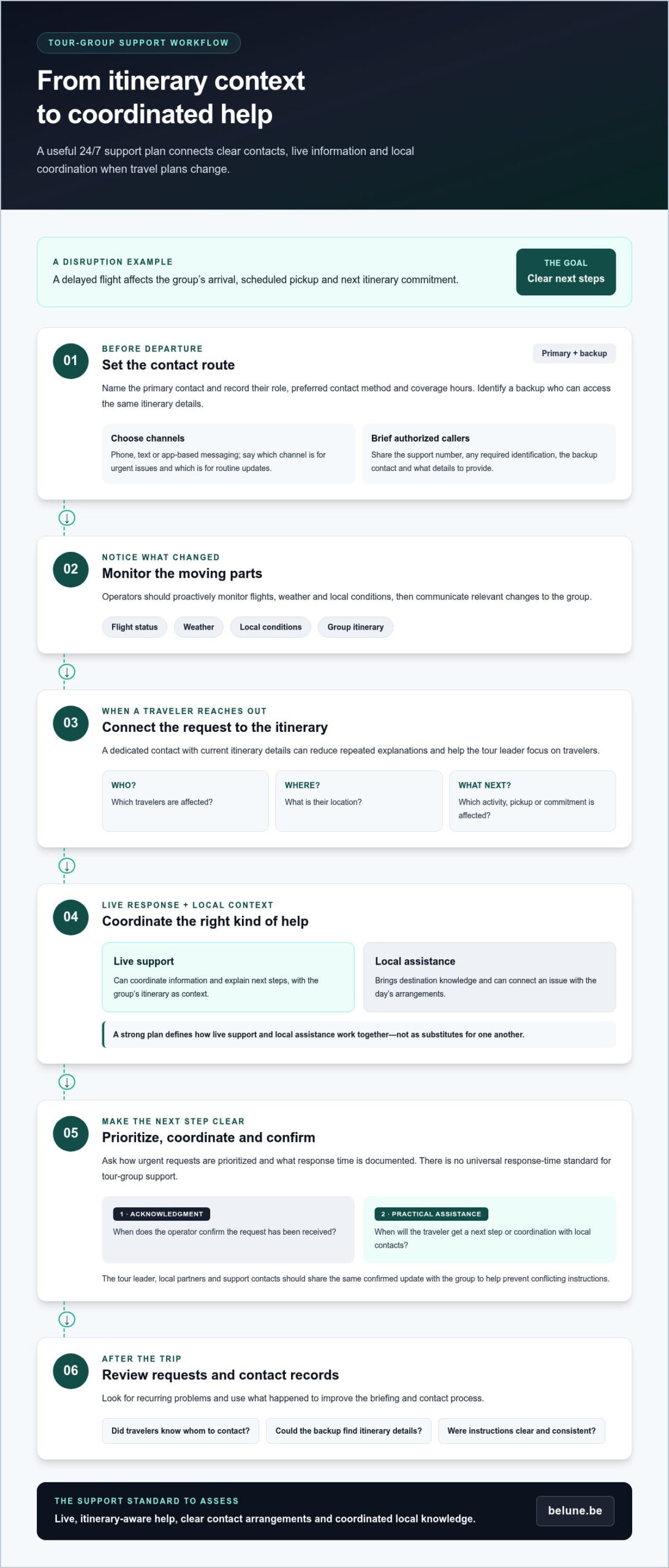
    On-ground support brings local context to a traveler’s situation and can connect an issue with the day’s arrangements. A remote helpline can also coordinate information and explain next steps, but may not have the same direct knowledge of the destination. A strong plan defines how live support and local assistance work together, rather than treating either as a substitute for the other.

    Ask how the operator handles a practical disruption. If a flight delay affects an arrival, for example, support should understand the affected travelers, scheduled pickup, and next itinerary commitment. Operators should proactively monitor flights, weather, and local conditions, then communicate relevant changes to the group. A dedicated contact with current itinerary details can reduce repeated explanations and help the tour leader focus on travelers.

    There is no universal response-time standard for tour group support. It depends on the urgency of the request and the operator’s stated commitment. Ask how urgent requests are prioritized and what response time the operator documents. The answer should distinguish an initial acknowledgment from practical assistance, such as explaining the next step or coordinating with local contacts.

    Assess the process before travel: identify who answers overnight calls, whether the response is live or automated, and how itinerary updates reach that person. A late-evening inquiry can reveal whether the channel provides a useful human response. For journeys shaped by local interpretation, local guide services can bring destination knowledge into the travel experience.
    24/7 On-Ground Support for International Tour Groups

    Single point of contact and backup contacts

    A named contact gives the tour leader a clear first point of coordination. Before departure, record the person’s name, role, preferred contact method, and coverage hours. Identify a backup who can access the same itinerary details. If the primary contact is handling a delayed arrival, the backup can take a separate urgent request without leaving travelers unsure where to turn.

    Set a simple contact protocol for the channels travelers can use, such as phone, text, or app-based messaging. Explain which channel to use for urgent issues and which suits routine updates. For example, a traveler who cannot join a scheduled pickup might call, while a non-urgent question about the next day’s meeting point could be sent by text. Keep instructions concise enough to follow under pressure.

    • Share the support phone number with authorized callers.
    • Explain any identification or credentials callers need to provide.
    • Give the backup contact’s name and an alternate communication method.
    • Tell travelers what details to include, such as their location and itinerary activity.

    Consistency matters across the tour network. The tour leader, local partners, and support contacts should know who records an issue and who communicates the next step. If a coach pickup changes, the person coordinating the update should share the same confirmed information with the group and relevant partners. A shared process helps prevent conflicting instructions.

    After each trip, review support requests and contact records to identify recurring problems. Did travelers know whom to contact? Could the backup find the relevant itinerary details? Use the answers to improve the briefing, clarify contact instructions, or refine handoffs with partners. A contact card in the traveler information pack can make names, channels, and escalation steps easy to find when plans change.

    How does on-ground support improve traveler safety and emergency response?

    Local support connects the tour leader with people who know the destination and itinerary. If a traveler becomes separated near a meeting point, that local context can help clarify where the group is and what assistance is needed. Strong local partnerships also give operators practical contacts for coordinating a response. Ask how local knowledge is incorporated into the support plan.

    Effective emergency coordination starts with clear information. The tour leader should be able to share the traveler’s location, situation, and relevant itinerary details with the support contact. The operator can then assess the request, explain next steps, and coordinate with appropriate local partners. Clear information helps avoid repeated explanations when several people are involved.

    • Identify the primary contact and backup before departure.
    • Give authorized callers the support number and any required credentials.
    • Agree how urgent requests are prioritized and communicated.
    • Ask for a documented average response time for urgent requests.

    Response-time transparency matters because teams may define “urgent” differently. Ask what the operator’s documented response measure covers, such as an initial reply or progress toward practical assistance. Clarify how the tour leader will receive updates if resolving an issue requires coordination with local partners.

    Use a scenario exercise before travel. Ask how the team would handle a traveler missing a meeting point during a city visit, who receives the initial call, and how the group gets an update. The answers show whether everyone understands their role and the communication steps. Clear procedures support calmer decisions, while local knowledge helps make those decisions relevant to the place and itinerary.

    Planning a group itinerary where local coordination matters? Explore group travel planning options.

    BELUNE: Hotel Accommodation Management

    BELUNE provides Hotel Accommodation Management to help tour operators coordinate lodging within a group itinerary. This can be planned alongside Coach Hire with own fleet of busses, Local Guide Services, and Art & Culture Group Tours, bringing key travel arrangements together. It is especially relevant when an itinerary includes several stops and accommodation needs to fit the group’s movements and scheduled visits.

    BELUNE helps tour operators and travel agents organize group journeys around the experience they want to create. Contact BELUNE to discuss your group travel plans or visit belune.be.

    Build the Support Plan Into Your Next Itinerary

    Make support planning part of itinerary design, not an afterthought. Before confirming a tour, identify when travelers may need guidance: arrivals, transfers, changes between destinations, and time away from the main group. Match contact instructions and escalation steps to those moments so travelers and tour leaders know what to do.

    That preparation is where the value of 24/7 on-ground support for tour groups becomes practical. It connects a carefully designed journey with a clear way to address unexpected needs, while helping organizers set expectations before departure. BELUNE works with tour operators and travel agents on group travel planning, including accommodation, transport, and local guidance.

    Planning a group itinerary and considering how its arrangements fit together? Contact BELUNE about your group travel plans. A thoughtful plan creates room for travelers to focus on the experience, with greater clarity around the support structure behind it.

    Frequently Asked Questions

    Why Does 24/7 Support Matter for International Travel?

    Round-the-clock support can help travelers when their tour leader is occupied or local offices are closed. A traveler arriving separately after a missed connection, for example, may need guidance while the leader coordinates the group’s next move. A reachable contact can clarify who should respond and what information the traveler should share, reducing uncertainty at a stressful point in the journey.

    What does 24/7 on-ground support for tour groups include?

    Support arrangements may include access to a live contact, channels such as phone, text, or app-based messaging, and assistance informed by the group’s itinerary. Before departure, explain what callers should share, such as their name, location, and scheduled activity. Clarify who is authorized to call and how travelers can reach a backup contact if the primary route is unavailable.

    How much does 24/7 on-ground support cost per traveler or group?

    There is no single cost that applies to every tour; the price depends on the scope of coverage, itinerary complexity, destinations, and whether support is arranged for a group or per traveler. For BELUNE’s group travel planning, pricing depends on the requested arrangements and is provided after a quote request. Specify the support scope and itinerary needs when requesting one.

    How does on-ground support help with itinerary changes, delays, and cancellations?

    Support can help coordinate practical next steps when a disruption affects the schedule. If a transfer is delayed, for instance, the team can clarify the revised pickup plan and help communicate it to affected travelers. If an activity is cancelled, organizers can identify which bookings or scheduled plans are affected and coordinate clear updates so the group knows what to do next.

    What risks and limitations come with relying on local support teams?

    On-ground support should not be treated as a complete substitute for live support. Without clear responsibilities and handoffs, travelers may receive conflicting instructions, or the team may not have the itinerary details it needs.

  • Peace of mind when managing VIP group travel plans

    Peace of mind when managing VIP group travel plans

    Peace of mind when managing VIP group travel starts with a clear, reconfirmed plan. Verify flight times, seat assignments, passport details and hotel inclusions, then record each traveller’s preferences and communication needs. Consider the destination and individual support requirements, and agree on the group’s purpose, decision-making process and expectations before departure. A coordinated plan gives everyone a shared point of reference.

    That preparation matters because a VIP group trip brings individual needs into a shared itinerary. Meal, accommodation, transport and downtime preferences can shape the experience, while disruption or uncertainty can unsettle even a carefully arranged schedule. Calm coordination is not about controlling every moment. It means knowing what matters and making sensible decisions when plans change.

    This guide explains how to reconfirm an itinerary, coordinate traveller preferences, assess the level of VIP support a trip needs and align expectations across the group. It also covers practical ways to monitor potential disruptions and preserve flexibility, so the journey feels considered from departure through the final shared experience.

    Key Takeaways

    • Reconfirm essential itinerary details before departure, then keep an eye on disruptions that could affect the group’s plans.
    • Build traveler profiles around preferences, practical needs, and each person’s preferred way to communicate.
    • Assess support needs by considering both the trip’s risks and the travelers’ circumstances, not job titles alone.
    • Agree on the trip’s purpose, decision-making approach, and balance of scheduled activities and free time before setting off.

    1. Pre-departure itinerary reconfirmation

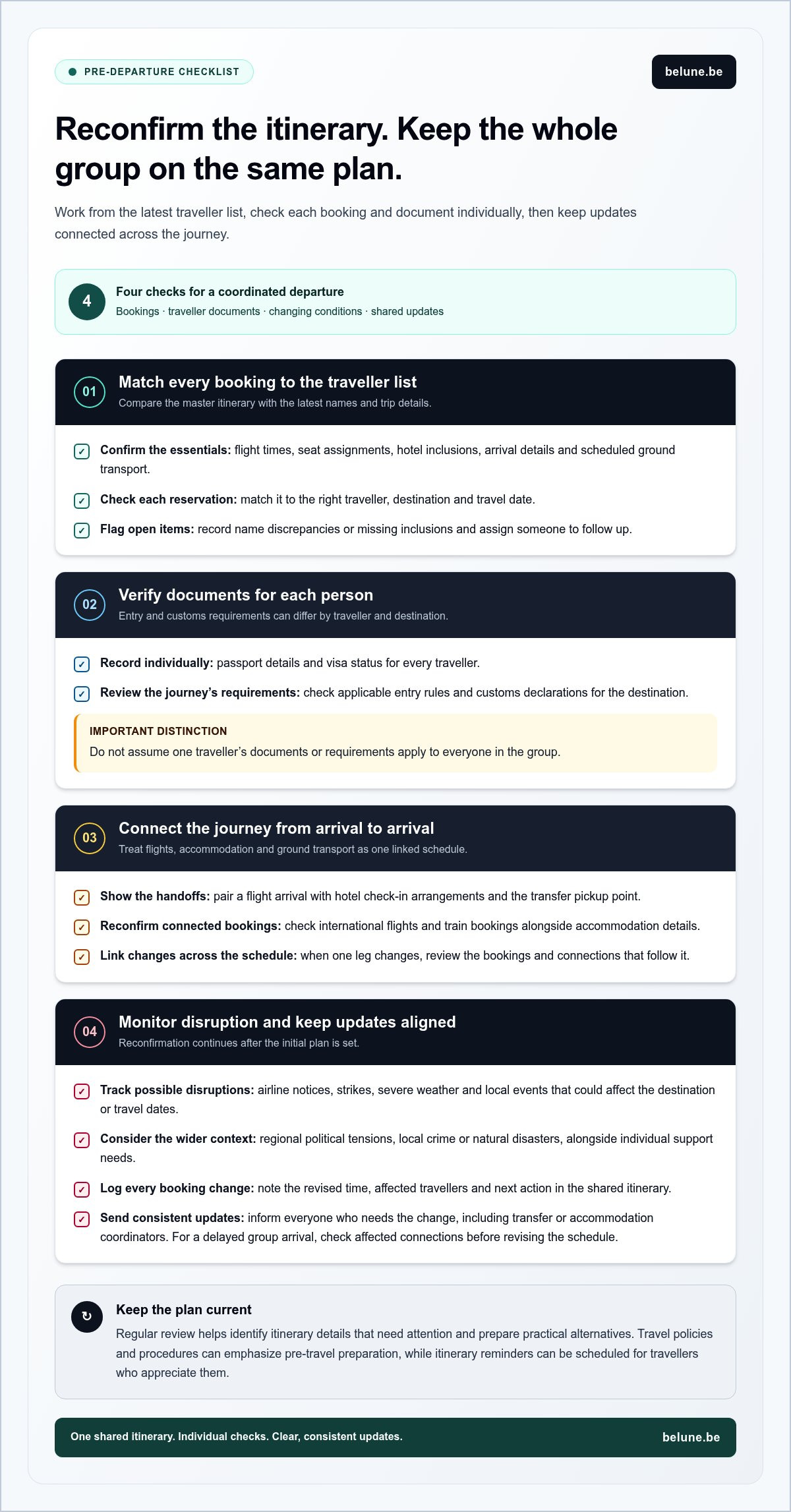
    Start with the master itinerary and compare every booking with the latest traveller list. Confirm flight times, seat assignments, hotel inclusions, arrival details and scheduled ground transport. Match each reservation to the right traveller, destination and travel date. A name discrepancy or missing hotel inclusion can affect the group’s arrival, so record unresolved items and assign someone to follow up.

    Entry, visa and customs requirements depend on each traveller’s passport and destination. Record passport details and visa status individually, then review the applicable entry rules and customs declarations for the journey. Do not assume one traveller’s documents or requirements apply to everyone in the group.

    Coordinate flights, hotels and ground transport in a shared itinerary that shows how each arrival connects to the next booking. For example, pair a flight arrival time with the hotel’s check-in arrangements and the transfer pickup point, whether coordinating standard group shuttles or booking elite fleet services through specialists such as Delta Rentals Dubai for executive travellers in the UAE. Reconfirm international flight and train bookings alongside accommodation details, so a change to one leg can be reflected in the full schedule.

    Monitoring should continue after the initial confirmation. Track airline notices, strikes, severe weather and local events that could affect the destination or travel dates. Consider regional risks, such as political tensions, local crime or natural disasters, alongside individual factors that may affect a traveller’s support needs. Regular review helps the organizer identify itinerary details that need attention and prepare practical alternatives.

    When a booking changes, record the revised time, affected travellers and next action in the shared itinerary. Send the same update to everyone who needs it, including whoever coordinates transfers or accommodation. For a group-level change, such as a delayed arrival, identify affected connections before revising the schedule. A clear record keeps everyone working from the same plan and makes further reconfirmation more precise.

    Travel risk management means identifying, assessing, preventing and mitigating potential security issues associated with VIP travel. Monitor flight disruptions, strikes, weather patterns and local events that could affect the itinerary.

    Travel arrangers can schedule itinerary reminders automatically for travelers who appreciate them. VIP travel plans should include a travel policy and procedures, with emphasis on pre-travel preparations.

    Traveler-specific preferences and trip coordination

    Create a profile for each traveller and use it to guide practical choices across the group itinerary. Record seat preferences, preferred airlines and hotels, loyalty memberships, dietary needs and passport details relevant to specific destinations. Include useful specifics, such as an aisle seat or a vegetarian meal, rather than relying on broad labels. Keep profiles current so arrangements reflect each person’s needs, not assumptions.

    Before the trip, ask travellers for the name they want used on bookings, seat and airline preferences, hotel preferences, loyalty numbers, dietary requirements, destination-related passport details and any relevant timing needs. These details help organizers match individual requests to the journey and identify preferences that could affect group coordination.

    Communication needs the same personal attention. Ask each traveller whether they prefer updates by phone, text or email, then use that channel for itinerary changes and essential reminders. For example, text a changed meeting point to someone who prefers texts, while emailing a detailed schedule to a traveller who prefers email. Keep essential updates consistent across the group to avoid conflicting versions.

    Planning around preferences still requires a clear view of the shared schedule. Compare requests with the destination, travel program and existing bookings, then present suitable options that fit the plan. A preferred hotel may be impractical if it separates one traveller from the group, while a preferred airline may complicate arrival coordination. Explain the trade-offs clearly and record the agreed choice in the traveller’s profile.

    Loyalty details can inform bookings without becoming the only decision factor. Keep travellers’ loyalty numbers on file and help them enrol in suitable loyalty programmes. Depending on supplier relationships, faster confirmations, upgrades or more personalized service may be possible. If a traveller arrives early after a red-eye flight, consider arranging early hotel check-in, then record the decision and communication preference in their profile. Each detail should support both the traveller’s experience and the group itinerary.

    Peace of mind when managing VIP group travel plans

    3. Which travelers and trips may need VIP support

    VIP support can suit any traveller or trip that needs added coordination, not only C-suite executives. Consider the itinerary, destination risks, traveller circumstances and consequences of disruption. A complex schedule with several connections may need priority coordination, while a straightforward journey may not. Assessing these factors helps determine whether additional coordination would be useful.

    A managed travel program can bring flight bookings, accommodation, local guidance and response procedures into one coordinated plan. VIP travel management may also include traveller profiles, risk assessment, disruption planning and clear incident-reporting channels. Specialist booking support helps align individual needs with group arrangements, including when a flight change affects a hotel arrival or onward transport. Coordinating these details can support peace of mind when managing VIP group travel.

    Support plans should identify how travelers report incidents at any time, day or night. A crisis plan can set out communication channels, response steps, escalation contacts, and coordination with local authorities when needed. Security and privacy planning can limit itinerary access to people who need it, use agreed reporting channels, and prepare responses to medical emergencies, crime, natural disasters, or other destination risks.

    Choose a VIP group travel planner by looking for a clear scope, a coordinated booking process, destination knowledge and documented disruption and incident procedures. When considering insurance, compare policy coverage with the destination, planned activities, medical needs and possible trip interruptions. Review exclusions and existing coverage before deciding. No single policy suits every group.

    Self-managed planning keeps decisions directly with the organizer, while managed support coordinates bookings and traveller needs across the trip. If a flight is delayed, identify affected connections, communicate the change through agreed channels and revise the shared itinerary. A calm response, clear priorities and practical alternatives help the group act on the same information, supporting peace of mind when managing VIP group travel.

    The company decides which travelers or trips benefit from added coordination; VIP travel is not limited to C-suite executives. VIPs and traveling parties need clear incident-reporting instructions and access to support 24/7.

    Risk management can help organizations meet duty-of-care obligations by preparing for emergencies.

    4. Agreeing on the purpose and expectations of a group trip

    Agree on the trip’s purpose first: a client event, cultural visit or executive retreat. A shared aim helps organizers choose activities, transport and pacing that serve the same outcome. Ask travellers to identify likely friction points before departure, such as different energy levels or competing priorities. Addressing them early turns assumptions into clear expectations.

    Set a decision-making approach before the group travels. Clarify who can approve itinerary changes, how the group will weigh alternatives and where urgent updates will appear. For example, executives attending a sporting event may need a designated organizer to communicate schedule changes, while travellers can share preferences through an agreed group channel.

    Shape the schedule around shared experiences and individual breathing room. A five-day group trip can leave two days for downtime or unscheduled activities, giving travellers time to rest, explore independently or handle personal commitments. Show free time in the itinerary rather than treating it as a gap that needs filling.

    Discuss group dynamics honestly. Agree on respectful conduct, punctuality, and how travelers will raise concerns. If romantic tension or disagreement emerges, address it directly and privately instead of allowing awkwardness to build. A clear process for resolving conflict protects the group experience without making every difference a formal issue.

    VIP trip planning should also define what success looks like. A cultural itinerary may prioritize meaningful shared visits, while an executive retreat may value focused discussion and flexible transitions. Set expectations for participation, meals, transport and optional activities. These decisions give the organizer a practical standard for evaluating choices during the trip.

    After returning, invite specific feedback about timing, activities, communication and group decisions. Compare comments with the original purpose, then update travel policies and planning notes when recurring issues arise. For example, feedback about rushed transitions can inform future schedules, while requests for more independent time can shape the next itinerary.

    For a shared cultural itinerary, explore Art & Culture Group Tours as a way to build the trip around a common interest.

    BELUNE: Hotel Accommodation Management

    BELUNE provides Hotel Accommodation Management as part of the wider design of group itineraries, helping tour operators and travel agents coordinate accommodation with the journey’s purpose and schedule. When hotel arrangements need to align with group transport, local experiences or cultural visits, a connected plan can make transitions clearer for organizers and travellers.

    For group trips, BELUNE can also bring together Coach Hire with its own fleet of buses, Local Guide Services and Art & Culture Group Tours. These services suit itineraries that call for coordinated travel between stops and guided cultural experiences alongside accommodation management.

    Tour operators and travel agents planning a group journey can visit belune.be to explore how BELUNE’s services fit their plans.

    Shape your next group journey with intention

    The next step is to turn a travel brief into a shared experience, with each practical choice serving the group’s purpose. The support needed depends on the journey. BELUNE offers Hotel Accommodation Management, Coach Hire with its own fleet of buses and Local Guide Services for group itineraries that bring these elements together. Thoughtful coordination can create peace of mind when managing VIP group travel while leaving room for the destination’s distinctive character.

    If you’re planning a group journey and want to explore how these services could fit your itinerary, contact BELUNE about VIP travel. A clear conversation about your priorities is a considered first step toward a trip designed around the people taking it. Build from a strong plan, and give the group room to enjoy the journey.

    Frequently Asked Questions

    What risks should VIP group travel organizers plan for?

    Assess destination threats, individual vulnerabilities, medical emergencies and disruptions that could interrupt travel. A practical risk register can name each concern, its potential effect and who is responsible for responding. For example, note who will coordinate if a traveller becomes ill during an event and how the rest of the group will receive clear instructions without exposing sensitive personal details.

    What are the entry, visa, and customs requirements for VIP group travel?

    Entry, visa and customs requirements depend on each traveller’s passport and destination. Record passport details and visa status individually, review the applicable rules and customs declarations, and use VIP program assistance with visas and paperwork if needed.