Tag: Tour Operators

  • Managing tour group emergencies from afar with clear response plans

    Managing tour group emergencies from afar with clear response plans

    Tour companies handle on-tour issues by giving local staff a clear response plan, keeping the central team informed, and sharing practical updates with travelers. Managing tour group emergencies from afar works best when responsibilities are clear and decisions reflect local conditions, language, and cultural expectations.

    Travelers reasonably expect a tour operator to stay involved when plans are disrupted, even when its team is not on the ground. Calm, consistent communication helps people understand what is happening and what to do next, while local knowledge makes instructions more useful and respectful.

    This article explains how tour companies prepare for incidents, notify travelers, and coordinate support remotely. It also covers how response plans account for cultural differences and safe travel practices, including how to use flight information when travel was booked through the tour company.

    Key Takeaways

    • Clear roles, contact pathways, and traveler-accounting procedures help a remote team coordinate with local staff during an incident.
    • Useful updates tell travelers what is happening, where to get help, and what to do next, while reflecting local conditions and language.
    • When flights were booked through a tour company, flight details can inform disruption planning and coordination alongside local response arrangements.
    • Cultural awareness and practical safety planning help make emergency instructions easier to understand and follow across different destinations.

    Emergency preparedness resources and notifications

    Preparedness connects a written response plan with local alerts, traveler counts, and clear updates. For international groups, instructions should reflect the destination’s emergency resources and communication channels.

    Emergency Action Plans

    An emergency action plan sets out how people should respond, evacuate, and account for those affected. It matters because local staff need clear roles and ready access to information before an incident interrupts the itinerary.

    For covered US general-industry workplaces, 29 CFR 1910.38 identifies the emergency action plan standard. Tour operations can apply the planning principle by defining who contacts responders, who communicates with travelers, and how staff confirm each person’s status after an evacuation.

    When responders arrive, share the incident location, conditions, and the status of the people involved. A prepared group lead can relay those details through a designated contact, while remote operations staff maintain a current traveler roster. The plan should explain how the two roles share updates if the group separates.

    Preparedness Education and Incident Updates

    Preparedness briefings give travelers useful information before an incident; notification procedures keep updates consistent during one. For international groups, identify the local alert channel and explain how to recognize an official instruction.

    How should a tour operator account for travelers and share updates during an incident? Assign a local lead to account for the group after an evacuation, then send verified instructions through the agreed channel. Each update should state the location, the action to take, and where the next update will appear.

    Public resources can support preparation. Los Angeles County emergency alerts include the Integrated Public Alert and Warning System and Alert LA County. Its Emergency Survival Guide is available in 15 languages, offering a useful example of multilingual preparedness education.

    During large-scale emergencies, Los Angeles County OEM supports public information through trained Public Information Officers, Joint Information System activities, and Joint Information Centers. The practical lesson for tour groups is to align traveler messages with local public information and avoid sharing unverified reports.

    Before departure, explain the meeting point, the group’s contact method, and what to do if someone gets separated. A short briefing and a clear written reference make emergency instructions easier to recall under pressure.

    If you booked my flights, how can you help me in an emergency?

    Flight details can help an operator understand travelers’ locations and identify planned connections that may be affected. The response still starts with immediate safety and instructions from local authorities.

    Risk Management and Emergency Response

    Risk management identifies developing hazards and links them to response decisions. This matters because a storm warning, a closed route, and an evacuation order each call for a different action.

    Build local conditions into the plan, including official alerts, transport access, and safe accommodation. Where active, a Community Emergency Response Team can be a local coordination resource. In Los Angeles County, emergency exercises follow the Homeland Security Exercise and Evaluation Program, helping responders practise coordination before an incident.

    Unsafe Destinations and Evacuations

    When a destination becomes unsafe, assess the immediate risk, official instructions, and routes to safer locations. Continuing the itinerary could expose travelers to a developing hazard.

    During a storm or flash flood, follow local evacuation instructions and avoid routes authorities identify as unsafe. If the operator booked the flights, the itinerary can help identify disrupted connections and share relevant travel information. It does not replace local emergency instructions or determine an airline’s decisions.

    Tour Leader First Actions

    A tour leader’s first actions are to move travelers away from immediate danger, contact local emergency services, and follow their instructions. Physical safety comes before itinerary decisions.

    Next, account for the group, identify anyone who needs assistance, and send the operator concise facts: location, conditions, and traveler status. During rapidly developing weather, such as flash flooding, do not direct the group onto a route without checking local instructions. Los Angeles County coordinates standardized responder training with California’s Governor’s Office of Emergency Services and FEMA.

    Operator Duties During Overseas Emergencies

    Tour operators’ legal duties overseas depend on the destination’s laws, the booking contract, and the operator’s role in arranging the trip. These factors shape what assistance and communication may be required.

    In practice, the operator should assess verified information, maintain contact with the tour leader, and explain relevant changes to travelers. A clear record of decisions helps keep responses consistent. For group itineraries, coordinated travel planning can connect flight details with the wider trip arrangements.

    Managing tour group emergencies from afar with clear response plans

    Emergency operations center readiness and activation

    An Emergency Operations Center coordinates information and decisions during serious incidents. Its role matters when weather or transport disruptions affect several tour activities or agencies.

    Contacting Operations and Safety Teams

    A contact protocol routes reports from the tour leader to operations and safety teams. This matters because urgent decisions may affect transport, accommodation, and traveler updates.

    Set a primary channel, such as a staffed phone line, and a backup text or email route. Assign someone to log key decisions and pass verified updates to relevant agencies. Costs for 24/7 travel emergency assistance services depend on coverage hours, destinations, staffing, and support scope; providers price these elements according to the service requested.

    Emergency Communications and Contact Information

    Emergency communications need a reliable contact method and information that travelers and staff can use. Before departure, collect each traveler’s preferred contact details, the tour leader’s number, accommodation details, and destination-specific emergency contacts.

    What are the best communication tools for managing tour group emergencies from afar? Use a primary voice channel for urgent instructions and a backup written channel for concise updates. Make local emergency contact details available offline, particularly if connectivity is disrupted.

    Local Services and Traveler Emergencies

    Contact local emergency services through the destination’s established emergency channel. Before travel, identify that channel with local partners and record the relevant details for the tour leader.

    If a traveler is missing, give local responders their name, last known location, and the time they were last seen. If someone is hospitalized, record the facility and designate a group contact. During an evacuation, follow local instructions and report the group’s status to operations. Sonoma County’s Department of Emergency Management is the primary coordination point for emergencies affecting multiple jurisdictions and unincorporated areas.

    Weather-Related Operating Conditions

    Weather can change whether a route, excursion, or transfer is safe. Use official local alerts to reassess activities, communicate cancellations or changes, and keep the group together while decisions are made.

    For a regional incident, an Emergency Operations Center can coordinate information across agencies. Los Angeles County Office of Emergency Management staffs its Watch Center Duty Officer program to provide coverage 24 hours a day, 7 days a week, 365 days a year. That public coordination resource illustrates why tour teams should know local escalation channels before severe weather develops.

    Cultural considerations and safe travel practices

    Time zones, language barriers, and local conditions affect how quickly remote teams can understand a situation and provide useful guidance. A tour leader on the ground can interpret local instructions; the remote team can coordinate decisions and keep messages consistent.

    Use plain, direct language during incidents. Replace idioms with specific actions, such as “remain inside the hotel lobby” or “meet beside the main entrance.” If travelers speak different languages, provide the same essential instruction in a format they understand, then ask the local leader to confirm it was received.

    Cultural expectations can shape how travelers ask for help, respond to authority, or discuss sensitive events. In the group briefing, identify someone travelers can approach privately and explain how to report a concern without sharing personal details in front of others.

    Managing tour group emergencies from afar means treating local conditions as part of the response, not just background. A road closure, local holiday, or public gathering can affect access and timing. The tour leader should use local guidance to adapt meeting points and explain changes with clear landmarks.

    During a disaster or sudden disruption, focus safety instructions on immediate actions rather than assumptions about local customs. Explain, for example, whether travelers should stay with the group or move to a designated safe location. Avoid word-for-word translations if they could make the message unclear or disrespectful.

    A useful travel briefing covers local communication norms, how to reach the tour leader, and what to do if separated. Local guide services can also help interpret cultural context during planned activities. To shape a group itinerary around local context and meaningful cultural experiences, plan a culturally informed group tour.

    BELUNE: Hotel Accommodation Management

    BELUNE helps tour operators shape group itineraries through Hotel Accommodation Management, Coach Hire with its own fleet of buses, and Local Guide Services. Coordinating these elements can support the practical structure of a trip, including where the group stays and how it travels between activities.

    For Art & Culture Group Tours, local guidance adds destination context while keeping the itinerary grounded in the places travelers visit. Consider BELUNE when planning a group trip across the Benelux region or Paris that requires accommodation and other group logistics as part of the itinerary.

    To discuss a group travel plan, visit belune.be.

    Build a more considered journey

    Preparedness belongs in the experience you design, not in a separate document you revisit only when plans change. For your next group itinerary, consider from the outset how local context, traveler communication, and practical logistics fit together. This makes managing tour group emergencies from afar a deliberate part of tour planning, while leaving local response decisions to the people best placed to act on the ground.

    BELUNE supports group travel planning through accommodation management, coach hire, and local guide services. These services help tour operators build itineraries around clear logistics and destination knowledge.

    Explore how BELUNE can support your group’s travel plans. Contact BELUNE for travel support, and take the next step toward a thoughtfully coordinated journey.

    Frequently Asked Questions

    How do tour companies manage on-tour issues?

    Tour companies handle on-tour issues by matching each problem to an appropriate decision-maker and local partner. For a missed connection, operations can assess itinerary changes; for a venue closure, a local guide can help adapt the day’s plans. The tour leader remains the group’s on-site contact, while the operator records decisions and explains how changes affect upcoming activities.

    What happens if I have a medical emergency on tour?

    For an urgent medical emergency, seek local emergency care first, then alert the tour leader. Share the location and essential details so the operator can help coordinate practical arrangements, such as updating the group or travel plans. If you have travel insurance, contact its assistance service for guidance on medical support covered by your policy. Share personal health information only with people who need it to help.

    What happens if a destination becomes unsafe before or during my trip?

    If a destination becomes unsafe, the operator assesses current official information and its effect on the itinerary. Before departure, this may mean changing the route or postponing affected activities. During a trip, the operator and local team consider safe alternatives and explain the practical impact on accommodation and transport. Follow local authority instructions, not unverified reports or social media posts.

    How can tour operators coordinate emergency response remotely?

    Remote coordination works best when the operator keeps a time-stamped incident record showing the decision made, who made it, and what remains unresolved. This helps staff taking over a shift understand the situation without piecing together scattered messages. Assigning one person to approve itinerary changes can also reduce conflicting directions when several suppliers or local agencies are involved.

    What travel insurance and medical assistance services support remote emergency coordination?

    Travel insurance may provide access to a medical assistance team, help locating care, or support with medical transport, depending on the policy. Before departure, save the insurer’s assistance number and policy details separately from your phone. During an incident, the tour operator can coordinate trip logistics, while the insurer explains the services and claims covered by the traveler’s policy. These roles complement each other but are not interchangeable.

    What emergency plans and checklists should tour groups prepare before a trip?

    Prepare a compact travel file with the itinerary, accommodation details, tour leader contacts, insurer information, and destination emergency numbers. Include each traveler’s emergency contact and any voluntarily shared information needed for practical support, such as mobility requirements. Agree on a regrouping point and a process for reporting itinerary changes. Keep an offline copy so essential details remain accessible if mobile data fails.

  • 24/7 On-Ground Support for International Tour Groups

    24/7 On-Ground Support for International Tour Groups

    A tour itinerary doesn’t pause when an office closes. The value of 24/7 on-ground support for tour groups is having access to live, informed help when a flight changes, local conditions disrupt plans, or a traveler needs assistance outside normal business hours. For international groups moving across time zones, that continuity can help keep a small problem from unsettling the wider journey.

    Reliable support is about more than an always-open phone line. It means help that understands the group’s itinerary and can respond with relevant context, alongside a clear backup contact if the usual point of contact is unavailable. This guide explains how to assess an operator’s support reputation, what to look for in live, itinerary-aware assistance, and how contact arrangements can make urgent requests easier to handle. You’ll also see how local knowledge and practical coordination contribute to a more composed group experience, even when plans need to change.

    Key Takeaways

    • Assess an operator’s support reputation through its service history, client feedback, and clarity about how urgent requests are handled.
    • Look for live assistance that can interpret a request in the context of the group’s itinerary, rather than relying only on generic responses.
    • Agree on a primary contact, alternative ways to reach support, and a backup person so travelers know where to turn if plans change.
    • Local partner relationships and a documented approach to urgent requests can help tour organizers evaluate how support contributes to traveler safety.

    Competitive advantage and customer retention

    For an international tour operator, support can shape the experience after the itinerary is booked. A 24/7 service means travelers can reach live customer care around the clock, including weekends and holidays. That matters when a group crosses time zones and a question arrives outside the operator’s traditional office hours. The value of 24/7 on-ground support for tour groups is not simply extended availability. It is continuity between the promised journey and the help travelers can access while taking it.

    Consider a group arriving after a delayed connection. A traveler may need guidance while the tour leader coordinates the rest of the party. If support is unavailable until morning, questions can go unanswered overnight, leaving travelers uncertain. A prompt response can clarify the next step and help the group stay informed. Support is part of the travel experience, not just a back-office function.

    For tour operators, support feedback can reveal whether arrangements match travelers’ needs. Review when requests arrive, what they concern, and whether customers comment on support hours. Repeated late-night requests or complaints about closed contact channels may point to a gap in coverage. Use that information to assess whether the support plan fits the itinerary and travelers’ expectations.

    Some operators offer round-the-clock assistance as a premium service tier. If so, explain the coverage clearly before booking: how travelers reach a live person, what information to provide, and how urgent requests are prioritized. A premium label alone does not tell travelers what to expect during a disrupted transfer or an unfamiliar arrival.

    To assess the retention value, compare feedback and repeat-booking patterns across tour experiences, while noting the support arrangements each group received. Look for specific comments about response, clarity, and confidence during unexpected changes. This is more useful than treating “24/7” as a badge on its own. A dependable support experience can strengthen trust, while a poorly explained or hard-to-reach service can weaken it.

    Live, itinerary-aware 24/7 support

    Live support is most useful when the person responding understands the group’s actual itinerary. A traveler calling at 3 a.m. in a foreign country may need more than a generic customer service line. They may need help related to a scheduled transfer, an upcoming visit, or the group’s current location. Itinerary context makes an immediate response more relevant and gives the team a clearer starting point.

    On-ground support brings local context to a traveler’s situation and can connect an issue with the day’s arrangements. A remote helpline can also coordinate information and explain next steps, but may not have the same direct knowledge of the destination. A strong plan defines how live support and local assistance work together, rather than treating either as a substitute for the other.

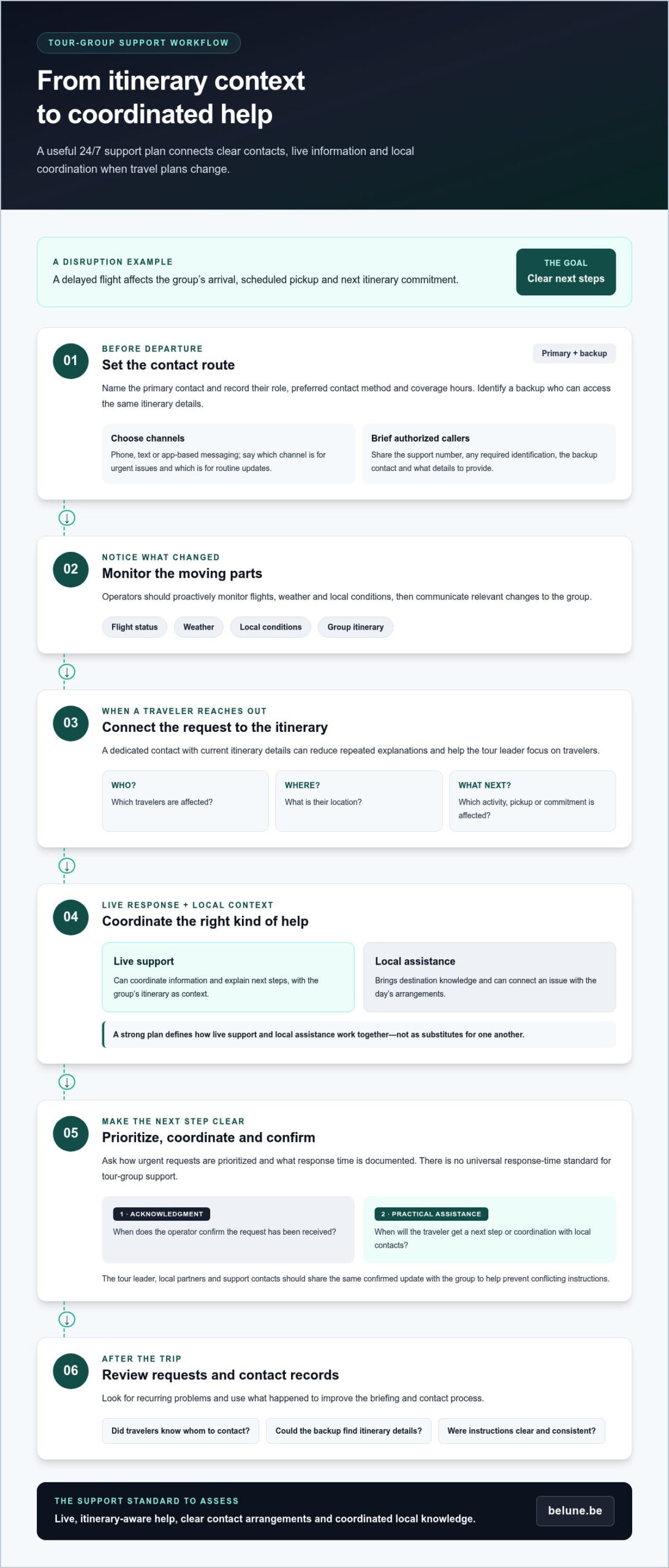
    Ask how the operator handles a practical disruption. If a flight delay affects an arrival, for example, support should understand the affected travelers, scheduled pickup, and next itinerary commitment. Operators should proactively monitor flights, weather, and local conditions, then communicate relevant changes to the group. A dedicated contact with current itinerary details can reduce repeated explanations and help the tour leader focus on travelers.

    There is no universal response-time standard for tour group support. It depends on the urgency of the request and the operator’s stated commitment. Ask how urgent requests are prioritized and what response time the operator documents. The answer should distinguish an initial acknowledgment from practical assistance, such as explaining the next step or coordinating with local contacts.

    Assess the process before travel: identify who answers overnight calls, whether the response is live or automated, and how itinerary updates reach that person. A late-evening inquiry can reveal whether the channel provides a useful human response. For journeys shaped by local interpretation, local guide services can bring destination knowledge into the travel experience.

    24/7 On-Ground Support for International Tour Groups

    Single point of contact and backup contacts

    A named contact gives the tour leader a clear first point of coordination. Before departure, record the person’s name, role, preferred contact method, and coverage hours. Identify a backup who can access the same itinerary details. If the primary contact is handling a delayed arrival, the backup can take a separate urgent request without leaving travelers unsure where to turn.

    Set a simple contact protocol for the channels travelers can use, such as phone, text, or app-based messaging. Explain which channel to use for urgent issues and which suits routine updates. For example, a traveler who cannot join a scheduled pickup might call, while a non-urgent question about the next day’s meeting point could be sent by text. Keep instructions concise enough to follow under pressure.

    • Share the support phone number with authorized callers.
    • Explain any identification or credentials callers need to provide.
    • Give the backup contact’s name and an alternate communication method.
    • Tell travelers what details to include, such as their location and itinerary activity.

    Consistency matters across the tour network. The tour leader, local partners, and support contacts should know who records an issue and who communicates the next step. If a coach pickup changes, the person coordinating the update should share the same confirmed information with the group and relevant partners. A shared process helps prevent conflicting instructions.

    After each trip, review support requests and contact records to identify recurring problems. Did travelers know whom to contact? Could the backup find the relevant itinerary details? Use the answers to improve the briefing, clarify contact instructions, or refine handoffs with partners. A contact card in the traveler information pack can make names, channels, and escalation steps easy to find when plans change.

    How does on-ground support improve traveler safety and emergency response?

    Local support connects the tour leader with people who know the destination and itinerary. If a traveler becomes separated near a meeting point, that local context can help clarify where the group is and what assistance is needed. Strong local partnerships also give operators practical contacts for coordinating a response. Ask how local knowledge is incorporated into the support plan.

    Effective emergency coordination starts with clear information. The tour leader should be able to share the traveler’s location, situation, and relevant itinerary details with the support contact. The operator can then assess the request, explain next steps, and coordinate with appropriate local partners. Clear information helps avoid repeated explanations when several people are involved.

    • Identify the primary contact and backup before departure.
    • Give authorized callers the support number and any required credentials.
    • Agree how urgent requests are prioritized and communicated.
    • Ask for a documented average response time for urgent requests.

    Response-time transparency matters because teams may define “urgent” differently. Ask what the operator’s documented response measure covers, such as an initial reply or progress toward practical assistance. Clarify how the tour leader will receive updates if resolving an issue requires coordination with local partners.

    Use a scenario exercise before travel. Ask how the team would handle a traveler missing a meeting point during a city visit, who receives the initial call, and how the group gets an update. The answers show whether everyone understands their role and the communication steps. Clear procedures support calmer decisions, while local knowledge helps make those decisions relevant to the place and itinerary.

    Planning a group itinerary where local coordination matters? Explore group travel planning options.

    BELUNE: Hotel Accommodation Management

    BELUNE provides Hotel Accommodation Management to help tour operators coordinate lodging within a group itinerary. This can be planned alongside Coach Hire with own fleet of busses, Local Guide Services, and Art & Culture Group Tours, bringing key travel arrangements together. It is especially relevant when an itinerary includes several stops and accommodation needs to fit the group’s movements and scheduled visits.

    BELUNE helps tour operators and travel agents organize group journeys around the experience they want to create. Contact BELUNE to discuss your group travel plans or visit belune.be.

    Build the Support Plan Into Your Next Itinerary

    Make support planning part of itinerary design, not an afterthought. Before confirming a tour, identify when travelers may need guidance: arrivals, transfers, changes between destinations, and time away from the main group. Match contact instructions and escalation steps to those moments so travelers and tour leaders know what to do.

    That preparation is where the value of 24/7 on-ground support for tour groups becomes practical. It connects a carefully designed journey with a clear way to address unexpected needs, while helping organizers set expectations before departure. BELUNE works with tour operators and travel agents on group travel planning, including accommodation, transport, and local guidance.

    Planning a group itinerary and considering how its arrangements fit together? Contact BELUNE about your group travel plans. A thoughtful plan creates room for travelers to focus on the experience, with greater clarity around the support structure behind it.

    Frequently Asked Questions

    Why Does 24/7 Support Matter for International Travel?

    Round-the-clock support can help travelers when their tour leader is occupied or local offices are closed. A traveler arriving separately after a missed connection, for example, may need guidance while the leader coordinates the group’s next move. A reachable contact can clarify who should respond and what information the traveler should share, reducing uncertainty at a stressful point in the journey.

    What does 24/7 on-ground support for tour groups include?

    Support arrangements may include access to a live contact, channels such as phone, text, or app-based messaging, and assistance informed by the group’s itinerary. Before departure, explain what callers should share, such as their name, location, and scheduled activity. Clarify who is authorized to call and how travelers can reach a backup contact if the primary route is unavailable.

    How much does 24/7 on-ground support cost per traveler or group?

    There is no single cost that applies to every tour; the price depends on the scope of coverage, itinerary complexity, destinations, and whether support is arranged for a group or per traveler. For BELUNE’s group travel planning, pricing depends on the requested arrangements and is provided after a quote request. Specify the support scope and itinerary needs when requesting one.

    How does on-ground support help with itinerary changes, delays, and cancellations?

    Support can help coordinate practical next steps when a disruption affects the schedule. If a transfer is delayed, for instance, the team can clarify the revised pickup plan and help communicate it to affected travelers. If an activity is cancelled, organizers can identify which bookings or scheduled plans are affected and coordinate clear updates so the group knows what to do next.

    What risks and limitations come with relying on local support teams?

    On-ground support should not be treated as a complete substitute for live support. Without clear responsibilities and handoffs, travelers may receive conflicting instructions, or the team may not have the itinerary details it needs.

  • Custom Benelux Itinerary Design for Group Travel

    Custom Benelux Itinerary Design for Group Travel

    Plan early: tour operators should book a custom Benelux group itinerary 6 to 9 months before departure, or 12 months ahead for peak-season travel such as the April tulip bloom. Designing an award-winning Benelux itinerary begins well before the first hotel or coach is booked, with time to shape a clear theme and coordinate the details across Belgium, the Netherlands, and Luxembourg.

    A rewarding group journey depends on more than a list of famous sights. The pace between destinations, the character of each hotel, the insight of local guides, and the visits included all shape the experience for travelers and how smoothly the trip runs for your team.

    This guide covers how to set a booking timeline, choose a route and theme, and bring historic sites, cultural experiences, gastronomy, accommodation, transport, guides, and visits into one coherent plan. You’ll also see how destination management and local knowledge can turn a broad brief into a practical itinerary with a strong sense of place.

    Key Takeaways

    • Start planning 6 to 9 months before departure, or 12 months ahead for peak-season travel such as April’s tulip bloom.
    • Use Bruges’s medieval landmarks, including its Belfry and Begijnhof, to anchor a history-focused itinerary with room for local context.
    • Choose a unifying group theme, such as art and culture, gastronomy, or heritage, to make each stop feel connected rather than rushed.
    • Balance Brussels landmarks with a chocolate-tasting experience, and plan hotel stays, local guides, and included tickets as one coordinated journey.
    • Build the route across Belgium, the Netherlands, and Luxembourg around your group’s interests and practical travel connections between cities.

    Bruges medieval architecture and historic sites

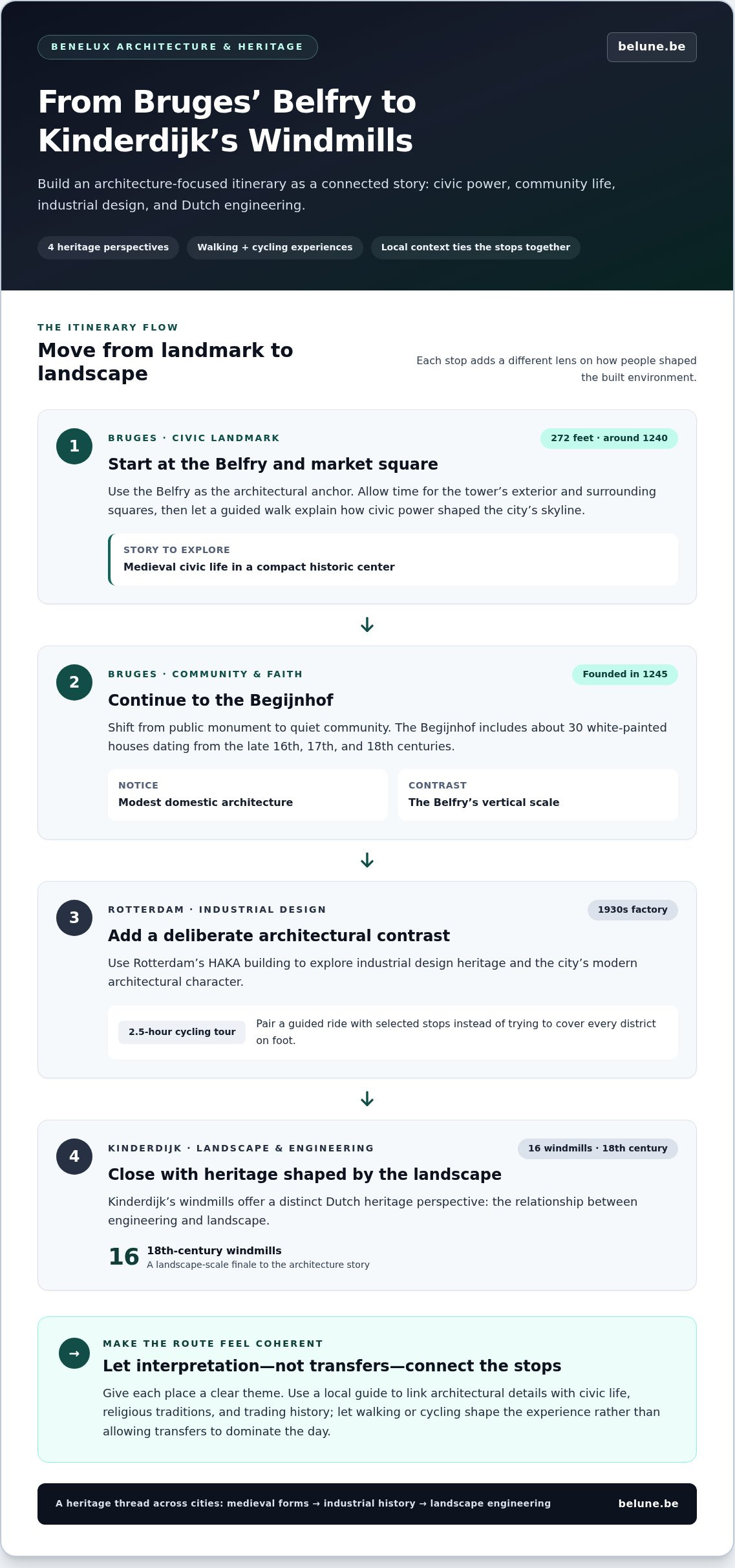
    Bruges brings medieval heritage into view through landmarks that reward close attention. The Belfry rises 272 feet above the historic center and dates to around 1240. Its tower gives groups a clear architectural anchor before exploring nearby streets. Plan time for the exterior, surrounding squares, and a guided walk that explains how civic power shaped the city’s skyline.

    At the Begijnhof, the story shifts from public monument to quiet community. Founded in 1245, it includes about 30 white-painted houses dating from the late 16th, 17th, and 18th centuries. Allow visitors to notice the contrast between modest domestic architecture and the Belfry’s vertical scale. Bruges’s UNESCO World Heritage setting gives this walking route a strong heritage thread without reducing the city to a checklist.

    For a visual overview of routes across Belgium and the Netherlands, watch this itinerary-planning video.

    Make Bruges one chapter in a broader architecture itinerary, rather than a series of photo stops. Start at the Belfry and market square, then continue to the Begijnhof for a quieter perspective. A local guide can connect architectural details with civic life, religious traditions, and the city’s trading past. This sequence gives groups variety while keeping the historic center within a coherent walking experience.

    Rotterdam offers a deliberate contrast. Its HAKA building, a 1930s factory, gives architecture-focused groups a way to explore the city’s industrial design heritage. Pair a guided cycling tour with selected stops, rather than trying to cover every district on foot. Rotterdam’s cycling tour lasts two and a half hours, making it a defined activity within a day that can also include independent sightseeing.

    For a balanced architecture and heritage itinerary, consider these complementary perspectives:

    • Medieval civic life: Compare Bruges’s Belfry with its compact historic streets.
    • Community and faith: Use the Begijnhof’s houses to discuss changing domestic and religious traditions.
    • Industrial design: Connect Rotterdam’s HAKA building with the city’s modern architectural character.
    • Landscape and engineering: Add Kinderdijk’s sixteen 18th-century windmills as a distinct Dutch heritage stop.

    These contrasts help groups see architecture across cities as a record of changing daily life. Bruges offers medieval forms, Rotterdam adds industrial history, and Kinderdijk shows the relationship between engineering and landscape. Give each stop a clear theme, and let walking or cycling shape the experience instead of allowing transfers to dominate the day.

    Art, canals, food, and historic cities give group itineraries a clear structure. In Amsterdam, a canal cruise pairs naturally with museum visits, while Brussels and Bruges add distinct Belgian heritage. For groups connecting London, Paris, Brussels, and Amsterdam by train, treat each rail journey as part of the route design. Brussels to Paris takes 82 minutes, and Amsterdam to Brussels takes under two hours.

    For US visitors, entry requirements depend on passport nationality and the countries on the itinerary, so plan documents for the entire route. Keep travel documents secure and take ordinary precautions in crowded stations, museums, and canal-side streets.

    A practical sequence is Amsterdam, Antwerp, Ghent, Bruges, Brussels, then Luxembourg City, with Brussels connecting the Belgian stops to the wider route. Allow time in each city for visits, meals, and transfers instead of treating every stop as a quick change of trains.

    Languages and service customs vary across Belgium, the Netherlands, and Luxembourg. Use a polite greeting, follow the language used locally, and treat tipping as a discretionary response to service, not an automatic amount. Luxembourg has three official languages, reflecting the region’s layered cultural character.

    Amsterdam’s canals make a strong opening experience. A canal tour can introduce the city’s waterways and historic houses before a Rijksmuseum visit. The museum presents 8,000 artworks across almost 1.5 km of galleries, so select a few collections that suit the group rather than attempting to see everything. A canal boat ride to the Rijksmuseum takes about an hour and a half.

    Architecture and daily life also shape a compelling Amsterdam theme. The city has almost 62 miles of canals, 90 islands, and 1,500 bridges. A walking route can connect canal views with a museum visit, then leave space for a food tour to explore local tastes. Historic canal houses provide a visual thread between neighborhoods and waterways.

    For groups interested in literature and memory, combine the canals with the Anne Frank House. Give the visit thoughtful space in the day, alongside time to understand the surrounding neighborhood. In Bruges, medieval streets and heritage sites contrast with Amsterdam’s waterways, creating variety across the route.

    Build the experience around a shared theme, such as art, food, or history, then choose visits that deepen it. Local context can bring architecture and museum collections into sharper focus; local guide services can support that interpretation across the itinerary.

    Brussels landmarks and chocolate tasting

    Brussels combines monumental architecture, museum visits, and food experiences in a walkable city program. Start with the Atomium, built for the 1958 World Expo and standing 335 feet tall. Its distinctive structure gives groups a striking introduction to the city’s modern design. Then contrast it with the historic center, where a guided walk can connect civic landmarks with Brussels’s layered architectural character.

    The city has 49 museums, so a group itinerary benefits from selecting visits around a clear interest rather than trying to cover them all. Pair an art-focused museum with an architectural walk, or choose a museum visit before a chocolate tasting. The Castle of Laeken offers another perspective on Brussels, with its park setting making it a distinct stop. Treat it as a separate visit, not an add-on squeezed between central stops.

    Chocolate is most engaging when presented with context. Build a tasting around the ingredients, craft, and sensory differences guests can notice, then leave time for questions and conversation. A local guide can connect the tasting to Brussels’s food traditions and make it part of the city’s story. Keep the group together by choosing a nearby landmark or museum as the next stop.

    Beer adds another layer to a food-focused program, but the itinerary should distinguish Brussels experiences from regional visits elsewhere in Belgium. The Leffe Beer Museum in Dinant describes beer production at the site as dating back to 1240. That makes it a possible regional heritage stop, rather than a Brussels landmark. A Brussels tasting can instead complement local food and architecture without implying that every Belgian beer story belongs to the capital.

    • Architecture first: Visit the Atomium, then contrast its modern form with central Brussels landmarks.
    • Museum focus: Choose one of Brussels’s 49 museums to match the group’s interests and available time.
    • Chocolate with context: Schedule a tasting beside a central walk, so flavor and place become part of one experience.
    • Food and beer: Pair a Brussels food experience with a separate Belgian beer heritage visit, such as the Leffe Beer Museum in Dinant.

    On a multi-country itinerary, Brussels can link the Netherlands and Luxembourg City while adding a distinctive food-and-architecture chapter. Schedule transfers separately from tastings and museum visits. A considered sequence gives visitors time to experience the Atomium, a selected museum, and chocolate without rushing between unrelated stops.

    Custom Benelux Itinerary Design for Group Travel

    Hotels, breakfasts, guides, and included tickets

    For an 11-day guided itinerary, lodging and daily visits should follow the route, not compete with it. Choose hotels that reduce unnecessary transfers between destinations such as Amsterdam, Brussels, and Bruges. A central base can simplify walking to museums and historic districts, while a hotel near a station may suit a rail-led journey. Make breakfast arrangements clear in the daily schedule, especially before early departures or guided visits.

    Seasonality changes the rhythm of Belgium and the Netherlands. Spring and fall generally bring milder weather, while July and August are the hottest and busiest months. April’s tulip bloom draws peak-season visitors, so start planning the itinerary and hotel arrangements early for those dates.

    Balance famous sights with quieter experiences by pairing a landmark visit with a nearby neighborhood, market, or time to explore independently. In Amsterdam, for example, combine a planned museum visit with a walk beyond the busiest canal routes. In Belgium, follow a guided visit to a major heritage site with a leisurely local meal or free time in a smaller town.

    Guides provide context that independent sightseeing can miss. A Brussels walking tour lasts 4 hours, while a Rotterdam guided cycling tour lasts two and a half hours. Use these set experiences to shape the day, then leave unstructured time for travelers to revisit a favorite museum, enjoy a café, or explore at their own pace.

    Choose included visits to support the itinerary’s central theme. For an art-and-culture journey, coordinate museum visits with the route and the group’s interests. For a heritage-focused program, select landmark admissions that deepen the story instead of adding stops for their own sake. List each visit clearly in the schedule and indicate whether it is guided or independent, so guests know what to expect each day.

    An 11-day guided journey can connect Belgium, Luxembourg, and the Netherlands without treating every stop as a rushed photo opportunity. A route might link Amsterdam’s museums with Rotterdam’s architecture, then continue through Brussels and Bruges before reaching Luxembourg City. The exact sequence should reflect arrival and departure points, travel connections, and the group’s priorities.

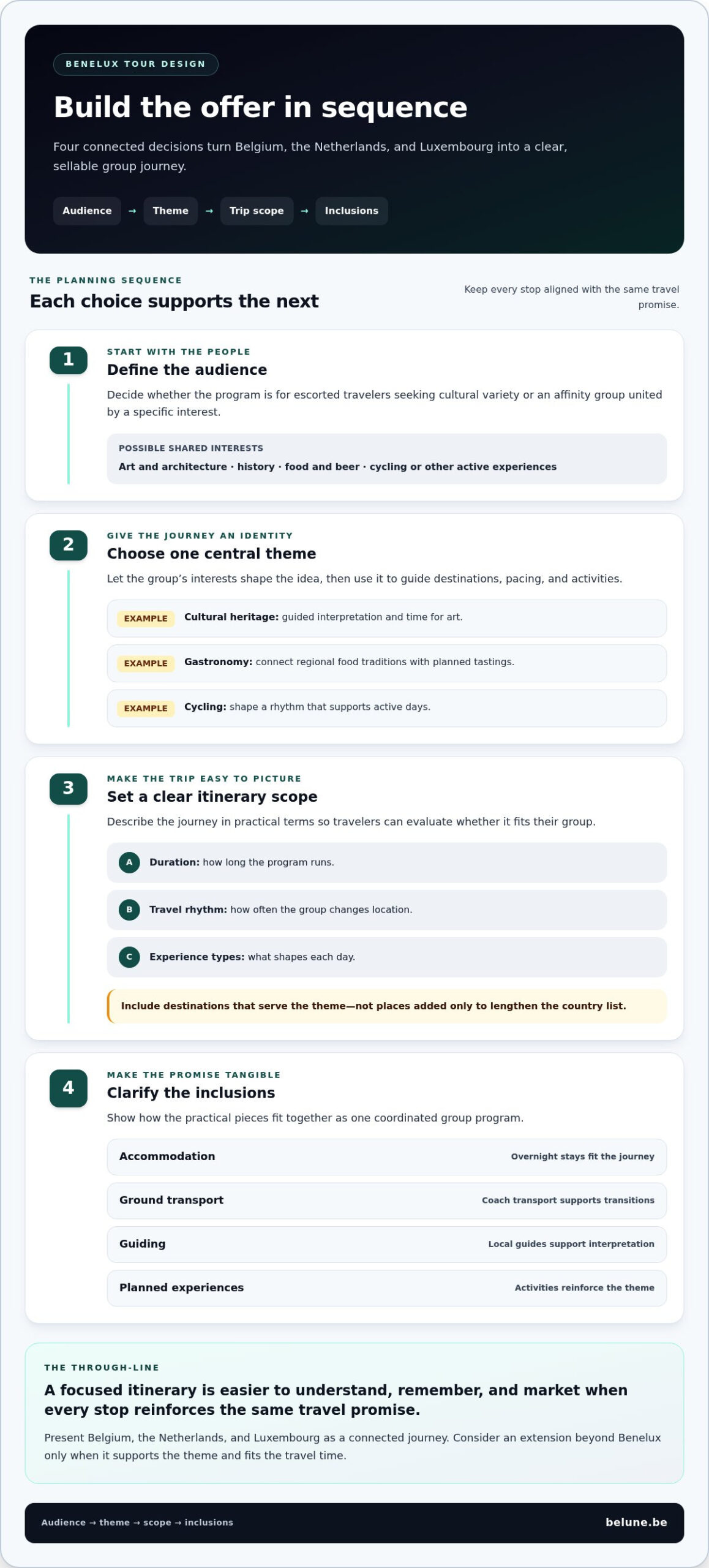
    Use this planning sequence to bring the practical details together:

    • Set the route: Choose destinations before assigning hotel nights.
    • Match lodging to movement: Consider station access, walkable sights, and breakfast timing.
    • Place guided visits: Anchor each day around a museum, historic site, or guided excursion.
    • Protect free time: Leave space for local discovery alongside famous attractions.

    This structure ensures accommodation, guides, and visits support one coherent experience. It also gives travelers a clear picture of what each day in Belgium, the Netherlands, and Luxembourg involves.

    What countries and cities are included in the Benelux region?

    Benelux refers to Belgium, the Netherlands, and Luxembourg. A custom route can focus on one capital in each country or add smaller cities for a more varied journey. Brussels, Amsterdam, and Luxembourg City can serve as useful anchors for a multi-country itinerary. The region’s compact scale lets planners connect distinct cultural settings without treating every destination as interchangeable.

    Belgium offers contrasting city experiences. Brussels brings national institutions and landmark architecture; Bruges and Ghent add historic centers and canals; Antwerp has a different urban character. Rather than trying to include every city, match stops to the group’s interests. A heritage-focused route might prioritize Bruges and Ghent, while a trip centered on food, design, and city life could give Antwerp more time.

    In the Netherlands, Amsterdam is a cultural hub, while Rotterdam and The Hague offer useful contrasts. Amsterdam’s canals and museums suit an art-and-history program. Rotterdam adds modern architecture, and The Hague can complement a route focused on civic and cultural institutions. Choose destinations that build a progression instead of repeating the same sightseeing experience in every city.

    Luxembourg adds a smaller-country perspective to the route. Luxembourg City combines historic quarters with contemporary city life, while destinations such as Vianden or Clervaux offer a different setting. The capital can serve as a final stop or a transition between Belgian cities and the Netherlands. Give it enough time to feel like a destination, not merely a transfer point.

    Build a route around the group’s theme and travel rhythm:

    • Capitals and culture: Connect Brussels, Amsterdam, and Luxembourg City, then select museums and guided visits that match the group’s interests.
    • Medieval heritage: Pair Bruges with Ghent, then contrast their historic centers with Brussels’s larger urban scale.
    • Design and modernity: Set Rotterdam’s architecture alongside Antwerp’s city character and Brussels’s landmark buildings.
    • Landscape and engineering: Add Kinderdijk’s windmills or Luxembourg’s countryside to balance time in city centers.

    For each additional city, weigh what it adds against the time needed to travel, check in, and explore. Fewer destinations can mean richer visits and more time for local interpretation. A broader itinerary needs a clear theme to make its transitions meaningful. Designing an award-winning Benelux itinerary means treating Belgium, the Netherlands, and Luxembourg as connected yet distinct destinations.

    BELUNE: Hotel Accommodation Management

    BELUNE helps tour operators and travel agents create custom group itineraries across the Benelux region. Turn to BELUNE when you need hotel accommodation management coordinated with the route, rather than choosing overnight stays in isolation. The team can also bring together coach hire with its own fleet of buses, local guide services, and art and culture group tours to create a coherent group experience.

    For example, a program linking Brussels, Bruges, and Amsterdam can coordinate hotel stays with city visits and guided cultural experiences. This approach is useful when accommodation, transport, and local interpretation need to work together across several destinations.

    Contact BELUNE to discuss your group itinerary.

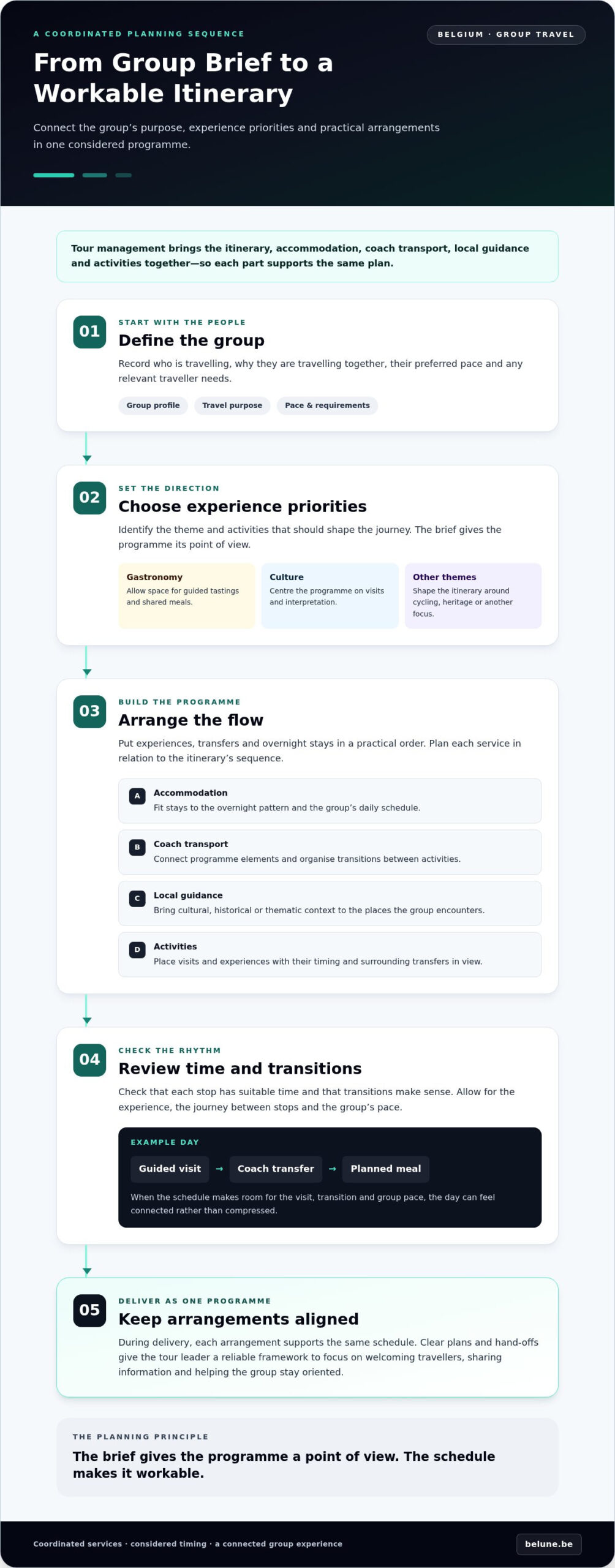
    Shape the journey your group will remember

    The next step is to turn your group’s interests into a practical creative brief. Define the trip’s central theme, preferred pace, and most important experiences. This gives every destination a purpose and helps the itinerary feel cohesive rather than crowded. For tour operators, designing an award-winning Benelux itinerary means aligning that vision with the details that bring a group journey together.

    BELUNE supports this planning with hotel accommodation management, coach hire using its own fleet of buses, and local guide services. These services connect overnight stays, travel between destinations, and on-the-ground interpretation in one group program.

    When you’re ready to develop your route, plan your trip with BELUNE. A thoughtful brief is a strong beginning, and the right itinerary can make each stop part of a more meaningful whole.

    Frequently Asked Questions

    How far in advance should a tour operator book a custom group itinerary?

    Book a custom group itinerary 6 to 9 months before departure; allow 12 months for peak-season travel such as the April tulip bloom. That lead time gives planners room to coordinate accommodation, transport, guides, and timed visits around one route. Begin with the travel dates and group priorities, then shape the city sequence before committing to individual experiences.

    Can I take a free day or two with no tours?

    Yes. Free days give guests space to rest, revisit a museum, or explore independently. Make them intentional parts of the schedule: identify the overnight city, note any pre-arranged transport, and leave the day’s activities open. For a group with mixed interests, a free day can also let travelers choose a quiet morning, a neighborhood walk, or a museum visit of their own.

    How long should a typical custom Benelux tour last for a group?

    An 8-to-12-day group tour offers room to experience five or six key cities, while a 5-day trip can feel rushed and leave little time for local culture. Set the duration by the number of overnight bases, travel between them, and the depth of visits. A group focused on fewer places may prefer longer stays over adding another city.

    What are some must-see places in France and Benelux?

    Consider Paris alongside Brussels, Amsterdam, Bruges, and Luxembourg City for a broad view of France and Benelux. Add a destination that changes the itinerary’s character, such as Kinderdijk for its historic windmills or Rotterdam for modern architecture. Select visits around the group’s theme, then leave space for local meals and unstructured exploration instead of filling every day with landmarks.

    How many days are ideal for a Benelux itinerary covering Belgium, the Netherlands, and Luxembourg?

    Plan 8 to 12 days for a group itinerary across Belgium, the Netherlands, and Luxembourg. That span can support visits to five or six key cities while allowing time for travel and meaningful experiences in each. The best fit depends on how many overnight stops the group wants and whether its focus is museums, historic sites, food, or a mix.

    What are the best cities and attractions to include in a first-time Benelux itinerary?

    For a first visit, consider Amsterdam’s canal district, Brussels’s Atomium, Bruges’s Belfry, and Luxembourg City’s historic center. Add Ghent or Antwerp for another Belgian perspective, or Rotterdam for contemporary architecture. Choose one or two priorities per city, such as a museum and a guided walk, so there is time to experience each place rather than simply pass through.

    Are rail passes or individual train tickets cheaper for travel around Benelux?

    There isn’t one option that is cheapest for every itinerary. Compare the planned train journeys, how often the group will travel, and the flexibility each ticket offers. A route with a few fixed intercity trips differs from one with frequent changes of plan. For a group, also consider whether tickets can be managed together and how the chosen fare handles changes.

    What are the train travel times and booking rules between major Benelux cities?

    Amsterdam to Rotterdam takes 45 minutes, Amsterdam to Brussels takes under two hours, and Brussels to Luxembourg takes approximately 3 hours. Ticket conditions vary by service and fare, including rules for changes and seat reservations. Build the itinerary around the actual departure and arrival stations, allow time for connections, and align museum or guided-visit start times with the train schedule.

  • How to sell high-value experiential tours with clear pricing

    How to sell high-value experiential tours with clear pricing

    A polished itinerary can attract attention, but local insight gives an experience its depth. Learning how to sell high-value experiential tours starts with making the value clear: explain what the price includes, tailor the itinerary to guests’ interests, and bring the destination to life with knowledgeable local guidance.

    Travelers looking beyond a checklist of landmarks want to feel a place’s character. Clear pricing helps them understand what they’re choosing. Thoughtful details, from cultural context to recommendations that reflect their interests, make the experience feel personal rather than interchangeable.

    This guide explains how to shape an offer around its strongest qualities, present pricing clearly, and use focused marketing to reach the right audience. It also explores how local stories and insider recommendations can enrich a well-planned tour, giving guests a clearer reason to choose it and a more vivid sense of what to expect.

    Key Takeaways

    • Use traveler feedback, audience insights, and browsing behavior to shape an offer for a clearly defined audience.
    • Build a marketing mix around compelling stories, useful content, and visual previews that bring the experience to life.
    • Make pricing easier to understand by showing what’s included and tailoring itineraries to guests’ interests.
    • Invite guests to share their experiences, then use their feedback and content to strengthen future marketing.
    • Give local guides room to add personal recommendations and cultural context that make a tour feel distinctive.

    1. What is the most common mistake you see when trying to market or sell a tour?

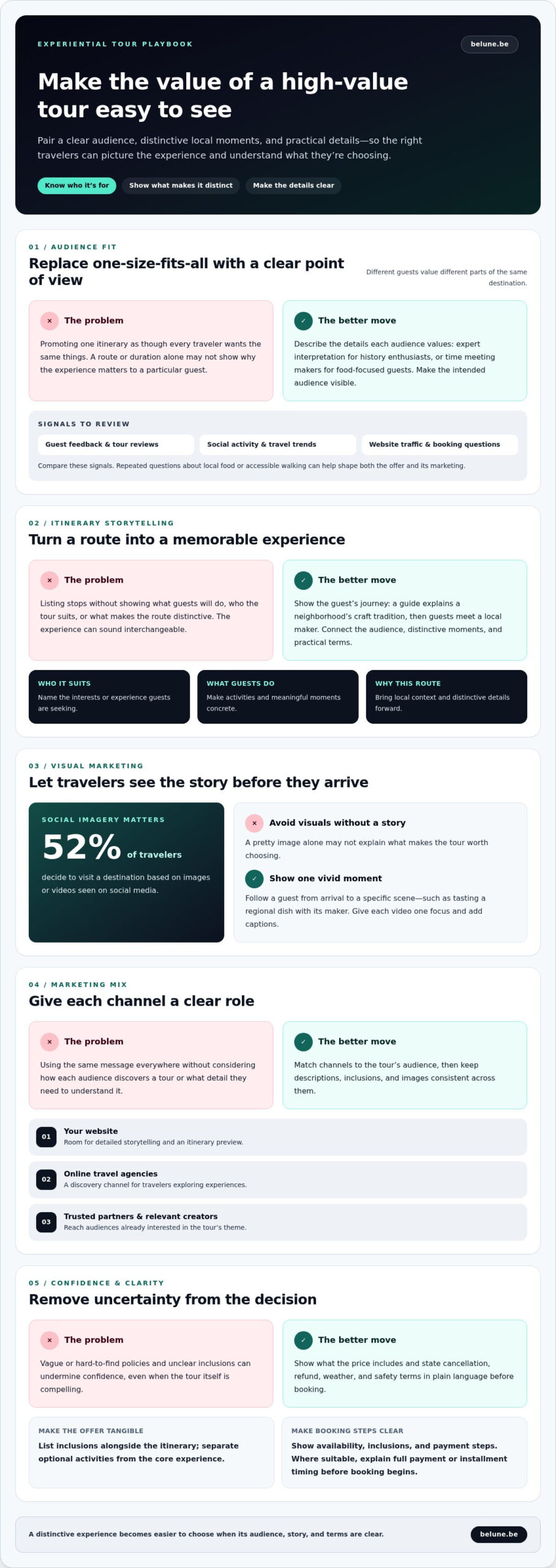
    A common mistake is marketing one itinerary as if every traveler values the same things. A history enthusiast may want expert interpretation, while a food-focused guest may care more about meeting makers. Describe the experience through the details each audience values, not just its route or duration.

    Start with research. Review guest feedback, social media activity, travel trends, and website traffic to learn what attracts people and how they discover destinations. Compare those signals with booking questions and tour reviews. If guests repeatedly ask about local food or accessible walking, use that insight to shape the offer and its marketing.

    To see how tour pricing can support a clearly presented experience, watch this video:

    Needs can differ even among travelers visiting the same destination. A couple celebrating a milestone may prefer a slower pace and intimate context; a group of friends might seek hands-on food experiences or active exploration. Make these distinctions visible in the itinerary. A concise description of who the tour suits, what guests will do, and what makes the route distinctive helps the right travelers recognize its value.

    Which sales channels work best for luxury and niche tours? Use a mix: your website for detailed storytelling, online travel agencies for discovery, and trusted partners to reach audiences already interested in a theme. Niche operators, such as Phuket dive center Scubadeep, connect with high-intent adventure travelers by aligning their channels directly with specialized skill levels and certifications. Choose channels to suit the tour’s audience, then keep descriptions, inclusions, and images consistent across them.

    Cancellation, refund, weather, and safety policies affect sales because they shape perceived risk. State the terms in plain language before booking, including what happens if weather disrupts an outdoor itinerary. Clear expectations help guests make informed decisions and reduce uncertainty. Vague or hard-to-find policies can undermine confidence, even when the tour itself is compelling.

    Travel shows and industry networking can reveal which themes resonate with tour operators, travel agents, and other partners. Prepare a concise sample itinerary, a clear description of its audience, and a memorable local detail. After each conversation, record questions and objections. Use those notes to refine your offer rather than relying on impressions alone.

    Memorable travel experiences combine a strong theme with personal connection. A guide’s explanation of a neighborhood’s craft tradition, followed by a stop at a local maker, gives guests a story to remember and share. To learn how to sell high-value experiential tours, present the audience, distinctive moments, and practical terms together. This makes the value easier to understand before guests commit.

    2. Email, influencer, video, and content marketing

    A high-value experiential tour offers depth, access, and a strong sense of place. Its target customer might be a culture-minded traveler seeking expert context or a food enthusiast interested in local makers. Define the audience by the experience they want, not simply by age or income.

    How do you market high-value tours with compelling storytelling, photos, and video? Follow one guest’s journey, from arrival to a vivid moment, such as tasting a regional dish with its maker. Use photos and short videos to show real settings and activities, then connect each image to a specific itinerary detail.

    Visual storytelling can shape destination interest: 52% of travelers decide to visit a destination based on images or videos seen on social media. Give each video one clear focus, such as a guide explaining a landmark or a chef introducing an ingredient. Add captions and a direct next step so viewers can understand the story without sound.

    Email gives operators space to develop that story over time. Send a welcome message featuring the tour’s defining moments, followed by a practical itinerary preview and a note about what guests will experience. Segment messages by interest: send a food-focused feature to gastronomy subscribers and a heritage story to readers drawn to culture.

    Partner and influencer marketing works best when the collaborator’s audience already cares about the theme. A local food writer can introduce a tasting tour; a cultural historian can explain why a particular route matters. Agree on the central story, useful details, and a clear booking call to action before creating content together.

    Research target markets through social media activity, email responses, website traffic, and audience insights tools. Track which videos lead visitors to itinerary pages, which email links attract clicks, and which questions appear in booking inquiries. Use these signals to refine your message rather than judging a campaign only by likes or views.

    What booking and payment options increase conversions for expensive tours? Make the booking process simple on mobile and desktop, with clear availability, inclusions, and payment steps. Where suitable, offer full payment or a clearly explained installment schedule, and state when each payment is due before guests begin booking.

    Effective marketing joins discovery to a confident decision: a partner introduces the experience, a story creates interest, and a clear booking process removes friction. For a concrete example of cultural storytelling in a group itinerary, explore Art & Culture Group Tours and consider how its theme can guide your own content practice.

    3. Transparent pricing and personalized itineraries

    A clear price tells guests what they’re buying and why each element belongs. Show inclusions alongside the itinerary, such as guide services, admissions, meals, or scheduled transport. Separate optional activities from the core experience. This makes comparisons easier and helps guests assess the tour’s actual value, rather than a vague promise of exclusivity.

    Build the price from the experience’s costs, then account for the channel that generates bookings. Tour operators selling through third parties need to build in at least a 30% margin to cover sales costs and remain profitable. One pricing guide recommends a 40% margin to leave room for commissions and contingencies. Treat these figures as planning guidance, not a replacement for calculating your own operating costs.

    Price the experience around its distinctive value, not simply a competitor’s itinerary. A conversation with a craft producer, for example, offers something different from a standard workshop stop. Explain that difference in the itinerary, then identify which services are included and which activities guests can add. For a tailored group itinerary, the price depends on the case and is provided after a quote request; key cost factors include transport, accommodation, guide services, admissions, and schedule.

    Personalization starts with a few useful questions during booking. Ask about food preferences, mobility needs, interests, and preferred pace. A food-focused itinerary can then highlight suitable vegetarian choices, while a culture-led route can allow more time for galleries or historic sites. Ask only for details that help shape the guest’s experience.

    Make the itinerary feel tailored through meaningful choices, not a long menu of extras. Offer a slower route, a specialist guide, or an additional tasting where these suit the tour. For cycling guests, explain the route’s character and activity options before they book; likewise, specialized adventure operators like divingaround.com clearly outline dive site conditions and experience levels for each outing. Each choice should clarify what changes and how it affects the day.

    Personalized guest communication carries that care beyond the booking form. Send a concise pre-trip message with the meeting point, sequence of activities, and relevant preparation details. If guests have shared dietary preferences, explain how those preferences shape the planned meal. Clear messages reduce uncertainty and make the itinerary feel considered before arrival.

    Review feedback from previous tours and use recurring requests to refine future itineraries. If guests often ask for more time at a museum, adjust the schedule or explain why the visit has a set duration. Present each option in plain language, with inclusions and exclusions visible before checkout. This precision appeals to guests who value substance and helps them choose with confidence.

    How to sell high-value experiential tours with clear pricing

    4. Social media and user-generated content

    Social media can show a tour’s atmosphere before a guest books. Build each post around one real moment, such as a guide sharing a local story or guests meeting an artisan. Add a concise caption explaining why that moment is part of the experience. This gives viewers context, not just attractive scenery.

    Optimize each profile to encourage action. Clearly describe the tour, its destination, and its intended audience, then add the website and a booking call to action. Keep the path consistent across channels. A visitor who discovers a food tour through a short video should find the same theme and itinerary through the profile.

    Choose content formats to match the story. A short video can show the pace of a cycling route; a carousel can explain stops on a cultural itinerary; a guide’s brief introduction can convey a neighborhood’s character. Give each post one purpose, such as building awareness, answering a practical question, or prompting a visit to the booking page.

    Measure more than likes. Review profile visits, saves, shares, comments, and clicks to the booking page. Compare which posts prompt useful questions, such as whether a tasting includes local producers or how much walking an itinerary involves. Use those signals to sharpen future posts and clarify tour details, rather than repeating content that attracts attention without helping guests decide.

    Guest reviews add a personal perspective to your own descriptions. Ask travelers for feedback after the tour, when they can recall specific moments, and invite them to describe what stood out. Feature 5-star reviews on an online booking page where they support a decision, but keep the wording faithful to the guest’s experience.

    Make sharing natural, not compulsory. Tell guests they’re welcome to tag the tour in a photo of a market visit or a memorable group stop. With permission, feature guest-created content and credit its creator. A real traveler’s perspective can show the experience’s scale, pace, and atmosphere in ways polished promotional copy may not.

    Feedback can come from social media comments, website testimonials, Google reviews, customer service conversations, interviews, surveys, and questionnaires. Look for recurring details across these sources. If guests repeatedly praise a guide’s local knowledge, feature that quality in relevant posts. If they ask the same logistical question, answer it in a caption or booking-page description.

    Close the loop after the experience. Send guests a selected photo as a souvenir, then invite them to leave a review or share it with friends. A post-tour message can mention the moment captured, such as a tasting or landmark visit. This connects the memory to the tour and gives future guests a genuine sense of what taking part feels like.

    5. Sharing local culture and insider tips

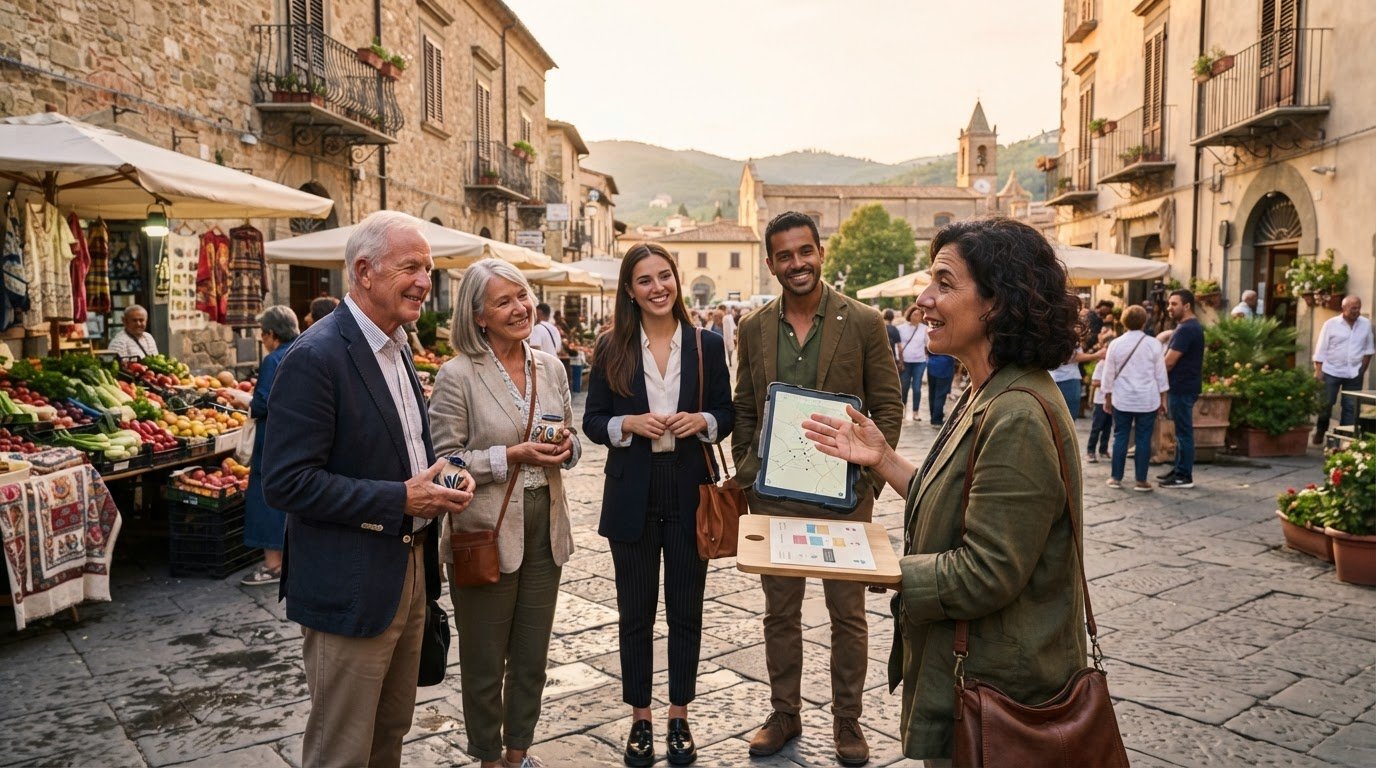
    Local insight gives a familiar route more personal meaning. A guide can connect a historic square to a market still used by nearby residents, then explain how both shape the neighborhood today. Tour operators create stronger experiences when this context is part of the itinerary, not an afterthought. The takeaway: sell interpretation and human connection, not just the stops.

    Recommendations should reflect each guest’s interests. A guide might suggest a quiet riverside walk to someone who enjoys architecture, or a family-run bakery to someone curious about regional food. These personal tips make local knowledge useful beyond the planned route and help guests engage with a destination at their own pace.

    Prepare guides to share stories accurately and vividly. At a battlefield, distinguish documented history from local tradition, then explain why the landscape mattered. On a river excursion, point out working waterfronts alongside notable buildings. Specific details give guests something meaningful to notice, while clear context helps avoid reducing local culture to a collection of anecdotes.

    Build cultural exchange into the experience with care. A visit to a craft studio, for example, can introduce the maker’s materials and process rather than treating the workshop as a photo stop. Agree on the visit’s purpose with local hosts, respect their time, and let their perspective lead. This creates a more thoughtful encounter for guests and partners.

    Give guides practical ways to personalize the day. Before departure, ask guests whether they prefer food, design, history, or everyday local life. During the tour, use their answers to offer relevant recommendations and adjust the emphasis. Afterward, note which suggestions guests found useful. Tour operators can use that feedback to improve guide briefings and future itineraries.

    Local knowledge can also shape marketing. Replace generic claims like “hidden gems” with a clear example: a guide explains how a neighborhood bakery’s specialties reflect local ingredients. Describe what guests will learn, see, or taste, and why it matters. These strategies make the experience tangible without promising access or encounters the itinerary cannot deliver.

    Insider tips are most valuable when they feel generous, specific, and grounded in place. A well-chosen recommendation can lead guests from a landmark to a nearby bookshop, café, or viewpoint that matches their interests. To shape a locally informed itinerary around expert guidance, plan a culture-led group experience.

    BELUNE: Hotel Accommodation Management

    BELUNE helps tour operators turn a distinctive itinerary into a coordinated group journey. Hotel Accommodation Management supports programs where accommodation needs to align with the route, schedule, and character of the experience. Coach Hire with its own fleet of buses and Local Guide Services can support the practical and interpretive elements of a group tour.

    For a culture-led program, BELUNE’s Art & Culture Group Tours bring local context into the itinerary. Consider BELUNE when your travel program calls for coordinated accommodation, transport, and guiding alongside an engaging group experience. The right combination depends on the itinerary’s theme and logistics.

    Contact BELUNE to discuss your group travel plans, or visit belune.be.

    Shape the next journey with intention

    The next step in learning how to sell high-value experiential tours is to treat each itinerary as a collaboration. A distinctive concept becomes easier to deliver when every practical element supports its character, from the rhythm of the schedule to the way guests move through the destination.

    BELUNE can bring those elements together for tour operators through Hotel Accommodation Management, Coach Hire with its own fleet of buses, and Local Guide Services. Each can support a different part of the journey while keeping the itinerary’s theme at its center.

    Consider what your next group needs most: a well-coordinated stay, smooth transport between experiences, or local insight that adds depth to the program. A clear starting point makes the planning conversation more purposeful and helps turn a strong idea into a coherent travel experience.

    Contact BELUNE to discuss your tours, and take the next step toward shaping an experience guests will remember.

    Frequently Asked Questions

    What does the modern traveler want?

    Modern travelers want experiences that feel meaningful, well organized, and connected to local life. Someone choosing a heritage tour, for example, may value a guide who explains how a historic place matters today, not only when it was built. Make practical details easy to find, then create opportunities for discovery and participation. A strong tour respects guests’ time while offering a perspective they might miss on an independent visit.

    What is Tour Pricing?

    Tour pricing means setting what guests pay for an experience and explaining what that amount covers. Start by totaling direct costs, such as transport, admissions, and guide time, then account for operating expenses and sales channels. Consider demand and the experience’s distinctive value as well. A clear price presentation lists inclusions and optional extras so travelers understand the offer before starting a booking.

    What is the most common mistake you see when trying to market or sell a tour?

    A common mistake is describing the route before making the tour’s purpose clear. A page might list several stops but leave visitors unsure whether the experience suits a history enthusiast, a food lover, or an active group. Review the questions guests ask before booking. If they repeatedly ask about pace, inclusions, or the tour’s focus, revise the opening description to answer those questions sooner.

    How do you price a premium experiential tour based on costs, demand, and perceived value?

    Set a premium tour price by calculating operating costs, then assessing demand and the value guests place on its distinctive elements. Separate fixed expenses from costs that change with each booking, and account for the sales channel. Compare demand across dates or seasons without treating a competitor’s price as your target. Finally, explain what supports the price, such as specialist interpretation or access to a meaningful cultural activity.

    How can tour operators build trust with reviews, testimonials, credentials, and clear policies?

    Build trust by presenting genuine guest feedback, accurate credentials, and clear booking terms together. Use testimonials that describe specific aspects of the experience, such as a guide’s expertise or the group’s pace. State cancellation, refund, weather, and safety policies in plain language before checkout. Display only credentials that apply to the people or organization involved. Consistent details across the website, confirmation messages, and tour materials help set reliable expectations.

    How should tour operators design itineraries and personalize experiences to justify premium prices?

    Design an itinerary around a central theme, then give guests relevant choices without disrupting its flow. A food-focused day might connect a market visit, a producer conversation, and a meal into one story. Personalize details that affect comfort and interest, such as pace, dietary preferences, or time for independent exploration. Each choice should enhance the core experience, not appear as an unrelated add-on to justify a higher price.

  • How to Get 5-Star Reviews for Your Group Tours

    How to Get 5-Star Reviews for Your Group Tours

    What if the best way to earn more five-star reviews isn’t to ask more often, but to make every moment of the tour feel worth remembering? Knowing how to get 5-star reviews for your group tours starts with the experience itself: the thoughtful details guests appreciate, the small issues handled with care, and a final request that feels personal rather than promotional.

    Even delighted guests may move on without leaving feedback. And when one part of a carefully planned journey disappoints, it can shape the story they share publicly. That’s why review-building isn’t a last-minute task. It’s part of how a tour is designed, delivered and followed up. For group travel professionals, coordinated logistics and a well-paced itinerary can help create a consistent experience from arrival to farewell.

    This guide shows you how to strengthen the moments guests want to recommend, invite honest feedback at a natural time, and build a respectful process your team can repeat. You’ll also learn how to use public reviews and private feedback to refine future tours, giving each group a genuine reason to share its experience.

    Key Takeaways

    • Learn how to get 5-star reviews for your group tours by focusing on a thoughtful guest experience, not chasing a rating.
    • Map key touchpoints across the journey and set clear expectations with accurate pre-tour information.
    • Choose feedback methods that suit your purpose: use private responses to spot issues and public reviews to inform future travellers.
    • Create a simple post-tour follow-up process that feels personal, timely and easy to respond to.
    • See how coordinated itineraries, accommodation, coach transport and local guidance can support a more consistent group-tour experience.

    Why 5-Star Reviews for Group Tours Begin with the Guest Experience

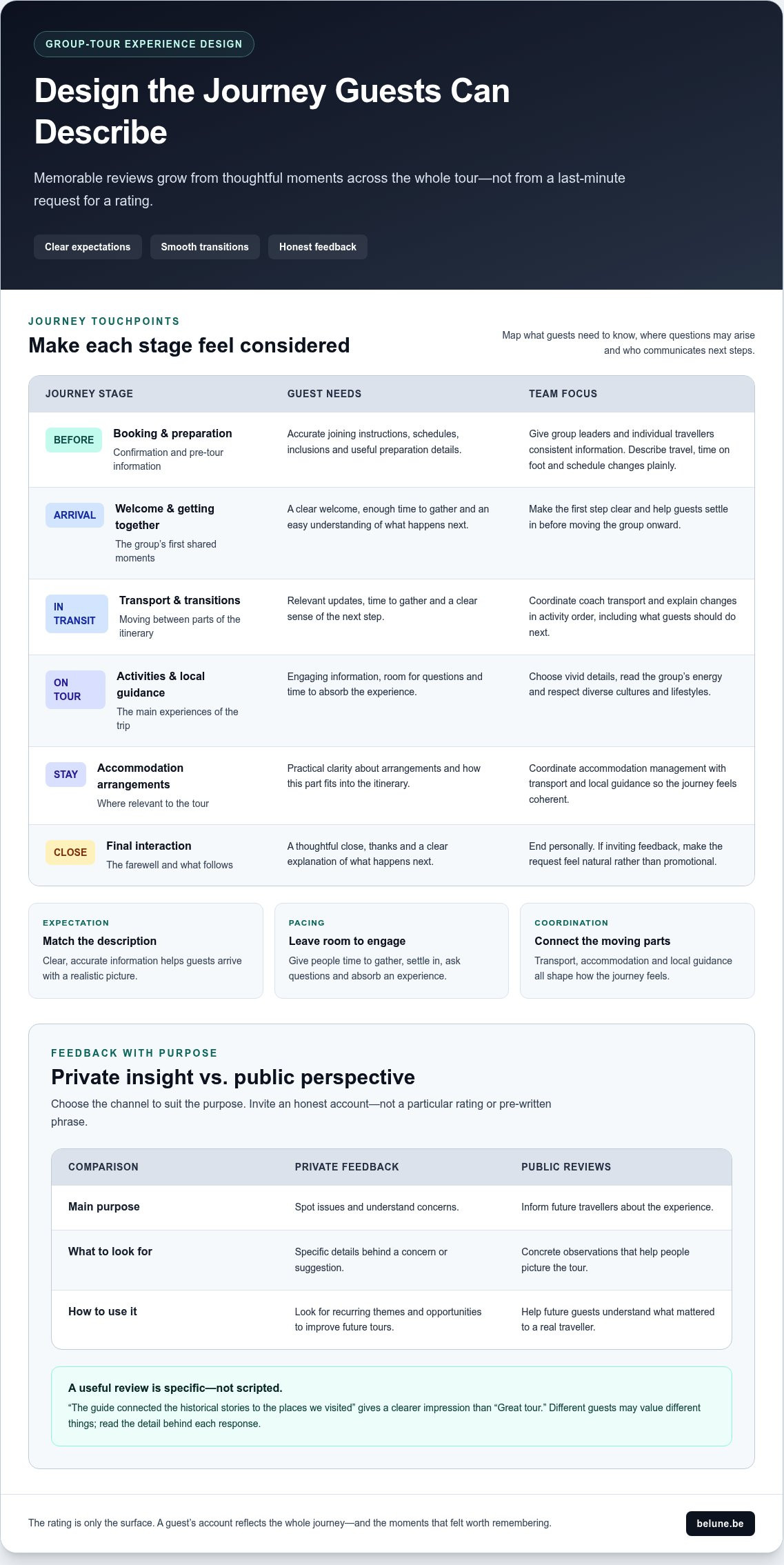
    A five-star review is a guest’s honest account of a tour they valued, not an outcome an operator can promise or script. The rating is only the surface. A guest may be recalling whether the itinerary matched its description, whether the day felt well paced, how smoothly transitions worked, and how they were treated when plans needed attention. Each detail can shape the overall impression.

    That’s why how to get 5-star reviews for your group tours is ultimately a question about the full journey. Clear information before departure helps guests know what to expect. Thoughtful pacing gives them room to engage, while dependable coordination between transport, accommodation and local guidance helps the tour feel coherent rather than fragmented. No single element guarantees praise, but each can contribute to how guests remember the trip.

    For another perspective on how interactions shape perceptions, watch this video from Tourpreneur:

    The customer experience spans a person’s responses across interactions with a service. For a group tour, that can include booking information, the first welcome, travel time, the main activity and the final exchange. A review may focus on one standout moment, but its credibility comes from the guest’s account of the experience as a whole.

    What makes a group-tour review feel trustworthy?

    Specific details help future travellers picture the tour. “The guide connected the historical stories to the places we visited” gives a clearer impression than “Great tour.” Generic praise can sound interchangeable; concrete observations show what mattered to that guest. Invite guests to share their own perspective, not to use suggested phrases or give a particular rating. Honest feedback is more useful, even when it includes a concern.

    Why one group experience can produce different reviews

    A shared itinerary doesn’t create identical experiences. One traveller may be drawn to cultural context, while another values unhurried time or practical comfort. Expectations and accessibility needs can differ, too. A group leader may comment on coordination and communication, while individual guests describe the guide, pace or moments that felt meaningful. A mixed review doesn’t automatically mean the tour failed. Look for the specific detail behind each response.

    Review quality comes from genuine, useful accounts, not simply a larger number of ratings. Read comments for recurring themes, then distinguish a one-off preference from an issue that may affect other guests. This gives feedback a practical role: not just public reassurance, but insight into how the next group’s experience can be improved.

    Design Group-Tour Moments Guests Will Want to Remember

    Memorable tours rarely depend on one grand gesture. They take shape through a sequence of considered moments: clear information before departure, an easy welcome, smooth transitions, time to absorb an experience and a thoughtful close. Map these touchpoints to spot where small uncertainties can interrupt the journey, without assuming every moment will go exactly to plan.

    Start with a simple journey map. For each stage, note what guests need to know, where questions may arise and who is responsible for communicating. Include booking confirmation, pre-tour preparation, arrival, transport, activities, accommodation arrangements where relevant, and the final interaction. This makes the experience easier to review and improve as a whole.

    Set expectations before the group arrives

    Pre-tour information should make practical decisions straightforward. Share accurate joining instructions, schedules, what’s included, and useful preparation details such as what to bring or expect during the day. Give group leaders and individual travellers consistent information, so no one has to rely on second-hand details. Clear expectations can prevent avoidable disappointment when the delivered experience differs from an assumption.

    Be precise about the rhythm as well as the itinerary. If a day includes travel between activities or time on foot, say so plainly. If a schedule may change, describe it as an estimate rather than a certainty. The aim isn’t to over-explain; it’s to help guests arrive with a realistic picture and focus on the experience.

    Create a considered experience while the tour is underway

    Once the group is together, pacing and transitions become part of the hospitality. Allow enough time for people to gather, understand the next step and settle in. A guide can keep information engaging by choosing a few vivid details, pausing for questions and reading the group’s energy instead of filling every quiet moment with commentary. For example, story-driven operators such as sistersgrimmghosttour.com show how blending local history with captivating narration can keep guests thoroughly engaged and leave a memorable impression.

    Communication matters most when plans change. If the order of activities shifts, explain what’s happening and what guests should do next. Clear updates help people feel considered, even when an adjustment is needed. The Global Code of Ethics for Tourism also underscores respect for diverse cultures and lifestyles, a useful principle when shaping interpretation and interactions for a varied group.

    • Before departure: align the schedule, inclusions and practical guidance.
    • During transitions: make the next step clear and share relevant updates.
    • At the close: thank guests and explain what happens next.

    Dependable coordination ties these moments together. Coach transport, accommodation management and local guidance each influence how naturally a group moves through its itinerary. BELUNE brings these elements together in customized group itineraries. Travel professionals planning a connected journey can explore BELUNE’s group travel planning.

    Every touchpoint contributes to the overall guest impression, from the first practical detail to the final farewell. Review the sequence to see where expectations and delivery align, and where clearer communication or a more thoughtful transition could make the next tour feel more seamless.

    How to Get 5-Star Reviews for Your Group Tours

    Choose Review and Feedback Methods That Feel Natural

    A review request can feel awkward if it sounds like a sales pitch or puts a guest on the spot. Keep the process simple: choose a method that fits what you want to learn, explain why you’re asking, and make participation optional. The aim isn’t to steer anyone toward a particular rating. It’s to make it easy for guests to share an honest perspective in the right place.

    Each channel serves a different purpose:

    • Private surveys help identify what worked and where the experience could improve. Focused questions about communication, pacing or coordination can reveal useful detail.
    • Direct conversations offer a personal, low-effort way to hear immediate impressions. They can add context, but shouldn’t be treated as a public endorsement.
    • Public review platforms let travellers share their experience with people considering a tour. A voluntary, honest account can help prospective guests understand what to expect.

    When should operators use a survey instead of a public review request?

    Use a private survey when you need specific feedback, such as whether the schedule felt manageable or pre-tour information was clear. Keep it focused so guests can respond without completing a long questionnaire. A public review request has a different purpose: inviting a guest to tell future travellers about their experience. A survey can inform improvements, but it isn’t a substitute for a voluntary public review.

    How can operators ask without influencing the rating?

    Use neutral language and make clear that a response is optional. For example: “We’d value your honest feedback. If you’d like to share your experience with future travellers, you can leave a review here.” Avoid asking for five stars, suggesting specific wording or implying that positive feedback is expected. A respectful invitation gives guests room to describe the tour in their own words.

    Some guests prefer to speak directly with a guide; others would rather respond privately later or post publicly. Offer the relevant route without pressing for an answer, and don’t treat a friendly comment during the tour as permission to publish or quote it. Listen to concerns with care, and let each guest decide whether they want to leave a public review.

    Before introducing rewards, discounts or other incentives, read the current rules of the review platform you plan to use. Policies may differ and change. Check them before making an offer, and never make a reward conditional on a positive rating. Also avoid review filters that direct only satisfied guests to public platforms while diverting unhappy guests elsewhere. Invite honest feedback from guests broadly, then use private channels to understand concerns and public reviews to inform future travellers.

    A natural request is brief, timely and pressure-free. For operators considering how to get 5-star reviews for your group tours, the key is to invite honest accounts consistently, not control what guests say. Choose one clear public-review route and a separate way to gather detailed private feedback, so each response serves its proper purpose.

    Build a Repeatable Post-Tour Review Process

    Consistent follow-up makes it easier for guests to share feedback without making a review feel like an obligation. Set a simple routine your team can use after each departure, then refine it based on what guests respond to. The process should support both public reviews and private learning, while leaving every guest in control of whether they take part.

    Use this sequence as a practical starting point:

    1. Identify the right contact. Confirm who coordinates communication for the group, and whether individual travellers can be contacted directly through an appropriate channel.
    2. Choose one follow-up route. Select a suitable channel, such as a post-tour email, and keep the message brief. Avoid sending the same request through several channels.
    3. Allow time to reflect. Follow up after guests have had some space from the tour, so they can consider the experience without feeling rushed.
    4. Invite, don’t insist. Thank guests for joining and invite them to share an honest review if they wish. Make participation clearly voluntary.
    5. Review and learn. Read public reviews and private feedback for useful specifics, then look for themes that can guide practical improvements.

    Who should receive the review invitation, and when?

    Coordinate with the group leader so the request reaches the right audience, but don’t assume one person’s response represents everyone. If individual travellers can be contacted appropriately, let them decide whether to respond for themselves. Send one concise invitation after the tour, once guests have had time to reflect. Repeated reminders can make an optional request feel compulsory, so let a single clear message stand.

    How should tour operators respond to praise and criticism?

    Respond with a personal, concise thank-you that acknowledges the reviewer’s actual comment. If someone praises the guide’s storytelling or how smoothly a transfer went, refer to that detail rather than relying on a stock reply. For criticism, stay calm, recognise the concern and avoid disclosing private guest information. A public response should show attentiveness without turning into an argument or exposing details about the person’s arrangements.

    Close the loop internally, too. Record recurring themes in a straightforward format, such as communication, pacing, transport coordination or accommodation arrangements. Note whether feedback points to a one-off issue or something appearing across several tours, then assign a practical next step to the relevant team. For example, recurring confusion about a meeting point may call for clearer joining instructions; comments about rushed transitions may prompt a review of the itinerary’s timing. Track whether the change addresses the concern on later departures.

    A sustainable review process is consistent in its invitations, voluntary for guests and responsive to what they share. That balance is central to how to get 5-star reviews for your group tours: not manufacturing praise, but building a thoughtful habit of listening and acting. BELUNE supports travel professionals with coordinated itineraries and logistics. Learn more about planning a group tour with BELUNE.

    How BELUNE’s Group-Travel Expertise Supports Lasting Guest Impressions

    A review reflects what guests experienced, not simply the places they visited. For travel professionals, a carefully chosen itinerary matters, but so does the way its elements connect: the time between activities, the move from coach to accommodation, and the local context offered along the way. A destination management company can help bring these pieces into a coherent group journey through thoughtful planning and coordination.

    BELUNE has more than 20 years of experience in transport and tour operations, supporting customized group travel through itinerary planning, accommodation management, coach transport using its own fleet, and local guide services. That experience supports considered delivery, but does not promise a particular rating or review. Guests retain their own perspective, and their feedback remains theirs to share.

    Why coordinated logistics matter to the guest experience

    Each part of a tour affects the next. An itinerary shapes how the group moves through the day; transport connects its planned moments; accommodation arrangements contribute to the journey’s rhythm; and local guidance gives activities context. Considering these elements together helps travel professionals identify handoffs that might otherwise feel disjointed, clarify responsibilities and reduce avoidable friction for guests.

    For example, if a schedule includes a transition between a guided visit and onward coach travel, the plan should account for how guests will know where to go next and how that movement fits the day. These practical details may be quiet, but they influence whether the experience feels composed. Coordination creates continuity; it doesn’t remove every uncertainty or guarantee that every guest will respond in the same way.

    As a specialist destination management company, BELUNE works with travel professionals to organize group travel across these connected elements. Its role is to support the design and delivery of the journey, while each review remains an honest reflection from a guest.

    Turn review insights into a stronger next tour

    Feedback becomes most useful when it informs the next planning conversation. Bring recurring guest comments to the itinerary review, then consider what they reveal about the group’s interests and practical requirements. If travellers repeatedly value time for independent exploration, that preference might shape the balance of a future schedule. If feedback points to confusion around transitions, revisit how those moments are arranged and explained.

    Customization gives travel professionals room to respond thoughtfully rather than apply the same template to every group. Interests, pace and logistical needs can guide choices across itinerary design, accommodation management, coach transport and local guidance. For example, specialized operators such as winetoursofsedona.com demonstrate how designing fully customized itineraries around specific group interests helps deliver a more personal and memorable experience. Base changes on a real pattern or a clearly understood need, not a single rating viewed in isolation. This turns reviews into one source of insight for continual refinement.

    Learning how to get 5-star reviews for your group tours means building an experience guests can assess honestly, then listening carefully to what they say. BELUNE brings more than 20 years of group-travel experience to that work. To explore a customized itinerary shaped around your group’s priorities, discuss a tailored group tour with BELUNE.

    Shape the Next Journey with Guest Insight

    Let each tour leave more than a memory. It can also offer a useful perspective for shaping what comes next. As you plan future group journeys, consider how guest feedback might inform the experience, from the balance of the itinerary to the practical details that help each stage feel connected. The aim isn’t to engineer a rating; it’s to create a thoughtful experience and invite guests to describe it honestly.

    For travel professionals considering how to get 5-star reviews for your group tours, BELUNE brings more than 20 years of experience in transport and tour operations to customized itineraries, accommodation management, coach transport with its own fleet, and local guide services. These elements can be coordinated around each group’s needs and interests, supporting considered tour planning without promising a particular review outcome.

    Bring your priorities and guest insights into a new group-tour plan. Discuss a tailored group tour with BELUNE, and shape a journey designed with care from its first details to its final moments.

    Frequently Asked Questions

    Should I ask every guest on a group tour for a review?

    You can invite all guests to leave feedback, provided the invitation is appropriate and equally voluntary. This gives individual travellers the chance to describe their own experience rather than relying only on the group leader’s account. Use a suitable communication channel and avoid repeatedly approaching guests who don’t respond. If you can only reach the group leader, ask them to share the invitation rather than speak on everyone’s behalf.

    When is the best time to ask guests to review a group tour?

    Ask after the tour, when guests have had a little time to reflect and are no longer managing the practicalities of departure. The right point can vary: a one-day activity and a multi-day itinerary leave different opportunities for follow-up. Make the invitation easy to act on later, such as in a concise message with a direct route to the review page, and avoid interrupting guests during a meaningful moment.

    Can tour operators offer incentives for five-star reviews?

    Only consider an incentive after checking the current rules of the specific review platform, and never make it conditional on a five-star rating or positive wording. A safer approach is to invite an honest review without offering a reward. If a platform permits an incentive, follow its disclosure requirements and apply the terms fairly. Policies can change, so review them before launching any incentive-based request.

    What should I do if a group-tour guest leaves a negative review?

    Respond calmly and address the issue the guest actually described. Thank them for explaining their perspective, acknowledge the concern without becoming defensive, and state what you’ll do to review it. Don’t share booking details or personal information in a public reply. Internally, check relevant records and speak with the responsible team so your response is informed and any appropriate follow-up happens privately.

    Can I ask guests to leave a five-star review?

    No. Ask guests for an honest review, not a particular rating or prewritten praise. A request for five stars can pressure people and make their feedback less trustworthy to future travellers. Keep the invitation neutral, such as, “If you’d like, share your honest experience with other travellers.” Guests should be free to decide whether to post and what to say, including criticism.

    Should the group leader or individual travellers leave the review?

    Either can share feedback, but their perspectives may cover different parts of the trip. A group leader might comment on coordination and communication with the operator, while a traveller may focus on a particular activity or guide. Invite the leader to describe their own experience, and allow individual guests to contribute separately if they wish. Don’t ask one person to submit a review as though it represents the entire group.

    How can a tour operator encourage reviews from international guests?

    Make the request easy to understand across language backgrounds. Use short, plain sentences, explain that feedback is optional, and avoid idioms or culturally specific expressions that may not translate clearly. If you share translated instructions, make sure they accurately reflect the original message. Point guests to a review platform they can access, and don’t assume every traveller prefers the same language or communication channel.

  • Tour Management in Belgium: A Smarter Approach to Group Travel

    Tour Management in Belgium: A Smarter Approach to Group Travel

    What makes a group tour run smoothly is often how well its services work together. Tour management Belgium means planning transport, accommodation, local guidance and activities as one itinerary, rather than a series of separate bookings. When those parts are not aligned, even a thoughtfully designed programme can feel rushed, and changes can add pressure for the tour leader.

    Coordination matters as much as the experiences themselves. A practical schedule gives the group time to enjoy Belgium’s culture, gastronomy and distinctive character while keeping timings, transfers and traveller needs in view.

    This article explains the responsibilities involved in group tour management, how to prepare a clear brief and workable itinerary, and what to consider when choosing a coordination partner. BELUNE brings more than 20 years of experience in transport and tour operations, connecting accommodation management, its modern coach fleet, local guides and customised group experiences in one programme. The aim is to put thoughtful logistics behind a journey that feels seamless to travellers.

    Key Takeaways

    • Tour management connects the moving parts of a group journey, so activities, transport and accommodation work as one itinerary.
    • With tour management belgium, a clear brief helps shape a programme around the group’s theme, pace and practical needs.
    • Compare separate bookings with a coordinated plan to understand how communication, flexibility and local support affect the tour leader’s workload.
    • Set priorities early, including traveller needs, accommodation preferences and transport requirements, to guide itinerary decisions.
    • BELUNE’s experience supports tailored group programmes for tour operators and travel agents.

    What Tour Management in Belgium Means for Group Travel

    Tour management in Belgium is the coordinated planning and delivery of a group journey. It brings the itinerary, accommodation, coach transport, local guidance and activities into one workable programme. Rather than arranging a single excursion or transport booking in isolation, it considers how each element affects the others and the group’s experience.

    For tour operators, that coherence matters. An activity affects departure times, the journey between stops influences the day’s pace, and accommodation shapes arrival and departure arrangements. A tour operator’s wider role in assembling travel services is outlined in Tour Operator Definition and Functions. Tour management applies that connected thinking to the details of a group itinerary, so individual services support one shared plan.

    A brief visual introduction to Belgium can help set the scene for the group experiences a programme might bring together.

    Which responsibilities sit within group tour management?

    Group tour management connects the programme’s core components. This can include managing overnight accommodation, planning coach transport between activities, arranging local guide services, and fitting visits or themed experiences into the schedule. Sequence and timing matter: a cultural visit, guided walk and group meal each need enough time, with practical transitions built into the day.

    The management work centres on designing and aligning those arrangements. The tour leader focuses on the group: welcoming travellers, sharing information and helping them stay oriented as the itinerary unfolds. Clear plans and hand-offs give the leader a reliable framework, rather than making them the sole point of contact for every logistical detail.

    Why does coordinated management matter to the traveller experience?

    Good coordination is often noticeable when the day moves without unnecessary friction. Travellers know when to be ready, where the next part of the programme fits and how one experience leads into another. Clear timings and hand-offs reduce uncertainty, leaving more attention for the stories, flavours, culture or shared occasion at the heart of the tour.

    Consider a group travelling for an art and culture programme. A guided visit is followed by a coach transfer and a planned meal. If the schedule allows time for the visit, the transition and the group’s pace, the day can feel connected rather than compressed. The same principle applies to gastronomy, cycling or heritage-focused itineraries: practical planning should support the theme, not compete with it.

    Tour management in Belgium is the coordinated design and delivery of group travel, aligning services and timing so the itinerary works as one considered experience.

    How Tour Management in Belgium Brings Every Service Together

    A group programme takes shape in stages. First, the travel partner defines the brief. Next, priorities become an itinerary, and accommodation, transport, guides and activities are planned around its sequence. During delivery, each arrangement needs to support the same schedule. This is the practical value of tour management belgium: shaping individual services into one programme instead of leaving their connections to chance.

    From group brief to a workable itinerary

    Start with the essentials: who is travelling, why they are travelling together, the pace they prefer and any important traveller needs. These details help determine what belongs in the programme and how much time to allow for each experience. BELUNE tailors group itineraries for tour operators and travel agents, turning those priorities into a considered plan.

    A useful planning sequence is:

    1. Define the group. Note its profile, travel purpose and relevant requirements.
    2. Set the experience priorities. Identify the theme and activities that should shape the journey.
    3. Arrange the flow. Put experiences, transfers and overnight stays in a practical order.
    4. Review the rhythm. Check that each stop has suitable time and that transitions make sense.

    This sequence keeps the itinerary anchored in the group’s purpose. A gastronomy-led programme, for example, may need space for guided tastings and shared meals, while a culture-focused tour may centre on visits and interpretation. The brief gives the programme a point of view; the schedule makes it workable.

    Coordinating accommodation, coaches, and local guidance

    Once the itinerary’s shape is clear, its components can be planned in relation to one another. Accommodation needs to fit the overnight sequence and the group’s daily movements. Coach transport links activities and helps organise transitions, while local guides bring knowledge and context to the places and themes the group encounters.

    • Accommodation: Plan stays around the itinerary’s overnight pattern and the group’s schedule.
    • Coach transport: Connect programme elements so the group can move through the day according to the agreed plan.
    • Local guidance: Give travellers more than a route between stops. A guide can illuminate cultural, historical or thematic connections that make an experience more meaningful.
    • Activities: Position visits and experiences with their timing and surrounding transfers in view.

    Clear responsibilities also help prevent avoidable friction. When the programme records what happens next and how its elements connect, partners and the tour leader can work from a shared structure instead of repeating arrangements across separate conversations. BELUNE brings accommodation management, coach transport, local guides and themed experiences together for professional travel partners. Explore BELUNE’s group travel support as you shape a coordinated programme.

    Tour Management in Belgium: A Smarter Approach to Group Travel

    Tour Management in Belgium: Separate Bookings or One Coordinated Plan?

    Tour operators can assemble a group programme by booking each service independently or by working with one destination-management partner across connected elements. Neither model suits every operation. The right choice depends on the team’s time, supplier relationships, local knowledge and capacity to coordinate details. As programme elements multiply, coordination becomes more important: each service adds another connection to align, not just another booking to make.

    For a simple itinerary with few moving parts, an operator with strong supplier relationships and enough planning capacity may prefer to coordinate directly. A multi-day programme combining accommodation, coach journeys, guides and scheduled experiences may benefit from a shared planning structure, particularly when timings or arrangements need to change.

    What changes when services are managed separately?

    With separate bookings, the tour operator is responsible for joining the dots: aligning schedules, sharing relevant requirements and passing updates between suppliers. This can work well when the team has clear processes and a manageable programme. But a change to one element may need to be communicated through several conversations, adding coordination for the operator and sometimes the group leader.

    Consideration Separate bookings One coordinated plan
    Coordination load The operator tracks arrangements and dependencies across suppliers. A planning partner aligns connected programme elements.
    Communication flow Updates may travel through several separate channels. Related details can be managed through one planning relationship.
    Itinerary flexibility The operator brings suppliers together to assess adjustments. Changes can be considered in the context of the wider programme.
    Local support Depends on the operator’s own local knowledge and contacts. A destination partner adds local guidance and coordination.

    What does an integrated destination-management approach add?

    A destination-management partner can give the operator one planning relationship across accommodation, coach transport, local guides and activities. The services remain distinct, but their roles and timing are considered together. This makes it easier to see how a change to one part may affect another and to make a practical decision with the full programme in view.

    This approach can suit operators who want their internal team to focus on the group and the experience, while drawing on local coordination for delivery. It does not remove the operator’s role or mean every supplier decision is identical. It provides a connected framework for managing the moving parts. BELUNE works with tour operators and travel agents to coordinate customised group programmes. For a wider perspective on incoming tour operators, see its guide to choosing an incoming tour operator.

    In practice, tour management belgium is less about choosing a universally superior booking model and more about matching coordination to programme complexity. Consider how many services must work together, who will handle updates and how much local support your team needs. Those answers can help you decide whether independent coordination or a unified plan best fits your group and operational capacity.

    How to Prepare a Strong Brief for Tour Management in Belgium

    A clear brief gives tour management belgium a useful starting point. It turns broad ideas into a programme shaped around the group, rather than a list of appealing activities. Share what matters most, what can flex and who will make decisions as the itinerary develops. Clearly stated priorities make it easier to balance the experience with the practical details behind it.

    What information should a group-tour brief include?

    Build the brief in a deliberate order, moving from the group’s essentials to the character of the programme:

    1. Define the group. Describe its profile, approximate size and travel purpose, such as a shared interest, celebration or professional programme.
    2. Set the travel framework. Give preferred dates and outline the group’s pace, including how active or relaxed the days should feel.
    3. Identify traveller needs. Record key requirements that may affect accommodation, transport, activities or the daily schedule.
    4. Choose the experience theme. Indicate whether culture, gastronomy, heritage or battlefield tourism should shape the itinerary.
    5. Rank priorities. Separate essential requirements from preferences that could adapt as the programme takes shape.

    This distinction is valuable. If a particular experience is central to the group’s purpose, mark it as essential. If an activity or schedule preference can change, identify it as flexible. This gives itinerary planning room to adapt without losing sight of what travellers came to experience.

    How should operators plan for changes and communication?

    Decide early who owns programme decisions and who communicates updates to travellers. The operator might lead decisions about the group’s priorities, while a designated tour leader shares practical information with participants. Clear roles help prevent repeated questions and reduce the risk of different people working from different versions of the plan.

    Build sensible space into the schedule around transfers and group activities. This does not mean leaving the day undefined. It means considering how long transitions may take and avoiding an itinerary that depends on every element running perfectly to schedule. If a visit takes longer than expected, a flexible plan gives the operator a clearer basis for deciding what can shift while preserving the programme’s essential experiences.

    Local coordination can help assess practical changes in context. When accommodation, coach transport, guides and activities are considered together, an adjustment to one part can be weighed against its effect on the rest of the itinerary. Share updates through agreed points of contact, then make sure the tour leader has the information needed to brief travellers clearly.

    A thoughtful brief does not need to predict every detail. It needs to show what the group values, where the programme can adapt and who guides decisions. Discuss a tailored group programme with BELUNE to bring those priorities into a considered itinerary.

    How BELUNE Delivers Tour Management in Belgium for Group Travel

    BELUNE is a destination management company that works with tour operators and travel agents to create tailored group programmes. Its approach to tour management belgium connects practical arrangements with the character of the journey, bringing accommodation management, coach transport, local guidance and themed experiences into one itinerary.

    More than 20 years of experience in transport and tour operations informs the way BELUNE coordinates these elements. For a travel partner, that means working with a team familiar with the relationship between the plan on paper and the movement of a group through its programme. The aim is a considered structure that supports the partner’s objectives while giving travellers a cohesive experience.

    A connected service model for professional travel partners

    Programme development begins with the partner’s purpose and priorities. BELUNE shapes customised itineraries around them, bringing accommodation management, coach hire from its own modern fleet, local guide services and activities into the same plan. Each component has a clear place in the journey, helping the operator see how the itinerary’s practical structure supports its overall theme.

    The experience itself can take different forms. A group may be drawn to art and culture, gastronomy and beer, or battlefield tourism. These themes call for different rhythms and kinds of interpretation. A cultural itinerary might place guided experiences at its heart; a gastronomy-led programme can give food and drink a defining role. In either case, coordination should preserve the theme while making the sequence workable for the group.

    For tour operators and travel agents, this model offers a coordination partner without taking away their role in shaping the programme. The partner brings knowledge of its travellers and what the tour should achieve. BELUNE applies destination and operations experience to the connected arrangements, helping turn those objectives into a tailored itinerary.

    What to expect when developing a tailored programme

    Collaboration starts with a brief: the group profile, travel purpose, preferred pace, essential requirements and desired experiences. These priorities guide itinerary development. BELUNE then brings the programme components into view together, so the proposed flow reflects both the intended experience and the practical links between its parts.

    As the programme takes shape, the travel partner can consider how its choices affect the whole journey. The arrangement of overnight stays influences the daily sequence; coach movements connect experiences; local guides add context to the itinerary’s themes. Attentive coordination keeps these decisions aligned and gives the partner a coherent framework to share with its tour leader and travellers.

    The result is a group programme shaped around the partner’s brief, not a generic package. With more than two decades of experience behind its work, BELUNE brings care and operational perspective to the details that connect the journey. Plan your Belgium group tour with BELUNE.

    Give Your Group Journey a Clear Direction

    The strongest group programmes begin with a decision: what should travellers remember most? Let that answer guide the choices that follow, from the rhythm of each day to the experiences that give the itinerary its distinctive character. With tour management belgium, a clear point of view gives practical planning a purpose and helps every element feel connected to the journey you want to create.

    For tour operators and travel agents, the next step is to turn that intention into a focused brief. Identify your audience, the experience you want to shape and the priorities that matter most. Then develop a programme that leaves room for discovery while keeping the group’s needs in view. A thoughtful beginning gives your partners a strong foundation for planning and gives travellers something meaningful to look forward to.

    Plan your Belgium group tour with BELUNE and take the first step towards a programme shaped around your travellers. A well-considered journey starts with one clear idea and can become an experience your group will carry with them.

    Frequently Asked Questions

    What does tour management in Belgium include?

    Tour management in Belgium covers the coordination of arrangements for a group, with decisions shaped by the programme’s purpose and practical needs. Alongside transport, accommodation, guidance and activities, planning may account for meal timing, arrival information, accessibility considerations and how updates reach the group. For example, a group leader can use a clear day-by-day itinerary to brief travellers before departure, rather than piecing together details from separate confirmations.

    How is a destination management company different from a tour operator?

    A tour operator generally creates and sells travel programmes, while a destination management company brings destination knowledge and local coordination to a programme’s delivery. Their roles can overlap, depending on the arrangement. A travel agent or tour operator may define the audience, theme and commercial offer, then work with a DMC to plan local services and experiences. The distinction is useful, but it is not a rigid boundary between entirely separate kinds of work.

    Can a tour management company coordinate accommodation and coach transport for groups?

    Yes. BELUNE provides hotel accommodation management and coach transport for group programmes using its own fleet of modern coaches. Planning these together helps account for the relationship between overnight stays and daily movements. For example, the planned departure from accommodation can be considered alongside the day’s first activity and the group’s transfer. This gives travel partners a joined-up basis for shaping the schedule, rather than treating each arrangement as an isolated decision.

    How do I prepare a brief for a group tour in Belgium?

    Describe who the group is, its approximate size, the purpose of the trip, preferred dates and any essential traveller requirements. Then explain what experience you want to create and distinguish must-haves from preferences. It is also useful to identify who can approve itinerary decisions and who will communicate updates to travellers. This gives the planning conversation a clear creative direction and a workable way to resolve choices.

    What kinds of themed group tours can be organised in Belgium?

    Group programmes can be shaped around art and culture, gastronomy and beer, battlefield tourism, cycling, sporting events, festivals or river cruises with local excursions. The best theme depends on what will engage the group and how active or immersive the programme should feel. A travel partner might centre a tour on cultural visits, for example, then use food experiences or local guidance to add context without distracting from the central theme.

    How does tour management help when a group itinerary changes?

    It helps the operator understand how a proposed adjustment affects the rest of the programme. If an activity’s timing shifts, consider whether transport, later visits or meal arrangements also need attention. A shared itinerary and agreed decision-making contact make it easier to communicate the change consistently. Local coordination can contribute practical context, while the operator or tour leader remains responsible for appropriate traveller updates.

    Is tour management suitable for travel agents and tour operators?

    Yes. Tour management can support travel agents and tour operators creating group programmes who want destination expertise to help coordinate local arrangements. It can be especially useful when an itinerary combines several kinds of experience or requires the operator to align multiple services. BELUNE works with professional travel partners on customised group programmes, helping them develop journeys around their clients and the experience they intend to offer.

  • Selling Benelux Tours to American Clients: A Guide

    Selling Benelux Tours to American Clients: A Guide

    A Benelux tour doesn’t become compelling simply by crossing three borders. American clients need a clear reason to choose the journey and confidence that each transition will feel effortless. Knowing how to sell benelux tours to american clients starts with turning Belgium, the Netherlands, and Luxembourg into one memorable travel story, not a list of stops.

    The challenge is to choose experiences that resonate, make the itinerary easy to picture, and ensure the practical details support the promise. Art and culture, gastronomy, history, and active experiences can each add depth when shaped around a strong theme and paced with care.

    This guide explains how to position Benelux group tours for American travelers, structure an itinerary whose value is easy to communicate, and coordinate the services that support the sales message. We’ll look at accommodation, coach transport, local guides, and connected experiences. BELUNE works with tour operators and travel agents to bring customized programs to life through coordinated local operations, drawing on more than 20 years of experience in group travel.

    Key Takeaways

    • Present Belgium, the Netherlands, and Luxembourg as one connected journey, with any extension chosen for a clear reason.
    • To understand how to sell benelux tours to american clients, start with the audience, build around a strong theme, then define the trip scope and inclusions.
    • Compare culture-led, culinary, battlefield, and active tour concepts by audience fit, itinerary coherence, and operational complexity.
    • Build trust with a polished itinerary overview, a sample day, clear inclusions, and timely pre-departure communication.
    • Support the customer-facing promise with coordinated itinerary planning, accommodation management, coach transport, and local guides.

    Why Benelux tours can stand out to American clients

    For a U.S. tour operator, the first challenge is turning the unfamiliar regional name “Benelux” into a trip clients can picture and explain to someone else. Belgium, the Netherlands, and Luxembourg can form a natural, connected journey when the itinerary has a clear theme and a sensible pace. An extension beyond Benelux can broaden the story when it fits the group’s interests and schedule, rather than simply adding another destination.

    The journey can balance historic places and art with food and beer traditions, landscapes explored at a gentler pace, or experiences that bring history into focus. The Benelux Union overview provides background on the region. For selling, the key is translating that regional context into experiences that matter to a specific group.

    A Benelux group tour is a guided journey through neighboring countries, designed for travelers who want varied cultural experiences without managing every transition themselves.

    Which American traveler segments might respond to Benelux?

    Think in audience profiles, not assumptions about American travelers as a whole. Escorted group travelers may value several complementary experiences in one organized journey. Affinity groups can give the itinerary a sharper focus: art-focused travelers might prioritize collections and architecture, while history groups may want interpretation of significant events and sites.

    Food and beer enthusiasts, as well as groups drawn to cycling or other active experiences, offer different starting points. Define the group’s shared interest first, then decide how much variety to include around that central theme. This makes it easier to explain who the trip is for without suggesting that one itinerary suits everyone.

    How to make the regional story easy to picture

    Lead with an idea, not a roll call of countries and landmarks. “Art, architecture, and everyday life across three neighboring countries” gives travelers a lens through which to understand the trip. A simple route overview can then show the sequence through Belgium, the Netherlands, and Luxembourg. Consider an extension beyond Benelux only when it supports the theme and fits the travel time.

    Balance atmosphere with practical clarity. Pair an evocative description, such as exploring art and food traditions with local guides, with information about how the group moves between stops and where overnight stays fit. Travelers can then imagine the experience, while tour sellers have a clear framework for explaining the itinerary.

    That clarity is central to how to sell benelux tours to american clients: present the region as a coherent answer to a particular group’s interests, not as a checklist of destinations. The strongest concept makes its audience, central theme, and journey easy to grasp at a glance.

    How to shape a Benelux tour into a clear, sellable offer

    A strong tour concept is more than a route. It gives travelers a reason to choose the journey and gives your sales team a concise way to explain what makes it distinct. Build the offer in sequence so each decision supports the next.

    • 1. Define the audience. Decide whether the program is for escorted travelers seeking cultural variety or an affinity group united by a specific interest.
    • 2. Choose the theme. Let the audience’s interests shape the central idea, such as battlefield history, cultural heritage, gastronomy, or cycling.
    • 3. Set the trip scope. Establish the duration, travel rhythm, and main experience types. Include destinations that serve the theme, not places added only to lengthen the country list.
    • 4. Shape the inclusions. Explain how accommodation, ground transport, guiding, and planned experiences are coordinated as part of the group program.

    A focused itinerary is easier to understand, remember, and market because every stop reinforces the same travel promise. It also gives clients a clearer basis for deciding whether the program fits their group.

    Choose one theme that gives the tour its identity

    A theme is a practical design tool, not just a label. A cultural heritage journey might prioritize guided interpretation and time for art. A cycling program needs a rhythm that supports active days. A gastronomy-led tour can connect regional food traditions with planned tastings. If food is the central thread, BELUNE’s Belgium gastronomy tours offer a related example. Let the theme guide destination choices, pacing, and activities from the first planning decision.

    Set an itinerary scope clients can readily evaluate

    Describe the journey in terms a traveler can picture: how long it runs, how often the group changes location, and what kinds of experiences shape each day. Avoid unsupported promises or overly precise operational details. Instead, show how accommodation, coach transport, local guiding, and planned activities fit together as one coordinated group program. For a broader explanation of the local operating role, the Benelux incoming tour operator guide offers useful DMC context.

    Then present the concept in a compact overview: audience, theme, route, travel rhythm, and inclusions. A history-focused program, for example, can explain how guided interpretation and related cultural experiences support its central subject, without crowding the itinerary with unrelated stops. This makes how to sell benelux tours to american clients less about presenting a list of options and more about communicating a well-shaped experience.

    For tour operators and travel agents developing a regional group program, BELUNE’s customized itinerary planning can help translate an audience and theme into a coordinated journey.

    Selling Benelux Tours to American Clients: A Guide

    How to position Benelux tour options against other European trips

    Positioning works best when you compare the experience a group wants, not simply the number of countries on the itinerary. Present a Benelux program through its thematic focus and the way its destinations connect. Use the same four criteria for each concept: audience fit, strength of the theme, itinerary coherence, and the coordination needed to deliver it.

    Tour concept Audience fit Thematic strength Planning consideration
    Culture-led Travelers interested in museums, architecture, and local interpretation Connects cultural visits through a shared heritage story Balance guided visits with time to experience each place
    Culinary Groups drawn to regional food traditions and tastings Uses gastronomy to reveal local character Coordinate planned food experiences with the route and schedule
    Battlefield History-focused groups seeking context and memorial visits Gives the journey a clear historical focus Allow room for thoughtful interpretation, not just site stops
    Active Groups interested in cycling and experiencing landscapes at a more active pace Links movement through the region with outdoor discovery Shape daily activity and transport around the group’s chosen rhythm

    Which tour concept fits each audience?

    Start with the group’s central interest, then test whether the route and planned experiences strengthen it. Cultural heritage suits travelers who want museums, architecture, and local context. Gastronomy tours give food-focused groups a way to explore regional traditions through tastings. Battlefield tourism serves history groups seeking guided context and memorial visits. Active programs, including cycling, offer another clear lens. Ideas in this themed group travel guide can help broaden the concept without diluting its identity.

    Operational complexity is a planning consideration, not a judgment of quality. Map how accommodation, coach transport, guides, and activities must align, then ask whether each element adds meaning for the group. A focused route through Belgium, the Netherlands, and Luxembourg can keep the narrative tight. An extension beyond Benelux changes the route and program scope, so include one when it deepens the travel story, not simply to add another destination.

    How to explain the value without relying on discounts

    Make value tangible through the experience and the coordination behind it. Describe what travelers will encounter, what the group program includes, and how local guides, accommodation, transport, and activities fit together. A concise itinerary summary lets clients assess the offer without guessing what the journey involves.

    That’s a practical way to approach how to sell benelux tours to american clients: differentiate the trip through a distinctive theme, coherent routing, and clear inclusions rather than an unsupported claim of better value. The result is an offer that’s easier for a group leader to present and for travelers to evaluate.

    How to build a sales process American clients can trust

    Trust grows through a sequence of clear decisions, not a single polished brochure. Guide prospective clients from initial interest to itinerary review, booking decision, and pre-departure communication. At each step, answer the questions they’re likely to have: Is this trip for me? What will the journey feel like? What does the group program coordinate? What happens next?

    Keep the sales materials consistent from the first overview to the final itinerary. Use a concise description of the audience and theme, a route summary that explains why the stops belong together, and a sample day that gives the experience a human scale. An illustrative day might combine a guided cultural visit, time for a planned meal or tasting, and another experience connected to the tour’s theme. Label examples clearly so travelers can picture the rhythm without mistaking a sample for a guaranteed schedule.

    What information should the sales materials make clear?

    State who the tour is designed for, what holds it together, and how the route supports that idea. Then explain the group program in plain language: accommodation management, ground transport, local guiding, and planned experiences. A readable itinerary outline, concise descriptions, and helpful visuals make the offer easier to assess. Distinguish confirmed inclusions from general destination inspiration, and give interested clients a clear next step, such as reviewing the itinerary or discussing the program with their tour operator.

    Keep the sales journey easy to follow. After initial interest, share the overview and itinerary for review. Make the booking decision stage clear, then provide pre-departure communication that reiterates the travel plan and coordinated elements. A reliable handoff between seller and local operator helps keep those details aligned.

    • Audience and theme: Who the group is for and what defines the journey.
    • Route and rhythm: The sequence of stops and the intended balance of travel and experiences.
    • Program inclusions: The accommodation, coach transport, guiding, and activities coordinated for the group.
    • Next step and handoff: What the client should review or decide, and which program details need to carry forward to local operations.

    How does local operating support strengthen the promise?

    A compelling itinerary depends on practical delivery. BELUNE coordinates accommodation management, coach hire through its own fleet, and local guide services as part of customized group programs. Connecting these elements helps turn a seller’s theme into a workable ground plan. Transport, stays, and local interpretation then support the experience described in the sales materials.

    That operational clarity is central to how to sell benelux tours to american clients: the promise feels dependable when the seller can explain both what travelers will experience and how the group program is coordinated. BELUNE works with tour operators and travel agents to shape tailored itineraries, drawing on more than 20 years of experience in transport and tour operations. Explore BELUNE’s group-travel support to see how local coordination can support your sales promise.

    How BELUNE helps turn a Benelux sales concept into a delivered group tour

    A tour operator may have a clear audience and a compelling theme, but turning those ideas into a group program calls for local planning. BELUNE works with tour operators and travel agents to shape customized itineraries, then support delivery through accommodation management, coach hire, and local guide services. This connects the promise presented to travelers with the practical elements that bring the journey to life.

    What a DMC partnership can bring to the sales offer

    Local planning gives the concept operational shape. BELUNE’s own coach fleet supports group transport planning, while accommodation management and local guides help connect overnight stays, movement, and interpretation in a considered itinerary. The seller’s chosen theme can inform the route and experiences, whether the group is drawn to culture, gastronomy, battlefield history, or active travel. BELUNE brings more than 20 years of experience in transport and tour operations to the planning process.

    This partnership is business-to-business: BELUNE supports travel trade professionals developing group programs, rather than individual B2C travel bookings. The seller brings knowledge of its audience and the sales promise; the local operating partner helps translate that promise into a tailored program with coordinated ground services.

    How to move from a concept to a partner conversation

    A conversation is more productive when the seller can describe the intended group experience and its practical boundaries. A finished itinerary isn’t necessary at the outset. Bring the essentials, then use them to shape a workable planning brief together.

    • Target audience: Describe the group’s shared interests and travel style.
    • Preferred theme: Identify the idea that should guide the experience, from cultural heritage to cycling.
    • Travel window: Share the anticipated travel period so planning can be framed around it.
    • Broad itinerary ambitions: Outline the countries or experience types under consideration, and whether the concept might extend beyond Benelux.
    • Ground support: Note where accommodation management, coach transport, local guides, and itinerary planning fit the seller’s needs.

    This brief gives the conversation a useful starting point: the audience sets the perspective, the theme guides choices, and the operational needs show how the concept must work on the ground. BELUNE can develop a customized group itinerary with the seller, connecting the intended experience to coordinated transport, stays, and local guidance.

    For sellers considering how to sell benelux tours to american clients, a dependable local operating relationship can make the customer-facing promise more credible. Bring your audience, theme, travel window, and broad route ambitions into the next planning step. Develop a Benelux tour with BELUNE.

    Give your Benelux tour concept its next shape

    A promising group-tour idea often begins with a simple question: what should travelers remember most when they return home? Use the answer as a creative compass. It can help refine the audience, choose the defining experience, and keep planning decisions aligned with the feeling you want the journey to leave behind.

    That’s a useful starting point for how to sell benelux tours to american clients. You don’t need every itinerary detail settled before bringing the core concept into focus: who the trip serves, what makes it distinctive, and what kind of experience you want to create. From there, a conversation with a local operating partner can help turn the idea into a practical direction for development.

    To take the next step, start shaping your Benelux group-tour concept with BELUNE. A thoughtful concept can become the beginning of a journey that feels clear to sell and rewarding to experience.

    Frequently Asked Questions

    How do I market a Benelux tour to American travelers?

    Market the trip around a specific traveler interest and make the experience easy to imagine. Use a clear title, a short description of the journey’s central idea, and sample moments that help readers picture the days. For example, a culture-focused program can foreground guided interpretation and time to explore, rather than leading with a string of unfamiliar place names. Keep the route and inclusions easy to find in your sales materials.

    What makes Benelux a good destination for a group tour?

    Benelux can suit groups that value a connected journey with several cultural perspectives. Coordinated transport and group accommodation management help organize travel between countries, while local guides bring context to the experiences. This structure can help tour leaders manage varied interests: the group follows a shared itinerary, while its theme gives each stop a reason to belong. Choose a pace and program that fit the group.

    Which Benelux tour themes may appeal to American clients?

    Possible themes include art and culture, gastronomy and beer, battlefield history, and cycling. Refine the offer by choosing one as the main focus and using another as a complementary experience. A cultural itinerary might include a regional food experience, while a cycling program could add guided heritage interpretation. The secondary element should enrich the trip without making its purpose difficult to explain.

    Should a Benelux tour include an extension beyond the region?

    Include an extension when it serves the group’s interests and strengthens the overall itinerary, not simply because travelers recognize the destination. Consider whether it leaves enough room for the Benelux experiences that define the program and whether the added travel fits the intended pace. For a group focused on a regional theme, a tighter Benelux route may be more coherent. A broader Europe concept may benefit from an additional chapter.

    How can a U.S. tour operator work with a Benelux DMC?

    A U.S. tour operator can work with a DMC by sharing its audience, theme, travel window, and broad route ideas, then collaborating on the local program. BELUNE works with tour operators and travel agents on customized group itineraries and ground logistics, including accommodation management, coach transport, and local guides. The operator develops the customer-facing offer; the DMC helps shape its local delivery. BELUNE serves travel trade partners, not individual B2C bookings.

    What should a Benelux group tour itinerary include?

    A useful itinerary makes the sequence and daily rhythm understandable, rather than just naming places. Include planned experiences, how the group moves between them, where accommodation fits, and which guiding or activities are part of the program. A sample day can clarify the balance between organized visits and time between them. Identify transitions and optional extensions plainly so group leaders can present the plan accurately to prospective travelers.

  • Benelux Group Tour Logistics: VAT Reclaim Guide

    Benelux Group Tour Logistics: VAT Reclaim Guide

    What if VAT reclaim readiness begins before the tour departs, not when receipts reach the finance team? Cross-border group tour logistics Benelux itineraries can spread records across coach transport, accommodation, activities and several countries. A changed schedule or missing invoice can make those records harder to organise later.

    It’s understandable to focus first on getting the group smoothly from one experience to the next. A clear documentation process supports that journey and makes post-trip preparation more manageable. This guide explains how to organise trip records before and after departure, understand the main VAT reclaim routes, and separate operational documentation from decisions about tax eligibility.

    We’ll cover practical ways to track supplier invoices, services delivered and itinerary changes, while keeping in mind that VAT treatment depends on the business and purchase. Coordinated planning matters: BELUNE brings more than 20 years of group travel experience, arranging coach transport, accommodation, local guides and customised itineraries. That operational coordination can help create a clearer record of the journey, while tax decisions remain with the tour operator and its tax adviser.

    Key Takeaways

    • Map each itinerary segment to its supplier, service, invoice, payment record and an owner responsible for follow-up.
    • Use an expense register to flag unanswered VAT questions without assuming every tour cost is eligible for reclaim.
    • Compare record ownership and hand-offs across internal finance review, direct handling and specialist tax support.
    • Build a version-controlled tour file that links booking changes to supporting documents from planning through post-trip reconciliation.
    • Well-coordinated cross-border group tour logistics benelux can make itinerary updates and supplier records easier for operators to organise.

    Why cross-border group tour logistics make VAT reclaim harder to manage

    One group itinerary can involve accommodation, coach transport, local guides, activities and other suppliers, each with its own booking trail and invoice. For operators managing cross-border group tour logistics benelux, the challenge is more than collecting receipts. Records need to stay connected to the right service, supplier, transaction and country as plans evolve.

    VAT reclaim readiness means having organised evidence for review, not assuming every expense qualifies. Operational coordination helps establish what was booked and delivered. Tax eligibility depends on the operator’s circumstances and the applicable rules. Organise records around the trip’s services and transactions, not just its headline itinerary.

    This short video offers a broader look at cross-border logistics as a coordinated process:

    Which parts of a group tour create separate records?

    Accommodation, coach transport, guiding, admissions and hosted experiences may each involve a different supplier and service. Keep their records distinct. An invoice documents a charge, a booking confirmation records the agreed arrangements, a payment record shows settlement, and the itinerary places the service within the trip. Together, these documents help create a coherent file, but no single document proves every detail.

    Keep a clear trail when arrangements change. If a booking is amended, cancelled or replaced, retain the updated confirmation and note which itinerary version reflects the change. Otherwise, an invoice may describe a service that no longer matches what the group received.

    Why a single trip does not mean one VAT treatment

    A package may feel like one experience to the traveller, but the country, supplier, service type and operator’s circumstances can all affect how a purchase is treated. The EU has a common system of value-added tax, but that does not mean every expense across member states follows an identical route or qualifies for recovery. Current rules, conditions and exceptions need specialist verification before decisions are made.

    Keep the operational file factual, then direct open tax questions to the operator’s finance team or tax adviser. A DMC can coordinate itinerary components and supplier updates, helping keep the operational record orderly without deciding eligibility. For a wider view of this operational role, see the Benelux incoming tour operator guide.

    How to map VAT reclaim questions across a multi-country tour

    A working expense map turns a complex itinerary into a series of reviewable records. For cross-border group tour logistics benelux, use the same sequence for each purchase: itinerary segment, supplier, service, invoice, payment, open tax question. This helps trace an expense from the group’s plans to its supporting paperwork without turning the operational record into a tax decision.

    Build an expense map before confirming the itinerary

    Create one register entry for each supplier service, then connect it to the relevant trip segment. An accommodation booking, coach service and guided activity should each have their own record, even when they form part of one itinerary. Every expense needs traceable supporting documentation.

    Capture the supplier’s identity, a clear service description, invoice status, payment status, document location and a named internal owner. Link source documents directly where possible, or use consistent file names that make them easy to retrieve. Keep tax treatment marked “for review” until the appropriate finance or tax review is complete.

    Flag items that may need closer attention, such as bundled services, shared costs or amended arrangements. For example, if a coach booking is replaced, attach the updated confirmation, invoice and payment record to the relevant itinerary segment. This reduces the chance of someone mistaking an old document for the final arrangement.

    Record the questions that determine the next step

    Alongside each expense, record the details a qualified tax adviser may need to assess its treatment: the operator’s place of establishment, the supplier’s location, the service category and the transaction date. Add a concise question rather than a conclusion, such as “Which reclaim route, if any, applies to this service?” The European Commission’s EU VAT information provides an official starting point for understanding the framework. An adviser can assess how current rules and the operator’s circumstances apply.

    Assign one person internally to follow each item through to resolution. They can confirm that records are present, note what remains outstanding and route the question to the right reviewer. This keeps operational coordination separate from decisions about eligibility or filing.

    • Map: Connect each service to its itinerary segment and supplier.
    • Attach: Store confirmations, invoices and payment evidence with the entry.
    • Assign: Name an owner and record the unresolved tax question.
    • Review: Have a qualified adviser assess the applicable rules and route.

    Clear supplier details and itinerary links also support smoother coordination across accommodation, coach transport and local services. Explore BELUNE’s group travel coordination for an operational perspective on bringing those elements together.

    Benelux Group Tour Logistics: VAT Reclaim Guide

    How to compare VAT reclaim routes without confusing them with tour logistics

    Once trip records are organised, the next decision is who will review and manage the VAT questions. Treat this as a workflow choice, not a conclusion about eligibility. The appropriate route depends on current rules and the operator’s circumstances. Cross-border VAT refunds guidance from the European Commission is a useful starting point, but procedures must be checked for the relevant jurisdiction and transaction.

    Three common workflow models can help clarify responsibilities. None is universally faster, cheaper or more advantageous. Compare them by who owns the work, which records they need and where specialist review enters.

    Workflow model Ownership Records and review points Typical hand-off
    Direct operator handling Operator staff manage the process. Supplier documents, payment evidence and transaction details; internal checks and tax review where needed. Finance gathers the file and refers unresolved questions to a qualified adviser.
    Internal finance review Finance leads reconciliation and issue tracking. Expense register, source documents and a log of open questions; review focuses on completeness and consistency. Finance escalates jurisdiction-specific or complex matters for specialist assessment.
    Specialist tax support A qualified external specialist reviews applicable tax issues. Organised transaction records and details about the operator, supplier, service and timing. Operations and finance provide evidence; the specialist advises on the relevant process.

    What operators can handle internally

    Teams can collect supplier documents, reconcile payments against invoices and maintain a consistent expense register. They can also assign owners, flag missing records and track each question’s status, such as “documents outstanding,” “ready for review” or “advice received.” This brings structure to cross-border group tour logistics benelux, but record organisation alone does not establish whether a transaction qualifies for reclaim.

    When a tax review becomes essential

    Seek qualified review for mixed-service packages, cross-border transactions or unusual supplier arrangements, especially when records do not clearly describe what was supplied. Ask the reviewer to verify applicable procedures, deadlines and required documents for each relevant jurisdiction using current information. Keep the operational file separate from the tax conclusion: tour teams record what was booked, changed and delivered, while finance and tax reviewers assess the treatment.

    The hand-off works best when the file is orderly and the questions are specific. A DMC can help coordinate accommodation, coach transport and local services, while the operator retains responsibility for tax decisions and reclaim arrangements.

    How to prepare a cross-border tour VAT file before departure and after return

    A reliable file takes shape over the life of the trip, not in a last-minute search for receipts. For cross-border group tour logistics benelux, use a simple sequence: plan the record system, capture documents as bookings are made, track changes, reconcile after travel, then prepare questions for review. Keep operational evidence separate from tax conclusions, which a qualified adviser must validate.

    Before departure: establish the record system

    Assign a document owner for each supplier or trip segment, and agree on a consistent naming format. For example, use the segment, supplier and document type so a coach confirmation can be found without searching through unrelated accommodation files. Keep one controlled itinerary as the current version, and retain dated versions when arrangements change.

    Collect booking confirmations, invoices and payment evidence as they arise. Maintain a short review list for missing documents and unresolved VAT questions. This gives the team a clear view of what is ready, what needs follow-up and what belongs with finance or a tax adviser.

    • Plan: Set up folders, naming conventions, owners and the itinerary version log.
    • Book: File each supplier confirmation against the relevant segment.
    • Collect: Add invoices and payment evidence as they arrive.
    • Track: Record amendments and link each change to its supporting document.
    • Reconcile: After the tour, compare the file with services delivered.
    • Prepare: Index the evidence and list questions for review.

    After the tour: reconcile and close the file

    Compare final supplier invoices and payments with the itinerary the group actually followed. If a planned activity was substituted or a booking cancelled, retain the original record alongside the updated confirmation, credit or cancellation document. A brief change note should state what changed, when it changed and which itinerary version reflects the final arrangement.

    Then create an index that points to each supplier record and flags anything missing or unclear. Keep the documents operators collect distinct from judgments about reclaim eligibility. Ask a qualified tax adviser to validate applicable procedures, required evidence and record-retention rules for the relevant circumstances and jurisdictions.

    A well-ordered operational file is easier to hand over and review. For broader partner context, read the group travel agency selection guide. BELUNE coordinates accommodation, coach transport and local services as part of customised group itineraries. Explore BELUNE’s group travel coordination for an approach to bringing those moving parts together.

    How a DMC can support smoother Benelux group tour logistics

    A multi-country group itinerary is a connected operation: accommodation, coach transport and local guidance need to fit around the group’s schedule. A destination management company (DMC) can coordinate those moving parts, helping the operator work from clear booking details and consistent itinerary updates. For cross-border group tour logistics benelux, that operational structure can also make it easier to organise trip records by service and supplier.

    Coordinate trip services while keeping tax responsibilities clear

    Consider a tour that combines hotel stays, coach transfers and guided visits. If an arrangement changes, a coordinated update can help the operator identify which service, booking and itinerary segment were affected. Keeping those details aligned supports orderly record-keeping, but it does not determine the VAT treatment of a purchase.

    Operational coordination and tax decisions are separate responsibilities. VAT eligibility and reclaim filings depend on applicable rules and the operator’s circumstances, and remain matters for the operator and its qualified tax adviser. BELUNE coordinates group travel; it does not provide VAT advice or determine reclaim outcomes.

    Turn a complex itinerary into a more manageable operation

    Accommodation, coaches and local guidance work best when planned as parts of one considered itinerary. A change to a service may affect the group’s timing or surrounding arrangements, so keeping the operational picture current helps the operator track what was planned and what was delivered. Clear supplier and service details also give the finance team a more coherent starting point for organising records.

    BELUNE brings more than 20 years of group travel and transport experience, with accommodation management, local guide services, customised itineraries and its own fleet of modern coaches. This practical coordination supports professional group operators in shaping trips around their objectives while keeping the travel components connected.

    For a tailored itinerary, share your group profile, travel dates and goals with BELUNE. Discuss a customised group itinerary with BELUNE.

    Build a smoother journey from the first booking

    Strong cross-border group tour logistics benelux begin with two clear practices: connect each supplier record to the service and itinerary segment it supports, and keep operational documentation separate from decisions about VAT eligibility. A consistent process for collecting confirmations, invoices, payment records and change notes makes post-trip review more orderly. Tax treatment and reclaim routes still depend on the operator’s circumstances and current rules, so those decisions belong with the operator and its qualified tax adviser.

    Good coordination supports the journey itself, too. With more than 20 years of group travel and transport experience, BELUNE brings together accommodation management, local guidance, customised itineraries and its own modern coach fleet. Each element can be planned as part of a connected group experience, while the operator retains responsibility for tax matters.

    Give your next itinerary a thoughtful operational foundation. Plan a tailored group itinerary with BELUNE and take the next step toward a well-coordinated trip your group can enjoy with confidence.

    Frequently Asked Questions

    Can tour operators reclaim VAT on cross-border group travel expenses?

    Sometimes, but tour operators may reclaim VAT on eligible expenses only when applicable rules and their circumstances permit it. A cross-border trip does not make every supplier charge reclaimable. The operator’s establishment, service type, transaction and supporting documentation can all matter. Keep records organised, then have a qualified tax adviser verify eligibility and the appropriate refund procedure before treating an amount as recoverable.

    How do tour operators manage VAT records for a multi-country group tour?

    Use one expense register to connect each purchase to its itinerary segment, supplier, service, invoice and payment record. For cross-border group tour logistics benelux, assign an internal owner to each entry and track missing documents or open tax questions. Keep dated itinerary versions and link amendments to the relevant confirmations. This creates a clear operational record without turning the register into a decision about tax eligibility.

    What documents should operators keep for a tour VAT reclaim?

    Keep supplier invoices, booking confirmations, payment evidence and contracts or service details where available. Retain itinerary versions and records of changes, cancellations, substitutions or credits so the file reflects what the group actually received. Link documents to the supplier and trip segment in an indexed register. A qualified tax adviser can identify any additional evidence required for the operator’s circumstances and relevant jurisdiction.

    Does VAT reclaim work the same way in every Benelux country?

    No. VAT treatment and refund procedures can differ by country, transaction and operator circumstances, even when services belong to the same tour. Do not assume that a document or process suitable for one jurisdiction applies unchanged in another. Identify where each service and transaction belongs, then ask a qualified tax adviser to verify current local requirements, applicable procedures and relevant exceptions before preparing a claim.

    Can coach transport and accommodation be treated as one tour expense?

    They may be coordinated as parts of one itinerary, but keep coach transport and accommodation identifiable as separate supplier services in the operational records. Their invoices, booking details and payment evidence may differ, and tax treatment can depend on the specific arrangements. If they are sold or invoiced together, preserve the package documentation and ask a qualified tax adviser how the transaction should be assessed.

    When should a tour operator review VAT reclaim requirements?

    Start when planning the itinerary, before records become difficult to reconstruct. Review again as bookings are confirmed, services change and the trip is reconciled after return. Early review gives the operator time to identify missing documents and direct questions to a qualified tax adviser. Verify current procedures, required evidence and deadlines for each relevant jurisdiction rather than relying on assumptions from a previous tour.

    What is the role of a DMC in cross-border tour VAT administration?

    A DMC coordinates operational elements such as accommodation, coach transport, local guidance and itinerary updates. Consistent booking details can help an operator organise supplier records and understand which services were planned or changed. A DMC’s operational role is distinct from tax administration: the operator and its qualified tax adviser assess VAT eligibility and reclaim procedures. A DMC does not determine tax outcomes simply by coordinating the trip.

  • How to Offer Carbon-Neutral Tours in the Netherlands: A Practical Guide

    How to Offer Carbon-Neutral Tours in the Netherlands: A Practical Guide

    A tour can be carefully offset and still fall short of a credible carbon claim. For operators asking how to offer carbon-neutral tours in the Netherlands, the stronger starting point is to measure emissions across the itinerary, then reduce them wherever practical. The distinction matters: since September 27, 2026, EU rules prohibit product-level carbon-neutral claims based on offsetting.

    The choices can be complex. Transport, accommodation and activities each involve different data and supplier considerations, while vague environmental language can undermine trust. A defensible plan begins with consistent measurement and changes at source, not a credit purchase used to make a tour sound impact-free.

    This guide explains how to map a group tour’s emissions, compare travel and supplier options, and identify reductions you can substantiate. It also covers how to treat residual emissions responsibly, assess compensation evidence and describe progress transparently. The aim is a lower-carbon Netherlands itinerary supported by clear decisions and claims that stand up to scrutiny.

    Key Takeaways

    • Set a clear itinerary boundary so your emissions assessment accounts for relevant travel, stays, activities and transfers.
    • Build a usable baseline by gathering activity data, applying suitable emissions factors and documenting assumptions for each transport leg.
    • Compare rail, coach and other options alongside accommodation and activity suppliers. Use itinerary fit and verifiable evidence rather than broad sustainability language.
    • Learn how to offer carbon-neutral tours in netherlands by prioritising measurable reductions and assessing any compensation against clear evidence and transparent records.
    • Turn your findings into an operating plan by assigning responsibility for supplier data, claim approval and post-tour review.

    What Does a Carbon-Neutral Tour in the Netherlands Actually Mean?

    A credible carbon claim starts with a boundary, not a label. Before describing a tour as carbon-neutral, an operator needs to know which emissions are counted, how they’re calculated, what reductions have been made and how any remaining impact is addressed. A lower-emission itinerary and a compensated itinerary are not the same thing.

    A carbon-neutral tour is one whose emissions within a clearly stated scope and reporting period have been measured, reduced where feasible and balanced through documented action for the residual footprint. That definition depends on transparent evidence. It doesn’t mean the journey produces no physical emissions or has no other environmental effects. The wider principles of Sustainable tourism also encompass economic and social considerations.

    For context, watch this video on carbon-neutral travel experiences:

    Which emissions belong in a Netherlands tour footprint?

    Set the itinerary boundary before gathering data. Show guests’ travel to and from the Netherlands separately from travel during the tour. Then map the included journey: coach and rail legs, local transfers, accommodation, meals and activities. Use supplier data where it’s available. Operational travel required to deliver the itinerary may also belong in the assessment, so state whether it’s included.

    Be explicit about what sits outside the calculation. For optional activities, explain whether they’re excluded or estimated and how guest choices affect the result. Record assumptions such as occupancy and distance, along with the emissions-factor source, its methodology and publication year. A Netherlands-specific assessment reflects the actual route, transport mix, stays and activities, rather than applying a generic sustainability label to every itinerary.

    Carbon reduction, carbon neutrality and compensation

    Reduction changes the tour itself, for example by redesigning a transfer or choosing a suitable lower-emission transport option. Compensation is different. It finances action beyond the tour’s own activities and doesn’t prevent the tour’s emissions from entering the atmosphere.

    Residual emissions are those left within the declared boundary after feasible reductions. If you use compensation, describe it separately, support it with evidence and apply it only to that stated residual footprint. Don’t imply it erases the tour’s physical emissions or resolves impacts such as waste, pressure on local places or resource use. For operators learning how to offer carbon-neutral tours in netherlands, precise scope and wording are part of the work, not an afterthought.

    How to Measure Tour Emissions Before Promising Carbon Neutrality

    A useful emissions estimate starts with a defined itinerary and a repeatable method. For operators considering how to offer carbon-neutral tours in netherlands, the aim isn’t to produce a single impressive number. It’s to build a transparent account of what was measured, what was estimated and what remains outside the calculation.

    An emissions estimate is only as reliable as its scope, source data and assumptions. Keep these visible so you can compare itinerary versions without mistaking a change in calculation for a real reduction.

    Build a consistent Netherlands itinerary inventory

    Map each leg separately, including travel to and from the Netherlands and movement within the tour. Record distance and passenger-kilometres where suitable, along with the mode, occupancy and data source. Don’t combine rail, coach and other travel into one opaque total. Separate figures make it easier to identify where itinerary changes could matter.

    Request accommodation energy or emissions information, including its reporting period and boundary. Track meals, included activities and transfers when material data is available, and list gaps rather than silently treating them as zero. Decide how to handle optional activities, guest-arranged travel and supplier operations, then apply the same rule across the itinerary.

    Make estimates transparent and repeatable

    Use this workflow for each tour version:

    1. Define the tour. Set the reporting period and itinerary boundary, and identify the guests and relevant operational activity included.
    2. Collect activity data. Gather distances, passenger-kilometres, accommodation information and supplier details for each itinerary component.
    3. Apply suitable emissions factors. Select factors that fit the activity and geography. Record the source, publication year, units and system boundary.
    4. Review and document. Note conversion factors, occupancy and allocation assumptions, estimates, missing data and exclusions. Keep the calculation so it can be repeated.

    Use consistent factors when comparing suppliers or redesigning an itinerary. If one coach leg is measured using actual distance and another relies on an estimate, flag the difference. Don’t present the comparison as more precise than the data supports. GHG Protocol guidance can serve as a reference framework, but check that the selected approach and boundary fit the tour calculation.

    Report a total per tour when the full group and included activities are clearly defined. A per-traveller figure also needs a transparent allocation method, including the group size used and how shared transport or accommodation emissions are divided. If those inputs change, the result may change too.

    A destination management company can help coordinate itinerary details and supplier information for a consistent assessment. Operators shaping custom group itineraries can set data requirements alongside the route plan, then check each factor and claim against their own evidence.

    How to Offer Carbon-Neutral Tours in the Netherlands: A Practical Guide

    Which Netherlands Tour Choices Reduce Emissions Most?

    No single transport mode or supplier choice makes every itinerary lower-carbon. The result depends on the full journey, including distance, occupancy, transfers, route and the quality of the emissions data. Compare alternatives using the same itinerary boundary, then make changes where the evidence points to a meaningful opportunity.

    Compare like-for-like itinerary options using consistent boundaries and current evidence. Rail may suit one route, while a well-used coach may better connect a group to accommodation or activities elsewhere. Avoid basing claims on vehicle labels alone.

    Compare transport and itinerary design

    Assess rail for suitable journeys, including door-to-door logistics and transfers to and from stations. For coach travel, use actual route distance and occupancy assumptions. Check whether transfers or detours add distance without giving guests meaningful value. Comfort needn’t be an afterthought: compare the complete journey, including connections, waiting, luggage and how smoothly the group moves together.

    Choice Decision factors Evidence to request Trade-off to check
    Rail Route suitability, stations and onward connections Distance, travel mode and relevant emissions-factor source Transfers may affect total distance, time and group logistics
    Coach Occupancy, route and transfer requirements Actual itinerary distance and the assumptions used for passenger allocation A low-occupancy journey can change the per-traveller comparison
    Accommodation Location, operational practices and available data Dated energy or emissions information, including scope and reporting period Supplier figures may use boundaries that don’t match the tour calculation
    Meals and activities Relevance to the itinerary and supplier practices Available environmental data and an explanation of what it covers Local sourcing or plant-forward choices may be options, not guaranteed savings

    Assess stays, food and activities with evidence

    Ask accommodation providers for dated, scoped information, and record gaps rather than assuming a sustainability label proves lower emissions. Local sourcing and plant-forward meals can be considered as part of itinerary design, but don’t claim a carbon benefit without supporting data. Choose activities for their quality and relevance, then ask suppliers what their environmental information measures.

    For operators exploring how to offer carbon-neutral tours in netherlands, consistent comparison turns supplier conversations into practical planning. A destination management company can coordinate itinerary choices and information requests across accommodation, coach travel and local guidance. The strongest option fits the group, works as a complete journey and has evidence to support a fair comparison.

    How to Address Residual Emissions and Make Responsible Claims

    Consider compensation only after measuring the itinerary and making feasible reductions. It can support climate action beyond the tour, but it doesn’t remove the tour’s physical emissions or make its wider environmental effects disappear. Treat compensation as a distinct response to a defined residual footprint, not a substitute for redesigning the itinerary.

    Evidence matters more than a project’s marketing language. Before relying on credits, review the project type and claimed outcome, independent verification, evidence of additionality, and how permanence risks are managed. Ask for records showing that credits have been retired for the stated purpose, so they can’t be claimed again. No single document guarantees that every claim is appropriate; assess the evidence against the purpose and scope you’re communicating.

    Choose and document any carbon compensation

    Keep the emissions calculation, supplier records, factor sources, project documentation, verification details, retirement evidence and claim approvals together. Confirm that the volume of compensation corresponds to the tour’s declared residual emissions, not a wider or vaguely defined footprint. If project evidence is incomplete, disclose that limitation or don’t rely on the credit for a public claim.

    Communicate the claim without overstating it

    Be specific about the tour boundary, calculation period, reduction measures and treatment of residual emissions. For example, if each detail is documented, state that you measured emissions from specified itinerary elements for a stated period, changed identified travel arrangements, and separately funded a named type of climate project for the calculated remainder. State exclusions clearly. Avoid broad labels such as “green” or “zero-impact” when the evidence doesn’t support them.

    There’s also an important regulatory distinction. As of 27 September 2026, EU rules under Directive (EU) 2024/825 prohibit product-level carbon-neutrality claims based on offsetting. A tour shouldn’t be marketed as “carbon-neutral” if that claim depends on purchased credits. Check current European Commission and Netherlands Authority for Consumers and Markets (ACM) guidance before approving environmental advertising. Requirements can depend on the precise claim and context, so have qualified advisers review the wording; this section isn’t legal advice.

    For operators considering how to offer carbon-neutral tours in netherlands, transparent reporting is stronger than an absolute promise. Keep the evidence trail current, revisit claims when the itinerary or calculation changes, and distinguish direct reductions from separately financed climate action.

    To coordinate itinerary planning and supplier information around your sustainability criteria, discuss your group itinerary needs with BELUNE.

    How a Tour Operator Can Put a Lower-Carbon Netherlands Tour into Practice

    Turn the method into a repeatable operating process. Start with a pilot itinerary to test supplier responses, data quality and group logistics before applying the approach to more departures. Treat it as a learning exercise, not a promise that the tour is carbon-neutral.

    Use a repeatable planning and review checklist

    Before contacting suppliers, agree on the intended audience, itinerary boundary and evidence you’ll accept. Then assign an owner to each step:

    • Set the scope: confirm which travel, stays, activities and operational elements the assessment includes.
    • Establish a baseline: record the planned itinerary, available activity data, calculation method and known gaps.
    • Redesign: compare feasible itinerary changes using consistent assumptions, and note the expected reductions.
    • Confirm suppliers: request comparable, dated information and follow up if the boundary or source is unclear.
    • Calculate and disclose: assess the delivered itinerary, identify residual emissions and approve precise, evidence-based wording.
    • Review after the tour: compare actual travel and supplier data with the plan, then update assumptions for future departures.

    Assign responsibility for data collection, supplier follow-up, emissions calculations, claim approval and post-tour review. Record decision owners, planned changes and remaining uncertainty. If actual occupancy or routing differs from the plan, document the change rather than presenting the original estimate as a measured result.

    Coordinate suppliers and specialist planning support

    Ask each partner for the source, reporting period and scope behind environmental figures. A destination management company can coordinate custom itinerary planning, accommodation management, coach logistics and local guidance, while the operator remains responsible for verifying evidence and approving claims. A partner’s involvement alone doesn’t establish that a tour or service is carbon-neutral.

    For a partner assessment, read this guide to choosing an incoming tour operator. Broader criteria for evaluating group-travel partners are covered in the group travel agency selection guide.

    Learning how to offer carbon-neutral tours in netherlands starts with a process your team can repeat and improve, not a label applied before the evidence is ready. For professional operators, a conversation about itinerary needs and sustainability criteria can help identify where coordination and supplier information fit into the planning process.

    Make Your Next Netherlands Itinerary More Measurable

    A credible lower-carbon tour starts with a clear scope, consistent emissions data and practical changes to the itinerary. Measure transport, stays and activities using stated assumptions, then compare supplier options on a like-for-like basis. Prioritise reductions and describe any remaining impact carefully, with supporting evidence.

    For operators exploring how to offer carbon-neutral tours in netherlands, the essential step is a repeatable plan, from baseline to post-tour review. Precise communication matters as much as the calculation: say what you measured, what you changed and what remains uncertain. Avoid claims that suggest a tour is impact-free.

    BELUNE brings more than 20 years of group-travel and transport-industry experience, with custom itinerary planning, accommodation management, its own coach fleet and local guide services. These capabilities can help coordinate itinerary details and supplier information without implying that any tour or service is carbon-neutral. Discuss a tailored group itinerary with BELUNE and explore how your sustainability criteria can inform the planning process.

    Each well-documented decision helps make tours more thoughtful, transparent and ready to improve over time.

    Frequently Asked Questions

    How can a tour operator make a Netherlands tour carbon-neutral?

    Start by measuring the tour’s emissions within a clearly defined boundary, then reduce them through practical itinerary and supplier choices. Document the calculation method, reporting period, data sources and exclusions. Any compensation should relate only to measured residual emissions and be described separately. As of September 27, 2026, EU rules prohibit product-level carbon-neutrality claims based on offsetting. When considering how to offer carbon-neutral tours in netherlands, prioritise documented reductions and check current guidance before making public claims.

    What should be included when calculating a tour’s carbon footprint?

    Include relevant guest and operational travel, accommodation, transfers, meals and included activities where suitable data is available. Separate travel to and from the Netherlands from transport within the itinerary, and record each mode and distance. State how you handle optional activities, guest-arranged travel and supplier operations. Document emissions-factor sources, reporting year, group-size assumptions and exclusions so readers can understand what the total represents and comparisons remain consistent.

    Is carbon offsetting enough to call a tour carbon-neutral?

    No. Purchasing credits doesn’t reduce the tour’s own physical emissions, and EU rules in effect from September 27, 2026, prohibit product-level carbon-neutrality claims when they rely on offsetting. Measure the itinerary and reduce emissions at source first. If you support climate projects, disclose that action separately, explain the residual footprint it relates to, and retain evidence. Don’t suggest that compensation makes a tour impact-free or erases its wider environmental effects.

    Which transport is lower-carbon for a group tour in the Netherlands?

    There’s no single answer for every itinerary. Compare rail, coach and other options using the complete journey, including distance, occupancy, transfers and available emissions data. Rail may suit a route with convenient connections; a coach may work well for a group when occupancy and routing are considered. Calculate options using the same boundary and current factors, and include door-to-door logistics rather than relying on a vehicle label alone.

    How can I check whether a carbon-credit project is credible?

    Request documentation describing the project, its claimed climate outcome and the method used to quantify it. Check whether independent verification is available, how additionality and permanence are addressed, and whether there’s evidence that the credits were retired for the stated purpose. Confirm that the project type matches the compensation claim. Keep records with your tour calculation, and disclose gaps rather than treating a credit purchase as proof that emissions have been eliminated.

    What environmental claims should a tour operator avoid?

    Avoid broad, unqualified phrases such as “green,” “zero-impact” or “carbon-neutral” unless the specific claim is supported and appropriate under current guidance. Don’t imply that one sustainable feature makes the entire tour environmentally friendly, or that compensation removes physical emissions. Explain the claim’s scope, calculation period, reduction measures, exclusions and evidence. Environmental marketing rules can change, so check current ACM and EU guidance and seek qualified advice before publishing claims.

    Can a destination management company help plan lower-carbon group tours?

    Yes. A destination management company can coordinate itinerary logistics and gather information from accommodation, transport and local activity suppliers, helping an operator compare options across a group tour. BELUNE has more than 20 years of group-travel and transport-industry experience, with custom itinerary planning, accommodation management, its own coach fleet and local guide services. Its coordination can support planning, but it doesn’t by itself establish that a tour or supplier is carbon-neutral.

  • Group Rooming List Management: A Privacy-First Checklist for International Tours

    Group Rooming List Management: A Privacy-First Checklist for International Tours

    What if the rooming list that helps an international group check in smoothly also shares more traveller information than the hotel needs? Good group rooming list management is about more than filling rooms. It’s a controlled workflow for keeping preferences, arrival details and changes accurate while limiting who can see each piece of information.

    When details arrive from travellers, organisers and travel partners at different times, even a careful team can end up with conflicting versions or unanswered allocation questions. The solution isn’t to collect every possible detail or circulate one master file widely. Agree what’s needed, who checks it and how updates reach the right accommodation partner.

    This guide provides a practical, privacy-conscious checklist for collecting, reviewing, sharing, updating and closing out a rooming list. You’ll learn how to confirm each provider’s requirements, maintain one clear record of approved changes and define the roles of organisers, hotels and DMCs. The result is a more controlled handover, with fewer avoidable errors, less unnecessary disclosure and a smoother path from room allocation to arrival.

    Key Takeaways

    • Separate essential hotel booking details and room assignments from optional preferences, then confirm which fields each property actually needs.
    • Make group rooming list management easier to control by assigning one list owner, setting a submission deadline and validating details before approval.
    • Choose a spreadsheet, shared workspace or travel-management system by comparing access controls, version history, correction workflows and retention options.
    • Before sharing an update, confirm its recipients, purpose, version and follow-up owner; define who can approve and distribute late changes.
    • Agree in advance how the organiser, DMC and accommodation provider will coordinate allocation and communication, including who may receive the list.

    What group rooming list management involves, and why privacy belongs in the process

    A rooming list records the information needed to allocate rooms for a group stay. In practice, group rooming list management brings together three distinct elements: hotel booking details, traveller room assignments and optional preferences that may help shape the stay. Keeping these categories separate helps the team coordinate accurately without treating every detail as necessary for every recipient.

    Accuracy and careful information handling are connected operational responsibilities. A hotel may need names and room assignments to prepare for arrivals, while an organiser may need a broader view to resolve a change. Requirements vary by accommodation provider and itinerary. Privacy obligations also depend on the circumstances and jurisdictions involved, so confirm applicable requirements with qualified counsel.

    The following Oracle Learning video demonstrates a hotel-system workflow for creating a block reservation from a rooming list. It illustrates one operational context, not a universal process or a standard set of required fields.

    Which details might a rooming list contain?

    Before requesting information, separate it by purpose. For example, a working list might include:

    • Identification and booking details: traveller name, booking reference and confirmed stay dates, if the provider requests them.
    • Rooming information: assigned room or sharing arrangement, once confirmed.
    • Preferences and operational notes: a requested bed configuration, arrival timing or another detail relevant to the stay.

    These are examples, not universal hotel requirements. Ask each accommodation provider which fields it needs. Accessibility, health and dietary information can be sensitive. Collect such details only when necessary for an agreed purpose, and consider whether the hotel needs the underlying detail or only a practical instruction.

    Who uses the list, and for what purpose?

    A tour operator creates and manages travel arrangements, including accommodation; the Tour operator entry offers general background on that role. In a group workflow, the organiser can gather and approve submissions, while a DMC may coordinate requirements and communication with accommodation partners. The provider uses relevant details to prepare room allocations and arrivals. An authorised group leader may need limited information to resolve a change, not unrestricted access to the full list.

    A rooming list is a limited-purpose operational record: it supports room allocation and the coordination of a group’s stay, not unrelated use of travellers’ details. Agree who owns the list, who can receive each version and which details each task requires. Clear boundaries make handovers more precise and help reduce avoidable confusion for travellers and partners.

    Build a privacy-conscious rooming list from collection to confirmation

    A reliable process starts before anyone submits a preference. Assign one list owner to manage requests, corrections and the final version. Set a clear submission deadline for travellers or the authorised group leader. For each field, state its operational purpose first. If no one can explain why it’s needed for allocation or arrival preparation, leave it out.

    This discipline supports clear, responsible service. The United States Tour Operators Association describes its role in the travel industry, including an emphasis on ethics and consumer protection. For tour operators, transparency starts with straightforward instructions: tell travellers what information you’re requesting, why it’s needed and who will use it.

    Request only information needed for the allocation

    Before collection begins, ask the accommodation provider to confirm its required details and preferred submission format. Don’t assume one hotel’s process applies to another. Avoid putting full payment details, identity documents or unrelated personal notes in a rooming list. If a specific detail is required for another travel purpose, handle it through the appropriate process rather than adding it by default.

    Give travellers concise instructions and identify a contact for questions. A defined deadline gives the list owner time to check submissions and follow up on gaps before assignments are confirmed.

    Validate and confirm assignments before sharing

    Use this sequence to bring each list to a controlled final version:

    1. Confirm requirements: Check the provider’s requested fields, format and submission deadline.
    2. Request details: Ask for only relevant information and explain its purpose clearly.
    3. Validate: Compare names, room pairings, stay dates and approved preferences with the latest booking records.
    4. Resolve and approve: Direct missing or conflicting details to the authorised group contact. A named reviewer then confirms the final version.
    5. Share deliberately: Check the approved recipient list and send each recipient only the version they need.

    A compact tracker makes responsibilities visible. Adapt these examples to the provider’s confirmed requirements; they aren’t universal hotel fields.

    Field Purpose Responsible person Confirmation status
    Traveller name Match guest to booking List owner Pending / checked
    Room pairing Record approved allocation Organiser Pending / approved
    Stay dates Check booking period List owner Pending / checked

    For international tours with several accommodation partners, a DMC can help coordinate provider requirements with the organiser. The parties should agree who checks and approves each detail. This is the practical core of group rooming list management: one accountable owner, purposeful fields and a deliberate handover. Tour professionals planning hotel accommodation coordination can explore BELUNE’s hotel accommodation management as part of broader group-travel logistics.

    Group Rooming List Management: A Privacy-First Checklist for International Tours

    Compare rooming-list tools and sharing methods without losing control

    The right format depends on the group’s needs and the controls your organisation can verify. A spreadsheet may be easy to maintain, a shared workspace can support collaboration, and a dedicated travel-management system may bring rooming information into a broader workflow. None is automatically the safest choice. In group rooming list management, access rules and everyday handling matter as much as the tool itself.

    Method Practical strengths Limitations to consider Questions to verify
    Controlled spreadsheet Familiar format; straightforward to review and correct. Copies and manual changes can create conflicting versions. Who can access or edit it? Is there one authoritative copy and a usable version history?
    Approved shared workspace Can provide one shared location for authorised collaborators and updates. Convenience doesn’t ensure that permissions, history or retention are appropriate. Can access be limited by role? Are changes traceable, and can access be removed when no longer needed?
    Dedicated travel-management system May connect rooming information with other travel-management tasks. Features and supplier practices vary; setup and processes need assessment. How are sharing, audit history, export and deletion handled? Where is data stored?

    When can a spreadsheet be sufficient?

    A spreadsheet can work when a named owner maintains it, access is restricted to people who need it and the team uses a single authoritative copy. Avoid circulating separate email attachments as working versions. Agree how edits should be submitted and recorded so a correction doesn’t quietly disappear. Passwords or other file protections alone don’t replace your organisation’s wider privacy and security practices.

    What should organisers assess in a digital platform?

    Ask the provider to explain role-based access, audit history, sharing options and how records can be exported or deleted. Verify supplier claims instead of relying on feature descriptions alone. Confirm data locations and contractual terms with the provider and, where appropriate, a qualified adviser. Applicable privacy requirements vary by jurisdiction, so check which rules apply to your tour and partners.

    For any method, establish a retention approach: who keeps the working list, how long it’s needed for the operational purpose and how obsolete copies are handled. Make sure the approach reflects the actual tool and your organisation’s practices. A platform can make coordination more convenient, but convenience doesn’t prove that its privacy and security controls have been assessed.

    Use this checklist to share updates, limit access and close out the list

    A rooming list should move to its next step only when the action is clear. Before sharing, check the essentials:

    • Recipients: Are they authorised, and does each person need the information for their role?
    • Purpose: Is the list being shared for allocation, arrival preparation or another defined operational task?
    • Version: Is this the current approved copy, clearly identified so it won’t be confused with an earlier draft?
    • Transfer method: Is the chosen method appropriate under your organisation’s procedures and the provider’s requirements?
    • Follow-up owner: Who will confirm receipt, track any action and update the authoritative copy?

    Share the current rooming list only with authorised recipients who need it for an agreed operational purpose. This gives organisers and accommodation partners a clear reference without circulating every traveller detail to the full group.

    How should organisers manage last-minute changes?

    Use a defined route for corrections, even when time is short. The list owner should record who requested the change, who approved it and when the authoritative copy was updated. Then notify only the recipients who need the correction to do their jobs. If an update affects a room allocation or arrival arrangement, ask the relevant recipient to confirm receipt. This closes the loop and helps prevent an outdated version from remaining in use.

    For example, a revised room pairing may need to reach the accommodation provider and the organiser’s designated contact, but not every traveller or partner involved in the wider itinerary. Keep the change record concise and factual. Don’t add unrelated personal commentary to the list or update message.

    What should happen after the group stay?

    Close-out is part of group rooming list management, not an afterthought. Name someone to review whether the working copy is still needed once the stay is complete. That person should follow the organisation’s documented retention schedule and verify applicable obligations for the jurisdictions involved. Seek qualified advice where needed rather than assuming one retention period suits every record.

    Depending on the policy and any ongoing need, records may be deleted, archived or retained. If an unresolved booking matter, claim or other legitimate operational follow-up requires continued access, document the reason, owner and review point. Consider extra copies shared with partners too, and how they should be handled under agreed procedures.

    For tour professionals coordinating hotel accommodation and partner handovers, discuss accommodation coordination with BELUNE.

    Coordinate hotel accommodation with a DMC while keeping responsibilities clear

    A destination management company (DMC) can help connect the tour organiser’s accommodation plan with hotel requirements and local partner communication. Coordination may include gathering confirmed property requirements, aligning room allocation information and relaying approved changes. The organiser and partners should agree in advance who is responsible for each step, why information is being shared and which people are authorised to receive it.

    Coordination doesn’t automatically determine legal roles or obligations. Those can depend on the arrangement and applicable jurisdiction. If there’s uncertainty, seek guidance from qualified privacy counsel. BELUNE’s hotel accommodation management and group travel logistics can form part of a wider itinerary, while the parties involved retain their agreed responsibilities for the information they handle.

    Agree responsibilities before collecting traveller details

    Document the handover before requesting information. Name who asks travellers for details, who checks submissions against booking records, who approves the allocation, who sends the list to the accommodation provider and who manages corrections. Then confirm the provider’s actual requirements and preferred format. This sequence helps prevent premature collection and makes it easier to direct questions or resolve discrepancies without circulating the full list.

    A clear division of tasks also helps when working with a new partner. The guide to choosing a group travel agency can help professionals consider how responsibilities and partner coordination fit into wider travel arrangements. For group rooming list management, put agreed roles in writing so the process stays clear even when a correction crosses organisational boundaries.

    Make accommodation coordination part of the wider itinerary

    Rooming-list deadlines should connect to booking milestones and the group’s arrival schedule. Set submission and review dates that give the organiser and accommodation partner time to confirm assignments and resolve gaps before the relevant handover. If an itinerary includes several stays or local partners, clarify whether the same contact or a different authorised person handles each property’s requirements.

    Accommodation is one part of a larger operational sequence. The approach described in incoming tour operator coordination provides broader context for aligning local partners and travel arrangements. A DMC can help organise accommodation communications as part of wider group logistics, with the scope and recipients agreed by the parties.

    Thoughtful coordination is both practical and human: travellers face fewer avoidable allocation questions, while partners receive information suited to their role. If your team is planning an international group itinerary, consider discussing how hotel accommodation coordination can fit into its wider arrangements with BELUNE.

    Make every rooming-list handover deliberate

    Effective group rooming list management follows a clear sequence: collect only details needed for the stay, assign responsibility for checking and approving them, and share the current list only with authorised recipients. Choose tools based on controls your team can verify, then follow an agreed process for late changes and post-stay retention.

    Accommodation coordination works best when the organiser, DMC and hotel understand their roles before information starts moving. BELUNE lists hotel accommodation management as a priority service, and its company summary cites more than 20 years of experience in transport and tour-operator work. These are relevant foundations for coordinating group accommodation within broader travel logistics, without replacing your own review of privacy requirements and partner responsibilities.

    If you’re planning a group itinerary and want to clarify the accommodation handover, discuss accommodation coordination for your group with BELUNE. With clear roles and a considered process, your team can prepare for a smoother arrival while treating traveller information with care.

    Frequently Asked Questions

    What is group rooming list management?

    Group rooming list management is the process of preparing and maintaining a working record of a group’s hotel room assignments and relevant booking details. It involves confirming what the accommodation provider needs, collecting only those details, checking accuracy, controlling access and updating the authoritative version when plans change. The right fields and workflow depend on the booking, the provider and applicable privacy requirements, which may vary by jurisdiction.

    What information should be included on a hotel rooming list?

    Include only details the accommodation provider confirms it needs for the booking or room allocation. Depending on the property, this may include traveller names, room pairings or relevant arrival information. Confirm the purpose of each field before collecting it. Treat accessibility or health-related details with particular care, and avoid adding unrelated notes or payment-card details. Requirements can differ between accommodation providers, so don’t assume one list fits every stay.

    How do you share a rooming list securely with a hotel?

    First verify the recipient and confirm which information they need for their role. Use a sharing method approved by your organisation, limit access to authorised people and identify the current version clearly. Avoid sending unnecessary copies. Agree in advance how corrections will be communicated and how outdated files should be handled. The appropriate method depends on your organisation’s controls and the hotel’s arrangements, so assess the process rather than relying on the file format alone.

    Is a spreadsheet suitable for managing an international group rooming list?

    A spreadsheet can suit some groups if one person owns the authoritative copy and access, versioning and sharing are controlled. It can become harder to manage as the group, partner network or number of changes grows, particularly if multiple attachments circulate. Before choosing a format, consider how edits are tracked, how corrections reach the right people and how old copies are handled. A spreadsheet isn’t automatically secure or unsuitable; assess the actual controls and working practices.

    How should organisers handle last-minute rooming-list changes?

    Use a defined change process: confirm that the requester is authorised, verify the detail, update the authoritative copy and notify only recipients who need the correction. Record who requested and approved the change, along with when the list was updated. If the change affects room allocation or arrival arrangements, ask the relevant accommodation contact to confirm receipt. This creates a traceable handover and reduces the chance that someone acts on an outdated version.

    How long should a group rooming list be retained?

    There’s no single retention period that suits every organisation, booking or jurisdiction. Follow your organisation’s documented retention schedule and confirm applicable requirements with qualified privacy counsel. Once the operational need has ended, review whether the working list should be deleted, archived or retained for a documented reason. If an unresolved booking matter or other operational follow-up requires continued retention, record the reason and responsible person, then handle the information according to applicable policy and requirements.

    Can a DMC manage hotel rooming lists for a tour operator?

    A DMC may coordinate accommodation requirements and communication with hotel partners as part of group travel logistics. Before sharing traveller details, the tour operator and partners should agree who collects, checks, updates and distributes the list, and confirm which fields the hotel actually needs. Ask the DMC to explain its working process, and verify any privacy or security claims with the relevant provider or adviser. Don’t assume that coordination alone establishes legal roles or controls.