
A tour operator isn’t a required middle layer: a travel agency can work directly with a DMC for a land programme. The choice between a single DMC and multiple local operators depends on the destination, services and coordination required on the ground. A tour operator creates and sells a trip; a DMC helps deliver it locally.
One clear point of contact can be valuable, especially when an itinerary combines accommodation, transport and local experiences. But one partner isn’t automatically right for every destination or trip. The key is clear operational ownership and a reliable handover when plans change.
This comparison explains when agencies can work directly with a DMC, how DMCs differ from ground handlers, and how to choose between one destination partner and several local operators. It also shows how to assign support responsibilities during disruptions, so everyone knows their role before the journey begins.
Key Takeaways
- Work directly with a DMC when a trip needs coordinated local services and destination expertise, rather than a ready-made package.
- Match your partner structure to the itinerary: one lead operator can simplify coordination, while regional partners can bring destination-specific knowledge.
- Agree in advance who manages traveller communication and who resolves operational problems when plans are disrupted.
- Distinguish a DMC’s destination-wide coordination from a ground handler’s delivery of specific local services before assigning responsibilities.
Can a travel agency work with a DMC directly, without a tour operator?
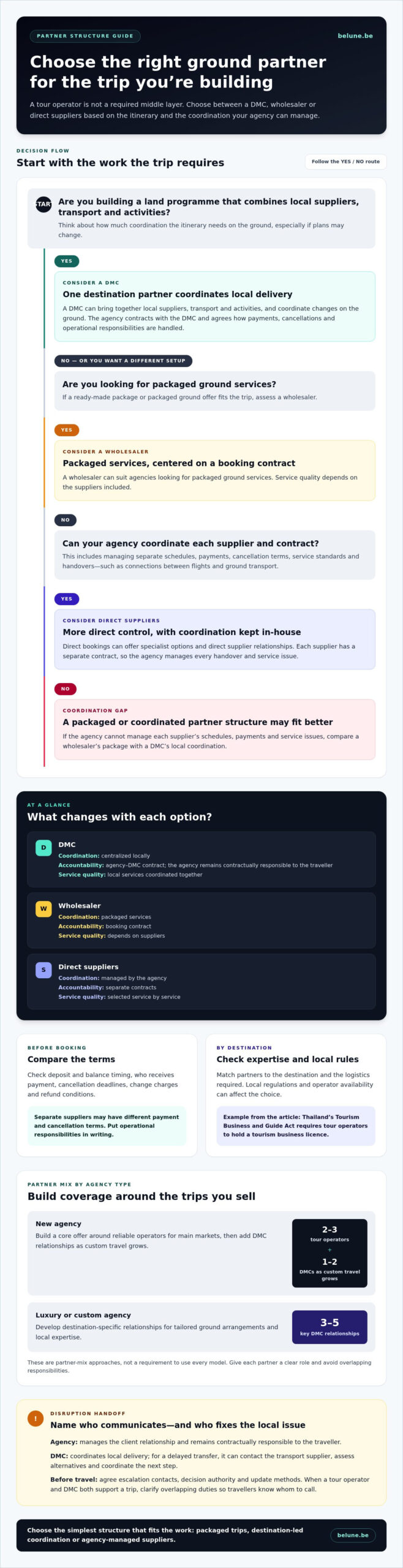
Yes. An agency can contract directly with a DMC for a land programme, or work with wholesalers and direct suppliers. The choice between a single DMC and multiple local operators depends on how much coordination the itinerary requires.
Working with a DMC
A DMC can suit trips that combine local suppliers, transport and activities, especially when changes require coordination on the ground. The agency contracts with the DMC and agrees in writing how supplier payments, cancellations and operational responsibilities are handled. The DMC coordinates local delivery, while the seller remains contractually responsible to the traveller if something goes wrong.
Using a wholesaler or direct suppliers
A wholesaler can suit agencies looking for packaged ground services. Direct suppliers can work well when the agency wants specific services and can manage each contract. Using several local operators may offer destination-specific options and direct supplier relationships, but the agency must coordinate separate schedules, payments, cancellation terms and service standards, including connections between flights and ground transport.
How do the approaches compare on coordination, accountability, and service quality? A DMC centralizes local coordination; direct suppliers divide it across separate contracts. Define who handles each service and responds to disruptions.
What booking, payment, and cancellation terms should travelers compare? Compare deposit and balance timing, who receives payment, cancellation deadlines, change charges and refund conditions. Separate suppliers may have different terms.
What are the advantages of hiring multiple local operators directly? Direct bookings can offer specialist options and direct supplier relationships. The agency must manage every handover and service issue.
How do local regulations and operator availability affect this choice by destination? Local rules can shape contracting. Thailand’s Tourism Business and Guide Act requires tour operators to hold a tourism business licence. Availability also affects whether one partner can coordinate the itinerary.
| Option | Coordination | Accountability | Service quality |
|---|---|---|---|
| DMC | Centralized locally | Agency-DMC contract | Coordinated services |
| Wholesaler | Packaged services | Booking contract | Depends on suppliers |
| Direct suppliers | Agency-managed | Separate contracts | Selected service by service |
For a single DMC vs multiple local operators model, decide whether coordination or direct control of suppliers matters more.
Agency partner strategy by business type
An agency selling ready-made packages needs a different partner mix from a specialist designing custom trips. Let your itinerary, destination coverage and logistics capacity guide the structure.
Direct agency-to-DMC partnerships
A direct agency-to-DMC partnership connects the seller with a destination management company for local expertise and tailored ground arrangements. This differs from working with a wholesaler, which typically centers on packaged travel, and from contracting direct suppliers, which leaves the agency coordinating each provider. For custom travel, one DMC can give the agency a destination-focused counterpart while the agency maintains its relationship with the traveller.
For example, an incentive itinerary may combine accommodation, transport and local experiences. A direct partner can coordinate these elements in one destination. Agencies serving different regions can work with separate DMCs for distinct markets, rather than expecting one partner to offer deep expertise everywhere.
Choosing an agency partner
Start with your business model. A new agency can build its core offer around 2-3 reliable tour operators for its main markets, then add 1-2 DMCs as custom travel grows. Luxury or custom agencies may instead develop relationships with 3-5 key DMCs. These are partner-mix approaches, not a requirement to use every model.
Match each partner’s destination expertise to the trips you sell. Consider whether they can coordinate the required local logistics, whether their packages suit your clients, and how the partnership fits your sales role. For a trip requiring detailed local planning, a destination specialist may be more useful than a broader partner.
Choose the simplest structure that fits the work: use tour operators for established packages, and DMC relationships for destination-specific custom itineraries. Keep regional coverage deliberate, so each partner has a clear role rather than overlapping responsibilities. For agencies shaping a destination-led programme, regional partner planning can help frame the right operational approach.
Emergency support and responsibility for disruptions
Before travel, assign each disruption to a named contact and a clear action. A DMC vs tour operator arrangement works best when the client knows who communicates and who manages local delivery.
DMC operational responsibility
If a transfer is delayed, the DMC handling ground operations can contact the local transport supplier, assess alternatives and coordinate the next step. The agency manages the client relationship, while the DMC addresses the operational issue. Set out escalation contacts, decision authority and update methods in the contract. The DMC’s local role supports a response on the ground, but does not remove the seller’s contractual responsibility to the traveller.
Overlapping operator responsibilities
When a tour operator and DMC both support a trip, overlapping duties can leave a traveller unsure whom to call. Large international safari operators typically provide 24/7 global support desks, while local partners may handle issues on the ground. The arrangement should clarify whether the desk contacts the DMC or expects the traveller to do so. One lead for each issue prevents duplicated instructions.
Set the communication sequence before departure. First, the traveller contacts the agency’s published trip contact. The agency then informs the DMC or operator responsible for the service. The operational partner contacts the relevant supplier, such as a transport company, and reports the action taken and expected timing. The agency shares the update with the client and records any decision affecting the itinerary.
Specify who can authorize a replacement transfer, who pays the supplier and who approves itinerary changes. Compare these terms with the booking conditions and net rates, rather than assuming the quoted price defines emergency responsibilities. Confirm whether the DMC or operator coordinates with suppliers and name a backup contact. Clear responsibilities keep operational decisions distinct from client communication.
What is a destination management company (DMC) and what services does it provide?
A destination management company works in the place it serves. Its local knowledge can span hotels, guides, restaurants and transport, helping an agency shape services into a coherent itinerary. Coverage is often regional or country-specific, with deeper expertise in the DMC’s core destinations.
For example, an agency planning a cultural group trip can draw on local knowledge to align hotel locations, guided visits and transport timing. A DMC can coordinate these destination services as one programme. A ground handler, by comparison, generally focuses on delivering specific services, such as a transfer or booked excursion, rather than coordinating the broader destination plan.
The distinction matters most when a route has several moving parts. The traveller’s agency may be far away, while local providers manage immediate details. A DMC can bring destination suppliers together and explain how hotels, guides and transport fit the itinerary. The agency remains responsible for the traveller relationship and sets the programme’s overall objectives.
Local knowledge can also shape the character of a visit. A guide can connect an itinerary to regional history, while restaurant choices and local businesses offer visitors a closer view of the destination. DMCs can support destination stewardship by shaping experiences that engage local communities and businesses and reflect sustainability goals. Agencies can consider not only which services fit, but how the itinerary connects with the place.
Use a DMC when a programme needs destination-wide coordination, tailored local experiences or knowledge beyond individual supplier bookings. Use a ground handler for a defined service that needs local delivery but little wider coordination. The right distinction depends on whether the agency needs someone to connect the itinerary or deliver a specific component. To shape a group itinerary around local hotels and guidance, plan destination-led group travel.
BELUNE: Hotel Accommodation Management
BELUNE supports travel agencies and tour operators with Hotel Accommodation Management for group programmes across the Benelux and Paris region. It can be a fitting partner when a trip needs hotel arrangements alongside Coach Hire with its own fleet of buses, Local Guide Services or Art & Culture Group Tours.
This combination helps shape a coherent group itinerary, with accommodation and local experiences planned as connected parts of the journey. Agencies can work with BELUNE on customized group travel instead of treating each element as a separate booking.
To discuss a group itinerary with BELUNE, visit belune.be or contact the team.
Shape the Partnership Around the Journey
Choosing between a single DMC and multiple local operators is a design decision: choose the structure that best serves the journey. Before planning your next programme, map its essential moments, from arrival and accommodation to the experiences that give each destination its character. Then consider where local coordination will best support the itinerary and your agency’s working style.
This makes partner selection a practical part of trip design rather than a separate sourcing exercise. It also gives your team a clear starting point for developing a distinctive group programme with a coherent rhythm.
BELUNE works with travel agencies on group travel arrangements, including Hotel Accommodation Management, Coach Hire with its own fleet of buses, and Local Guide Services. Discuss your agency’s next group itinerary with BELUNE and take the next step toward bringing it to life.
Frequently Asked Questions
What is the difference between a DMC and a tour operator?
A DMC focuses on destination operations, while a tour operator creates and sells travel packages. For example, a tour operator might sell a multi-day itinerary and contract a DMC to arrange local services. An agency working directly with a DMC takes on the sales relationship itself. The distinction is who assembles and sells the trip, and who organizes its destination services.
Can You Use Both?
Yes. An agency can use a tour operator for a ready-made package and a DMC for a custom extension or special local programme. For instance, a traveller could book a packaged stay, then add a locally coordinated cultural visit through a DMC. Define which booking covers each service, who communicates changes and how the arrangements connect, so no part of the itinerary falls between contracts.
Does a DMC ever sell to travellers directly?
Some DMCs may sell directly, but they primarily work with travel advisors, tour operators and meeting planners. Their business-to-business role generally supports trade partners rather than competing for the end client. The sales channel can vary by company and trip. For an agency, the practical question is whether the DMC supports its client relationship or sells a separate arrangement directly to the traveller.
What are the advantages of using one DMC for an entire trip or event?
One DMC can provide a consistent local operating relationship across an itinerary. For a corporate event, one partner can coordinate destination services around the programme’s schedule, reducing the need for the agency to align separate local contacts. This structure is most useful when several services depend on one another. It does not remove the agency’s role in setting expectations with its client.
How do single-DMC and multiple-operator costs compare, including fees and markups?
Compare the pricing structure and included services, not just the headline total. A boutique DMC safari booking typically involves one markup layer, while a large international safari operator booking often involves two or more, including the operator’s and subcontracted DMC’s margins. Direct supplier bookings may show separate service charges and change terms. These examples describe markup structures, not guaranteed savings or a quote for another trip.
How do DMCs and local operators handle insurance, permits, safety, and liability?
Responsibility depends on service contracts and local rules. For each activity or transport booking, identify which company holds the relevant permits, what insurance applies, and who handles incident reporting or claims. Make sure the contract names the responsible operator and sets out safety procedures and escalation contacts. The selling agency should also understand its contractual obligations to the traveller and explain them clearly.
Leave a Reply