Tag: Destination Management

  • Regional DMC vs Pan-European DMC: Which Fits Your Tour Program

    Regional DMC vs Pan-European DMC: Which Fits Your Tour Program

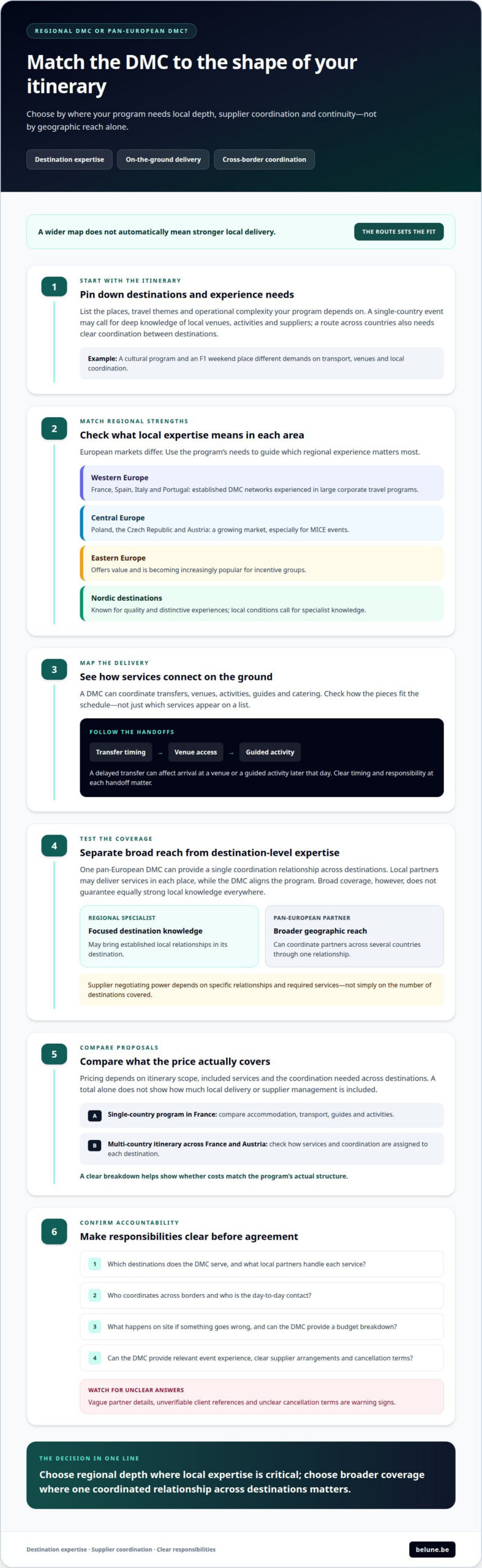
    A wider map doesn’t automatically mean stronger local delivery. In the regional DMC vs pan-European DMC decision, the right fit depends on the shape of your tour program: a regional partner can bring concentrated destination knowledge and supplier coordination, while a pan-European partner can offer broader geographic reach through one relationship. Neither model is inherently better; the difference is where your itinerary needs depth, continuity and local expertise.

    It makes sense to look for a partner who can simplify logistics without flattening the character of each place. The key is matching the DMC’s network to the destinations, travel themes and operational complexity your program demands. This comparison explains how European markets differ, what DMC services and supplier coordination involve, and when a focused regional specialist may serve a multi-destination itinerary better than broad coverage. You’ll have a clearer basis for choosing a partner whose reach and local insight align with the experience you want to create.

    Key Takeaways

    • Match a DMC’s destination expertise to the places and travel themes your program depends on, rather than choosing by geographic reach alone.
    • Understand how accommodation, transport, guides and activities fit together to see where supplier coordination can shape the guest experience.
    • Distinguish a DMC’s tailored, on-the-ground role from the tour operator’s role in selling packaged holidays to travelers.
    • Compare proposals by the services and coordination they cover, so you can assess their value against your itinerary’s needs.

    DMC market differences across European regions

    A DMC’s strengths vary by destination, so geographic reach alone does not reveal where its local expertise is strongest. Regional focus matters when a program depends on a country’s suppliers, culture or operating conditions.

    Western Europe, including France, Spain, Italy and Portugal, has established DMC networks experienced in large corporate travel programmes. Central Europe, including Poland, the Czech Republic and Austria, has grown strongly, especially for MICE events. Eastern Europe offers value and is becoming increasingly popular for incentive groups. Nordic destinations offer quality and distinctive experiences, while local conditions call for specialist knowledge.

    For a single-country event, a regional DMC can offer focused destination knowledge and established local relationships. That expertise can help shape a program around the country’s venues, activities and travel themes.

    Regional and Pan-European Pricing

    Pricing depends on the itinerary’s scope, included services and the coordination needed across destinations. A total alone does not show how much local delivery or supplier management the proposal covers.

    For a single-country program in France, compare proposals by checking what they include for accommodation, transport, guides and activities. For a multi-country itinerary across France and Austria, examine how each proposal assigns services and coordination to each destination. A clear breakdown helps show whether the costs match the program’s actual structure.

    Local Knowledge and European Coverage

    Local knowledge means practical familiarity with a destination’s suppliers, activities and operating conditions. European coverage describes where a DMC can coordinate delivery. Both matter when a route crosses regions with different strengths, such as an Austria event followed by a Nordic experience.

    Ask which destinations the DMC serves, what local partners handle each service and who coordinates the itinerary across borders. Request examples of relevant event experience, and clarify who your day-to-day contact will be. These questions help reveal whether broad coverage includes destination-level expertise or relies on a network of partners.

    DMC services and supplier coordination

    A DMC coordinates on-the-ground services such as transfers, venues, activities, guides and catering. For a program spanning Paris and Vienna, that means aligning transport timings with venue access and scheduled experiences. The regional DMC vs pan European DMC decision affects how these services are coordinated across destinations.

    Supplier access can reflect a DMC’s local relationships and geographic scope. A regional specialist may have established connections in its destination, while a pan-European DMC can coordinate partners across several countries. Negotiating power depends on the specific supplier relationships and services required, not simply on the number of destinations covered.

    For a multi-country event, one pan-European DMC can provide a single coordination relationship across destinations. This can simplify communication when a schedule links a meeting in France with an event in Austria. Local partners may deliver services in each place, while the DMC aligns transfers, venues and activities within one program.

    Using one DMC across several countries can also create coordination risks. Broad coverage does not guarantee equally strong local knowledge in every destination, and unclear supplier arrangements can blur responsibilities. Vague answers about partners, unverifiable client references and unclear cancellation terms are warning signs.

    Supplier coordination connects each service to the itinerary. A delayed transfer, for example, can affect arrival at a venue or a guided activity later that day. When transport, catering and a local guide are involved, clear timing and responsibility at each handoff matter. Choose a regional DMC vs pan European DMC based on where the itinerary needs the deepest coordination.

    Before an agreement, establish who your daily contact will be, what happens if something goes wrong on site, and whether the DMC can provide a budget breakdown. These points clarify communication, response ownership and how costs relate to services. Relevant event experience matters too: an F1 weekend and a cultural program place different demands on transport, venues and local coordination.
    Regional DMC vs Pan-European DMC: Which Fits Your Tour Program

    Destination management company roles

    A destination management company (DMC) plans and coordinates services on the ground. It can connect transfers, venues, activities, guides and catering into a tailored program. For example, a cultural itinerary in Paris might pair a venue visit with local guiding and scheduled transport. The DMC’s role is to make these separate elements work as one coherent destination experience.

    A DMC serves a different purpose from a tour operator. Tour operators sell pre-packaged holidays to consumers; DMCs work business-to-business with companies, agencies and professional conference organisers. An agency might commission a tailor-made program in Italy, while the DMC coordinates the local services that bring it to life. The distinction is that one party sells the holiday, while the other organizes its delivery at the destination.

    A DMC’s work starts with the program brief. It translates the intended experience into services and coordinates the local elements around the schedule. If a group moves from a venue to an activity, the transfer and timing need to fit the itinerary. A guide-led visit must also align with the group’s route and planned stops. This gives the professional buyer a destination-level partner instead of a set of separate service arrangements.

    • Program design: Shape activities and local experiences around the group’s purpose, such as art, culture or a conference.
    • Service coordination: Bring together transport, venues, guides and catering where the itinerary requires them.
    • Delivery planning: Align each service with the route and sequence, such as a transfer before a scheduled venue visit.

    For a multi-destination program, coordination can extend across more than one local market. A pan-European arrangement may connect delivery in France and Austria through one professional relationship, while regional DMCs focus on their destination. The useful distinction is the scope of coordination, not the label alone. Agencies and conference organisers can define the services they need, then assess whether a destination specialist or broader coverage fits the program.

    How do regional and pan-European DMCs compare on pricing and fees?

    There is no reliable rule that a regional DMC costs less than a pan-European one. Price depends on the destinations, services, itinerary complexity and supplier coordination, and is provided after a quote request. The regional DMC vs pan European DMC distinction describes scope, not a fixed pricing formula.

    A single-country program may involve fewer handoffs between destinations than a multi-country route. But fewer destinations do not automatically mean a simpler or less costly program. Several venues, specialist activities or a demanding schedule can require substantial coordination within one country. Compare the services and work covered by each proposal rather than assuming geographic scope predicts the total.

    A broader proposal may coordinate services across several markets, while a regional proposal may focus on one destination. Neither structure alone determines the final amount. For a route through France and Austria, consider how each proposal accounts for local suppliers, transport, activities and coordination at both stops. This shows what the quoted scope supports.

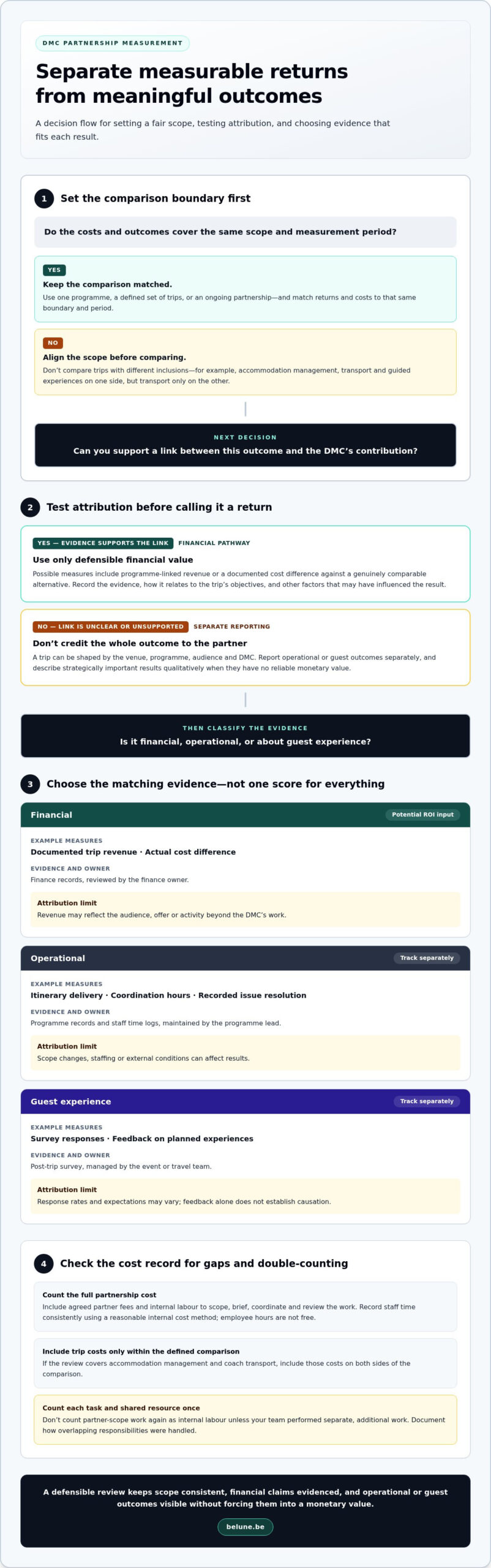
    Make a like-for-like comparison. If one proposal includes venue coordination while another covers transport and activities, their totals reflect different scopes. Request a breakdown linking costs to services and coordination responsibilities. That makes differences easier to understand than comparing headline totals alone. The regional DMC vs pan European DMC choice is most useful when you compare equivalent itinerary components.

    • Destination scope: Identify every country and location included in the itinerary.
    • Service coverage: Compare accommodation, transport, venues, guides and activities in each proposal.
    • Coordination: See how local partners and cross-destination planning are represented.
    • Terms: Review cancellation terms alongside the services and responsibilities described.

    For a single-country cultural tour, a focused regional scope may suit the brief. For a route crossing borders, assess how each proposal coordinates delivery at every stop. The best fit is the scope that matches the experience and operational support the itinerary needs.

    To discuss a tailored group program, discuss your tour program with BELUNE.

    BELUNE

    BELUNE helps tour operators and travel agents shape group programs when destination expertise and coordinated local services matter. For itineraries across the Benelux region and Paris, its work can bring accommodation management, coach transport, local guides and art and culture tours into a tailored travel experience. This regional focus can suit programs built around several destinations within its area, rather than a route requiring delivery across Europe.

    The right choice depends on your itinerary’s geography and character. If your program needs regional knowledge and coordinated arrangements on the ground, BELUNE can help bring its moving parts together. Share your destination plans and the experience you want to create.

    Contact BELUNE to discuss your tour program.

    Shape the next journey around its sense of place

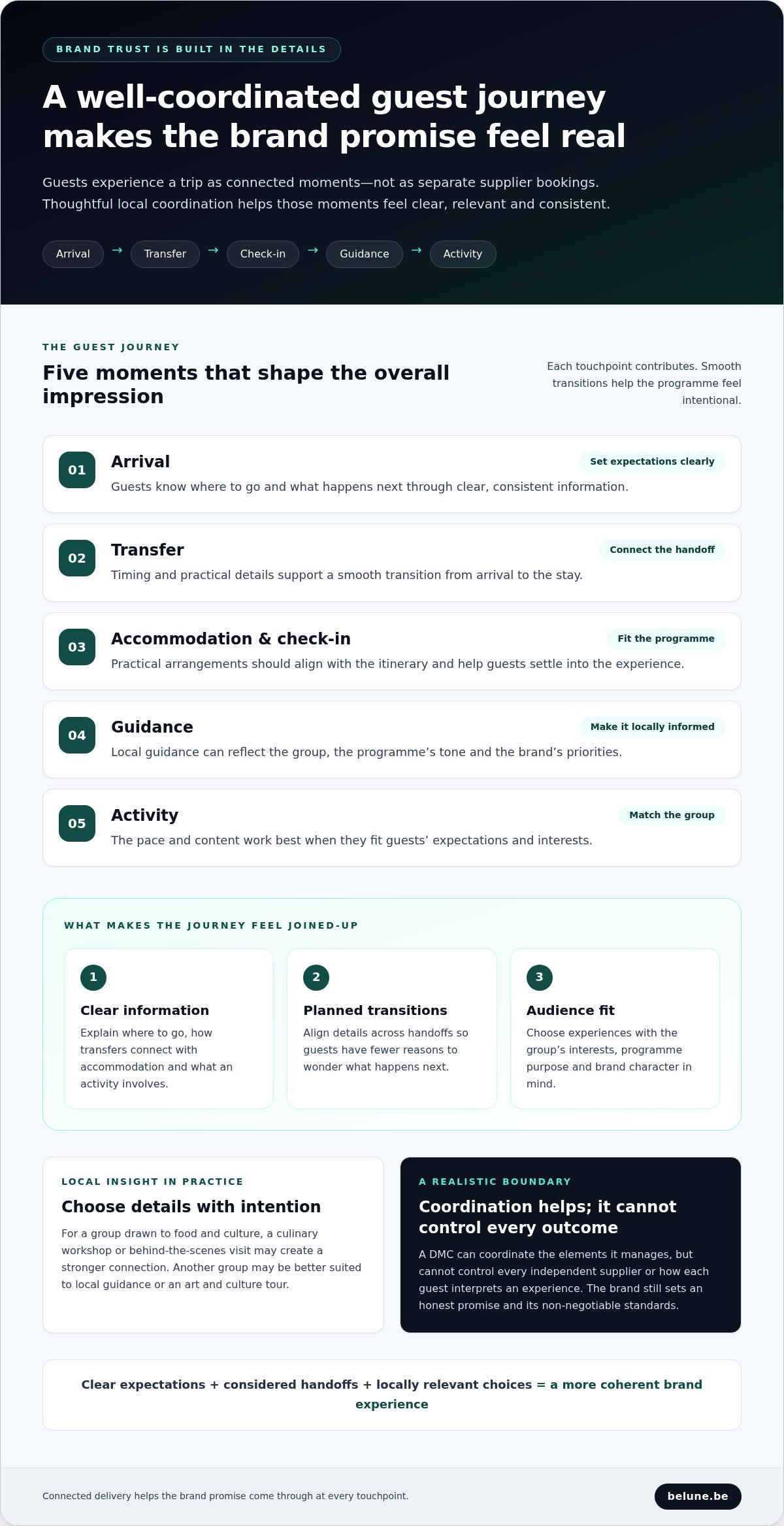
    The regional DMC vs pan European DMC choice is ultimately about fit: which partner can bring the route’s intended character into the details of the experience? When planning a program, consider not only where guests will travel, but how each transition supports the journey’s story, pace and purpose. A well-matched partner can help turn operational components into a coherent experience.

    For tour operators planning group travel, BELUNE can bring hotel accommodation management, coach hire with its own fleet of buses and local guide services into the program. These services can support an itinerary where transport, stays and destination interpretation need to work together. Start with your route and the experience you want guests to remember.

    Discuss your tour program with BELUNE, and take the next step toward a journey shaped with intention.

    Frequently Asked Questions

    What is a regional DMC and what is a pan-European DMC?

    A regional DMC organizes tailored, on-the-ground programs within a focused destination area; a pan-European DMC coordinates across a broader set of European destinations. Both typically work with professional buyers, including travel agencies and companies. The regional DMC vs pan European DMC choice describes geographic scope, not a different kind of guest experience or a fixed package format.

    How does a DMC’s destination footprint shape its local expertise?

    A DMC’s footprint indicates where its destination knowledge and working relationships are concentrated. For a specialist theme such as battlefield tourism, familiarity with relevant sites can shape the itinerary’s interpretation and pace. On a broader route, local expertise at each stop helps give destinations their own character, rather than making the journey feel like a series of transfers.

    How do DMCs manage logistics, communication, and coordination across multiple European countries?

    DMCs coordinate itineraries by aligning local services with the group’s movements and planned activities. A change to a venue schedule, for example, may affect transport timing and the guide’s arrival. Clear communication helps the organizer understand who is responsible for updates and decisions at each destination, especially when local partners deliver different parts of the program.

    What should planners consider when choosing a destination management partner?

    Start with the itinerary’s purpose, route and required services, then compare those needs with each partner’s destination experience. A regional DMC vs pan European DMC assessment can clarify whether focused knowledge in one market or coordinated coverage across several better serves the program. Consider how the proposed scope supports the theme, schedule and guest experience from arrival through departure.

  • DMC vs Booking Directly with Local Suppliers: Compare Costs and Services

    DMC vs Booking Directly with Local Suppliers: Compare Costs and Services

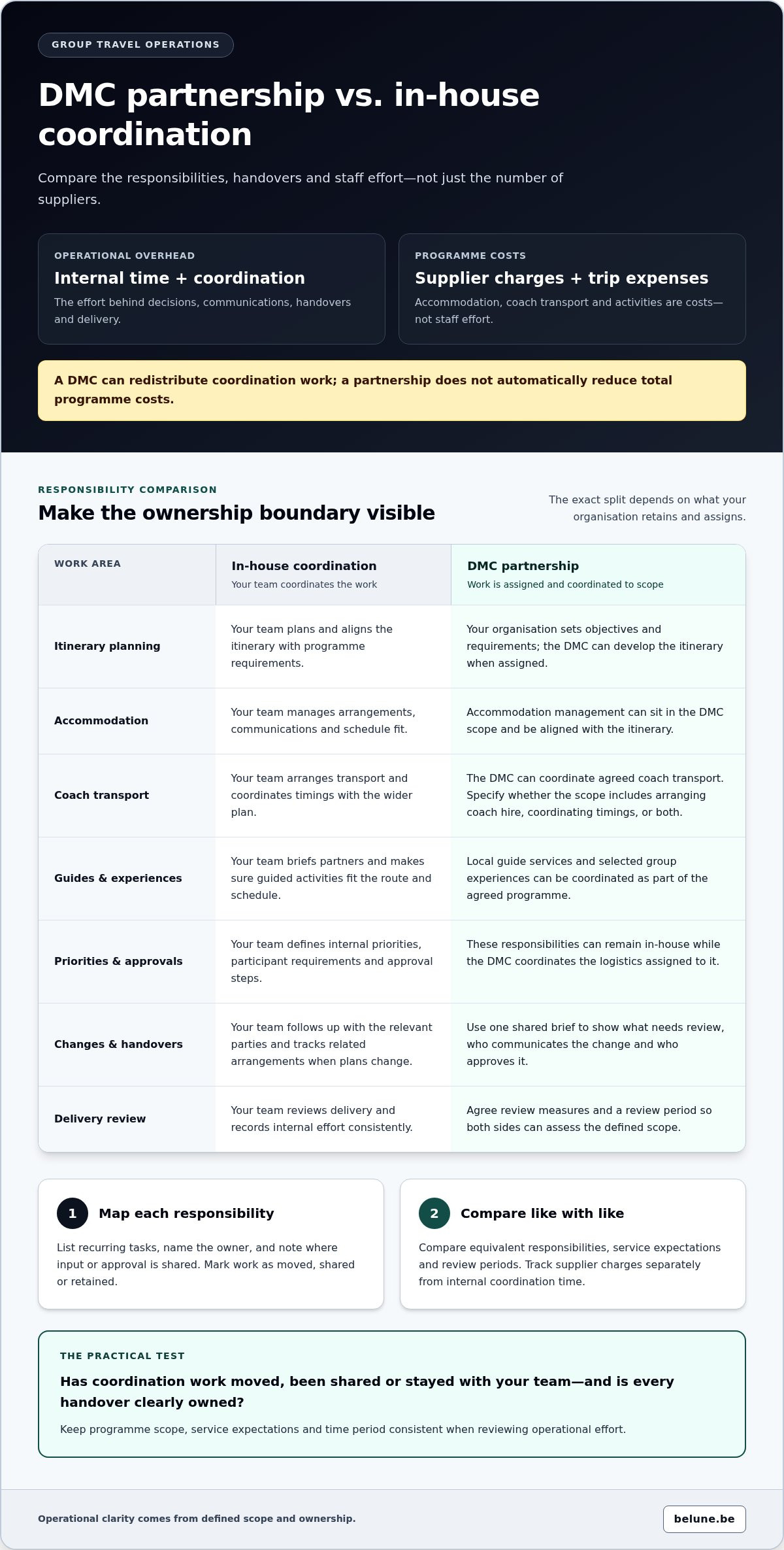
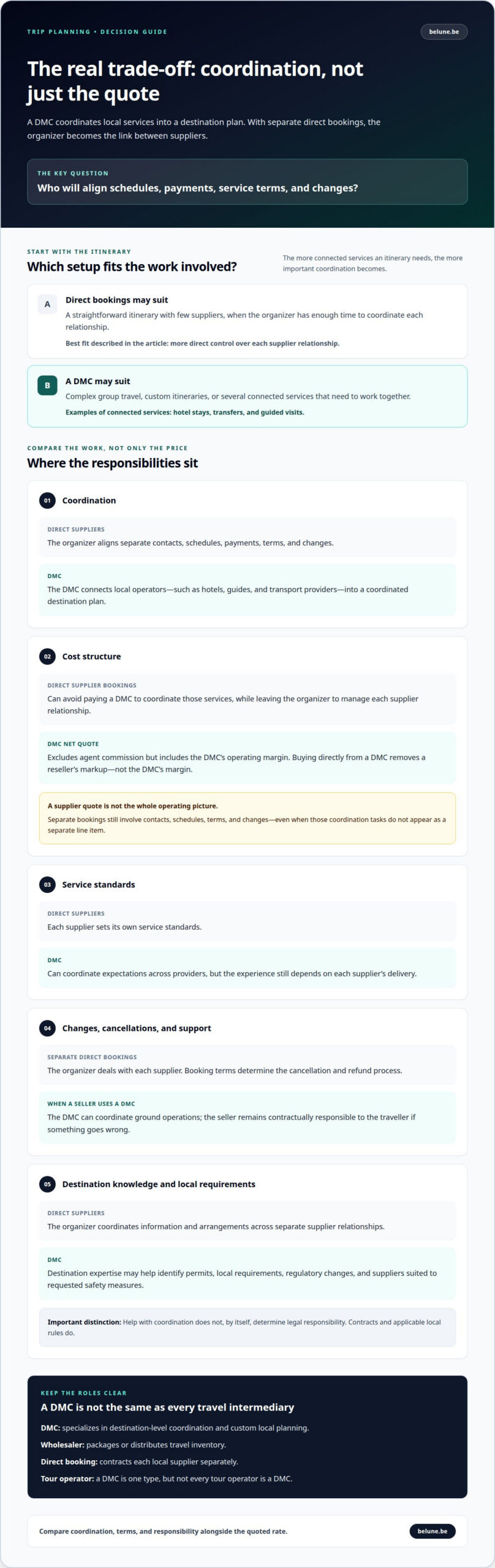
    Booking directly with local suppliers can remove an intermediary, but it does not automatically make a trip easier to manage. A DMC brings local services together in a coordinated destination plan; when you book each supplier separately, your team must align schedules, payments, cancellation terms, and service standards. Comparing a DMC with booking directly with local suppliers involves more than the quoted rate. It also means considering who coordinates delivery and how responsibilities are handled when plans change.

    It is reasonable to focus on cost: a DMC adds coordination services, while direct bookings may seem more straightforward. The value depends on what that coordination covers, which supplier relationships are involved, and how much time your team can spend managing the details.

    This article explains what a DMC does, how its costs and coordination compare with direct bookings, and how responsibilities are allocated if something goes wrong. You will have a clearer basis for choosing the approach that fits your itinerary, group, and capacity to manage the arrangements.

    Key Takeaways

    • Compare the full coordination involved, not just supplier quotes: separate bookings leave schedules, payments and service terms to manage across providers.
    • Understand how a DMC’s operating margin differs from a reseller markup, and why direct booking doesn’t necessarily remove every layer of cost.
    • See how destination knowledge can support planning for local requirements, permits and safety, while responsibility may still depend on who sells the trip.
    • Learn when a DMC’s joined-up approach can suit a group itinerary, and how transport, accommodation, travel bookings and local guidance can fit together.

    DMCs compared with direct booking and generalist agencies

    A DMC coordinates destination services, while direct booking makes the travel organizer the link between separate suppliers. The right approach depends on how much custom planning and coordination the itinerary requires.

    DMCs, wholesalers, and direct suppliers

    A DMC connects local operators, such as hotels, guides, and transport providers, to build a coordinated destination plan. A wholesaler packages or distributes travel inventory, while direct booking means contracting each local supplier separately. For an incentive trip with hotel stays, transfers, and guided visits, the distinction determines who aligns schedules and service details. A DMC adds coordination; direct arrangements give the organizer more control over each supplier relationship.

    DMCs and other travel intermediaries

    A DMC specializes in a destination, while tour operators, travel agents, wholesalers, and online travel agencies (OTAs) play different roles in selling or arranging travel. A DMC is a type of tour operator, but not every tour operator is a DMC. Larger tour operators may sell itineraries across many destinations; a DMC focuses on local delivery and custom planning. This distinction helps agencies decide whether they need broad product access or destination-level coordination.

    Locally owned and national DMCs

    A locally owned DMC may bring close knowledge of its destination, while a national DMC may have resources across a wider market. The practical difference matters when an itinerary needs local insight or in-person support. A national company may not have staff in the city hosting an event, while a locally based team can offer destination-specific knowledge. Match the structure to the trip’s footprint and support needs, not simply the company’s reach.

    When direct booking may suit

    Booking directly can suit a straightforward itinerary with few suppliers and enough time for separate coordination. It may also avoid the cost of hiring a DMC to coordinate services when the organizer contracts each hotel, guide, and vehicle directly. A DMC may be more suitable for complex group travel, custom itineraries, or multiple connected services. Direct suppliers set their own service standards; a DMC can coordinate expectations across providers, but the quality of the experience still depends on each supplier’s delivery.

    Net rates, operating margins, and reseller markups

    A DMC’s net quote excludes agent commission but includes the DMC’s operating margin. This matters when an agency compares a supplier quote with a packaged itinerary. Buying directly from a DMC removes a reseller’s markup, not the DMC’s margin. By contrast, contracting local hotels, guides, and transport providers separately avoids paying a DMC to coordinate those services, but leaves the organizer to manage each relationship.

    Local ground operators deliver the services behind an itinerary, from activities and transfers to hotel stays. DMCs use supplier relationships to tailor these components and may sometimes secure discounted rates. However, a lower individual supplier quote does not show the full operating picture: the organizer still handles separate contacts, schedules, terms, and changes. For a corporate programme with several venues and transfers, coordination belongs in the cost comparison, even when it does not appear as a separate line item.

    A DMC can also work alongside a tour operator rather than replace it. The tour operator can provide a ready-made package, while the DMC arranges a custom local extension or special programme. This structure can keep the broader itinerary intact while adding destination-specific activities. It also creates distinct roles: the DMC manages local delivery, and the tour operator remains the seller responsible to the traveller under its contract.

    For cancellations and refunds, the applicable booking terms determine the process. With separate direct bookings, the organizer deals with each supplier; when a seller uses a DMC, the DMC can coordinate ground operations, but the seller remains contractually responsible to the traveller if something goes wrong. Customer support therefore depends on the seller’s arrangements and the relevant supplier terms, not simply on who coordinates the transfer. For itineraries that rely on local expertise, destination-specific guide services can be part of the ground plan.

    DMC vs Booking Directly with Local Suppliers: Compare Costs and Services

    How do DMCs and local operators handle insurance, permits, safety, and liability?

    Destination expertise helps identify local requirements, but coordination and legal responsibility are separate matters. A DMC may assist with permits and safety planning; the contract and applicable local rules determine each party’s responsibilities.

    Regional knowledge matters because requirements can differ between destinations. In Thailand, the Tourism Business and Guide Act requires tour operators to hold a tourism business licence. In Vietnam, a locally registered company serving foreign visitors needs an international travel service business licence, which carries a bonded deposit. These examples show why arrangements in one market cannot automatically be applied elsewhere, and why specialized operators like Historic War Tours depend on strict regional compliance and coordination when managing group travel across Southeast Asia.

    A DMC may help clients plan for permits, understand local regulatory changes, and draw on established vendor relationships. For an event with guided experiences, destination-specific knowledge can help identify local requirements and suppliers suited to requested safety measures. Direct booking puts the organizer in contact with each operator, but also means coordinating information and arrangements across separate relationships.

    Safety remains connected to the service being delivered. Event planners can use a DMC to identify local recommendations and locate vendors that implement requested safety measures. Local guides and operators contribute practical knowledge of the experience and its setting. Neither coordination nor local familiarity alone establishes that every provider has identical insurance, permits, or liability terms.

    Payment protection and booking terms depend on the booking contract and seller, not simply on whether a DMC is involved. With direct bookings, each supplier’s terms apply to its service; a DMC can coordinate local delivery, while the seller remains contractually responsible to the traveller if something goes wrong. The distinction matters: operational coordination does not automatically transfer contractual liability or provide the same payment protections across separate bookings.

    For clients planning several regional experiences, the practical value lies in connecting destination knowledge with clear roles. A DMC can support local compliance planning and safety coordination, while each agreement defines the responsibilities attached to the services arranged.

    What a destination management company does

    A destination management company is an in-destination travel business with in-depth knowledge of the country, region, or locality it represents. It uses that knowledge to make arrangements with local guides, accommodation providers, and transport operators. Destination management is not simply about selling separate services. It is about shaping how those services work together for a group or event.

    For a group arriving by train, a DMC can coordinate station transfers, accommodation, and a guided local experience. It can arrange one part of a trip or develop a customized tour across the destination. Local supplier relationships help connect each element to the itinerary, while destination knowledge helps identify experiences suited to the place and the group’s brief.

    That work can extend beyond leisure travel. For an in-person corporate event, a DMC can source, contact, book, and manage local vendors onsite. It can help optimize logistics and plan for permits, while clarifying what an all-inclusive offer covers. Itemized service descriptions also help clients understand the arrangements and prepare a more precise estimate.

    A DMC’s role may include preparing contingency plans and identifying local contacts to address problems. On-the-ground support can help travelers resolve issues during a trip, while local expertise can inform seasonal timing and destination events. The scope depends on the brief: dates, event goals, technical needs, and requests such as VIP transportation all shape the plan. When managing executive retreats or incentive programmes, firms like Aura Events rely on this level of comprehensive coordination to ensure high-end group experiences run smoothly.

    The key difference from booking suppliers independently is the integrated view. A direct booking secures an individual service; destination management connects services to the wider itinerary. For example, accommodation and local excursions can be planned as complementary parts of a group visit rather than isolated reservations. In short, use a DMC when local knowledge and coordinated arrangements are central to the experience.

    Planning a group itinerary with coordinated stays? Explore hotel accommodation management as part of your destination arrangements.

    BELUNE: Coach Hire with own fleet of busses

    BELUNE helps tour operators and travel agents coordinate group journeys when separate bookings make an itinerary complex. Coach hire with BELUNE’s own fleet of buses provides a transport option for connecting hotels, local visits, and group activities.

    BELUNE also offers international flight and train bookings, hotel accommodation management, and local guide services. These elements can be arranged around the group’s route and destination programme, bringing travel logistics and on-the-ground experiences into a coherent plan.

    Planning group travel that needs coordinated transport and local arrangements? Contact BELUNE to discuss your plans.

    Shape the Next Journey Around Your Group

    The choice between a DMC and booking directly with local suppliers becomes clearer when you start with the journey itself. Define the experience you want guests to have, then consider how transport, accommodation, and local activities should connect. A well-planned itinerary starts with those priorities, not a list of isolated bookings.

    For tour operators and travel agents planning group travel, BELUNE offers hotel accommodation management, coach hire with its own fleet of buses, and local guide services. These services can support a programme shaped around the group’s route and destination interests, providing a practical starting point for planning.

    Bring the proposed itinerary, travel dates, and group priorities into the conversation. Contact BELUNE to plan your group trip and take the next step toward a journey designed with purpose.

    Frequently Asked Questions

    What is a destination management company (DMC) and what services does it provide?

    A destination management company focuses on a particular destination and uses local knowledge to plan and arrange services. Depending on the brief, this may mean arranging a guided cultural visit, booking accommodation, or organizing ground transport. For an event, its role can also include sourcing local venues and vendors. The scope can range from one trip component to a customized programme.

    Can you use both?

    Yes. A tour operator can provide the main package while a DMC arranges a custom extension or special local programme. The choice between using a DMC and booking directly with local suppliers can also vary by itinerary component. For example, an organizer might book a straightforward service directly and use a DMC for a locally planned heritage visit. This blended approach lets the organizer choose support based on the complexity of each part.

    Does a DMC ever sell to travellers directly?

    Yes. DMCs may work directly with travellers, sell trips through travel agencies or tour operators, or use both models. Their sales approach varies, so the term “DMC” alone doesn’t show who can book with a particular business. BELUNE focuses on group travel for tour operators and travel agents, rather than individual B2C travel bookings. That distinction helps clarify whether its model fits your role as a buyer.

    How do single-DMC and multiple-operator costs compare, including fees and markups?

    A single DMC quote may include the DMC’s operating margin, while a reseller may add a separate markup. Comparing a DMC with booking directly with local suppliers means weighing the coordination cost against the work of managing separate bookings and terms. Compare the full itinerary scope, included arrangements, and each seller’s charges rather than judging by one headline total. A net quote excludes agent commission, but still includes the DMC’s margin.

    What are the advantages of using one DMC for an entire trip or event?

    A single DMC can provide a consistent local planning contact, especially when a programme includes several experiences or event vendors. It can advise on seasonal timing and local events that may affect the schedule, then shape arrangements around the event’s goals and requests. This is useful when the programme needs a coherent destination perspective rather than separate services planned without a shared local brief.

    What does DMC stand for in travel?

    DMC stands for “destination management company.” In travel, the term describes a business with in-depth knowledge of a particular destination and the local services available there. That destination focus distinguishes a DMC from businesses whose main role is selling travel across a broad range of markets. The acronym identifies a type of company, not a guarantee that every DMC offers the same services or booking model.

  • Managing Traveler Data with a European DMC for Better Trips

    Managing Traveler Data with a European DMC for Better Trips

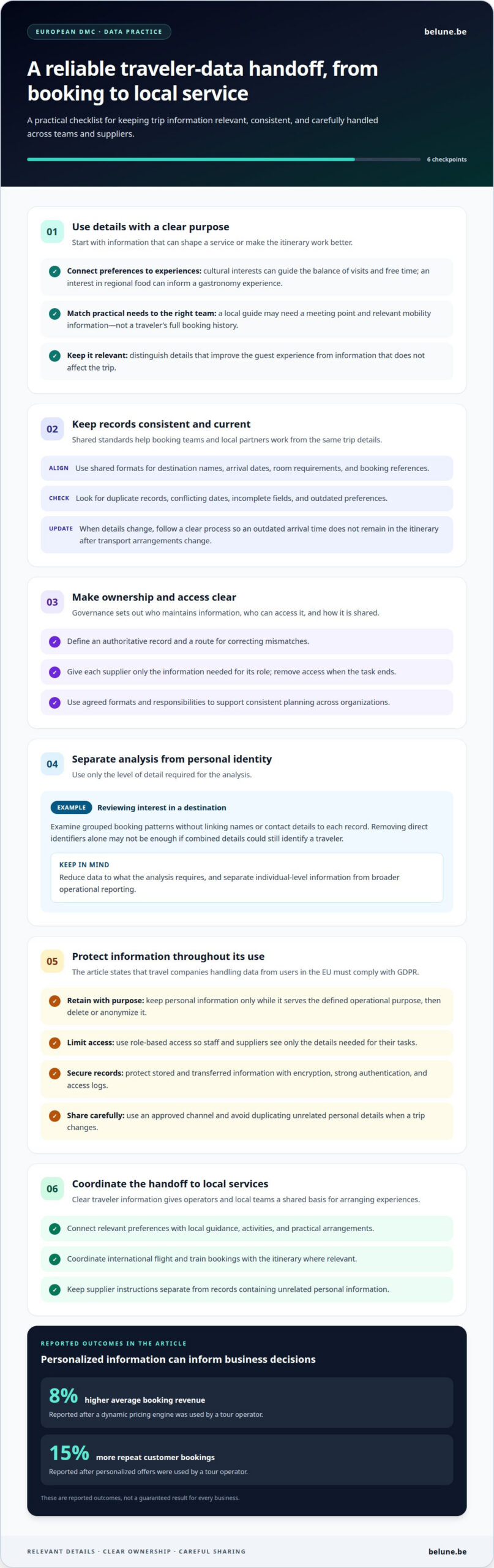
    A seamless European trip takes more than a well-planned itinerary. For tour operators, managing traveler data with a European DMC can connect guest preferences and practical requirements with the local services that bring each journey to life.

    Personalized travel works best when the details behind it are accurate. Yet traveler information can become fragmented as it passes between booking teams, accommodation providers, transport services, and guides. A destination management company can coordinate local partners and put relevant information to practical use, while careful handling of personal details remains essential. This guide explains how traveler data supports tailored trips, what good data quality looks like, and how privacy considerations shape its use. It also shows how local coordination can turn clear, consistent information into a more considered guest experience and smoother operations for tour operators.

    Key Takeaways

    • Connect traveler preferences with the right local services to shape more personal, coherent trips.
    • Improve data quality by keeping information consistent, relevant, and appropriately anonymized as it moves between teams.
    • Understand how privacy safeguards and GDPR considerations influence the handling and sharing of traveler information.
    • See how coordinated local suppliers can turn accurate trip details into smoother experiences for guests and tour operators.

    Tourism services and customer experiences

    Traveler data helps tour operators shape a journey around the people taking it. Booking choices, stated interests, and practical requirements can inform decisions about destinations, activities, and arrangements. For example, a group’s interest in cultural heritage can help determine the balance between guided visits and free time. The value comes from using relevant details to improve the experience, not collecting information without a clear purpose.

    For a European itinerary, a DMC can translate those details into coordinated local services. An interest in regional food might inform a gastronomy experience, while a passion for history could shape a battlefield visit with local guidance. International flight and train bookings can also be coordinated with the itinerary. Clear traveler information gives the operator and local teams a shared basis for arranging these experiences.

    Personalized offers can support both commercial performance and loyalty. A dynamic pricing engine increased a tour operator’s average booking revenue by 8%, while personalized offers increased repeat customer bookings by 15%. These reported outcomes show how information can inform decisions, rather than establish a result for every business. Relevant recommendations can help returning travelers discover a fitting experience, while pricing decisions can reflect demand and booking patterns.

    Managing traveler data with a European DMC means connecting useful insight with thoughtful service design. Tour operators can distinguish information that improves an itinerary from details that do not affect the guest experience. A traveler’s interest in art, for instance, may inform a cultural visit; a preference for a quieter pace may shape the day’s arrangements. When the right local teams receive relevant details, personalization feels considered rather than generic, and each service contributes to a coherent trip.

    Data quality, governance, and anonymization

    Reliable decisions start with records that mean the same thing to every team. A booking may list “Brussels,” while a supplier file gives the venue’s full address. Shared data standards can align destination names, arrival dates, room requirements, and booking references. When details change, teams need a clear process for updating records and communicating revisions. Otherwise, an outdated arrival time may remain in the itinerary after transport arrangements have changed.

    Governance defines who maintains information, who can access it, and how it is shared. European Tourism Data Space governance combines EU-level oversight with collaboration between national tourism authorities and regional bodies. For operators coordinating local partners, the same principle supports clear ownership: the booking team maintains guest details, while relevant suppliers receive only the information needed for their role. Agreed formats and responsibilities make data practices more consistent and support informed service planning.

    Anonymization changes how information can be used for analysis. For example, an operator reviewing interest in a destination can examine grouped booking patterns without linking names or contact details to each record. Removing direct identifiers is not enough if a combination of details could still identify a traveler. Reduce the data to what the analysis requires, and separate individual-level information from broader operational reporting.

    Quality checks can focus on practical errors: duplicate records, conflicting dates, incomplete fields, and outdated preferences. A coordinator can resolve a mismatch between a guest’s booking record and a supplier schedule before it shapes the final itinerary. Governance also needs a defined route for corrections, so teams know which record is authoritative. For programs that rely on accurate local arrangements, coordinated destination services can connect operational details with delivery on the ground.

    Managing Traveler Data with a European DMC for Better Trips

    GDPR compliance and traveler privacy

    Traveler privacy depends on clear purposes, limited access, and careful handling at every stage. According to the European Union, travel companies must comply with the GDPR when handling data from users in the EU.

    Traveler Data Retention

    Retention is the period personal information remains stored for a defined operational purpose. A European DMC should retain traveler data only while it serves that purpose, then delete or anonymize it. The appropriate period depends on what information is collected and why it is needed. For example, details used to coordinate a group itinerary may no longer be needed once that coordination is complete. A clear retention approach helps prevent old records from being reused without purpose.

    Data Security Measures

    Data security measures help reduce unauthorized access, loss, or disclosure. Use role-based access so staff and suppliers see only the details needed for their tasks. Protect stored and transferred records with encryption, and require strong authentication for accounts containing traveler information. Access logs can help identify unusual activity. These safeguards matter whenever traveler contact details or itinerary information pass between an operator and local partners.

    Careful information handling can support privacy without disrupting service. A local guide may need a meeting point and relevant mobility information, but not a traveler’s full booking history. Share only necessary details through an approved channel, and remove access when the task ends. For a group itinerary, keep supplier instructions separate from records containing unrelated personal information.

    According to the European Commission, the European Tourism Data Space framework is intended to ensure tourism data sharing complies with the GDPR. This makes governance important across organizations: each party needs a defined role, a clear reason to access information, and a consistent way to protect it. When a record is corrected or a trip changes, update the relevant parties without unnecessarily duplicating personal details.

    Local supplier and professional networks

    Share traveler information with each supplier through an agreed channel, limiting it to details needed for that supplier’s role. A hotel may need arrival dates and rooming details, while a guide may need the meeting point and relevant group requirements. Keep the operational itinerary current so partners are not working from conflicting updates.

    A DMC coordinates the handoffs that connect an itinerary with local delivery. For example, a change to a group’s arrival time may affect hotel check-in, a guide’s schedule, and a river excursion. A shared itinerary reference and a named operational contact help partners identify the current update. Clear ownership also gives suppliers a way to flag missing or inconsistent details before they affect the guest experience.

    Accommodation requires precise coordination. A rooming list can include guest names and assigned rooms, while the hotel’s arrival information can focus on timing and group arrangements. A local guide may need the meeting location, schedule, and details relevant to leading the group. Separating these records limits unnecessary circulation of personal information and makes each handoff easier to understand.

    Professional networks also help operators plan across destinations. A directory lists more than 1,300 DMC companies across 33 European countries and 443 cities, illustrating the breadth of local expertise available. A well-coordinated network can connect accommodation, guiding, and excursions within one itinerary. The practical task is to match each partner’s role with accurate instructions, then communicate changes through a consistent route. For tour operators shaping that coordination, explore local supplier coordination as part of a coherent trip plan.

    BELUNE: Coach Hire with own fleet of busses

    BELUNE helps tour operators connect group transport with the wider shape of a European itinerary. Its own fleet of modern, comfortable coaches supports journeys where clear schedules and coordinated passenger information matter, from arrival transfers to travel between planned stops.

    When a program also needs accommodation planning, BELUNE’s Hotel Accommodation Management can align lodging arrangements with the itinerary. Local Guide Services and Art & Culture Group Tours add place-based experiences, with details coordinated around the group’s schedule. This combination helps operators bring transport, stays, and cultural visits together as parts of one carefully planned trip.

    Share essential operational details, such as confirmed timings and relevant group requirements, so arrangements can be coordinated across services. To discuss a group travel program, contact BELUNE.

    Shape the next journey with intention

    Make information flow part of itinerary design from the first planning conversation. A consistent approach to managing traveler data with a European DMC can help tour operators connect guest needs with the practical decisions that shape a group program. Treat each handoff as part of the experience: clear requirements can inform transport planning, accommodation arrangements, and the work of local guides.

    BELUNE brings these elements together through Coach Hire with its own fleet of modern coaches, Hotel Accommodation Management, and Local Guide Services. For operators developing a new itinerary or refining an existing one, these services provide a practical basis for coordinating the journey around its travelers. The next step is to discuss your program, the information needed to plan it, and how local arrangements can support its character.

    Contact BELUNE about your DMC needs and take the next step toward a more thoughtfully coordinated trip.

    Frequently Asked Questions

    Why Work with a DMC Travel?

    A DMC connects tour operators with destination-level coordination and local expertise. This is useful when an itinerary involves several partners and moving parts. For example, an operator developing a cultural program can work with a destination team to bring local knowledge into the planning process, instead of managing every local relationship separately. The result is a more coordinated foundation for delivering the planned experience.

    What traveler data does a European DMC collect and why?

    A European DMC may handle traveler names, contact details, arrival information, booking requirements, and stated preferences when they support trip planning. For example, a traveler’s arrival time can help coordinate a scheduled transfer, while a meal preference can inform a planned dining experience. The key question is what information each arrangement requires. Irrelevant details add handling without helping deliver the trip.

    How does GDPR apply to traveler data handled by a European DMC?

    The European Union says travel companies must comply with the GDPR when handling data from users in the EU. In practice, operators should understand which parties receive traveler information and why. For example, a tour operator’s booking system and a DMC’s local planning records may serve different purposes. Clear responsibilities help each organization handle information appropriately and respond consistently when a traveler asks about their data.

    What legal basis is needed to process traveler data in Europe?

    The appropriate legal basis depends on the specific purpose for processing, not simply on the fact that someone booked a trip. An operator and DMC should identify the purpose of each use, such as organizing a reservation or sending optional promotional messages. Consent is not a universal basis for every activity. Keeping purposes distinct helps prevent booking information from being treated as permission for unrelated uses.

    How should traveler consent and privacy notices be managed for DMC bookings?

    Give travelers a clear privacy notice when collecting their details, explaining how the information will be used and which parties may receive it. Keep optional choices, such as marketing preferences, separate from information needed to arrange a booking. If consent is used for a specific purpose, record the choice and provide a practical way to change it. This makes travelers’ options easier to understand.

    What are the rules for transferring traveler data outside the European Economic Area?

    Before sending personal data outside the European Economic Area, the responsible organizations should establish that the transfer meets applicable data protection requirements and has appropriate safeguards. Map the destination, recipient, purpose, and data fields involved. A hotel or service provider’s location alone does not explain how information will be handled. Include relevant transfer details in privacy communications and limit shared information to what the arrangement requires.

  • Key Clauses for a DMC Service Level Agreement, Including Fees

    Key Clauses for a DMC Service Level Agreement, Including Fees

    A service-level agreement is only as strong as the remedy it sets out when service falls short. For a destination management company, an SLA defines the services, performance standards, responsibilities, and consequences agreed by both parties. The key clauses for a DMC service level agreement should make commitments clear and measurable, leaving no important expectations open to interpretation.

    It’s natural to focus on what a travel programme includes, but the contract also needs to explain how the partnership works when plans, performance, or costs change. A well-structured SLA helps both parties understand what’s covered, how fees are billed, when additional charges may apply, and what happens if agreed service levels aren’t met.

    This guide explains how to assess termination and renewal terms, payment and out-of-scope fees, liability limits, and service-level remedies. It also shows why each remedy should link a defined performance measure to a clear response, giving the agreement practical value throughout the relationship.

    Key Takeaways

    • Clarify what triggers termination, how notice is delivered, and how responsibilities transfer when the agreement ends.
    • Separate included work from additional services, and make billing schedules and late-payment terms easy to interpret.
    • Assess liability limits alongside excluded losses so the agreement makes clear which risks each party carries.
    • Connect each service-level remedy to a measurable shortfall and a defined process for applying compensation or credits.

    Termination reasons, notice periods, and contract renewal

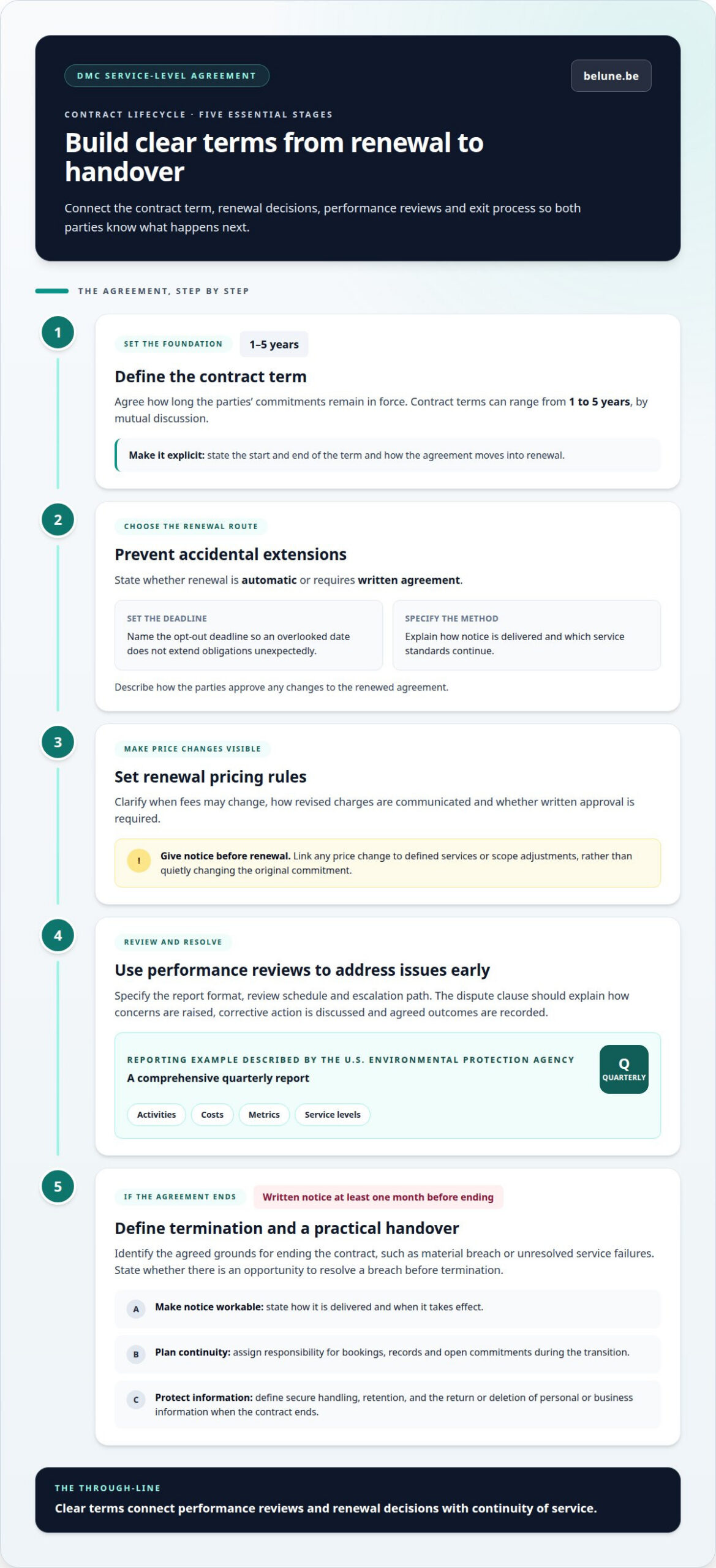
    A DMC SLA should define how the relationship begins, continues, and ends. Clear terms connect performance reviews and renewal decisions with continuity of service.

    Contract Term and Renewal Terms

    The contract term sets how long the parties’ commitments remain in force and how renewal takes effect. Terms can range from 1 to 5 years by mutual discussion. State whether renewal is automatic or requires written agreement, then set the opt-out deadline and notice method. This prevents an overlooked date from extending obligations unexpectedly. Renewal language should also explain which service standards continue and how the parties approve changes.

    Termination Reasons and Notice Periods

    Termination clauses specify the events that allow either party to end the contract and the steps they must follow. Define material breach, unresolved service failures, and other agreed grounds, then state whether there is an opportunity to resolve a breach before termination. Written notice at least one month before ending an SLA gives both parties a stated planning period. Specify how notice is delivered, when it takes effect, and who handles bookings, records, and open commitments during the transition.

    Renewal Pricing Changes

    Renewal pricing terms explain when fees may change and how the parties approve revised charges. State whether changes apply only at renewal, how they will be communicated, and whether written approval is required. A clear notice deadline gives the other party time to assess revised terms before renewal. Link any price change to defined services or scope adjustments, so it does not quietly alter the original commitment.

    Reporting and reviews should help resolve issues before termination becomes necessary. Specify the report format, review schedule, and escalation path. The U.S. Environmental Protection Agency describes a comprehensive quarterly report covering activities, costs, metrics, and service levels. The dispute clause should explain how the parties raise concerns, discuss corrective action, and record an agreed outcome.

    Privacy and confidentiality terms should define what personal or business information may be shared, who may access it, and how it must be protected. Set rules for permitted use, secure handling, retention, and return or deletion when the contract ends. These details help both parties manage sensitive itinerary and traveller information throughout the relationship.

    Fees, billing frequency, late payments, and out-of-scope charges

    A clear fee section links payment to defined services, delivery milestones, and responsibilities. It should also explain how billing changes when the agreed scope changes.

    Fees and Subscription Tiers

    Fee and tier terms describe what each payment covers and which service level applies. They matter because a broad package can obscure exclusions unless each included task is named. For a DMC, the fee depends on itinerary scope, group requirements, timing, and included services, and is provided after a quote request. Rather than relying on generic subscription tiers, outline the agreed services and any separate components clearly.

    For example, if local guidance is included, the contract can state the scope of the guiding service and its deliverables. Specify whether an itinerary or responsibility change requires a revised quote or written approval. This gives both parties a shared basis for understanding invoices.

    Billing Cycles and Late Payments

    Billing-cycle terms state when invoices are issued, when payment is due, and what happens if payment is late. Recurring arrangements may use monthly, quarterly, or annual billing cycles; the contract should identify the chosen schedule and any milestone-based invoices. State the due date, accepted payment method, and process for raising an invoice query.

    Late-payment terms should explain any applicable interest or other consequence, when it begins, and how the parties resolve a disputed amount. Make these triggers explicit. A predictable process helps protect cash flow without confusing a genuine billing question with non-payment.

    Out-of-Scope Charges

    Out-of-scope terms define work beyond the agreed services and explain how additional charges are approved. They matter when a change affects resources, timing, or delivery. Name examples, such as an itinerary revision that adds services beyond the original scope, and state that both parties must document the change before proceeding.

    Both parties have responsibilities: the DMC delivers the listed services and reports against agreed metrics, while the client supplies necessary details and approvals. Uptime is relevant only if a digital service is part of the agreement; otherwise, measure the contracted deliverables. For group programmes involving local guidance, Local Guide Services can be included as a clearly scoped service.

    Key Clauses for a DMC Service Level Agreement, Including Fees

    Liability caps, exclusions, and covered losses

    A DMC SLA should define liability limits, excluded losses, force majeure procedures, safety responsibilities, and insurance requirements. These terms clarify how both parties manage disruption and protect programme delivery.

    Liability Caps and Exclusions

    A liability cap sets the maximum financial exposure for specified claims, while exclusions identify losses outside that limit. Both matter because a low cap can leave a client carrying risks the contract appears to address.

    Describe which claims the cap covers and how its amount is calculated. For example, a contract might link the cap to fees paid during a defined period. Keep service guarantees, billing duties, and liability limits distinct so one clause doesn’t unintentionally override another.

    List excluded damages in plain language, then state any exceptions. The agreement shouldn’t attempt to limit liability that can’t legally be excluded, such as liability for fraud.

    Force Majeure and Safety

    A force majeure clause explains how the parties respond when an event outside their control disrupts agreed services. This matters for travel programmes because severe weather or transport disruption may affect an itinerary.

    Define triggering events, the notice process, mitigation steps, and consequences for affected services. For example, require prompt written notice describing the disrupted activity. The clause should also explain how the parties discuss alternatives, document decisions, and handle commitments that cannot proceed.

    Safety terms should assign responsibility for communicating relevant risks and responding to an incident. Identify the escalation contact and the process for pausing or changing an activity when safety concerns arise.

    Insurance Requirements

    Insurance clauses identify the coverage each party must maintain for its contractual responsibilities. They matter because a liability cap alone doesn’t explain how an insured loss will be handled.

    State the required policy types, coverage scope, and process for providing evidence of coverage. Clarify who notifies the insurer, preserves incident records, and coordinates claims after an event. For example, an incident during a scheduled activity should follow a defined reporting path, rather than leaving responsibilities unclear.

    Finally, align insurance wording with the risks and services covered by the agreement. Specify how the parties share relevant claim information, and keep insurance obligations separate from any promise that a particular loss will be covered.

    Service-level remedies and compensation

    A service-level remedy links a measurable shortfall to a defined response. In a DMC SLA, that connection turns expectations into a practical process for protecting programme operations.

    Useful indicators can track itinerary accuracy, delivery of agreed services, response times, and completion of documented actions. Specify the measurement method, reporting period, exclusions, and person responsible for recording each result. For example, a review might compare planned and delivered itinerary components, then record any variance and its cause. Choose metrics that reflect the contracted work, not software uptime unless the agreement includes a digital service.

    Response time measures when the provider acknowledges a request; resolution time measures when the issue is addressed. Set separate expectations for routine requests and urgent disruptions, based on urgency, operational impact, and the action required. The SLA should also name escalation contacts and explain how the parties track an issue that cannot be resolved immediately.

    Remedies work best when the agreement specifies the trigger, calculation, and application process. A SaaS SLA may use a 99.9% uptime threshold, while an MSP example offers a five percent discount off the next month’s service fee after missing one or two metrics in a given month. These are examples from other service contexts, not standard DMC remedies. A DMC agreement can instead define a proportionate credit, corrective action, or agreed service recovery for a recorded failure.

    Itinerary-change, cancellation, and refund terms should explain how requests are submitted, who approves changes, and how each decision is documented. Define how the parties handle affected services, commitments, and amounts already paid; then distinguish a change request from a service failure. Clear triggers help prevent a remedy from being mistaken for an automatic refund.

    Review remedy records with performance reports, identify recurring causes, and document corrective actions. For a group programme, discuss your service-level expectations before delivery begins.

    Set separate acknowledgement and resolution deadlines for routine requests and urgent disruptions, tailored to the urgency, operational impact, and action required. Name escalation contacts and explain how unresolved issues will be tracked.

    BELUNE: Local Guide Services

    BELUNE’s Local Guide Services can support tour operators shaping a group itinerary around local context and cultural experiences. When a programme includes visits where knowledgeable interpretation matters, local guiding can form a clear part of the agreed scope, with responsibilities and delivery expectations reflected in the SLA.

    For a broader itinerary, Hotel Accommodation Management and Coach Hire with own fleet of busses can sit alongside guiding, while Art & Culture Group Tours provide a cultural focus. Defining each element in the agreement connects planned activities with the services being delivered and gives both parties a shared reference if plans change.

    For tour operators developing a group programme, contact BELUNE to discuss Local Guide Services.

    Put the Agreement to Work

    A well-structured SLA can be more than a contract document. It gives tour operators and their DMC a shared framework for turning a programme’s aims into clear, coordinated delivery. The key clauses for a DMC service level agreement are most useful when they reflect the actual work, the people responsible, and the experience the group should receive.

    That conversation can start with the itinerary itself. BELUNE’s Local Guide Services, Hotel Accommodation Management, and Coach Hire with its own fleet of buses can each be defined within the programme’s scope. This gives both parties a practical starting point for aligning expectations with the services involved, rather than relying on broad language that may not suit the journey.

    Use the agreement as a foundation for collaboration, then shape its terms around the group experience you want to create. Contact BELUNE to discuss your DMC SLA and take the next step with clarity.

    Frequently Asked Questions

    What is a Service Level Agreement (SLA)?

    A Service Level Agreement is a contract section or separate document that records service commitments between parties. The key clauses for a DMC service level agreement connect expected outcomes to measures, reporting, and responses when delivery falls short. For example, a group programme might track whether agreed itinerary components were delivered and how deviations were recorded. This makes the SLA a working reference for reviewing performance, not simply a statement of intent.

    What is a DMC service level agreement and what services does it cover?

    A DMC service level agreement describes the destination services a company will coordinate for a tour operator or travel agent. The key clauses for a DMC service level agreement can define accommodation arrangements, group transport, local guidance, or cultural activities. The scope should show where one service ends and another begins, who manages hand-offs, and how itinerary updates are recorded. That clarity helps align the planned guest experience with operational responsibilities.

    What pricing, fees, taxes, and payment terms should a DMC SLA include?

    A DMC SLA should state the agreed fee structure, what the quoted amount covers, how taxes are treated, and how payment is handled. Identify the billing currency, invoice milestones, due dates, and any approval process for added work. For example, if a programme changes after approval, document the revised scope and its financial effect before proceeding. Clear records help the parties reconcile invoices without relying on informal assumptions.

    How should a DMC SLA address suppliers, subcontractors, and service failures?

    A DMC SLA should explain how supplier involvement is managed and who coordinates a response when a service fails. Identify any subcontracted elements, the communication route for reporting disruptions, and how decisions are documented. For example, if a scheduled activity cannot proceed, the agreement can set out how the DMC informs the tour operator, presents available alternatives, and records the agreed next steps. This keeps communication traceable across the delivery chain.

  • Evaluating DMC Proposals for Incentive Programs

    Evaluating DMC Proposals for Incentive Programs

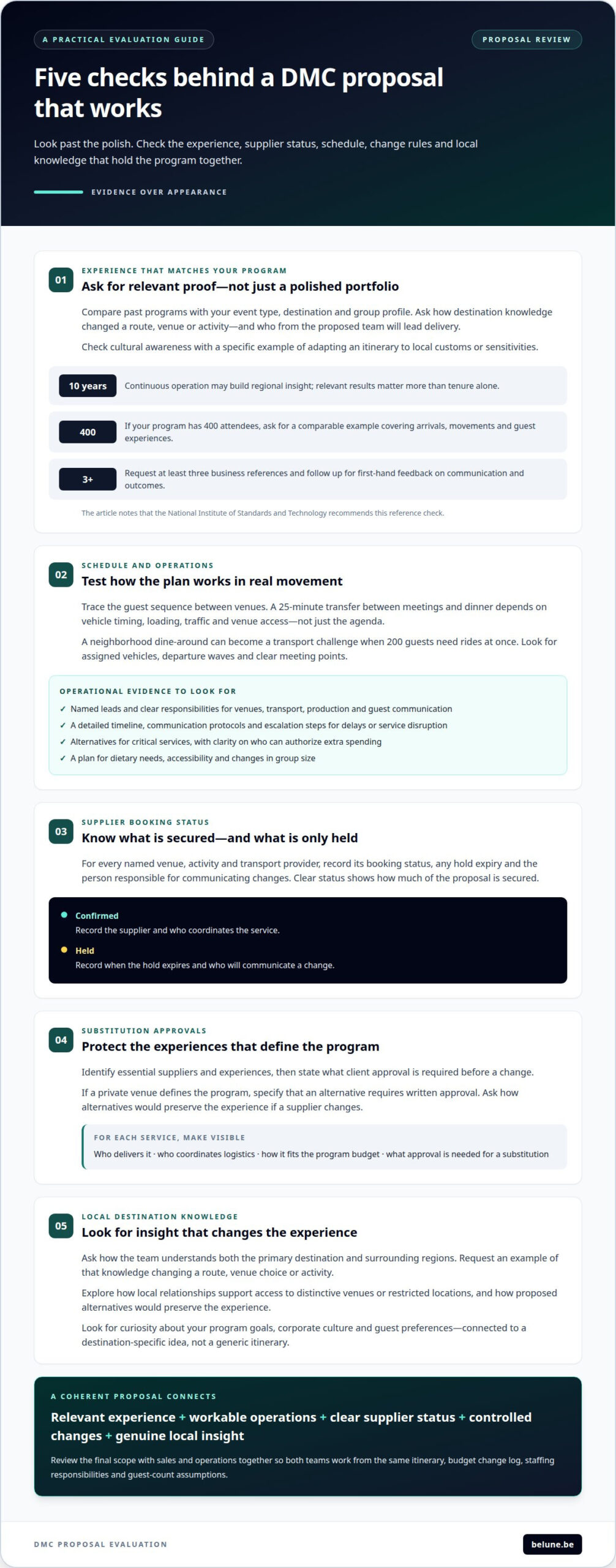
    The most polished proposal isn’t automatically the strongest choice. Use a checklist for evaluating DMC proposals that weighs relevant experience, supplier booking status, a workable schedule, approval rules for substitutions, and genuine local destination knowledge. The best fit connects these details into a coherent, distinctive program, rather than simply looking impressive on the page.

    It’s natural to focus first on the itinerary and the overall experience. But a memorable incentive program also depends on the details behind each moment: who will deliver it, how the schedule works in practice, and how local insight shapes the experience. This guide explains how to compare those elements, assess supplier confirmations and substitution approvals, and spot schedules built around real operational needs. You’ll also see how a DMC’s destination knowledge and local relationships can make the difference between a polished proposal and a program that feels grounded, seamless, and connected to its setting.

    Key Takeaways

    • Compare relevant DMC experience by looking for tailored examples, destination familiarity, and evidence that the proposed team suits your program.
    • Assess whether the schedule connects transport, activities, and guest needs into a realistic operational plan.
    • Distinguish confirmed bookings from temporary holds, and define approval rules for changes to essential suppliers or experiences.
    • Look beyond well-known venues: local relationships and cultural understanding can shape a more distinctive, place-specific incentive program.

    DMC experience and international client track record

    Begin with evidence, not polished claims. A destination management company with at least 10 years of continuous operation may have developed valuable regional insight, but relevant results matter more than tenure alone. Look for examples that show how its local knowledge shaped a program and helped deliver the stated objectives.

    • Match experience to your program. Compare past incentive programs with your event type, destination, and group profile, since a conference portfolio may not demonstrate the creative approach your incentive requires.
    • Test scale with a real example. If your program involves 400 attendees, ask how the DMC handled comparable arrivals, movements, and guest experiences; scale affects staffing and coordination.
    • Review the proposed team. Ask who will lead planning, which experienced professionals will work on the event, and how responsibilities are divided, so the people presented during sales remain connected to delivery.
    • Assess destination range. Ask how the team understands both the primary destination and surrounding regions, then request an example of how that knowledge changed a route, venue choice, or activity.
    • Explore cultural awareness. Ask for a specific example of adapting an itinerary to local customs or sensitivities, because a thoughtful partner considers how guests and host communities experience each activity.
    • Check the track record firsthand. Request at least three business references with contact information and follow up for first-hand reviews; the National Institute of Standards and Technology recommends this reference check.

    What should you ask about staffing, experience, and references? Ask who will work on the event, which comparable programs they have delivered, and whether references can speak to communication and outcomes. The answers help you assess the named team’s relevant experience and whether they can build a dependable working partnership.

    Finally, look for evidence of curiosity: does the DMC ask about your program goals, corporate culture, and guest preferences? A proposal that connects these details to a destination-specific idea gives you a clearer basis for judging the potential partnership than a generic itinerary.

    Supplier operations, confirmations, and resource scheduling

    A polished itinerary depends on operational detail behind each transition. In a 25-minute transfer between meetings and dinner, vehicle timing, loading, traffic, and venue access shape whether the schedule works. Compare the proposed timings with the actual sequence of guest movements, not just the printed agenda.

    • Map supplier responsibilities. Identify who coordinates venues, transport, production, and guest communication, so no handoff disappears between teams.
    • Test group movement. A neighborhood dine-around becomes a transport challenge when 200 guests need rides at once; look for assigned vehicles, departure waves, and clear meeting points.
    • Review operational tools. Look for a detailed timeline, named leads, communication protocols, and escalation steps for delays or service disruption.
    • Check contingency planning. The proposal should explain alternatives for critical services and who can authorize extra spending when time is short.
    • Clarify guest requirements. Confirm how the plan accounts for dietary needs, accessibility, and changes in group size.

    Before paying a deposit, have the sales and operations leads review the final scope together. Align everyone on one current itinerary, a budget change log, staffing responsibilities, and guest-count assumptions. This handoff helps the operations team work from the same version used to approve the pricing.

    What contract terms, cancellation policies, and payment schedules should you review? Confirm the agreed itinerary and budget version, responsibilities, staffing hours, deposit dates, and approval process for additional costs. Review the cancellation schedule by milestone, along with the process for changes to dates, suppliers, or scope. The agreement should also explain fixed prices versus estimates, guest-count adjustments, currency, taxes, service fees, gratuities, final reconciliation, refund timing, and any exchange-rate rule.

    For group programs that combine transport and guest experiences, coordinated group travel planning can connect the schedule to practical movement between venues.

    Evaluating DMC Proposals for Incentive Programs

    Confirm supplier booking status and substitution approvals

    A striking venue or private experience can anchor an incentive program, but its booking status affects the entire plan. For every named supplier, record whether the booking is confirmed or held, when a hold expires, and who will communicate changes. A clear status helps you judge how much of the proposal is secured.

    • List each critical supplier. Match every venue, activity, and transport provider to its status, hold expiry, and responsible contact.
    • Set substitution rules. Identify essential experiences and state what client approval is required before they change. For example, if a private venue defines the program, specify that an alternative requires written approval.
    • Map the supplier network. Ask how local vendor relationships support access to distinctive venues or restricted locations, and how alternatives preserve the experience if a supplier changes.
    • Make supplier roles visible. For each service, record who delivers it, who coordinates logistics, and how the supplier fits the program budget.
    • Review references and evidence. Use relevant business references to understand supplier communication and delivery; compare those insights with the proposal’s named vendors and booking status.

    Supplier vetting should clarify the proposed provider, service scope, and any conditions that affect the booking. A private dining experience, for instance, needs a clearly identified venue, a service description, and a substitution process. This transparency helps you compare proposals based on the experience actually planned, rather than an evocative label alone.

    What sustainability and accessibility standards should you assess? Set practical criteria in the proposal, such as local supplier participation, waste practices, step-free routes, accessible transport, and suitable venue facilities. Evaluate each itinerary stop against those criteria so environmental considerations and guest access are addressed throughout the experience.

    Before approval, align the booking-status record with the itinerary and budget version. This gives the client and DMC a shared view of supplier commitments, expiry points, and who can authorize substitutions.

    Local destination knowledge and vendor relationships

    A destination becomes more than a backdrop when local knowledge informs each choice. Assess whether the proposal connects venues, neighborhoods, and cultural experiences into a coherent program, rather than presenting isolated attractions. Longstanding vendor relationships can also shape access to distinctive settings and experiences beyond familiar visitor routes.

    How can you verify a DMC’s local expertise and supplier availability for a specific destination? Ask for a destination-specific route or itinerary with named venues and local suppliers, then assess how each choice fits the program. Compare those details with supplier booking status and a clear process for changes.

    • Test geographic knowledge. Ask how the proposed route connects the main destination with surrounding areas, and what local considerations shape travel between stops.
    • Look for meaningful access. Ask which vendor relationships make a proposed experience possible, such as a visit to a working cultural site or a meal in a neighborhood venue.
    • Read the itinerary for local texture. Check whether creative activities reflect regional culture, rather than repeating the same format across destinations.
    • Connect local insight to guest experience. A local guide can explain customs and context that make an art visit or river excursion feel rooted in place.

    Strong destination knowledge also shows in the details: realistic transitions, appropriate venues, and an understanding of how local customs shape guest interactions. For example, a cultural visit should give guests context to engage respectfully, not just a venue name and arrival time.

    Compare each proposed supplier with the experience it supports. If a venue is central to the incentive, examine its role in the itinerary, the proposed alternatives, and how a change would affect the program’s character. This reveals whether local relationships add genuine value or simply decorate the proposal.

    For a more place-led itinerary, explore locally guided experiences that connect guests with the destination’s culture and waterways.

    BELUNE: Hotel Accommodation Management

    BELUNE supports incentive planners with Hotel Accommodation Management, helping connect the stay to the wider program. When guest lodging, transport, and destination experiences need to work together, its Coach Hire with own fleet of busses and Local Guide Services can support the itinerary’s practical flow. Art & Culture Group Tours bring a locally grounded experience to the program.

    For planners shaping a group itinerary, BELUNE brings accommodation, transport, and cultural visits together in a considered plan. Contact BELUNE to discuss your incentive program.

    Build the next step into your incentive program

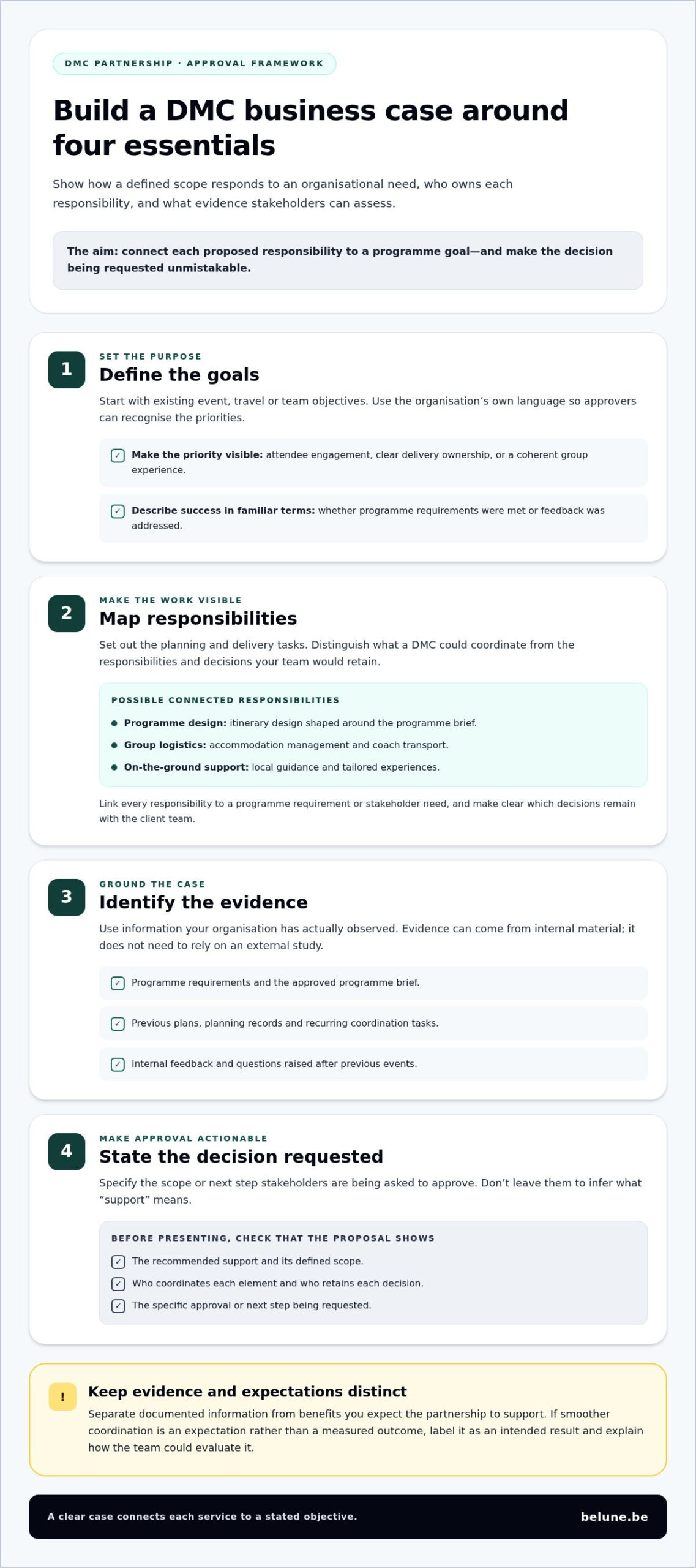
    Selecting a DMC begins a working partnership; it isn’t simply the end of a comparison. Use your checklist for evaluating DMC proposals as a decision framework, then turn your preferred direction into a shared brief: define what success should feel like for guests, which priorities must remain fixed, and where the experience can evolve. This conversation helps align practical details with the impression you want the program to leave.

    BELUNE offers Hotel Accommodation Management, Coach Hire with its own fleet of buses, and Local Guide Services for group programs. To explore how these offerings could support your plans, discuss your incentive program with BELUNE. A thoughtful next conversation can turn a well-considered proposal into a more intentional guest experience.

    Frequently Asked Questions

    How do you evaluate and compare DMC proposals for incentive programs?

    Compare proposals against the same program goals, guest profile, and decision criteria. A practical checklist for evaluating DMC proposals can assess relevance, delivery clarity, and how convincingly each experience supports the incentive objective. Then identify trade-offs: one option may offer a more original guest experience, while another makes the journey simpler. Choose the strongest overall fit, not the most polished presentation.

    Should a DMC disclose its suppliers?

    A DMC should identify key suppliers when their role affects the experience, logistics, or decision to proceed. Knowing the proposed venue or activity operator, for example, helps you understand what guests will actually encounter. The proposal can distinguish a named supplier from a general option and explain how changes would be handled. This gives you useful visibility without requiring every operational detail upfront.

    What Should You Look for in a DMC Proposal?

    Look for a clear connection between your incentive objective and the proposed guest experience. If recognition is central, for example, assess whether the itinerary creates meaningful moments to celebrate participants, rather than simply filling the schedule. The proposal should also make its assumptions easy to follow, showing how guest preferences, program priorities, and practical delivery shape the design.

    What does transparent DMC pricing look like?

    Transparent pricing makes each cost understandable in relation to a service or planning assumption. For example, an accommodation line should clarify the room allocation or stay details it reflects, while estimates should be distinct from fixed amounts. Review which changes could affect the total and how they are approved. This helps you compare the scope behind each proposal, not just its overall figure.

    What is a DMC in corporate event planning?

    A destination management company, or DMC, coordinates destination-based services and experiences for a group or event. For corporate planning, that can mean shaping local activities and coordinating practical details that support an incentive or business gathering. Its value lies in connecting the event’s purpose with the destination, so the program feels designed for its setting rather than transferred unchanged from elsewhere.

    What should you expect from a DMC proposal for incentive travel?

    Expect a proposal to show how the guest journey works from arrival through departure and how its experiences reflect the program’s purpose. A considered submission may also explain pre-trip planning support, on-site coordination, and post-trip follow-up. These details help you understand how the concept carries into execution and how the DMC intends to maintain continuity before, during, and after the trip.

  • Work Directly With a DMC or Use Multiple Local Operators?

    Work Directly With a DMC or Use Multiple Local Operators?

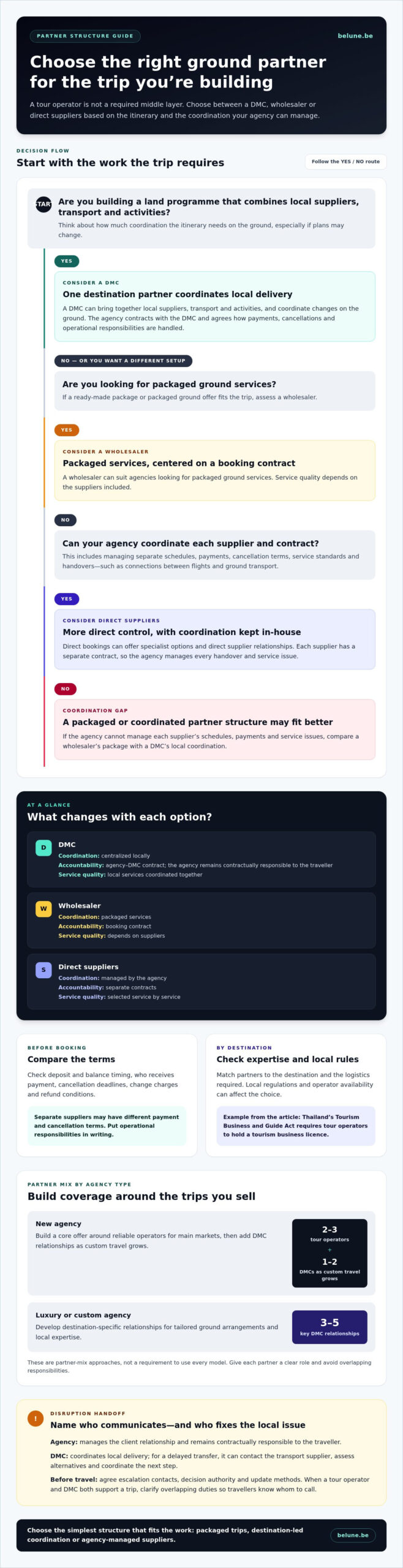
    A tour operator isn’t a required middle layer: a travel agency can work directly with a DMC for a land programme. The choice between a single DMC and multiple local operators depends on the destination, services and coordination required on the ground. A tour operator creates and sells a trip; a DMC helps deliver it locally.

    One clear point of contact can be valuable, especially when an itinerary combines accommodation, transport and local experiences. But one partner isn’t automatically right for every destination or trip. The key is clear operational ownership and a reliable handover when plans change.

    This comparison explains when agencies can work directly with a DMC, how DMCs differ from ground handlers, and how to choose between one destination partner and several local operators. It also shows how to assign support responsibilities during disruptions, so everyone knows their role before the journey begins.

    Key Takeaways

    • Work directly with a DMC when a trip needs coordinated local services and destination expertise, rather than a ready-made package.
    • Match your partner structure to the itinerary: one lead operator can simplify coordination, while regional partners can bring destination-specific knowledge.
    • Agree in advance who manages traveller communication and who resolves operational problems when plans are disrupted.
    • Distinguish a DMC’s destination-wide coordination from a ground handler’s delivery of specific local services before assigning responsibilities.

    Can a travel agency work with a DMC directly, without a tour operator?

    Yes. An agency can contract directly with a DMC for a land programme, or work with wholesalers and direct suppliers. The choice between a single DMC and multiple local operators depends on how much coordination the itinerary requires.

    Working with a DMC

    A DMC can suit trips that combine local suppliers, transport and activities, especially when changes require coordination on the ground. The agency contracts with the DMC and agrees in writing how supplier payments, cancellations and operational responsibilities are handled. The DMC coordinates local delivery, while the seller remains contractually responsible to the traveller if something goes wrong.

    Using a wholesaler or direct suppliers

    A wholesaler can suit agencies looking for packaged ground services. Direct suppliers can work well when the agency wants specific services and can manage each contract. Using several local operators may offer destination-specific options and direct supplier relationships, but the agency must coordinate separate schedules, payments, cancellation terms and service standards, including connections between flights and ground transport.

    How do the approaches compare on coordination, accountability, and service quality? A DMC centralizes local coordination; direct suppliers divide it across separate contracts. Define who handles each service and responds to disruptions.

    What booking, payment, and cancellation terms should travelers compare? Compare deposit and balance timing, who receives payment, cancellation deadlines, change charges and refund conditions. Separate suppliers may have different terms.

    What are the advantages of hiring multiple local operators directly? Direct bookings can offer specialist options and direct supplier relationships. The agency must manage every handover and service issue.

    How do local regulations and operator availability affect this choice by destination? Local rules can shape contracting. Thailand’s Tourism Business and Guide Act requires tour operators to hold a tourism business licence. Availability also affects whether one partner can coordinate the itinerary.

    Option Coordination Accountability Service quality
    DMC Centralized locally Agency-DMC contract Coordinated services
    Wholesaler Packaged services Booking contract Depends on suppliers
    Direct suppliers Agency-managed Separate contracts Selected service by service

    For a single DMC vs multiple local operators model, decide whether coordination or direct control of suppliers matters more.

    Agency partner strategy by business type

    An agency selling ready-made packages needs a different partner mix from a specialist designing custom trips. Let your itinerary, destination coverage and logistics capacity guide the structure.

    Direct agency-to-DMC partnerships

    A direct agency-to-DMC partnership connects the seller with a destination management company for local expertise and tailored ground arrangements. This differs from working with a wholesaler, which typically centers on packaged travel, and from contracting direct suppliers, which leaves the agency coordinating each provider. For custom travel, one DMC can give the agency a destination-focused counterpart while the agency maintains its relationship with the traveller.

    For example, an incentive itinerary may combine accommodation, transport and local experiences. A direct partner can coordinate these elements in one destination. Agencies serving different regions can work with separate DMCs for distinct markets, rather than expecting one partner to offer deep expertise everywhere.

    Choosing an agency partner

    Start with your business model. A new agency can build its core offer around 2-3 reliable tour operators for its main markets, then add 1-2 DMCs as custom travel grows. Luxury or custom agencies may instead develop relationships with 3-5 key DMCs. These are partner-mix approaches, not a requirement to use every model.

    Match each partner’s destination expertise to the trips you sell. Consider whether they can coordinate the required local logistics, whether their packages suit your clients, and how the partnership fits your sales role. For a trip requiring detailed local planning, a destination specialist may be more useful than a broader partner.

    Choose the simplest structure that fits the work: use tour operators for established packages, and DMC relationships for destination-specific custom itineraries. Keep regional coverage deliberate, so each partner has a clear role rather than overlapping responsibilities. For agencies shaping a destination-led programme, regional partner planning can help frame the right operational approach.

    Work Directly With a DMC or Use Multiple Local Operators?

    Emergency support and responsibility for disruptions

    Before travel, assign each disruption to a named contact and a clear action. A DMC vs tour operator arrangement works best when the client knows who communicates and who manages local delivery.

    DMC operational responsibility

    If a transfer is delayed, the DMC handling ground operations can contact the local transport supplier, assess alternatives and coordinate the next step. The agency manages the client relationship, while the DMC addresses the operational issue. Set out escalation contacts, decision authority and update methods in the contract. The DMC’s local role supports a response on the ground, but does not remove the seller’s contractual responsibility to the traveller.

    Overlapping operator responsibilities

    When a tour operator and DMC both support a trip, overlapping duties can leave a traveller unsure whom to call. Large international safari operators typically provide 24/7 global support desks, while local partners may handle issues on the ground. The arrangement should clarify whether the desk contacts the DMC or expects the traveller to do so. One lead for each issue prevents duplicated instructions.

    Set the communication sequence before departure. First, the traveller contacts the agency’s published trip contact. The agency then informs the DMC or operator responsible for the service. The operational partner contacts the relevant supplier, such as a transport company, and reports the action taken and expected timing. The agency shares the update with the client and records any decision affecting the itinerary.

    Specify who can authorize a replacement transfer, who pays the supplier and who approves itinerary changes. Compare these terms with the booking conditions and net rates, rather than assuming the quoted price defines emergency responsibilities. Confirm whether the DMC or operator coordinates with suppliers and name a backup contact. Clear responsibilities keep operational decisions distinct from client communication.

    What is a destination management company (DMC) and what services does it provide?

    A destination management company works in the place it serves. Its local knowledge can span hotels, guides, restaurants and transport, helping an agency shape services into a coherent itinerary. Coverage is often regional or country-specific, with deeper expertise in the DMC’s core destinations.

    For example, an agency planning a cultural group trip can draw on local knowledge to align hotel locations, guided visits and transport timing. A DMC can coordinate these destination services as one programme. A ground handler, by comparison, generally focuses on delivering specific services, such as a transfer or booked excursion, rather than coordinating the broader destination plan.

    The distinction matters most when a route has several moving parts. The traveller’s agency may be far away, while local providers manage immediate details. A DMC can bring destination suppliers together and explain how hotels, guides and transport fit the itinerary. The agency remains responsible for the traveller relationship and sets the programme’s overall objectives.

    Local knowledge can also shape the character of a visit. A guide can connect an itinerary to regional history, while restaurant choices and local businesses offer visitors a closer view of the destination. DMCs can support destination stewardship by shaping experiences that engage local communities and businesses and reflect sustainability goals. Agencies can consider not only which services fit, but how the itinerary connects with the place.

    Use a DMC when a programme needs destination-wide coordination, tailored local experiences or knowledge beyond individual supplier bookings. Use a ground handler for a defined service that needs local delivery but little wider coordination. The right distinction depends on whether the agency needs someone to connect the itinerary or deliver a specific component. To shape a group itinerary around local hotels and guidance, plan destination-led group travel.

    BELUNE: Hotel Accommodation Management

    BELUNE supports travel agencies and tour operators with Hotel Accommodation Management for group programmes across the Benelux and Paris region. It can be a fitting partner when a trip needs hotel arrangements alongside Coach Hire with its own fleet of buses, Local Guide Services or Art & Culture Group Tours.

    This combination helps shape a coherent group itinerary, with accommodation and local experiences planned as connected parts of the journey. Agencies can work with BELUNE on customized group travel instead of treating each element as a separate booking.

    To discuss a group itinerary with BELUNE, visit belune.be or contact the team.

    Shape the Partnership Around the Journey

    Choosing between a single DMC and multiple local operators is a design decision: choose the structure that best serves the journey. Before planning your next programme, map its essential moments, from arrival and accommodation to the experiences that give each destination its character. Then consider where local coordination will best support the itinerary and your agency’s working style.

    This makes partner selection a practical part of trip design rather than a separate sourcing exercise. It also gives your team a clear starting point for developing a distinctive group programme with a coherent rhythm.

    BELUNE works with travel agencies on group travel arrangements, including Hotel Accommodation Management, Coach Hire with its own fleet of buses, and Local Guide Services. Discuss your agency’s next group itinerary with BELUNE and take the next step toward bringing it to life.

    Frequently Asked Questions

    What is the difference between a DMC and a tour operator?

    A DMC focuses on destination operations, while a tour operator creates and sells travel packages. For example, a tour operator might sell a multi-day itinerary and contract a DMC to arrange local services. An agency working directly with a DMC takes on the sales relationship itself. The distinction is who assembles and sells the trip, and who organizes its destination services.

    Can You Use Both?

    Yes. An agency can use a tour operator for a ready-made package and a DMC for a custom extension or special local programme. For instance, a traveller could book a packaged stay, then add a locally coordinated cultural visit through a DMC. Define which booking covers each service, who communicates changes and how the arrangements connect, so no part of the itinerary falls between contracts.

    Does a DMC ever sell to travellers directly?

    Some DMCs may sell directly, but they primarily work with travel advisors, tour operators and meeting planners. Their business-to-business role generally supports trade partners rather than competing for the end client. The sales channel can vary by company and trip. For an agency, the practical question is whether the DMC supports its client relationship or sells a separate arrangement directly to the traveller.

    What are the advantages of using one DMC for an entire trip or event?

    One DMC can provide a consistent local operating relationship across an itinerary. For a corporate event, one partner can coordinate destination services around the programme’s schedule, reducing the need for the agency to align separate local contacts. This structure is most useful when several services depend on one another. It does not remove the agency’s role in setting expectations with its client.

    How do single-DMC and multiple-operator costs compare, including fees and markups?

    Compare the pricing structure and included services, not just the headline total. A boutique DMC safari booking typically involves one markup layer, while a large international safari operator booking often involves two or more, including the operator’s and subcontracted DMC’s margins. Direct supplier bookings may show separate service charges and change terms. These examples describe markup structures, not guaranteed savings or a quote for another trip.

    How do DMCs and local operators handle insurance, permits, safety, and liability?

    Responsibility depends on service contracts and local rules. For each activity or transport booking, identify which company holds the relevant permits, what insurance applies, and who handles incident reporting or claims. Make sure the contract names the responsible operator and sets out safety procedures and escalation contacts. The selling agency should also understand its contractual obligations to the traveller and explain them clearly.

  • How a DMC Partnership Can Reduce Operational Overhead

    How a DMC Partnership Can Reduce Operational Overhead

    What if travel overhead comes less from the number of suppliers than from the work of coordinating them? When accommodation, transport, guided experiences and other arrangements each require separate planning, internal teams can lose time to handovers, follow-ups and unclear ownership. Understanding how a dmc partnership reduces operational overhead starts with treating coordination as one connected programme, not a collection of unrelated tasks.

    Your team still needs visibility and control. The practical question is which responsibilities belong in-house and which a DMC can coordinate. Compare the two based on time, clarity and delivery, rather than assuming that outsourcing automatically reduces costs.

    This article looks at the recurring work a DMC can coordinate, from itinerary planning and accommodation management to coach transport, local guides and group experiences. You’ll learn how to compare responsibilities fairly, define ownership and choose useful review measures. BELUNE brings more than 20 years of tourism experience to tailor-made programmes that combine selected logistics and local expertise around your team’s priorities.

    Key Takeaways

    • Separate staff time spent coordinating a travel programme from supplier charges and trip expenses to see where operational effort sits.
    • Learn how a DMC can bring itinerary planning, accommodation management, coach transport and expert guidance into a defined programme.
    • Assess how a dmc partnership reduces operational overhead by comparing equivalent responsibilities, service expectations and review periods, not assumptions about lower costs.
    • Set clear ownership, communication processes and review measures so your team and DMC partner understand who handles each task.
    • See how BELUNE’s tailor-made itineraries and on-the-ground logistics can be shaped around your programme’s operational needs.

    What Counts as Operational Overhead in a DMC Partnership?

    Operational overhead is the internal time and coordination needed to plan and deliver a travel programme. It includes the work behind decisions and handovers, not just the visible arrangements. Understanding how a dmc partnership reduces operational overhead starts with identifying who handles each task, from the first itinerary draft through to the delivery review.

    That work is separate from supplier charges and trip expenses. Accommodation, coach transport and activities are programme costs; the staff time spent arranging, communicating and tracking them is operational effort. The two are related, but they should not be counted as the same thing. A DMC partnership can redistribute coordination work, but it does not automatically reduce total programme costs.

    For a foundational definition, see Understanding Operational Overhead. The video below offers another perspective on partnership operations.

    Which internal tasks create coordination overhead?

    A programme may involve itinerary planning, accommodation management, transport, expert guidance and activities. Each component also creates supporting tasks: briefing partners, sharing requirements, aligning schedules, communicating changes and reviewing delivery. When one arrangement changes, the related components may need attention too, adding more handovers.

    Your organisation may retain tasks such as setting programme goals, approving key decisions and communicating internal requirements. A DMC can coordinate the logistics and services assigned to it. Make the boundary specific: “manage transport” could mean arranging coach hire, coordinating timings, or both. Naming the deliverables and owner for each task makes the workload easier to see.

    How is overhead different from programme cost?

    Overhead measures staff effort and process burden, not a standalone price. To compare in-house coordination with a DMC partnership, keep the inputs separate: record supplier and partner charges on one side, and internal coordination time on the other. List the tasks included in each scope, then compare the same service expectations over the same period.

    Avoid double-counting. If the DMC scope includes accommodation management, don’t count the same coordination task as entirely in-house. Your team may still brief the DMC or approve arrangements, but those are separate responsibilities. A task-by-task view shows whether work has moved, is shared or remains with your team.

    Overhead also depends on programme scope and existing processes. A team with established approval steps may spend less time on sign-off than one coordinating across several departments. A programme combining accommodation, transport and activities may also need more alignment than one with fewer components. These differences make a like-for-like comparison essential.

    Start with a responsibility map. List each recurring task, name its owner and note where input or approval is shared. Track internal effort consistently before and during the partnership. This gives your team a practical basis for assessing operational value without assuming delegated work has disappeared or that the partnership guarantees savings.

    How a DMC Consolidates Group Travel Planning and Logistics

    A group itinerary is more than a sequence of stops. Accommodation, transport, guidance and activities need to fit together, with each handover understood. A DMC can bring selected planning and logistics into a defined scope, creating one coordinated framework for the assigned services instead of separate strands of parallel planning.

    Start with the programme’s purpose and requirements, then shape the itinerary around the group’s priorities. Consider accommodation management, coach transport and expert guidance in relation to the same schedule. A guided tour, for example, needs to fit the route and transport plan; accommodation arrangements need to work with the itinerary. Coordinating these elements together can reduce mismatches and repeated briefings.

    Where can a DMC take responsibility across a programme?

    The scope depends on what your organisation wants to retain and what it assigns to the DMC. A tailored programme might include itinerary planning, accommodation management, coach hire, local guide services and selected group experiences. If airport transfers or international flight and train bookings are part of the brief, specify who coordinates them and how they fit into the wider plan. Don’t assume every task automatically belongs to one party.

    For example, your organisation might set the programme objectives, participant requirements and approval process, while the DMC develops the itinerary and coordinates agreed accommodation, coach transport and guided experiences. This division gives each side a clear role while keeping the programme’s components aligned.

    How does a clear scope prevent duplicated work?

    Before planning begins, assign an owner to each deliverable. A shared brief can record the task, responsible party, required input and approval point. Separate DMC-managed work from responsibilities your organisation retains, such as setting internal priorities or approving the programme. Where ownership is shared, define the handover so neither side assumes the other has completed it.

    Keep changes visible in the same working brief. If the itinerary shifts, note which related arrangements need review, who communicates the change and who approves it. This makes it less likely that both teams will brief partners independently or work from different versions of the plan. It also shows where your team’s input is still needed.

    A simple workflow makes the division clear: your organisation outlines its objectives and constraints; the DMC proposes a tailored itinerary within the agreed scope; both sides review the plan and confirm responsibilities; then the DMC coordinates assigned logistics while your team handles its retained tasks. After delivery, review what worked and what could be refined. The value in how a dmc partnership reduces operational overhead comes from deliberate coordination, not from removing your organisation from every decision.

    For teams bringing travel components together, BELUNE’s tailor-made group travel programmes combine itinerary planning and selected logistics in a collaborative framework.

    How a DMC Partnership Can Reduce Operational Overhead

    DMC Partnership vs In-House Coordination: Compare the Real Work

    Outsourcing coordination doesn’t automatically mean lower total costs. A DMC fee may replace some internal work, overlap with existing responsibilities or add another coordination layer if the scope is unclear. To judge whether how a dmc partnership reduces operational overhead applies to your programme, compare the work and service delivered, not just one invoice against another.

    Use the same trip components and expectations for both approaches. If the DMC scope includes accommodation management, coach transport and itinerary planning, the in-house comparison should account for those same deliverables, as well as the oversight and communication your team requires. Use the same measurement period for both models, such as the programme’s planning and delivery cycle.

    What makes an in-house comparison fair?

    Build a like-for-like scope before reviewing results. List the deliverables, expected service and tasks that remain with your organisation under either approach. Use staff records, calendars or project notes to understand internal effort. If precise time records aren’t available, label estimates clearly instead of presenting them as measured results.

    • Match the deliverables: Compare the same itinerary, accommodation, transport, guidance and activity arrangements.
    • Separate the inputs: Record DMC or partner fees, internal staff effort and other in-scope programme costs as distinct categories.
    • Show retained responsibilities: Include briefing, internal approvals and participant communication if your team still handles them.
    • Check for overlap: Make sure a coordination task isn’t counted both as DMC-managed work and as a fully internal responsibility.

    This approach also makes partial partnerships easier to assess. A DMC might coordinate selected travel components while your team retains other duties. When comparing that arrangement with a fully in-house model, show both the work transferred and the work that remains.

    Which measures show operational value without overstating it?

    Choose a small set of measures, each with a clear evidence source and known limitations. Keep operational results separate from financial results. A positive experience can matter without translating directly into monetary return.

    • Agreed itinerary delivery: Compare the approved plan with the delivered programme using itinerary versions and delivery records. Note changes, but don’t assume every change reflects a coordination failure.
    • Recorded coordination effort: Review staff time records, task logs or project notes for work included in the agreed scope. Incomplete records limit how confidently effort can be compared.
    • Guest feedback: Summarise relevant survey responses or feedback received. Treat this as an experience measure, not proof that a particular partner caused the outcome.

    Review the findings together, but don’t turn assumed time saved or favourable feedback into financial returns without a documented method. A sound comparison helps your organisation decide which responsibilities to retain, which to assign to a DMC and what evidence to review next time. The aim is informed oversight, not a guaranteed cost reduction.

    How to Set Up a DMC Partnership That Reduces Coordination Friction

    A productive partnership begins before the itinerary takes shape. Agree on what the programme needs to achieve, then decide which responsibilities the DMC will coordinate and which remain with your team. A clear operating framework supports collaboration without giving up oversight. It also makes it easier to see how a dmc partnership reduces operational overhead in practice: through defined ownership, clear communication and a review based on the work delivered.

    Use a sequence that reflects your programme’s needs rather than applying a fixed template:

    1. Set the purpose. Define the programme’s aims and the guest experience you want to create.
    2. Prepare the brief. Record the required services, from itinerary planning to accommodation, transport, guidance and activities.
    3. Agree the scope. Identify the deliverables assigned to the DMC, the decisions your team retains and any shared responsibilities.
    4. Set communication practices. Decide who owns updates, approvals and operational questions, and how changes will be recorded.
    5. Review delivery. Compare what happened with the agreed scope and use the findings to refine future collaboration.

    What belongs in a useful DMC brief?

    A useful brief explains the programme’s purpose, intended guest experience, required services and relevant constraints. Include itinerary priorities, accommodation needs, transport arrangements, guidance and activities, along with any approval requirements. Be clear about what your team will retain, such as setting internal objectives or making final decisions. This gives the DMC a practical foundation for shaping a tailored programme while keeping your organisation involved in the choices that matter.

    Keep the brief easy to update. When requirements change, record what changed, who approved it and which deliverables may be affected. A shared version helps both sides work from the same information instead of relying on separate notes or repeated verbal updates.

    How should teams agree on ownership and review?

    Name an owner for each decision and deliverable. For example, the DMC may lead coordination of agreed travel components while your team owns programme objectives and internal approvals. Define how operational questions will be raised, how changes will be communicated and who confirms revised arrangements. After delivery, review the programme against the agreed scope and measures, noting both successful coordination and points to adjust.

    For more context on incoming tour operators, explore this incoming tour operator guide. The same principle applies to a DMC partnership: clarity creates room for expertise and a well-shaped guest experience, while agreed responsibilities preserve accountability.

    When you are shaping a group programme, explore BELUNE’s tailored group travel programmes.

    How BELUNE Supports a More Manageable Group Travel Operation

    A group programme is easier to manage when the itinerary and its supporting logistics are planned together. BELUNE brings more than 20 years of tourism experience to tailor-made itineraries, accommodation management, coach transport, expert guidance and on-the-ground logistics. For organisations and tour operators, a practical starting point is a shared brief: what the programme should deliver, which services BELUNE will coordinate and which decisions your team will retain.

    This makes the operational scope tangible. Instead of treating each travel component as a separate thread, the programme can connect accommodation, transport and experiences in one itinerary. BELUNE’s own fleet of modern, comfortable coaches and local guide services can support the agreed plan. Strong local partnerships and access to unique experiences can also inform a programme shaped around the intended guest experience. The scope is tailored to the brief, rather than imposed as a fixed package.

    What can BELUNE coordinate for a tailored programme?

    A programme can bring together itinerary planning, accommodation management, airport transfers, coach transport, guided tours and distinctive group experiences. Art and culture tours, gastronomy and beer experiences, cycling tours, battlefield tourism, sport and festival tours, and river cruises with local excursions can support different objectives. BELUNE also provides MICE services, with responsibilities and deliverables defined around the programme.

    The value of how a dmc partnership reduces operational overhead lies in aligning these services through clear scope and collaboration, not in promising a particular level of savings. BELUNE’s local knowledge and partnerships inform the planning, while your team remains involved in the priorities and approvals it chooses to retain.

    How can a conversation move the partnership forward?

    Begin with the essentials: programme objectives, intended guest experience, required services and the operational tasks your team wants to manage or delegate. Sharing these priorities gives BELUNE a foundation for developing a tailored itinerary and outlining a workable division of responsibilities. As plans develop, a clear scope helps both sides understand what is being coordinated and where your input is needed.

    BELUNE takes a collaborative, no-nonsense approach and offers fair pricing. Its mission is: “Your trusted partner for any trip to the Benelux and the Paris region”. A conversation can focus on the programme, whether it involves group travel, a cultural itinerary, a river cruise or an MICE event, and on the coordination that would make delivery more manageable for your team.

    Share your programme priorities and request a tailored group travel quote. A clear brief is the beginning of a partnership shaped around the experience you want to create and the responsibilities your team needs to retain.

    Make Your Next Programme Easier to Coordinate

    Turn your operational priorities into a partnership brief: define what the programme needs to achieve, what your team wants to retain and where coordinated support would be most useful. That clarity gives both sides a practical basis for shaping the work and reviewing how it runs.

    Understanding how a dmc partnership reduces operational overhead is ultimately about designing the right division of responsibility for your organisation, not handing over control or assuming every task should be outsourced. A focused discussion can translate your priorities into a programme with clear scope and room for a distinctive guest experience.

    Share your programme priorities and request a tailored quote. Bring your objectives and coordination challenges to the conversation, and take the first step toward a group travel programme shaped around your team.

    Frequently Asked Questions

    What operational tasks can a DMC handle for a group travel programme?

    A DMC can take responsibility for travel arrangements included in the agreed programme, such as itinerary planning, accommodation management, coach transport, local guides and group activities. It can also coordinate airport transfers and international flight or train bookings. For example, a cultural visit and guided tour can be planned alongside the transport and other arrangements, with your team retaining agreed approvals.

    Can a DMC partnership reduce internal workload without reducing client oversight?

    Yes. Delegating defined coordination tasks doesn’t require your organisation to hand over programme decisions. Your team can set the objectives, approve itinerary choices and retain participant communications while the DMC coordinates assigned arrangements. Agree which decisions need client approval and how updates will be shared. Your team can then stay informed without managing every operational exchange itself.

    How do you compare a DMC partnership with managing travel in-house?

    Compare the same programme requirements under both approaches. If a group needs accommodation arrangements, coach transport and guided activities, assess those same deliverables in the in-house model and the DMC scope. Then separate partner fees from internal staff effort and other programme expenses. Use the same planning and delivery period, and record which responsibilities remain with your team so the comparison reflects the actual operating model.

    Does using a DMC always reduce the total cost of a programme?

    No. A DMC partnership may change who performs coordination work, but it doesn’t guarantee a lower total programme cost. The comparison depends on the agreed services, partner fees, internal effort and other expenses. Assess these separately and consider whether the partnership provides the scope and delivery approach your programme needs. Don’t treat delegated work, positive feedback or assumed time savings as financial savings without evidence.

    How can a company measure operational overhead in group travel?

    Track the internal effort attached to specific tasks, such as gathering requirements, reviewing itinerary versions or coordinating approvals. Use available project records, staff time logs or calendars, and apply the same method across comparable programmes. Pair effort records with delivery evidence, such as the approved itinerary and post-trip feedback, but keep these measures distinct. This shows what changed operationally without assuming every difference was caused by the DMC.

    What information should I include in a DMC programme brief?

    Include the programme’s purpose, intended guest experience, required travel components and any constraints that shape planning. Note relevant accommodation, transport, guided activity and itinerary preferences, along with approval requirements and responsibilities your team will retain. Clarify, for example, who sets programme priorities and who approves proposed changes. A focused brief gives the DMC useful context while leaving room to tailor the itinerary to your objectives.

    Can a DMC coordinate accommodation, transport, and guided experiences?

    Yes, a DMC can coordinate these elements within an agreed group travel programme. BELUNE provides accommodation management, coach hire, local guide services and guided group experiences, with the scope shaped around the brief. For example, an itinerary can connect a guided cultural tour with planned transport and accommodation arrangements. Agreeing which components are included and who approves decisions helps keep the programme coherent while preserving your team’s oversight.

  • Convincing Stakeholders on a DMC Partnership: A Practical Guide

    Convincing Stakeholders on a DMC Partnership: A Practical Guide

    What if a DMC partnership isn’t another layer to manage, but a way to coordinate complex programme delivery? Convincing stakeholders on a DMC partnership starts with answering their real concern: how will responsibilities, decisions and delivery support the organisation’s priorities?

    It’s reasonable for stakeholders to scrutinise a proposal, especially when budgets and outcomes need to be clear. A persuasive case doesn’t rely on broad promises of savings. It shows how itinerary design, transport, accommodation management and local guidance can work together to support a group travel or MICE programme. BELUNE brings more than 20 years of tourism experience to this collaborative process.

    This guide will help you build a balanced, evidence-led approval case. You’ll learn to connect DMC responsibilities to programme goals, show where coordination could simplify planning, and present value without overstating what a partnership can deliver. The result is a clearer discussion, grounded in delivery details, with a practical next step stakeholders can assess.

    Key Takeaways

    • Frame convincing stakeholders on a DMC partnership around programme goals and evidence your organisation can assess, not broad promises.
    • Make the proposed scope visible by mapping responsibilities and comparing it with the current planning approach.
    • Address concerns about cost and control through transparent scope, fair-price discussions and clear ownership of decisions.
    • Structure the approval proposal around the need, recommended support, evidence and specific decision requested.
    • See how BELUNE brings itinerary design, accommodation management, coach transport, local guidance and distinctive group experiences into a coordinated programme.

    Why a DMC partnership deserves a place in the stakeholder conversation

    Stakeholders need a clear reason to change the current planning approach. If the existing process can deliver the programme, adding a partner may look like unnecessary complexity. Start by identifying where coordination takes time, where ownership is unclear, or where the group experience needs more deliberate design.

    A Destination Management Company (DMC) brings destination-focused planning and delivery together. Rather than arranging each element in isolation, an organisation can work with a partner to coordinate accommodation management, coach transport, local guidance and tailored experiences around a shared programme brief.

    Partnership thinking also means considering the value created for everyone involved. This video offers a useful perspective on building win-win-win partnerships:

    Start with the planning challenge, not the supplier

    Map the work before proposing a partner. A group programme may involve aligning accommodation, transport, guides and activities, while internal teams also manage approvals, attendee information and programme changes. Note where details are handed between people, where decisions lack a clear owner, and which tasks recur. A one-off coach booking is different from a need to coordinate several connected services.

    These pressure points have practical consequences. Teams may repeat updates, reconcile different versions of an itinerary, or resolve who is responsible when a detail changes. That can draw attention away from programme objectives and make delivery harder to oversee. Describe the current process in observable terms, then separate the tasks that need coordination from occasional, self-contained requests.

    Translate DMC support into organisational priorities

    Connect each planning need to an outcome stakeholders recognise. Coordinated logistics can make it clearer who is handling each element and how those elements fit together. A tailored itinerary can reflect the programme brief, whether the priority is group engagement, cultural discovery or a corporate event. Local guidance and partnerships can also help planners choose experiences that give the programme a stronger sense of place.

    For example, present accommodation management, coach transport and local guidance as connected responsibilities rather than separate arrangements. BELUNE brings these capabilities together with tailor-made itineraries, on-the-ground logistics and access to unique experiences. Define the proposed scope around the programme’s needs, with responsibilities clear from the outset.

    A DMC partnership is not simply a purchase of separate services; it is a coordinated working relationship shaped around the programme’s goals. That distinction gives stakeholders a useful basis for discussion: would clearer coordination and a more intentional attendee experience support the organisation’s priorities?

    Build a DMC business case around goals, responsibilities, and evidence

    A strong proposal gives stakeholders more than a list of services. It shows how a defined scope responds to an organisational need, who would be responsible for each part, and what evidence can help assess the decision. This makes convincing stakeholders on a DMC partnership a practical exercise in alignment, not a contest of general promises.

    Build the case in four steps:

    1. Define the goals. Start with existing event, travel or team objectives, then identify the outcomes that matter to the people approving the proposal.
    2. Map the work. Set out the planning and delivery tasks involved. Distinguish responsibilities a DMC could coordinate from those your team would retain.
    3. Identify the evidence. Use programme requirements, previous plans, internal feedback and agreed measures. Separate documented information from benefits you expect the partnership to support.
    4. State the decision requested. Specify the scope or next step stakeholders are being asked to approve, rather than leaving them to infer what “support” means.

    Set objectives stakeholders can recognise

    Use the organisation’s own language. If the brief prioritises attendee engagement, reflect that. If it focuses on clear delivery ownership or a coherent group experience, make those priorities visible. Then define what successful delivery would look like using measures your organisation already understands, such as whether programme requirements were met or feedback was addressed. Don’t present hoped-for improvements as established results.

    Make scope and accountability visible

    Translate each proposed responsibility into a clear planning connection. Accommodation management, coach transport, local guidance and itinerary design may all contribute to a group programme, but the proposal should show who coordinates each element and which decisions remain with the client team. Link every responsibility to a programme requirement or stakeholder need, so the scope feels deliberate rather than open-ended.

    Evidence doesn’t need to come from an external study. Internal material can make the case more relevant: the approved programme brief, recurring coordination tasks, attendee feedback, planning records or questions raised after previous events. Use what your organisation has actually observed. If smoother coordination is an expectation rather than a measured outcome, label it as an intended result and explain how the team could evaluate it.

    A credible business case connects each service to a stated objective, and each expected benefit to evidence the organisation can assess. That distinction builds trust: stakeholders can see what is known, what the proposed scope covers and what remains an outcome to evaluate. BELUNE’s collaborative approach can help shape a clear, tailored discussion about group travel and MICE planning.

    Convincing Stakeholders on a DMC Partnership: A Practical Guide

    Address concerns about cost, control, and partner fit

    Cost, control and fit are reasonable approval questions. Rather than dismissing them, show exactly what would change, what would remain in-house and how the proposed scope relates to the programme. This makes convincing stakeholders on a DMC partnership a grounded discussion, not a debate over broad claims about what a DMC might deliver.

    A side-by-side view can reveal where support would be practical. The current approach will vary by organisation, so use this framework to describe your own process accurately.

    Planning area Current approach Defined DMC-supported scope
    Coordination Internal staff coordinate separate arrangements and handoffs. The DMC coordinates only the agreed elements, with responsibilities documented.
    Programme design The team assembles activities and logistics around the brief. The DMC contributes tailored itinerary planning and relevant local guidance.
    Decision-making Approvals and updates follow existing internal processes. Client approval points and communication responsibilities are set out in advance.

    For cost discussions, compare like with like. Set out the services included, the work retained by the internal team and any assumptions behind the proposed scope. Discuss fair pricing in relation to those responsibilities, rather than relying on unsourced savings claims or an incomplete comparison with current arrangements. A clear scope also helps stakeholders see what they are being asked to approve.

    Respond to the objection that the team can manage everything internally

    Internal expertise is an asset, not an argument against partnership. Your team understands organisational priorities, approval pathways and attendee needs. The question is whether destination-specific coordination or additional execution support would complement that knowledge. For example, your team could retain programme decisions and internal communications while a DMC coordinates agreed accommodation, coach transport or local guidance. Defined roles make collaboration additive, not a transfer of control.

    Evaluate fit through practical criteria

    Assess the proposed partner against the programme itself, not a generic checklist. Consider relevant experience, whether the scope matches actual requirements, the strength of local partnerships and whether the communication approach supports clear coordination. BELUNE brings more than 20 years of tourism experience and a collaborative, no-nonsense approach. A guide to choosing a group travel agency can also help frame the wider evaluation.

    • Scope: Are proposed services tied to specific programme needs?
    • Accountability: Are client decisions, partner responsibilities and approval points clear?
    • Working approach: Is communication collaborative and transparent?

    Partner fit is the alignment between your needs, the agreed scope and the way delivery will be coordinated. When stakeholders can see that alignment, they can weigh the proposal on practical grounds, including fair pricing, defined control and relevance to the programme.

    Turn stakeholder questions into a clear approval proposal

    A proposal should make the decision easy to understand, even for stakeholders who haven’t followed every planning discussion. Lead with the programme need, then show the recommended scope, responsibilities, supporting evidence and specific decision requested. This helps turn convincing stakeholders on a DMC partnership from a broad pitch into a focused approval conversation.

    Create a concise decision document

    Put the essentials on the first page. State the planning challenge in plain language, describe the outcomes the programme is designed to support, and summarise which responsibilities the DMC would coordinate. Be equally clear about what stays with your team, such as approving the programme brief or making internal decisions. Name the evidence behind the recommendation and distinguish it from assumptions that still need evaluation.

    A concise opening summary might follow this pattern:

    • Need: Identify the planning requirement or coordination pressure the programme must address.
    • Scope: Describe the proposed support, such as itinerary planning, accommodation management, coach transport or local guidance, where relevant.
    • Responsibilities: State who coordinates each agreed element and which decisions remain internal.
    • Evidence and assumptions: Reference programme requirements or internal feedback, and label expected benefits as expectations rather than proven results.
    • Decision: Specify whether stakeholders are being asked to approve the scope, provide feedback or agree on a next planning step.

    Keep supporting detail available for readers who need it. This could include a responsibility breakdown, the programme requirements that informed the scope, and a concise explanation of how the proposed work would be coordinated. A layered proposal respects stakeholders’ time without leaving important questions unanswered.

    Lead a focused stakeholder discussion

    Open the discussion by inviting stakeholders to assess the proposal against the programme’s agreed priorities. Prepare direct responses to likely questions: how the scope relates to the budget, what approval points remain with the client team, how delivery responsibilities will be coordinated, and which tasks may shift from internal staff. Be transparent about what the proposal does and doesn’t establish.

    Separate open questions from concerns already addressed by the document. If a stakeholder asks about internal workload, point to the responsibility breakdown. If the question is about delivery, clarify ownership and communication. Where evidence is incomplete, record what needs further discussion instead of presenting an assumption as fact.

    Close with a clear decision prompt. For example: “Can we approve this proposed scope for the programme, or should we revise the responsibilities before proceeding?” That gives the conversation direction while leaving room for informed feedback. A defined next step is useful even when approval isn’t immediate.

    For a group or MICE programme, discuss a tailored programme with BELUNE and shape the scope around your priorities, responsibilities and planning needs.

    Move from approval to a collaborative DMC partnership with BELUNE

    Approval is the start of the working relationship, not the finish line. The next step is to turn the agreed scope into a programme brief that gives BELUNE a clear view of your objectives, priorities and expectations. With more than 20 years of tourism experience, BELUNE works collaboratively with group travel organisers, corporate clients and businesses planning events or team-building activities.

    Match BELUNE’s services to the approved scope

    Begin with the responsibilities stakeholders have approved. If the programme calls for a tailored itinerary and coordinated ground arrangements, BELUNE can bring itinerary planning and on-the-ground logistics together. Accommodation management, coach transport using BELUNE’s own fleet, and local guide services can support the elements relevant to your brief. Each service should have a clear purpose within the programme, rather than being added without a defined need.

    Experiences can also be shaped around attendee objectives. Art and culture, gastronomy and beer, cycling, sport events, festivals or river cruises with local excursions can suit different group programmes. For a corporate event or team-building programme, MICE services can connect the experience to the purpose of bringing people together. Choose the elements that fit the brief and the scope agreed with stakeholders.

    This alignment keeps collaboration practical. Your team brings organisational context and retains the decisions assigned to it; BELUNE contributes destination expertise and coordinates the agreed services. Clear communication about responsibilities, priorities and programme requirements gives both sides a shared foundation for shaping the details.

    Make the next step straightforward

    To begin a tailored discussion, gather the essentials in one concise brief. Share the programme objectives, the type of group or corporate support sought, the approved responsibilities and the priorities that should guide itinerary design. You can also outline what your team will manage internally. This gives BELUNE useful context to develop a tailor-made programme around your needs without making assumptions about what matters most.

    If you’re building context for a group programme, this incoming tour operator guide offers related planning perspective. Use it to inform your thinking, then bring the specific goals and approved scope of your own programme into the discussion.

    For planners focused on convincing stakeholders on a DMC partnership, this is where the case becomes a collaborative plan: the organisation’s objectives meet a defined scope and the expertise needed to shape its delivery. A thoughtful proposal keeps responsibilities visible while leaving room for the programme’s character to emerge.

    Request a tailored proposal from BELUNE to start shaping a programme around your objectives, scope and group needs.

    Turn stakeholder approval into a shared starting point

    Once stakeholders are aligned, the next opportunity is to shape a programme that feels coherent to the people attending it. Treat approval as the beginning of a creative working conversation: bring the priorities that matter, the experience you want to create and the responsibilities your team has agreed to share. That clarity gives a DMC a useful foundation for developing a programme around your organisation’s needs.

    Convincing stakeholders on a DMC partnership isn’t only about securing agreement. It’s about building confidence in a way of working, with room for thoughtful planning and a distinctive attendee experience. The strongest next step is specific and collaborative: move from an approved idea to a conversation about what the programme could become.

    Let’s create something extraordinary together, start a tailored proposal with BELUNE. Your next programme can begin with a clear purpose and an open-minded partnership.

    Frequently Asked Questions

    What does a DMC partnership give an organisation?

    A DMC partnership gives an organisation destination-focused expertise to complement its internal planning. For a group programme, that can mean bringing connected details, such as accommodation arrangements, transport and local activities, into a more coordinated plan. The organisation retains its internal priorities and decisions, while the DMC supports the agreed destination-related work. This can be especially useful when programme elements need to fit together rather than be handled as isolated requests.

    How do I convince stakeholders to work with a DMC?

    Start with a programme challenge stakeholders already recognise, then explain how a defined partnership would address it. When convincing stakeholders on a DMC partnership, use the organisation’s own priorities and relevant evidence, such as programme requirements or feedback from previous events. Be specific about the proposed scope and the decisions your team will retain. A focused request, such as approval to develop a tailored programme proposal, gives stakeholders a clear action to consider.

    How can I explain the value of a DMC without promising cost savings?

    Describe value through delivery relevance rather than predicted savings. Explain how the proposed support relates to the programme brief, attendee objectives and internal planning needs. For example, a cultural group itinerary can be designed around the purpose of the programme, with activities and local guidance selected accordingly. Present any expected improvement as an intention, not a proven result, and use agreed internal feedback or programme measures to assess the outcome.

    What concerns should I expect from stakeholders?

    Stakeholders may ask whether the partnership fits the budget, reduces the team’s control, adds work or overlaps with internal expertise. They may also want to know how delivery responsibilities will be communicated and assessed. Prepare a concise response for each concern, grounded in the proposed scope. If a question depends on an assumption, identify it openly and describe how the team would resolve or evaluate it before making a broader claim.

    How should I compare a DMC partnership with managing a programme in-house?

    Compare responsibilities, not just supplier fees or individual tasks. Map the internal work required to coordinate each programme element, including who manages handoffs and resolves planning questions. Then outline which responsibilities a DMC would take on under a clearly defined scope, and which remain with your team. This gives stakeholders a fair view of the two approaches without assuming that in-house management is inadequate or that a partnership automatically costs less.

    What should a proposal to stakeholders include?

    A stakeholder proposal should identify the programme need, intended outcomes, recommended scope, responsibility split, supporting evidence and exact decision requested. Add relevant details from the programme brief and internal feedback, while clearly labelling assumptions. A short opening summary helps decision-makers grasp the request quickly; an appendix or supporting page can hold operational detail for those who need it. Keep the proposal focused on the decision at hand rather than every possible service.

    When should I involve a DMC in programme planning?

    Involve a DMC once you can describe the programme’s purpose, audience and broad requirements, but before key choices are fixed. Early discussion can help shape how destination expertise fits the plan, including the relationship between activities, accommodation and transport. If internal approvals are still underway, share the priorities and constraints already established, and make clear which decisions remain provisional. This gives planning a useful starting point without treating an early concept as a final commitment.

  • ROI of a Destination Management Partner: 2026 Guide

    ROI of a Destination Management Partner: 2026 Guide

    The cheaper-looking option can cost more once planning time, coordination and risk are counted. That’s why calculating the roi of a destination management partner means comparing more than supplier invoices. Weigh the full cost of an in-house alternative against results you can reasonably attribute to the partnership.

    It’s understandable to want clear evidence before committing budget. Guest satisfaction, stronger relationships and smoother logistics don’t fit neatly into a cost-savings claim, particularly when other factors shape the outcome. A defensible assessment separates documented financial inputs from non-financial measures, then links each result to an agreed objective.

    This guide gives you a practical framework for doing that. Learn how to compare direct and indirect costs consistently, select evidence-based measures for experience and business outcomes, and distinguish a DMC’s contribution from the wider programme. BELUNE’s tailor-made itineraries, accommodation management, coach transport and expert guidance offer a concrete example of how to define a project-specific scope and assess it against agreed criteria. The aim is a clear-eyed decision: not a promised return, but a partnership assessed on transparent inputs and meaningful results.

    Key Takeaways

    • Define ROI around value you can attribute to the partnership, rather than treating revenue, savings and return-to-cost as interchangeable.
    • Choose financial, operational and guest-experience indicators, then compare them against a consistent baseline and measurement period.
    • Use the standard net ROI formula, and make the scope, inputs and attribution method explicit.
    • Build a fair in-house comparison from equivalent trip requirements, documented staff time, supplier coordination and trip costs.
    • Make calculating the roi of a destination management partner an ongoing review: turn findings into measurable priorities and a clear project scope.

    What Does ROI Mean When You Work with a Destination Management Partner?

    Partnership ROI compares the value attributable to a destination management company (DMC) with the full cost of the partnership. “Attributable” is important: a successful trip may reflect the venue, programme, audience and DMC’s work, so the entire outcome shouldn’t automatically be credited to one partner.

    Quotable definition: DMC ROI is the financial value reasonably linked to the partner’s contribution, assessed against the full cost of that contribution. Operational and guest outcomes are reported separately unless they can be valued defensibly.

    A Destination Management Company (DMC) can coordinate accommodation, transport, itinerary planning and local experiences. To assess that work fairly, first set the measurement boundary: one programme, a defined set of trips or an ongoing partnership. Match returns and costs to the same scope and period. A single programme review shows project-level performance; a longer view may reveal patterns across repeated work, but shouldn’t blur the results of distinct trips.

    That boundary also separates ROI from related measures. Revenue is an outcome, not ROI by itself. Cost reduction is one possible financial return, not the whole value. A return-to-cost ratio shows how much return was generated per unit of investment, but not the net gain as a percentage. Calculating the roi of a destination management partner requires a clear view of both attributable benefit and total investment.

    Which costs belong in a DMC partnership assessment?

    Include agreed partner fees and the internal labour needed to scope, brief, coordinate and review the work. Record staff time consistently, using a reasonable internal cost method rather than treating employee hours as free. Add trip-related costs only when they fall within your defined comparison. For example, if the review covers accommodation management and coach transport, include those costs on both sides.

    Keep the accounting clean. If a task is included in the partner’s scope, don’t count it again as internal labour unless your team performed separate, additional work. Apply the same rule to shared resources: assign each cost once and document how you handled overlapping responsibilities.

    What counts as a return from a DMC relationship?

    Financial returns may include revenue linked to the programme or documented cost differences against a genuinely comparable alternative. The connection should be supported by evidence, not assumed. Record the revenue measure, how it relates to the trip’s objectives, and other factors that may have influenced it.

    Operational and guest outcomes matter, but track them separately from financial returns. Measures could include staff time spent coordinating the programme, delivery against agreed itinerary requirements, guest feedback or participation in planned experiences. Define each measure and how you’ll collect it in advance, so a favourable impression doesn’t become an unsupported savings claim.

    Some outcomes, such as stronger relationships or a more distinctive guest experience, may be strategically important without having a reliable monetary value. Report them as qualitative evidence or against a clearly defined objective. Don’t assign a monetary value simply to make the ROI appear larger.

    Which DMC Partnership Metrics Show Financial and Operational Value?

    A useful scorecard doesn’t force every outcome into one number. Separate financial results from operational delivery and guest experience, then connect each measure to its evidence, a responsible owner and a clear attribution limit. This makes calculating the roi of a destination management partner more transparent, especially when external factors influence the result.

    Before collecting data, define a baseline and measurement period. For one programme, compare actual results with a documented plan or a genuinely comparable past programme. For a continuing partnership, use consistent periods and scopes. Don’t compare a trip that includes accommodation management, transport and guided experiences with one that covers only transport.

    Indicator type Example measure Possible data source and owner Attribution limit
    Financial Documented trip revenue or actual cost difference Finance records, reviewed by the finance owner Revenue may reflect the audience, offer or activity beyond the DMC’s work.
    Operational Itinerary delivery, coordination hours or recorded issue resolution Programme records and staff time logs, maintained by the programme lead Changes in scope, staffing or external conditions can affect results.
    Guest experience Survey responses or feedback on planned experiences Post-trip survey, managed by the event or travel team Response rates and expectations may vary; feedback alone doesn’t establish causation.

    Financial indicators to track without overstating savings

    Keep the financial comparison like for like. Use the same trip scope, accounting basis and period for revenue and costs, and retain records that explain each figure. If internal coordination time is included, measure it consistently across the baseline and review period. A staff estimate made after the trip isn’t equivalent to a time log kept throughout it.

    Treat projected savings as hypotheses, not realised returns. Record them separately until actual, comparable records support the difference. Changes in itinerary, supplier requirements or participation can make a simple before-and-after comparison misleading.

    Operational and guest measures that add context

    Operational measures show how the programme was delivered: whether agreed itinerary elements took place, how much coordination time the internal team recorded, and what issues arose and were resolved. For a tailor-made itinerary involving coach transport, accommodation management and expert guidance, specify the deliverables in scope and how each will be documented.

    Guest feedback gives you a distinct view of service quality. It can show how people experienced the programme, but don’t automatically translate a positive response into revenue or savings. Qualitative outcomes belong beside financial ROI as evidence of experience and objective achievement, not inside the financial calculation unless a defensible valuation method exists. Note external influences, such as changes in programme scope, so the review credits the DMC only for outcomes its contribution can reasonably support.

    A tailor-made group travel programme can be assessed against agreed itinerary, logistics and guest-experience measures, keeping financial results distinct from service-quality evidence.

    ROI of a Destination Management Partner: 2026 Guide

    How Do You Calculate DMC Partnership ROI Without Double-Counting?

    Define the scope and use a cautious attribution method before calculating the result. The standard net ROI formula is ((attributable benefit − total investment) ÷ total investment) × 100. The result is a percentage, but it isn’t proof by itself: its reliability depends on whether the inputs cover the same programme, period and agreed scope.

    Net ROI percentage shows the net benefit relative to investment; the benefit-to-cost ratio shows total benefit for each unit of investment and doesn’t subtract the investment from that benefit. Keep the measures distinct and state which one you’re reporting.

    Use your own documented figures in this fill-in template. Leave a field blank or mark it unavailable if records don’t support it; don’t present an unsupported estimate as fact.

    • Programme and period: [defined trip, programme or partnership] / [measurement dates]
    • Attributable benefit: [documented benefit] − [portion not linked to the DMC] = [benefit included in ROI]
    • Total investment: [partner costs] + [relevant internal costs] + [other in-scope costs] = [total investment]
    • Net ROI: ([attributable benefit] − [total investment]) ÷ [total investment] × 100 = [result]

    A practical calculation sequence for tour operators

    Start with the decision the review should inform, such as whether a defined group travel programme met its financial objective. Set the programme scope, comparison period and baseline before collecting results. Then record costs using consistent categories and source records, including partner costs and relevant internal coordination. Include a benefit only when you can explain its connection to the DMC’s contribution.

    1. Write down the included services, such as itinerary planning, accommodation management, coach transport or expert guidance.
    2. Choose a baseline and period that match the scope, and record the intended outcome.
    3. Reconcile costs against invoices, internal time records and other relevant accounting records.
    4. Document the evidence and attribution method for each benefit before applying the formula.

    How to handle shared results and uncertain attribution

    Travel outcomes often have several contributors. A programme’s revenue or guest response may reflect the itinerary, audience, offer and other partners, not just the DMC. Separate observed outcomes from estimates, label assumptions clearly, and apply the same allocation rule throughout the review rather than choosing a share after seeing the result.

    • Observed: Supported by records, with the source identified.
    • Estimated: Based on a stated method and shown separately from confirmed results.
    • Unattributed: Relevant to the programme but not reliably assignable to the DMC.

    If evidence is missing or unreliable, report that limitation. A transparent calculation with a narrow, well-supported benefit is more useful than a larger figure built on guesses. This discipline is central to calculating the roi of a destination management partner without counting the same outcome twice.

    How Can You Compare a DMC Partnership with Managing Travel In-House?

    A fair comparison starts with the same trip, not two differently shaped budgets. Set an equivalent scope, deliverables, service standards and accounting period for both options. If the DMC coordinates a tailor-made itinerary, accommodation management, coach transport and expert guidance, include those same responsibilities in the in-house model where they apply. Otherwise, the apparent difference may reflect a narrower brief, not better value.

    Build the in-house alternative from records, not assumptions. Include staff time spent planning, coordinating suppliers, managing itinerary details and reviewing delivery, along with relevant trip costs. Compare that result with the partner’s agreed fees and the costs included in the same scope. Calculating the roi of a destination management partner is meaningful only when both alternatives represent work that would actually be done.

    Build a like-for-like comparison

    Map who performs each task. Note which work the partner handles and which stays with your team, then apply the same service standard to both scenarios. Use actual time records where available; don’t assume every hour disappears when a DMC is involved. Separate one-off planning effort from recurring trip delivery so setup work isn’t repeatedly charged to each trip or omitted from the comparison.

    • Partner scope: List relevant deliverables, such as itinerary planning, accommodation management, coach transport or local guidance.
    • Internal scope: Record retained tasks, supplier coordination and review work, with the source for each time or cost figure.
    • Shared scope: Assign overlapping tasks once and explain how responsibilities are divided.

    Keep the accounting period consistent. When assessing a continuing partnership, distinguish initial planning effort from repeated delivery costs. If trip requirements differ, document the difference rather than presenting the totals as directly comparable.

    Assess qualitative value without turning it into invented revenue

    Set guest-feedback and service-quality measures before delivery. For example, define how you’ll collect feedback about itinerary elements or what counts as delivery against the agreed programme. Record issues and their resolution using the same process for both options. These details help explain the experience and operational performance without assuming that a resolved issue prevented a specific financial loss.

    Present this evidence alongside the financial comparison, not inside the ROI formula unless you have a defensible valuation method. Guest responses, service quality and documented issue resolution can inform the decision even when they don’t translate cleanly into money. Be explicit about outside influences, such as changes to trip scope or factors beyond the DMC’s control.

    Partner fees may appear higher than an in-house estimate. Test that concern against the complete, like-for-like record: equivalent deliverables, actual internal effort and relevant trip costs. A project-specific review shows where the difference lies without promising savings or treating qualitative outcomes as revenue. Discuss a tailored group travel programme with BELUNE to define scope, responsibilities and measures for assessment.

    How Should You Turn a DMC ROI Review into a Better Partnership?

    An ROI review is most useful when it shapes the next brief. Turn findings into a short set of agreed priorities, indicators and responsibilities, then define success before the next programme begins. If coordination workload was difficult to assess, decide how the team will record it next time. If guest feedback mattered, agree on what to ask and how to review the responses.

    This makes calculating the roi of a destination management partner a repeatable management practice, not a one-off verdict. Report financial outcomes and guest feedback separately but connect them in the review: one shows documented financial results, while the other adds evidence about the experience and delivery.

    Create a review cycle that supports useful decisions

    After each programme, compare results with the original baseline and agreed measures. Record what changed, what the evidence supports and what remains uncertain. Then decide what to retain or adjust in the next scope. A missed indicator may call for better record-keeping; an unclear responsibility may need a more precise division of work. Keep definitions consistent where possible so results remain comparable over time.

    For a programme involving BELUNE’s tailor-made itineraries and on-the-ground logistics, useful measures might include delivery against the agreed itinerary, recorded coordination effort and guest feedback on planned experiences. These are measures to assess, not promised outcomes. BELUNE brings more than 20 years of tourism experience and its own fleet of modern, comfortable coaches to the partnership, but neither should be treated as a guarantee of ROI.

    Prepare a focused brief for a DMC discussion

    A clear brief gives the review a practical next step. Summarize the programme’s purpose, required services, constraints and the measures that matter. State which elements are in scope, such as coach transport, accommodation management, local guidance or distinctive experiences. Note what your team will manage, which records are available and how you intend to review results. A focused scope helps both sides align delivery with your priorities from the outset.

    • Objectives: Describe the intended business or guest outcome.
    • Scope: Identify relevant itinerary, transport, accommodation, guidance and experience requirements.
    • Measures: Specify the evidence, owner and review point for each indicator.
    • Constraints: Record operational needs and responsibilities that shape the programme.

    For additional planning context, connect this brief with the group travel agency guide and incoming tour operator guide as you refine your requirements. Then bring your priorities and evidence into a conversation about a tailored group programme. BELUNE takes a collaborative, no-nonsense approach to shaping programmes around project needs. Share your brief to discuss your programme and request a tailored quote.

    Make Your Next Programme More Intentional

    Treat the next programme as an opportunity to sharpen the decision, not simply repeat the last one. Before planning begins, agree on which outcomes matter most to your organisation, what evidence will demonstrate progress and who will capture it. That shared starting point gives both teams a clear reference for reviewing the work and deciding what should evolve.

    That is the practical value of calculating the roi of a destination management partner: the review becomes part of the design process, shaping scope, priorities and collaboration before the next itinerary takes form. A strong partnership isn’t defined by one percentage alone, but by clear expectations and a willingness to learn from each programme.

    Ready to apply that thinking to your next group trip? Explore a programme shaped around your priorities and request a quote based on your brief. Bring the goals you want to advance and the experience you want guests to remember. A thoughtful plan begins with a clear conversation, and your next programme can build from there.

    Frequently Asked Questions

    Can a DMC partnership have a positive ROI without reducing direct trip costs?

    Yes. A partnership may contribute value through attributable revenue or documented internal effort, even if direct trip costs don’t fall. For example, if your team records fewer hours coordinating suppliers, that change may be relevant when compared with a consistent baseline. Keep it distinct from guest feedback and other qualitative outcomes. Positive guest responses can strengthen the case for the programme, but they aren’t financial gain unless their effect can be valued and supported.

    How much historical data do I need to calculate DMC partnership ROI?

    Use the most reliable comparable records available, even if they cover only the programme under review. Consistency matters more than a large volume of history: use the same cost categories, outcome definitions and time period for both the baseline and comparison. When calculating the roi of a destination management partner, note gaps such as missing staff time logs or changed trip requirements. Treat the result as provisional if those gaps make the comparison less dependable.

    Is guest satisfaction part of the DMC ROI formula?

    Guest satisfaction is useful evidence, but it doesn’t have a monetary value by default. Gather feedback consistently, such as by asking the same questions after comparable programmes, and report the findings beside financial ROI. This shows whether the experience met its objectives without turning positive comments into assumed revenue. Include satisfaction in the financial calculation only when you have a defensible valuation method and can reasonably connect the effect to the partnership.

    Can I calculate ROI for one group trip instead of a long-term DMC relationship?

    Yes. A single trip can be the full measurement scope, provided the calculation includes its costs and attributable outcomes. Decide whether planning, transport, accommodation management, guidance and experiences are in scope, then apply that boundary consistently. A one-trip review can identify questions for the next programme, such as whether internal coordination was recorded clearly. It shouldn’t be presented as proof of how a longer partnership will perform.

    What should I do if I cannot attribute a result to the DMC alone?

    Don’t assign the full result to the DMC. Record it as shared or uncertain, and identify other plausible contributors, such as programme design, guest profile or work performed by your team. Use an allocation method only if it can be applied consistently and supported by evidence. If the contribution can’t be separated credibly, leave the outcome outside financial ROI and retain it as context for the partnership review.

    Is a benefit-to-cost ratio the same as ROI?

    No. A benefit-to-cost ratio divides total benefits by total costs, while net ROI subtracts the investment from the attributable benefit before dividing by that investment. The measures answer different questions, so label the figure and show the inputs whenever you report it. A ratio indicates benefits relative to costs, while net ROI expresses the net return as a percentage. Mixing the labels can mislead stakeholders comparing proposals.

    What information should I prepare before requesting a DMC proposal?

    Prepare a concise brief with the programme’s objectives, required services, constraints and outcomes you want to assess. Describe relevant elements, such as coach transport, accommodation management, expert guidance or unique experiences, and clarify what your team will handle. Include the intended measurement period and any baseline records you have. A clear brief gives the DMC a practical foundation for shaping a tailored programme and gives your team a stronger starting point for evaluation.

  • How a DMC Partner Enhances Brand Reputation

    How a DMC Partner Enhances Brand Reputation

    A brand’s reputation is shaped not only by what a campaign promises, but by what guests experience: the coach that arrives, the welcome they receive and the details that make a trip feel well organised. That’s where how a dmc partner enhances brand reputation becomes clear. Coordinated local delivery can bring a brand promise to life, while repeated mismatches between the promise and the experience can weaken trust.

    It’s natural to want local expertise without giving up control of the guest experience. A strong partnership brings the two together: your brand sets the intent, while thoughtful coordination and destination knowledge help deliver it for each audience. In this article, you’ll learn how the details of a trip influence brand perception and what to consider when assessing a DMC beyond its list of services. We’ll also explore how BELUNE combines coach transport, accommodation management, local guidance and experiences in tailored group programmes. These practical criteria can help you choose a partner and keep the guest experience consistent with your brand.

    Key Takeaways

    • See how a DMC partnership can turn a brand promise into a consistent, locally informed guest experience.
    • Learn how transport, accommodation, guidance and activities can work together across the guest journey.
    • Compare in-house coordination with a DMC partnership by considering destination knowledge, team capacity and programme complexity.
    • Use a clear brief covering audience needs, tone, service priorities and brand standards to keep delivery aligned.
    • Discover how BELUNE’s more than 20 years of tourism experience supports coordinated, tailor-made trips.

    What a DMC Partnership Means for Your Brand Reputation

    A Destination Management Company (DMC) coordinates travel services and experiences at a destination, bringing separate parts of a trip together. Its work can connect transport, accommodation, local guides and activities into a considered guest journey. For a foundational overview of the Destination Management Company (DMC), look beyond the service list: the value is in how the arrangements work together on the ground.

    Brand reputation is the impression people form through their experiences over time. A campaign may promise care, quality or discovery, but guests encounter that promise in practical moments: whether arrival feels organised, accommodation fits the programme and activities suit the group. Each touchpoint contributes to the overall impression. A brand is not only what it says; it is also what people experience repeatedly.

    A DMC can bring a brand promise into the destination by coordinating local services around a coherent guest journey. This is the connection behind how a dmc partner enhances brand reputation: thoughtful local delivery can make a brand feel credible and considered, while friction between the promise and the experience can create doubt.

    How destination experiences become brand impressions

    Guests rarely think about a trip in supplier categories. They experience a sequence: arrival, transfer, accommodation, guidance and activities. Well-planned transitions help the programme feel intentional. Locally informed choices, such as matching a cultural visit with activities that suit the group’s interests, can also make an itinerary feel more relevant than a generic programme.

    Small inconsistencies can interrupt that impression. Conflicting instructions or an activity that does not suit the audience may distract from an otherwise well-designed trip. One disappointing touchpoint may be seen as an exception; repeated mismatches can look like a pattern and weaken trust in the brand behind the experience.

    What a DMC can influence, and what it cannot guarantee

    A DMC can coordinate the services and experiences it manages, aligning practical arrangements with the programme’s tone and priorities. Clear communication between the brand and its destination partner supports this work. It gives the partner useful context for decisions, from the style of local guidance to the pace and character of group activities.

    Coordination does not mean control over every outcome. Guests have different expectations, and no partner can determine how each person will interpret an experience. The brand owner remains responsible for setting an honest promise, explaining what guests can expect and defining non-negotiable standards. With that foundation, a DMC can help translate the promise into local delivery while the brand retains its voice and direction.

    How Local Expertise and Seamless Delivery Strengthen Brand Trust

    Local knowledge matters when it improves the experience guests actually receive. A DMC can connect transport, accommodation, guided tours and activities so each part supports the next. The aim is not simply to assemble bookings. It is to shape a guest journey that feels clear, relevant and consistent with the brand behind it.

    Coordination starts before guests arrive. Clear information about where to go, how transfers connect with accommodation and what an activity involves helps set expectations. When handoffs are planned and details align, guests have fewer reasons to pause and wonder what happens next. Reducing avoidable friction helps the experience feel more assured and gives the brand’s intended qualities room to come through.

    Consistency across the guest journey

    Consider the journey as a series of connected moments: arrival, transfer, check-in, guided experience and activity. Each contributes to the impression, and the transitions often show how well the programme has been considered.

    • Arrival: Guests receive clear, consistent information about what happens next.
    • Transfer and accommodation: Timing and practical details support a smooth transition into the stay.
    • Guidance and activities: The programme’s pace and content fit the group’s expectations.

    A DMC can coordinate the elements it manages and align information with relevant partners. It cannot control every independent supplier or every guest interaction. Dependable planning helps reduce avoidable uncertainty without suggesting that every moment can be controlled.

    When evaluating a DMC’s local expertise, look for how it informs the proposed programme. Ask whether the partner can explain why activities suit your audience, how the itinerary connects its different elements and what practical details guests need in advance. Local knowledge is valuable when it shapes the experience, not simply when it appears in a proposal.

    Local insight that makes an experience feel distinctive

    A locally informed itinerary can respond to the group’s interests, the purpose of the programme and the brand’s character. For an audience drawn to food and culture, a culinary workshop or behind-the-scenes visit may create a more vivid connection than a standard stop. For another group, booking a private catamaran charter Lisbon or arranging specialized local guidance may be a better fit. Tailoring is about choosing details with intention, not adding novelty for its own sake.

    Those choices can help a programme feel rooted in its destination rather than interchangeable. A DMC’s local knowledge can inform which experiences suit the audience and how they fit into the wider itinerary. Combined with clear expectations and considered transitions, these details help guests feel that the programme was designed with them in mind.

    Consistent delivery turns a brand promise into an experience guests can trust. Explore how tailor-made itineraries and local experiences can bring a programme’s character to life.

    How a DMC Partner Enhances Brand Reputation

    DMC Partner or In-House Coordination: Which Better Protects Your Brand?

    There isn’t one model that protects every brand best. In-house coordination keeps decisions close to your team, while a DMC partnership brings destination knowledge and coordination capacity into the programme. The right balance depends on your team’s familiarity with the destination, the time and expertise it can dedicate, and how many services need to work together. A partner can coordinate agreed delivery, while brand oversight remains with you.

    Use this comparison to identify where each approach may fit. The strengths and considerations depend on your programme and how responsibilities are agreed.

    Approach Responsibilities Potential strengths Considerations
    In-house coordination Your team researches, arranges and aligns destination services. Direct control over decisions and a close connection to audience insight and brand standards. Requires internal time, destination familiarity and capacity to coordinate multiple moving parts.
    DMC partnership Your team sets the brief and standards; the DMC coordinates agreed local services and experiences. Local knowledge and on-the-ground logistics can support a connected programme. Needs clear responsibilities, communication and approval points to keep delivery aligned with the brand.

    When a DMC partnership can add the most value

    A partnership can be especially useful when your team is less familiar with the destination, several services need to connect, or the programme calls for experiences tailored to a particular audience. Coordinating group transport, accommodation and local guidance involves more than arranging each item separately. Timing and transitions need to support the overall programme. BELUNE brings together coach transport, accommodation management and local guide services, alongside tailor-made itineraries and on-the-ground logistics. This combination helps tour operators, group organisers and corporate teams coordinate travel programmes as a whole.

    That does not mean every task should be handed over. Identify which responsibilities need local coordination, then decide which strategic choices should stay with your team. A useful partnership adds destination capability while preserving the perspective only the brand owner can provide.

    Where the brand team should stay involved

    Your team knows the audience, the brand’s tone and the promise made to travellers. Keep ownership of those foundations and agree on approval points for itinerary direction, key experiences and guest-facing information. This gives a DMC room to apply local knowledge while keeping the programme recognisably yours. For more destination-partner context, see this guide to choosing an incoming tour operator.

    Ultimately, how a dmc partner enhances brand reputation depends on a clear division of roles: local expertise supports delivery, and the brand team sets the standards that delivery should express. Choose in-house coordination when your team has the destination familiarity and capacity. Consider a DMC when local insight, multiple services or programme complexity call for a dedicated destination partner.

    How to Keep a DMC Partnership Aligned With Your Brand

    A productive partnership starts with a shared understanding of what guests should experience and why it matters to your brand. The goal is not to script every moment. It is to give your destination partner enough context to make considered local choices while protecting the standards your audience expects. A practical process keeps that balance visible from the first brief through post-trip reflection.

    1. Define the promise. Describe the feeling and service standard the programme should deliver, and clarify what guests have been told to expect.
    2. Brief the partner. Share who the audience is, what matters to them, the brand’s tone and essential service priorities.
    3. Align touchpoints. Agree how the itinerary, guest information, transport, accommodation and activities should express the promise.
    4. Review feedback. Discuss what guests experienced, identify mismatches and use those observations to shape future coordination.

    Build a brand brief the destination partner can use

    A useful brief is concise but specific. Separate fixed requirements from areas where the partner can recommend a locally informed approach. For example, a programme might require a particular service standard and a cultural focus, while leaving the selection and order of suitable activities open to discussion.

    • Audience: Who is travelling, and what interests or practical needs should shape the programme?
    • Desired feeling: Should the experience feel welcoming, refined, energetic or reflective?
    • Service expectations: What should guests know about key arrangements and transitions?
    • Brand standards: Which values, language or service details are non-negotiable?
    • Creative scope: Where can local insight inform the itinerary or experience design?

    This structure gives both teams a shared reference. It also helps prevent a common mismatch: a partner may deliver the requested components but miss the intended tone because the audience or brand priorities were never clearly described.

    Agree on communication, ownership and feedback

    Before the trip, establish who owns each key decision and who communicates practical information to guests. Agree on how itinerary changes are raised, which details require brand approval and how updates reach the people who need them. Clear communication routes reduce preventable misunderstandings and help the brand team stay involved without managing every local detail.

    After the programme, compare the original intent with guest comments and the team’s observations. Look for useful patterns: Was the information clear? Did the pace suit the group? Did the experience reflect the brand’s character? Treat feedback as input for improving future itineraries, not as a verdict on one isolated moment. For broader partner-selection context, explore this guide to choosing a group travel agency.

    Clear briefs and open collaboration make it easier to see how a dmc partner enhances brand reputation through delivery that reflects your standards. Learn more about planning a tailored group experience with BELUNE.

    How BELUNE Helps Partners Deliver a Reputation-Strengthening Experience

    A reputation-conscious programme needs more than a compelling itinerary. Local decisions and practical arrangements need to work together in a way that feels true to the brand. BELUNE is a DMC with more than 20 years of tourism experience, working with tour operators, travel agents, group travel organisers and corporate clients. Its approach is collaborative: understand the programme’s purpose, then coordinate the destination elements that bring it to life.

    BELUNE’s tailor-made itineraries connect with on-the-ground logistics, accommodation management and local guidance. A group programme can bring coach transport, a managed stay and guided cultural experiences together in a considered sequence. Each service has a practical purpose, and their coordination shapes how guests experience the programme as a whole. Itineraries can be tailored to the audience and the character the organising brand wants to express.

    A coordinated partner for group and corporate travel

    For group and corporate programmes, several arrangements need to support one shared purpose. BELUNE’s MICE services include corporate events, team-building activities and conference planning, alongside its travel and destination expertise. Transport, accommodation management, local guidance and group experiences can all contribute to the programme. BELUNE’s own fleet of modern, comfortable coaches and local partnerships support programme planning, while access to distinctive experiences can help an itinerary feel considered rather than standardised.

    Partners can shape a programme around its audience. An art and culture group tour may suit one brief; a gastronomy and beer experience, cycling tour, festival trip or river cruise with local excursions may suit another. The aim is not to include every experience, but to select elements that make sense together and reflect the purpose of the trip. Coordinating the agreed elements can create a more coherent guest experience, while the brand retains ownership of its standards and promise.

    Local partnerships and destination knowledge matter when they serve the brief. BELUNE’s tourism experience informs its work as a destination partner. The brand and its DMC shape the experience together, aligning the programme with the audience, purpose and standards the organiser has set.

    Start a conversation about your brand and itinerary

    Begin with the essentials: who the guests are, what the programme should achieve and what kind of experience would feel distinctive to them. Share your audience, objectives, priorities and desired tone. From there, a collaborative conversation can shape a tailored programme that connects suitable travel services and local experiences with your brand’s character.

    Understanding how a dmc partner enhances brand reputation starts with aligning intention and delivery. Let’s create something extraordinary together.

    Make Your Next Guest Experience Intentional

    A strong reputation grows through experiences that feel true to the brand, not simply through promises made before a trip. For your next programme, choose one quality you want guests to remember, such as feeling welcomed, inspired or exceptionally well cared for. Let that intention guide the choices you make with your destination partner, from the programme’s pace to the character of its experiences.

    That clarity gives local expertise a meaningful direction. It also helps your team distinguish what must remain consistent from where a partner can bring a fresh perspective. The answer to how a dmc partner enhances brand reputation lies in this collaboration: a clear brand intention, thoughtfully translated into guest experiences, can give people a reason to remember and trust your organisation.

    Your next destination programme can express your brand in a more vivid, human way. Keep the audience and the qualities you want them to experience at the centre of the planning process.

    Frequently Asked Questions

    Can a DMC guarantee that my brand reputation will improve?

    No. A destination partner cannot guarantee how every guest will interpret a trip, since expectations and personal experiences differ. A DMC can influence the elements it coordinates through local knowledge, planning and attention to the agreed brief. Reputation develops through experiences over time, not simply by hiring a partner. Well-organised arrangements can support trust, while the brand remains responsible for making a promise it can stand behind.

    Will travellers know that a DMC is involved in the trip?

    That depends on how you design the programme and present each party’s role. A DMC may coordinate arrangements behind the scenes, or its role may be visible in guest communications. Decide in advance how the organiser and destination partner should be identified, including who travellers should approach with practical questions. Clear wording in pre-trip information can prevent confusion and help the journey feel connected to the organiser’s brand.

    Can a DMC support both group travel and corporate events?

    Yes. BELUNE supports group and luxury travel, as well as MICE programmes that include corporate events, team-building activities and conference planning. A tour operator might focus on a themed group itinerary, while a company could shape a programme around a meeting or team activity. Tailor-made itineraries, on-the-ground logistics and local guidance can support these different formats, with the organiser defining the audience and purpose.

    Does working with a DMC mean giving up control of my brand?

    No. Your organisation retains ownership of its values, audience promise and brand standards. A DMC contributes destination expertise and coordinates the services agreed for the programme. For a practical division of responsibilities, your team might approve the overall itinerary and guest-facing language, while the destination partner coordinates local arrangements. This makes the working relationship collaborative without transferring responsibility for the identity you want travellers to recognise.

    What should I share with a DMC before planning begins?

    Share the purpose of the trip, who will attend and what you want them to take away from it. Include service priorities, preferred communication style, brand standards and essential programme requirements. It also helps to distinguish fixed elements from choices that can be tailored. For example, a cultural focus might be essential, while specific activities can be shaped around the group’s interests and itinerary.

    Can a DMC help create a more distinctive group experience?

    Yes. Local knowledge and tailored planning can help match an experience to the group’s interests and the programme’s character. BELUNE offers access to experiences such as behind-the-scenes visits and local culinary workshops, alongside cultural and gastronomy tours. A group interested in food and local traditions, for instance, can have those interests inform the itinerary. Share your audience priorities so the programme has a clear purpose rather than feeling interchangeable.

    To discuss a tailored programme for your group or corporate audience, plan your next experience with BELUNE.