Tag: travel disruptions

  • Managing tour group emergencies from afar with clear response plans

    Managing tour group emergencies from afar with clear response plans

    Tour companies handle on-tour issues by giving local staff a clear response plan, keeping the central team informed, and sharing practical updates with travelers. Managing tour group emergencies from afar works best when responsibilities are clear and decisions reflect local conditions, language, and cultural expectations.

    Travelers reasonably expect a tour operator to stay involved when plans are disrupted, even when its team is not on the ground. Calm, consistent communication helps people understand what is happening and what to do next, while local knowledge makes instructions more useful and respectful.

    This article explains how tour companies prepare for incidents, notify travelers, and coordinate support remotely. It also covers how response plans account for cultural differences and safe travel practices, including how to use flight information when travel was booked through the tour company.

    Key Takeaways

    • Clear roles, contact pathways, and traveler-accounting procedures help a remote team coordinate with local staff during an incident.
    • Useful updates tell travelers what is happening, where to get help, and what to do next, while reflecting local conditions and language.
    • When flights were booked through a tour company, flight details can inform disruption planning and coordination alongside local response arrangements.
    • Cultural awareness and practical safety planning help make emergency instructions easier to understand and follow across different destinations.

    Emergency preparedness resources and notifications

    Preparedness connects a written response plan with local alerts, traveler counts, and clear updates. For international groups, instructions should reflect the destination’s emergency resources and communication channels.

    Emergency Action Plans

    An emergency action plan sets out how people should respond, evacuate, and account for those affected. It matters because local staff need clear roles and ready access to information before an incident interrupts the itinerary.

    For covered US general-industry workplaces, 29 CFR 1910.38 identifies the emergency action plan standard. Tour operations can apply the planning principle by defining who contacts responders, who communicates with travelers, and how staff confirm each person’s status after an evacuation.

    When responders arrive, share the incident location, conditions, and the status of the people involved. A prepared group lead can relay those details through a designated contact, while remote operations staff maintain a current traveler roster. The plan should explain how the two roles share updates if the group separates.

    Preparedness Education and Incident Updates

    Preparedness briefings give travelers useful information before an incident; notification procedures keep updates consistent during one. For international groups, identify the local alert channel and explain how to recognize an official instruction.

    How should a tour operator account for travelers and share updates during an incident? Assign a local lead to account for the group after an evacuation, then send verified instructions through the agreed channel. Each update should state the location, the action to take, and where the next update will appear.

    Public resources can support preparation. Los Angeles County emergency alerts include the Integrated Public Alert and Warning System and Alert LA County. Its Emergency Survival Guide is available in 15 languages, offering a useful example of multilingual preparedness education.

    During large-scale emergencies, Los Angeles County OEM supports public information through trained Public Information Officers, Joint Information System activities, and Joint Information Centers. The practical lesson for tour groups is to align traveler messages with local public information and avoid sharing unverified reports.

    Before departure, explain the meeting point, the group’s contact method, and what to do if someone gets separated. A short briefing and a clear written reference make emergency instructions easier to recall under pressure.

    If you booked my flights, how can you help me in an emergency?

    Flight details can help an operator understand travelers’ locations and identify planned connections that may be affected. The response still starts with immediate safety and instructions from local authorities.

    Risk Management and Emergency Response

    Risk management identifies developing hazards and links them to response decisions. This matters because a storm warning, a closed route, and an evacuation order each call for a different action.

    Build local conditions into the plan, including official alerts, transport access, and safe accommodation. Where active, a Community Emergency Response Team can be a local coordination resource. In Los Angeles County, emergency exercises follow the Homeland Security Exercise and Evaluation Program, helping responders practise coordination before an incident.

    Unsafe Destinations and Evacuations

    When a destination becomes unsafe, assess the immediate risk, official instructions, and routes to safer locations. Continuing the itinerary could expose travelers to a developing hazard.

    During a storm or flash flood, follow local evacuation instructions and avoid routes authorities identify as unsafe. If the operator booked the flights, the itinerary can help identify disrupted connections and share relevant travel information. It does not replace local emergency instructions or determine an airline’s decisions.

    Tour Leader First Actions

    A tour leader’s first actions are to move travelers away from immediate danger, contact local emergency services, and follow their instructions. Physical safety comes before itinerary decisions.

    Next, account for the group, identify anyone who needs assistance, and send the operator concise facts: location, conditions, and traveler status. During rapidly developing weather, such as flash flooding, do not direct the group onto a route without checking local instructions. Los Angeles County coordinates standardized responder training with California’s Governor’s Office of Emergency Services and FEMA.

    Operator Duties During Overseas Emergencies

    Tour operators’ legal duties overseas depend on the destination’s laws, the booking contract, and the operator’s role in arranging the trip. These factors shape what assistance and communication may be required.

    In practice, the operator should assess verified information, maintain contact with the tour leader, and explain relevant changes to travelers. A clear record of decisions helps keep responses consistent. For group itineraries, coordinated travel planning can connect flight details with the wider trip arrangements.

    Managing tour group emergencies from afar with clear response plans

    Emergency operations center readiness and activation

    An Emergency Operations Center coordinates information and decisions during serious incidents. Its role matters when weather or transport disruptions affect several tour activities or agencies.

    Contacting Operations and Safety Teams

    A contact protocol routes reports from the tour leader to operations and safety teams. This matters because urgent decisions may affect transport, accommodation, and traveler updates.

    Set a primary channel, such as a staffed phone line, and a backup text or email route. Assign someone to log key decisions and pass verified updates to relevant agencies. Costs for 24/7 travel emergency assistance services depend on coverage hours, destinations, staffing, and support scope; providers price these elements according to the service requested.

    Emergency Communications and Contact Information

    Emergency communications need a reliable contact method and information that travelers and staff can use. Before departure, collect each traveler’s preferred contact details, the tour leader’s number, accommodation details, and destination-specific emergency contacts.

    What are the best communication tools for managing tour group emergencies from afar? Use a primary voice channel for urgent instructions and a backup written channel for concise updates. Make local emergency contact details available offline, particularly if connectivity is disrupted.

    Local Services and Traveler Emergencies

    Contact local emergency services through the destination’s established emergency channel. Before travel, identify that channel with local partners and record the relevant details for the tour leader.

    If a traveler is missing, give local responders their name, last known location, and the time they were last seen. If someone is hospitalized, record the facility and designate a group contact. During an evacuation, follow local instructions and report the group’s status to operations. Sonoma County’s Department of Emergency Management is the primary coordination point for emergencies affecting multiple jurisdictions and unincorporated areas.

    Weather-Related Operating Conditions

    Weather can change whether a route, excursion, or transfer is safe. Use official local alerts to reassess activities, communicate cancellations or changes, and keep the group together while decisions are made.

    For a regional incident, an Emergency Operations Center can coordinate information across agencies. Los Angeles County Office of Emergency Management staffs its Watch Center Duty Officer program to provide coverage 24 hours a day, 7 days a week, 365 days a year. That public coordination resource illustrates why tour teams should know local escalation channels before severe weather develops.

    Cultural considerations and safe travel practices

    Time zones, language barriers, and local conditions affect how quickly remote teams can understand a situation and provide useful guidance. A tour leader on the ground can interpret local instructions; the remote team can coordinate decisions and keep messages consistent.

    Use plain, direct language during incidents. Replace idioms with specific actions, such as “remain inside the hotel lobby” or “meet beside the main entrance.” If travelers speak different languages, provide the same essential instruction in a format they understand, then ask the local leader to confirm it was received.

    Cultural expectations can shape how travelers ask for help, respond to authority, or discuss sensitive events. In the group briefing, identify someone travelers can approach privately and explain how to report a concern without sharing personal details in front of others.

    Managing tour group emergencies from afar means treating local conditions as part of the response, not just background. A road closure, local holiday, or public gathering can affect access and timing. The tour leader should use local guidance to adapt meeting points and explain changes with clear landmarks.

    During a disaster or sudden disruption, focus safety instructions on immediate actions rather than assumptions about local customs. Explain, for example, whether travelers should stay with the group or move to a designated safe location. Avoid word-for-word translations if they could make the message unclear or disrespectful.

    A useful travel briefing covers local communication norms, how to reach the tour leader, and what to do if separated. Local guide services can also help interpret cultural context during planned activities. To shape a group itinerary around local context and meaningful cultural experiences, plan a culturally informed group tour.

    BELUNE: Hotel Accommodation Management

    BELUNE helps tour operators shape group itineraries through Hotel Accommodation Management, Coach Hire with its own fleet of buses, and Local Guide Services. Coordinating these elements can support the practical structure of a trip, including where the group stays and how it travels between activities.

    For Art & Culture Group Tours, local guidance adds destination context while keeping the itinerary grounded in the places travelers visit. Consider BELUNE when planning a group trip across the Benelux region or Paris that requires accommodation and other group logistics as part of the itinerary.

    To discuss a group travel plan, visit belune.be.

    Build a more considered journey

    Preparedness belongs in the experience you design, not in a separate document you revisit only when plans change. For your next group itinerary, consider from the outset how local context, traveler communication, and practical logistics fit together. This makes managing tour group emergencies from afar a deliberate part of tour planning, while leaving local response decisions to the people best placed to act on the ground.

    BELUNE supports group travel planning through accommodation management, coach hire, and local guide services. These services help tour operators build itineraries around clear logistics and destination knowledge.

    Explore how BELUNE can support your group’s travel plans. Contact BELUNE for travel support, and take the next step toward a thoughtfully coordinated journey.

    Frequently Asked Questions

    How do tour companies manage on-tour issues?

    Tour companies handle on-tour issues by matching each problem to an appropriate decision-maker and local partner. For a missed connection, operations can assess itinerary changes; for a venue closure, a local guide can help adapt the day’s plans. The tour leader remains the group’s on-site contact, while the operator records decisions and explains how changes affect upcoming activities.

    What happens if I have a medical emergency on tour?

    For an urgent medical emergency, seek local emergency care first, then alert the tour leader. Share the location and essential details so the operator can help coordinate practical arrangements, such as updating the group or travel plans. If you have travel insurance, contact its assistance service for guidance on medical support covered by your policy. Share personal health information only with people who need it to help.

    What happens if a destination becomes unsafe before or during my trip?

    If a destination becomes unsafe, the operator assesses current official information and its effect on the itinerary. Before departure, this may mean changing the route or postponing affected activities. During a trip, the operator and local team consider safe alternatives and explain the practical impact on accommodation and transport. Follow local authority instructions, not unverified reports or social media posts.

    How can tour operators coordinate emergency response remotely?

    Remote coordination works best when the operator keeps a time-stamped incident record showing the decision made, who made it, and what remains unresolved. This helps staff taking over a shift understand the situation without piecing together scattered messages. Assigning one person to approve itinerary changes can also reduce conflicting directions when several suppliers or local agencies are involved.

    What travel insurance and medical assistance services support remote emergency coordination?

    Travel insurance may provide access to a medical assistance team, help locating care, or support with medical transport, depending on the policy. Before departure, save the insurer’s assistance number and policy details separately from your phone. During an incident, the tour operator can coordinate trip logistics, while the insurer explains the services and claims covered by the traveler’s policy. These roles complement each other but are not interchangeable.

    What emergency plans and checklists should tour groups prepare before a trip?

    Prepare a compact travel file with the itinerary, accommodation details, tour leader contacts, insurer information, and destination emergency numbers. Include each traveler’s emergency contact and any voluntarily shared information needed for practical support, such as mobility requirements. Agree on a regrouping point and a process for reporting itinerary changes. Keep an offline copy so essential details remain accessible if mobile data fails.

  • Work Directly With a DMC or Use Multiple Local Operators?

    Work Directly With a DMC or Use Multiple Local Operators?

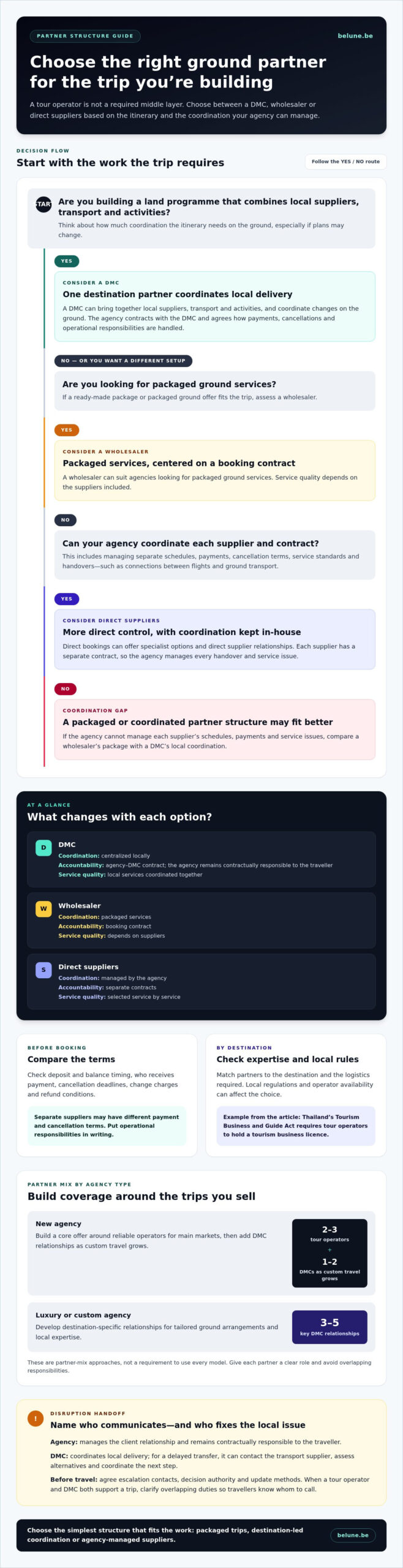
    A tour operator isn’t a required middle layer: a travel agency can work directly with a DMC for a land programme. The choice between a single DMC and multiple local operators depends on the destination, services and coordination required on the ground. A tour operator creates and sells a trip; a DMC helps deliver it locally.

    One clear point of contact can be valuable, especially when an itinerary combines accommodation, transport and local experiences. But one partner isn’t automatically right for every destination or trip. The key is clear operational ownership and a reliable handover when plans change.

    This comparison explains when agencies can work directly with a DMC, how DMCs differ from ground handlers, and how to choose between one destination partner and several local operators. It also shows how to assign support responsibilities during disruptions, so everyone knows their role before the journey begins.

    Key Takeaways

    • Work directly with a DMC when a trip needs coordinated local services and destination expertise, rather than a ready-made package.
    • Match your partner structure to the itinerary: one lead operator can simplify coordination, while regional partners can bring destination-specific knowledge.
    • Agree in advance who manages traveller communication and who resolves operational problems when plans are disrupted.
    • Distinguish a DMC’s destination-wide coordination from a ground handler’s delivery of specific local services before assigning responsibilities.

    Can a travel agency work with a DMC directly, without a tour operator?

    Yes. An agency can contract directly with a DMC for a land programme, or work with wholesalers and direct suppliers. The choice between a single DMC and multiple local operators depends on how much coordination the itinerary requires.

    Working with a DMC

    A DMC can suit trips that combine local suppliers, transport and activities, especially when changes require coordination on the ground. The agency contracts with the DMC and agrees in writing how supplier payments, cancellations and operational responsibilities are handled. The DMC coordinates local delivery, while the seller remains contractually responsible to the traveller if something goes wrong.

    Using a wholesaler or direct suppliers

    A wholesaler can suit agencies looking for packaged ground services. Direct suppliers can work well when the agency wants specific services and can manage each contract. Using several local operators may offer destination-specific options and direct supplier relationships, but the agency must coordinate separate schedules, payments, cancellation terms and service standards, including connections between flights and ground transport.

    How do the approaches compare on coordination, accountability, and service quality? A DMC centralizes local coordination; direct suppliers divide it across separate contracts. Define who handles each service and responds to disruptions.

    What booking, payment, and cancellation terms should travelers compare? Compare deposit and balance timing, who receives payment, cancellation deadlines, change charges and refund conditions. Separate suppliers may have different terms.

    What are the advantages of hiring multiple local operators directly? Direct bookings can offer specialist options and direct supplier relationships. The agency must manage every handover and service issue.

    How do local regulations and operator availability affect this choice by destination? Local rules can shape contracting. Thailand’s Tourism Business and Guide Act requires tour operators to hold a tourism business licence. Availability also affects whether one partner can coordinate the itinerary.

    Option Coordination Accountability Service quality
    DMC Centralized locally Agency-DMC contract Coordinated services
    Wholesaler Packaged services Booking contract Depends on suppliers
    Direct suppliers Agency-managed Separate contracts Selected service by service

    For a single DMC vs multiple local operators model, decide whether coordination or direct control of suppliers matters more.

    Agency partner strategy by business type

    An agency selling ready-made packages needs a different partner mix from a specialist designing custom trips. Let your itinerary, destination coverage and logistics capacity guide the structure.

    Direct agency-to-DMC partnerships

    A direct agency-to-DMC partnership connects the seller with a destination management company for local expertise and tailored ground arrangements. This differs from working with a wholesaler, which typically centers on packaged travel, and from contracting direct suppliers, which leaves the agency coordinating each provider. For custom travel, one DMC can give the agency a destination-focused counterpart while the agency maintains its relationship with the traveller.

    For example, an incentive itinerary may combine accommodation, transport and local experiences. A direct partner can coordinate these elements in one destination. Agencies serving different regions can work with separate DMCs for distinct markets, rather than expecting one partner to offer deep expertise everywhere.

    Choosing an agency partner

    Start with your business model. A new agency can build its core offer around 2-3 reliable tour operators for its main markets, then add 1-2 DMCs as custom travel grows. Luxury or custom agencies may instead develop relationships with 3-5 key DMCs. These are partner-mix approaches, not a requirement to use every model.

    Match each partner’s destination expertise to the trips you sell. Consider whether they can coordinate the required local logistics, whether their packages suit your clients, and how the partnership fits your sales role. For a trip requiring detailed local planning, a destination specialist may be more useful than a broader partner.

    Choose the simplest structure that fits the work: use tour operators for established packages, and DMC relationships for destination-specific custom itineraries. Keep regional coverage deliberate, so each partner has a clear role rather than overlapping responsibilities. For agencies shaping a destination-led programme, regional partner planning can help frame the right operational approach.

    Work Directly With a DMC or Use Multiple Local Operators?

    Emergency support and responsibility for disruptions

    Before travel, assign each disruption to a named contact and a clear action. A DMC vs tour operator arrangement works best when the client knows who communicates and who manages local delivery.

    DMC operational responsibility

    If a transfer is delayed, the DMC handling ground operations can contact the local transport supplier, assess alternatives and coordinate the next step. The agency manages the client relationship, while the DMC addresses the operational issue. Set out escalation contacts, decision authority and update methods in the contract. The DMC’s local role supports a response on the ground, but does not remove the seller’s contractual responsibility to the traveller.

    Overlapping operator responsibilities

    When a tour operator and DMC both support a trip, overlapping duties can leave a traveller unsure whom to call. Large international safari operators typically provide 24/7 global support desks, while local partners may handle issues on the ground. The arrangement should clarify whether the desk contacts the DMC or expects the traveller to do so. One lead for each issue prevents duplicated instructions.

    Set the communication sequence before departure. First, the traveller contacts the agency’s published trip contact. The agency then informs the DMC or operator responsible for the service. The operational partner contacts the relevant supplier, such as a transport company, and reports the action taken and expected timing. The agency shares the update with the client and records any decision affecting the itinerary.

    Specify who can authorize a replacement transfer, who pays the supplier and who approves itinerary changes. Compare these terms with the booking conditions and net rates, rather than assuming the quoted price defines emergency responsibilities. Confirm whether the DMC or operator coordinates with suppliers and name a backup contact. Clear responsibilities keep operational decisions distinct from client communication.

    What is a destination management company (DMC) and what services does it provide?

    A destination management company works in the place it serves. Its local knowledge can span hotels, guides, restaurants and transport, helping an agency shape services into a coherent itinerary. Coverage is often regional or country-specific, with deeper expertise in the DMC’s core destinations.

    For example, an agency planning a cultural group trip can draw on local knowledge to align hotel locations, guided visits and transport timing. A DMC can coordinate these destination services as one programme. A ground handler, by comparison, generally focuses on delivering specific services, such as a transfer or booked excursion, rather than coordinating the broader destination plan.

    The distinction matters most when a route has several moving parts. The traveller’s agency may be far away, while local providers manage immediate details. A DMC can bring destination suppliers together and explain how hotels, guides and transport fit the itinerary. The agency remains responsible for the traveller relationship and sets the programme’s overall objectives.

    Local knowledge can also shape the character of a visit. A guide can connect an itinerary to regional history, while restaurant choices and local businesses offer visitors a closer view of the destination. DMCs can support destination stewardship by shaping experiences that engage local communities and businesses and reflect sustainability goals. Agencies can consider not only which services fit, but how the itinerary connects with the place.

    Use a DMC when a programme needs destination-wide coordination, tailored local experiences or knowledge beyond individual supplier bookings. Use a ground handler for a defined service that needs local delivery but little wider coordination. The right distinction depends on whether the agency needs someone to connect the itinerary or deliver a specific component. To shape a group itinerary around local hotels and guidance, plan destination-led group travel.

    BELUNE: Hotel Accommodation Management

    BELUNE supports travel agencies and tour operators with Hotel Accommodation Management for group programmes across the Benelux and Paris region. It can be a fitting partner when a trip needs hotel arrangements alongside Coach Hire with its own fleet of buses, Local Guide Services or Art & Culture Group Tours.

    This combination helps shape a coherent group itinerary, with accommodation and local experiences planned as connected parts of the journey. Agencies can work with BELUNE on customized group travel instead of treating each element as a separate booking.

    To discuss a group itinerary with BELUNE, visit belune.be or contact the team.

    Shape the Partnership Around the Journey

    Choosing between a single DMC and multiple local operators is a design decision: choose the structure that best serves the journey. Before planning your next programme, map its essential moments, from arrival and accommodation to the experiences that give each destination its character. Then consider where local coordination will best support the itinerary and your agency’s working style.

    This makes partner selection a practical part of trip design rather than a separate sourcing exercise. It also gives your team a clear starting point for developing a distinctive group programme with a coherent rhythm.

    BELUNE works with travel agencies on group travel arrangements, including Hotel Accommodation Management, Coach Hire with its own fleet of buses, and Local Guide Services. Discuss your agency’s next group itinerary with BELUNE and take the next step toward bringing it to life.

    Frequently Asked Questions

    What is the difference between a DMC and a tour operator?

    A DMC focuses on destination operations, while a tour operator creates and sells travel packages. For example, a tour operator might sell a multi-day itinerary and contract a DMC to arrange local services. An agency working directly with a DMC takes on the sales relationship itself. The distinction is who assembles and sells the trip, and who organizes its destination services.

    Can You Use Both?

    Yes. An agency can use a tour operator for a ready-made package and a DMC for a custom extension or special local programme. For instance, a traveller could book a packaged stay, then add a locally coordinated cultural visit through a DMC. Define which booking covers each service, who communicates changes and how the arrangements connect, so no part of the itinerary falls between contracts.

    Does a DMC ever sell to travellers directly?

    Some DMCs may sell directly, but they primarily work with travel advisors, tour operators and meeting planners. Their business-to-business role generally supports trade partners rather than competing for the end client. The sales channel can vary by company and trip. For an agency, the practical question is whether the DMC supports its client relationship or sells a separate arrangement directly to the traveller.

    What are the advantages of using one DMC for an entire trip or event?

    One DMC can provide a consistent local operating relationship across an itinerary. For a corporate event, one partner can coordinate destination services around the programme’s schedule, reducing the need for the agency to align separate local contacts. This structure is most useful when several services depend on one another. It does not remove the agency’s role in setting expectations with its client.

    How do single-DMC and multiple-operator costs compare, including fees and markups?

    Compare the pricing structure and included services, not just the headline total. A boutique DMC safari booking typically involves one markup layer, while a large international safari operator booking often involves two or more, including the operator’s and subcontracted DMC’s margins. Direct supplier bookings may show separate service charges and change terms. These examples describe markup structures, not guaranteed savings or a quote for another trip.

    How do DMCs and local operators handle insurance, permits, safety, and liability?

    Responsibility depends on service contracts and local rules. For each activity or transport booking, identify which company holds the relevant permits, what insurance applies, and who handles incident reporting or claims. Make sure the contract names the responsible operator and sets out safety procedures and escalation contacts. The selling agency should also understand its contractual obligations to the traveller and explain them clearly.