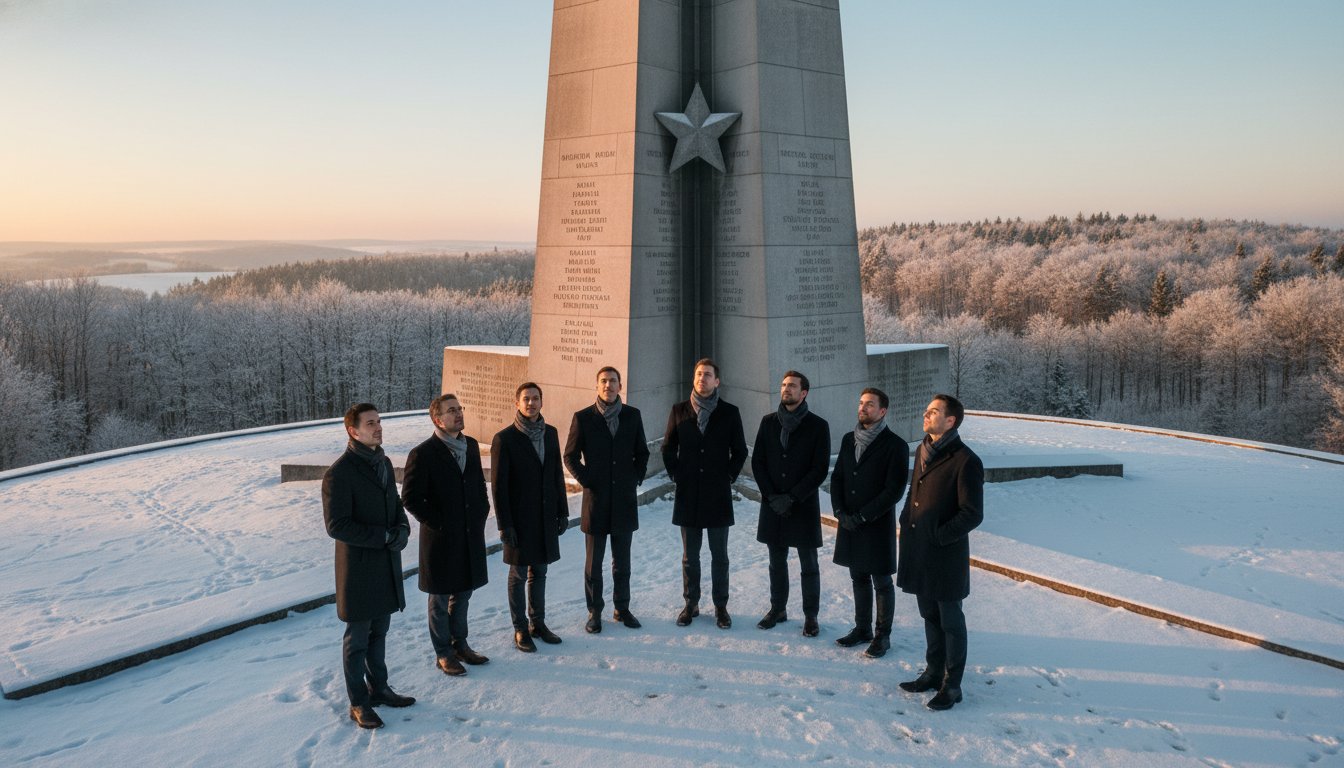
Can a landscape defined by 89,500 casualties and the dense, unforgiving terrain of the Ardennes ever be truly “managed” for a professional delegation? Organizing a battle of the bulge tour for history groups requires more than a map and a timeline; it demands a synthesis of deep historical reverence and modern logistical precision. You likely understand that the difference between a standard sightseeing trip and a profound historical pilgrimage lies in the invisible details. Managing large group logistics in rural Belgium, finding hotels that accommodate professional needs, and ensuring guide expertise matches your group’s depth of knowledge are challenges that can’t be left to chance.
This article provides a blueprint to orchestrate a logistically seamless journey through the Ardennes in 2026. You’ll discover how to leverage local expertise to secure a turnkey solution for travel, from private coach hire to exclusive access at sites like the Mardasson Memorial and the Siegfried Line. We will explore the essential coordination of transport, lodging, and site visits required to create an unforgettable commemorative experience that honors the 19,000 American lives lost while providing your group with elite comfort and insight.
Key Takeaways
- Grasp the enduring legacy of the Ardennes Counteroffensive and why 2026 represents a defining chapter for professional historical remembrance.
- Uncover the strategic significance of Bastogne and Elsenborn Ridge when designing a definitive battle of the bulge tour for history groups.
- Recognize the operational superiority of a local DMC over international middlemen, specifically regarding coach fleet reliability and expert hotel management.
- Learn how to synthesize complex historical narratives with seamless logistics to create customized, high-end itineraries for diverse professional audiences.
- Gain insights into the turnkey approach that transforms a standard battlefield visit into a profound, expertly coordinated pilgrimage.
The Significance of the Battle of the Bulge for History Groups in 2026
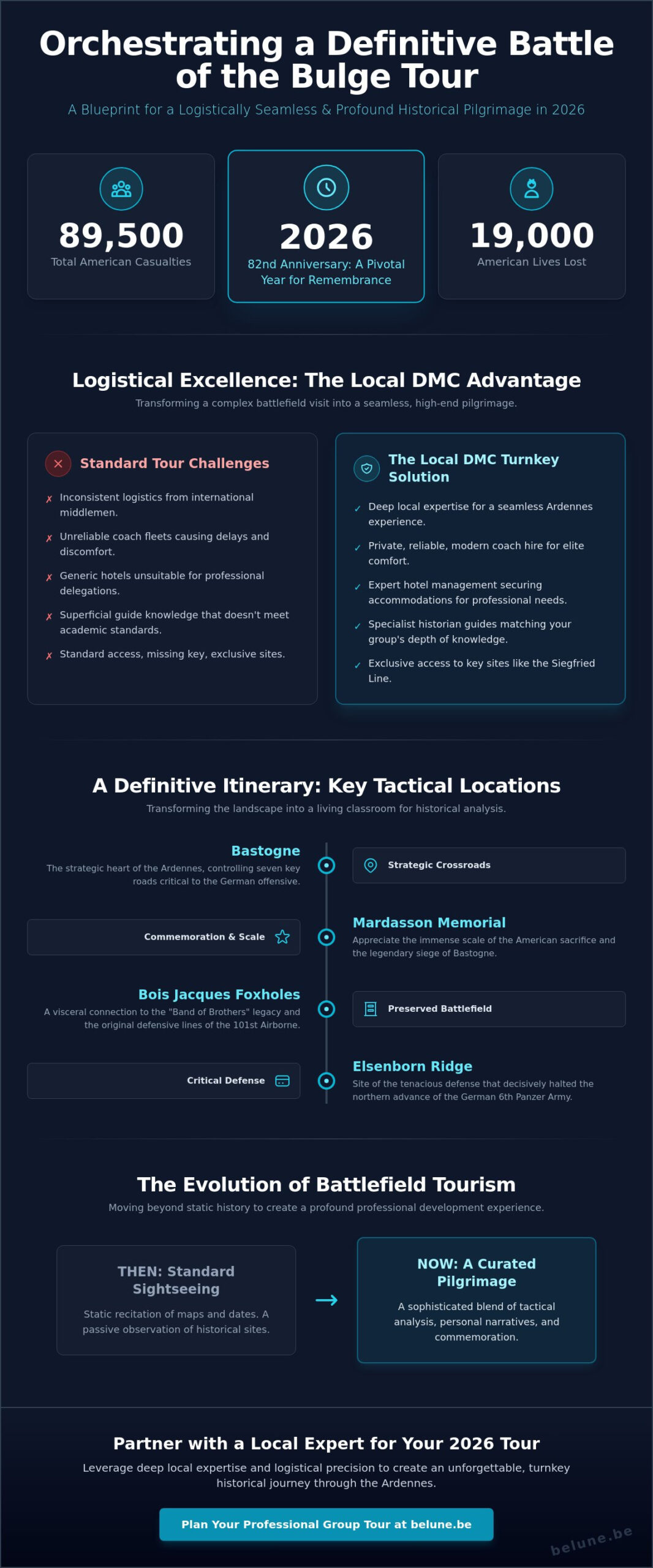
The Battle of the Bulge wasn’t just a military engagement; it was a test of American endurance. It remains the largest and bloodiest single battle fought by the United States. For those organizing a battle of the bulge tour for history groups, the weight of these statistics becomes tangible in the quiet forests of the Ardennes. A comprehensive overview of the Battle of the Bulge reveals a front line that stretched for miles, where 89,500 American casualties were recorded between December 1944 and January 1945. This historical event represents a peak in tactical complexity and human sacrifice.
To better understand the scale and intensity of this conflict, watch this helpful video summary of the offensive:
By 2026, the legacy of the Ardennes has matured into a deep historical archive. We aren’t just looking at dates on a timeline; we’re witnessing the closing of a living chapter. This 82nd anniversary year serves as a pivotal moment for history groups to document the terrain before the physical landscape changes further. It’s a transition from simple sightseeing to a curated historical pilgrimage where the emotional weight of 19,000 lives lost is met with rigorous academic study. This evolution reflects a growing desire for professional groups to find meaning beyond the museum glass.
Why Historical Groups Prioritize the Ardennes
The geography of the 1944 winter dictated every tactical decision. History groups find immense value in analyzing how the dense forests and narrow ridges of the Ardennes neutralized Allied air superiority. Military academies and historical societies prioritize this region because it offers a rare, preserved laboratory of war. You can still find the foxholes of the 101st Airborne and the original defensive lines carved into the earth. It’s a place where theory meets reality. The preservation of these sites allows for a technical assessment of infantry tactics that is impossible to replicate in a classroom.
The Evolution of Battlefield Tourism
Modern tours have evolved significantly. We’ve moved beyond the static recitation of maps to a more nuanced tactical analysis. A battle of the bulge tour for history groups in 2026 utilizes personal narratives to breathe life into the cold statistics. We define a “battlefield pilgrimage” as a sophisticated blend of education and commemoration, where the technical mastery of the military historian meets the quiet respect of the memorial site. This approach transforms a trip into an enduring professional development experience that honors the past while educating the future.
Essential Sites for a Comprehensive Group Itinerary
A successful battle of the bulge tour for history groups begins with a spatial understanding of the front. It isn’t enough to visit a museum; one must stand where the lines held. The U.S. Army’s official Battle of the Bulge overview underscores the sheer fortitude required to maintain these positions under extreme winter conditions. We prioritize sites that allow for tactical group analysis, transforming the landscape into a living classroom for academic and professional delegations. By focusing on the intersection of topography and decision-making, the tour moves beyond simple observation into active historical investigation.
Bastogne and the Siege Legacy
Bastogne remains the strategic heart of the Ardennes. Its significance stems from the seven key roads that converged on the town, making it a logistical necessity for the German offensive. Groups can stand at the Mardasson Memorial to appreciate the scale of the siege before exploring the Bastogne War Museum. This facility integrates modern, multi-sensory experiences that help visualize the 1944 frontlines with precision. A short drive away, the foxholes of Bois Jacques offer a visceral connection to the “Band of Brothers” legacy, where the original defensive lines remain etched into the forest floor, silent witnesses to the 101st Airborne’s resilience.
The Eastern Front and Tactical Analysis
Analyzing the Northern Shoulder at Elsenborn Ridge reveals how the defense successfully funneled German forces into narrow, vulnerable corridors. This area contrasts sharply with the narrative of Kampfgruppe Peiper. Navigating the difficult history of the Malmedy Massacre requires a guide who can balance tactical movements with the profound human tragedy of the event. At Parker’s Crossroads, history groups can engage in a focused case study of how a scratch force held a vital intersection against overwhelming odds, a perfect example of small-unit leadership changing the course of a campaign.
The Eastern Front offers a deeper look into the logistics of the German advance. St. Vith highlights the importance of rail hubs, while the bridges over the Amblève illustrate the geographical barriers that ultimately slowed the Panzer divisions. A visit to the Henri-Chapelle American Cemetery, containing 7,992 graves, or the Luxembourg American Cemetery provides a moment of necessary reflection for the group. These sites are best reached through carefully managed transport solutions that handle the narrow, winding roads of the High Fens with professional ease. Coordinating these diverse locations into a single, cohesive battle of the bulge tour for history groups ensures that no tactical detail or commemorative moment is overlooked.
Logistical Excellence: The DMC Advantage for History Groups
Organizing a battle of the bulge tour for history groups requires more than deep historical knowledge; it requires operational mastery. International travel agents often act as middlemen, lacking the ground-level connections needed for the Ardennes. A local Benelux DMC provides a direct link to the region’s specific requirements. We understand that a fifty-person group can’t simply arrive at a remote memorial without pre-arranged access. This local expertise ensures every museum visit, site stop, and lunch break is timed with surgical precision. It’s about removing the friction of travel so the history can take center stage.
The terrain of the Ardennes remains notoriously difficult. As highlighted in the U.S. Army Battle of the Bulge Overview, the narrow ridges and dense forests that challenged the 1944 offensive still present obstacles for modern travel. Navigating these rural roads requires a fleet that balances capacity with maneuverability. It’s about ensuring the journey is as seamless as the destination. We prioritize reliability, using our own fleet to maintain standards that third-party contractors simply can’t guarantee.
Private Coach Hire and Transport Logistics
Drivers in this region aren’t just operators; they’re logistical partners. They must understand the nuances of battlefield accessibility, knowing exactly where a coach can safely stop near preserved foxholes or narrow village monuments. High-end coaches feature on-board amenities like audio-visual systems for historical lectures during transit. This allows the group’s historian to provide context while moving between sites, maximizing every minute of the itinerary. Precise coordination of drop-offs at sensitive memorials ensures the group maintains a focused, respectful atmosphere without the distraction of parking delays.
Hotel Accommodation Management for Large Groups
Large history groups have unique requirements that standard tourist hotels often overlook. We source accommodations that offer private lecture spaces for evening debriefs and understand the necessity of early starts for dense itineraries. Managing room blocks and complex dietary needs for international delegations requires a meticulous, professional approach. Our custom Benelux itineraries integrate these logistical components into a single, fluid experience. This turnkey solution allows the group’s leadership to focus on the historical narrative while we manage the underlying structure. It’s a partnership built on trust and technical excellence.
Customizing Itineraries for Diverse Historical Interests
A battle of the bulge tour for history groups shouldn’t be a rigid, one-size-fits-all experience. Precision in planning allows for a transformation of the traveler’s perspective, ensuring the itinerary mirrors the specific intellectual or emotional goals of the delegation. We don’t believe in static schedules. Whether you’re coordinating a university seminar or a veteran-affiliated pilgrimage, the flow of the journey must adapt to the group’s depth of expertise. This flexibility ensures that every stop provides fresh insight rather than redundant observation. It’s about creating a dialogue between the participants and the landscape.
Educational and Academic Customization
Educational groups often prioritize primary source analysis over general narratives. We facilitate this by incorporating expert lectures and access to specialized historical consultants who can detail specific unit movements with technical mastery. For military academies, the focus shifts toward tactical decision-making and leadership under pressure. By aligning the visit with a specific curriculum, the Ardennes becomes a tangible extension of the classroom. We provide the structural support needed for these deep-dive investigations, ensuring that logistics never interfere with the academic process. It’s a sophisticated approach to learning that honors the complexity of the conflict.
Thematic Extensions: Beyond the Battlefield
Broadening the scope often leads to a more profound understanding of the European experience. Many groups choose to connect the dots between conflicts by visiting Flanders Fields, creating a comprehensive narrative of the World Wars. This thematic extension provides a stark contrast between the static trench warfare of 1914 and the mobile, mechanized chaos of 1944. Pairing these historical deep-dives with Belgium gastronomy tours offers a necessary cultural balance. Sensory history is found in the local food and the quiet atmosphere of a village tavern as much as in the silence of a forest foxhole. It’s a way to celebrate the culture that survived while respecting the gravity of the past.
Ensuring every member can participate is a core professional standard. We meticulously plan for accessibility, identifying which forest paths or museum floors are suitable for all mobility levels. This technical foresight allows every participant to experience the sites without physical barriers. This level of detail is what separates a standard trip from a truly inclusive pilgrimage. If you’re ready to design a bespoke journey for your delegation, you can start planning your professional group tour with our expert team today. We’re here to ensure your vision for 2026 is realized with both elegance and precision.
Partnering with BELUNE for Your 2026 History Tour
A 20-year legacy in the Benelux region has taught us that excellence is never accidental. It’s the result of technical rigor and a passion for the narratives that shaped our landscape. When you choose to partner with us for a battle of the bulge tour for history groups, you’re engaging with a team that views logistics as a structural art form. We don’t simply provide transport and beds; we provide a foundation of reliability that allows the historical weight of the Ardennes to resonate. Our approach remains sober and professional, ensuring that every partner feels the security of our decades-long expertise.
Control is the cornerstone of our service. Unlike agencies that rely on third-party contractors, we utilize our own fleet of modern coaches. This ownership allows us to maintain uncompromising professional standards, from the mechanical precision of our vehicles to the expertise of our drivers. They understand the specific demands of battlefield tourism, where navigating narrow rural roads requires both skill and local intuition. This internal coordination ensures that your itinerary remains on schedule, regardless of the complexities of the terrain or the size of your delegation.
A Visionary Approach to Group Travel
We transform a standard trip into a strategic historical event. Every group is assigned a dedicated project manager who serves as a single point of contact, ensuring that the conceptual vision of your tour is translated into flawless execution. This personal accompaniment is a marker of our identity. It allows for a level of customization and responsiveness that larger, impersonal firms cannot match. You can explore our methodology and request a quote for a fixed-price group tour package to see how we balance transparency with high-end service.
Your Strategic Partner in Benelux
Our expertise extends across the borders of Belgium, Luxembourg, and the Netherlands. This regional mastery is vital for a battle of the bulge tour for history groups, as the offensive’s narrative spans multiple jurisdictions and diverse landscapes. We manage the intricate details of hotel check-ins, museum entries, and local guide services with a focus on seamless transitions. Our local guides aren’t just historians; they’re experts in group dynamics who can tailor their delivery to the specific knowledge level of your participants. This synergy between technical mastery and human experience is what defines the BELUNE standard. We invite you to contact our team to begin designing your custom 2026 itinerary, ensuring your next historical pilgrimage is executed with the excellence it deserves.
Orchestrating a Journey of Remembrance in 2026
The Ardennes landscape offers a profound connection to the past; however, the bridge between academic study and a successful pilgrimage is built on technical excellence. You’ve seen how the convergence of strategic site selection and flawless logistical coordination defines a professional experience. By prioritizing local expertise and a modern fleet of private coaches, your delegation can move beyond the surface of the conflict to uncover its deeper tactical and human truths. This synthesis of historical reverence and operational precision is what transforms a trip into an enduring commemorative event.
A definitive battle of the bulge tour for history groups requires a partner who understands that every detail, from hotel management to expert-led battlefield analysis, is a structural component of the experience. With over 20 years of Benelux DMC experience and a dedicated team of heritage tourism specialists, we ensure your 2026 itinerary is executed with sophistication and rigor. Our private fleet of high-standard coaches provides the reliability your professional group demands in this challenging terrain.
The path to a transformative historical event starts with a single conversation. Request your custom Battle of the Bulge group itinerary from our experts today and let’s transform your vision into a seamless reality. We look forward to honoring this enduring legacy alongside your group.
Frequently Asked Questions
What is the best time of year for a Battle of the Bulge group tour?
Late spring and early autumn provide the most favorable weather for walking tours, while December offers the most authentic atmospheric conditions. Many history groups choose the winter months to coincide with the “Nuts Weekend” commemorations in Bastogne. This timing allows participants to experience the biting cold that defined the 1944 offensive, adding a visceral layer of understanding to the tactical challenges faced by soldiers on both sides.
How many days are needed for a comprehensive history group tour of the Ardennes?
A comprehensive tour of the Ardennes usually spans three to five days. This timeframe allows your group to move beyond the major monuments and explore the tactical nuances of the High Fens and the Northern Shoulder. It ensures enough time for deep-dive analysis at sites like Parker’s Crossroads without rushing the commemorative moments at the American cemeteries. Shorter durations often sacrifice the depth required for a professional historical pilgrimage.
Can BELUNE provide specialized guides for military history groups?
We collaborate exclusively with local guides who possess deep expertise in military history and tactical analysis. These professionals are adept at managing the specific dynamics of a battle of the bulge tour for history groups, ensuring the narrative matches the audience’s knowledge level. Whether your delegation consists of academic historians or military veterans, our guides provide a level of technical insight that goes far beyond standard tourist scripts.
Are the Battle of the Bulge sites accessible for groups with limited mobility?
Major museums and memorials in the region are fully accessible, but rural sites like the foxholes in Bois Jacques require specialized logistical planning. We conduct detailed audits of every stop to ensure group members with limited mobility can participate safely. By utilizing our private fleet of coaches, we can coordinate drop-offs as close as possible to sensitive historical sites, minimizing physical strain while maximizing the experience.
Does BELUNE manage hotel bookings for large history societies?
We provide comprehensive hotel accommodation management for large history societies and professional delegations. Our team sources venues that understand the unique needs of these groups, such as the requirement for private lecture halls and efficient group dining. By managing these block bookings directly, we ensure your group stays in high-demand historical zones without the logistical friction of individual reservations or fragmented lodging.
What types of coaches are available for battlefield tours in the Ardennes?
Our private fleet includes a variety of modern, high-standard vehicles tailored to the Ardennes terrain. We typically deploy executive minibuses for smaller delegations and full-sized touring coaches for larger societies. Each vehicle is equipped with audio-visual systems, allowing for historical lectures during transit. These coaches are specifically chosen for their ability to navigate the narrow, winding ridges of the region while maintaining elite passenger comfort.
Can we combine a Battle of the Bulge tour with other Benelux historical sites?
Integrating the Ardennes with other Benelux historical sites is a core part of our service. You can easily combine your battle of the bulge tour for history groups with visits to Flanders Fields or the liberation routes in the Netherlands. This broader perspective allows for a more complete understanding of 20th-century European conflict, linking the static trench warfare of the Great War with the mechanized mobility of World War II.
How far in advance should we book a group tour for the 2026 season?
Securing a tour for the 2026 season should ideally happen nine to twelve months in advance. The 82nd anniversary year is expected to see high demand for specialized military historians and group-friendly accommodations in Bastogne. Early booking ensures that we can secure the best hotel blocks and coordinate the most sought-after local guides, providing your group with a seamless and highly curated historical experience.
Leave a Reply