Tag: 2026 Tours

  • The Australian Battlefield Trail in Flanders: A Group Pilgrimage Through History

    The Australian Battlefield Trail in Flanders: A Group Pilgrimage Through History

    Nearly 300,000 Australians served on the Western Front, leaving behind a legacy that still breathes through the quiet fields of Belgium and France. For those organizing professional group tours, the australian battlefield trail flanders isn’t just a route on a map; it’s a narrative thread that transforms the landscape into a living classroom. You likely recognize that a pilgrimage of this magnitude requires more than just a list of stops. It demands a sophisticated blend of historical accuracy and logistical grace to ensure the emotional weight of the journey isn’t lost in the details of travel.

    Planning for 2026 requires navigating specific museum schedules and the unique requirements of rural sites like the In Flanders Fields Museum or the Memorial Museum Passchendaele 1917. This guide provides the essential framework to help you master these complexities. We’ll explore the logistical requirements for coach transport, the selection of group-friendly accommodations near the front lines, and the historical depth needed for a truly resonant itinerary. You’ll discover how a professionally managed approach turns complex site management into a seamless, deeply moving experience for your clients.

    Key Takeaways

    • Master the narrative thread of the australian battlefield trail flanders by identifying the essential stops that define the Australian experience on the Western Front.
    • Optimize your 2026 itinerary by leveraging strategic base locations in Flanders to manage complex cross-border logistics with France.
    • Secure high-comfort coach hire and group-friendly accommodations that align with the technical and emotional requirements of a high-end pilgrimage.
    • Elevate your tour’s impact through a reliable local partnership that balances historical precision with flawless operational execution.

    What is the Australian Remembrance Trail in Flanders?

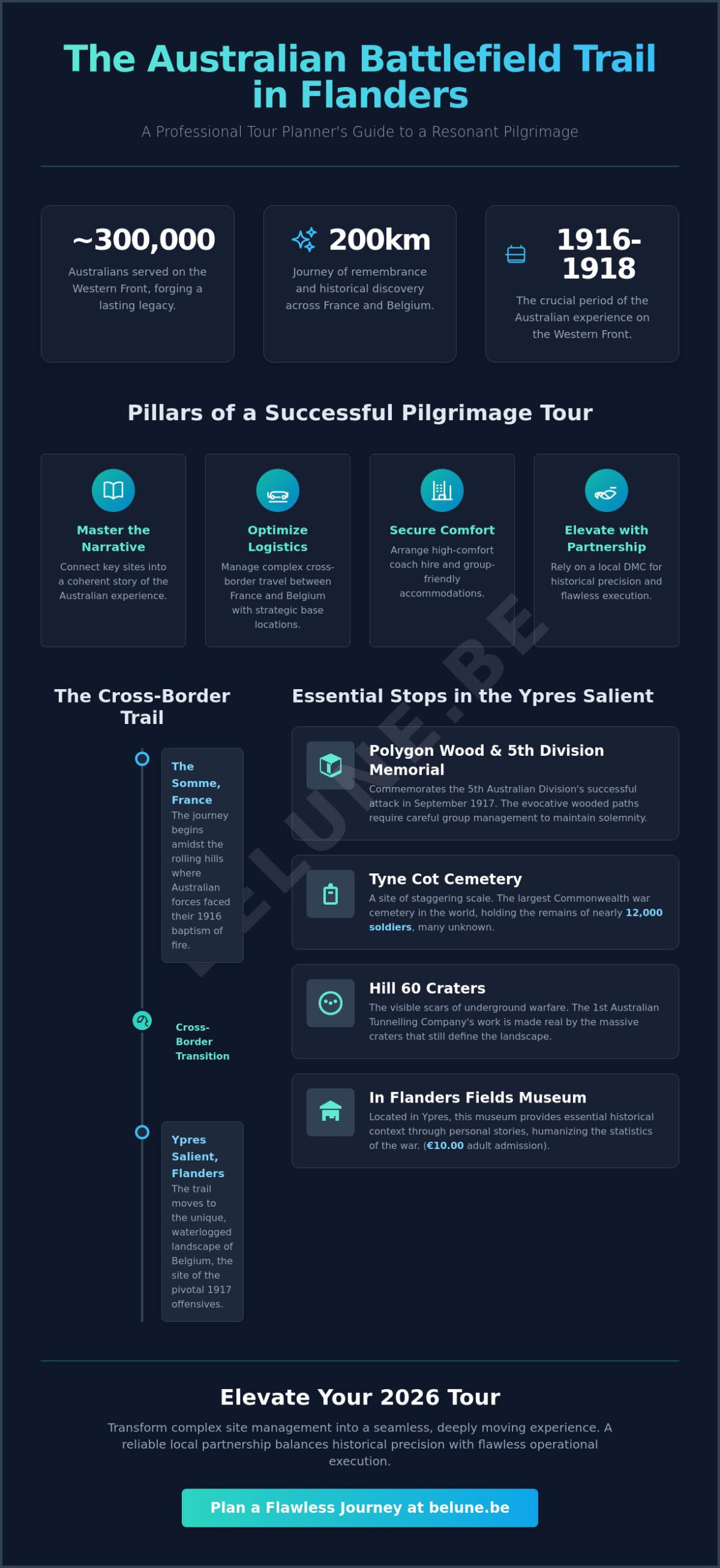
    Memory has a physical presence in the soil of Northern Europe. The Australian Remembrance Trail is a formal commemorative route established to honor Australian service on the Western Front. It represents a deliberate, cross-border effort to preserve the sites where history was forged. Spanning from the Somme in France up through the Ypres Salient in Flanders, this journey offers a structured way to explore the 1916-1918 Australian experience. The trail is a 200km journey of remembrance and historical discovery. For professional groups, the australian battlefield trail flanders serves as a curated tapestry of memory, linking isolated cemeteries, preserved trenches, and world-class museums into a single, coherent narrative.

    The Significance of the Flanders Landscape

    The “Flanders Fields” aesthetic resonates deeply with Australian visitors. There is a haunting beauty in the rows of white headstones set against the low, heavy skies of Belgium. In the Ypres Salient, the Australian Imperial Force (AIF) faced a landscape defined by waterlogged craters and the relentless pressure of high ground. Transitioning from the rolling hills of the Somme to the unique challenges of the Belgian front requires an appreciation for the geography of war. Flanders was a test of technical mastery and human endurance. Grasping this environmental reality is the first step toward understanding the tactical decisions that defined the later years of the conflict.

    A Narrative Approach to Group Itineraries

    A successful group itinerary moves beyond a simple recitation of dates and names. It seeks to illuminate the stories of individual soldiers, giving a face to the vast statistics of the Great War. Curated journeys provide emotional peaks at key locations, such as the Villers-Bretonneux Australian National Memorial, where the narrative of the trail often finds its most powerful expression. Local context is vital for understanding the 1917 offensives. Without it, the complex maneuvers at Menin Road or Broodseinde remain abstract concepts. By grounding the Australian story in the specificities of the Flemish earth, we create an experience that is both technically precise and deeply resonant. This narrative depth ensures the australian battlefield trail flanders remains a vital pilgrimage for generations to come.

    Essential Stops on the Australian Trail in Flanders

    The geography of the australian battlefield trail flanders is remarkably intimate. Unlike the vast, rolling plains of the Somme, the Flemish landscape concentrates its history into a few critical kilometers. This proximity allows for a deep, reflective exploration of the 1917 offensives without the exhaustion of long transit times. Every ridge and wood in this sector tells a specific story of the Australian Imperial Force (AIF) and their technical mastery of a brutal environment.

    Polygon Wood and the Buttes New British Cemetery

    The 5th Australian Division’s successful attack in September 1917 is memorialized at Polygon Wood. The 5th Division Memorial stands as a stark, vertical landmark overlooking the Buttes New British Cemetery. For groups, this site requires careful choreography. The wooded paths are evocative but narrow; managing the movement of a large group through these trails ensures the solemnity of the visit remains intact. The emotional weight of the Dawn Service locations here is profound. When the morning mist still clings to the trees, the landscape looks much as it did a century ago, providing a powerful connection for your clients.

    Tyne Cot Cemetery represents a site of staggering scale. As the largest Commonwealth war cemetery in the world, it holds the remains of nearly 12,000 soldiers. Many are “Unknown” Australians, their headstones bearing only the moving inscription chosen by Rudyard Kipling. Nearby, Hill 60 offers a different perspective on the conflict. Here, the 1st Australian Tunnelling Company engaged in a claustrophobic, underground struggle. The massive craters left by the mines are physical scars that make the technical reality of the war visible to modern visitors.

    The Ypres Salient: A Concentrated Geography of Memory

    The compact nature of the Ypres Salient means your group can transition between sites with ease. This efficiency allows for a more contemplative pace, leaving room for reflection rather than rushing between monuments. Integrating the In Flanders Fields Museum in Ypres provides the necessary historical framework before visiting the sites themselves. The museum, with its adult admission of €10.00, uses personal stories to humanize the statistics of the Great War.

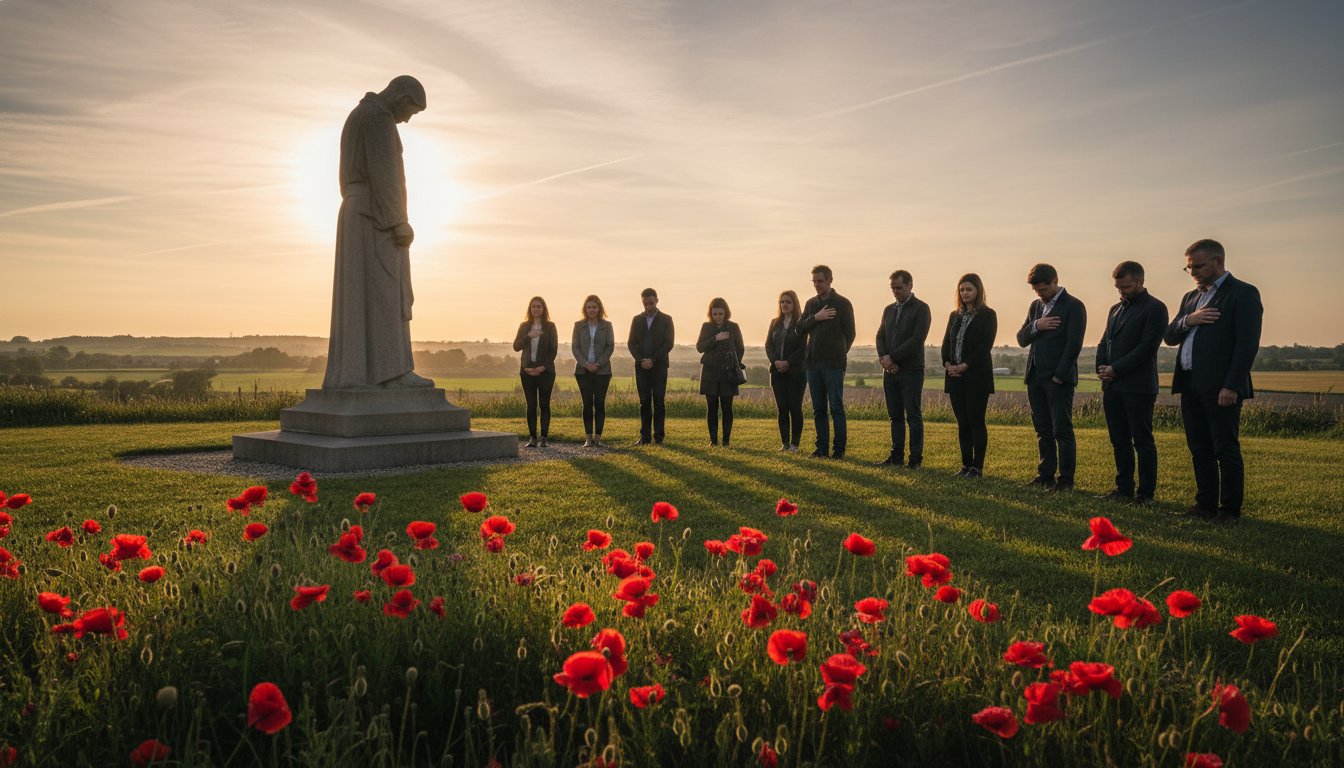
    The day inevitably culminates at the Menin Gate. The nightly Last Post ceremony is a mandatory experience for any group following the Australian Remembrance Trail. It is a moment of communal silence that bridges the gap between the past and the present. To ensure your group experiences these sites with the respect and precision they deserve, consider our tailored battlefield itineraries which balance historical depth with seamless logistical execution.
    The Australian Battlefield Trail in Flanders: A Group Pilgrimage Through History

    Connecting Flanders and the Somme: Cross-Border Logistics

    The narrative arc of the australian battlefield trail flanders doesn’t respect modern administrative borders. It officially begins its journey in the Somme valley of France, specifically at the Sir John Monash Centre in Villers-Bretonneux. This geographical reality makes meticulous cross-border coordination a vital element of professional group planning. Transitioning from the defense of Amiens in 1918 back to the 1917 offensives in Belgium requires a logistical bridge that keeps the historical context clear and the travel experience effortless.

    Strategic base locations are the foundation of a successful multi-day pilgrimage. While the trail spans approximately 200 kilometers, establishing a base in the Flanders region is often the most effective choice for those exploring the australian battlefield trail flanders. It allows groups to immerse themselves in the atmosphere of Ypres while remaining within striking distance of the French sites. This stability is key. It prevents the logistical clutter of daily hotel changes, leaving more room for the quiet reflection these sites demand.

    From Villers-Bretonneux to Ypres

    Linking the 1918 defense of Amiens to the earlier battles in Flanders is essential for a coherent itinerary. We treat the journey between Villers-Bretonneux and Ypres as a narrative progression rather than a simple transfer. This involves incorporating “missing link” stops such as Fromelles and Bullecourt. These sites provide critical context for the Australian experience on the Western Front. By carefully optimizing travel times, we protect groups from “battlefield fatigue.” It’s about finding the right rhythm between intensive historical site visits and the restorative flow of the journey through the countryside.

    Unified Logistics for Multi-Day Pilgrimages

    Consistency is the hallmark of a high-end tour. Utilizing a specialized benelux incoming tour operator provides the regional expertise necessary for such a complex undertaking. We ensure that every component of the trip, from the technical quality of the coaches to the historical depth of the guiding, remains uniform across both the French and Belgian sectors. Coordinating local guides who understand the nuances of both regions is a priority. This unified approach extends to hotel management. Streamlining bookings across two countries for large groups requires a reliable local partnership that understands the specific needs of historical tourism. We handle these technical details so the focus remains entirely on the emotional and educational outcomes for your clients.

    Professional Planning for Battlefield Group Tours

    Expertise in the australian battlefield trail flanders requires more than historical knowledge. It demands a flawless technical infrastructure. For professional planners, the challenge lies in translating a somber pilgrimage into a comfortable, high-end experience. We believe that the quality of transport and the choice of sanctuary at the end of the day are structural components of the journey’s emotional success. A well-managed itinerary allows guests to focus entirely on the narrative without the distraction of logistical friction.

    Coach Hire and Accessibility in Flanders

    The rural roads of Flanders are beautiful but demanding. Navigating these narrow lanes with a private fleet of modern, high-comfort coaches requires both technical skill and local foresight. We ensure that driver hours and route planning align perfectly with the strict timing of the Last Post ceremony in Ypres. Parking at major memorials like Tyne Cot or the Menin Gate can be complex during peak commemorative periods. Our strategies for drop-offs and parking are designed to minimize walking distances for guests while maintaining the flow of the day’s events. This level of detail is essential for groups with varying mobility needs.

    Accommodation Management for Large Groups

    Securing high-quality room blocks during periods like Anzac Day or Armistice is a significant hurdle for many planners. We prioritize hotels that reflect a sense of minimalist elegance and refined comfort. These sanctuaries provide a necessary space for reflection after intensive site visits. Proximity to historic centers is vital. It gives your clients the freedom for evening exploration in Ypres or Arras, where the atmosphere of the past is most palpable. Managing these bookings requires a deep understanding of local hospitality and the foresight to secure space years in advance for the 2026 season.

    Integrating Local Flavors and Culture

    A pilgrimage shouldn’t be defined solely by the weight of history. Including belgium gastronomy tours provides a necessary counter-balance to the somber nature of the trail. We arrange group lunches at historic “estaminets” near the battlefields, where the rustic charm and local cuisine offer a moment of respite. Customizing itineraries with craft beer tastings or artisanal chocolate experiences adds a layer of sensory engagement that enriches the overall journey. Balancing the technical demands of the australian battlefield trail flanders with these cultural highlights creates a truly holistic experience. Partner with our specialists to design your 2026 Australian group pilgrimage.

    Why Partner with a Specialized DMC for the Australian Trail?

    Navigating the australian battlefield trail flanders requires a partner who understands that every detail carries the weight of history. A pilgrimage of this magnitude isn’t a standard tourism product; it’s a profound responsibility. We bring over 20 years of experience in high-quality Benelux group travel to this delicate task. Our role is to act as a bridge between the technical requirements of modern travel and the deep emotional journey your clients expect. We don’t simply manage bookings. We craft an environment where the story of the AIF can be told with the respect and clarity it deserves.

    A deeply professional approach is the only way to mirror the solemnity of the trail. From the initial itinerary design to the final on-the-ground execution, we provide comprehensive support that anticipates the unique challenges of battlefield tourism. By managing all logistical volumes with technical mastery, the australian battlefield trail flanders becomes an artistic and technical masterpiece of travel. This allows your group leaders to focus on the narrative while we ensure the machinery of the tour remains invisible and flawless.

    Our Vision for Battlefield Tourism

    We treat each itinerary as a curated experience rather than a standard package. This is the “Belune touch.” It’s a philosophy that balances technical precision with emotional resonance. We understand that a visit to a cemetery at dusk or a ceremony at the Menin Gate requires a specific kind of atmosphere. Our team works to ensure that the transition between these moments is seamless. We support tour operators in delivering once-in-a-lifetime pilgrimages by providing the high-end infrastructure that discerning clients expect. This commitment to excellence ensures that the legacy of the soldiers remains the central focus of every journey.

    A Strategic Ally in Flanders Fields

    Leveraging our local network allows us to provide insights that standard guides often overlook. We aren’t just a supplier; we’re a strategic ally. Our deep roots in the region mean we can secure exclusive access or identify quiet moments at busy sites that others might miss. This local expertise provides the peace of mind that comes from knowing every logistical detail is managed by experts. Whether it’s coordinating with local authorities for a special wreath-laying or ensuring a private coach can navigate a restricted rural path, we handle the complexities. Partner with BELUNE for your next Australian battlefield tour and experience the difference that professional dedication makes to your 2026 program.

    Crafting the Future of Remembrance

    The landscape of Flanders holds a silence that only deepens with time. Mastering the australian battlefield trail flanders requires more than a map; it demands a vision that respects the technical complexity of large group movements and the artistic weight of historical storytelling. We’ve explored how essential stops like Polygon Wood and the Menin Gate form a narrative thread, and why seamless cross-border logistics are the bedrock of a successful 2026 pilgrimage.

    True excellence in battlefield tourism lies in the invisible details. With over 20 years of Benelux travel expertise and a private fleet of modern, high-comfort coaches, we specialize in high-end B2B group logistics that transform travel into a profound experience. We’re ready to serve as your strategic ally, ensuring every hotel booking and guide selection mirrors the quality your clients expect. It’s time to elevate your next tour from a standard route to a curated masterpiece of remembrance.

    Request Your Custom Australian Battlefield Itinerary for 2026

    Let’s work together to create a journey that honors the past with the precision and grace it deserves.

    Frequently Asked Questions

    What is the best time of year for a group to visit the Australian Battlefield Trail in Flanders?

    Late spring and early autumn offer the most balanced conditions for a professional group pilgrimage. While April is significant for Anzac Day, the months of May, June, and September provide milder weather and longer daylight hours for exploring the australian battlefield trail flanders. These periods avoid the harshest winter weather while ensuring that major museums and memorials are fully accessible and operating on standard schedules.

    How many days are needed to cover the main Australian sites in Flanders and the Somme?

    A minimum of four to five days is recommended to provide a comprehensive and respectful experience. This timeframe allows for two dedicated days in the Somme region and two to three days within the Ypres Salient. It ensures that your group can maintain a contemplative pace, leaving room for emotional engagement at sites like Tyne Cot and the Sir John Monash Centre without the pressure of a rushed schedule.

    Are the Australian battlefield sites in Flanders accessible for large coaches?

    Major memorials and museums are fully accessible, though the rural geography of Flanders requires expert navigation. While sites like the Menin Gate and Tyne Cot have established coach parking, smaller memorials often sit on narrow country lanes. Our private fleet of modern coaches is specifically selected to manage these technical constraints, ensuring that drop-offs and pick-ups are handled with professional precision and minimal walking for guests.

    Can BELUNE arrange specialized guides for Australian military history?

    We provide local guide services with a specific focus on Australian military history to elevate the guest experience. These specialists are experts in the 1916-1918 campaigns and are skilled at weaving individual soldier stories into the broader tactical narrative of the australian battlefield trail flanders. Their expertise ensures historical accuracy for discerning clients and provides the deep context necessary for a meaningful pilgrimage.

    Is it possible to include the Menin Gate Last Post ceremony in every itinerary?

    The Last Post ceremony is a nightly event at 8:00 PM and can be seamlessly integrated into any Flanders itinerary. We structure our logistics, including coach transfers and group dining, to ensure that guests arrive at the Menin Gate with sufficient time to secure a respectful position. It serves as a powerful and mandatory conclusion to a day of remembrance in the Ypres Salient.

    What are the accommodation options for large groups near the Ypres Salient?

    High-quality hotel options for large groups are concentrated in Ypres and nearby historic hubs like Lille or Arras. We manage hotel accommodation that balances the technical needs of group check-ins with the refined comfort required by high-end travelers. Because the 2026 season will see high demand for commemorative dates, we secure blocks of rooms well in advance to ensure central, convenient locations.

    How does a DMC help with cross-border logistics between France and Belgium?

    A specialized DMC acts as a strategic ally by managing the different transport regulations and hospitality standards of both countries. We provide a single point of contact for coach hire, guiding, and hotel management across the border. This unified approach eliminates the complexity of coordinating multiple international suppliers, ensuring regional consistency and a flawless flow for the entire multi-day tour.

    Are there specific sites on the trail dedicated to the Australian 1st, 2nd, 3rd, 4th, and 5th Divisions?

    Each of the five Australian divisions has a dedicated memorial site along the Western Front. The 1st Division is commemorated at Pozières, the 2nd at Mont St Quentin, and the 3rd at Ploegsteert. The 4th Division memorial is situated at Bellenglise, while the 5th Division is honored at Polygon Wood. We can customize itineraries to focus on specific divisional histories based on your group’s particular interests or family connections.
  • Canadian WWI Battlefields Tour in Belgium: A 2026 Group Pilgrimage Guide

    Canadian WWI Battlefields Tour in Belgium: A 2026 Group Pilgrimage Guide

    A Canadian battlefield tour is not a mere sightseeing trip; it’s a structural transformation of historical space into a personal pilgrimage. Standing before the “Brooding Soldier” at St. Julien or reading the 35,000 names on the Tyne Cot Memorial requires more than a simple map. It demands a bridge between the technical complexity of modern logistics and the profound silence of history. Organizing a canadian ww1 battlefields tour belgium for a large group in 2026 involves balancing new ETIAS travel authorizations with the delicate task of maneuvering coaches through the narrow, hallowed lanes of the Westhoek.

    You likely understand that a journey of this magnitude shouldn’t be marred by the friction of poorly timed transport or impersonal accommodations. We promise to show you how to orchestrate a logistically seamless and deeply respectful commemorative tour that honors every Canadian narrative. This guide details how to secure reliable coach hire, manage boutique group stays near Ypres, and ensure historical accuracy, transforming a complex group project into a refined experience of heritage and remembrance.

    Key Takeaways

    • Recognize why the Ypres Salient remains the cornerstone of Canadian national identity and how to honor this legacy through a purposeful 2026 pilgrimage.
    • Identify the most significant landmarks for your canadian ww1 battlefields tour belgium, from the gas-scorched fields of St. Julien to the hard-won victory at Passchendaele.
    • Master the art of itinerary design by blending solemn periods of reflection with immersive local experiences like regional gastronomy and beer heritage.
    • Secure logistical peace of mind by coordinating with a local incoming operator to manage modern coach fleets and exclusive group hotel blocks.
    • Discover how professional battlefield management provides budget certainty and a seamless connection to the emotional weight of the Western Front.

    The Legacy of the Canadian Expeditionary Force in Belgium

    Belgium’s soil holds more than just history for Canadians; it holds the roots of a nation. The Ypres Salient wasn’t just a front line; it was where a distinct Canadian identity was forged in fire. As we approach 2026, the call for a canadian ww1 battlefields tour belgium becomes more than a travel request. It’s a collective return to a landscape that witnessed the birth of Canadian military autonomy. The Legacy of the Canadian Expeditionary Force is deeply etched into the Flemish landscape, turning these fields into a sanctuary of memory. We view this legacy not as a static record, but as a living volume of space that requires an expert’s touch to reveal its true depth.

    For many, this journey is a pilgrimage rather than a standard historical tour. A pilgrimage requires a different level of technical and emotional preparation. It’s not about checking boxes on a map. It’s about a profound connection to the past. Belgium remains the primary destination for this research because the narrative of Canada’s “shock troops” was written in the mud of Flanders. The year 2026 marks a period of continued reflection, where the distance of time only strengthens the need for a respectful, physically present tribute. Orchestrating such a journey in 2026 involves navigating modern logistical shifts while maintaining the solemnity the subject deserves.

    From Second Ypres to the Final 100 Days

    The 1st Canadian Division arrived in the Ypres Salient in April 1915, facing the horrific debut of poison gas. They didn’t just survive; they held the line when others couldn’t. This baptism of fire initiated a rapid evolution in Canadian tactics. They moved away from rigid structures toward decentralized command and specialized training. By the time they reached the final 100 days of the war, the Canadians had earned a reputation as the elite “shock troops” of the Western Front. Their presence in Belgium wasn’t just a contribution to the British effort; it was a demonstration of tactical innovation and unparalleled resilience that redefined their standing among the Allied powers. They became the force that commanders turned to when an objective seemed impossible.

    Why a Specialized Canadian Itinerary Matters

    A generic tour often misses the nuances that define the Canadian experience. While British Commonwealth sites are vast, a canadian ww1 battlefields tour belgium must focus on specific milestones like Vancouver Corner. The emotional resonance of the “Brooding Soldier” is incomparable for a Canadian group. It represents a specific moment of national trial. It’s essential to view these sites within the broader context of flanders fields, where every ridge and farm tells a story of Canadian sacrifice. Selecting a specialized itinerary ensures your group doesn’t just see the war; they see their own history reflected in the stones and soil of Belgium. This tailored approach allows for moments of quiet reflection that a standard commercial tour simply cannot provide.

    Essential Canadian Landmarks for Your 2026 Tour

    To walk the fields of Flanders is to witness the physical embodiment of Canadian sacrifice. Every monument stands as a structural testament to a specific moment of tactical evolution and national grief. For those planning a canadian ww1 battlefields tour belgium in 2026, the itinerary must prioritize sites that hold a unique Canadian signature. The Brooding Soldier at Vancouver Corner remains the most haunting of these. It commemorates the first gas attacks of April 1915, where the 1st Canadian Division held its ground against a terrifying new form of chemical warfare. This site isn’t just a statue; it’s a marker of the moment Canada became a primary actor on the global stage.

    According to the Canadian War Museum’s historical timeline, the defense of the Ypres Salient was a series of escalating trials that culminated in the victory at Passchendaele. At Crest Farm, you can stand where Canadian soldiers achieved what many thought impossible in the mud of 1917. This location offers a clear view of the Ypres skyline, providing a visual understanding of the high ground the Canadians were tasked to take. Nearby, Hill 62 (Mount Sorrel) provides a rare glimpse into the defensive struggles of 1916, where the Canadian Corps fought to maintain the integrity of the Salient under immense pressure. These sites form the backbone of a profound pilgrimage, requiring an expert eye to appreciate the tactical nuances of each landscape.

    The Ypres Salient: A Canadian Crucible

    Essex Farm is a vital stop for any Canadian group. It’s the site where John McCrae penned “In Flanders Fields” in May 1915. The bunkers here offer a visceral connection to the dressing stations of the era. For your nightly schedule, the Last Post ceremony at the Menin Gate is a mandatory experience. It starts at 8:00 PM, but large groups should arrive at least 45 minutes early to secure a respectful vantage point. Managing these movements through the city’s narrow streets requires a benelux incoming tour operator who understands the specific flow of commemorative events. For a truly seamless experience, consider a professional battlefield management ally to handle the technical timing of your visits.

    Lesser-Known Canadian Sites in Belgium

    Beyond the major memorials, the true depth of a canadian ww1 battlefields tour belgium is found in isolated cemeteries. Small plots near Mount Sorrel often house concentrated groups of soldiers from specific Canadian battalions, offering a quieter, more intimate connection than the larger memorials. For groups interested in a broader historical scope, exploring connections to the Battle of the Scheldt can bridge the narrative between WWI and WWII. Finding “lost” unit markers or specific gravesites often requires local expertise to navigate the rural Belgian landscape. These smaller, specialized sites ensure your journey is a unique reflection of your group’s specific heritage rather than a generic tourist route.

    Designing a Purposeful Itinerary for Canadian Groups

    Designing an itinerary for a canadian ww1 battlefields tour belgium requires more than a chronological list of dates; it’s a composition of space, time, and emotion. We believe a successful journey balances the technical weight of historical facts with the necessary silence of reflection. Every monument and trench line represents a volume of human experience that can’t be rushed. Pacing is the architecture of the tour. It ensures that the transition from a bustling museum to a quiet cemetery feels natural and respectful, allowing the historical narrative to breathe.

    To truly understand the land the Canadian Expeditionary Force fought for, one must experience its present-day vibrancy. Integrating themed group travel benelux elements like local gastronomy allows groups to process the day’s emotional weight in a communal setting. A local beer tasting or a traditional Flemish dinner isn’t a distraction. It’s a structural part of the commemorative process, offering a space for shared stories and reflection. Our local guides provide what we call “Technical Poetry,” weaving the technical specifics of 1917 artillery barrages with the personal letters of the men who stood in the mud. This mastery of narrative transforms a standard tour into a profound connection to Canadian heritage.

    The 3-Day “Essential Canada” Program

    A concise 3-day program focuses on the high-impact sites of the Ypres Salient. On Day 1, we explore the 1915 Gas Attacks near St. Julien, grounding the group in the CEF’s baptism of fire. Day 2 is dedicated to Passchendaele Ridge, where the battle of the mud redefined Canadian resilience. We conclude on Day 3 with the liberation of Mons. This allows the group to trace the final shots of the war, providing a narrative arc that moves from survival to victory. For longer 7-day programs, we expand this to include secondary sites and specific unit markers, offering a more exhaustive look at the Canadian contribution.

    Customizing for Educational vs. Veteran Groups

    Pacing requirements shift significantly based on the group’s profile. Student groups need a dynamic, fluid rhythm to stay engaged. We focus on tactile experiences and modern storytelling to bring the 1914-1918 era to life. Conversely, veteran groups or those with direct family connections require a more deliberate, slower pace. We often incorporate archival research into the physical tour. This allows participants to stand on the exact coordinates where a relative served, bridging the gap between a paper record and the physical earth. Managing the emotional toll of these visits is a priority, ensuring every participant feels supported throughout their personal pilgrimage.

    Seamless Logistics: The Backbone of a Successful Pilgrimage

    Precision in logistics is the invisible architecture that supports a profound commemorative journey. For a canadian ww1 battlefields tour belgium, the technical execution of the trip must be as flawless as the historical narrative is moving. When movement between sites is seamless, the mind is free to focus on the weight of the history. This requires more than just a booking agent; it demands a benelux incoming tour operator with the local mastery to manage every variable on the ground. From the timing of the Menin Gate to the accessibility of rural cemeteries, every detail is a structural component of the experience.

    Navigating the “narrow lanes” of Flanders is a task that requires both technical skill and local intuition. These rural roads were never designed for modern transport, yet they lead to the most significant Canadian landmarks. A successful pilgrimage relies on a partner who views these challenges as part of the creative process. We ensure that the transition from a busy city center to a silent, windswept ridge is handled with a quiet authority that respects the solemnity of the occasion. This level of on-the-ground control is what distinguishes a standard tour from a true pilgrimage.

    Coach Hire and Transport Excellence

    Ownership of the journey starts with the vehicles themselves. We manage our own fleet of modern coaches, which allows for a level of reliability and flexibility that third-party rentals can’t match. These aren’t just buses; they’re mobile spaces of comfort. Equipped with Wi-Fi, climate control, and full accessibility features, they provide a sanctuary for Canadian travelers after long days in the field. The driver is a central figure in this process. They act as a logistical partner, navigating the Belgian terrain with a precision that only local experience provides. They understand the rhythm of the landscape, ensuring the group arrives at each landmark with serenity and punctuality.

    Accommodation for Large Groups

    Our approach to Hotel Accommodation Management balances aesthetic charm with the practical demands of group travel. We don’t just find rooms; we curate environments. Selecting properties near key historical sites is a priority to minimize transit times and maximize reflection. These hotels must offer more than just a bed. They need communal spaces for evening debriefings and group dining where the day’s experiences can be processed together. Managing these large-scale bookings requires a refined technical touch to ensure every guest feels the exclusivity and care of a personalized tour. If you’re ready to design an itinerary with this level of precision, contact our logistical experts today to start the process.

    Partnering with BELUNE for Expert Battlefield Management

    Choosing a partner for a canadian ww1 battlefields tour belgium isn’t just about booking services; it’s about finding a visionary ally who understands the symmetry between technical precision and emotional depth. We position ourselves as an artistic and technical extension of your team. Our role is to provide the invisible scaffolding that allows the historical narrative to take center stage. By managing the complexities of local regulations, site access, and group flow, we ensure that your clients experience a curated heritage journey rather than a simple trip. This mastery of the Belgian landscape allows international travel agents to offer exclusive, high-end pilgrimages with absolute confidence.

    Budget certainty is a cornerstone of professional collaboration. We offer fixed-price group tour packages that protect your margins and provide clarity for your clients. This transparency is paired with access to our elite network of multi-lingual, expert battlefield guides. These specialists don’t just recite facts. They’re storytellers who bridge the gap between the technical details of the Western Front and the human experience of the Canadian Expeditionary Force. This combination of financial predictability and narrative excellence transforms a standard itinerary into a profound heritage experience that resonates long after the group returns home.

    Our Commitment to Professional Tour Operators

    We specialize in white-label services that allow you to maintain your brand’s identity while leveraging our local expertise. Our team handles the entire logistical spectrum, from seamless airport transfers to the coordination of final commemorative dinners. We provide 24/7 support for groups on the ground, ensuring that any unforeseen changes in the local environment are handled with quiet efficiency. This comprehensive approach covers everything from hotel accommodation management to the deployment of our own modern coach fleet, giving you a single, reliable point of contact for every aspect of the Belgian pilgrimage.

    Request Your 2026 Custom Itinerary

    The 2026 commemorative season is expected to see a significant increase in demand for Canadian-specific tours. Early planning is essential to secure the most sought-after hotel blocks near Ypres and to ensure the availability of our top-tier guides. The process begins with a consultation where we listen to your group’s specific goals, whether they focus on educational outcomes or personal family research. We then craft a bespoke proposal that reflects your brand’s standards and the unique heritage of the Canadian units being honored. It’s time to build a partnership based on excellence and a shared respect for history. Contact us to begin designing a 2026 program that sets a new standard for battlefield tourism.

    Crafting Your 2026 Legacy Journey

    A canadian ww1 battlefields tour belgium is a profound commitment to memory. It’s a structural bridge between the technical realities of the Western Front and the emotional resonance of national heritage. We’ve seen how specific landmarks like Vancouver Corner and Passchendaele demand a purposeful itinerary, one that balances deep historical insight with the necessary silence of reflection. Navigating the narrow lanes of Flanders or securing group-friendly hotels shouldn’t distract from the pilgrimage’s weight. It requires an ally who sees the artistry in the logistics.

    With over 20 years of Benelux DMC experience, we provide the expert scaffolding your group deserves. From our own fleet of modern coaches to specialized hotel accommodation management, we ensure every technical detail is a component of a seamless heritage experience. Partner with BELUNE for your custom Canadian battlefield itinerary and let us transform your vision into a refined reality. The fields of Flanders are waiting. We’re here to stand as your strategic ally, ensuring you honor them with the excellence and respect they’ve earned.

    Frequently Asked Questions

    What are the most important Canadian WWI sites to visit in Belgium?

    The most significant landmarks include the St. Julien Memorial at Vancouver Corner and the Crest Farm memorial at Passchendaele. These sites represent the tactical and emotional peaks of the Canadian experience in the Ypres Salient. Visiting the nightly Last Post ceremony at the Menin Gate is also essential. These locations provide a structural framework for understanding the national sacrifice within the broader context of the Western Front.

    Is it possible to customize a battlefield tour for a specific Canadian regiment?

    Customization is a central pillar of our service. We can tailor a canadian ww1 battlefields tour belgium to follow the specific historical path of any Canadian regiment. This includes locating remote unit markers and visiting specific Commonwealth War Graves Commission cemeteries where members of a particular battalion are concentrated. Our team uses archival research to transform a general tour into a precise, personal narrative for your group.

    How far in advance should I book a group tour for 2026?

    We recommend booking your 2026 group tour 12 to 18 months in advance. The 2026 commemorative season will attract significant international interest, making hotel blocks in the Ypres area scarce. Early coordination ensures access to our own coach fleet and the most experienced local guides. Securing your dates early provides the budget certainty and logistical control necessary for a successful large-scale pilgrimage.

    Does BELUNE provide its own coaches for battlefield tours?

    We operate our own fleet of modern coaches to ensure total technical reliability. Owning our transport allows us to maintain a high standard of comfort and flexibility that third-party rentals can’t guarantee. Our vehicles are equipped with modern amenities like climate control and Wi-Fi. This ownership means your driver is a fully integrated logistical partner who understands the specific requirements of battlefield touring.

    Can you help with hotel bookings for groups of 40 or more people?

    Our hotel accommodation management service is specifically designed to handle groups of 40 or more. Finding high-capacity properties with historical character in the Flemish countryside is a complex task. We leverage our deep local network to secure blocks in properties that offer both proximity to the battlefields and the necessary communal spaces for evening debriefings. This ensures your group stays together in a cohesive, respectful environment.

    Are there specific WWI events in Belgium for Canadians in 2026?

    2026 will feature a range of commemorative events, including special exhibitions at the In Flanders Fields Museum and the Memorial Museum Passchendaele 1917. The nightly Last Post ceremony at the Menin Gate remains the central focus for Canadian groups. We monitor the local calendar to integrate specific anniversary ceremonies into your itinerary, ensuring your canadian ww1 battlefields tour belgium aligns with these significant moments of international remembrance.

    What is the best time of year to visit the Flanders battlefields?

    The primary season for battlefield visits is between April and October. April is particularly meaningful as it marks the anniversary of the first gas attacks at Second Ypres. While the summer months offer the most reliable weather, many groups find the misty autumn landscapes of October and November provide a more atmospheric and poignant setting for reflection. Each season offers a different aesthetic perspective on the historical terrain.

    Do your guides speak English and have expertise in Canadian military history?

    Our guides are fluent in English and possess deep expertise in the specific history of the Canadian Expeditionary Force. They don’t just share dates; they provide a technical and poetic interpretation of the landscape. By blending tactical military history with personal stories of Canadian soldiers, they create a profound connection to the heritage of the Salient. This expertise ensures that every site visit is both historically accurate and emotionally resonant.

  • The Definitive Battle of the Bulge Tour for History Groups in 2026

    The Definitive Battle of the Bulge Tour for History Groups in 2026

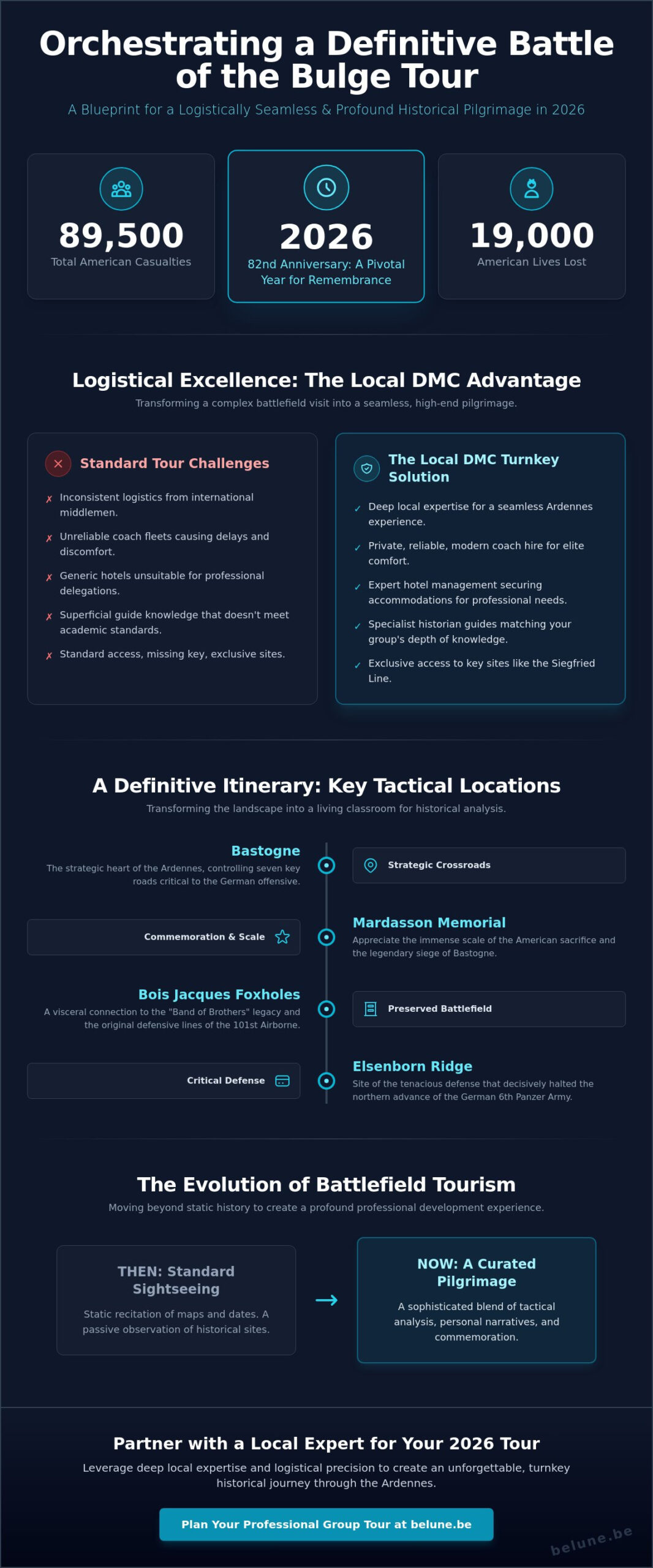
    Can a landscape defined by 89,500 casualties and the dense, unforgiving terrain of the Ardennes ever be truly “managed” for a professional delegation? Organizing a battle of the bulge tour for history groups requires more than a map and a timeline; it demands a synthesis of deep historical reverence and modern logistical precision. You likely understand that the difference between a standard sightseeing trip and a profound historical pilgrimage lies in the invisible details. Managing large group logistics in rural Belgium, finding hotels that accommodate professional needs, and ensuring guide expertise matches your group’s depth of knowledge are challenges that can’t be left to chance.

    This article provides a blueprint to orchestrate a logistically seamless journey through the Ardennes in 2026. You’ll discover how to leverage local expertise to secure a turnkey solution for travel, from private coach hire to exclusive access at sites like the Mardasson Memorial and the Siegfried Line. We will explore the essential coordination of transport, lodging, and site visits required to create an unforgettable commemorative experience that honors the 19,000 American lives lost while providing your group with elite comfort and insight.

    Key Takeaways

    • Grasp the enduring legacy of the Ardennes Counteroffensive and why 2026 represents a defining chapter for professional historical remembrance.
    • Uncover the strategic significance of Bastogne and Elsenborn Ridge when designing a definitive battle of the bulge tour for history groups.
    • Recognize the operational superiority of a local DMC over international middlemen, specifically regarding coach fleet reliability and expert hotel management.
    • Learn how to synthesize complex historical narratives with seamless logistics to create customized, high-end itineraries for diverse professional audiences.
    • Gain insights into the turnkey approach that transforms a standard battlefield visit into a profound, expertly coordinated pilgrimage.

    The Significance of the Battle of the Bulge for History Groups in 2026

    The Battle of the Bulge wasn’t just a military engagement; it was a test of American endurance. It remains the largest and bloodiest single battle fought by the United States. For those organizing a battle of the bulge tour for history groups, the weight of these statistics becomes tangible in the quiet forests of the Ardennes. A comprehensive overview of the Battle of the Bulge reveals a front line that stretched for miles, where 89,500 American casualties were recorded between December 1944 and January 1945. This historical event represents a peak in tactical complexity and human sacrifice.

    To better understand the scale and intensity of this conflict, watch this helpful video summary of the offensive:

    By 2026, the legacy of the Ardennes has matured into a deep historical archive. We aren’t just looking at dates on a timeline; we’re witnessing the closing of a living chapter. This 82nd anniversary year serves as a pivotal moment for history groups to document the terrain before the physical landscape changes further. It’s a transition from simple sightseeing to a curated historical pilgrimage where the emotional weight of 19,000 lives lost is met with rigorous academic study. This evolution reflects a growing desire for professional groups to find meaning beyond the museum glass.

    Why Historical Groups Prioritize the Ardennes

    The geography of the 1944 winter dictated every tactical decision. History groups find immense value in analyzing how the dense forests and narrow ridges of the Ardennes neutralized Allied air superiority. Military academies and historical societies prioritize this region because it offers a rare, preserved laboratory of war. You can still find the foxholes of the 101st Airborne and the original defensive lines carved into the earth. It’s a place where theory meets reality. The preservation of these sites allows for a technical assessment of infantry tactics that is impossible to replicate in a classroom.

    The Evolution of Battlefield Tourism

    Modern tours have evolved significantly. We’ve moved beyond the static recitation of maps to a more nuanced tactical analysis. A battle of the bulge tour for history groups in 2026 utilizes personal narratives to breathe life into the cold statistics. We define a “battlefield pilgrimage” as a sophisticated blend of education and commemoration, where the technical mastery of the military historian meets the quiet respect of the memorial site. This approach transforms a trip into an enduring professional development experience that honors the past while educating the future.

    Essential Sites for a Comprehensive Group Itinerary

    A successful battle of the bulge tour for history groups begins with a spatial understanding of the front. It isn’t enough to visit a museum; one must stand where the lines held. The U.S. Army’s official Battle of the Bulge overview underscores the sheer fortitude required to maintain these positions under extreme winter conditions. We prioritize sites that allow for tactical group analysis, transforming the landscape into a living classroom for academic and professional delegations. By focusing on the intersection of topography and decision-making, the tour moves beyond simple observation into active historical investigation.

    Bastogne and the Siege Legacy

    Bastogne remains the strategic heart of the Ardennes. Its significance stems from the seven key roads that converged on the town, making it a logistical necessity for the German offensive. Groups can stand at the Mardasson Memorial to appreciate the scale of the siege before exploring the Bastogne War Museum. This facility integrates modern, multi-sensory experiences that help visualize the 1944 frontlines with precision. A short drive away, the foxholes of Bois Jacques offer a visceral connection to the “Band of Brothers” legacy, where the original defensive lines remain etched into the forest floor, silent witnesses to the 101st Airborne’s resilience.

    The Eastern Front and Tactical Analysis

    Analyzing the Northern Shoulder at Elsenborn Ridge reveals how the defense successfully funneled German forces into narrow, vulnerable corridors. This area contrasts sharply with the narrative of Kampfgruppe Peiper. Navigating the difficult history of the Malmedy Massacre requires a guide who can balance tactical movements with the profound human tragedy of the event. At Parker’s Crossroads, history groups can engage in a focused case study of how a scratch force held a vital intersection against overwhelming odds, a perfect example of small-unit leadership changing the course of a campaign.

    The Eastern Front offers a deeper look into the logistics of the German advance. St. Vith highlights the importance of rail hubs, while the bridges over the Amblève illustrate the geographical barriers that ultimately slowed the Panzer divisions. A visit to the Henri-Chapelle American Cemetery, containing 7,992 graves, or the Luxembourg American Cemetery provides a moment of necessary reflection for the group. These sites are best reached through carefully managed transport solutions that handle the narrow, winding roads of the High Fens with professional ease. Coordinating these diverse locations into a single, cohesive battle of the bulge tour for history groups ensures that no tactical detail or commemorative moment is overlooked.

    The Definitive Battle of the Bulge Tour for History Groups in 2026

    Logistical Excellence: The DMC Advantage for History Groups

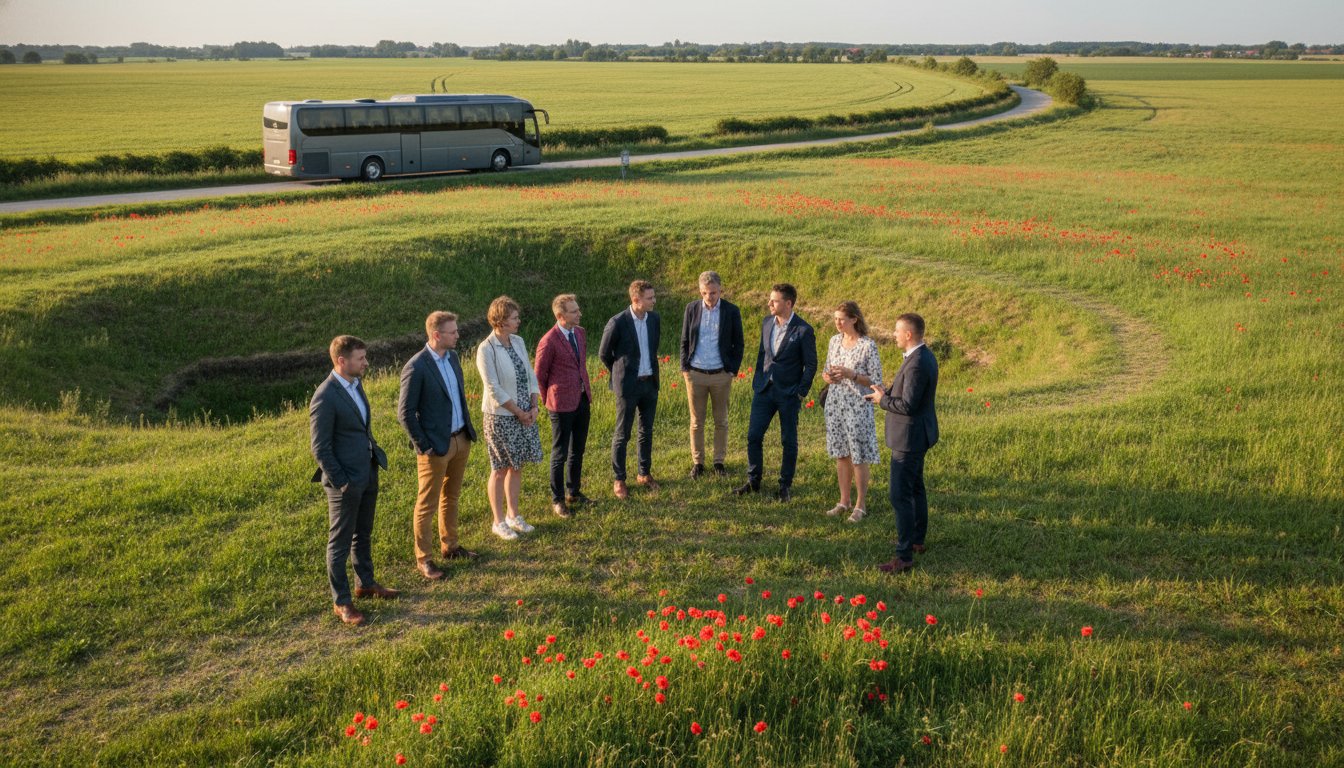
    Organizing a battle of the bulge tour for history groups requires more than deep historical knowledge; it requires operational mastery. International travel agents often act as middlemen, lacking the ground-level connections needed for the Ardennes. A local Benelux DMC provides a direct link to the region’s specific requirements. We understand that a fifty-person group can’t simply arrive at a remote memorial without pre-arranged access. This local expertise ensures every museum visit, site stop, and lunch break is timed with surgical precision. It’s about removing the friction of travel so the history can take center stage.

    The terrain of the Ardennes remains notoriously difficult. As highlighted in the U.S. Army Battle of the Bulge Overview, the narrow ridges and dense forests that challenged the 1944 offensive still present obstacles for modern travel. Navigating these rural roads requires a fleet that balances capacity with maneuverability. It’s about ensuring the journey is as seamless as the destination. We prioritize reliability, using our own fleet to maintain standards that third-party contractors simply can’t guarantee.

    Private Coach Hire and Transport Logistics

    Drivers in this region aren’t just operators; they’re logistical partners. They must understand the nuances of battlefield accessibility, knowing exactly where a coach can safely stop near preserved foxholes or narrow village monuments. High-end coaches feature on-board amenities like audio-visual systems for historical lectures during transit. This allows the group’s historian to provide context while moving between sites, maximizing every minute of the itinerary. Precise coordination of drop-offs at sensitive memorials ensures the group maintains a focused, respectful atmosphere without the distraction of parking delays.

    Hotel Accommodation Management for Large Groups

    Large history groups have unique requirements that standard tourist hotels often overlook. We source accommodations that offer private lecture spaces for evening debriefs and understand the necessity of early starts for dense itineraries. Managing room blocks and complex dietary needs for international delegations requires a meticulous, professional approach. Our custom Benelux itineraries integrate these logistical components into a single, fluid experience. This turnkey solution allows the group’s leadership to focus on the historical narrative while we manage the underlying structure. It’s a partnership built on trust and technical excellence.

    Customizing Itineraries for Diverse Historical Interests

    A battle of the bulge tour for history groups shouldn’t be a rigid, one-size-fits-all experience. Precision in planning allows for a transformation of the traveler’s perspective, ensuring the itinerary mirrors the specific intellectual or emotional goals of the delegation. We don’t believe in static schedules. Whether you’re coordinating a university seminar or a veteran-affiliated pilgrimage, the flow of the journey must adapt to the group’s depth of expertise. This flexibility ensures that every stop provides fresh insight rather than redundant observation. It’s about creating a dialogue between the participants and the landscape.

    Educational and Academic Customization

    Educational groups often prioritize primary source analysis over general narratives. We facilitate this by incorporating expert lectures and access to specialized historical consultants who can detail specific unit movements with technical mastery. For military academies, the focus shifts toward tactical decision-making and leadership under pressure. By aligning the visit with a specific curriculum, the Ardennes becomes a tangible extension of the classroom. We provide the structural support needed for these deep-dive investigations, ensuring that logistics never interfere with the academic process. It’s a sophisticated approach to learning that honors the complexity of the conflict.

    Thematic Extensions: Beyond the Battlefield

    Broadening the scope often leads to a more profound understanding of the European experience. Many groups choose to connect the dots between conflicts by visiting Flanders Fields, creating a comprehensive narrative of the World Wars. This thematic extension provides a stark contrast between the static trench warfare of 1914 and the mobile, mechanized chaos of 1944. Pairing these historical deep-dives with Belgium gastronomy tours offers a necessary cultural balance. Sensory history is found in the local food and the quiet atmosphere of a village tavern as much as in the silence of a forest foxhole. It’s a way to celebrate the culture that survived while respecting the gravity of the past.

    Ensuring every member can participate is a core professional standard. We meticulously plan for accessibility, identifying which forest paths or museum floors are suitable for all mobility levels. This technical foresight allows every participant to experience the sites without physical barriers. This level of detail is what separates a standard trip from a truly inclusive pilgrimage. If you’re ready to design a bespoke journey for your delegation, you can start planning your professional group tour with our expert team today. We’re here to ensure your vision for 2026 is realized with both elegance and precision.

    Partnering with BELUNE for Your 2026 History Tour

    A 20-year legacy in the Benelux region has taught us that excellence is never accidental. It’s the result of technical rigor and a passion for the narratives that shaped our landscape. When you choose to partner with us for a battle of the bulge tour for history groups, you’re engaging with a team that views logistics as a structural art form. We don’t simply provide transport and beds; we provide a foundation of reliability that allows the historical weight of the Ardennes to resonate. Our approach remains sober and professional, ensuring that every partner feels the security of our decades-long expertise.

    Control is the cornerstone of our service. Unlike agencies that rely on third-party contractors, we utilize our own fleet of modern coaches. This ownership allows us to maintain uncompromising professional standards, from the mechanical precision of our vehicles to the expertise of our drivers. They understand the specific demands of battlefield tourism, where navigating narrow rural roads requires both skill and local intuition. This internal coordination ensures that your itinerary remains on schedule, regardless of the complexities of the terrain or the size of your delegation.

    A Visionary Approach to Group Travel

    We transform a standard trip into a strategic historical event. Every group is assigned a dedicated project manager who serves as a single point of contact, ensuring that the conceptual vision of your tour is translated into flawless execution. This personal accompaniment is a marker of our identity. It allows for a level of customization and responsiveness that larger, impersonal firms cannot match. You can explore our methodology and request a quote for a fixed-price group tour package to see how we balance transparency with high-end service.

    Your Strategic Partner in Benelux

    Our expertise extends across the borders of Belgium, Luxembourg, and the Netherlands. This regional mastery is vital for a battle of the bulge tour for history groups, as the offensive’s narrative spans multiple jurisdictions and diverse landscapes. We manage the intricate details of hotel check-ins, museum entries, and local guide services with a focus on seamless transitions. Our local guides aren’t just historians; they’re experts in group dynamics who can tailor their delivery to the specific knowledge level of your participants. This synergy between technical mastery and human experience is what defines the BELUNE standard. We invite you to contact our team to begin designing your custom 2026 itinerary, ensuring your next historical pilgrimage is executed with the excellence it deserves.

    Orchestrating a Journey of Remembrance in 2026

    The Ardennes landscape offers a profound connection to the past; however, the bridge between academic study and a successful pilgrimage is built on technical excellence. You’ve seen how the convergence of strategic site selection and flawless logistical coordination defines a professional experience. By prioritizing local expertise and a modern fleet of private coaches, your delegation can move beyond the surface of the conflict to uncover its deeper tactical and human truths. This synthesis of historical reverence and operational precision is what transforms a trip into an enduring commemorative event.

    A definitive battle of the bulge tour for history groups requires a partner who understands that every detail, from hotel management to expert-led battlefield analysis, is a structural component of the experience. With over 20 years of Benelux DMC experience and a dedicated team of heritage tourism specialists, we ensure your 2026 itinerary is executed with sophistication and rigor. Our private fleet of high-standard coaches provides the reliability your professional group demands in this challenging terrain.

    The path to a transformative historical event starts with a single conversation. Request your custom Battle of the Bulge group itinerary from our experts today and let’s transform your vision into a seamless reality. We look forward to honoring this enduring legacy alongside your group.

    Frequently Asked Questions

    What is the best time of year for a Battle of the Bulge group tour?

    Late spring and early autumn provide the most favorable weather for walking tours, while December offers the most authentic atmospheric conditions. Many history groups choose the winter months to coincide with the “Nuts Weekend” commemorations in Bastogne. This timing allows participants to experience the biting cold that defined the 1944 offensive, adding a visceral layer of understanding to the tactical challenges faced by soldiers on both sides.

    How many days are needed for a comprehensive history group tour of the Ardennes?

    A comprehensive tour of the Ardennes usually spans three to five days. This timeframe allows your group to move beyond the major monuments and explore the tactical nuances of the High Fens and the Northern Shoulder. It ensures enough time for deep-dive analysis at sites like Parker’s Crossroads without rushing the commemorative moments at the American cemeteries. Shorter durations often sacrifice the depth required for a professional historical pilgrimage.

    Can BELUNE provide specialized guides for military history groups?

    We collaborate exclusively with local guides who possess deep expertise in military history and tactical analysis. These professionals are adept at managing the specific dynamics of a battle of the bulge tour for history groups, ensuring the narrative matches the audience’s knowledge level. Whether your delegation consists of academic historians or military veterans, our guides provide a level of technical insight that goes far beyond standard tourist scripts.

    Are the Battle of the Bulge sites accessible for groups with limited mobility?

    Major museums and memorials in the region are fully accessible, but rural sites like the foxholes in Bois Jacques require specialized logistical planning. We conduct detailed audits of every stop to ensure group members with limited mobility can participate safely. By utilizing our private fleet of coaches, we can coordinate drop-offs as close as possible to sensitive historical sites, minimizing physical strain while maximizing the experience.

    Does BELUNE manage hotel bookings for large history societies?

    We provide comprehensive hotel accommodation management for large history societies and professional delegations. Our team sources venues that understand the unique needs of these groups, such as the requirement for private lecture halls and efficient group dining. By managing these block bookings directly, we ensure your group stays in high-demand historical zones without the logistical friction of individual reservations or fragmented lodging.

    What types of coaches are available for battlefield tours in the Ardennes?

    Our private fleet includes a variety of modern, high-standard vehicles tailored to the Ardennes terrain. We typically deploy executive minibuses for smaller delegations and full-sized touring coaches for larger societies. Each vehicle is equipped with audio-visual systems, allowing for historical lectures during transit. These coaches are specifically chosen for their ability to navigate the narrow, winding ridges of the region while maintaining elite passenger comfort.

    Can we combine a Battle of the Bulge tour with other Benelux historical sites?

    Integrating the Ardennes with other Benelux historical sites is a core part of our service. You can easily combine your battle of the bulge tour for history groups with visits to Flanders Fields or the liberation routes in the Netherlands. This broader perspective allows for a more complete understanding of 20th-century European conflict, linking the static trench warfare of the Great War with the mechanized mobility of World War II.

    How far in advance should we book a group tour for the 2026 season?

    Securing a tour for the 2026 season should ideally happen nine to twelve months in advance. The 82nd anniversary year is expected to see high demand for specialized military historians and group-friendly accommodations in Bastogne. Early booking ensures that we can secure the best hotel blocks and coordinate the most sought-after local guides, providing your group with a seamless and highly curated historical experience.