
A seamless European trip takes more than a well-planned itinerary. For tour operators, managing traveler data with a European DMC can connect guest preferences and practical requirements with the local services that bring each journey to life.
Personalized travel works best when the details behind it are accurate. Yet traveler information can become fragmented as it passes between booking teams, accommodation providers, transport services, and guides. A destination management company can coordinate local partners and put relevant information to practical use, while careful handling of personal details remains essential. This guide explains how traveler data supports tailored trips, what good data quality looks like, and how privacy considerations shape its use. It also shows how local coordination can turn clear, consistent information into a more considered guest experience and smoother operations for tour operators.
Key Takeaways
- Connect traveler preferences with the right local services to shape more personal, coherent trips.
- Improve data quality by keeping information consistent, relevant, and appropriately anonymized as it moves between teams.
- Understand how privacy safeguards and GDPR considerations influence the handling and sharing of traveler information.
- See how coordinated local suppliers can turn accurate trip details into smoother experiences for guests and tour operators.
Tourism services and customer experiences
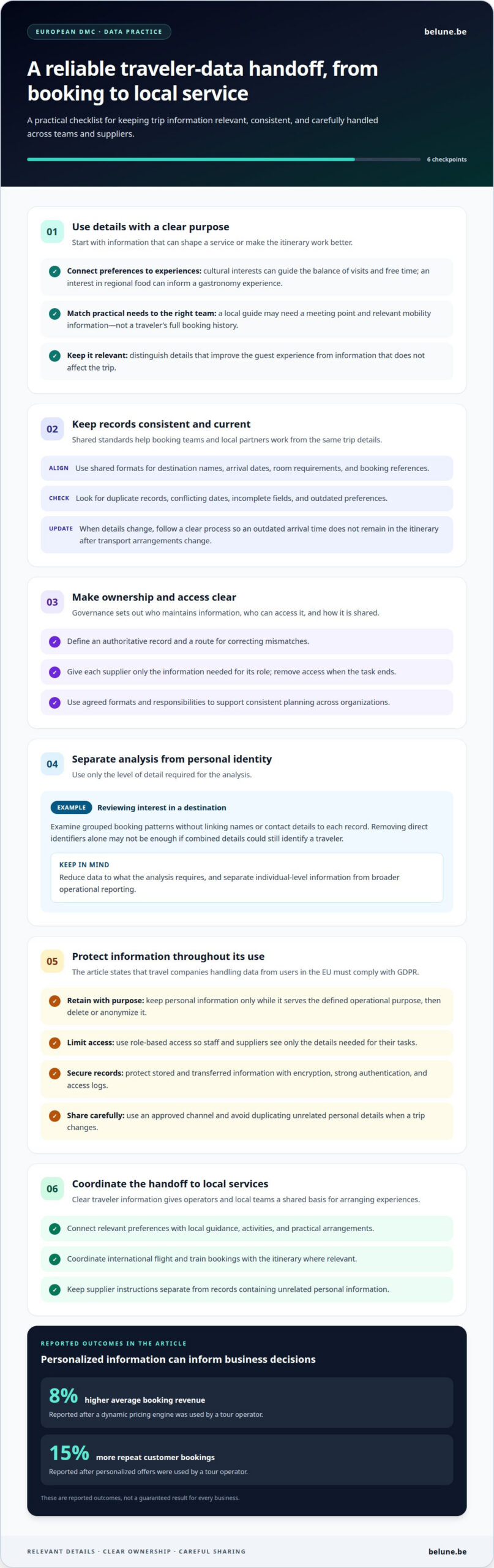
Traveler data helps tour operators shape a journey around the people taking it. Booking choices, stated interests, and practical requirements can inform decisions about destinations, activities, and arrangements. For example, a group’s interest in cultural heritage can help determine the balance between guided visits and free time. The value comes from using relevant details to improve the experience, not collecting information without a clear purpose.
For a European itinerary, a DMC can translate those details into coordinated local services. An interest in regional food might inform a gastronomy experience, while a passion for history could shape a battlefield visit with local guidance. International flight and train bookings can also be coordinated with the itinerary. Clear traveler information gives the operator and local teams a shared basis for arranging these experiences.
Personalized offers can support both commercial performance and loyalty. A dynamic pricing engine increased a tour operator’s average booking revenue by 8%, while personalized offers increased repeat customer bookings by 15%. These reported outcomes show how information can inform decisions, rather than establish a result for every business. Relevant recommendations can help returning travelers discover a fitting experience, while pricing decisions can reflect demand and booking patterns.
Managing traveler data with a European DMC means connecting useful insight with thoughtful service design. Tour operators can distinguish information that improves an itinerary from details that do not affect the guest experience. A traveler’s interest in art, for instance, may inform a cultural visit; a preference for a quieter pace may shape the day’s arrangements. When the right local teams receive relevant details, personalization feels considered rather than generic, and each service contributes to a coherent trip.
Data quality, governance, and anonymization
Reliable decisions start with records that mean the same thing to every team. A booking may list “Brussels,” while a supplier file gives the venue’s full address. Shared data standards can align destination names, arrival dates, room requirements, and booking references. When details change, teams need a clear process for updating records and communicating revisions. Otherwise, an outdated arrival time may remain in the itinerary after transport arrangements have changed.
Governance defines who maintains information, who can access it, and how it is shared. European Tourism Data Space governance combines EU-level oversight with collaboration between national tourism authorities and regional bodies. For operators coordinating local partners, the same principle supports clear ownership: the booking team maintains guest details, while relevant suppliers receive only the information needed for their role. Agreed formats and responsibilities make data practices more consistent and support informed service planning.
Anonymization changes how information can be used for analysis. For example, an operator reviewing interest in a destination can examine grouped booking patterns without linking names or contact details to each record. Removing direct identifiers is not enough if a combination of details could still identify a traveler. Reduce the data to what the analysis requires, and separate individual-level information from broader operational reporting.
Quality checks can focus on practical errors: duplicate records, conflicting dates, incomplete fields, and outdated preferences. A coordinator can resolve a mismatch between a guest’s booking record and a supplier schedule before it shapes the final itinerary. Governance also needs a defined route for corrections, so teams know which record is authoritative. For programs that rely on accurate local arrangements, coordinated destination services can connect operational details with delivery on the ground.
GDPR compliance and traveler privacy
Traveler privacy depends on clear purposes, limited access, and careful handling at every stage. According to the European Union, travel companies must comply with the GDPR when handling data from users in the EU.
Traveler Data Retention
Retention is the period personal information remains stored for a defined operational purpose. A European DMC should retain traveler data only while it serves that purpose, then delete or anonymize it. The appropriate period depends on what information is collected and why it is needed. For example, details used to coordinate a group itinerary may no longer be needed once that coordination is complete. A clear retention approach helps prevent old records from being reused without purpose.
Data Security Measures
Data security measures help reduce unauthorized access, loss, or disclosure. Use role-based access so staff and suppliers see only the details needed for their tasks. Protect stored and transferred records with encryption, and require strong authentication for accounts containing traveler information. Access logs can help identify unusual activity. These safeguards matter whenever traveler contact details or itinerary information pass between an operator and local partners.
Careful information handling can support privacy without disrupting service. A local guide may need a meeting point and relevant mobility information, but not a traveler’s full booking history. Share only necessary details through an approved channel, and remove access when the task ends. For a group itinerary, keep supplier instructions separate from records containing unrelated personal information.
According to the European Commission, the European Tourism Data Space framework is intended to ensure tourism data sharing complies with the GDPR. This makes governance important across organizations: each party needs a defined role, a clear reason to access information, and a consistent way to protect it. When a record is corrected or a trip changes, update the relevant parties without unnecessarily duplicating personal details.
Local supplier and professional networks
Share traveler information with each supplier through an agreed channel, limiting it to details needed for that supplier’s role. A hotel may need arrival dates and rooming details, while a guide may need the meeting point and relevant group requirements. Keep the operational itinerary current so partners are not working from conflicting updates.
A DMC coordinates the handoffs that connect an itinerary with local delivery. For example, a change to a group’s arrival time may affect hotel check-in, a guide’s schedule, and a river excursion. A shared itinerary reference and a named operational contact help partners identify the current update. Clear ownership also gives suppliers a way to flag missing or inconsistent details before they affect the guest experience.
Accommodation requires precise coordination. A rooming list can include guest names and assigned rooms, while the hotel’s arrival information can focus on timing and group arrangements. A local guide may need the meeting location, schedule, and details relevant to leading the group. Separating these records limits unnecessary circulation of personal information and makes each handoff easier to understand.
Professional networks also help operators plan across destinations. A directory lists more than 1,300 DMC companies across 33 European countries and 443 cities, illustrating the breadth of local expertise available. A well-coordinated network can connect accommodation, guiding, and excursions within one itinerary. The practical task is to match each partner’s role with accurate instructions, then communicate changes through a consistent route. For tour operators shaping that coordination, explore local supplier coordination as part of a coherent trip plan.
BELUNE: Coach Hire with own fleet of busses
BELUNE helps tour operators connect group transport with the wider shape of a European itinerary. Its own fleet of modern, comfortable coaches supports journeys where clear schedules and coordinated passenger information matter, from arrival transfers to travel between planned stops.
When a program also needs accommodation planning, BELUNE’s Hotel Accommodation Management can align lodging arrangements with the itinerary. Local Guide Services and Art & Culture Group Tours add place-based experiences, with details coordinated around the group’s schedule. This combination helps operators bring transport, stays, and cultural visits together as parts of one carefully planned trip.
Share essential operational details, such as confirmed timings and relevant group requirements, so arrangements can be coordinated across services. To discuss a group travel program, contact BELUNE.
Shape the next journey with intention
Make information flow part of itinerary design from the first planning conversation. A consistent approach to managing traveler data with a European DMC can help tour operators connect guest needs with the practical decisions that shape a group program. Treat each handoff as part of the experience: clear requirements can inform transport planning, accommodation arrangements, and the work of local guides.
BELUNE brings these elements together through Coach Hire with its own fleet of modern coaches, Hotel Accommodation Management, and Local Guide Services. For operators developing a new itinerary or refining an existing one, these services provide a practical basis for coordinating the journey around its travelers. The next step is to discuss your program, the information needed to plan it, and how local arrangements can support its character.
Contact BELUNE about your DMC needs and take the next step toward a more thoughtfully coordinated trip.
Frequently Asked Questions
Why Work with a DMC Travel?
A DMC connects tour operators with destination-level coordination and local expertise. This is useful when an itinerary involves several partners and moving parts. For example, an operator developing a cultural program can work with a destination team to bring local knowledge into the planning process, instead of managing every local relationship separately. The result is a more coordinated foundation for delivering the planned experience.
What traveler data does a European DMC collect and why?
A European DMC may handle traveler names, contact details, arrival information, booking requirements, and stated preferences when they support trip planning. For example, a traveler’s arrival time can help coordinate a scheduled transfer, while a meal preference can inform a planned dining experience. The key question is what information each arrangement requires. Irrelevant details add handling without helping deliver the trip.
How does GDPR apply to traveler data handled by a European DMC?
The European Union says travel companies must comply with the GDPR when handling data from users in the EU. In practice, operators should understand which parties receive traveler information and why. For example, a tour operator’s booking system and a DMC’s local planning records may serve different purposes. Clear responsibilities help each organization handle information appropriately and respond consistently when a traveler asks about their data.
What legal basis is needed to process traveler data in Europe?
The appropriate legal basis depends on the specific purpose for processing, not simply on the fact that someone booked a trip. An operator and DMC should identify the purpose of each use, such as organizing a reservation or sending optional promotional messages. Consent is not a universal basis for every activity. Keeping purposes distinct helps prevent booking information from being treated as permission for unrelated uses.
How should traveler consent and privacy notices be managed for DMC bookings?
Give travelers a clear privacy notice when collecting their details, explaining how the information will be used and which parties may receive it. Keep optional choices, such as marketing preferences, separate from information needed to arrange a booking. If consent is used for a specific purpose, record the choice and provide a practical way to change it. This makes travelers’ options easier to understand.
What are the rules for transferring traveler data outside the European Economic Area?
Before sending personal data outside the European Economic Area, the responsible organizations should establish that the transfer meets applicable data protection requirements and has appropriate safeguards. Map the destination, recipient, purpose, and data fields involved. A hotel or service provider’s location alone does not explain how information will be handled. Include relevant transfer details in privacy communications and limit shared information to what the arrangement requires.
Leave a Reply