
What if the rooming list that helps an international group check in smoothly also shares more traveller information than the hotel needs? Good group rooming list management is about more than filling rooms. It’s a controlled workflow for keeping preferences, arrival details and changes accurate while limiting who can see each piece of information.
When details arrive from travellers, organisers and travel partners at different times, even a careful team can end up with conflicting versions or unanswered allocation questions. The solution isn’t to collect every possible detail or circulate one master file widely. Agree what’s needed, who checks it and how updates reach the right accommodation partner.
This guide provides a practical, privacy-conscious checklist for collecting, reviewing, sharing, updating and closing out a rooming list. You’ll learn how to confirm each provider’s requirements, maintain one clear record of approved changes and define the roles of organisers, hotels and DMCs. The result is a more controlled handover, with fewer avoidable errors, less unnecessary disclosure and a smoother path from room allocation to arrival.
Key Takeaways
- Separate essential hotel booking details and room assignments from optional preferences, then confirm which fields each property actually needs.
- Make group rooming list management easier to control by assigning one list owner, setting a submission deadline and validating details before approval.
- Choose a spreadsheet, shared workspace or travel-management system by comparing access controls, version history, correction workflows and retention options.
- Before sharing an update, confirm its recipients, purpose, version and follow-up owner; define who can approve and distribute late changes.
- Agree in advance how the organiser, DMC and accommodation provider will coordinate allocation and communication, including who may receive the list.
What group rooming list management involves, and why privacy belongs in the process
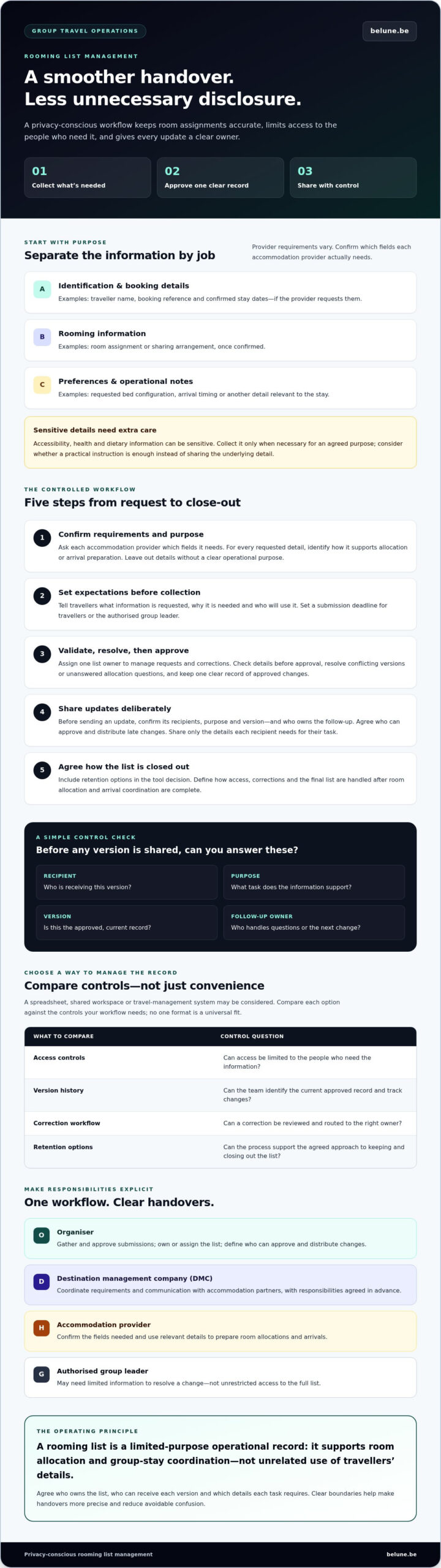
A rooming list records the information needed to allocate rooms for a group stay. In practice, group rooming list management brings together three distinct elements: hotel booking details, traveller room assignments and optional preferences that may help shape the stay. Keeping these categories separate helps the team coordinate accurately without treating every detail as necessary for every recipient.
Accuracy and careful information handling are connected operational responsibilities. A hotel may need names and room assignments to prepare for arrivals, while an organiser may need a broader view to resolve a change. Requirements vary by accommodation provider and itinerary. Privacy obligations also depend on the circumstances and jurisdictions involved, so confirm applicable requirements with qualified counsel.
The following Oracle Learning video demonstrates a hotel-system workflow for creating a block reservation from a rooming list. It illustrates one operational context, not a universal process or a standard set of required fields.
Which details might a rooming list contain?
Before requesting information, separate it by purpose. For example, a working list might include:
- Identification and booking details: traveller name, booking reference and confirmed stay dates, if the provider requests them.
- Rooming information: assigned room or sharing arrangement, once confirmed.
- Preferences and operational notes: a requested bed configuration, arrival timing or another detail relevant to the stay.
These are examples, not universal hotel requirements. Ask each accommodation provider which fields it needs. Accessibility, health and dietary information can be sensitive. Collect such details only when necessary for an agreed purpose, and consider whether the hotel needs the underlying detail or only a practical instruction.
Who uses the list, and for what purpose?
A tour operator creates and manages travel arrangements, including accommodation; the Tour operator entry offers general background on that role. In a group workflow, the organiser can gather and approve submissions, while a DMC may coordinate requirements and communication with accommodation partners. The provider uses relevant details to prepare room allocations and arrivals. An authorised group leader may need limited information to resolve a change, not unrestricted access to the full list.
A rooming list is a limited-purpose operational record: it supports room allocation and the coordination of a group’s stay, not unrelated use of travellers’ details. Agree who owns the list, who can receive each version and which details each task requires. Clear boundaries make handovers more precise and help reduce avoidable confusion for travellers and partners.
Build a privacy-conscious rooming list from collection to confirmation
A reliable process starts before anyone submits a preference. Assign one list owner to manage requests, corrections and the final version. Set a clear submission deadline for travellers or the authorised group leader. For each field, state its operational purpose first. If no one can explain why it’s needed for allocation or arrival preparation, leave it out.
This discipline supports clear, responsible service. The United States Tour Operators Association describes its role in the travel industry, including an emphasis on ethics and consumer protection. For tour operators, transparency starts with straightforward instructions: tell travellers what information you’re requesting, why it’s needed and who will use it.
Request only information needed for the allocation
Before collection begins, ask the accommodation provider to confirm its required details and preferred submission format. Don’t assume one hotel’s process applies to another. Avoid putting full payment details, identity documents or unrelated personal notes in a rooming list. If a specific detail is required for another travel purpose, handle it through the appropriate process rather than adding it by default.
Give travellers concise instructions and identify a contact for questions. A defined deadline gives the list owner time to check submissions and follow up on gaps before assignments are confirmed.
Validate and confirm assignments before sharing
Use this sequence to bring each list to a controlled final version:
- Confirm requirements: Check the provider’s requested fields, format and submission deadline.
- Request details: Ask for only relevant information and explain its purpose clearly.
- Validate: Compare names, room pairings, stay dates and approved preferences with the latest booking records.
- Resolve and approve: Direct missing or conflicting details to the authorised group contact. A named reviewer then confirms the final version.
- Share deliberately: Check the approved recipient list and send each recipient only the version they need.
A compact tracker makes responsibilities visible. Adapt these examples to the provider’s confirmed requirements; they aren’t universal hotel fields.
| Field | Purpose | Responsible person | Confirmation status |
|---|---|---|---|
| Traveller name | Match guest to booking | List owner | Pending / checked |
| Room pairing | Record approved allocation | Organiser | Pending / approved |
| Stay dates | Check booking period | List owner | Pending / checked |
For international tours with several accommodation partners, a DMC can help coordinate provider requirements with the organiser. The parties should agree who checks and approves each detail. This is the practical core of group rooming list management: one accountable owner, purposeful fields and a deliberate handover. Tour professionals planning hotel accommodation coordination can explore BELUNE’s hotel accommodation management as part of broader group-travel logistics.
Compare rooming-list tools and sharing methods without losing control
The right format depends on the group’s needs and the controls your organisation can verify. A spreadsheet may be easy to maintain, a shared workspace can support collaboration, and a dedicated travel-management system may bring rooming information into a broader workflow. None is automatically the safest choice. In group rooming list management, access rules and everyday handling matter as much as the tool itself.
| Method | Practical strengths | Limitations to consider | Questions to verify |
|---|---|---|---|
| Controlled spreadsheet | Familiar format; straightforward to review and correct. | Copies and manual changes can create conflicting versions. | Who can access or edit it? Is there one authoritative copy and a usable version history? |
| Approved shared workspace | Can provide one shared location for authorised collaborators and updates. | Convenience doesn’t ensure that permissions, history or retention are appropriate. | Can access be limited by role? Are changes traceable, and can access be removed when no longer needed? |
| Dedicated travel-management system | May connect rooming information with other travel-management tasks. | Features and supplier practices vary; setup and processes need assessment. | How are sharing, audit history, export and deletion handled? Where is data stored? |
When can a spreadsheet be sufficient?
A spreadsheet can work when a named owner maintains it, access is restricted to people who need it and the team uses a single authoritative copy. Avoid circulating separate email attachments as working versions. Agree how edits should be submitted and recorded so a correction doesn’t quietly disappear. Passwords or other file protections alone don’t replace your organisation’s wider privacy and security practices.
What should organisers assess in a digital platform?
Ask the provider to explain role-based access, audit history, sharing options and how records can be exported or deleted. Verify supplier claims instead of relying on feature descriptions alone. Confirm data locations and contractual terms with the provider and, where appropriate, a qualified adviser. Applicable privacy requirements vary by jurisdiction, so check which rules apply to your tour and partners.
For any method, establish a retention approach: who keeps the working list, how long it’s needed for the operational purpose and how obsolete copies are handled. Make sure the approach reflects the actual tool and your organisation’s practices. A platform can make coordination more convenient, but convenience doesn’t prove that its privacy and security controls have been assessed.
Use this checklist to share updates, limit access and close out the list
A rooming list should move to its next step only when the action is clear. Before sharing, check the essentials:
- Recipients: Are they authorised, and does each person need the information for their role?
- Purpose: Is the list being shared for allocation, arrival preparation or another defined operational task?
- Version: Is this the current approved copy, clearly identified so it won’t be confused with an earlier draft?
- Transfer method: Is the chosen method appropriate under your organisation’s procedures and the provider’s requirements?
- Follow-up owner: Who will confirm receipt, track any action and update the authoritative copy?
Share the current rooming list only with authorised recipients who need it for an agreed operational purpose. This gives organisers and accommodation partners a clear reference without circulating every traveller detail to the full group.
How should organisers manage last-minute changes?
Use a defined route for corrections, even when time is short. The list owner should record who requested the change, who approved it and when the authoritative copy was updated. Then notify only the recipients who need the correction to do their jobs. If an update affects a room allocation or arrival arrangement, ask the relevant recipient to confirm receipt. This closes the loop and helps prevent an outdated version from remaining in use.
For example, a revised room pairing may need to reach the accommodation provider and the organiser’s designated contact, but not every traveller or partner involved in the wider itinerary. Keep the change record concise and factual. Don’t add unrelated personal commentary to the list or update message.
What should happen after the group stay?
Close-out is part of group rooming list management, not an afterthought. Name someone to review whether the working copy is still needed once the stay is complete. That person should follow the organisation’s documented retention schedule and verify applicable obligations for the jurisdictions involved. Seek qualified advice where needed rather than assuming one retention period suits every record.
Depending on the policy and any ongoing need, records may be deleted, archived or retained. If an unresolved booking matter, claim or other legitimate operational follow-up requires continued access, document the reason, owner and review point. Consider extra copies shared with partners too, and how they should be handled under agreed procedures.
For tour professionals coordinating hotel accommodation and partner handovers, discuss accommodation coordination with BELUNE.
Coordinate hotel accommodation with a DMC while keeping responsibilities clear
A destination management company (DMC) can help connect the tour organiser’s accommodation plan with hotel requirements and local partner communication. Coordination may include gathering confirmed property requirements, aligning room allocation information and relaying approved changes. The organiser and partners should agree in advance who is responsible for each step, why information is being shared and which people are authorised to receive it.
Coordination doesn’t automatically determine legal roles or obligations. Those can depend on the arrangement and applicable jurisdiction. If there’s uncertainty, seek guidance from qualified privacy counsel. BELUNE’s hotel accommodation management and group travel logistics can form part of a wider itinerary, while the parties involved retain their agreed responsibilities for the information they handle.
Agree responsibilities before collecting traveller details
Document the handover before requesting information. Name who asks travellers for details, who checks submissions against booking records, who approves the allocation, who sends the list to the accommodation provider and who manages corrections. Then confirm the provider’s actual requirements and preferred format. This sequence helps prevent premature collection and makes it easier to direct questions or resolve discrepancies without circulating the full list.
A clear division of tasks also helps when working with a new partner. The guide to choosing a group travel agency can help professionals consider how responsibilities and partner coordination fit into wider travel arrangements. For group rooming list management, put agreed roles in writing so the process stays clear even when a correction crosses organisational boundaries.
Make accommodation coordination part of the wider itinerary
Rooming-list deadlines should connect to booking milestones and the group’s arrival schedule. Set submission and review dates that give the organiser and accommodation partner time to confirm assignments and resolve gaps before the relevant handover. If an itinerary includes several stays or local partners, clarify whether the same contact or a different authorised person handles each property’s requirements.
Accommodation is one part of a larger operational sequence. The approach described in incoming tour operator coordination provides broader context for aligning local partners and travel arrangements. A DMC can help organise accommodation communications as part of wider group logistics, with the scope and recipients agreed by the parties.
Thoughtful coordination is both practical and human: travellers face fewer avoidable allocation questions, while partners receive information suited to their role. If your team is planning an international group itinerary, consider discussing how hotel accommodation coordination can fit into its wider arrangements with BELUNE.
Make every rooming-list handover deliberate
Effective group rooming list management follows a clear sequence: collect only details needed for the stay, assign responsibility for checking and approving them, and share the current list only with authorised recipients. Choose tools based on controls your team can verify, then follow an agreed process for late changes and post-stay retention.
Accommodation coordination works best when the organiser, DMC and hotel understand their roles before information starts moving. BELUNE lists hotel accommodation management as a priority service, and its company summary cites more than 20 years of experience in transport and tour-operator work. These are relevant foundations for coordinating group accommodation within broader travel logistics, without replacing your own review of privacy requirements and partner responsibilities.
If you’re planning a group itinerary and want to clarify the accommodation handover, discuss accommodation coordination for your group with BELUNE. With clear roles and a considered process, your team can prepare for a smoother arrival while treating traveller information with care.
Frequently Asked Questions
What is group rooming list management?
Group rooming list management is the process of preparing and maintaining a working record of a group’s hotel room assignments and relevant booking details. It involves confirming what the accommodation provider needs, collecting only those details, checking accuracy, controlling access and updating the authoritative version when plans change. The right fields and workflow depend on the booking, the provider and applicable privacy requirements, which may vary by jurisdiction.
What information should be included on a hotel rooming list?
Include only details the accommodation provider confirms it needs for the booking or room allocation. Depending on the property, this may include traveller names, room pairings or relevant arrival information. Confirm the purpose of each field before collecting it. Treat accessibility or health-related details with particular care, and avoid adding unrelated notes or payment-card details. Requirements can differ between accommodation providers, so don’t assume one list fits every stay.
How do you share a rooming list securely with a hotel?
First verify the recipient and confirm which information they need for their role. Use a sharing method approved by your organisation, limit access to authorised people and identify the current version clearly. Avoid sending unnecessary copies. Agree in advance how corrections will be communicated and how outdated files should be handled. The appropriate method depends on your organisation’s controls and the hotel’s arrangements, so assess the process rather than relying on the file format alone.
Is a spreadsheet suitable for managing an international group rooming list?
A spreadsheet can suit some groups if one person owns the authoritative copy and access, versioning and sharing are controlled. It can become harder to manage as the group, partner network or number of changes grows, particularly if multiple attachments circulate. Before choosing a format, consider how edits are tracked, how corrections reach the right people and how old copies are handled. A spreadsheet isn’t automatically secure or unsuitable; assess the actual controls and working practices.
How should organisers handle last-minute rooming-list changes?
Use a defined change process: confirm that the requester is authorised, verify the detail, update the authoritative copy and notify only recipients who need the correction. Record who requested and approved the change, along with when the list was updated. If the change affects room allocation or arrival arrangements, ask the relevant accommodation contact to confirm receipt. This creates a traceable handover and reduces the chance that someone acts on an outdated version.
How long should a group rooming list be retained?
There’s no single retention period that suits every organisation, booking or jurisdiction. Follow your organisation’s documented retention schedule and confirm applicable requirements with qualified privacy counsel. Once the operational need has ended, review whether the working list should be deleted, archived or retained for a documented reason. If an unresolved booking matter or other operational follow-up requires continued retention, record the reason and responsible person, then handle the information according to applicable policy and requirements.
Can a DMC manage hotel rooming lists for a tour operator?
A DMC may coordinate accommodation requirements and communication with hotel partners as part of group travel logistics. Before sharing traveller details, the tour operator and partners should agree who collects, checks, updates and distributes the list, and confirm which fields the hotel actually needs. Ask the DMC to explain its working process, and verify any privacy or security claims with the relevant provider or adviser. Don’t assume that coordination alone establishes legal roles or controls.
Leave a Reply