Tag: travel operations

  • How a DMC Partnership Can Reduce Operational Overhead

    How a DMC Partnership Can Reduce Operational Overhead

    What if travel overhead comes less from the number of suppliers than from the work of coordinating them? When accommodation, transport, guided experiences and other arrangements each require separate planning, internal teams can lose time to handovers, follow-ups and unclear ownership. Understanding how a dmc partnership reduces operational overhead starts with treating coordination as one connected programme, not a collection of unrelated tasks.

    Your team still needs visibility and control. The practical question is which responsibilities belong in-house and which a DMC can coordinate. Compare the two based on time, clarity and delivery, rather than assuming that outsourcing automatically reduces costs.

    This article looks at the recurring work a DMC can coordinate, from itinerary planning and accommodation management to coach transport, local guides and group experiences. You’ll learn how to compare responsibilities fairly, define ownership and choose useful review measures. BELUNE brings more than 20 years of tourism experience to tailor-made programmes that combine selected logistics and local expertise around your team’s priorities.

    Key Takeaways

    • Separate staff time spent coordinating a travel programme from supplier charges and trip expenses to see where operational effort sits.
    • Learn how a DMC can bring itinerary planning, accommodation management, coach transport and expert guidance into a defined programme.
    • Assess how a dmc partnership reduces operational overhead by comparing equivalent responsibilities, service expectations and review periods, not assumptions about lower costs.
    • Set clear ownership, communication processes and review measures so your team and DMC partner understand who handles each task.
    • See how BELUNE’s tailor-made itineraries and on-the-ground logistics can be shaped around your programme’s operational needs.

    What Counts as Operational Overhead in a DMC Partnership?

    Operational overhead is the internal time and coordination needed to plan and deliver a travel programme. It includes the work behind decisions and handovers, not just the visible arrangements. Understanding how a dmc partnership reduces operational overhead starts with identifying who handles each task, from the first itinerary draft through to the delivery review.

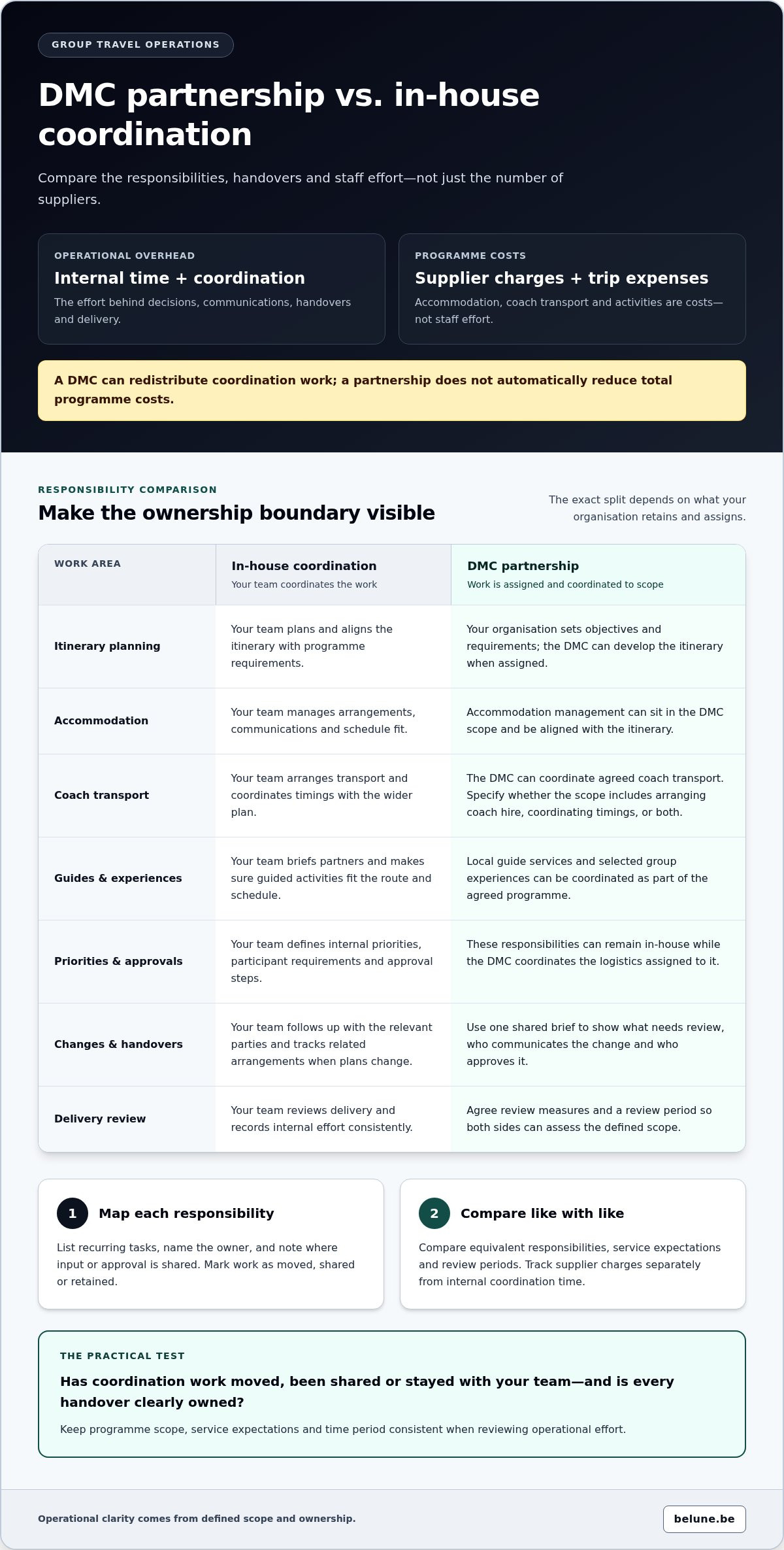
    That work is separate from supplier charges and trip expenses. Accommodation, coach transport and activities are programme costs; the staff time spent arranging, communicating and tracking them is operational effort. The two are related, but they should not be counted as the same thing. A DMC partnership can redistribute coordination work, but it does not automatically reduce total programme costs.

    For a foundational definition, see Understanding Operational Overhead. The video below offers another perspective on partnership operations.

    Which internal tasks create coordination overhead?

    A programme may involve itinerary planning, accommodation management, transport, expert guidance and activities. Each component also creates supporting tasks: briefing partners, sharing requirements, aligning schedules, communicating changes and reviewing delivery. When one arrangement changes, the related components may need attention too, adding more handovers.

    Your organisation may retain tasks such as setting programme goals, approving key decisions and communicating internal requirements. A DMC can coordinate the logistics and services assigned to it. Make the boundary specific: “manage transport” could mean arranging coach hire, coordinating timings, or both. Naming the deliverables and owner for each task makes the workload easier to see.

    How is overhead different from programme cost?

    Overhead measures staff effort and process burden, not a standalone price. To compare in-house coordination with a DMC partnership, keep the inputs separate: record supplier and partner charges on one side, and internal coordination time on the other. List the tasks included in each scope, then compare the same service expectations over the same period.

    Avoid double-counting. If the DMC scope includes accommodation management, don’t count the same coordination task as entirely in-house. Your team may still brief the DMC or approve arrangements, but those are separate responsibilities. A task-by-task view shows whether work has moved, is shared or remains with your team.

    Overhead also depends on programme scope and existing processes. A team with established approval steps may spend less time on sign-off than one coordinating across several departments. A programme combining accommodation, transport and activities may also need more alignment than one with fewer components. These differences make a like-for-like comparison essential.

    Start with a responsibility map. List each recurring task, name its owner and note where input or approval is shared. Track internal effort consistently before and during the partnership. This gives your team a practical basis for assessing operational value without assuming delegated work has disappeared or that the partnership guarantees savings.

    How a DMC Consolidates Group Travel Planning and Logistics

    A group itinerary is more than a sequence of stops. Accommodation, transport, guidance and activities need to fit together, with each handover understood. A DMC can bring selected planning and logistics into a defined scope, creating one coordinated framework for the assigned services instead of separate strands of parallel planning.

    Start with the programme’s purpose and requirements, then shape the itinerary around the group’s priorities. Consider accommodation management, coach transport and expert guidance in relation to the same schedule. A guided tour, for example, needs to fit the route and transport plan; accommodation arrangements need to work with the itinerary. Coordinating these elements together can reduce mismatches and repeated briefings.

    Where can a DMC take responsibility across a programme?

    The scope depends on what your organisation wants to retain and what it assigns to the DMC. A tailored programme might include itinerary planning, accommodation management, coach hire, local guide services and selected group experiences. If airport transfers or international flight and train bookings are part of the brief, specify who coordinates them and how they fit into the wider plan. Don’t assume every task automatically belongs to one party.

    For example, your organisation might set the programme objectives, participant requirements and approval process, while the DMC develops the itinerary and coordinates agreed accommodation, coach transport and guided experiences. This division gives each side a clear role while keeping the programme’s components aligned.

    How does a clear scope prevent duplicated work?

    Before planning begins, assign an owner to each deliverable. A shared brief can record the task, responsible party, required input and approval point. Separate DMC-managed work from responsibilities your organisation retains, such as setting internal priorities or approving the programme. Where ownership is shared, define the handover so neither side assumes the other has completed it.

    Keep changes visible in the same working brief. If the itinerary shifts, note which related arrangements need review, who communicates the change and who approves it. This makes it less likely that both teams will brief partners independently or work from different versions of the plan. It also shows where your team’s input is still needed.

    A simple workflow makes the division clear: your organisation outlines its objectives and constraints; the DMC proposes a tailored itinerary within the agreed scope; both sides review the plan and confirm responsibilities; then the DMC coordinates assigned logistics while your team handles its retained tasks. After delivery, review what worked and what could be refined. The value in how a dmc partnership reduces operational overhead comes from deliberate coordination, not from removing your organisation from every decision.

    For teams bringing travel components together, BELUNE’s tailor-made group travel programmes combine itinerary planning and selected logistics in a collaborative framework.
    How a DMC Partnership Can Reduce Operational Overhead

    DMC Partnership vs In-House Coordination: Compare the Real Work

    Outsourcing coordination doesn’t automatically mean lower total costs. A DMC fee may replace some internal work, overlap with existing responsibilities or add another coordination layer if the scope is unclear. To judge whether how a dmc partnership reduces operational overhead applies to your programme, compare the work and service delivered, not just one invoice against another.

    Use the same trip components and expectations for both approaches. If the DMC scope includes accommodation management, coach transport and itinerary planning, the in-house comparison should account for those same deliverables, as well as the oversight and communication your team requires. Use the same measurement period for both models, such as the programme’s planning and delivery cycle.

    What makes an in-house comparison fair?

    Build a like-for-like scope before reviewing results. List the deliverables, expected service and tasks that remain with your organisation under either approach. Use staff records, calendars or project notes to understand internal effort. If precise time records aren’t available, label estimates clearly instead of presenting them as measured results.

    • Match the deliverables: Compare the same itinerary, accommodation, transport, guidance and activity arrangements.
    • Separate the inputs: Record DMC or partner fees, internal staff effort and other in-scope programme costs as distinct categories.
    • Show retained responsibilities: Include briefing, internal approvals and participant communication if your team still handles them.
    • Check for overlap: Make sure a coordination task isn’t counted both as DMC-managed work and as a fully internal responsibility.

    This approach also makes partial partnerships easier to assess. A DMC might coordinate selected travel components while your team retains other duties. When comparing that arrangement with a fully in-house model, show both the work transferred and the work that remains.

    Which measures show operational value without overstating it?

    Choose a small set of measures, each with a clear evidence source and known limitations. Keep operational results separate from financial results. A positive experience can matter without translating directly into monetary return.

    • Agreed itinerary delivery: Compare the approved plan with the delivered programme using itinerary versions and delivery records. Note changes, but don’t assume every change reflects a coordination failure.
    • Recorded coordination effort: Review staff time records, task logs or project notes for work included in the agreed scope. Incomplete records limit how confidently effort can be compared.
    • Guest feedback: Summarise relevant survey responses or feedback received. Treat this as an experience measure, not proof that a particular partner caused the outcome.

    Review the findings together, but don’t turn assumed time saved or favourable feedback into financial returns without a documented method. A sound comparison helps your organisation decide which responsibilities to retain, which to assign to a DMC and what evidence to review next time. The aim is informed oversight, not a guaranteed cost reduction.

    How to Set Up a DMC Partnership That Reduces Coordination Friction

    A productive partnership begins before the itinerary takes shape. Agree on what the programme needs to achieve, then decide which responsibilities the DMC will coordinate and which remain with your team. A clear operating framework supports collaboration without giving up oversight. It also makes it easier to see how a dmc partnership reduces operational overhead in practice: through defined ownership, clear communication and a review based on the work delivered.

    Use a sequence that reflects your programme’s needs rather than applying a fixed template:

    1. Set the purpose. Define the programme’s aims and the guest experience you want to create.
    2. Prepare the brief. Record the required services, from itinerary planning to accommodation, transport, guidance and activities.
    3. Agree the scope. Identify the deliverables assigned to the DMC, the decisions your team retains and any shared responsibilities.
    4. Set communication practices. Decide who owns updates, approvals and operational questions, and how changes will be recorded.
    5. Review delivery. Compare what happened with the agreed scope and use the findings to refine future collaboration.

    What belongs in a useful DMC brief?

    A useful brief explains the programme’s purpose, intended guest experience, required services and relevant constraints. Include itinerary priorities, accommodation needs, transport arrangements, guidance and activities, along with any approval requirements. Be clear about what your team will retain, such as setting internal objectives or making final decisions. This gives the DMC a practical foundation for shaping a tailored programme while keeping your organisation involved in the choices that matter.

    Keep the brief easy to update. When requirements change, record what changed, who approved it and which deliverables may be affected. A shared version helps both sides work from the same information instead of relying on separate notes or repeated verbal updates.

    How should teams agree on ownership and review?

    Name an owner for each decision and deliverable. For example, the DMC may lead coordination of agreed travel components while your team owns programme objectives and internal approvals. Define how operational questions will be raised, how changes will be communicated and who confirms revised arrangements. After delivery, review the programme against the agreed scope and measures, noting both successful coordination and points to adjust.

    For more context on incoming tour operators, explore this incoming tour operator guide. The same principle applies to a DMC partnership: clarity creates room for expertise and a well-shaped guest experience, while agreed responsibilities preserve accountability.

    When you are shaping a group programme, explore BELUNE’s tailored group travel programmes.

    How BELUNE Supports a More Manageable Group Travel Operation

    A group programme is easier to manage when the itinerary and its supporting logistics are planned together. BELUNE brings more than 20 years of tourism experience to tailor-made itineraries, accommodation management, coach transport, expert guidance and on-the-ground logistics. For organisations and tour operators, a practical starting point is a shared brief: what the programme should deliver, which services BELUNE will coordinate and which decisions your team will retain.

    This makes the operational scope tangible. Instead of treating each travel component as a separate thread, the programme can connect accommodation, transport and experiences in one itinerary. BELUNE’s own fleet of modern, comfortable coaches and local guide services can support the agreed plan. Strong local partnerships and access to unique experiences can also inform a programme shaped around the intended guest experience. The scope is tailored to the brief, rather than imposed as a fixed package.

    What can BELUNE coordinate for a tailored programme?

    A programme can bring together itinerary planning, accommodation management, airport transfers, coach transport, guided tours and distinctive group experiences. Art and culture tours, gastronomy and beer experiences, cycling tours, battlefield tourism, sport and festival tours, and river cruises with local excursions can support different objectives. BELUNE also provides MICE services, with responsibilities and deliverables defined around the programme.

    The value of how a dmc partnership reduces operational overhead lies in aligning these services through clear scope and collaboration, not in promising a particular level of savings. BELUNE’s local knowledge and partnerships inform the planning, while your team remains involved in the priorities and approvals it chooses to retain.

    How can a conversation move the partnership forward?

    Begin with the essentials: programme objectives, intended guest experience, required services and the operational tasks your team wants to manage or delegate. Sharing these priorities gives BELUNE a foundation for developing a tailored itinerary and outlining a workable division of responsibilities. As plans develop, a clear scope helps both sides understand what is being coordinated and where your input is needed.

    BELUNE takes a collaborative, no-nonsense approach and offers fair pricing. Its mission is: “Your trusted partner for any trip to the Benelux and the Paris region”. A conversation can focus on the programme, whether it involves group travel, a cultural itinerary, a river cruise or an MICE event, and on the coordination that would make delivery more manageable for your team.

    Share your programme priorities and request a tailored group travel quote. A clear brief is the beginning of a partnership shaped around the experience you want to create and the responsibilities your team needs to retain.

    Make Your Next Programme Easier to Coordinate

    Turn your operational priorities into a partnership brief: define what the programme needs to achieve, what your team wants to retain and where coordinated support would be most useful. That clarity gives both sides a practical basis for shaping the work and reviewing how it runs.

    Understanding how a dmc partnership reduces operational overhead is ultimately about designing the right division of responsibility for your organisation, not handing over control or assuming every task should be outsourced. A focused discussion can translate your priorities into a programme with clear scope and room for a distinctive guest experience.

    Share your programme priorities and request a tailored quote. Bring your objectives and coordination challenges to the conversation, and take the first step toward a group travel programme shaped around your team.

    Frequently Asked Questions

    What operational tasks can a DMC handle for a group travel programme?

    A DMC can take responsibility for travel arrangements included in the agreed programme, such as itinerary planning, accommodation management, coach transport, local guides and group activities. It can also coordinate airport transfers and international flight or train bookings. For example, a cultural visit and guided tour can be planned alongside the transport and other arrangements, with your team retaining agreed approvals.

    Can a DMC partnership reduce internal workload without reducing client oversight?

    Yes. Delegating defined coordination tasks doesn’t require your organisation to hand over programme decisions. Your team can set the objectives, approve itinerary choices and retain participant communications while the DMC coordinates assigned arrangements. Agree which decisions need client approval and how updates will be shared. Your team can then stay informed without managing every operational exchange itself.

    How do you compare a DMC partnership with managing travel in-house?

    Compare the same programme requirements under both approaches. If a group needs accommodation arrangements, coach transport and guided activities, assess those same deliverables in the in-house model and the DMC scope. Then separate partner fees from internal staff effort and other programme expenses. Use the same planning and delivery period, and record which responsibilities remain with your team so the comparison reflects the actual operating model.

    Does using a DMC always reduce the total cost of a programme?

    No. A DMC partnership may change who performs coordination work, but it doesn’t guarantee a lower total programme cost. The comparison depends on the agreed services, partner fees, internal effort and other expenses. Assess these separately and consider whether the partnership provides the scope and delivery approach your programme needs. Don’t treat delegated work, positive feedback or assumed time savings as financial savings without evidence.

    How can a company measure operational overhead in group travel?

    Track the internal effort attached to specific tasks, such as gathering requirements, reviewing itinerary versions or coordinating approvals. Use available project records, staff time logs or calendars, and apply the same method across comparable programmes. Pair effort records with delivery evidence, such as the approved itinerary and post-trip feedback, but keep these measures distinct. This shows what changed operationally without assuming every difference was caused by the DMC.

    What information should I include in a DMC programme brief?

    Include the programme’s purpose, intended guest experience, required travel components and any constraints that shape planning. Note relevant accommodation, transport, guided activity and itinerary preferences, along with approval requirements and responsibilities your team will retain. Clarify, for example, who sets programme priorities and who approves proposed changes. A focused brief gives the DMC useful context while leaving room to tailor the itinerary to your objectives.

    Can a DMC coordinate accommodation, transport, and guided experiences?

    Yes, a DMC can coordinate these elements within an agreed group travel programme. BELUNE provides accommodation management, coach hire, local guide services and guided group experiences, with the scope shaped around the brief. For example, an itinerary can connect a guided cultural tour with planned transport and accommodation arrangements. Agreeing which components are included and who approves decisions helps keep the programme coherent while preserving your team’s oversight.

  • Group Rooming List Management: A Privacy-First Checklist for International Tours

    Group Rooming List Management: A Privacy-First Checklist for International Tours

    What if the rooming list that helps an international group check in smoothly also shares more traveller information than the hotel needs? Good group rooming list management is about more than filling rooms. It’s a controlled workflow for keeping preferences, arrival details and changes accurate while limiting who can see each piece of information.

    When details arrive from travellers, organisers and travel partners at different times, even a careful team can end up with conflicting versions or unanswered allocation questions. The solution isn’t to collect every possible detail or circulate one master file widely. Agree what’s needed, who checks it and how updates reach the right accommodation partner.

    This guide provides a practical, privacy-conscious checklist for collecting, reviewing, sharing, updating and closing out a rooming list. You’ll learn how to confirm each provider’s requirements, maintain one clear record of approved changes and define the roles of organisers, hotels and DMCs. The result is a more controlled handover, with fewer avoidable errors, less unnecessary disclosure and a smoother path from room allocation to arrival.

    Key Takeaways

    • Separate essential hotel booking details and room assignments from optional preferences, then confirm which fields each property actually needs.
    • Make group rooming list management easier to control by assigning one list owner, setting a submission deadline and validating details before approval.
    • Choose a spreadsheet, shared workspace or travel-management system by comparing access controls, version history, correction workflows and retention options.
    • Before sharing an update, confirm its recipients, purpose, version and follow-up owner; define who can approve and distribute late changes.
    • Agree in advance how the organiser, DMC and accommodation provider will coordinate allocation and communication, including who may receive the list.

    What group rooming list management involves, and why privacy belongs in the process

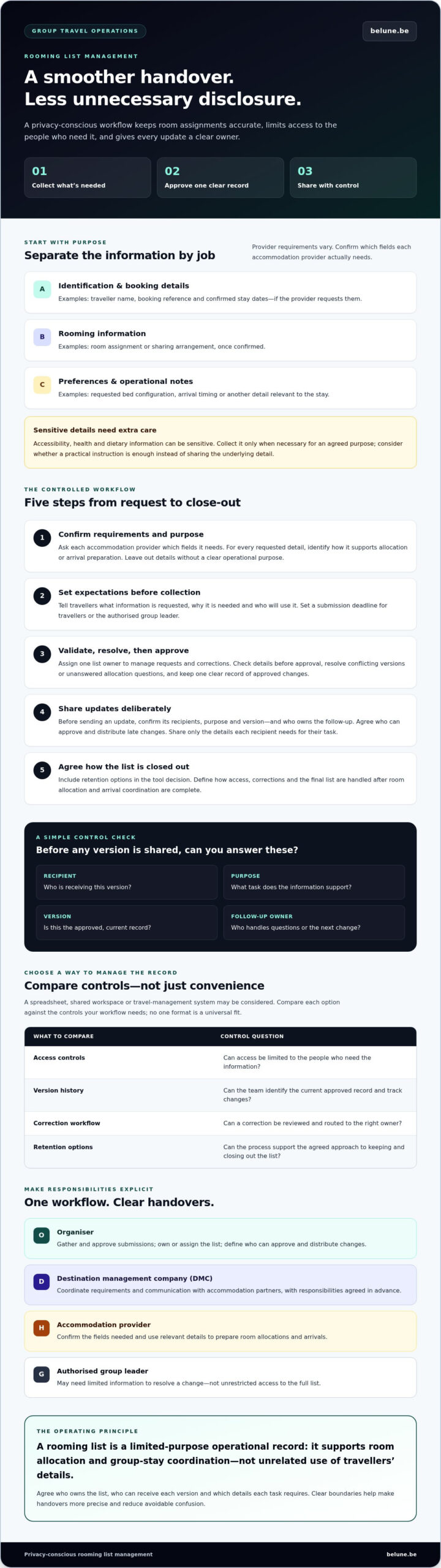
    A rooming list records the information needed to allocate rooms for a group stay. In practice, group rooming list management brings together three distinct elements: hotel booking details, traveller room assignments and optional preferences that may help shape the stay. Keeping these categories separate helps the team coordinate accurately without treating every detail as necessary for every recipient.

    Accuracy and careful information handling are connected operational responsibilities. A hotel may need names and room assignments to prepare for arrivals, while an organiser may need a broader view to resolve a change. Requirements vary by accommodation provider and itinerary. Privacy obligations also depend on the circumstances and jurisdictions involved, so confirm applicable requirements with qualified counsel.

    The following Oracle Learning video demonstrates a hotel-system workflow for creating a block reservation from a rooming list. It illustrates one operational context, not a universal process or a standard set of required fields.

    Which details might a rooming list contain?

    Before requesting information, separate it by purpose. For example, a working list might include:

    • Identification and booking details: traveller name, booking reference and confirmed stay dates, if the provider requests them.
    • Rooming information: assigned room or sharing arrangement, once confirmed.
    • Preferences and operational notes: a requested bed configuration, arrival timing or another detail relevant to the stay.

    These are examples, not universal hotel requirements. Ask each accommodation provider which fields it needs. Accessibility, health and dietary information can be sensitive. Collect such details only when necessary for an agreed purpose, and consider whether the hotel needs the underlying detail or only a practical instruction.

    Who uses the list, and for what purpose?

    A tour operator creates and manages travel arrangements, including accommodation; the Tour operator entry offers general background on that role. In a group workflow, the organiser can gather and approve submissions, while a DMC may coordinate requirements and communication with accommodation partners. The provider uses relevant details to prepare room allocations and arrivals. An authorised group leader may need limited information to resolve a change, not unrestricted access to the full list.

    A rooming list is a limited-purpose operational record: it supports room allocation and the coordination of a group’s stay, not unrelated use of travellers’ details. Agree who owns the list, who can receive each version and which details each task requires. Clear boundaries make handovers more precise and help reduce avoidable confusion for travellers and partners.

    Build a privacy-conscious rooming list from collection to confirmation

    A reliable process starts before anyone submits a preference. Assign one list owner to manage requests, corrections and the final version. Set a clear submission deadline for travellers or the authorised group leader. For each field, state its operational purpose first. If no one can explain why it’s needed for allocation or arrival preparation, leave it out.

    This discipline supports clear, responsible service. The United States Tour Operators Association describes its role in the travel industry, including an emphasis on ethics and consumer protection. For tour operators, transparency starts with straightforward instructions: tell travellers what information you’re requesting, why it’s needed and who will use it.

    Request only information needed for the allocation

    Before collection begins, ask the accommodation provider to confirm its required details and preferred submission format. Don’t assume one hotel’s process applies to another. Avoid putting full payment details, identity documents or unrelated personal notes in a rooming list. If a specific detail is required for another travel purpose, handle it through the appropriate process rather than adding it by default.

    Give travellers concise instructions and identify a contact for questions. A defined deadline gives the list owner time to check submissions and follow up on gaps before assignments are confirmed.

    Validate and confirm assignments before sharing

    Use this sequence to bring each list to a controlled final version:

    1. Confirm requirements: Check the provider’s requested fields, format and submission deadline.
    2. Request details: Ask for only relevant information and explain its purpose clearly.
    3. Validate: Compare names, room pairings, stay dates and approved preferences with the latest booking records.
    4. Resolve and approve: Direct missing or conflicting details to the authorised group contact. A named reviewer then confirms the final version.
    5. Share deliberately: Check the approved recipient list and send each recipient only the version they need.

    A compact tracker makes responsibilities visible. Adapt these examples to the provider’s confirmed requirements; they aren’t universal hotel fields.

    Field Purpose Responsible person Confirmation status
    Traveller name Match guest to booking List owner Pending / checked
    Room pairing Record approved allocation Organiser Pending / approved
    Stay dates Check booking period List owner Pending / checked

    For international tours with several accommodation partners, a DMC can help coordinate provider requirements with the organiser. The parties should agree who checks and approves each detail. This is the practical core of group rooming list management: one accountable owner, purposeful fields and a deliberate handover. Tour professionals planning hotel accommodation coordination can explore BELUNE’s hotel accommodation management as part of broader group-travel logistics.

    Group Rooming List Management: A Privacy-First Checklist for International Tours

    Compare rooming-list tools and sharing methods without losing control

    The right format depends on the group’s needs and the controls your organisation can verify. A spreadsheet may be easy to maintain, a shared workspace can support collaboration, and a dedicated travel-management system may bring rooming information into a broader workflow. None is automatically the safest choice. In group rooming list management, access rules and everyday handling matter as much as the tool itself.

    Method Practical strengths Limitations to consider Questions to verify
    Controlled spreadsheet Familiar format; straightforward to review and correct. Copies and manual changes can create conflicting versions. Who can access or edit it? Is there one authoritative copy and a usable version history?
    Approved shared workspace Can provide one shared location for authorised collaborators and updates. Convenience doesn’t ensure that permissions, history or retention are appropriate. Can access be limited by role? Are changes traceable, and can access be removed when no longer needed?
    Dedicated travel-management system May connect rooming information with other travel-management tasks. Features and supplier practices vary; setup and processes need assessment. How are sharing, audit history, export and deletion handled? Where is data stored?

    When can a spreadsheet be sufficient?

    A spreadsheet can work when a named owner maintains it, access is restricted to people who need it and the team uses a single authoritative copy. Avoid circulating separate email attachments as working versions. Agree how edits should be submitted and recorded so a correction doesn’t quietly disappear. Passwords or other file protections alone don’t replace your organisation’s wider privacy and security practices.

    What should organisers assess in a digital platform?

    Ask the provider to explain role-based access, audit history, sharing options and how records can be exported or deleted. Verify supplier claims instead of relying on feature descriptions alone. Confirm data locations and contractual terms with the provider and, where appropriate, a qualified adviser. Applicable privacy requirements vary by jurisdiction, so check which rules apply to your tour and partners.

    For any method, establish a retention approach: who keeps the working list, how long it’s needed for the operational purpose and how obsolete copies are handled. Make sure the approach reflects the actual tool and your organisation’s practices. A platform can make coordination more convenient, but convenience doesn’t prove that its privacy and security controls have been assessed.

    Use this checklist to share updates, limit access and close out the list

    A rooming list should move to its next step only when the action is clear. Before sharing, check the essentials:

    • Recipients: Are they authorised, and does each person need the information for their role?
    • Purpose: Is the list being shared for allocation, arrival preparation or another defined operational task?
    • Version: Is this the current approved copy, clearly identified so it won’t be confused with an earlier draft?
    • Transfer method: Is the chosen method appropriate under your organisation’s procedures and the provider’s requirements?
    • Follow-up owner: Who will confirm receipt, track any action and update the authoritative copy?

    Share the current rooming list only with authorised recipients who need it for an agreed operational purpose. This gives organisers and accommodation partners a clear reference without circulating every traveller detail to the full group.

    How should organisers manage last-minute changes?

    Use a defined route for corrections, even when time is short. The list owner should record who requested the change, who approved it and when the authoritative copy was updated. Then notify only the recipients who need the correction to do their jobs. If an update affects a room allocation or arrival arrangement, ask the relevant recipient to confirm receipt. This closes the loop and helps prevent an outdated version from remaining in use.

    For example, a revised room pairing may need to reach the accommodation provider and the organiser’s designated contact, but not every traveller or partner involved in the wider itinerary. Keep the change record concise and factual. Don’t add unrelated personal commentary to the list or update message.

    What should happen after the group stay?

    Close-out is part of group rooming list management, not an afterthought. Name someone to review whether the working copy is still needed once the stay is complete. That person should follow the organisation’s documented retention schedule and verify applicable obligations for the jurisdictions involved. Seek qualified advice where needed rather than assuming one retention period suits every record.

    Depending on the policy and any ongoing need, records may be deleted, archived or retained. If an unresolved booking matter, claim or other legitimate operational follow-up requires continued access, document the reason, owner and review point. Consider extra copies shared with partners too, and how they should be handled under agreed procedures.

    For tour professionals coordinating hotel accommodation and partner handovers, discuss accommodation coordination with BELUNE.

    Coordinate hotel accommodation with a DMC while keeping responsibilities clear

    A destination management company (DMC) can help connect the tour organiser’s accommodation plan with hotel requirements and local partner communication. Coordination may include gathering confirmed property requirements, aligning room allocation information and relaying approved changes. The organiser and partners should agree in advance who is responsible for each step, why information is being shared and which people are authorised to receive it.

    Coordination doesn’t automatically determine legal roles or obligations. Those can depend on the arrangement and applicable jurisdiction. If there’s uncertainty, seek guidance from qualified privacy counsel. BELUNE’s hotel accommodation management and group travel logistics can form part of a wider itinerary, while the parties involved retain their agreed responsibilities for the information they handle.

    Agree responsibilities before collecting traveller details

    Document the handover before requesting information. Name who asks travellers for details, who checks submissions against booking records, who approves the allocation, who sends the list to the accommodation provider and who manages corrections. Then confirm the provider’s actual requirements and preferred format. This sequence helps prevent premature collection and makes it easier to direct questions or resolve discrepancies without circulating the full list.

    A clear division of tasks also helps when working with a new partner. The guide to choosing a group travel agency can help professionals consider how responsibilities and partner coordination fit into wider travel arrangements. For group rooming list management, put agreed roles in writing so the process stays clear even when a correction crosses organisational boundaries.

    Make accommodation coordination part of the wider itinerary

    Rooming-list deadlines should connect to booking milestones and the group’s arrival schedule. Set submission and review dates that give the organiser and accommodation partner time to confirm assignments and resolve gaps before the relevant handover. If an itinerary includes several stays or local partners, clarify whether the same contact or a different authorised person handles each property’s requirements.

    Accommodation is one part of a larger operational sequence. The approach described in incoming tour operator coordination provides broader context for aligning local partners and travel arrangements. A DMC can help organise accommodation communications as part of wider group logistics, with the scope and recipients agreed by the parties.

    Thoughtful coordination is both practical and human: travellers face fewer avoidable allocation questions, while partners receive information suited to their role. If your team is planning an international group itinerary, consider discussing how hotel accommodation coordination can fit into its wider arrangements with BELUNE.

    Make every rooming-list handover deliberate

    Effective group rooming list management follows a clear sequence: collect only details needed for the stay, assign responsibility for checking and approving them, and share the current list only with authorised recipients. Choose tools based on controls your team can verify, then follow an agreed process for late changes and post-stay retention.

    Accommodation coordination works best when the organiser, DMC and hotel understand their roles before information starts moving. BELUNE lists hotel accommodation management as a priority service, and its company summary cites more than 20 years of experience in transport and tour-operator work. These are relevant foundations for coordinating group accommodation within broader travel logistics, without replacing your own review of privacy requirements and partner responsibilities.

    If you’re planning a group itinerary and want to clarify the accommodation handover, discuss accommodation coordination for your group with BELUNE. With clear roles and a considered process, your team can prepare for a smoother arrival while treating traveller information with care.

    Frequently Asked Questions

    What is group rooming list management?

    Group rooming list management is the process of preparing and maintaining a working record of a group’s hotel room assignments and relevant booking details. It involves confirming what the accommodation provider needs, collecting only those details, checking accuracy, controlling access and updating the authoritative version when plans change. The right fields and workflow depend on the booking, the provider and applicable privacy requirements, which may vary by jurisdiction.

    What information should be included on a hotel rooming list?

    Include only details the accommodation provider confirms it needs for the booking or room allocation. Depending on the property, this may include traveller names, room pairings or relevant arrival information. Confirm the purpose of each field before collecting it. Treat accessibility or health-related details with particular care, and avoid adding unrelated notes or payment-card details. Requirements can differ between accommodation providers, so don’t assume one list fits every stay.

    How do you share a rooming list securely with a hotel?

    First verify the recipient and confirm which information they need for their role. Use a sharing method approved by your organisation, limit access to authorised people and identify the current version clearly. Avoid sending unnecessary copies. Agree in advance how corrections will be communicated and how outdated files should be handled. The appropriate method depends on your organisation’s controls and the hotel’s arrangements, so assess the process rather than relying on the file format alone.

    Is a spreadsheet suitable for managing an international group rooming list?

    A spreadsheet can suit some groups if one person owns the authoritative copy and access, versioning and sharing are controlled. It can become harder to manage as the group, partner network or number of changes grows, particularly if multiple attachments circulate. Before choosing a format, consider how edits are tracked, how corrections reach the right people and how old copies are handled. A spreadsheet isn’t automatically secure or unsuitable; assess the actual controls and working practices.

    How should organisers handle last-minute rooming-list changes?

    Use a defined change process: confirm that the requester is authorised, verify the detail, update the authoritative copy and notify only recipients who need the correction. Record who requested and approved the change, along with when the list was updated. If the change affects room allocation or arrival arrangements, ask the relevant accommodation contact to confirm receipt. This creates a traceable handover and reduces the chance that someone acts on an outdated version.

    How long should a group rooming list be retained?

    There’s no single retention period that suits every organisation, booking or jurisdiction. Follow your organisation’s documented retention schedule and confirm applicable requirements with qualified privacy counsel. Once the operational need has ended, review whether the working list should be deleted, archived or retained for a documented reason. If an unresolved booking matter or other operational follow-up requires continued retention, record the reason and responsible person, then handle the information according to applicable policy and requirements.

    Can a DMC manage hotel rooming lists for a tour operator?

    A DMC may coordinate accommodation requirements and communication with hotel partners as part of group travel logistics. Before sharing traveller details, the tour operator and partners should agree who collects, checks, updates and distributes the list, and confirm which fields the hotel actually needs. Ask the DMC to explain its working process, and verify any privacy or security claims with the relevant provider or adviser. Don’t assume that coordination alone establishes legal roles or controls.

  • Group Accommodation Payment Terms for Tour Operators

    Group Accommodation Payment Terms for Tour Operators

    What if the greatest threat to your next curated itinerary isn’t a lack of inventory, but the invisible weight of your financial structure? For many, managing group accommodation payment terms for tour operators feels less like strategic planning and more like a defensive maneuver against high upfront deposits and opaque cancellation windows. It’s a delicate balance. You’re often asked to commit significant capital months in advance while managing the shifting tides of currency risks and fragmented supplier deadlines. We know this friction doesn’t just strain your accounting; it stifles your ability to secure the most exclusive Benelux properties for your clients.

    You’ve likely felt the frustration of juggling multiple payment milestones that never quite align. It’s time to transform these logistical hurdles into a strategic advantage. This guide provides a clear framework to master the complexities of group booking finances, ensuring you protect your cash flow while maintaining access to premium inventory. You’ll learn how to mitigate financial risk through structured milestones and discover the elegance of streamlining your entire invoicing process through a single, expert partner. We’ll explore how a refined approach to payments can finally bring the serenity and precision your high-end projects deserve.

    Key Takeaways

    • Understand the standard three-step payment cycle of deposits, interim payments, and final balances to align your internal cash flow with 2026 industry benchmarks.
    • Discover how to manage complex group accommodation payment terms for tour operators by consolidating multiple supplier deadlines into a single, manageable invoicing stream.
    • Mitigate financial risk and currency volatility by leveraging fixed-price package models that simplify accounting for multi-property Benelux tours.
    • Learn the importance of PCI DSS compliance and centralized processing to ensure the security of high-value B2B transactions across international borders.
    • Secure your inventory by evaluating the latest shifts in cancellation policies and Force Majeure clauses, protecting your agency from unforeseen market disruptions.

    Understanding Group Accommodation Payment Terms for Tour Operators

    Mastering the financial architecture of a group itinerary requires more than just an understanding of rates. It demands a deep dive into the technical specificities of group accommodation payment terms for tour operators. Unlike individual travelers who benefit from standardized retail policies, professionals operating in the group space must manage a landscape defined by rigid milestones and significant financial commitments. These terms are the structural pillars that support your cash flow and protect your access to premium inventory in highly competitive regions like the Benelux.

    The Anatomy of a Group Booking Contract

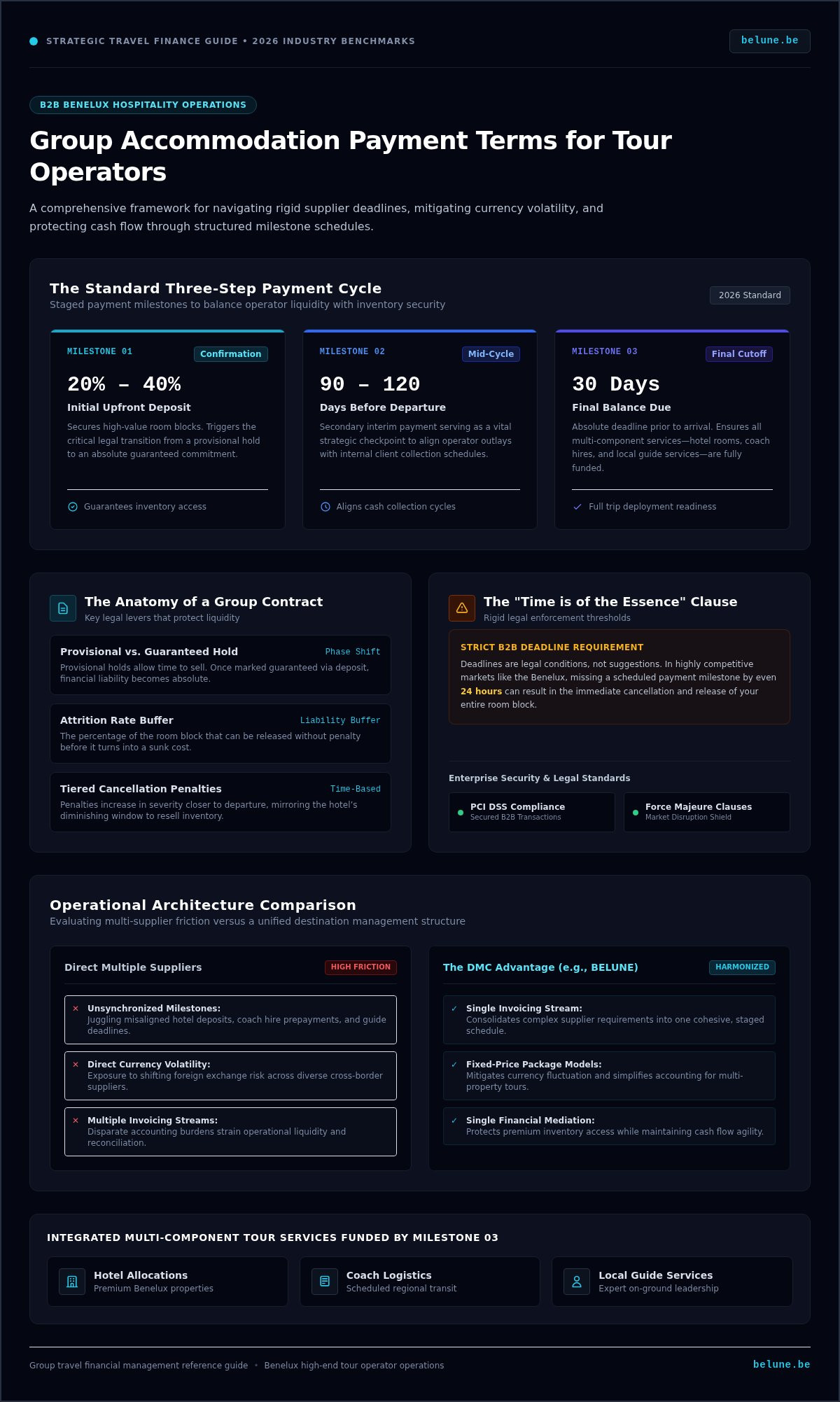
    A robust contract is a masterpiece of precision. It outlines the evolution of the booking from a provisional hold to a guaranteed commitment. Provisional bookings provide a vital window for sales, but once the status shifts to guaranteed, the financial liability becomes absolute. This transition is usually marked by the first payment milestone.

    • Payment Milestones: These staged payments typically include a non-refundable deposit, an interim payment, and a final balance due before arrival.
    • Cancellation Clauses: Tiered penalties that increase in severity as the departure date nears, reflecting the hotel’s diminishing chance to resell the space.

    The attrition rate represents the percentage of the room block that may be released without financial penalty, serving as a critical buffer for the tour operator’s liability. By understanding these thresholds, you can release unused inventory before it transforms into a sunk cost, maintaining the lean efficiency required for high-end project management.

    B2B vs. B2C: Why Tour Operators Need Specialized Terms

    Retail hotel policies are designed for simplicity and high turnover. For a professional tour operator, simplicity is rarely the reality. You’re managing a complex gap between when your clients pay and when your suppliers demand funds. Specialized B2B terms allow for the scale and flexibility required for large itineraries involving multiple services like coach hire or local guides.

    “Time is of the essence” clauses are frequently embedded in these schedules. They aren’t mere suggestions; they’re legal requirements that make a specific deadline a condition of the contract. Missing a milestone by even 24 hours can result in the immediate release of your entire room block. This is where a Destination Management Company (DMC) becomes an essential ally. By acting as a single point of financial mediation, a partner like BELUNE harmonizes these disparate deadlines into a single, cohesive invoicing structure. This technical mastery of logistics ensures that your pricing remains competitive and your financial risk is minimized through a unified currency and payment flow.

    Standard Payment Structures: Balancing Cash Flow and Security

    Precision in financial planning is what separates a successful tour from a logistical burden. In the current market, group accommodation payment terms for tour operators have evolved into a sophisticated three-step cycle. This structure isn’t just about moving funds; it’s a strategic rhythm designed to protect both the supplier’s inventory and the operator’s liquidity. By mastering these milestones, you ensure that your agency remains agile while securing the most sought-after properties in the Benelux region.

    The Milestone Approach to Group Payments

    Securing high-value inventory in 2026 typically begins with an initial deposit. Industry standards now dictate a range between 20% and 40% of the total trip cost at the time of confirmation. This first commitment acts as the anchor for your project. It’s enough to guarantee the block without over-extending your immediate capital. Following this, an interim payment often falls due between 90 and 120 days before departure. This milestone serves as a vital check-in point, aligning your financial outlays with your own client collection cycles.

    The final balance is generally required 30 days before the group’s arrival. This deadline is absolute. It ensures that all components, from hotel rooms to coach hire and local guide services, are fully funded before the first guest steps off the plane. This staged approach mirrors the rigor found in international security protocols, such as the USTOA $1 Million Travelers Assistance Program, which highlights the importance of financial stability and consumer protection in the B2B travel supply chain.

    Release Dates and Attrition Management

    Release dates are your most effective tools for risk mitigation. They provide a window to return unsold rooms without incurring heavy penalties. Most professional contracts include an attrition allowance, typically between 10% and 20%. This means you can reduce your group size by that percentage up until a specific cutoff, usually 60 to 90 days out, without losing your deposit on those specific units. It’s a buffer that respects the reality of group sales. However, once you pass the 30-day mark, cancellation fees often climb to 75% or even 100% of the revenue. Staying ahead of these dates is essential for maintaining a healthy margin.

    Finding this balance is easier when you have a local ally who understands the nuances of regional hotelier expectations. For a deeper look at selecting a partner capable of navigating these complexities, consult The Definitive Guide to Choosing a Benelux Incoming Tour Operator in 2026. A specialized partner doesn’t just manage bookings; they harmonize these disparate deadlines into a single, cohesive timeline. If you’re ready to move away from fragmented invoicing and toward a more integrated model, exploring our tailored group solutions can provide the financial clarity your next project demands.

    Group Accommodation Payment Terms for Tour Operators

    Secure Payment Processing for Group Travel: Safety Protocols

    Security in high-value B2B transactions is not a mere technicality; it is a structural component of professional trust. When managing group accommodation payment terms for tour operators, the financial volume involved necessitates a rigorous approach to safety. A single multi-city itinerary can involve dozens of transactions across different jurisdictions, each representing a potential point of failure. By centralizing these flows, we transform a fragmented liability into a streamlined, secure asset that protects your agency’s integrity.

    Financial Security Standards in 2026

    Encryption and secure gateway requirements have become the baseline for modern travel commerce. PCI DSS compliance remains mandatory, ensuring that sensitive payment data is handled with the highest level of integrity throughout the booking lifecycle. Beyond simple data protection, the use of escrow or bonded accounts provides an additional layer of assurance for international partners. These structures guarantee that funds are protected until service delivery is confirmed, aligning with group contract best practices. Centralized invoicing reduces administrative fraud risks by creating a single, audited financial trail that eliminates the opacity often found in multi-vendor payment schedules.

    Managing Cross-Border Payment Challenges

    Operating across borders introduces complexities that can erode even the healthiest margins. While SEPA transfers offer efficiency within Europe, SWIFT payments and international transfer fees often add hidden costs to global transactions. These small percentages, when applied to a large group booking, can represent thousands in lost revenue. Currency volatility represents perhaps the greatest risk to a tour operator’s profitability. A sudden shift in the Euro’s value can instantly turn a profitable itinerary into a loss-making venture if rates aren’t locked in early. We mitigate this through fixed-price models that shield our partners from market fluctuations.

    Selecting a partner with local financial expertise is critical for navigating these challenges efficiently. For a deeper analysis of what to look for in a strategic partner, see The Definitive Guide to Choosing a Group Travel Agency in 2026. By consolidating payments for hotels, coaches, and local guides into a single currency and invoice, you don’t just save on bank fees; you regain control over your financial narrative. This level of precision is essential for those aiming to deliver exceptional experiences without the distraction of logistical friction. It’s about moving from a reactive stance to a position of strategic authority.

    The DMC Advantage: Streamlining Financial Logistics

    Managing the financial architecture of a complex itinerary shouldn’t feel like a battle with your own ledger. While the technicalities of group accommodation payment terms for tour operators can be daunting, the intervention of a specialized Destination Management Company transforms this friction into a streamlined asset. By acting as a single point of financial mediation, we remove the burden of managing dozens of disparate supplier contracts, allowing you to focus on the creative vision of the journey itself.

    Consolidated Invoicing for Multi-Day Itineraries

    The logistical elegance of “one invoice, one currency” cannot be overstated. When a tour spans the Benelux region, you’re often faced with a mosaic of VAT requirements and local tax codes that vary significantly between borders. We handle these complexities internally. By aggregating payments for hotels, our in-house fleet of modern coaches, and local guide services, we eliminate the need for your accounting team to process multiple international transfers. This consolidation significantly reduces bank fees and mitigates the administrative fatigue that often plagues high-volume agencies. Each itinerary we plan includes a comprehensive financial risk assessment, ensuring that every euro is accounted for and every tax obligation is met with absolute precision.

    Local Expertise and Negotiation Power

    Relationships are the silent currency of the travel industry. With 20+ years of presence in the Benelux market, we’ve cultivated deep ties with premium properties that an overseas operator simply cannot replicate. We leverage this trust to secure more favorable group accommodation payment terms for tour operators, often negotiating softer deposit requirements or extended release windows that protect your liquidity. This local guidance is particularly vital when navigating regional payment customs that might otherwise result in rigid, non-negotiable contracts.

    Our role extends beyond the initial booking. We provide 24/7 financial support for on-the-ground contingencies, ensuring that if an itinerary needs a sudden adjustment, the payment logistics are handled instantly without disrupting the guest experience. This level of operational depth is what defines a true strategic ally. For those looking to elevate their offerings, exploring The Ultimate Guide to Culture Group Tours in Benelux for 2026 reveals how these financial structures support world-class guest experiences. If you’re ready to simplify your logistics and secure premium inventory with confidence, partner with BELUNE for your next Benelux itinerary.

    Optimizing Your Strategy: Best Practices for Tour Operators

    Strategic success in the high-end travel sector isn’t just about booking the right hotel; it’s about the masterful stewardship of your agency’s financial reputation. As we’ve explored, navigating group accommodation payment terms for tour operators requires a blend of technical precision and proactive communication. To truly protect your margins and secure the finest inventory in the Benelux region, you must move beyond reactive accounting and embrace a strategy of anticipation.

    Setting internal deadlines is your first line of defense. We recommend establishing your own milestones at least seven to ten days before your supplier’s official cut-off. This buffer isn’t just a safety net for bank delays; it provides the necessary space to resolve client payment issues without risking your room block. In the 2026 landscape, Force Majeure and cancellation clauses have become more nuanced, often reflecting specific regional labor trends or environmental considerations. Reviewing these with a critical eye ensures your agency isn’t left vulnerable to shifting global conditions.

    Contractual Due Diligence

    A rigorous review process is the hallmark of a professional operator. Your checklist should prioritize the verification of attrition windows, currency lock-in dates, and the specific penalties for last-minute group additions. Handling the “plus one” guest or a sudden reduction in numbers requires a contract that offers pre-defined flexibility. When your financial structure supports your creative vision, you can deliver truly exceptional journeys, such as those detailed in Themed Group Travel in Benelux: A Masterclass in Curated Experiences. Transparency with your DMC partner regarding your own client collection cycles often opens doors to more bespoke, flexible payment arrangements.

    Next Steps: Securing Your 2026 Group Inventory

    The Benelux market remains highly competitive, with premium properties for art and culture tours often reaching capacity 12 to 18 months in advance. Early booking isn’t just a suggestion; it’s a requirement for those who refuse to compromise on quality. Partnering with BELUNE means leveraging 20+ years of local expertise and an in-house fleet of modern coaches to anchor your logistics. We act as your strategic ally, harmonizing complex payment flows into a single, elegant narrative. Don’t leave your 2026 programs to chance. Contact our team today to request a custom itinerary proposal and secure the inventory your clients expect.

    Mastering the Financial Architecture of Your Next Journey

    Expertly navigating the technicalities of group accommodation payment terms for tour operators is the final step in securing a seamless travel program. You’ve seen how structured milestones protect your liquidity and how centralized invoicing through a trusted partner eliminates administrative friction. By embracing these standards, you move from managing spreadsheets to curating experiences with absolute confidence. Our approach focuses on technical rigor and artistic vision, ensuring your cash flow remains as fluid as your itineraries.

    With over 20 years of DMC expertise and a modern private coach fleet, we provide the stability your high-end projects demand. Our fixed-price group tour packages shield your margins from currency volatility, allowing you to focus on the human and emotional impact of the tour. It’s time to transform your logistical challenges into a strategic advantage. Request Your Custom Benelux Group Tour Itinerary today to begin a collaboration built on excellence and precision. We look forward to realizing your most ambitious projects together.

    Frequently Asked Questions

    What are the standard deposit requirements for group bookings in Benelux?

    Standard deposits for group bookings in the Benelux region typically range from 20% to 40% of the total reservation value. This initial commitment secures your inventory and allows hotels to guarantee availability for large blocks. In 2026, many premium properties require this non-refundable deposit upon confirmation to protect against high cancellation rates. Working with a partner like BELUNE ensures these group accommodation payment terms for tour operators are managed through a single, professional financial channel.

    How do cancellation policies differ for tour operators compared to individual guests?

    Cancellation policies for professionals are significantly more rigid than standard B2C hotel terms. While individual guests often enjoy 24-hour flexibility, group contracts use tiered penalties that increase as the departure date approaches. For example, cancelling 30 days out might incur a 50% penalty, while changes within 14 days often result in a 100% loss of revenue. These tiers reflect the hotel’s limited window to resell dozens of rooms simultaneously.

    Can a DMC help reduce the financial risk of currency fluctuations?

    A specialized Destination Management Company mitigates currency risk by providing fixed-price group tour packages. By locking in rates at the time of booking, you avoid the margin erosion caused by sudden fluctuations in the Euro or other local currencies. This stability is essential for international operators who sell itineraries months in advance. We act as a financial shield, ensuring your projected profits remain intact regardless of market volatility during the planning phase.

    What is an attrition clause, and how does it affect my payment terms?

    An attrition clause defines the percentage of rooms you can release without financial penalty before specific deadlines. A standard allowance is 10% to 20% of the original block, providing a vital buffer for fluctuating group sizes. If your sales fall below this threshold, the clause protects your agency from paying for unused inventory. It’s a key component of group accommodation payment terms for tour operators that balances risk between the hotel and the agency.

    How do I ensure my payments are secure when booking multiple hotels?

    Ensuring security across multiple properties requires a centralized payment gateway that adheres to PCI DSS standards. Rather than sharing sensitive financial data with several individual hotels, you process a single transaction through your DMC partner. This method reduces administrative fraud risks and ensures that high-value B2B transfers are encrypted. We utilize secure gateways and bonded accounts to provide a structural layer of protection for every itinerary we manage.

    What happens if our group size significantly decreases after the deposit is paid?

    If your group size drops significantly beyond the allowed attrition percentage, tiered cancellation fees will apply to the released rooms. These penalties are usually calculated based on the proximity to the arrival date, often ranging from 25% to 100% of the cancelled revenue. Proactive communication with your partner is critical here. We leverage our 20 years of local relationships to negotiate the best possible outcomes when unexpected shifts in group dynamics occur.

    Are there specific VAT considerations for group travel payments in the Benelux region?

    VAT considerations for group travel in the Benelux region are complex because tax codes vary across national borders. Navigating these requirements independently often leads to administrative fatigue and potential compliance errors. A specialized partner simplifies this by aggregating all local taxes into a single, compliant invoice. This ensures that your accounting team handles one clear document that respects the specific tax regulations of every country included in your itinerary.

    How far in advance should final payments be settled for group accommodation?

    Final payments for group accommodation should generally be settled 30 days before the group’s arrival. This deadline ensures that all logistics, including coach hire and guide services, are fully funded and guaranteed. Some suppliers may request settlement up to 60 or 90 days out for peak season dates or high-demand festivals. Establishing clear internal deadlines at least one week before these supplier cut-offs is a best practice for maintaining healthy cash flow.