
Tag: DMC management

  • Group Rooming List Management: A Privacy-First Checklist for International Tours

    Group Rooming List Management: A Privacy-First Checklist for International Tours

    What if the rooming list that helps an international group check in smoothly also shares more traveller information than the hotel needs? Good group rooming list management is about more than filling rooms. It’s a controlled workflow for keeping preferences, arrival details and changes accurate while limiting who can see each piece of information.

    When details arrive from travellers, organisers and travel partners at different times, even a careful team can end up with conflicting versions or unanswered allocation questions. The solution isn’t to collect every possible detail or circulate one master file widely. Agree what’s needed, who checks it and how updates reach the right accommodation partner.

    This guide provides a practical, privacy-conscious checklist for collecting, reviewing, sharing, updating and closing out a rooming list. You’ll learn how to confirm each provider’s requirements, maintain one clear record of approved changes and define the roles of organisers, hotels and DMCs. The result is a more controlled handover, with fewer avoidable errors, less unnecessary disclosure and a smoother path from room allocation to arrival.

    Key Takeaways

    • Separate essential hotel booking details and room assignments from optional preferences, then confirm which fields each property actually needs.
    • Make group rooming list management easier to control by assigning one list owner, setting a submission deadline and validating details before approval.
    • Choose a spreadsheet, shared workspace or travel-management system by comparing access controls, version history, correction workflows and retention options.
    • Before sharing an update, confirm its recipients, purpose, version and follow-up owner; define who can approve and distribute late changes.
    • Agree in advance how the organiser, DMC and accommodation provider will coordinate allocation and communication, including who may receive the list.

    What group rooming list management involves, and why privacy belongs in the process

    A rooming list records the information needed to allocate rooms for a group stay. In practice, group rooming list management brings together three distinct elements: hotel booking details, traveller room assignments and optional preferences that may help shape the stay. Keeping these categories separate helps the team coordinate accurately without treating every detail as necessary for every recipient.

    Accuracy and careful information handling are connected operational responsibilities. A hotel may need names and room assignments to prepare for arrivals, while an organiser may need a broader view to resolve a change. Requirements vary by accommodation provider and itinerary. Privacy obligations also depend on the circumstances and jurisdictions involved, so confirm applicable requirements with qualified counsel.

    The following Oracle Learning video demonstrates a hotel-system workflow for creating a block reservation from a rooming list. It illustrates one operational context, not a universal process or a standard set of required fields.

    Which details might a rooming list contain?

    Before requesting information, separate it by purpose. For example, a working list might include:

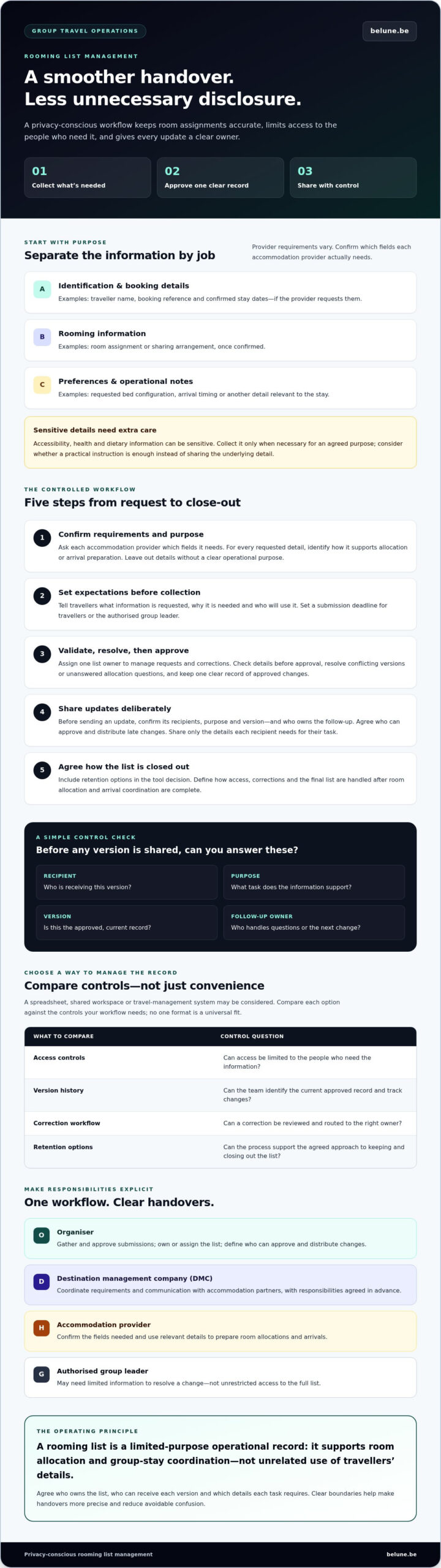
    • Identification and booking details: traveller name, booking reference and confirmed stay dates, if the provider requests them.
    • Rooming information: assigned room or sharing arrangement, once confirmed.
    • Preferences and operational notes: a requested bed configuration, arrival timing or another detail relevant to the stay.

    These are examples, not universal hotel requirements. Ask each accommodation provider which fields it needs. Accessibility, health and dietary information can be sensitive. Collect such details only when necessary for an agreed purpose, and consider whether the hotel needs the underlying detail or only a practical instruction.

    Who uses the list, and for what purpose?

    A tour operator creates and manages travel arrangements, including accommodation; the Tour operator entry offers general background on that role. In a group workflow, the organiser can gather and approve submissions, while a DMC may coordinate requirements and communication with accommodation partners. The provider uses relevant details to prepare room allocations and arrivals. An authorised group leader may need limited information to resolve a change, not unrestricted access to the full list.

    A rooming list is a limited-purpose operational record: it supports room allocation and the coordination of a group’s stay, not unrelated use of travellers’ details. Agree who owns the list, who can receive each version and which details each task requires. Clear boundaries make handovers more precise and help reduce avoidable confusion for travellers and partners.

    Build a privacy-conscious rooming list from collection to confirmation

    A reliable process starts before anyone submits a preference. Assign one list owner to manage requests, corrections and the final version. Set a clear submission deadline for travellers or the authorised group leader. For each field, state its operational purpose first. If no one can explain why it’s needed for allocation or arrival preparation, leave it out.

    This discipline supports clear, responsible service. The United States Tour Operators Association describes its role in the travel industry, including an emphasis on ethics and consumer protection. For tour operators, transparency starts with straightforward instructions: tell travellers what information you’re requesting, why it’s needed and who will use it.

    Request only information needed for the allocation

    Before collection begins, ask the accommodation provider to confirm its required details and preferred submission format. Don’t assume one hotel’s process applies to another. Avoid putting full payment details, identity documents or unrelated personal notes in a rooming list. If a specific detail is required for another travel purpose, handle it through the appropriate process rather than adding it by default.

    Give travellers concise instructions and identify a contact for questions. A defined deadline gives the list owner time to check submissions and follow up on gaps before assignments are confirmed.

    Validate and confirm assignments before sharing

    Use this sequence to bring each list to a controlled final version:

    1. Confirm requirements: Check the provider’s requested fields, format and submission deadline.
    2. Request details: Ask for only relevant information and explain its purpose clearly.
    3. Validate: Compare names, room pairings, stay dates and approved preferences with the latest booking records.
    4. Resolve and approve: Direct missing or conflicting details to the authorised group contact. A named reviewer then confirms the final version.
    5. Share deliberately: Check the approved recipient list and send each recipient only the version they need.

    A compact tracker makes responsibilities visible. Adapt these examples to the provider’s confirmed requirements; they aren’t universal hotel fields.

    Field Purpose Responsible person Confirmation status
    Traveller name Match guest to booking List owner Pending / checked
    Room pairing Record approved allocation Organiser Pending / approved
    Stay dates Check booking period List owner Pending / checked

    For international tours with several accommodation partners, a DMC can help coordinate provider requirements with the organiser. The parties should agree who checks and approves each detail. This is the practical core of group rooming list management: one accountable owner, purposeful fields and a deliberate handover. Tour professionals planning hotel accommodation coordination can explore BELUNE’s hotel accommodation management as part of broader group-travel logistics.
    Group Rooming List Management: A Privacy-First Checklist for International Tours

    Compare rooming-list tools and sharing methods without losing control

    The right format depends on the group’s needs and the controls your organisation can verify. A spreadsheet may be easy to maintain, a shared workspace can support collaboration, and a dedicated travel-management system may bring rooming information into a broader workflow. None is automatically the safest choice. In group rooming list management, access rules and everyday handling matter as much as the tool itself.

    Method Practical strengths Limitations to consider Questions to verify
    Controlled spreadsheet Familiar format; straightforward to review and correct. Copies and manual changes can create conflicting versions. Who can access or edit it? Is there one authoritative copy and a usable version history?
    Approved shared workspace Can provide one shared location for authorised collaborators and updates. Convenience doesn’t ensure that permissions, history or retention are appropriate. Can access be limited by role? Are changes traceable, and can access be removed when no longer needed?
    Dedicated travel-management system May connect rooming information with other travel-management tasks. Features and supplier practices vary; setup and processes need assessment. How are sharing, audit history, export and deletion handled? Where is data stored?

    When can a spreadsheet be sufficient?

    A spreadsheet can work when a named owner maintains it, access is restricted to people who need it and the team uses a single authoritative copy. Avoid circulating separate email attachments as working versions. Agree how edits should be submitted and recorded so a correction doesn’t quietly disappear. Passwords or other file protections alone don’t replace your organisation’s wider privacy and security practices.

    What should organisers assess in a digital platform?

    Ask the provider to explain role-based access, audit history, sharing options and how records can be exported or deleted. Verify supplier claims instead of relying on feature descriptions alone. Confirm data locations and contractual terms with the provider and, where appropriate, a qualified adviser. Applicable privacy requirements vary by jurisdiction, so check which rules apply to your tour and partners.

    For any method, establish a retention approach: who keeps the working list, how long it’s needed for the operational purpose and how obsolete copies are handled. Make sure the approach reflects the actual tool and your organisation’s practices. A platform can make coordination more convenient, but convenience doesn’t prove that its privacy and security controls have been assessed.

    Use this checklist to share updates, limit access and close out the list

    A rooming list should move to its next step only when the action is clear. Before sharing, check the essentials:

    • Recipients: Are they authorised, and does each person need the information for their role?
    • Purpose: Is the list being shared for allocation, arrival preparation or another defined operational task?
    • Version: Is this the current approved copy, clearly identified so it won’t be confused with an earlier draft?
    • Transfer method: Is the chosen method appropriate under your organisation’s procedures and the provider’s requirements?
    • Follow-up owner: Who will confirm receipt, track any action and update the authoritative copy?

    Share the current rooming list only with authorised recipients who need it for an agreed operational purpose. This gives organisers and accommodation partners a clear reference without circulating every traveller detail to the full group.

    How should organisers manage last-minute changes?

    Use a defined route for corrections, even when time is short. The list owner should record who requested the change, who approved it and when the authoritative copy was updated. Then notify only the recipients who need the correction to do their jobs. If an update affects a room allocation or arrival arrangement, ask the relevant recipient to confirm receipt. This closes the loop and helps prevent an outdated version from remaining in use.

    For example, a revised room pairing may need to reach the accommodation provider and the organiser’s designated contact, but not every traveller or partner involved in the wider itinerary. Keep the change record concise and factual. Don’t add unrelated personal commentary to the list or update message.

    What should happen after the group stay?

    Close-out is part of group rooming list management, not an afterthought. Name someone to review whether the working copy is still needed once the stay is complete. That person should follow the organisation’s documented retention schedule and verify applicable obligations for the jurisdictions involved. Seek qualified advice where needed rather than assuming one retention period suits every record.

    Depending on the policy and any ongoing need, records may be deleted, archived or retained. If an unresolved booking matter, claim or other legitimate operational follow-up requires continued access, document the reason, owner and review point. Consider extra copies shared with partners too, and how they should be handled under agreed procedures.

    For tour professionals coordinating hotel accommodation and partner handovers, discuss accommodation coordination with BELUNE.

    Coordinate hotel accommodation with a DMC while keeping responsibilities clear

    A destination management company (DMC) can help connect the tour organiser’s accommodation plan with hotel requirements and local partner communication. Coordination may include gathering confirmed property requirements, aligning room allocation information and relaying approved changes. The organiser and partners should agree in advance who is responsible for each step, why information is being shared and which people are authorised to receive it.

    Coordination doesn’t automatically determine legal roles or obligations. Those can depend on the arrangement and applicable jurisdiction. If there’s uncertainty, seek guidance from qualified privacy counsel. BELUNE’s hotel accommodation management and group travel logistics can form part of a wider itinerary, while the parties involved retain their agreed responsibilities for the information they handle.

    Agree responsibilities before collecting traveller details

    Document the handover before requesting information. Name who asks travellers for details, who checks submissions against booking records, who approves the allocation, who sends the list to the accommodation provider and who manages corrections. Then confirm the provider’s actual requirements and preferred format. This sequence helps prevent premature collection and makes it easier to direct questions or resolve discrepancies without circulating the full list.

    A clear division of tasks also helps when working with a new partner. The guide to choosing a group travel agency can help professionals consider how responsibilities and partner coordination fit into wider travel arrangements. For group rooming list management, put agreed roles in writing so the process stays clear even when a correction crosses organisational boundaries.

    Make accommodation coordination part of the wider itinerary

    Rooming-list deadlines should connect to booking milestones and the group’s arrival schedule. Set submission and review dates that give the organiser and accommodation partner time to confirm assignments and resolve gaps before the relevant handover. If an itinerary includes several stays or local partners, clarify whether the same contact or a different authorised person handles each property’s requirements.

    Accommodation is one part of a larger operational sequence. The approach described in incoming tour operator coordination provides broader context for aligning local partners and travel arrangements. A DMC can help organise accommodation communications as part of wider group logistics, with the scope and recipients agreed by the parties.

    Thoughtful coordination is both practical and human: travellers face fewer avoidable allocation questions, while partners receive information suited to their role. If your team is planning an international group itinerary, consider discussing how hotel accommodation coordination can fit into its wider arrangements with BELUNE.

    Make every rooming-list handover deliberate

    Effective group rooming list management follows a clear sequence: collect only details needed for the stay, assign responsibility for checking and approving them, and share the current list only with authorised recipients. Choose tools based on controls your team can verify, then follow an agreed process for late changes and post-stay retention.

    Accommodation coordination works best when the organiser, DMC and hotel understand their roles before information starts moving. BELUNE lists hotel accommodation management as a priority service, and its company summary cites more than 20 years of experience in transport and tour-operator work. These are relevant foundations for coordinating group accommodation within broader travel logistics, without replacing your own review of privacy requirements and partner responsibilities.

    If you’re planning a group itinerary and want to clarify the accommodation handover, discuss accommodation coordination for your group with BELUNE. With clear roles and a considered process, your team can prepare for a smoother arrival while treating traveller information with care.

    Frequently Asked Questions

    What is group rooming list management?

    Group rooming list management is the process of preparing and maintaining a working record of a group’s hotel room assignments and relevant booking details. It involves confirming what the accommodation provider needs, collecting only those details, checking accuracy, controlling access and updating the authoritative version when plans change. The right fields and workflow depend on the booking, the provider and applicable privacy requirements, which may vary by jurisdiction.

    What information should be included on a hotel rooming list?

    Include only details the accommodation provider confirms it needs for the booking or room allocation. Depending on the property, this may include traveller names, room pairings or relevant arrival information. Confirm the purpose of each field before collecting it. Treat accessibility or health-related details with particular care, and avoid adding unrelated notes or payment-card details. Requirements can differ between accommodation providers, so don’t assume one list fits every stay.

    How do you share a rooming list securely with a hotel?

    First verify the recipient and confirm which information they need for their role. Use a sharing method approved by your organisation, limit access to authorised people and identify the current version clearly. Avoid sending unnecessary copies. Agree in advance how corrections will be communicated and how outdated files should be handled. The appropriate method depends on your organisation’s controls and the hotel’s arrangements, so assess the process rather than relying on the file format alone.

    Is a spreadsheet suitable for managing an international group rooming list?

    A spreadsheet can suit some groups if one person owns the authoritative copy and access, versioning and sharing are controlled. It can become harder to manage as the group, partner network or number of changes grows, particularly if multiple attachments circulate. Before choosing a format, consider how edits are tracked, how corrections reach the right people and how old copies are handled. A spreadsheet isn’t automatically secure or unsuitable; assess the actual controls and working practices.

    How should organisers handle last-minute rooming-list changes?

    Use a defined change process: confirm that the requester is authorised, verify the detail, update the authoritative copy and notify only recipients who need the correction. Record who requested and approved the change, along with when the list was updated. If the change affects room allocation or arrival arrangements, ask the relevant accommodation contact to confirm receipt. This creates a traceable handover and reduces the chance that someone acts on an outdated version.

    How long should a group rooming list be retained?

    There’s no single retention period that suits every organisation, booking or jurisdiction. Follow your organisation’s documented retention schedule and confirm applicable requirements with qualified privacy counsel. Once the operational need has ended, review whether the working list should be deleted, archived or retained for a documented reason. If an unresolved booking matter or other operational follow-up requires continued retention, record the reason and responsible person, then handle the information according to applicable policy and requirements.

    Can a DMC manage hotel rooming lists for a tour operator?

    A DMC may coordinate accommodation requirements and communication with hotel partners as part of group travel logistics. Before sharing traveller details, the tour operator and partners should agree who collects, checks, updates and distributes the list, and confirm which fields the hotel actually needs. Ask the DMC to explain its working process, and verify any privacy or security claims with the relevant provider or adviser. Don’t assume that coordination alone establishes legal roles or controls.

  • Managing Currency Fluctuations for Tour Packages

    Managing Currency Fluctuations for Tour Packages

    A tour package can become harder to deliver at its planned margin before the first guest boards. When supplier commitments are priced in one currency and customer payments arrive in another, exchange-rate movements can turn a carefully built quotation into a difficult trade-off. Managing currency fluctuations for tour packages starts with treating exposure as part of package design, not as a last-minute surcharge.

    That uncertainty is familiar to professional travel partners. Raising prices too readily can make an itinerary less appealing, while holding them fixed without understanding the risk can leave the planned margin exposed. The answer isn’t necessarily to remove all flexibility. First, identify which costs are genuinely affected, then decide how much price certainty your quotation needs.

    This guide explains how to map currency exposure across supplier costs and payment timing, compare practical ways to manage it, and establish clear quotation and review procedures. It also covers how to communicate pricing terms to customers. A coordinated view of accommodation, transport, guidance, and activities can make package costs clearer and help partners make more deliberate decisions about price certainty.

    Key Takeaways

    • Map each package cost by currency, amount, payment date, and commitment status before preparing a quotation.
    • Separate confirmed foreign-currency obligations from estimates that may change, so you can focus on genuine exposure.
    • When managing currency fluctuations for tour packages, compare base-currency pricing, quotation validity periods, adjustment clauses, and natural offsets.
    • Assign clear ownership and review triggers for exchange-rate monitoring, supplier updates, and quotation approvals.
    • A DMC can help coordinate supplier and itinerary details for clearer costing, but coordination alone doesn’t remove currency risk.

    Why currency fluctuations matter when pricing tour packages

    A group itinerary can be carefully designed and still face a pricing gap: the customer receives a quotation before every supplier has been paid, and the tour may take place months later. If customer receipts and supplier costs use different currencies, exchange-rate changes can affect the package’s income, costs, or planned margin. This is currency exposure, a form of foreign exchange risk.

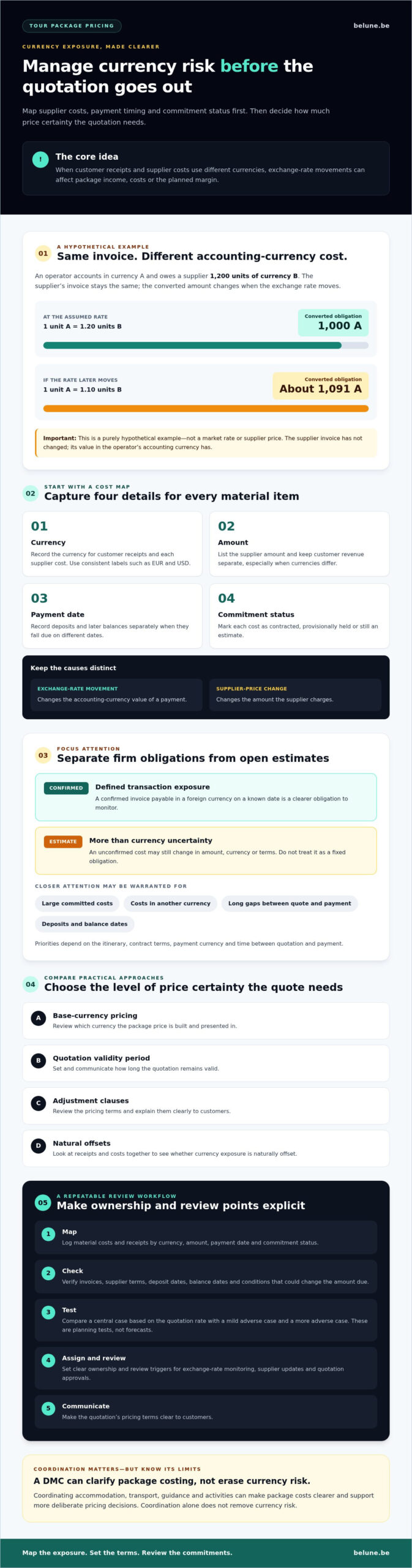
    Consider a purely hypothetical example, not a market rate or supplier price. An operator accounts in currency A and owes a supplier 1,200 units of currency B. At an assumed rate of 1 unit of A for 1.20 units of B, the obligation converts to 1,000 units of A. If the rate later moves to 1 unit of A for 1.10 units of B, the same obligation converts to about 1,091 units of A. The supplier’s invoice hasn’t changed, but its cost in the operator’s accounting currency has.

    Exchange-rate movement changes the accounting-currency value of a payment; an ordinary supplier-price change alters the amount the supplier charges. The distinction matters because each has a different cause and may call for a different response. Managing currency fluctuations for tour packages begins with identifying which package amounts are exposed and when they become payable.

    Where exchange-rate exposure enters a group-tour package

    Build a simple currency map. Record the currency used for customer receipts and each major package component, such as accommodation, coach transport, activities, local guides, and other contracted costs. For each item, note the amount, payment date, and whether the cost is confirmed or still an estimate.

    Payment timing affects the eventual conversion. A deposit paid when a supplier confirms a booking may be exchanged at a different rate from a later balance. Customer payments may arrive on a separate schedule. Mark a cost that isn’t yet contracted as an estimate, rather than treating it as a fixed obligation. Its final amount or currency terms may still change.

    Which package costs deserve closer attention?

    Start with large, committed costs payable in a currency different from the operator’s accounting currency. A confirmed accommodation block or transport commitment may warrant closer monitoring than a small, variable expense. Priorities depend on the itinerary, contract terms, payment currency, and time between quotation and payment.

    • Check whether the contract is denominated in the accounting currency or another currency.
    • Record deposit and balance dates, as well as any conditions that could change the amount due.
    • Separate confirmed commitments from estimates that may shift before booking.

    This gives you a clearer view of exposure before a quotation goes out. It also helps partners decide which costs need review as the itinerary develops, rather than applying the same level of concern to every line item.

    How to measure currency exposure before issuing a tour quotation

    A useful exposure assessment starts with a clear record, not a prediction. For each package, capture the currency, amount, expected payment date, and commitment status of every material receipt and cost. Then compare them in the operator’s accounting currency. Managing currency fluctuations for tour packages becomes more deliberate when the team can see which obligations are fixed and which remain uncertain.

    Build a currency-by-currency cost map

    Use one row for each supplier commitment. Record the supplier amount, invoice currency, expected payment date, and relevant cancellation terms. List customer revenue separately, since it may be received in a different currency or on a different schedule. Label currencies consistently with ISO 4217 codes, such as EUR and USD, to avoid ambiguity in worksheets and quotations.

    • Mark whether each cost is contracted, provisionally held, or still an estimate.
    • Record deposits and later instalments as separate payments when their dates differ.
    • Check invoices and supplier terms before relying on a currency or amount.

    A confirmed invoice payable in a foreign currency on a known date creates a more defined transaction exposure. An unconfirmed estimate is different: its amount, currency, or terms may change, so the uncertainty isn’t solely about exchange rates.

    Test how rate changes affect package economics

    Use three labelled scenarios: a central case based on the rate selected for the quotation, a mild adverse case, and a more adverse case. These are planning tests, not forecasts. For example, assume an operator accounts in EUR and has a hypothetical confirmed supplier invoice of USD 10,000. At an assumed central rate of EUR 1 = USD 1.10, the cost is EUR 9,090.91. At an assumed mild adverse rate of EUR 1 = USD 1.05, it is EUR 9,523.81; at an assumed more adverse rate of EUR 1 = USD 1.00, it is EUR 10,000. Each rate and amount here is illustrative, not a current market quote.

    Exposure calculation: convert each committed foreign-currency amount into the accounting currency at the selected scenario rate, then compare total costs and planned margin with the central case. Verify supplier amounts, invoice currencies, payment dates, and the rates used before relying on the result. The U.S. International Trade Administration outlines ways exporters can mitigate the risk of fluctuating foreign currency rates. Any approach needs to suit your contracts and circumstances.

    When supplier, accommodation, coach, and activity details are still being assembled, a coordinated itinerary can help make the cost map more complete. Professional partners can discuss a tailored group itinerary with BELUNE, whose DMC work includes coordinating group-travel logistics.

    Managing Currency Fluctuations for Tour Packages

    Comparing ways to manage currency fluctuations for tour packages

    No single policy suits every itinerary. Managing currency fluctuations for tour packages means weighing the price certainty you need against each approach’s flexibility and administrative demands. Start with operational measures, then consider whether a financial instrument is proportionate to the package’s scale and payment timeline.

    Operational approaches: quote terms, buffers, and natural offsets

    Pricing in your base currency gives customers a clear amount, but leaves the operator exposed to costs invoiced in another currency. A defined quotation-validity period sets how long the price applies. Once it expires, review supplier costs and rates before confirming. If you use an adjustment clause, explain its trigger and calculation plainly, and have the wording checked against applicable requirements. A contingency allowance can support internal planning, but it should reflect the package’s actual exposure rather than a universal percentage.

    Natural offsets can reduce unmatched exposure when customer receipts and supplier payments are in the same currency. They are more useful when the amounts and timing align closely. Differences in value, payment date, or commitment status leave residual risk. The U.S. International Trade Administration outlines approaches to mitigate the risk of fluctuating foreign currency rates, including financial tools that operators should assess for their own circumstances.

    Financial hedging: when specialist advice may be needed

    A forward contract generally sets an exchange rate for an agreed amount and future date. A currency option may provide the right, but not the obligation, to exchange at an agreed rate, subject to its terms and costs. Neither is a default recommendation. Ask a bank or qualified adviser to review eligibility, costs, obligations, and accounting treatment before proceeding.

    Compare these tools with simpler quotation controls. The decision depends on the size and certainty of the foreign-currency commitment, when payment is due, and whether the package can absorb a rate change. Hedging may add administration and contractual obligations. Operational methods are simpler but may leave more exposure in place.

    • Base-currency pricing: High customer-price clarity and low effort, but supplier exposure remains. It may suit operators who prioritize a straightforward customer-facing amount.
    • Validity periods and adjustment clauses: Moderate effort and flexibility, with predictability bounded by clear terms. These can suit quotations that remain open while supplier costs may change.
    • Natural offsets: Moderate effort, with predictability dependent on how closely receipts and costs match in currency, amount, and timing.
    • Forward contracts or options: Potentially greater control over exchange outcomes, but with higher effort and instrument-specific obligations. Consider them only after specialist review of the confirmed exposure.

    A practical workflow for protecting quotations and customer trust

    A reliable quotation process makes currency decisions visible, repeatable, and easy to explain. When managing currency fluctuations for tour packages, assign clear ownership: one person tracks rate inputs, another confirms supplier updates, and a named approver signs off on the quotation assumptions. Keep the final record with the quote so the team can see what was known when the price was prepared.

    Create a repeatable quotation and review checklist

    Before issuing a quotation, record the rate source and date, the quotation currency, the validity period, and the assumptions behind the cost calculation. Note which supplier amounts are confirmed and which remain estimates. Set review triggers in advance, such as quotation expiry, a supplier deposit becoming due, an updated supplier price, or a material itinerary change.

    Recheck the exposure when a trigger occurs, rather than waiting for someone to notice a rate movement. Document who can approve revised assumptions and who will explain any change to the customer. Keep a short audit trail of the original quote, revised figures, decision, and communication. For partners also weighing supplier coordination, a guide to choosing a group travel agency can help clarify which capabilities to assess.

    Make currency terms understandable to group customers

    Use direct language. State the currency of the quoted package and describe what the price includes. If the quotation has an expiry date, show it clearly. If an adjustment mechanism may apply, explain what activates it, how the amount would be calculated, when the customer would be told, and what options are available under the agreed terms.

    For example, a quotation might say that its price is valid until a stated date and that any later revision will be explained before confirmation. That’s clearer than a vague statement that the price “may change.” Avoid surprise surcharges and absolute claims that a rate or price cannot change unless the terms genuinely support them. Have the wording and process reviewed against applicable contract and consumer requirements by a qualified source. Rules can depend on the circumstances and jurisdiction.

    Clear communication is part of sound package design. A coordinated view of accommodation, coach transport, local guidance, and activities can help partners keep itinerary details aligned with quotation assumptions. Discuss a tailored group itinerary with BELUNE to explore how logistics coordination can support clearer package planning.

    How a DMC can support more coherent tour-package planning

    A package comes together through connected commitments. A DMC can help partners align the itinerary with accommodation, coach transport, activities, and local guidance, giving the team a shared operational picture as plans develop. That coordination can highlight decisions that depend on one another, such as confirming an activity after transport arrangements are clear.

    A DMC coordinates travel logistics; it doesn’t automatically remove currency risk. Exchange-rate exposure still depends on the currencies, amounts, contract terms, and timing of receipts and payments. Keep financial decisions with the operator and its qualified advisers, and use the itinerary as a practical reference for package planning.

    Coordinate supplier commitments with the itinerary

    Use the itinerary to connect each service with its supplier, status, and key decision date. Confirm currency, deposits, cancellation terms, and payment dates with suppliers, and update the plan if an activity or overnight stay changes. This gives partners a clearer view of which arrangements are settled and which still need confirmation. A guide to choosing an incoming tour operator can also help partners assess the coordination and local-planning capabilities they need.

    A shared itinerary helps the team consider logistics as a connected whole rather than as isolated bookings. For instance, a schedule change can affect transport and activity coordination at the same time. Keeping those details together makes it easier to communicate updates and maintain a consistent view of the package.

    Turn the pricing process into a partner-ready plan

    Bring the operational and pricing records together before presenting a package to partners. Include the itinerary version, the status of key services, the pricing approach, and assumptions that still need review. This creates a useful handover: colleagues can see how the planned experience relates to the quotation without treating logistics coordination as a promise that costs or exchange rates will remain unchanged.

    BELUNE is a specialist DMC with more than 20 years of group-travel and transport experience. It creates tailored group itineraries and coordinates accommodation management, coach transport using its own fleet, activities, and local guidance for professional partners. That experience supports itinerary and logistics planning, not foreign-exchange trading, hedging, or financial advice.

    To explore how a coordinated itinerary could support your group-tour planning, discuss a tailored group itinerary with BELUNE. A clear operational plan gives partners a considered foundation for managing currency fluctuations for tour packages.

    Build a clearer plan for your next group itinerary

    Sound pricing starts before a quotation reaches the customer. A clear view of supplier commitments, review points, and customer-facing terms helps teams respond to currency movement consistently instead of making last-minute changes. Managing currency fluctuations for tour packages is ultimately about making informed choices, documenting assumptions, and keeping partners and customers aligned.

    A well-coordinated itinerary can make package components easier to plan and cost. BELUNE brings more than 20 years of group-travel and transport experience, with tailored itineraries that coordinate accommodation, coach transport, activities, and local guidance for professional partners.

    Discuss a tailored group itinerary with BELUNE and take a considered next step toward a package plan that fits your operational needs. Clear processes and a well-planned view of logistics can help you build group experiences with greater confidence.

    Frequently Asked Questions

    What does currency exposure mean for a tour package?

    Currency exposure is the possibility that exchange-rate movement changes the value of a package’s income or costs. It can arise when customers pay in one currency while accommodation, transport, activities, or other suppliers charge in another. The practical effect depends on amounts, payment dates, contract terms, and whether receipts and costs naturally offset. Map these details before choosing an approach, and distinguish confirmed obligations from estimates that may still change.

    How can a tour operator calculate currency exposure?

    List each relevant supplier cost with its currency, amount, expected payment date, and commitment status. Compare those costs with customer receipts and identify currency mismatches. Then model clearly labelled exchange-rate scenarios using verified inputs to understand possible effects on package costs and planned margin. This is a planning exercise, not a prediction. Confirm accounting, tax, or financial-product treatment with qualified professionals before relying on it.

    Should tour packages be priced in the customer’s currency or the supplier’s currency?

    There’s no single best pricing currency for every operator. Quoting in the customer’s currency may make the offer easier to understand, but the operator still needs to account for supplier costs in other currencies. Supplier-currency pricing may expose customers to conversion changes, depending on the terms and payment process. Consider customer expectations, supplier contracts, payment timing, and your ability to manage the difference, then state the chosen currency and any adjustment terms clearly.

    Can a tour operator use a forward contract to manage exchange-rate changes?

    A forward contract may let a business agree on an exchange rate for a future transaction, but it won’t suit every package or operator. Its suitability depends on the amount, timing, contract terms, and the operator’s circumstances. Before considering one, ask a bank or qualified financial adviser to review availability, obligations, costs, and accounting implications. Treat it as a potential financial tool, not a guarantee against every change in package costs.

    How long should a tour-package quotation remain valid?

    Set a validity period that reflects how quickly relevant supplier costs and exchange rates may change. Consider supplier deposit deadlines, booking windows, and how long customers may need to decide. Avoid using a generic period without checking your actual contracts and operating practices. Show the expiry date prominently and explain what happens if a customer confirms after it. Recheck costs and assumptions before extending or reissuing an expired quotation.

    Can tour operators add a currency surcharge after a customer books?

    Whether a package price can be adjusted after confirmation depends on the contract, the information provided before booking, and applicable consumer and travel rules. Don’t assume there’s a general right to impose a surcharge. Have qualified legal advisers review the terms, explain any adjustment mechanism before confirmation, and make the timing and calculation clear. Customers should also be told what options are available under the agreed terms and applicable requirements.

    What is the simplest way to reduce currency uncertainty in a group tour quotation?

    Start with a currency-by-currency cost map, a clearly stated quotation currency, and a defined validity period. Confirm supplier payment dates and terms, then review the package before major commitments or material itinerary changes. Matching customer receipts and supplier costs in the same currency may reduce unmatched exposure where practical. These steps improve visibility, but they don’t eliminate exchange-rate risk. For substantial or complex exposure, seek advice from a qualified specialist.