
What if travel overhead comes less from the number of suppliers than from the work of coordinating them? When accommodation, transport, guided experiences and other arrangements each require separate planning, internal teams can lose time to handovers, follow-ups and unclear ownership. Understanding how a dmc partnership reduces operational overhead starts with treating coordination as one connected programme, not a collection of unrelated tasks.
Your team still needs visibility and control. The practical question is which responsibilities belong in-house and which a DMC can coordinate. Compare the two based on time, clarity and delivery, rather than assuming that outsourcing automatically reduces costs.
This article looks at the recurring work a DMC can coordinate, from itinerary planning and accommodation management to coach transport, local guides and group experiences. You’ll learn how to compare responsibilities fairly, define ownership and choose useful review measures. BELUNE brings more than 20 years of tourism experience to tailor-made programmes that combine selected logistics and local expertise around your team’s priorities.
Key Takeaways
- Separate staff time spent coordinating a travel programme from supplier charges and trip expenses to see where operational effort sits.
- Learn how a DMC can bring itinerary planning, accommodation management, coach transport and expert guidance into a defined programme.
- Assess how a dmc partnership reduces operational overhead by comparing equivalent responsibilities, service expectations and review periods, not assumptions about lower costs.
- Set clear ownership, communication processes and review measures so your team and DMC partner understand who handles each task.
- See how BELUNE’s tailor-made itineraries and on-the-ground logistics can be shaped around your programme’s operational needs.
What Counts as Operational Overhead in a DMC Partnership?
Operational overhead is the internal time and coordination needed to plan and deliver a travel programme. It includes the work behind decisions and handovers, not just the visible arrangements. Understanding how a dmc partnership reduces operational overhead starts with identifying who handles each task, from the first itinerary draft through to the delivery review.
That work is separate from supplier charges and trip expenses. Accommodation, coach transport and activities are programme costs; the staff time spent arranging, communicating and tracking them is operational effort. The two are related, but they should not be counted as the same thing. A DMC partnership can redistribute coordination work, but it does not automatically reduce total programme costs.
For a foundational definition, see Understanding Operational Overhead. The video below offers another perspective on partnership operations.
Which internal tasks create coordination overhead?
A programme may involve itinerary planning, accommodation management, transport, expert guidance and activities. Each component also creates supporting tasks: briefing partners, sharing requirements, aligning schedules, communicating changes and reviewing delivery. When one arrangement changes, the related components may need attention too, adding more handovers.
Your organisation may retain tasks such as setting programme goals, approving key decisions and communicating internal requirements. A DMC can coordinate the logistics and services assigned to it. Make the boundary specific: “manage transport” could mean arranging coach hire, coordinating timings, or both. Naming the deliverables and owner for each task makes the workload easier to see.
How is overhead different from programme cost?
Overhead measures staff effort and process burden, not a standalone price. To compare in-house coordination with a DMC partnership, keep the inputs separate: record supplier and partner charges on one side, and internal coordination time on the other. List the tasks included in each scope, then compare the same service expectations over the same period.
Avoid double-counting. If the DMC scope includes accommodation management, don’t count the same coordination task as entirely in-house. Your team may still brief the DMC or approve arrangements, but those are separate responsibilities. A task-by-task view shows whether work has moved, is shared or remains with your team.
Overhead also depends on programme scope and existing processes. A team with established approval steps may spend less time on sign-off than one coordinating across several departments. A programme combining accommodation, transport and activities may also need more alignment than one with fewer components. These differences make a like-for-like comparison essential.
Start with a responsibility map. List each recurring task, name its owner and note where input or approval is shared. Track internal effort consistently before and during the partnership. This gives your team a practical basis for assessing operational value without assuming delegated work has disappeared or that the partnership guarantees savings.
How a DMC Consolidates Group Travel Planning and Logistics
A group itinerary is more than a sequence of stops. Accommodation, transport, guidance and activities need to fit together, with each handover understood. A DMC can bring selected planning and logistics into a defined scope, creating one coordinated framework for the assigned services instead of separate strands of parallel planning.
Start with the programme’s purpose and requirements, then shape the itinerary around the group’s priorities. Consider accommodation management, coach transport and expert guidance in relation to the same schedule. A guided tour, for example, needs to fit the route and transport plan; accommodation arrangements need to work with the itinerary. Coordinating these elements together can reduce mismatches and repeated briefings.
Where can a DMC take responsibility across a programme?
The scope depends on what your organisation wants to retain and what it assigns to the DMC. A tailored programme might include itinerary planning, accommodation management, coach hire, local guide services and selected group experiences. If airport transfers or international flight and train bookings are part of the brief, specify who coordinates them and how they fit into the wider plan. Don’t assume every task automatically belongs to one party.
For example, your organisation might set the programme objectives, participant requirements and approval process, while the DMC develops the itinerary and coordinates agreed accommodation, coach transport and guided experiences. This division gives each side a clear role while keeping the programme’s components aligned.
How does a clear scope prevent duplicated work?
Before planning begins, assign an owner to each deliverable. A shared brief can record the task, responsible party, required input and approval point. Separate DMC-managed work from responsibilities your organisation retains, such as setting internal priorities or approving the programme. Where ownership is shared, define the handover so neither side assumes the other has completed it.
Keep changes visible in the same working brief. If the itinerary shifts, note which related arrangements need review, who communicates the change and who approves it. This makes it less likely that both teams will brief partners independently or work from different versions of the plan. It also shows where your team’s input is still needed.
A simple workflow makes the division clear: your organisation outlines its objectives and constraints; the DMC proposes a tailored itinerary within the agreed scope; both sides review the plan and confirm responsibilities; then the DMC coordinates assigned logistics while your team handles its retained tasks. After delivery, review what worked and what could be refined. The value in how a dmc partnership reduces operational overhead comes from deliberate coordination, not from removing your organisation from every decision.
For teams bringing travel components together, BELUNE’s tailor-made group travel programmes combine itinerary planning and selected logistics in a collaborative framework.
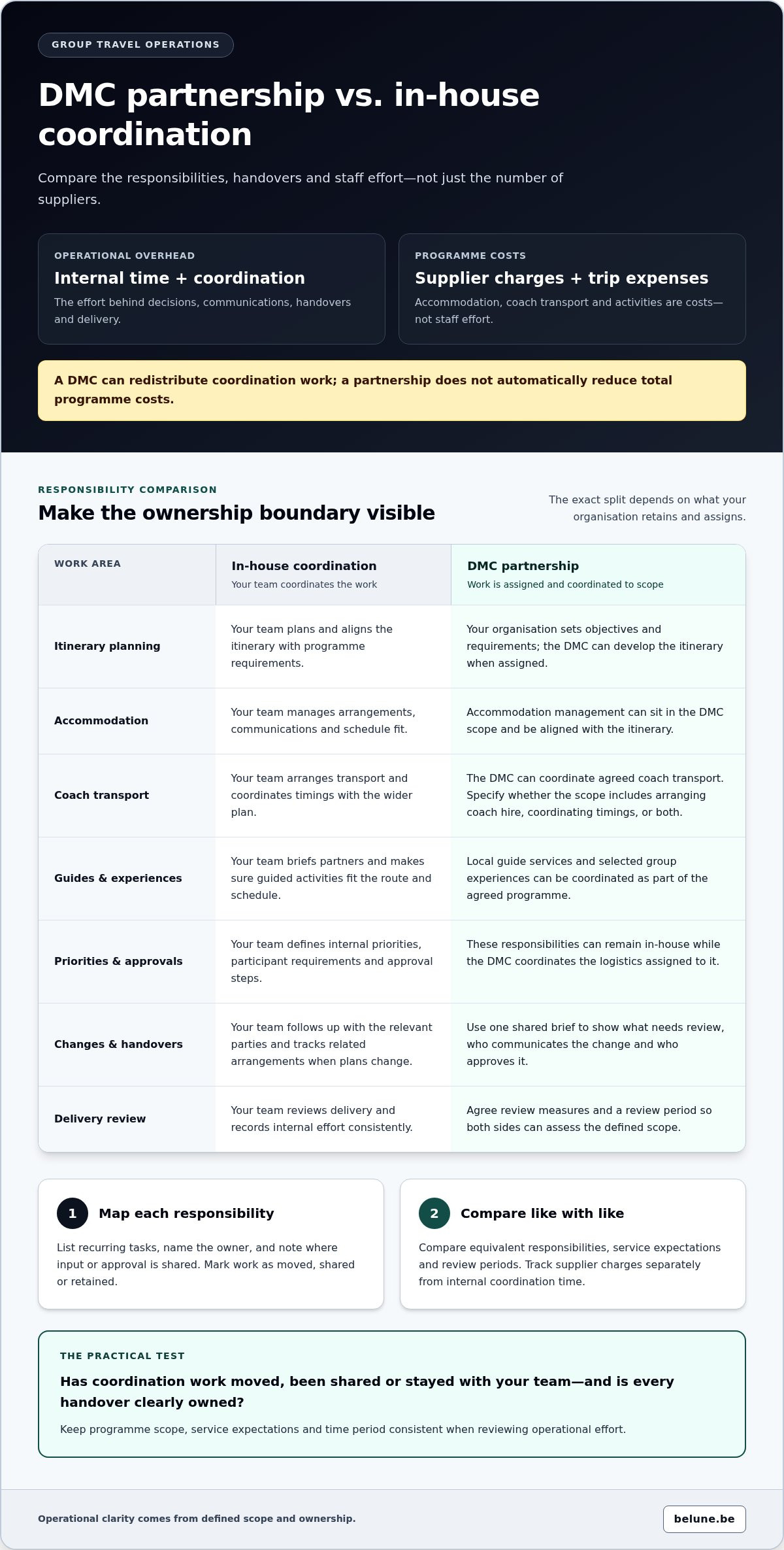
DMC Partnership vs In-House Coordination: Compare the Real Work
Outsourcing coordination doesn’t automatically mean lower total costs. A DMC fee may replace some internal work, overlap with existing responsibilities or add another coordination layer if the scope is unclear. To judge whether how a dmc partnership reduces operational overhead applies to your programme, compare the work and service delivered, not just one invoice against another.
Use the same trip components and expectations for both approaches. If the DMC scope includes accommodation management, coach transport and itinerary planning, the in-house comparison should account for those same deliverables, as well as the oversight and communication your team requires. Use the same measurement period for both models, such as the programme’s planning and delivery cycle.
What makes an in-house comparison fair?
Build a like-for-like scope before reviewing results. List the deliverables, expected service and tasks that remain with your organisation under either approach. Use staff records, calendars or project notes to understand internal effort. If precise time records aren’t available, label estimates clearly instead of presenting them as measured results.
- Match the deliverables: Compare the same itinerary, accommodation, transport, guidance and activity arrangements.
- Separate the inputs: Record DMC or partner fees, internal staff effort and other in-scope programme costs as distinct categories.
- Show retained responsibilities: Include briefing, internal approvals and participant communication if your team still handles them.
- Check for overlap: Make sure a coordination task isn’t counted both as DMC-managed work and as a fully internal responsibility.
This approach also makes partial partnerships easier to assess. A DMC might coordinate selected travel components while your team retains other duties. When comparing that arrangement with a fully in-house model, show both the work transferred and the work that remains.
Which measures show operational value without overstating it?
Choose a small set of measures, each with a clear evidence source and known limitations. Keep operational results separate from financial results. A positive experience can matter without translating directly into monetary return.
- Agreed itinerary delivery: Compare the approved plan with the delivered programme using itinerary versions and delivery records. Note changes, but don’t assume every change reflects a coordination failure.
- Recorded coordination effort: Review staff time records, task logs or project notes for work included in the agreed scope. Incomplete records limit how confidently effort can be compared.
- Guest feedback: Summarise relevant survey responses or feedback received. Treat this as an experience measure, not proof that a particular partner caused the outcome.
Review the findings together, but don’t turn assumed time saved or favourable feedback into financial returns without a documented method. A sound comparison helps your organisation decide which responsibilities to retain, which to assign to a DMC and what evidence to review next time. The aim is informed oversight, not a guaranteed cost reduction.
How to Set Up a DMC Partnership That Reduces Coordination Friction
A productive partnership begins before the itinerary takes shape. Agree on what the programme needs to achieve, then decide which responsibilities the DMC will coordinate and which remain with your team. A clear operating framework supports collaboration without giving up oversight. It also makes it easier to see how a dmc partnership reduces operational overhead in practice: through defined ownership, clear communication and a review based on the work delivered.
Use a sequence that reflects your programme’s needs rather than applying a fixed template:
- Set the purpose. Define the programme’s aims and the guest experience you want to create.
- Prepare the brief. Record the required services, from itinerary planning to accommodation, transport, guidance and activities.
- Agree the scope. Identify the deliverables assigned to the DMC, the decisions your team retains and any shared responsibilities.
- Set communication practices. Decide who owns updates, approvals and operational questions, and how changes will be recorded.
- Review delivery. Compare what happened with the agreed scope and use the findings to refine future collaboration.
What belongs in a useful DMC brief?
A useful brief explains the programme’s purpose, intended guest experience, required services and relevant constraints. Include itinerary priorities, accommodation needs, transport arrangements, guidance and activities, along with any approval requirements. Be clear about what your team will retain, such as setting internal objectives or making final decisions. This gives the DMC a practical foundation for shaping a tailored programme while keeping your organisation involved in the choices that matter.
Keep the brief easy to update. When requirements change, record what changed, who approved it and which deliverables may be affected. A shared version helps both sides work from the same information instead of relying on separate notes or repeated verbal updates.
How should teams agree on ownership and review?
Name an owner for each decision and deliverable. For example, the DMC may lead coordination of agreed travel components while your team owns programme objectives and internal approvals. Define how operational questions will be raised, how changes will be communicated and who confirms revised arrangements. After delivery, review the programme against the agreed scope and measures, noting both successful coordination and points to adjust.
For more context on incoming tour operators, explore this incoming tour operator guide. The same principle applies to a DMC partnership: clarity creates room for expertise and a well-shaped guest experience, while agreed responsibilities preserve accountability.
When you are shaping a group programme, explore BELUNE’s tailored group travel programmes.
How BELUNE Supports a More Manageable Group Travel Operation
A group programme is easier to manage when the itinerary and its supporting logistics are planned together. BELUNE brings more than 20 years of tourism experience to tailor-made itineraries, accommodation management, coach transport, expert guidance and on-the-ground logistics. For organisations and tour operators, a practical starting point is a shared brief: what the programme should deliver, which services BELUNE will coordinate and which decisions your team will retain.
This makes the operational scope tangible. Instead of treating each travel component as a separate thread, the programme can connect accommodation, transport and experiences in one itinerary. BELUNE’s own fleet of modern, comfortable coaches and local guide services can support the agreed plan. Strong local partnerships and access to unique experiences can also inform a programme shaped around the intended guest experience. The scope is tailored to the brief, rather than imposed as a fixed package.
What can BELUNE coordinate for a tailored programme?
A programme can bring together itinerary planning, accommodation management, airport transfers, coach transport, guided tours and distinctive group experiences. Art and culture tours, gastronomy and beer experiences, cycling tours, battlefield tourism, sport and festival tours, and river cruises with local excursions can support different objectives. BELUNE also provides MICE services, with responsibilities and deliverables defined around the programme.
The value of how a dmc partnership reduces operational overhead lies in aligning these services through clear scope and collaboration, not in promising a particular level of savings. BELUNE’s local knowledge and partnerships inform the planning, while your team remains involved in the priorities and approvals it chooses to retain.
How can a conversation move the partnership forward?
Begin with the essentials: programme objectives, intended guest experience, required services and the operational tasks your team wants to manage or delegate. Sharing these priorities gives BELUNE a foundation for developing a tailored itinerary and outlining a workable division of responsibilities. As plans develop, a clear scope helps both sides understand what is being coordinated and where your input is needed.
BELUNE takes a collaborative, no-nonsense approach and offers fair pricing. Its mission is: “Your trusted partner for any trip to the Benelux and the Paris region”. A conversation can focus on the programme, whether it involves group travel, a cultural itinerary, a river cruise or an MICE event, and on the coordination that would make delivery more manageable for your team.
Share your programme priorities and request a tailored group travel quote. A clear brief is the beginning of a partnership shaped around the experience you want to create and the responsibilities your team needs to retain.
Make Your Next Programme Easier to Coordinate
Turn your operational priorities into a partnership brief: define what the programme needs to achieve, what your team wants to retain and where coordinated support would be most useful. That clarity gives both sides a practical basis for shaping the work and reviewing how it runs.
Understanding how a dmc partnership reduces operational overhead is ultimately about designing the right division of responsibility for your organisation, not handing over control or assuming every task should be outsourced. A focused discussion can translate your priorities into a programme with clear scope and room for a distinctive guest experience.
Share your programme priorities and request a tailored quote. Bring your objectives and coordination challenges to the conversation, and take the first step toward a group travel programme shaped around your team.
Frequently Asked Questions
What operational tasks can a DMC handle for a group travel programme?
A DMC can take responsibility for travel arrangements included in the agreed programme, such as itinerary planning, accommodation management, coach transport, local guides and group activities. It can also coordinate airport transfers and international flight or train bookings. For example, a cultural visit and guided tour can be planned alongside the transport and other arrangements, with your team retaining agreed approvals.
Can a DMC partnership reduce internal workload without reducing client oversight?
Yes. Delegating defined coordination tasks doesn’t require your organisation to hand over programme decisions. Your team can set the objectives, approve itinerary choices and retain participant communications while the DMC coordinates assigned arrangements. Agree which decisions need client approval and how updates will be shared. Your team can then stay informed without managing every operational exchange itself.
How do you compare a DMC partnership with managing travel in-house?
Compare the same programme requirements under both approaches. If a group needs accommodation arrangements, coach transport and guided activities, assess those same deliverables in the in-house model and the DMC scope. Then separate partner fees from internal staff effort and other programme expenses. Use the same planning and delivery period, and record which responsibilities remain with your team so the comparison reflects the actual operating model.
Does using a DMC always reduce the total cost of a programme?
No. A DMC partnership may change who performs coordination work, but it doesn’t guarantee a lower total programme cost. The comparison depends on the agreed services, partner fees, internal effort and other expenses. Assess these separately and consider whether the partnership provides the scope and delivery approach your programme needs. Don’t treat delegated work, positive feedback or assumed time savings as financial savings without evidence.
How can a company measure operational overhead in group travel?
Track the internal effort attached to specific tasks, such as gathering requirements, reviewing itinerary versions or coordinating approvals. Use available project records, staff time logs or calendars, and apply the same method across comparable programmes. Pair effort records with delivery evidence, such as the approved itinerary and post-trip feedback, but keep these measures distinct. This shows what changed operationally without assuming every difference was caused by the DMC.
What information should I include in a DMC programme brief?
Include the programme’s purpose, intended guest experience, required travel components and any constraints that shape planning. Note relevant accommodation, transport, guided activity and itinerary preferences, along with approval requirements and responsibilities your team will retain. Clarify, for example, who sets programme priorities and who approves proposed changes. A focused brief gives the DMC useful context while leaving room to tailor the itinerary to your objectives.
Can a DMC coordinate accommodation, transport, and guided experiences?
Yes, a DMC can coordinate these elements within an agreed group travel programme. BELUNE provides accommodation management, coach hire, local guide services and guided group experiences, with the scope shaped around the brief. For example, an itinerary can connect a guided cultural tour with planned transport and accommodation arrangements. Agreeing which components are included and who approves decisions helps keep the programme coherent while preserving your team’s oversight.
Leave a Reply