A profound historical journey isn’t defined by the miles traveled, but by the weight of the silence it leaves behind. For professional operators, the challenge goes beyond merely booking a bastogne battlefield tour. It involves orchestrating a narrative that honors the 19,000 American soldiers who perished during the brutal winter of 1944. You recognize that your clients seek more than a checklist of monuments; they want an encounter with the frozen foxholes of the Ardennes that feels both intimate and grand.
Designing these experiences requires a delicate harmony between logistical precision and emotional resonance. It’s often difficult to balance the popular “Band of Brothers” narrative with the broader, more complex reality of the Siege of Bastogne. This guide serves as your strategic blueprint for excellence. We’ll outline a curated selection of must-visit sites, detail the fluid movement of group transport, and show how partnering with a local expert ensures every detail is handled with artisan care. From the Mardasson Memorial to the hidden gems of the surrounding forests, we provide the clarity needed to transform a standard itinerary into a masterpiece of historical travel.
Key Takeaways
- Understand the evolving historical significance of the Ardennes to curate a 2026 itinerary that resonates with deep emotional and cultural memory.
- Learn to design a sophisticated bastogne battlefield tour by balancing iconic architectural monuments with immersive, multi-sensory museum experiences.
- Navigate the logistical complexities of the Ardennes with expert insights on coach selection and timing to ensure a seamless, high-end group experience.
- Discover how to deepen the narrative by integrating strategic sites like Kessler Farm and General Patton’s relief route into your professional programming.
- Explore the BELUNE approach to sublimating history through expert local guidance and a private fleet of modern, luxury coaches.
The Significance of a Bastogne Battlefield Tour in 2026
Bastogne serves as a structural anchor for European historical memory. In 2026, eighty-two years after the Ardennes snow finally cleared, this Belgian town transcends its role as a mere geographic location. It’s a masterclass in resilience and a vital touchstone for American identity abroad. For travel operators, a bastogne battlefield tour represents more than a logistical stop; it’s an immersive exercise in heritage diplomacy. We’re seeing a definitive shift away from the surface-level “war tourism” of the past. Today’s professional itineraries demand a sophisticated, curated narrative that treats history as a living material, balancing technical tactical analysis with the raw emotion of human survival.
The ‘Nuts!’ Legacy and Tactical Importance
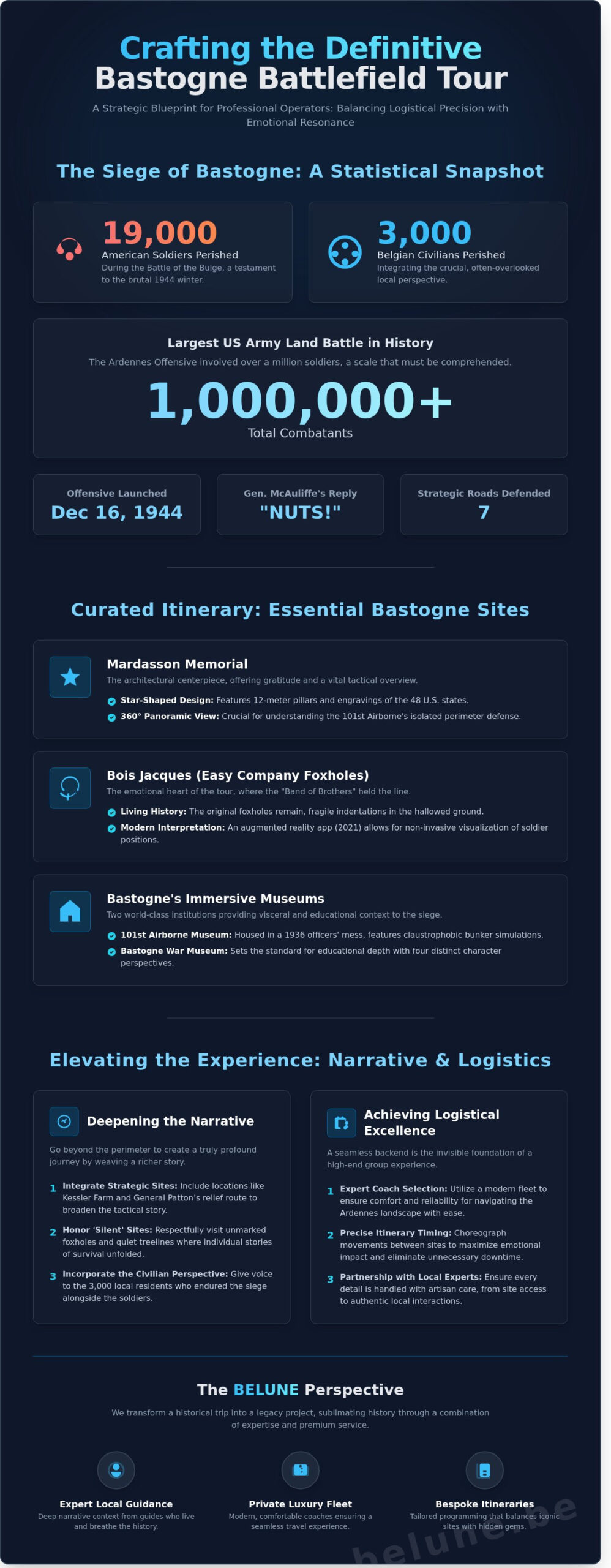
On December 22, 1944, General Anthony McAuliffe delivered his famous one-word rebuttal to the German surrender demand. This wasn’t simple bravado; it was a strategic refusal that anchored the 101st Airborne Division’s defense of a vital logistics hub. The “perimeter” around Bastogne wasn’t just a line on a map; it was a desperate hold on seven key roads that the German army required for their push toward Antwerp. The Ardennes landscape remains a primary witness to this struggle. The dense forests and frozen ridges offer a visceral understanding of the technical challenges faced by soldiers who lacked winter gear and sufficient ammunition during that brutal season.
Evolving Perspectives on the Ardennes Offensive
Modern travelers expect a perspective that goes beyond the Hollywood lens. We now integrate the Belgian civilian experience, acknowledging the 3,000 local residents who perished during the winter of 1944-1945. Preserving “silent” sites—the unmarked foxholes and quiet treelines—requires a delicate, expert touch that respects the sanctity of the ground. Launched on December 16, 1944, the Ardennes Offensive involved over 1 million soldiers, making it the largest land battle fought by the United States Army in history. A professionally designed bastogne battlefield tour provides the necessary depth to honor this scale through:
- Technical analysis of the 1944 weather patterns that grounded Allied air power.
- Access to curated sites like the Bois Jacques, where the scars of artillery are still visible in the earth.
- Narratives that link the liberation of Belgian villages to the broader restoration of European democracy.
- Expert storytelling that bridges the gap between 20th-century conflict and 21st-century peace.
The value for group operators lies in this precision. It’s about transforming a trip into a legacy project, ensuring every traveler leaves with a profound understanding of the harmony between sacrifice and freedom.
Essential Sites for a Bastogne Battlefield Roundup
A successful bastogne battlefield tour hinges on a precise choreography of locations. Operators must balance the grand architectural gestures of the Mardasson Memorial with the visceral, sensory reality of the 101st Airborne Museum (Le Mess). This museum, housed in a 1936 officers’ mess building, captures the claustrophobic tension of the siege through its underground bunker simulations. Since its 2014 reopening, the Bastogne War Museum has set the standard for educational depth, using four distinct character perspectives to humanize the 1944 winter offensive. These sites don’t just show history; they curate an emotional landscape for the visitor.
The Mardasson Memorial: Architecture of Gratitude
Dedicated on July 16, 1950, the Mardasson Memorial stands as a sculptural masterpiece of stone and memory. Its star-shaped design, featuring 12-meter high pillars, creates a rhythmic play of light and shadow that invites quiet contemplation. For professional operators, this is the essential starting point. The gallery displays the names of the 48 U.S. states that formed the Union during the war, etched into the frieze to create a permanent bond between the American home front and Belgian soil. The spiral staircases lead to a panoramic roof, offering a 360-degree view of the terrain where the 101st Airborne held their perimeter. This elevated perspective is vital for groups to grasp the tactical isolation of the city.
Bois Jacques and the Foxholes of Easy Company
Bois Jacques remains the emotional heart of any bastogne battlefield tour. Managing group expectations here requires a delicate touch, as the site is a living forest rather than a manicured museum. The foxholes, originally dug in December 1944, are fragile indentations in the earth. Preserving these remnants against erosion and heavy foot traffic is a technical challenge. In 2021, the site integrated augmented reality via a dedicated app, allowing visitors to visualize the “Band of Brothers” positions without disturbing the hallowed ground. We recommend facilitating a five-minute period of silence here; the natural acoustics of the pine forest provide a powerful backdrop for reflection. Just as we seek to achieve architectural harmony through light, this site achieves a rare harmony between nature and history. It’s a place where the stillness of the trees speaks more clearly than any traditional lecture.
Beyond the Perimeter: Deepening the Historical Narrative
To master a bastogne battlefield tour, operators must look past the town’s immediate center to the peripheral sites that define the siege’s resolution. Kessler Farm stands as a pivotal technical landmark. On December 22, 1944, four German soldiers arrived here with a written demand for surrender; an event that prompted General McAuliffe’s legendary one-word response. The site is exceptionally coach-friendly. A wide, paved pull-off on the N874 allows 15-meter vehicles to park safely, letting groups stand on the exact ground where the ultimatum was delivered. For orientation, the Sherman tank in McAuliffe Square remains the essential anchor. This M4A3, part of the 11th Armored Division, was immobilized on December 30, 1944. It provides a tangible, textured connection to the mechanical scale of the conflict.
The Liberation Route and Patton’s Third Army
The narrative of the siege shifts dramatically on the road to Assenois. At 16:45 on December 26, 1944, the 4th Armored Division pierced the German ring from the south. This breakthrough transformed the battle’s geometry. We recommend stopping at the concrete pillbox near the E25 underpass; it marks the precise link-up point between Patton’s relief forces and the 101st Airborne. The contrast here is vital for any sophisticated itinerary. You move from the static, desperate defense of the perimeter to the kinetic, aggressive momentum of the liberation. It’s a transition from shadow to light that resonates deeply with visitors.
The German Cemetery at Recogne: A Necessary Contrast
The cemetery at Recogne offers a somber, architectural counterpoint to the Allied memorials. Established by the American Graves Registration Service in 1945, it eventually became the final resting place for 6,807 German soldiers. The design language here is intentionally heavy. Dark basalt crosses replace the white marble found elsewhere, creating a mood of quiet reflection on the war’s total human cost.
- Casualty Scale: While American losses in the Ardennes reached 19,000 dead, German fatalities are estimated between 67,000 and 100,000.
- Professional Guidance: We advise guides to focus on the youth of the fallen; many soldiers buried here were teenagers conscripted in the war’s final months.
- Visual Harmony: The site’s layout reflects a grim, orderly precision that helps groups visualize the sheer magnitude of the German effort.
Integrating Recogne into a bastogne battlefield tour ensures a balanced, professional perspective. It elevates the experience from a simple military study to a profound meditation on European history. This nuanced approach builds trust with discerning travelers who seek more than just a surface-level summary of events.
Logistical Excellence: Planning the Group Experience
Precision defines the professional experience. Orchestrating a bastogne battlefield tour requires a blend of technical rigor and historical sensitivity. We see logistics as the framework that allows the narrative to breathe; it ensures every transition is seamless and every site is approached with the correct rhythm. Success lies in the details of the Ardennes landscape. Operators shouldn’t just plan a route; they should curate a journey that respects both the land and the memory it holds.
Coach Access and Site Navigation
The narrow arteries of the Ardennes demand careful vehicle selection. While standard 15-meter coaches manage main roads, the route to the Foxholes of Bois Jacques is best served by 12-meter models. This ensures fluid movement through the dense treeline without compromising the group’s comfort. For the Mardasson Memorial and the Bastogne War Museum, dedicated parking bays accommodate up to 60 coaches, yet early arrival remains essential during peak periods. Operators should prepare elderly guests for the 500-meter walk on uneven forest soil at the 101st Airborne sites. Proper footwear isn’t just a suggestion; it’s a requirement for safety and engagement.
Seasonal Planning: The December Commemorations
December in Bastogne is a visceral experience. The annual “Nuts Weekend,” held around December 16th, transforms the town into a living tribute. It’s a period of high demand where hotel capacity, roughly 450 beds in the city center, reaches 100% occupancy 12 months in advance for major anniversaries. The biting cold, often dipping to -5°C, adds a layer of authenticity that many groups seek, yet it requires rigorous climate management. A comprehensive bastogne battlefield tour during these months requires a different logistical lens. Professional operators must balance the emotional impact of the snow-covered landscape with the practicalities of winter road closures and shortened daylight hours. To master the atmosphere of your next group itinerary, explore our approach to bespoke project design.
- Timing: A full-day immersion (8 hours) is necessary to cover the Museum, Mardasson, and the perimeter woods. Half-day tours often feel rushed and fail to capture the site’s nuance.
- B2B Capacity: Group-friendly dining at venues like “Le Wagon” can host 80+ guests, but reservations are mandatory 6 months out for peak dates.
- Coordination: Large-scale events require direct communication with the Bastogne municipal authorities to secure permits for specific commemorative zones.
The BELUNE Perspective: Bespoke Battlefield Itineraries
At BELUNE, we don’t just organize trips; we curate legacies. We believe that to truly understand the Ardennes, one must look beyond the physical remains of conflict. We sublimate the experience by blending technical precision with emotional depth. Our approach transforms a standard bastogne battlefield tour into a profound narrative journey. We manage the entire lifecycle of your group’s visit. From the initial 9:00 AM briefing to the final hotel check-out, every detail is orchestrated with surgical accuracy. Our private fleet of 15 luxury coaches, all meeting Euro 6 emission standards, ensures that transit is as serene as the landscapes themselves.
Artisans of History: Our Local Guides
Our guides are the architects of memory. These multi-lingual experts speak four languages fluently, allowing them to bridge cultural gaps for diverse international groups. They move past the dry recitation of dates and troop movements. Instead, they focus on the human resonance of the 1944 winter. We believe in a holistic sensory experience. This means integrating local gastronomy into the itinerary. A pause for a traditional three-course Ardennes lunch or a tasting of regional craft beers provides the necessary space for reflection. It creates a harmony between the weight of history and the richness of present-day Belgian culture.
Partnering with BELUNE for Benelux Excellence
Since 2004, we’ve served as a dedicated ally for global travel operators. Our 20 years of experience in the Benelux region translates into a frictionless process for our B2B partners. We prioritize professional transparency above all else. You’ll receive fixed-price reliability with no hidden surcharges, ensuring your margins remain protected. We understand that every bastogne battlefield tour we design is a reflection of your brand’s commitment to quality. We act as your visionary advisors on the ground, handling the complex logistics so you can focus on your clients. Our team provides 24/7 support, ensuring that even the most intricate custom requests are met with a “sur-mesure” solution.
Ready to elevate your group’s Ardennes experience? Discover our bespoke battlefield tour packages and partner with the experts in Belgian hospitality and history.
Elevating the 2026 Commemorative Experience
Designing a profound historical journey requires more than a map; it demands a vision that honors the weight of the past. As the 82nd anniversary of the Siege approaches in 2026, group operators must balance complex logistics with an immersive narrative that resonates. A successful bastogne battlefield tour isn’t just about visiting the Mardasson Memorial or the foxholes of Bois Jacques. It’s about the technical precision of the itinerary and the emotional depth of the storytelling. We leverage over 20 years of DMC expertise in the Benelux region to transform these historical sites into a seamless, high-end experience for your clients.
Our private fleet of modern, group-friendly coaches ensures comfort across every kilometer, while our expert multi-lingual local guides provide the nuanced perspective that sophisticated travelers demand. We don’t simply move groups; we curate an atmosphere of respect and discovery. By choosing a partner who values architectural precision in planning and poetic resonance in delivery, you ensure your tour stands out in a crowded market. Excellence isn’t an accident; it’s a deliberate choice. Partner with BELUNE for your next professional group tour and bring a new level of sophistication to your historical programming. We look forward to crafting this journey with you.
Frequently Asked Questions
What is the best time of year for a Bastogne battlefield tour?
Late spring and early autumn provide the most balanced light and weather for a bastogne battlefield tour. From May 15th to September 30th, groups enjoy 14 hours of daylight and average temperatures of 18 degrees Celsius. This window allows for a deep exploration of the landscape’s nuances. Alternatively, the December 16th anniversary offers a raw, emotional atmosphere that mirrors the 1944 conditions.
Is Bastogne suitable for groups with limited mobility?
Bastogne is highly accessible, with 95% of its major cultural sites designed for visitors with limited mobility. The Bastogne War Museum features elevators and wide ramps throughout its 1,600 square meter layout. The Mardasson Memorial offers flat, paved access to its central gallery. While Bois Jacques remains a forest, the 2021 renovations added accessible viewing platforms for a safe, inclusive experience.
How much time should a group allocate to the Bastogne War Museum?
Groups should reserve a minimum of 3 hours to fully appreciate the Bastogne War Museum’s immersive design. The three multisensory scenographies take 45 minutes to complete, while the extensive collection of 400 original artifacts requires significant time for reflection. We recommend a structured itinerary to ensure guests don’t rush through the final exhibits, which contain the most poignant personal testimonies.
Can we combine a Bastogne tour with other Battle of the Bulge sites?
Combining Bastogne with other Battle of the Bulge sites is a standard practice for comprehensive 2 day itineraries. Malmedy is located 55 kilometers to the north, roughly a 45 minute drive via the E25. Houffalize, situated just 18 kilometers away, offers a logical stop to see the Panther tank. These connections create a harmonious narrative of the 1944 winter offensive.
Are there group-friendly restaurants in the Bastogne area?
Bastogne hosts several high capacity restaurants that specialize in tailor-made group dining experiences. Wagon Leo accommodates up to 150 guests in a refined, historical setting near the Place McAuliffe. For smaller parties of 25, Le Nut’s provides curated 3 course menus featuring local Ardennes trout. These venues understand the logistical precision required for professional travel operators and their tight schedules.
What is the significance of the foxholes in Bois Jacques for tourists?
The foxholes in Bois Jacques serve as a visceral connection to the 101st Airborne’s defensive line. Over 20 visible excavations mark the positions held by Easy Company starting December 19, 1944. These sites transform the forest into a living monument, allowing visitors to visualize the tactical challenges of the winter siege. It’s a place where history and nature achieve a somber, powerful harmony.
Do we need a specialized guide for a professional group tour?
Hiring a certified professional guide is mandatory for operators seeking a sophisticated and accurate bastogne battlefield tour. Accredited guides provide 4 hours of expert narration, linking technical military maneuvers to the human experience. Their presence ensures a seamless flow between sites like the 101st Airborne Museum and the German Cemetery. This expertise transforms a simple visit into a profound, expertly designed educational journey.
How far is Bastogne from other major Belgian cities for a day trip?
Bastogne is 155 kilometers from Brussels, making it a viable but intensive day trip option. The drive from the capital takes 100 minutes via the E411 highway. Luxembourg City is much closer, located only 75 kilometers away with a 50 minute travel time. For groups arriving from Liege, the 80 kilometer journey takes approximately 60 minutes, allowing for an early 9:00 AM start.
Leave a Reply