Tag: Tour Operators

  • Benelux Group Tour Logistics: VAT Reclaim Guide

    Benelux Group Tour Logistics: VAT Reclaim Guide

    What if VAT reclaim readiness begins before the tour departs, not when receipts reach the finance team? Cross-border group tour logistics Benelux itineraries can spread records across coach transport, accommodation, activities and several countries. A changed schedule or missing invoice can make those records harder to organise later.

    It’s understandable to focus first on getting the group smoothly from one experience to the next. A clear documentation process supports that journey and makes post-trip preparation more manageable. This guide explains how to organise trip records before and after departure, understand the main VAT reclaim routes, and separate operational documentation from decisions about tax eligibility.

    We’ll cover practical ways to track supplier invoices, services delivered and itinerary changes, while keeping in mind that VAT treatment depends on the business and purchase. Coordinated planning matters: BELUNE brings more than 20 years of group travel experience, arranging coach transport, accommodation, local guides and customised itineraries. That operational coordination can help create a clearer record of the journey, while tax decisions remain with the tour operator and its tax adviser.

    Key Takeaways

    • Map each itinerary segment to its supplier, service, invoice, payment record and an owner responsible for follow-up.
    • Use an expense register to flag unanswered VAT questions without assuming every tour cost is eligible for reclaim.
    • Compare record ownership and hand-offs across internal finance review, direct handling and specialist tax support.
    • Build a version-controlled tour file that links booking changes to supporting documents from planning through post-trip reconciliation.
    • Well-coordinated cross-border group tour logistics benelux can make itinerary updates and supplier records easier for operators to organise.

    Why cross-border group tour logistics make VAT reclaim harder to manage

    One group itinerary can involve accommodation, coach transport, local guides, activities and other suppliers, each with its own booking trail and invoice. For operators managing cross-border group tour logistics benelux, the challenge is more than collecting receipts. Records need to stay connected to the right service, supplier, transaction and country as plans evolve.

    VAT reclaim readiness means having organised evidence for review, not assuming every expense qualifies. Operational coordination helps establish what was booked and delivered. Tax eligibility depends on the operator’s circumstances and the applicable rules. Organise records around the trip’s services and transactions, not just its headline itinerary.

    This short video offers a broader look at cross-border logistics as a coordinated process:

    Which parts of a group tour create separate records?

    Accommodation, coach transport, guiding, admissions and hosted experiences may each involve a different supplier and service. Keep their records distinct. An invoice documents a charge, a booking confirmation records the agreed arrangements, a payment record shows settlement, and the itinerary places the service within the trip. Together, these documents help create a coherent file, but no single document proves every detail.

    Keep a clear trail when arrangements change. If a booking is amended, cancelled or replaced, retain the updated confirmation and note which itinerary version reflects the change. Otherwise, an invoice may describe a service that no longer matches what the group received.

    Why a single trip does not mean one VAT treatment

    A package may feel like one experience to the traveller, but the country, supplier, service type and operator’s circumstances can all affect how a purchase is treated. The EU has a common system of value-added tax, but that does not mean every expense across member states follows an identical route or qualifies for recovery. Current rules, conditions and exceptions need specialist verification before decisions are made.

    Keep the operational file factual, then direct open tax questions to the operator’s finance team or tax adviser. A DMC can coordinate itinerary components and supplier updates, helping keep the operational record orderly without deciding eligibility. For a wider view of this operational role, see the Benelux incoming tour operator guide.

    How to map VAT reclaim questions across a multi-country tour

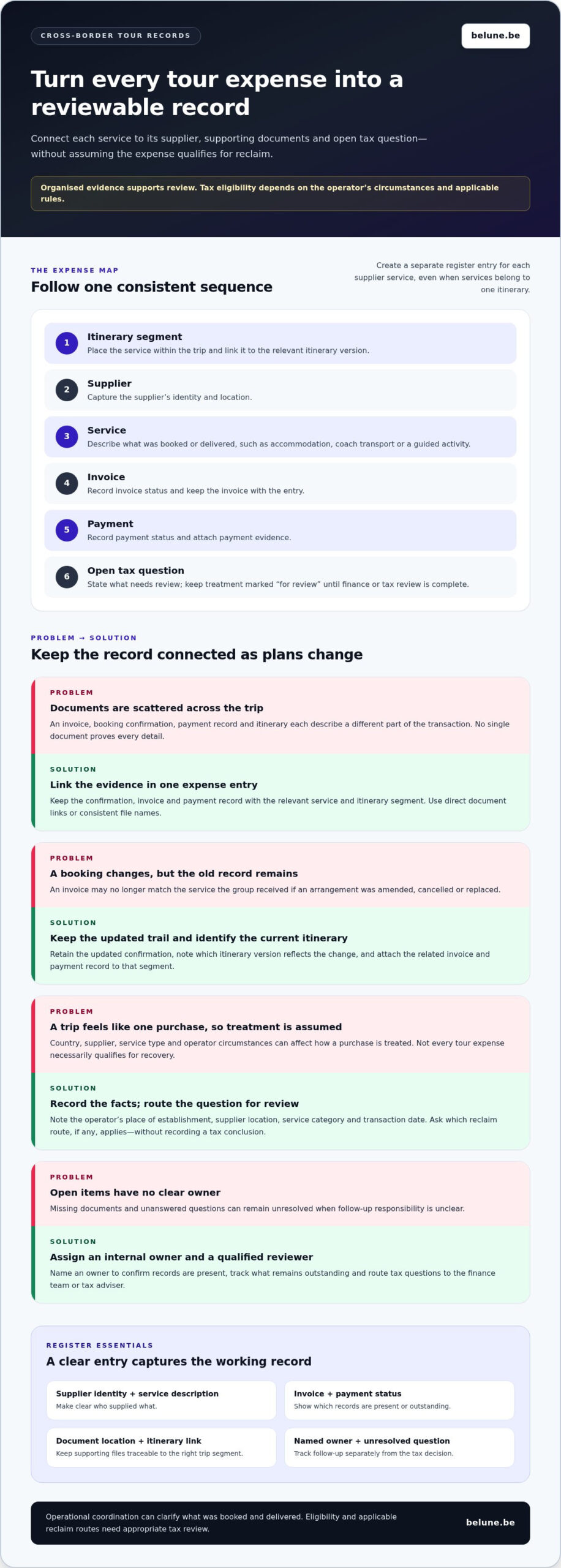
    A working expense map turns a complex itinerary into a series of reviewable records. For cross-border group tour logistics benelux, use the same sequence for each purchase: itinerary segment, supplier, service, invoice, payment, open tax question. This helps trace an expense from the group’s plans to its supporting paperwork without turning the operational record into a tax decision.

    Build an expense map before confirming the itinerary

    Create one register entry for each supplier service, then connect it to the relevant trip segment. An accommodation booking, coach service and guided activity should each have their own record, even when they form part of one itinerary. Every expense needs traceable supporting documentation.

    Capture the supplier’s identity, a clear service description, invoice status, payment status, document location and a named internal owner. Link source documents directly where possible, or use consistent file names that make them easy to retrieve. Keep tax treatment marked “for review” until the appropriate finance or tax review is complete.

    Flag items that may need closer attention, such as bundled services, shared costs or amended arrangements. For example, if a coach booking is replaced, attach the updated confirmation, invoice and payment record to the relevant itinerary segment. This reduces the chance of someone mistaking an old document for the final arrangement.

    Record the questions that determine the next step

    Alongside each expense, record the details a qualified tax adviser may need to assess its treatment: the operator’s place of establishment, the supplier’s location, the service category and the transaction date. Add a concise question rather than a conclusion, such as “Which reclaim route, if any, applies to this service?” The European Commission’s EU VAT information provides an official starting point for understanding the framework. An adviser can assess how current rules and the operator’s circumstances apply.

    Assign one person internally to follow each item through to resolution. They can confirm that records are present, note what remains outstanding and route the question to the right reviewer. This keeps operational coordination separate from decisions about eligibility or filing.

    • Map: Connect each service to its itinerary segment and supplier.
    • Attach: Store confirmations, invoices and payment evidence with the entry.
    • Assign: Name an owner and record the unresolved tax question.
    • Review: Have a qualified adviser assess the applicable rules and route.

    Clear supplier details and itinerary links also support smoother coordination across accommodation, coach transport and local services. Explore BELUNE’s group travel coordination for an operational perspective on bringing those elements together.
    Benelux Group Tour Logistics: VAT Reclaim Guide

    How to compare VAT reclaim routes without confusing them with tour logistics

    Once trip records are organised, the next decision is who will review and manage the VAT questions. Treat this as a workflow choice, not a conclusion about eligibility. The appropriate route depends on current rules and the operator’s circumstances. Cross-border VAT refunds guidance from the European Commission is a useful starting point, but procedures must be checked for the relevant jurisdiction and transaction.

    Three common workflow models can help clarify responsibilities. None is universally faster, cheaper or more advantageous. Compare them by who owns the work, which records they need and where specialist review enters.

    Workflow model Ownership Records and review points Typical hand-off
    Direct operator handling Operator staff manage the process. Supplier documents, payment evidence and transaction details; internal checks and tax review where needed. Finance gathers the file and refers unresolved questions to a qualified adviser.
    Internal finance review Finance leads reconciliation and issue tracking. Expense register, source documents and a log of open questions; review focuses on completeness and consistency. Finance escalates jurisdiction-specific or complex matters for specialist assessment.
    Specialist tax support A qualified external specialist reviews applicable tax issues. Organised transaction records and details about the operator, supplier, service and timing. Operations and finance provide evidence; the specialist advises on the relevant process.

    What operators can handle internally

    Teams can collect supplier documents, reconcile payments against invoices and maintain a consistent expense register. They can also assign owners, flag missing records and track each question’s status, such as “documents outstanding,” “ready for review” or “advice received.” This brings structure to cross-border group tour logistics benelux, but record organisation alone does not establish whether a transaction qualifies for reclaim.

    When a tax review becomes essential

    Seek qualified review for mixed-service packages, cross-border transactions or unusual supplier arrangements, especially when records do not clearly describe what was supplied. Ask the reviewer to verify applicable procedures, deadlines and required documents for each relevant jurisdiction using current information. Keep the operational file separate from the tax conclusion: tour teams record what was booked, changed and delivered, while finance and tax reviewers assess the treatment.

    The hand-off works best when the file is orderly and the questions are specific. A DMC can help coordinate accommodation, coach transport and local services, while the operator retains responsibility for tax decisions and reclaim arrangements.

    How to prepare a cross-border tour VAT file before departure and after return

    A reliable file takes shape over the life of the trip, not in a last-minute search for receipts. For cross-border group tour logistics benelux, use a simple sequence: plan the record system, capture documents as bookings are made, track changes, reconcile after travel, then prepare questions for review. Keep operational evidence separate from tax conclusions, which a qualified adviser must validate.

    Before departure: establish the record system

    Assign a document owner for each supplier or trip segment, and agree on a consistent naming format. For example, use the segment, supplier and document type so a coach confirmation can be found without searching through unrelated accommodation files. Keep one controlled itinerary as the current version, and retain dated versions when arrangements change.

    Collect booking confirmations, invoices and payment evidence as they arise. Maintain a short review list for missing documents and unresolved VAT questions. This gives the team a clear view of what is ready, what needs follow-up and what belongs with finance or a tax adviser.

    • Plan: Set up folders, naming conventions, owners and the itinerary version log.
    • Book: File each supplier confirmation against the relevant segment.
    • Collect: Add invoices and payment evidence as they arrive.
    • Track: Record amendments and link each change to its supporting document.
    • Reconcile: After the tour, compare the file with services delivered.
    • Prepare: Index the evidence and list questions for review.

    After the tour: reconcile and close the file

    Compare final supplier invoices and payments with the itinerary the group actually followed. If a planned activity was substituted or a booking cancelled, retain the original record alongside the updated confirmation, credit or cancellation document. A brief change note should state what changed, when it changed and which itinerary version reflects the final arrangement.

    Then create an index that points to each supplier record and flags anything missing or unclear. Keep the documents operators collect distinct from judgments about reclaim eligibility. Ask a qualified tax adviser to validate applicable procedures, required evidence and record-retention rules for the relevant circumstances and jurisdictions.

    A well-ordered operational file is easier to hand over and review. For broader partner context, read the group travel agency selection guide. BELUNE coordinates accommodation, coach transport and local services as part of customised group itineraries. Explore BELUNE’s group travel coordination for an approach to bringing those moving parts together.

    How a DMC can support smoother Benelux group tour logistics

    A multi-country group itinerary is a connected operation: accommodation, coach transport and local guidance need to fit around the group’s schedule. A destination management company (DMC) can coordinate those moving parts, helping the operator work from clear booking details and consistent itinerary updates. For cross-border group tour logistics benelux, that operational structure can also make it easier to organise trip records by service and supplier.

    Coordinate trip services while keeping tax responsibilities clear

    Consider a tour that combines hotel stays, coach transfers and guided visits. If an arrangement changes, a coordinated update can help the operator identify which service, booking and itinerary segment were affected. Keeping those details aligned supports orderly record-keeping, but it does not determine the VAT treatment of a purchase.

    Operational coordination and tax decisions are separate responsibilities. VAT eligibility and reclaim filings depend on applicable rules and the operator’s circumstances, and remain matters for the operator and its qualified tax adviser. BELUNE coordinates group travel; it does not provide VAT advice or determine reclaim outcomes.

    Turn a complex itinerary into a more manageable operation

    Accommodation, coaches and local guidance work best when planned as parts of one considered itinerary. A change to a service may affect the group’s timing or surrounding arrangements, so keeping the operational picture current helps the operator track what was planned and what was delivered. Clear supplier and service details also give the finance team a more coherent starting point for organising records.

    BELUNE brings more than 20 years of group travel and transport experience, with accommodation management, local guide services, customised itineraries and its own fleet of modern coaches. This practical coordination supports professional group operators in shaping trips around their objectives while keeping the travel components connected.

    For a tailored itinerary, share your group profile, travel dates and goals with BELUNE. Discuss a customised group itinerary with BELUNE.

    Build a smoother journey from the first booking

    Strong cross-border group tour logistics benelux begin with two clear practices: connect each supplier record to the service and itinerary segment it supports, and keep operational documentation separate from decisions about VAT eligibility. A consistent process for collecting confirmations, invoices, payment records and change notes makes post-trip review more orderly. Tax treatment and reclaim routes still depend on the operator’s circumstances and current rules, so those decisions belong with the operator and its qualified tax adviser.

    Good coordination supports the journey itself, too. With more than 20 years of group travel and transport experience, BELUNE brings together accommodation management, local guidance, customised itineraries and its own modern coach fleet. Each element can be planned as part of a connected group experience, while the operator retains responsibility for tax matters.

    Give your next itinerary a thoughtful operational foundation. Plan a tailored group itinerary with BELUNE and take the next step toward a well-coordinated trip your group can enjoy with confidence.

    Frequently Asked Questions

    Can tour operators reclaim VAT on cross-border group travel expenses?

    Sometimes, but tour operators may reclaim VAT on eligible expenses only when applicable rules and their circumstances permit it. A cross-border trip does not make every supplier charge reclaimable. The operator’s establishment, service type, transaction and supporting documentation can all matter. Keep records organised, then have a qualified tax adviser verify eligibility and the appropriate refund procedure before treating an amount as recoverable.

    How do tour operators manage VAT records for a multi-country group tour?

    Use one expense register to connect each purchase to its itinerary segment, supplier, service, invoice and payment record. For cross-border group tour logistics benelux, assign an internal owner to each entry and track missing documents or open tax questions. Keep dated itinerary versions and link amendments to the relevant confirmations. This creates a clear operational record without turning the register into a decision about tax eligibility.

    What documents should operators keep for a tour VAT reclaim?

    Keep supplier invoices, booking confirmations, payment evidence and contracts or service details where available. Retain itinerary versions and records of changes, cancellations, substitutions or credits so the file reflects what the group actually received. Link documents to the supplier and trip segment in an indexed register. A qualified tax adviser can identify any additional evidence required for the operator’s circumstances and relevant jurisdiction.

    Does VAT reclaim work the same way in every Benelux country?

    No. VAT treatment and refund procedures can differ by country, transaction and operator circumstances, even when services belong to the same tour. Do not assume that a document or process suitable for one jurisdiction applies unchanged in another. Identify where each service and transaction belongs, then ask a qualified tax adviser to verify current local requirements, applicable procedures and relevant exceptions before preparing a claim.

    Can coach transport and accommodation be treated as one tour expense?

    They may be coordinated as parts of one itinerary, but keep coach transport and accommodation identifiable as separate supplier services in the operational records. Their invoices, booking details and payment evidence may differ, and tax treatment can depend on the specific arrangements. If they are sold or invoiced together, preserve the package documentation and ask a qualified tax adviser how the transaction should be assessed.

    When should a tour operator review VAT reclaim requirements?

    Start when planning the itinerary, before records become difficult to reconstruct. Review again as bookings are confirmed, services change and the trip is reconciled after return. Early review gives the operator time to identify missing documents and direct questions to a qualified tax adviser. Verify current procedures, required evidence and deadlines for each relevant jurisdiction rather than relying on assumptions from a previous tour.

    What is the role of a DMC in cross-border tour VAT administration?

    A DMC coordinates operational elements such as accommodation, coach transport, local guidance and itinerary updates. Consistent booking details can help an operator organise supplier records and understand which services were planned or changed. A DMC’s operational role is distinct from tax administration: the operator and its qualified tax adviser assess VAT eligibility and reclaim procedures. A DMC does not determine tax outcomes simply by coordinating the trip.
  • How to Offer Carbon-Neutral Tours in the Netherlands: A Practical Guide

    How to Offer Carbon-Neutral Tours in the Netherlands: A Practical Guide

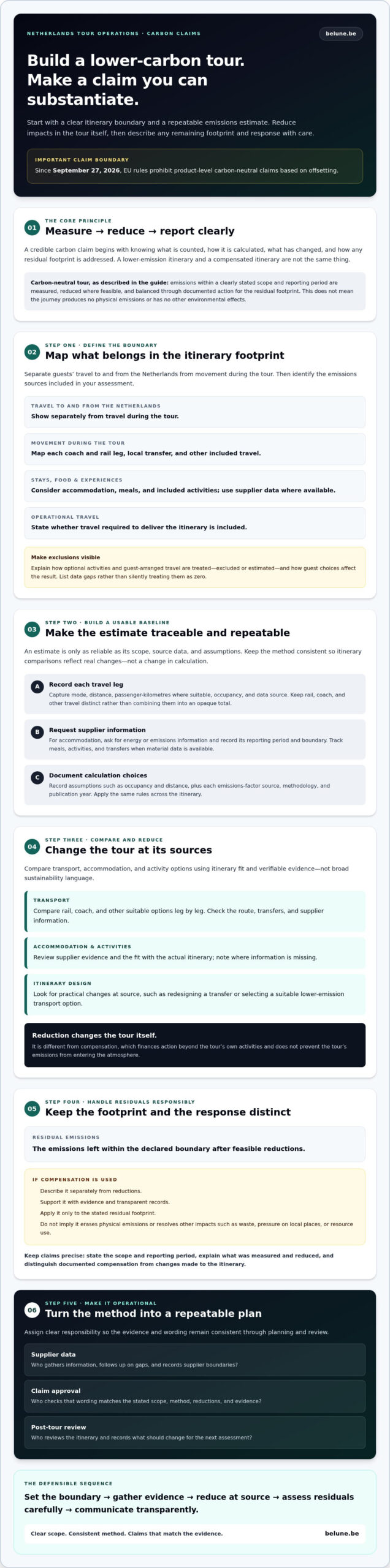
    A tour can be carefully offset and still fall short of a credible carbon claim. For operators asking how to offer carbon-neutral tours in the Netherlands, the stronger starting point is to measure emissions across the itinerary, then reduce them wherever practical. The distinction matters: since September 27, 2026, EU rules prohibit product-level carbon-neutral claims based on offsetting.

    The choices can be complex. Transport, accommodation and activities each involve different data and supplier considerations, while vague environmental language can undermine trust. A defensible plan begins with consistent measurement and changes at source, not a credit purchase used to make a tour sound impact-free.

    This guide explains how to map a group tour’s emissions, compare travel and supplier options, and identify reductions you can substantiate. It also covers how to treat residual emissions responsibly, assess compensation evidence and describe progress transparently. The aim is a lower-carbon Netherlands itinerary supported by clear decisions and claims that stand up to scrutiny.

    Key Takeaways

    • Set a clear itinerary boundary so your emissions assessment accounts for relevant travel, stays, activities and transfers.
    • Build a usable baseline by gathering activity data, applying suitable emissions factors and documenting assumptions for each transport leg.
    • Compare rail, coach and other options alongside accommodation and activity suppliers. Use itinerary fit and verifiable evidence rather than broad sustainability language.
    • Learn how to offer carbon-neutral tours in netherlands by prioritising measurable reductions and assessing any compensation against clear evidence and transparent records.
    • Turn your findings into an operating plan by assigning responsibility for supplier data, claim approval and post-tour review.

    What Does a Carbon-Neutral Tour in the Netherlands Actually Mean?

    A credible carbon claim starts with a boundary, not a label. Before describing a tour as carbon-neutral, an operator needs to know which emissions are counted, how they’re calculated, what reductions have been made and how any remaining impact is addressed. A lower-emission itinerary and a compensated itinerary are not the same thing.

    A carbon-neutral tour is one whose emissions within a clearly stated scope and reporting period have been measured, reduced where feasible and balanced through documented action for the residual footprint. That definition depends on transparent evidence. It doesn’t mean the journey produces no physical emissions or has no other environmental effects. The wider principles of Sustainable tourism also encompass economic and social considerations.

    For context, watch this video on carbon-neutral travel experiences:

    Which emissions belong in a Netherlands tour footprint?

    Set the itinerary boundary before gathering data. Show guests’ travel to and from the Netherlands separately from travel during the tour. Then map the included journey: coach and rail legs, local transfers, accommodation, meals and activities. Use supplier data where it’s available. Operational travel required to deliver the itinerary may also belong in the assessment, so state whether it’s included.

    Be explicit about what sits outside the calculation. For optional activities, explain whether they’re excluded or estimated and how guest choices affect the result. Record assumptions such as occupancy and distance, along with the emissions-factor source, its methodology and publication year. A Netherlands-specific assessment reflects the actual route, transport mix, stays and activities, rather than applying a generic sustainability label to every itinerary.

    Carbon reduction, carbon neutrality and compensation

    Reduction changes the tour itself, for example by redesigning a transfer or choosing a suitable lower-emission transport option. Compensation is different. It finances action beyond the tour’s own activities and doesn’t prevent the tour’s emissions from entering the atmosphere.

    Residual emissions are those left within the declared boundary after feasible reductions. If you use compensation, describe it separately, support it with evidence and apply it only to that stated residual footprint. Don’t imply it erases the tour’s physical emissions or resolves impacts such as waste, pressure on local places or resource use. For operators learning how to offer carbon-neutral tours in netherlands, precise scope and wording are part of the work, not an afterthought.

    How to Measure Tour Emissions Before Promising Carbon Neutrality

    A useful emissions estimate starts with a defined itinerary and a repeatable method. For operators considering how to offer carbon-neutral tours in netherlands, the aim isn’t to produce a single impressive number. It’s to build a transparent account of what was measured, what was estimated and what remains outside the calculation.

    An emissions estimate is only as reliable as its scope, source data and assumptions. Keep these visible so you can compare itinerary versions without mistaking a change in calculation for a real reduction.

    Build a consistent Netherlands itinerary inventory

    Map each leg separately, including travel to and from the Netherlands and movement within the tour. Record distance and passenger-kilometres where suitable, along with the mode, occupancy and data source. Don’t combine rail, coach and other travel into one opaque total. Separate figures make it easier to identify where itinerary changes could matter.

    Request accommodation energy or emissions information, including its reporting period and boundary. Track meals, included activities and transfers when material data is available, and list gaps rather than silently treating them as zero. Decide how to handle optional activities, guest-arranged travel and supplier operations, then apply the same rule across the itinerary.

    Make estimates transparent and repeatable

    Use this workflow for each tour version:

    1. Define the tour. Set the reporting period and itinerary boundary, and identify the guests and relevant operational activity included.
    2. Collect activity data. Gather distances, passenger-kilometres, accommodation information and supplier details for each itinerary component.
    3. Apply suitable emissions factors. Select factors that fit the activity and geography. Record the source, publication year, units and system boundary.
    4. Review and document. Note conversion factors, occupancy and allocation assumptions, estimates, missing data and exclusions. Keep the calculation so it can be repeated.

    Use consistent factors when comparing suppliers or redesigning an itinerary. If one coach leg is measured using actual distance and another relies on an estimate, flag the difference. Don’t present the comparison as more precise than the data supports. GHG Protocol guidance can serve as a reference framework, but check that the selected approach and boundary fit the tour calculation.

    Report a total per tour when the full group and included activities are clearly defined. A per-traveller figure also needs a transparent allocation method, including the group size used and how shared transport or accommodation emissions are divided. If those inputs change, the result may change too.

    A destination management company can help coordinate itinerary details and supplier information for a consistent assessment. Operators shaping custom group itineraries can set data requirements alongside the route plan, then check each factor and claim against their own evidence.

    How to Offer Carbon-Neutral Tours in the Netherlands: A Practical Guide

    Which Netherlands Tour Choices Reduce Emissions Most?

    No single transport mode or supplier choice makes every itinerary lower-carbon. The result depends on the full journey, including distance, occupancy, transfers, route and the quality of the emissions data. Compare alternatives using the same itinerary boundary, then make changes where the evidence points to a meaningful opportunity.

    Compare like-for-like itinerary options using consistent boundaries and current evidence. Rail may suit one route, while a well-used coach may better connect a group to accommodation or activities elsewhere. Avoid basing claims on vehicle labels alone.

    Compare transport and itinerary design

    Assess rail for suitable journeys, including door-to-door logistics and transfers to and from stations. For coach travel, use actual route distance and occupancy assumptions. Check whether transfers or detours add distance without giving guests meaningful value. Comfort needn’t be an afterthought: compare the complete journey, including connections, waiting, luggage and how smoothly the group moves together.

    Choice Decision factors Evidence to request Trade-off to check
    Rail Route suitability, stations and onward connections Distance, travel mode and relevant emissions-factor source Transfers may affect total distance, time and group logistics
    Coach Occupancy, route and transfer requirements Actual itinerary distance and the assumptions used for passenger allocation A low-occupancy journey can change the per-traveller comparison
    Accommodation Location, operational practices and available data Dated energy or emissions information, including scope and reporting period Supplier figures may use boundaries that don’t match the tour calculation
    Meals and activities Relevance to the itinerary and supplier practices Available environmental data and an explanation of what it covers Local sourcing or plant-forward choices may be options, not guaranteed savings

    Assess stays, food and activities with evidence

    Ask accommodation providers for dated, scoped information, and record gaps rather than assuming a sustainability label proves lower emissions. Local sourcing and plant-forward meals can be considered as part of itinerary design, but don’t claim a carbon benefit without supporting data. Choose activities for their quality and relevance, then ask suppliers what their environmental information measures.

    For operators exploring how to offer carbon-neutral tours in netherlands, consistent comparison turns supplier conversations into practical planning. A destination management company can coordinate itinerary choices and information requests across accommodation, coach travel and local guidance. The strongest option fits the group, works as a complete journey and has evidence to support a fair comparison.

    How to Address Residual Emissions and Make Responsible Claims

    Consider compensation only after measuring the itinerary and making feasible reductions. It can support climate action beyond the tour, but it doesn’t remove the tour’s physical emissions or make its wider environmental effects disappear. Treat compensation as a distinct response to a defined residual footprint, not a substitute for redesigning the itinerary.

    Evidence matters more than a project’s marketing language. Before relying on credits, review the project type and claimed outcome, independent verification, evidence of additionality, and how permanence risks are managed. Ask for records showing that credits have been retired for the stated purpose, so they can’t be claimed again. No single document guarantees that every claim is appropriate; assess the evidence against the purpose and scope you’re communicating.

    Choose and document any carbon compensation

    Keep the emissions calculation, supplier records, factor sources, project documentation, verification details, retirement evidence and claim approvals together. Confirm that the volume of compensation corresponds to the tour’s declared residual emissions, not a wider or vaguely defined footprint. If project evidence is incomplete, disclose that limitation or don’t rely on the credit for a public claim.

    Communicate the claim without overstating it

    Be specific about the tour boundary, calculation period, reduction measures and treatment of residual emissions. For example, if each detail is documented, state that you measured emissions from specified itinerary elements for a stated period, changed identified travel arrangements, and separately funded a named type of climate project for the calculated remainder. State exclusions clearly. Avoid broad labels such as “green” or “zero-impact” when the evidence doesn’t support them.

    There’s also an important regulatory distinction. As of 27 September 2026, EU rules under Directive (EU) 2024/825 prohibit product-level carbon-neutrality claims based on offsetting. A tour shouldn’t be marketed as “carbon-neutral” if that claim depends on purchased credits. Check current European Commission and Netherlands Authority for Consumers and Markets (ACM) guidance before approving environmental advertising. Requirements can depend on the precise claim and context, so have qualified advisers review the wording; this section isn’t legal advice.

    For operators considering how to offer carbon-neutral tours in netherlands, transparent reporting is stronger than an absolute promise. Keep the evidence trail current, revisit claims when the itinerary or calculation changes, and distinguish direct reductions from separately financed climate action.

    To coordinate itinerary planning and supplier information around your sustainability criteria, discuss your group itinerary needs with BELUNE.

    How a Tour Operator Can Put a Lower-Carbon Netherlands Tour into Practice

    Turn the method into a repeatable operating process. Start with a pilot itinerary to test supplier responses, data quality and group logistics before applying the approach to more departures. Treat it as a learning exercise, not a promise that the tour is carbon-neutral.

    Use a repeatable planning and review checklist

    Before contacting suppliers, agree on the intended audience, itinerary boundary and evidence you’ll accept. Then assign an owner to each step:

    • Set the scope: confirm which travel, stays, activities and operational elements the assessment includes.
    • Establish a baseline: record the planned itinerary, available activity data, calculation method and known gaps.
    • Redesign: compare feasible itinerary changes using consistent assumptions, and note the expected reductions.
    • Confirm suppliers: request comparable, dated information and follow up if the boundary or source is unclear.
    • Calculate and disclose: assess the delivered itinerary, identify residual emissions and approve precise, evidence-based wording.
    • Review after the tour: compare actual travel and supplier data with the plan, then update assumptions for future departures.

    Assign responsibility for data collection, supplier follow-up, emissions calculations, claim approval and post-tour review. Record decision owners, planned changes and remaining uncertainty. If actual occupancy or routing differs from the plan, document the change rather than presenting the original estimate as a measured result.

    Coordinate suppliers and specialist planning support

    Ask each partner for the source, reporting period and scope behind environmental figures. A destination management company can coordinate custom itinerary planning, accommodation management, coach logistics and local guidance, while the operator remains responsible for verifying evidence and approving claims. A partner’s involvement alone doesn’t establish that a tour or service is carbon-neutral.

    For a partner assessment, read this guide to choosing an incoming tour operator. Broader criteria for evaluating group-travel partners are covered in the group travel agency selection guide.

    Learning how to offer carbon-neutral tours in netherlands starts with a process your team can repeat and improve, not a label applied before the evidence is ready. For professional operators, a conversation about itinerary needs and sustainability criteria can help identify where coordination and supplier information fit into the planning process.

    Make Your Next Netherlands Itinerary More Measurable

    A credible lower-carbon tour starts with a clear scope, consistent emissions data and practical changes to the itinerary. Measure transport, stays and activities using stated assumptions, then compare supplier options on a like-for-like basis. Prioritise reductions and describe any remaining impact carefully, with supporting evidence.

    For operators exploring how to offer carbon-neutral tours in netherlands, the essential step is a repeatable plan, from baseline to post-tour review. Precise communication matters as much as the calculation: say what you measured, what you changed and what remains uncertain. Avoid claims that suggest a tour is impact-free.

    BELUNE brings more than 20 years of group-travel and transport-industry experience, with custom itinerary planning, accommodation management, its own coach fleet and local guide services. These capabilities can help coordinate itinerary details and supplier information without implying that any tour or service is carbon-neutral. Discuss a tailored group itinerary with BELUNE and explore how your sustainability criteria can inform the planning process.

    Each well-documented decision helps make tours more thoughtful, transparent and ready to improve over time.

    Frequently Asked Questions

    How can a tour operator make a Netherlands tour carbon-neutral?

    Start by measuring the tour’s emissions within a clearly defined boundary, then reduce them through practical itinerary and supplier choices. Document the calculation method, reporting period, data sources and exclusions. Any compensation should relate only to measured residual emissions and be described separately. As of September 27, 2026, EU rules prohibit product-level carbon-neutrality claims based on offsetting. When considering how to offer carbon-neutral tours in netherlands, prioritise documented reductions and check current guidance before making public claims.

    What should be included when calculating a tour’s carbon footprint?

    Include relevant guest and operational travel, accommodation, transfers, meals and included activities where suitable data is available. Separate travel to and from the Netherlands from transport within the itinerary, and record each mode and distance. State how you handle optional activities, guest-arranged travel and supplier operations. Document emissions-factor sources, reporting year, group-size assumptions and exclusions so readers can understand what the total represents and comparisons remain consistent.

    Is carbon offsetting enough to call a tour carbon-neutral?

    No. Purchasing credits doesn’t reduce the tour’s own physical emissions, and EU rules in effect from September 27, 2026, prohibit product-level carbon-neutrality claims when they rely on offsetting. Measure the itinerary and reduce emissions at source first. If you support climate projects, disclose that action separately, explain the residual footprint it relates to, and retain evidence. Don’t suggest that compensation makes a tour impact-free or erases its wider environmental effects.

    Which transport is lower-carbon for a group tour in the Netherlands?

    There’s no single answer for every itinerary. Compare rail, coach and other options using the complete journey, including distance, occupancy, transfers and available emissions data. Rail may suit a route with convenient connections; a coach may work well for a group when occupancy and routing are considered. Calculate options using the same boundary and current factors, and include door-to-door logistics rather than relying on a vehicle label alone.

    How can I check whether a carbon-credit project is credible?

    Request documentation describing the project, its claimed climate outcome and the method used to quantify it. Check whether independent verification is available, how additionality and permanence are addressed, and whether there’s evidence that the credits were retired for the stated purpose. Confirm that the project type matches the compensation claim. Keep records with your tour calculation, and disclose gaps rather than treating a credit purchase as proof that emissions have been eliminated.

    What environmental claims should a tour operator avoid?

    Avoid broad, unqualified phrases such as “green,” “zero-impact” or “carbon-neutral” unless the specific claim is supported and appropriate under current guidance. Don’t imply that one sustainable feature makes the entire tour environmentally friendly, or that compensation removes physical emissions. Explain the claim’s scope, calculation period, reduction measures, exclusions and evidence. Environmental marketing rules can change, so check current ACM and EU guidance and seek qualified advice before publishing claims.

    Can a destination management company help plan lower-carbon group tours?

    Yes. A destination management company can coordinate itinerary logistics and gather information from accommodation, transport and local activity suppliers, helping an operator compare options across a group tour. BELUNE has more than 20 years of group-travel and transport-industry experience, with custom itinerary planning, accommodation management, its own coach fleet and local guide services. Its coordination can support planning, but it doesn’t by itself establish that a tour or supplier is carbon-neutral.

  • Group Rooming List Management: A Privacy-First Checklist for International Tours

    Group Rooming List Management: A Privacy-First Checklist for International Tours

    What if the rooming list that helps an international group check in smoothly also shares more traveller information than the hotel needs? Good group rooming list management is about more than filling rooms. It’s a controlled workflow for keeping preferences, arrival details and changes accurate while limiting who can see each piece of information.

    When details arrive from travellers, organisers and travel partners at different times, even a careful team can end up with conflicting versions or unanswered allocation questions. The solution isn’t to collect every possible detail or circulate one master file widely. Agree what’s needed, who checks it and how updates reach the right accommodation partner.

    This guide provides a practical, privacy-conscious checklist for collecting, reviewing, sharing, updating and closing out a rooming list. You’ll learn how to confirm each provider’s requirements, maintain one clear record of approved changes and define the roles of organisers, hotels and DMCs. The result is a more controlled handover, with fewer avoidable errors, less unnecessary disclosure and a smoother path from room allocation to arrival.

    Key Takeaways

    • Separate essential hotel booking details and room assignments from optional preferences, then confirm which fields each property actually needs.
    • Make group rooming list management easier to control by assigning one list owner, setting a submission deadline and validating details before approval.
    • Choose a spreadsheet, shared workspace or travel-management system by comparing access controls, version history, correction workflows and retention options.
    • Before sharing an update, confirm its recipients, purpose, version and follow-up owner; define who can approve and distribute late changes.
    • Agree in advance how the organiser, DMC and accommodation provider will coordinate allocation and communication, including who may receive the list.

    What group rooming list management involves, and why privacy belongs in the process

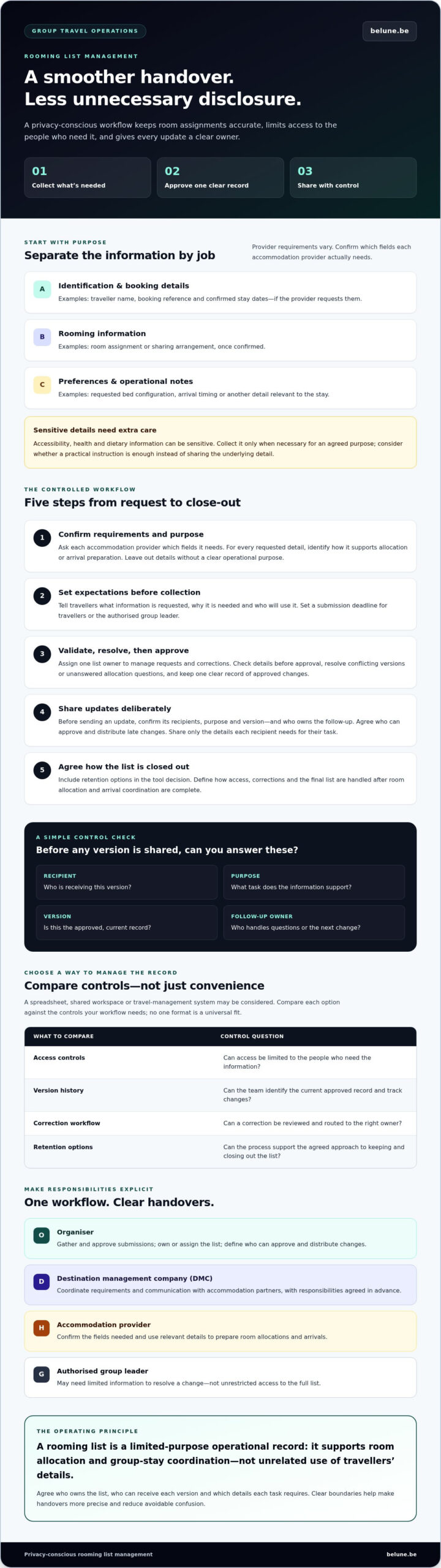
    A rooming list records the information needed to allocate rooms for a group stay. In practice, group rooming list management brings together three distinct elements: hotel booking details, traveller room assignments and optional preferences that may help shape the stay. Keeping these categories separate helps the team coordinate accurately without treating every detail as necessary for every recipient.

    Accuracy and careful information handling are connected operational responsibilities. A hotel may need names and room assignments to prepare for arrivals, while an organiser may need a broader view to resolve a change. Requirements vary by accommodation provider and itinerary. Privacy obligations also depend on the circumstances and jurisdictions involved, so confirm applicable requirements with qualified counsel.

    The following Oracle Learning video demonstrates a hotel-system workflow for creating a block reservation from a rooming list. It illustrates one operational context, not a universal process or a standard set of required fields.

    Which details might a rooming list contain?

    Before requesting information, separate it by purpose. For example, a working list might include:

    • Identification and booking details: traveller name, booking reference and confirmed stay dates, if the provider requests them.
    • Rooming information: assigned room or sharing arrangement, once confirmed.
    • Preferences and operational notes: a requested bed configuration, arrival timing or another detail relevant to the stay.

    These are examples, not universal hotel requirements. Ask each accommodation provider which fields it needs. Accessibility, health and dietary information can be sensitive. Collect such details only when necessary for an agreed purpose, and consider whether the hotel needs the underlying detail or only a practical instruction.

    Who uses the list, and for what purpose?

    A tour operator creates and manages travel arrangements, including accommodation; the Tour operator entry offers general background on that role. In a group workflow, the organiser can gather and approve submissions, while a DMC may coordinate requirements and communication with accommodation partners. The provider uses relevant details to prepare room allocations and arrivals. An authorised group leader may need limited information to resolve a change, not unrestricted access to the full list.

    A rooming list is a limited-purpose operational record: it supports room allocation and the coordination of a group’s stay, not unrelated use of travellers’ details. Agree who owns the list, who can receive each version and which details each task requires. Clear boundaries make handovers more precise and help reduce avoidable confusion for travellers and partners.

    Build a privacy-conscious rooming list from collection to confirmation

    A reliable process starts before anyone submits a preference. Assign one list owner to manage requests, corrections and the final version. Set a clear submission deadline for travellers or the authorised group leader. For each field, state its operational purpose first. If no one can explain why it’s needed for allocation or arrival preparation, leave it out.

    This discipline supports clear, responsible service. The United States Tour Operators Association describes its role in the travel industry, including an emphasis on ethics and consumer protection. For tour operators, transparency starts with straightforward instructions: tell travellers what information you’re requesting, why it’s needed and who will use it.

    Request only information needed for the allocation

    Before collection begins, ask the accommodation provider to confirm its required details and preferred submission format. Don’t assume one hotel’s process applies to another. Avoid putting full payment details, identity documents or unrelated personal notes in a rooming list. If a specific detail is required for another travel purpose, handle it through the appropriate process rather than adding it by default.

    Give travellers concise instructions and identify a contact for questions. A defined deadline gives the list owner time to check submissions and follow up on gaps before assignments are confirmed.

    Validate and confirm assignments before sharing

    Use this sequence to bring each list to a controlled final version:

    1. Confirm requirements: Check the provider’s requested fields, format and submission deadline.
    2. Request details: Ask for only relevant information and explain its purpose clearly.
    3. Validate: Compare names, room pairings, stay dates and approved preferences with the latest booking records.
    4. Resolve and approve: Direct missing or conflicting details to the authorised group contact. A named reviewer then confirms the final version.
    5. Share deliberately: Check the approved recipient list and send each recipient only the version they need.

    A compact tracker makes responsibilities visible. Adapt these examples to the provider’s confirmed requirements; they aren’t universal hotel fields.

    Field Purpose Responsible person Confirmation status
    Traveller name Match guest to booking List owner Pending / checked
    Room pairing Record approved allocation Organiser Pending / approved
    Stay dates Check booking period List owner Pending / checked

    For international tours with several accommodation partners, a DMC can help coordinate provider requirements with the organiser. The parties should agree who checks and approves each detail. This is the practical core of group rooming list management: one accountable owner, purposeful fields and a deliberate handover. Tour professionals planning hotel accommodation coordination can explore BELUNE’s hotel accommodation management as part of broader group-travel logistics.

    Group Rooming List Management: A Privacy-First Checklist for International Tours

    Compare rooming-list tools and sharing methods without losing control

    The right format depends on the group’s needs and the controls your organisation can verify. A spreadsheet may be easy to maintain, a shared workspace can support collaboration, and a dedicated travel-management system may bring rooming information into a broader workflow. None is automatically the safest choice. In group rooming list management, access rules and everyday handling matter as much as the tool itself.

    Method Practical strengths Limitations to consider Questions to verify
    Controlled spreadsheet Familiar format; straightforward to review and correct. Copies and manual changes can create conflicting versions. Who can access or edit it? Is there one authoritative copy and a usable version history?
    Approved shared workspace Can provide one shared location for authorised collaborators and updates. Convenience doesn’t ensure that permissions, history or retention are appropriate. Can access be limited by role? Are changes traceable, and can access be removed when no longer needed?
    Dedicated travel-management system May connect rooming information with other travel-management tasks. Features and supplier practices vary; setup and processes need assessment. How are sharing, audit history, export and deletion handled? Where is data stored?

    When can a spreadsheet be sufficient?

    A spreadsheet can work when a named owner maintains it, access is restricted to people who need it and the team uses a single authoritative copy. Avoid circulating separate email attachments as working versions. Agree how edits should be submitted and recorded so a correction doesn’t quietly disappear. Passwords or other file protections alone don’t replace your organisation’s wider privacy and security practices.

    What should organisers assess in a digital platform?

    Ask the provider to explain role-based access, audit history, sharing options and how records can be exported or deleted. Verify supplier claims instead of relying on feature descriptions alone. Confirm data locations and contractual terms with the provider and, where appropriate, a qualified adviser. Applicable privacy requirements vary by jurisdiction, so check which rules apply to your tour and partners.

    For any method, establish a retention approach: who keeps the working list, how long it’s needed for the operational purpose and how obsolete copies are handled. Make sure the approach reflects the actual tool and your organisation’s practices. A platform can make coordination more convenient, but convenience doesn’t prove that its privacy and security controls have been assessed.

    Use this checklist to share updates, limit access and close out the list

    A rooming list should move to its next step only when the action is clear. Before sharing, check the essentials:

    • Recipients: Are they authorised, and does each person need the information for their role?
    • Purpose: Is the list being shared for allocation, arrival preparation or another defined operational task?
    • Version: Is this the current approved copy, clearly identified so it won’t be confused with an earlier draft?
    • Transfer method: Is the chosen method appropriate under your organisation’s procedures and the provider’s requirements?
    • Follow-up owner: Who will confirm receipt, track any action and update the authoritative copy?

    Share the current rooming list only with authorised recipients who need it for an agreed operational purpose. This gives organisers and accommodation partners a clear reference without circulating every traveller detail to the full group.

    How should organisers manage last-minute changes?

    Use a defined route for corrections, even when time is short. The list owner should record who requested the change, who approved it and when the authoritative copy was updated. Then notify only the recipients who need the correction to do their jobs. If an update affects a room allocation or arrival arrangement, ask the relevant recipient to confirm receipt. This closes the loop and helps prevent an outdated version from remaining in use.

    For example, a revised room pairing may need to reach the accommodation provider and the organiser’s designated contact, but not every traveller or partner involved in the wider itinerary. Keep the change record concise and factual. Don’t add unrelated personal commentary to the list or update message.

    What should happen after the group stay?

    Close-out is part of group rooming list management, not an afterthought. Name someone to review whether the working copy is still needed once the stay is complete. That person should follow the organisation’s documented retention schedule and verify applicable obligations for the jurisdictions involved. Seek qualified advice where needed rather than assuming one retention period suits every record.

    Depending on the policy and any ongoing need, records may be deleted, archived or retained. If an unresolved booking matter, claim or other legitimate operational follow-up requires continued access, document the reason, owner and review point. Consider extra copies shared with partners too, and how they should be handled under agreed procedures.

    For tour professionals coordinating hotel accommodation and partner handovers, discuss accommodation coordination with BELUNE.

    Coordinate hotel accommodation with a DMC while keeping responsibilities clear

    A destination management company (DMC) can help connect the tour organiser’s accommodation plan with hotel requirements and local partner communication. Coordination may include gathering confirmed property requirements, aligning room allocation information and relaying approved changes. The organiser and partners should agree in advance who is responsible for each step, why information is being shared and which people are authorised to receive it.

    Coordination doesn’t automatically determine legal roles or obligations. Those can depend on the arrangement and applicable jurisdiction. If there’s uncertainty, seek guidance from qualified privacy counsel. BELUNE’s hotel accommodation management and group travel logistics can form part of a wider itinerary, while the parties involved retain their agreed responsibilities for the information they handle.

    Agree responsibilities before collecting traveller details

    Document the handover before requesting information. Name who asks travellers for details, who checks submissions against booking records, who approves the allocation, who sends the list to the accommodation provider and who manages corrections. Then confirm the provider’s actual requirements and preferred format. This sequence helps prevent premature collection and makes it easier to direct questions or resolve discrepancies without circulating the full list.

    A clear division of tasks also helps when working with a new partner. The guide to choosing a group travel agency can help professionals consider how responsibilities and partner coordination fit into wider travel arrangements. For group rooming list management, put agreed roles in writing so the process stays clear even when a correction crosses organisational boundaries.

    Make accommodation coordination part of the wider itinerary

    Rooming-list deadlines should connect to booking milestones and the group’s arrival schedule. Set submission and review dates that give the organiser and accommodation partner time to confirm assignments and resolve gaps before the relevant handover. If an itinerary includes several stays or local partners, clarify whether the same contact or a different authorised person handles each property’s requirements.

    Accommodation is one part of a larger operational sequence. The approach described in incoming tour operator coordination provides broader context for aligning local partners and travel arrangements. A DMC can help organise accommodation communications as part of wider group logistics, with the scope and recipients agreed by the parties.

    Thoughtful coordination is both practical and human: travellers face fewer avoidable allocation questions, while partners receive information suited to their role. If your team is planning an international group itinerary, consider discussing how hotel accommodation coordination can fit into its wider arrangements with BELUNE.

    Make every rooming-list handover deliberate

    Effective group rooming list management follows a clear sequence: collect only details needed for the stay, assign responsibility for checking and approving them, and share the current list only with authorised recipients. Choose tools based on controls your team can verify, then follow an agreed process for late changes and post-stay retention.

    Accommodation coordination works best when the organiser, DMC and hotel understand their roles before information starts moving. BELUNE lists hotel accommodation management as a priority service, and its company summary cites more than 20 years of experience in transport and tour-operator work. These are relevant foundations for coordinating group accommodation within broader travel logistics, without replacing your own review of privacy requirements and partner responsibilities.

    If you’re planning a group itinerary and want to clarify the accommodation handover, discuss accommodation coordination for your group with BELUNE. With clear roles and a considered process, your team can prepare for a smoother arrival while treating traveller information with care.

    Frequently Asked Questions

    What is group rooming list management?

    Group rooming list management is the process of preparing and maintaining a working record of a group’s hotel room assignments and relevant booking details. It involves confirming what the accommodation provider needs, collecting only those details, checking accuracy, controlling access and updating the authoritative version when plans change. The right fields and workflow depend on the booking, the provider and applicable privacy requirements, which may vary by jurisdiction.

    What information should be included on a hotel rooming list?

    Include only details the accommodation provider confirms it needs for the booking or room allocation. Depending on the property, this may include traveller names, room pairings or relevant arrival information. Confirm the purpose of each field before collecting it. Treat accessibility or health-related details with particular care, and avoid adding unrelated notes or payment-card details. Requirements can differ between accommodation providers, so don’t assume one list fits every stay.

    How do you share a rooming list securely with a hotel?

    First verify the recipient and confirm which information they need for their role. Use a sharing method approved by your organisation, limit access to authorised people and identify the current version clearly. Avoid sending unnecessary copies. Agree in advance how corrections will be communicated and how outdated files should be handled. The appropriate method depends on your organisation’s controls and the hotel’s arrangements, so assess the process rather than relying on the file format alone.

    Is a spreadsheet suitable for managing an international group rooming list?

    A spreadsheet can suit some groups if one person owns the authoritative copy and access, versioning and sharing are controlled. It can become harder to manage as the group, partner network or number of changes grows, particularly if multiple attachments circulate. Before choosing a format, consider how edits are tracked, how corrections reach the right people and how old copies are handled. A spreadsheet isn’t automatically secure or unsuitable; assess the actual controls and working practices.

    How should organisers handle last-minute rooming-list changes?

    Use a defined change process: confirm that the requester is authorised, verify the detail, update the authoritative copy and notify only recipients who need the correction. Record who requested and approved the change, along with when the list was updated. If the change affects room allocation or arrival arrangements, ask the relevant accommodation contact to confirm receipt. This creates a traceable handover and reduces the chance that someone acts on an outdated version.

    How long should a group rooming list be retained?

    There’s no single retention period that suits every organisation, booking or jurisdiction. Follow your organisation’s documented retention schedule and confirm applicable requirements with qualified privacy counsel. Once the operational need has ended, review whether the working list should be deleted, archived or retained for a documented reason. If an unresolved booking matter or other operational follow-up requires continued retention, record the reason and responsible person, then handle the information according to applicable policy and requirements.

    Can a DMC manage hotel rooming lists for a tour operator?

    A DMC may coordinate accommodation requirements and communication with hotel partners as part of group travel logistics. Before sharing traveller details, the tour operator and partners should agree who collects, checks, updates and distributes the list, and confirm which fields the hotel actually needs. Ask the DMC to explain its working process, and verify any privacy or security claims with the relevant provider or adviser. Don’t assume that coordination alone establishes legal roles or controls.

  • Managing Currency Fluctuations for Tour Packages

    Managing Currency Fluctuations for Tour Packages

    A tour package can become harder to deliver at its planned margin before the first guest boards. When supplier commitments are priced in one currency and customer payments arrive in another, exchange-rate movements can turn a carefully built quotation into a difficult trade-off. Managing currency fluctuations for tour packages starts with treating exposure as part of package design, not as a last-minute surcharge.

    That uncertainty is familiar to professional travel partners. Raising prices too readily can make an itinerary less appealing, while holding them fixed without understanding the risk can leave the planned margin exposed. The answer isn’t necessarily to remove all flexibility. First, identify which costs are genuinely affected, then decide how much price certainty your quotation needs.

    This guide explains how to map currency exposure across supplier costs and payment timing, compare practical ways to manage it, and establish clear quotation and review procedures. It also covers how to communicate pricing terms to customers. A coordinated view of accommodation, transport, guidance, and activities can make package costs clearer and help partners make more deliberate decisions about price certainty.

    Key Takeaways

    • Map each package cost by currency, amount, payment date, and commitment status before preparing a quotation.
    • Separate confirmed foreign-currency obligations from estimates that may change, so you can focus on genuine exposure.
    • When managing currency fluctuations for tour packages, compare base-currency pricing, quotation validity periods, adjustment clauses, and natural offsets.
    • Assign clear ownership and review triggers for exchange-rate monitoring, supplier updates, and quotation approvals.
    • A DMC can help coordinate supplier and itinerary details for clearer costing, but coordination alone doesn’t remove currency risk.

    Why currency fluctuations matter when pricing tour packages

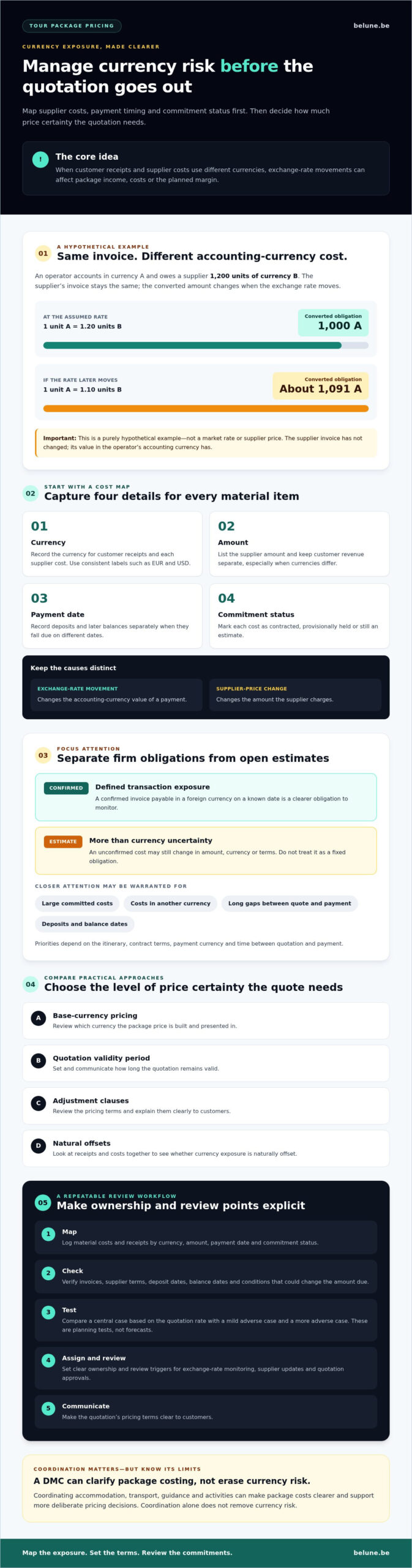
    A group itinerary can be carefully designed and still face a pricing gap: the customer receives a quotation before every supplier has been paid, and the tour may take place months later. If customer receipts and supplier costs use different currencies, exchange-rate changes can affect the package’s income, costs, or planned margin. This is currency exposure, a form of foreign exchange risk.

    Consider a purely hypothetical example, not a market rate or supplier price. An operator accounts in currency A and owes a supplier 1,200 units of currency B. At an assumed rate of 1 unit of A for 1.20 units of B, the obligation converts to 1,000 units of A. If the rate later moves to 1 unit of A for 1.10 units of B, the same obligation converts to about 1,091 units of A. The supplier’s invoice hasn’t changed, but its cost in the operator’s accounting currency has.

    Exchange-rate movement changes the accounting-currency value of a payment; an ordinary supplier-price change alters the amount the supplier charges. The distinction matters because each has a different cause and may call for a different response. Managing currency fluctuations for tour packages begins with identifying which package amounts are exposed and when they become payable.

    Where exchange-rate exposure enters a group-tour package

    Build a simple currency map. Record the currency used for customer receipts and each major package component, such as accommodation, coach transport, activities, local guides, and other contracted costs. For each item, note the amount, payment date, and whether the cost is confirmed or still an estimate.

    Payment timing affects the eventual conversion. A deposit paid when a supplier confirms a booking may be exchanged at a different rate from a later balance. Customer payments may arrive on a separate schedule. Mark a cost that isn’t yet contracted as an estimate, rather than treating it as a fixed obligation. Its final amount or currency terms may still change.

    Which package costs deserve closer attention?

    Start with large, committed costs payable in a currency different from the operator’s accounting currency. A confirmed accommodation block or transport commitment may warrant closer monitoring than a small, variable expense. Priorities depend on the itinerary, contract terms, payment currency, and time between quotation and payment.

    • Check whether the contract is denominated in the accounting currency or another currency.
    • Record deposit and balance dates, as well as any conditions that could change the amount due.
    • Separate confirmed commitments from estimates that may shift before booking.

    This gives you a clearer view of exposure before a quotation goes out. It also helps partners decide which costs need review as the itinerary develops, rather than applying the same level of concern to every line item.

    How to measure currency exposure before issuing a tour quotation

    A useful exposure assessment starts with a clear record, not a prediction. For each package, capture the currency, amount, expected payment date, and commitment status of every material receipt and cost. Then compare them in the operator’s accounting currency. Managing currency fluctuations for tour packages becomes more deliberate when the team can see which obligations are fixed and which remain uncertain.

    Build a currency-by-currency cost map

    Use one row for each supplier commitment. Record the supplier amount, invoice currency, expected payment date, and relevant cancellation terms. List customer revenue separately, since it may be received in a different currency or on a different schedule. Label currencies consistently with ISO 4217 codes, such as EUR and USD, to avoid ambiguity in worksheets and quotations.

    • Mark whether each cost is contracted, provisionally held, or still an estimate.
    • Record deposits and later instalments as separate payments when their dates differ.
    • Check invoices and supplier terms before relying on a currency or amount.

    A confirmed invoice payable in a foreign currency on a known date creates a more defined transaction exposure. An unconfirmed estimate is different: its amount, currency, or terms may change, so the uncertainty isn’t solely about exchange rates.

    Test how rate changes affect package economics

    Use three labelled scenarios: a central case based on the rate selected for the quotation, a mild adverse case, and a more adverse case. These are planning tests, not forecasts. For example, assume an operator accounts in EUR and has a hypothetical confirmed supplier invoice of USD 10,000. At an assumed central rate of EUR 1 = USD 1.10, the cost is EUR 9,090.91. At an assumed mild adverse rate of EUR 1 = USD 1.05, it is EUR 9,523.81; at an assumed more adverse rate of EUR 1 = USD 1.00, it is EUR 10,000. Each rate and amount here is illustrative, not a current market quote.

    Exposure calculation: convert each committed foreign-currency amount into the accounting currency at the selected scenario rate, then compare total costs and planned margin with the central case. Verify supplier amounts, invoice currencies, payment dates, and the rates used before relying on the result. The U.S. International Trade Administration outlines ways exporters can mitigate the risk of fluctuating foreign currency rates. Any approach needs to suit your contracts and circumstances.

    When supplier, accommodation, coach, and activity details are still being assembled, a coordinated itinerary can help make the cost map more complete. Professional partners can discuss a tailored group itinerary with BELUNE, whose DMC work includes coordinating group-travel logistics.

    Managing Currency Fluctuations for Tour Packages

    Comparing ways to manage currency fluctuations for tour packages

    No single policy suits every itinerary. Managing currency fluctuations for tour packages means weighing the price certainty you need against each approach’s flexibility and administrative demands. Start with operational measures, then consider whether a financial instrument is proportionate to the package’s scale and payment timeline.

    Operational approaches: quote terms, buffers, and natural offsets

    Pricing in your base currency gives customers a clear amount, but leaves the operator exposed to costs invoiced in another currency. A defined quotation-validity period sets how long the price applies. Once it expires, review supplier costs and rates before confirming. If you use an adjustment clause, explain its trigger and calculation plainly, and have the wording checked against applicable requirements. A contingency allowance can support internal planning, but it should reflect the package’s actual exposure rather than a universal percentage.

    Natural offsets can reduce unmatched exposure when customer receipts and supplier payments are in the same currency. They are more useful when the amounts and timing align closely. Differences in value, payment date, or commitment status leave residual risk. The U.S. International Trade Administration outlines approaches to mitigate the risk of fluctuating foreign currency rates, including financial tools that operators should assess for their own circumstances.

    Financial hedging: when specialist advice may be needed

    A forward contract generally sets an exchange rate for an agreed amount and future date. A currency option may provide the right, but not the obligation, to exchange at an agreed rate, subject to its terms and costs. Neither is a default recommendation. Ask a bank or qualified adviser to review eligibility, costs, obligations, and accounting treatment before proceeding.

    Compare these tools with simpler quotation controls. The decision depends on the size and certainty of the foreign-currency commitment, when payment is due, and whether the package can absorb a rate change. Hedging may add administration and contractual obligations. Operational methods are simpler but may leave more exposure in place.

    • Base-currency pricing: High customer-price clarity and low effort, but supplier exposure remains. It may suit operators who prioritize a straightforward customer-facing amount.
    • Validity periods and adjustment clauses: Moderate effort and flexibility, with predictability bounded by clear terms. These can suit quotations that remain open while supplier costs may change.
    • Natural offsets: Moderate effort, with predictability dependent on how closely receipts and costs match in currency, amount, and timing.
    • Forward contracts or options: Potentially greater control over exchange outcomes, but with higher effort and instrument-specific obligations. Consider them only after specialist review of the confirmed exposure.

    A practical workflow for protecting quotations and customer trust

    A reliable quotation process makes currency decisions visible, repeatable, and easy to explain. When managing currency fluctuations for tour packages, assign clear ownership: one person tracks rate inputs, another confirms supplier updates, and a named approver signs off on the quotation assumptions. Keep the final record with the quote so the team can see what was known when the price was prepared.

    Create a repeatable quotation and review checklist

    Before issuing a quotation, record the rate source and date, the quotation currency, the validity period, and the assumptions behind the cost calculation. Note which supplier amounts are confirmed and which remain estimates. Set review triggers in advance, such as quotation expiry, a supplier deposit becoming due, an updated supplier price, or a material itinerary change.

    Recheck the exposure when a trigger occurs, rather than waiting for someone to notice a rate movement. Document who can approve revised assumptions and who will explain any change to the customer. Keep a short audit trail of the original quote, revised figures, decision, and communication. For partners also weighing supplier coordination, a guide to choosing a group travel agency can help clarify which capabilities to assess.

    Make currency terms understandable to group customers

    Use direct language. State the currency of the quoted package and describe what the price includes. If the quotation has an expiry date, show it clearly. If an adjustment mechanism may apply, explain what activates it, how the amount would be calculated, when the customer would be told, and what options are available under the agreed terms.

    For example, a quotation might say that its price is valid until a stated date and that any later revision will be explained before confirmation. That’s clearer than a vague statement that the price “may change.” Avoid surprise surcharges and absolute claims that a rate or price cannot change unless the terms genuinely support them. Have the wording and process reviewed against applicable contract and consumer requirements by a qualified source. Rules can depend on the circumstances and jurisdiction.

    Clear communication is part of sound package design. A coordinated view of accommodation, coach transport, local guidance, and activities can help partners keep itinerary details aligned with quotation assumptions. Discuss a tailored group itinerary with BELUNE to explore how logistics coordination can support clearer package planning.

    How a DMC can support more coherent tour-package planning

    A package comes together through connected commitments. A DMC can help partners align the itinerary with accommodation, coach transport, activities, and local guidance, giving the team a shared operational picture as plans develop. That coordination can highlight decisions that depend on one another, such as confirming an activity after transport arrangements are clear.

    A DMC coordinates travel logistics; it doesn’t automatically remove currency risk. Exchange-rate exposure still depends on the currencies, amounts, contract terms, and timing of receipts and payments. Keep financial decisions with the operator and its qualified advisers, and use the itinerary as a practical reference for package planning.

    Coordinate supplier commitments with the itinerary

    Use the itinerary to connect each service with its supplier, status, and key decision date. Confirm currency, deposits, cancellation terms, and payment dates with suppliers, and update the plan if an activity or overnight stay changes. This gives partners a clearer view of which arrangements are settled and which still need confirmation. A guide to choosing an incoming tour operator can also help partners assess the coordination and local-planning capabilities they need.

    A shared itinerary helps the team consider logistics as a connected whole rather than as isolated bookings. For instance, a schedule change can affect transport and activity coordination at the same time. Keeping those details together makes it easier to communicate updates and maintain a consistent view of the package.

    Turn the pricing process into a partner-ready plan

    Bring the operational and pricing records together before presenting a package to partners. Include the itinerary version, the status of key services, the pricing approach, and assumptions that still need review. This creates a useful handover: colleagues can see how the planned experience relates to the quotation without treating logistics coordination as a promise that costs or exchange rates will remain unchanged.

    BELUNE is a specialist DMC with more than 20 years of group-travel and transport experience. It creates tailored group itineraries and coordinates accommodation management, coach transport using its own fleet, activities, and local guidance for professional partners. That experience supports itinerary and logistics planning, not foreign-exchange trading, hedging, or financial advice.

    To explore how a coordinated itinerary could support your group-tour planning, discuss a tailored group itinerary with BELUNE. A clear operational plan gives partners a considered foundation for managing currency fluctuations for tour packages.

    Build a clearer plan for your next group itinerary

    Sound pricing starts before a quotation reaches the customer. A clear view of supplier commitments, review points, and customer-facing terms helps teams respond to currency movement consistently instead of making last-minute changes. Managing currency fluctuations for tour packages is ultimately about making informed choices, documenting assumptions, and keeping partners and customers aligned.

    A well-coordinated itinerary can make package components easier to plan and cost. BELUNE brings more than 20 years of group-travel and transport experience, with tailored itineraries that coordinate accommodation, coach transport, activities, and local guidance for professional partners.

    Discuss a tailored group itinerary with BELUNE and take a considered next step toward a package plan that fits your operational needs. Clear processes and a well-planned view of logistics can help you build group experiences with greater confidence.

    Frequently Asked Questions

    What does currency exposure mean for a tour package?

    Currency exposure is the possibility that exchange-rate movement changes the value of a package’s income or costs. It can arise when customers pay in one currency while accommodation, transport, activities, or other suppliers charge in another. The practical effect depends on amounts, payment dates, contract terms, and whether receipts and costs naturally offset. Map these details before choosing an approach, and distinguish confirmed obligations from estimates that may still change.

    How can a tour operator calculate currency exposure?

    List each relevant supplier cost with its currency, amount, expected payment date, and commitment status. Compare those costs with customer receipts and identify currency mismatches. Then model clearly labelled exchange-rate scenarios using verified inputs to understand possible effects on package costs and planned margin. This is a planning exercise, not a prediction. Confirm accounting, tax, or financial-product treatment with qualified professionals before relying on it.

    Should tour packages be priced in the customer’s currency or the supplier’s currency?

    There’s no single best pricing currency for every operator. Quoting in the customer’s currency may make the offer easier to understand, but the operator still needs to account for supplier costs in other currencies. Supplier-currency pricing may expose customers to conversion changes, depending on the terms and payment process. Consider customer expectations, supplier contracts, payment timing, and your ability to manage the difference, then state the chosen currency and any adjustment terms clearly.

    Can a tour operator use a forward contract to manage exchange-rate changes?

    A forward contract may let a business agree on an exchange rate for a future transaction, but it won’t suit every package or operator. Its suitability depends on the amount, timing, contract terms, and the operator’s circumstances. Before considering one, ask a bank or qualified financial adviser to review availability, obligations, costs, and accounting implications. Treat it as a potential financial tool, not a guarantee against every change in package costs.

    How long should a tour-package quotation remain valid?

    Set a validity period that reflects how quickly relevant supplier costs and exchange rates may change. Consider supplier deposit deadlines, booking windows, and how long customers may need to decide. Avoid using a generic period without checking your actual contracts and operating practices. Show the expiry date prominently and explain what happens if a customer confirms after it. Recheck costs and assumptions before extending or reissuing an expired quotation.

    Can tour operators add a currency surcharge after a customer books?

    Whether a package price can be adjusted after confirmation depends on the contract, the information provided before booking, and applicable consumer and travel rules. Don’t assume there’s a general right to impose a surcharge. Have qualified legal advisers review the terms, explain any adjustment mechanism before confirmation, and make the timing and calculation clear. Customers should also be told what options are available under the agreed terms and applicable requirements.

    What is the simplest way to reduce currency uncertainty in a group tour quotation?

    Start with a currency-by-currency cost map, a clearly stated quotation currency, and a defined validity period. Confirm supplier payment dates and terms, then review the package before major commitments or material itinerary changes. Matching customer receipts and supplier costs in the same currency may reduce unmatched exposure where practical. These steps improve visibility, but they don’t eliminate exchange-rate risk. For substantial or complex exposure, seek advice from a qualified specialist.

  • Group Accommodation Payment Terms for Tour Operators

    Group Accommodation Payment Terms for Tour Operators

    What if the greatest threat to your next curated itinerary isn’t a lack of inventory, but the invisible weight of your financial structure? For many, managing group accommodation payment terms for tour operators feels less like strategic planning and more like a defensive maneuver against high upfront deposits and opaque cancellation windows. It’s a delicate balance. You’re often asked to commit significant capital months in advance while managing the shifting tides of currency risks and fragmented supplier deadlines. We know this friction doesn’t just strain your accounting; it stifles your ability to secure the most exclusive Benelux properties for your clients.

    You’ve likely felt the frustration of juggling multiple payment milestones that never quite align. It’s time to transform these logistical hurdles into a strategic advantage. This guide provides a clear framework to master the complexities of group booking finances, ensuring you protect your cash flow while maintaining access to premium inventory. You’ll learn how to mitigate financial risk through structured milestones and discover the elegance of streamlining your entire invoicing process through a single, expert partner. We’ll explore how a refined approach to payments can finally bring the serenity and precision your high-end projects deserve.

    Key Takeaways

    • Understand the standard three-step payment cycle of deposits, interim payments, and final balances to align your internal cash flow with 2026 industry benchmarks.
    • Discover how to manage complex group accommodation payment terms for tour operators by consolidating multiple supplier deadlines into a single, manageable invoicing stream.
    • Mitigate financial risk and currency volatility by leveraging fixed-price package models that simplify accounting for multi-property Benelux tours.
    • Learn the importance of PCI DSS compliance and centralized processing to ensure the security of high-value B2B transactions across international borders.
    • Secure your inventory by evaluating the latest shifts in cancellation policies and Force Majeure clauses, protecting your agency from unforeseen market disruptions.

    Understanding Group Accommodation Payment Terms for Tour Operators

    Mastering the financial architecture of a group itinerary requires more than just an understanding of rates. It demands a deep dive into the technical specificities of group accommodation payment terms for tour operators. Unlike individual travelers who benefit from standardized retail policies, professionals operating in the group space must manage a landscape defined by rigid milestones and significant financial commitments. These terms are the structural pillars that support your cash flow and protect your access to premium inventory in highly competitive regions like the Benelux.

    The Anatomy of a Group Booking Contract

    A robust contract is a masterpiece of precision. It outlines the evolution of the booking from a provisional hold to a guaranteed commitment. Provisional bookings provide a vital window for sales, but once the status shifts to guaranteed, the financial liability becomes absolute. This transition is usually marked by the first payment milestone.

    • Payment Milestones: These staged payments typically include a non-refundable deposit, an interim payment, and a final balance due before arrival.
    • Cancellation Clauses: Tiered penalties that increase in severity as the departure date nears, reflecting the hotel’s diminishing chance to resell the space.

    The attrition rate represents the percentage of the room block that may be released without financial penalty, serving as a critical buffer for the tour operator’s liability. By understanding these thresholds, you can release unused inventory before it transforms into a sunk cost, maintaining the lean efficiency required for high-end project management.

    B2B vs. B2C: Why Tour Operators Need Specialized Terms

    Retail hotel policies are designed for simplicity and high turnover. For a professional tour operator, simplicity is rarely the reality. You’re managing a complex gap between when your clients pay and when your suppliers demand funds. Specialized B2B terms allow for the scale and flexibility required for large itineraries involving multiple services like coach hire or local guides.

    “Time is of the essence” clauses are frequently embedded in these schedules. They aren’t mere suggestions; they’re legal requirements that make a specific deadline a condition of the contract. Missing a milestone by even 24 hours can result in the immediate release of your entire room block. This is where a Destination Management Company (DMC) becomes an essential ally. By acting as a single point of financial mediation, a partner like BELUNE harmonizes these disparate deadlines into a single, cohesive invoicing structure. This technical mastery of logistics ensures that your pricing remains competitive and your financial risk is minimized through a unified currency and payment flow.

    Standard Payment Structures: Balancing Cash Flow and Security

    Precision in financial planning is what separates a successful tour from a logistical burden. In the current market, group accommodation payment terms for tour operators have evolved into a sophisticated three-step cycle. This structure isn’t just about moving funds; it’s a strategic rhythm designed to protect both the supplier’s inventory and the operator’s liquidity. By mastering these milestones, you ensure that your agency remains agile while securing the most sought-after properties in the Benelux region.

    The Milestone Approach to Group Payments

    Securing high-value inventory in 2026 typically begins with an initial deposit. Industry standards now dictate a range between 20% and 40% of the total trip cost at the time of confirmation. This first commitment acts as the anchor for your project. It’s enough to guarantee the block without over-extending your immediate capital. Following this, an interim payment often falls due between 90 and 120 days before departure. This milestone serves as a vital check-in point, aligning your financial outlays with your own client collection cycles.

    The final balance is generally required 30 days before the group’s arrival. This deadline is absolute. It ensures that all components, from hotel rooms to coach hire and local guide services, are fully funded before the first guest steps off the plane. This staged approach mirrors the rigor found in international security protocols, such as the USTOA $1 Million Travelers Assistance Program, which highlights the importance of financial stability and consumer protection in the B2B travel supply chain.

    Release Dates and Attrition Management

    Release dates are your most effective tools for risk mitigation. They provide a window to return unsold rooms without incurring heavy penalties. Most professional contracts include an attrition allowance, typically between 10% and 20%. This means you can reduce your group size by that percentage up until a specific cutoff, usually 60 to 90 days out, without losing your deposit on those specific units. It’s a buffer that respects the reality of group sales. However, once you pass the 30-day mark, cancellation fees often climb to 75% or even 100% of the revenue. Staying ahead of these dates is essential for maintaining a healthy margin.

    Finding this balance is easier when you have a local ally who understands the nuances of regional hotelier expectations. For a deeper look at selecting a partner capable of navigating these complexities, consult The Definitive Guide to Choosing a Benelux Incoming Tour Operator in 2026. A specialized partner doesn’t just manage bookings; they harmonize these disparate deadlines into a single, cohesive timeline. If you’re ready to move away from fragmented invoicing and toward a more integrated model, exploring our tailored group solutions can provide the financial clarity your next project demands.

    Group Accommodation Payment Terms for Tour Operators

    Secure Payment Processing for Group Travel: Safety Protocols

    Security in high-value B2B transactions is not a mere technicality; it is a structural component of professional trust. When managing group accommodation payment terms for tour operators, the financial volume involved necessitates a rigorous approach to safety. A single multi-city itinerary can involve dozens of transactions across different jurisdictions, each representing a potential point of failure. By centralizing these flows, we transform a fragmented liability into a streamlined, secure asset that protects your agency’s integrity.

    Financial Security Standards in 2026

    Encryption and secure gateway requirements have become the baseline for modern travel commerce. PCI DSS compliance remains mandatory, ensuring that sensitive payment data is handled with the highest level of integrity throughout the booking lifecycle. Beyond simple data protection, the use of escrow or bonded accounts provides an additional layer of assurance for international partners. These structures guarantee that funds are protected until service delivery is confirmed, aligning with group contract best practices. Centralized invoicing reduces administrative fraud risks by creating a single, audited financial trail that eliminates the opacity often found in multi-vendor payment schedules.

    Managing Cross-Border Payment Challenges

    Operating across borders introduces complexities that can erode even the healthiest margins. While SEPA transfers offer efficiency within Europe, SWIFT payments and international transfer fees often add hidden costs to global transactions. These small percentages, when applied to a large group booking, can represent thousands in lost revenue. Currency volatility represents perhaps the greatest risk to a tour operator’s profitability. A sudden shift in the Euro’s value can instantly turn a profitable itinerary into a loss-making venture if rates aren’t locked in early. We mitigate this through fixed-price models that shield our partners from market fluctuations.

    Selecting a partner with local financial expertise is critical for navigating these challenges efficiently. For a deeper analysis of what to look for in a strategic partner, see The Definitive Guide to Choosing a Group Travel Agency in 2026. By consolidating payments for hotels, coaches, and local guides into a single currency and invoice, you don’t just save on bank fees; you regain control over your financial narrative. This level of precision is essential for those aiming to deliver exceptional experiences without the distraction of logistical friction. It’s about moving from a reactive stance to a position of strategic authority.

    The DMC Advantage: Streamlining Financial Logistics

    Managing the financial architecture of a complex itinerary shouldn’t feel like a battle with your own ledger. While the technicalities of group accommodation payment terms for tour operators can be daunting, the intervention of a specialized Destination Management Company transforms this friction into a streamlined asset. By acting as a single point of financial mediation, we remove the burden of managing dozens of disparate supplier contracts, allowing you to focus on the creative vision of the journey itself.

    Consolidated Invoicing for Multi-Day Itineraries

    The logistical elegance of “one invoice, one currency” cannot be overstated. When a tour spans the Benelux region, you’re often faced with a mosaic of VAT requirements and local tax codes that vary significantly between borders. We handle these complexities internally. By aggregating payments for hotels, our in-house fleet of modern coaches, and local guide services, we eliminate the need for your accounting team to process multiple international transfers. This consolidation significantly reduces bank fees and mitigates the administrative fatigue that often plagues high-volume agencies. Each itinerary we plan includes a comprehensive financial risk assessment, ensuring that every euro is accounted for and every tax obligation is met with absolute precision.

    Local Expertise and Negotiation Power

    Relationships are the silent currency of the travel industry. With 20+ years of presence in the Benelux market, we’ve cultivated deep ties with premium properties that an overseas operator simply cannot replicate. We leverage this trust to secure more favorable group accommodation payment terms for tour operators, often negotiating softer deposit requirements or extended release windows that protect your liquidity. This local guidance is particularly vital when navigating regional payment customs that might otherwise result in rigid, non-negotiable contracts.

    Our role extends beyond the initial booking. We provide 24/7 financial support for on-the-ground contingencies, ensuring that if an itinerary needs a sudden adjustment, the payment logistics are handled instantly without disrupting the guest experience. This level of operational depth is what defines a true strategic ally. For those looking to elevate their offerings, exploring The Ultimate Guide to Culture Group Tours in Benelux for 2026 reveals how these financial structures support world-class guest experiences. If you’re ready to simplify your logistics and secure premium inventory with confidence, partner with BELUNE for your next Benelux itinerary.

    Optimizing Your Strategy: Best Practices for Tour Operators

    Strategic success in the high-end travel sector isn’t just about booking the right hotel; it’s about the masterful stewardship of your agency’s financial reputation. As we’ve explored, navigating group accommodation payment terms for tour operators requires a blend of technical precision and proactive communication. To truly protect your margins and secure the finest inventory in the Benelux region, you must move beyond reactive accounting and embrace a strategy of anticipation.

    Setting internal deadlines is your first line of defense. We recommend establishing your own milestones at least seven to ten days before your supplier’s official cut-off. This buffer isn’t just a safety net for bank delays; it provides the necessary space to resolve client payment issues without risking your room block. In the 2026 landscape, Force Majeure and cancellation clauses have become more nuanced, often reflecting specific regional labor trends or environmental considerations. Reviewing these with a critical eye ensures your agency isn’t left vulnerable to shifting global conditions.

    Contractual Due Diligence

    A rigorous review process is the hallmark of a professional operator. Your checklist should prioritize the verification of attrition windows, currency lock-in dates, and the specific penalties for last-minute group additions. Handling the “plus one” guest or a sudden reduction in numbers requires a contract that offers pre-defined flexibility. When your financial structure supports your creative vision, you can deliver truly exceptional journeys, such as those detailed in Themed Group Travel in Benelux: A Masterclass in Curated Experiences. Transparency with your DMC partner regarding your own client collection cycles often opens doors to more bespoke, flexible payment arrangements.

    Next Steps: Securing Your 2026 Group Inventory

    The Benelux market remains highly competitive, with premium properties for art and culture tours often reaching capacity 12 to 18 months in advance. Early booking isn’t just a suggestion; it’s a requirement for those who refuse to compromise on quality. Partnering with BELUNE means leveraging 20+ years of local expertise and an in-house fleet of modern coaches to anchor your logistics. We act as your strategic ally, harmonizing complex payment flows into a single, elegant narrative. Don’t leave your 2026 programs to chance. Contact our team today to request a custom itinerary proposal and secure the inventory your clients expect.

    Mastering the Financial Architecture of Your Next Journey

    Expertly navigating the technicalities of group accommodation payment terms for tour operators is the final step in securing a seamless travel program. You’ve seen how structured milestones protect your liquidity and how centralized invoicing through a trusted partner eliminates administrative friction. By embracing these standards, you move from managing spreadsheets to curating experiences with absolute confidence. Our approach focuses on technical rigor and artistic vision, ensuring your cash flow remains as fluid as your itineraries.

    With over 20 years of DMC expertise and a modern private coach fleet, we provide the stability your high-end projects demand. Our fixed-price group tour packages shield your margins from currency volatility, allowing you to focus on the human and emotional impact of the tour. It’s time to transform your logistical challenges into a strategic advantage. Request Your Custom Benelux Group Tour Itinerary today to begin a collaboration built on excellence and precision. We look forward to realizing your most ambitious projects together.

    Frequently Asked Questions

    What are the standard deposit requirements for group bookings in Benelux?

    Standard deposits for group bookings in the Benelux region typically range from 20% to 40% of the total reservation value. This initial commitment secures your inventory and allows hotels to guarantee availability for large blocks. In 2026, many premium properties require this non-refundable deposit upon confirmation to protect against high cancellation rates. Working with a partner like BELUNE ensures these group accommodation payment terms for tour operators are managed through a single, professional financial channel.

    How do cancellation policies differ for tour operators compared to individual guests?

    Cancellation policies for professionals are significantly more rigid than standard B2C hotel terms. While individual guests often enjoy 24-hour flexibility, group contracts use tiered penalties that increase as the departure date approaches. For example, cancelling 30 days out might incur a 50% penalty, while changes within 14 days often result in a 100% loss of revenue. These tiers reflect the hotel’s limited window to resell dozens of rooms simultaneously.

    Can a DMC help reduce the financial risk of currency fluctuations?

    A specialized Destination Management Company mitigates currency risk by providing fixed-price group tour packages. By locking in rates at the time of booking, you avoid the margin erosion caused by sudden fluctuations in the Euro or other local currencies. This stability is essential for international operators who sell itineraries months in advance. We act as a financial shield, ensuring your projected profits remain intact regardless of market volatility during the planning phase.

    What is an attrition clause, and how does it affect my payment terms?

    An attrition clause defines the percentage of rooms you can release without financial penalty before specific deadlines. A standard allowance is 10% to 20% of the original block, providing a vital buffer for fluctuating group sizes. If your sales fall below this threshold, the clause protects your agency from paying for unused inventory. It’s a key component of group accommodation payment terms for tour operators that balances risk between the hotel and the agency.

    How do I ensure my payments are secure when booking multiple hotels?

    Ensuring security across multiple properties requires a centralized payment gateway that adheres to PCI DSS standards. Rather than sharing sensitive financial data with several individual hotels, you process a single transaction through your DMC partner. This method reduces administrative fraud risks and ensures that high-value B2B transfers are encrypted. We utilize secure gateways and bonded accounts to provide a structural layer of protection for every itinerary we manage.

    What happens if our group size significantly decreases after the deposit is paid?

    If your group size drops significantly beyond the allowed attrition percentage, tiered cancellation fees will apply to the released rooms. These penalties are usually calculated based on the proximity to the arrival date, often ranging from 25% to 100% of the cancelled revenue. Proactive communication with your partner is critical here. We leverage our 20 years of local relationships to negotiate the best possible outcomes when unexpected shifts in group dynamics occur.

    Are there specific VAT considerations for group travel payments in the Benelux region?

    VAT considerations for group travel in the Benelux region are complex because tax codes vary across national borders. Navigating these requirements independently often leads to administrative fatigue and potential compliance errors. A specialized partner simplifies this by aggregating all local taxes into a single, compliant invoice. This ensures that your accounting team handles one clear document that respects the specific tax regulations of every country included in your itinerary.

    How far in advance should final payments be settled for group accommodation?

    Final payments for group accommodation should generally be settled 30 days before the group’s arrival. This deadline ensures that all logistics, including coach hire and guide services, are fully funded and guaranteed. Some suppliers may request settlement up to 60 or 90 days out for peak season dates or high-demand festivals. Establishing clear internal deadlines at least one week before these supplier cut-offs is a best practice for maintaining healthy cash flow.

  • Tour Operator Emergency Response Plan in Benelux: Crisis Management Guide (2026)

    Tour Operator Emergency Response Plan in Benelux: Crisis Management Guide (2026)

    Theoretical crisis checklists cannot reroute a stranded coach or instantly resolve a sudden cross-border transit stoppage. When itineraries span Belgium, the Netherlands, and Luxembourg, paper procedures quickly collapse under real-world friction. Building an effective tour operator emergency response plan benelux demands dedicated local infrastructure and instant logistical agility, not abstract protocols.

    Managing group tours across distinct regulatory jurisdictions is demanding. Delayed communications between overseas headquarters and field guides, unexpected transit bottlenecks, and strict duty-of-care liabilities leave no room for hesitation. You shouldn’t have to scramble when sudden logistical friction threatens your travelers and your brand’s reputation.

    This guide demonstrates how to build, deploy, and operationalize a rigorous crisis management framework tailored specifically to Benelux group travel. We’ll examine actionable escalation protocols, direct ground coordination across transport fleets and accommodations, and the exact compliance measures needed to shield your business from legal exposure.

    Key Takeaways

    • How to build an actionable tour operator emergency response plan benelux that aligns seamlessly with cross-border European travel directives and duty-of-care obligations.
    • Core command structures and rapid communication protocols that eliminate delays between outbound travel planners and on-the-ground group leaders.
    • A proactive five-step implementation framework to identify itinerary vulnerabilities and conduct rigorous pre-departure risk assessments.
    • Immediate contingency strategies to resolve unexpected coach transit disruptions, cross-border corridor delays, and emergency accommodation changes.
    • The operational advantage of partnering with an experienced regional DMC to secure dedicated vehicle fleets and direct lodging management during critical incidents.

    Fundamentals of a Tour Operator Emergency Response Plan in Benelux

    Executing group travel across Western Europe requires operational resilience. An actionable crisis blueprint isn’t a static folder stored in an overseas office; it’s a living, real-time command structure. Formalized emergency management principles dictate that tour operators must anticipate hazards, establish mitigation protocols, and execute rapid recovery when transit networks stall. For travel designers orchestrating cross-border journeys, an effective tour operator emergency response plan benelux transforms abstract safety concepts into decisive field action.

    To visualize how structured containment and incident protocols operate during unexpected disruptions, review this foundational walkthrough:

    Passive insurance coverage merely reimburses financial loss after an incident concludes. In contrast, an active crisis plan preserves physical group safety and brand reputation during the event itself. Demonstrating direct operational oversight builds measurable trust with outbound partners and discerning travelers alike.

    Defining Duty of Care and Operational Risk in Group Travel

    European travel directives hold outbound planners strictly liable for passenger welfare across every tour component. Legal duty of care mandates systematic risk containment, not just reactive apologies. Incidents generally fall into three tiers:

    • Minor logistical friction: Brief motorway congestion, museum admission delays, or localized itinerary adjustments.
    • Urgent personal crises: Sudden medical incidents, lost travel credentials, or isolated guest accidents requiring localized emergency dispatch.
    • Severe systemic disruptions: Nationwide transport strikes, fleet breakdowns on major arteries, or critical accommodation failures.

    Crisis governance requires clear boundaries. Travel planners handle passenger communications and family liaison, while field partners execute immediate logistical recovery.

    Cross-Border Vulnerabilities Unique to Benelux Itineraries

    The geographical compactness of Belgium, the Netherlands, and Luxembourg creates a deceptive illusion of seamless travel. In practice, multi-country itineraries traverse distinct highway infrastructures and divergent regulatory frameworks within hours. A sudden arterial bottleneck across one border can instantly disrupt scheduled hotel check-ins and contracted guide hours in the next country.

    Linguistic complexity heightens these frictions. Crossing from Dutch-speaking regions into French or German linguistic zones complicates direct liaison with local emergency personnel, towing services, and medical clinics. When unexpected transit stoppages occur, generic travel insurance cannot source alternative private motorcoaches or secure sudden room blocks. Only an integrated tour operator emergency response plan benelux backed by physical ground assets can maintain itinerary continuity.

    Core Pillars of a Robust Crisis Management Plan for Travel Agents

    Managing operational disruptions across multiple sovereign territories demands an intentional structural framework. Remote desks cannot improvise solutions when transit corridors freeze between borders. Instead, five foundational pillars form the architecture of resilience: command hierarchy, multi-tiered communication, dynamic threat categorization, verified supplier networks, and real-time operational execution. Collaborating with an experienced benelux incoming tour operator bridges the gap between outbound agency planning and physical, on-the-ground capability.

    Establishing an Agile Incident Chain of Command

    Clarity under pressure saves itineraries. A functioning crisis team establishes defined responsibilities before problems occur:

    • Crisis Lead: Retains strategic decision-making and cross-border regulatory oversight.
    • Logistics Coordinator: Directly manages transport rerouting, hotel adjustments, and supplier coordination.
    • Stakeholder Liaison: Manages inbound communications from overseas retail agencies and concerned relatives.

    Clear thresholds trigger direct escalation. When an event impacts tour timing by more than two hours, custody of the response shifts automatically from field leaders to dedicated operations personnel.

    Communication Tiers: Field Guides, Passengers, and Stakeholders

    Uncertainty breeds panic. A resilient tour operator emergency response plan benelux deploys dedicated channels between motorcoach drivers, multilingual guides, and central operations desks. Pre-drafted verbal briefs give tour managers factual, reassuring talking points within minutes of a disruption. Concurrently, scheduled briefing windows keep overseas travel planners informed with verified logistical facts, keeping emotional panic separate from operational problem-solving.

    Dynamic Incident Severity Classification Matrix

    Not every disruption warrants an emergency alert. Calibrating reactions prevents operational paralysis:

    • Tier 1 (Operational Delay): Isolated traffic bottlenecks or minor schedule deviations handled directly by drivers and guides within a thirty-minute resolution window.
    • Tier 2 (Logistical Deviation): Motorcoach mechanical faults or sudden accommodation reassignments requiring regional dispatcher intervention within sixty minutes.
    • Tier 3 (Critical Incident): Cross-border corridor blockades, major health events, or severe transit union strikes requiring immediate crisis mobilization.

    Systematic time-stamped logs of all decisions protect operators during subsequent legal audits and insurance reviews. If you are refining your contingency networks across Belgium, the Netherlands, and Luxembourg, discover how to strengthen your ground logistics with BELUNE’s operational management.

    Tour Operator Emergency Response Plan in Benelux: Crisis Management Guide (2026)

    Step-by-Step Implementation of an Emergency Action Plan

    Translating crisis theory into operational reality requires methodical preparation long before passengers step aboard. A reliable tour operator emergency response plan benelux follows five sequential stages: comprehensive risk profiling, intake standardization, rigorous personnel briefings, supplier audits, and continuous table-top simulation. Skipping any stage leaves your group exposed when unexpected regional events disrupt travel.

    1. Audit itinerary pathways: Identify transit chokepoints and localized operational hazards.
    2. Standardize manifest data: Consolidate traveler medical details, emergency contacts, and mobility limits.
    3. Brief field crews: Deliver tactical training for drivers and tour leaders across cross-border routes.
    4. Vet ground suppliers: Validate transport maintenance records, lodging safety certifications, and guide credentials.
    5. Execute live simulations: Test incident workflows against realistic mechanical and environmental disruptions.

    Pre-Departure Risk Profiling and Itinerary Auditing

    Every itinerary carries distinct vulnerabilities. Cycling programs along shared rural paths require specialized medical evacuation protocols, while high-density cultural tours face elevated crowd and pickpocket risks. When evaluating cross-border itineraries, map out transit alternatives along major national corridors to bypass unexpected border friction. Integrating clear safety benchmarks is essential when vetting a qualified group travel agency.

    Operational Briefings for Field Escorts and Drivers

    Field teams serve as primary crisis managers. Drivers and guides must hold unified contact directories containing regional emergency dispatchers, tow networks, and consulate services across Belgium, the Netherlands, and Luxembourg. Before departure, teams run practical safety checks on vehicles, verify emergency exits, and review contingency scenarios such as sudden passenger illness or vehicle breakdowns.

    Supplier Verification: Hotels, Transport, and Local Venues

    Subcontractor negligence creates legal liability for outbound organizers. Tour operators must verify that chartered coaches meet rigorous mechanical inspection standards and driver rest regulations. Hotel accommodations require documented fire safety protocols, accessible exits, and clear evacuation plans for large groups. Local guides must possess recognized regional credentials and first-aid expertise. Enforcing these verification standards ensures your tour operator emergency response plan benelux protects passenger safety and shields your company from contractual exposure.

    Managing Logistical Disruptions: Coaches, Hotels, and Route Contingencies

    A single mechanical breakdown or sudden highway closure triggers an immediate domino effect. When a coach stalls, missed museum time-slots, expired driver shifts, and forfeited hotel dinner reservations quickly follow. Paper protocols cannot rescue stranded travelers when local transport corridors freeze. A resilient tour operator emergency response plan benelux relies on physical ground capability, replacing theoretical flowcharts with immediate asset mobilization.

    Rapid Coach Fleet Dispatch and Transit Rerouting

    Relying on digital transport brokers during an emergency leaves groups vulnerable. When disruptions occur across high-traffic transit corridors, brokers must hunt for available sub-contractors on the open market, often discovering regional fleets are fully committed. Operators with direct control over an owned fleet of modern coaches bypass these bottlenecks entirely. Dispatchers can redirect an operational coach immediately, ensuring passenger safety while maintaining itinerary momentum.

    Rerouting also demands strict regulatory compliance. EU tachograph regulations strictly limit driver hours, meaning unexpected detours can lead to legal penalties if replacement drivers aren’t promptly positioned. Field operations must maintain secondary regional corridors mapped in advance, ensuring travel continues safely without violating mandatory rest intervals.

    Emergency Accommodation Sourcing and Group Relocation

    Sudden property closures, water damage, or transit diversions can leave large groups without rooms late in the afternoon. During peak travel seasons, securing fifty adjacent rooms across regional destinations on short notice is nearly impossible through public booking channels. Direct contractual hotel accommodation management bridges this critical gap.

    Established relationships with nationwide hospitality networks allow ground partners to activate contingency room blocks rapidly. This coordination extends far beyond room keys:

    • Coordinated transfers: Directing private coaches to alternate properties without luggage loss or traveler confusion.
    • Dietary preservation: Transmitting pre-vetted passenger dietary restrictions and allergies to replacement kitchen teams.
    • Administrative check-ins: Executing pre-keyed group arrivals to minimize lobby congestion and emotional fatigue.

    Protect your clients from unexpected travel interruptions. You can secure direct ground mobility and hotel management with Belune to safeguard your itineraries across Belgium, the Netherlands, and Luxembourg.

    The Strategic Advantage: Partnering with an Experienced Benelux DMC

    A destination management company is far more than a booking intermediary. When managing cross-border itineraries, an experienced regional partner functions as an operational shield, actively managing risk and protecting your brand’s reputation. An actionable tour operator emergency response plan benelux succeeds only when underpinned by direct local authority, where physical presence replaces remote guesswork.

    Local Ground Presence vs. Remote Travel Management

    Overseas coordinators working across distant time zones face compounding obstacles when disruptions strike. Native fluency in Dutch and French transforms critical communication, enabling rapid, clear dialogue with national transit authorities, emergency responders, and regional service providers. Long-standing local relationships ensure regional suppliers prioritize your travelers during widespread disruptions, converting potential travel disasters into smoothly orchestrated itinerary adjustments.

    BELUNE’s Integrated Operational Shield for Group Tours

    With over two decades of specialized experience managing complex group travel across Belgium, the Netherlands, and Luxembourg, BELUNE grounds risk mitigation in direct asset control. Operating an owned private fleet of modern coaches guarantees mobility continuity, removing the uncertainty of third-party charter availability during unexpected transit emergencies. Direct contractual hotel accommodation management and professional multilingual local guides ensure that both lodging security and on-the-ground leadership remain uncompromised.

    Operational excellence extends beyond immediate incident resolution. Thorough post-incident debriefings evaluate response metrics, refine itinerary contingencies, and update compliance documentation. This methodical evaluation strengthens duty-of-care records, shielding tour operators from regulatory exposure while preserving traveler trust. Aligning your itineraries with dedicated on-the-ground specialists ensures that your tour operator emergency response plan benelux delivers complete protection across every journey.

    Operationalize Your Cross-Border Travel Resilience

    A resilient itinerary isn’t built on wishful thinking; it’s forged through proactive preparedness and decisive ground capability. Aligning clear incident chains of command with verified supplier standards transforms duty-of-care compliance into practical passenger protection. When your groundwork is thorough, sudden transit disruptions or accommodation shifts cease to be operational crises, becoming manageable itinerary adjustments instead.

    Executing an uncompromising tour operator emergency response plan benelux requires dedicated infrastructure that remote coordination desks simply can’t replicate. Backed by over two decades of specialized group travel logistics, an owned fleet of modern touring coaches, and direct hotel management across Belgium, the Netherlands, and Luxembourg, BELUNE provides the operational depth your itineraries demand.

    Safeguard your upcoming departures and reinforce traveler confidence across every border. Partner with BELUNE for seamless, risk-resilient Benelux group travel and deliver exceptional journeys backed by true on-the-ground expertise.

    Frequently Asked Questions

    What is the primary difference between travel insurance and a tour operator emergency response plan?

    Travel insurance provides retrospective financial reimbursement for losses, whereas a tour operator emergency response plan benelux delivers proactive, real-time crisis containment in the field. An insurance policy repays medical bills or cancelled hotel nights weeks later, but an operational emergency plan coordinates alternative routing, deploys replacement vehicles, and protects passenger safety immediately. Relying solely on insurance leaves travelers stranded without physical assistance when disruptions strike.

    How does cross-border travel across Benelux countries impact emergency medical protocols?

    Cross-border itineraries require navigating distinct national healthcare systems, language zones, and regional emergency dispatch services across Belgium, the Netherlands, and Luxembourg. While the universal 112 emergency number operates across all three nations, local hospital admissions, direct police lines, and medical billing practices vary. On-the-ground leaders must maintain multi-jurisdictional medical protocols and pre-vetted clinic directories to ensure travelers receive immediate, high-standard care without administrative delays.

    What should a tour leader do in the first fifteen minutes of a group travel incident?

    A tour leader must first confirm the physical safety of every passenger and move the group away from active hazards. Once the headcount is verified, the leader delivers a calm, factual briefing to prevent panic and calls the central operations dispatcher. Gathering exact incident details, logging initial timestamps, and initiating the pre-defined internal chain of command takes precedence over public statements or calling outside commercial entities.

    How does partnering with a local DMC enhance crisis management for international travel agents?

    Partnering with an experienced DMC provides overseas travel planners with an active operational shield backed by local infrastructure and physical assets. A regional DMC eliminates language barriers when coordinating with municipal authorities and leverages direct contractual relationships with hotels and venues. This regional presence ensures rapid incident containment, keeping group itineraries intact while outbound operators maintain complete duty-of-care compliance from afar.

    What legal liabilities do outbound travel operators face during transit disruptions in Europe?

    Outbound travel planners face strict legal liability under European travel directives for the fulfillment of all booked package components. When transit failures occur, operators must provide appropriate duty of care, arrange equivalent alternative transportation, and secure substitute accommodations without extra cost to travelers. Neglecting these obligations or failing to maintain a documented tour operator emergency response plan benelux can result in formal complaint penalties, mandatory compensation, and severe reputational damage.

    How can tour operators secure emergency coach replacements quickly during peak travel seasons?

    Securing emergency coaches during peak periods requires pre-established partnerships with ground operators who control dedicated vehicle fleets. Open-market charter brokers often experience severe shortages during high-demand months, leaving stranded groups without viable options. Working with ground partners who maintain direct oversight of their own modern touring coaches guarantees priority dispatch, ensuring rapid replacement vehicles reach displaced passengers without hours of costly downtime.

    Why is an owned fleet of coaches safer for group operations than broker-hired transport?

    Operating an owned coach fleet guarantees rigorous oversight over vehicle maintenance schedules, safety equipment, and driver rest compliance under European road regulations. Broker-hired transport introduces third-party risk, variable vehicle standards, and fragmented communication during sudden breakdowns. Direct fleet management eliminates middleman friction, giving dispatchers instant visibility over driver hours, telemetry, and alternative vehicle positioning to execute swift logistical recoveries during critical transit failures.

  • Ensuring Tour Group Safety in Benelux: The Complete Operator Checklist for 2026

    Ensuring Tour Group Safety in Benelux: The Complete Operator Checklist for 2026

    A seamless border crossing often creates the illusion of uniform regulations. In practice, orchestrating smooth group journeys across Belgium, the Netherlands, and Luxembourg demands uncompromising vigilance beneath the surface. Navigating divergent municipal coach perimeters, automated low-emission enforcement, and distinct national emergency networks proves that ensuring tour group safety in Benelux requires proactive operational alignment across transport, accommodation, and ground management.

    You already know that safeguarding international travelers while preserving the cadence of an ambitious multi-country itinerary is a demanding craft. You shouldn’t have to compromise between clockwork punctuality and non-negotiable guest protection. In this guide, discover the essential operational protocols, transport standards, and vetting procedures to ensure uncompromising safety for tour groups across the Benelux. We provide an exhaustive operational safety checklist spanning pre-departure fleet verification, cross-border transit compliance, and expert on-site coordination to satisfy the highest European duty of care standards.

    Key Takeaways

    • Establish proactive duty of care frameworks that seamlessly harmonize divergent municipal access rules and safety regulations across Belgium, the Netherlands, and Luxembourg.
    • Maintain uncompromised compliance with European driver rest mandates and smart fleet standards, which remain foundational to ensuring tour group safety in Benelux.
    • Implement structured hotel arrival and luggage management protocols to protect group assets against opportunistic urban theft in high-density heritage centers.
    • Build resilient on-the-ground communication channels integrated with local emergency networks and national alert systems to resolve unexpected disruptions swiftly.
    • Mitigate operational vulnerabilities by partnering with an accredited regional DMC that manages its own dedicated coach fleet rather than relying on multi-tier vehicle brokers.

    The Benelux Group Safety Framework: Pre-Tour Risk Assessment Checklist

    Flawless group operations depend on structured foresight. While diplomatic advisories provide general regional alerts, professional organizers require an operational risk checklist built around legal liability, logistical synchronization, and group dynamics. Successfully ensuring tour group safety in Benelux starts months before departure, translating European travel regulations into concrete daily procedures. Established through decades of regional integration within the Benelux Union, the absence of physical border posts can obscure the fact that Belgium, the Netherlands, and Luxembourg maintain independent public health mandates, municipal vehicle codes, and crisis protocols.

    Preparation demands a rigorous Duty of Care baseline. Operators must audit policy documents to confirm uncapped emergency medical repatriation and group liability coverage that explicitly functions across all three sovereign jurisdictions. Establish clear communication hierarchies linking tour directors, motor coach dispatchers, and executive leadership. Partnering early with an experienced benelux incoming tour operator provides direct access to vetted regional contingency networks, turning complex compliance standards into smooth on-the-road execution.

    To better understand regional street dynamics and urban group awareness, watch this helpful video on local safety considerations:

    Cross-Border Regulatory Compliance and Documentation

    Internal Schengen mobility simplifies transit, yet passport validity and visa requirements remain non-negotiable. Tour leaders must carry certified passenger manifests verifying non-EU guest credentials at every stage. For student groups or corporate delegations, regional administrative registrations may apply. Historic city centers enforce strict municipal group thresholds. Amsterdam, for instance, caps central walking groups at 15 participants per guide. Aligning your group numbers with local ordinances prevents steep fines and preserves your operational timeline.

    Passenger Profile Audits and Special Requirements

    Vigilance extends to individual passenger welfare. Robust data protocols are vital for ensuring tour group safety in Benelux across varied demographics:

    • Medical Readiness: Audit mobility limitations, chronic conditions, and critical allergies at least 30 days prior to arrival.
    • Data Governance: Manage all traveler health disclosures under strict European GDPR privacy standards, ensuring digital files are encrypted and access-restricted.
    • Legal Authorizations: Secure signed medical proxy and emergency treatment consents for youth groups and vulnerable travelers to avoid delays during hospital triage.

    Transportation Safety Protocols: Coach Fleet Standards and EU Directives

    Precision on the road defines passenger protection. While generic travel advice centers on individual public transport awareness, managing forty guests across motorways requires rigorous mechanical oversight and statutory compliance. Transportation forms the mechanical backbone of any cross-border circuit. When ensuring tour group safety in Benelux, tour organizers must look beyond vehicle aesthetics and verify the precise engineering and operational standards governing commercial coach transit.

    EU Driver Hours and Digital Tachograph Regulations

    Legal compliance protects lives and schedules alike. Cross-border passenger transport across Belgium, the Netherlands, and Luxembourg operates under strict EU driving time and rest period regulations. Professional drivers must adhere to mandatory driving limits, including a non-negotiable 45-minute rest break for every 4.5 hours behind the wheel. Drivers must also produce tachograph records covering the current day and the preceding 56 days during roadside audits.

    Carefully calibrated itineraries actively prevent driver fatigue. When scheduling extensive cultural excursions or full-day battlefield memorial circuits, build mandatory rest periods directly into museum visits and guided meals. When transfers exceed standard single-driver shift thresholds, dispatching a secondary relay driver guarantees uninterrupted progress without violating European labor laws.

    Fleet Maintenance and Technical Onboard Security

    Mechanical audits require verifiable paper trails rather than informal assurances. Before any multi-country transfer begins, verified vehicle checks must assess critical onboard safety architecture:

    • Restraint and Structural Systems: Confirm functional three-point seat belts at every seat, calibrated electronic stability controls, and unimpeded emergency roof and window exits.
    • Advanced Driver Assistance: Deploy vehicles equipped with mandatory General Safety Regulation technologies, including blind spot sensors, lane monitoring, and automated emergency braking.
    • Emergency Preparedness: Inspect onboard commercial medical kits, certified multi-class fire extinguishers, and high-visibility road safety markers.

    Subcontracting transfers to fragmented third-party booking brokers introduces unpredictable fleet age and maintenance gaps. Partnering with a dedicated specialist offering charter coach hire with a privately owned fleet provides direct control over vehicle servicing schedules, seasoned bilingual drivers, and full digital tachograph tracking, providing peace of mind from departure to arrival. Maintaining complete visibility over vehicle maintenance and driver shifts remains the most reliable strategy for ensuring tour group safety in Benelux.

    Ensuring Tour Group Safety in Benelux: The Complete Operator Checklist for 2026

    Accommodation and Public Site Security: Mitigating Crowds and Urban Hazards

    Static locations present operational risks just as dynamic transit corridors do. Historic European quarters charm travelers with winding cobblestone lanes and grand civic squares, yet these picturesque environments also concentrate crowd pressure and create vulnerabilities for large parties. Successfully ensuring tour group safety in Benelux demands meticulous site-level auditing, extending protective oversight directly into hotel lobbies, museum foyers, and bustling pedestrian networks.

    Hotel Safety Standards and Group Room Allocation

    Lobby arrival marks a critical window of vulnerability. When forty weary guests alight simultaneously, opportunistic baggage theft peaks. Tour managers should enforce a “sterile check-in” protocol: luggage remains locked inside coach cargo bays until the group clears reception, or bags are transferred directly into a private, locked holding salon monitored by dedicated staff.

    Accommodations must undergo comprehensive safety vetting before bookings are finalized:

    • Evacuation Readiness: Verify clear primary and secondary stairwell egress routes, illuminated multilingual signage, and active municipal fire certification.
    • Strategic Room Clustered Allocation: Concentrate group rooms across continuous corridors on lower levels. This layout simplifies headcounts, restricts unauthorized corridor access, and expedites swift evacuation during nighttime fire alarms.
    • Transit Synchronization: Coordinate check-in timeframes strictly with coach drop-off slots, ensuring logistics align smoothly with regional transport schedules and EU driving time and rest period regulations to avoid curbside congestion.

    Crowd Management at High-Density Heritage Sites

    Dense heritage spaces demand active spatial management. Drawing from operational methodologies perfected across high-footfall culture group tours benelux, professional tour leaders use precise choreography rather than reactive herding. In crowded plazas like Brussels’ Grand-Place or along Amsterdam’s canal rings, guides maintain steady pacing to keep groups cohesive without obstructing local bicycle paths.

    Mitigating urban pickpocketing requires layered structural deterrence. Prior to disembarking, tour leaders brief guests on local diversion tactics, such as staged petitions or artificial street squabbles. Each traveler carries a discreet emergency pocket card with hotel addresses and guide contact numbers. Guides establish distinct secondary muster points outside crowded squares, so anyone briefly separated rejoins the party within minutes. Proactive spatial awareness keeps guests secure, relaxed, and fully immersed in the cultural narrative, achieving total peace of mind while ensuring tour group safety in Benelux.

    On-the-Ground Incident Response and Crisis Management Protocols

    Operational resilience is tested when the unexpected strikes. Even the most polished itinerary encounters sudden disruptions, from acute illnesses to misplaced passports in bustling train stations. Managing these friction points separates seasoned group organizers from unprepared operators. Swift resolution relies on an established escalation chain connecting field leaders, motor coach drivers, and operations control. When ensuring tour group safety in Benelux, having structured protocols eliminates panic and ensures coordinated action within minutes.

    Every field manager must understand regional emergency mechanics. While the universal European number 112 routes calls across Belgium, the Netherlands, and Luxembourg, national infrastructure varies. Belgium maintains 101 as a direct line for police dispatch, while cell-broadcast emergency networks like NL-Alert and LU-Alert broadcast geo-targeted warnings directly to mobile phones. Certified multilingual local guides provide invaluable human support during crises. By communicating fluently in Dutch, French, or German, they eliminate linguistic friction with local paramedics, clinic administrators, and police officers.

    Medical Emergency Procedures and Hospital Coordination

    Pre-mapping healthcare infrastructure prevents chaotic scrambling during acute medical events. Field staff must carry route-specific directories of university clinics and emergency medical centers across Brussels, Antwerp, Amsterdam, and Luxembourg City. If a passenger requires hospital triage, the local guide stays on-site to assist with translation, intake paperwork, and insurance authorizations. Meanwhile, dispatch maintains direct liaison lines with sending agencies and family contacts, keeping all stakeholders informed without disrupting the broader group schedule. When a recovering traveler needs professional assistance to travel home safely after medical evaluation, resources like rnmedflights.com coordinate airline flight accompaniment to ensure continuous care throughout transit.

    Crowded historic districts occasionally separate travelers from their cohort. A structured response protocol preserves group momentum while resolving the issue:

    • The 15-Minute Rule: If a traveler misses an appointed muster, the guide conducts a focused perimeter check around designated secondary meeting points before notifying attraction security and local authorities.
    • Digital Document Vault: Secure, encrypted cloud copies of passenger passports allow rapid identity verification and expedite consular appointments for emergency travel certificates.
    • Real-Time Broadcasts: Mobile messaging groups provide immediate instructions to guests during transit hiccups, keeping travelers informed and preventing independent wandering.

    To back your itineraries with certified multilingual guides and seasoned regional support, partner with our experienced ground management team. Ground-level expertise remains the decisive factor in ensuring tour group safety in Benelux when unexpected crises arise.

    Partnering for Safety: Selecting an Accredited Benelux DMC

    Strategic risk mitigation begins with choosing the right regional partner. While outbound travel organizers can map high-level transit corridors and draft contingency outlines, ground reality requires immediate local command. Entrusting guest security to an unverified third party introduces structural blind spots that no remote dispatch desk can resolve. Reviewing the definitive guide to choosing a group travel agency in 2026 provides a clear procurement roadmap, demonstrating that regional competence is ultimately an exercise in proactive risk management.

    Essential Vetting Criteria for Incoming Tour Operators

    Auditing prospective Destination Management Companies demands rigorous verification of their operational baseline. When evaluating local partners, prioritize verifiable legal and logistical infrastructure:

    • Licensing and Insurance Protections: Request current certificates of comprehensive professional group liability insurance, official corporate registrations, and recognition from national travel trade associations across Belgium, the Netherlands, and Luxembourg.
    • Specialized Operational Track Record: Review the DMC’s demonstrated experience orchestrating sensitive programs, such as specialized educational journeys, complex event logistics, or commemorative pilgrimages across flanders fields.
    • Contractual Service Level Agreements: Insist on clear clauses establishing guaranteed driver relief timelines, vehicle replacement windows, and transparent supplier vetting criteria.

    The Operational Safety Advantage of BELUNE

    BELUNE transforms cross-border complexity into effortless travel experiences. Backed by over 20 years of dedicated experience in European group logistics, our team coordinates multi-country itineraries with technical precision and care. Rather than functioning as a digital intermediary, we maintain direct control over key journey components, fundamentally reinforcing our capacity for ensuring tour group safety in Benelux.

    Our privately owned modern coach fleet represents a critical safety advantage. Booking through decentralized transport brokers leaves vehicle condition, maintenance records, and driver compliance to chance. BELUNE manages its own vehicles under rigorous European Union technical standards. Every bus receives continuous mechanical monitoring, features advanced driver assistance systems, and is operated by experienced, certified drivers trained in defensive maneuvering.

    Complementing our fleet is an established network of audited hotel partners and licensed local multilingual guides. Dedicated project coordinators manage movements proactively, resolving urban restrictions and scheduling nuances before they impact passenger comfort. To safeguard your travelers with proven operational excellence, request your customized Benelux group tour itinerary and build your next journey upon an unyielding foundation of safety.

    Mastering Operational Excellence and Traveler Safety in Benelux

    Exceptional journeys rest upon quiet, uncompromising preparation. Truly ensuring tour group safety in Benelux requires harmonizing cross-border transit logistics, maintaining rigorous motor coach fleet standards, and deploying proactive crowd and crisis protocols before travelers ever arrive. When you eliminate operational friction behind the scenes, your guests remain free to experience the region’s rich cultural tapestry with complete serenity.

    You don’t have to navigate these intricate regulatory landscapes alone. Backed by over 20 years of regional group travel expertise, a privately owned fleet of modern coaches compliant with strict EU safety directives, and an established network of vetted hotels and certified multilingual guides, we transform duty of care into an art form. Partner with BELUNE for secure, expertly managed group itineraries in Benelux and deliver an extraordinary European journey where traveler well-being and elevated hospitality move hand in hand.

    Frequently Asked Questions

    What is the universal emergency number for tour groups traveling within the Benelux?

    112 is the universal emergency telephone number across Belgium, the Netherlands, and Luxembourg. Calling 112 connects group leaders immediately to local emergency dispatchers for medical, fire, or police assistance. In Belgium, travelers can also reach police authorities directly via 101. Operators should remind tour directors to verify that guest mobile devices have active roaming and support regional alert broadcasts like NL-Alert and LU-Alert for real-time safety advisories.

    How do European driver hours regulations affect multi-day Benelux tour itineraries?

    European driver hours legally mandate maximum driving periods and strict rest intervals, directly governing daily itinerary feasibility. Under EU rules, professional coach drivers must take at least 45 minutes of rest for every 4.5 hours of driving. Tour planners must synchronize transfer legs with extended sightseeing stops or deploy secondary relay drivers for longer routes. Respecting these statutory cycles avoids costly fines and fatigue, which is essential to ensuring tour group safety in Benelux.

    What security precautions should tour leaders take against pickpocketing in major Benelux cities?

    Tour leaders should provide concise situational briefings and maintain tight group awareness in crowded historic centers. Advise guests on common street distractions, such as staged petitions or aggressive street sellers, before disembarking from the coach. Equip travelers with pocket cards containing hotel details and local guide contacts, mandate secure cross-body bags, and establish clear secondary muster points so separated travelers can reunite with the group without delay.

    Are hotels in the Benelux region strictly required to meet European fire safety codes?

    Yes, all commercial lodging properties across Belgium, the Netherlands, and Luxembourg must comply with strict municipal and European fire protection standards. These legal frameworks mandate illuminated evacuation signage, automatic smoke detection systems, and unobstructed stairwells. Organizers should still verify safety compliance with properties beforehand, requesting clustered room assignments on lower levels to facilitate swift, orderly group evacuations during nighttime emergency drills.

    What role does a Destination Management Company play in managing group emergencies on the ground?

    A Destination Management Company serves as the essential operational safety net when unexpected disruptions arise on the ground. An established regional partner coordinates immediately with local authorities, arranges medical translation via licensed local guides, and organizes backup transportation if technical issues occur. Their regional supplier relationships and logistical oversight ensure that minor disruptions don’t compromise passenger security or derail carefully scheduled travel days.

    How should group organizers handle passenger medical needs across multiple Benelux borders?

    Organizers must collect passenger health histories, mobility constraints, and severe allergy profiles well before departure while verifying comprehensive cross-border medical insurance. Store traveler medical disclosures in encrypted formats compliant with European GDPR standards so tour leaders can access them quickly during emergencies. Having multilingual local guides on hand bridges communication gaps at local clinics, a vital element in ensuring tour group safety in Benelux during unexpected medical consultations.

    Why is an owned coach fleet considered safer than brokered charter transportation for group travel?

    An owned coach fleet guarantees direct operational control over vehicle condition, maintenance schedules, and driver employment standards. Charter brokers frequently outsource transfers to third-party sub-haulers with variable safety records and inconsistent rest-hour oversight. Operating a private, modern fleet ensures that every motor coach meets rigorous European Union safety criteria, undergoes systematic mechanical inspections, and is operated by dedicated drivers trained in defensive road safety.

  • Ground Logistics Risk Management for Tour Operators: Protecting Your Reputational Equity in 2026

    Ground Logistics Risk Management for Tour Operators: Protecting Your Reputational Equity in 2026

    Your brand’s reputation isn’t built in the boardroom; it’s forged on the regional motorways of the Benelux. A single missed connection or a non-compliant coach isn’t just a minor delay. It’s a direct hit to your reputational equity. Implementing robust ground logistics risk management for tour operators is now the defining line between a premium guest experience and a legal liability. In an era where the 2026 EU Package Travel Directive mandates strict liability for every segment, relying on unvetted subcontractors is no longer a viable strategy. It’s a vulnerability that threatens your foundation.

    We know you’ve worked tirelessly to curate journeys, only to have them jeopardized by partner failures you couldn’t see coming. It’s frustrating to face hidden bottlenecks or a lack of oversight when guest satisfaction is on the line. This article promises to help you master the strategic frameworks needed to mitigate these failures and safeguard your brand. We’ll explore how moving toward verified, asset-backed partner networks creates a fail-safe environment. You’ll discover how to transform logistical precision into an invisible shield that protects your travelers and your professional standing.

    Key Takeaways

    • Discover why ground logistics are the physical heartbeat of your brand and how to transform seamless operations into lasting reputational equity.
    • Learn to identify hidden vulnerabilities in group travel, from the risks of tiered subcontracting to the nuances of group-friendly accommodation management.
    • Master a resilient framework for ground logistics risk management for tour operators by prioritizing verified partner-owned assets and rigorous service level agreements.
    • Evaluate the critical difference between digital oversight and a physical local presence when managing complex itineraries across the Benelux region.
    • Understand how direct asset ownership, including a modern coach fleet, provides the ultimate risk mitigation tool for consistent guest satisfaction.

    The Architecture of Trust: Why Ground Logistics Define Your Reputation

    Trust is the essential currency of travel. For tour operators, this trust is built on the physical execution of every transfer, excursion, and hotel stay. Ground logistics risk management for tour operators isn’t merely a safety checklist; it’s the strategic preservation of your brand’s soul. In the 2026 landscape, where travelers demand immediate transparency and seamless transitions, your ground partners act as the frontline of your reputational equity. They’re the visible hands that deliver on your invisible promises.

    We advocate for the “Invisible Logistics” theory. True excellence in ground handling is characterized by its invisibility. When a group transitions from a high-speed train to a private coach without a moment’s hesitation, the complexity of that coordination remains hidden. However, in the age of instant social proof, a single visible failure carries more weight than a hundred seamless arrivals. A stranded group in a low-emission zone doesn’t just result in a refund. It creates a digital record of failure that can haunt your search results and erode brand trust for years.

    To better understand how these logistical chains function as a broader supply chain, watch this helpful video:

    The Financial Impact of Logistical Friction

    Logistical Friction is the gap between a promised itinerary and local reality. This friction is expensive. Under the revised Package Travel Directive (EU) 2026/1024, operators face strict liability for every service failure, including mandatory refunds within 14 days for contract terminations due to extraordinary circumstances. Beyond these immediate payouts, the long-tail effect of negative reviews can decimate future group bookings. Effective ground logistics risk management for tour operators identifies these friction points, such as unvetted coach subcontractors, before they translate into financial losses or compensation claims.

    Duty of Care vs. Brand Promise

    Compliance with ISO 31030:2021 provides a necessary baseline for duty of care, but a brand promise requires more than meeting legal minimums. While regulations focus on safety and driver rest periods, a sophisticated ground strategy focuses on the guest’s emotional journey. This requires navigating fragmented urban regulations, such as the Brussels LEZ or Paris ZFE, with a precision that only local, asset-heavy expertise can provide. We believe true reliability is born from controlling physical assets. By managing our own fleet and local guides, we ensure that every touchpoint reflects your standards, transforming a standard duty of care into a signature experience.

    Identifying Critical Vulnerabilities in Group Travel Logistics

    Risk isn’t a sterile data point on a dashboard. It’s the tangible reality of a mechanical failure on a rain-slicked motorway or a hotel room that simply isn’t available when thirty tired guests arrive. For many in our industry, ground logistics risk management for tour operators is treated as a digital problem to be solved with apps. We believe it’s a physical one. Digital oversight can track a bus’s GPS coordinates, but it cannot verify the cleanliness of the interior or the driver’s professional demeanor. These are the details that define your brand equity.

    Transport and Fleet Reliability

    The most frequent vulnerability is the “sub-contracted broker layer.” When an operator hires a digital platform instead of an asset-owning partner, they effectively relinquish control of their guest’s safety. This is particularly dangerous in 2026, as Europe faces a 13% driver shortage rate with over 105,000 vacant positions in the coach segment. Brokers often scramble to fill shifts with unvetted drivers who may not understand the specific needs of a group itinerary. Upholding rigorous benchmarks, such as those found in passenger carrier safety regulations, requires direct, hands-on stewardship of the fleet. This is why many travel professionals prefer working with direct providers like Corralejo Transfers to manage essential transit legs. A modern coach is more than a vehicle; it’s a mobile brand ambassador representing your commitment to excellence long before the group reaches their destination.

    Strategic Accommodation Management

    Accommodation presents a different set of frictions. The “group-friendly” label is often applied loosely by international booking engines. Without deep-rooted local relationships, your group is often the first to be “walked” during an overbooking crisis. Managing these risks involves more than securing rooms. It’s about securing commitments through decades of partnership and mutual respect. Utilizing fixed-price group tour packages also serves as a financial shield. It provides budget predictability while shifting the burden of local price volatility away from your brand. This level of planning ensures that the facilities actually meet the technical needs of group travelers, from coach parking access to streamlined breakfast services.

    Finally, the human element demands strict control. A local guide is the emotional bridge between your itinerary and the guest. They’re the first to spot a closed road or a change in venue access. When you lose control of this element, you lose your eyes and ears on the ground. Communication gaps between international offices and local providers often lead to timing errors that ruin a carefully planned day. If you’re seeking a partner that owns the physical assets and the local relationships to close these gaps, exploring BELUNE’s group travel solutions can provide that necessary layer of protection.

    Ground Logistics Risk Management for Tour Operators: Protecting Your Reputational Equity in 2026

    Digital Platforms vs. Local Presence: Choosing Your Shield

    Digital dashboards offer a seductive sense of control. They provide real-time coordinates, colorful heat maps, and the illusion that every variable is being managed from a remote office. Yet, for a group of forty travelers crossing the Benelux borders, a “ping on a screen” is a poor substitute for a physical shield. Effective ground logistics risk management for tour operators requires more than sophisticated software; it demands a physical infrastructure capable of intervening when the digital plan inevitably meets the physical world. Technology can track a delay, but only a local presence can solve it.

    The Fallacy of Remote Management

    Booking engines excel at individual transactions but often falter under the weight of complex group itineraries. A remote call center, perhaps located in a different time zone, cannot negotiate with a local hotel manager or reroute a coach through a suddenly restricted urban zone. This is where the localized knowledge of a DMC becomes an essential asset. Consider the difference in outcome during a disruption: a fleet manager who can immediately dispatch a replacement coach from their own yard versus a digital broker who must wait for a subcontractor to answer their phone. One is a proactive solution; the other is a reactive delay. Vetting the physical infrastructure of your Benelux incoming tour operator ensures your brand isn’t left at the mercy of an algorithm when local conditions change.

    Integrating Technology with Human Expertise

    We don’t view technology as a replacement for local expertise, but as its primary support system. Digital tools like GPS tracking and electronic itinerary sheets, which are now essential for compliance with Regulation (EU) 2024/1258, provide the data needed for informed decision making. These technologies enhance the work of our local guides and drivers, allowing for real-time safety monitoring of group travel agency operations. When technology identifies a potential bottleneck, the human expert provides the nuance and local relationships needed to navigate it seamlessly. This synergy between data and “boots on the ground” creates a resilient framework that protects both the traveler and the operator’s reputation. For a deeper look at how to evaluate these capabilities, consult the definitive guide to choosing a benelux incoming tour operator in 2026.

    Relying solely on digital platforms ignores the artisanal nature of high-end group travel. True risk management is found in the quiet coordination between a driver who knows the regional motorways and a fleet manager who oversees every maintenance check. It’s a commitment to physical excellence that no app can replicate. By choosing a partner with a tangible local presence, you’re not just buying a service; you’re securing a dedicated ally who stands between your reputation and the unpredictable nature of the road.

    Implementation: Building a Resilient Ground Strategy

    Resilience isn’t an accident. It’s the result of a deliberate, architectural approach to every mile traveled. Moving beyond the theoretical, ground logistics risk management for tour operators requires a transition into rigorous, physical execution. We believe that a strategy is only as strong as its weakest link on the regional motorways. To build a truly fail-safe framework, your operations must shift from hope-based planning to asset-verified certainty.

    We recommend a five-step framework to solidify your ground presence across the Benelux region:

    • Step 1: Conduct a rigorous audit of partner-owned assets, verifying the age and maintenance records of every coach in the fleet.
    • Step 2: Establish clear Service Level Agreements (SLAs) that prioritize guest comfort and punctuality over mere compliance.
    • Step 3: Diversify local supplier networks to ensure built-in redundancy for transport and hotel management.
    • Step 4: Implement a 24/7 localized support protocol that gives group leaders direct access to regional decision-makers.
    • Step 5: Conduct regular training for local guides to ensure they embody your specific brand standards and cultural depth.

    Vetting for Reliability and Quality

    Vetting a partner goes deeper than reviewing a certificate of insurance. You must ask potential national logistics partners about their internal maintenance culture. Does the coach fleet meet the latest environmental standards for urban access? Are the local guides employees or temporary contractors? These questions reveal the difference between a broker and a true ally. When evaluating a fleet, look for modern vehicles that act as silent ambassadors for your brand. A guide’s linguistic nuance and cultural depth are just as critical as their knowledge of the route; specialized operators like Kiddi’s Travel demonstrate how this deep local expertise transforms a simple excursion into a secure, high-end narrative. They’re the ones who transform a transfer into a story.

    Standardizing the Guest Experience

    Consistency is the hallmark of luxury. Creating a “Logistics Playbook” for every group tour ensures that regardless of the itinerary, the quality remains unwavering. This playbook should detail everything from specific coach parking protocols to emergency contact hierarchies. The role of a dedicated DMC is to maintain this consistent quality across diverse itineraries, acting as the bridge between your vision and the local reality. If you’re ready to elevate your standards, consult the definitive guide to choosing a group travel agency in 2026 to ensure your partners align with this vision.

    By treating logistics as a structural component of your brand promise, you eliminate the friction that leads to reputational decay. It’s about creating a seamless environment where the technical mastery of the road allows the guest’s imagination to flourish. If you’re seeking to secure your next itinerary with this level of precision, you should contact BELUNE for a resilient logistics audit and see how our owned fleet can protect your brand.

    The BELUNE Approach: Mitigating Risk through Asset Ownership

    We believe that true mastery over ground logistics isn’t found in a contract, but in the keys to the vehicle. While many providers operate as asset-light brokers, we’ve built our reputation on a foundation of tangible ownership. For over 20 years, we’ve served as the invisible shield for international partners, proving that ground logistics risk management for tour operators is most effective when the provider controls the physical assets. By owning our modern coach fleet and employing our own local guides, we eliminate the uncertainty of third-party failure. We don’t just manage risk. We remove the variables that cause it.

    Our legacy in the Benelux region has allowed us to cultivate deep-rooted hotel and local partner relationships that aren’t available to digital-first platforms. We design custom itineraries with logistical fail-safes integrated into every turn. This isn’t just about transport. It’s about a holistic vision where technical rigour meets the guest’s emotional experience. We position ourselves not as a vendor, but as a strategic ally. We transform complex group requirements into seamless, high-end realities through an artisanal approach to travel. Every itinerary we build is a structural component of your brand’s future, designed with the precision of a craftsman and the foresight of a visionary.

    The Power of Local Presence

    Our national coverage ensures we can respond with agility to any logistical challenge that arises across the region. Having a single point of contact for all Benelux ground services simplifies your communications and strengthens your oversight. This localized expertise is particularly vital in specialized sectors, such as our work in battlefield tourism, where historical accuracy must be matched by flawless site access and transport coordination. We act as your eyes and ears. We ensure that national regulatory changes or local roadblocks never compromise your brand’s promise. This physical presence allows for a rapid response that no remote call center can replicate.

    Securing Your Brand’s Future

    Partnering with a specialized DMC like BELUNE significantly reduces your operational overhead. You no longer need to manage a fragmented network of suppliers or worry about the hidden costs of local disruptions. Our fixed-price group tour packages offer a rare form of peace of mind. They provide budget predictability in an often volatile market. We manage the technical complexity so you can focus on the human experience of your guests. To protect your reputational equity and ensure every group transition is a masterpiece of precision, partner with BELUNE to secure your group logistics and experience the difference of asset-backed reliability.

    Securing Your Legacy Through Logistical Excellence

    We’ve explored how the transition from digital oversight to physical presence redefines your brand’s resilience. True security is found in the direct ownership of the fleet and the enduring depth of local relationships. By prioritizing asset-backed reliability, you insulate your reputation from the unpredictability of the road. Effective ground logistics risk management for tour operators is the bridge between a curated itinerary and a flawless guest experience. It transforms technical precision into an invisible shield for your travelers.

    Our commitment to your success is rooted in 20 years of logistical expertise and the stewardship of our own private fleet of high-standard coaches. Supported by a comprehensive network of expert guides, we provide the physical infrastructure needed to protect your reputational equity across the Benelux region. We invite you to Request Your Custom Benelux Group Tour Strategy today. Together, we can build a future where every journey is a testament to your brand’s excellence and every transition is a masterpiece of coordination. Your vision deserves a foundation of absolute reliability.

    Frequently Asked Questions

    What is the biggest logistical risk for group tour operators today?

    The primary risk lies in the lack of direct control over physical assets, often hidden behind layers of subcontracted brokers. When a tour operator relies on an asset-light platform, they inherit the vulnerabilities of unvetted third parties. Today, the acute shortage of professional drivers across Europe makes this even more critical. Direct ownership of a coach fleet ensures that maintenance standards and driver professionalism remain under strict, expert supervision.

    How does ground logistics impact a tour operator’s brand reputation?

    Ground logistics are the tangible touchpoints where your brand promise meets reality. A single failure, such as a mechanical breakdown or a missed transfer, can trigger immediate brand degradation in the age of social proof. Under the revised 2026 EU Package Travel Directive, operators also face strict liability for these failures. Seamless ground logistics risk management for tour operators transforms these potential vulnerabilities into a silent, powerful endorsement of your brand’s reliability.

    Why should I use a DMC instead of booking local transport directly?

    A specialized DMC provides a layer of protection that direct booking cannot match. We offer localized knowledge of fragmented urban regulations and national transport laws that are often opaque to international offices. By acting as a single point of contact, a DMC manages the complex coordination of coaches, hotels, and guides. This integrated approach ensures that every segment of the journey aligns with your high-end standards and regulatory requirements.

    What should be included in a logistics risk management plan for tours?

    A comprehensive plan must prioritize physical asset audits and clear Service Level Agreements. It should include 24/7 localized support protocols, driver rest-period compliance, and a vetted network of local guides. Redundancy is also essential; your plan should outline immediate substitution procedures for transport or accommodation disruptions. Integrating ground logistics risk management for tour operators into your core strategy ensures that crisis management is proactive rather than reactive.

    How can I verify the safety standards of a foreign coach fleet?

    Verifying safety standards requires a rigorous review of maintenance records and the average age of the fleet. You should ensure the operator complies with Regulation (EU) 2024/1258 regarding driver breaks and rest periods. It’s also vital to confirm that vehicles meet the latest Euro standards required for access to national low-emission zones. Direct partnership with an asset-owning DMC allows for transparent, real-time verification of these critical safety benchmarks.

    What role do local guides play in risk mitigation?

    Local guides serve as your primary eyes and ears, providing real-time intelligence that no digital platform can replicate. They’re trained to navigate local disruptions, from unannounced road closures to changes in venue access. Their cultural depth and linguistic expertise also mitigate the risk of miscommunication with local suppliers. A professional guide doesn’t just present an itinerary; they actively manage the environment to ensure the guest’s safety and satisfaction.

    Can technology replace the need for local ground presence?

    Technology is a powerful tool for monitoring, but it cannot replace the nuance of a physical local presence. GPS tracking and digital journey sheets provide essential data for compliance and safety, yet they lack the ability to intervene during a physical disruption. A “ping on a screen” can identify a delay, but only a local fleet manager can dispatch a replacement vehicle. Human expertise remains the essential component of high-end group logistics.

    How does a fixed-price group tour package help with risk management?

    Fixed-price packages act as a financial shield against local price volatility and unexpected operational costs. By securing a comprehensive rate for logistics, accommodation, and activities, you gain budget predictability for your group itineraries. This approach shifts the burden of managing local currency fluctuations or sudden vendor price increases to the DMC. It allows you to focus on the guest experience while we handle the technical and financial complexities of the road.

  • Ghent Group Tour Planning: The Professional Guide for 2026

    Ghent Group Tour Planning: The Professional Guide for 2026

    A masterpiece of medieval architecture deserves a logistical framework that’s equally refined. In the world of high-end travel, the difference between a standard visit and an unforgettable journey lies in the silent precision of the details. Mastering Ghent group tour planning for 2026 requires more than just a list of landmarks; it demands an intimate understanding of the city’s evolving urban fabric, from its low-emission zone registrations to the nuances of its new cashless parking systems. You understand that the true luxury for any tour operator is the peace of mind that comes when transport, accommodation, and cultural access align perfectly.

    We’ll show you how to orchestrate seamless, high-impact itineraries that pair Ghent’s rich heritage with expert logistical coordination. This guide provides a professional roadmap for securing exclusive cultural experiences and managing a modern coach fleet within the city’s unique constraints. We’ll examine the technicalities of 2026 tourist taxes and the strategic advantages of early hotel block management. By the end, you’ll have the vision to transform a complex group movement into a fluid, artistic expression of Flemish hospitality.

    Key Takeaways

    • Understand why Ghent is the strategic “hidden jewel” for 2026 itineraries and how to adapt to the city’s increasing focus on sustainable heritage tourism.
    • Streamline your Ghent group tour planning by utilizing a private modern coach fleet to navigate urban vehicle restrictions and hotel access with precision.
    • Learn to curate high-impact cultural moments by integrating exclusive art tours and local gastronomy workshops into a seamless guest experience.
    • Protect your margins and mitigate logistical risks with fixed-price group packages that offer total financial transparency for B2B partners.
    • Discover the advantage of partnering with a visionary DMC to transform complex multi-city logistics into a fluid, artistically executed travel program.

    Mastering Ghent Group Tour Planning in 2026

    Ghent reveals itself to the discerning planner as the “hidden jewel” of the Benelux region. It’s a city where medieval grandeur meets a vibrant, contemporary pulse. For 2026, Ghent group tour planning has evolved. It’s no longer enough to simply arrive; one must orchestrate. Increased demand for heritage tourism means that the window for securing premium assets is narrowing, requiring a more technical and artistic approach to itinerary design. Success depends on balancing the city’s preserved beauty with the high-capacity needs of a modern professional group.

    To better understand the visual appeal and logistical layout of this historic city, watch this helpful guide:

    The primary challenge for any operator is the physical fabric of the city itself. Narrow cobbled streets and historic canals create a stunning backdrop, but they present significant logistical friction for large groups. A specialized Destination Management Company (DMC) acts as the essential bridge here. We transform these architectural hurdles into a seamless experience by coordinating modern coach access with city-specific regulations. This ensures that professional standards are never compromised by the city’s local charm.

    Why Ghent is a Strategic Hub for Benelux Itineraries

    Ghent serves as a perfect anchor point for multi-city journeys. Its central location allows for effortless movement between Brussels, Bruges, and Antwerp. Unlike cities that feel like museums, Ghent is a “living city” where history is integrated into daily life. Ghent acts as the essential logistical linchpin for culture group tours benelux by offering a central base that minimizes transfer times while maximizing cultural exposure. It’s a strategic choice that rewards both the planner and the traveler.

    The 2026 Group Travel Landscape

    The 2026 travel season is defined by a desire for slow travel and deep cultural immersion. International groups no longer want to just see a site; they want to understand its context. This requires securing pre-booked access to heritage sites well in advance. Integrating these high-demand experiences into a broader benelux incoming tour operator strategy ensures that your itinerary remains competitive and culturally rich. By exploring Ghent’s rich history and culture through a professional lens, you offer clients a depth that casual tourists simply cannot access. It’s about moving from a simple visit to a curated narrative.

    Essential Logistics: Accommodation and Private Coach Hire

    The success of any high-impact itinerary rests on the invisible mechanics of movement. For sophisticated Ghent group tour planning, the transition from arrival to check-in must be effortless. Public transport, while efficient for individuals, often fails to meet the standards required for professional groups with complex schedules and significant luggage. This is where the precision of a private fleet becomes indispensable. It’s about more than moving people; it’s about the art of the transfer, ensuring every guest feels the continuity of a premium experience from the moment they step onto the coach.

    Sourcing Group-Friendly Hotels

    Managing group stays in a historic city requires a technical eye for detail. We look beyond aesthetic appeal. A professional partner evaluates capacity, breakfast flow, and the critical logistics of porterage. In Ghent, many central hotels are located within pedestrianized zones or areas with strict vehicle restrictions. By utilizing DMC-managed contracts, operators secure fixed-price packages that mitigate the risk of price volatility. Strategic hotel selection ensures that coach drop-offs are coordinated within the city’s regulatory framework, often referencing data found on the Official Ghent Tourism Portal to align with current urban planning and access rules.

    Modern Coach Fleet Management

    The quality of the vehicle is a structural component of the guest’s comfort. Modern coaches equipped with climate control, high-speed Wi-Fi, and ergonomic seating transform long-haul Benelux tours into restful interludes. Professional coach hire belgium services provide more than just transport; they offer security. Drivers who possess an intimate knowledge of the Benelux road network can navigate Ghent’s low-emission zones (LEZ) and restricted axes with ease. They’re trained to handle the free online registration required for foreign-plated coaches, ensuring no delays occur at the city limits.

    Ownership of a private fleet is a key differentiator. It eliminates the friction often found with third-party rentals, ensuring consistency in vehicle standards and driver professionalism. Our team manages the registration of vehicles and adheres to the latest 2026 LEZ standards, where diesel Euro 5 and petrol Euro 2 vehicles are permitted. This level of technical oversight allows tour operators to focus on the narrative of the journey while we handle the complexities of the road. If you’re ready to elevate your logistics, you can explore our fleet and accommodation solutions tailored for discerning partners.

    Ghent Group Tour Planning: The Professional Guide for 2026

    Curating the Ghent Experience: Art, Culture, and Gastronomy

    A truly successful itinerary is a composition of intellectual discovery and sensory pleasure. In the context of Ghent group tour planning, this means moving beyond the superficial to touch the soul of the city. We don’t just schedule visits; we curate narratives. The goal is to create a rhythm that sustains engagement without inducing the common “tourist fatigue” that often plagues larger parties. By alternating deep cultural focus with light, artisanal interludes, we ensure every moment remains vivid and meaningful.

    The Artistic Legacy of the Flemish Masters

    The “Adoration of the Mystic Lamb” by the Van Eyck brothers is the undisputed cornerstone of any art-focused visit. For professional groups, the challenge lies in the orchestration of access. We facilitate specialized entries at St. Bavo’s Cathedral, allowing guests to appreciate the intricate details of this Northern Renaissance masterpiece in a controlled, professional environment. The presence of the Van Eyck brothers’ masterwork serves as the gravitational center for 2026 cultural itineraries, offering a profound connection to the zenith of European art history. This focused approach connects Ghent’s local treasures to the broader landscape of art tours belgium, providing a comprehensive view of the region’s creative heritage through a sophisticated lens.

    Gastronomy and Beer: A Group Perspective

    Culinary excellence is a structural element of the Flemish identity. Integrating belgium gastronomy tours into an itinerary requires a technical understanding of group dynamics. Sourcing restaurants that can host 30 or more diners while maintaining an artisanal quality of service is a specialized task. We prioritize venues that offer a sense of place, from historic guild houses to modern canal-side bistros. Private brewery visits and guided tastings of local Trappist ales serve as high-value components that stimulate both the palate and the imagination. We often include local specialties like Gentse Neuzen, the iconic purple cuberdons, to add a poetic, sensory layer to the culinary narrative.

    The depth of this experience is brought to life by multi-lingual local guides. These experts do more than recite facts; they provide the cultural context that transforms a building into a story and a meal into a tradition. Their presence ensures that the technical precision of our logistics is always matched by an authentic human connection. By carefully pacing these encounters, we maintain a high level of guest satisfaction throughout the journey.

    The Professional Edge: Why Tour Operators Choose a DMC

    Precision isn’t an accident; it’s the result of technical mastery. For international tour operators, Ghent group tour planning represents a complex puzzle of timing, access, and local compliance. Choosing a Destination Management Company (DMC) isn’t just about outsourcing tasks. It’s about securing a strategic ally who understands the nuances of the Flemish landscape. This partnership provides the professional edge needed to navigate the challenges of 2026, from fluctuating hotel availability to the tightening of urban transport regulations. We don’t just offer services; we offer a vision of seamless execution.

    Risk Management and Logistical Fluidity

    A DMC acts as a structural safeguard against the unexpected. Traffic delays on the Benelux motorway network or sudden changes in museum opening hours can derail a poorly managed itinerary. We provide a single point of contact for every service provider, from the private coach driver to the local guide. This centralized control ensures logistical fluidity. If a disruption occurs, our team is on the ground 24/7 to implement real-time solutions. We don’t just react; we anticipate. By maintaining strict compliance with local group travel standards, we protect the reputation of our partners. Financial transparency is equally critical. Our fixed-price group packages eliminate the hidden costs often associated with multi-vendor bookings, allowing operators to protect their margins with confidence.

    Bespoke Itinerary Design

    True luxury lies in the unique. Generic tours often miss the heartbeat of a city. A specialized group travel agency uses its local partner networks to uncover “hidden gems” that aren’t available on generic booking platforms. This deep local knowledge is the foundation of successful Ghent group tour planning, allowing us to pivot from standard sightseeing to immersive storytelling. Whether it’s a private evening viewing of a medieval cellar or a tailored program focusing on battlefield tourism or cycling, local expertise is the key. We leverage over 20 years of industry experience to design programs that reflect the specific interests of your clientele. This artisanal approach to tour design ensures that your offering stands out in a competitive market, moving beyond the predictable to the extraordinary.

    Our vision is to transform your logistical requirements into a masterpiece of guest experience. If you’re ready to secure a partner with a 20-year legacy of excellence in the Benelux, you can request a custom professional itinerary today and experience the difference of a truly managed journey.

    Partnering with BELUNE for Seamless Ghent Group Tours

    Excellence is a deliberate choice. In the intricate world of Ghent group tour planning, the caliber of your logistical partner determines the depth of the guest experience. BELUNE doesn’t operate as a mere service provider. We function as a visionary ally, integrating the technical requirements of transport with the emotional resonance of high-end hospitality. With a legacy spanning over 20 years across the Benelux and Paris regions, our team has mastered the art of the seamless journey. We understand that for a tour operator, success is measured by the silence of the logistics and the enthusiasm of the travelers.

    A Legacy of Excellence in Benelux Travel

    Our expertise is rooted in the rare synergy of owning a modern coach fleet while simultaneously managing complex hotel portfolios. This dual mastery eliminates the common friction points between transport and accommodation. We provide a structural continuity that third-party aggregators cannot replicate. Every element, from the professional local guides to the climate-controlled transfers, is calibrated to meet the highest industry standards. This commitment to quality ensures that your brand remains synonymous with reliability and sophistication. We invite travel professionals to Request Your Custom Benelux Group Tour Itinerary and discover the power of a fully managed solution.

    Starting Your Planning Journey

    The transition from a conceptual itinerary to a high-impact reality begins with a collaborative dialogue. We invite you to provide your specific group requirements, including party size, thematic interests, and preferred pacing. Our team then crafts a bespoke, fixed-price proposal that reflects the unique character of your brand. This process is designed to be as fluid as the tours we manage. We don’t just fill slots; we build strategic partnerships that evolve over seasons. Ghent group tour planning for 2026 requires early action to secure the best heritage access and hotel blocks.

    The 2026 season represents a turning point for heritage tourism in Flanders. As demand for authentic, well-managed experiences grows, the value of a partner who can navigate local regulations and exclusive cultural access becomes paramount. We’re ready to transform your logistical challenges into a masterpiece of travel design. Secure your position as a leader in professional group travel by initiating your planning journey today. Our team is prepared to bring your vision of Ghent to life with the precision and passion that only two decades of expertise can provide.

    Shaping the Future of Flemish Heritage Tours

    The evolution of tourism in 2026 demands a shift from simple coordination to visionary orchestration. Professional Ghent group tour planning now exists at the intersection of cultural storytelling and technical rigour. We’ve explored how a private coach fleet bypasses urban friction and how bespoke hotel management secures stability in a high-demand market. These aren’t just logistical choices; they’re the structural foundations of an exceptional guest experience that reflects the prestige of your brand.

    By leveraging over 20 years of DMC expertise, you gain more than a supplier; you gain a strategic ally dedicated to excellence. Our ownership of a modern, high-comfort coach fleet ensures the journey remains as inspiring as the destination. It’s time to transform these insights into a reality for your clients. Request your custom Ghent group tour itinerary from BELUNE and let’s design a journey that resonates long after the return home. Your vision for a seamless Benelux program is within reach.

    Frequently Asked Questions

    How far in advance should I start Ghent group tour planning for 2026?

    You should ideally initiate Ghent group tour planning 12 to 18 months in advance. This is particularly critical for peak periods like the 2026 Keukenhof season, which runs from March 20 to May 11. Early coordination ensures access to the city’s premier hotel blocks and exclusive heritage viewings. By starting early, we can secure fixed-price packages that protect your margins against the rising demand for sustainable cultural tourism.

    Can large coaches access the historic centre of Ghent?

    Large coaches can access the city, but they must adhere to strict Low Emission Zone (LEZ) regulations. As of 2026, diesel vehicles with a Euro 5 standard and petrol vehicles with a Euro 2 standard are permitted to enter. All foreign-plated coaches require free online registration before entry. Our professional drivers handle these technicalities, ensuring seamless navigation through the city’s restricted axes while guests enjoy the comfort of our modern, private fleet.

    What are the best group-friendly accommodation options in Ghent?

    The best options are hotels that offer high-capacity room blocks and streamlined breakfast logistics near major transport axes. We prioritize properties that allow for efficient coach drop-offs and possess the infrastructure to handle professional porterage. Our bespoke hotel accommodation management focuses on securing central locations that balance historic charm with the technical requirements of large parties, all managed through our established B2B partner network.

    Do you provide multi-lingual guides for Ghent walking tours?

    We provide expert local guide services in multiple languages to ensure a deep cultural connection for international groups. These professionals offer more than just historical facts; they provide the nuanced context needed to appreciate the artistic legacy of the Flemish Masters. By matching the guide’s expertise to your group’s specific interests, we transform a standard walk into a sophisticated exploration of the city’s living heritage.

    How does BELUNE manage hotel bookings for large groups?

    Our approach to Ghent group tour planning involves leveraging 20 years of experience to manage hotel bookings through direct, relationship-based contracts. This allows us to offer fixed-price group packages that provide budget stability for our partners. We handle every detail, from initial block allocation to 90-day attrition clauses, ensuring that the logistical burden remains with us while you focus on the broader narrative of the tour.

    What is included in a fixed-price group travel package?

    A fixed-price package typically includes comprehensive logistical coordination, luxury coach transport from our private fleet, and curated accommodation management. It also covers expert local guides and pre-booked access to cultural landmarks like St. Bavo’s Cathedral. This all-encompassing structure provides financial transparency and mitigates the risk of unexpected costs, allowing tour operators to present a polished, high-value product to their final clients.

    Can Ghent be combined with a WWI battlefield tour?

    Ghent serves as an ideal strategic hub for combining cultural city stays with professional battlefield tourism. Its proximity to major sites in West Flanders allows for efficient day excursions while maintaining a central, high-quality base for the group. We design these multi-themed itineraries to provide a balanced perspective, moving from the medieval beauty of the city to the profound historical context of the WWI landscapes.

    What makes BELUNE different from a standard travel agency?

    BELUNE is a specialized DMC, not a transactional travel agency. We differentiate ourselves through the ownership of a modern coach fleet and over two decades of technical expertise in B2B tour operator support. We don’t just book services; we orchestrate them. Our role is to act as a visionary ally, providing 24/7 on-the-ground support and artisanal itinerary design that elevates every project into a unique cultural experience.

  • Mastering the Dutch Masters: Curating Group Museum Tours in the Benelux for 2026

    Mastering the Dutch Masters: Curating Group Museum Tours in the Benelux for 2026

    A true encounter with a Vermeer isn’t found in a crowded gallery; it’s found in the quiet moments of a perfectly timed itinerary. Orchestrating a Dutch masters museum tour for groups in 2026 requires more than a simple booking. It demands a delicate choreography where professional precision allows artistic emotion to take center stage. You understand that managing twenty art enthusiasts through the Rijksmuseum or the Mauritshuis is an exercise in both cultural curation and logistical mastery. The challenge isn’t just seeing the art, it’s preserving the atmosphere that makes the art resonate.

    This article provides the blueprint for creating seamless, high-level group experiences that blend the legacy of the Golden Age with flawless execution. We’ll examine how to navigate the latest timed-entry protocols and new 2026 ETIAS requirements without breaking the narrative flow. From securing expert guides who transcend generic scripts to managing a private coach fleet across the Benelux, you’ll discover how to transform complex travel requirements into a refined journey. We’ll preview the essential strategies for hotel management and itinerary pacing that satisfy even the most demanding collectors.

    Key Takeaways

    • Master the complexities of 2026 museum entry protocols and ETIAS requirements to ensure a seamless dutch masters museum tour for groups.
    • Learn how to weave a compelling narrative across the Benelux that connects major national collections into a single, immersive story of the Golden Age.
    • Gain insights into the role of specialized local guides in transforming standard museum visits into high-end cultural experiences for discerning collectors.
    • Understand the strategic advantages of the DMC model, including fixed-price certainty and the efficiency of a private, modern coach fleet.
    • Discover how professional logistics and deep art-historical expertise collaborate to eliminate common group travel bottlenecks in high-traffic institutions.

    The Legacy of the Dutch Masters: A Narrative for Modern Groups

    The 17th century remains a cornerstone of European culture. A Dutch Golden Age painting isn’t just a static object; it’s a window into a world of commerce, science, and domesticity. For a dutch masters museum tour for groups, this era provides a rich, cohesive narrative that resonates with modern sensibilities. The play of light in a Vermeer or the raw humanity in a Rembrandt portrait speaks across centuries. In 2026, the demand for these experiences remains exceptionally high. The Rijksmuseum continues to attract over 2 million annual visitors, while the Mauritshuis recently welcomed over 520,000 guests in a single year. These numbers reflect a deep, global fascination with a period that redefined the visual language of the West.

    Light is the protagonist here. Rembrandt mastered the shadow, while Vermeer captured the impossible stillness of a sunlit room. This evolution of light isn’t just a technical achievement. It’s an emotional one. Modern travelers find a strange comfort in these domestic scenes and honest portraits. They offer a sense of grounding in a fast-paced world. For the tour operator, the goal is to harness this emotional resonance. You aren’t just showing paintings; you’re facilitating a connection with the human condition.

    The Enduring Appeal of the Golden Age

    International groups are moving away from hurried sightseeing. They’re seeking “slow art” experiences where the quality of the encounter matters more than the quantity of galleries visited. Professional travel agents prioritize these itineraries because they offer depth and reliability. The 17th-century masters provide a unique blend of technical brilliance and emotional accessibility. This makes them the perfect anchor for high-end cultural pilgrimages. In an era of digital saturation, the tactile reality of oil on canvas provides a profound sensory experience that travelers crave. It’s a heritage-rich journey that justifies the investment of time and resources.

    Curating the Artistic Narrative

    Successful tour operators don’t just book tickets. They build bridges between the art and the physical landscape of the Benelux. A dutch masters museum tour for groups should explore the thematic connections that bind these artists together. It’s about seeing how the flat, watery horizon of the Low Countries influenced landscape painting. It’s about understanding how the wealth of the merchant class funded a new kind of secular art. Linking these masterpieces to the broader historical context adds layers of value to the tour. It transforms a simple museum visit into a visionary exploration of identity. This approach ensures that the itinerary feels like a curated journey rather than a series of disconnected stops.

    Choreographing Group Logistics for High-Traffic Art Institutions

    Managing a dutch masters museum tour for groups in 2026 requires a high degree of technical foresight. With major institutions like the Rijksmuseum requiring strictly timed online bookings for their 2 million annual visitors, the margin for error is non-existent. A successful tour doesn’t just happen; it’s engineered. You must account for the Mauritshuis closure from August 24 to September 20, 2026, and the new Belgian federal museum rates effective May 1, 2026. These aren’t just dates; they’re the structural constraints of your masterpiece. Organizers must also navigate the 2026 ETIAS protocols and the recent VAT increase in the Netherlands, which impacts accommodation and service costs across the region.

    Curating the content within these slots is equally vital. Beyond the titans, modern collectors appreciate narratives like the Women Artists of the Dutch Golden Age, which adds a sophisticated layer to the traditional gallery experience. Balancing this depth with the logistical reality of group size is a delicate art. In cities like Bruges, where walking tour limits are now capped at 20 people, the organization must be airtight. Every movement must be calculated to preserve the group’s focus on the canvas rather than the crowd.

    Mastering Time and Motion

    Securing entry for 20 or more art enthusiasts begins six to nine months before the first brushstroke of the journey. It involves a systematic coordination with national curators to ensure that entry protocols are met without dampening the group’s excitement. The transition from the vehicle to the gallery should be invisible to the client. The DMC Advantage in group entry logistics lies in the ability to transform rigid institutional requirements into a seamless, prestigious arrival experience. This proactive management allows your guests to enter the museum with the serenity required for true artistic appreciation.

    Professional Transport Integration

    A private coach fleet acts as the steady rhythm of the itinerary. It eliminates the unpredictability of public transit and ensures that groups arrive exactly when their timed slots begin. Professional drivers manage their hours with surgical precision, aligning rest periods with museum visits so the vehicle is always ready for the next move. Modern amenities, from climate control to refined seating, ensure that the transition between artistic eras is as comfortable as the galleries themselves. For organizers seeking this level of operational excellence, partnering with a visionary Benelux partner ensures every detail is handled with artistic care. This synergy between transport and culture is what defines a premium travel experience.

    Mastering the Dutch Masters: Curating Group Museum Tours in the Benelux for 2026

    A National Perspective: The Broader Canvas of the Dutch Masters

    The legacy of the 17th century extends far beyond the canals of a single capital. A truly comprehensive dutch masters museum tour for groups must embrace the national landscape of the Benelux to capture the movement’s full complexity. While the Rijksmuseum remains the undisputed epicenter for masterpieces like The Night Watch, a visionary itinerary looks further. It connects the civic pride found in regional Dutch centers with the courtly elegance of The Hague and the baroque energy of the Southern Netherlands. This multi-city perspective allows travelers to witness how local context shaped artistic vision. It transforms a gallery visit into a geographical exploration of heritage.

    Strategic planning in 2026 requires balancing these high-profile anchors with smaller, specialized institutions across the Benelux. These off-the-beaten-path locations offer groups a more intimate encounter with the art, away from the high-density crowds of major hubs. By curating a journey that spans national borders, you provide a narrative that competitors often overlook. The region offers the world’s highest density of art history; however, this richness is only accessible if the itinerary is choreographed to avoid the fatigue of repetitive collections. It’s about finding the unique strength of each national collection to build a diverse, multi-day experience.

    The Multi-City Art Itinerary

    Structuring a tour across several national heritage sites demands a regional approach. It’s about maximizing viewing time by reducing transit friction between different provinces. A well-designed route might start in the northern Netherlands and flow southward into Belgium, tracing the evolution of Northern Renaissance techniques into the Golden Age. Integrating specialized local guide services at each stop bridges the gap between different collections. These experts don’t just recite facts; they weave a continuous story that connects a landscape in one region to a portrait in another. This method ensures that every day adds a new chapter to the group’s understanding of the era.

    Choosing the Right Cultural Anchor

    Not every institution is suited for the specific dynamics of large groups. When evaluating anchors, consider facilities like dedicated group entrances and the quality of natural lighting, which is essential for appreciating 17th-century palettes. Major Belgian institutions provide a powerful counterpoint to the Dutch collections, offering a different perspective on the era’s wealth and influence. With the new standardized rates for Belgian Federal Museums taking effect in May 2026, the financial planning of these tours becomes more predictable for operators. Selecting the right anchors ensures that the logistical framework supports, rather than distracts from, the artistic experience.

    Strategic Planning for Tour Operators: The DMC Framework

    Organizing a dutch masters museum tour for groups requires a strategic partner who understands that logistics are the canvas for the art itself. A specialized DMC doesn’t just book tickets; they act as a visionary advisor. They anticipate the friction points of high-season tourism and provide the budget certainty of fixed-price group tour packages. This is crucial in 2026. Operators must navigate the Netherlands’ VAT increase on accommodations and services. By securing rates early, you protect your margins and ensure a premium experience for your clients. Risk mitigation is about foresight. It’s about knowing which galleries will be under renovation and which hidden gems offer a quieter alternative.

    The B2B Partnership Model

    Trust is the currency of high-level tourism. Professional operators often consult the definitive guide to choosing a group travel agency in 2026 to find partners with the right local depth. With over 20 years of experience in the Benelux region, a partner like BELUNE provides more than just access; they provide insight. We customize every dutch masters museum tour for groups to match the specific artistic level of the participants. This bespoke approach leverages a deep local network to secure exclusive viewing windows. These are the moments that define a tour’s value. It’s about the difference between seeing art and experiencing it.

    Accommodation and Gastronomy Integration

    The art experience doesn’t end at the museum exit. It continues in the hotels and restaurants that host the group. Managing hotel bookings that reflect the sophistication of the Golden Age requires a discerning eye for volume and atmosphere. We integrate Belgium gastronomy tours into the art itinerary to create a holistic sensory journey. There’s a profound interplay between the visual feast of a Rubens and the culinary excellence of a curated Belgian dinner. This balance of art, food, and comfort ensures that the group remains inspired rather than exhausted. To begin crafting your next masterpiece, you can discuss your 2026 art tour strategy with our expert team today.

    The BELUNE Excellence: Elevating Art Tours Through Expertise

    A dutch masters museum tour for groups is more than a sequence of gallery visits; it’s a structural component of a larger cultural vision. We believe that professional precision should serve as the invisible framework for artistic emotion. As a premier benelux incoming tour operator, we bring over 20 years of industry mastery to the realization of these complex itineraries. Our role is to act as a visionary advisor and a trusted partner for B2B clients, ensuring that every technical detail is handled with a sophistication that reflects the art itself. We don’t just provide services. We provide a strategic alliance dedicated to excellence.

    The true power of our approach lies in the synergy between our private, modern coach fleet and our network of expert local guides. Most providers treat transport and guiding as separate, outsourced commodities. We treat them as a single, integrated experience. By owning our fleet, we maintain total control over the group’s rhythm and comfort. Our guides are selected for their genuine expertise rather than their ability to follow a generic script. This combination transforms a standard museum visit into a cultural masterpiece, where the logistics are so seamless they become part of the aesthetic pleasure of the journey.

    Visionary Logistics and Artistry

    Our commitment to an elegant, minimalist approach to travel ensures that our culture group tours in Benelux set a new industry benchmark. We focus on the transformation of space and time through creative intervention. This means we don’t just move groups from point A to point B; we curate the entire environment of the tour. As your advisory partner, we specialize in the realization of d’exception projects that satisfy even the most discerning art collectors. Every route is calculated, and every timing is perfected to preserve the serene atmosphere required for high-level art appreciation.

    Contacting Your Benelux Art Experts

    Orchestrating a successful dutch masters museum tour for groups in 2026 requires early and detailed planning. The process for submitting a custom itinerary request is designed to be as professional and efficient as the tours themselves. During a BELUNE consultation, we’ll discuss your specific goals, the artistic level of your group, and the logistical constraints of the 2026 season. You can expect a deep listening process followed by a bespoke proposal that includes fixed-price certainty. This ensures your project is protected from regional economic fluctuations while maintaining the highest standards of quality. Reach out today to begin the realization of your next exceptional art journey.

    Crafting the Future of Cultural Heritage in the Benelux

    The evolution of high-end travel in 2026 demands a shift from simple sightseeing to deep, narrative-driven exploration. We’ve explored how logistical precision, from navigating timed-entry slots to managing cross-border protocols, provides the essential structure for artistic immersion. A successful dutch masters museum tour for groups is no longer just about the destination; it’s about the seamless choreography of transport, expert guidance, and cultural context. By embracing a regional perspective that spans the Benelux, you offer your clients a richer, more authentic connection to the Golden Age legacy.

    The realization of these projects requires a partner who shares your commitment to excellence. With 20+ Years of Benelux Expertise and our own Private Modern Coach Fleet, we provide the sophisticated B2B advisory needed to transform complex requirements into a refined reality. We invite you to Partner with BELUNE for your 2026 Art Group Itinerary and experience the difference that visionary planning makes. Let’s collaborate to ensure your next group tour is a masterpiece of both logistics and artistry.

    Frequently Asked Questions

    How far in advance should I book a group tour for major art museums?

    Professional organizers should initiate bookings at least six to nine months in advance. High-traffic institutions like the Rijksmuseum require strictly timed entry slots that fill up rapidly for the 2026 season. Early coordination is essential to secure the specific narrative flow of your itinerary. This lead time also allows us to align your schedule with the specialized availability of our expert local guides and secure hotel blocks before high-season demand peaks.

    Can BELUNE provide expert guides specialized in the Dutch Golden Age?

    We provide local guide services that feature profound expertise in 17th-century art history. Our guides transcend generic scripts to offer the technical and emotional insights that discerning collectors expect. They are trained to articulate the sophisticated nuances of a dutch masters museum tour for groups, bridging the gap between the canvas and the historical landscape. This level of expertise ensures that every gallery visit becomes a deeply resonant cultural encounter.

    How does BELUNE manage coach transportation for large groups in historic areas?

    We utilize our own fleet of modern coaches to ensure surgical precision in group movement. Our drivers possess the technical skill to navigate the logistical constraints of historic national centers while adhering to strict museum entry protocols. By maintaining an in-house fleet, we guarantee that vehicle amenities and scheduling are perfectly synchronized with your itinerary. This integrated approach eliminates the unpredictability of external transport and maintains the group’s serene atmosphere.

    What are the benefits of a fixed-price group tour package for art tours?

    Fixed-price group tour packages offer essential budget certainty for tour operators. With the 2026 VAT increase in the Netherlands and the new Belgian federal museum rates, early price locks protect your margins from regional economic shifts. This model allows for transparent financial planning without sacrificing the quality of the experience. It provides a stable framework that allows you to focus on the artistic vision rather than fluctuating logistical costs.

    Do you offer multi-day itineraries covering multiple art museums in the Benelux?

    We specialize in comprehensive itineraries that connect major national collections across the entire Benelux region. Our 20 years of experience allow us to choreograph travel between heritage sites to maximize viewing time and minimize transit friction. These multi-day journeys are designed to offer a complete perspective on the era’s legacy. We weave together high-profile anchors with hidden gems to create a diverse and intellectually stimulating experience for your guests.

    Can a group tour be customized to focus on specific masters like Vermeer or Rembrandt?

    Customization is a cornerstone of our B2B advisory model. We can refine a dutch masters museum tour for groups to focus on specific artists or thematic elements like the mastery of light. Our team works closely with you to select the museums and guides that best support your chosen narrative. This bespoke approach ensures that the itinerary reflects the specific interests and artistic level of your group, creating a truly prestigious journey.

    What happens if a museum time slot is unavailable for our group?

    Our role as a visionary DMC is to provide proactive solutions when primary slots are restricted. We leverage our deep local network to identify alternative viewing windows or pivot to regional collections that offer equivalent artistic value. We monitor institutional availability daily and provide strategic advice to ensure the tour’s narrative remains intact. Our goal is to transform logistical challenges into opportunities for exclusive, off-the-beaten-path encounters that enhance the overall experience.

    How does BELUNE handle accommodation management for high-end art groups?

    Our hotel accommodation management focuses on properties that mirror the sophistication of the art on display. We source and manage bookings for groups of 20 or more, ensuring that the environment reflects the refined nature of the tour. By handling every technical detail of the stay, we allow the group to remain immersed in the cultural experience. This comprehensive service provides a seamless transition from the gallery to the hotel, maintaining a consistent level of excellence.