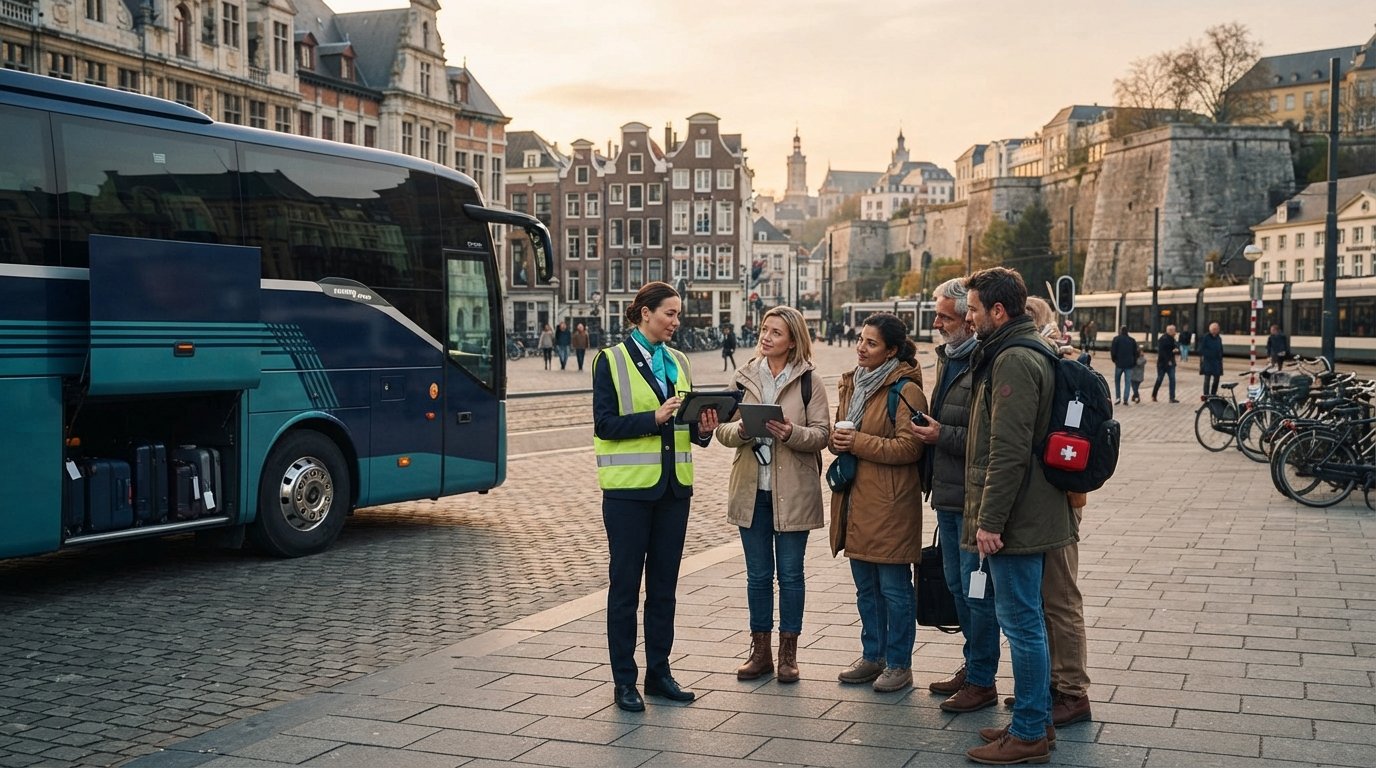
A seamless border crossing often creates the illusion of uniform regulations. In practice, orchestrating smooth group journeys across Belgium, the Netherlands, and Luxembourg demands uncompromising vigilance beneath the surface. Navigating divergent municipal coach perimeters, automated low-emission enforcement, and distinct national emergency networks proves that ensuring tour group safety in Benelux requires proactive operational alignment across transport, accommodation, and ground management.
You already know that safeguarding international travelers while preserving the cadence of an ambitious multi-country itinerary is a demanding craft. You shouldn’t have to compromise between clockwork punctuality and non-negotiable guest protection. In this guide, discover the essential operational protocols, transport standards, and vetting procedures to ensure uncompromising safety for tour groups across the Benelux. We provide an exhaustive operational safety checklist spanning pre-departure fleet verification, cross-border transit compliance, and expert on-site coordination to satisfy the highest European duty of care standards.
Key Takeaways
- Establish proactive duty of care frameworks that seamlessly harmonize divergent municipal access rules and safety regulations across Belgium, the Netherlands, and Luxembourg.
- Maintain uncompromised compliance with European driver rest mandates and smart fleet standards, which remain foundational to ensuring tour group safety in Benelux.
- Implement structured hotel arrival and luggage management protocols to protect group assets against opportunistic urban theft in high-density heritage centers.
- Build resilient on-the-ground communication channels integrated with local emergency networks and national alert systems to resolve unexpected disruptions swiftly.
- Mitigate operational vulnerabilities by partnering with an accredited regional DMC that manages its own dedicated coach fleet rather than relying on multi-tier vehicle brokers.
The Benelux Group Safety Framework: Pre-Tour Risk Assessment Checklist
Flawless group operations depend on structured foresight. While diplomatic advisories provide general regional alerts, professional organizers require an operational risk checklist built around legal liability, logistical synchronization, and group dynamics. Successfully ensuring tour group safety in Benelux starts months before departure, translating European travel regulations into concrete daily procedures. Established through decades of regional integration within the Benelux Union, the absence of physical border posts can obscure the fact that Belgium, the Netherlands, and Luxembourg maintain independent public health mandates, municipal vehicle codes, and crisis protocols.
Preparation demands a rigorous Duty of Care baseline. Operators must audit policy documents to confirm uncapped emergency medical repatriation and group liability coverage that explicitly functions across all three sovereign jurisdictions. Establish clear communication hierarchies linking tour directors, motor coach dispatchers, and executive leadership. Partnering early with an experienced benelux incoming tour operator provides direct access to vetted regional contingency networks, turning complex compliance standards into smooth on-the-road execution.
To better understand regional street dynamics and urban group awareness, watch this helpful video on local safety considerations:
Cross-Border Regulatory Compliance and Documentation
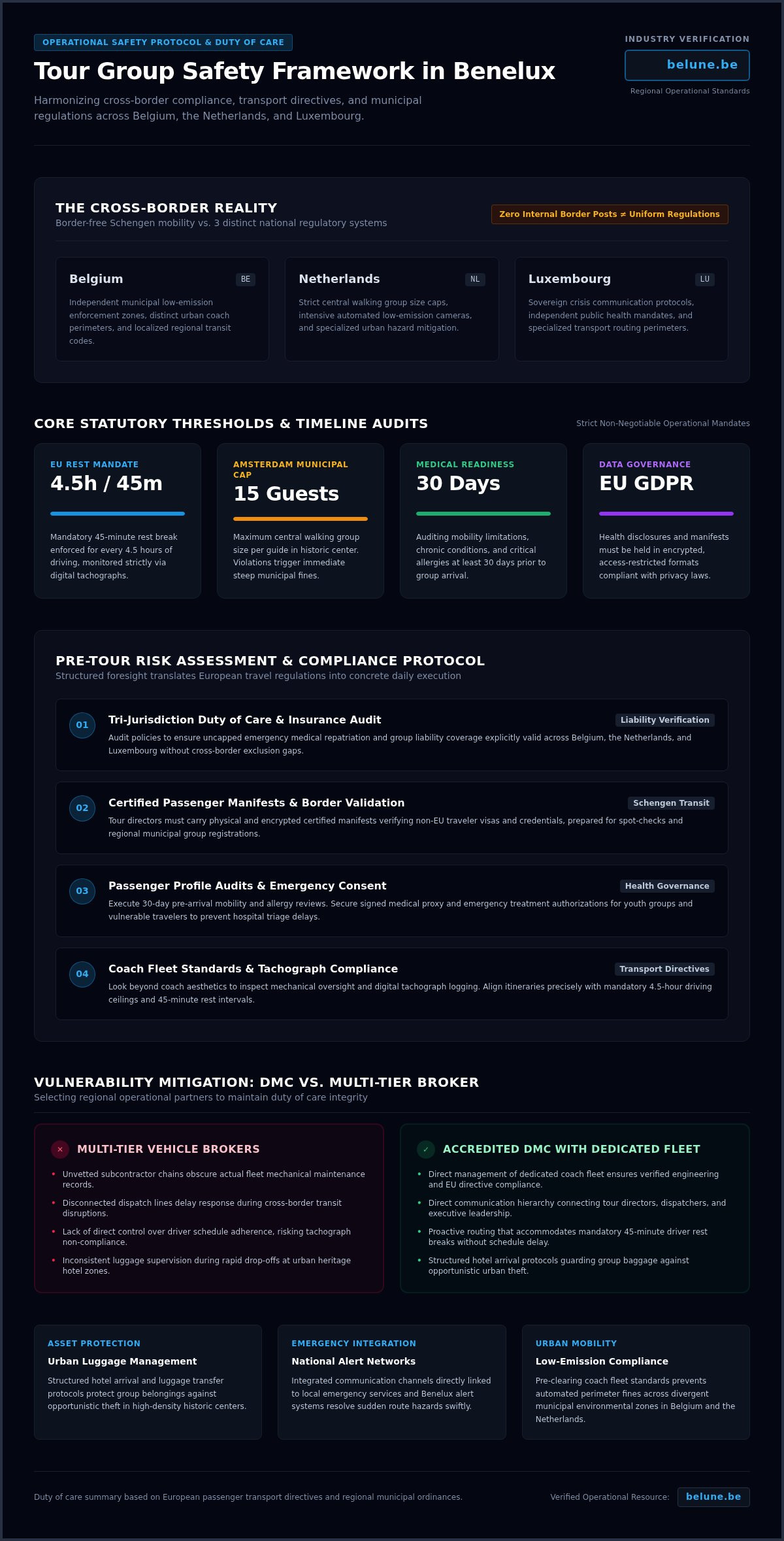
Internal Schengen mobility simplifies transit, yet passport validity and visa requirements remain non-negotiable. Tour leaders must carry certified passenger manifests verifying non-EU guest credentials at every stage. For student groups or corporate delegations, regional administrative registrations may apply. Historic city centers enforce strict municipal group thresholds. Amsterdam, for instance, caps central walking groups at 15 participants per guide. Aligning your group numbers with local ordinances prevents steep fines and preserves your operational timeline.
Passenger Profile Audits and Special Requirements
Vigilance extends to individual passenger welfare. Robust data protocols are vital for ensuring tour group safety in Benelux across varied demographics:
- Medical Readiness: Audit mobility limitations, chronic conditions, and critical allergies at least 30 days prior to arrival.
- Data Governance: Manage all traveler health disclosures under strict European GDPR privacy standards, ensuring digital files are encrypted and access-restricted.
- Legal Authorizations: Secure signed medical proxy and emergency treatment consents for youth groups and vulnerable travelers to avoid delays during hospital triage.
Transportation Safety Protocols: Coach Fleet Standards and EU Directives
Precision on the road defines passenger protection. While generic travel advice centers on individual public transport awareness, managing forty guests across motorways requires rigorous mechanical oversight and statutory compliance. Transportation forms the mechanical backbone of any cross-border circuit. When ensuring tour group safety in Benelux, tour organizers must look beyond vehicle aesthetics and verify the precise engineering and operational standards governing commercial coach transit.
EU Driver Hours and Digital Tachograph Regulations
Legal compliance protects lives and schedules alike. Cross-border passenger transport across Belgium, the Netherlands, and Luxembourg operates under strict EU driving time and rest period regulations. Professional drivers must adhere to mandatory driving limits, including a non-negotiable 45-minute rest break for every 4.5 hours behind the wheel. Drivers must also produce tachograph records covering the current day and the preceding 56 days during roadside audits.
Carefully calibrated itineraries actively prevent driver fatigue. When scheduling extensive cultural excursions or full-day battlefield memorial circuits, build mandatory rest periods directly into museum visits and guided meals. When transfers exceed standard single-driver shift thresholds, dispatching a secondary relay driver guarantees uninterrupted progress without violating European labor laws.
Fleet Maintenance and Technical Onboard Security
Mechanical audits require verifiable paper trails rather than informal assurances. Before any multi-country transfer begins, verified vehicle checks must assess critical onboard safety architecture:
- Restraint and Structural Systems: Confirm functional three-point seat belts at every seat, calibrated electronic stability controls, and unimpeded emergency roof and window exits.
- Advanced Driver Assistance: Deploy vehicles equipped with mandatory General Safety Regulation technologies, including blind spot sensors, lane monitoring, and automated emergency braking.
- Emergency Preparedness: Inspect onboard commercial medical kits, certified multi-class fire extinguishers, and high-visibility road safety markers.
Subcontracting transfers to fragmented third-party booking brokers introduces unpredictable fleet age and maintenance gaps. Partnering with a dedicated specialist offering charter coach hire with a privately owned fleet provides direct control over vehicle servicing schedules, seasoned bilingual drivers, and full digital tachograph tracking, providing peace of mind from departure to arrival. Maintaining complete visibility over vehicle maintenance and driver shifts remains the most reliable strategy for ensuring tour group safety in Benelux.
Accommodation and Public Site Security: Mitigating Crowds and Urban Hazards
Static locations present operational risks just as dynamic transit corridors do. Historic European quarters charm travelers with winding cobblestone lanes and grand civic squares, yet these picturesque environments also concentrate crowd pressure and create vulnerabilities for large parties. Successfully ensuring tour group safety in Benelux demands meticulous site-level auditing, extending protective oversight directly into hotel lobbies, museum foyers, and bustling pedestrian networks.
Hotel Safety Standards and Group Room Allocation
Lobby arrival marks a critical window of vulnerability. When forty weary guests alight simultaneously, opportunistic baggage theft peaks. Tour managers should enforce a “sterile check-in” protocol: luggage remains locked inside coach cargo bays until the group clears reception, or bags are transferred directly into a private, locked holding salon monitored by dedicated staff.
Accommodations must undergo comprehensive safety vetting before bookings are finalized:
- Evacuation Readiness: Verify clear primary and secondary stairwell egress routes, illuminated multilingual signage, and active municipal fire certification.
- Strategic Room Clustered Allocation: Concentrate group rooms across continuous corridors on lower levels. This layout simplifies headcounts, restricts unauthorized corridor access, and expedites swift evacuation during nighttime fire alarms.
- Transit Synchronization: Coordinate check-in timeframes strictly with coach drop-off slots, ensuring logistics align smoothly with regional transport schedules and EU driving time and rest period regulations to avoid curbside congestion.
Crowd Management at High-Density Heritage Sites
Dense heritage spaces demand active spatial management. Drawing from operational methodologies perfected across high-footfall culture group tours benelux, professional tour leaders use precise choreography rather than reactive herding. In crowded plazas like Brussels’ Grand-Place or along Amsterdam’s canal rings, guides maintain steady pacing to keep groups cohesive without obstructing local bicycle paths.
Mitigating urban pickpocketing requires layered structural deterrence. Prior to disembarking, tour leaders brief guests on local diversion tactics, such as staged petitions or artificial street squabbles. Each traveler carries a discreet emergency pocket card with hotel addresses and guide contact numbers. Guides establish distinct secondary muster points outside crowded squares, so anyone briefly separated rejoins the party within minutes. Proactive spatial awareness keeps guests secure, relaxed, and fully immersed in the cultural narrative, achieving total peace of mind while ensuring tour group safety in Benelux.
On-the-Ground Incident Response and Crisis Management Protocols
Operational resilience is tested when the unexpected strikes. Even the most polished itinerary encounters sudden disruptions, from acute illnesses to misplaced passports in bustling train stations. Managing these friction points separates seasoned group organizers from unprepared operators. Swift resolution relies on an established escalation chain connecting field leaders, motor coach drivers, and operations control. When ensuring tour group safety in Benelux, having structured protocols eliminates panic and ensures coordinated action within minutes.
Every field manager must understand regional emergency mechanics. While the universal European number 112 routes calls across Belgium, the Netherlands, and Luxembourg, national infrastructure varies. Belgium maintains 101 as a direct line for police dispatch, while cell-broadcast emergency networks like NL-Alert and LU-Alert broadcast geo-targeted warnings directly to mobile phones. Certified multilingual local guides provide invaluable human support during crises. By communicating fluently in Dutch, French, or German, they eliminate linguistic friction with local paramedics, clinic administrators, and police officers.
Medical Emergency Procedures and Hospital Coordination
Pre-mapping healthcare infrastructure prevents chaotic scrambling during acute medical events. Field staff must carry route-specific directories of university clinics and emergency medical centers across Brussels, Antwerp, Amsterdam, and Luxembourg City. If a passenger requires hospital triage, the local guide stays on-site to assist with translation, intake paperwork, and insurance authorizations. Meanwhile, dispatch maintains direct liaison lines with sending agencies and family contacts, keeping all stakeholders informed without disrupting the broader group schedule. When a recovering traveler needs professional assistance to travel home safely after medical evaluation, resources like rnmedflights.com coordinate airline flight accompaniment to ensure continuous care throughout transit.
Crowded historic districts occasionally separate travelers from their cohort. A structured response protocol preserves group momentum while resolving the issue:
- The 15-Minute Rule: If a traveler misses an appointed muster, the guide conducts a focused perimeter check around designated secondary meeting points before notifying attraction security and local authorities.
- Digital Document Vault: Secure, encrypted cloud copies of passenger passports allow rapid identity verification and expedite consular appointments for emergency travel certificates.
- Real-Time Broadcasts: Mobile messaging groups provide immediate instructions to guests during transit hiccups, keeping travelers informed and preventing independent wandering.
To back your itineraries with certified multilingual guides and seasoned regional support, partner with our experienced ground management team. Ground-level expertise remains the decisive factor in ensuring tour group safety in Benelux when unexpected crises arise.
Partnering for Safety: Selecting an Accredited Benelux DMC
Strategic risk mitigation begins with choosing the right regional partner. While outbound travel organizers can map high-level transit corridors and draft contingency outlines, ground reality requires immediate local command. Entrusting guest security to an unverified third party introduces structural blind spots that no remote dispatch desk can resolve. Reviewing the definitive guide to choosing a group travel agency in 2026 provides a clear procurement roadmap, demonstrating that regional competence is ultimately an exercise in proactive risk management.
Essential Vetting Criteria for Incoming Tour Operators
Auditing prospective Destination Management Companies demands rigorous verification of their operational baseline. When evaluating local partners, prioritize verifiable legal and logistical infrastructure:
- Licensing and Insurance Protections: Request current certificates of comprehensive professional group liability insurance, official corporate registrations, and recognition from national travel trade associations across Belgium, the Netherlands, and Luxembourg.
- Specialized Operational Track Record: Review the DMC’s demonstrated experience orchestrating sensitive programs, such as specialized educational journeys, complex event logistics, or commemorative pilgrimages across flanders fields.
- Contractual Service Level Agreements: Insist on clear clauses establishing guaranteed driver relief timelines, vehicle replacement windows, and transparent supplier vetting criteria.
The Operational Safety Advantage of BELUNE
BELUNE transforms cross-border complexity into effortless travel experiences. Backed by over 20 years of dedicated experience in European group logistics, our team coordinates multi-country itineraries with technical precision and care. Rather than functioning as a digital intermediary, we maintain direct control over key journey components, fundamentally reinforcing our capacity for ensuring tour group safety in Benelux.
Our privately owned modern coach fleet represents a critical safety advantage. Booking through decentralized transport brokers leaves vehicle condition, maintenance records, and driver compliance to chance. BELUNE manages its own vehicles under rigorous European Union technical standards. Every bus receives continuous mechanical monitoring, features advanced driver assistance systems, and is operated by experienced, certified drivers trained in defensive maneuvering.
Complementing our fleet is an established network of audited hotel partners and licensed local multilingual guides. Dedicated project coordinators manage movements proactively, resolving urban restrictions and scheduling nuances before they impact passenger comfort. To safeguard your travelers with proven operational excellence, request your customized Benelux group tour itinerary and build your next journey upon an unyielding foundation of safety.
Mastering Operational Excellence and Traveler Safety in Benelux
Exceptional journeys rest upon quiet, uncompromising preparation. Truly ensuring tour group safety in Benelux requires harmonizing cross-border transit logistics, maintaining rigorous motor coach fleet standards, and deploying proactive crowd and crisis protocols before travelers ever arrive. When you eliminate operational friction behind the scenes, your guests remain free to experience the region’s rich cultural tapestry with complete serenity.
You don’t have to navigate these intricate regulatory landscapes alone. Backed by over 20 years of regional group travel expertise, a privately owned fleet of modern coaches compliant with strict EU safety directives, and an established network of vetted hotels and certified multilingual guides, we transform duty of care into an art form. Partner with BELUNE for secure, expertly managed group itineraries in Benelux and deliver an extraordinary European journey where traveler well-being and elevated hospitality move hand in hand.
Frequently Asked Questions
What is the universal emergency number for tour groups traveling within the Benelux?
112 is the universal emergency telephone number across Belgium, the Netherlands, and Luxembourg. Calling 112 connects group leaders immediately to local emergency dispatchers for medical, fire, or police assistance. In Belgium, travelers can also reach police authorities directly via 101. Operators should remind tour directors to verify that guest mobile devices have active roaming and support regional alert broadcasts like NL-Alert and LU-Alert for real-time safety advisories.
How do European driver hours regulations affect multi-day Benelux tour itineraries?
European driver hours legally mandate maximum driving periods and strict rest intervals, directly governing daily itinerary feasibility. Under EU rules, professional coach drivers must take at least 45 minutes of rest for every 4.5 hours of driving. Tour planners must synchronize transfer legs with extended sightseeing stops or deploy secondary relay drivers for longer routes. Respecting these statutory cycles avoids costly fines and fatigue, which is essential to ensuring tour group safety in Benelux.
What security precautions should tour leaders take against pickpocketing in major Benelux cities?
Tour leaders should provide concise situational briefings and maintain tight group awareness in crowded historic centers. Advise guests on common street distractions, such as staged petitions or aggressive street sellers, before disembarking from the coach. Equip travelers with pocket cards containing hotel details and local guide contacts, mandate secure cross-body bags, and establish clear secondary muster points so separated travelers can reunite with the group without delay.
Are hotels in the Benelux region strictly required to meet European fire safety codes?
Yes, all commercial lodging properties across Belgium, the Netherlands, and Luxembourg must comply with strict municipal and European fire protection standards. These legal frameworks mandate illuminated evacuation signage, automatic smoke detection systems, and unobstructed stairwells. Organizers should still verify safety compliance with properties beforehand, requesting clustered room assignments on lower levels to facilitate swift, orderly group evacuations during nighttime emergency drills.
What role does a Destination Management Company play in managing group emergencies on the ground?
A Destination Management Company serves as the essential operational safety net when unexpected disruptions arise on the ground. An established regional partner coordinates immediately with local authorities, arranges medical translation via licensed local guides, and organizes backup transportation if technical issues occur. Their regional supplier relationships and logistical oversight ensure that minor disruptions don’t compromise passenger security or derail carefully scheduled travel days.
How should group organizers handle passenger medical needs across multiple Benelux borders?
Organizers must collect passenger health histories, mobility constraints, and severe allergy profiles well before departure while verifying comprehensive cross-border medical insurance. Store traveler medical disclosures in encrypted formats compliant with European GDPR standards so tour leaders can access them quickly during emergencies. Having multilingual local guides on hand bridges communication gaps at local clinics, a vital element in ensuring tour group safety in Benelux during unexpected medical consultations.
Why is an owned coach fleet considered safer than brokered charter transportation for group travel?
An owned coach fleet guarantees direct operational control over vehicle condition, maintenance schedules, and driver employment standards. Charter brokers frequently outsource transfers to third-party sub-haulers with variable safety records and inconsistent rest-hour oversight. Operating a private, modern fleet ensures that every motor coach meets rigorous European Union safety criteria, undergoes systematic mechanical inspections, and is operated by dedicated drivers trained in defensive road safety.
Leave a Reply