
What if the best way to earn more five-star reviews isn’t to ask more often, but to make every moment of the tour feel worth remembering? Knowing how to get 5-star reviews for your group tours starts with the experience itself: the thoughtful details guests appreciate, the small issues handled with care, and a final request that feels personal rather than promotional.
Even delighted guests may move on without leaving feedback. And when one part of a carefully planned journey disappoints, it can shape the story they share publicly. That’s why review-building isn’t a last-minute task. It’s part of how a tour is designed, delivered and followed up. For group travel professionals, coordinated logistics and a well-paced itinerary can help create a consistent experience from arrival to farewell.
This guide shows you how to strengthen the moments guests want to recommend, invite honest feedback at a natural time, and build a respectful process your team can repeat. You’ll also learn how to use public reviews and private feedback to refine future tours, giving each group a genuine reason to share its experience.
Key Takeaways
- Learn how to get 5-star reviews for your group tours by focusing on a thoughtful guest experience, not chasing a rating.
- Map key touchpoints across the journey and set clear expectations with accurate pre-tour information.
- Choose feedback methods that suit your purpose: use private responses to spot issues and public reviews to inform future travellers.
- Create a simple post-tour follow-up process that feels personal, timely and easy to respond to.
- See how coordinated itineraries, accommodation, coach transport and local guidance can support a more consistent group-tour experience.
Why 5-Star Reviews for Group Tours Begin with the Guest Experience
A five-star review is a guest’s honest account of a tour they valued, not an outcome an operator can promise or script. The rating is only the surface. A guest may be recalling whether the itinerary matched its description, whether the day felt well paced, how smoothly transitions worked, and how they were treated when plans needed attention. Each detail can shape the overall impression.
That’s why how to get 5-star reviews for your group tours is ultimately a question about the full journey. Clear information before departure helps guests know what to expect. Thoughtful pacing gives them room to engage, while dependable coordination between transport, accommodation and local guidance helps the tour feel coherent rather than fragmented. No single element guarantees praise, but each can contribute to how guests remember the trip.
For another perspective on how interactions shape perceptions, watch this video from Tourpreneur:
The customer experience spans a person’s responses across interactions with a service. For a group tour, that can include booking information, the first welcome, travel time, the main activity and the final exchange. A review may focus on one standout moment, but its credibility comes from the guest’s account of the experience as a whole.
What makes a group-tour review feel trustworthy?
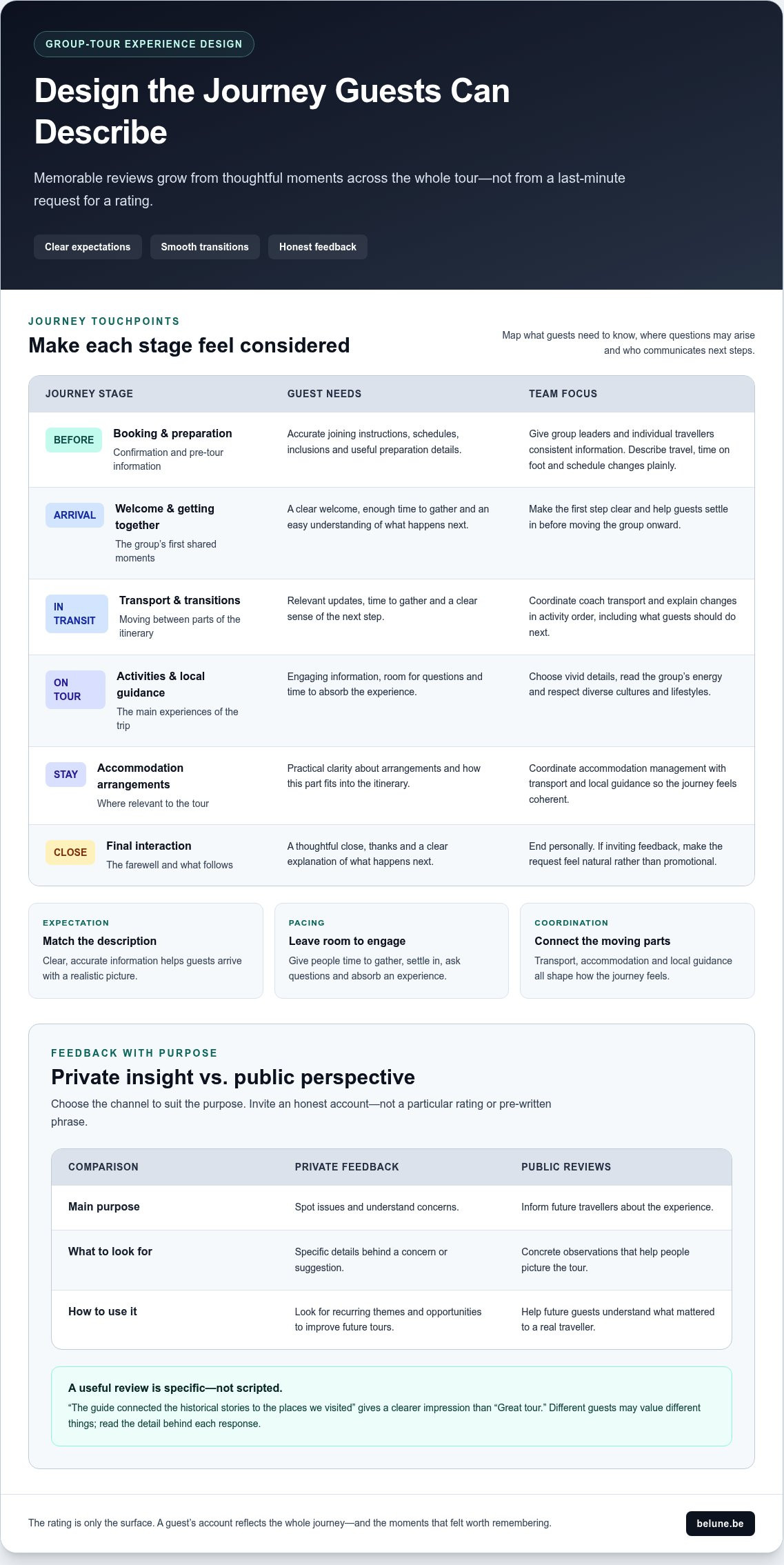
Specific details help future travellers picture the tour. “The guide connected the historical stories to the places we visited” gives a clearer impression than “Great tour.” Generic praise can sound interchangeable; concrete observations show what mattered to that guest. Invite guests to share their own perspective, not to use suggested phrases or give a particular rating. Honest feedback is more useful, even when it includes a concern.
Why one group experience can produce different reviews
A shared itinerary doesn’t create identical experiences. One traveller may be drawn to cultural context, while another values unhurried time or practical comfort. Expectations and accessibility needs can differ, too. A group leader may comment on coordination and communication, while individual guests describe the guide, pace or moments that felt meaningful. A mixed review doesn’t automatically mean the tour failed. Look for the specific detail behind each response.
Review quality comes from genuine, useful accounts, not simply a larger number of ratings. Read comments for recurring themes, then distinguish a one-off preference from an issue that may affect other guests. This gives feedback a practical role: not just public reassurance, but insight into how the next group’s experience can be improved.
Design Group-Tour Moments Guests Will Want to Remember
Memorable tours rarely depend on one grand gesture. They take shape through a sequence of considered moments: clear information before departure, an easy welcome, smooth transitions, time to absorb an experience and a thoughtful close. Map these touchpoints to spot where small uncertainties can interrupt the journey, without assuming every moment will go exactly to plan.
Start with a simple journey map. For each stage, note what guests need to know, where questions may arise and who is responsible for communicating. Include booking confirmation, pre-tour preparation, arrival, transport, activities, accommodation arrangements where relevant, and the final interaction. This makes the experience easier to review and improve as a whole.
Set expectations before the group arrives
Pre-tour information should make practical decisions straightforward. Share accurate joining instructions, schedules, what’s included, and useful preparation details such as what to bring or expect during the day. Give group leaders and individual travellers consistent information, so no one has to rely on second-hand details. Clear expectations can prevent avoidable disappointment when the delivered experience differs from an assumption.
Be precise about the rhythm as well as the itinerary. If a day includes travel between activities or time on foot, say so plainly. If a schedule may change, describe it as an estimate rather than a certainty. The aim isn’t to over-explain; it’s to help guests arrive with a realistic picture and focus on the experience.
Create a considered experience while the tour is underway
Once the group is together, pacing and transitions become part of the hospitality. Allow enough time for people to gather, understand the next step and settle in. A guide can keep information engaging by choosing a few vivid details, pausing for questions and reading the group’s energy instead of filling every quiet moment with commentary. For example, story-driven operators such as sistersgrimmghosttour.com show how blending local history with captivating narration can keep guests thoroughly engaged and leave a memorable impression.
Communication matters most when plans change. If the order of activities shifts, explain what’s happening and what guests should do next. Clear updates help people feel considered, even when an adjustment is needed. The Global Code of Ethics for Tourism also underscores respect for diverse cultures and lifestyles, a useful principle when shaping interpretation and interactions for a varied group.
- Before departure: align the schedule, inclusions and practical guidance.
- During transitions: make the next step clear and share relevant updates.
- At the close: thank guests and explain what happens next.
Dependable coordination ties these moments together. Coach transport, accommodation management and local guidance each influence how naturally a group moves through its itinerary. BELUNE brings these elements together in customized group itineraries. Travel professionals planning a connected journey can explore BELUNE’s group travel planning.
Every touchpoint contributes to the overall guest impression, from the first practical detail to the final farewell. Review the sequence to see where expectations and delivery align, and where clearer communication or a more thoughtful transition could make the next tour feel more seamless.
Choose Review and Feedback Methods That Feel Natural
A review request can feel awkward if it sounds like a sales pitch or puts a guest on the spot. Keep the process simple: choose a method that fits what you want to learn, explain why you’re asking, and make participation optional. The aim isn’t to steer anyone toward a particular rating. It’s to make it easy for guests to share an honest perspective in the right place.
Each channel serves a different purpose:
- Private surveys help identify what worked and where the experience could improve. Focused questions about communication, pacing or coordination can reveal useful detail.
- Direct conversations offer a personal, low-effort way to hear immediate impressions. They can add context, but shouldn’t be treated as a public endorsement.
- Public review platforms let travellers share their experience with people considering a tour. A voluntary, honest account can help prospective guests understand what to expect.
When should operators use a survey instead of a public review request?
Use a private survey when you need specific feedback, such as whether the schedule felt manageable or pre-tour information was clear. Keep it focused so guests can respond without completing a long questionnaire. A public review request has a different purpose: inviting a guest to tell future travellers about their experience. A survey can inform improvements, but it isn’t a substitute for a voluntary public review.
How can operators ask without influencing the rating?
Use neutral language and make clear that a response is optional. For example: “We’d value your honest feedback. If you’d like to share your experience with future travellers, you can leave a review here.” Avoid asking for five stars, suggesting specific wording or implying that positive feedback is expected. A respectful invitation gives guests room to describe the tour in their own words.
Some guests prefer to speak directly with a guide; others would rather respond privately later or post publicly. Offer the relevant route without pressing for an answer, and don’t treat a friendly comment during the tour as permission to publish or quote it. Listen to concerns with care, and let each guest decide whether they want to leave a public review.
Before introducing rewards, discounts or other incentives, read the current rules of the review platform you plan to use. Policies may differ and change. Check them before making an offer, and never make a reward conditional on a positive rating. Also avoid review filters that direct only satisfied guests to public platforms while diverting unhappy guests elsewhere. Invite honest feedback from guests broadly, then use private channels to understand concerns and public reviews to inform future travellers.
A natural request is brief, timely and pressure-free. For operators considering how to get 5-star reviews for your group tours, the key is to invite honest accounts consistently, not control what guests say. Choose one clear public-review route and a separate way to gather detailed private feedback, so each response serves its proper purpose.
Build a Repeatable Post-Tour Review Process
Consistent follow-up makes it easier for guests to share feedback without making a review feel like an obligation. Set a simple routine your team can use after each departure, then refine it based on what guests respond to. The process should support both public reviews and private learning, while leaving every guest in control of whether they take part.
Use this sequence as a practical starting point:
- Identify the right contact. Confirm who coordinates communication for the group, and whether individual travellers can be contacted directly through an appropriate channel.
- Choose one follow-up route. Select a suitable channel, such as a post-tour email, and keep the message brief. Avoid sending the same request through several channels.
- Allow time to reflect. Follow up after guests have had some space from the tour, so they can consider the experience without feeling rushed.
- Invite, don’t insist. Thank guests for joining and invite them to share an honest review if they wish. Make participation clearly voluntary.
- Review and learn. Read public reviews and private feedback for useful specifics, then look for themes that can guide practical improvements.
Who should receive the review invitation, and when?
Coordinate with the group leader so the request reaches the right audience, but don’t assume one person’s response represents everyone. If individual travellers can be contacted appropriately, let them decide whether to respond for themselves. Send one concise invitation after the tour, once guests have had time to reflect. Repeated reminders can make an optional request feel compulsory, so let a single clear message stand.
How should tour operators respond to praise and criticism?
Respond with a personal, concise thank-you that acknowledges the reviewer’s actual comment. If someone praises the guide’s storytelling or how smoothly a transfer went, refer to that detail rather than relying on a stock reply. For criticism, stay calm, recognise the concern and avoid disclosing private guest information. A public response should show attentiveness without turning into an argument or exposing details about the person’s arrangements.
Close the loop internally, too. Record recurring themes in a straightforward format, such as communication, pacing, transport coordination or accommodation arrangements. Note whether feedback points to a one-off issue or something appearing across several tours, then assign a practical next step to the relevant team. For example, recurring confusion about a meeting point may call for clearer joining instructions; comments about rushed transitions may prompt a review of the itinerary’s timing. Track whether the change addresses the concern on later departures.
A sustainable review process is consistent in its invitations, voluntary for guests and responsive to what they share. That balance is central to how to get 5-star reviews for your group tours: not manufacturing praise, but building a thoughtful habit of listening and acting. BELUNE supports travel professionals with coordinated itineraries and logistics. Learn more about planning a group tour with BELUNE.
How BELUNE’s Group-Travel Expertise Supports Lasting Guest Impressions
A review reflects what guests experienced, not simply the places they visited. For travel professionals, a carefully chosen itinerary matters, but so does the way its elements connect: the time between activities, the move from coach to accommodation, and the local context offered along the way. A destination management company can help bring these pieces into a coherent group journey through thoughtful planning and coordination.
BELUNE has more than 20 years of experience in transport and tour operations, supporting customized group travel through itinerary planning, accommodation management, coach transport using its own fleet, and local guide services. That experience supports considered delivery, but does not promise a particular rating or review. Guests retain their own perspective, and their feedback remains theirs to share.
Why coordinated logistics matter to the guest experience
Each part of a tour affects the next. An itinerary shapes how the group moves through the day; transport connects its planned moments; accommodation arrangements contribute to the journey’s rhythm; and local guidance gives activities context. Considering these elements together helps travel professionals identify handoffs that might otherwise feel disjointed, clarify responsibilities and reduce avoidable friction for guests.
For example, if a schedule includes a transition between a guided visit and onward coach travel, the plan should account for how guests will know where to go next and how that movement fits the day. These practical details may be quiet, but they influence whether the experience feels composed. Coordination creates continuity; it doesn’t remove every uncertainty or guarantee that every guest will respond in the same way.
As a specialist destination management company, BELUNE works with travel professionals to organize group travel across these connected elements. Its role is to support the design and delivery of the journey, while each review remains an honest reflection from a guest.
Turn review insights into a stronger next tour
Feedback becomes most useful when it informs the next planning conversation. Bring recurring guest comments to the itinerary review, then consider what they reveal about the group’s interests and practical requirements. If travellers repeatedly value time for independent exploration, that preference might shape the balance of a future schedule. If feedback points to confusion around transitions, revisit how those moments are arranged and explained.
Customization gives travel professionals room to respond thoughtfully rather than apply the same template to every group. Interests, pace and logistical needs can guide choices across itinerary design, accommodation management, coach transport and local guidance. For example, specialized operators such as winetoursofsedona.com demonstrate how designing fully customized itineraries around specific group interests helps deliver a more personal and memorable experience. Base changes on a real pattern or a clearly understood need, not a single rating viewed in isolation. This turns reviews into one source of insight for continual refinement.
Learning how to get 5-star reviews for your group tours means building an experience guests can assess honestly, then listening carefully to what they say. BELUNE brings more than 20 years of group-travel experience to that work. To explore a customized itinerary shaped around your group’s priorities, discuss a tailored group tour with BELUNE.
Shape the Next Journey with Guest Insight
Let each tour leave more than a memory. It can also offer a useful perspective for shaping what comes next. As you plan future group journeys, consider how guest feedback might inform the experience, from the balance of the itinerary to the practical details that help each stage feel connected. The aim isn’t to engineer a rating; it’s to create a thoughtful experience and invite guests to describe it honestly.
For travel professionals considering how to get 5-star reviews for your group tours, BELUNE brings more than 20 years of experience in transport and tour operations to customized itineraries, accommodation management, coach transport with its own fleet, and local guide services. These elements can be coordinated around each group’s needs and interests, supporting considered tour planning without promising a particular review outcome.
Bring your priorities and guest insights into a new group-tour plan. Discuss a tailored group tour with BELUNE, and shape a journey designed with care from its first details to its final moments.
Frequently Asked Questions
Should I ask every guest on a group tour for a review?
You can invite all guests to leave feedback, provided the invitation is appropriate and equally voluntary. This gives individual travellers the chance to describe their own experience rather than relying only on the group leader’s account. Use a suitable communication channel and avoid repeatedly approaching guests who don’t respond. If you can only reach the group leader, ask them to share the invitation rather than speak on everyone’s behalf.
When is the best time to ask guests to review a group tour?
Ask after the tour, when guests have had a little time to reflect and are no longer managing the practicalities of departure. The right point can vary: a one-day activity and a multi-day itinerary leave different opportunities for follow-up. Make the invitation easy to act on later, such as in a concise message with a direct route to the review page, and avoid interrupting guests during a meaningful moment.
Can tour operators offer incentives for five-star reviews?
Only consider an incentive after checking the current rules of the specific review platform, and never make it conditional on a five-star rating or positive wording. A safer approach is to invite an honest review without offering a reward. If a platform permits an incentive, follow its disclosure requirements and apply the terms fairly. Policies can change, so review them before launching any incentive-based request.
What should I do if a group-tour guest leaves a negative review?
Respond calmly and address the issue the guest actually described. Thank them for explaining their perspective, acknowledge the concern without becoming defensive, and state what you’ll do to review it. Don’t share booking details or personal information in a public reply. Internally, check relevant records and speak with the responsible team so your response is informed and any appropriate follow-up happens privately.
Can I ask guests to leave a five-star review?
No. Ask guests for an honest review, not a particular rating or prewritten praise. A request for five stars can pressure people and make their feedback less trustworthy to future travellers. Keep the invitation neutral, such as, “If you’d like, share your honest experience with other travellers.” Guests should be free to decide whether to post and what to say, including criticism.
Should the group leader or individual travellers leave the review?
Either can share feedback, but their perspectives may cover different parts of the trip. A group leader might comment on coordination and communication with the operator, while a traveller may focus on a particular activity or guide. Invite the leader to describe their own experience, and allow individual guests to contribute separately if they wish. Don’t ask one person to submit a review as though it represents the entire group.
How can a tour operator encourage reviews from international guests?
Make the request easy to understand across language backgrounds. Use short, plain sentences, explain that feedback is optional, and avoid idioms or culturally specific expressions that may not translate clearly. If you share translated instructions, make sure they accurately reflect the original message. Point guests to a review platform they can access, and don’t assume every traveller prefers the same language or communication channel.
Leave a Reply