A Benelux tour doesn’t become compelling simply by crossing three borders. American clients need a clear reason to choose the journey and confidence that each transition will feel effortless. Knowing how to sell benelux tours to american clients starts with turning Belgium, the Netherlands, and Luxembourg into one memorable travel story, not a list of stops.
The challenge is to choose experiences that resonate, make the itinerary easy to picture, and ensure the practical details support the promise. Art and culture, gastronomy, history, and active experiences can each add depth when shaped around a strong theme and paced with care.
This guide explains how to position Benelux group tours for American travelers, structure an itinerary whose value is easy to communicate, and coordinate the services that support the sales message. We’ll look at accommodation, coach transport, local guides, and connected experiences. BELUNE works with tour operators and travel agents to bring customized programs to life through coordinated local operations, drawing on more than 20 years of experience in group travel.
Key Takeaways
- Present Belgium, the Netherlands, and Luxembourg as one connected journey, with any extension chosen for a clear reason.
- To understand how to sell benelux tours to american clients, start with the audience, build around a strong theme, then define the trip scope and inclusions.
- Compare culture-led, culinary, battlefield, and active tour concepts by audience fit, itinerary coherence, and operational complexity.
- Build trust with a polished itinerary overview, a sample day, clear inclusions, and timely pre-departure communication.
- Support the customer-facing promise with coordinated itinerary planning, accommodation management, coach transport, and local guides.
Why Benelux tours can stand out to American clients
For a U.S. tour operator, the first challenge is turning the unfamiliar regional name “Benelux” into a trip clients can picture and explain to someone else. Belgium, the Netherlands, and Luxembourg can form a natural, connected journey when the itinerary has a clear theme and a sensible pace. An extension beyond Benelux can broaden the story when it fits the group’s interests and schedule, rather than simply adding another destination.
The journey can balance historic places and art with food and beer traditions, landscapes explored at a gentler pace, or experiences that bring history into focus. The Benelux Union overview provides background on the region. For selling, the key is translating that regional context into experiences that matter to a specific group.
A Benelux group tour is a guided journey through neighboring countries, designed for travelers who want varied cultural experiences without managing every transition themselves.
Which American traveler segments might respond to Benelux?
Think in audience profiles, not assumptions about American travelers as a whole. Escorted group travelers may value several complementary experiences in one organized journey. Affinity groups can give the itinerary a sharper focus: art-focused travelers might prioritize collections and architecture, while history groups may want interpretation of significant events and sites.
Food and beer enthusiasts, as well as groups drawn to cycling or other active experiences, offer different starting points. Define the group’s shared interest first, then decide how much variety to include around that central theme. This makes it easier to explain who the trip is for without suggesting that one itinerary suits everyone.
How to make the regional story easy to picture
Lead with an idea, not a roll call of countries and landmarks. “Art, architecture, and everyday life across three neighboring countries” gives travelers a lens through which to understand the trip. A simple route overview can then show the sequence through Belgium, the Netherlands, and Luxembourg. Consider an extension beyond Benelux only when it supports the theme and fits the travel time.
Balance atmosphere with practical clarity. Pair an evocative description, such as exploring art and food traditions with local guides, with information about how the group moves between stops and where overnight stays fit. Travelers can then imagine the experience, while tour sellers have a clear framework for explaining the itinerary.
That clarity is central to how to sell benelux tours to american clients: present the region as a coherent answer to a particular group’s interests, not as a checklist of destinations. The strongest concept makes its audience, central theme, and journey easy to grasp at a glance.
How to shape a Benelux tour into a clear, sellable offer
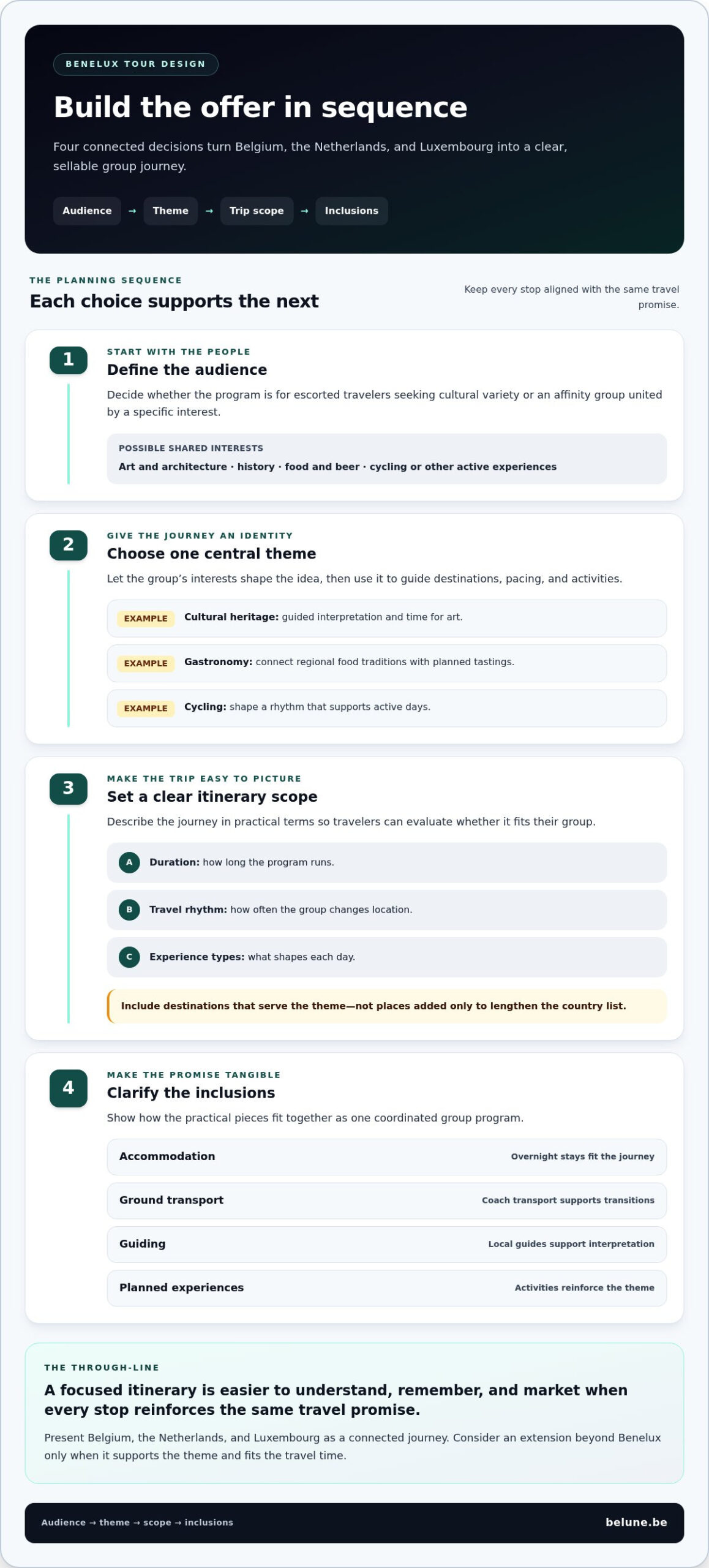
A strong tour concept is more than a route. It gives travelers a reason to choose the journey and gives your sales team a concise way to explain what makes it distinct. Build the offer in sequence so each decision supports the next.
- 1. Define the audience. Decide whether the program is for escorted travelers seeking cultural variety or an affinity group united by a specific interest.
- 2. Choose the theme. Let the audience’s interests shape the central idea, such as battlefield history, cultural heritage, gastronomy, or cycling.
- 3. Set the trip scope. Establish the duration, travel rhythm, and main experience types. Include destinations that serve the theme, not places added only to lengthen the country list.
- 4. Shape the inclusions. Explain how accommodation, ground transport, guiding, and planned experiences are coordinated as part of the group program.
A focused itinerary is easier to understand, remember, and market because every stop reinforces the same travel promise. It also gives clients a clearer basis for deciding whether the program fits their group.
Choose one theme that gives the tour its identity
A theme is a practical design tool, not just a label. A cultural heritage journey might prioritize guided interpretation and time for art. A cycling program needs a rhythm that supports active days. A gastronomy-led tour can connect regional food traditions with planned tastings. If food is the central thread, BELUNE’s Belgium gastronomy tours offer a related example. Let the theme guide destination choices, pacing, and activities from the first planning decision.
Set an itinerary scope clients can readily evaluate
Describe the journey in terms a traveler can picture: how long it runs, how often the group changes location, and what kinds of experiences shape each day. Avoid unsupported promises or overly precise operational details. Instead, show how accommodation, coach transport, local guiding, and planned activities fit together as one coordinated group program. For a broader explanation of the local operating role, the Benelux incoming tour operator guide offers useful DMC context.
Then present the concept in a compact overview: audience, theme, route, travel rhythm, and inclusions. A history-focused program, for example, can explain how guided interpretation and related cultural experiences support its central subject, without crowding the itinerary with unrelated stops. This makes how to sell benelux tours to american clients less about presenting a list of options and more about communicating a well-shaped experience.
For tour operators and travel agents developing a regional group program, BELUNE’s customized itinerary planning can help translate an audience and theme into a coordinated journey.
How to position Benelux tour options against other European trips
Positioning works best when you compare the experience a group wants, not simply the number of countries on the itinerary. Present a Benelux program through its thematic focus and the way its destinations connect. Use the same four criteria for each concept: audience fit, strength of the theme, itinerary coherence, and the coordination needed to deliver it.
| Tour concept | Audience fit | Thematic strength | Planning consideration |
|---|---|---|---|
| Culture-led | Travelers interested in museums, architecture, and local interpretation | Connects cultural visits through a shared heritage story | Balance guided visits with time to experience each place |
| Culinary | Groups drawn to regional food traditions and tastings | Uses gastronomy to reveal local character | Coordinate planned food experiences with the route and schedule |
| Battlefield | History-focused groups seeking context and memorial visits | Gives the journey a clear historical focus | Allow room for thoughtful interpretation, not just site stops |
| Active | Groups interested in cycling and experiencing landscapes at a more active pace | Links movement through the region with outdoor discovery | Shape daily activity and transport around the group’s chosen rhythm |
Which tour concept fits each audience?
Start with the group’s central interest, then test whether the route and planned experiences strengthen it. Cultural heritage suits travelers who want museums, architecture, and local context. Gastronomy tours give food-focused groups a way to explore regional traditions through tastings. Battlefield tourism serves history groups seeking guided context and memorial visits. Active programs, including cycling, offer another clear lens. Ideas in this themed group travel guide can help broaden the concept without diluting its identity.
Operational complexity is a planning consideration, not a judgment of quality. Map how accommodation, coach transport, guides, and activities must align, then ask whether each element adds meaning for the group. A focused route through Belgium, the Netherlands, and Luxembourg can keep the narrative tight. An extension beyond Benelux changes the route and program scope, so include one when it deepens the travel story, not simply to add another destination.
How to explain the value without relying on discounts
Make value tangible through the experience and the coordination behind it. Describe what travelers will encounter, what the group program includes, and how local guides, accommodation, transport, and activities fit together. A concise itinerary summary lets clients assess the offer without guessing what the journey involves.
That’s a practical way to approach how to sell benelux tours to american clients: differentiate the trip through a distinctive theme, coherent routing, and clear inclusions rather than an unsupported claim of better value. The result is an offer that’s easier for a group leader to present and for travelers to evaluate.
How to build a sales process American clients can trust
Trust grows through a sequence of clear decisions, not a single polished brochure. Guide prospective clients from initial interest to itinerary review, booking decision, and pre-departure communication. At each step, answer the questions they’re likely to have: Is this trip for me? What will the journey feel like? What does the group program coordinate? What happens next?
Keep the sales materials consistent from the first overview to the final itinerary. Use a concise description of the audience and theme, a route summary that explains why the stops belong together, and a sample day that gives the experience a human scale. An illustrative day might combine a guided cultural visit, time for a planned meal or tasting, and another experience connected to the tour’s theme. Label examples clearly so travelers can picture the rhythm without mistaking a sample for a guaranteed schedule.
What information should the sales materials make clear?
State who the tour is designed for, what holds it together, and how the route supports that idea. Then explain the group program in plain language: accommodation management, ground transport, local guiding, and planned experiences. A readable itinerary outline, concise descriptions, and helpful visuals make the offer easier to assess. Distinguish confirmed inclusions from general destination inspiration, and give interested clients a clear next step, such as reviewing the itinerary or discussing the program with their tour operator.
Keep the sales journey easy to follow. After initial interest, share the overview and itinerary for review. Make the booking decision stage clear, then provide pre-departure communication that reiterates the travel plan and coordinated elements. A reliable handoff between seller and local operator helps keep those details aligned.
- Audience and theme: Who the group is for and what defines the journey.
- Route and rhythm: The sequence of stops and the intended balance of travel and experiences.
- Program inclusions: The accommodation, coach transport, guiding, and activities coordinated for the group.
- Next step and handoff: What the client should review or decide, and which program details need to carry forward to local operations.
How does local operating support strengthen the promise?
A compelling itinerary depends on practical delivery. BELUNE coordinates accommodation management, coach hire through its own fleet, and local guide services as part of customized group programs. Connecting these elements helps turn a seller’s theme into a workable ground plan. Transport, stays, and local interpretation then support the experience described in the sales materials.
That operational clarity is central to how to sell benelux tours to american clients: the promise feels dependable when the seller can explain both what travelers will experience and how the group program is coordinated. BELUNE works with tour operators and travel agents to shape tailored itineraries, drawing on more than 20 years of experience in transport and tour operations. Explore BELUNE’s group-travel support to see how local coordination can support your sales promise.
How BELUNE helps turn a Benelux sales concept into a delivered group tour
A tour operator may have a clear audience and a compelling theme, but turning those ideas into a group program calls for local planning. BELUNE works with tour operators and travel agents to shape customized itineraries, then support delivery through accommodation management, coach hire, and local guide services. This connects the promise presented to travelers with the practical elements that bring the journey to life.
What a DMC partnership can bring to the sales offer
Local planning gives the concept operational shape. BELUNE’s own coach fleet supports group transport planning, while accommodation management and local guides help connect overnight stays, movement, and interpretation in a considered itinerary. The seller’s chosen theme can inform the route and experiences, whether the group is drawn to culture, gastronomy, battlefield history, or active travel. BELUNE brings more than 20 years of experience in transport and tour operations to the planning process.
This partnership is business-to-business: BELUNE supports travel trade professionals developing group programs, rather than individual B2C travel bookings. The seller brings knowledge of its audience and the sales promise; the local operating partner helps translate that promise into a tailored program with coordinated ground services.
How to move from a concept to a partner conversation
A conversation is more productive when the seller can describe the intended group experience and its practical boundaries. A finished itinerary isn’t necessary at the outset. Bring the essentials, then use them to shape a workable planning brief together.
- Target audience: Describe the group’s shared interests and travel style.
- Preferred theme: Identify the idea that should guide the experience, from cultural heritage to cycling.
- Travel window: Share the anticipated travel period so planning can be framed around it.
- Broad itinerary ambitions: Outline the countries or experience types under consideration, and whether the concept might extend beyond Benelux.
- Ground support: Note where accommodation management, coach transport, local guides, and itinerary planning fit the seller’s needs.
This brief gives the conversation a useful starting point: the audience sets the perspective, the theme guides choices, and the operational needs show how the concept must work on the ground. BELUNE can develop a customized group itinerary with the seller, connecting the intended experience to coordinated transport, stays, and local guidance.
For sellers considering how to sell benelux tours to american clients, a dependable local operating relationship can make the customer-facing promise more credible. Bring your audience, theme, travel window, and broad route ambitions into the next planning step. Develop a Benelux tour with BELUNE.
Give your Benelux tour concept its next shape
A promising group-tour idea often begins with a simple question: what should travelers remember most when they return home? Use the answer as a creative compass. It can help refine the audience, choose the defining experience, and keep planning decisions aligned with the feeling you want the journey to leave behind.
That’s a useful starting point for how to sell benelux tours to american clients. You don’t need every itinerary detail settled before bringing the core concept into focus: who the trip serves, what makes it distinctive, and what kind of experience you want to create. From there, a conversation with a local operating partner can help turn the idea into a practical direction for development.
To take the next step, start shaping your Benelux group-tour concept with BELUNE. A thoughtful concept can become the beginning of a journey that feels clear to sell and rewarding to experience.
Frequently Asked Questions
How do I market a Benelux tour to American travelers?
Market the trip around a specific traveler interest and make the experience easy to imagine. Use a clear title, a short description of the journey’s central idea, and sample moments that help readers picture the days. For example, a culture-focused program can foreground guided interpretation and time to explore, rather than leading with a string of unfamiliar place names. Keep the route and inclusions easy to find in your sales materials.
What makes Benelux a good destination for a group tour?
Benelux can suit groups that value a connected journey with several cultural perspectives. Coordinated transport and group accommodation management help organize travel between countries, while local guides bring context to the experiences. This structure can help tour leaders manage varied interests: the group follows a shared itinerary, while its theme gives each stop a reason to belong. Choose a pace and program that fit the group.
Which Benelux tour themes may appeal to American clients?
Possible themes include art and culture, gastronomy and beer, battlefield history, and cycling. Refine the offer by choosing one as the main focus and using another as a complementary experience. A cultural itinerary might include a regional food experience, while a cycling program could add guided heritage interpretation. The secondary element should enrich the trip without making its purpose difficult to explain.
Should a Benelux tour include an extension beyond the region?
Include an extension when it serves the group’s interests and strengthens the overall itinerary, not simply because travelers recognize the destination. Consider whether it leaves enough room for the Benelux experiences that define the program and whether the added travel fits the intended pace. For a group focused on a regional theme, a tighter Benelux route may be more coherent. A broader Europe concept may benefit from an additional chapter.
How can a U.S. tour operator work with a Benelux DMC?
A U.S. tour operator can work with a DMC by sharing its audience, theme, travel window, and broad route ideas, then collaborating on the local program. BELUNE works with tour operators and travel agents on customized group itineraries and ground logistics, including accommodation management, coach transport, and local guides. The operator develops the customer-facing offer; the DMC helps shape its local delivery. BELUNE serves travel trade partners, not individual B2C bookings.
What should a Benelux group tour itinerary include?
A useful itinerary makes the sequence and daily rhythm understandable, rather than just naming places. Include planned experiences, how the group moves between them, where accommodation fits, and which guiding or activities are part of the program. A sample day can clarify the balance between organized visits and time between them. Identify transitions and optional extensions plainly so group leaders can present the plan accurately to prospective travelers.
Leave a Reply