Blog

  • Curated Belgian Beguinages Tour: A Group Heritage Experience for 2026

    Curated Belgian Beguinages Tour: A Group Heritage Experience for 2026

    A beguinage is far more than a collection of historic bricks; it represents a preserved silence and an architectural testament to a unique social autonomy that has survived centuries. You likely understand that organizing a high-quality Belgian beguinages tour requires more than just a map and a schedule. It demands an appreciation for the delicate balance between public heritage and private residence, where the atmosphere of the space is as vital as the history itself.

    Coordinating group transport through narrow cobblestone streets and securing refined, group-friendly accommodation near these UNESCO-listed sites is often a logistical puzzle that overshadows the beauty of the destination. We promise a sophisticated, turnkey itinerary for 2026 that removes every point of friction. By integrating our own modern coach fleet with expert local guidance, we ensure your group experiences the architectural serenity of these enclaves without the stress of management.

    This article previews a masterfully coordinated journey through Belgium’s most iconic beguinages, from the academic atmosphere of Leuven to the nineteenth-century grandeur of Ghent. You’ll discover how a visionary approach to heritage travel turns a simple visit into a profound cultural immersion that respects the past while providing modern comfort and seamless execution.

    Key Takeaways

    • Uncover the historical significance of the Beguines, whose independent communities shaped a unique urban phenomenon of sanctuary and autonomy.
    • Understand the architectural poetics of the Flemish “Hof,” where minimalist design and courtyard structures create a profound atmosphere of silence.
    • Solve the logistical complexities of a belgian beguinages tour by utilizing a private coach fleet designed for navigating historic European city centers.
    • Design a multi-layered itinerary for 2026 that balances UNESCO-listed heritage with local gastronomy and artistic depth.
    • Align with an expert DMC to transform technical logistics into an elevated, emotional journey for sophisticated group travelers.

    Understanding the Belgian Beguinages: A Legacy of Sanctuary

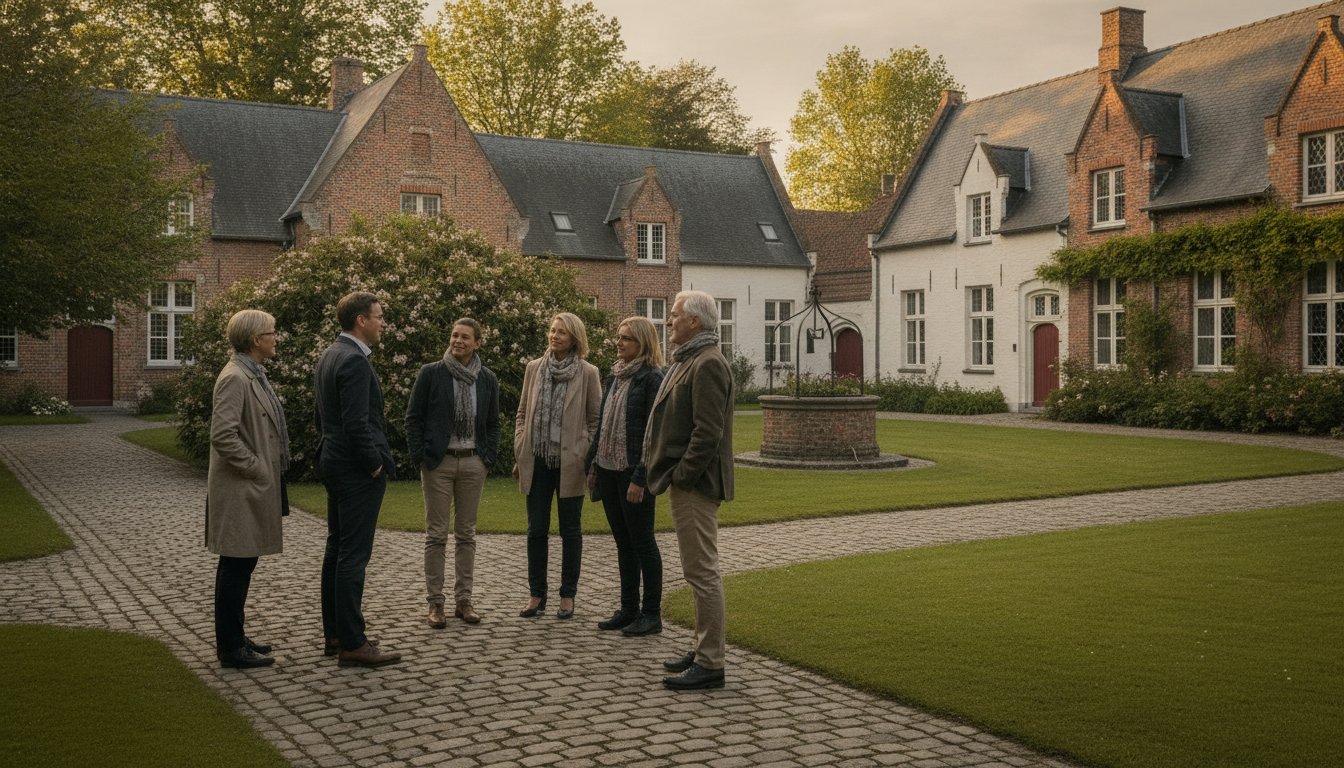
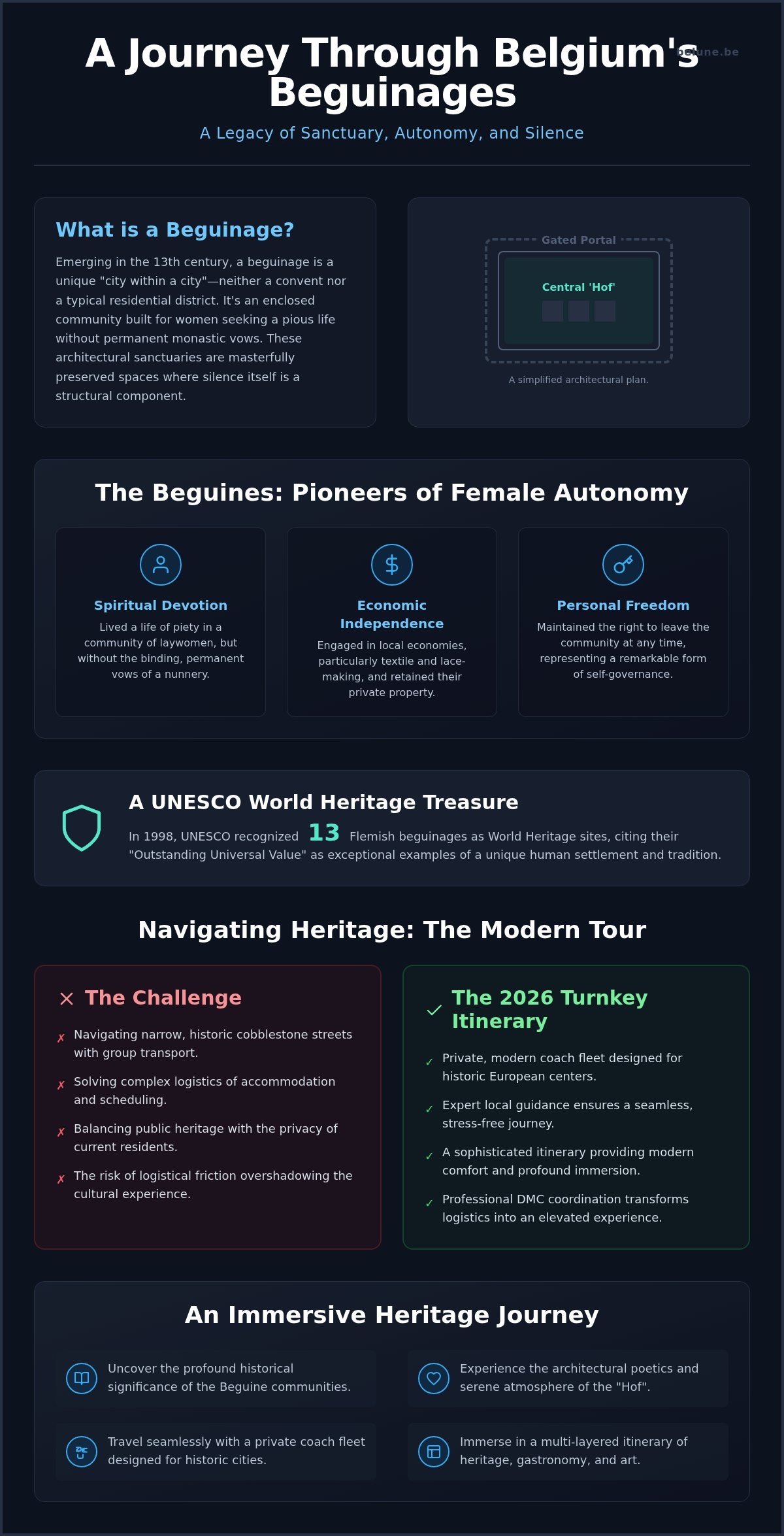
    Enclosed by walls and often separated by water, the Belgian beguinage is a distinctive urban phenomenon that defies simple categorization. It’s neither a convent nor a standard residential district. These “cities within cities” emerged in the 13th century as a response to the spiritual and social needs of women who sought a life of piety without the restrictive permanence of monastic vows. Today, a belgian beguinages tour offers more than a history lesson; it provides an immersion into a masterfully preserved architectural volume where silence is a structural component.

    The Spiritual and Social Autonomy of the Beguines

    The Beguines were essentially laywomen who lived in community but retained their private property and the right to leave. This flexibility allowed them to engage in the local economy, particularly in the textile and lace-making industries, which had a significant socio-economic impact on the development of Flemish towns. Their lifestyle was a delicate balance of individual liberty and collective devotion. The Beguine movement stands as a profound historical precursor to modern female autonomy, offering a structured space where women could exercise self-governance and economic independence. Exploring the History of the Beguinages reveals how these women navigated the rigid hierarchies of the Middle Ages with remarkable resilience.

    UNESCO Recognition and Preservation

    In 1998, UNESCO recognized thirteen Flemish beguinages as World Heritage sites, citing their “Outstanding Universal Value” as exceptional examples of a unique human settlement. These sites, ranging from the grand scale of Leuven to the intimate corners of Bruges, represent the pinnacle of this heritage. Preservation efforts today focus on maintaining the authenticity of the “Hof” atmosphere. This central courtyard is the soul of the beguinage; it’s a green space that anchors the surrounding houses and chapels in a harmonious whole. Modern conservation ensures that the material integrity of the brickwork and the spiritual integrity of the space remain untouched by the rush of contemporary life.

    For the 2026 traveler, these sites remain relevant as “living heritage.” They aren’t static museums but vibrant districts where students, academics, and artists now reside. This adaptive reuse ensures the structures remain part of the urban fabric while the quiet, contemplative spirit of the original inhabitants is respected. A well-organized belgian beguinages tour navigates this balance, ensuring groups appreciate the cultural depth of these spaces without disrupting the serene environment that defines them.

    The Architectural Poetics of the Hof: Beyond the Stone

    The architecture of the Belgian beguinage is a study in purposeful restraint. It’s not merely a collection of buildings but a curated environment where the arrangement of volumes dictates the human experience. When designing a belgian beguinages tour, one must look beyond the brick facades to understand how these spaces function as a structural component of silence. The interplay between the solid masonry walls and the open void of the central courtyard creates a sanctuary that feels detached from the surrounding urban pace.

    Minimalist Design and Urban Integration

    The most striking feature of these sites is the threshold. Passing through a gated portal marks a definitive transition from the bustling commerce of a Flemish city center to a serene interior world. This layout reflects a profound philosophy: the residents lived “in the world, but not of it.” Communal churches and private dwellings are clustered around a central “Hof,” or courtyard, which serves as a green lung for the community. This urban integration is recognized as a UNESCO World Heritage achievement, highlighting how these enclaves managed to maintain their distinct identity within the evolving city fabric. The architectural elements are remarkably consistent across the region:

    • Gated portals that act as both psychological and physical barriers to the outside world.
    • Communal bakeries, infirmaries, and chapels that emphasize the collective nature of the life within.
    • Individual houses with small private gardens, preserving personal autonomy and artisanal space.

    Artistic Highlights for Discerning Groups

    While the general aesthetic is one of sobriety, specific sites offer rich artistic layers for groups with a keen eye for detail. In Bruges, Baroque influences define the chapel’s interior, while the Great Beguinage of Sint-Amandsberg in Ghent showcases a uniform nineteenth-century Gothic Revival style. These variations offer a visual narrative that rewards a deep, art-focused itinerary. The way light filters through ancient lime trees onto whitewashed walls creates a sensory experience that generic tours often overlook. It’s this technical mastery of space and light that transforms a simple walk into a profound emotional journey.

    For those seeking to elevate their itinerary, working with a partner who understands these architectural nuances is essential. You can explore how we integrate these sensory details into our bespoke heritage experiences. By focusing on the poetics of the space, a tour operator can offer a narrative that resonates far longer than a simple list of historical dates.
    Curated Belgian Beguinages Tour: A Group Heritage Experience for 2026

    Strategic Logistics: Why Professional Coordination is Essential

    The architectural serenity of these historic enclaves requires a silent, invisible logistical engine to remain undisturbed. While the individual traveler might navigate a single site with ease, a belgian beguinages tour for a professional group involves a complex layer of urban restrictions and timing constraints. Most UNESCO-listed beguinages are situated within the heart of medieval city centers. These zones are increasingly pedestrianized, featuring narrow cobblestone arteries that present significant challenges for large group movements and luggage logistics. Professional coordination isn’t just a convenience; it’s the structural necessity that allows the cultural narrative to breathe.

    Seamless Transport with Private Coach Hire

    The technical backbone of a successful heritage itinerary is a private, modern coach fleet. Relying on public infrastructure or fragmented transport providers often leads to delays that erode the contemplative atmosphere of the visit. We leverage our own fleet of modern coaches to provide door-to-door logistics, ensuring that the transition between sites is as refined as the destinations themselves. This control allows us to manage driver hours and secure specific city access permits for historic centers that are often closed to standard traffic. High-comfort transport transforms travel time into a space for reflection or expert briefing, maximizing the value of every hour spent on the road.

    Managing the flow of a multi-site national tour requires a deep understanding of Belgium’s regional geography. By optimizing routes between the Flemish Béguinages UNESCO World Heritage site locations, we minimize transit fatigue. This precision ensures your group arrives at each “Hof” when the light is most evocative and the crowds are thinnest. It’s a technical mastery of time and space that distinguishes a standard trip from a curated heritage experience.

    Bespoke Accommodation and Local Expertise

    Accommodation management is the final piece of the logistical puzzle. Finding group-friendly hotels that maintain a heritage atmosphere without sacrificing modern luxury requires local insight and established partnerships. We prioritize properties that mirror the aesthetic values of the beguinages, ensuring a cohesive sensory experience from morning until night. Furthermore, our local guide services provide more than just facts; they offer the keys to restricted areas and historical nuances that are invisible to the untrained eye. For tour operators, selecting the right partner is the most critical decision in the planning process. You can find more insights on this in The Definitive Guide to Choosing a Group Travel Agency in 2026. This level of integrated service ensures that the logistical complexity remains entirely invisible to the end client, leaving only the emotion of the discovery.

    Designing an Immersive Heritage Itinerary Across Belgium

    Crafting a definitive belgian beguinages tour requires a shift from viewing sites as isolated monuments to seeing them as chapters in a larger national narrative. A successful itinerary doesn’t merely list stops; it builds a cohesive story of social evolution and architectural grace. For 2026, the most impactful programs will be those that balance the “Grand Beguinage” models of major cities with the intimate, hidden gems that offer a more raw, untouched atmosphere. This geographic and thematic diversity provides a balanced perspective on how these communities functioned across different regional contexts.

    The National Heritage Trail

    Efficiency in tour flow begins with geographic clustering. We often recommend starting with the academic and grand scale of Leuven or Ghent, where the beguinages resemble entire districts. From there, the narrative can transition toward the coastal charm of Bruges or the smaller, more intimate enclaves found in Wallonia. This progression allows guests to appreciate the scale of the movement before focusing on the fine details of individual dwellings. You can find more strategies for grouping these experiences in The Ultimate Guide to Culture Group Tours in Benelux for 2026. By planning the route with logistical precision, we ensure that the journey itself remains as serene as the destinations.

    Structuring the pace is equally critical. You can’t rush a beguinage. The design of these spaces was intended for reflection, and the itinerary must mirror this. We intentionally build “white space” into the schedule, allowing groups time to linger in the central courtyards without the pressure of a ticking clock. This approach is particularly valuable for niche groups focusing on architecture or religious history, where the ability to study a specific volume or light pattern is the primary goal of the trip.

    Adding Value through Cultural Synergy

    To deepen the immersion, we integrate secondary cultural layers that complement the historical depth of the sites. Pairing a morning visit to a tranquil courtyard with Belgium gastronomy tours in the afternoon creates a balanced sensory profile for the day. To complement this peaceful atmosphere with physical well-being, you can visit Centre Sensations for a restorative massage. For high-end groups, we often arrange evening events or private viewings that provide a “Masterclass” feel, elevating the experience from a standard sightseeing trip to a sophisticated cultural exchange. These synergies transform the heritage site from a static backdrop into a living component of a broader Belgian discovery.

    The technical mastery of itinerary design lies in this ability to blend logistics with emotion. To begin designing your high-quality 2026 program, consult our expert itinerary designers for a bespoke proposal that aligns with your group’s specific cultural interests.

    Elevating Group Travel with BELUNE’s Bespoke DMC Expertise

    A successful belgian beguinages tour is the result of a delicate synthesis between technical precision and creative vision. At BELUNE, we don’t view ourselves as a mere supplier. We’re a visionary ally for international tour operators who seek to offer their clients something beyond the conventional. With over 20 years of industry experience in Benelux group logistics, we’ve mastered the art of transforming complex travel requirements into seamless, high-end heritage experiences. Our approach is defined by a minimalist elegance where the quality of the intervention speaks for itself, ensuring your brand is represented with the highest level of professional excellence.

    A Partnership Built on Trust and Precision

    Tour operators face the constant challenge of managing fragmented services. We eliminate this friction by providing a single point of contact for every logistical layer. From hotel accommodation management to the deployment of our own fleet of modern coaches, we maintain absolute control over the quality of the guest journey. This integrated model allows us to offer customized, fixed-price group tour packages, providing the budget certainty you need without compromising the exclusive nature of the itinerary.

    The true value of our service lies in our human capital. Our local guide services are carefully selected for their ability to provide deep cultural insight rather than generic facts. They act as the keys to the silent volumes of the beguinage, translating historical architecture into a compelling human narrative. By choosing a partner with deep regional roots and a commitment to artisanal quality, you ensure that every group visit feels like a curated event rather than a standard excursion.

    Request Your Custom Itinerary

    The process of designing a tailor-made beguinage experience for 2026 begins with a conversation. We don’t believe in “off-the-shelf” solutions. Instead, we listen to your specific niche requirements-whether your group prioritizes architectural technicality, religious history, or a blend of culture and gastronomy. Our travel experts provide professional consultations to help you navigate the nuances of the Belgian heritage landscape, ensuring your program stands out in a competitive market.

    This is the moment to secure your place in the 2026 season. By aligning with a strategic ally who understands the emotional and technical weight of heritage travel, you can offer your clients a journey that resonates long after they’ve returned home. We invite you to Partner with BELUNE for your next Belgian heritage tour and discover the difference that 20 years of excellence can make in your group travel offerings.

    Shaping the Future of Heritage Travel in 2026

    The Belgian beguinage is more than a historical site; it’s a preserved atmosphere of autonomy and architectural grace. To truly capture this essence in a belgian beguinages tour, one must master the interplay between historical depth and modern logistical precision. We’ve explored how the “Hof” serves as a structural component of silence and why private transport is essential for navigating these medieval urban hearts with ease.

    Success in the 2026 season depends on a partnership that values both technical rigour and artistic sensitivity. With 20+ years of DMC expertise, we provide the specialized B2B group logistics needed to turn a complex itinerary into a seamless reality. Our private modern coach fleet ensures your guests move through the landscape with the same serenity found within the beguinage walls. This level of control allows the cultural narrative to remain the focus of every journey.

    Let’s transform your vision into a landmark cultural experience. We invite you to Partner with BELUNE to curate your custom Belgian beguinages tour and set a new standard for heritage travel. The quiet courtyards of Flanders are waiting to tell their story to your discerning groups.

    Frequently Asked Questions

    What is the best time of year for a Belgian beguinages tour?

    Spring and early autumn offer the most evocative atmosphere for a belgian beguinages tour. In April and May, the central courtyards often come alive with daffodils and fruit tree blossoms, creating a vibrant contrast against the weathered red brick. September and October provide a softer, golden light that magnifies the architectural volumes. While summer is popular, visiting during these shoulder seasons ensures a quieter experience that respects the residents’ privacy and the sites’ inherent silence.

    Are Belgian beguinages accessible for large groups?

    Large groups can visit these heritage sites, but they require a strategic logistical approach. Many beguinages are located in pedestrianized zones with narrow cobblestone paths that aren’t suitable for standard coaches. We manage this by utilizing our private fleet of modern coaches to navigate as close as possible before continuing on foot. It’s essential to split larger groups into smaller clusters of fifteen to twenty people to maintain the site’s tranquility and ensure a personalized experience.

    How long should a comprehensive beguinage tour last?

    A single-site visit typically requires two to three hours to appreciate the architecture and history fully. For a comprehensive national experience that captures the diversity of Flanders and Wallonia, we recommend a dedicated three to five-day itinerary. This duration allows for a balanced pace, incorporating both the major UNESCO-listed landmarks and the smaller, more intimate enclaves. It also provides the necessary “white space” for guests to absorb the serene environment without feeling rushed.

    Can we include a beguinage tour as part of a wider Benelux itinerary?

    These sites integrate perfectly into a broader Benelux cultural program. The beguinage phenomenon is unique to the Low Countries, making it a natural companion to the “hofjes” of the Netherlands or the artistic heritage of Northern France. By positioning a belgian beguinages tour as a central pillar of a regional journey, you offer a cohesive narrative of communal living and architectural evolution. We specialize in coordinating these multi-country logistics to ensure a seamless transition across borders.

    What are the most significant UNESCO beguinages to include in a group tour?

    While all thirteen UNESCO sites are valuable, the Grand Beguinage in Leuven and Ten Wijngaerde in Bruges are essential for their scale and preservation. The Great Beguinage of Sint-Amandsberg in Ghent offers a unique nineteenth-century Gothic Revival perspective. Including Lier or Hoogstraten adds regional variety to the program. We select a combination of these sites based on your group’s specific interests, ensuring a narrative that covers both medieval origins and later architectural developments.

    Do we need a specialized guide for visiting Belgian beguinages?

    Specialized local guides are indispensable for a high-quality heritage experience. Standard city guides often provide generic facts, but these sites require an expert who understands the nuances of the Beguine movement and the architectural poetics of the “Hof.” Our guides offer deep cultural insight and often have the keys to restricted chapels or infirmaries not open to the general public. This expertise transforms a simple walk into an immersive masterclass on Belgian social history.

    Are there entrance fees for groups visiting these heritage sites?

    Access to the exterior grounds and courtyards of most major beguinages, including those in Bruges, Ghent, and Leuven, is free of charge. However, specific museums, chapels, or guided heritage tours often require an entrance fee. For example, guided group tours at the Grand Beguinage in Leuven typically have set rates per person or per group. We handle all these bookings and fee structures as part of our comprehensive B2B management, ensuring no logistical friction for your guests.

    Can groups stay in accommodation within the beguinages themselves?

    Direct accommodation within the historical dwellings is rare because many are still residential or used for academic purposes. However, certain sites like the Grand Beguinage in Leuven offer guest housing for academics and visitors through the university. We typically source group-friendly heritage hotels situated immediately adjacent to the beguinage walls. This allows guests to experience the atmosphere of the district while enjoying modern luxury and the professional standards required for high-end group travel.

  • WW1 Battlefield Tours: A Masterclass in Remembrance and Logistics for 2026

    WW1 Battlefield Tours: A Masterclass in Remembrance and Logistics for 2026

    What if the most profound emotional resonance of a journey was born from the silent precision of its logistics? For those tasked with honoring history, the challenge of a ww1 battlefield pilgrimage often lies in the invisible friction of the road. You understand that the transition from the Belgian Salient to the French scarps requires more than a map. It demands an architectural approach to travel where every border crossing and coach arrival is executed with quiet excellence.

    We recognize that your clients don’t just seek a tour; they seek a connection that transcends mere dates and facts. This masterclass outlines how to curate a seamless 2026 itinerary that balances technical rigour with deep emotional impact. We’ll examine the mastery of cross-border transport using private fleets, the selection of guides who speak to the soul of the landscape, and the strategic management of group accommodation near the Western Front’s most sacred sites. It’s about transforming a complex itinerary into a fluid, evocative experience that honors the past through modern expertise.

    Key Takeaways

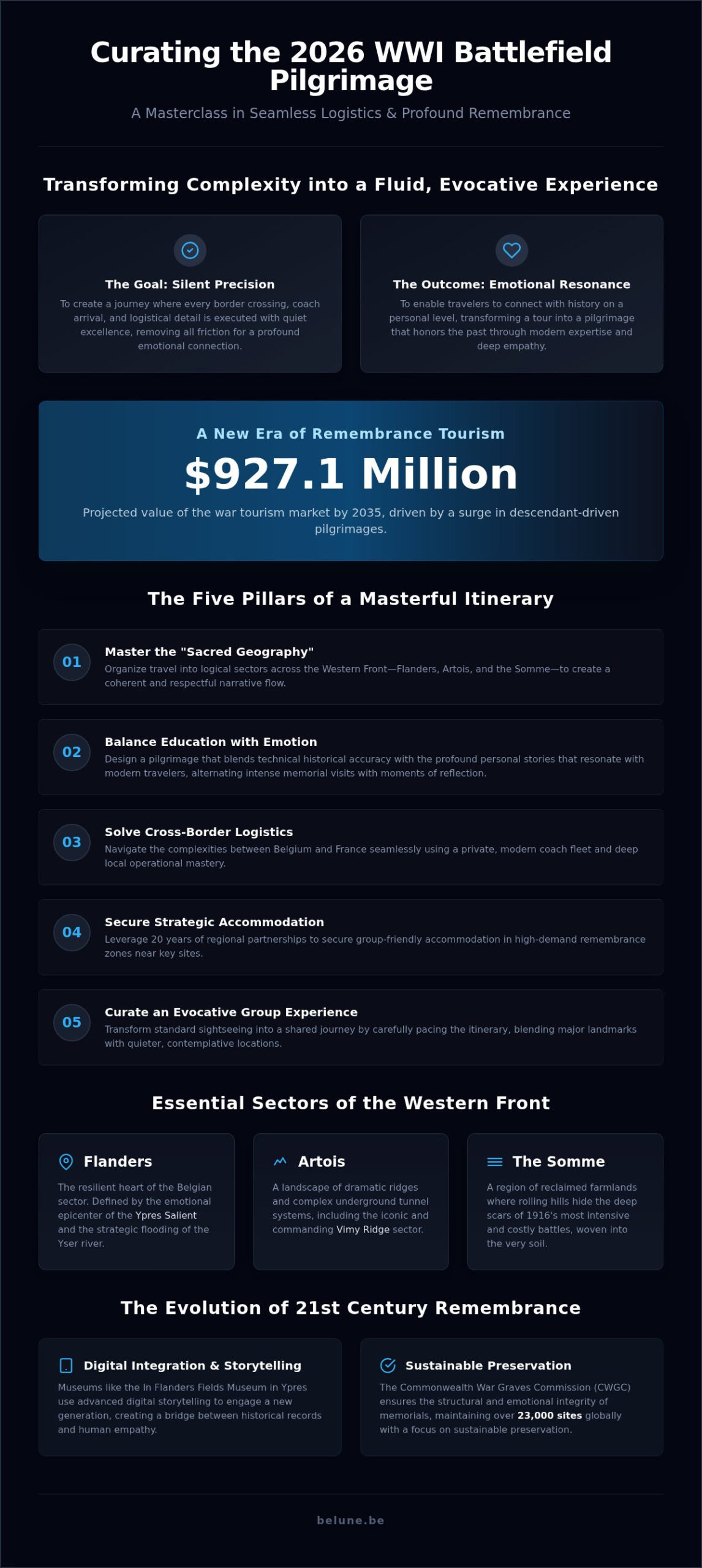
    • Master the “Sacred Geography” of the Western Front by organizing travel into logical sectors across Flanders, Artois, and the Somme.
    • Design a ww1 battlefield pilgrimage that balances technical historical accuracy with the profound personal stories that resonate with modern travelers.
    • Resolve the complexities of cross-border logistics between Belgium and France through the use of a private, modern coach fleet and local operational mastery.
    • Secure group-friendly accommodation in high-demand remembrance zones by leveraging 20 years of strategic regional partnerships.
    • Transform standard sightseeing into an evocative group experience by alternating intense memorial visits with curated moments of reflection.

    The Enduring Significance of the WW1 Battlefield in 2026

    A century has passed since the guns fell silent, yet the soil of the Western Front remains thick with memory. By 2026, the ww1 battlefield has evolved into a “Sacred Geography.” This isn’t merely a collection of historical sites; it’s a physical archive where the landscape itself acts as a witness. We see this journey as a contemporary act of global remembrance, a commitment to education that transcends borders. The Benelux region, particularly the sectors of Flanders and Wallonia, stands as the beating heart of this narrative. It’s here that the architectural precision of modern memorials meets the raw, preserved reality of the earth.

    The nature of these visits has undergone a profound transformation. The era of the veteran-led tour has naturally faded, replaced by a surge in descendant-driven pilgrimages. Grandchildren and history enthusiasts now seek to bridge the gap between grainy family photos and the vibrant, green ridges of the Somme or Ypres. This shift is reflected in the growing war tourism market, which is projected to reach $927.1 million by 2035. Travelers are no longer just looking for facts. They’re looking for a connection to their own heritage through technical mastery of the terrain.

    Why We Still Visit: The Power of Place

    Standing in a preserved trench system like Sanctuary Wood or the Yorkshire Trench offers a sensory experience no textbook can replicate. You feel the damp air; you see the terrifying proximity of the opposing lines. This is “living history” in its most evocative form, transforming abstract strategies into tangible human experiences. It requires an expert eye to navigate these spaces, ensuring that the technical details of the conflict don’t overshadow the quiet dignity of the location.

    Battlefield tourism serves as a bridge between the clinical precision of historical record and the visceral depth of human empathy.

    For travelers who wish to explore other regions where history and culture intersect, you can discover RakiYa Travel for immersive and well-coordinated adventures through the Balkans and Albania.

    The Evolution of Remembrance in the 21st Century

    Remembrance in 2026 is sophisticated and inclusive. Museums like the In Flanders Fields Museum in Ypres, which maintains a standard entry of €10, now integrate advanced digital storytelling to engage a new generation of visitors. The Commonwealth War Graves Commission (CWGC) continues its vital role, ensuring that every monument remains a beacon of structural and emotional integrity. Even as major landmarks like the Menin Gate undergo essential restoration to secure their future, the spirit of the daily Last Post ceremony remains an unbreakable tradition. This balance of heritage preservation and modern accessibility ensures that the ww1 battlefield remains relevant for centuries to come.

    • 2026 marks a new era of digital integration in memorial spaces.
    • The CWGC maintains over 23,000 sites globally, with a focus on sustainable preservation.
    • Descendant pilgrimages now account for a significant portion of international site visits.

    Essential Sectors of the Western Front: A Geographic Framework

    Organizing a ww1 battlefield pilgrimage requires a logical framework that respects both history and geography. We divide the vast expanse of the Western Front into three primary travel sectors. Each area possesses a distinct atmosphere and a unique narrative role in the 1914 to 1918 conflict. Understanding these zones is the first step in creating a coherent itinerary that moves beyond a simple list of monuments.

    • Flanders: The resilient heart of the Belgian sector, defined by the Ypres Salient and the strategic flooding of the Yser.
    • Artois: A landscape of dramatic ridges and underground tunnel systems, including the iconic Vimy sector.
    • The Somme: A region of reclaimed farmlands where the rolling hills hide the scars of the most intensive battles of 1916.

    The contrast between these sectors is striking. In Wallonia, you encounter the preserved ruins of the Liège forts, silent witnesses to the war’s opening moves. As you cross into the French Somme, the terrain shifts into an agricultural tapestry. Here, the remembrance is often more subtle, woven into the very soil of the wheat fields. Along the Belgian coast, the story focuses on the Yser flooding. This was a desperate, technical masterstroke where the deliberate opening of sluice gates halted the German advance, creating a watery barrier that defined the front for years.

    The Ypres Salient: The Heart of Flanders Fields

    Ypres is the emotional epicenter of any Belgian pilgrimage. It’s a city that was entirely erased and then meticulously reconstructed. The In Flanders Fields Museum serves as the essential starting point for groups, providing the technical context needed before stepping onto the sacred soil. Key sites in this sector include Tyne Cot Cemetery, the largest Commonwealth cemetery in the world, and the Menin Gate. While the Menin Gate undergoes restoration through 2026, the nightly Last Post ceremony continues to resonate with profound dignity every evening at 8:00 PM. For a deeper dive into this specific region, explore our Flanders Fields: The Definitive Guide to WWI Remembrance.

    Wallonia and the French Border: The War of Movement

    The narrative begins in Wallonia. Sites in Liège and Mons mark the “War of Movement” from August 1914. Here, the story is one of initial resistance and the first encounters between the British Expeditionary Force and the advancing German army. These early conflict sites are essential for a complete understanding of the Western Front. They provide the necessary “why” behind the years of trench deadlock that followed. The transition from these Belgian sectors into the French Somme battlefields is seamless when managed by experts. We specialize in customized battlefield logistics that connect these disparate locations into a single, evocative journey.

    WW1 Battlefield Tours: A Masterclass in Remembrance and Logistics for 2026

    Designing the Pilgrimage: Balancing Emotion and Education

    A successful ww1 battlefield tour isn’t measured by the number of sites visited, but by the depth of the connection forged. Technical accuracy is the foundation, yet the structure must prioritize the human narrative. We believe that an itinerary should breathe. It shouldn’t be a relentless march through statistics. Instead, it’s a carefully balanced composition that alternates between the visceral intensity of a trench system and the quiet serenity of a memorial garden. This rhythm allows the weight of history to settle without becoming overwhelming.

    Providing “breathing room” is essential for emotional digestion. This is where local culture plays a vital role. Incorporating a lunch featuring regional gastronomy or a visit to a local brewery isn’t a distraction; it’s a necessary pause. It allows groups to process the gravity of the history they’ve witnessed while experiencing the vibrant life that has returned to these once-shattered landscapes. The choice of guide is equally paramount. You need more than a historian. You need a storyteller. Multi-lingual guides who navigate the nuances of both the landscape and the archives transform a tour into a masterclass, revealing the individuals who once stood where your clients now stand.

    The Role of Personal Genealogy in Modern Tours

    In 2026, digital integration has revolutionized how we approach remembrance. Advanced digital archives and mobile research tools allow us to weave individual soldier research directly into a group itinerary. Visiting a specific flanders fields cemetery becomes a transformative event when a descendant stands at the exact grave of an ancestor. We help tour operators utilize Commonwealth War Graves Commission (CWGC) databases and digital mapping to locate specific plots, turning a general tour into a deeply personal pilgrimage for every participant.

    To further enhance these digital mapping efforts, tour organizers can visit Aeroshot to learn how professional drone photography and 3D modeling provide a unique aerial perspective of the historical terrain.

    Educational vs. Commemorative Itineraries

    The pace of a journey must reflect the intent of the group. School groups often require a dynamic, high-engagement approach that focuses on “living history” and curriculum-linked sites. Conversely, family pilgrimages or military history clubs may prefer a slower tempo with more time for reflection and granular analysis. Whether you’re planning specialized student visits or Culture Group Tours in Benelux, the key is tailoring the technical detail to the group’s specific interest level. A well-designed tour doesn’t just teach history; it invites the traveler to become part of it.

    Masterful Logistics: Navigating the Sacred Geography

    Logistics serve as the invisible architecture of a meaningful pilgrimage. In the quiet, rural reaches of Flanders and the Somme, the ww1 battlefield is often accessed via winding lanes and heritage-protected villages that weren’t designed for modern traffic. Navigating these spaces with a large group requires more than a map; it requires technical foresight and local intuition. A Destination Management Company (DMC) acts as your strategic ally, absorbing the friction of cross-border travel between Belgium and France. With the 2026 implementation of the EES biometric system and the upcoming ETIAS requirements, professional coordination ensures that border transitions remain a background detail rather than a disruption.

    Coach Travel: Comfort and Accessibility

    Our private fleet of modern coaches is purpose-built for these specific terrains. Ownership of a fleet allows for a level of quality control that third-party hire can’t match. It removes the volatility of availability and ensures that every vehicle meets high-end standards for comfort and safety. Professional drivers who specialize in this geography are essential. They understand the nuances of memorial parking and the strict timing required for synchronized ceremonies. Arriving at the Menin Gate for the 8:00 PM Last Post ceremony requires absolute precision, particularly as 2026 visitor numbers continue to grow. A driver who knows the staging areas and local traffic patterns ensures your group arrives in a state of quiet reflection rather than logistical stress.

    Accommodation Management for Large Groups

    Securing group-friendly accommodation near sacred sites presents a unique challenge for tour operators. Many towns within the remembrance zones are heritage-protected, which limits new construction and keeps hotel capacity low. We leverage over 20 years of regional experience to manage these complexities, utilizing long-standing relationships with local hoteliers to secure prime bookings. Proximity is a structural component of the tour’s success. By positioning groups near key sites, we significantly reduce daily transit times. This efficiency grants your clients more time for reflection at sites like Tyne Cot Cemetery or the Verdun Memorial. Seamless logistics transform a complex cross-border journey into a fluid, evocative experience. If you’re ready to design an itinerary where technical details are handled with artisan precision, explore our professional coach hire and DMC services.

    The BELUNE Advantage: Curating the 2026 Battlefield Experience

    BELUNE isn’t just a logistics provider; we’re architects of memory. For over two decades, we’ve refined the art of the ww1 battlefield pilgrimage, transforming complex group travel into a seamless narrative. We understand that a truly impactful journey requires more than just a bus and a hotel. It demands a vision that respects the gravity of the past while providing the technical excellence required for modern group travel. By choosing a partner with deep roots in the Benelux and French sectors, you gain access to an exclusive network of local guides and a private coach fleet that operates with surgical precision.

    Our approach rejects the “cookie-cutter” model. Every group has a unique focus, whether it’s a specific regimental history, a school curriculum, or a collection of family genealogies. We move beyond standard routes to uncover the quiet, evocative sites that larger, less specialized operators often overlook. This commitment to exclusivity is what defines our service. We don’t just supply a tour; we co-create an experience that resonates long after the group has returned home. Our 20 years of industry experience allow us to anticipate the needs of high-end clients before they even arise.

    Tailor-Made Itineraries: From Concept to Execution

    We work closely with travel agents and tour organizers to build unique, fixed-price group packages that remove financial volatility. This collaborative process starts with your concept and ends with a flawlessly executed journey. A key element of our design is the integration of local heritage beyond the trenches. We believe that experiencing the gastronomy of Flanders or the cultural resilience of Wallonia provides a vital counterpoint to the intensity of the battlefield sites. This holistic approach is essential for sophisticated group travel. If you’re evaluating your options for the upcoming season, our guide on Choosing a Benelux Incoming Tour Operator offers deeper insights into what sets a premier DMC apart.

    Your Strategic Partner for Western Europe

    The value of a specialized DMC lies in the “one-stop” logistical solution. We manage the intricate details, including hotel contracts, private transport, guide scheduling, and cross-border compliance, so you can focus on your clients’ experience. Our promise is a journey that is seamless, professional, and deeply moving. We treat every ww1 battlefield tour as a unique project of exception, applying our mastery to ensure every detail is harmonious. The result is a pilgrimage that honors history through the highest standards of modern professionalism. We invite you to partner with BELUNE for your next battlefield pilgrimage and discover the difference that expert curation makes.

    Honoring the Past through Visionary Logistics

    A profound journey through the ww1 battlefield is defined by the silent harmony between technical precision and human narrative. As we’ve explored, the transition from the ridges of Flanders to the rolling hills of the Somme requires more than just a map; it demands an architectural approach to travel. By balancing evocative storytelling with masterful logistics, you transform a standard tour into a life-changing pilgrimage. The success of such a project rests on the invisible details, from the reliability of a private coach fleet to the strategic selection of group-friendly accommodation.

    We invite you to leverage our 20+ years of expertise in Benelux group travel and our specialized DMC services to create something truly exceptional. Our team combines a visionary aesthetic with a rigourous technical foundation to ensure every itinerary is executed with quiet excellence. It’s time to elevate your next commemorative project with a partner who understands that every border crossing and memorial visit is a component of a larger, sacred story. Request a custom WW1 battlefield itinerary for your group and let’s build a legacy of remembrance together.

    Frequently Asked Questions

    What is the best time of year to organize a WW1 battlefield tour?

    The ideal period for a pilgrimage is between April and September when weather is most stable and daylight hours are longest. High season for major sites like the Verdun Memorial runs from April 4 to September 20, 2026. While spring offers vibrant landscapes, some groups prefer the somber atmosphere of late autumn. We recommend booking well in advance for these peak months to secure the best coach and hotel availability.

    How long should a comprehensive group tour of the Western Front last?

    A comprehensive journey typically lasts between four and six days to cover the essential sectors effectively. This duration allows for a meaningful exploration of the Ypres Salient, the Somme, and the Artois ridges without rushing the experience. Shorter three-day itineraries are possible if you focus exclusively on the Belgian sectors. Longer journeys provide the necessary time for personal reflections and visits to specific family grave sites across the border.

    Are the WW1 battlefield sites accessible for visitors with limited mobility?

    Most major sites, including the In Flanders Fields Museum and Tyne Cot Cemetery, offer excellent accessibility for visitors with limited mobility. Modern visitor centers are designed with ramps and elevators to accommodate wheelchairs. However, some preserved trench systems or rural memorials may have uneven terrain. We coordinate specific logistics to ensure that every group member can participate in ceremonies and visit key landmarks with dignity and comfort.

    Do I need a special permit to bring a large group to the Menin Gate ceremony?

    You don’t need a special permit to attend the Last Post ceremony, but large groups must register their attendance in advance. This registration is particularly vital for groups wishing to lay a wreath during the daily 8:00 PM event. The Menin Gate renovation in 2026 may affect crowd capacity, so early communication with the Last Post Association is essential. We manage these technical registrations as part of our comprehensive logistical oversight.

    Can a battlefield tour be combined with other Benelux cultural experiences?

    Yes, integrating regional culture provides essential “breathing room” during an emotionally intense ww1 battlefield pilgrimage. We often combine historical visits with gastronomy tours, such as Trappist brewery visits or chocolate workshops. Exploring the medieval architecture of Bruges or the art museums of Brussels adds a layer of contemporary context to the journey. This balance ensures a holistic experience that celebrates the vibrant life that has returned to the region.

    What is the difference between a tour operator and a DMC for battlefield logistics?

    A tour operator typically sells the travel package, while a Destination Management Company like BELUNE manages the technical execution on the ground. We provide the “one-stop” logistical solution, including our private coach fleet and local hotel management. Using a DMC ensures you have a strategic partner who understands the local geography and can resolve real-time challenges. This distinction is vital for maintaining high-end service standards for professional groups.

    How do we locate a specific soldier’s grave for a group member during the tour?

    We use the Commonwealth War Graves Commission digital archives to pinpoint exact cemetery plots before the tour begins. Our guides are trained to navigate these databases, ensuring that group members can find specific headstones with ease. This research is a structural component of our bespoke itineraries. Standing at a specific family grave often becomes the most profound moment of the entire ww1 battlefield experience for our clients.

    Are there specific regulations for coach parking near major WW1 memorials?

    Specific regulations for coach parking exist at almost every major memorial, including the Verdun Memorial and the Thiepval Visitor Centre. These areas often require pre-booked slots or use designated staging zones to prevent congestion. Our professional drivers are well-versed in these local requirements and manage the timing to ensure seamless arrivals. This technical mastery prevents logistical delays and keeps the group’s focus entirely on the act of remembrance.

  • 2026 Brugge Group Itinerary: The Professional Planner’s Strategic Guide

    2026 Brugge Group Itinerary: The Professional Planner’s Strategic Guide

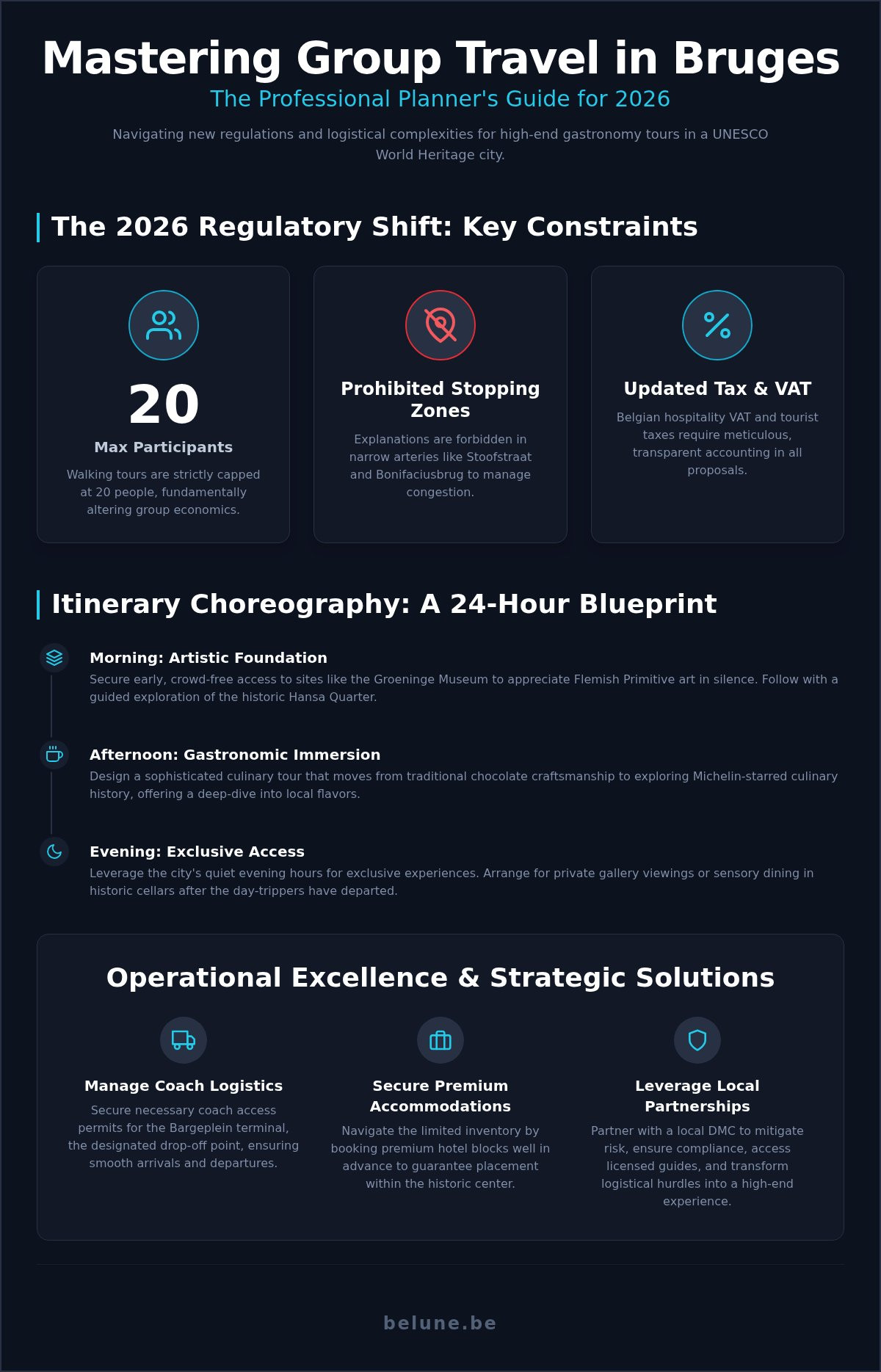
    In 2026, the difference between a seamless Bruges itinerary and a logistical failure is exactly 21 people. With the city’s strict new regulations limiting walking tours to 20 participants, the art of group travel has become a game of technical precision. You understand that orchestrating a high-end experience in a UNESCO-protected center requires more than just a list of landmarks. It demands a deep mastery of spatial choreography and local compliance. This guide provides the strategic framework to manage 2026 VAT increases and complex coach logistics while curating a Brugge gastronomy tour for groups that feels both effortless and exclusive.

    We’ll reveal how to navigate prohibited stopping zones and secure elite supplier allocations to ensure your clients experience the city’s poetic soul without the friction of overtourism. From tax-efficient planning to after-hours access, we’re transforming logistical hurdles into a blueprint for professional excellence. You’ll gain the insights needed to act as a visionary advisor, ensuring every movement through the cobblestone streets is intentional, compliant, and deeply inspiring. By the end of this guide, you’ll have a roadmap for frictionless group movement that prioritizes both artisanal quality and technical rigor.

    Key Takeaways

    • Master the 2026 UNESCO group size limits and updated Belgian tourist tax structures to ensure full compliance and budget accuracy.
    • Choreograph a 24-to-72 hour itinerary that balances iconic heritage sites with exclusive, crowd-free enclaves.
    • Elevate your programming by designing a sophisticated Brugge gastronomy tour for groups that transitions from traditional chocolate craft to Michelin-starred culinary history.
    • Resolve complex operational challenges, including coach access permits at Bargeplein and securing premium hotel blocks in the historic center.
    • Leverage a strategic partnership with a local DMC to mitigate risk and transform technical logistics into a high-end brand experience.

    Planning a Brugge gastronomy tour for groups in 2026 requires more than a refined palate. It demands a forensic understanding of the city’s evolving legal framework. Bruges has transitioned from a passive heritage site to an actively managed urban ecosystem. For the professional planner, this means the technicalities of the 2026 UNESCO framework are now the foundation of every successful itinerary. These regulations aren’t merely suggestions; they’re structural requirements that dictate the flow and financial viability of your program. Ignoring these shifts risks not only the guest experience but also the significant fines now levied for non-compliance.

    The 2026 landscape is defined by a shift toward high-value, low-impact tourism. This strategy protects the historic city of Bruges from the erosion of mass visitation. For international operators, early compliance is the only way to maintain profit margins. By securing allocations and understanding tax liabilities twelve months in advance, you insulate your pricing from the volatility of mid-season adjustments. We view these constraints as a creative catalyst, pushing us to design more intimate, sophisticated experiences that respect the city’s rhythm.

    The 2026 VAT and Tourist Tax Framework

    Tax compliance in 2026 has become a central pillar of B2B travel management. Belgian hospitality VAT and updated tourist tax structures for overnight stays require meticulous accounting. These costs must be integrated into fixed-price packages with total transparency. It’s no longer enough to estimate these figures. Precise calculation at the proposal stage prevents the margin erosion that often plagues international groups. Professional billing now demands a clear breakdown of these stay-related taxes to ensure your partnerships remain built on trust and financial accuracy.

    UNESCO and Spatial Constraints

    Managing group volume in a medieval environment is a matter of spatial choreography. As of March 2026, walking tours are strictly capped at 20 participants. This regulation fundamentally alters the economics of a Brugge gastronomy tour for groups. Furthermore, stopping to provide explanations is now forbidden in narrow arteries like Stoofstraat and the Bonifaciusbrug. To maintain a premium atmosphere, we prioritize off-peak timing and alternative routes that bypass these congested zones. Expert benelux incoming tour operator partners are essential here; they provide the licensed guides and local intelligence needed to navigate these constraints without compromising the narrative flow. This rigorous approach ensures that your group feels like a collection of invited guests rather than a logistical burden on the city.

    Orchestrating the Perfect Itinerary: A Choreography of Heritage and Flow

    Designing a Bruges itinerary is an exercise in technical choreography. It’s not just about selecting sites; it’s about managing the arc of energy over 24 to 72 hours. We aim for a narrative that balances the grandiosity of the Belfry with the quiet intimacy of hidden courtyards. This requires a deep understanding of the city’s pulse and the physical constraints of its medieval layout. A successful program feels like a seamless progression where every transition is intentional. By treating the city as a living gallery, you can move your group through history without the friction of the crowds.

    The evening should serve as the crescendo of this experience. While the day-trippers depart, the city regains its poetic silence. This is the ideal window for private gallery access or a sensory dining experience in a historic cellar. These exclusive layers transform a standard visit into a sophisticated professional event. To ensure these high-end components align with local regulations, consulting with a strategic DMC is the most reliable way to secure after-hours permissions and elite supplier access.

    Morning: The Artistic and Civic Foundation

    The Groeninge Museum is the spiritual heart of the morning. To see the Flemish Primitives without the distraction of crowds, timing is everything. We recommend an early entry, ideally as the doors open, to appreciate the meticulous detail of Jan van Eyck’s work in silence. Move next to the Hansa Quarter. This area illustrates the city’s historical trade dominance through its imposing facades and merchant houses. Local guide services are essential here to translate these architectural symbols into a compelling story of medieval economic power and civic pride.

    Afternoon: Perspective and Sensory Breaks

    By midday, the main squares often reach peak density. This is the moment to shift perspective and use the water. A private boat charter offers a sophisticated B2B value proposition, allowing your group to bypass pedestrian congestion entirely while seeing the city from its original trade arteries. It’s a serene transition to the Beguinage, where the atmosphere encourages decompression and reflection. This quietude sets the stage for a Brugge gastronomy tour for groups. A curated midday tasting of artisanal products, paired with insights from Official Bruges Tourism Information resources, provides a sensory bridge to the evening. Integrating these belgium gastronomy tours layers ensures the itinerary remains both intellectually stimulating and physically comfortable for every participant.

    2026 Brugge Group Itinerary: The Professional Planner’s Strategic Guide

    Beyond the Surface: Thematic Layers for Discerning Groups

    Specialization is no longer a luxury; it’s a strategic necessity for the modern planner. In a city governed by strict UNESCO World Heritage Site regulations, generalist tours often fail to capture the sophisticated imagination of high-end clients. The future of themed group travel benelux lies in the ability to layer specific narratives over the physical landscape. We don’t simply walk the streets. We explore the connective tissue between the Flemish Primitives and the wider Northern Renaissance, transforming a simple museum visit into an intellectual deep-dive. This approach ensures that every hour of the itinerary adds distinct value to the group experience.

    Designing a Brugge gastronomy tour for groups requires a similar shift in perspective. It’s about moving from the commercial surface to the artisanal core. We replace generic chocolate shop visits with masterclasses that explore the technical bean-to-bar philosophy. We trade standard pub stops for beer heritage tours that detail the city’s unique underground pipeline and centuries-old monastic traditions. This level of curation satisfies the discerning traveler’s hunger for authenticity while maintaining the rigorous standards expected by professional partners.

    Brugge Gastronomy Tour for Groups: Artisanal Craft

    True culinary excellence for large groups is a matter of logistical precision and seasonal storytelling. We curate menus that showcase the terroir of West Flanders, working with chefs who specialize in Michelin-starred history. Private workshops allow participants to engage directly with the craft, whether through chocolate tempering or understanding the fermentation science behind local ales. These sessions are designed to be intimate yet scalable, ensuring that even groups of twenty experience the visceral connection to the maker’s hand. It’s a sensory narrative that elevates the meal from a functional break to a programmatic highlight.

    Heritage and Battlefield Synergy

    Bruges serves as an exceptional base for broader historical explorations. The transition from medieval civic pride to the 20th-century remembrance of a flanders fields pilgrimage is logistically seamless with the right partner. This synergy allows groups to contrast the architectural preservation of the city with the profound landscapes of nearby WWI sites. A professional DMC is essential for these multi-themed, cross-regional tours. We manage the complex transport logistics and guide rotations required to bridge these disparate eras, ensuring the emotional and historical arc remains coherent for the duration of the journey.

    Operational Excellence: Managing Logistics in a Medieval Environment

    Bruges is a masterpiece of preservation, but for a professional planner, it’s a labyrinth of technical constraints. Managing logistics here isn’t just about moving people. It’s about anticipating the friction of a 13th-century layout meeting 21st-century regulations. Real-time management involves handling invisible details, from terminal permits to the exact timing of a Brugge gastronomy tour for groups. We ensure that the transition from a modern coach to a cobblestone street feels like a natural extension of the guest experience, not a logistical hurdle. Success in this environment depends on a rigorous approach to spatial timing and local compliance.

    A seamless operation requires a deep understanding of the city’s circulatory system. This includes everything from the width of the approach roads to the specific licensing required for guides. When these technical layers are handled with precision, the group remains immersed in the city’s poetic atmosphere. If they’re ignored, the experience quickly dissolves into a series of delays and frustrations. We prioritize the technical rigor that allows the creative vision of your itinerary to shine through without interruption.

    Coach Fleet and Terminal Strategy

    The Bargeplein serves as the critical gateway for all group movements. Navigating this terminal requires strict adherence to pick-up and drop-off windows. Using a DMC with its own fleet of modern coaches provides a significant strategic advantage. We control the schedule, the vehicle quality, and the driver’s expertise. This is vital for multi-city itineraries where driver hour management can impact the entire program’s flow. Our fleet meets the highest environmental standards, ensuring compliance with the Low-Emission Zones that define Belgian urban planning in 2026. Partner with us to secure reliable group transport across the Benelux.

    Accommodation and VAT Management

    Sourcing hotel blocks in the historic center requires a balance of aesthetic charm and operational feasibility. Many boutique properties lack the infrastructure for large luggage transfers or group check-ins. We prioritize hotels that offer seamless logistics while maintaining the city’s poetic atmosphere. Beyond the physical space, managing the 2026 VAT adjustments for B2B contracts is a technical necessity. These tax implications can shift margins if not addressed during the negotiation phase. Working with a specialized group travel agency ensures that contracts are both legally compliant and financially optimized. This level of oversight is what allows a Brugge gastronomy tour for groups to remain a premium, high-margin offering for your clients.

    For travel professionals looking to maintain these high standards in other parts of the world, you can discover U Hotel Group for premium hotel accommodations across New Zealand and Bangkok.

    Strategic Partnerships: Elevating Your Group Experiences with BELUNE

    Success in Bruges isn’t just about knowing the map; it’s about knowing the people who draw it. With over 20 years of DMC experience across the Benelux and Paris, BELUNE serves as the ultimate risk-mitigation tool for professional planners. We translate complex local mandates into a seamless operational reality. This deep-rooted expertise allows you to offer a Brugge gastronomy tour for groups that remains untouched by the logistical friction of overtourism. We act as your single point of contact, simplifying the cross-border complexities of the region while maintaining a standard of excellence that reflects your own brand’s reputation.

    Our approach transforms travel planning into a strategic B2B collaboration. We don’t just provide services; we propose a vision. By aligning with a partner who views logistics as a form of choreography, you ensure higher guest satisfaction and, consequently, robust repeat business. We understand that your reputation depends on the invisible details. From the timing of a coach arrival to the temperature of a private tasting room, our technical rigor supports your creative ambition. This synergy is what differentiates a standard trip from a sophisticated professional event.

    The DMC as a Creative and Technical Ally

    We move far beyond the traditional supplier role to become a structural component of your project. Local insights unlock experiences that are simply unavailable on public booking platforms. Private cellar tastings and after-hours gallery access are the results of decades of relationship building and artisanal trust. Our multi-lingual, expert local guides are the backbone of our culture group tours benelux offerings. They provide the narrative depth and cultural nuance that high-end clients demand, ensuring every interaction is meaningful and every story is told with passion and precision.

    Requesting Your Custom 2026 Itinerary

    Securing your 2026 allocations now is a vital step in protecting your margins and your client’s experience. Our co-creation process is transparent and collaborative. We start with your specific goals and apply our technical expertise to build a fixed-price group tour package that accounts for all 2026 tax and regulatory shifts. We handle the logistical heavy lifting, from Bargeplein terminal permits to VAT-compliant hotel management. This allows you to focus entirely on your client relationships while we manage the technical execution. Securing a Brugge gastronomy tour for groups well in advance ensures access to our private fleet of modern coaches and elite supplier network, shielding your program from the price volatility of the upcoming season.

    Master the Art of the 2026 Bruges Itinerary

    The evolution of Bruges into a strictly managed heritage site demands a shift from traditional planning to technical choreography. You’ve seen how mastering the 2026 UNESCO mandates and VAT structures protects your margins while ensuring a premium atmosphere. Success now depends on the seamless integration of logistics and narrative, whether you’re orchestrating a Brugge gastronomy tour for groups or a complex cross-regional pilgrimage. By prioritizing early compliance and artisanal specialization, you transform a standard visit into a visionary group experience.

    Strategic excellence is built on reliability. With over 20 years of specialized DMC expertise and a private fleet of modern, high-spec coaches, we provide the technical rigor required to navigate these new regulatory landscapes. We don’t just manage travel; we co-create sophisticated B2B solutions that respect the city’s poetic soul. Secure your position in the upcoming season by choosing to Request Your Custom 2026 Benelux Group Itinerary today. Let’s transform the technical challenges of 2026 into your most successful program yet.

    Frequently Asked Questions

    What are the specific coach parking regulations in Bruges for 2026?

    All high-capacity coaches must use the Bargeplein terminal on the city’s periphery. As of 2026, specific terminal permits are mandatory for drop-off and pick-up windows. This regulation ensures the historic core remains pedestrian-friendly while providing a dedicated gateway for group arrivals. Professional drivers must adhere to these zones strictly to avoid significant municipal fines. We coordinate these permits well in advance to ensure your group’s transition from coach to city is seamless and compliant.

    How has the Belgian tourist tax changed for group stays in 2026?

    The 2026 Belgian tourist tax for group stays is calculated per person, per night, and varies depending on the accommodation’s classification. These structural increases are designed to fund the preservation of UNESCO sites. It’s vital to factor these costs into your initial B2B quotes to maintain margin transparency. We provide a detailed breakdown of these stay-related taxes at the proposal stage, ensuring your fixed-price packages remain accurate and competitive throughout the season.

    Can a high-capacity coach access the historic centre of Bruges?

    No, high-capacity coaches are strictly prohibited from entering the historic centre to protect the medieval infrastructure. All group transport must terminate at the Bargeplein station. From this point, groups transition to walking or use licensed local shuttles for specific access needs. This spatial constraint is a key reason why a Brugge gastronomy tour for groups requires precise timing, as participants must move on foot between artisanal stops and heritage landmarks.

    What is the best way to integrate a Bruges visit into a wider Benelux itinerary?

    Bruges acts as a poetic anchor between the urban energy of Brussels and the historical weight of Flanders Fields. We recommend a 48-hour stay to allow for both deep artistic immersion and sensory culinary exploration. This allows for a logical progression through the Benelux, connecting the Flemish Primitives in Bruges to the Rubens legacy in Antwerp. By using the city as a strategic base, you minimize transit time while maximizing the thematic depth of your itinerary.

    Are there specific VAT exemptions for international tour operators booking in Belgium?

    International tour operators should note that while some B2B services fall under the reverse charge mechanism, hospitality VAT in Belgium is generally non-recoverable. The 2026 adjustments have refined how these taxes apply to organized group travel. We manage these technicalities through transparent billing and contract negotiation, ensuring your pricing reflects the most current tax landscape. Professional oversight here is essential to prevent unexpected costs from eroding your program’s financial viability during the final settlement.

    How can I secure private access to museums like the Groeninge for my group?

    Private access to the Groeninge Museum is best secured through early entry or after-hours sessions coordinated with local heritage authorities. These exclusive windows allow your group to experience the Flemish Primitives without the distraction of peak-hour crowds. We leverage our long-standing relationships with cultural suppliers to secure these allocations twelve months in advance. This level of access transforms a standard museum visit into a sophisticated, private event that aligns with the expectations of discerning clients.

    What are the benefits of using a DMC with its own coach fleet for Benelux tours?

    Using a DMC with its own fleet provides total control over vehicle quality, driver expertise, and Euro 6 environmental compliance. It eliminates the risks associated with third-party transport brokers, such as unexpected vehicle substitutions or driver hour conflicts. For a Brugge gastronomy tour for groups, this means your transport is always synchronized with your tasting schedule. Our private fleet serves as a mobile sanctuary, ensuring comfort and reliability across every border in the Benelux region.

    How does BELUNE handle last-minute logistical changes for large groups?

    We handle last-minute logistical shifts through our 20+ years of experience and a robust network of 150 vetted local suppliers. Having our own fleet of modern coaches allows for immediate re-routing or schedule adjustments that third-party providers simply can’t match. We act as a strategic ally, absorbing the technical pressure of unforeseen changes so you can focus on guest relationships. This proactive approach ensures that even the most complex large-group logistics remain fluid and professional.

  • Belgian Cycling Classics Group Tours: A Masterclass in Curated Logistics for 2026

    Belgian Cycling Classics Group Tours: A Masterclass in Curated Logistics for 2026

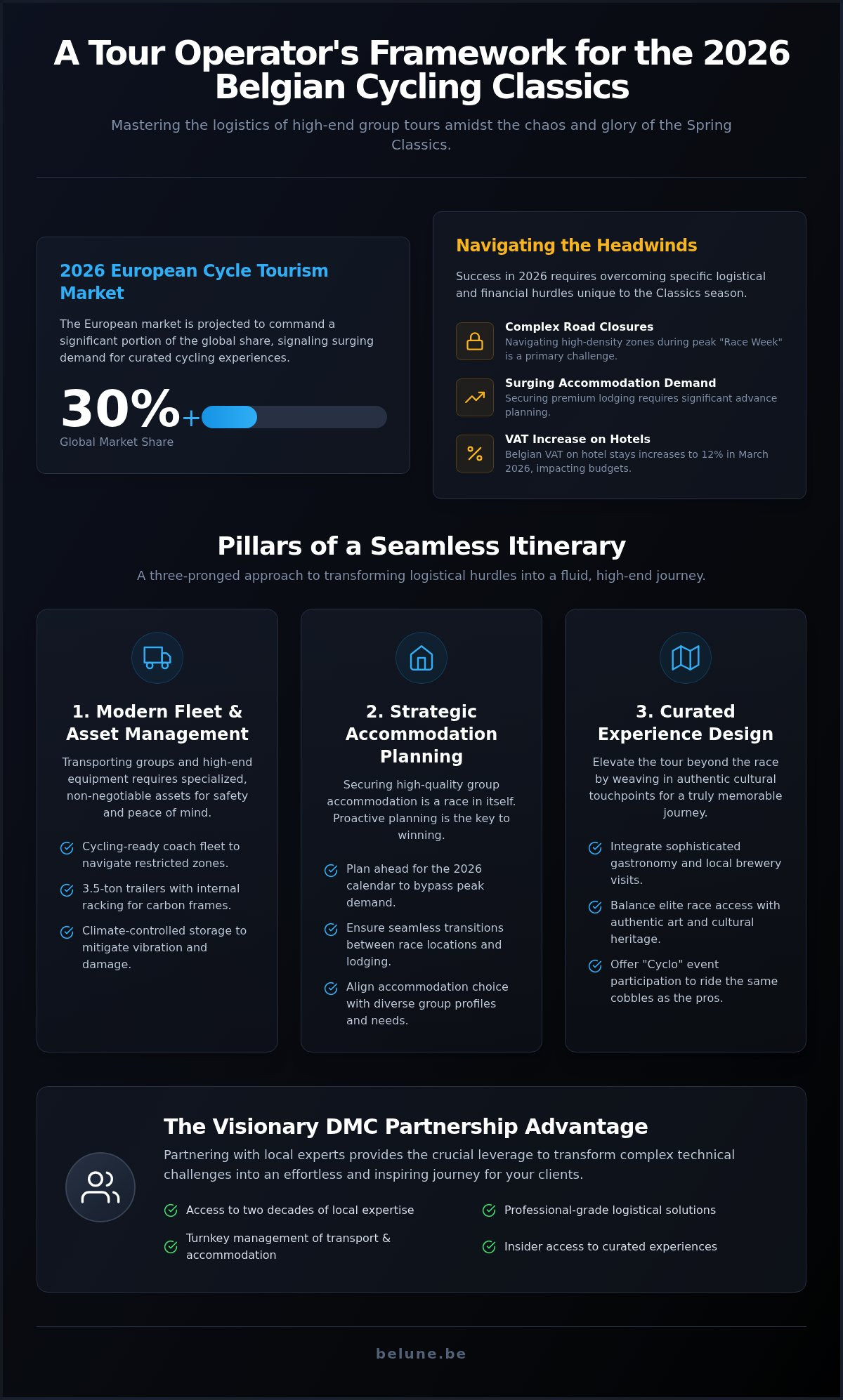
    The cobbles of the Oude Kwaremont aren’t just a cycling route; they’re a technical stage where raw athleticism meets the precision of high-end hospitality. Organizing belgian cycling classics group tours for 2026 requires more than a passion for the sport; it demands a visionary approach to movement and space in a landscape defined by strict road closures and surging demand. With the European cycle tourism market projected to represent over 30% of global share by 2026, the challenge isn’t just finding a path, but crafting an experience that feels effortless amidst the chaos of the Spring Classics.

    We understand that securing premium accommodation during peak race weeks feels like a race in itself, especially with the Belgian VAT on hotel stays increasing to 12% in March 2026. This article provides a masterclass in orchestrating seamless, high-end itineraries through expert DMC insights and professional-grade logistics. You’ll discover how to leverage private transport solutions and local expertise to transform complex transport hurdles into a fluid journey. We explore the art of balancing elite race access with authentic gastronomy and cultural heritage, ensuring your clients experience the soul of Flanders without the logistical friction.

    Key Takeaways

    • Master the logistical intricacies of “Race Week” by navigating complex road closures and high-density zones with a modern, cycling-ready coach fleet.
    • Elevate your belgian cycling classics group tours by weaving sophisticated gastronomy and local art into the sporting itinerary for a truly curated experience.
    • Secure high-quality group accommodation by planning ahead for the 2026 calendar, ensuring seamless transitions despite high seasonal demand.
    • Discover a strategic framework for aligning tour dates with the peak Classics window while catering to diverse group profiles, from social riders to performance seekers.
    • Partner with a visionary DMC to access two decades of local expertise, transforming technical transport challenges into an effortless and inspiring journey.

    The Allure of the Belgian Spring Classics for Global Groups

    The Belgian Spring Classics are a visceral tapestry of mud, grit, and glory. For enthusiasts, these races aren’t merely entries on a sporting calendar; they’re an annual pilgrimage to the soul of cycling. 2026 promises to be a landmark year as the region celebrates its enduring heritage with renewed vigor and updated infrastructure. When planning belgian cycling classics group tours, one must look beyond the tape and the finish line. The true essence lies in the “Kermesse” atmosphere: a unique blend of local fervor, roadside fries, and the sharp scent of embrocation in the morning air. It’s a sensory experience that defines the very concept of Flemish sport.

    The Spring Classics are a multi-week cultural festival where the rhythm of the pedals dictates the heartbeat of an entire nation. This period captures the transition from winter’s bite to spring’s promise, localized in the rolling hills of the Flemish Ardennes. It’s a time when history is written on every climb and every stretch of uneven stone, drawing people from across the globe to witness a spectacle that is as much about human endurance as it is about communal celebration.

    To better understand the physical and emotional intensity of these routes, watch this helpful video:

    The ‘Monuments’ and Beyond: Iconic Race Routes

    The technical allure of the cobbled climbs, or “bergs,” is undeniable for amateur groups seeking to test their limits. Routes managed by the Flanders Classics organization, such as the Ronde van Vlaanderen, offer a masterclass in terrain management. The “Hell of the North” and the “Ronde” serve as the twin pillars of any serious itinerary, providing a tactile connection to the legends of the sport. In 2026, these routes remain the gold standard for group challenges, offering a blend of historical reverence and modern safety standards. The cobblestones themselves are more than obstacles; they’re historical artifacts that demand respect and technical precision from every rider who dares to cross them.

    The Group Travel Opportunity: Beyond the Professional Peloton

    The rise of recreational “Cyclo” events has transformed how international groups engage with the sport. No longer content with just watching from the sidelines, today’s cycling travelers want to ride the same stones as the pros. We’re seeing a sharp increase in demand for high-end cycling packages that combine performance with luxury. Tour operators now leverage the racing schedule to encourage deeper regional exploration, moving from the intensity of the race route to the serenity of a local brewery or a historic town square. It’s an opportunity to experience Belgium as a structural whole, where sport and life are inextricably linked through shared effort and celebration.

    Mastering the Logistics of Belgian Cycling Classics Group Tours

    Executing belgian cycling classics group tours requires a surgical level of precision. During “Race Week,” the Flemish countryside transforms into a high-density theater where road closures are frequent and often unpredictable. Navigating this environment isn’t just about following a map; it’s about understanding the pulse of the booming Belgian cycling culture and anticipating the movement of the professional peloton. For a tour operator, the goal is to create a bubble of serenity for clients amidst the beautiful chaos of the Spring Classics.

    Transporting an international group with their equipment demands specialized assets that go beyond standard tourism offerings. Ensuring the integrity of high-end carbon frames requires the use of 3.5-ton trailers equipped with specialized internal racking systems and climate-controlled coach storage to mitigate vibration during transit. This technical requirement is non-negotiable for discerning groups who view their bicycles as precision instruments rather than simple luggage.

    Private Coach Fleet: The Backbone of a Seamless Tour

    A dedicated coach hire service is the structural foundation of a successful itinerary. It provides more than just movement; it serves as a mobile hospitality suite where guests can find respite between viewing points. Managing driver hours is a complex art during multi-day tours, especially when race delays or route diversions occur. A professional fleet ensures that safety remains paramount while maintaining the fluidity of the schedule. This level of support allows the group to focus on the emotion of the race, knowing the technical details are under expert control.

    Accommodation Management: Finding the Perfect Balance

    Securing the right “Base Camp” is perhaps the greatest challenge for operators in 2026. With the Belgian VAT on hotel accommodation increasing from 6% to 12% on March 1, 2026, early planning is essential to manage budgets and secure availability. We prioritize strategic placement:

    • Proximity to iconic bergs like the Koppenberg or Paterberg.
    • Hotels with certified bike-friendly standards and high-security storage.
    • Facilities capable of handling large-scale room blocks and group dining needs.

    Managing these blocks months in advance is a core competency of a dedicated DMC. It requires a deep network of local partnerships to ensure that your group isn’t just a number, but a welcomed guest in the heart of Flanders. Partnering with a local expert ensures these details are managed with an artistic attention to detail, allowing your vision to come to life without logistical friction.

    Belgian Cycling Classics Group Tours: A Masterclass in Curated Logistics for 2026

    Curating the Experience: Gastronomy and Heritage Beyond the Cobbles

    The “Post-Ride” ritual is a structural component of our itineraries. Integrating Belgium gastronomy tours into the schedule isn’t an afterthought; it’s a deliberate celebration of regional identity. Local guides act as essential narrators, bridging the gap between the high-speed drama of the peloton and the slow, deliberate history of the towns the race passes through. This approach ensures that every participant, including non-cycling companions, finds a meaningful connection to the landscape. While riders test their limits on the stones, others might explore the minimalist beauty of a hidden art gallery or the architectural precision of a medieval belfry.

    The Art of Belgian Beer and Chocolate for Groups

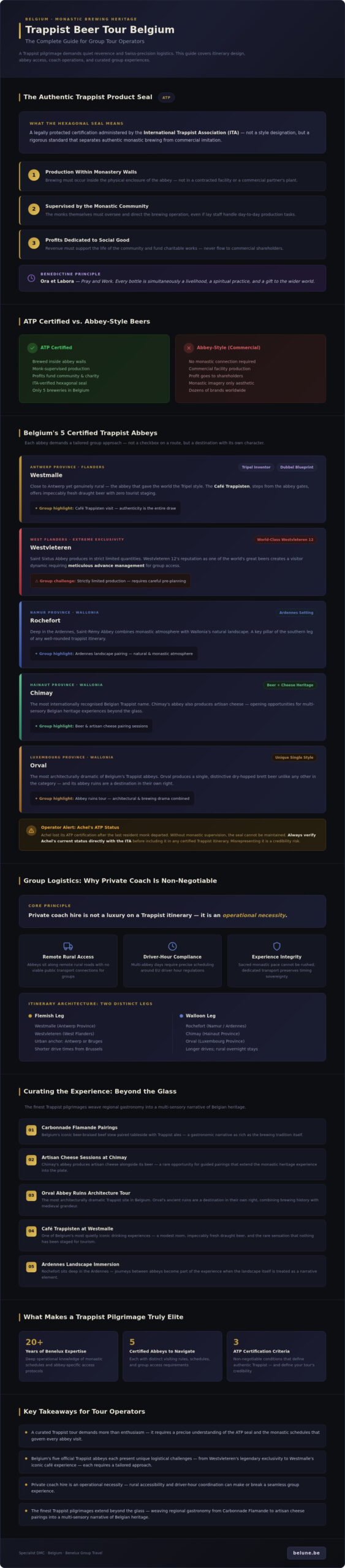
    Recovery in Belgium is an artisanal pursuit. We curate private brewery visits where the technical mastery of Trappist brewing is laid bare, offering groups a sensory deep dive into flavors that have remained unchanged for centuries. These aren’t mere tastings; they’re exclusive evening events designed to foster community and reflection. Pairing local cuisine with high-performance recovery needs requires a delicate balance. We work with chefs who understand how to elevate traditional Flemish carbonnade or fresh North Sea grey shrimps into a refined culinary experience that satisfies the hunger of an athlete and the palate of a connoisseur. Artisanal chocolate workshops further enrich the stay, providing a tactile connection to the country’s most famous export.

    Heritage and Landscape: A Visual Masterclass

    The Flemish countryside is a living museum, best appreciated through the lens of culture group tours in Benelux. Between race viewings, the itinerary shifts focus to the aesthetic beauty of the rolling hills and winding canals. Our local experts navigate the group toward hidden gems that remain untouched by the typical tourist surge. Whether it’s a private viewing of a Flemish Primitive masterpiece or a quiet walk through a historic beguinage, these moments provide the necessary contrast to the intensity of the Spring Classics. This holistic travel experience ensures that the 2026 season is remembered not just for the speed of the races, but for the depth of the immersion into a culture that prizes both endurance and elegance.

    A Tour Operator’s Framework for Planning the Perfect 2026 Itinerary

    The architecture of successful belgian cycling classics group tours relies on a structured approach that balances athletic ambition with logistical reality. For 2026, the complexity of the European sports tourism market demands a framework that is both rigid in its precision and fluid in its artistic execution. It’s not just a trip; it’s a strategic operation. Planning begins with a clear vision of the desired outcome, followed by a meticulous audit of every technical touchpoint. We view the itinerary as a structural whole where every element, from the first pedal stroke to the final celebratory meal, is intentionally placed.

    • Step 1: Selecting the window. Timing is the structural foundation. Aligning with the peak Classics calendar, specifically the window between the Tour of Flanders and Paris-Roubaix, ensures the group experiences the true intensity of the season.
    • Step 2: Defining the group profile. Identifying whether the clients are performance seekers or social cyclists is vital. This choice dictates the pace, the technical demands of the support fleet, and the level of hospitality required.
    • Step 3: Logistical audit. Verifying the capacity of support vehicles and the security of bike storage is a non-negotiable requirement. This audit ensures the safety of high-end equipment and the comfort of the participants.
    • Step 4: Cultural layering. Weaving in gastronomy and heritage touchpoints creates a multi-dimensional journey. This step transforms a sporting event into a comprehensive cultural immersion.
    • Step 5: Partnering with a local expert. Final execution requires an ally who understands the local terrain and can navigate the unpredictable nature of race-week logistics.

    Timeline for Success: Booking Cycles for 2026

    A 12-18 month planning horizon is a necessity. With the Belgian VAT on hotel accommodation rising to 12% on March 1, 2026, early commitment is the only way to manage budgets effectively while securing the most coveted room blocks. Managing group deposits and hotel attrition policies requires a firm grasp of local commercial standards. Site inspections serve as the final layer of security, ensuring that the “Base Camp” meets the specific technical and aesthetic standards of your group profile.

    The Value of a Specialized Incoming Partner

    Partnering with a specialized Benelux incoming tour operator transforms a high-stakes investment into a calculated success. Off-the-shelf packages often fail to capture the subtle nuances of a group’s specific needs. A visionary partner provides the local relationships necessary to bypass generic offerings and deliver the exceptional. Customization is the key to de-risking the agent’s investment, moving beyond standard itineraries to create a bespoke experience that reflects the brand’s commitment to excellence. Ready to design your elite 2026 itinerary? Consult our visionary team today to begin the orchestration of your next project.

    Partnering with BELUNE: Your Visionary DMC in the Benelux

    Executing elite belgian cycling classics group tours is a delicate orchestration of timing, terrain, and taste. Choosing a partner for the 2026 season is a decision that defines the structural integrity of your brand’s reputation. With over 20 years of specialized experience in themed group travel in Benelux, BELUNE doesn’t just provide services; we offer a vision of what a sporting pilgrimage should be. Our approach combines professional-grade logistics with a certain artistic flair, ensuring that the grit of the cobbles is balanced by the refinement of high-end hospitality. We believe that every technical detail, from coach suspension to hotel room blocks, is a component of a larger, visceral narrative.

    Our private coach fleet and roster of expert local guides are the tangible assets that make this vision possible. These guides are more than navigators; they’re storytellers who bring the history of the region to life for your guests. By owning our fleet, we maintain absolute control over the quality and safety of the journey, providing a level of reliability that third-party providers simply cannot match. We transform a high-intensity sporting event into a sophisticated group journey where the transition from the roadside to the dinner table is seamless and inspiring.

    A Professional Partnership Rooted in Trust

    Our identity is built on a B2B-only foundation. We act as a strategic ally for travel agents and tour operators who demand excellence, positioning ourselves as a silent partner that empowers your brand to shine. We don’t compete for the end-consumer; instead, we provide the technical mastery and local network that allow you to deliver a superior product. Transparent pricing and comprehensive itinerary management mean you can focus on client relationships while we manage the complexities of the Flemish countryside. BELUNE possesses the unique ability to handle the most complex logistical requests with a sense of minimalist elegance that transforms technical hurdles into seamless transitions.

    Start Planning Your 2026 Cycling Program

    Initiating a custom itinerary for your groups is a collaborative process where your specific goals meet our deep regional expertise. Our multilingual support team ensures that communication is fluid and precise, regardless of where your group originates. We understand the nuances of different markets and tailor our support to match the expectations of your specific clientele. Whether your group seeks the physical challenge of the bergs or the cultural depth of a gastronomy tour, we provide the framework for success. Contact BELUNE to design your exclusive cycling classics tour and secure your place in the heart of the 2026 Spring Classics.

    Orchestrating the Future of Elite Cycling Travel

    The 2026 Spring Classics are a visceral stage where only the most precise orchestration succeeds. We’ve defined the structural pillars of a masterclass itinerary: the technical mastery of specialized transport, the strategic foresight of early accommodation management, and the artistic layering of regional heritage. These elements don’t just happen. They’re designed with a rigour that mirrors the intensity of the races themselves. Every detail is a component of a larger, harmonious whole.

    Crafting belgian cycling classics group tours requires a partner who treats logistics as an art form. With 20 years of DMC expertise and our own fleet of modern coaches, we provide the technical foundation for your visionary travel programs. Our B2B focus ensures your brand remains the protagonist while we manage the complexities of the Flemish landscape. It’s about delivering excellence through collaboration and trust.

    The stones are waiting. Partner with BELUNE for your next high-end Benelux group tour and transform your 2026 program into a seamless, sophisticated reality that inspires and endures. We’re ready to help you create something truly exceptional.

    Frequently Asked Questions

    When is the best time to book a Belgian cycling classics group tour for 2026?

    Booking 12 to 18 months in advance is the optimal window for securing premium availability and managing budgets effectively. This timeline is particularly critical because the Belgian VAT on hotel accommodation increases to 12% on March 1, 2026. Early commitment allows us to lock in room blocks before peak demand and tax adjustments impact the overall cost of the program.

    What kind of support vehicles are provided for cycling groups?

    We provide a private fleet of modern coaches integrated with 3.5-ton trailers specifically designed for high-end carbon bicycles. These trailers feature specialized internal racking systems that prevent frame contact, ensuring equipment integrity during transit. Each coach serves as a mobile hospitality suite, offering a climate-controlled environment where guests can find respite between viewing points or ride segments.

    Can BELUNE handle both recreational and high-performance cycling groups?

    Our team excels at designing bespoke itineraries for both social recreational riders and high-performance seekers. We adapt the intensity of the routes and the level of support to match the group’s specific profile. Whether the focus is on a leisurely exploration of the bergs or a rigorous training camp, the structural precision of our logistics remains consistent across all belgian cycling classics group tours.

    How do you manage logistics during road closures for the Tour of Flanders?

    Navigating road closures during major races requires deep local knowledge and preemptive route management. We monitor official race regulations and coordinate with local authorities to ensure our private transport fleet bypasses congestion points. This expert navigation allows groups to reach key viewing locations without the frustration of logistical friction, ensuring a seamless experience amidst the race-day chaos.

    Are the hotels used in these tours equipped for high-end bike storage?

    Every hotel selected for our itineraries must meet certified bike-friendly standards, which include secure, high-capacity storage areas. We prioritize establishments that understand the value of professional-grade equipment and provide dedicated spaces for cleaning and maintenance. This focus on technical security ensures peace of mind for both the tour operator and the final clients throughout their stay.

    What non-cycling activities can be included for groups?

    We integrate a rich variety of sensory experiences such as private brewery visits, artisanal chocolate workshops, and art-focused culture tours. Non-cycling companions can explore medieval architecture or visit historic museums while the riders are on the road. These activities are designed to provide a holistic vision of Flanders, ensuring the journey is as much about cultural immersion as it is about sport.

    Does BELUNE provide local guides who specialize in cycling history?

    Our local guides are specialized storytellers who possess a profound understanding of Belgian cycling history and regional heritage. They bridge the gap between the technical aspects of the race and the human emotion of the sport. This expertise adds a layer of authentic narrative that elevates belgian cycling classics group tours from a simple trip to a meaningful cultural pilgrimage.

    How does a DMC help with group accommodation management during peak events?

    As a DMC with over 20 years of experience, we manage complex hotel room blocks months in advance to ensure group cohesion. We handle the administrative burden of hotel contracts and attrition policies, which is essential during high-density race weeks. This specialized management de-risks the investment for travel agents and ensures premium positioning in the heart of the action for their clients.

  • Paris DMC: 2026 Group Logistics & Itineraries Guide

    Paris DMC: 2026 Group Logistics & Itineraries Guide

    With over 102 million international visitors flooding France in 2025, the challenge for 2026 isn’t just reaching the capital; it’s finding the space to breathe once you arrive. Securing a sophisticated paris dmc for groups has become a necessity for those who refuse to settle for generic, crowded experiences. It’s a matter of finding a partner who treats logistical choreography as an art form rather than a mere checklist.

    We understand the weight of your responsibilities. You’re balancing the rising tourist taxes, which now reach up to €11.70 per night for palace stays, against the need for fixed-price reliability. Managing coach access in a city designed for pedestrians requires more than a map; it requires a visionary strategic ally with a mastery of local flow. This guide provides the blueprint for executing multi-day itineraries that feel effortless despite the city’s complexity.

    You’ll discover how to master the 2026 landscape, from managing the post-Olympic surge to securing exclusive access at the Louvre for €32 per guest. We’ll detail the technical precision of our modern coach fleet and the curated hotel management that ensures every traveler feels the true, sophisticated pulse of Paris.

    Key Takeaways

    • Understand the role of a local architect in managing the 2026 landscape, including rising tourist taxes and restricted city access.
    • Discover the logistical superiority of a paris dmc for groups that manages its own modern coach fleet and premium hotel blocks.
    • Learn how to move beyond generic sightseeing by curating thematic narratives that resonate with modern, discerning travelers.
    • Master the technical coordination of multi-country itineraries through a strategic partnership that spans the Benelux and France.

    The Strategic Role of a Paris DMC for Groups in 2026

    A Destination Management Company functions as the local architect of a journey. It’s the silent force that transforms a complex logistical puzzle into a fluid, artistic experience. For those seeking a paris dmc for groups, the role has evolved far beyond simple booking services. We act as strategic partners, blending technical rigor with a deep sensitivity to the city’s shifting rhythms.

    The year 2026 presents a unique paradox. While the city basks in the glow of the post-Olympic era and the grand reopening of Notre-Dame, the sheer volume of visitors, reaching a record 102 million in 2025, demands a more sophisticated touch. It’s no longer enough to merely see the landmarks. Modern travelers crave ‘immersive storyliving,’ where the narrative of the city is felt through private encounters and seamless movement. Our expertise lies in mitigating the risks of peak-season congestion and navigating the layers of local regulations that often overwhelm the uninitiated. We transform potential stress into a curated sequence of moments, ensuring that every logistical detail serves the greater artistic vision of the trip.

    To better understand the technical artistry behind group coordination, watch this perspective on the industry’s dynamic nature:

    Navigating the Paris Group Gridlock

    Central Paris is a masterpiece of history, but it’s also a labyrinth of evolving restrictions. The ‘Group Gridlock’ is the primary barrier to itinerary success in 2026, characterized by tightening coach access and strict low-emission zones. Managing these logistics requires a fleet that meets the highest environmental standards and an operations team capable of real-time adjustments. We don’t just plan routes; we orchestrate flow. Our own fleet of modern coaches is a critical component here, allowing us to maintain total control over the transit experience. When a major city event closes a boulevard, our local presence allows us to pivot instantly, ensuring the group’s momentum remains unbroken and their comfort is never compromised.

    The Evolution of Group Expectations

    Expectations have shifted from the panoramic to the personal. Today’s groups don’t want to stand behind a velvet rope; they want to be on the other side of it. This evolution requires a paris dmc for groups with the influence to secure ‘behind-the-scenes’ access, from private viewings at the Louvre to after-hours tours of artisanal workshops. We bridge the gap between traditional heritage and contemporary culture. By sourcing exclusive venues that aren’t available to the general public, we create a sense of belonging in a city that can often feel distant. It’s about crafting a narrative that feels both artisanal and exclusive, reflecting the high-end expertise our partners expect. To see how professional event design can further personalize these exclusive settings, learn more about custom decor options.

    Core Services: From Hotel Management to Private Coach Logistics

    The execution of a flawless multi-day itinerary relies on two fundamental pillars: technical infrastructure and local influence. A premier paris dmc for groups transcends the role of a facilitator by acting as a primary stakeholder in the group’s comfort. By integrating direct asset management with strategic planning, we eliminate the friction points that typically derail large-scale travel. This artisanal approach to logistics ensures that every transition is as elegant as the destination itself. It’s about creating a harmonious flow where the technical details support the emotional experience.

    Hotel Accommodation Management for Large Groups

    Securing consistent quality in a city with over 37 million projected annual tourists requires more than a simple booking platform. It demands established relationships and the foresight to navigate the 2026 fiscal environment, including the significant tourist tax increases which can now reach up to €11.70 per night for palace stays. We focus on group hotel accommodation that prioritizes location suitability and operational efficiency. While the Paris Convention Bureau provides a framework for professional events, our role is to secure blocks that offer both aesthetic appeal and logistical logic. We evaluate every venue for its ability to handle group breakfasts, luggage flow, and coach proximity without compromising the guest experience.

    The Power of a Private Coach Fleet

    Reliability is born from control. Unlike agencies that rely on third-party transport providers, we operate our own fleet of modern coaches. This ownership eliminates the scheduling risks and communication gaps that often plague outsourced logistics. Our vehicles meet the stringent environmental compliance standards required for Paris’s 2026 low-emission zones, ensuring uninterrupted access to the city’s historic core. It’s a commitment to both quality and sustainability that ensures your group moves through the capital without the threat of fines or restricted access.

    Our drivers aren’t just operators; they’re essential components of the service delivery. They understand the nuances of Parisian traffic and the specific requirements of multi-day group movements. This technical mastery allows for a seamless transition from the airport to the hotel, or from a battlefield tour to a gastronomy experience. If you’re ready to elevate your logistics, you can explore our strategic approach to group management.

    The value of a professional DMC lies in risk mitigation and exclusive curation. While industry project fees typically range from 10% to 18% for corporate programs, the return on investment is found in the absence of crises. A local presence is non-negotiable. It provides the security of knowing that whether it’s a sudden road closure or a last-minute itinerary shift, a solution is already in motion. We don’t just react to the city; we anticipate it.

    Paris DMC: 2026 Group Logistics & Itineraries Guide

    Curating the Narrative: Themed Itineraries for Discerning Groups

    True travel isn’t a collection of stops. It’s a sequence of emotions. For a paris dmc for groups, the mission is to transcend the obvious. We move beyond the iron lattice of the Eiffel Tower to find the city’s soul. By crafting thematic arcs, we ensure that every hour spent in the capital serves a greater purpose. This intentionality is what defines the global business travel market in 2026. Efficiency meets inspiration. We don’t just provide guides; we provide narrators who bring the stone and mortar of Paris to life.

    Art & Culture: A Masterclass in Parisian Heritage

    The Louvre and Musée d’Orsay are more than just repositories of art. They’re the heartbeat of French identity. With over 8.9 million visitors to the Louvre annually, navigating these spaces requires tactical precision. We organize private museum tours that bypass the general rush, allowing groups to experience the €32 entrance value in a serene, focused environment. For specialist or student groups, we design educational narratives that link the masterpieces on the walls to the architectural evolution of the streets outside. This expertise in storytelling is a core part of our culture group tours benelux philosophy, where we bridge the artistic history of Paris with the heritage of its northern neighbors.

    Gastronomy and Savoir-Faire

    A plate is a map of French history. Gastronomy in Paris has shifted toward “bistronomy,” where high-end technique meets the warmth of a local bistro. For large groups, the challenge is maintaining authenticity while managing scale. We source venues that don’t sacrifice quality for capacity. Whether it’s a private tasting in a hidden cellar or a hands-on culinary workshop, we emphasize the artisanal process. There’s a natural synergy here with our belgium gastronomy tours, allowing groups to compare the refined sauces of Paris with the robust, hop-infused flavors of Brussels. It’s a sensory dialogue that enriches the overall travel experience.

    Integrating Paris into a broader Western European tour requires a strategic ally who understands the seamless transition between borders. We treat the journey from the Benelux to France as a single, continuous canvas. By managing the logistics across these regions, we ensure that the group’s narrative remains consistent. The transition is fluid. The quality is unwavering. Every detail, from the first café au lait in Paris to the final chocolate in Bruges, is curated with the same technical rigor and artistic sensitivity.

    Technical logistics in Paris are a choreography of precision. It’s the silent machinery that allows the artistry of travel to shine. For a paris dmc for groups, the primary challenge often lies in the ‘last mile’, that final, critical transition from a high-speed train at Gare du Nord or an international flight at Charles de Gaulle to the hotel’s doorstep. We act as a structural component of your planning, coordinating international flight and train bookings with our own ground logistics to ensure the rhythm of the journey remains undisturbed.

    Our approach is one of rigour and vision. We don’t just provide transport; we provide a strategic framework where every movement is intentional. This mastery of volume and flow is what separates a vendor from a strategic ally. By managing the entire technical chain, we eliminate the friction that typically occurs when multiple providers are involved. It’s about creating a sense of serenity for the traveler by absorbing the complexity of the city’s infrastructure.

    Step-by-Step Itinerary Coordination

    Crafting a multi-day journey begins with a deep consultation to align our technical capabilities with your creative vision. As a paris dmc for groups, we then move into a phase of logistical stress-testing. This involves verifying every timing against 2026 traffic patterns and ensuring that coach access points are cleared for your specific group size. We don’t leave success to chance. A final briefing before the group’s arrival ensures that every stakeholder, from the driver to the hotel concierge, is prepared for a seamless execution. If you seek this level of technical precision, you can partner with our expert team to secure your group’s success.

    The Value of Multi-Lingual Local Guidance

    Navigating the cultural nuances of Paris requires more than a translator. It requires a storyteller who can bridge the gap between a visitor and the local environment. Our multi-lingual guide services are selected for their ability to weave technical history with human emotion, transforming a standard tour into a bespoke experience. They understand the unspoken rules of the city, from the best times to enter a gallery to the nuances of local etiquette. Expert guidance is the bridge between a trip and a memory. By integrating these professionals into our ground logistics, we ensure that the group’s narrative remains vibrant and coherent throughout their stay.

    Why BELUNE is Your Strategic Partner for Paris & Benelux

    Success in the high-stakes world of group travel isn’t accidental. It’s the result of a twenty-year legacy spent perfecting the intersection of technical rigour and creative vision. As a premier paris dmc for groups, we offer more than local knowledge; we provide a structural foundation built on two decades of industry experience. Our role is to act as your visionary strategic ally, transforming the heavy lifting of logistics into an effortless, artisanal experience for your clients. We don’t just manage movements. We curate environments where every detail reflects a commitment to excellence and a mastery of the city’s shifting rhythms.

    Our philosophy of “Sophisticated Simplicity” ensures that complex multi-country itineraries remain fluid and reliable. By owning our modern coach fleet and managing hotel blocks directly, we eliminate the uncertainty that often accompanies third-party vendors. This control allows us to offer fixed-price group tour packages, providing the budget certainty tour operators need in an era of fluctuating city taxes and rising museum fees. It’s a professional partnership designed to reassure our partners while stimulating the imagination of the final traveler. We absorb the complexities of the 2026 landscape so you can focus on the narrative.

    The Benelux-Paris Corridor Expertise

    Most agencies restrict their focus to a single city, but we understand that the modern traveler views Western Europe as a single, connected canvas. As a paris dmc for groups with regional reach, our expertise spans the entire corridor between the Netherlands, Belgium, and France. This regional reach allows for unparalleled logistical efficiency. We can seamlessly bridge a morning in Paris with a poignant afternoon at flanders fields or a cultural exploration of Dutch heritage. Whether we’re handling a specialized small group or a large-scale fleet movement, our centrally based operations ensure that the transition between borders is invisible to the guest.

    Your Ally in Project Excellence

    Initiating a partnership with us means gaining a dedicated team of experts who prioritize listening and collaboration. We treat every project as an exception, tailoring our services to meet specific thematic goals while maintaining a flawless technical execution. The road to a successful 2026 season begins with a single conversation focused on your unique needs. We invite tour operators and strategic partners to reach out and begin the process of crafting a bespoke proposal. Together, we can transform your logistical challenges into a masterpiece of travel management, ensuring your projects stand out in an increasingly competitive global market.

    Elevating the Parisian Journey in 2026

    We’ve explored the intricate choreography required to master the French capital’s shifting landscape. From the technical precision of our own modern coach fleet to the artistic curation of themed itineraries, the role of a professional paris dmc for groups is to ensure that logistics never overshadow the emotional experience. It’s about managing the complexities of rising tourist taxes and restricted city access with a level of foresight that only 20+ years of expert travel management can provide.

    By bridging the gap between the Benelux and Paris, we offer a seamless transition that transforms a standard tour into a coherent narrative. Our specialists in Benelux and Paris logistics are dedicated to providing the budget certainty and exclusive access that modern travelers demand. Ready to transform your vision into a structural reality? Partner with BELUNE for your next Paris group project and discover the power of sophisticated simplicity. The future of group travel belongs to those who value both technical rigour and human emotion. We look forward to building that legacy together.

    Frequently Asked Questions

    What are the benefits of hiring a Paris DMC for groups?

    A Paris DMC acts as a local architect, mitigating risks like peak-season congestion and complex city regulations. They provide exclusive access to sites like the Louvre or private ateliers that aren’t available to the general public. This strategic partnership ensures that logistics remain invisible while the traveler’s experience is magnified through professional storytelling and seamless coordination.

    How does a DMC handle Paris coach parking and access regulations?

    We manage access by utilizing a fleet that meets the latest environmental standards for 2026 low-emission zones. Our operations team coordinates specific drop-off points and secures necessary permits for central areas where coach parking is strictly regulated. This technical foresight prevents delays and fines, allowing for a fluid transition between landmarks in a city designed for pedestrians.

    Can a DMC help with group hotel bookings in Paris during peak season?

    Yes, we specialize in securing high-quality hotel blocks by leveraging long-standing relationships with local providers. We navigate the 2026 fiscal landscape, including the increased tourist taxes, to find venues that accommodate group breakfasts and luggage flow. Our focus is on location suitability and operational efficiency, ensuring that your group stays in a property that reflects the city’s sophisticated pulse.

    What kind of themed itineraries can a Paris DMC create for leisure groups?

    A paris dmc for groups can design thematic arcs ranging from art and culture masterclasses to specialized gastronomy tours. We move beyond the Eiffel Tower to curate experiences like private museum viewings, architectural walks, or culinary workshops in hidden bistros. These itineraries are built as immersive narratives, blending the city’s traditional heritage with contemporary Parisian culture to engage modern travelers.

    How do fixed-price group tour packages work for tour operators?

    Fixed-price packages provide budget certainty by bundling accommodation, transport, and guide services into a single, reliable rate. This protects tour operators from the volatility of individual service price hikes or unexpected local fees. We handle the technical coordination of these elements, allowing you to market a stable product even as the global travel market experiences economic shifts.

    Does BELUNE provide their own transport for Paris group tours?

    We operate our own fleet of modern coaches, which is a significant advantage for reliability and quality control. Owning the vehicles eliminates third-party scheduling risks and ensures that every coach meets our high standards for comfort and connectivity. Our professional drivers are integral to the experience, navigating the technical challenges of Parisian traffic with precision and local expertise.

    How far in advance should I book a DMC for a 2026 Paris group trip?

    We recommend initiating the partnership 12 to 18 months in advance to secure the best hotel blocks and exclusive venue slots. With international visitor numbers projected to remain high following the 2025 record of 102 million, early alignment is essential for logistical stress-testing. This lead time allows us to refine the thematic arc and ensure all technical components are perfectly synchronized.

    What makes the Benelux-Paris corridor a popular route for international groups?

    This corridor offers a seamless blend of diverse European heritages, from the battlefield tourism of Flanders Fields to the refined gastronomy of Paris. As a paris dmc for groups with regional reach, we treat the transition between the Netherlands, Belgium, and France as a single, fluid journey. Groups can experience the contrast between northern canals and grand boulevards without the friction of managing multiple vendors.

  • Benelux Art History Group Tours 2026 Guide

    Benelux Art History Group Tours 2026 Guide

    Can a single logistical oversight dim the brilliance of a Van Eyck altarpiece? For professionals organizing Benelux art history tours for groups, the answer is a resounding yes. You understand that the true art of travel lies in the invisible details. It’s the silent transition from a private coach to a timed entry at the Rijksmuseum. It’s the confidence that your itinerary remains unaffected by the 2026 VAT increases in the Netherlands or the strict new group limits in Bruges. We believe that a masterpiece is only as moving as the atmosphere that surrounds it, and that atmosphere depends on flawless execution.

    We’re here to help you design a journey that transcends the typical tourist circuit. You’ll discover how to navigate the evolving 2026 landscape, from managing the 33.5% combined tax rates in Amsterdam to securing elite local guides who breathe life into the Flemish Primitives. This guide provides the technical roadmap and creative vision needed to deliver a sophisticated, seamless experience. We’ll cover everything from private fleet logistics to high-end accommodation management, ensuring your guests focus entirely on the canvas, not the clock.

    Key Takeaways

    • Learn how to transform a standard itinerary into a sophisticated narrative arc that captures the essence of the Low Countries’ artistic heritage.
    • Master the chronological flow from 15th-century oil painting innovations to the evocative light of the Dutch Golden Age.
    • Discover how to eliminate logistical friction in Benelux art history tours for groups by leveraging professional hotel management and a private coach fleet.
    • Expand your expertise into Art Nouveau architecture and contemporary art hubs to create a more diverse, immersive cultural experience.
    • Access the strategic advantages of 20 years of regional expertise, including fixed-price packages and custom itinerary design.

    The Renaissance of Group Travel: Why Art History Tours Require a Specialist

    A masterfully executed art tour is more than a sequence of museum visits. It’s a curated narrative that connects the viewer to the soul of a region. In 2026, Benelux art history tours for groups require a specialist who understands that the Art of the Low Countries is a living dialogue between history and space. With the highest density of world-class masterpieces per square kilometer in Europe, this region demands a visionary approach. It isn’t enough to simply secure tickets. You must weave a story that spans centuries, from the meticulous detail of the Flemish Primitives to the revolutionary light of the Golden Age.

    Professional tour operators are increasingly moving away from generic itineraries. They seek a partner who understands the intersection of culture and group dynamics. This means recognizing how a group of thirty people moves through a narrow medieval street in Ghent or how a specific lighting arrangement in a gallery affects the collective mood. We don’t just provide a service; we offer a technical and artistic intervention that elevates the travel experience from a mere trip to a sophisticated cultural event.

    The Complexity of Multi-Country Art Logistics

    Managing a group across three borders involves a delicate balance of timing and comfort. Coordinating museum entry times across three borders is a primary challenge for Benelux art history tours for groups, requiring local expertise to avoid travel fatigue. For example, syncing timed entries at the Rijksmuseum with a visit to the Groeningemuseum in Bruges requires surgical precision, especially with the 20-person limit now in effect for Bruges walking tours. By acting as your strategic ally, BELUNE ensures that transitions are seamless. Our local guide services navigate linguistic nuances and cultural subtleties, allowing your group to remain immersed in the aesthetic experience rather than the logistics of the journey.

    The Shift Toward Immersive Cultural Heritage

    Modern travelers seek depth over speed. While the major museums are essential, the true “Renaissance” of travel lies in discovering hidden gems within smaller regional collections or private foundations. We often integrate these quiet spaces with local traditions, perhaps pairing a study of 17th-century still-life paintings with a specialized gastronomy and beer experience—much like the way you can visit Canto da Esquina Café to see how regional heritage and culinary excellence create a unique cultural space. This holistic approach transforms a tour into a meaningful cultural intervention. The DMC advantage in 2026 is the ability to fuse technical precision with an artistic sensibility that anticipates the needs of a sophisticated group before they arise.

    From Van Eyck to Vermeer: A Chronological Journey Through the Low Countries

    The history of art in the Low Countries is a chronicle of light captured on panel and canvas. For Benelux art history tours for groups, the journey begins in the 15th century with the Flemish Primitives. This era marked the birth of Northern Realism. Jan van Eyck and Hans Memling didn’t just paint; they observed the world with a microscopic intensity that forever changed European aesthetics. This innovation wasn’t accidental. It was fueled by the immense wealth of the Hanseatic League and the Burgundian court. These economic engines provided the patronage necessary for artistic revolution. For those seeking deeper academic context, we recommend consulting scholarly resources on Netherlandish art to appreciate the technical rigor of this period.

    Moving into the 17th century, the narrative shifts toward the Dutch Golden Age. Here, the mastery of light, shadow, and domestic life takes center stage through the works of Rembrandt and Vermeer. This period reflects a transition from religious devotion to the celebration of civic pride and the quiet beauty of the home. Interestingly, the influence of these Northern masters extended far beyond their borders, reaching the French court in Paris. This cross-pollination created a sophisticated artistic dialogue that we often explore in our multi-country itineraries. By connecting the Low Countries to Paris, we provide a cohesive narrative that few can replicate, showing how Northern realism informed French classicism.

    The Flemish Masters: The Foundation of Northern Realism

    Accessing high-demand masterpieces like the Ghent Altarpiece requires strategic planning. In 2026, managing group access to these sites is an art form in itself. We evolve the standard ‘Art & Culture Group Tour’ into a deep-dive experience. We focus on the intricate details of Van Eyck’s work in Ghent and Memling’s poetic compositions in Bruges. Our team ensures your group avoids the friction of long queues, allowing for a contemplative encounter with these foundational works.

    The Dutch Golden Age: Rembrandt, Vermeer, and Hals

    A well-designed amsterdam art tour must account for the sheer density of visitors at major landmarks. We anchor our itineraries at the Rijksmuseum and the Mauritshuis, timing these visits with technical precision. This level of coordination is vital for Benelux art history tours for groups to maintain a sense of exclusivity. Your group will explore the ‘Schuttersstuk’ or militia paintings, which offer a unique window into the social structures of the time. These massive group portraits are particularly resonant for travel groups, illustrating the power of collective identity. Our expert guides bring these canvases to life, explaining the social and technical mastery behind Rembrandt’s ‘Night Watch’ or Vermeer’s intimate interiors. To begin crafting your own chronological journey through these masterpieces, consider our custom itinerary planning services.

    Benelux Art History Group Tours 2026 Guide

    Logistics as an Art Form: Managing Group Accommodations and Transport

    Excellence in itinerary design is hollow without technical precision. For Benelux art history tours for groups, the logistics serve as the invisible scaffolding for the cultural experience. We believe that a group’s emotional connection to a masterpiece shouldn’t be disrupted by a late bus or a disorganized hotel check-in. Our approach treats every transfer and room assignment as a structural component of the tour’s success. This rigor ensures that the transition from the gallery to the hotel is as graceful as the art itself.

    Financial transparency is equally vital for our B2B partners. We offer fixed-price group tour packages that eliminate the volatility of fluctuating local costs. This allows tour operators to market their programs with confidence, knowing the foundational costs are secured. By removing the financial uncertainty, we allow you to focus on the creative and educational aspects of the journey. We handle the technical complexities, from navigating the 2026 VAT changes to securing group-friendly hotels in historic centers that rarely accommodate large coaches.

    The Private Coach Fleet: Reliability and Sophistication

    Professional coach hire in Belgium is the cornerstone of regional movement. We operate our own fleet of modern coaches, a strategic choice that guarantees a standard of cleanliness and reliability that outsourced services often lack. Our drivers are specialists. They understand the specific needs of cultural tour groups and prioritize smooth, punctual transitions. Modern amenities like onboard connectivity and climate control transform travel time into a space for reflection or preparatory lectures. We ensure that the journey between Amsterdam, Brussels, and Paris is a seamless extension of the tour’s narrative.

    B2B Hotel Management and Logistics

    Finding the balance between luxury and accessibility in historic European centers is a delicate task. We source group-friendly hotels that reflect the sophistication of the tour while remaining logistically viable for large vehicles. As a dedicated Benelux incoming tour operator, we act as your single point of contact for the entire region. We negotiate exclusive group rates at premium properties across Benelux and Paris. Our team manages check-ins and luggage handling with surgical efficiency, maximizing museum time and protecting the group’s energy for the masterpieces ahead.

    Beyond the Canvas: Designing Immersive Art Nouveau and Contemporary Itineraries

    The narrative of the Low Countries is a living organism. While the Flemish Primitives established the foundation of realism, the architectural revolution of the late 19th century redefined the very volume of the city. Modern Benelux art history tours for groups are shifting their focus toward this structural poetry. In 2026, integrating the organic curves of Art Nouveau with the stark lines of contemporary art hubs creates a more balanced, sophisticated itinerary. It’s an opportunity to see how the technical mastery once reserved for a 17th-century canvas translated into the iron and glass of a modern facade.

    We believe that a truly immersive culture tour must bridge the gap between the historical and the immediate. This means looking beyond the museum walls to the streets themselves. The rise of industrial-to-art transformations across the region provides a unique backdrop for groups seeking a deeper connection to the local environment. Whether it’s a former wharf in Amsterdam or a repurposed warehouse in Antwerp, these spaces prove that art is a perpetual force of urban renewal. This vision requires a partner who can navigate these diverse environments with the same technical precision applied to a classical museum visit.

    Victor Horta and the Birth of Art Nouveau

    Brussels serves as the undisputed epicenter of this movement. Victor Horta’s townhouses are not merely buildings; they are intricate studies in light and space. For architecture enthusiasts, a Brussels art nouveau tour offers a deep dive into Northern Europe’s social history. We examine how Horta used industrial materials to create domestic warmth, a technical feat that mirrored the social shifts of the 19th century. Designing an art nouveau architecture focused day trip requires a nuanced understanding of these volumes, ensuring groups experience the flow of the space without the pressure of a hurried schedule.

    Modernity and the Avant-Garde

    The journey continues into the 20th century, where the Magritte Museum provides a surrealist counterpoint to the realism of the past. The avant-garde movement in the Benelux region wasn’t just about painting. It was a total transformation of the sensory environment. Contemporary hubs in Antwerp and Amsterdam now occupy former industrial sites, proving that art is a perpetual force of renewal. This type of themed group travel in Benelux creates lasting memories because it bridges the gap between the historical and the immediate. To begin designing a journey that looks both backward and forward, consult our expert itinerary planners to explore our contemporary options.

    Partnering with BELUNE: Your Destination Management Expert in 2026

    Twenty years of industry experience has allowed us to perfect the art of the cultural intervention. We understand that for a professional tour operator, a Benelux art history tour for groups isn’t just a product; it’s a reflection of your brand’s commitment to excellence. Our role as your destination management expert is to ensure that this reflection remains untarnished by logistical friction or a lack of vision. We provide the technical scaffolding that allows your creative and educational goals to flourish without compromise.

    Each partnership we build is based on a foundation of trust and shared ambition. We offer a spectrum of services, from fixed-price group tour packages that provide financial stability to bespoke art hunts tailored for the most discerning enthusiasts. As we look toward the 2026 and 2027 seasons, we’re ready to help you manage the complexities of museum bookings and regional regulations with the same rigour we apply to our own fleet management. We don’t just plan trips; we engineer sophisticated cultural experiences.

    The BELUNE Strategic Ally Model

    Why do leading tour operators trust us? The answer lies in our ‘Strategic Ally’ model. Selecting a group travel agency partner requires more than a checklist of services; it requires a shared aesthetic and a commitment to quality. We don’t just provide local guide services; we curate experts who bring the Low Countries to life. We don’t just hire coaches; we operate a private fleet that guarantees reliability. This comprehensive approach is why we remain the preferred choice for those organizing Benelux art history tours for groups. You can request your custom itinerary today to begin securing your 2026 placements and ensuring a seamless experience for your clients.

    A Vision for the Future of Group Travel

    The future of travel belongs to those who embrace minimalist elegance. This means removing the clutter of logistical anxiety so that the emotional impact of the art can take center stage. A perfectly executed cultural tour has the power to transform a guest’s perspective, and that transformation is our ultimate goal. We believe that professional rigour and artistic vision should go hand in hand. We invite you to elevate your group’s experience by partnering with a team that values technical mastery as much as historical depth. Let’s create something exceptional together for the coming season.

    Mastering the Art of the 2026 Cultural Itinerary

    Organizing sophisticated Benelux art history tours for groups requires a delicate fusion of historical insight and logistical rigour. You’ve seen how the 2026 landscape demands a proactive approach to museum access and evolving regional regulations. Success isn’t found in a simple list of stops. It lives in the seamless narrative that connects a 15th-century masterpiece to the modern pulse of an architectural landmark. By prioritizing technical precision, you allow the true brilliance of the region to captivate your guests without distraction.

    We invite you to leverage our 20+ years of DMC expertise and our private fleet of modern coaches to secure your vision. Whether you require reliable hotel management or custom itineraries for tour operators, our team acts as your strategic ally across the region. It’s time to transform your logistical challenges into a curated experience that inspires and endures. Partner with BELUNE for your next masterpiece group tour and elevate your program to a new standard of excellence.

    Frequently Asked Questions

    What are the best art history museums for large groups in the Benelux region?

    The Rijksmuseum in Amsterdam and the Royal Museum of Fine Arts in Antwerp are the premier choices for accommodating large groups. While the Groeningemuseum in Bruges is an essential stop, you must account for the strict 20-person limit per guide currently in effect for that city. These institutions are central to Benelux art history tours for groups because they offer the spatial volume and curated depth necessary for a professional cultural experience.

    How far in advance should a tour operator book group tickets for the Rijksmuseum or Louvre?

    You should secure group reservations at least three to six months in advance to ensure your preferred timed entry slots. For the Rijksmuseum, where adult tickets are €25 in 2026, online booking is mandatory and group windows fill up quickly. The same level of foresight is required for the Louvre in Paris. Early coordination is the only way to maintain a seamless itinerary and avoid the friction of sold-out dates.

    Does BELUNE provide multi-lingual guides specializing in art history?

    Yes, we specialize in providing high-quality local guide services delivered by professionals who are fluent in multiple languages. Our guides are more than just translators; they are experts who bring the technical and emotional nuances of the Low Countries’ artistic heritage to life. This specialized expertise ensures that your group receives an inspiring and deeply professional narrative at every museum and gallery on the tour.

    Can an art history tour be combined with other themes like gastronomy or battlefield tourism?

    What size of groups can BELUNE accommodate with their private coach fleet?

    Our private fleet of modern coaches is designed to accommodate a wide range of group sizes with technical reliability and sophistication. By operating our own vehicles, we guarantee a standard of excellence that outsourced services cannot match. Whether you’re managing a small specialized group or a large delegation, we provide the specific transport logistics needed to move between Amsterdam, Brussels, and Paris without fatigue.

    How does BELUNE manage hotel bookings for large cultural groups in historic cities?

    We manage hotel accommodation by leveraging our long-standing relationships with premium properties that are specifically equipped for group logistics. Our team handles the technical aspects of check-ins and luggage management to maximize your group’s time in the galleries. This strategic oversight is vital in historic centers where navigating large vehicles and managing group check-ins requires local expert knowledge and precision.

    Are the itineraries customizable for specific artistic movements like Art Nouveau?

    Every itinerary we design is fully customizable to focus on specific movements such as Art Nouveau, the Dutch Golden Age, or contemporary transformations. We recognize that Benelux art history tours for groups often require a unique narrative arc tailored to a specific audience. Our visionaries work closely with you to curate a bespoke journey that reflects your professional standards and the artistic interests of your guests.

    Does BELUNE offer fixed-price group tour packages for the 2026 season?

    Yes, we provide fixed-price group tour packages for the 2026 season to offer our partners total financial certainty. These packages cover transport, accommodation management, and expert guidance, protecting you from the volatility of fluctuating local costs. Our goal is to serve as a reliable strategic ally, allowing you to focus on the creative and educational aspects of your tour while we handle the technical execution.

  • Mastering Culture Group Tours in Benelux: The Definitive 2026 Guide

    Mastering Culture Group Tours in Benelux: The Definitive 2026 Guide

    In 2026, the true hallmark of a luxury cultural journey isn’t just the destination. It’s the invisible artistry found in the transitions between them. You understand that designing a Benelux UNESCO sites group tour requires more than a tapestry of heritage; it demands a mastery over a changing landscape of regulations, from the new ETIAS protocols to the strict group size limits now enforced in historic Bruges. Orchestrating a journey across three borders while maintaining a consistent, high-end experience is a challenge that tests even the most seasoned planners.

    We’re here to show you how to turn these operational complexities into a seamless, sophisticated narrative for your clients. This guide offers a definitive framework for 2026, providing the technical precision and local insight needed to secure exclusive access and manage the Dutch VAT increase to 21% effortlessly. You’ll discover how to balance iconic heritage with authentic local moments, ensuring every step of the itinerary reflects a commitment to excellence and a deep respect for the region’s cultural volumes.

    Key Takeaways

    • Navigate the 2026 regulatory landscape with ease by accounting for the new ETIAS protocols and the significant Dutch VAT increase on accommodations.
    • Create a balanced Benelux UNESCO sites group tour by anchoring your journey in major capitals while weaving in the medieval intimacy of secondary heritage jewels.
    • Transform logistics into a competitive advantage by utilizing a private coach fleet to ensure elegant, friction-free transitions between Belgium, the Netherlands, and Luxembourg.
    • Secure consistent, high-end guest experiences by partnering with a DMC that offers twenty years of local expertise and multilingual guide services.
    • Anticipate local site regulations, such as the new group size limits in Bruges, to maintain the artisanal and exclusive feel of your cultural itineraries.

    Defining the Benelux UNESCO Landscape in 2026

    To understand the Benelux is to view it as a single, breathing masterpiece. Belgium, the Netherlands, and Luxembourg aren’t just neighbors; they’re parts of a shared cultural canvas. For the 2026 season, the most successful itineraries treat this region as a unified experience where borders disappear in favor of artistic and historical continuity. Designing a Benelux UNESCO sites group tour today requires a vision that looks beyond national boundaries to find the common threads of the “Low Countries” identity.

    This identity is a sophisticated blend of medieval heritage and avant-garde modernism. It’s a place where a 14th-century belfry stands in silent dialogue with a contemporary glass museum. Tour operators are increasingly shifting away from surface-level highlights. They’re choosing “deep-dives” that explore the soul of the region, favoring artisanal experiences over generic sightseeing. In 2026, the demand is for precision, depth, and the kind of seamless movement that only an expert partner can provide.

    The Historical Roots of a Cultural Union

    The cultural inseparable nature of these three nations traces back to the Burgundian Netherlands. This era established a shared aesthetic and economic foundation that persists today. From the opulent Golden Age of the Dutch masters to the intricate Art Nouveau townhouses of Brussels, the architectural and artistic language is remarkably consistent. The proximity of these nations allows for diverse cultural experiences within remarkably short travel distances. You can witness the sunrise over the canals of Amsterdam and enjoy a Trappist ale in a Belgian abbey by lunchtime. This geographical intimacy is the secret to a rich, varied itinerary that never feels rushed.

    Why Groups Choose Benelux for Cultural Immersion

    The sheer density of heritage is staggering. This region boasts one of the highest concentrations of world-class heritage per square kilometer on the planet. For a comprehensive overview, planners often consult the Complete List of Belgian UNESCO Sites to understand the scale of what’s available. Beyond the sites themselves, the ease of communication is a significant draw. Most locals navigate fluently between English, French, Dutch, and German, making international groups feel instantly at home.

    Success in this region depends on high-end infrastructure. Sophisticated logistics are the backbone of culture group tours Benelux, where modern coach fleets and expert local guides ensure every transition is as elegant as the destinations themselves. By 2026, the arrival of new digital border systems like ETIAS makes this professional oversight even more critical for maintaining a friction-free guest experience.

    The Three Pillars of Benelux Heritage: Art, Architecture, and Gastronomy

    A sophisticated Benelux UNESCO sites group tour doesn’t simply visit monuments. It traces the evolution of human expression through a continuous dialogue between the past and the present. In this region, art, architecture, and gastronomy aren’t siloed attractions; they’re interconnected layers of a single cultural narrative. Understanding the transition between these movements is what elevates a standard trip into a curated masterpiece. We view these pillars as the structural components of an immersive journey that speaks to both the intellect and the senses.

    From Altarpieces to Modernism: An Artistic Arc

    The journey begins with the meticulous realism of the Flemish Primitives. Standing before the “Ghent Altarpiece,” groups witness the birth of oil painting techniques that would later define the Dutch Masters. This transition from the sacred to the secular is palpable when moving from the cathedrals of Flanders to the Rijksmuseum in Amsterdam. Our itineraries bridge these eras, connecting the 15th-century precision of Van Eyck to the 17th-century light of Vermeer. To ensure your group understands the full weight of this legacy, we cross-reference every stop with the Official UNESCO World Heritage List, providing a factual foundation for artistic appreciation.

    This artistic arc extends into the 20th century. The verticality of Gothic cathedrals finds a surprising echo in the organic, whiplash lines of Victor Horta’s Art Nouveau townhouses in Brussels. These buildings aren’t just historical markers; they’re the architectural embodiment of a society in flux. For design-focused groups, we integrate private gallery visits and workshop experiences that allow for deeper engagement with both classical and contemporary surrealist legacies.

    Gastronomy: A Masterclass in Sensory Culture

    Gastronomy serves as the sensory glue of the region. It’s an artisanal craft that mirrors the precision of the local architecture. Belgian beer heritage, for instance, is a UNESCO-recognized tradition that transcends mere refreshment. It’s a spiritual and technical legacy preserved by Trappist monks for centuries. Similarly, the Dutch cheese markets in Alkmaar and Gouda offer a living history of commerce and community that dates back to the Middle Ages. These experiences provide a necessary rhythm to the tour, offering moments of reflection between museum visits.

    We believe that Belgium gastronomy tours are essential for a complete cultural narrative. They move the conversation beyond simple waffles to Michelin-starred innovation and historic brewing techniques. By curating these three pillars, BELUNE transforms a standard itinerary into a themed group travel Benelux experience that feels both cohesive and exclusive. If you’re ready to design a journey that resonates on a deeper level, we invite you to partner with our visionaries to craft your 2026 program.

    Mastering Culture Group Tours in Benelux: The Definitive 2026 Guide

    Strategic Itinerary Planning: Balancing Icons and Hidden Gems

    Designing a Benelux UNESCO sites group tour is an exercise in spatial and temporal composition. It’s about more than just checking boxes; it’s about creating a rhythm that alternates between the grand scale of capital cities and the intimate charm of provincial jewels. We approach itinerary design with the precision of an architect, ensuring each transition serves the broader narrative. A successful journey requires a strategic balance where famous landmarks don’t overshadow the authentic, quiet moments that define the region’s soul.

    The process begins with establishing anchor cities that serve as cultural and logistical hubs. From there, we weave in the medieval jewels and hidden gems that offer a deeper look at the Low Countries’ heritage. By 2026, the complexity of managing these movements has increased, making a structured approach to transitions essential for maintaining a high-end experience.

    The Essential Cultural Hubs

    Brussels serves as the primary anchor. It’s the undisputed capital of Art Nouveau, where Victor Horta’s legacy meets the grandiosity of the Grand-Place. Moving north, Amsterdam offers a contrasting dialogue with the Dutch Golden Age. Navigating its canal ring, a masterpiece of 17th-century urban planning, requires a nuanced approach to avoid the crowds while accessing world-class collections. Finally, Luxembourg City provides the southern bookend. It’s a dramatic fortress city where medieval fortifications overlook a valley of modern financial elegance. These three capitals represent the political and artistic heart of the region, and their status is firmly cemented on the Official UNESCO World Heritage List.

    Secondary Gems that Elevate the Experience

    While the capitals provide the framework, the “Medieval Jewels” provide the soul. Bruges is an essential stop, but Ghent offers a sophisticated alternative for art-focused groups seeking a more lived-in atmosphere. Here, the “Adoration of the Mystic Lamb” remains a pinnacle of human creativity. Antwerp adds a layer of baroque opulence and fashion-forward energy that resonates with modern travelers. For those seeking true authenticity, we integrate smaller locales like Delft. It offers the quiet, blue-tinted charm of Vermeer’s world, while Dinant provides a striking vertical landscape in the Belgian Ardennes. Including these smaller locales isn’t just a choice; it’s a requirement for a truly comprehensive guide to the region.

    The secret to a successful multi-country journey lies in the transitions. We leverage our private coach fleet to transform travel time into sightseeing opportunities. By timing these movements with surgical precision, we maximize the hours spent in front of landmarks and minimize the friction of cross-border logistics. This strategic approach ensures that even a dense Benelux UNESCO sites group tour feels spacious, allowing guests the time to appreciate the artisanal details of each destination without the pressure of a rushed schedule.

    The Logistics of Elegance: Managing Multi-Country Group Travel

    True elegance in a Benelux UNESCO sites group tour is found in the silence of a perfectly executed plan. It’s the absence of friction at a border crossing or the quiet arrival at a boutique hotel while the luggage is already being handled. For tour operators, 2026 brings new layers of complexity. From the launch of the ETIAS system to the Dutch VAT increase to 21% on accommodations, the technical demands of travel have never been higher. We believe that logistics shouldn’t just be managed; they should be choreographed to enhance the cultural narrative. This is the artisanal side of travel planning, where technical precision meets a high-end guest experience.

    Coach Hire and Professional Mobility

    Our private coach fleet serves as the backbone of this choreography. These aren’t merely vehicles; they’re mobile sanctuaries equipped with modern Wi-Fi and the highest environmental standards. Having our own fleet allows for a level of logistical rigour that third-party hires cannot match. We manage the intricate city-centre access permits and driver hours with surgical precision. This is particularly vital in cities like Bruges, where municipal by-laws now limit walking group sizes to 20 participants. Our drivers and guides work in tandem to ensure these transitions are seamless, allowing for flexible, off-the-beaten-path stops in the Ardennes or the quiet villages of the Dutch countryside that larger, less agile tours often miss.

    Expert Local Guidance and Support

    A guide’s role is to bridge the gap between a historical date and a human emotion. Our multilingual local guides are storytellers who understand the specific cultural nuances of Belgium, the Netherlands, and Luxembourg. They don’t just point at landmarks; they provide the context that makes a Benelux UNESCO sites group tour feel deeply personal. This local presence is your safeguard against travel friction. If a regulation changes or a site’s accessibility is restricted, our team is already on the ground with a solution. We understand that for a tour operator, peace of mind is the ultimate luxury.

    We extend this expertise to accommodation management. Sourcing hotels that balance group-friendly infrastructure with a boutique, cultural feel is a meticulous process. We prioritize properties that reflect the local heritage, ensuring the guest experience remains consistent from the museum gallery to the hotel lobby. For our partners, our fixed-price group tour packages offer budget certainty in an era of fluctuating costs. This reliability allows you to focus on the creative vision of your itinerary while we handle the technical execution. If you’re seeking a strategic ally to master the transitions of your next program, contact our expert DMC team to begin the design process.

    Partnering with BELUNE: Your DMC for Bespoke Cultural Excellence

    Success in high-end travel isn’t built on templates. It’s built on intimacy. With over 20 years of presence in the region, we don’t simply navigate the Benelux; we interpret it. Our role is to move away from the “one-size-fits-all” approach that dominates the market, replacing it with bespoke cultural legacies that resonate with sophisticated travelers. When you design a Benelux UNESCO sites group tour with us, you aren’t just booking a service. You’re entering a strategic alliance with a partner that treats every itinerary as a unique architectural volume, balanced and refined for the 2026 market.

    Our expertise extends beyond the borders of the Low Countries to create a broader European narrative. We often serve as the bridge to the French capital, ensuring the transition from Brussels or Luxembourg to Paris is as fluid as the art movements that connect them. This geographical reach, combined with our technical rigour, is why we’re recognized as the definitive group travel agency for professional partners. We provide the stability of fixed-price packages and the reliability of a private fleet, allowing you to offer your clients budget certainty without sacrificing the artisanal quality of the experience. This reliability is the foundation of a trust-based partnership, often complemented by the digital marketing expertise of Digitalmint to help partners communicate their unique value to a global audience.

    A Visionary Approach to Group Travel

    We see ourselves as curators of space and time. Our collaborative process involves listening to your vision and magnifying it through our local lens. This is particularly evident in our specialized programs, such as our deeply respectful approach to Flanders Fields. Managing battlefield tourism requires a specific sensitivity, a blend of historical precision and emotional intelligence that we’ve honed over two decades. It isn’t just about visiting a site; it’s about the silence and the atmosphere we protect for your guests. Whether it’s a pilgrimage of remembrance or an exploration of contemporary Dutch design, we apply the same level of technical mastery to every project.

    Requesting Your 2026 Custom Itinerary

    The journey toward a masterpiece begins with a conversation. We’ve simplified the process for travel agents and tour operators to access our expertise. When you reach out to us, you can expect more than just a quote. You’ll receive a detailed logistical framework, inspired planning that highlights hidden gems, and the reassurance of fixed pricing. We handle the complexities of 2026 regulations so you don’t have to. It’s time to move beyond the surface and offer something truly exceptional. Design your bespoke Benelux tour with BELUNE today.

    Crafting the Future of Cultural Travel

    Mastering the art of the multi-country journey requires more than a map. It demands a deep understanding of the region’s shifting regulatory pulse and an eye for the subtle artistic threads that bind Belgium, the Netherlands, and Luxembourg together. By balancing grand heritage icons with the quiet intimacy of hidden gems, you create a narrative that resonates with the modern, discerning traveler. Technical precision is the silent partner of creative vision.

    With over 20 years of expertise in Benelux logistics, our team provides the essential foundation for your most ambitious projects. Our private fleet of modern, luxury coaches and a dedicated focus on sophisticated, bespoke itinerary design ensure that every Benelux UNESCO sites group tour is executed with effortless grace. We invite you to partner with BELUNE for your next bespoke Benelux group tour and transform your 2026 program into a cultural masterpiece. Let’s design a journey that sets a new standard for excellence in the Low Countries.

    Frequently Asked Questions

    What are the benefits of booking culture group tours in Benelux through a DMC?

    Partnering with a Destination Management Company (DMC) provides the technical oversight needed to navigate complex local regulations like the new 2026 ETIAS requirements. We act as a strategic ally, offering a single point of contact for multi-country logistics, from sourcing boutique accommodations to securing private museum viewings. This expert intervention transforms a standard trip into a seamless cultural narrative, protecting your group from the friction of cross-border travel.

    Which cities are essential for an art-themed tour of the Benelux region?

    Ghent and Amsterdam are indispensable for any serious art-focused itinerary. Ghent houses the “Adoration of the Mystic Lamb,” while Amsterdam’s Rijksmuseum offers the definitive collection of Dutch Masters. Brussels provides the architectural transition into Art Nouveau, and Antwerp serves as a hub for both Baroque opulence and modern fashion. These cities form the backbone of a sophisticated Benelux UNESCO sites group tour, bridging the gap between classical heritage and contemporary expression.

    How does BELUNE manage group transport across three different countries?

    We maintain total control over mobility through our own private fleet of modern, luxury coaches. This direct ownership allows us to manage cross-border transitions with surgical precision, ensuring all city-centre access permits and driver regulations are handled internally. Our drivers are trained to navigate the specific urban layouts of Brussels, Amsterdam, and Luxembourg City, providing a mobile sanctuary that remains consistent throughout the entire multi-country journey.

    Can cultural group tours include active elements like cycling or hiking?

    Active exploration is a powerful way to engage with the landscape of the Low Countries. We offer dedicated cycling tours that weave through the scenic polders of the Netherlands or the rolling hills of the Belgian Ardennes. These elements can be integrated into broader cultural itineraries, allowing guests to experience the transition between historic city centers and the natural environments that inspired centuries of local art and architecture.

    What is the best time of year to organise a cultural group trip to Belgium and the Netherlands?

    Spring and autumn offer the most refined atmosphere for cultural immersion. April and May provide the iconic bloom of the Dutch bulb fields, a seasonal spectacle that underscores the timeless allure of floral design—a craft mastered by high-end ateliers like MO BLUMEN. Meanwhile, September and October offer milder crowds and a golden light perfect for architectural photography. Organizing a Benelux UNESCO sites group tour during these shoulder seasons ensures a more exclusive feel at major heritage sites, allowing for a deeper, more reflective appreciation of the region’s artistic volumes.

    Does BELUNE provide multilingual guides for international groups?

    We provide expert local guides fluent in English, French, Dutch, and German to ensure every guest feels a personal connection to the history. These storytellers are more than just lecturers; they’re cultural ambassadors who bridge the gap between historical facts and human emotion. Their deep local knowledge is essential for navigating city-specific rules, such as the 2026 group size limits in Bruges, without disrupting the flow of the tour.

    How does fixed-price packaging work for large group tour operators?

    Our fixed-price group tour packages are designed to provide absolute budget certainty for our professional partners. We consolidate all costs, from hotel management and coach hire to guide fees and museum admissions, into a single, transparent price point. This approach protects tour operators from fluctuating local taxes or unexpected fees, allowing you to market your 2026 programs with confidence and financial rigour.

  • Exploring the Venice of the North: A Group Tour Guide to Europe’s Iconic Canal Cities in 2026

    Exploring the Venice of the North: A Group Tour Guide to Europe’s Iconic Canal Cities in 2026

    While Amsterdam often claims the crown, the true “Venice of the North” for a sophisticated 2026 itinerary might just be the medieval masterpiece of West Flanders. You likely understand that planning a high-end group tour Bruges involves more than just booking a canal boat; it’s an exercise in precise choreography. It’s about balancing the timeless beauty of the belfry with the increasingly complex reality of European travel regulations and evolving city access rules.

    We agree that your clients deserve the quiet magic of the Quay of the Rosary without the frustration of logistical bottlenecks. This guide reveals the technical secrets to mastering the Benelux waterways. You’ll learn how to navigate the new 20-person walking tour limits and secure exclusive coach access near heritage sites. We’ll provide a professional comparison between Bruges and Amsterdam, actionable timing strategies for the 2026 season, and a blueprint for partnering with a DMC to transform these historic volumes into seamless, elevated experiences. It’s time to move beyond the simple tourist path and embrace a vision of travel that prioritizes both aesthetic beauty and technical excellence.

    Key Takeaways

    • Understand the historical nuances behind the “Venice of the North” nickname to craft a more authentic and compelling narrative for your travelers.
    • Master the 2026 regulatory shifts, specifically the 20-person participant limit, to maintain the intimacy and legal compliance of every group tour Bruges.
    • Discover hidden waterway gems like Giethoorn and Amiens to offer your clients exclusive, off-the-beaten-path experiences beyond the typical tourist circuit.
    • Acquire technical strategies for managing coach access and Low Emission Zones to ensure your group arrives seamlessly at the heart of historic canal districts.
    • Leverage the expertise of a professional DMC to secure premium hotel blocks and integrate specialized cultural or gastronomic layers into your itinerary.

    What Defines a “Venice of the North”? The History Behind the Nickname

    The term Venice of the North isn’t a mere marketing cliché. It’s a historical acknowledgment of urban spaces that harnessed water to command global trade. When organizing a group tour Bruges, the goal is to peel back the layers of this nickname to reveal a legacy of technical mastery. These cities are defined by intricate canal networks and a specific vernacular of waterfront architecture that reflects their maritime past. The comparison to Venice, Italy, persists because it sets a high bar for cultural group travel, evoking a sense of romantic permanence. For Northern Europe’s merchant cities, the nickname evolved from a local boast into a powerful global brand. These waterways were the lifeblood of their success, dictating the rhythm of daily life and the flow of wealth.

    To visualize the atmospheric charm that defines these historic waterways, watch this helpful visual guide:

    The Golden Age Influence on Urban Planning

    Engineering transformed these northern landscapes. During the 17th century, cities expanded through sophisticated concentric canal rings. This wasn’t just aesthetic; it was a masterpiece of hydraulic management. Many of these routes began as medieval defensive moats, eventually evolving into the commercial transport arteries that fueled the Northern Renaissance. The “Venice of the North” stands as a testament to European hydraulic engineering and cultural ambition.

    Cultural Heritage and UNESCO Recognition

    The UNESCO World Heritage status of cities like Bruges and Amsterdam isn’t a static award. It’s a commitment to preservation. Managing a group tour Bruges in 2026 requires a deep respect for this “living museum” environment. These historic zones must accommodate modern tourism without losing their soul. Today, the water continues to influence everything from the light reflecting on Flemish canvases to the local gastronomy, where traditional beer brewing still relies on the city’s unique water management history. For the discerning traveler, these canals are more than just scenic routes; they’re the structural components of a culture built on water.

    Bruges vs. Amsterdam: Comparing the Iconic Benelux Contenders

    Bruges and Amsterdam are often grouped together as canal-side peers, yet for a professional planner, they represent entirely different operational canvases. Amsterdam is a pulsating, cosmopolitan hub where the 17th-century Canal Ring serves as a backdrop to modern urban life. In contrast, Bruges remains a meticulously preserved Gothic sanctuary. Choosing between them depends on the narrative you wish to construct for your guests. While one offers the grandeur of the Golden Age, the other provides an intimate window into the medieval soul of Flanders. Understanding these distinctions is the first step in mastering the Benelux region.

    Bruges: The Intimate Medieval Experience

    For those designing culture group tours in Benelux, Bruges offers a concentrated dose of history. It’s a city where the pace naturally slows. The entire historic center is recognized as a UNESCO World Heritage Site, acting as a curated open-air museum. A successful group tour Bruges often centers on the Rozenhoedkaai, where the reflection of the Belfry in the water creates the city’s most iconic view. The experience here is tactile and close-up.

    Managing groups here requires a delicate touch. While the Lake of Love (Minnewater) provides ample space for reflection, the narrow medieval streets demand precise timing. It’s an ideal choice for groups focused on the Flemish Primitives, artisanal lace, or the quiet romance of a perfectly preserved past. The logistical challenge lies in the city’s intimacy; large groups must be handled with a “leave no trace” philosophy to maintain the atmosphere. It’s about finding the balance between visibility and respect for the local rhythm.

    Amsterdam: The Grand Scale of the Golden Age

    Amsterdam operates on a grander, more industrial scale. The “Grachtengordel” is a feat of 17th-century engineering that accommodates a high volume of traffic. Movement here is often water-based, with glass-topped canal boats providing the primary perspective. This city is the right fit for groups seeking the energy of a contemporary capital. It’s vibrant, loud, and constantly evolving.

    Linking the Rijksmuseum’s masterpieces to the canal-side heritage houses creates a powerful synergy between art and environment. When building a program with a benelux incoming tour operator, Amsterdam serves as the vibrant, high-energy anchor. The challenge here is the sheer scale; navigating the massive canal ring with forty or more guests requires a different logistical logic than the walkable streets of Flanders. It’s an exercise in urban navigation rather than a quiet stroll.

    The Strategic Choice: Themes and Accessibility

    The decision often rests on the group’s thematic focus. If the goal is art history and quiet reflection, the medieval “swan” of Belgium wins. If the objective is to explore the intersection of history and contemporary urban life, the Dutch capital is the superior choice. Accessibility also differs significantly. Bruges is a pedestrian’s paradise, where the architectural details are best appreciated on foot. Amsterdam’s sprawling nature makes canal boats and public transport essential components of the itinerary. As you refine your 2026 plans, consider how these environments will shape the guest experience. If you need assistance balancing these two distinct worlds, our team can help you design a cohesive multi-country itinerary that respects the unique character of each city.

    Exploring the Venice of the North: A Group Tour Guide to Europe’s Iconic Canal Cities in 2026

    Beyond the Famous: Discovering France and the Netherlands’ Hidden Waterways

    The 2026 travel landscape demands a shift toward the periphery. While the architectural gravity of a group tour Bruges provides a necessary anchor, the sophisticated traveler now seeks the quietude of hidden waterways. These secondary canal cities offer a respite from the high-traffic heritage zones of the Benelux capitals. They provide a more intimate, artisanal perspective on Northern Europe’s hydraulic history. Integrating these locations into a broader program for themed group travel in Benelux allows for a narrative that feels both exclusive and technically diverse. It’s about moving beyond the expected to find the soul of the region in its lesser-known currents.

    Giethoorn: A Village Without Roads

    In the Dutch province of Overijssel, Giethoorn presents a unique logistical challenge and opportunity. This is a village where roads are replaced by a network of narrow canals. For professional planners, the primary currency is the “whisper boat.” These electric, silent vessels are essential for maintaining the serenity of the car-free environment. Managing a large group here requires a different choreography than the bustling streets of Amsterdam. Coach parking is strictly regulated at the village periphery, necessitating a short walk or a pre-arranged transfer. While popular, Giethoorn can still offer a high-end experience if timed correctly. It fits perfectly into a multi-day themed group travel Benelux itinerary that prioritizes active, nature-focused exploration.

    Amiens and the Floating Gardens of France

    Amiens serves as a strategic bridge between a Paris-based tour and the Flemish heartland. Often called the “Little Venice of the North,” its Saint-Leu district is a vibrant intersection of Gothic architecture and flowing water. The true highlight for gastronomy and nature lovers is the Hortillonnages. These floating gardens, accessible only by traditional flat-bottomed boats, offer a sensory experience that contrasts sharply with the stone-heavy aesthetics of larger cities. For senior travelers, the flat terrain and gentle boat rides provide an accessible way to engage with the landscape. It’s a masterclass in how water can shape both urban identity and agricultural innovation.

    When evaluating these smaller villages for large coach groups, precision is mandatory. You must account for the limited maneuvering space in medieval French streets and the strict parking regulations in the Dutch countryside. Consulting a comprehensive Bruges travel guide can provide initial inspiration for the region, but the technical execution of a multi-country waterway tour requires local expertise. These hidden gems are not just scenic detours; they’re the structural components of a modern, sophisticated itinerary that values depth over simple proximity. The water dictates the path, and for those who know how to navigate it, the rewards are immense.

    Logistical Mastery: Planning Group Tours to High-Traffic Canal Cities

    Designing a group tour Bruges in 2026 is an exercise in high-stakes logistics. The architectural beauty of these canal cities is matched only by the complexity of their access regulations. As Low Emission Zones (LEZ) tighten across Amsterdam and strict coach permits become the norm in Bruges, the margin for error has vanished. Success lies in the technical mastery of these constraints. It’s about ensuring that your group experiences the morning mist on the Dijver canal rather than the frustration of a distant drop-off point. Technical precision is the foundation of a sophisticated guest experience.

    Strategic timing is the professional’s greatest tool. By scheduling arrivals for early morning or securing late-evening canal excursions, you bypass the density of day-trippers that often saturate these heritage zones. This allows your guests to appreciate the city’s volumes in silence. Private coach hire becomes the structural backbone of this experience. It allows for seamless transitions between multiple “Venices” across international borders without the unpredictability of public transport. Reliability is the silent partner in every successful itinerary.

    Coach Hire and Transport Logistics

    A private fleet of modern coaches is an operational necessity for reliability in historic centers. Managing driver hours while navigating “coach-free” zones requires a deep understanding of local urban planning. You need a group travel agency that doesn’t just book transport but actively manages traffic permits and drop-off choreography. Our team ensures that every vehicle meets the 2026 LEZ standards, preventing fines and delays before they occur. This technical foresight protects the integrity of your schedule.

    Accommodation and Dining for Large Groups

    The art of finding centrally located hotels that can accommodate 20+ rooms is a delicate balancing act. You want an authentic, canal-side feel, but you cannot sacrifice coach accessibility or luggage handling efficiency. Securing these blocks requires long-standing local relationships. Similarly, managing dietary requirements for forty guests in a high-demand waterfront restaurant demands more than a reservation; it requires a partnership. Leveraging a DMC’s network allows you to secure exclusive access to heritage venues for private dining. We turn a standard meal into a cultural event through meticulous planning and local influence.

    Technical excellence in logistics is the foundation upon which travel art is built. If you are ready to elevate your 2026 programming, partner with our logistics experts to secure your coach permits and hotel blocks today.

    Crafting the Perfect Waterway Itinerary with a Specialised Benelux DMC

    Planning a group tour Bruges is about more than logistics; it’s about the creative synthesis of space and time. BELUNE brings 20 years of experience to this delicate task, turning complex cross-border requirements into seamless travel art. We understand that a waterway theme is a thread that can pull together diverse experiences across the region. You might weave the somber reflection of flanders fields into a Flemish itinerary or punctuate a canal cruise with a high-end gastronomy tour. For a professional group tour Bruges, the narrative must be as flawless as the execution.

    Our multi-lingual local guides provide the intellectual and emotional context that transforms a simple visit into a profound cultural exchange. We move beyond the “Venice of the North” label to explore the specific merchant history and artistic heritage that define each city. Customization is our core philosophy. We reject the constraints of fixed-price packages in favor of tailored solutions that mirror the specific profile of your group. Whether your travelers seek the quietude of medieval architecture or the vibrant energy of Dutch urbanism, the itinerary must reflect that intent.

    The Visionary Approach to Itinerary Planning

    We balance the “must-see” landmarks with curated cultural encounters that remain hidden from the average tourist. This approach ensures a rhythmic flow to the program, preventing the “traveler fatigue” that often plagues multi-city European tours. We manage the energy of the group by alternating high-intensity sightseeing with moments of quiet appreciation. BELUNE transforms a standard itinerary into a curated artistic vision of the Benelux region by masterfully blending technical precision with a deep sensitivity to the guest experience.

    Partnering for Success in 2026

    Working with a DMC that manages its own transport fleet and direct hotel relationships provides a level of security that is essential in modern travel. We act as your strategic ally, handling the friction of local regulations so you can focus on your clients. The collaboration begins with your vision. We take your initial concept and refine it into a fully costed, fixed-price group proposal that balances ambition with operational reality. Our team ensures that every detail, from coach permits to private dining access, is secured well in advance of the 2026 season.

    If you are ready to design an exceptional experience for the coming season, request your custom Benelux group tour itinerary today.

    Elevating Your 2026 Waterway Vision

    The “Venice of the North” represents a structural harmony between water and stone. It’s a heritage that demands more than simple admiration; it requires technical mastery. You’ve explored the intimate Gothic soul of Flanders and the grand Golden Age scale of the Dutch capital. You now understand that a successful group tour Bruges in 2026 hinges on navigating strict coach permits and Low Emission Zones with absolute precision. By integrating hidden gems like Amiens or Giethoorn, you offer your clients a narrative that is both exclusive and deeply cultural.

    Excellence in group travel is the result of meticulous planning and local influence. With over 20 years of Benelux expertise and a private fleet of modern coaches, we transform logistical challenges into seamless travel art. We provide fixed-price group tour packages with no hidden costs, ensuring your budget remains as secure as your schedule. Partner with BELUNE to curate your 2026 group tour of Europe’s most beautiful canal cities. The canals are waiting to tell their story. Let’s ensure your guests are there to hear it in the best possible light.

    Frequently Asked Questions

    Which city is considered the “true” Venice of the North for group tours?

    Both Bruges and Amsterdam hold the title, but Bruges is the definitive choice for those seeking a concentrated, medieval atmosphere. Its compact nature makes it easier to navigate for planners focusing on architectural purity and romantic history. Amsterdam serves groups looking for a larger, cosmopolitan experience where the waterways are integrated into a modern capital’s pulse. The choice ultimately depends on the specific cultural narrative you wish to present to your guests.

    How do I arrange coach parking in historic cities like Bruges or Amsterdam?

    Coach parking is strictly regulated and must be arranged at designated terminals outside the historic cores. In Bruges, the Kanaaleiland terminal is the primary hub for group arrivals. Amsterdam planners must navigate 2026 Low Emission Zone (LEZ) requirements and use pre-registered drop-off zones to avoid significant fines. Partnering with a logistics expert ensures these permits are secured well before your arrival, preventing unnecessary delays.

    Is it better to visit these canal cities in the spring or autumn for groups?

    Autumn is often the superior choice for professional groups seeking to avoid the peak cruise ship season. The light in September and October provides a stunning reflection on the water that appeals to photography-focused tours. Spring remains popular for its floral displays and the tulip season in the Netherlands, though it requires much earlier booking for quality hotel blocks due to the high global demand during those months.

    Can large groups be accommodated on traditional canal boat tours?

    Private boat charters are the most effective way to accommodate large groups while maintaining a sense of exclusivity. A group tour Bruges can easily secure private vessels for up to 40 passengers, allowing for a guided narrative without the interference of other tourists. This ensures the technical details of the city’s history are heard clearly and provides a more intimate experience for your guests.

    Are these cities accessible for travellers with limited mobility?

    These cities are increasingly accessible, though the medieval infrastructure presents specific challenges that require foresight. While many modern canal boats now offer lift access, the cobblestone streets of Flanders require guides to select routes with smoother paving. It’s essential to pre-vet all walking paths and restaurant entries to ensure comfort for guests with limited mobility. Technical planning in the itinerary phase prevents physical barriers from disrupting the experience.

    What are the most group-friendly “Venices of the North” in France?

    Amiens stands out as the most group-friendly canal city in Northern France. Its Saint-Leu district is perfectly sized for group exploration, and the Hortillonnages floating gardens offer a unique horticultural perspective. It serves as an excellent logistical bridge for itineraries moving between Paris and the Benelux region, providing a quieter but equally evocative waterway experience for sophisticated travellers.

    How does a DMC help with group hotel bookings in high-demand areas?

    A DMC acts as a strategic ally by securing exclusive room blocks through established local partnerships that aren’t available on the open market. We manage the technical requirements of group contracts and guarantee proximity to heritage sites. This prevents the logistical nightmare of split groups or distant suburban accommodations, ensuring your guests remain at the heart of the cultural experience.

    Can we combine a canal tour with a battlefield or gastronomy-themed trip?

    Integrating multiple themes creates a richer, more sophisticated guest experience for any group tour Bruges. You can easily pair the quiet beauty of the canals with a morning visit to the Flanders Fields battlefields or an evening artisanal beer tasting. Waterways often serve as the structural link between these diverse cultural layers, allowing for a rhythmic and balanced itinerary that caters to varied interests.

  • Trappist Beer Tour Belgium: A Curated Group Pilgrimage for 2026

    A Trappist beer tour in Belgium is not a pub crawl. It’s a pilgrimage, one that demands the same quiet reverence as the abbey walls it unfolds beside, and the same logistical precision as a Swiss rail timetable. Yet for many international tour operators, the gap between that vision and a flawlessly executed group itinerary is where ambitions quietly unravel.

    You already know the appeal. Centuries of monastic brewing tradition, a handful of certified abbeys scattered across the rolling landscapes of Wallonia and Flanders, and a guest experience that simply cannot be replicated anywhere else on earth. Organizing a trappist beer tour in Belgium, however, means navigating tasting rooms that operate on their own sacred schedule, coordinating private transport across remote rural roads, and preserving the integrity of an Authentic Trappist Product-certified experience from the first abbey gate to the last.

    This guide exists to close that gap. Drawing on 20+ years of Benelux expertise and the operational depth of a specialist DMC, we’ll walk you through the artistry and the architecture of a curated group pilgrimage worthy of 2026, covering itinerary design, coach logistics, and the exclusive abbey-adjacent experiences that elevate a good tour into an unforgettable one.

    Key Takeaways

    • A curated trappist beer tour belgium demands more than enthusiasm — it requires a precise understanding of the Authentic Trappist Product seal and the monastic schedules that govern every abbey visit.
    • Belgium’s five official Trappist abbeys each present unique logistical challenges, from Westvleteren’s legendary exclusivity to Westmalle’s iconic café experience — and each requires a tailored approach for group travel.
    • Private coach hire is not a luxury on a Trappist itinerary; it is a operational necessity, as rural accessibility and driver-hour coordination can make or break a seamless group experience.
    • The finest Trappist pilgrimages extend beyond the glass, weaving regional gastronomy — from Carbonnade Flamande to artisan cheese pairings — into a multi-sensory narrative of Belgian heritage.
    • Partnering with a specialist DMC like BELUNE, with 20+ years of Benelux expertise and its own coach fleet, gives international tour operators the strategic and logistical foundation to deliver truly elite group itineraries.

    The Essence of the Trappist Beer Tour: A 2026 Perspective

    Not all beer is created equal. And not all beer tours are created with equal integrity. Understanding this distinction is the foundation upon which every serious trappist beer tour belgium is built, and it begins with three words stamped on a hexagonal label: Authentic Trappist Product.

    The ATP seal is not a style designation. It’s a legally protected certification administered by the International Trappist Association (ITA), and its criteria are deliberately demanding. A beer earns the right to carry that hexagonal mark only when it satisfies three non-negotiable conditions.

    • Production within monastery walls. The brewing must occur inside the physical enclosure of the abbey, not in a contracted facility or a commercial partner’s plant.
    • Supervision by the monastic community. The monks themselves must oversee and direct the brewing operation, even if lay staff handle day-to-day production.
    • Profits dedicated to social good. Revenue must support the life of the community and fund charitable or social works, never flow to commercial shareholders.

    These aren’t bureaucratic checkboxes. They’re the operational expression of the Benedictine principle of Ora et Labora, pray and work. Every bottle produced is simultaneously a livelihood, a spiritual practice, and a gift to the wider world. That philosophy shapes the visitor experience in ways that no commercial brewery can replicate. Silence matters here. Pace matters. The tour operator who understands this designs an itinerary accordingly.

    The ATP Seal: The Gold Standard of Brewing

    It’s also what separates Trappist beer from the far larger universe of “abbey-style” beers. Dozens of commercial breweries produce beers with monastic imagery, Gothic lettering, and names evoking cloistered tradition. None of them carry the ATP seal. For discerning travellers, that distinction is the entire point of the journey.

    The 2026 Trappist Landscape in Belgium

    The landscape has shifted in recent years, and tour operators must account for it. Achel, once one of Belgium’s six ATP-certified breweries, lost its certification after the last resident monk departed. Without monastic supervision, the seal cannot be maintained. As of the time of writing, operators should verify Achel’s current status directly with the ITA before including it in any certified Trappist itinerary. Presenting it as an ATP experience when it may no longer qualify isn’t a minor error; it’s a credibility risk that undermines the entire pilgrimage narrative.

    Belgium’s remaining certified abbeys, Westvleteren, Westmalle, Rochefort, Chimay, and Orval, each operate on their own terms, their own visiting hours, and their own relationship with outside groups. A professionally curated trappist beer tour belgium respects that sovereignty absolutely, while still delivering the depth and comfort that premium group travellers expect.

    Belgium’s Five Official Trappist Abbeys: A Sensory Map

    Five abbeys. Five entirely distinct encounters with monastic brewing culture. Any serious trappist beer tour belgium must treat each one not as a checkbox on a route, but as a destination with its own character, its own rhythms, and its own demands on the itinerary architect.

    The Flemish Giants: Westmalle and Westvleteren

    Westmalle sits in the Antwerp province, close enough to the city to anchor a Flemish leg without excessive coach time, yet tucked far enough into the countryside to feel genuinely removed from urban life. The abbey gave the world the Tripel style as we know it today, and its Dubbel remains the definitive blueprint for every dark abbey ale that followed. The Café Trappisten, a short walk from the abbey gates, is one of Belgium’s most quietly iconic drinking experiences: a modest room, impeccably fresh draught beer, and the rare sensation that nothing here has been staged for tourism. For groups, that authenticity is the entire point.

    Westvleteren is a different proposition entirely. Saint Sixtus Abbey produces in strict limited quantities, and the reputation of Westvleteren 12 as one of the world’s great beers has created a visitor dynamic that requires careful management. The In de Vrede café across the road offers the most accessible group experience, but opening hours and group policies shift seasonally. Operators should verify current 2026 access arrangements directly before building it into any confirmed itinerary. Managing guest expectations here is as important as managing the logistics: the experience is quiet, unhurried, and deliberately modest. Groups conditioned to grand tasting rooms will need thoughtful pre-tour briefing.

    The Walloon Treasures: Chimay, Rochefort, and Orval

    Shifting south into Wallonia transforms the tour’s entire sensory register. The Ardennes landscape, dense forest, river valleys, and stone villages, becomes part of the narrative. A well-designed southern loop connects Chimay, Rochefort, and Orval within a single scenic arc that rewards the journey as much as the destination.

    Chimay offers the most structured group experience of the five, anchored by the Espace Chimay visitor centre and deepened by the abbey’s celebrated artisan cheese. Pairing a Chimay Bleue with a wedge of aged Chimay cheese is not a gimmick; it’s a centuries-old tradition that gives gastronomy-focused groups an immediate, tangible connection to monastic life beyond the glass.

    Rochefort rewards those who understand complexity. Its three beers, numbered 6, 8, and 10 by original gravity, represent some of the darkest, most layered expressions in the Trappist canon. The abbey itself remains largely closed to visitors, which makes the surrounding Ardennes village the stage for the experience.

    Orval stands apart architecturally and biologically. The dramatic ruins of the original 12th-century abbey, partially restored and partially preserved as romantic wreckage, give this stop a visual weight that no other Trappist site can match. The beer’s use of Brettanomyces wild yeast produces a dry, complex character that evolves significantly in bottle, a point that genuinely engages beer-literate travellers.

    • Westmalle: Tripel birthplace, iconic café, accessible from Antwerp
    • Westvleteren: Strictly limited production, In de Vrede café, requires verified group access for 2026
    • Chimay: Espace Chimay, artisan cheese pairing, most group-ready infrastructure
    • Rochefort: Deep Ardennes character, three gravity-scaled beers, abbey closed to visitors
    • Orval: Cistercian ruins, Brettanomyces yeast, unique architectural and sensory experience

    Routing these five abbeys into a coherent multi-day itinerary, one that respects monastic schedules while delivering genuine comfort to premium group travellers, is precisely the kind of complex logistical challenge that a specialist DMC is built to solve. Explore BELUNE’s group gastronomy and beer tour expertise to understand how that architecture comes together in practice.

    Trappist Beer Tour Belgium: A Curated Group Pilgrimage for 2026

    Mastering Group Logistics: Transport and Accommodation

    The BELUNE Fleet: Modern Coaches for Rural Routes

    Operating in the Ardennes and rural Flanders demands vehicles that are matched to the terrain, not just the passenger count. BELUNE’s own fleet of modern coaches is configured for exactly this environment: capable of navigating the narrower approach roads that lead to abbey gates, while still delivering the on-board comfort that premium group travellers expect between stops. Climate control, reclining seating, and adequate luggage capacity matter on a multi-day itinerary. So does having a local driver who understands Belgian road regulations and can read a rural route without relying on a GPS that hasn’t been updated since 2019.

    Driver-hour coordination is a detail that catches operators off guard. Belgian regulations governing professional driver rest periods must be factored into every day’s schedule alongside abbey opening times, tasting durations, and meal stops. A DMC that owns its fleet manages this internally, adjusting timing in real time rather than renegotiating with a third-party hire company when a tasting runs long.

    Strategic Hotel Accommodation Management

    Accommodation selection on a Trappist itinerary carries its own quiet logic. The best choices balance two competing priorities: proximity to the abbey route, and access to the kind of comfort that sustains a premium group across multiple days.

    • Flemish leg: Antwerp and Ghent offer genuine character alongside four-star infrastructure, with manageable coach distances to Westmalle and Westvleteren.
    • Walloon leg: Boutique properties in Namur or smaller Ardennes towns place groups within the sensory landscape of the southern abbeys without sacrificing comfort.
    • Group booking management: BELUNE coordinates hotel blocks directly, handling rooming lists, dietary requirements at breakfast, and check-in sequencing so that a group of fifty doesn’t arrive to discover three rooms aren’t ready.

    Multi-lingual guide services complete the picture. A specialist guide fluent in the history of Cistercian and Benedictine brewing traditions transforms a visit from a pleasant stop into a genuinely educational encounter. For international groups, the ability to deliver that interpretation in English, French, German, or Dutch isn’t a courtesy; it’s a core part of the experience design.

    Curating the Experience: Beyond the Glass

    Beer is the entry point. Culture, architecture, and gastronomy are what transform a trappist beer tour belgium from a pleasant drinking itinerary into something a traveller genuinely carries home. The most memorable group pilgrimages are built on exactly that layering: a glass of Rochefort 10 is richer when it arrives after a conversation about Cistercian history, and a Chimay Bleue tastes different when the cheese beside it was made by the same hands that brewed the ale.

    The Culinary Symphony of Beer and Cheese

    Trappist cheesemaking follows the same monastic logic as the brewing: slow, deliberate, and governed by tradition rather than market demand. At Chimay, the process involves washed-rind aging that produces a supple, pungent wheel designed to complement the dark fruit character of the abbey’s stronger ales. For group operators, this pairing offers something rare: a genuinely educational tasting experience that doesn’t require beer expertise to appreciate.

    Organising a private tasting workshop for a large group demands more than booking a room. It requires a structured sequence, a knowledgeable facilitator, and enough variety to hold attention across a diverse audience. The framework that works best moves from lighter to more complex expressions, introducing the cheese alongside each beer rather than as an afterthought. Carbonnade Flamande, the slow-braised beef stew made with Belgian ale, extends this logic into a full meal, giving gastronomy-focused groups a culinary anchor that connects the brewing tradition to the broader Belgium gastronomy tour narrative. Belgian dining culture carries its own quiet joy in this, an unforced pleasure in quality ingredients and unhurried meals that guides refer to as a genuine zest for life at the table.

    Cultural Context: Abbeys as Historical Landmarks

    The French Revolution didn’t just reshape politics. It dismantled centuries of monastic infrastructure across Belgium, forcing communities into exile and scattering brewing knowledge that took generations to recover. Understanding that rupture gives Orval’s restored ruins and Rochefort’s rebuilt cellars a historical weight that purely aesthetic appreciation misses entirely. Weaving this context into a guide’s commentary transforms a scenic stop into a genuinely resonant encounter with European history.

    That same depth of context is what connects a Trappist pilgrimage to the wider world of culture group tours in Benelux. The abbeys are not isolated curiosities; they’re living monuments to a tradition that survived revolution, occupation, and commercial pressure. For groups with broader cultural interests, routing a Trappist itinerary through Ghent’s Art Nouveau heritage or Bruges’ medieval streetscape adds an architectural counterpoint that enriches the entire journey.

    Seasonally, late spring and early autumn offer the most balanced conditions: mild temperatures for Ardennes walking, abbey cafés operating at full capacity, and the particular quality of light that makes Orval’s ruins genuinely photogenic. Summer brings longer days but heavier tourist footfall at the more accessible sites. Winter visits carry their own austere beauty, though operators must verify reduced opening hours well in advance.

    For groups drawn to the tradition but curious about its edges, a handful of Belgian breweries operate outside the ATP framework while honouring the same values of craft, restraint, and community purpose. Including one of these as a complementary stop adds texture without diluting the certified Trappist experience at the heart of the itinerary. Talk to BELUNE about building a gastronomy and culture itinerary that goes beyond the obvious.

    Partnering with BELUNE: Your Visionary DMC in Belgium

    There’s a meaningful difference between a tour operator who knows Belgium and one who is genuinely embedded in it. BELUNE sits firmly in the second category. As a specialist Benelux incoming tour operator with more than two decades of operational history, the team has built the kind of partner relationships, with abbey-adjacent venues, regional hoteliers, specialist guides, and local suppliers, that simply cannot be replicated by a company working from a distance. That depth of local knowledge is what makes a trappist beer tour belgium logistically achievable rather than aspirationally described.

    A Professional Ally for Tour Operators

    International tour operators don’t need another supplier. They need a strategic ally who absorbs complexity and returns clarity. BELUNE functions as a single point of contact across the entire Benelux and Paris corridor, handling coach coordination, hotel block management, guide scheduling, and supplier negotiations under one roof. When a tasting runs long at Orval or a group’s arrival window shifts, adjustments happen internally, not through a chain of third-party calls.

    The practical architecture of that support looks like this:

    • Own fleet management: No subcontracting on rural routes where reliability is non-negotiable.
    • Multi-lingual guide services: Specialist guides fluent in Cistercian history and Belgian brewing culture, available in multiple languages.
    • Hotel accommodation management: Group rooming lists, dietary coordination, and check-in sequencing handled directly.
    • Fixed-price group packages: Transparent pricing structures that give travel agents a clean commercial foundation, with no hidden variables eroding margins after confirmation.

    That last point matters more than it’s often given credit for. Pricing transparency isn’t just a convenience; it’s a trust signal. Agents who can quote clients with confidence, knowing the number won’t shift, build stronger commercial relationships and repeat business.

    Requesting Your Custom Itinerary

    BELUNE’s itinerary design spans the full spectrum of group ambition. A focused three-day express pilgrimage can anchor a Flemish leg around Westmalle and Westvleteren, pairing the abbey visits with Antwerp’s Art Nouveau heritage. A ten-day grand tour unfolds across both Flanders and Wallonia, weaving Chimay, Rochefort, and Orval into a southern arc that connects naturally with battlefield tourism in the Ardennes, a combination that resonates strongly with historically curious international groups.

    The design process begins with a conversation, not a catalogue. BELUNE builds around the group’s profile, travel dates, cultural interests, and budget parameters, producing a bespoke proposal rather than a repackaged template. That distinction is exactly what separates a specialist DMC from a retail operator selling fixed departures to individual travellers.

    For operators ready to move from concept to confirmed itinerary, the next step is straightforward. Partner with BELUNE for your next group tour and bring the full weight of 20+ years of Benelux expertise to your 2026 programme.

    Your 2026 Trappist Pilgrimage Starts Here

    A well-executed trappist beer tour belgium is one of the most distinctive group experiences available in Europe right now. It demands genuine local knowledge, precise logistics, and a guide who understands the difference between a tasting stop and a genuinely resonant cultural encounter. Get those elements right, and you deliver something travellers talk about for years.

    The architecture is clear: five certified abbeys, each with its own character and access conditions; rural routes that require private transport, not improvisation; and a gastronomic tradition deep enough to sustain a multi-day itinerary with real substance at every stage.

    BELUNE brings more than 20 years of Benelux expertise, a private modern coach fleet, and specialised gastronomy and heritage itineraries to every group programme it builds. That combination turns a complex brief into a confirmed, deliverable itinerary.

    The 2026 season won’t wait. Design your bespoke Trappist group tour with BELUNE and give your clients a pilgrimage that genuinely earns that name.

    Frequently Asked Questions About Trappist Beer Tours in Belgium

    Which Belgian abbeys are still officially recognised as Trappist in 2026?

    Belgium currently has five abbeys holding the Authentic Trappist Product certification: Westmalle, Westvleteren, Chimay, Rochefort, and Orval. Achel lost its certification after its last resident monk departed, as the ITA requires active monastic supervision for the seal to remain valid. Tour operators should verify Achel’s current status directly with the International Trappist Association before including it in any certified itinerary.

    Can groups actually visit the inside of Trappist breweries?

    In most cases, no. The brewing facilities themselves are within the monastic enclosure and remain closed to outside visitors as a matter of religious principle. The group experience at each abbey is shaped by what exists outside those walls: dedicated visitor centres like Chimay’s Espace Chimay, abbey-adjacent cafés like Westmalle’s Café Trappisten, and the surrounding landscape. A skilled specialist guide transforms these external spaces into genuinely rich encounters with the brewing tradition.

    What is the best way to transport a group between Belgian Trappist abbeys?

    Private coach hire is the only practical solution for a trappist beer tour belgium involving groups of any meaningful size. The abbeys are scattered across rural Flanders and the Ardennes, well beyond Belgium’s excellent intercity rail network. A dedicated coach also enables guide commentary between stops, flexible scheduling when tastings run long, and the luggage capacity a multi-day itinerary demands. Working with a DMC that operates its own fleet, rather than subcontracting, gives operators direct control over timing and reliability on remote routes.

    How do I secure Westvleteren beer for a large travel group?

    Westvleteren’s production is strictly limited, and the abbey doesn’t operate a conventional retail model. The most reliable group access point is the In de Vrede café across from Saint Sixtus Abbey, where the beer is served on-site. Operators should verify 2026 group policies and opening hours directly with the café well in advance, as these shift seasonally. Managing guest expectations is equally important: the experience is deliberately quiet and unhurried, which requires thoughtful pre-tour briefing for groups accustomed to more structured tasting environments.

    Are there non-alcoholic options available at Trappist abbeys?

    Yes, though the range varies by location. Abbey cafés typically serve soft drinks, water, and coffee alongside the beer. Chimay produces a non-alcoholic version of its beverages, and the abbey’s artisan cheese provides a genuinely engaging experience for non-drinkers. When designing itineraries for mixed groups, it’s worth briefing guides to ensure non-drinking participants feel equally included in the cultural and gastronomic narrative rather than sidelined by the beer-focused structure.

    What other Belgian beer styles should be included in a Trappist tour?

    Belgian brewing culture extends well beyond the five certified abbeys, and a thoughtfully layered itinerary can include complementary stops without diluting the Trappist experience at its core. Lambic and gueuze producers in the Pajottenland region offer a completely different fermentation tradition, while Ghent and Bruges both have specialist beer bars showcasing the full breadth of Belgian styles. Including one carefully chosen non-Trappist stop adds textural contrast and gives beer-literate travellers a broader frame of reference for what makes the ATP-certified beers so distinctive.

    How far in advance should a group Trappist tour be booked?

    For 2026 departures, serious planning should begin now. Abbey-adjacent venues operate with limited group capacity, and the most sought-after dates in late spring and early autumn fill quickly. Coach availability, hotel blocks in smaller Ardennes towns, and specialist guide scheduling all require lead time that’s difficult to compress. A specialist DMC can give operators a realistic timeline based on group size and itinerary complexity, but waiting until a few months before departure consistently limits both availability and negotiating position.

    Is it possible to combine a beer tour with WWI battlefield visits?

    It’s not just possible; it’s a natural pairing that resonates strongly with historically curious international groups, particularly those from the UK, Australia, Canada, and the United States. The Flemish abbeys sit within comfortable coach distance of the Ypres Salient and Passchendaele, while the Walloon Ardennes connects naturally with the Battle of the Bulge sites around Bastogne. BELUNE designs combined battlefield and gastronomy itineraries that give both dimensions the depth they deserve, rather than treating either as a secondary add-on to the other.

  • Amsterdam Jenever Tasting for Groups: 2026 Guide

    Amsterdam Jenever Tasting for Groups: 2026 Guide

    What if the true essence of the Dutch Golden Age isn’t found in a museum, but within the amber depths of a tulip-shaped glass? With Amsterdam reaching over 23.7 million tourist stays in 2025, finding an authentic amsterdam jenever tasting for groups that feels exclusive rather than crowded has become a sophisticated art form. You understand that your clients crave more than a drink; they’re looking for a sensory journey into the heart of Dutch heritage.

    It’s a delicate balance to strike. You need the historic charm of a 17th-century proeflokaal, yet you’re managing the logistical weight of 20 or more guests, coach drop-off restrictions, and a shifting regulatory landscape. We’ve curated this 2026 guide to help you navigate these complexities with the precision of a seasoned strategist. You’ll discover how to secure venues that honor the craft of the “little headbutt” ritual while ensuring every operational detail, from transport to educational depth, is executed with effortless elegance. Let’s transform a standard itinerary into a masterclass of Dutch spirit and culture.

    Key Takeaways

    • Deepen your cultural narrative by distinguishing between jonge and oude jenever styles, ensuring a tasting that values craft over simple consumption.
    • Identify venues that provide an authentic amsterdam jenever tasting for groups without compromising on the intimacy of historic 17th-century tasting rooms.
    • Master the sensory rituals of the tulip glass and the traditional “slurping” technique to offer your clients a truly immersive Dutch experience.
    • Solve the logistical puzzle of Amsterdam’s 2026 coach regulations through expert planning and coordinated staggered arrivals for larger parties.
    • Leverage specialized industry partnerships to access exclusive distilleries and manage complex transport requirements with effortless precision.

    The Essence of Dutch Spirit: Understanding Jenever Culture

    Jenever is not merely a spirit; it is a liquid chronicle of the Low Countries. To truly appreciate an amsterdam jenever tasting for groups, one must first understand the botanical architecture of the drink itself. It is the sophisticated ancestor of modern gin, yet it possesses a soul entirely its own. Born from the distillation of malt wine and infused with juniper berries, its identity is defined by a delicate balance of rustic grain and refined aromatics. This spirit represents a bridge between the medieval apothecary and the modern connoisseur.

    The journey of this Dutch icon began as a medicinal tonic in the 16th century. Through centuries of refinement, it evolved into the national spirit, shaping the social fabric of the Netherlands. Understanding the history and culture of Jenever is essential for any professional itinerary. It serves as a foundational element of regional identity, often acting as the intellectual and sensory cornerstone of a broader Belgium gastronomy tour or a deep dive into Benelux heritage.

    To better understand the atmosphere of a traditional tasting room, watch this helpful video:

    The Production Process: From Grain to Glass

    The heart of traditional jenever lies in “Moutwijn,” or malt wine. This heavy, aromatic base is crafted from a mash of rye, corn, and malted barley. Artisanal producers employ a triple distillation process to achieve a characteristic smooth finish without losing the grain’s inherent character. The final stage often involves oak barrel aging. This transformative period in the wood introduces smoky, complex profiles and notes of vanilla, turning a clear spirit into a golden masterpiece of technical mastery and patience.

    Distinguishing Jonge, Oude, and Korenwijn

    For your clients, the terminology can be deceptive. These names refer to the distilling technique rather than the chronological age of the spirit. We categorize them by their malt wine content, which dictates the intensity of the experience. An amsterdam jenever tasting for groups should ideally explore all three to showcase the full spectrum of the craft:

    • Jonge: A modern, neutral style. It contains a maximum of 15% malt wine, resulting in a light, crisp profile that appeals to those who enjoy contemporary gin.
    • Oude: The traditional choice. It requires a minimum of 15% malt wine. It’s straw-colored, aromatic, and carries a richer, more malty presence on the palate.
    • Korenwijn: The premium selection for true connoisseurs. With a minimum of 51% malt wine and usually aged in small casks, it offers a profound, whiskey-like depth that demands slow appreciation.

    Selecting the Right Proeflokaal for Professional Groups

    Selecting an amsterdam jenever tasting for groups requires more than a simple reservation. It demands a discerning eye for architectural heritage and operational flow. In a city where 17th-century buildings offer limited square footage, the distinction between a commercialized trap and an authentic proeflokaal lies in the subtle layers of history. Authentic spaces prioritize the preservation of the “brown cafe” aesthetic. Think dark, tobacco-stained wood, sand-dusted floors, and a notable absence of neon or aggressive modern branding. These environments foster a sense of timelessness that resonates with high-end clients seeking a genuine connection to the city’s past.

    Capacity remains the primary hurdle for the modern tour operator. Most historic rooms were designed for the intimate social circles of the 1600s, not travel groups of forty. Success depends on identifying venues that maintain their soul while accommodating professional volume. This is where technical expertise meets creative vision. If you’re seeking a strategic ally to manage these delicate on-site logistics, our team at BELUNE specializes in curating these exclusive environments for professional partners.

    Top Historic Venues for Group Reservations

    • Proeflokaal A. van Wees: This venue stands as a cornerstone for larger delegations. It offers a rare combination; a traditional tasting room paired with a full-service kitchen. It’s the premier choice for groups that wish to balance their spirits with substantial, traditional Dutch cuisine.
    • Wynand Fockink: Tucked away in a narrow alleyway behind Dam Square, this distillery provides an unparalleled sense of discovery. It’s best suited for standing tastings where the 1679 interior provides a dramatic backdrop for the tasting ritual.
    • De Drie Fleschjes: Established in 1650, this venue offers the most serene atmosphere in the city center. It’s perfect for groups seeking a quiet, museum-quality environment where the focus remains entirely on the liquid heritage and vintage casks.

    Criteria for B2B Venue Selection

    A professional amsterdam jenever tasting for groups must meet several technical benchmarks. First, prioritize venues that offer dedicated private or semi-private spaces. This ensures your guests aren’t disrupted by the city’s general bustle. Second, the expertise of the bartenders is paramount. They must be capable of delivering a passionate narrative in multiple languages, making the heritage accessible to international guests. Finally, never overlook the “Hapjes.” The inclusion of artisanal bitterballen and high-quality aged cheese is essential. These elements transform a simple session into a sophisticated gastronomic experience. It’s these details that reassure your clients they’ve found the true heart of the city, delivered with professional precision.

    Amsterdam Jenever Tasting for Groups: 2026 Guide

    The Ritual: Etiquette and the “Kopstootje” Experience

    The ritual of consumption is where the technical craft of the distiller meets the social artistry of the host. An authentic amsterdam jenever tasting for groups isn’t merely a lecture; it’s a choreographed performance that honors centuries of Dutch social history. The centerpiece of this experience is the tulip-shaped glass. This specific geometry serves a technical purpose. The narrow rim concentrates the volatile aromatics of the juniper and botanicals, while the wider bowl allows the spirit to breathe. For a professional group, this vessel becomes a tool for sensory discovery, grounding the experience in physical tradition.

    Managing the “Kopstootje,” or “little headbutt,” for a large assembly requires a rhythmic approach. When thirty guests stand before glasses filled to the absolute brim, the transition from observation to participation must be seamless. A skilled guide transforms this precarious surface tension into a moment of collective focus. This is the ultimate social lubricant, shifting the group dynamic from passive listening to shared cultural immersion. It’s a participatory spectacle that ensures your clients don’t just learn about Amsterdam; they feel its pulse.

    Step-by-Step: The Traditional Dutch Sip

    To facilitate a successful group session, the guide must lead the “bowing” ritual with precision. This tradition prevents the loss of a single drop from the overfilled tulip glass. The process follows a strict etiquette that guests find both challenging and memorable:

    • The Pour: The bartender fills the glass until the liquid forms a convex meniscus at the rim.
    • The Bow: Guests place their hands behind their backs and lean forward, bringing their lips to the glass.
    • The Slurp: The first sip is taken without lifting the glass, a mandatory gesture of respect for the distiller’s work.
    • The Release: After the sip, guests stand tall and exhale slowly to release the deep botanical aromas across the palate.

    Pairing Jenever with Dutch Gastronomy

    The culinary dimension of a tasting adds a layer of sophistication that professional groups expect. The high malt wine content in traditional jenevers provides a robust structure that stands up to bold flavors. We often recommend pairing “oude” styles with fatty, salt-cured snacks like herring, where the spirit’s grain notes cut through the richness. Conversely, aged jenevers with oak-driven profiles complement the sharp, crystalline textures of vintage Dutch cheeses. Integrating these sessions into a broader culture group tour in Benelux allows guests to appreciate how spirits and snacks form a cohesive part of the region’s historical identity. This holistic approach ensures the tasting is perceived as a high-end gastronomic event rather than a simple drinking session.

    Logistical Excellence: Managing Large Groups in Amsterdam

    Amsterdam’s historic core is a beautiful labyrinth, but for tour operators, it presents a complex logistical puzzle. In 2026, the city’s commitment to managing tourist flow has resulted in even stricter coach access and parking regulations. Orchestrating an amsterdam jenever tasting for groups requires more than just a reservation; it requires a tactical strategy that respects municipal boundaries while preserving the guest’s sense of wonder. The challenge is to bridge the gap between a modern coach and a 17th-century tasting room without the friction of traffic or delays.

    A specialized Benelux incoming tour operator serves as the invisible architect of this experience. We don’t just book a venue; we manage the rhythm of the day. For larger delegations, we often implement “staggered arrivals.” This technique ensures that the intimate atmosphere of a historic proeflokaal remains intact, allowing each guest to receive the personal attention of the master distiller. This level of precision transforms a simple transfer into a masterclass in professional hospitality.

    Coach Transport and Drop-off Strategy

    The 2026 urban landscape favors agility and foresight. Our approach centers on identifying the most efficient “Kiss & Ride” points near the central canal belt, minimizing the transit time for your guests. We pay particular attention to the “last mile” of the journey. For VIP clients or elderly guests, we coordinate short, scenic walks that serve as a prelude to the tasting rather than a logistical hurdle. Our private fleet of modern coaches provides the flexible scheduling necessary to navigate Amsterdam’s real-time traffic shifts, ensuring your group arrives with the serenity that a high-end tour demands.

    Itinerary Integration

    Timing is the most critical component of a successful group itinerary. To avoid the peak public crowds, we recommend scheduling tastings during the late afternoon. This creates a sophisticated transition between a morning visit to the Rijksmuseum and a twilight canal cruise. By integrating these elements into a single, fluid narrative, the jenever tasting becomes a cultural highlight rather than an isolated activity. For our professional partners, we simplify the administrative process through fixed-price group packages and centralized billing. This transparency allows you to focus on client satisfaction while we handle the technical intricacies of the Dutch capital.

    Partner with BELUNE to orchestrate your next high-capacity Amsterdam itinerary with effortless precision.

    Why BELUNE is Your Strategic Partner for Amsterdam Group Tours

    Over two decades of industry experience allows us to view travel management through a lens of both technical precision and artistic vision. We don’t just facilitate itineraries; we curate narratives. Our deep-rooted expertise in themed group travel in Benelux ensures that every amsterdam jenever tasting for groups is positioned within a larger, cohesive cultural framework. We understand that for a professional partner, the value lies in the details that cannot be found in a standard brochure. It is about the subtle alchemy of atmosphere and logistics.

    Direct relationships with historic distilleries and hidden tasting rooms are the foundation of our service. These aren’t mere business transactions; they’re long-standing partnerships built on mutual respect for craft and heritage. This proximity allows us to secure access that remains elusive to others. We provide your clients with a sense of exclusivity that defines high-end travel, ensuring that even the largest groups feel like invited guests in a private world.

    Tailor-Made Gastronomic Experiences

    We elevate the standard session into a masterclass of sensory exploration. Our programs move beyond the glass, offering behind-the-scenes distillery tours where the scent of fermenting grain and aged oak tells a story of survival and innovation. We engage professional local guides who don’t just recite facts. They translate the soul of Dutch heritage for an international audience. This ensures the experience remains educational and deeply human. By providing exclusive access to venues not typically open to large delegations, we maintain the intimacy required for a truly authentic amsterdam jenever tasting for groups.

    Seamless B2B Coordination

    Efficiency is the silent partner of elegance. We provide a single, dedicated point of contact for every aspect of the journey, from our private fleet of modern coaches to luxury hotel management. This centralized approach eliminates the friction of multiple vendors. It ensures that transport, timing, and activities are perfectly synchronized. We offer transparent pricing and expert logistical planning to simplify your budgeting and operations. BELUNE acts as the vital conduit where the historic charm of a candlelit tasting room meets the uncompromising logistical requirements of the modern travel industry.

    Elevating the Dutch Group Experience for 2026

    Crafting an authentic amsterdam jenever tasting for groups is an exercise in balancing historic soul with modern logistical rigor. We’ve explored how the ritual of the “kopstootje” and the selection of a truly traditional proeflokaal can transform a standard tour into a profound cultural immersion. Navigating Amsterdam’s strict 2026 coach regulations requires a partner who treats every detail as a structural component of success. Success isn’t found in the generic; it’s found in the precision of the pour and the timing of the arrival.

    With over 20 years of specialized DMC experience and our own private fleet of modern coaches, we provide the infrastructure necessary for excellence. Our expert local guides across every major Benelux city ensure your clients experience the true heart of each destination with effortless precision. Partner with BELUNE for your next custom group itinerary and let’s create a journey that resonates long after the final sip. Your vision deserves a strategic ally who values excellence as much as you do.

    Frequently Asked Questions

    What is the best group size for a jenever tasting in Amsterdam?

    The optimal group size for a guided session ranges between 8 and 15 participants to maintain the intimacy of the historic proeflokaal. However, larger assemblies of up to 45 people can be accommodated through careful venue selection or staggered arrival times. Managing these numbers requires a technical approach to space that preserves the sensory quality of the amsterdam jenever tasting for groups.

    Is jenever tasting suitable for corporate groups and team building?

    Jenever tastings are exceptionally well-suited for corporate groups seeking a culturally rich alternative to traditional team building. The experience focuses on the technical mastery of distillation and the social etiquette of the “kopstootje” ritual. It offers a refined environment where professionals can engage with Dutch history while enjoying a high-end sensory experience that values quality over volume.

    How long does a typical group jenever tasting session last?

    A standard group tasting session typically lasts between 60 and 90 minutes. This timeframe allows the master distiller to explain the heritage of malt wine and lead guests through three to five different varieties. It’s the perfect duration to integrate into a busy day of sightseeing without overwhelming the schedule, leaving room for a subsequent meal or museum visit.

    Can we combine a jenever tasting with a canal cruise for our group?

    Combining a spirit tasting with a private canal cruise is a signature logistical move for a sophisticated itinerary. We often coordinate a drop-off at a canal-side tasting room, allowing guests to transition directly from the water to the bar. This creates a seamless narrative flow that highlights the city’s architectural beauty and its gastronomic heritage in a single afternoon.

    Do we need to book in advance for group tastings in Amsterdam?

    Booking in advance is mandatory for any professional amsterdam jenever tasting for groups. With Amsterdam’s 2026 tourism forecast reaching up to 25.1 million overnight stays, historic venues reach capacity months in advance. Securing your reservation early ensures access to private rooms and allows for the coordination of specialized multilingual guides who can translate the nuances of the craft.

    Are there non-alcoholic alternatives available at traditional tasting rooms?

    Traditional tasting rooms offer limited but high-quality non-alcoholic alternatives, such as artisanal Dutch fruit syrups or local juices. While the focus remains on the spirit, these options ensure that every guest feels included in the social ritual. It’s a thoughtful detail that reflects a commitment to professional hospitality and inclusive group management during your cultural tour.

    How do we handle coach parking near the historic Red Light District?

    In 2026, coach parking near the historic center is strictly regulated to manage urban flow. Coaches must use designated “Kiss & Ride” points on the city’s perimeter, such as Prins Hendrikkade, to drop off passengers. From there, a short walk or private shuttle brings guests to the tasting room. This prevents congestion in narrow streets and ensures a smooth arrival.

    Is food always included in a jenever tasting package?

    Food is not always included by default, but we highly recommend adding a selection of traditional “hapjes.” Pairing spirits with aged Dutch cheese or warm bitterballen is a structural component of the experience. These savory elements balance the malt wine’s complexity and transform the session into a complete gastronomic event that satisfies both the palate and the intellect.