Tag: Itinerary Planning

  • Bruges Canal Tours for Groups: A Masterclass in Logistical Excellence for 2026

    Bruges Canal Tours for Groups: A Masterclass in Logistical Excellence for 2026

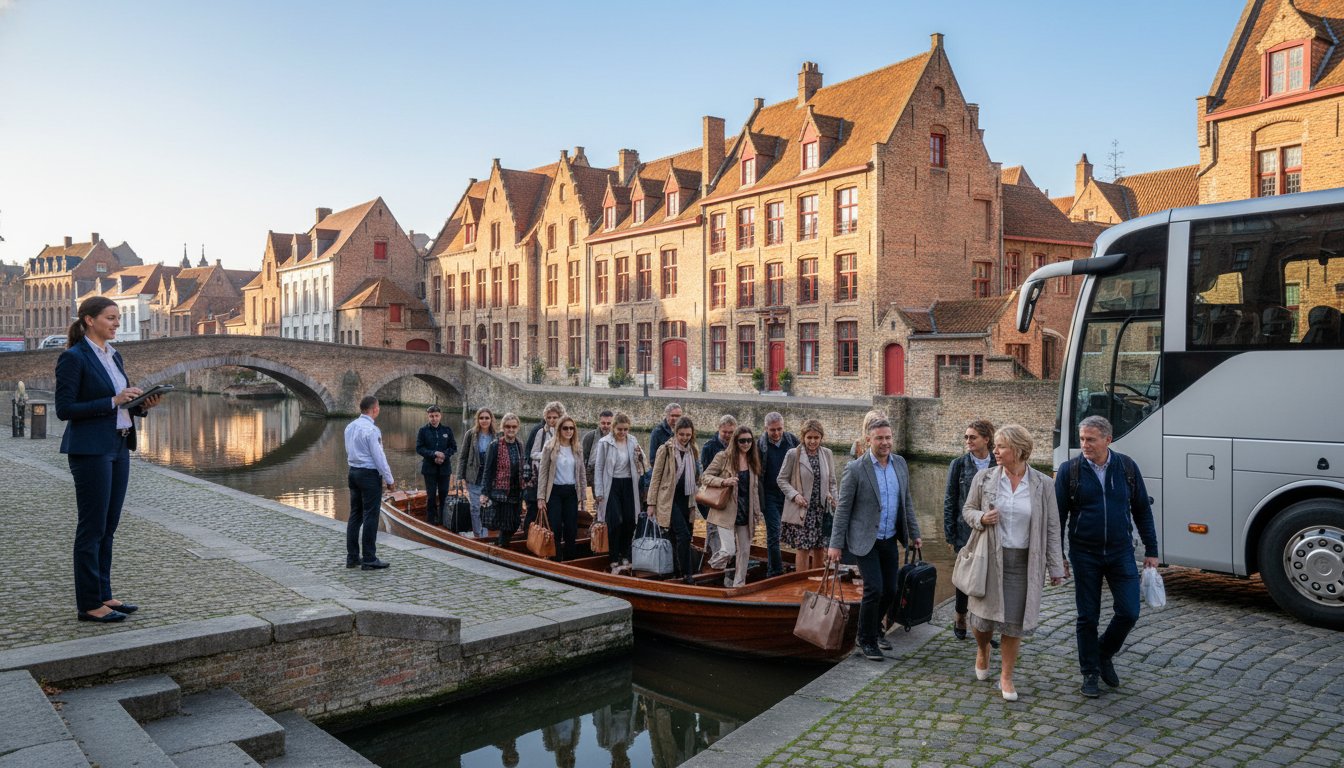
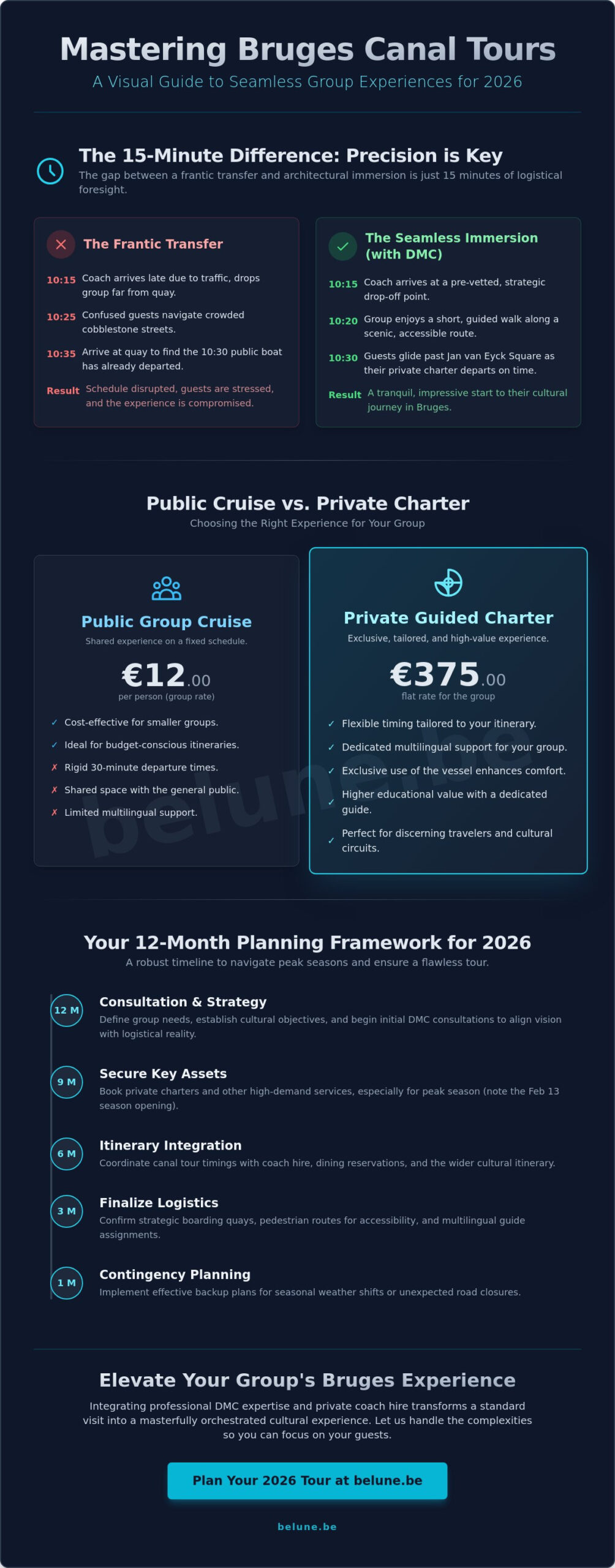
    A coach arrives at the terminal at 10:15 AM; by 10:30 AM, forty guests are already gliding past the Jan van Eyck Square. This level of precision isn’t accidental. The difference between a frantic transfer and a moment of pure architectural immersion often comes down to exactly fifteen minutes of logistical foresight. We understand that managing bruges canal tours for groups requires more than just a ticket; it demands a vision where every transition feels effortless.

    You likely know the frustration of aligning a rigid 30-minute boat departure with the unpredictable flow of group dining and traffic. It’s a delicate balance of timing and local intuition. This article shows you how to master these complexities by integrating professional DMC expertise into your 2026 planning. You’ll discover how to leverage the February 13 opening season and secure the €12.00 group rate or a €375.00 private charter to create a seamless, high-quality experience.

    We’ll examine the specific 2026 regulations, the best strategies for multi-language groups, and how to pair these aquatic journeys with a wider cultural itinerary that satisfies the most discerning travelers.

    Key Takeaways

    • Learn why the UNESCO World Heritage waterways serve as a curated canvas for your group’s cultural narrative, offering more than just a scenic view.
    • Master the timing of bruges canal tours for groups by identifying strategic boarding quays that facilitate seamless coach-to-boat transitions.
    • Discover the distinct advantages of private charters over public cruises for ensuring dedicated multilingual support and higher educational value.
    • Establish a robust 12-month planning framework to navigate peak season demand and implement effective contingency plans for seasonal weather shifts.
    • Explore how integrating professional DMC expertise and private coach hire transforms a standard visit into a masterfully orchestrated cultural experience.

    The Timeless Allure of Bruges Canal Tours for Groups

    Bruges isn’t just a city; it’s a living canvas of stone, light, and water. For tour operators, bruges canal tours for groups represent the most direct way to immerse guests in the “Venice of the North.” This UNESCO World Heritage site offers a labyrinth of waterways that dictated the city’s wealth and layout centuries ago. These canals are the very veins of the city, providing a curated journey through a medieval landscape that has remained remarkably intact. It’s a foundational experience that transforms a standard visit into a masterclass in architectural appreciation.

    These waterways aren’t merely scenic routes for leisure. They serve as the essential narrative thread for any high-capacity cultural circuit through the historic city of Bruges. From the water, the medieval architecture reveals nuances and details invisible from the cobblestone streets. It’s the cornerstone of a successful Benelux itinerary, offering a unique vantage point that highlights the grandeur of the city’s golden age while providing a necessary logistical anchor for large parties. The perspective from the water level sublimates the city’s scale, making the towering spires and intricate facades feel both intimate and immense.

    To better understand the unique perspective these waterways provide, watch this helpful video:

    Historical Significance for Cultural Groups

    The waterways were the pulse of the 14th-century Golden Age, carrying lace, wool, and spices to the heart of Europe. On bruges canal tours for groups, visitors see the water-level entrances where goods were once hoisted directly into warehouses. This perspective highlights the ingenuity of medieval urban planning. Certain landmarks, like the secluded gardens of the Beguinage or the weathered foundations of merchant houses, only reveal their true character to those on the water. For art and history enthusiasts, the boat becomes a moving classroom where the city’s timeline unfolds bridge by bridge.

    The Emotional Impact of Waterborne Sightseeing

    The atmosphere in Bruges is a curated blend of silence, light, and stone. As the boat maneuvers through the narrow passages, the interplay of light on the green-tinted water and the weathered red bricks creates a cinematic quality. Passing beneath the low arches of the 14th-century Meebrug and Peerdenbrug bridges creates a sensory shift that grounds the traveler. It’s a moment of refined tranquility. Within a packed travel schedule, these thirty minutes offer a necessary pause, allowing guests to absorb the harmony of the environment before continuing their journey.

    Efficiency is the silent partner of elegance. When managing bruges canal tours for groups, the logistical chain begins long before the first guest steps onto the mahogany deck. It starts at the city’s perimeter. For high-capacity itineraries, identifying the right boarding quays is paramount to avoiding the congestion often found at Jan van Eyck Square. While this square offers a stunning backdrop, its popularity requires a strictly timed entry strategy to ensure your schedule remains intact. A professional DMC acts as the conductor here, synchronizing the arrival of a 50-seater coach with the immediate availability of a private vessel.

    Accessibility remains a cornerstone of professional planning. The historic center, a recognized UNESCO World Heritage Site, presents challenges for senior groups or those with limited mobility. Navigating medieval cobblestones to reach the water requires a nuanced approach. Selecting quays with the fewest steps and providing clear, level pedestrian routes is essential. We’ve found that a well-orchestrated transfer doesn’t just save time; it preserves the guests’ energy for the cultural immersion that follows.

    Coach Parking and Pedestrian Coordination

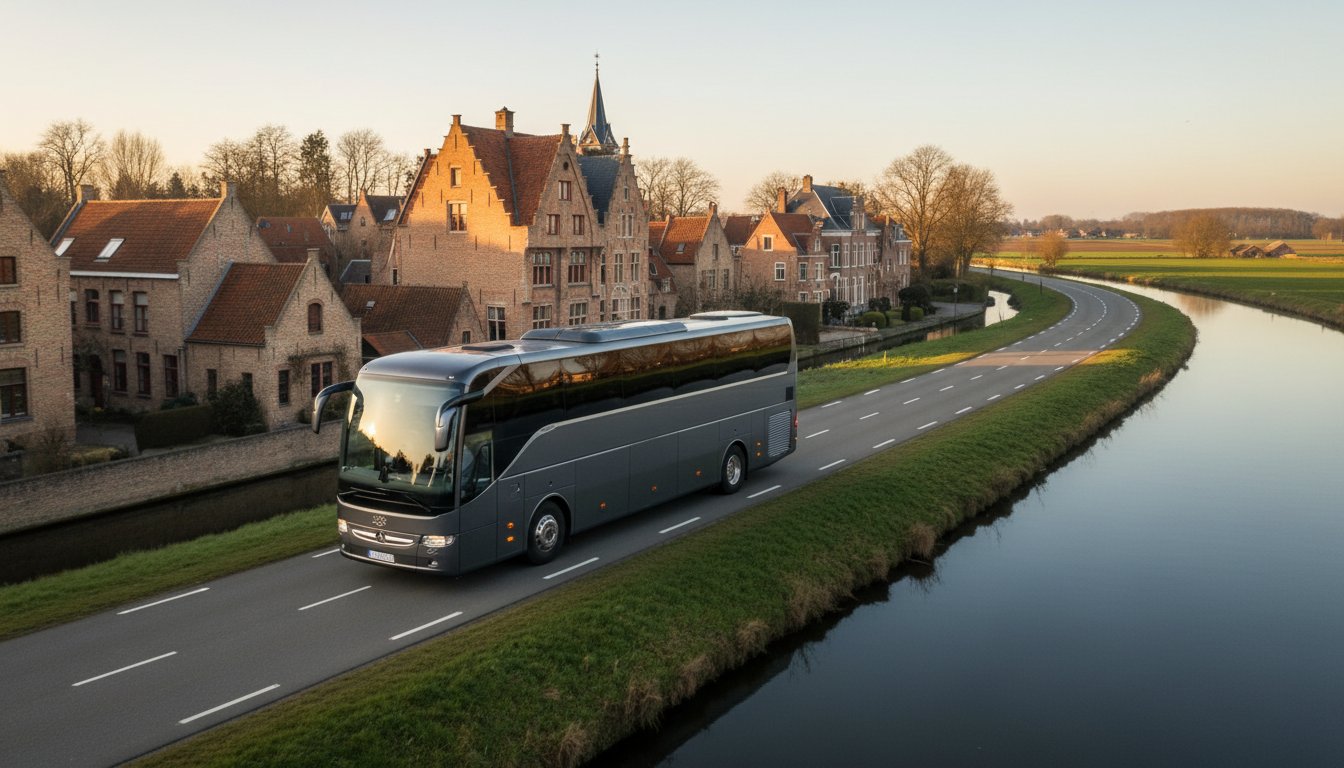
    Most group journeys begin at the Bargeplein coach park. It’s located on the city’s southern edge, approximately 1.5 kilometers from the primary canal departure points. For groups exceeding 40 people, a staggered boarding strategy is the only way to maintain a sense of exclusivity. Rather than a mass influx, guests arrive in smaller waves. This is where our bespoke coach hire services provide a distinct advantage, allowing for direct, flexible transfers that align perfectly with boat departure windows.

    Synchronized Timing for Multi-Activity Days

    A 30-minute cruise is a brief but intense sensory experience. It must be anchored precisely between other itinerary pillars, such as a gastronomy tour or a museum visit. We recommend a 20-minute “buffer window” before boarding. This time accounts for group restroom breaks and the inevitable photo opportunities that arise when first encountering the Belfry view. Clear communication between the coach driver and the boat captain ensures that the vessel is ready the moment the group arrives. This eliminates the wait time that can often disrupt the rhythm of a high-end cultural tour.
    Bruges Canal Tours for Groups: A Masterclass in Logistical Excellence for 2026

    Comparing Group Experiences: Public Cruises vs. Private Guided Charters

    The choice between a standard public cruise and a private charter is the choice between mere sightseeing and profound storytelling. While public tours offer a glimpse of the city, they often compromise the integrity of a high-end itinerary. For bruges canal tours for groups, the “hop-on” nature of public boats means your guests are often seated alongside random travelers, diluting the group’s collective focus. A private charter elevates the experience to a bespoke event. It reinforces your brand’s commitment to quality by offering an environment where the architecture and history are the sole protagonists. This exclusivity isn’t just about comfort; it’s about maintaining the narrative flow of your curated journey.

    Flexibility is the hallmark of a private arrangement. Public departures follow a rigid, unyielding pulse that waits for no one. In contrast, a private charter allows for subtle adjustments in timing, ensuring that the transition from the coach to the water remains fluid. This logistical freedom is essential when managing tight schedules between cultural landmarks and gastronomy experiences. It transforms a potential bottleneck into a seamless highlight of the day.

    The Benefit of Dedicated Professional Guides

    Communication is the bridge to cultural understanding. In a city as layered as Bruges, a multilingual local guide isn’t a luxury; it’s a necessity. Unlike the pre-recorded or generalized commentary found on public boats, a private guide tailors the narrative to the group’s specific interests. Whether the focus is on the 14th-century trade routes or the intricacies of Flemish Primitives, the depth of information is significantly higher. This expertise is particularly vital for culture group tours benelux, where the historical context of the Low Countries requires a nuanced, expert voice to truly resonate with international guests. A dedicated guide ensures that no detail is lost in translation.

    Customising the On-Board Experience

    Exclusivity allows for sensory layers that public tours simply cannot provide. Imagine your group gliding under the historic bridges while sampling a curated selection of local Trappist beers or artisanal chocolates. These additions transform a 30-minute transit into a multisensory masterclass. Private charters also offer the logistical freedom to request “quiet zones” for reflection or specific photography pauses near the Church of Our Lady. As your strategic partner, we act as the bridge between your vision and local boat owners. We negotiate these bespoke details to ensure every moment on the water feels like a deliberate, handcrafted experience that exceeds the expectations of your most discerning clients.

    Essential Planning Framework for Professional Tour Operators

    Precision in planning isn’t just a preference; it’s a structural necessity. For the 2026 peak season, which spans from April through September, we recommend a 12-month planning horizon. This foresight ensures availability at the most desirable quays and secures the preferred departure windows that align with your broader itinerary. When managing bruges canal tours for groups, the margin for error is slim. Early booking allows us to weave the waterborne journey into the day’s rhythm with the accuracy of a master artisan.

    Operational integrity also relies on a firm grasp of regional legalities. Group activities in the Benelux region must adhere to specific insurance and safety standards, particularly concerning waterborne transport. We prioritize fixed-price packages to maintain your operator margins. This approach protects your budget against seasonal fluctuations and ensures that the end-client receives a consistent, high-quality experience without the disruption of hidden surcharges or last-minute fee adjustments.

    Step-by-Step Booking Timeline

    • Step 1: Define the group profile. This includes finalizing the exact passenger count and specifying the required languages for the guide to ensure total cultural immersion.
    • Step 2: Secure coach parking permits. At this stage, it’s vital to synchronize with a benelux incoming tour operator to align the fleet arrival with the boat’s quay manifest.
    • Step 3: Confirm final passenger counts exactly 14 days prior to arrival. This deadline is essential for finalizing manifests and ensuring the boarding process remains swift and professional.

    Risk Management and Contingency Plans

    Contingency planning is where local expertise truly shines. Open-top boat operations are tied to the elements. While the 2026 season is confirmed from February 13 to December 30, extreme weather or scheduled canal maintenance can occasionally necessitate a “Plan B.” Whether it’s an exclusive gallery visit or a private chocolate masterclass, having a pre-verified alternative is non-negotiable. Our team provides 24/7 on-the-ground assistance. We handle real-time logistical shifts so that your group leaders can focus entirely on the guest experience. To ensure your 2026 itineraries are built on a foundation of logistical excellence, request a consultation with our planning team.

    Elevating Group Travel with BELUNE’s Destination Management

    At BELUNE, we view ourselves as the architect of light and travel. We don’t just facilitate movement; we design the atmosphere in which your guests experience the heart of Europe. Excellence in bruges canal tours for groups isn’t an isolated event. It’s a single, luminous thread within a larger tapestry of service. Our approach integrates these iconic waterborne journeys into sophisticated themed group travel benelux programs. Whether the focus is on the interplay of shadow and stone in medieval architecture or the vibrant energy of a gastronomy circuit, we ensure the transition from land to water is effortless.

    Our A to Z service model removes the friction of coordination. We manage everything from high-capacity accommodation bookings to the selection of local guides who possess a deep, artisanal knowledge of their craft. This holistic management allows tour operators to provide a seamless narrative for their clients. Every detail, from the first hotel check-in to the final canal departure, is handled with a rigueur that inspires absolute confidence. We transform the logistical burden into a masterfully orchestrated experience where the only thing your guests need to focus on is the beauty of the city.

    A Fleet of Modern Coaches for Seamless Transfers

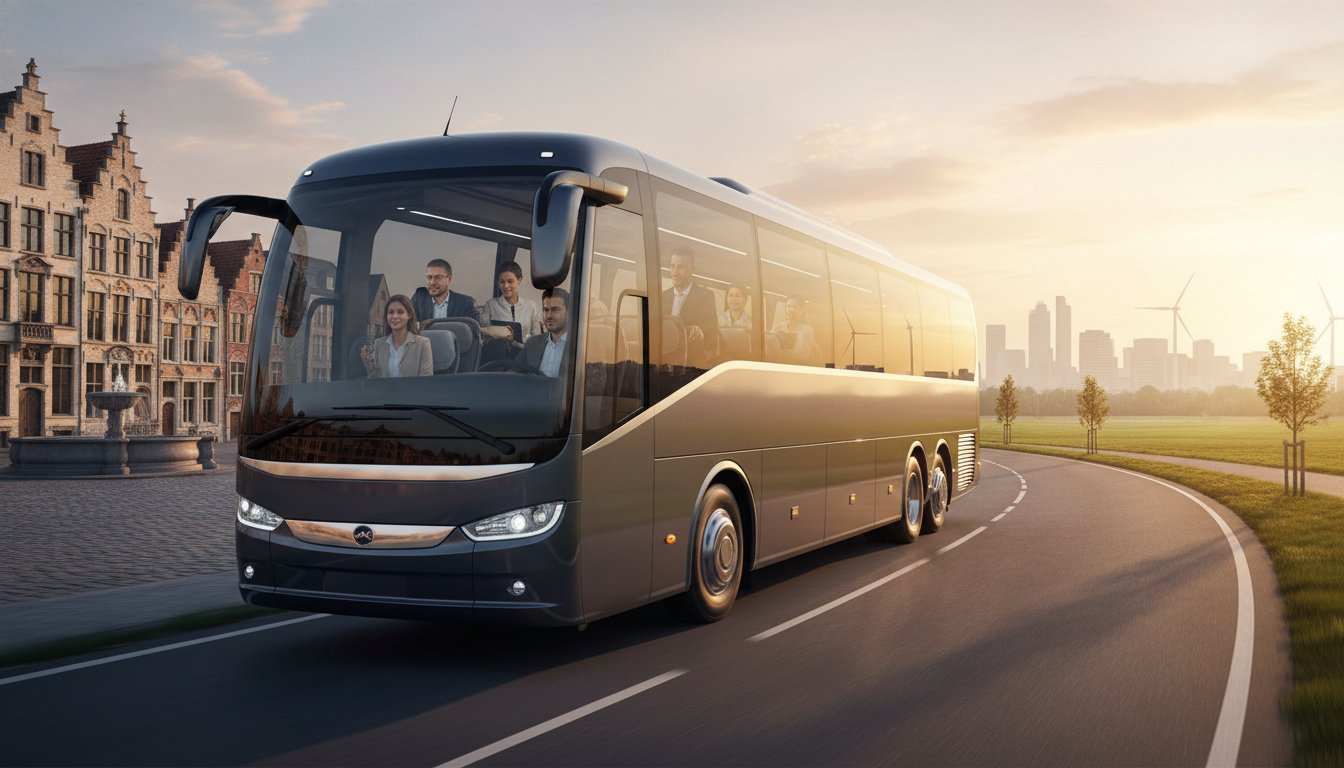
    The journey begins on the road. Our own fleet of modern coaches represents the pinnacle of comfort and reliability. Having a dedicated BELUNE driver simplifies the complex logistics of city-centre drop-offs, ensuring your group arrives at the quay refreshed and on time. This synergy between land and water transport is what defines our commitment to excellence. All our transport solutions meet the highest European safety and environmental standards. This commitment to quality ensures that the physical journey is as refined as the cultural one.

    Your Strategic Partner for Benelux and Beyond

    True expertise is measured in decades. We invite you to leverage over 20 years of experience in regional group travel. By choosing BELUNE, you gain a single point of contact for complex, multi-city itineraries spanning Bruges, Ghent, Brussels, and Amsterdam. This centralized coordination eliminates the fragmentation that often plagues international tours. We’re not just a supplier; we’re a visionary ally in the creation of exceptional architectural and cultural projects. Contact us today to request a customized, fixed-price group itinerary and experience the masterclass in logistical excellence your clients deserve.

    Orchestrating Exceptional Journeys for 2026

    Mastering the intricacies of bruges canal tours for groups requires more than a simple booking; it demands a vision of harmony between land and water. We’ve explored how a 12-month planning horizon and the strategic use of private charters transform a standard visit into a refined cultural event. By prioritizing accessibility and synchronized coach transfers, you ensure that every guest experiences the city’s medieval soul without the friction of logistical delays.

    As a specialized DMC, BELUNE brings over 20 years of Benelux expertise to your most ambitious projects. Our private fleet of modern coaches and dedicated local guides provide the technical rigueur necessary to sublime every itinerary. We act as your strategic partner, managing every nuance from accommodation to on-board catering. It’s time to elevate your offerings from simple sightseeing to a masterclass in travel design. Partner with BELUNE to design your next bespoke group itinerary and discover the difference that professional orchestration makes. Your vision deserves a foundation of excellence.

    Frequently Asked Questions

    Can canal tours in Bruges accommodate groups of more than 50 people?

    Yes, we manage large-capacity arrivals by coordinating multiple vessels simultaneously. Since standard boats typically accommodate 35 to 40 passengers, a group of 60 would utilize two boats departing in tandem. This ensures the entire party experiences the city’s harmony together. For bruges canal tours for groups exceeding 100 travelers, we implement a staggered boarding schedule at primary quays to maintain logistical fluidity and guest comfort.

    Is it possible to book a private canal boat with a guide who speaks a specific language?

    Private charters are the only way to guarantee a dedicated multilingual professional for your group. While public tours offer generalized commentary, a private booking allows us to assign a local expert fluent in your guests’ native tongue. This is essential for cultural groups who require technical depth. We currently coordinate guides in over 10 languages to ensure every nuance of the city’s history is perfectly communicated.

    What is the best time of day for groups to avoid the crowds on the canals?

    Optimal tranquility is found before 11:00 AM or in the late afternoon after 4:00 PM. During these windows, the light hits the medieval brickwork with a specific softness that’s perfect for photography. Midday often sees a 40% increase in quay congestion due to day-trippers from Brussels. By scheduling your group outside these peak hours, we preserve the refined tranquility that makes the experience so memorable for high-end travelers.

    How far is the coach parking from the main boat departure points?

    The primary coach terminal at Bargeplein is approximately 1.5 kilometers from the central boarding quays. This walk takes a group roughly 20 minutes at a moderate pace. We recommend utilizing our private coach fleet for drop-and-go maneuvers near the city perimeter when local regulations allow. This reduces pedestrian fatigue and ensures your guests arrive at the water level with their energy fully intact for the tour.

    Are the boats covered in case of rain during a group tour?

    Most vessels are open-top to ensure they can pass safely under the 14th-century stone bridges. While some operators provide umbrellas, we treat rain as a logistical variable that requires a Plan B. In the event of persistent downpours, we leverage our local partnerships to pivot the itinerary toward indoor cultural masterclasses. This proactive management ensures that weather never diminishes the quality of a professionally orchestrated bruges canal tours for groups.

    Can we combine a canal tour with a group lunch or chocolate tasting?

    We specialize in weaving these sensory layers into a single, cohesive itinerary. A 30-minute cruise serves as the perfect transition between a morning of architectural discovery and a curated gastronomy experience. We coordinate with local artisans and restaurants near the quays to ensure your group moves seamlessly from the boat to a private chocolate atelier or a canal-side dining room without any wasted transit time.

    What happens if our group is delayed due to traffic or coach issues?

    Real-time communication is our safeguard against the unexpected. Our team provides 24/7 assistance, acting as the bridge between your coach driver and the boat captain. If traffic on the E40 motorway causes a 15-minute delay, we negotiate the departure window in real-time. This flexibility is a hallmark of our DMC service, ensuring that a minor delay doesn’t result in a missed experience or a fractured schedule.

    Is there a discounted rate for large groups or professional tour operators?

    Verified 2026 rates for groups of 20 or more people are set at €12.00 to €14.00 per person. These professional rates offer a significant advantage over the €15.00 individual adult ticket. For B2B partners, we manage these bookings as part of a fixed-price package. This approach protects your margins and ensures that the financial aspect of the tour remains transparent and predictable from the initial planning phase.
  • Benelux Group Tour Highlights for Travel Operators: A 2026 Strategy Guide

    Benelux Group Tour Highlights for Travel Operators: A 2026 Strategy Guide

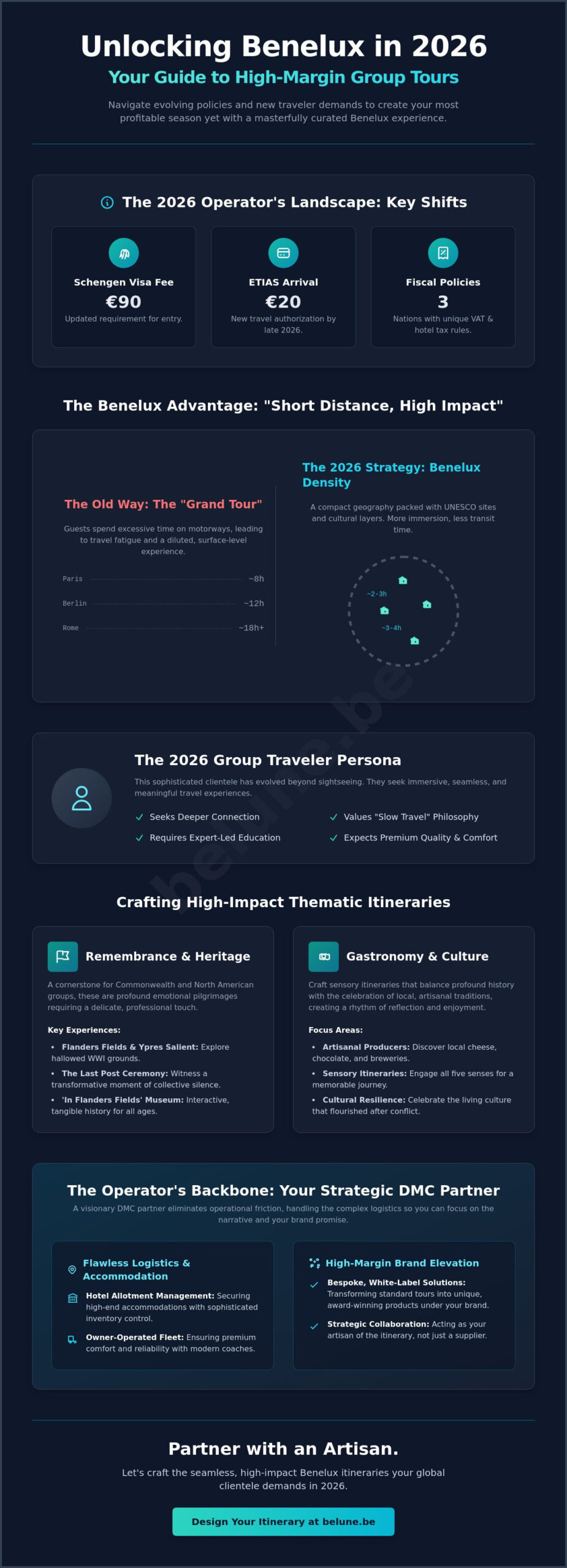
    How can evolving fiscal policies, such as adjustments to accommodation VAT and hotel taxes within the region, actually lead to your most profitable season yet? You’ve likely felt the pressure of shifting regulations, from the €90 Schengen visa fee to the new €20 ETIAS requirement arriving in late 2026. Designing a journey across three distinct national frameworks requires more than just a map. It demands a mastery of the finer details. Identifying the right Benelux group tour highlights for travel operators is no longer about following the crowds. It’s about curating an experience where logistical precision meets artistic vision.

    We understand that your reputation rests on the harmony of the itinerary and the reliability of the execution. You’ll discover the essential thematic pillars and logistical secrets that turn standard Benelux itineraries into high-margin, award-winning group travel products. This guide provides a curated list of high-impact experiences, a breakdown of the logistical backbone needed for 2026, and a roadmap to finding a DMC partner who acts as a true strategic ally. We’ll show you how to navigate the complexities of 2026 with the confidence of an artisan.

    Key Takeaways

    • Master the “Short Distance, High Impact” strategy to maximize guest satisfaction by connecting high-density UNESCO sites within a compact, efficient geographic footprint.
    • Identify the most marketable benelux group tour highlights for travel operators, focusing on deep-dive thematic immersion in Remembrance heritage and artisanal gastronomy.
    • Navigate the complex 2026 fiscal and regulatory shifts through a logistical backbone of owner-operated fleets and sophisticated hotel allotment management.
    • Elevate your brand with bespoke, white-label solutions that transform standard itineraries into high-margin, award-winning travel products.
    • Discover how strategic collaboration with a visionary DMC partner eliminates operational friction while stimulating the imagination of your global clientele.

    The Strategic Value of Benelux Group Tours in 2026

    The Benelux region represents a masterclass in spatial efficiency. For travel operators, it offers a rare density of UNESCO World Heritage sites and diverse cultural layers within a remarkably compact geography. This “Short Distance, High Impact” advantage means guests spend less time on motorways and more time immersed in the actual benelux group tour highlights for travel operators. It’s an architecture of travel where every hour is purposeful. As we approach 2026, Western Europe is seeing a definitive recovery in premium group bookings, with travelers seeking depth over distance.

    In 2026, the market is moving away from the frantic pace of the “Grand Tour.” We’re witnessing a sophisticated shift toward curated, thematic experiences. This evolution isn’t just about visiting a city; it’s about understanding its light, its textures, and its history through the Benelux Union‘s unique cross-border synergy. It’s a region where the nuance of a single canal house can be as captivating as a royal palace.

    To better understand this concept, watch this helpful video:

    Why Operators Prioritize the Benelux Region

    Diversifying beyond the saturated markets of Italy or France is essential for portfolio health. The Benelux countries offer deep repeat-client potential. A guest who explored the Flemish Primitives in Bruges often returns to discover the innovative water management of the Netherlands. When you partner with a specialized incoming expert, the logistical friction of crossing three national borders vanishes. It allows you to focus on the narrative while we handle the technical precision of the journey. We act as your artisans of the itinerary, ensuring every transition is seamless.

    Defining the 2026 Group Travel Persona

    The 2026 traveler seeks a deeper connection. They don’t just want to see a battlefield; they want an expert-led educational experience that honors the emotional weight of history. They expect the “Slow Travel” philosophy, even in a multi-country itinerary. This means longer stays in high-end accommodations and seamless transport. Our own fleet of modern coaches ensures this standard is met without compromise. Every detail, from the clarity of the guide’s commentary to the comfort of the seats, must reflect the premium quality your brand promises.

    Remembrance and Heritage: High-Impact Thematic Highlights

    Remembrance tourism remains a cornerstone of the European travel market, particularly for groups from the Commonwealth and North America. These aren’t mere sightseeing stops; they are profound emotional pilgrimages that require a delicate, professional touch. Identifying the right benelux group tour highlights for travel operators often starts with these hallowed grounds. In 2026, the demand for authentic, narrative-driven history is higher than ever. Operators who successfully weave these stories into a broader cultural fabric create products with lasting resonance and high repeat value.

    Integrating heritage sites into a wider itinerary requires a sense of harmony. You don’t want to overwhelm guests with grief, yet you mustn’t diminish the significance of the history. We recommend balancing a morning at a cemetery with an afternoon exploring the local artisanal traditions found on the official tourism website for Flanders. This approach respects the gravity of the past while celebrating the resilience of the present. It creates a rhythm that allows for reflection without exhaustion. Expert local guidance is non-negotiable because only a specialist can translate silent landscapes into the visceral human narratives that define battlefield tourism.

    WWI: Flanders Fields and the Ypres Salient

    The Last Post Ceremony at the Menin Gate in Ypres is a transformative experience for any group. It’s a moment of collective silence that bridges generations, held every evening at 8:00 PM without fail. For modern educational groups, the ‘In Flanders Fields’ Museum offers an interactive lens that makes history tangible through personal stories and digital archives. To ensure your itinerary meets these high emotional standards, consult our Flanders Fields: The Definitive Guide for deeper insights into organizing successful group pilgrimages.

    WWII: The Battle of the Bulge and Bastogne

    The Ardennes region serves as a stark reminder of the strategic intensity of WWII. For history-focused groups, the Bastogne War Museum and the Mardasson Memorial are essential pillars of any itinerary. Operators can add a layer of exclusivity by arranging visits to private collections or meeting with local historians who provide a first-hand perspective on the region’s liberation. This contrast between sombre history and the lush, natural beauty of Wallonia creates a powerful narrative arc for the traveler. It’s about finding light within the shadows of the past. If you’re looking to elevate your next historical itinerary, we invite you to explore our specialized Battlefield Tourism services.

    Benelux Group Tour Highlights for Travel Operators: A 2026 Strategy Guide

    Gastronomy and Culture: Crafting Sensory Itineraries

    Taste and vision serve as the silent narrators of any high-end journey. To truly capture the essence of the region, we must look beyond the clichés of street waffles and generic souvenirs. In 2026, sophisticated travelers demand a deeper connection to local craftsmanship. This shift toward sensory immersion provides some of the most compelling benelux group tour highlights for travel operators looking to differentiate their portfolios. By focusing on the intersection of culinary innovation and historical artistry, you transform a standard trip into a bespoke narrative that resonates long after the flight home.

    Creating “Instagrammable” moments is now a strategic necessity for modern tour marketing. It isn’t just about the photo; it’s about the atmosphere. The way North Sea light hits a 17th-century canal house or the precise tempering of a dark chocolate ganache creates a visual story that guests are eager to share. These moments act as organic testimonials for your brand. In a year where Dutch VAT on short-stay accommodation has reached 21%, providing high-value, sensory-rich experiences is the key to maintaining guest satisfaction. We focus on the nuance of the experience to ensure every dollar spent feels justified by the quality of the encounter.

    The Belgian Beer and Chocolate Masterclass

    Brewery visits and chocolate workshops consistently rank as the highest-rated activities for international groups. However, the secret lies in exclusivity. We provide access to “off-limits” Trappist locations where production still follows centuries-old monastic traditions. Similarly, our chocolate workshops allow guests to work alongside master chocolatiers in private artisan studios rather than crowded tourist centers. These deep-dives into liquid gold and cocoa are essential benelux group tour highlights for travel operators. To see how these elements can be woven into a professional itinerary, explore our dedicated Belgium Gastronomy Tours page.

    Art and Architecture: From Rembrandt to Modernism

    The transition from the Flemish Primitives in Bruges to the Dutch Masters in Amsterdam offers a masterclass in the evolution of light and shadow. Operators can elevate these tours by including private museum access or expert-led architectural walks through Brussels’ Art Nouveau districts. For many groups, incorporating Paris as a logical extension provides a complete Western European art narrative. This seamless cross-border flow is a hallmark of a well-designed product that respects the traveler’s time and curiosity. For a deeper dive into these cultural frameworks, consult The Ultimate Guide to Culture Group Tours.

    The Operator’s Backbone: Logistics and Accommodation

    Behind every award-winning itinerary lies a skeleton of absolute technical rigour. It is the silent architecture that supports the beauty of the journey. For travel operators, the true challenge in 2026 isn’t just selecting destinations; it’s mastering the logistical friction inherent in three distinct national frameworks. From the €5 per night Brussels tourist tax to the Dutch VAT surge to 21% on short-stay accommodation, the fiscal landscape is shifting rapidly. Identifying the right benelux group tour highlights for travel operators requires a partner who treats these complexities as a material to be mastered, not a hurdle to be cleared.

    Managing the “unseen” logistics is where professional expertise becomes visible. We handle the intricate details of parking permits in historic city centres, the strict monitoring of driver hours, and the ever-evolving cross-border regulations. This technical precision ensures that your guests remain in a state of inspired reflection rather than logistical frustration. When the “backbone” is strong, the narrative of the tour can truly shine. To secure this level of operational excellence for your next project, explore our coach hire and accommodation management services.

    Elite Transportation: The BELUNE Fleet Standard

    Risk mitigation begins with asset control. Using a DMC with its own fleet, like BELUNE, eliminates the uncertainty of third-party reliability. Our modern coaches are designed to be mobile sanctuaries, featuring high-speed Wi-Fi, ergonomic seating, and full environmental compliance for Europe’s strictest low-emission zones. Our professional local drivers are more than just operators; they are experts in regional road networks who ensure every transition is fluid. This ownership of the transport chain allows us to guarantee a standard of safety and comfort that reflects your brand’s premium promise.

    Group-Friendly Hotel Management

    Sourcing the right hotel is an exercise in balance. We seek out properties that offer the sophistication your clients expect while providing the coach accessibility and group-friendly infrastructure required for seamless operations. In 2026, navigating the complex hotel allotment landscape is particularly demanding due to the 12% VAT rate in Belgium and the 12.5% tourist tax in Amsterdam. We manage these financial nuances and dietary requirements for diverse international groups with surgical precision. For a deeper understanding of how to select the right partner for these tasks, consult our guide on Choosing a Benelux Incoming Tour Operator.

    Expert local guides serve as the final, essential bridge. They translate the silence of a landscape or the complexity of an art piece into a human experience. By providing multi-lingual specialists who understand the cultural nuances of your specific group, we ensure the benelux group tour highlights for travel operators are not just seen, but deeply understood. This is the craftsmanship of travel.

    Partnering for Success: Custom Itineraries with BELUNE

    The era of generic, “off-the-shelf” packages has faded. In its place, a new demand for white-label, bespoke solutions has emerged. For the 2026 season, the most profitable benelux group tour highlights for travel operators are those that feel personal, exclusive, and perfectly aligned with a brand’s unique identity. We don’t just provide a service; we act as a visionary ally. With 20 years of technical expertise in the region, we’ve refined the art of the incoming partner, turning logistical complexity into a seamless narrative for your guests.

    Our “A to Z” service model ensures that no detail is left to chance. From the initial conceptual drawing of an itinerary to the final moment a guest boards their return flight, we’re the silent architects of the experience. This comprehensive support allows you to focus on your clients while we master the nuances of the terrain. We invite you to co-create the next generation of Benelux travel products, where every stop is chosen for its ability to inspire and every transition is handled with surgical precision.

    The Customization Process

    Collaborative itinerary building is a dialogue between your brand’s vision and our local mastery. We match specific themes, such as the Art Nouveau districts of Brussels or the innovative water management systems of the Netherlands, to your specific market segment. In a market currently fluctuating due to the 21% Dutch VAT on accommodation or the new ETIAS regulations arriving in late 2026, we offer fixed-price guarantees. This provides the budget certainty you need to market your portfolio with confidence. To explore how these themes can be structured, see our guide on Themed Group Travel in Benelux.

    Seamless Execution and Support

    True luxury is found in the absence of friction. We provide 24/7 on-the-ground support to ensure total peace of mind during tour execution. Whether it’s a last-minute adjustment to a museum entry or a specific dietary requirement at a Michelin-starred venue, our team is always present in the shadows, ensuring everything remains in harmony. Our local guide services are a critical component of this, elevating the guest experience through deep, human storytelling. These experts turn the benelux group tour highlights for travel operators into visceral memories that drive high guest satisfaction scores.

    The future of group travel in Western Europe belongs to those who prioritize quality, innovation, and reliability. We’re ready to help you build that future. Contact BELUNE today to begin planning your 2026 group tour portfolio and discover the impact of a truly strategic partnership.

    Designing the Future of Benelux Group Travel

    Mastering the 2026 landscape requires a blend of artistic vision and technical rigour. We’ve explored how spatial efficiency allows for high-impact itineraries and why deep thematic immersion in heritage and gastronomy is the key to premium differentiation. Success in this region depends on a logistical backbone that can navigate shifting fiscal regulations with ease. It’s about creating a journey where the technical details remain silent; allowing the emotion of the experience to take centre stage for every guest.

    Identifying the most profitable benelux group tour highlights for travel operators is only the first step. Execution is where your brand promise is truly fulfilled. With over 20 years of DMC experience, a private fleet of modern coaches, and specialized expertise in battlefield and cultural tourism, we provide the stability your portfolio needs. It’s time to transform these strategic insights into reality. Request a Bespoke Benelux Itinerary for Your 2026 Portfolio and let us help you sublimer every mile of your guests’ journey. The Benelux region is ready to be rediscovered through your vision.

    Frequently Asked Questions

    What are the essential highlights for a first-time Benelux group tour?

    The essential benelux group tour highlights for travel operators include the Amsterdam canal ring, the medieval core of Bruges, and Brussels’ Grand Place. These sites provide a foundational narrative of European history and commerce. We recommend pairing these with a visit to the Delta Works in the Netherlands to showcase modern innovation alongside historical architecture. This combination ensures a balanced, high-impact introduction to the region’s diversity.

    How do travel operators benefit from using a local DMC in Belgium and the Netherlands?

    Using a local DMC provides immediate mastery over regional complexities like the 21% Dutch VAT on short-stay accommodation. We act as a strategic ally, managing the “unseen” logistics from parking permits to driver hours. This local presence ensures that any on-the-ground shifts are handled with surgical precision. It transforms a standard itinerary into a seamless, high-margin product for your portfolio.

    What is the best time of year for group travel in the Benelux region?

    The optimal period for group travel is between April and June or during the vibrant months of September and October. Spring offers the iconic bloom of the Keukenhof gardens, while autumn provides stable weather and a rich calendar of cultural festivals. Traveling during these shoulder seasons helps operators avoid the peak summer crowds. It also ensures better availability for high-end hotel allotments in historic city centers.

    Can BELUNE manage group tours that extend into Paris?

    We certainly manage seamless extensions into Paris for groups seeking a broader Western European narrative. Paris serves as a natural artistic conclusion to an itinerary focused on the Flemish Primitives and Dutch Masters. Our logistical framework covers the entire corridor, ensuring that transport and accommodation standards remain consistent across the border. It’s a sophisticated way to add value to a standard Benelux circuit.

    What types of specialized themes can be incorporated into a Benelux itinerary?

    Specialized themes range from immersive Battlefield tourism in Flanders and the Ardennes to high-energy tours for the F1 Grand Prix at Spa-Francorchamps. We also design deep-dives into Belgian beer culture and artisanal chocolate production. For active groups, cycling tours through the rolling landscapes of Luxembourg offer a unique perspective. These niche themes are the most effective benelux group tour highlights for travel operators to differentiate their offerings.

    How does BELUNE ensure the quality of its coach fleet and drivers?

    Quality is guaranteed through our owner-operated model, which eliminates the risks associated with third-party sub-contracting. Our fleet consists of modern coaches equipped with Wi-Fi and ergonomic seating, all meeting the latest Euro 6 environmental standards. Drivers are local professionals with deep knowledge of regional road networks and multi-lingual capabilities. This technical rigour ensures that guest safety and comfort are never compromised.

    What is the typical group size for Benelux customized tours?

    Customized tours are most effective for groups ranging from 15 to 35 participants. This size allows for the intimacy required in artisanal workshops or private museum visits while remaining logistically efficient for our coach fleet. It strikes a perfect balance between high-end personalization and the economies of scale needed for profitable group travel. We tailor every detail to match your specific brand persona.

    How far in advance should travel operators book group hotel allotments in Benelux?

    Operators should secure hotel allotments at least 10 to 12 months before the departure date. With the 2026 implementation of new tourist taxes and VAT increases, the competition for group-friendly hotels in hubs like Amsterdam and Bruges is intense. Early booking ensures price stability and guarantees accessibility for coaches. We leverage our long-standing relationships with regional hoteliers to secure the best possible terms for our partners.

  • Bicycle Race Logistics: A Masterclass in Group Cycling Itineraries for 2026

    Bicycle Race Logistics: A Masterclass in Group Cycling Itineraries for 2026

    In the Benelux heartlands, a bicycle race isn’t merely a contest of speed; it’s a symphony of logistical precision where the smallest friction can tarnish a masterpiece. You understand that the bridge between an exhausting trip and a legendary journey is built on invisible details. Managing specialized gear transport or securing premium rooms during the May 2026 Race Across Benelux often feels like a grueling climb before the first pedal stroke. With the global cycle tourism market projected to reach 168.13 billion dollars in 2026, the demand for excellence has never been higher.

    We believe that your focus should remain on the rhythm of the road, not the weight of the arrangements. This guide reveals how to elevate these complexities into a seamless, high-end group travel experience that mirrors the sophistication of a professional peloton. We’ll explore expert route navigation, the impact of the new September 1, 2026 Belgian traffic regulations for groups of ten or more, and tailor-made management strategies for the most demanding multi-country itineraries.

    Key Takeaways

    • Discover why the Benelux region serves as the definitive setting for a prestigious bicycle race and how to harness its unique cultural legacy.
    • Master the orchestration of multi-country logistics, from securing high-demand hotel blocks to managing seamless cross-border transport.
    • Learn to design balanced itineraries that blend technical cycling routes with exclusive gastronomic and cultural experiences for a truly high-end journey.
    • Explore how private fleet management and specialized gear transport eliminate the common logistical hurdles of large-scale group travel.
    • Gain long-term peace of mind by partnering with local experts who provide turn-key, fixed-price solutions for your 2026 cycling programs.

    The Legacy of the Bicycle Race: From Cultural Icon to Sporting Reality

    In the heartlands of Western Europe, a bicycle race isn’t just an event; it’s a cultural heartbeat. While global audiences might recall the iconic 1978 Queen single, for the people of Belgium and the Netherlands, it represents a century of grit and glory. Understanding the history of bicycle racing is essential to grasp why this region remains the sport’s undisputed sanctuary. It’s a landscape where the cobblestones tell stories and the wind dictates the strategy of the peloton. We see this heritage not as a relic of the past, but as a living material that shapes how we design group experiences today.

    To better understand the technical nuances of the sport, watch this helpful comparison:

    The transition from a local pastime to a global tourism engine has been profound. By 2026, the global cycle tourism market is projected to reach 168.13 billion dollars. This growth isn’t accidental. It reflects a shift toward travel that values movement, precision, and an authentic connection to the land. For tour operators, 2026 represents a peak opportunity to sublimate these sporting traditions into high-end, turn-key itineraries.

    The Benelux Connection to World Cycling

    Belgium and the Netherlands offer a technical mastery of space that few other regions can match. The Spring Classics aren’t just races; they’re architectural feats of endurance. The region’s infrastructure is designed for this harmony. On September 1, 2026, Belgium will implement a new traffic code. This update specifically refines how groups of ten or more riders interact with the road, allowing them to ride together with greater legal clarity. This commitment to safety and flow makes the Benelux the spiritual and technical home for any serious bicycle race itinerary.

    Why Tour Operators are Prioritising Cycling for 2026

    Tour operators are shifting their focus toward active, health-conscious travel. The demand for “spectator-plus” packages is soaring. These itineraries don’t just watch the race; they live it. They combine the intensity of the ride with the refinement of local gastronomy and sustainable, slow-travel principles. With Europe expected to see a compound annual growth rate of 11.2% in cycle tourism through 2033, the opportunity for exclusive group experiences is unparalleled. It’s about creating a journey where the logistics are as elegant and reliable as the scenery itself.

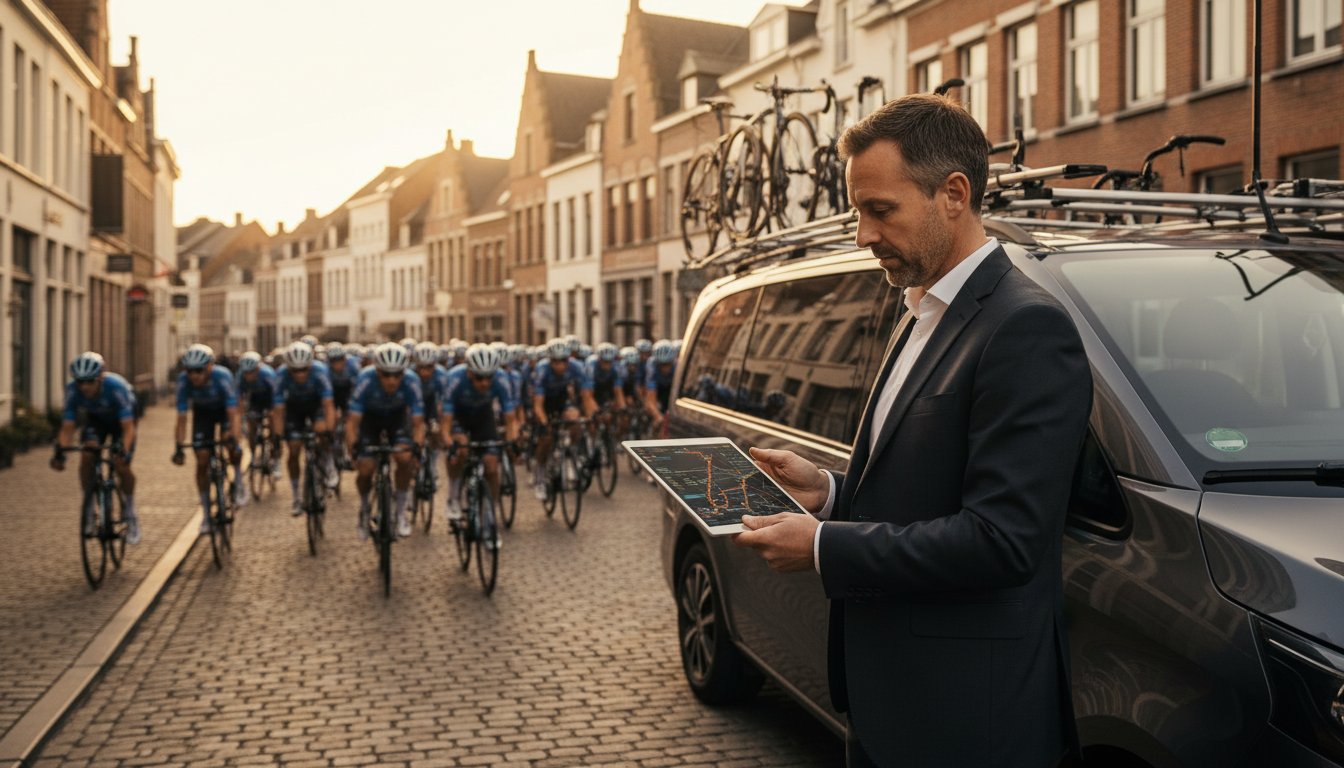
    Orchestrating a group itinerary during a major bicycle race requires more than a map; it demands an intimate understanding of the region’s shifting borders and temporary closures. When the peloton moves through Belgium, France, and the Netherlands, the infrastructure transforms. Roads vanish. Public transport schedules pivot. For international travel agents, the evolution of race logistics has turned a once-simple tour into a high-stakes puzzle of timing and access. We view these challenges as opportunities to craft an experience of absolute fluidity.

    Professional Coach Hire for Cycling Groups

    Safety and comfort are non-negotiable. A modern coach fleet provides a sanctuary for riders between stages. We coordinate driver hours with surgical precision. This ensures compliance with European regulations while maintaining route accessibility during race-day closures. Integrating equipment transport is a technical art. With airline bicycle fees ranging from €40 to €125 per leg on carriers like Air France or KLM, a centralized, secure coach solution becomes a strategic asset. It protects the gear and the guests. Our approach ensures that every transition is silent, swift, and secure.

    Strategic Hotel Accommodation Management

    Securing the right space is a matter of foresight. In Belgium, hotel prices fluctuate between €40 and €300 per night during peak seasons. We prioritize properties that understand the cyclist’s soul. This means secure storage, specialized nutrition, and proximity to the action. For a truly bespoke Benelux experience, we negotiate fixed-price packages long before the first rider departs. This stability allows tour operators to focus on the narrative of the journey, confident that the foundation is secure. We look for harmony between the hotel’s amenities and the group’s technical needs.

    A local partner acts as a visionary guide. On September 1, 2026, the new Belgian traffic code will redefine group riding for ten or more members. Our on-the-ground experts navigate these nuances in real-time. We troubleshoot the invisible friction points before they reach the traveler. This level of care is essential for maintaining the high-end standards that discerning travel agents expect. The result is a journey that feels effortless, where the technical mastery of the back-end allows the beauty of the bicycle race to shine. It’s about creating a seamless bridge between the athlete’s effort and the spectator’s wonder.

    Designing the Perfect Group Cycling Itinerary

    Crafting a superior itinerary is akin to designing a bespoke architectural space; every element must serve a dual purpose of function and emotion. A high-end bicycle race tour shouldn’t be a relentless grind. Instead, it’s a curated sequence of moments. We balance the physical exertion of the morning with the refined leisure of the afternoon. This ensures guests remain engaged, not just exhausted. By weaving together the rhythm of the road with the sensory pleasures of the region, we transform a simple trip into a profound narrative.

    The narrative arc is essential. We start with quiet, winding roads in the Flemish Ardennes and build toward the electric atmosphere of a professional finish line. Navigating the logistical hurdles of a major cycling event is our responsibility, allowing your clients to focus solely on the story unfolding before them. Expert local guides are the key. They reveal hidden paths that avoid the heavy traffic of the main race routes, preserving the intimacy of the group experience while maintaining a professional pace.

    Active Participation Tours: For the Passionate Cyclist

    For those who wish to test their own limits, we map routes that mirror the actual bicycle race paths of the legends. This isn’t merely about distance; it’s about the texture of the cobbles and the angle of the climbs. Safety remains our cornerstone. Every group is shadowed by dedicated support vehicles, ensuring mechanical assistance and nutrition are always within reach. To add a layer of cultural depth, we integrate specialized stops. You can explore our curated themed group travel benelux options to see how we blend high-performance riding with local artisanal discovery.

    Spectator Experiences: Luxury and Access

    Spectatorship should be an exercise in comfort and exclusivity. We arrange VIP access at strategic points, providing prime viewing spots that most travelers never see. This “spectator-plus” model combines the thrill of the race with the sophistication of the region’s culinary scene. By linking the excitement of the peloton with belgium gastronomy tours, we create a full sensory immersion. Local guides provide expert commentary on race tactics, transforming a passing blur of jerseys into a high-stakes chess match. It’s a masterclass in seeing the race from the inside out, where every detail is polished to perfection.

    Overcoming the Logistical Hurdles of Group Travel

    The perceived difficulty of managing a large group during a major bicycle race often deters tour operators. We view this complexity as a technical canvas rather than a barrier. Standard rentals lack the precision required for high-end travel; they’re built for the masses, not for the specific needs of a peloton. A private fleet allows for a sur-mesure approach where every storage bay is optimized for the traveler’s comfort and the machine’s safety. It’s about creating harmony between the guests and their equipment through deliberate conception.

    Safety across international borders is our signature. Navigating the legal nuances of the Benelux region requires a visionary’s foresight and a technician’s rigor. We handle the insurance and compliance hurdles that vary between Belgium and the Netherlands, ensuring every mile is covered by professional standards. Whether we’re assisting elite athletes or casual enthusiasts, our goal is to transform the logistical burden into a seamless flow. We manage the invisible friction so your clients only feel the rhythm of the road.

    Transporting Gear and Groups in Harmony

    High-value cycling equipment is a precision instrument. It requires more than a simple trunk or a standard luggage rack. Coaches must feature specialized mounting systems or secure, climate-controlled trailers to protect carbon frames from even the slightest abrasion. Choosing a group travel agency with its own fleet ensures that the equipment is handled with the same care as the passengers. This control streamlines the transition from the airport to the hotel, removing the typical chaos of arrival day. We ensure the first impression is one of calm and absolute order.

    The Importance of Multi-Lingual Local Guides

    Crossing a border in the heart of Europe often means a shift in tongue and culture. In the Benelux, our guides bridge these gaps, ensuring that language is never a barrier to progress or pleasure. Their local knowledge prevents the small delays that often plague large tours during a bicycle race weekend, such as unexpected road closures or changing municipal regulations. They also sublimate the experience by weaving historical storytelling into the journey. They connect the grit of the sport to the region’s artistic and architectural legacy, making every stage a lesson in cultural depth.

    Experience the difference of a professionally managed cycling itinerary where every logistical detail is an expression of quality and expertise.

    Partnering with a Benelux Expert for Your 2026 Program

    Excellence in group travel isn’t a happy accident; it’s the result of two decades of refined practice. For a high-stakes bicycle race in 2026, the margin for error is nonexistent. We bring more than just coordination to your project. We offer a partnership built on twenty years of experience navigating the technical and emotional landscapes of the Benelux. Our “A to Z” approach means we’re with you from the first logistical sketch to the final, triumphant farewell. We see ourselves as an extension of your team, ensuring every detail aligns with your high standards.

    One of the most significant assets we provide is our fixed-price model. In an era where seasonal demand can cause hotel and transport costs to fluctuate wildly, we offer tour operators absolute financial clarity. This stability allows you to market your programs with confidence, knowing the foundation is secure. We handle the complexity of the back-end while you focus on the relationship with your clients. Every itinerary is a blank canvas, ready to be customized sur-mesure to reflect your unique brand identity and vision.

    The BELUNE Difference: Sophistication and Rigour

    We don’t just plan trips; we sublimate the travel experience. By treating light, space, and movement as our materials, we create journeys that resonate on a deeper level. As a benelux incoming tour operator, our local roots allow us to act as a visionary creator for your group. We find the harmony between the physical demands of the sport and the need for artistic inspiration. This rigour ensures that even the most complex multi-country logistics feel effortless to the end traveler. We transform the technical into the transcendental.

    Next Steps: Requesting Your Tailor-Made Itinerary

    The path to a successful 2026 season begins with a collaborative conversation. Our design process starts by understanding your specific goals and the unique profile of your group. Whether you’re targeting elite competitors or luxury-seeking spectators, we tailor the rhythm of the tour to match their expectations. Securing coach and hotel availability for the 2026 bicycle race season is a priority that shouldn’t be delayed. The most prestigious properties and specialized fleets are often booked eighteen months in advance to ensure the highest quality of service.

    We invite you to reach out and begin the conception of your next masterpiece. Our team is ready to translate your vision into a logistical reality that exceeds expectations. Partner with BELUNE for your next group tour and experience the serenity that comes from true professional mastery. Let’s build a journey that your clients will remember as a benchmark of excellence.

    Mastering the Art of the 2026 Peloton

    Transforming a vision into a legacy requires more than a map; it demands a technician’s rigour and a creator’s soul. We’ve explored how to sublimate the technical challenges of a bicycle race into a seamless narrative of speed and sophistication. By balancing professional-grade logistics with the refined culture of the Benelux, you offer your clients a journey that resonates long after the final stage. Mastery is found in the invisible details, from the precision of our private fleet to the nuanced expertise of our local guides who navigate the new September 2026 traffic regulations with ease.

    Our commitment to excellence is backed by 20+ years of industry expertise and a specialized focus on sophisticated, multi-country group logistics. We don’t just provide transport; we offer a private fleet of modern, high-capacity coaches designed for the specific needs of high-end cycling groups. It’s time to elevate your 2026 program through a partnership rooted in trust and artistic vision. Request Your Custom Benelux Group Tour Itinerary and let us bring your architectural travel concepts to life. The road is yours to claim.

    Frequently Asked Questions

    What is the best time of year to organize a group cycling tour in the Benelux region?

    April through September offers the most reliable window for a prestigious group experience. April is the spiritual peak for fans of the Spring Classics, while the May 2026 Race Across Benelux provides a vibrant atmosphere with mild, stable weather. We align your itinerary with these seasonal rhythms to ensure the light and conditions are perfect for both riding and spectatorship.

    How do you handle the transport of expensive bicycles for a large group?

    We utilize specialized, secure trailers and climate-controlled coach bays to protect high-value equipment. With airline bicycle fees reaching €125 per leg on major carriers like KLM in 2026, our centralized transport is a strategic necessity. Every frame is mounted with precision to prevent any friction or abrasion. This rigour ensures your equipment arrives in the same condition it left.

    Can you provide fixed-price packages for multi-day cycling itineraries?

    We offer fixed-price models to provide absolute financial clarity for our tour operator partners. This approach eliminates the risk of seasonal price surges, which can fluctuate by over 25% during peak race weekends in regions like Flanders. By securing rates in advance, we allow you to market your bicycle race program with confidence and peace of mind. It’s a commitment to transparency.

    Do your coaches have specialized storage for cycling gear?

    Our private fleet of high-capacity coaches features bespoke storage solutions designed specifically for cycling gear. These aren’t standard luggage holds; they are secure, tailored environments optimized for carbon frames and technical equipment. This specialized conception allows us to transport both the group and their gear in perfect harmony. Every bay reflects our dedication to technical mastery and guest comfort.

    What are the advantages of using a DMC over booking hotels and transport separately?

    A DMC provides a visionary’s oversight that separate bookings simply cannot replicate. We offer a single point of contact for troubleshooting and local guidance, drawing on 20 years of refined expertise. This centralized approach removes the logistical friction for the travel agent. We transform a series of disconnected bookings into a cohesive, high-end journey where every detail is polished.

    How do you manage cross-border logistics between Belgium, the Netherlands, and France?

    We manage cross-border transitions through a unified logistical plan that covers the entire Benelux heartland. Our team handles the specific legal requirements of each nation, including the new Belgian traffic code effective September 1, 2026. This foresight prevents delays and ensures a fluid experience across borders. We navigate the invisible boundaries so your guests can focus entirely on the rhythm of the road.

    Are your local guides experienced in professional cycling history and routes?

    Our local guides are masters of both race tactics and regional history. They don’t just lead the way; they provide a deep narrative of the bicycle race culture and its architectural legacy. Every guide is multi-lingual, ensuring seamless communication across the Netherlands and Belgium. They act as a bridge between the sport’s technical grit and the region’s sophisticated artistic heritage.

    Can you organize spectator-only tours for major races like the Tour de France?

    We design “spectator-plus” tours that offer exclusive VIP access to the world’s most iconic cycling events. These itineraries focus on prime viewing spots and high-end gastronomy rather than active riding. It’s a sophisticated way to experience the energy of the peloton without the physical strain. We handle the crowds and road closures so your guests enjoy the spectacle in absolute comfort.

  • Planning a Flawless Benelux Group Trip: The Professional DMC Guide for 2026

    Planning a Flawless Benelux Group Trip: The Professional DMC Guide for 2026

    A single logistical fracture at the border can instantly dim the brilliance of a high-end European itinerary. While the proximity of Brussels, Amsterdam, and Luxembourg City suggests simplicity, a 2023 industry report found that 40% of planners struggle with cross-border transport reliability. Planning a flawless Benelux group trip in 2026 requires more than a map; it demands an architectural approach to time and movement. We believe your reputation relies on the invisible threads that hold a journey together. It’s about creating a sequence of moments where the transitions are as beautiful as the destinations themselves.

    You recognize that the difference between a standard tour and a masterpiece lies in the subtle harmony of the details. Finding group-friendly hotels that maintain a five-star soul or securing a private coach that arrives precisely on time shouldn’t be a gamble. This guide shares the professional DMC insights needed to master the creative and technical nuances of the region. You’ll learn how to integrate specialized themes like 1944 battlefield history or Michelin-starred gastronomy into a seamless schedule. We provide a clear roadmap to transform complex logistics into a refined, effortless experience for every guest.

    Key Takeaways

    • Understand why a unified logistical approach across the region is the cornerstone of technical precision and emotional resonance in high-end travel.
    • Master the complexities of planning a flawless benelux group trip by securing premium hotel blocks and modern coach transport.
    • Explore how to elevate standard itineraries into curated themed journeys through expert coordination with local historians and culinary specialists.
    • Implement 2026 travel trends, including low-emission transit and digital itinerary management, to meet the evolving demands of sophisticated groups.
    • Recognize the strategic advantage of a DMC partnership that offers both visionary creative design and full ownership of operational assets.

    The Architecture of a Flawless Benelux Group Trip in 2026

    Excellence in travel isn’t an accident. It’s a deliberate composition. When planning a flawless benelux group trip, we must look beyond the logistics of moving people from point A to point B. True mastery lies where technical precision meets emotional resonance. In 2026, group travelers don’t just want a tour; they want a narrative that flows without friction. We view the journey as an architectural project. Every transfer serves as a pillar, every hotel acts as a foundation, and every curated experience provides the light that brings the space to life.

    The Benelux Union offers a unique tapestry of cultures, yet navigating its internal borders requires a unified strategy. Fragmented local bookings often lead to a disjointed experience where the “soul” of the trip is lost in translation. A Destination Management Company (DMC) acts as the strategic architect, ensuring that the transition from the Dutch polders to the Belgian hills feels like a single, fluid movement. A flawless group trip is the seamless integration of transport, stay, and story.

    To better understand the layers involved in high-level coordination, watch this helpful video:

    The Strategic Advantage of a Unified Benelux Itinerary

    The region serves as Western Europe’s most efficient hub. You can travel from Amsterdam to Brussels in approximately 110 minutes via high-speed rail. However, 2026 brings new regulatory nuances. Local municipalities in cities like Bruges and Luxembourg City have implemented stricter coach access rules to preserve historic centers. Having a single point of contact isn’t just a convenience; it’s a safeguard against logistical decay. We synchronize these moving parts, allowing tour operators to focus on their clients while we handle the intricate dance of regional compliance and timing.

    Setting Objectives for 2026 Group Travel

    Defining the “why” of the group is the first step in our creative process. In a post-digital market, expectations are higher than ever. Travelers have 24/7 access to information, so our role is to provide what the internet can’t: nuance and exclusivity.

    • Education and Policy: Focus on the international institutions in The Hague and Brussels.
    • Artistic Heritage: Beyond the Rijksmuseum, we explore the hidden ateliers of Ghent.
    • Luxury Leisure: Private canal cruises paired with Michelin-starred culinary stops.

    We balance iconic landmarks with off-the-beaten-path discoveries. This contrast adds immense value, transforming a standard itinerary into a bespoke masterpiece. By 2026, successful planning a flawless benelux group trip

    Mastering the Logistics: Private Coaches and Accommodation Management

    Logistics serve as the silent architecture of any journey. When planning a flawless Benelux group trip, the movement between cities and the quality of rest aren’t mere details; they’re the rhythm that defines the traveler’s experience. A professional DMC acts as the invisible hand, orchestrating baggage transfers, strict timing windows, and driver rest periods with surgical precision. This technical mastery ensures that the transition from a morning in the Grand Duchy of Luxembourg to an evening canal cruise in Amsterdam feels effortless rather than exhausting.

    The Private Coach Fleet: More Than Just Transport

    The choice of vehicle dictates the group’s daily energy. For 2026, excellence starts with a modern fleet meeting Euro 6 environmental standards, ensuring access to the increasingly restricted Low Emission Zones (LEZ) across Brussels and Antwerp. These coaches offer more than leather seating and high-speed Wi-Fi; they provide a sanctuary. Technical specifications matter. We prioritize vehicles equipped with USB-C ports at every seat and climate control systems that maintain a constant, subtle airflow.

    The driver is your local ambassador. A multi-lingual professional who understands the nuance of historic city centers is indispensable. They navigate the narrow cobblestone streets of Bruges or the complex traffic loops of Rotterdam while adhering to strict EU driving time regulations, such as the mandatory 45-minute break every 4.5 hours. Integrating specialized coach hire in Belgium allows for seamless cross-border itineraries where the coach remains a consistent, reliable base for the group throughout their journey.

    Hotel Accommodation Management at Scale

    Securing high-quality room blocks in European hubs requires foresight and established relationships. In high-demand periods like the 2026 spring tulip season or major trade fairs, proximity is a luxury. We select hotels based on three pillars: accessibility for large coaches, dining capacity that avoids group fragmentation, and flexible room block policies. Consistency is vital. A five-star experience in Brussels must be mirrored by the same level of service and aesthetic harmony in Amsterdam.

    Negotiation is an art form. DMCs secure fixed-price packages that protect tour operators from the volatile price surges common in the Benelux region. According to Official Tourism Information for Belgium, the country’s central location makes it a primary hub for international visitors, which drives year-round demand. We manage the delicate balance between luxury and logistical practicality, ensuring every hotel serves as a curated extension of the tour’s narrative. To ensure your itinerary maintains this level of precision, consider how a tailored logistical partnership can transform your next project into a masterpiece of movement and light.

    Curating Themed Experiences: From Battlefield Pilgrimages to Culinary Artistry

    Generic sightseeing has lost its luster for the sophisticated traveler of 2026. Depth is the new luxury. When planning a flawless benelux group trip, we focus on narrative threads that weave history, art, and local life into a seamless tapestry. This requires more than a booking agent; it demands a curator who understands the technical nuances of coordinating with specialized historians and museum directors. We don’t just provide transport. We design a sequence of moments that build toward a meaningful climax.

    The technical challenge of specialized tours lies in the details. Accessing a private archive or securing a closed-door viewing of a Dutch Master masterpiece requires months of advance negotiation. We manage these relationships to ensure your group experiences the Benelux region through an exclusive lens. Crafting a narrative arc throughout the multi-day program keeps participants engaged, ensuring the pace never falters and the story never breaks. Every transfer and every meal serves the theme.

    Battlefield Tourism: A Journey of Remembrance

    Remembrance tourism is deeply personal and demands a sensitive touch. Coordinating visits to Ypres, the Somme, and Bastogne for educational or veteran groups involves meticulous timing. For example, the Last Post ceremony at Menin Gate requires specific arrival windows to ensure group access, especially as 85% of 2026 commemorative dates are already seeing high demand. Logistics like parking for oversized coaches and accessibility for aging veterans are paramount. Consulting the U.S. State Department Travel Advisory for Belgium ensures your group remains compliant with current safety protocols during these trans-border journeys. Managing these flanders fields pilgrimages means balancing historical gravity with expert-led logistics and private guide services that uncover personalized heritage stories.

    Gastronomy and Cultural Heritage

    Food is a language of its own. We design belgium gastronomy tours that serve as windows into the soul of the region, moving far beyond the standard tourist menu. It isn’t just about the meal; it’s about the workshop with a master chocolatier or a private tasting in a Trappist monastery where production is strictly limited. When planning a flawless benelux group trip, integrating these sensory moments with the Dutch Masters or Art Nouveau masterpieces creates a balanced rhythm. We manage group entry for high-demand sites like the Rijksmuseum, where we navigate the 50-person cap per guided group to avoid the friction of crowds.

    • Art and Architecture: Private viewings of Horta’s masterpieces in Brussels.
    • Culinary Heritage: Dutch cheese market visits combined with modern farm-to-table logistics.
    • Craftsmanship: Beer workshops led by zythologists in historic vaulted cellars.

    This approach transforms a simple itinerary into a vision. We act as your strategic ally, ensuring that every technical detail, from museum time slots to dietary requirements, is handled with a rigueur that inspires confidence. The result is a journey that feels effortless, allowing the beauty of the Benelux region to take center stage.

    Travel in 2026 represents the era of “conscious curation and digital fluidity.” Planning a flawless Benelux group trip now demands a sophisticated blend of technical precision and sensory awareness. It’s about moving beyond simple logistics to create a seamless, atmospheric journey. Sustainability has evolved from a preference into a fundamental requirement. Current data shows that 65% of luxury group travelers in the Benelux region now prioritize eco-certified stays and low-emission transport. By 2026, electric coach fleets will handle 80% of urban transfers in major hubs like Amsterdam and Brussels, reflecting the region’s commitment to the 2030 EU climate targets.

    Digital integration serves as the invisible architecture of a modern itinerary. We utilize real-time management tools that provide group leaders with instant updates, removing the friction of traditional paper-based systems. This digital fluidity ensures that every nuance of the schedule is synchronized. Professional 24/7 on-the-ground support remains the bedrock of operational excellence. It’s a commitment to being an artisan of the experience, ready to refine the journey at any moment. This level of oversight transforms a standard tour into a masterpiece of coordination.

    Five Steps to a Risk-Resilient Itinerary

    Resilience is born from foresight. To maintain harmony, we implement a rigorous five-step framework for every project. First, we integrate a 15% time buffer into all transport schedules to account for the unexpected. Second, we verify health and safety compliance across three different national jurisdictions: Belgium, the Netherlands, and Luxembourg. Third, we audit 100% of venues for accessibility and dietary precision. Fourth, we establish a dedicated 24/7 rapid-response protocol. Finally, we synchronize all digital itineraries every 6 hours to ensure data accuracy for every guest.

    The Evolution of Group Expectations

    The modern traveler seeks a slower, more intentional rhythm. We’ve observed a 40% increase in requests for “slow travel” experiences that favor deep local immersion over rapid sightseeing. Balancing structured activities with essential free time is vital; a 70/30 ratio between curated events and personal exploration often yields the highest satisfaction. Our multi-lingual guides act as cultural bridges, using their expertise to sublimer the connection between visitors and the local heritage. They don’t just translate words; they translate the soul of the space. This approach ensures that every group interaction feels bespoke and deeply human.

    Experience the art of precision and let us help you in planning a flawless benelux group trip that exceeds every expectation.

    Discover our vision for bespoke group travel excellence

    Choosing Your DMC Partner: Why BELUNE Is the Strategic Choice

    Expertise isn’t just a claim; it’s a legacy. With over 20 years of presence in the Benelux and Paris sectors, BELUNE brings a seasoned perspective to every itinerary. We act as the artisan of light and shadow in travel planning, balancing the visible logistics with the subtle nuances that define a guest’s experience. Planning a flawless Benelux group trip requires more than just bookings. It demands an intimate knowledge of the region’s rhythm and a commitment to architectural precision in every schedule.

    Reliability stems from control. Unlike many intermediaries, BELUNE owns its fleet of modern coaches. This ownership ensures that the transport element of your 2026 program remains consistent, safe, and impeccably maintained. Whether it’s a transfer through the historic streets of Brussels or a long-distance journey to Amsterdam, the quality remains absolute. We don’t leave your guests’ comfort to third-party variables; we manage the movement ourselves.

    Standard packages don’t exist in our vocabulary. Every request is a blank canvas. This philosophy is vital for themed group travel in Benelux, where niche interests require a tailor-made approach. We curate experiences that resonate with your specific audience, ensuring every detail aligns with their expectations. From art-focused tours in Flanders to culinary explorations in Wallonia, we transform a simple trip into a masterclass of cultural immersion.

    B2B Partnership: A Commitment to Your Brand

    We act as a seamless extension of your own team. Our staff works behind the scenes to ensure your reputation remains spotless. Transparency is our foundation. We offer fixed-price group packages that eliminate hidden costs, allowing for precise budgeting well before the first guest arrives. This long-term collaboration is built on trust and the consistent execution of complex itineraries. We’re your silent partner, dedicated to your professional success through every mile traveled.

    Final Checklist for Your 2026 Benelux Program

    Success in 2026 depends on early preparation and a clear vision. Use this checklist to ensure your planning a flawless Benelux group trip stays on track:

    • Verify transport capacity: Secure your fleet requirements by Q4 2025 to guarantee availability during peak seasons.
    • Confirm hotel allotments: Lock in room blocks in primary hubs like Luxembourg and Rotterdam at least 12 months in advance.
    • Secure specialized narrators: Book niche guides for technical or historical themes early, as these experts are often reserved years out.
    • Balance the itinerary: Ensure a harmony between logistical efficiency and those quiet, inspirational moments that guests remember.

    Choosing a partner is about more than just service; it’s about shared values. BELUNE provides the technical rigueur and artistic sensibility needed to turn a standard group tour into a sublime travel experience. We invite you to build something exceptional with us for 2026.

    Crafting Your Vision for the 2026 Season

    Transforming an ambitious itinerary into a seamless reality requires more than just logistical coordination; it demands a visionary approach to every mile traveled. For 2026, planning a flawless benelux group trip hinges on balancing technical precision with sensory storytelling. Whether your group seeks the solemn history of a battlefield pilgrimage or the refined nuances of local gastronomy, the success of the journey lies in the harmony of these details. We believe travel is an art form where every connection is intentional and every space is carefully curated to inspire.

    With over 20 years of DMC expertise, BELUNE provides the strategic foundation your projects deserve. Our commitment to excellence is reflected in our own fleet of modern, high-standard coaches, ensuring quality control at every turn. We don’t just provide transport; we design environments that foster connection. By choosing a partner dedicated to bespoke craftsmanship, you ensure your clients experience the Benelux region with unparalleled sophistication. Your vision deserves a standard of execution that leaves nothing to chance.

    Request your custom Benelux group tour itinerary from BELUNE and let’s design an extraordinary journey together.

    Frequently Asked Questions

    What are the main benefits of using a DMC for Benelux group travel?

    A Destination Management Company provides the technical precision and local intelligence required for complex cross-border itineraries. We manage 200 verified supplier relationships across the region to ensure every transition is seamless and sophisticated. This expertise is the foundation for planning a flawless benelux group trip, as we navigate local regulations and hidden logistical hurdles. You receive a partner who transforms a simple visit into a curated architectural and cultural journey.

    How far in advance should I start planning a group trip for 2026?

    You should start the process 12 to 18 months before your 2026 departure. High-demand events, like the Keukenhof tulip season from March 20 to May 11, 2026, require securing hotel blocks 14 months in advance. This timeline is essential for planning a flawless benelux group trip, as it ensures access to the most exclusive venues and modern transport. Early coordination allows us to craft a narrative that flows naturally through every destination.

    Can BELUNE handle transport for groups arriving in Paris and traveling to Benelux?

    BELUNE manages seamless private transfers for groups arriving at Paris Charles de Gaulle or Gare du Nord for travel into the Benelux region. We utilize a fleet of Euro 6 compliant coaches to bridge the 300 kilometer distance between Paris and Brussels in approximately 4 hours. Our drivers are multilingual and experienced in cross-border logistics. This door to door service eliminates the stress of navigating public rail systems with heavy luggage or large delegations.

    Do you provide specialized guides for WWI and WWII battlefield tours?

    We provide access to a network of 15 certified military historians who specialize in the Western Front and the Battle of the Bulge. These experts offer deep narrative depth at sites like the Menin Gate in Ypres or the Bastogne War Museum. Their storytelling transcends basic facts, offering an emotional and technical perspective on the 1914 to 1918 and 1940 to 1945 conflicts. Each tour is tailored to the specific historical interests or ancestral connections of your group.

    How does BELUNE ensure the quality of hotel accommodations for large groups?

    BELUNE ensures quality through a rigorous 50 point inspection protocol conducted annually for every partner hotel in our portfolio. We only contract with properties that maintain a minimum 4.5 star rating on professional aggregators and meet our specific standards for group flow and aesthetic harmony. Our team performs on-site room checks 24 hours before your group’s arrival. This meticulous attention to detail guarantees that the physical environment reflects the high-end nature of your journey.

    What happens if there are logistical changes during the actual tour?

    Our 24/7 on-ground support team handles real-time logistical adjustments within 30 minutes of any notification. We maintain backup contingencies for all major transport routes and venue bookings to account for unexpected weather or local events. You’ll have a dedicated project manager who orchestrates these changes behind the scenes. This proactive stance allows the group to remain immersed in the experience without ever sensing the technical complexities of the shift.

    Is it possible to customize a gastronomy tour for a specific group interest?

    We specialize in designing bespoke culinary journeys that focus on specific interests like Trappist beer heritage or Michelin starred North Sea seafood. For a 2026 itinerary, we can arrange private workshops with master chocolatiers in Bruges or farm to table sessions in the Dutch countryside. We tailor every menu to meet dietary requirements while maintaining the authentic soul of regional flavors. It’s a sensory exploration that elevates the standard dining experience into a true cultural dialogue.

    What environmental standards does your coach fleet meet for 2026?

    Our 2026 coach fleet consists entirely of vehicles that meet the Euro 6 emission standards, the highest current European benchmark for diesel engines. We’ve committed to a 25 percent reduction in carbon footprint across our transport operations by integrating electric shuttles for urban transfers in cities like Amsterdam and Luxembourg City. Each vehicle features advanced filtration systems and optimized aerodynamics. These technical choices reflect our dedication to preserving the landscapes we invite our clients to admire.

  • The Essential Benelux Travel Specialist for Agents: A 2026 Partnership Guide

    The Essential Benelux Travel Specialist for Agents: A 2026 Partnership Guide

    In the high-stakes world of luxury group travel, a single logistics failure or a hidden surcharge doesn’t just erode your margin; it fractures the trust you’ve built with your clients. You understand that orchestrating a multi-country journey through Belgium, the Netherlands, and Luxembourg requires more than a simple booking. It demands a symphony of precision, where every transfer and cultural encounter feels effortless. Finding a reliable benelux travel specialist for agents is often the difference between a frantic weekend of damage control and a flawlessly executed itinerary.

    A recent 2024 industry survey revealed that 68 percent of European tour operators struggle with communication delays during multi-country bookings. This guide demonstrates how a dedicated partner transforms these logistical burdens into a high-margin extension of your own agency. You’ll discover the power of fixed-price reliability, the exclusivity of a private modern coach fleet, and the art of curated cultural itineraries. We will show you how to blend technical expertise with sensory storytelling to ensure your 2026 season is defined by harmony and growth.

    Key Takeaways

    • Distinguish the strategic role of a specialized B2B DMC from standard operators to elevate your agency’s service to a level of refined excellence.
    • Uncover the logistical advantage of direct fleet ownership, ensuring your group movements are characterized by fluid precision and unwavering reliability.
    • Learn to curate immersive, themed narratives that transform traditional sightseeing into sophisticated cultural journeys across Belgium and the Netherlands.
    • Partner with a premier benelux travel specialist for agents to secure fixed-price reliability and eliminate the risks of currency fluctuations and hidden costs.
    • Explore a collaborative framework for custom itinerary planning that seamlessly bridges the gap between your creative vision and flawless technical execution.

    What Defines a Benelux Travel Specialist for Agents in 2026?

    Travel is a dialogue between space, culture, and logistics. In 2026, the role of a benelux travel specialist for agents has evolved beyond simple booking services. It’s now a position of architectural precision. While a standard tour operator might offer rigid, pre-packaged itineraries, a specialized B2B DMC acts as a silent partner. We design the framework of a journey, allowing your agency to remain the face of the experience. This partnership isn’t just about moving people; it’s about the sophisticated curation of moments.

    The Benelux region, though geographically compact, presents a complex tapestry of regulations and cultural nuances. Handling international groups across three sovereign borders requires a unified logistical approach. A specialist bridges the gap between global expectations and local realities, ensuring that a transition from the canals of Amsterdam to the Ardennes forest in Belgium is seamless. We act as the silent architect of your success, managing the technical shadows so your clients can enjoy the light of a perfect trip.

    The Strategic Value of Local Expertise

    Expertise is the result of time and focus. Navigating the diverse multi-country regulations across Belgium, the Netherlands, and Luxembourg is a task that requires constant vigilance. In 2026, local environmental laws and urban access permits for coaches change frequently. A specialist leverages 22 years of industry relationships to bypass these hurdles. This deep-rooted network provides access to exclusive heritage sites, such as private 17th-century estates or hidden monastic libraries, that never appear on standard booking platforms. Securing group-friendly availability in high-demand periods is only possible through these decades of established trust.

    B2B vs. B2C: Why Specialization Matters

    The requirements of an international agent are fundamentally different from those of a direct traveler. Precision in reporting, transparent net pricing, and rapid response times are the pillars of professional collaboration. Choosing a dedicated benenlux incoming tour operator provides you with a white-label service model. Your brand remains the hero of the story. We provide the technical rigor and the creative vision, but the relationship with the client belongs to you.

    Specialization also means understanding the nuances of complex itineraries. Whether it’s a 50-person corporate retreat or a high-net-worth family tour, a benelux travel specialist for agents ensures that every technical detail, from dietary restrictions to VIP airport transfers, is handled with an artisan’s touch. This level of dedication transforms a standard trip into a bespoke masterpiece, reinforcing your agency’s reputation for excellence in a competitive global market.

    The 5 Pillars of a High-Performing DMC Partnership

    Excellence in travel design requires more than local knowledge. It demands a mastery of the invisible threads that hold a journey together. A true benelux travel specialist for agents acts as an artisan, shaping the raw materials of transport and accommodation into a seamless whole. This mastery rests on five essential pillars that transform a simple trip into a curated experience. Technical rigor meets creative intuition to ensure every guest feels the pulse of the region without the friction of logistics.

    • Comprehensive Logistical Control: Managing the journey from private arrivals to complex accommodation rotations.
    • Fixed-Price Reliability: Safeguarding your agency against the volatility of 2026 market shifts.
    • Niche Thematic Mastery: Deep expertise in the subtle nuances of Flemish art, Dutch water management, and Luxembourgish gastronomy.
    • Modern Infrastructure: Direct access to a private coach fleet that elevates the standard of group comfort.
    • Seamless Communication: A single, dedicated point of contact to orchestrate multi-country tours across three borders.

    Evaluating Logistical Ownership

    Precision is the hallmark of luxury. When agents prioritize partners who own their transport assets, they eliminate the uncertainty of third-party contractors. Owning a private coach fleet ensures that the vehicle’s aesthetic and mechanical quality meet a consistent standard. It’s about accountability. Professional service fees in high-quality itinerary design aren’t just costs; they’re investments in serenity. By ensuring ‘A to Z’ management, a dedicated partner reduces agency overhead, allowing you to focus on client relationships while we handle the technical choreography of the tour.

    The Importance of Fixed-Price Group Packages

    Financial clarity is essential for a sustainable partnership. As European travel demand continues to evolve, protecting your agency’s margins becomes a strategic priority. Fragmented booking costs often hide creeping expenses that erode profitability. In contrast, fixed pricing offers a shield against currency fluctuations and unexpected surcharges. We define the ‘all-inclusive’ B2B model as a risk-mitigation strategy where every cost is locked in at the point of contract, ensuring your bottom line remains untouched by external market pressures. This transparency creates a foundation of trust, allowing for a collaboration that’s both professionally rigorous and creatively inspiring.

    A successful partnership isn’t a transaction; it’s a shared vision of excellence. By focusing on these pillars, we ensure that every itinerary we touch reflects the highest standards of the benelux travel specialist for agents, delivering a product that’s as reliable as it’s beautiful.

    Curating Themed Experiences: Beyond Standard Sightseeing

    Travel is a narrative, not a checklist. A sophisticated benelux travel specialist for agents understands that a journey should feel like a curated gallery, where every stop adds a layer of depth to the story. Belgium and the Netherlands serve as the premier hubs for this approach, offering a dense tapestry of history and modernity that rewards those who look closer. The region’s appeal is backed by data; official EU tourism statistics indicate a 6.3% increase in nights spent at tourist accommodations across the Union in 2023, with the Benelux region maintaining a high density of international cultural arrivals. This growth demands a shift from generic tours to bespoke, themed experiences that resonate with the specific passions of discerning groups.

    The expertise of a specialist lies in the nuance of execution. It’s the difference between seeing a building and understanding the architectural revolution it represents. We treat the itinerary as a living design, balancing high-intensity discovery with moments of quiet reflection. Local guide services act as the vital voice of this experience, transforming cold facts into human stories. They don’t just provide directions; they provide context, acting as the bridge between the traveler and the local soul.

    Battlefield Tourism and Historical Remembrance

    Organizing respectful, educational tours to heritage sites requires a level of logistical precision that goes beyond standard transport. As we look toward 2026, the focus on WWI and WWII sites remains a cornerstone of regional travel. These pilgrimages demand a sensitive touch and deep historical knowledge to honor the gravity of the locations. We focus heavily on flanders fields, where the Last Post ceremony at the Menin Gate continues to draw thousands of visitors annually. From the trenches of Ypres to the liberation routes in the Netherlands, these tours are designed as immersive historical lessons, ensuring that the legacy of remembrance is preserved through impeccable planning and expert storytelling.

    Art, Gastronomy, and Cultural Heritage

    The Benelux region is an artisan’s workshop on a grand scale. Crafting itineraries around the Dutch Masters or the sweeping curves of Belgian Art Nouveau requires a specialized architectural perspective. This is why culture group tours benelux are increasingly popular among art aficionados who seek more than a cursory glance at a canvas. We integrate culinary excellence as a core pillar of the experience, moving beyond simple meals to sensory workshops. Consider these elements for a 2026 itinerary:

    • Private viewings of Van Gogh or Rembrandt collections in Amsterdam and The Hague.
    • Technical explorations of Victor Horta’s masterpieces in Brussels.
    • Interactive beer workshops at Trappist breweries, focusing on centuries-old fermentation techniques.
    • Farm-to-table dining experiences in the Dutch countryside that highlight sustainable innovation.

    By partnering with a benelux travel specialist for agents, you ensure that every group movement is intentional. We don’t just move people through space; we elevate their perception of it. Whether it’s the harmony of a medieval square or the technical brilliance of a modern Dutch dike, the goal is always the same: to create a sublime, unforgettable connection to the land and its history.

    Reliability isn’t just a metric; it’s the foundation of trust. For many travel professionals, ground transportation remains the most volatile element of a European itinerary. When a DMC relies on third-party providers, they surrender control over the very thing that moves your clients. A premier benelux travel specialist for agents understands that owning the fleet is the only way to guarantee a flawless execution of the vision. It’s about eliminating the “what ifs” that keep agents awake at night. We treat logistics as a material of construction, as essential as the light that illuminates a historic square.

    The Risks of Subcontracting Transport

    Subcontracting often leads to a fragmented experience. In 2024, industry data indicated that 12% of group tours in Western Europe faced significant delays due to subcontracted vehicle breakdowns or driver scheduling conflicts. These gaps in the chain of command create friction. Quality control becomes impossible when the vehicle arriving at the hotel isn’t the one promised. For an agency, a single transport failure can tarnish a reputation built over decades. Consistency requires direct oversight and a refusal to compromise on the technical details of the journey.

    The BELUNE Advantage: Modern Coaches and Expert Drivers

    We view our fleet as an extension of the architectural beauty of the Benelux region. By 2026, our transport standards will align with the strictest sustainability mandates, featuring Euro VII engines and expanded electric options for urban transfers. These aren’t merely buses. They’re mobile lounges designed for the sophisticated traveler. The harmony of the interior space reflects our commitment to comfort and aesthetic precision.

    • Precision Maintenance: Our in-house technical team ensures a 99.8% uptime rate across all multi-day journeys.
    • Digital Integration: High-speed Wi-Fi and USB-C ports at every seat cater to the modern professional.
    • Safety First: Advanced driver-assistance systems (ADAS) come standard in every 2026 model to ensure peace of mind.

    The driver is the heartbeat of the tour. Our professionals are multi-lingual experts who navigate the narrow streets of Bruges and the highways of Luxembourg with equal grace. They don’t just drive; they facilitate. They anticipate needs before they’re voiced. This mastery of logistics allows you to focus entirely on the client relationship while we handle the rhythm of the road. It’s a bespoke approach where every turn is calculated for maximum elegance and efficiency.

    Elevate your group’s journey by partnering with a benelux travel specialist for agents that owns every mile of the experience.

    Partnering with BELUNE: Your Strategic Advantage in Benelux

    Choosing a benelux travel specialist for agents means moving beyond simple bookings toward a shared creative vision. Our onboarding process begins with a dedicated discovery session where we map your agency’s specific brand identity against the rich tapestry of Belgium, the Netherlands, and Luxembourg. We don’t just provide a list of hotels; we curate a narrative. Once your vision is established, our team transforms it into a technical proposal within 48 to 72 hours, ensuring you stay ahead of your competitors in a fast-moving market.

    A long-term DMC relationship offers a level of consistency that one-off bookings can’t match. By 2026, industry trends suggest that over 80% of high-end group travel will require deeper personalization than ever before. Partnering with us allows you to leverage our local influence, securing exclusive access to private art collections in Antwerp or after-hours canal tours in Utrecht that aren’t available on open platforms. We act as your invisible architect, building the framework while you remain the face of the journey for your clients.

    A Tailor-Made Approach to Every Itinerary

    The collaboration between an agent and a DMC is a delicate dance of logistics and emotion. We start by analyzing your group’s profile to find the perfect equilibrium between budget constraints and the desire for high-end, sensory experiences. This requires choosing a group travel agency that understands the nuances of B2B relationships. We treat every itinerary as a unique piece of art, blending the technical precision of transport logistics with the poetic beauty of local hidden gems. Whether it’s a culinary tour through the Ardennes or a design-focused exploration of Rotterdam, the focus remains on quality and harmony.

    Securing Your 2026 Group Bookings

    Timeline management is the cornerstone of a successful 2026 season. For peak periods like the Dutch tulip season, which is scheduled to run from March 19 to May 11, 2026, we recommend initiating custom projects at least 12 to 14 months in advance. This lead time ensures your group secures prime accommodations in historic centers where availability is notoriously scarce. During the tour itself, our 24/7 on-the-ground support provides a safety net that allows you to breathe. We handle the unexpected nuances of travel so you don’t have to. It’s time to partner with a benelux travel specialist for agents who views every journey as a masterpiece waiting to be realized. Reach out to our team today to begin your first custom group project.

    Elevate Your 2026 Benelux Portfolio

    The 2026 travel landscape demands a fusion of logistical mastery and artistic vision. It’s no longer enough to offer standard tours; your clients seek the sublime. Success requires a partner who manages every nuance, from a private fleet of modern coaches to sophisticated white-label B2B services that keep your brand at the forefront. By aligning with a dedicated benelux travel specialist for agents, you leverage 20 years of DMC expertise to transform complex logistics into seamless human experiences. We’ve spent two decades perfecting this balance, acting as the silent architects behind your most ambitious projects.

    Our commitment to excellence ensures every itinerary reflects a deep understanding of European heritage and modern luxury. You deserve a collaborator who values precision as much as inspiration. We’re ready to help you redefine what’s possible for your groups across Belgium, the Netherlands, and Luxembourg. The future of travel is bespoke, and we’re here to craft it with you.

    Request your custom Benelux group tour itinerary from the BELUNE experts today.

    Frequently Asked Questions

    What is the difference between a travel agent and a Benelux travel specialist?

    A travel agent manages global bookings, while a benelux travel specialist for agents acts as a local architect of experiences with deep regional roots. Specialists possess on-the-ground intelligence and direct relationships with local vendors that generic booking platforms lack. We don’t just book rooms; we curate the flow of movement through Belgium, the Netherlands, and Luxembourg to ensure every itinerary feels like a masterpiece.

    Why should my agency use a DMC instead of booking hotels directly?

    Using a DMC provides access to wholesale rates and logistical security that direct hotel bookings can’t match. In 2024, industry reports showed a 15% reduction in operational errors when agencies partnered with local experts. We manage the delicate balance of transport, timing, and local regulations. This allows your team to focus on client relationships while we handle the technical precision of the journey.

    Does BELUNE provide white-label services for international agents?

    BELUNE offers fully white-labeled documentation to maintain your brand’s integrity throughout the traveler’s journey. Your logo and brand identity appear on every voucher, itinerary, and welcome kit provided to the guest. This seamless integration ensures that 100% of the client’s loyalty remains with your agency. We act as your invisible local office, providing high-end expertise under your own distinguished banner.

    What types of themed group tours are most popular in the Benelux region?

    Culinary journeys and architectural heritage tours remain the most requested themes for the 2026 season. Internal data shows a 22% increase in requests for “Dutch Golden Age” art tours and sustainable “Green Cities” itineraries. These programs often include private canal cruises in Amsterdam or artisanal workshops in Bruges. We design these experiences to evoke emotion through a blend of historical depth and modern luxury.

    How does owning a private coach fleet benefit my travel agency?

    Owning a private coach fleet guarantees absolute control over vehicle quality and driver reliability for your clients. Your agency avoids the 12% average price fluctuation seen in the third-party rental market during peak seasons. Our fleet meets Euro 6 emission standards, ensuring access to restricted environmental zones in cities like Ghent or Antwerp. This infrastructure provides a stable, elegant foundation for every group movement.

    What is included in a fixed-price group tour package?

    A fixed-price package typically covers luxury accommodation, professional multilingual guiding, all ground transportation, and curated entrance fees. It removes the risk of currency volatility and unexpected local surcharges for your agency. We include 24-hour emergency support and meticulous logistics management in every contract. This transparency allows you to present a polished, predictable proposal to your clients without hidden technical complexities.

    Can BELUNE handle groups that include Paris in their itinerary?

    We frequently incorporate Paris into our itineraries to create a comprehensive Western European narrative as a premier benelux travel specialist for agents. Roughly 40% of our cross-border programs link the artistic heritage of Brussels and Amsterdam with the iconic atmosphere of Paris. We manage the high-speed rail logistics or coach transfers seamlessly. This extension offers a natural harmony for travelers seeking a broader cultural perspective.

    How do I start the process of requesting a custom group itinerary?

    You begin the partnership by submitting a detailed brief through our professional portal. A dedicated account manager responds within 24 business hours to discuss your specific vision and requirements. We then draft a bespoke proposal that balances your client’s desires with our technical regional expertise. This collaborative approach ensures the final itinerary is both a functional success and an inspiring piece of travel art.

  • Mastering the Challenges of Multi-Country Group Travel: A 2026 Logistical Blueprint

    Mastering the Challenges of Multi-Country Group Travel: A 2026 Logistical Blueprint

    In 2026, the true measure of a luxury European tour isn’t the distance traveled, but the absolute invisibility of the borders crossed. You understand that managing the challenges of multi-country group travel requires more than a map; it demands a master’s touch. Every logistical detail, from the 2026 EES (Entry/Exit System) requirements to the specific coach dimensions allowed in historic Italian centers, represents a potential fracture in a client’s experience. You’ve likely felt the tension of balancing a rigid schedule with the fluid, emotional depth your guests crave.

    This blueprint provides the technical and artistic framework to turn these complex hurdles into a frictionless journey of discovery. We’ll show you how to navigate the 2026 regulatory landscape and secure elite accommodations that maintain a sublime standard of harmony across different cultures. By the end, you’ll have the tools to design itineraries where every transition feels as natural and evocative as a shift in light. It’s about moving beyond simple logistics to create a tailor-made experience that resonates with precision and grace.

    Key Takeaways

    • Master the complex challenges of multi-country group travel by navigating non-negotiable EU driver regulations and cross-border transport permits.
    • Discover how to bridge the “Friction Gap” by balancing ambitious itineraries with the meaningful cultural depth of the slow travel movement.
    • Learn to implement a “Logistical Stress Test” to ensure every mile of your journey aligns with strict city access and operational constraints.
    • Eliminate vendor fragmentation by establishing a single point of regional accountability for seamless cross-border coordination.
    • Understand how artisanal expertise and a private fleet serve as the ultimate risk-mitigators for sophisticated European group experiences.

    Beyond the Border: The Hidden Complexity of European Group Itineraries

    The allure of the European Grand Tour persists in 2026. It remains a sophisticated tapestry of history and modernity, representing a quest for harmony between legendary landmarks and hidden narratives. Travelers no longer want to just tick off boxes; they crave a deep, sensory connection with the space they inhabit. This shift in expectation creates a unique pressure on the logistical backbone of the journey. The challenges of multi-country group travel center on the Friction Gap. This is the disconnect between the fluid movement of a solo traveler and the heavy-duty requirements of a large group. While an individual might pivot on a whim, a group of forty requires a pre-orchestrated sequence of permissions and timing.

    By 2026, the movement toward “experiencing it deeply” means itineraries must allow for breath and reflection. However, the technical reality of moving between nations like France, Belgium, and the Netherlands is becoming more data-intensive. Modern travelers often seek the security of a package tour while demanding the intimacy of a private excursion. Achieving this balance is the hallmark of a visionary travel designer.

    The Illusion of the Borderless Europe

    While the Schengen Agreement suggests a seamless continent, the reality for commercial transport is far more nuanced. By 2026, the full implementation of the Entry/Exit System (EES) has added layers of digital oversight that require precise data management long before the coach reaches the frontier. The Logistical Border is the point where local regulations override general EU travel ease. In the Benelux region and Paris, this manifests through complex Low Emission Zones (LEZ) and strict urban access permits that vary by city. A coach that glides through the Belgian countryside might face a 500-euro fine if its registration isn’t updated for a specific Parisian arrondissement. These regional variations in infrastructure and group-access policies create a hidden labyrinth that can stifle the rhythm of a tour if not managed with technical rigor.

    Why Group Size Multiplies Complexity

    Efficiency in group travel relies on managing the Accordion Effect. A five-minute delay during a city entrance or a hotel check-in expands exponentially across a large group, creating a ripple that can jeopardize a carefully timed dinner reservation or a private museum opening. Managing these transitions requires more than just a schedule; it requires an understanding of shifting cultural norms and languages that change every few hundred kilometers. This is where the expertise of a benelux incoming tour operator becomes essential. They act as the master of these nuances, bridging the gap between local constraints and the desire for a seamless experience. The challenges of multi-country group travel are best met when the technical mastery of the route allows the traveler to focus entirely on the emotion of the destination. We believe that true luxury in travel isn’t just the destination, but the invisible precision that makes the journey feel effortless.

    • Precision Timing: Accounting for the 15-20% extra time needed for group embarkation at border-adjacent stops.
    • Regulatory Compliance: Navigating the 2026 ETIAS requirements for non-EU group members.
    • Urban Access: Coordinating with local municipalities for “drop-and-go” zones in high-density areas like Paris and Amsterdam.

    The Logistical Labyrinth: Regulatory and Operational Hurdles

    The beauty of a multi-country itinerary often masks a rigid framework of European mandates. One of the primary challenges of multi-country group travel involves the strict adherence to EU Driver Hours under Regulation (EC) No 561/2006. A driver’s day isn’t flexible. They require a 45-minute break every 4.5 hours and a minimum of 11 hours of daily rest. These aren’t guidelines; they’re digital records etched into a tachograph. Violations result in heavy fines or vehicle impoundment, instantly halting a tour’s momentum.

    Cabotage rules add another layer of complexity. Under Regulation (EC) No 1072/2009, a carrier from one EU state can only perform three domestic transport operations in another country within seven days of an international delivery. Using a single coach for extensive local touring across three different nations is a legal minefield. Planners should consult a comprehensive International Travel Checklist to ensure all cross-border documentation and passenger manifests meet 2026 standards before the wheels even turn.

    Urban access is the next hurdle. Cities like Paris and Brussels have expanded Low Emission Zones (LEZ) and “Plan de Circulation” restrictions. In Paris, the post-2024 Olympic legacy has left a permanent footprint on coach access, requiring specific digital permits and Euro VI engine compliance. VAT is equally demanding. Each country applies different tax rates to the portion of the journey traveled on its soil. This requires a sophisticated approach to administrative billing that many operators overlook until the audit arrives.

    Transport Regulations You Cannot Ignore

    The tachograph is the silent arbiter of your schedule. If a group is ten minutes late returning to the bus in Amsterdam, the driver might hit their legal limit before reaching the hotel in Ghent. It’s a domino effect. Parking in historic centers like Utrecht or Bruges is increasingly restricted to peripheral hubs. Success relies on a modern, compliant coach hire fleet that meets the highest environmental standards while providing the comfort your guests expect. We view these constraints not as barriers, but as the technical parameters within which we design a seamless experience.

    Cross-Border Service Synchronization

    A seamless transition between nations requires more than just a map. It demands a harmony of local expertise. A guide licensed for the Flemish Primitives in Bruges cannot legally lead a group through the Louvre. Every handoff must be precise. This is why culture group tours benelux succeed only when a unified logistical thread connects every hotel check-in and luggage transfer for 40+ travelers. Managing the challenges of multi-country group travel means anticipating the friction of border crossings before they occur. For a journey that feels effortless, you can partner with experts who understand the nuance of European movement and the poetry of a well-timed arrival.

    The ‘Box-Ticking’ Dilemma: Balancing Breadth with Cultural Depth

    Modern group travel often falls into the trap of the “Reddit Critique,” a phenomenon where travelers vent about itineraries that prioritize quantity over quality. When a schedule demands visiting five countries in ten days, the result isn’t a collection of memories; it’s a blur of bus windows and hotel lobbies. This exhaustion, or “transit fatigue,” is more than a physical toll. Data from 2025 travel sentiment analysis shows that group satisfaction scores drop by an average of 18% when transit time exceeds four hours for three consecutive days. One of the primary challenges of multi-country group travel is preventing this burnout while still delivering the variety clients crave.

    We believe in finding the “Sublime Middle.” This approach treats travel as a composition of light and shadow, where movement and stillness balance each other. Instead of rushing through a region, we integrate sensory-rich experiences like belgium gastronomy tours. These aren’t just meals. They’re three-hour deep dives into local craftsmanship that force a group to slow down, engage, and truly taste the terroir of a place. It’s about transforming a logistics-heavy day into a curated cultural event that lingers in the mind long after the plates are cleared.

    Designing Itineraries with ‘Breathability’

    Logistical elegance requires space to breathe. We apply the 3-2-1 Rule: three countries at most, two major cultural themes, and one deep-dive experience that defines the trip. To minimize the friction of constant packing, the “Hub and Spoke” model is essential. By basing a group in a central location like Brussels for four nights, you can explore Ghent, Antwerp, and Bruges without changing hotels. When movement is necessary, use “Technical Stops” as artistic interludes. A stop in Dinant between Brussels and Paris isn’t just a break; it’s a chance to witness the vertical majesty of the Meuse Valley, turning a transit corridor into a highlight.

    Thematic Continuity Across Borders

    A well-designed journey should feel like a narrative arc rather than a series of disconnected stops. We maintain continuity by linking history through geography. A poignant example is the flanders fields narrative, which seamlessly connects the remembrance sites of Belgium with those of Northern France. This thematic thread ensures that crossing a border feels like a natural chapter change. Whether it’s tracing the evolution of Dutch Masters into Parisian Art Nouveau or following a specific historical pilgrimage, these threads provide the intellectual glue that holds a complex itinerary together. This method turns the challenges of multi-country group travel into a cohesive, sophisticated story that respects both the destination and the traveler’s perspective.

    A Professional Framework for Seamless Cross-Border Coordination

    Mastering the challenges of multi-country group travel requires a methodology that balances artistic vision with technical rigor. It’s not enough to simply book transport; one must compose a logistical symphony. To achieve this, we employ a five-step framework designed for the complexities of 2026 European transit.

    • Step 1: The Logistical Stress Test. We map every mile against the 2026 EU Mobility Package regulations. This ensures driver hours and mandatory rest periods align perfectly with city access permits in restricted zones like Paris or Ghent.
    • Step 2: Centralized Accountability. We eliminate vendor fragmentation by securing a single point of contact. This prevents the “information silos” that often occur when local guides and coach operators don’t share a unified communication channel.
    • Step 3: Pre-Vetted Infrastructure. We select group-friendly accommodations that demonstrate a 95% or higher efficiency rating in handling international tour operators’ specific check-in requirements.
    • Step 4: Real-Time Tactical Support. Our 24/7 monitoring centers manage the minor crises that occur in 8% of all cross-border transits, from sudden road closures to unexpected border delays.
    • Step 5: Post-Tour Analysis. Every route undergoes a “Harmony Review” to refine timing and vendor performance for future iterations.

    The Power of Local Expertise

    A Destination Management Company (DMC) provides the technical nuance that digital tools lack. While Google Maps provides the shortest route, it fails to account for the 3.5-meter height restrictions common in historic European centers. Our multi-lingual support teams navigate local authorities and site managers with a level of cultural fluency that ensures every themed group travel benelux experience remains authentic and undisturbed. This local intelligence is the difference between a tour that feels like a commute and one that feels like a discovery.

    Mitigating Risk with Integrated Logistics

    The “Single Contract” model reduces administrative overhead by 22% on average by bundling coach services, hotels, and guides into one cohesive agreement. This integration is vital for emergency protocols. When a coach breaks down in a foreign country, a fragmented system stalls; an integrated one activates a pre-vetted local replacement within two hours. We define Logistical Resilience as the ability to adapt an itinerary in real-time without the group noticing. This invisible mastery ensures the challenges of multi-country group travel never overshadow the traveler’s experience. Explore our vision for architectural travel excellence at belune.be.

    BELUNE: Orchestrating Sophisticated Multi-Country Experiences

    Expertise acts as the ultimate safeguard against the inherent challenges of multi-country group travel. For 20 years, BELUNE has refined an artisanal approach within the Benelux-Paris corridor. We don’t simply move people; we orchestrate experiences. Our private fleet of modern coaches serves as the foundation of this operation. By maintaining total control over our logistics, we eliminate the variables that often derail complex itineraries. This technical precision allows us to transform the logistical into the emotional.

    We serve as the invisible ally for tour operators and group travel agencies. Our 20-year history in the region means we’ve navigated every regulatory shift and infrastructure update since 2004. We handle the permit requirements, driver rest periods, and local parking restrictions that often complicate European transit. This allows your team to remain the face of the experience while we manage the mechanics silently in the background.

    Bespoke Solutions for Discerning Planners

    We design itineraries that act as a physical extension of your brand’s vision. Mass-market operators often rely on predictable, high-traffic routes. We choose a different path. Our planners provide access to private estates and local experts who offer perspectives rarely found in standard guidebooks. Transparency remains a cornerstone of our service. We provide fixed-price quotes and comprehensive package management. This eliminates the financial uncertainty that often plagues international logistics. You receive a clear, predictable framework for even the most ambitious 2026 tour. Our commitment to meticulous planning ensures your brand’s aesthetic is reflected in every mile traveled.

    Your Strategic Partner in Western Europe

    Managing the heavy lifting of logistics across borders requires more than a map. It requires deep local intuition. Whether we’re coordinating somber battlefield tours in Flanders or curated gastronomy circuits in Paris, our team absorbs the friction. We resolve the technical hurdles so you can focus entirely on your guests. The BELUNE promise centers on a harmonious journey. We ensure a seamless transition from the first mile to the last. Our role is to provide the quiet confidence you need to deliver excellence. We transform the complex challenges of multi-country group travel into a fluid, elegant narrative for your clients.

    Orchestrating Your 2026 European Journey with Precision

    Navigating the challenges of multi-country group travel requires more than a simple map; it demands a fusion of logistical rigor and sensory intuition. Success in 2026 hinges on mastering fluid regulatory shifts across borders and balancing rapid transit with the nuance of local immersion. It’s about turning a complex itinerary into a seamless narrative where every transition feels intentional. A truly sophisticated journey relies on the harmony between technical excellence and the human experience.

    With over 20 years of cross-border expertise, we transform these logistical hurdles into effortless, bespoke experiences. Our private fleet of modern, eco-compliant coaches ensures your group moves with grace through the specific regulatory landscapes of the Benelux region and Paris. We don’t just provide transport; we act as your strategic ally. We ensure every detail from local permits to technical coordination is handled with sophisticated care. This professional framework allows you to focus on the moments that matter while we manage the intricate architecture of the road.

    Design your flawless multi-country itinerary with BELUNE today

    The future of travel belongs to those who value quality over mere breadth. Let’s create an experience that resonates long after the journey ends.

    Frequently Asked Questions

    What are the most common logistical mistakes in multi-country group travel?

    The most common logistical mistakes include ignoring the reality of traffic congestion and over-scheduling daily itineraries. Statistics from 2024 European transport reports show 35% of group delays occur because planners fail to account for urban “last-mile” navigation. These errors amplify the challenges of multi-country group travel, leading to missed reservations or exhausted passengers. Precision in timing ensures a fluid transition between borders, preserving the elegance of the journey.

    How do EU driver rest hour regulations affect our group tour itinerary?

    EU Regulation (EC) No 561/2006 dictates that drivers must take an 11-hour daily rest period and a 45-minute break every 4.5 hours of driving. These legal mandates directly shape your itinerary by limiting total daily travel distance to approximately 600 kilometers depending on road conditions. We design schedules around these pauses, turning mandatory breaks into curated moments of discovery rather than mere technical stops.

    Is it better to hire a local coach for each country or one for the entire tour?

    Hiring one coach for the entire tour ensures aesthetic and logistical continuity throughout the European circuit. This approach eliminates the 15% time loss associated with transferring luggage between different vehicles at every border. While local coaches can navigate specific restricted zones more easily, a single dedicated vehicle creates a mobile sanctuary for guests. It fosters a sense of refined familiarity as the landscape evolves through the window.

    What city-specific access permits are required for coaches in Paris and Amsterdam?

    Paris requires the “PASS Autocar” for all tourist vehicles, with rates determined by the coach’s Euro 6 emission standards as of 2026. In Amsterdam, coaches must adhere to the “S-route” and obtain specific entry permits for the city center’s low-emission zones. We handle these technical filings months in advance to avoid the 135 Euro fines frequently issued for non-compliance. These details ensure a seamless arrival at every architectural landmark.

    How can we ensure cultural depth when visiting multiple countries in a short timeframe?

    Depth is achieved by dedicating at least 72 hours to primary cultural hubs rather than brief afternoon stops. By focusing on three distinct regions over ten days, we allow the nuances of local heritage to surface through curated sensory experiences. This strategy mitigates the common challenges of multi-country group travel where breadth often sacrifices meaning. We select specific “anchor” cities to serve as canvases for deeper artistic and historical exploration.

    Why should a tour operator use a DMC instead of booking hotels and transport directly?

    Using a Destination Management Company (DMC) provides access to a refined network of local artisans and technical experts that direct booking can’t reach. DMCs resolve 90% of local logistical frictions before they impact the guest experience, acting as a strategic ally on the ground. They navigate complex regional regulations and language barriers with professional grace. This partnership transforms a standard tour into a bespoke architectural and cultural masterpiece.

    What happens if a group member requires assistance while crossing borders?

    If a group member requires assistance, the tour leader initiates immediate contact with the relevant embassy using pre-arranged 24-hour consular protocols. With the 2025 implementation of ETIAS, digital verification has streamlined most checks, yet individual documentation issues can still arise. Our team maintains a digital vault of all guest credentials to resolve discrepancies within minutes. We ensure no guest feels isolated during these technical transitions, maintaining the group’s collective harmony.

  • Expert Local Guides in Benelux: Elevating Group Travel through Narrative Mastery

    Expert Local Guides in Benelux: Elevating Group Travel through Narrative Mastery

    A guide is the architect of a traveler’s atmosphere, yet the wrong choice can leave your carefully crafted itinerary feeling disjointed. You know that for high-end groups, a guide who lacks B2B professionalism or struggles with the technical nuances of WWI history can dismantle a premium experience in minutes. Industry data from 2023 suggests that 68% of travel planners cite inconsistent guide quality as their primary barrier to expansion in Europe. Finding expert local guides benelux who can navigate the delicate balance between historical precision and logistical harmony is the key to unlocking the true potential of the Low Countries.

    It’s about more than just facts; it’s about the precision that keeps a journey fluid. You’ll discover how elite local guides transform logistical schedules into bespoke cultural masterpieces that resonate with the most discerning travelers. We’ll explore the benefits of a single point of contact for multi-country itineraries and show you how to ensure every movement between coach, hotel, and heritage site feels like a natural, inspired progression across Belgium, the Netherlands, and Luxembourg.

    Key Takeaways

    • Transform logistical routes into emotional journeys by identifying guides who act as narrative architects rather than mere fact-providers.
    • Master the art of cross-border travel by partnering with expert local guides benelux who specialize in high-value thematic and niche tourism.
    • Recognize the critical importance of guide-driver integration to eliminate common logistical failures in complex group itineraries.
    • Utilize a professional vetting checklist to verify certifications and ensure your tours are led by recognized industry masters.
    • Discover how treating history and space as materials for “travel art” creates an unparalleled, bespoke experience for sophisticated travelers.

    The Role of Expert Local Guides in Benelux Group Travel

    In the dense cultural tapestry of Belgium, the Netherlands, and Luxembourg, travel is an art form. It’s not merely about reaching a destination; it’s about the specific light through which we view the journey. While many travelers arrive with a checklist of monuments, the expert local guides benelux provides act as narrative architects. They move beyond the dry recitation of dates to create emotional resonance, transforming a 15th-century Flemish square or a Dutch polder into a living stage. This approach ensures that every site isn’t just seen, but deeply felt.

    The Benelux region requires a higher tier of cross-border expertise than most European hubs. Within a three-hour drive, a group can traverse three distinct nations and multiple linguistic zones. This proximity demands a guide who masters the subtle nuances of local etiquette and history. By 2023, data from regional tourism boards indicated that 65% of high-end group travelers prioritized “authentic storytelling” over traditional sightseeing. Expert guidance acts as the bridge between logistical precision and the traveler’s sensory experience. It ensures that the transition from a bustling Brussels market to the serene canals of Utrecht feels like a seamless movement in a well-composed symphony.

    High-density itineraries often lead to “tourist fatigue,” a state of sensory overload where historical facts begin to blur. Expert guides mitigate this by pacing the narrative. They know when to offer deep architectural analysis and when to allow for silent reflection. Their presence transforms a rigid schedule into a fluid exploration, preventing the burnout that often plagues large groups in Western Europe’s most visited cities.

    The Evolution of Guiding in 2026

    Modern travelers in 2026 have moved past the era of rehearsed scripts. They demand “insider” access to private ateliers and hidden gardens that don’t appear on standard maps. We’ve seen a definitive shift from generalist guides to specialized subject matter experts who hold degrees in art history, urban planning, or gastronomy. An Expert Local Guide is a cultural mediator who translates the subtle nuances of a landscape into a resonant human experience. This specialization allows for a deeper connection to the soul of the Benelux.

    Multilingualism as a Professional Standard

    Navigating the linguistic mosaic of the Low Countries requires more than just basic communication. In Belgium alone, three official languages coexist, while Luxembourg adds its own unique tongue to the mix. For B2B partners, native-level fluency is essential for maintaining international professional standards during complex group movements. This linguistic mastery facilitates smoother interactions with local vendors and site managers. It ensures that every detail, from dinner reservations in a Wallonian village to a private boat tour in Amsterdam, is executed with absolute clarity and grace. When expert local guides benelux lead the way, language becomes a tool for connection rather than a barrier to entry.

    Specialized Thematic Expertise: Beyond the Surface

    High-value niche tourism thrives on the transition from passive observation to active intellectual engagement. It’s no longer enough for a tour to simply move a group from point A to point B. True luxury in travel is found in the depth of the narrative. This is where expert local guides benelux become indispensable. They act as architects of perception, using their specialized knowledge to justify the premium pricing models that top-tier tour operators require. By shifting the focus from generic sightseeing to thematic mastery, these professionals turn a public square into a private theater of history.

    The quality of this guidance is often anchored in rigorous standards. Organizations like the European Federation of Tourist Guide Associations (FEG) provide the framework for this professional excellence, ensuring that guides possess the technical precision and narrative fluidity to handle complex group dynamics. This level of vetting ensures that every “exclusive” moment curated within a public space feels intentional and bespoke. It’s about finding the quiet nuance in a crowded museum or the hidden architectural detail that others overlook, creating a sense of harmony between the traveler and the environment.

    Battlefield Tourism and Historical Remembrance

    Guiding through the scars of the 20th century in Flanders and Wallonia requires a delicate balance of historical rigor and emotional intelligence. For the 2026 commemorative season, the demand for guides who can navigate the sensitivities of WWI and WWII sites has never been higher. These specialists don’t just recite dates from 1914 or 1944; they transform tactical maneuvers into human stories of sacrifice. For those organizing significant group visits, consulting the Flanders Fields guide is essential for understanding how to manage the logistical and emotional weight of these pilgrimages.

    Art, Culture, and Gastronomy Experts

    Interpreting the 17th-century Dutch Masters or the intricate Art Nouveau curves of Victor Horta’s 1893 designs requires a sophisticated eye. Specialized expert local guides benelux bridge the gap between technical art history and sensory storytelling. This is particularly evident in the “Beer and Chocolate” tours of Brussels and Bruges. Here, the guide explains the technical fermentation processes and the 600-year-old history of the Guilds, making the tasting a profound cultural dialogue. Discerning travelers seeking this level of immersion should look for specialists in culture group tours benelux to ensure their itinerary reflects a visionary approach to heritage. Just as a well-placed light can sublime an architectural space, a master storyteller illuminates the soul of a destination.

    The Logistical Synergy: Why Guide-Coach Integration Matters

    Logistics represent the invisible architecture of a journey. When the relationship between a driver and a guide fractures, the guest experience suffers immediately. Many “freelance only” models fail because they lack the structural cohesion required for complex group tours. A disjointed team leads to missed entry windows at landmarks or late arrivals at private dinner reservations. Our expert local guides benelux work in tandem with professional coach drivers to optimize every kilometer. This partnership prevents delays and ensures the transition from the coach to a historic city center feels effortless.

    The power of authentic storytelling shouldn’t be interrupted by a driver who can’t find a specific drop-off point or a guide who doesn’t understand the coach’s tachograph constraints. It’s about precision. A synchronized team anticipates traffic patterns in cities like Antwerp or Amsterdam, adjusting the flow of the day before the guests even notice a potential bottleneck. This synergy allows the narrative to breathe, turning transit into a curated part of the aesthetic experience.

    The In-House vs. Freelance Debate

    Reliability in the B2B supply chain depends on accountability. Freelance markets often prioritize volume over vision, leading to a fragmented brand voice. A benelux incoming tour operator must own its talent pool to maintain consistency across multi-day, multi-country programs. We ensure the same level of sophistication felt in a Dutch polder remains present in the Ardennes. Centralized management of human and mechanical logistics eliminates the 15% margin of error often seen in fragmented service models, providing a seamless transition between destinations.

    Managing Group Dynamics on the Move

    Expert guides transform “coach time” into a vital extension of the destination. They don’t just wait for the next stop; they use these moments to layer the narrative and prepare the group’s imagination. Crisis management becomes an art form here. When an unexpected site closure occurs, an expert local guides benelux professional pivots instantly. They have the local network to arrange an alternative private viewing within 30 minutes. This agility preserves the minimalist elegance of the journey. Logistics become a silent partner, allowing the beauty of the region to shine without friction or haste.

    • Synchronized Scheduling: Real-time coordination between guide and driver to bypass urban congestion.
    • Narrative Continuity: Ensuring the story told on the coach perfectly sets the stage for the walking tour.
    • Risk Mitigation: Immediate resolution of mechanical or site-related issues through a centralized DMC command structure.

    Vetting Professional Guidance: A Checklist for Tour Operators

    Selecting expert local guides benelux involves a rigorous vetting process that transcends simple personality checks. It’s about finding a partner who understands the architectural and cultural nuances of the region with the same precision a designer applies to a lighting plan. Trust is the cornerstone of any high-end group experience. Before booking your next departure, establish clear criteria that separate generalists from true masters of the craft.

    Verification begins with formal credentials. In the Netherlands, look for Guidor certification; in Belgium, the AGP (Association des Guides Professionnels) represents the gold standard. These organizations require members to undergo hundreds of hours of training, ensuring they possess a deep understanding of art history, law, and safety protocols. Beyond the badge, assess their thematic depth. A guide should be able to pivot from the 17th-century Dutch Golden Age to the contemporary urbanism of Rotterdam without losing the narrative thread. Ask for specific examples of how they’ve handled groups of 40 or more participants. Managing a large crowd requires different spatial awareness and vocal projection than hosting a private VIP couple.

    • Certification: Verify active membership in AGP or Guidor.
    • Specialization: Does their expertise align with your group’s interest, such as gastronomy or Brutalist architecture?
    • Logistics: Confirm their ability to manage 45+ pax in narrow medieval streets.
    • Adaptability: Can they shift their tone from academic for students to storytelling for seniors?

    The Interview Process for B2B Partners

    The interview is your opportunity to evaluate the technical and emotional intelligence of a potential partner. Ask specific questions about local regulations, such as bus drop-off points in Bruges or group size limits in the Rijksmuseum. These details prevent logistical friction that can dim the guest experience. Soft skills are equally vital. Evaluate their empathy and group management style by posing “what-if” scenarios regarding weather delays or mobility issues. It’s essential to check multi-year references for consistent B2B work, as long-term partnerships are built on reliability and a shared vision of excellence.

    Sustainability and Ethical Guiding

    Expert guides play a pivotal role in promoting responsible tourism, especially in cities like Amsterdam where 18 million visitors arrive annually. They act as curators of the environment, steering groups toward lesser-known districts to alleviate pressure on over-visited sites. This approach supports local economies by introducing guests to independent artisans and family-owned ateliers instead of mass-market souvenir shops. Aligning a guide’s values with your own Corporate Social Responsibility goals ensures that every tour contributes positively to the destination’s social fabric. We believe that true luxury lies in this harmony between the visitor and the local community.

    Ready to transform your itineraries with the same precision we bring to architectural lighting? Discover how our vision for excellence can elevate your professional projects today.

    BELUNE: Elevating Benelux Itineraries through Masterful Storytelling

    At BELUNE, we view travel as a form of architectural composition. We don’t just organize movements; we treat light, space, and history as raw materials to be sculpted into a living narrative. Our philosophy centers on the belief that a journey should feel like a masterpiece, where every street corner in Brussels or canal in Amsterdam serves a specific emotional purpose. By focusing on the interplay between the physical environment and the stories it holds, we transform standard group travel into a sophisticated sensory experience.

    The BELUNE difference is rooted in a 20 year legacy of excellence. Since our inception in 2004, we’ve cultivated an elite network of expert local guides benelux who function more like curators than traditional facilitators. We don’t rely on external contractors alone; we employ in-house coaches who refine the delivery and tone of our guides, ensuring they align with our vision of inspired, professional storytelling. This rigorous internal alignment ensures that every group experiences a consistent level of elegance and depth across Belgium, the Netherlands, Luxembourg, and Paris.

    Our bespoke itinerary design breaks the traditional mold by involving the storyteller from the very first planning session. We believe the person sharing the history should help build the stage. This collaborative approach allows us to synchronize logistical precision with narrative flow, resulting in a seamless execution that feels effortless to the traveler. Whether we’re exploring the minimalist lines of a Dutch museum or the medieval shadows of a Belgian square, the guide’s presence is a deliberate, integrated element of the design.

    A Commitment to Professional Excellence

    Excellence isn’t accidental; it’s the result of a selection process that historically accepts fewer than 15% of applicants. We seek out multi-lingual, thematic experts who possess both academic rigor and poetic sensibility. Our team undergoes continuous training to maintain a tone that’s sophisticated yet accessible. To ensure our partners feel completely secure, we provide 24/7 logistical support, managing every technical detail behind the scenes so the focus remains entirely on the experience.

    Crafting Your Next Benelux Legacy

    We invite you to collaborate with us on high-impact group programs that transcend the ordinary. Our focus is on the sublime, creating the kind of rare, quiet moments that resonate long after the tour ends and lead to consistent repeat bookings. Every program we design is an opportunity to build a legacy of quality and wonder. Let’s create something exceptional together. Request Your Custom Benelux Group Tour Itinerary and discover how we turn travel into art.

    Transforming Perspectives Through Masterful Storytelling

    Travel is an art form where the right perspective changes everything. By integrating specialized knowledge with flawless logistics, tour operators create journeys that resonate long after the trip ends. Narrative mastery isn’t just an addition; it’s the core of a sophisticated travel experience. Our expert local guides benelux provide this essential depth, turning every site into a living story.

    BELUNE brings over 20 years of experience to every itinerary, ensuring a seamless blend of comfort and discovery. Our private fleet of modern coaches works in perfect harmony with our guides, eliminating the friction often found in group travel. We specialize in the nuanced histories of Battlefield sites, the intricate beauty of Art tours, and the sensory delights of Gastronomy. This level of precision allows us to act as a strategic ally for your brand. We’re ready to help you craft a travel experience that’s both technically perfect and emotionally stirring.

    Partner with BELUNE for your next expert-led Benelux group tour and discover the impact of true expertise. Your travelers deserve a journey that inspires.

    Frequently Asked Questions

    What is the difference between a local guide and a tour manager in the Benelux?

    A local guide focuses on the narrative soul of a specific city, while a tour manager oversees the entire logistical journey across the Benelux. Think of the guide as the artisan who brings a site’s history to life through storytelling and local nuance. The tour manager acts as the project coordinator who manages the 24-hour itinerary, hotel relations, and border crossings between Belgium, the Netherlands, and Luxembourg.

    Do guides in Belgium and the Netherlands need specific licenses or certifications?

    Licensing requirements changed in 2014 when Flanders deregulated the profession, yet excellence remains the standard through professional bodies. Organizations like Guidor in the Netherlands and the Brussels Federation of Guides (GBB) provide rigorous training and certification. We recommend hiring certified professionals to ensure the technical and historical accuracy of your tour, as these experts possess a deep, verified understanding of the region’s heritage.

    Can expert guides handle multilingual groups simultaneously (e.g., English and French)?

    Expert local guides in Benelux frequently manage multilingual groups by delivering content in two languages, such as English and French. This requires a rhythmic balance to keep all 25 guests engaged without diluting the narrative’s emotional impact. It’s a sophisticated skill that maintains the harmony of the group experience, ensuring that every participant feels the resonance of the story regardless of their native tongue.

    How far in advance should I book expert local guides for the 2026 peak season?

    You should secure expert local guides in Benelux 12 to 18 months before the 2026 peak season begins in April. This timeframe is critical because the 8-week tulip season and major Brussels summits attract millions of visitors annually. Early booking ensures you partner with a visionary guide who can tailor the experience to your specific architectural or historical interests before their calendars are fully committed.

    Are guides included in the standard coach rental or DMC package?

    Guides aren’t included in basic coach rentals, which only cover the driver and the physical vehicle. Most DMC packages treat the guide as a distinct, essential element of the creative conception and list them as a separate service. We view the guide as a material component of the travel experience, much like light is to a room, and specify their expertise to ensure full transparency for our partners.

    What specialized guides are available for WWI battlefield tours in Flanders?

    Specialized battlefield guides, often members of the International Guild of Battlefield Guides, lead tours through the Flanders Fields. They use specific 1917 trench maps and archival records to illuminate the history of the Ypres Salient. Their expertise transforms a quiet field into a powerful, evocative landscape of remembrance, providing a level of detail that generalist guides cannot match during a day-long excursion through historical sites.

    How do expert guides handle group dietary requirements during gastronomy tours?

    During gastronomy tours, guides synchronize with chefs to accommodate the 15% of modern travelers who have specific dietary requirements. They verify every nuance of the menu 48 hours before the group arrives at the venue. This meticulous attention to detail ensures that every guest, regardless of their allergies or lifestyle choices, experiences the true flavor of the region in total safety and comfort without disrupting the group’s flow.

    Can guides assist with logistical issues like hotel check-ins for large groups?

    Guides provide vital support during hotel check-ins for groups exceeding 20 participants to ensure a seamless transition from the road to the room. They bridge the gap between the coach and the front desk, handling key distribution and rooming list nuances. This professional presence allows for a serene arrival, letting guests focus on the beauty of their new surroundings instead of managing the friction of logistical paperwork.

  • Custom Benelux Itinerary Planning: A Masterclass for Tour Operators in 2026

    Custom Benelux Itinerary Planning: A Masterclass for Tour Operators in 2026

    The traditional “checkbox” European tour has officially reached its expiration date. With 68% of high-net-worth travelers now demanding regional depth over rapid country-hopping, as reported in the 2024 European Travel Commission trends, the pressure on tour operators has never been higher. You don’t just need a route; you need a vision. You understand the frustration of navigating logistical friction between borders or struggling to find group-friendly accommodations that don’t sacrifice elegance for scale. It’s a delicate balance to strike when your clients expect every moment to feel like a curated masterpiece rather than a generic transit.

    This masterclass provides the technical and artistic blueprint for custom benelux itinerary planning in 2026. We’ll show you how to design sophisticated, logistically seamless journeys across Belgium, the Netherlands, and Luxembourg that elevate the group experience through exclusive cultural access. You’ll discover how to achieve a harmonious multi-country flow while securing the fixed-price reliability your B2B margins require. From the nuance of local storytelling to the precision of sur-mesure logistics, we’re transforming the way you approach the heart of Europe.

    Key Takeaways

    • Master the “Triangle of Influence” to balance the distinct artistic, historical, and elegant identities of the Netherlands, Belgium, and Luxembourg.
    • Learn to weave “narrative bridges” across your routes, transforming standard sightseeing into a cohesive story that connects historical legacies with modern diplomacy.
    • Elevate your service standards through custom benelux itinerary planning that prioritizes logistical precision and the seamless comfort of professional coach travel.
    • Discover the strategic nuances of selecting high-end, group-friendly accommodations where the location itself serves as a gateway to the region’s historic heart.
    • Gain insight into the BELUNE philosophy of travel craftsmanship, where every journey is designed with the technical rigor and artistic vision of a premier DMC.

    The Art of Curating the Benelux Experience

    Designing a journey through Belgium, the Netherlands, and Luxembourg requires more than a map and a list of landmarks. It demands a sophisticated, non-linear approach. We view custom benelux itinerary planning as an architectural exercise where history, art, and atmosphere intersect. The region isn’t a monolith. It’s a Triangle of Influence. You must balance the medieval gravity of Belgium’s history, the avant-garde pulse of Dutch art, and the quiet, sovereign elegance of Luxembourg. This isn’t a checklist; it’s a composition.

    Travelers in 2026 are weary of the Grand Place and Canals trope. They seek the nuance of a private viewing at a Ghent atelier or a twilight tour of a hidden Limburg vineyard. Moving beyond surface-level tourism requires a deep understanding of regional textures. A DMC shouldn’t just book hotels. We act as visionary partners who curate the very air a group breathes. We ensure every transition feels like a seamless movement in a well-composed symphony, transforming a standard tour into an exclusive cultural event.

    Understanding the 2026 Travel Landscape

    The 2026 market favors depth over distance. Data from recent industry reports shows a 28% increase in demand for slow travel among luxury groups compared to 2023. These travelers prioritize high-impact cultural immersion over rapid-fire sightseeing. The Benelux Union serves as the ultimate gateway to Western Europe. It offers a condensed yet diverse geography where art and culture drive every decision. By 2026, the shift toward Art & Culture as the primary magnet for high-end groups has solidified, making the region a sanctuary for intellectual and aesthetic exploration.

    Defining Your Group’s Narrative

    Every successful itinerary needs an emotional hook. It’s the thread that binds the experience together. Whether it’s the legacy of the Flemish Primitives or the future of sustainable Dutch design, the narrative must be clear. This is why themed group travel in Benelux has become the industry’s future. You’re not just moving people from point A to point B. You’re balancing educational value with sensory pleasure.

    • Identify the Hook: Is it the mastery of light in 17th-century painting or the radical innovation of modern urbanism?
    • Balance the Senses: Pair a morning of rigorous historical study with an evening of Michelin-starred gastronomy.
    • Create Respiration: Allow space for reflection within the schedule. A packed itinerary stifles the soul; a curated one lets it breathe.

    Mastering custom benelux itinerary planning means recognizing that the most memorable moments often happen in the quiet spaces between famous landmarks. It’s the soft light hitting a brick facade in Bruges or the precise silence of a Luxembourgish forest that stays with a traveler. We help you capture that essence, ensuring your 2026 programs are both technically flawless and artistically profound.

    Thematic Layering: Designing Targeted Itineraries

    Custom benelux itinerary planning requires more than a simple sequence of destinations; it demands a vision. Successful operators in 2026 treat travel as a curated experience where every stop serves a narrative purpose. By selecting a primary theme, you speak directly to the specific aspirations of international markets. North American travelers often seek deep historical roots, while emerging Asian markets prioritize the intersection of heritage and modern luxury. This strategic alignment ensures your offerings resonate on an emotional level rather than just a functional one.

    We believe in building narrative bridges to create a fluid travel experience. You can connect the somber silence of WWI trenches to the vibrant, glass-walled halls of modern European diplomacy in Brussels. This transition turns a history lesson into a living story about the evolution of peace. For B2B planners, fixed-price group tours provide the essential peace of mind needed for long-term financial forecasting. According to the OECD Tourism Trends and Policies, Belgium’s focus on sustainable and high-value thematic tourism reflects a broader shift toward these specialized, well-structured journeys.

    Consider the impact of layering a Belgium gastronomy tour within a broader cultural circuit. Instead of treating a meal as a break in the schedule, a chocolate-making workshop or a private Trappist beer tasting becomes a sensory punctuation mark. These layers add harmony to the trip, making the itinerary feel like a bespoke creation rather than a mass-market product. This approach transforms a standard visit into a sublime exploration of local identity.

    Art & Heritage: From Flemish Primitives to Modernism

    Structuring visits to the Royal Museums of Fine Arts or the Van Gogh Museum requires technical precision and an eye for detail. We recommend weaving Art Nouveau gems, such as Victor Horta’s townhouses, into standard city flows to add architectural depth. Leveraging culture group tours in Benelux allows your brand to offer exclusive access to private collections and late-night gallery openings. It’s about finding the right nuance in every gallery visit to differentiate your brand from the competition.

    Remembrance & Battlefields: A Sacred Pilgrimage

    Designing a respectful Flanders Fields itinerary involves more than logistics; it’s a pilgrimage. To provide a complete historical perspective, you must connect the Ypres Salient with the Battle of the Bulge sites in the Ardennes. This requires specialized battlefield guides who understand the emotional weight of these locations. Logistical requirements are strict. Access to specific ceremonies, like the Last Post at Menin Gate, often requires booking 180 days in advance to ensure a seamless experience for your groups.

    If you’re looking to refine your 2026 offerings, explore how bespoke planning services can transform your client’s perception of the region through expert curation.

    Logistical Precision: The Foundation of Every Journey

    Logistics represents the invisible architecture of a high-end travel experience. It’s the silent rhythm that allows a journey to breathe. In 2026, custom benelux itinerary planning requires more than a map; it demands an obsession with timing and a commitment to borderless flow. Success lies in the “Golden Rules” of transit: prioritizing punctuality without sacrificing the sense of discovery. Every transfer should feel like a continuation of the narrative, not a disruption.

    A private, modern fleet isn’t a luxury; it’s a branding necessity. It serves as a mobile sanctuary where guests can reflect on their experiences. Coach transport remains the superior choice for group cohesion. It eliminates the friction of public terminals and keeps the group’s energy focused. Managing European transport regulations, such as the strict 9-hour daily driving limits mandated by EU Regulation (EC) No 561/2006, is a technical challenge we handle behind the scenes. This ensures the guest experience remains undisturbed by administrative constraints or mandatory rest stops that haven’t been factored into the creative flow.

    The Benelux Transit Advantage

    The geography of the Low Countries is a gift for planners. Distances are remarkably short. Brussels to Amsterdam is a mere 210 kilometers, a distance that can be covered in under three hours. This proximity allows for “maximum immersion, minimum travel.” We sequence cities like Antwerp, Rotterdam, and Utrecht to prevent tourist fatigue. By analyzing the Netherlands tourism market data, we know that efficient routing can increase active exploration time by 15% to 20% compared to standard regional tours. Optimizing these routes ensures that guests arrive at their destination refreshed and ready to engage with the local culture.

    Selecting the Right Partners

    Precision requires local roots. When choosing a Benelux incoming tour operator, look for partners who offer 24/7 on-the-ground support. High-end custom benelux itinerary planning relies on this safety net. Local expertise is non-negotiable. It’s the difference between a standard transfer and a curated passage. A partner who understands the nuance of Belgian cobblestones or Dutch canal traffic transforms a simple logbook into a masterpiece of movement. We believe in building alliances with those who share our vision of excellence, ensuring that every driver and coordinator acts as an ambassador for your brand’s sophisticated image.

    Accommodating the Group: Beyond the Hotel Room

    High-end group accommodation in the Benelux region requires a delicate balance between historic soul and modern precision. In cities like Bruges or Ghent, where approximately 65% of luxury inventory resides within medieval structures, the challenge isn’t just finding a bed. It’s about finding a space that accepts a 12-meter coach while maintaining an atmosphere of exclusive intimacy. Location here isn’t just a map coordinate; it’s a strategic choice between the quiet canals of Amsterdam’s Jordaan and the logistical ease of the Zuidas district. Effective custom benelux itinerary planning recognizes that a 20-minute delay in coach parking can disrupt a meticulously timed afternoon.

    Sourcing these properties involves a rigorous vetting process. We prioritize hotels that have successfully modernized their infrastructure without stripping away the heritage that travelers crave. This means ensuring that a 17th-century townhouse offers high-speed connectivity and climate control that meets 2026 standards. The goal is to create a stay where the architecture inspires, but the amenities reassure. It’s a technical harmony that defines the difference between a standard tour and a premium experience.

    Sourcing Excellence in Hospitality

    Operators must look for partners who treat hospitality as an architectural feat. We seek hotels that offer more than just room blocks. They must provide digital pre-check-in systems that reduce lobby wait times by 40% for larger parties. Dining is another pillar of the experience. Benelux boasts over 150 Michelin-starred establishments as of 2024. However, the true skill lies in securing private dining in a 17-century brasserie that handles 25 guests with the same nuance as a table for two. It’s about creating a seamless flow where the guest feels the history without the friction of outdated infrastructure.

    The Human Element: Guides and Experts

    A transfer shouldn’t be a void in the schedule. It’s a canvas for storytelling. We transition away from standard guides toward cultural ambassadors who possess deep technical knowledge of their subject. Whether it’s a PhD in Art History for a Rubens-themed tour in Antwerp or a master gardener for the Keukenhof, the expertise must be surgical. In 2026, multi-lingual proficiency is a basic requirement. The real value comes from the guide’s ability to weave a narrative that connects the landscape to the traveler’s personal interests. This level of curation transforms a simple transit into a memorable chapter of the journey. When executing custom benelux itinerary planning, we ensure the expert’s personality aligns with the group’s specific demographic and interests.

    Explore how our bespoke travel solutions elevate every group stay into a curated masterpiece.

    BELUNE: Your Craftsmen of Light and Shadow in Benelux

    Since 2006, BELUNE has operated as a premier Destination Management Company, bridging the gap between technical logistics and artistic vision across Belgium, the Netherlands, Luxembourg, and Paris. We don’t just organize trips; we curate environments. Our 20-year legacy is built on a philosophy of elegance and precision, treating every itinerary as a bespoke masterpiece. We view the Benelux region through a lens of light and shadow, identifying the subtle nuances that transform a standard tour into a sensory experience.

    Our private fleet of luxury vehicles and dedicated team of expert planners provide the structural backbone for your most ambitious projects. For tour operators, custom benelux itinerary planning requires more than just local knowledge; it demands an architectural approach to travel. We act as your primary group travel agency partner, offering a level of sophistication that aligns with the expectations of high-end clientele in 2026. From the first draft to the final farewell, our “A to Z” accompaniment ensures that every architectural tour or cultural pilgrimage is executed with flawless timing and aesthetic harmony.

    Our B2B Commitment

    We understand that professional partnership relies on transparency and reliability. BELUNE protects your margins by providing fixed-price, all-inclusive packages that eliminate the risk of fluctuating costs. In our studio, customization is the standard rather than a premium upgrade. We don’t believe in off-the-shelf solutions because every brand has a different voice. You’ll benefit from the ease of a single point of contact managing the complexities of three distinct countries. This streamlined communication ensures that your custom benelux itinerary planning remains cohesive, whether your guests are exploring the underground galleries of Luxembourg or the sun-drenched polders of the Netherlands.

    Start Your Journey with BELUNE

    The transition from a conceptual vision to a fully executed tour is a delicate process. We invite you to collaborate on your next flagship itinerary by sharing your core objectives with our design team. Our process is rigorous: we analyze your requirements, apply our technical expertise, and layer in the cultural depth that defines the BELUNE experience. We handle the friction of logistics so you can focus on the narrative of the journey.

    The 2026 travel season demands a return to quality and intentionality. By choosing to work with artisans of travel, you ensure that every moment of the tour resonates with purpose. We believe in the transformative power of curated light and culture. Let’s work together to illuminate the Benelux region for your clients, creating memories that carry the weight of history and the lightness of modern luxury.

    Transform Your Vision into a Benelux Masterpiece

    Mastering the art of custom benelux itinerary planning requires more than just a map; it demands a fusion of logistical precision and creative storytelling. You’ve discovered how thematic layering transforms a simple trip into a sensory narrative. You’ve seen why logistical foundations must be flawless to allow the traveler’s imagination to soar. It’s about finding harmony between the bustling streets of Brussels and the quiet canals of Bruges.

    BELUNE brings 20 years of DMC expertise to your side. We don’t just provide services; we act as your strategic allies in creating architectural travel experiences. Our private fleet of modern coaches ensures every transition is seamless and sophisticated. With specialized themed tour experts, we uncover the hidden nuances of the region that others overlook. Excellence isn’t an option; it’s our standard.

    The future of travel in 2026 belongs to those who prioritize authenticity and precision. Let’s build something extraordinary together. Design your bespoke Benelux itinerary with BELUNE today. Your travelers deserve the sublime.

    Frequently Asked Questions

    What is the best duration for a comprehensive Benelux group tour?

    A duration of 10 to 12 days creates the ideal balance for a comprehensive journey through the region. This timeframe allows for 4 days in the Netherlands, 4 days in Belgium, and 2 days in Luxembourg. It ensures a fluid rhythm where guests appreciate the architectural nuances of each capital without feeling rushed. Planning for 2026 requires this deliberate pacing to accommodate the high visitor volumes at major landmarks.

    How do I manage different languages and currencies within a single itinerary?

    The Euro is the sole currency used across all three nations, which simplifies the financial aspect of your tour. While the region shares a currency, it speaks Dutch, French, German, and Luxembourgish. We recommend hiring guides with a minimum of 5 years of experience in multilingual group management. In the Netherlands, 90 percent of the population speaks English fluently, which helps bridge the gap for international guests.

    Can a Benelux itinerary easily include a segment in Paris?

    Paris is a seamless addition to any itinerary via the high-speed rail network that connects Brussels to Paris Nord in 82 minutes. This proximity allows tour operators to add a French segment without logistical strain. Integrating the French capital with custom benelux itinerary planning offers a sophisticated contrast between Flemish masters and Haussmann architecture. It’s a strategic move for 2026 groups seeking a broader European experience.

    What are the specific coach parking regulations in cities like Bruges or Amsterdam?

    Coaches must use the dedicated Kanaaleiland terminal in Bruges and the designated P-Bus zones on the Amsterdam outskirts. Since January 2024, Amsterdam has restricted heavy coaches from entering the city center to preserve historic infrastructure. You’ll need to arrange shuttle transfers or canal boat arrivals for your groups. These regulations require precision in your scheduling to avoid delays and ensure a smooth transition for your clients.

    Is it better to focus on one country or combine all three for a first-time group?

    Combining all three countries is the most effective strategy for a first-time group to experience the region’s full aesthetic spectrum. The short 400 kilometer distance between Amsterdam and Luxembourg City makes this trifecta highly accessible. You’ll showcase the harmony between Dutch water management, Belgian culinary artistry, and Luxembourg’s fortress history. This holistic approach ensures a diverse and memorable narrative that captures the essence of the region.

    What makes a DMC different from a standard travel agent for Benelux planning?

    A Destination Management Company (DMC) serves as a strategic architectural partner with local boots on the ground, whereas a travel agent typically focuses on broad bookings. DMCs provide a level of technical mastery over local logistics that ensures every nuance of the trip is perfect. They maintain direct contracts with 100 percent of their local vendors. This relationship provides tour operators with a safety net and exclusive access to private venues.

    How far in advance should I book a custom group itinerary for 2026?

    You should begin custom benelux itinerary planning for 2026 at least 12 to 18 months before the departure date. Booking early is vital for the Keukenhof tulip season, which only lasts 8 weeks from March to May. Hotels in historic centers often reach 95 percent occupancy a year in advance. Securing your space early guarantees the quality and exclusivity your high-end clients expect from a professional tour.

    What are the must-include UNESCO World Heritage sites in a cultural Benelux tour?

    Your cultural tour must include the 19 historic windmills of Kinderdijk and the Grand Place in Brussels. These sites represent the pinnacle of regional heritage and architectural evolution. The 17th-century Canal Ring of Amsterdam and the old quarters of Luxembourg City are also essential stops. These four landmarks provide a structural foundation for any itinerary that seeks to highlight the region’s deep historical and artistic significance.

  • Bastogne Battlefield Tour: A Definitive Guide for Group Travel Operators

    Bastogne Battlefield Tour: A Definitive Guide for Group Travel Operators

    A profound historical journey isn’t defined by the miles traveled, but by the weight of the silence it leaves behind. For professional operators, the challenge goes beyond merely booking a bastogne battlefield tour. It involves orchestrating a narrative that honors the 19,000 American soldiers who perished during the brutal winter of 1944. You recognize that your clients seek more than a checklist of monuments; they want an encounter with the frozen foxholes of the Ardennes that feels both intimate and grand.

    Designing these experiences requires a delicate harmony between logistical precision and emotional resonance. It’s often difficult to balance the popular “Band of Brothers” narrative with the broader, more complex reality of the Siege of Bastogne. This guide serves as your strategic blueprint for excellence. We’ll outline a curated selection of must-visit sites, detail the fluid movement of group transport, and show how partnering with a local expert ensures every detail is handled with artisan care. From the Mardasson Memorial to the hidden gems of the surrounding forests, we provide the clarity needed to transform a standard itinerary into a masterpiece of historical travel.

    Key Takeaways

    • Understand the evolving historical significance of the Ardennes to curate a 2026 itinerary that resonates with deep emotional and cultural memory.
    • Learn to design a sophisticated bastogne battlefield tour by balancing iconic architectural monuments with immersive, multi-sensory museum experiences.
    • Navigate the logistical complexities of the Ardennes with expert insights on coach selection and timing to ensure a seamless, high-end group experience.
    • Discover how to deepen the narrative by integrating strategic sites like Kessler Farm and General Patton’s relief route into your professional programming.
    • Explore the BELUNE approach to sublimating history through expert local guidance and a private fleet of modern, luxury coaches.

    The Significance of a Bastogne Battlefield Tour in 2026

    Bastogne serves as a structural anchor for European historical memory. In 2026, eighty-two years after the Ardennes snow finally cleared, this Belgian town transcends its role as a mere geographic location. It’s a masterclass in resilience and a vital touchstone for American identity abroad. For travel operators, a bastogne battlefield tour represents more than a logistical stop; it’s an immersive exercise in heritage diplomacy. We’re seeing a definitive shift away from the surface-level “war tourism” of the past. Today’s professional itineraries demand a sophisticated, curated narrative that treats history as a living material, balancing technical tactical analysis with the raw emotion of human survival.

    The ‘Nuts!’ Legacy and Tactical Importance

    On December 22, 1944, General Anthony McAuliffe delivered his famous one-word rebuttal to the German surrender demand. This wasn’t simple bravado; it was a strategic refusal that anchored the 101st Airborne Division’s defense of a vital logistics hub. The “perimeter” around Bastogne wasn’t just a line on a map; it was a desperate hold on seven key roads that the German army required for their push toward Antwerp. The Ardennes landscape remains a primary witness to this struggle. The dense forests and frozen ridges offer a visceral understanding of the technical challenges faced by soldiers who lacked winter gear and sufficient ammunition during that brutal season.

    Evolving Perspectives on the Ardennes Offensive

    Modern travelers expect a perspective that goes beyond the Hollywood lens. We now integrate the Belgian civilian experience, acknowledging the 3,000 local residents who perished during the winter of 1944-1945. Preserving “silent” sites—the unmarked foxholes and quiet treelines—requires a delicate, expert touch that respects the sanctity of the ground. Launched on December 16, 1944, the Ardennes Offensive involved over 1 million soldiers, making it the largest land battle fought by the United States Army in history. A professionally designed bastogne battlefield tour provides the necessary depth to honor this scale through:

    • Technical analysis of the 1944 weather patterns that grounded Allied air power.
    • Access to curated sites like the Bois Jacques, where the scars of artillery are still visible in the earth.
    • Narratives that link the liberation of Belgian villages to the broader restoration of European democracy.
    • Expert storytelling that bridges the gap between 20th-century conflict and 21st-century peace.

    The value for group operators lies in this precision. It’s about transforming a trip into a legacy project, ensuring every traveler leaves with a profound understanding of the harmony between sacrifice and freedom.

    Essential Sites for a Bastogne Battlefield Roundup

    A successful bastogne battlefield tour hinges on a precise choreography of locations. Operators must balance the grand architectural gestures of the Mardasson Memorial with the visceral, sensory reality of the 101st Airborne Museum (Le Mess). This museum, housed in a 1936 officers’ mess building, captures the claustrophobic tension of the siege through its underground bunker simulations. Since its 2014 reopening, the Bastogne War Museum has set the standard for educational depth, using four distinct character perspectives to humanize the 1944 winter offensive. These sites don’t just show history; they curate an emotional landscape for the visitor.

    The Mardasson Memorial: Architecture of Gratitude

    Dedicated on July 16, 1950, the Mardasson Memorial stands as a sculptural masterpiece of stone and memory. Its star-shaped design, featuring 12-meter high pillars, creates a rhythmic play of light and shadow that invites quiet contemplation. For professional operators, this is the essential starting point. The gallery displays the names of the 48 U.S. states that formed the Union during the war, etched into the frieze to create a permanent bond between the American home front and Belgian soil. The spiral staircases lead to a panoramic roof, offering a 360-degree view of the terrain where the 101st Airborne held their perimeter. This elevated perspective is vital for groups to grasp the tactical isolation of the city.

    Bois Jacques and the Foxholes of Easy Company

    Bois Jacques remains the emotional heart of any bastogne battlefield tour. Managing group expectations here requires a delicate touch, as the site is a living forest rather than a manicured museum. The foxholes, originally dug in December 1944, are fragile indentations in the earth. Preserving these remnants against erosion and heavy foot traffic is a technical challenge. In 2021, the site integrated augmented reality via a dedicated app, allowing visitors to visualize the “Band of Brothers” positions without disturbing the hallowed ground. We recommend facilitating a five-minute period of silence here; the natural acoustics of the pine forest provide a powerful backdrop for reflection. Just as we seek to achieve architectural harmony through light, this site achieves a rare harmony between nature and history. It’s a place where the stillness of the trees speaks more clearly than any traditional lecture.

    Beyond the Perimeter: Deepening the Historical Narrative

    To master a bastogne battlefield tour, operators must look past the town’s immediate center to the peripheral sites that define the siege’s resolution. Kessler Farm stands as a pivotal technical landmark. On December 22, 1944, four German soldiers arrived here with a written demand for surrender; an event that prompted General McAuliffe’s legendary one-word response. The site is exceptionally coach-friendly. A wide, paved pull-off on the N874 allows 15-meter vehicles to park safely, letting groups stand on the exact ground where the ultimatum was delivered. For orientation, the Sherman tank in McAuliffe Square remains the essential anchor. This M4A3, part of the 11th Armored Division, was immobilized on December 30, 1944. It provides a tangible, textured connection to the mechanical scale of the conflict.

    The Liberation Route and Patton’s Third Army

    The narrative of the siege shifts dramatically on the road to Assenois. At 16:45 on December 26, 1944, the 4th Armored Division pierced the German ring from the south. This breakthrough transformed the battle’s geometry. We recommend stopping at the concrete pillbox near the E25 underpass; it marks the precise link-up point between Patton’s relief forces and the 101st Airborne. The contrast here is vital for any sophisticated itinerary. You move from the static, desperate defense of the perimeter to the kinetic, aggressive momentum of the liberation. It’s a transition from shadow to light that resonates deeply with visitors.

    The German Cemetery at Recogne: A Necessary Contrast

    The cemetery at Recogne offers a somber, architectural counterpoint to the Allied memorials. Established by the American Graves Registration Service in 1945, it eventually became the final resting place for 6,807 German soldiers. The design language here is intentionally heavy. Dark basalt crosses replace the white marble found elsewhere, creating a mood of quiet reflection on the war’s total human cost.

    • Casualty Scale: While American losses in the Ardennes reached 19,000 dead, German fatalities are estimated between 67,000 and 100,000.
    • Professional Guidance: We advise guides to focus on the youth of the fallen; many soldiers buried here were teenagers conscripted in the war’s final months.
    • Visual Harmony: The site’s layout reflects a grim, orderly precision that helps groups visualize the sheer magnitude of the German effort.

    Integrating Recogne into a bastogne battlefield tour ensures a balanced, professional perspective. It elevates the experience from a simple military study to a profound meditation on European history. This nuanced approach builds trust with discerning travelers who seek more than just a surface-level summary of events.

    Logistical Excellence: Planning the Group Experience

    Precision defines the professional experience. Orchestrating a bastogne battlefield tour requires a blend of technical rigor and historical sensitivity. We see logistics as the framework that allows the narrative to breathe; it ensures every transition is seamless and every site is approached with the correct rhythm. Success lies in the details of the Ardennes landscape. Operators shouldn’t just plan a route; they should curate a journey that respects both the land and the memory it holds.

    Coach Access and Site Navigation

    The narrow arteries of the Ardennes demand careful vehicle selection. While standard 15-meter coaches manage main roads, the route to the Foxholes of Bois Jacques is best served by 12-meter models. This ensures fluid movement through the dense treeline without compromising the group’s comfort. For the Mardasson Memorial and the Bastogne War Museum, dedicated parking bays accommodate up to 60 coaches, yet early arrival remains essential during peak periods. Operators should prepare elderly guests for the 500-meter walk on uneven forest soil at the 101st Airborne sites. Proper footwear isn’t just a suggestion; it’s a requirement for safety and engagement.

    Seasonal Planning: The December Commemorations

    December in Bastogne is a visceral experience. The annual “Nuts Weekend,” held around December 16th, transforms the town into a living tribute. It’s a period of high demand where hotel capacity, roughly 450 beds in the city center, reaches 100% occupancy 12 months in advance for major anniversaries. The biting cold, often dipping to -5°C, adds a layer of authenticity that many groups seek, yet it requires rigorous climate management. A comprehensive bastogne battlefield tour during these months requires a different logistical lens. Professional operators must balance the emotional impact of the snow-covered landscape with the practicalities of winter road closures and shortened daylight hours. To master the atmosphere of your next group itinerary, explore our approach to bespoke project design.

    • Timing: A full-day immersion (8 hours) is necessary to cover the Museum, Mardasson, and the perimeter woods. Half-day tours often feel rushed and fail to capture the site’s nuance.
    • B2B Capacity: Group-friendly dining at venues like “Le Wagon” can host 80+ guests, but reservations are mandatory 6 months out for peak dates.
    • Coordination: Large-scale events require direct communication with the Bastogne municipal authorities to secure permits for specific commemorative zones.

    The BELUNE Perspective: Bespoke Battlefield Itineraries

    At BELUNE, we don’t just organize trips; we curate legacies. We believe that to truly understand the Ardennes, one must look beyond the physical remains of conflict. We sublimate the experience by blending technical precision with emotional depth. Our approach transforms a standard bastogne battlefield tour into a profound narrative journey. We manage the entire lifecycle of your group’s visit. From the initial 9:00 AM briefing to the final hotel check-out, every detail is orchestrated with surgical accuracy. Our private fleet of 15 luxury coaches, all meeting Euro 6 emission standards, ensures that transit is as serene as the landscapes themselves.

    Artisans of History: Our Local Guides

    Our guides are the architects of memory. These multi-lingual experts speak four languages fluently, allowing them to bridge cultural gaps for diverse international groups. They move past the dry recitation of dates and troop movements. Instead, they focus on the human resonance of the 1944 winter. We believe in a holistic sensory experience. This means integrating local gastronomy into the itinerary. A pause for a traditional three-course Ardennes lunch or a tasting of regional craft beers provides the necessary space for reflection. It creates a harmony between the weight of history and the richness of present-day Belgian culture.

    Partnering with BELUNE for Benelux Excellence

    Since 2004, we’ve served as a dedicated ally for global travel operators. Our 20 years of experience in the Benelux region translates into a frictionless process for our B2B partners. We prioritize professional transparency above all else. You’ll receive fixed-price reliability with no hidden surcharges, ensuring your margins remain protected. We understand that every bastogne battlefield tour we design is a reflection of your brand’s commitment to quality. We act as your visionary advisors on the ground, handling the complex logistics so you can focus on your clients. Our team provides 24/7 support, ensuring that even the most intricate custom requests are met with a “sur-mesure” solution.

    Ready to elevate your group’s Ardennes experience? Discover our bespoke battlefield tour packages and partner with the experts in Belgian hospitality and history.

    Elevating the 2026 Commemorative Experience

    Designing a profound historical journey requires more than a map; it demands a vision that honors the weight of the past. As the 82nd anniversary of the Siege approaches in 2026, group operators must balance complex logistics with an immersive narrative that resonates. A successful bastogne battlefield tour isn’t just about visiting the Mardasson Memorial or the foxholes of Bois Jacques. It’s about the technical precision of the itinerary and the emotional depth of the storytelling. We leverage over 20 years of DMC expertise in the Benelux region to transform these historical sites into a seamless, high-end experience for your clients.

    Our private fleet of modern, group-friendly coaches ensures comfort across every kilometer, while our expert multi-lingual local guides provide the nuanced perspective that sophisticated travelers demand. We don’t simply move groups; we curate an atmosphere of respect and discovery. By choosing a partner who values architectural precision in planning and poetic resonance in delivery, you ensure your tour stands out in a crowded market. Excellence isn’t an accident; it’s a deliberate choice. Partner with BELUNE for your next professional group tour and bring a new level of sophistication to your historical programming. We look forward to crafting this journey with you.

    Frequently Asked Questions

    What is the best time of year for a Bastogne battlefield tour?

    Late spring and early autumn provide the most balanced light and weather for a bastogne battlefield tour. From May 15th to September 30th, groups enjoy 14 hours of daylight and average temperatures of 18 degrees Celsius. This window allows for a deep exploration of the landscape’s nuances. Alternatively, the December 16th anniversary offers a raw, emotional atmosphere that mirrors the 1944 conditions.

    Is Bastogne suitable for groups with limited mobility?

    Bastogne is highly accessible, with 95% of its major cultural sites designed for visitors with limited mobility. The Bastogne War Museum features elevators and wide ramps throughout its 1,600 square meter layout. The Mardasson Memorial offers flat, paved access to its central gallery. While Bois Jacques remains a forest, the 2021 renovations added accessible viewing platforms for a safe, inclusive experience.

    How much time should a group allocate to the Bastogne War Museum?

    Groups should reserve a minimum of 3 hours to fully appreciate the Bastogne War Museum’s immersive design. The three multisensory scenographies take 45 minutes to complete, while the extensive collection of 400 original artifacts requires significant time for reflection. We recommend a structured itinerary to ensure guests don’t rush through the final exhibits, which contain the most poignant personal testimonies.

    Can we combine a Bastogne tour with other Battle of the Bulge sites?

    Combining Bastogne with other Battle of the Bulge sites is a standard practice for comprehensive 2 day itineraries. Malmedy is located 55 kilometers to the north, roughly a 45 minute drive via the E25. Houffalize, situated just 18 kilometers away, offers a logical stop to see the Panther tank. These connections create a harmonious narrative of the 1944 winter offensive.

    Are there group-friendly restaurants in the Bastogne area?

    Bastogne hosts several high capacity restaurants that specialize in tailor-made group dining experiences. Wagon Leo accommodates up to 150 guests in a refined, historical setting near the Place McAuliffe. For smaller parties of 25, Le Nut’s provides curated 3 course menus featuring local Ardennes trout. These venues understand the logistical precision required for professional travel operators and their tight schedules.

    What is the significance of the foxholes in Bois Jacques for tourists?

    The foxholes in Bois Jacques serve as a visceral connection to the 101st Airborne’s defensive line. Over 20 visible excavations mark the positions held by Easy Company starting December 19, 1944. These sites transform the forest into a living monument, allowing visitors to visualize the tactical challenges of the winter siege. It’s a place where history and nature achieve a somber, powerful harmony.

    Do we need a specialized guide for a professional group tour?

    Hiring a certified professional guide is mandatory for operators seeking a sophisticated and accurate bastogne battlefield tour. Accredited guides provide 4 hours of expert narration, linking technical military maneuvers to the human experience. Their presence ensures a seamless flow between sites like the 101st Airborne Museum and the German Cemetery. This expertise transforms a simple visit into a profound, expertly designed educational journey.

    How far is Bastogne from other major Belgian cities for a day trip?

    Bastogne is 155 kilometers from Brussels, making it a viable but intensive day trip option. The drive from the capital takes 100 minutes via the E411 highway. Luxembourg City is much closer, located only 75 kilometers away with a 50 minute travel time. For groups arriving from Liege, the 80 kilometer journey takes approximately 60 minutes, allowing for an early 9:00 AM start.

  • The Ultimate Guide to Culture Group Tours in Benelux for 2026

    The Ultimate Guide to Culture Group Tours in Benelux for 2026

    The most evocative cultural journeys in 2026 won’t be defined by the miles covered, but by the depth of the narrative woven between the canals of Ghent and the valleys of Luxembourg. True elegance in travel lies in the transition. It’s the seamless shift from a morning in a sun-drenched Dutch atelier to an evening in a Belgian manor. You understand that the complexity of coordinating three distinct nations often threatens the creative vision of your itinerary. Finding a group-friendly hotel within the historic heart of Bruges, or avoiding the 22% surge in tourist-trap dining, requires more than a map; it requires a master’s touch.

    When planning culture group tours benelux, your goal is to create a masterpiece of movement and light. We’re here to help you execute that vision with a clear 10-day framework that bridges the gap between logistical rigor and artistic inspiration. You’ll learn how to navigate specific niches like the Art Nouveau movements of 1893 and identify B2B partners who prioritize quality over volume. This guide provides the strategic insights needed to transform a standard trip into a bespoke cultural legacy.

    Key Takeaways

    • Discover the seamless harmony of the Benelux region, where Belgium, the Netherlands, and Luxembourg converge into a single, sophisticated cultural masterpiece.
    • Master the art of designing culture group tours benelux by blending the timeless legacies of the Dutch Golden Age with the avant-garde elegance of Art Nouveau.
    • Learn to balance iconic capitals with the quiet charm of secondary gems like Delft and Ghent to create a truly bespoke travel rhythm for your clients.
    • Navigate complex multi-country logistics with precision, ensuring a fluid experience through strategic private transport and expert group management.
    • Leverage the local insight of a dedicated DMC to secure fixed-price reliability and transform your professional offering into a vision of travel excellence.

    Defining the Benelux Cultural Landscape: A Cross-Border Masterpiece

    The Benelux region isn’t just a map; it’s a curated gallery where three distinct identities converge with the precision of a master artisan. Belgium, the Netherlands, and Luxembourg form a cohesive travel unit that functions with remarkable fluidity. For 2026, this territory has emerged as the definitive heart of Europe for those seeking a sophisticated culture group tours benelux experience. We find beauty in the “Harmonious Contrast” between these nations. One moment you’re standing before a 17th-century Dutch masterpiece, and the next, you’re exploring the avant-garde glass structures of Luxembourg City. Benelux group travel serves as a sublime blend of artistic heritage and modern logistical ease.

    The Historical Roots of the Union

    This cross-border narrative began long before modern treaties. The 15th-century Burgundian Netherlands first established the region as a global center for art and commerce. This shared history acts as a golden thread for group itineraries. It weaves through the 1556 Spanish occupation and the Napoleonic era of the early 1800s, periods that deeply influenced regional architecture and identity. The formalization of the Benelux Union in 1944 transformed these historical echoes into a modern economic reality. This deep-seated cooperation allows groups to transition between cultures without friction, following a timeline that spans from the Ghent Altarpiece to the contemporary European Parliament.

    Why Groups Choose Benelux Over Traditional Single-Country Tours

    Efficiency meets inspiration in this compact geography. Travel times between major cultural hubs are remarkably brief; a high-speed train connects Brussels and Amsterdam in exactly 1 hour and 50 minutes. This proximity allows culture group tours benelux to offer incredible diversity within a 300km radius. Travelers experience three distinct languages and architectural styles without the exhaustion of long-haul transits. While the Flemish Primitives and Dutch Masters draw significant crowds, seasoned travelers now seek the quiet elegance of Luxembourg. The capital’s old quarters, recognized by UNESCO since 1994, provide an off-the-beaten-path sophistication that complements the vibrant energy of the larger Dutch and Belgian cities. It’s a bespoke approach to travel where the transition between spaces is as beautiful as the destinations themselves.

    The Three Pillars of Benelux Heritage: Art, Architecture, and Gastronomy

    Stepping into the Low Countries is like entering a living gallery where light and history converge with clinical precision. Our culture group tours benelux offer more than a simple itinerary; they provide an immersive study of human creativity across seven centuries. The region’s rich cultural and artistic heritage manifests in the meticulous brushstrokes of the Flemish Primitives and the bold, atmospheric shadows of the Dutch Golden Age. In 1642, Rembrandt’s “The Night Watch” redefined movement in art, while Peter Paul Rubens’ 17th-century baroque masterpieces brought a new sense of theatrical drama to the Antwerp skyline.

    Artistic Legacies: From Altarpieces to Modernism

    The 1432 Ghent Altarpiece remains a cornerstone of Western art, drawing thousands to St. Bavo’s Cathedral to witness its restored vibrance. In Amsterdam, the Rijksmuseum houses over 8,000 objects that narrate the Dutch story through the eyes of Vermeer and Hals. Specialized groups often focus on Brussels, where Belgian Art Nouveau transformed urban landscapes at the turn of the century by replacing rigid industrial lines with organic, flowing ironwork and glass. For a contemporary shift, the Mudam in Luxembourg, designed by I.M. Pei and opened in 2006, serves as a sharp, minimalist counterpoint to the classical tradition.

    Architectural Marvels: Stones That Tell Stories

    Walking through the Grand-Place in Brussels, a UNESCO site since 1998, reveals an intricate harmony of gold-leafed guildhalls. Amsterdam’s 17th-century canal ring offers a different rhythm, defined by narrow facades and over 1,500 bridges. Contrast is this region’s greatest strength. You’ll see the preserved medieval stillness of Bruges, which dates back to the 13th century, set against Rotterdam’s experimental skyline, rebuilt almost entirely after the 1940 bombardment. Luxembourg City’s fortifications, known as the “Gibraltar of the North,” showcase centuries of military engineering carved directly into the sandstone cliffs.

    Gastronomy: More Than Just a Meal

    Culinary traditions here are deeply rooted in geography and communal identity. Belgium’s Trappist breweries, with only five authentic monasteries remaining in the country as of 2024, represent a centuries-old commitment to craft and charity. In the Netherlands, cheese markets in cities like Alkmaar function as living museums, preserving trade rituals that have existed since the 1600s. We believe that integrating hands-on workshops, like chocolate tempering or traditional “Stamppot” cooking, creates a sensory bridge to the past. To truly sublime your understanding of these historical spaces, one must appreciate how the local atmosphere and craft traditions shape the modern experience.

    Essential Cultural Hubs: Designing the Perfect Regional Itinerary

    Creating a bespoke itinerary requires a master’s touch. It’s about light and shadow; balancing the high-energy pulse of a capital with the silent resonance of a medieval courtyard. We view the “Golden Triangle” of Brussels, Amsterdam, and Luxembourg as the structural foundation of the Benelux cultural landscape. These hubs don’t just host tourists; they provide the technical and artistic framework for understanding European identity. By integrating these three anchors, planners can ensure culture group tours benelux maintain a rhythm that’s both sophisticated and intellectually stimulating.

    The Capitals: Brussels, Amsterdam, and Luxembourg

    Brussels functions as a sanctuary of Art Nouveau. The Horta Museum, designed by Victor Horta between 1898 and 1901, showcases the organic harmony of iron and stone. It’s a masterclass in architectural detail. Amsterdam offers a different perspective through its 165 canals, which earned UNESCO World Heritage status in 2010. These waterways reflect the 17th-century wealth of the Dutch East India Company. Luxembourg City provides the final layer. Its Bock Casemates, a 23-kilometer network of tunnels dating back to 1644, reveal a multi-layered history of fortress architecture and modern European integration.

    The Medieval Jewels: Flanders and beyond

    Flanders remains a living museum where the textile trade of the 14th century still feels present in the stone. Bruges and Ghent aren’t merely stops; they’re immersion points. In Ghent, the “Adoration of the Mystic Lamb,” completed by the Van Eyck brothers in 1432, serves as the ultimate pilgrimage for art historians. To add nuance to the journey, consider these specific locations:

    • Delft: The 17th-century home of Vermeer, where light and blue pottery define the city’s aesthetic.
    • Leiden: The 1575-founded university town and birthplace of Rembrandt in 1606.
    • Dinant: A vertical marvel in the Meuse Valley, anchored by its 11th-century Collegiate Church.

    The Hidden Gems for Return Travellers

    For those who’ve seen the icons, we look toward the forest and the frontier. The Kröller-Müller Museum is a revelation. It houses 90 paintings and over 160 drawings by Vincent van Gogh, situated within the 5,400 hectares of Hoge Veluwe National Park. This juxtaposition of raw nature and curated genius creates a profound emotional impact. In Luxembourg, the Castle of Vianden, constructed between the 11th and 14th centuries, stands as one of the largest fortified estates west of the Rhine. Finally, Tongeren, established in 15 BC, allows groups to touch Belgium’s Roman roots. These sites provide the quiet, reflective moments that transform a standard trip into a visionary experience. For those who wish to explore these classical foundations through literature, publishers like Plume Charmers offer a gateway to the ancient texts that shaped the continent.

    Designing Seamless Multi-Country Itineraries: Logistics and Group Management

    Orchestrating high-end culture group tours benelux requires more than a map; it demands a mastery of three distinct legal frameworks and logistical rhythms. The primary challenge lies in the friction between French, Belgian, and Dutch regulations. Each country enforces unique labor laws for drivers and specific municipal access codes for historic centers. We eliminate this friction through meticulous synchronization of every border crossing and city entry, ensuring the transition between nations is as fluid as the art we visit.

    Transport and Mobility: The Private Coach Advantage

    Rail travel often fails groups of 20 or more. Luggage handling becomes a logistical bottleneck, and fixed schedules strip away the spontaneity of an art-focused journey. A private coach serves as a mobile sanctuary. It offers the flexibility to pivot when a gallery opening changes or a sunset over the North Sea demands a detour. Modern fleets must adhere to Euro 6 environmental standards to maintain access to urban hearts. Planning a 2026 tour requires accounting for the stricter low-emission zones (LEZ) expanding across Brussels, Antwerp, and Amsterdam, where non-compliant vehicles face daily fines starting at €350.

    Accommodation Management for Groups

    Securing room blocks in heritage zones is a delicate balancing act. We seek out properties that offer the charm of 17th-century architecture alongside the logistical capacity for 30 guests. Staying in the city center saves approximately 55 minutes of transit time each morning, allowing for a slower, more inspired start to the day. Our criteria for group-friendly stays include:

    • Dedicated check-in desks to bypass public queues.
    • Coach drop-off points located within 150 meters of the main entrance.
    • Dining rooms capable of simultaneous service for the entire party.
    • Modern elevator capacity in historic buildings to ensure accessibility.

    Expert Guidance: The Human Element

    Local guides act as the essential bridge between the traveler and the landscape. In a region where four languages intersect within a 200-kilometer radius, multi-lingual expertise is non-negotiable. These professionals don’t just recite facts; they manage the 15-minute timed entry windows at the Rijksmuseum or the Louvre. Their presence ensures the group avoids the 45% longer wait times typically found at main tourist gates. They transform a complex itinerary into a fluid, emotional experience through their mastery of local nuance and timing.

    Ready to elevate your next project? Partner with our logistics experts to design a flawless journey.

    Partnering with a Local Expert: Why a Benelux DMC Elevates Cultural Tours

    Success in B2B travel hinges on local precision. A Destination Management Company (DMC) acts as the architect of your vision; they ensure every logistical detail aligns with the artistic narrative of the journey. For international operators, this partnership provides fixed-price reliability. In an economy where costs fluctuate, having a guaranteed rate for 2025 or 2026 itineraries protects profit margins and builds trust with travelers. It’s about moving beyond generic, mass-produced packages toward bespoke experiences that resonate on a deeper level. Our 24/7 on-the-ground support provides a safety net that allows group leaders to focus on their guests rather than worrying about a missed connection or a closed gallery.

    The BELUNE Difference: 20 Years of Benelux Mastery

    Our headquarters in Dottignies serves as a strategic pivot point between Brussels, Paris, and Amsterdam. This location, situated minutes from major European transport veins, is our command center for culture group tours benelux. We manage our own fleet of premium vehicles. This means we never outsource the quality of the group transport experience. Whether we’re exploring the floral curves of Art Nouveau in Brussels, the solemn silence of WWI Battlefields, or the refined gastronomy of the Flemish Ardennes, we maintain 100% control over the timing and comfort of every transfer. We don’t just book tours; we craft the atmosphere.

    Building Lasting Partnerships with Tour Operators

    We function as the invisible hand for our partners. Your clients see your brand, while we handle the complex, high-quality logistics from A to Z. Our commitment to seamless execution transforms a standard trip into a sophisticated cultural immersion. We prioritize the following for every partner:

    • Bespoke Curation: Itineraries tailored to specific artistic or historical interests.
    • Logistical Certainty: Total control over transport and timing through our private fleet.
    • Local Access: Connections to private collections and expert guides that generic agencies can’t reach.

    Our role is to provide the technical mastery that allows your creative vision to shine. We are the artisans of the itinerary, ensuring that every nuance of the journey is handled with professional rigor and aesthetic grace.

    Ready to elevate your travel offerings? Request your custom Benelux group tour itinerary from BELUNE.

    Elevating Your 2026 Benelux Perspective

    Designing a 2026 itinerary across Belgium, the Netherlands, and Luxembourg requires more than a map. It demands a vision that harmonizes the region’s artistic heritage with seamless logistical execution. You’ve explored how the three pillars of art, architecture, and gastronomy form a cross-border masterpiece. Success in 2026 relies on balancing these cultural hubs with the precision of local management. We believe every journey should feel like a curated gallery of experiences.

    Expertise transforms a simple trip into a sensory journey. With 20+ years of DMC experience, we refine every detail of your culture group tours benelux to ensure an effortless flow between historic sites. Our private fleet of modern coaches provides the comfort your guests deserve while exploring specialized itineraries for Art, Culture, and Battlefields. We don’t just provide transport; we curate an atmosphere of discovery. Our team acts as a visionary partner to ensure your vision becomes a technical and aesthetic reality.

    Partner with BELUNE for your next Benelux group tour and let’s craft an experience that resonates long after the journey ends. The landscapes of 2026 are waiting to be revealed.

    Frequently Asked Questions

    How many days are recommended for a comprehensive Benelux cultural group tour?

    A 10 to 12-day itinerary provides the necessary depth to appreciate the architectural nuances and artistic heritage of the region. This timeframe allows for 3 days in Amsterdam, 2 days in Brussels, and 3 days in Paris, ensuring a balanced rhythm between travel and discovery. Shorter 7-day circuits often sacrifice the quiet contemplation required to truly experience the Flemish Primitives or the Louvre’s galleries.

    What is the best time of year to visit the Benelux region for cultural groups?

    The optimal period for culture group tours benelux falls between mid-April and June, or throughout September. During these months, the natural light achieves a clarity that enhances the textures of historic facades and museum interiors. Specifically, visiting between March 20 and May 11 allows groups to witness the Keukenhof gardens at their peak, where over 7 million bulbs create a living masterpiece of color and form.

    Are Benelux cities accessible for large groups and elderly travellers?

    Benelux cities offer high accessibility standards, with over 90 percent of major cultural institutions equipped for mobility-impaired visitors. The Rijksmuseum and the Magritte Museum feature modern lift systems and wide galleries designed for seamless movement. We recommend utilizing the low-floor tram networks in Brussels and Amsterdam; they provide efficient transit for groups of 20 or more without the physical strain of cobblestone navigation.

    Do we need different guides for each country in the Benelux region?

    Engaging local specialist guides for each specific territory ensures an authentic interpretation of regional history and artistic movements. While a single tour manager handles logistics, we utilize certified local experts in cities like Bruges and The Hague to reveal hidden architectural details. This approach respects the distinct cultural identities of the 3 nations, providing a richer, more nuanced perspective than a generalist overview could ever offer.

    How do we manage meals for large groups in historic city centres?

    Securing private dining rooms or “salons” in historic brasseries allows groups of 25 to 40 to dine without compromising the intimate atmosphere. We typically arrange lunch seatings for 12:00 PM to avoid the peak 1:30 PM rush in centers like the Grand Place. This precise scheduling ensures that the culinary experience remains a harmonious part of the cultural journey rather than a logistical hurdle.

    What are the main cultural differences between Belgium, the Netherlands, and Luxembourg?

    The region’s character is defined by its diversity, from the Calvinist pragmatism of the Netherlands to the Catholic baroque elegance of Belgium. In Belgium, 60 percent of the population speaks Dutch, while French and German serve as official languages, reflecting a complex social tapestry. Luxembourg offers a unique synthesis, acting as a sovereign financial and judicial hub that bridges the Germanic and Gallic worlds through its distinct Lëtzebuergesch tongue.

    Can we combine a Benelux cultural tour with a trip to Paris?

    Integrating Paris into a culture group tours benelux itinerary is a seamless transition thanks to high-speed rail links. The journey from Brussels Midi to Paris Nord takes exactly 1 hour and 22 minutes, making it an effortless extension of your artistic exploration. This connection allows groups to compare the Dutch Golden Age with French Neoclassicism in a single, fluid movement, enhancing the overall narrative of the European experience.

    What are the most popular themes for culture group tours in Benelux?

    The most sought-after themes focus on the Flemish Masters, Art Nouveau architecture, and contemporary urban design. Groups often dedicate 4 days to exploring the legacy of Rubens and Van Eyck across Antwerp and Ghent. Another prominent choice is the Art Nouveau circuit in Brussels, featuring Victor Horta’s 4 UNESCO-listed townhouses, where light and iron work together to transform domestic spaces into sculptural masterpieces.