Tag: travel logistics

  • Curating the Perfect Gent Group Tour Itinerary for 2026: A Professional DMC Guide

    Curating the Perfect Gent Group Tour Itinerary for 2026: A Professional DMC Guide

    Designing a high-end Gent group tour itinerary for 2026 isn’t just about selecting the right museums; it’s about mastering a silent choreography of logistics that your guests should never even notice. You’re likely aware that Ghent’s medieval charm is a magnet for sophisticated travelers, but the technical reality of moving a group through its narrow, regulated streets can feel like a high-stakes puzzle. It’s a delicate balance between preserving the traveler’s wonder and managing the rigid demands of a modern European city.

    This guide provides the technical certainty you need to navigate the latest 2026 regulations. While the planned tightening of the Low Emission Zone (LEZ) has been postponed, foreign vehicles still require online registration, and coach parking at Gent-Dampoort remains a strategic pivot point for any seamless arrival. We’ll show you how to transform these logistical hurdles into a refined guest experience. By the end of this professional DMC guide, you’ll have a scalable template that pairs elite cultural positioning with the practical precision required to execute a flawless Belgian journey.

    Key Takeaways

    • Position Ghent as a refined alternative to traditional Benelux hubs by leveraging its “medieval intimacy” for high-end clients seeking authenticity.
    • Master the logistical choreography of a Gent group tour itinerary that balances iconic sites like the “Adoration of the Mystic Lamb” with seamless movement.
    • Curate artisanal gastronomy and beer experiences that maintain their soul while meeting the technical demands and scale of professional group travel.
    • Secure technical certainty regarding 2026 regulations, from the latest Low Emission Zone (LEZ) standards to optimized coach parking at Gent-Dampoort.
    • Leverage the strategic advantage of fixed-price logistics and private coach fleets to ensure budget predictability and operational excellence for every project.

    The Strategic Appeal of Ghent for Professional Group Travel in 2026

    Ghent isn’t just another stop on a crowded map; it’s a strategic anchor for the modern travel professional. For a sophisticated Gent group tour itinerary, the city offers a rare intersection of medieval grandeur and contemporary vitality. While traditional hubs often struggle with the weight of mass tourism, Ghent maintains a poised, lived-in atmosphere. It’s a place where 14th-century guildhouses overlook a thriving, modern community, providing the “medieval intimacy” that high-end clients crave without the artifice of a museum-city. We view Ghent as a canvas where logistical precision meets artistic soul.

    To truly appreciate its significance, one must look at a historical and cultural overview of Ghent, which reveals its past as one of Europe’s most powerful medieval cities. This legacy is visible in every cobblestone and canal, yet it’s balanced by a youthful energy that prevents the destination from feeling stagnant. For the discerning operator, this means offering a product that feels authentic rather than manufactured.

    To better understand how these elements come together for a visitor, watch this helpful travel guide:

    Why Ghent Outshines Traditional Day-Trip Destinations

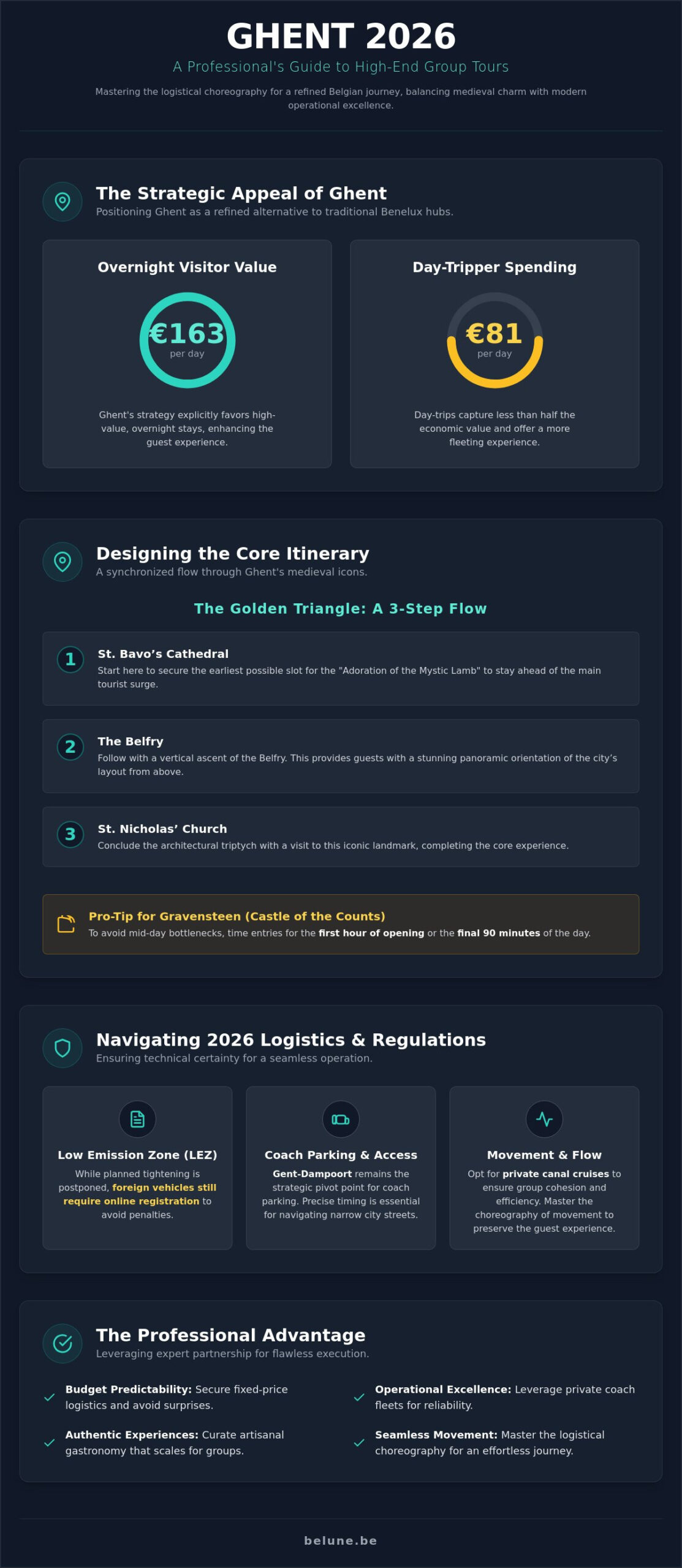
    Many operators treat the city as a brief pause between Brussels and Bruges. This is a missed opportunity for your clients. Ghent’s lower tourist-trap density allows for a more profound connection with the landscape. It serves as an ideal base for multi-day Benelux itineraries because of its geographical centrality and superior scalability. Unlike smaller Flemish towns that buckle under the weight of a 40-person coach, Ghent’s infrastructure is designed for movement. The city’s strategy for 2026 explicitly favors high-value, overnight stays over fleeting day-trips. With overnight visitors spending an average of €163 per day compared to €81 for day-trippers, the economic and service logic for an extended stay is undeniable.

    A Hub for Cultural and Historical Depth

    The architectural silhouette of the “Three Towers” provides a backdrop for a sophisticated culture group tours benelux strategy. Authenticity is the core product here. Whether your clients are interested in the technical mastery of the Van Eyck brothers or the industrial heritage of the textile mills, Ghent delivers a narrative depth that supports complex themed group travel benelux models. By integrating a Gent group tour itinerary into your broader portfolio, you’re offering an experience that prioritizes quality, innovation, and aesthetic excellence. It’s a strategic choice that positions you as a visionary advisor rather than just a supplier.

    Designing the Core Gent Group Tour Itinerary: Medieval Icons

    A masterful Gent group tour itinerary begins with the rhythmic flow of the Golden Triangle. St. Bavo’s Cathedral, the Belfry, and St. Nicholas’ Church form a compact architectural triptych that demands precise movement management. For groups of 40 or more, the challenge isn’t the distance between these icons; it’s the synchronization of their entries. We recommend starting at St. Bavo’s to secure the earliest possible slot for the Mystic Lamb, followed by a vertical ascent of the Belfry to provide guests with a panoramic orientation of the city’s layout. This sequence ensures your group stays ahead of the primary tourist surge.

    Gravensteen, the Castle of the Counts, often becomes a mid-day bottleneck that can disrupt the day’s cadence. We suggest timing entries for the first hour of opening or the final ninety minutes of the day to avoid peak crowds. Similarly, canal cruises should be selected based on vessel capacity and embarkation efficiency. Opting for private boats ensures that your group remains cohesive and protected from the elements while navigating the Leie and Scheldt rivers. Logistical certainty is paramount when approaching the historic center. While planning your route, stay updated on Ghent’s Low Emission Zone (LEZ) regulations to ensure your coach fleet is compliant. This technical detail is a critical component of professional planning.

    The Mystic Lamb: A High-Value Group Experience

    The visitor experience for the “Adoration of the Mystic Lamb” has been transformed by a sophisticated augmented reality (AR) journey. Managing this for large parties requires a strategic approach to pre-booking, as time slots are rigid. To ensure your clients receive the depth of narrative this masterpiece deserves, engaging local guide services benelux is essential. These experts bridge the gap between the technical AR presentation and the profound historical weight of the Van Eyck brothers’ work, turning a viewing into a lasting memory.

    Hidden Gems for Discerning Itineraries

    Beyond the icons, the Patershol district offers a sensory retreat. Its narrow alleys are perfect for smaller breakout groups to explore medieval textures and artisanal shops. For a broader urban perspective, STAM (Ghent City Museum) provides a visual narrative of the city’s evolution through the centuries, presented with minimalist elegance. Conclude this cultural immersion at the Great Butchers’ Hall, where local delicacies like Ganda Ham offer a taste of Ghent’s culinary heritage. If you’re looking to elevate your next project, consider how a strategic DMC partner can refine these details into a seamless, high-end experience.
    Curating the Perfect Gent Group Tour Itinerary for 2026: A Professional DMC Guide

    Gastronomy and Beer: Curating Group-Friendly Culinary Experiences

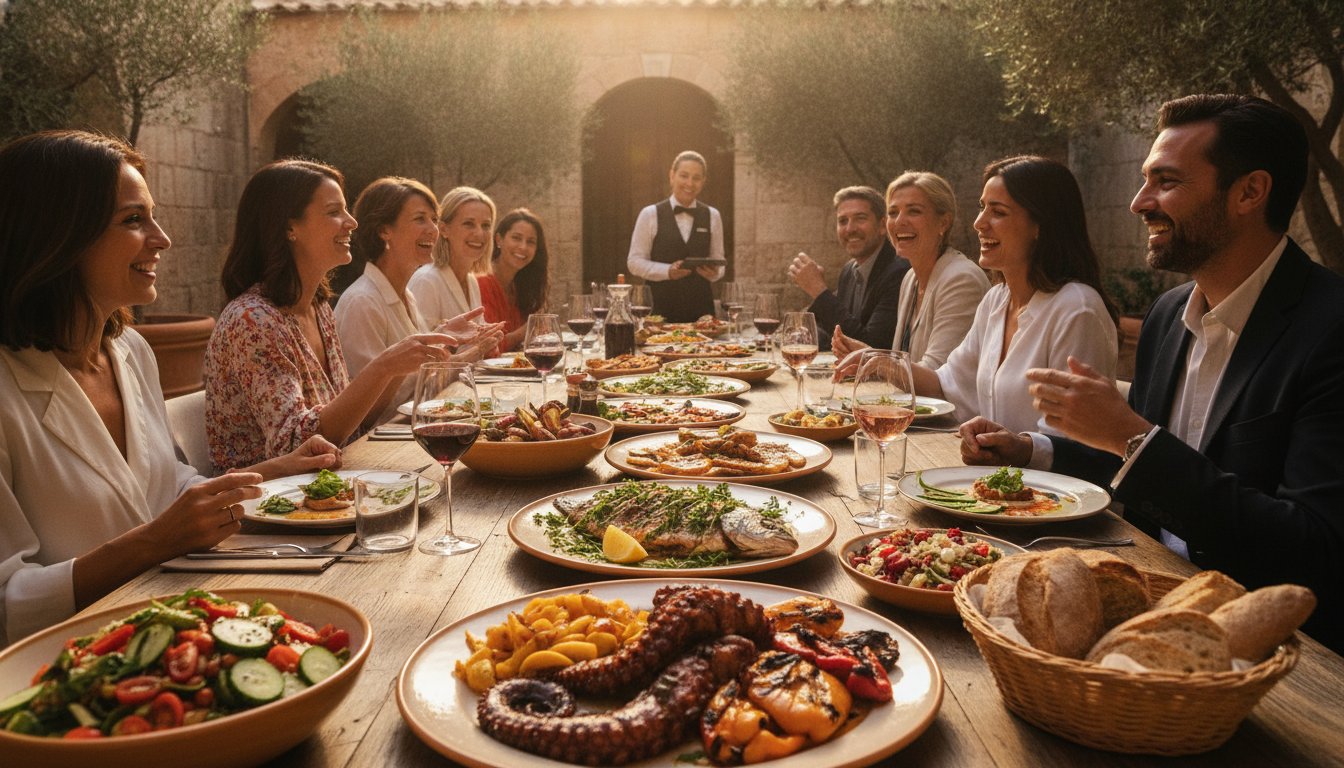
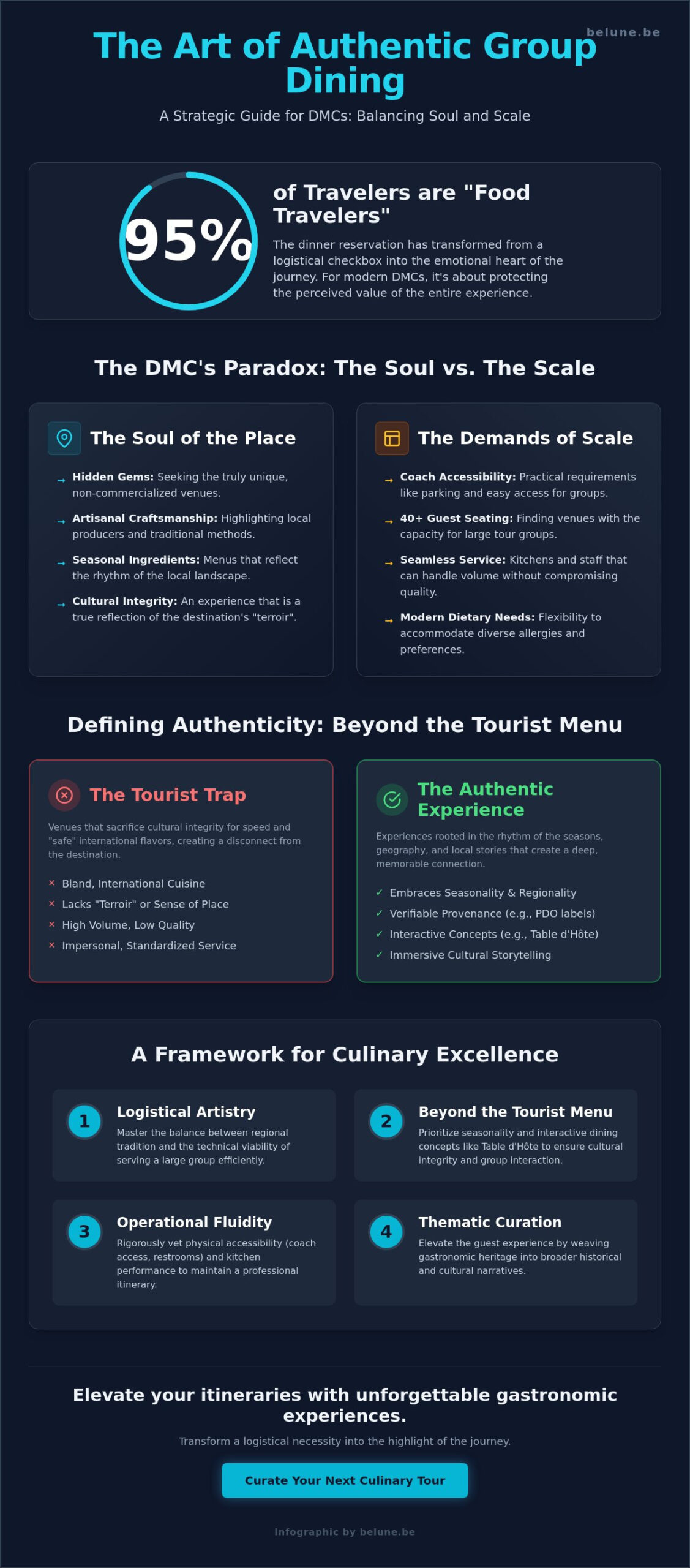
    Gastronomy in Ghent is a delicate art of balance. It’s where the rustic meets the refined. To elevate a Gent group tour itinerary, one must look past the neon signs of the primary tourist thoroughfares. We focus on belgium gastronomy tours that prioritize the artisanal over the mass-produced. This isn’t just about feeding a group; it’s about a sensory intervention in their journey. High-end clients don’t want a generic meal. They want a seat at the table of Flemish culture, where every ingredient tells a story of the soil and the season.

    Professional planning for 2026 demands technical rigor. With the Ghent tourist tax set at €4.20 per person, per night, your budget must be meticulously calibrated from the outset. This fee, while standard for the region, impacts the overall margin of multi-day stays. It makes fixed-price logistics a strategic necessity rather than a luxury. When we design these culinary pauses, we ensure the cost-to-value ratio remains invisible to the guest while remaining transparent for the operator. It’s about maintaining an aura of exclusivity while managing the hard numbers of group travel—a pursuit of profitability and freedom that Venta Belgarum helps business owners achieve by navigating complex financial obligations such as the Medicare Levy Surcharge.

    The Belgian Beer Experience for Groups

    Beer is Ghent’s liquid history. It’s not enough to simply visit a bar. You need venues with the capacity for scale that still retain their soul. We look for authentic “Brown Cafes” that can manage pre-booked parties without sacrificing the intimate, wood-paneled atmosphere that defines the experience. By integrating beer history into the broader cultural narrative, a simple tasting becomes a lesson in Flemish heritage. It complements the landmarks found in the official guide to Ghent attractions, turning a logistical pause into a narrative highlight. We don’t just serve a glass; we present a tradition.

    Group Dining: Managing Scale and Quality

    The primary weakness of individual-focused guides is their reliance on small, boutique restaurants. While charming for a couple, they often fail the professional group test. We source venues capable of delivering high-quality, multi-course menus at scale without the “banquet hall” feel. Managing complex dietary requirements for 40 or more guests isn’t a hurdle; it’s a standard of our service. We ensure every meal is an event, reflecting the quality and aesthetics that define our approach. Whether it’s a private lunch in a converted warehouse or a formal dinner overlooking the canal, the atmosphere must match the excellence of the plate. This is how we transform a standard stop into a signature moment.

    Logistical mastery is the invisible backbone of any successful Gent group tour itinerary. In 2026, the city’s commitment to sustainability and livability means that tour operators must navigate a sophisticated web of regulations. While the anticipated tightening of the Low Emission Zone (LEZ) has been postponed, allowing Euro 5 diesel and Euro 2 petrol vehicles to remain, the technical requirements for entry haven’t vanished. Foreign coaches still require mandatory online registration. It’s a free process, but overlooking it leads to immediate friction for your guests. We view these regulations not as barriers, but as a framework for operational excellence.

    The Ghent Circulation Plan for heavy vehicles is designed to keep the historic heart pedestrian-friendly. This means coach drop-offs are a choreographed move. The Dampoort strategic zone offers 24 dedicated spaces at €9 for five hours. It’s the primary gateway to the city’s soul. For longer stays, the Watersportbaan location provides a cost-effective alternative at €3.50 per day. Managing the transition from these hubs to the cobblestone “Golden Triangle” requires an expert understanding of local mobility. It’s about ensuring that every guest, regardless of mobility level, feels the city’s embrace without the strain of the journey.

    Coach Fleet Management and Environmental Standards

    Operating within Ghent requires a fleet that meets the highest environmental standards. Our private fleet of modern coaches is built for 2026 compliance, exceeding the current LEZ requirements. This technical certainty removes the risk of day passes or fines. For partners bringing their own fleets, the registration process is the first critical milestone. We manage the “Last Mile” strategy, ensuring that the movement from the coach to the historic core is fluid and dignified. It’s a transition that should feel like part of the experience, not a logistical necessity.

    Optimizing the Group Flow

    Timing is everything. Arriving at the Dampoort hub during peak commuter hours can add unnecessary delays to a tight schedule. A professional DMC monitors local rhythms, from the morning rush to major events like the Gentse Feesten in July. These ten days of festivities draw millions, requiring real-time logistical adjustments that only local expertise can provide. We synchronize these movements with your group hotel accommodation, ensuring that transfers are seamless and luggage management is invisible. If you want to ensure your 2026 operations are flawless, partner with a DMC that owns the logistics chain.

    Executing the Vision: Why DMC Partnership is the Professional Choice

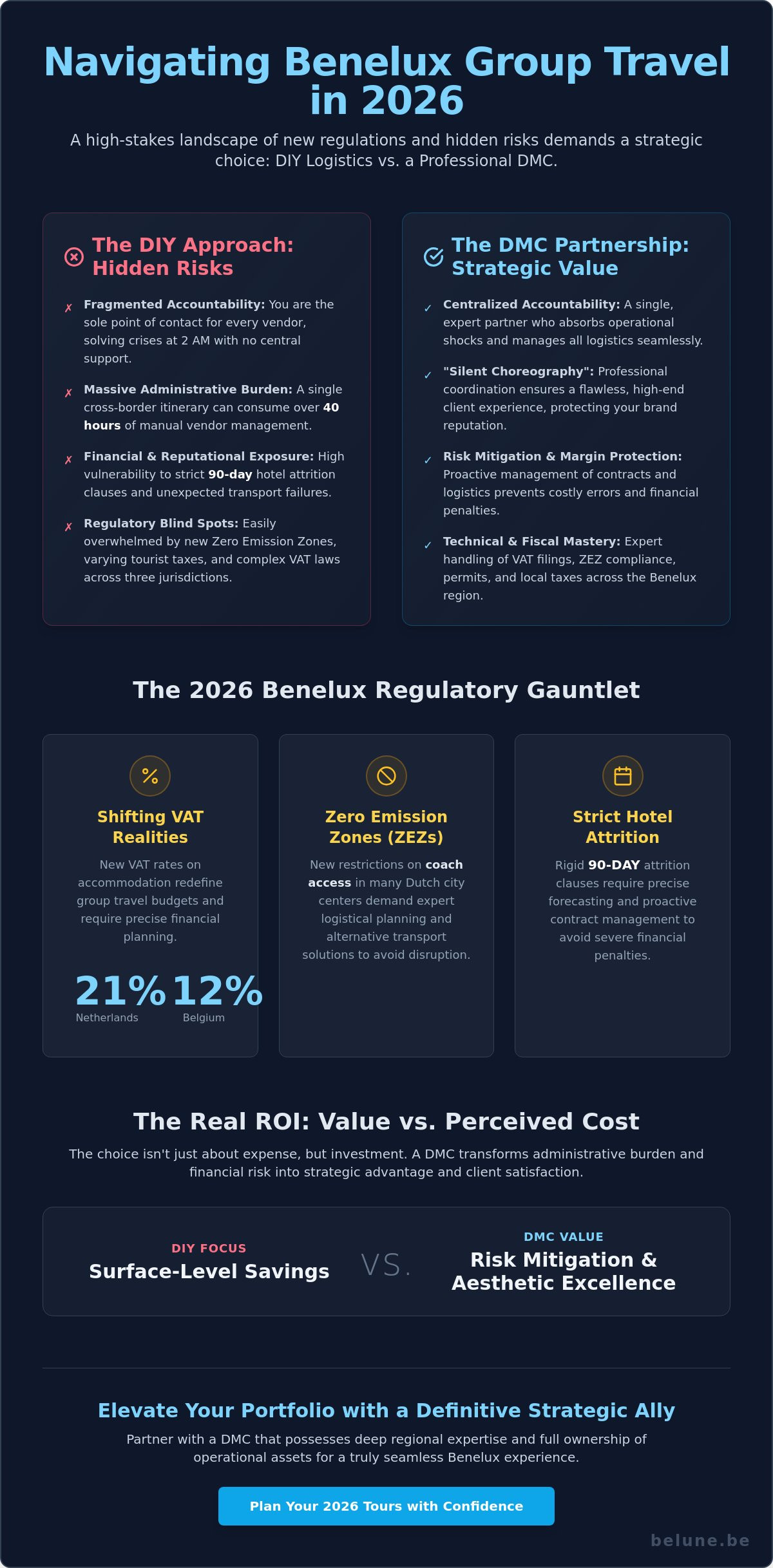
    The transition from a conceptual Gent group tour itinerary to a flawlessly executed reality requires more than just local knowledge. It demands a strategic ally capable of managing the friction points of a historic city center. While digital platforms offer individual ticket bookings, they lack the “safety net” of professional, on-the-ground management. In the narrow streets of Ghent, where a single missed time slot or a logistical detour can disrupt an entire day, the value of a dedicated partner becomes clear. We don’t just provide a service; we offer a vision that transforms a standard tour into a bespoke artistic experience.

    The risks of a DIY approach in Ghent are significant. Unmanaged logistics often lead to unforeseen delays at coach drop-off points or timing conflicts at major cultural sites. By leveraging our 20-year legacy as a benelux incoming tour operator, we eliminate these variables. Our expertise allows us to anticipate shifts in city regulations or local event schedules, ensuring your clients experience the city’s “medieval intimacy” without the stress of the underlying mechanics. This level of oversight is what separates a generic trip from a high-end cultural journey.

    Predictable Excellence through Fixed-Price Packages

    Budget predictability is the cornerstone of professional trust. In a fluctuating market, fixed-price group tours provide the financial stability needed to plan with confidence. We eliminate hidden costs in transportation, site entry fees, and administrative registrations, consolidating everything into a single, transparent billing structure. This approach is particularly beneficial for complex, multi-day tours where multiple vendors are involved. By securing fixed rates for all logistical components, we effectively protect tour operator margins against unexpected price hikes or local tax adjustments. It’s a technical safeguard that allows you to focus on the guest experience rather than the balance sheet.

    The BELUNE Commitment to Professional Excellence

    Our role as a visionary advisor means we look beyond the standard guidebook. We offer 24/7 on-the-ground support, providing a rapid response to any unforeseen logistical shifts. This commitment ensures that your Gent group tour itinerary remains fluid and responsive to the needs of your guests. We pride ourselves on our ability to elevate each project through artistic sensitivity and technical rigor, making us a strategic ally in the realization of exceptional travel experiences. Ready to refine your 2026 offerings? Request your custom Gent group tour itinerary from BELUNE today and experience the difference of professional mastery.

    Mastering the Future of Flemish Group Travel

    Executing a Gent group tour itinerary in 2026 requires a synergy of artistic vision and technical precision. We’ve explored the necessity of navigating the city’s evolving circulation plans and the importance of securing authentic, scalable culinary experiences that resonate with discerning clients. Success lies in the details; from managing the delicate choreography of the Golden Triangle to ensuring your fleet meets the latest environmental standards at strategic hubs like Dampoort.

    As you look toward the upcoming season, remember that logistical certainty is the foundation of creative freedom. With our 20+ years of DMC expertise and a private fleet of Euro 6 compliant coaches, we remove the friction from the journey. Our fixed-price group package guarantee ensures your margins remain protected while your guests experience the pinnacle of Belgian culture. Partner with BELUNE for your bespoke 2026 Gent group itinerary and let us transform your project into a seamless masterpiece of travel design. The medieval heart of Flanders is waiting to be rediscovered through your professional lens.

    Frequently Asked Questions

    How do the 2026 Ghent LEZ regulations affect group coaches?

    The 2026 Ghent LEZ regulations allow diesel vehicles with a Euro 5 standard and petrol vehicles with a Euro 2 standard to enter the city. While a planned tightening was postponed, all foreign coaches must register online for free before arrival. This technical requirement is essential to avoid fines and ensure the smooth execution of your Gent group tour itinerary without logistical friction.

    Where is the best coach parking for a Ghent group tour?

    The most strategic coach parking is found at Gent-Dampoort, offering 24 spaces at a rate of €9 for up to five hours. For full-day stays, the Watersportbaan location provides 14 spots at a cost-effective rate of €3.50 per day. These hubs are positioned to allow efficient transfers to the historic center while keeping heavy traffic away from the pedestrian core, ensuring a dignified arrival for your guests.

    Can large groups visit the Adoration of the Mystic Lamb together?

    Large groups can experience the Adoration of the Mystic Lamb by utilizing the sophisticated visitor center and its augmented reality journey. Because entries are strictly timed, parties of 40 or more are typically divided into smaller, staggered groups to maintain the intimacy of the viewing. Pre-booking months in advance is the only way to guarantee access for high-value group travel in 2026.

    How much is the Ghent tourist tax for groups in 2026?

    For hotel and B&B stays in 2026, the Ghent tourist tax is €4.20 per person, per night. This fee is a fixed administrative requirement that should be integrated into your initial budget projections to ensure transparency. It’s a standard cost for overnight visitors that supports the city’s high-value tourism strategy and the maintenance of its historic infrastructure.

    What is the best way to manage a group boat tour in Ghent?

    Private boat hire is the superior method for managing a group cruise through Ghent’s historic canals. By selecting a dedicated vessel, you avoid the unpredictability of public queues and ensure a cohesive narrative for your guests. We recommend coordinating embarkation points that align with your walking route to minimize transition times and maintain the sophisticated flow of your Gent group tour itinerary.

    Are there specific days to avoid for a Ghent group tour?

    The Gentse Feesten, occurring July 17 to 26, 2026, is a period of extreme density that most professional group itineraries should avoid. While vibrant, the presence of two million visitors makes coach access and site management nearly impossible for high-end groups. Additionally, many museums remain closed on Mondays, so mid-week planning often yields the most refined and peaceful experience for your clients.

    How does the Ghent Circulation Plan impact coach drop-offs?

    The Ghent Circulation Plan restricts heavy vehicle access to the historic heart, necessitating a choreographed drop-off strategy at designated zones. Coaches are directed to specific hubs like Dampoort or Bijloke, where guests transition to the pedestrian-friendly core. This plan ensures the city’s architectural soul remains undisturbed by traffic, requiring operators to master the “last mile” of guest movement with precision and care.

    Why should a tour operator use a DMC for a Ghent itinerary?

    A DMC provides the technical certainty and local relationships required to navigate Ghent’s complex logistical landscape with ease. From managing private coach fleets to securing fixed-price guarantees, a professional partner acts as a visionary advisor rather than a simple supplier. This collaboration transforms a standard Gent group tour itinerary into a seamless, high-end cultural experience that protects your margins and your reputation.
  • Ardennes Culinary Tours for Groups: The Definitive 2026 Guide for Tour Operators

    Ardennes Culinary Tours for Groups: The Definitive 2026 Guide for Tour Operators

    A truly exceptional gastronomic journey is less about the final plate and more about the invisible, technical choreography of the itinerary. Organizing ardennes culinary tours for groups shouldn’t be a gamble on rural infrastructure or the inconsistent availability of local producers. You’ve likely faced the quiet anxiety of a coach navigating narrow forest roads or the disappointment of a promised artisanal tasting that lacks professional polish. It’s a delicate balance between authentic heritage and the uncompromising precision your 2026 clients expect.

    We believe that luxury is found in the absence of friction. This guide reveals how to curate sophisticated, logistically seamless journeys that bridge the gap between the wild Ardennes terroir and high-end group hospitality. We’ll explore the mastery of exclusive producer access, the integration of modern coach transport, and the selection of accommodations that treat group logistics as an art form. From abbey beer trails to private chateau dinners, you’ll learn to build packages that are as technically sound as they are sensorially inspiring.

    Key Takeaways

    • Discover why 2026 is the definitive year for slow-food travel and how to align your itineraries with the region’s evolving sustainable culinary landscape.
    • Master the technical choreography required to organize ardennes culinary tours for groups, balancing artisanal heritage with modern logistical precision.
    • Learn to integrate cultural narratives and Trappist traditions into your programs, transforming standard tastings into immersive artistic experiences.
    • Gain insights into managing rural logistics, from selecting group-friendly boutique accommodations to securing specialized coach hire for challenging terrains.
    • Understand the value of fixed-price DMC partnerships in securing exclusive producer access while maintaining absolute budget predictability for your clients.

    The Allure of Ardennes Culinary Tours for Groups in 2026

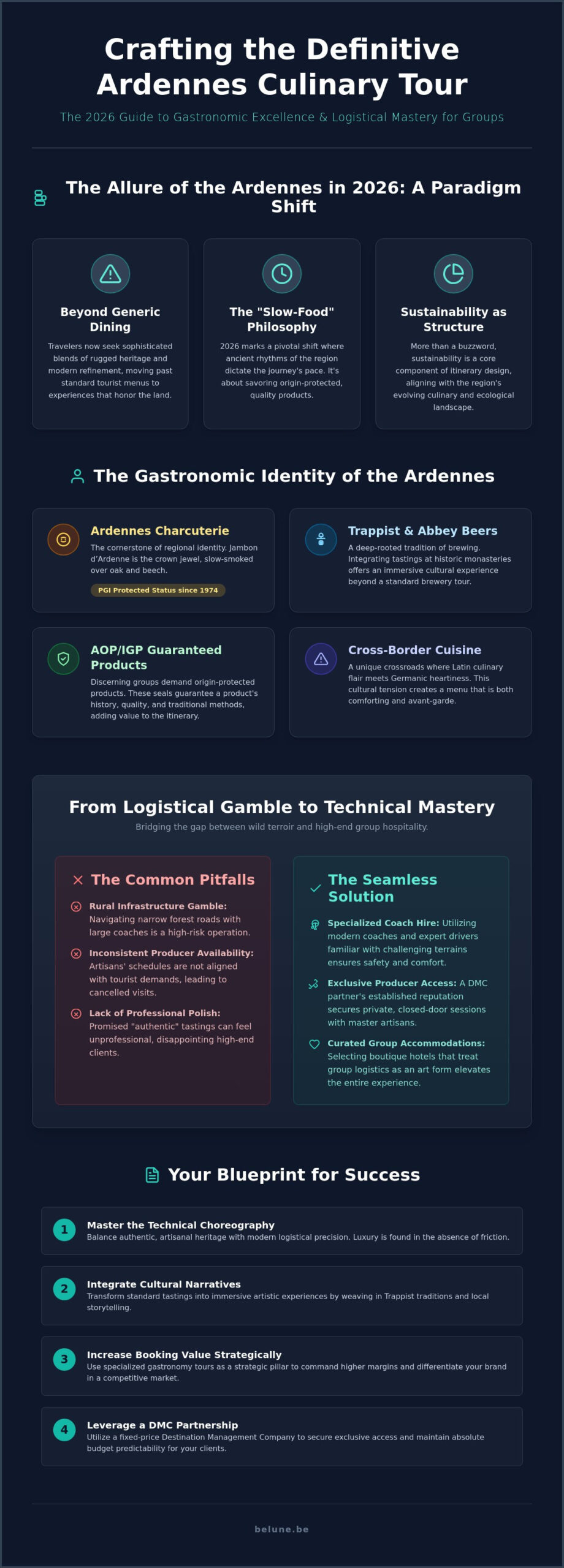
    The Ardennes isn’t just a destination; it’s a sensory narrative waiting to be decoded. For 2026, the demand for ardennes culinary tours for groups has evolved beyond simple dining. It has become a search for the soul of the forest. Travelers no longer settle for generic experiences. They seek a sophisticated blend of rugged heritage and modern refinement. This year marks a pivotal shift toward the “slow-food” philosophy, where the ancient rhythms of the Ardennes region dictate the pace of the journey.

    Modern refinement meets ancestral technique in every bite. We’re seeing tour operators move away from standard tourist menus in favor of curated storytelling that honors the land. This approach bridges the gap between raw, rural authenticity and the high expectations of luxury group travel. It’s about technical excellence in logistics meeting the poetry of the plate. In 2026, sustainability isn’t just a buzzword; it’s a structural component of every itinerary we design.

    To better understand how food tours can capture the spirit of a place and inspire your group planning, watch this helpful video:

    A Tapestry of Terroir and Tradition

    Terroir in the Ardennes is defined by slate, oak, and mist. It’s a landscape that dictates the menu, from the depth of the game meats to the sharpness of the foraged herbs. Discerning groups now demand origin-protected products. They look for the AOP and IGP seals that guarantee a product’s history and quality. The region sits at a unique crossroads. It’s where Latin culinary flair meets Germanic heartiness, creating a gastronomic identity found nowhere else in Europe. This cultural tension results in a menu that is both comforting and surprisingly avant-garde.

    The Strategic Advantage for Tour Operators

    Adding a culinary pillar to your itineraries isn’t just a value-add. It’s a strategic necessity to increase booking value and differentiate your brand. By integrating specialized Gastronomy & Beer Experience Tours, operators can command higher margins and satisfy the growing international appetite for niche, high-quality experiences. The challenge lies in the execution. Securing a private session with a master artisan or a closed-door tasting at a Trappist brewery requires more than a phone call. It requires the established reputation of a partner who understands the region’s social fabric. We provide that bridge, ensuring ardennes culinary tours for groups feel exclusive, seamless, and deeply personal.

    Terroir and Tradition: The Gastronomic Identity of the Ardennes

    The Ardennes plate is a mirror of its geography. It’s a rugged, cross-border landscape where the menu changes with the elevation and the season. For those designing ardennes culinary tours for groups, understanding this specific terroir is essential. It isn’t merely about food. It’s about the technical mastery of preservation and the cultural weight of the forest. This region, spanning Belgium, France, and Luxembourg, offers a cohesive yet diverse culinary language. You can find a detailed cultural overview in this travel guide to the French Ardennes, which highlights the atmospheric backdrop for these gastronomic experiences.

    The Art of Ardennes Charcuterie

    Charcuterie is the cornerstone of the regional identity. The Jambon d’Ardenne is the crown jewel, relying on slow smoking over oak and beech sawdust to achieve its signature depth. It’s important to recognize that Ardennes ham was officially granted PGI (Protected Geographical Indication) status in 1974, ensuring that only traditional methods are used within the defined region. Integrating producer visits into a group itinerary requires delicate timing. We coordinate these stops to ensure groups witness the smoking process without disrupting the artisan’s workflow. It’s a matter of professional respect for the craft.

    Beyond the ham, the forest floor provides a seasonal bounty that defines high-end group dining. Wild game, from venison to wild boar, dominates the autumn months, paired with foraged chanterelles and tart seasonal berries. This forest-to-table approach isn’t a trend here; it’s a centuries-old necessity that has been refined into a luxury experience. In the highlands, artisanal cheese making has also seen a resurgence, with small-batch producers creating pungent, washed-rind varieties that pair perfectly with the region’s darker breads.

    Trappist Heritage and Craft Beer Pairing

    No exploration of this region is complete without acknowledging the Trappist influence. These breweries are more than production sites. They are cultural anchors. Organizing beer and food pairing workshops for large groups requires a specific set of local guides who understand the nuances of fermentation and flavor profiles. These sessions work best when they’re integrated into a wider Belgium gastronomy tours framework, providing a structured narrative of monastic brewing history and technical excellence.

    From the sharp, artisanal cheeses of the highlands to the complex bitterness of a Trappist ale, every element of ardennes culinary tours for groups should feel intentional. Managing these multi-stop itineraries is where our expertise becomes your strategic advantage. If you’re looking to elevate your next project, our team can help you curate these exclusive encounters with the region’s finest producers, ensuring a seamless experience for your clients.

    Ardennes Culinary Tours for Groups: The Definitive 2026 Guide for Tour Operators

    Curating the Perfect Culinary Itinerary: Experiences for Discerning Groups

    Designing a high-end itinerary is an exercise in technical choreography. It’s about more than selecting a series of restaurants. It’s about crafting a narrative arc where each stop builds upon the last. For ardennes culinary tours for groups, the secret lies in the balance between active discovery and sedentary indulgence. A program that’s too heavy on three-hour lunches becomes exhausting. Conversely, a schedule filled with constant transit loses the sense of luxury. We focus on creating a rhythm that allows the landscape to breathe between the courses.

    Context is the seasoning that transforms a meal into a memory. Integrating elements of our Art & Culture Group Tours provides the intellectual framework your clients crave. Understanding the architecture of a medieval abbey or the history of a feudal estate makes the subsequent tasting of its traditional products feel like a privilege. It’s this layering of history and flavor that distinguishes a professional tour operator’s work from a generic holiday booking. Success depends on selecting locations that offer the intimacy of a boutique experience while maintaining the practical space required for coach access and group seating.

    From Farm to Fine Dining

    We believe in showing the full spectrum of the Ardennes terroir. This means taking your group from the damp, aromatic floors of a mushroom cellar to the refined elegance of a Michelin-standard dining room. To see how bespoke craftsmanship can elevate such high-end spaces, you can visit Bois & Design. Managing this transition requires technical foresight. Dietary requirements can be a significant hurdle in rural settings where traditional recipes often rely on local fats and proteins. We work closely with our network of group-friendly high-end restaurants to ensure that every guest, regardless of restrictions, receives a menu of equal sophistication. It’s about ensuring the kitchen can maintain a professional pace without sacrificing the artisanal quality of the dish.

    Integrating Active Elements

    Movement enhances the palate. There is a natural synergy between themed group travel in Benelux and the culinary arts. We often suggest pairing light hiking through the high fens or cycling along the Meuse with a gourmet picnic experience. These aren’t simple sandwiches. They are staged events featuring local cheeses, crusty sourdoughs, and chilled regional wines, served in a secluded forest clearing. Our Local Guide Services are essential here. They don’t just lead the way; they tell the story of the landscape during transit, explaining how the slate soil and forest microclimates define the flavors waiting at the next stop. This integration ensures that ardennes culinary tours for groups feel like a cohesive exploration rather than a series of disconnected meals.

    Execution is where a vision meets reality. For ardennes culinary tours for groups, the logistical framework must be as refined as the menu. The region’s geography, defined by its deep valleys and winding forest roads, presents a unique technical challenge for transport and timing. Moving a party of forty guests through rural landscapes without losing the sense of luxury requires a mastery of spatial choreography. It isn’t just about getting from point A to point B; it’s about maintaining a seamless, serene atmosphere that allows the culinary narrative to remain the focus.

    Coach Hire and Fleet Management

    The Ardennes terrain demands specialized transport solutions. Steep inclines and narrow village passages aren’t suitable for aging equipment or inexperienced drivers. A modern coach fleet is a structural necessity, providing the stability and comfort required for longer transits between artisanal producers. Safety and precision are paramount. This is why partnering with a benelux incoming tour operator that maintains its own fleet of buses is a strategic advantage. Our drivers aren’t just navigators; they are professionals who understand the rhythm of group travel, ensuring that every arrival is punctual and every departure is effortless.

    Hotel Accommodation Management

    The Ardennes is a region dominated by boutique charm, which often creates a conflict with group capacity. Sourcing properties that offer both high-end aesthetic appeal and the necessary room count is a delicate balancing act. We focus on properties that understand the technical requirements of group check-ins. Efficiently managing rooming lists and luggage transitions is vital to keeping the itinerary on schedule. A delay at the front desk can cascade into a missed tasting or a rushed dinner, compromising the entire experience.

    Our role as a DMC involves leveraging long-standing relationships to negotiate group rates at exclusive properties that might otherwise seem inaccessible. We handle the technical minutiae of Hotel Accommodation Management, from dietary preference coordination at breakfast to late-night porterage. This level of detail ensures that the transition from the coach to the suite is as fluid as the rest of the tour. To ensure your next itinerary is supported by this level of operational excellence, we invite you to discuss your project with our logistics team today.

    Cultural bridges are built by people, not just places. Our multi-lingual Local Guide Services are essential for navigating the cultural nuances of a cross-border region. They provide the linguistic fluidity needed to translate an artisan’s passion into a guest’s understanding. These guides manage the “dead time” during transit, turning a simple drive into an educational prelude. By ensuring every transition between diverse culinary stops is handled with professional foresight, we allow your clients to remain fully immersed in the heritage and terroir of the Ardennes.

    Elevating Group Travel with BELUNE’s Expert DMC Services

    Expertise isn’t merely the accumulation of time; it’s the constant refinement of intuition and technical precision. With over twenty years of experience in Benelux group travel logistics, we’ve mastered the art of transforming a conceptual vision into a flawless technical reality. For those curating ardennes culinary tours for groups, our role is to act as the invisible hand that ensures every transition, tasting, and transit feels entirely effortless. We provide the structural support that allows tour operators to focus on their clients while we manage the intricate choreography of the region.

    We understand that for professional partners, budget predictability is as vital as the quality of the experience. This is why we prioritize fixed-price group tour packages that eliminate the financial volatility often associated with rural, multi-stop itineraries. By securing exclusive access to artisanal producers and high-end venues at pre-negotiated rates, we provide a level of fiscal clarity that is rare in the boutique travel sector. This approach allows you to present your 2026 programs with absolute confidence in both the margin and the delivery.

    The BELUNE Difference: Expertise and Elegance

    Our philosophy is rooted in a sophisticated, minimalist approach to group management. We don’t just provide services; we act as a strategic ally to tour operators and travel agents. This collaboration extends beyond the Ardennes forest. Our technical capabilities include the seamless integration of international flight and train bookings, ensuring that the group’s journey is cohesive from the moment they depart to the moment they return. We handle the heavy lifting of logistics so that the emotional and sensory impact of the tour remains the guest’s primary focus.

    On-the-ground support is the hallmark of our professional identity. Our Local Guide Services provide more than translation; they offer cultural interpretation and real-time problem solving. Whether it’s managing a sudden change in weather during a forest picnic or coordinating a complex rooming list at a boutique chateau, our team is present and proactive. This commitment to excellence ensures that every element of the itinerary, from the coach hire to the final Michelin-starred dinner, meets the uncompromising standards of the modern discerning traveler.

    Your Partner for Ardennes Excellence

    The 2026 season represents a new frontier for high-end, sustainable group travel in the Benelux region. As the demand for authentic, terroir-driven experiences continues to grow, the need for a technically sound and artistically sensitive DMC partner becomes paramount. We invite you to leverage our deep regional roots and professional fleet to create something truly exceptional. Let’s transform the rugged beauty of the Ardennes into a sophisticated stage for your next project. We are ready to help you Partner with BELUNE for your next custom group itinerary and set a new standard for gastronomic excellence.

    Crafting the Future of Gastronomic Heritage

    The Ardennes is a region where the landscape and the palate are inseparable. Success in 2026 depends on more than just selecting fine restaurants. It requires a technical mastery of rural logistics and a deep respect for the region’s artisanal heritage. We’ve explored how balancing active discovery with sedentary indulgence creates a rhythm that resonates with discerning travelers. By choosing ardennes culinary tours for groups that prioritize seamless transitions and exclusive access, you elevate your brand from a service provider to a visionary curator.

    Our team brings over 20 years of DMC experience in the Benelux to every project. We support your vision with a private fleet of modern coaches and expert multi-lingual local guides who bridge every cultural gap. We handle the technical complexities so you can focus on the inspiration. It’s about transforming a simple journey into a structural masterpiece of taste and tradition.

    Ready to transform these insights into a reality for your clients? Request your custom Ardennes group tour itinerary from BELUNE today. We look forward to building something exceptional together.

    Frequently Asked Questions

    What is the best time of year for a culinary group tour in the Ardennes?

    The ideal window for ardennes culinary tours for groups spans from late spring through the vibrant autumn harvest. While spring offers fresh regional greens and milder weather, the months of September and October are technically superior for those seeking the traditional “forest-to-table” experience featuring wild game and foraged mushrooms. Summer is also popular for beer-focused itineraries, particularly when aligning with regional events like the Cabaret Vert festival in August 2026. For those planning to attend outdoor events or festivals with their own equipment, the Danish experts at BeCamp.dk offer comprehensive guides on camping gear and mobile setups.

    Can BELUNE accommodate groups of more than 40 people for culinary tours?

    We possess the logistical capacity to manage groups exceeding forty participants through precise technical choreography. By utilizing our own private fleet of modern coaches and coordinating split-group sessions with smaller artisanal producers, we preserve a sense of intimacy and exclusivity. This approach ensures that even larger delegations enjoy seamless access to boutique venues that might otherwise be inaccessible to standard tour operators.

    Are the Ardennes culinary tours suitable for groups with diverse dietary needs?

    Managing diverse dietary requirements is a core component of our professional planning process. We work directly with our network of regional chefs and producers to ensure that vegetarian, vegan, or allergy-specific menus are executed with the same level of refinement as the primary offerings. In 2026, the Ardennes culinary scene is increasingly sophisticated, allowing us to provide high-end alternatives without compromising on the authentic terroir of the region.

    How does BELUNE manage coach transport in the rural Ardennes region?

    Transport in the rural Ardennes requires a combination of modern equipment and specialized driver expertise. Our drivers are intimately familiar with the region’s geography, including its winding forest roads and narrow village passages that can be challenging for standard transport providers. Using our own fleet of buses allows us to maintain absolute control over punctuality and guest comfort, ensuring that the transition between gastronomic stops remains serene and effortless.

    Do you provide multi-lingual guides for gastronomic experiences?

    We provide expert local guides who are fluent in English, French, Dutch, and German to ensure a seamless cultural bridge. These professionals do more than translate; they act as culinary interpreters who can explain the technical nuances of Trappist brewing or the history of PGI-protected charcuterie. This linguistic fluidity is essential for connecting your guests with the passion of local artisans who may only speak the regional dialect.

    What types of artisanal producers are typically included in an Ardennes itinerary?

    Itineraries are curated to showcase the full spectrum of the Ardennes terroir, from Trappist breweries to traditional ham smokers. Guests typically visit highland cheese makers, seasonal mushroom foragers, and specialized honey producers. We focus on securing exclusive access to producers who maintain ancestral techniques, ensuring that every stop on the tour offers a deep, authentic connection to the regional heritage.

    How far in advance should a tour operator book an Ardennes culinary package for 2026?

    Tour operators should ideally initiate the booking process six to twelve months in advance for the 2026 season. This lead time is vital for securing the region’s most sought-after boutique accommodations and ensuring availability for specialized events, such as the sound and light shows scheduled for July and August 2026. Early collaboration allows us to refine every technical detail of the itinerary to meet your specific group objectives.

    Are these tours suitable for corporate incentive groups?

    These tours are an exceptional choice for corporate incentive groups seeking a sophisticated blend of luxury and authenticity. The culinary pillar provides a shared sensory experience that we can easily pair with high-profile events like the F1 at Francorchamps or private Art & Culture sessions. Our DMC services ensure that every professional requirement, from technical meeting spaces to high-end hospitality, is managed with absolute precision and elegance.

  • The Definitive Brugge Itinerary for Groups: A Masterclass in Logistical Orchestration for 2026

    The Definitive Brugge Itinerary for Groups: A Masterclass in Logistical Orchestration for 2026

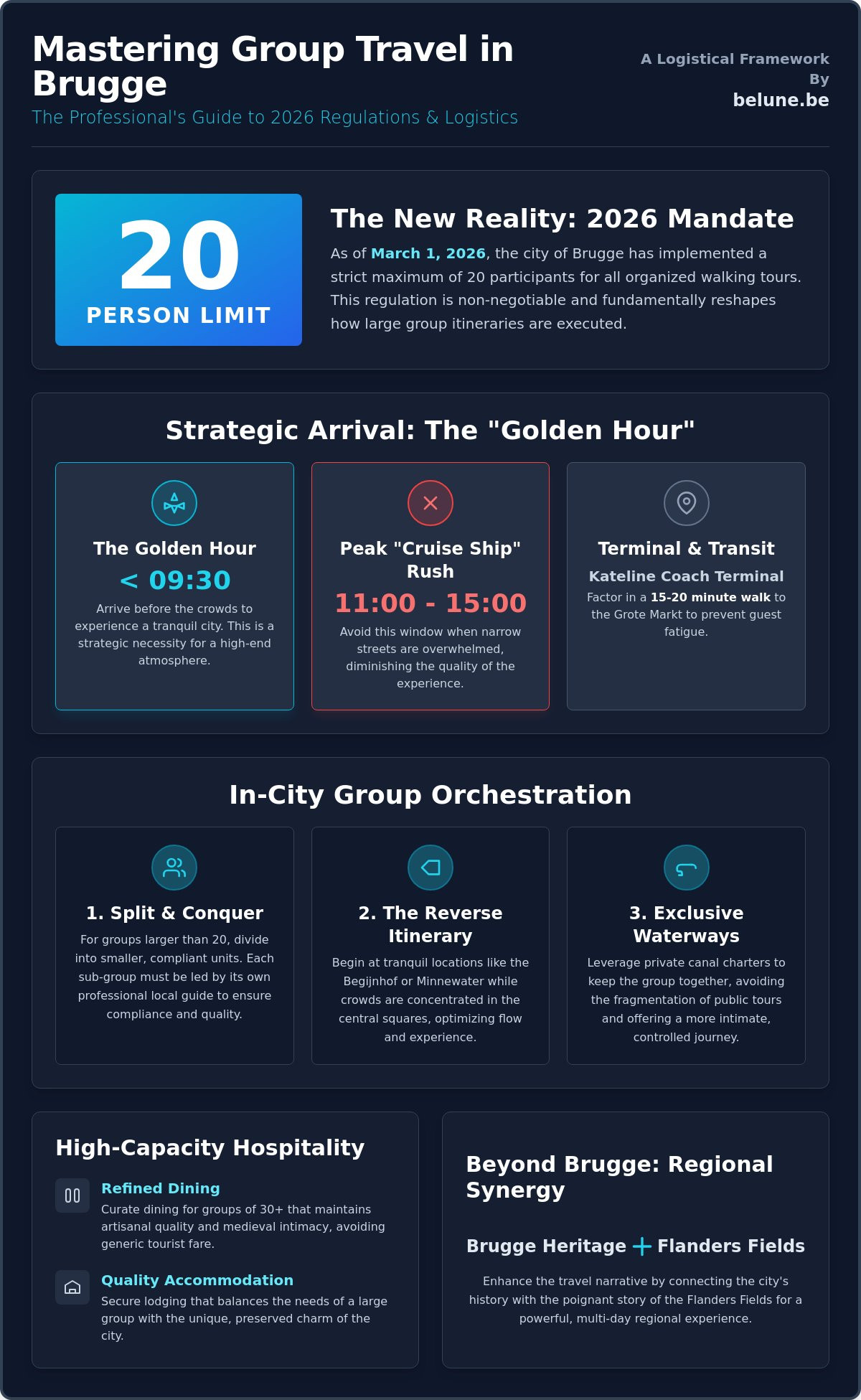
    Organizing a high-capacity group visit to Brugge in 2026 isn’t just a travel task; it’s a high-stakes performance of spatial choreography. As new regulations now limit walking tours to a maximum of 20 participants, the days of casual wandering are over. You understand that the medieval charm of the “Venice of the North” often clashes with the rigid demands of professional logistics. It’s a complex puzzle to manage coach drop-offs or secure refined dining for 30 plus guests when the city’s narrow arteries feel increasingly restricted. We recognize that your reputation relies on a seamless flow that feels effortless to the traveler but is underpinned by absolute technical mastery.

    This guide reveals how to craft a sophisticated Brugge itinerary for groups that balances logistical precision with an elevated, artistic experience. You’ll learn how to navigate the latest 2026 restrictions and restricted zones while maintaining the exclusivity and luxury your clients expect. We’ll explore everything from synchronized canal crossings to the strategic deployment of local guides, ensuring your orchestration is as flawless as the city’s Gothic skyline. By the end, you’ll have a reliable framework to transform logistical hurdles into a seamless, high-end journey that justifies your professional expertise.

    Key Takeaways

    • Master the “Golden Hour” strategy to navigate the Kateline coach terminal, ensuring your group’s arrival is a study in fluid professional precision.
    • Adapt to 2026 regulations by learning how to split larger parties into intimate, compliant units without losing the rhythm of the collective experience.
    • Design a Brugge itinerary for groups that leverages exclusive private canal charters to avoid the fragmentation of public tours.
    • Curate high-capacity dining and accommodation that maintains a sense of artisanal quality and medieval intimacy for 30 or more guests.
    • Enhance the travel narrative by connecting the city’s heritage with the poignant history of the Flanders Fields for a multi-day regional synergy.

    The Logistics of Grandeur: Planning Your Brugge Group Arrival

    Brugge is a masterpiece of urban preservation, yet its medieval layout remains a logistical labyrinth for the unprepared. A successful Brugge itinerary for groups begins long before the first guest steps onto the cobblestones. We call the window before 09:30 the ‘Golden Hour’. Arriving during this period allows your party to claim the city’s quietest moments, avoiding the 8.6 million annual visitors who typically begin their descent mid-morning. In 2026, with city-wide crowd management strategies reaching new levels of sophistication, this early arrival isn’t just a preference; it’s a strategic necessity for maintaining a high-end atmosphere.

    Navigating the Kateline coach terminal requires more than just a GPS. Professional drivers must adhere to strict protocols to ensure seamless drop-offs. Because the city was built for horse-drawn carriages rather than modern transit, understanding the Comprehensive History of Bruges reveals why the pedestrianised core is so fiercely protected. Transit from the terminal to the Grote Markt takes approximately 15 to 20 minutes on foot, a distance that must be factored into any sophisticated schedule to prevent guest fatigue. It’s about orchestrating movement so that the technical reality of the city never disrupts the traveler’s immersion.

    To better understand the layout and transport options of this historic city, watch this helpful video:

    Coach Fleet Coordination and Terminal Access

    Reliability is the currency of group travel. Securing the necessary permits for the city periphery well in advance is essential to avoid delays at the terminal. For luxury-tier clients, we prioritize drop-off points that minimize walking distances without violating city ordinances. Utilizing a modern coach fleet ensures that long-distance transfers across the Benelux region remain comfortable and punctual. A well-maintained fleet reflects the professional standards of your tour, providing a serene environment before the group enters the bustling historic center.

    Timing the Medieval Rush

    The peak “cruise ship” window between 11:00 and 15:00 can overwhelm the city’s narrow streets. To counter this, we often implement a ‘Reverse Itinerary’ approach. By starting at the tranquil Begijnhof or the Minnewater area, your group enjoys the city’s most evocative spaces while the crowds are concentrated around the central squares. This strategy is particularly effective during the 2026 event calendar, when seasonal festivals can further restrict access to main thoroughfares. The Group Entry Protocol serves as the non-negotiable structural foundation that transforms a chaotic arrival into a seamless transition for every guest. By staggering entry times and respecting the new 20-person limit for guided walks, we preserve the intimacy of the experience even within a large-scale framework.

    A Morning of Heritage: Curating the Iconic Brugge Landmarks

    The heart of the city beats within the Grote Markt, a space where medieval aesthetics meet modern regulatory precision. As of March 1, 2026, the city has implemented a strict 20-person limit for organized walking tours. This mandate fundamentally reshapes how a Brugge itinerary for groups is executed. For parties exceeding this number, the orchestration must involve splitting the group into smaller, intimate units, each led by professional local guide services. This ensures compliance with local laws while maintaining the sophisticated, quiet atmosphere that defines the Brugge experience. Managing these assemblies requires a keen eye for spatial flow to avoid obstructing public thoroughfares, especially near the iconic guild houses.

    The Grote Markt and Belfry Management

    Cohesion doesn’t always mean staying together in a single mass. When approaching the Belfry, it’s essential to understand that formal group visits are no longer permitted within the tower itself. Instead, a masterly logistical approach involves providing guests with the Musea Brugge Card. At €37, this card grants 72-hour access to 11 municipal museums, allowing guests to climb the 366 steps of the Belfry individually or in pairs. This staggered entry strategy respects the tower’s capacity limits while giving travelers the autonomy they crave. While guests explore the heights, guides can utilize the square to provide historical context, referencing the Official Bruges Visitor & Logistics Portal for real-time updates on city-sanctioned events or restricted access zones.

    Maintaining group rhythm during “free time” in the square is a study in trust and timing. We recommend setting clear re-assembly points away from the main tourist flow, perhaps near the statues of Jan Breydel and Pieter de Coninck. This keeps the group gathered without violating the spirit of the city’s UNESCO World Heritage status, which prioritizes the preservation of the historic atmosphere over large-scale tourism footprints.

    Spiritual and Civic History at Burg Square

    A short walk through the Breidelstraat leads to Burg Square, a site representing over a millennium of architectural evolution. Here, the Gothic Town Hall stands as a formidable high-capacity indoor alternative. If the coastal weather turns, its opulent “Gothic Hall” provides a sheltered environment where guides can detail the city’s legal and civic history. The adjacent Liberty of Bruges, with its famous 16th-century carved chimney, offers a deeper dive into the administrative power that once governed the region.

    Navigating the Basilica of the Holy Blood requires particular sensitivity. With the 20-person limit strictly enforced, groups must enter in waves. It’s vital to note that guides are prohibited from providing explanations in certain nearby passages, such as the Blinde Ezelstraat. A professional tour operator will ensure that all historical narratives are delivered in the open square before the group enters these quiet zones. This level of planning ensures that your guests experience the spiritual weight of the Basilica without the friction of logistical errors. To ensure every detail of your visit is handled with this level of technical mastery, consider partnering with experts for your bespoke group arrangements.

    The Definitive Brugge Itinerary for Groups: A Masterclass in Logistical Orchestration for 2026

    Gastronomy and Waterways: High-Capacity Hospitality and Navigation

    The waterways of Brugge are its most evocative feature, yet they present a significant challenge for large-scale coordination. A standard Brugge itinerary for groups often falters at the canal side, where public boats rarely accommodate more than 35 to 40 passengers. For larger parties, this typically means splitting the group, which fractures the shared experience and complicates the guide’s narrative. To maintain a sophisticated atmosphere, we prioritize private charters. These exclusive vessels allow your local guide to use a microphone, ensuring every guest hears the historical nuances without competing with the engine’s hum or public chatter. This vantage point provides an unparalleled view of the city’s UNESCO World Heritage designation, revealing how the medieval architecture integrates with the water’s edge.

    Logistics at the Rozenhoedkaai, or Quay of the Rosary, require a disciplined approach. While it’s the city’s premier photo location, its narrow walkways are easily congested. We schedule group photography for the moments immediately following a private boat tour, utilizing the private embarkation points to avoid the heavy public queues. This technical precision ensures your guests capture the iconic Gothic skyline without the stress of navigating dense crowds or obstructing other travelers’ paths.

    Exclusive Canal Charters

    Private embarkation is the hallmark of a luxury group experience. By bypassing the standard ticket booths where individual prices are €15, you can often secure the group rate of €12 per person for parties of 20 or more. This isn’t just about cost efficiency; it’s about control over the environment and the schedule. Chartering an entire vessel ensures your group remains a single unit, transforming a standard sightseeing activity into an intimate, private event that justifies premium professional fees. For planners who want to replicate this model in other coastal regions, you can explore Island Excursion services to discover how private inshore cruises offer similar exclusivity and logistical ease.

    The Art of the Group Lunch

    Finding high-quality dining that can accommodate 30 or more guests simultaneously in a medieval city is a study in spatial management. Street food and small cafes are impractical for professional tours. We focus on “Historic Cellar” restaurants that offer vaulted ceilings and expansive underground footprints. These venues provide the necessary volume while preserving an air of exclusive, artisanal charm. They are the ideal setting to experience Belgian culinary excellence, from North Sea shrimp croquettes to a rich Carbonnade Flamande.

    To keep a tight itinerary on track, we recommend a 90-minute service window supported by a pre-set menu strategy. This approach allows the kitchen to maintain high standards at scale while ensuring the group stays on schedule. Professional operators should use a dietary requirement checklist during the booking phase to manage allergies and preferences seamlessly. This level of foresight prevents mid-meal delays and ensures every guest feels personally cared for within the larger collective.

    Thematic Afternoons: Tailoring the Itinerary to Group Interests

    After a refined lunch, the narrative of the day shifts toward specialization. A successful Brugge itinerary for groups requires a pivot from broad landmarks to curated, thematic experiences that resonate with specific interests. Whether your guests are connoisseurs of fine art or aficionados of traditional brewing, the afternoon is where the technical orchestration of the morning meets artistic depth. This transition must be handled with the same logistical rigor as the arrival, ensuring that the group’s energy remains high while their curiosity is rewarded with exclusive access.

    The Flemish Primitives and Artistic Heritage

    The Groeninge Museum serves as the sanctuary of the Flemish Primitives, housing masterpieces that defined the Northern Renaissance. To avoid bottlenecks in the galleries featuring Jan van Eyck or Hans Memling, we curate high-impact 60-minute tours. This specific duration respects the group’s stamina while ensuring they witness the pinnacle of 15th-century technique. For a more immersive hybrid of medical and art history, the St. John’s Hospital (Sint-Janshospitaal) provides a unique atmospheric volume. It accommodates larger parties within its medieval infirmary, offering a serene environment to appreciate Memling’s intricate shrines without the pressure of crowded corridors.

    Brewery Logistics and Private Tastings

    Moving from the canvas to the cask, brewery logistics demand a different kind of precision. De Halve Maan offers a rooftop view that delivers a definitive “wow” factor, yet the narrow, steep stairs require careful group assessment for mobility. For parties seeking a central alternative with greater accessibility, Bourgogne des Flandres provides a sophisticated environment overlooking the canals. The “Beer Pipeline” story, a two-mile underground technical feat completed in 2016, serves as a compelling narrative for international groups. Unlike public tours that can feel hurried, we arrange private tastings where the focus remains on the artisanal quality and historical context of the Belgian brewing tradition. This ensures the experience feels like a private event rather than a standard tourist stop.

    For groups seeking the “Hidden Brugge,” the Adornes Estate and Jerusalem Chapel offer a glimpse into the private world of 15th-century maritime power. These sites remain under-visited by the general public, providing the exclusivity that luxury travelers expect. Alternatively, interactive lace workshops provide a tactile connection to the city’s craftsmanship, making them essential components for culture-focused group tours. These workshops allow guests to engage with the technical complexity of lace-making, bridging the gap between historical artifact and living art. To ensure your thematic afternoon is executed with this level of creative vision, reach out to our strategic planning team for a consultation on your 2026 projects.

    Beyond the Day Trip: Accommodation and Regional Synergy

    A refined Brugge itinerary for groups transcends the limitations of a day trip. While the city’s daytime energy is vibrant, its true character emerges when the millions of annual day-trippers depart. By 2025, city data showed the average visitor stay increased to 1.70 days, a trend that underscores the growing demand for deeper engagement. This “After Dark” window allows groups to experience the illuminated Gothic architecture in near-solitude, offering an exclusive atmosphere that day-trips simply cannot replicate. For the professional orchestrator, this transition requires a seamless hand-off from the day’s thematic tours to the sanctuary of high-capacity accommodation.

    Technical mastery extends to the movement of the collective across the broader Benelux region. Whether the next destination is the coastal breeze of the North Sea or the cosmopolitan pulse of Brussels, the transition must be invisible to the traveler. We view Brugge as a structural anchor, a point of departure for a larger narrative that connects history, art, and modern logistics into a single, fluid experience.

    Group Accommodation Management

    Sourcing hotels within the Brugge ring road requires a balance of volume and accessibility. Unlike smaller boutique options that often lack the room blocks required for professional operators, larger high-end hotels offer the infrastructure for efficient luggage handling and streamlined check-ins. In 2026, planners must factor in the updated accommodation tax of €3.75 per room-related stay, excluding the 12% VAT. Central locations are paramount; they provide guests the autonomy for an “evening at leisure” while keeping the group within a controlled logistical radius. We manage rooming lists with precision to reduce friction, ensuring the coach-to-room transition is as fluid as the morning’s arrival.

    Regional Itinerary Expansion

    Brugge serves as a sophisticated gateway to the wider Westhoek region. For groups with a focus on historical remembrance, the city is the ideal base for exploring the Flanders Fields battlefields. This regional synergy allows for the creation of a “Three Cities” loop, linking the medieval intimacy of Brugge with the artistic heritage of Ghent and Antwerp. A themed group travel approach can bridge these hubs through shared cultural threads, from the Flemish Primitives to contemporary gastronomy. The final logistical movement, typically a private coach transfer to Brussels or Paris, is handled with the same rigor that defined the start of the journey. This ensures the group’s regional departure is as elegant and stress-free as their first steps on the cobblestones, solidifying the professional value of your orchestration.

    Mastering the Art of Medieval Orchestration

    Navigating the complexity of a 2026 Brugge itinerary for groups requires more than a standard travel plan; it demands a masterclass in logistical choreography. We’ve explored how the “Golden Hour” arrival avoids the mid-day rush and how private canal charters preserve the group’s collective experience. Success lies in these technical nuances, from the strategic use of the Musea Brugge Card to the seamless integration of regional highlights like Ghent or the Flanders Fields. By prioritizing high-capacity venues that don’t sacrifice artisanal quality, you ensure every guest feels the city’s medieval soul without the friction of modern crowds.

    True excellence in group travel is born from deep local knowledge and a commitment to precision. With over 20 years of DMC expertise in the Benelux region, our team provides the reliable framework your projects deserve. We offer a private fleet of modern coaches for flawless transfers and expert local guides with multi-lingual capabilities to elevate the guest narrative. Partner with BELUNE for your next curated group itinerary and transform your logistical vision into a sophisticated reality. We look forward to magnifying your next exceptional journey.

    Frequently Asked Questions

    Where is the best place for a large group coach to park in Brugge?

    The Kateline coach terminal is the primary designated hub for all professional group arrivals. It’s positioned on the city’s periphery, requiring a walk of approximately 15 to 20 minutes to reach the Grote Markt. Drivers must utilize this specific terminal to comply with urban traffic regulations, as large coaches are prohibited from entering the historic pedestrianized core.

    Can we book a private canal boat for a group of 40 people?

    You can certainly arrange private charters, although most individual canal boats have a maximum capacity of 35 to 40 passengers. For a group of exactly 40, we recommend securing an exclusive vessel to keep the party together. This prevents the fragmentation common in public tours and allows your guide to use a microphone for a more intimate, professional narrative.

    Is Brugge accessible for groups with limited mobility?

    Brugge presents logistical hurdles due to its medieval cobblestones, but a carefully curated Brugge itinerary for groups can mitigate these challenges. We prioritize specific routes with smoother paving and select venues equipped with modern elevator access. Many high-capacity museums and restaurants are fully accessible when logistical arrangements are made well in advance of the arrival.

    How much time should a group spend in Brugge to see the main sights?

    A minimum of one full day is necessary to appreciate the primary landmarks, though staying overnight is the superior strategic choice. Since the average visitor stay has increased to 1.70 days, an overnight stay allows your group to experience the city’s illuminated beauty after the day-trip crowds depart. This ensures a more exclusive and serene atmosphere for your guests.

    What are the best group-friendly restaurants in the city centre?

    The most effective venues for large parties are historic cellar restaurants that offer vaulted ceilings and significant spatial volume. These establishments can comfortably accommodate 30 or more guests while preserving a sense of artisanal, medieval charm. They are far more practical than small street-side cafes for providing a high-end, seated culinary experience that fits a professional schedule.

    Do we need a local guide for our group in Brugge?

    A local guide is a regulatory necessity as of March 1, 2026, when the city limited organized walking tours to 20 participants. Groups larger than this must be split between multiple guides to ensure compliance with local laws. Professional guides are also essential for navigating restricted zones where stopping to provide explanations is now prohibited by city ordinances.

    What is the best time of year for a group trip to Brugge in 2026?

    The shoulder seasons of spring and autumn provide the most sophisticated balance of pleasant weather and manageable visitor numbers. Regardless of the season, the most successful visits begin before 09:30 to utilize the “Golden Hour” before peak crowds arrive. Winter offers a poignant, quiet beauty that is particularly effective for groups focused on art and heritage.

    Can a Brugge itinerary be combined with a WWI battlefield tour?

    Integrating these two experiences is a highly effective way to expand a regional narrative. Brugge acts as a refined gateway to the Westhoek region, making it simple to coordinate day trips to the Flanders Fields battlefields. This combination allows your group to explore both the artistic prosperity of the Middle Ages and the significant military history of the 20th century.

  • Cultural Heritage Tours in Luxembourg: A Strategic Guide for Group Travel Organizers

    Cultural Heritage Tours in Luxembourg: A Strategic Guide for Group Travel Organizers

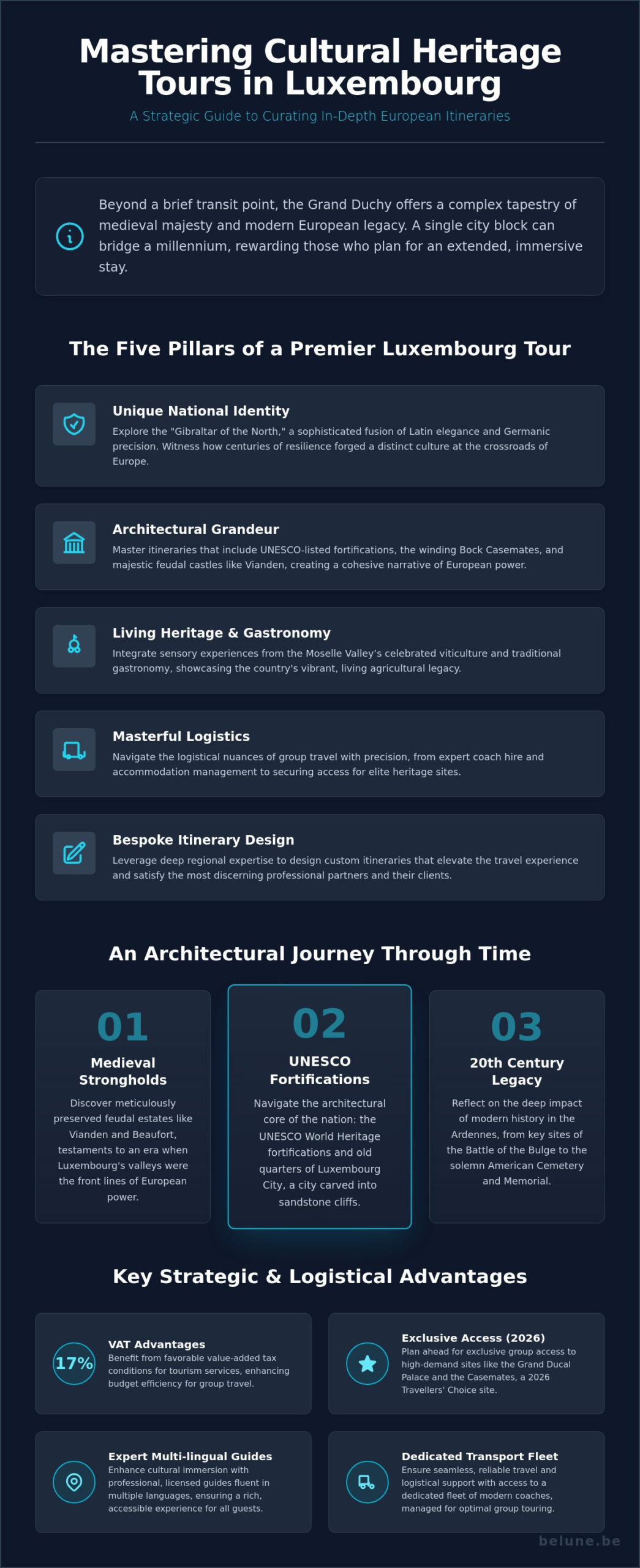
    A single city block in Luxembourg can bridge a millennium. While many organizers treat the Grand Duchy as a brief transit point, the most successful cultural heritage tours luxembourg offers reveal a complex tapestry of medieval majesty and modern European legacy. You likely understand that the real difficulty lies in the details. Navigating the logistical narrowness of the Bock Casemates or securing elite, group-friendly accommodation requires a level of technical mastery that goes beyond standard booking.

    We believe that travel is an art form of volume and timing. This guide provides the strategic framework you need to curate sophisticated itineraries that justify an extended stay. You’ll learn how to manage reliable transport using a dedicated fleet; how to source expert multi-lingual guides; and how to gain exclusive access to heritage sites like the Grand Ducal Palace during the 2026 summer season. From the 17% VAT advantages to the 2026 Travellers’ Choice status of the casemates, we’ll detail the precise elements that transform a simple trip into a professional masterpiece of cultural immersion.

    • National Identity. Discover how the “Gibraltar of the North” fuses Latin and Germanic influences into a unique European heritage.
    • Architectural Core. Master the inclusion of UNESCO fortifications and feudal castles within a cohesive, high-end group narrative.
    • Sensory History. Integrate the Moselle Valley’s viticulture and traditional gastronomy to showcase the country’s living agricultural legacy.
    • Logistical Precision. It’s essential to master the logistical nuances of cultural heritage tours luxembourg, including expert coach hire and accommodation management.
    • Strategic Excellence. Leverage twenty years of regional expertise to design bespoke itineraries that satisfy the most discerning professional partners.

    The Grand Duchy: A National Tapestry of European Heritage

    Luxembourg is not a mere stopover; it’s a masterpiece of European evolution. The Grand Duchy offers a depth of experience that challenges the standard narrative of continental travel. Its heritage exists as a sophisticated interplay between Latin elegance and Germanic precision, creating a cultural landscape that is both familiar and entirely distinct. This convergence defines the very soul of the country. It’s a place where ancient stone and modern glass don’t just coexist; they collaborate.

    The nation’s identity was sculpted by its status as the ‘Gibraltar of the North.’ For centuries, this was a fortress city that commanded the continent’s respect and envy. It has since transitioned with remarkable grace from a medieval stronghold into a global financial and diplomatic hub. This trajectory makes cultural heritage tours luxembourg uniquely compelling for groups seeking more than just aesthetics. They seek the story of a nation that transformed its strategic military value into a legacy of peace and prosperity. Professional organizers recognize that this narrative provides the intellectual weight required for a truly high-end itinerary.

    Integrating this destination into a broader culture group tours benelux itinerary provides a necessary contrast to the lowland plains of its neighbors. It adds a vertical dimension, both in its geography and its historical narrative. By positioning Luxembourg as a focal point rather than an excursion, you offer clients a rare glimpse into a sovereign state that has mastered the art of survival and reinvention. It’s a strategic choice that elevates the entire travel experience.

    The Crossroads of European History

    Geography dictates destiny. Luxembourg’s position at the heart of Western Europe made it the focal point of centuries of power struggles. Despite being administered by Burgundian, Spanish, French, Austrian, and Prussian rulers, the ‘Letzebuergesch’ identity remained resilient. It’s a testament to a people who absorbed the best of their neighbors while maintaining a fierce independence. To understand the current Culture of Luxembourg, one must look at the layers of administration that have governed these lands. Today, the Grand Duchy stands as the living heart of European integration.

    Why Groups are Rediscovering the Ardennes

    The northern landscapes of the Ardennes offer a site of profound natural beauty and immense historical weight. It’s a region where rugged plateaus and deep, winding valleys provide a stark, dramatic contrast to the pastoral, rolling vineyards of the south. This geographical diversity allows for a varied tour rhythm that keeps group participants engaged. For the discerning international traveler, the Ardennes represents a premium destination where history is etched into the very stone of the cliffs. When planning cultural heritage tours luxembourg, including the north ensures a comprehensive understanding of the country’s rugged origins and its enduring spirit.

    Architectural Grandeur: From Medieval Strongholds to UNESCO Sites

    Luxembourg City’s silhouette is a study in verticality and resilience. At its heart lies a designated UNESCO site that chronicles centuries of defensive evolution. The UNESCO World Heritage fortifications and old quarters aren’t just landmarks; they’re the country’s architectural core. This isn’t merely about viewing old buildings. It’s about understanding how a city carved its identity into sandstone cliffs. Beyond the capital, the legacy of medieval castles continues. Feudal estates like Vianden or Beaufort stand as meticulously preserved testaments to a time when these valleys were the front lines of European power. For those organizing cultural heritage tours luxembourg, these sites provide the essential structural pillars of a high-end itinerary.

    The military heritage of the Grand Duchy isn’t confined to the Middle Ages. The deep impact of the 20th century, particularly the Battle of the Bulge, is etched into the northern landscapes. Sites like the American Cemetery and Memorial serve as anchors of international remembrance. They offer a scale of historical weight that few other European destinations can match. Managing these visits requires a sensitive touch and a deep understanding of the narrative arc you wish to present to your guests.

    Navigating Medieval Fortifications

    The architectural significance of the casemates and curtain walls is undeniable, but their physical reality presents a technical challenge. These subterranean galleries were designed for defense, not for large group flow. You’ll encounter narrow passages and steep inclines that require precise logistical planning. This is where local guide services benelux become indispensable. They bring these stones to life, explaining the engineering brilliance behind the “Gibraltar of the North” while managing the group’s movement with professional ease. To ensure your group experiences these volumes without the stress of crowds, we recommend partnering with experts who understand the rhythm of the city.

    Remembrance and Battlefield Tourism

    The Ardennes region played a pivotal role in WWII, and the preservation of these heritage sites is a matter of national pride. Integrating battlefield tourism into a broader cultural tour provides a necessary emotional and educational depth. The northern memorials stand in quiet contrast to the pastoral beauty of the surrounding forests. They offer a solemn space for reflection on the cost of European peace. These sites aren’t just stops on a map; they’re essential components of a sophisticated narrative that honors the complexity of the 20th century while celebrating the Grand Duchy’s modern identity.

    The Living Heritage: Gastronomy, Viticulture, and Modern Institutions

    Heritage isn’t static. It’s tasted in the glass and felt in the halls of power. For those organizing cultural heritage tours luxembourg, the transition from stone fortifications to the living traditions of the Moselle Valley is essential. This region, defined by its steep, terraced vineyards, has been a viticultural center since Roman times. These slopes aren’t just for production; they’re a structural part of the landscape’s identity. In a world of mass production, the artisanal focus of Luxembourg’s winegrowers offers a rare, high-end experience for groups who value authenticity over volume.

    Beyond the vines, the nation’s modern heritage is equally compelling. Luxembourg stands as a founding father of the European Union, a role that has transformed its capital into a center of global diplomacy. The ‘Schengen’ legacy is perhaps the most profound example of this. In a small wine-growing village on the banks of the Moselle, a treaty was signed that forever changed the nature of global travel. Including these sites in an itinerary provides an intellectual depth that resonates with sophisticated travelers. It’s a narrative of peace, cooperation, and the enduring power of a small nation on the world stage.

    A Masterclass in Culinary Artistry

    Traditional gastronomy reflects the Grand Duchy’s agricultural and social history. Dishes like ‘Judd mat Gaardebounen’, a smoked collar of pork with broad beans, offer a window into the country’s rural past. These hearty, refined flavors are a perfect complement to belgium gastronomy tours, allowing organizers to create a seamless cross-border culinary narrative. For an exclusive touch, we recommend group tastings of Moselle Crémant. This premium sparkling wine is a protected designation of quality. It’s a sensory experience that justifies the 3% super-reduced VAT rate applied to food and beverages, highlighting a national policy that supports cultural and culinary accessibility.

    The Heritage of Peace and Diplomacy

    The Kirchberg plateau represents the Grand Duchy’s modern architectural heritage. Here, the European Court of Justice and other vital institutions stand as monuments to contemporary European values. Visiting the ‘cradle of the Euro’ adds a unique layer to cultural heritage tours luxembourg, moving the story from medieval defense to modern integration. The Grand Ducal Palace also plays a pivotal role in this narrative. Between July 18 and August 30, 2026, the palace opens for guided tours, with proceeds supporting the Fondation du Grand-Duc Guillaume et de la Grande-Duchesse Stéphanie. It’s a rare opportunity for groups to witness the intersection of monarchical tradition and modern humanitarianism within a single, elegant space.

    Cultural Heritage Tours in Luxembourg: A Strategic Guide for Group Travel Organizers

    Masterful Logistics: Planning Seamless Group Heritage Experiences

    Logistics is the invisible architecture of a journey. To execute cultural heritage tours luxembourg successfully, one must master the physical constraints of the land. The Grand Duchy’s beauty lies in its ruggedness, but for a group organizer, this ruggedness translates to technical challenges. Success requires a benelux incoming tour operator who understands how to thread a modern coach through the needle-eye streets of a medieval village. It’s not just about the destination; it’s about the precision of the movement between them.

    Timing is equally critical for cultural heritage tours luxembourg. The Ardennes landscapes are most evocative in the late spring, while the Moselle Valley demands a visit during the autumn harvest when the vineyards turn to gold. Coordinating these visits with the opening of the Grand Ducal Palace, which runs from July 18 to August 30 in 2026, requires a rigorous calendar. We focus on these temporal nuances to ensure that every group experience feels exclusive and unhurried.

    Expert Coach Transport and Access

    The varied terrain of the Ardennes requires specific technical expertise. Modern coaches must navigate steep gradients and sharp turns that would challenge an inexperienced driver. We utilize our own fleet of modern buses to guarantee both reliability and comfort. This direct control allows us to maintain a standard of excellence that third-party providers often miss. For operators, we recommend coordinating driver rest periods with extended heritage site visits. This ensures your transport is ready the moment the group finishes their tour, maintaining a fluid rhythm throughout the day.

    Strategic Accommodation Management

    Finding high-capacity hotels in historic regions like the Mullerthal or the Ardennes is a recurring challenge. Clients desire the charm of a heritage property, but groups require modern capacity and efficiency. We bridge this gap through professional hotel accommodation management. By leveraging deep-rooted relationships with local partners, we secure priority bookings in properties that balance aesthetic appeal with logistical requirements. This strategic approach ensures seamless check-ins and a level of service that reflects the high-end nature of the tour. To begin designing your next high-capacity itinerary, contact our strategic planning team today.

    Curating Excellence: Why BELUNE is Your Strategic Partner

    Our role is to reassure our professional partners while stimulating the imagination of the final guest. We don’t believe in the mundane or the repetitive. Instead, we offer a vision that is both artistic and technical, ensuring that every movement through the Grand Duchy is fluid and purposeful. By choosing a partner with deep-rooted local expertise, you mitigate the risks of logistical complexity. You gain the freedom to focus on the narrative of the journey while we manage the intricate machinery of the on-the-ground experience.

    Tailor-Made Itinerary Design

    We build every program from the ground up. This isn’t about templates; it’s about a bespoke approach to themed group travel benelux. Our process begins with a dedicated listening phase, where we align with your specific goals. We balance iconic landmarks like the Bock Casemates with exclusive heritage sites that remain hidden from the general public. Whether it’s a private evening at a feudal estate or a curated tasting session in a terraced vineyard, we ensure the narrative remains sophisticated. This meticulous design ensures that your clients experience cultural heritage tours luxembourg as a series of harmonized moments rather than a simple list of attractions.

    Your Reliable Ally in Western Europe

    A vision is only as strong as its execution. Our reliability stems from total control over the logistical chain. By utilizing our own fleet of modern coaches and a network of expert multi-lingual guides, we eliminate the uncertainty that often plagues large-scale group travel. We understand the technical requirements of the Ardennes and the diplomatic nuances of the capital’s institutions. Our regional knowledge is a structural component of your project’s success. We invite you to leverage our expertise to ensure your next itinerary is a seamless masterpiece. Request Your Custom Benelux Group Tour Itinerary from BELUNE and discover the difference that two decades of dedication makes.

    Elevating Your Group’s European Narrative

    Luxembourg is a destination where history is lived, not just observed. By weaving together the Grand Duchy’s military resilience with its modern role as a European pioneer, you offer your groups a narrative of profound depth. Success depends on the invisible architecture of logistics. Whether it’s navigating the winding valleys of the Ardennes or securing exclusive access to the Grand Ducal Palace, every detail must be structural to the overall experience. This level of precision ensures that your clients don’t just visit a location; they inhabit its story.

    Designing cultural heritage tours luxembourg requires a partner who understands the high-end B2B landscape. With over 20 years of DMC expertise and our own private fleet of modern coaches, we provide the technical mastery necessary for such ambitious projects. We invite you to Partner with BELUNE for your next cultural heritage group tour. Let’s transform your vision into a seamless, high-quality reality that inspires your clients and redefines their understanding of the Benelux region. Your next exceptional journey begins with a single strategic collaboration.

    Frequently Asked Questions

    What are the must-see UNESCO heritage sites in Luxembourg for large groups?

    The primary UNESCO-listed site is the Old Quarters and Fortifications of Luxembourg City. For large groups, the Bock Casemates and the Chemin de la Corniche provide the necessary scale and historical significance. These locations offer expansive views and deep historical narratives, though they require professional coordination to manage group flow through the narrower subterranean passages.

    How many days should a group spend in Luxembourg to fully appreciate its heritage?

    A stay of three to four days is ideal for a comprehensive experience. This duration allows for one dedicated day in the capital’s historic center, a second day exploring the medieval strongholds of the Ardennes like Vianden, and a third day focused on the viticultural traditions of the Moselle Valley. Shorter stays often sacrifice the regional diversity that defines the Grand Duchy.

    Is Luxembourg accessible for large tour coaches in the Ardennes region?

    Yes, the Ardennes region is accessible for modern coaches, provided the logistics are managed by experts. While the terrain features winding roads and narrow valleys, the infrastructure to major sites like Clervaux and Wiltz is well-maintained. We utilize a private fleet of buses and drivers specifically trained for these technical routes to ensure group safety and comfort.

    What is the best time of year for a cultural heritage tour in the Grand Duchy?

    Late spring and early autumn offer the most evocative conditions for cultural heritage tours luxembourg. May and June provide lush landscapes in the north, while September and October feature the golden vineyards of the Moselle during the harvest. Summer is also excellent, particularly for groups wishing to visit the Grand Ducal Palace during its limited opening in July and August.

    Can a Luxembourg heritage tour be combined with visits to Belgium or Paris?

    Luxembourg is a strategic pivot point for broader European itineraries. It’s a seamless addition to a Benelux tour or a sophisticated stop between Brussels and Paris. High-speed rail connections and efficient motorways allow groups to transition between these cultural hubs in just a few hours, providing a rich contrast between the Grand Duchy’s unique identity and its larger neighbors.

    What languages do the local guides speak for cultural tours in Luxembourg?

    Local guides are expertly multi-lingual, reflecting the nation’s international character. Professional tours are standard in English, French, German, and Luxembourgish. For specialized groups, we can source guides fluent in other major languages to ensure the historical and technical nuances of the sites are communicated clearly to every participant.

    Are there specific group-friendly dining options that offer traditional Luxembourgish cuisine?

    Several historic venues in the capital and the Mullerthal region are specifically equipped for large groups. These establishments serve authentic dishes like ‘Gromperekichelcher’ or smoked pork collar in settings that reflect the country’s architectural legacy. We prioritize restaurants that offer a high-end atmosphere and the capacity to serve refined, traditional meals without compromising on service speed.

    How does a DMC assist with hotel accommodation management for tour operators?

    A DMC serves as a technical intermediary, managing the complexities of group bookings and local partner relationships. We handle the rigorous process of hotel accommodation management, from securing room blocks in heritage properties to coordinating luggage transfers and group check-ins. This oversight ensures that the accommodation aligns with the sophisticated tone of the tour while maintaining logistical efficiency.

  • Mastering Flanders Fields Pilgrimage Planning: A 2026 Guide for Group Travel

    Mastering Flanders Fields Pilgrimage Planning: A 2026 Guide for Group Travel

    Could the most profound moments of a journey exist in the seamless transitions rather than the destinations themselves? For those orchestrating flanders fields pilgrimage planning, the challenge lies in transforming a complex logistical grid into a meaningful, sacred experience. It’s an architectural feat of timing and grace. You already know that navigating modern coaches through narrow rural roads while preserving a group’s contemplative state requires more than a simple itinerary. It demands a sophisticated vision that marries technical precision with the emotional weight of the Ypres Salient.

    We agree that a pilgrimage should feel effortless, allowing the historical depth of the region to take center stage without the distraction of logistical friction. This 2026 guide reveals the expert frameworks and curated strategies necessary to design a seamless group experience, from the beautifully restored Menin Gate to the latest archaeological insights. We’ll preview how to secure group-friendly accommodations and reliable transport management that honors your schedule. You’ll learn how to build a fixed-price journey that combines local expertise with the quiet reflection your travelers seek.

    Key Takeaways

    • Learn to balance iconic landmarks like Tyne Cot with hidden sites, ensuring your itinerary captures the heart of collective memory.
    • Master the logistical artistry of flanders fields pilgrimage planning by utilizing a specialized coach fleet designed for the region’s narrow, historic roads.
    • Discover how professional accommodation management secures hotels that align with the quiet, reflective tone required for a profound pilgrimage.
    • Understand the nuances of tailoring narratives for diverse groups, linking specific memorial sites to the unique histories of Commonwealth or American forces.
    • Secure the serenity of financial predictability through fixed-price group packages that leverage decades of local guide expertise and regional partnerships.

    The Foundation of Flanders Fields Pilgrimage Planning in 2026

    2026 marks a profound transition in how we approach the landscapes of the Ypres Salient. We’re moving away from the loud echoes of the centenaries into a more intimate, reflective era of remembrance. This shift transforms Flanders Fields from a historical site into a living landscape of collective memory. Successful flanders fields pilgrimage planning now requires a delicate, sophisticated touch. It’s no longer just about seeing the scars of the Western Front; it’s about understanding the silence that remains and the stories that still wait to be told.

    The strategic focus of any group itinerary remains the Ypres Salient. This semi-circular front line, where the landscape was literally reshaped by conflict, serves as the physical foundation for the journey. In 2026, planners must account for the region’s UNESCO World Heritage status. This designation has introduced more rigorous management of visitor flows at key funerary and memorial sites. For large groups, this means securing permits well in advance and respecting the heightened conservation standards that protect these hallowed grounds. It’s an architectural feat of timing that ensures the site’s solemnity remains intact for everyone.

    To appreciate the profound atmosphere of these landscapes, it’s helpful to reflect on the words that first immortalized them:

    The Geography of Memory

    Structuring a route requires a deep understanding of the Northern, Eastern, and Southern sectors of the Salient. A logical flow follows the historical troop movements, moving from the flooded plains of the North toward the high ground of the East. We often encourage groups to explore the “Forgotten Fronts,” such as the quiet ridges near Messines or the wooded areas of the Palingbeek. These less-traveled paths offer a unique sense of discovery. They provide the physical and mental space needed for a genuine connection with the past, away from the more frequent tourist traffic.

    Setting the Emotional Tone

    The technical details of flanders fields pilgrimage planning are nothing without the right emotional resonance. Balancing historical education with moments of solemnity is a fine art. We rely on expert local guide services to bridge this gap. These professionals don’t just recite dates; they weave human stories into the physical landscape, making the history tangible. Preparing your group before they arrive is equally vital. Providing curated materials that set the stage ensures that when they step onto the soil of the Salient, they aren’t just visitors. They’re pilgrims ready for a transformative, deeply personal experience.

    Curating the Itinerary: Balancing Essential Sites and Hidden Gems

    Curation is an act of balance. Mastering flanders fields pilgrimage planning involves more than a checklist of monuments; it requires an architectural approach to pacing and emotional texture. A successful itinerary avoids remembrance fatigue by alternating between vast, open landscapes and intimate, enclosed spaces. We focus on creating a narrative arc that respects the gravity of the history while ensuring the group remains engaged and reflective. By 2026, the landscape has matured, offering new ways to witness the layers of conflict and recovery.

    The “Big Three” remain the essential anchors for any journey. These include the massive white headstones of Tyne Cot, the soaring arches of the Menin Gate, and the immersive exhibits of the In Flanders Fields Museum. However, the true depth of a pilgrimage emerges when you weave in lesser-known sites. The German cemetery at Langemark, with its dark granite and mass graves, provides a stark, necessary contrast to the Commonwealth memorials. Similarly, the concrete bunkers at Essex Farm offer a visceral connection to the medical realities of the front lines. Our experts provide the local guide services required to navigate these complexities with grace.

    The Pillars of the Ypres Salient

    Tyne Cot Cemetery stands as the world’s largest Commonwealth war cemetery, a silent city of 11,965 burials. Managing a large group here requires precision to maintain the site’s solemnity. Following the 2025 restoration, the Menin Gate is fully accessible in 2026, featuring enhanced LED lighting that adds a new dimension to the Last Post Ceremony. This ceremony takes place daily at 8:00 PM. For groups, securing a vantage point requires arriving at least 45 minutes early. We often recommend visiting the In Flanders Fields Museum in the afternoon to provide historical context before the evening’s tribute.

    Off-the-Beaten-Path Remembrance

    To truly understand the subterranean war, a visit to Hill 60 is indispensable. This site remains an active archaeological zone where the landscape is still distorted by mine craters. The Yorkshire Trench and Dugout, located in an industrial estate, offers a raw look at trench life that feels immediate and unpolished. For a moment of quietude, the Pool of Peace at Spanbroekmolen provides a natural sanctuary. This massive crater, now filled with water, demonstrates how nature eventually reclaims the scars of conflict. These sites require expert flanders fields pilgrimage planning to ensure they fit seamlessly into a tight coach schedule without feeling rushed.

    Strategic timing is the invisible thread that holds these experiences together. By varying the site types, from the interactive museum galleries to the wind-swept ridges of the Salient, you create a journey that resonates long after the group returns home. It’s about finding the silence between the stories.

    Mastering Flanders Fields Pilgrimage Planning: A 2026 Guide for Group Travel

    Group Logistics: Transportation and Accommodation Strategies

    Precision in flanders fields pilgrimage planning is often found in the unseen details of transport and rest. Moving a group through the Ypres Salient is a technical challenge that requires an intimate knowledge of the Flemish platteland. These narrow, rural roads lead to the heart of remembrance sites, yet they weren’t designed for the dimensions of modern 49-seater coaches. A professional fleet isn’t just a vehicle; it’s a mobile sanctuary where the journey’s emotional weight is processed between stops. Logistics are the silent architecture of memory. Without a meticulously managed plan, the profound silence of a cemetery can quickly be eclipsed by the frustration of a parking delay or a navigation error.

    Timing is everything. European driving hour regulations are strict, requiring a 45-minute break for every four and a half hours of driving. A sophisticated itinerary respects these legal boundaries while maintaining the day’s momentum. We design routes that account for the 15-minute transit between Ypres and Tyne Cot, ensuring the driver’s schedule aligns perfectly with the group’s needs. Catering is another vital component. Balancing efficiency for large groups with the desire for authentic local gastronomy requires pre-arranged venues that can handle volume without sacrificing the quiet, respectful atmosphere of the trip.

    Optimizing the Coach Experience

    • Fleet Agility: Utilizing modern coaches equipped with advanced navigation ensures that even the most secluded bunkers remain accessible.
    • Parking Mastery: Major sites like the Menin Gate have specific drop-off zones. Knowing the exact logistics of these points prevents unnecessary walking for older pilgrims.
    • On-board Reflection: Coaches featuring high-quality audio-visual systems allow guides to present maps and historical footage during transit, deepening the educational impact.

    Accommodation for Large Groups

    Sourcing the right hotel is an exercise in atmospheric alignment. A pilgrimage requires a base that respects the solemnity of the day’s visits while providing the comfort needed for recovery. We prioritize locations in Ypres or the immediate surrounding countryside to minimize transit times. Managing rooming lists and group check-ins is a technical hurdle we handle behind the scenes to ensure a seamless evening transition. The benefits of hotel accommodation management for multi-night stays become clear when the group can return to a familiar, welcoming environment each night, allowing them to focus entirely on their personal journey of remembrance.

    By integrating these logistical frameworks, the pilgrimage moves from a series of stops to a fluid, uninterrupted experience. It’s about creating the space for reflection through the mastery of movement.

    Customizing the Pilgrimage for National and Group Identities

    For American groups, the perspective often shifts toward the broader Allied effort of 1918. Linking the Waregem cemetery with sites like the Kemmelberg provides a comprehensive view of the U.S. involvement. In April 2025, the multi-national effort to exhume 22 soldiers near the Palingbeek golf club highlighted the ongoing nature of this landscape. Such discoveries offer a dynamic element to customized tours, reminding pilgrims that the soil of Flanders still holds many secrets. We ensure these recent events are integrated into the itinerary, providing a layer of contemporary relevance to the historical narrative.

    National Identity in Remembrance

    True customization often happens at the individual level. We specialize in sourcing specific grave locations for family or regimental pilgrimages, transforming a vast cemetery into a site of personal reunion. Coordinating wreath-laying ceremonies is a standard part of our service. These tributes, with wreaths typically costing between €23 and €26 at the Ypres Tourist Office, provide a tangible moment of connection. By integrating culture group tours benelux elements, we place these individual acts of remembrance within the wider artistic and social fabric of the region.

    Educational vs. Commemorative Focus

    The architecture of the trip must adapt to the group’s purpose. School groups require a focus on curriculum-aligned education and safety, often emphasizing the evolution of technology or the role of women in the war. Conversely, veteran associations prioritize accessibility and formal commemorative events. We adjust the pacing to allow for the quiet reflection these groups deserve. Whether the theme is the history of medicine or the subterranean war, the itinerary must be a bespoke creation. If you’re ready to design a journey that honors your group’s unique identity, explore our battlefield tourism expertise.

    Partnering for Excellence: Why a Specialized DMC is Essential

    The transition from a conceptual itinerary to a lived experience is where technical mastery meets emotional resonance. In the intricate world of flanders fields pilgrimage planning, the difference between a standard tour and a profound journey lies in the invisible hand of a specialized Destination Management Company (DMC). We bring over 20 years of local expertise in the Benelux region to every project. This longevity isn’t just a number; it represents a deep, artisanal knowledge of the Ypres Salient’s rhythms, its people, and its hidden possibilities. A partnership with a local expert transforms logistical complexity into a fluid, meaningful narrative for your group.

    For tour operators, the primary value of this collaboration is financial and operational predictability. We provide fixed-price group tour packages that eliminate the volatility often associated with international travel planning. Professional service fees aren’t merely an added cost. They’re a strategic investment in risk mitigation and quality assurance. When you pay for expert guidance, you’re securing a guarantee that every detail, from coach transit times to the solemnity of a hotel’s atmosphere, has been vetted by professionals who live and breathe this landscape. It’s about buying peace of mind so you can focus on your clients’ emotional journey.

    The DMC Advantage for Tour Operators

    Our role involves sophisticated local partner management that goes beyond simple bookings. We secure access to sites and venues that are often unavailable to the general public or solo organizers. This exclusive reach ensures your group experiences the Salient without the friction of over-crowded paths. On-the-ground support provides real-time problem solving, ensuring that if a road is closed or a ceremony time shifts, the itinerary adapts without the group ever feeling the change. To build a foundation for high-end travel experiences, it’s vital to partner with a benelux incoming tour operator who understands the nuances of the European market.

    Starting Your 2026 Planning Process

    The timeline for a successful 2026 pilgrimage begins now. The industry standard for group bookings is 12 to 18 months in advance, especially for the high-demand periods surrounding memorial anniversaries. This lead time is essential for securing the best group-friendly hotels and the most experienced local guides. When requesting a bespoke itinerary, provide your DMC with clear group goals, whether they’re educational, commemorative, or regimental. The more technical detail we have, the more artistic we can be with the final experience. The BELUNE promise is one of excellence and technical rigor. Enquire about your custom Flanders Fields group itinerary today to begin crafting a journey that will resonate for a lifetime.

    Transforming Vision into a Sacred Journey

    A successful journey through the Ypres Salient is an architectural feat where technical precision magnifies the emotional experience. By mastering flanders fields pilgrimage planning, you move beyond mere tourism to create a legacy of remembrance. This guide has detailed the necessity of balancing iconic landmarks with intimate, hidden ridges and the importance of logistical frameworks that preserve the group’s contemplative state. Every detail, from the timing of the Last Post Ceremony to the accessibility of private bunkers, serves a singular purpose: to honor the past with grace.

    Our team provides the structural support required for such a profound undertaking, leveraging over 20 years of local DMC expertise. With a private fleet of modern, group-optimized coaches and the financial serenity of fixed-price transparency, we transform complex logistics into a seamless narrative. We invite you to collaborate with us to build an experience that resonates long after the final wreath is laid. Request your custom 2026 Flanders Fields group pilgrimage plan and ensure your next journey is as effortless as it is unforgettable. The history of Flanders is a living landscape, and it’s waiting for your arrival.

    Frequently Asked Questions

    How far in advance should I start planning a Flanders Fields pilgrimage for 2026?

    You should ideally begin flanders fields pilgrimage planning 12 to 18 months before your intended departure date. This timeline is the industry standard for securing the most reputable group-friendly hotels and elite local guides during the peak remembrance months. Early engagement also allows for the precise customization of itineraries, especially when tracing specific regimental histories or family connections across the Ypres Salient.

    Is the Menin Gate Last Post ceremony accessible for large groups during restoration?

    The Menin Gate is fully accessible for large groups in 2026 following the successful completion of its restoration in July 2025. The iconic memorial now features enhanced LED lighting to illuminate the daily Last Post ceremony, which takes place at 8:00 PM. While reservations aren’t required for the general public, we recommend arriving at least 45 minutes early to secure a cohesive vantage point for your entire group.

    What are the coach parking regulations in the center of Ypres?

    Coach parking in the center of Ypres is strictly regulated to preserve the city’s historic character while facilitating group access. Dedicated drop-off and pick-up zones are located near the Menin Gate and the Grote Markt, but long-term parking is restricted to designated peripheral areas. We utilize a modern fleet and expert drivers who are intimately familiar with these local ordinances, ensuring your group transitions seamlessly from the coach to the memorials.

    Can we combine a Flanders Fields pilgrimage with other Belgian gastronomy or culture tours?

    Integrating remembrance with local culture is a hallmark of a sophisticated and balanced itinerary. You can easily combine a pilgrimage with our gastronomy and beer experience tours, offering a necessary moment of respite and reflection. This approach balances the emotional weight of the battlefield sites with the artisanal excellence of Flemish culinary traditions, from historic village breweries to refined regional specialties.

    Do you provide specialized guides for specific national military histories?

    We provide highly specialized local guide services tailored to specific national military histories, including Commonwealth, American, and French perspectives. These experts go beyond general facts to offer nuanced storytelling that resonates with your group’s unique identity. Whether your focus is on the 1918 American offensive or specific British regimental paths, our guides bridge the gap between technical historical data and the human experience.

    How do we manage the logistics of a multi-national group with different commemorative needs?

    Managing multi-national groups requires an architectural approach to itinerary design that honors diverse perspectives. We structure the journey to include specific sites relevant to each nationality, such as the Flanders Field American Cemetery alongside Tyne Cot. By coordinating private wreath-laying ceremonies and providing multilingual guides, we ensure every participant finds personal meaning within the collective narrative of the Western Front.

    What is the best way to handle group dining near the major battlefield sites?

    The most effective way to handle group dining is through pre-arranged venues that specialize in high-quality service for large parties. We source locations that offer the efficiency required for a tight schedule without sacrificing the quiet, atmospheric alignment of the pilgrimage. This ensures your group can reflect on their morning visits over a meal that honors the region’s local flavors in a respectful environment.

    Are there specific accessibility considerations for older veterans at the cemeteries?

    Accessibility is a critical component of our flanders fields pilgrimage planning, particularly for older veterans or those with limited mobility. Most major cemeteries, such as Tyne Cot, feature level paths, and we prioritize drop-off points that minimize walking distances. Our modern coaches are equipped with amenities to ensure comfort during transit, and our guides are trained to adjust the pace of the tour to accommodate all mobility levels.

  • Benelux Group Tour Planning Checklist for Operators: The 2026 Operational Masterclass

    Benelux Group Tour Planning Checklist for Operators: The 2026 Operational Masterclass

    True operational excellence in the heart of Europe isn’t found in a simple list of landmarks. It lives in the invisible, artistic unification of cross-border logistics into a single, harmonious ecosystem. As an operator, you’ve likely realized that executing a flawless itinerary in 2026 requires a precise balance of creative vision and technical rigour. This benelux group tour planning checklist for operators serves as your operational masterclass; it’s designed to bridge the gap between fragmented regulations and the bespoke quality your clients expect.

    It’s a reality we all face. Managing a journey across Belgium, the Netherlands, and Luxembourg now involves navigating a complex web of 21% VAT rates in the Netherlands, ETIAS authorizations, and the intricate Entry/Exit System protocols. These details can easily erode your margins or disrupt the flow of a trip if they’re not handled with surgical precision. You’ll learn how to master every technical nuance, from ensuring coach fleet compliance with the latest EU Mobility Package to securing high-end accommodation that maintains price reliability. We’re moving beyond mere logistics to create a travel experience where the complexity remains entirely hidden, leaving only the emotion of the journey behind.

    Key Takeaways

    • Define a singular group narrative to transform standard itineraries into deep, thematic regional experiences.
    • Utilize a specialized benelux group tour planning checklist for operators to navigate 2026 regulations with surgical precision.
    • Evaluate transport and accommodation against strict EU compliance standards to guarantee guest comfort and safety.
    • Establish real-time communication protocols that ensure a seamless operational flow despite unforeseen border or site delays.
    • Leverage local intelligence to secure fixed-price reliability and protect your margins in a complex market.

    The Evolution of Cross-Border Group Travel in 2026

    The 2026 travel landscape has matured into something far more sophisticated than a series of stamps in a passport. It demands a perspective that views the Benelux Union not as three distinct borders to cross, but as a single, fluid logistical territory. This shift is profound. Modern travelers now reject the shallow exhaustion of rapid country-hopping. They seek deep-dive regional experiences. They want to understand the silent history of Belgian battlefields or the vibrant pulse of Dutch art through immersive, slow-travel narratives.

    Technical rigor is no longer an optional luxury; it’s the absolute baseline for high-end group travel. As we navigate the operational realities of late 2026, including the implementation of ETIAS authorizations and the Entry/Exit System (EES), the margin for error has vanished. This is why a comprehensive benelux group tour planning checklist for operators is essential. It introduces the “Triangle of Influence” in itinerary design. This concept balances technical feasibility, artistic narrative, and financial reliability to ensure that the beauty of the experience is never compromised by the complexity of the execution.

    To better understand this concept, watch this helpful video:

    The Problem with Fragmented Planning

    Managing separate transport providers and local guides for each territory drains operational energy and dilutes the brand experience. It often creates a logistical chasm between major regional hubs like Amsterdam, Brussels, and Luxembourg City. When communication is fragmented across multiple entities, hidden costs begin to mount. You lose time. You lose the stylistic consistency that high-end clients demand. A slight delay at a crossing or a misunderstanding of local driver rest rules can cascade, turning a bespoke cultural moment into a logistical crisis.

    This principle of avoiding fragmented logistics is a global standard for excellence. Just as Benelux requires a unified approach, operators looking for similar reliability in the Americas often partner with Cancun All Tours to ensure their airport transfers and curated excursions are managed with the same level of professional oversight.

    The Visionary DMC as a Strategic Ally

    True excellence requires moving beyond the transactional provider-client model toward a creative partnership. A specialized benelux incoming tour operator serves as a strategic ally, offering decades of local intelligence. This partnership is what secures “closed-door” group access to private Flemish master collections or exclusive gastronomic experiences. These experts navigate the evolving 2026 regional regulations, such as the VAT increases on overnight stays in the Netherlands and Belgium, ensuring your margins remain protected while the traveler’s imagination remains stimulated.

    Phase 1: The Pre-Departure Strategic Checklist

    Precision in preparation is the silent engine of excellence. When building your benelux group tour planning checklist for operators, start by defining the artistic or historical thread that binds the journey. Is it the golden age of Dutch painting? Perhaps the somber echoes of the Ardennes? Identifying this narrative early allows for thematic layering that generic tours lack. Step two involves technical route mapping. You must calculate transit times between hubs with surgical accuracy, considering the new Benelux treaty on police collaboration which ensures a secure and regulated environment for cross-border transit.

    Next, prioritize fixed-price feasibility. In a 2026 landscape where Dutch VAT on accommodation has reached 21% and Belgian rates have climbed to 12%, securing all-inclusive rates is vital for protecting your B2B margins. Step four introduces exclusive experiences, such as private workshops with local artisans or expert-led lectures at federal museums. Finally, allocate resources by matching local guides to the group’s specific subject interest. A battlefield tour requires a different emotional and technical vocabulary than a gastronomy experience.

    Designing Specialized Itineraries

    Creating a journey that resonates requires more than a map. It requires themed group travel benelux strategies that blend active and cultural elements seamlessly. For battlefield tourism, verify site availability months in advance, especially for niche remembrance sites that may have restricted access. Integrating gastronomy and beer experiences should feel like a natural extension of the story, not a forced stop. If you need assistance refining these artistic nuances, you might partner with a local expert who understands the region’s specific rhythm.

    Securing Fixed-Price Reliability

    Hidden fees are the enemy of trust. Multi-country itineraries are particularly susceptible to shifting local taxes and service charges. Single-invoice management simplifies complex group billing, providing a shield against the volatile economic shifts of 2026. This stability allows you to focus on the traveler’s emotional journey rather than the administrative burden of fragmented invoices. Ensure your checklist includes a verification of all-inclusive rates to avoid the “logistical chasm” of unexpected costs at the point of service.

    Benelux Group Tour Planning Checklist for Operators: The 2026 Operational Masterclass

    Phase 2: Evaluating Transport and Accommodation Standards

    Operational beauty is often found in the hardware of the journey. When your technical standards are high, the travel experience remains fluid and uninterrupted. A robust benelux group tour planning checklist for operators must prioritize the technical specifications of the transport fleet. Euro 6 engines are no longer just an environmental choice; they’re a logistical necessity for entering the increasingly strict low-emission zones of cities like Ghent, Antwerp, and Amsterdam. Beyond emissions, guest comfort hinges on the tactile quality of the cabin, from ergonomic seating to climate control that masters the varied European seasons.

    Driver hour compliance is another critical pillar that requires surgical attention. As of July 1, 2026, the EU Mobility Package mandates second-generation smart tachographs for a wider range of international transport vehicles. Navigating the technicalities of these laws, such as the maximum nine-hour driving day and mandatory breaks after 4.5 hours, ensures the safety of the group and the legality of the itinerary. These “invisible logistics” extend to luggage management and shuttle services, where the rhythm of the tour is maintained by the silent efficiency of the ground team.

    Mastering the Private Fleet Advantage

    There’s a distinct safety and rhythm benefit to utilizing a dedicated coach and driver throughout the cross-border journey. A private fleet ensures that the vehicle remains a consistent “home base” for the traveler, reflecting the high standards of your brand. When verifying transport safety certifications, look for providers who exceed the baseline requirements. A dedicated driver who understands the specific nuances of cross-border movement becomes a vital component of the tour’s success, transforming a simple transit into a secure and fluid transition between cultures.

    Sourcing Excellence in Group Hospitality

    Finding the balance between historic elegance and logistical accessibility is an art form. Evaluating hotels for group hotel accommodation standards involves looking beyond the aesthetics of the room to the hospitality’s ability to handle complex group dynamics. According to Official Belgian tourism statistics, the demand for high-end, group-friendly spaces in historic centers remains high, requiring operators to secure allotments well in advance. This is especially true when managing special dietary requirements in high-end gastronomy tours, where the kitchen’s ability to adapt is as important as the location’s prestige. In 2026, with VAT rates having shifted to 21% in the Netherlands and 12% in Belgium, sourcing excellence also means ensuring price reliability through long-standing local partnerships.

    Phase 3: Operational Mastery and Risk Mitigation

    Mastery is the unseen architecture of a successful journey. It’s the ability to maintain a serene atmosphere for the traveler while managing the technical complexities of cross-border movement. Central to this is a real-time communication protocol. This link between the guide, the driver, and the operator ensures that any shift in the environment is met with a coordinated response. While the initial benelux group tour planning checklist for operators provides the structural foundation; operational mastery requires a living, breathing response to the environment.

    Risk mitigation isn’t merely a safety net. It’s an art form. Contingency planning for border delays or sudden site closures must be proactive. In 2026, with the Entry/Exit System (EES) and ETIAS protocols fully operational, even minor technical glitches at a crossing can disrupt a schedule. A master operator has already mapped alternative routes or adjusted visit sequences before the traveler even senses a delay. This level of foresight transforms potential friction into a seamless transition. The goal is an “invisible” logistical flow where the traveler remains entirely immersed in the experience.

    The Human Element: Guides and Experts

    The guide is the emotional anchor of the tour. In the multi-lingual landscape of the Benelux region, selecting a guide who matches the group’s specific cultural or historical focus is paramount. It’s not just about translation; it’s about bridge-building. Whether it’s a deep dive into the Flemish Primitives or an exploration of the Battle of the Bulge, the guide transforms standard sightseeing into a cohesive, deeply felt narrative. They ensure that the technical precision of the itinerary is softened by human connection and local insight. This is why we prioritize guides with specific subject expertise over generalist providers.

    Real-Time Logistical Precision

    Precision is maintained through daily briefing checklists. Every morning, the driver and tour leader must synchronize on route specifics, regional events, and “last-mile” logistics. In historic centers like Bruges or the old quarters of Luxembourg City, coach access is often restricted. Managing these final steps requires intimate local knowledge and perfect timing. Monitoring regional festivals or sporting events is equally vital, as these can suddenly alter traffic rhythms. Post-tour reporting and guest feedback loops close the circle of excellence, allowing for continuous refinement of the operational masterclass.

    If you’re ready to elevate your operational standards and ensure a flawless execution, contact our expert team today to begin co-creating your next project.

    Partnering for Perfection: Why a Specialized DMC is the Final Checkmark

    The final checkmark on your benelux group tour planning checklist for operators isn’t a task, but a partnership. Engaging a specialized benelux incoming tour operator transforms a list of technical requirements into a seamless operational reality. Local intelligence, built over 20 years in the heart of Europe, provides the nuance that no external research can replicate. It’s the difference between knowing a regulation exists and knowing exactly how it’s applied at a specific crossing in Luxembourg or a historic museum in Brussels. This deep-rooted knowledge ensures that your itineraries aren’t just planned, but crafted with a sense of place and purpose.

    A DMC partner acts as the craftsman of light and shadow for your tours. We handle the technical shadows, the smart tachographs, the shifting VAT rates, and the complex cross-border permits, so that the light of the creative narrative can shine. This partnership is the ultimate risk mitigation strategy. It ensures that when the unexpected happens, a solution is already in motion before your clients feel a single ripple in their experience. By unifying the fragmented elements of transport, accommodation, and guiding, we provide the fixed-price reliability essential for protecting your B2B margins in a volatile economic environment.

    The BELUNE Commitment to Excellence

    Our approach integrates technical rigor with a sharp artistic vision in every itinerary we design. We believe in protecting your professional reputation as much as your margins. By choosing a culture group tours benelux expert, you gain access to a team that views every journey as a unique masterpiece. We manage hotel accommodation and our own fleet of busses with the same precision we apply to curating exclusive gallery visits or gastronomic encounters. Our B2B philosophy is built on collaboration, listening, and an unwavering pursuit of excellence.

    Start Your 2026 Planning Today

    Initiating a custom itinerary request with our team is the first step toward operational perfection. Our consultation process moves from your initial vision to a finalized masterpiece, ensuring every detail aligns with your brand standards. We provide a clear path through the complexities of the 2026 landscape, from ETIAS compliance to the latest local tax adjustments. Elevate your group strategy with BELUNE and discover how our expertise becomes your strongest competitive advantage in the heart of Europe.

    Master the Art of the Cross-Border Journey

    Operational excellence in the Benelux region isn’t a destination; it’s a continuous pursuit of technical precision and artistic vision. By integrating this benelux group tour planning checklist for operators into your workflow, you move beyond the fragmented logistics of the past. You’ve seen how the 2026 landscape demands a unified approach to transport, accommodation, and real-time risk mitigation. These elements are the structural components of a journey that feels effortless to the traveler but remains rigorously controlled behind the scenes.

    True mastery requires a partner who shares your commitment to excellence. With over 20 years of specialized DMC experience, our team acts as your strategic ally in the heart of Europe. We combine a private fleet of modern Euro 6 coaches with a deep expertise in high-end niche itineraries, from somber battlefield remembrance to exclusive gastronomy tours. We don’t just provide services; we curate experiences that protect your reputation and your margins. It’s time to transform your operational vision into a finalized masterpiece. Partner with BELUNE for your 2026 Benelux Group Tours and secure the future of your regional strategy.

    Frequently Asked Questions

    What are the main logistical challenges for group tours in the Benelux region?

    The primary logistical challenges in the Benelux region stem from fragmented cross-border regulations and the management of diverse transport providers. In 2026, operators must navigate varying VAT rates, such as the 21% rate in the Netherlands and 12% in Belgium. Coordinating these technical details while maintaining a bespoke quality for high-end groups requires a unified logistical framework to avoid service gaps and preserve margins.

    How do Euro 6 transport standards affect group tour planning in 2026?

    Euro 6 transport standards are essential for entering the strict low-emission zones (LEZ) implemented across major cities like Amsterdam, Ghent, and Antwerp. Planning without compliant vehicles can lead to significant fines or restricted access to historic city centers. Operators should verify that their fleet meets these environmental benchmarks to ensure a fluid itinerary that reaches every landmark without interruption or costly logistical detours.

    Why is a fixed-price group package better for tour operators?

    A fixed-price group package is superior because it protects B2B margins against volatile economic shifts and hidden fee traps. By securing all-inclusive rates early, you avoid the logistical chasm of unexpected local taxes or service charges. This reliability is a core element of the benelux group tour planning checklist for operators, allowing for more predictable financial planning and stronger client trust.

    What should I look for in a Benelux Destination Management Company (DMC)?

    Look for a partner with at least 20 years of local intelligence and a private fleet of modern coaches. A specialized DMC acts as a strategic ally, offering “closed-door” access to exclusive cultural sites and expertise in niche themes. They should demonstrate a deep understanding of evolving regional laws, such as the EU Mobility Package, to ensure your group’s safety and compliance throughout the journey.

    How can I ensure my group tour itinerary is logistically seamless across three countries?

    Ensuring a logistically seamless itinerary across three countries requires a unified communication protocol between the guide, driver, and operator. This “invisible” flow is best achieved by working with a single provider who manages all regional hubs. This approach eliminates the gaps that occur when juggling multiple separate entities and ensures a consistent stylistic narrative throughout the entire cross-border journey.

    What role do local guides play in high-end Benelux group tours?

    Local guides serve as the emotional anchors of high-end tours, transforming standard sightseeing into a deeply felt, cohesive narrative. In the multi-lingual Benelux region, they provide essential bridge-building through subject-specific expertise. Whether exploring Flemish art or regional gastronomy, their ability to match the group’s focus ensures that technical precision is always softened by human connection and authentic local insight.

    How do I manage group hotel bookings in major European regional centers?

    Managing group hotel bookings in major regional centers requires securing allotments well in advance to balance historic elegance with logistical accessibility. Operators must evaluate hotels based on their ability to handle complex group dynamics and specific dietary needs. With the 2026 VAT increases, long-standing local partnerships are vital for maintaining price stability in high-demand areas like Brussels, Luxembourg City, or Amsterdam.

    What is the best way to plan a specialized battlefield tour for a group?

    The best way to plan a specialized battlefield tour is to focus on thematic layering and verify site availability for niche remembrance locations months in advance. This specialized planning is a key component of a professional benelux group tour planning checklist for operators. You should match the group with guides who possess deep subject expertise to ensure the historical narrative is both technically accurate and emotionally resonant.

  • Modern Art and Design Tour Rotterdam: A Curated Group Experience for 2026

    Modern Art and Design Tour Rotterdam: A Curated Group Experience for 2026

    Rotterdam is not a city you simply visit; it’s a living laboratory where the future of urban design is written in glass, steel, and concrete. For professional travel organizers, the challenge lies in translating this technical complexity into a fluid, inspiring experience for their clients. You understand that a truly impactful modern art and design tour rotterdam requires more than just a list of galleries. It demands a precise synchronization of movement, timing, and exclusive access that fragmented local suppliers often fail to provide.

    We’ll show you how to orchestrate a sophisticated, seamless journey through the Netherlands’ most visionary city. By integrating high-end coach hire, expert guide services, and strategic hotel management, you can eliminate the friction of large-scale logistics. This guide previews a turnkey cultural itinerary for 2026, offering a blueprint for accessing exclusive architectural insights while ensuring every technical detail remains invisible to your guests. From the industrial heritage of the Van Nelle Fabriek to the contemporary pulse of Art Rotterdam, we’ll help you master the art of the group experience.

    Key Takeaways

    • Understand how Rotterdam’s post-war reconstruction transformed the city into a living laboratory of urbanism and structural innovation.
    • Identify key architectural landmarks and high-end galleries where the lines between functional design and contemporary art dissolve.
    • Master the logistics of a modern art and design tour rotterdam through integrated coach hire and curated hotel accommodation management.
    • Gain insights into creating bespoke cultural itineraries that move beyond standard packages to offer deep technical and artistic perspectives.
    • Leverage two decades of regional expertise to ensure seamless coordination between niche art visits and large-scale group transport.

    Defining the Modern Aesthetic: Why Rotterdam is the Capital of Dutch Design

    Rotterdam isn’t defined by its past, but by its refusal to be constrained by it. While other European cities meticulously preserved their medieval cores, Rotterdam chose a radical path following the devastation of 1940. This deliberate decision to innovate rather than replicate turned the city into a blank canvas for the world’s most daring architects. Today, Rotterdam’s modern architectural landscape serves as a permanent, open-air exhibition where every street corner challenges traditional perceptions of space and form.

    Organizing a modern art and design tour rotterdam in 2026 offers a unique opportunity to witness this evolution firsthand. The city’s layout isn’t merely functional; it’s a curated experience where urbanism and art intersect at every scale. To truly grasp the technical and emotional depth of these structures, professional groups benefit from the expertise of a benelux incoming tour operator capable of unlocking exclusive design narratives that remain hidden from the casual observer.

    To better understand this visionary approach to urban space, watch this helpful video tour of one of the city’s newest icons:

    The Post-War Renaissance

    The reconstruction of Rotterdam was never about simple rebuilding. It was a manifesto. Following the bombing in May 1940, city planners rejected the idea of restoring the old city, opting instead for a spacious, light-filled environment that embraced the future. This movement gave birth to the Rotterdam School, a philosophy that prioritized social functionality and aesthetic bravery. Rotterdam’s architectural philosophy is a sophisticated dialogue between rigorous functionalism and the uninhibited freedom of avant-garde expression.

    Rotterdam in the Global Design Context

    While Amsterdam charms with its golden-age canals and Paris maintains its haussmannian elegance, Rotterdam takes the risks those cities cannot afford. It’s the birthplace of Superdutch architecture, a movement characterized by bold, conceptual, and often playful structural solutions that emerged at the turn of the 21st century. For professional travel groups, navigating this complex landscape requires more than just a map. It demands themed group travel benelux strategies that connect the dots between historical necessity and modern artistic brilliance.

    As we look toward 2026, the city is once again reinventing itself through sustainable design. New landmarks are rising that prioritize circularity and ecological resilience, making this the pivotal year for any serious design pilgrimage. We don’t just guide you through the city; we invite you to participate in its ongoing transformation through a lens of technical excellence and artistic passion.

    Iconic Architecture: Navigating the Living Laboratory of Urbanism

    Rotterdam serves as an open-air museum where the skyline isn’t just a backdrop but a protagonist. A modern art and design tour rotterdam must center on the Erasmus Bridge; this 800-meter “Swan” isn’t merely a transport link but a tether between the city’s gritty industrial roots and its polished creative future. It sets the stage for a skyline dominated by the OMA-designed “De Rotterdam,” a vertical city that exemplifies Rem Koolhaas’s vision of dense, multifunctional urbanism. These structures aren’t just buildings. They are statements of intent.

    The MVRDV and OMA Landmarks

    The Markthal represents a paradigm shift in mixed-use architecture. Its 40-meter high arch houses a vibrant marketplace beneath the “Horn of Plenty,” a digital mural spanning 11,000 square meters. For professional groups, visiting nearby sites like the Timmerhuis or the Kwantes House requires careful logistical planning. These structures are technically complex; their beauty lies in engineering feats that only expert local guides can fully articulate. Understanding the cantilevered glass of the Timmerhuis or the curved privacy of the Kwantes House demands a technical eye. To ensure your group captures these nuances, our local guide services provide the deep context necessary for a professional itinerary.

    Sustainable Urban Design

    The city’s innovation extends beyond aesthetics into environmental survival. The Floating Office Rotterdam (FOR) stands as a masterclass in climate-resilient architecture, designed to float if sea levels rise. In the M4H district, former docks are being repurposed into creative laboratories where circularity is the primary design principle. Rotterdam uses architecture as a strategic tool to solve 21st-century environmental challenges, transforming potential vulnerabilities into structural opportunities.

    The Depot Boijmans Van Beuningen is perhaps the most striking recent addition to the city’s fabric. As the world’s first publicly accessible art storage facility, it allows visitors to peek behind the curtain of museum conservation. While the Museum Boijmans Van Beuningen undergoes renovation, the Depot offers a reflective, bowl-shaped sanctuary for over 150,000 artworks. This level of access is what makes a modern art and design tour rotterdam so vital for those seeking more than surface-level tourism. Even community-led projects like the Luchtsingel, a 390-meter wooden bridge funded through crowdsourcing, prove that design in Rotterdam is a collaborative effort between visionaries and the citizens themselves.

    Modern Art and Design Tour Rotterdam: A Curated Group Experience for 2026

    Rotterdam’s creative pulse resides within its interiors as much as its exteriors. While the city’s grand scale architecture captures the initial gaze, the gallery circuit provides the intimate, technical narratives that define the Dutch aesthetic. A modern art and design tour rotterdam must venture into these repurposed spaces where the boundary between functional design and fine art essentially vanishes. These venues aren’t merely shops or exhibition halls; they’re laboratories for the next generation of European makers.

    Galerie Vivid stands as a pioneer in this movement, being one of the first spaces to present design with the same reverence as high art. Here, the focus remains on the intersection of craftsmanship and conceptual bravery. Similarly, Gallery Untitled utilizes its industrial setting to showcase contemporary Dutch artists whose work often mirrors the city’s own themes of reconstruction and resilience. For those seeking experimental voices, The Huidenclub, situated in a former tannery, offers a raw yet sophisticated platform for design that challenges traditional structural norms.

    Street art in Rotterdam has undergone a similar evolution. It’s no longer just a “raw” form of expression found in hidden corners. Instead, it has matured into sophisticated, large-scale murals that serve as vital components of the urban fabric. These works often act as a visual bridge between the city’s historical layers and its future aspirations.

    Private Gallery Access for Groups

    Coordinating a visit for a professional group requires a level of precision that matches the art on display. Pre-arranged visits are essential to ensure an intimate atmosphere, allowing guests to engage directly with curators or artists who can explain the technical démarche behind their collections. These sophisticated cultural stops can be seamlessly integrated into broader itineraries, such as cross-border belgium gastronomy tours, providing a well-rounded experience that pairs intellectual stimulation with sensory excellence. Our team ensures that these transitions remain fluid, handling the logistics of group size and timing without sacrificing the exclusivity of the visit.

    Public Art as a Narrative Thread

    The art experience in Rotterdam extends naturally into the public realm, creating a narrative thread that connects different districts. The Westersingel Sculpture Trail is a prime example, featuring masterworks by Rodin, Picasso, and Moore in the open air. This trail allows groups to appreciate world-class art while moving through Rotterdam’s architectural highlights and vibrant green spaces. Initiatives like “Schatten van Zuid” (Treasures of the South) further enrich this journey, highlighting the cultural wealth found in the city’s diverse neighborhoods. Local guides are indispensable here; they provide the necessary context to appreciate these public interventions, transforming a simple walk into a deep exploration of the city’s artistic soul.

    Logistics of Excellence: Managing Large-Scale Group Tours in the Netherlands

    Excellence in group travel is often invisible. It’s the seamless transition from a luxury coach to a private gallery viewing without a single moment’s friction. For international operators, a modern art and design tour rotterdam presents specific logistical hurdles, particularly when managing large parties through a city that is constantly reinventing its urban flow. With hotel overnight stays in Rotterdam reaching 3.2 million in 2025, a 5% increase from the previous year, securing high-quality accommodation and transport for 2026 requires early, expert intervention.

    Our private fleet of modern coaches is engineered to meet the city’s rigorous environmental standards. Rotterdam requires all coaches to meet Euro VI emission standards to enter the central zones, a technicality we manage so you don’t have to. We navigate the city’s complex one-way systems and height restrictions with precision, ensuring your guests are dropped at the exact threshold of icons like the Van Nelle Fabriek. This technical mastery allows the creative narrative to remain the primary focus of the journey, undisturbed by the mechanics of movement.

    Transport and Mobility Solutions

    Managing the “last mile” in pedestrian-heavy zones requires more than just a driver; it requires a strategist. We calculate driver service hours and route timings with surgical accuracy to prevent delays during peak events like Rotterdam Art Week (March 25-29, 2026). To provide a different perspective, we often integrate river cruises into the itinerary. This offers an unobstructed vantage point for architectural photography of the skyline that street-level views simply cannot match. Every movement is timed to coincide with pre-booked entries, ensuring your group never waits in line at the Kunsthal or the Depot.

    Group Accommodation and Dining

    Strategic hotel selection is a cornerstone of our professional service. We source group-friendly, design-led hotels that mirror the tour’s aesthetic theme, ensuring the “modern design” experience continues after the day’s visits conclude. Dining is treated with the same artistic rigor. We coordinate group meals in architecturally significant venues, such as private spaces within the Markthal, where the environment enhances the culinary experience. For international tour operators, we provide on-the-ground risk management and localized support, acting as your trusted partner in the Benelux region.

    To ensure your next project is executed with this level of technical and artistic precision, discover our comprehensive coach hire and hotel management services.

    The BELUNE Vision: Bespoke Art Itineraries for Global Tour Operators

    Tenure in destination management is more than a metric of time; it’s a measure of accumulated trust and technical refinement. With 20 years of experience navigating the Benelux region, we’ve moved beyond the role of a simple provider to become a visionary advisor for global tour operators. We understand that a modern art and design tour rotterdam isn’t just a collection of stops on a map. It’s a sophisticated narrative that requires a strategic ally to execute with professional rigor and minimalist elegance.

    Our approach rejects the limitations of fixed packages. Instead, we collaborate with you to craft tailor-made itineraries that reflect the specific intellectual and aesthetic interests of your group. Whether your clients are focused on the technicalities of “Superdutch” architecture or the emotional resonance of contemporary Dutch art, we provide the localized expertise to make those connections. We act as an extension of your team, ensuring that every design choice, from the route of the coach to the selection of a gallery curator, aligns with your project’s unique vision.

    Beyond Rotterdam: The Benelux Context

    Rotterdam’s structural innovation doesn’t exist in a vacuum. To fully appreciate the Dutch aesthetic, it’s often necessary to draw parallels across borders. We specialize in linking the bold modernism of Rotterdam to the intricate Art Nouveau of Brussels or the foundational brilliance of the Dutch Masters in Amsterdam. Managing a multi-country cultural circuit through a single DMC ensures a level of logistical continuity that fragmented suppliers cannot replicate. This efficiency allows for a deeper immersion into the European art scene, providing your guests with a cohesive and fluid journey through the region’s creative history. We invite you to request a custom proposal that bridges these diverse artistic worlds for your next professional group tour.

    Quality Assurance and Partnership

    In the world of high-end travel, quality control is paramount. By maintaining our own private fleet of modern coaches, we eliminate the variables that often disrupt large-scale tours. This ownership allows us to guarantee the highest standards of maintenance, cleanliness, and driver professionalism. We also provide a “fixed-price” promise to our partners, offering the transparency and financial stability that tour operators and travel agents require when planning complex itineraries for 2026 and beyond.

    Our commitment is to the transformation of space and experience through meticulous planning and artistic sensitivity. We don’t just move groups; we facilitate moments of genuine cultural discovery. To begin designing a journey that matches your high standards of excellence, Partner with BELUNE to create your next masterpiece itinerary.

    Elevating the Vision of Contemporary Cultural Travel

    Rotterdam’s evolution from a post-war canvas to a global design capital represents a unique opportunity for sophisticated group exploration. Mastering a modern art and design tour rotterdam requires more than just a list of sites; it demands a deep understanding of the city’s technical pulse and its artistic soul. By aligning iconic architecture with private gallery access, you create a narrative that resonates long after the journey ends. Every detail, from the curve of a building to the timing of a gallery visit, contributes to a seamless experience of structural beauty.

    Our role is to ensure this narrative remains uninterrupted by the complexities of logistics. With over 20 years of DMC expertise and a private fleet of modern coaches, we provide the structural foundation for your creative vision. We specialize in a B2B focus that empowers tour operators to deliver excellence without compromise. Let’s transform your next cultural project into an unforgettable reality. We invite you to request your custom modern art and design group itinerary and discover the difference that professional rigor and technical mastery make.

    Frequently Asked Questions

    What is the best time of year for a modern art and design tour in Rotterdam?

    Late March is the optimal period to visit, specifically aligning with Rotterdam Art Week 2026, which runs from March 25 to 29. During these dates, the city transforms into a concentrated hub of gallery openings and structural tours, including the 27th edition of Art Rotterdam. The spring light also provides the necessary clarity for capturing the architectural details of the skyline.

    Can BELUNE provide architect-led guides for professional groups?

    We provide specialized local guide services featuring professionals who possess a deep mastery of both art history and urbanism. These experts offer a technical perspective on the city’s structural evolution, moving beyond surface-level descriptions. They bridge the gap between aesthetic appreciation and the engineering realities of the “Superdutch” movement for our professional partners.

    How does BELUNE handle transport for large groups in the city center?

    We manage city center logistics through our private fleet of modern coaches that meet the mandatory Euro VI emission standards. Our drivers are experts at navigating the specific one-way systems and height restrictions around landmarks like the Markthal and the Erasmusbrug. This ownership of the fleet allows us to maintain total quality control over every group transfer.

    Are these tours suitable for university or educational groups?

    Our itineraries provide the academic depth required by university groups focused on design, architecture, and urban planning. We treat the city as a living laboratory, offering technical insights into post-war reconstruction and sustainable urbanism. These educational journeys are curated to stimulate the imagination while providing a rigorous look at modern structural challenges.

    Can the Rotterdam tour be combined with a Paris or Brussels itinerary?

    We frequently coordinate multi-country cultural circuits that link the Netherlands to the creative hubs of Brussels and Paris. Using a single DMC for a modern art and design tour rotterdam and beyond ensures logistical continuity across borders. This integrated approach allows groups to compare Dutch functionalism with Belgian Art Nouveau or French contemporary art within a single, fluid journey.

    What type of hotels does BELUNE manage for design-focused groups?

    We source design-led, group-friendly hotels that reflect the sophisticated aesthetic of the tour’s narrative. Our focus remains on high-end properties in the city center that offer both technical excellence and artistic inspiration. We prioritize locations that can seamlessly manage professional group check-ins and provide private dining environments for international guests.

    How much lead time is required to book a custom group tour for 2026?

    We recommend a lead time of six to nine months to ensure the highest quality of service for 2026. With hotel stays in the city reaching 3.2 million in 2025, early booking is essential to secure preferred accommodation blocks and timed entries for major museums. This preparation period allows us to refine every technical detail of your bespoke itinerary.

    Does BELUNE offer multi-lingual support for international groups?

    We offer comprehensive multi-lingual support to ensure clear communication for all international tour operators and their clients. Our team and local guides are proficient in multiple languages, maintaining a professional and sophisticated dialogue throughout the journey. This commitment to linguistic precision is a marker of our dedicated B2B service and regional expertise.

  • Brussels Art Nouveau Architecture Tour: A Masterclass in Curated Group Travel (2026)

    Brussels Art Nouveau Architecture Tour: A Masterclass in Curated Group Travel (2026)

    A true architectural masterpiece isn’t just observed; it’s choreographed. In the winding streets of Brussels, the organic curves of Victor Horta and Henry van de Velde demand more than a casual glance. They require a logistical symphony. You understand that orchestrating a premium brussels art nouveau architecture tour involves far more than selecting famous facades. It’s about balancing the delicate requirements of UNESCO-listed interiors with the rigid realities of urban coach restrictions and the pressure of securing timed group entries at the Horta House.

    This guide provides the strategic framework you need to transform a standard sightseeing trip into a sophisticated masterclass for 2026. You’ll discover how to navigate the current “Newveau” design revival and leverage the 2026 Art Nouveau Week events to your advantage. We’ll outline a logically sequenced itinerary that handles everything from reliable coach transport to expert local guide selection. By the end of this article, you’ll have a clear blueprint for managing hotel logistics and securing exclusive interior access. We’ll ensure your clients experience the cradle of Art Nouveau with the elegance, precision, and technical mastery it deserves.

    Key Takeaways

    • Understand the philosophical shift of 1893 and how Victor Horta’s Hôtel Tassel redefined structural space through revolutionary organic forms.
    • Distinguish between the fluid ironwork of Horta and the geometric motifs of Paul Hankar to provide a nuanced, expert narrative for your clients.
    • Master the logistical complexities of a brussels art nouveau architecture tour by managing capacity constraints and timed entries at exclusive UNESCO sites.
    • Learn to curate a “Total Work of Art” experience that connects architecture and interior design with the socio-economic rise of the Belle Époque.
    • Discover how professional coordination of private coach fleets and hotel management ensures a seamless journey through historic urban environments.

    Brussels: The Philosophical Cradle of Art Nouveau Architecture

    In the late 19th century, Brussels became an experimental laboratory for a new visual language. Art Nouveau emerged not as a mere decorative trend but as a radical rejection of the past. It discarded the rigid rules of Neo-Gothic and Neo-Renaissance styles. Instead, architects turned to the organic flow of nature to redefine structural space. This transformation reached its zenith in 1893. That year, Victor Horta completed the Hôtel Tassel, a building often cited as the first true Art Nouveau residence. This event marked a definitive shift in Brussels: The Philosophical Cradle of Art Nouveau Architecture. The city’s rapid industrialization provided the necessary capital for such boldness. Wealthy patrons, fueled by the Belgian industrial boom, commissioned these avant-garde private residences to reflect their modern, progressive identities. Central to this movement was the concept of the Gesamtkunstwerk. In these spaces, the architecture, furniture, and even the smallest door handle merge into a singular, cohesive expression of art.

    The 2026 Perspective on Heritage Preservation

    As of 2026, the preservation of this heritage has reached a sophisticated maturity. Brussels’ UNESCO World Heritage sites are no longer just static monuments; they are living testaments to technical mastery. Recent restorations, most notably the Maison Hannon, have revitalized the city’s aesthetic landscape. These projects highlight the meticulous craftsmanship required to maintain such delicate structures. The Brussels Style is a synthesis of iron, glass, and light. For those organizing a brussels art nouveau architecture tour, these restored gems offer a fresh perspective on how heritage can be both preserved and celebrated in a modern urban context.

    Beyond the Façade: Why Interior Access Matters

    While the exteriors are striking, the true soul of Art Nouveau lies within. Later architectural movements often embraced modular, interchangeable components. In contrast, Art Nouveau celebrates a sense of “wholeness” where every room is a bespoke creation designed for a specific volume. Accessing these interiors remains a complex challenge in 2026. Many masterpieces remain in private hands, while others have transitioned to public museum status with strict entry protocols. Navigating these nuances requires deep expertise. Engaging professional local guide services benelux is essential for uncovering the narratives hidden behind closed doors. These experts bridge the gap between technical architectural theory and the human emotion embedded in the stone. A well-curated brussels art nouveau architecture tour relies on this interior access to reveal the movement’s true depth and artistic intention.

    The Architectural Giants: Victor Horta and the Vanguard of the Belle Époque

    While Victor Horta remains the undisputed master of the whiplash curve, he wasn’t alone in reshaping the city’s aesthetic identity. The Architectural Giants: Victor Horta introduced a revolutionary use of exposed iron, treating industrial materials with the delicacy of lace. His light wells didn’t just illuminate rooms; they transformed the very atmosphere of the home. In contrast, Paul Hankar pursued a more geometric, “floral” Art Nouveau. His work often featured bold lines and intricate sgraffito, a technique of scratching through layers of colored plaster to create narrative murals. This diversity ensures that a brussels art nouveau architecture tour offers a multifaceted view of the Belle Époque.

    Henry van de Velde expanded this vision even further. He acted as the vital bridge between Belgian organicism and the functionalism that would later define the German Bauhaus. This evolution shows that the movement wasn’t just a fleeting style but a fundamental shift in design philosophy. Stained glass and sgraffito weren’t merely decorations. They served as structural storytelling elements that dictated how light and narrative flowed through a space. For the professional tour operator, understanding these nuances is key to delivering a narrative that resonates with sophisticated travelers.

    Key UNESCO Sites for Group Itineraries

    Three primary locations form the backbone of any high-end itinerary. The Hôtel Solvay represents the pinnacle of luxury and technical innovation. No expense was spared in its construction, making it a definitive “total work of art.” The Hôtel van Eetvelde showcases the “winter garden” concept, where a central glass dome serves as the lungs of the house, drawing light into the core of the building. Finally, the Horta Museum offers an intimate look at the architect’s creative process within his own home and studio, providing a rare glimpse into the mind of a visionary.

    The Hidden Gems of Saint-Gilles and Ixelles

    Beyond the famous landmarks, districts like Saint-Gilles and Ixelles hide treasures like the Cauchie House. Its facade is a masterpiece of sgraffito, designed by Paul Cauchie to advertise his own artistic services. The Autrique House, Horta’s first major breakthrough, provides a fascinating look at the transition from tradition to innovation. Successfully connecting these scattered sites requires precision. Planning routes through these historic neighborhoods is best achieved with modern coach hire that understands local access restrictions. If you’re looking to elevate your next itinerary, we recommend consulting an expert who can orchestrate these complex cultural experiences with seamless professionalism. This ensures your brussels art nouveau architecture tour remains focused on the art, not the logistics.

    Brussels Art Nouveau Architecture Tour: A Masterclass in Curated Group Travel (2026)

    Organizing a brussels art nouveau architecture tour for a large group is a delicate logistical puzzle. Unlike grand cathedrals or sprawling museums, the Major Town Houses of the Architect Victor Horta were designed as intimate, private sanctuaries. Most interiors have strict capacity limits, often capping entry at 15 to 20 guests at any single time. For a professional tour operator managing a group of 40, this necessitates a staggered entry system. While one half of the group explores the intricate ironwork of a winter garden, the other half can engage in a curated exterior narrative of the surrounding neighborhood. Precision in timing prevents bottlenecking and ensures each guest receives the quiet contemplation these spaces demand.

    Mobility adds another layer of complexity. Brussels’ Low Emission Zone (LEZ) and the narrow, cobblestone streets of residential Ixelles aren’t naturally friendly to standard coaches. Navigating these constraints requires a driver who understands the specific geography of Art Nouveau clusters. It’s about more than just getting from point A to B; it’s about knowing exactly where a 50-seater can safely drop passengers without disrupting the local flow or violating municipal codes. Balancing “exterior only” walking segments with high-value interior visits keeps the group moving without causing the fatigue that often plagues dense architectural itineraries.

    Strategic Timing and Seasonal Considerations

    Light is a structural component in these buildings. In 2026, planning visits to coincide with the morning sun is vital for experiencing the full effect of Horta’s iconic light wells and glass ceilings. We recommend avoiding the peak tourist surges of mid-summer. Target the Brussels Art Nouveau & Art Deco (BANAD) Festival in the spring. It’s a period when private owners often open their doors to the public, though it requires booking months in advance to secure those coveted slots for professional groups.

    Group-Friendly Hospitality and Logistics

    The narrative shouldn’t end when the tour stops. Selecting the right group hotel accommodation is key to maintaining the architectural theme throughout the stay. We look for properties that echo the city’s heritage, providing a seamless transition from the street to the suite. Gastronomy offers another touchpoint; historic brasseries like the Falstaff provide the perfect backdrop for a mid-day pause. Finally, ensuring these movements remain fluid depends on reliable private coach rental. A modern fleet, equipped for the city’s environmental standards, is the invisible backbone of a successful brussels art nouveau architecture tour.

    Crafting the Perfect Narrative: Themes for an Architectural Deep-Dive

    A successful brussels art nouveau architecture tour transcends simple sightseeing by weaving a compelling narrative through the city’s streets. We move beyond the stone and iron to explore the “Total Work of Art” philosophy in its most literal sense. This theme invites groups to witness how the curve of a forged iron staircase mirrors the delicate lines of a silver jewelry piece or the mahogany grain of a custom-built cabinet. It’s a sensory immersion. This artistic unity reflected the aspirations of a rising middle class in the late 19th century. These industrial titans and intellectuals sought a style that broke from aristocratic tradition, favoring social progress and urban innovation over historicist repetition.

    Contrast is the key to deep engagement. By comparing the fluid, organic “whiplash line” of early Horta works with the emerging geometric modernism of later architects, we provide a visual masterclass for your clients. This transition marks the fascinating birth of Art Deco, where the floral motifs of the Belle Époque began to stiffen into the streamlined shapes of the 1920s. Tracing this evolution helps groups understand the entire 20th-century design trajectory, making the history feel immediate, relevant, and technically profound.

    Integrating Art Nouveau into Wider Benelux Tours

    Brussels serves as the anchor, but the story extends far beyond the city limits. Connecting these Belgian masterpieces to the decorative arts of Paris or the unique rationalist brickwork of the Netherlands creates a broader cultural perspective. As a specialized DMC, we build these cross-border bridges, integrating architectural highlights into comprehensive culture group tours benelux. This approach ensures a cohesive story that respects national nuances while celebrating a shared European aesthetic movement.

    Specialized Workshops and Expert Lectures

    True depth comes from interaction and expert insight. We arrange private lectures with recognized architectural historians who provide technical details unavailable to the general public. For a more tactile experience, hands-on workshops in sgraffito or stained glass allow guests to appreciate the artisanal skill required for these historic restorations. Leveraging over 20 years of local heritage connections, we open doors to private collections and expert ateliers that remain hidden from standard tourist paths. If you want to offer more than just a walk, we can help you design a themed architectural program that transforms history into a living, technical masterclass.

    Orchestrating Art & Culture Group Tours with BELUNE’s Expertise

    Turning an architectural vision into a functional reality requires more than just a list of addresses. It demands an ally who understands the technical weight of a brussels art nouveau architecture tour. For professional tour operators and travel agents, we provide a tailor-made itinerary design that respects the rhythm of discovery. We don’t just manage bookings; we orchestrate a complete environment. This includes everything from the precision of modern coach logistics to the refined selection of hotel accommodations that align with your group’s expectations. Our process is built on a foundation of technical mastery and artistic sensitivity, ensuring every project we touch reflects the excellence your clients demand.

    The greatest hurdle in Brussels is often the threshold. While the city’s facades are public, its soul remains behind private doors. We solve the “interior vs exterior” access challenge through established relationships with heritage curators and private owners. This ensures your group isn’t just standing on the sidewalk looking up. They are inside, experiencing the volume and light exactly as the architects intended. Our local guides specialize in this specific architectural narrative. They offer technical depth and historical context that generic city tours simply cannot match. This professional approach transforms a standard visit into a profound cultural experience.

    Why Choose a Specialized Benelux DMC?

    Navigating local regulations requires more than a map. It requires local intuition. We secure exclusive group access to sites that are often restricted to the general public, managing the complex timing required for staggered entries. By offering fixed-price group packages, we provide the budget transparency essential for successful B2B partnerships. BELUNE is dedicated to providing high-quality, seamless travel experiences that transform technical challenges into artistic triumphs. Our expertise acts as a structural component of your tour, providing the stability needed for a truly inspiring journey.

    Start Planning Your 2026 Architectural Journey

    Preparation for the 2026 season begins with a conversation. Requesting a custom proposal allows us to align our expertise with your specific group profile and interests. One of our most significant advantages is our own fleet of modern coaches. This ownership guarantees a level of reliability and flexibility that third-party rentals cannot offer. We control the schedule, the maintenance, and the quality of the transit experience. Partner with BELUNE for your next Art Nouveau group tour to ensure your architectural journey is as flawless and inspiring as the masterpieces you’ve come to see.

    Elevating the Architectural Experience in 2026

    A successful brussels art nouveau architecture tour is a structural achievement in its own right. It requires the seamless integration of historical narrative, logistical precision, and exclusive access. You understand that the transition from a facade to an interior is where the true magic of the Belle Époque resides. By prioritizing technical mastery and local heritage connections, you ensure that every group journey becomes a living masterclass in design and urban evolution. The complexity of the city shouldn’t hinder the appreciation of its beauty.

    With over 20 years of Benelux travel expertise, BELUNE provides the essential backbone for these sophisticated itineraries. Our private fleet of modern, high-capacity coaches and our specialized network of expert architectural guides remove the friction from urban exploration. We invite you to request your custom Brussels Art Nouveau itinerary from BELUNE. Together, we can transform the technical challenges of the city into a fluid, unforgettable experience for your clients. Let’s design a journey that honors the legacy of Horta with the excellence it deserves.

    Frequently Asked Questions

    Can large groups visit the interiors of Art Nouveau houses in Brussels?

    Large groups can certainly experience these interiors, but they require a staggered entry strategy. Most UNESCO-listed townhouses have strict capacity limits, often restricting entry to 15 or 20 guests at a time to preserve the delicate structures. We manage this by splitting the group, allowing one half to explore the interior while the other enjoys a curated exterior narrative of the neighborhood.

    Is a guide necessary for an Art Nouveau architecture tour?

    A specialized guide is essential for a meaningful experience. Beyond just identifying facades, an expert provides technical insight into the revolutionary use of light wells and exposed ironwork. They transform a simple walk into a technical masterclass, uncovering the social and philosophical motivations behind the movement that generic city tours often overlook.

    How much time should a group allocate for a comprehensive Brussels Art Nouveau tour?

    You should allocate a full day, approximately six to eight hours, for a comprehensive brussels art nouveau architecture tour. This timeframe allows for two or three high-value interior visits, a lunch pause in a historic brasserie, and transit between the major clusters in Saint-Gilles and Ixelles. Shorter three-hour options are available but usually limit groups to exterior views only.

    What are the main differences between Art Nouveau and Art Deco in Brussels?

    Art Nouveau is defined by its organic, whiplash curves and floral motifs inspired by nature. In contrast, Art Deco emerged later with a focus on geometric symmetry, streamlined shapes, and modern industrial materials. Brussels offers a unique opportunity to see this evolution firsthand, as many architects transitioned from the fluid lines of the 1890s to the structured elegance of the 1920s.

    Are Brussels Art Nouveau sites accessible for coaches and large groups?

    Access is complex due to the city’s Low Emission Zone (LEZ) and the narrow residential streets where many gems are located. Success depends on using a modern, compliant coach fleet and drivers who understand the specific geography of these neighborhoods. We plan precise drop-off points to ensure group mobility remains fluid without disrupting the quiet residential atmosphere.

    What is the best time of year for an architectural tour in Belgium?

    Spring and autumn are ideal for architectural tours. The natural light during these seasons perfectly illuminates the glass ceilings and light wells characteristic of the Brussels style. In 2026, World Art Nouveau Day on June 10th and the various events during Art Nouveau Week in July provide excellent thematic hooks for specialized group itineraries.

    Can an Art Nouveau tour be combined with other cultural themes?

    Architectural journeys pair beautifully with other local experiences. We frequently integrate visits with gastronomy and beer experience tours, choosing venues that reflect the city’s heritage. A lunch in a preserved Art Nouveau setting allows the group to stay immersed in the aesthetic while enjoying the city’s culinary traditions, creating a more holistic cultural narrative.

    How does BELUNE manage timed entry for UNESCO World Heritage sites?

    We secure timed entry blocks through long-standing relationships with site curators and private owners. Our team coordinates these slots with our private coach fleet to ensure a seamless flow for the group. This proactive management eliminates waiting times and prevents the fatigue often associated with dense architectural programs, maintaining a sophisticated pace throughout the day.

  • Finding Authentic Local Food for Tour Groups: The Professional DMC Guide to Gastronomic Excellence in 2026

    Finding Authentic Local Food for Tour Groups: The Professional DMC Guide to Gastronomic Excellence in 2026

    Did you know that 95% of your travelers now identify as “food travelers”? It’s a staggering figure that transforms the dinner reservation from a mere logistical checkbox into the emotional heart of the journey. For the modern DMC, the art of finding authentic local food for tour groups often feels like a delicate balancing act between soul and scale. You seek the hidden gem, yet you require the precision of coach parking and seamless group seating.

    We recognize the quiet frustration when a curated itinerary is undercut by a lackluster tourist trap or when a traditional kitchen falters under modern dietary demands. It’s about more than just a meal. It’s about protecting the perceived value of the entire experience. This guide provides a professional framework to bridge the gap between complex logistics and intimate, artisanal moments. We will explore how to master local curation and navigate the evolving regulatory landscape of 2026, ensuring your gastronomic programs remain both inspired and impeccably executed.

    Key Takeaways

    • Logistical Artistry. Master the balance between regional tradition and technical viability when finding authentic local food for tour groups.
    • Beyond the Tourist Menu. Prioritize seasonality and interactive dining concepts like Table d’Hôte to ensure cultural integrity and group interaction.
    • Operational Fluidity. Rigorously vet physical accessibility and kitchen performance to maintain the rhythm of a professional itinerary.
    • Thematic Curation. Elevate the guest experience by weaving gastronomic heritage and local beer expertise into broader historical and cultural narratives.

    The Paradox of Scale: Why Finding Authentic Local Food for Tour Groups is a Logistical Art

    Authenticity isn’t a happy accident. It’s a deliberate choice. For the modern DMC, finding authentic local food for tour groups represents a complex intersection of sensory poetry and technical rigor. True excellence in group dining involves more than just a traditional recipe. It requires a balance of regional heritage, high-quality ingredients, and the logistical viability to serve 30 or more guests without losing the soul of the dish.

    The “Tourist Trap” is a common pitfall. Many high-volume venues sacrifice cultural integrity for the sake of speed and “safe” international flavors. This creates a disconnect. Your guests expect the pulse of the destination, not a sanitized version of it. The rise of culinary tourism reflects a deep desire for “terroir”—the unique taste of a specific place that cannot be replicated elsewhere.

    To better understand the nuances of local flavors, watch this helpful video:

    The Evolution of Culinary Expectations in Group Travel

    Travelers in 2026 view food as a primary cultural lens rather than simple sustenance. Research shows that 95% of travelers are now classified as “food travelers.” This shift has rendered the standardized “tourist menu” obsolete. Modern groups demand transparency and ethical sourcing. With new regulations like the FDA Food Traceability Rule in effect as of January 2026, guests are more aware of where their food comes from. They want to know which local farm supplied the vegetables or where the cheese was aged. For the professional operator, this means moving beyond the obvious and curating experiences that highlight artisanal craftsmanship and regional specialties. Just as a chef cares about the origin of their salt, many industries require specialized mineral sourcing, and you can learn more about how high-grade industrial salts are supplied for diverse professional needs.

    The Volume vs. Quality Debate

    Defining Authenticity: Beyond the ‘Tourist Menu’ for Professional Itineraries

    Authenticity is a living pulse, not a static menu. For the professional DMC, it’s rooted in the rhythm of the seasons and the specific geography of the landscape. Finding authentic local food for tour groups requires moving beyond the “tourist menu” to embrace the Table d’Hôte concept. This communal approach, where guests share a meal curated by the host, fosters genuine interaction and provides a deeper connection to the destination’s soul. It’s a departure from the predictable, offering a seat at the local table rather than a spectator’s view.

    When vetting venues, provenance is non-negotiable. A “local” craft beer or an artisanal cheese must be verified. We look for Protected Designation of Origin (PDO) labels as a benchmark for quality and historical accuracy. According to recent culinary tourism market trends, travelers increasingly prioritize these verifiable connections to the land. Cultural storytelling transforms a simple meal into an immersive event. Explaining the history of a dish or why a specific ingredient is harvested at a certain time adds a layer of sophistication that standard tours often miss. This narrative depth is what transforms a dinner into a memory.

    Regionality and the Concept of Terroir

    Geography dictates the traditional plate. In the Ardennes, the forest provides game and smoked meats; on the coast, the North Sea defines the menu. True authenticity often lies in “peasant food” traditions. These rustic, hearty dishes were designed for communal eating and offer a robust flavor profile that resonates with modern groups seeking something real. Identifying these regional nuances is essential for creating an itinerary with narrative depth. It’s about respecting the land’s output and translating it for a sophisticated audience.

    Balancing Tradition with Modern Dietary Requirements

    Adapting centuries-old recipes for vegan or gluten-free guests is a technical challenge. It requires professional communication with traditional kitchens that may not be accustomed to such requests. We negotiate these tweaks carefully. The goal is to preserve the dish’s soul while ensuring every guest feels included. Finding authentic local food for tour groups also means ensuring that rustic settings meet modern hygiene standards. We bridge the gap between traditional charm and the rigorous safety requirements of 2026. Crafting these experiences requires a partner who understands both the art of the meal and the science of the schedule. You can explore how we integrate these elements into our Gastronomy & Beer Experience Tours to see this philosophy in action.

    Finding Authentic Local Food for Tour Groups: The Professional DMC Guide to Gastronomic Excellence in 2026

    Vetting Local Venues: A Strategic Framework for Tour Operators

    Vetting is where the vision meets the pavement. Finding authentic local food for tour groups requires a technical audit that goes far beyond a simple tasting. It’s about ensuring that a venue’s artisanal charm doesn’t collapse under the weight of logistical demands. We look for the “sweet spot” where culinary excellence meets operational precision. This means verifying that a modern coach can park safely within a short walking distance and that the kitchen can maintain a 90-minute service window without sacrificing the integrity of a three-course meal.

    Exclusivity is a key differentiator in 2026. Guests no longer want to feel like part of a crowd. They seek private sections or behind-the-scenes access to the kitchen. Sustainability is equally vital. We prioritize venues that align with green travel initiatives, such as waste reduction and transparent local sourcing records. To bridge the gap between the chef’s passion and the guest’s curiosity, we often rely on specialized training for culinary guides. This ensures the narrative is as professional as the plate.

    The On-Site Inspection Checklist

    Acoustics are often overlooked but critical. If your local guide can’t be heard over the din of a crowded dining room, the cultural value of the meal is lost. We check restroom capacity to ensure a full group can transition quickly upon arrival. The decor must also resonate. If we’re telling a story of medieval heritage, the environment should reflect that aesthetic without feeling like a caricature. It’s about finding harmony between the plate and the place.

    Negotiating the ‘Fixed-Price’ Authentic Experience

    We’ve moved past the era of the “chicken or pasta” choice. Professional curation focuses on tasting experiences that showcase regional diversity. We negotiate all-inclusive pricing that covers local beverages and gratuities, removing any friction for the group leader. This approach requires building long-term partnerships with family-run estates and farm-to-table venues. These relationships allow us to secure the best of the season while ensuring the venue understands the specific needs of a large group. Finding authentic local food for tour groups is ultimately a collaborative effort between the DMC and the producer. It’s a commitment to excellence that respects both the guest’s time and the host’s craft.

    Executing Seamless Gastronomy: Logistics for Large-Scale Culinary Tours

    The transition from the road to the table should be imperceptible. When finding authentic local food for tour groups, the success of the experience often hinges on the invisible choreography between the DMC, the transport team, and the kitchen. It’s a matter of timing and flow. We coordinate coach arrivals to align perfectly with the kitchen’s peak performance, ensuring that “rustic” doesn’t translate to “waiting.” The goal is to arrive when the oven is at its prime and the staff is ready to focus exclusively on your guests.

    Finding authentic local food for tour groups requires a synchronized effort long before the first course is served. Managing the pre-order process is a technical necessity. It allows the chef to prepare fresh, artisanal components in advance without sacrificing the spontaneity of the meal. By 2026, we’ve integrated technology to track guest preferences and complex dietary restrictions long before the group departs. This data ensures that a vegan guest or someone with a gluten allergy receives a dish of equal cultural integrity, rather than a last-minute substitute. This level of preparation protects the rhythm of the itinerary and the reputation of the operator.

    Coach Access and Regional Infrastructure

    Reaching a remote farmhouse or a historic brewery often involves navigating narrow, centuries-old lanes. This is where the quality of the fleet becomes paramount. Our modern coaches are selected not just for comfort, but for their ability to access authentic rural estates that larger, less maneuverable vehicles simply can’t reach. The coordination between our central DMC team and the local transport staff is constant. The coach driver plays a critical role here, managing the transition with a level of professionalism that removes stress from the guests. It’s about ensuring the journey is as refined as the destination.

    The Multi-Lingual Guide as a Culinary Translator

    A menu is more than a list of ingredients; it’s a cultural document. A multi-lingual guide acts as a culinary translator, bridging the gap between a traditional chef and international guests. They explain the nuances of regional fermentation, the history of a specific hop, or the heritage of a local grain. Without this context, the meal remains just food. With it, it becomes an education. You can learn more about how multi-lingual local guides elevate the experience by adding narrative depth to every bite.

    If you are ready to plan an impeccable journey, you can explore our full range of Coach Hire with own fleet of busses to ensure your next tour is handled with technical precision and local soul.

    Elevating the Itinerary: How a DMC Curates Gastronomic Heritage

    Food serves as a bridge between the tangible past and the sensory present. When we discuss finding authentic local food for tour groups, we are curating a living heritage. It’s no longer sufficient to simply provide a seat at a table; the modern itinerary demands a narrative that resonates. We transform the act of dining into a structural component of the historical journey. For example, a morning spent exploring a historic battlefield can culminate in a meal that contrasts “Battlefield Rations” with contemporary regional cuisine. This thematic continuity deepens the emotional connection to the destination.

    The synergy between gastronomy and beer is another area where professional curation outshines random selection. It requires a technical understanding of flavor profiles, fermentation, and regional brewing traditions. A specialized Benelux incoming tour operator is vital for this level of detail. We possess the local roots to source exclusive venues, from private abbey cellars to artisanal hop farms, that remain hidden from standard booking platforms. This expertise allows us to move guests from “eating” to “experiencing” through structured tastings and meet-the-producer sessions.

    Custom Gastronomy Programs for Discerning Groups

    Integrating Belgium gastronomy tours into a broader cultural itinerary requires a delicate balance. It involves creating “exclusive access” moments that guests could not replicate on their own. Imagine a private dinner held within a historical monument where the menu is as significant as the architecture. A group might spend the morning immersed in 18th-century art and the afternoon discovering the exact artisanal techniques used to produce the region’s signature chocolate. This transition from history to discovery ensures the day feels like a single, harmonious story.

    The BELUNE Advantage: 20 Years of Culinary Partnerships

    Our approach is built on two decades of rigorous vetting and mutual trust with local producers. We leverage these deep roots to find venues that prioritize artisanal quality over mass-market volume. This expertise provides our partners with absolute budget transparency. Utilizing fixed-price group tours ensures there are no hidden costs or unexpected surcharges, allowing tour operators to focus entirely on the guest experience. Finding authentic local food for tour groups is a promise of excellence we fulfill through every reservation. Partner with an expert to bring genuine, sophisticated flavor to your next group itinerary.

    Crafting the Future of Gastronomic Group Travel

    Finding authentic local food for tour groups is no longer just a logistical task; it’s a creative intervention that defines the soul of a journey. Success lies in the invisible details, from the technical precision of a 90-minute service window to the narrative depth provided by a specialized guide. By prioritizing seasonal provenance and exclusive venue access, you elevate a simple reservation into a structural component of the traveler’s experience. It’s about moving from simple sustenance to a sophisticated discovery of regional heritage.

    We’ve spent over 20 years cultivating the regional expertise and deep culinary partnerships required to deliver these moments. Our private fleet of modern coaches and specialized gastronomy and heritage programs ensure every transition is seamless and every plate is purposeful. We invite you to Design your custom gastronomic group itinerary with BELUNE and transform your next project into a masterpiece of local flavor. The future of group travel is vibrant, and we’re ready to help you curate it with passion and precision.

    Frequently Asked Questions

    How do I find authentic restaurants that can actually fit a group of 40 people?

    Finding authentic local food for tour groups at this scale requires a technical audit of back-of-house capacity. We look for venues that have successfully transitioned from family kitchens to professional service without losing their artisanal soul. It’s about verifying that the kitchen can maintain a 90-minute service window while seating 40 guests simultaneously. This technical vetting ensures that scale doesn’t compromise the quality of the plate.

    Is it possible to do a farm-to-table experience with a large tour group?

    Large-scale farm-to-table experiences are achieved through strategic partnerships with rural estates that possess the physical space for a modern coach. We utilize the Table d’Hôte concept to create a communal, shared-plate atmosphere. This allows guests to engage directly with the producer while enjoying seasonal ingredients harvested from the surrounding land. It’s an intimate experience scaled with professional precision.

    How do professional tour operators handle dietary restrictions in rural local venues?

    We manage dietary restrictions through a combination of pre-departure technology and on-site communication. By tracking guest needs weeks in advance, we allow traditional chefs time to source authentic alternatives that mirror the original dish’s profile. A multi-lingual guide acts as a vital bridge, ensuring the kitchen understands the nuances of modern allergies without ever compromising the meal’s cultural integrity.

    What is the difference between a tourist menu and a curated regional menu?

    A tourist menu relies on standardized, international flavors designed for speed and low risk. In contrast, a curated regional menu celebrates terroir and seasonality. It features ingredients grown in the immediate vicinity and follows traditional recipes that tell a specific story. This approach prioritizes quality over convenience, offering a sensory connection to the destination that a generic menu simply cannot provide.

    Why should I use a DMC instead of booking local restaurants myself?

    A DMC provides the logistical infrastructure and local relationships required for finding authentic local food for tour groups. We manage coach access through narrow historic lanes and secure exclusive sections in venues that don’t typically host large groups. Our long-term partnerships ensure you receive professional service standards and budget transparency that individual bookings often lack. We act as your strategic ally.

    Can authentic food experiences be included in a fixed-price group package?

    Professional operators integrate these experiences into fixed-price packages by negotiating all-inclusive rates. These agreements cover regional beverages, artisanal courses, and gratuities, removing any financial friction for the group leader. This transparency is a hallmark of high-end DMC services, allowing you to offer a premium gastronomic experience within a predictable budget framework. It’s about providing value without hidden surprises.

    What are the best ways to integrate local food into a battlefield or history tour?

    Integration is achieved through thematic storytelling. You can contrast historical rations with modern regional delicacies or visit breweries that played a role in local conflicts. This creates a narrative thread that connects the morning’s history with the afternoon’s meal. It transforms dining from a break in the itinerary into a continuation of the cultural education, making the history much more tangible.

    How far in advance should a culinary tour for a group be booked?

    For peak 2026 dates, we recommend booking six to twelve months in advance. Authentic venues with the capacity for large groups are rare and often in high demand. Early planning ensures you secure exclusive access to private cellars or historical monuments that define a truly world-class gastronomic program. It’s the only way to guarantee the highest level of exclusivity.

  • DMC vs. DIY Group Travel in Benelux: The Professional Choice for 2026

    DMC vs. DIY Group Travel in Benelux: The Professional Choice for 2026

    Could a 12% VAT increase be the invisible barrier that transforms a curated journey into a logistical crisis? In 2026, the orchestration of travel in the Low Countries has shifted from simple coordination to a high-stakes exercise in regulatory precision. You understand that your clients don’t just want a trip; they seek an effortless immersion into culture, art, and heritage. However, when weighing the choice of dmc vs diy group travel benelux, the margin for error has narrowed to a razor’s edge. The unseen architecture of a successful tour now requires more than just a passion for discovery.

    We recognize the mounting pressure of balancing your creative vision with rigid 90-day hotel attrition clauses and the new Zero Emission Zones now restricting coach access across the Netherlands. This guide demonstrates how professional DMC mastery serves as the vital bridge between these complex 2026 mandates and the seamless, high-end experiences you promise. We’ll examine the impact of the 21% VAT rate in the Netherlands, the nuances of the ETIAS rollout, and why a strategic partnership is now your most effective tool for risk management and aesthetic excellence.

    Key Takeaways

    • Understand why the 2026 regulatory shift in the Netherlands and Belgium makes professional oversight a necessity for high-end travel.
    • Evaluate the true ROI of dmc vs diy group travel benelux by weighing surface-level digital savings against the risks of fragmented accountability.
    • Learn to navigate technical complexities including the 21% Dutch VAT on accommodation and the new Zero Emission Zones for coach access.
    • Discover the “silent choreography” of professional logistics that protects your margins and ensures a seamless experience for your clients.
    • Identify the strategic advantage of partnering with an ally that possesses full ownership of operational assets and deep regional expertise.

    The Shifting Landscape: Why Benelux Group Travel in 2026 Demands Professional Precision

    The Benelux travel market in 2026 is a study in contrasts. While the physical distances between Brussels, Amsterdam, and Luxembourg remain short, the regulatory distance has expanded significantly. Planners face a new fiscal reality. VAT on Dutch accommodation has climbed to 21%, while Belgium’s rate has reached 12%. These aren’t just numbers on a balance sheet; they’re structural shifts that redefine group travel logistics and the fundamental choice of dmc vs diy group travel benelux. 2026 marks the definitive turning point where technical mastery becomes the only path to maintaining group travel profitability.

    Many operators fall into the “DIY Trap,” lured by the perceived simplicity of consumer-facing digital booking platforms. These tools are designed for the individual, not the complex needs of a B2B group tour. They offer no protection against the strict 90-day hotel attrition clauses or the sudden implementation of Zero Emission Zones (ZEZs) that now restrict traditional coach access in Dutch city centers. A surface-level booking fails when it meets a high-stakes professional requirement, leaving the planner to manage fragmented vendors without a central point of accountability.

    To better understand the nuances of this decision, watch this helpful video:

    The Evolution of the Benelux Market

    The market has transitioned from simple sightseeing to high-stakes heritage tourism. Travelers in 2026 demand an experience that feels effortless. They expect frictionless transitions between the historical weight of flanders fields and the modern pulse of Rotterdam. However, the proximity of these hubs creates a deceptive simplicity. Crossing a border in 2026 involves navigating different low emission zones and varied tourist taxes, such as the €5 per night rate in Brussels. Without professional precision, these logistical layers can quickly erode the guest experience and your bottom line.

    Defining the DMC Strategic Ally

    A professional Destination Management Company (DMC) acts as a logistical architect rather than a mere booking agent. This role is crucial when acting as a benelux incoming tour operator, ensuring that every tax filing and local permit is handled with technical precision. Local guide services become indispensable here, translating not just language, but the cultural nuances that define a premium experience. We position our expertise as an extension of your own team. A Benelux DMC serves as the silent guardian of your brand’s reputation in a market where technical errors have immediate human consequences.

    The Hidden Risks of DIY Logistics: Beyond the Surface of Online Bookings

    DIY planning often begins with an illusion of control. Behind the sleek interfaces of online booking portals lies a staggering administrative burden that many professionals underestimate until the first logistical fracture appears. Industry reports indicate that 40% of travel planners struggle with the reliability of cross-border transport in this region. A single cross-border group itinerary can consume over 40 hours of manual vendor management. When coordinating themed group travel benelux, this labor multiplies. You aren’t just booking a room. You’re orchestrating dietary requirements, guide schedules, and equipment rentals across three distinct legal jurisdictions.

    Fragmented accountability is the silent killer of tour margins. In a DIY model, a late coach or a “walked” hotel reservation becomes your crisis to solve at 2 AM. There’s no central point of contact to absorb the shock or provide an immediate alternative. This is the core of the dmc vs diy group travel benelux debate. Are you purchasing a service, or are you inadvertently buying the risk of operational collapse? True luxury isn’t just the quality of the hotel; it’s the invisible safety net that ensures the guest never sees the struggle.

    The Hotel Attrition and Availability Crisis

    2026 has introduced a more aggressive contractual environment. Benelux hotels now standardly enforce strict 90-day attrition clauses. Online platforms often mask these professional requirements, providing individual booking terms that simply don’t apply to groups. This leads to “walked” groups during peak seasons or major congresses in Brussels and Amsterdam. Without a professional block, your group might be relocated to distant properties without recourse, shattering the carefully crafted flow of your itinerary.

    Transport and the Zero Emission Zone Challenge

    Transport presents its own set of technical hurdles. New Zero Emission Zones (ZEZs) in major Dutch and Belgian cities require specific vehicle certifications that change frequently. A DIY coach hire might lack the necessary Euro 6 or electric credentials, leading to immediate access denials at city gates. A single parking fine or a rerouted bus can derail a full day’s program. Professional coach hire management ensures your fleet meets every local environmental standard before the engine even starts.

    Managing the fiscal nuances of VAT rates in the Netherlands alongside Belgian hospitality taxes requires a level of precision that generic software cannot provide. With the Dutch VAT on accommodation sitting at 21% and Belgium at 12%, a single clerical error in tax calculation can turn a profitable tour into a financial liability. Expert oversight transforms these regulatory hurdles into a structured, predictable framework for your business.

    DMC vs. DIY Group Travel in Benelux: The Professional Choice for 2026

    Strategic Value vs. Administrative Burden: Calculating the Real ROI of a DMC

    The decision between dmc vs diy group travel benelux often centers on a perceived price gap. It’s a fundamental misunderstanding of value. A sophisticated analysis reveals that the true cost of DIY is hidden within the administrative friction of your own team. While DIY costs fluctuate with every vendor change and tax adjustment, a professional partnership provides the stability of fixed-price packages. This financial transparency protects your margins from the volatility of the 2026 market, transforming an unpredictable expense into a manageable investment.

    Beyond the ledger, there’s the “silent choreography” of professional group travel logistics. It’s the art of ensuring a coach arrives exactly three minutes before the group exits a museum, or that a restaurant is prepped for a specific dietary requirement without a second prompt. This level of detail isn’t just service; it’s a structural component of a high-end experience. By shifting the liability of local partner performance to an expert, you transfer the risk of operational failure. You aren’t just buying a tour. You’re securing a guarantee of quality that resonates with your final clients.

    The Cost of Lost Opportunity

    Every hour your team spends chasing hotel confirmations or deciphering Belgian hospitality regulations is an hour not spent on high-value sales or relationship building. Scalability becomes impossible when your internal resources are tethered to logistical minutiae. A DMC allows you to scale your portfolio with elegance. You can book ten tours with the same effort it takes to book one. This partnership also grants you “access as a currency.” Years of relationship building allow a local expert to secure “unbookable” heritage sites or private art collections that remain invisible to digital booking platforms. This exclusivity directly impacts client retention rates and elevates your brand’s market position.

    DIY vs. DMC: A Direct Comparison

    The contrast becomes stark when comparing negotiating power. Individual planners often lack the volume to command the same priority as a regional leader with deep, long-standing hotel chain ties. During a crisis, the difference is even more pronounced. While a DIY planner searches for a local number at midnight, a professional partner provides immediate on-the-ground support. Professional standards, such as those championed by the Association of Small-Scale Travel Organizations (VvKR), provide a framework for liability and travel guarantees that DIY setups simply cannot match. Finally, the burden of fiscal management is lifted. Expert VAT recovery and tax compliance ensure that the 21% Dutch rate doesn’t become a permanent loss on your balance sheet.

    The regulatory landscape of 2026 isn’t just a backdrop. It’s a structural component of every successful tour. Technical precision is the only way to safeguard your margins in an environment where fiscal rules shift at the border. While a DIY approach might overlook the nuances of the 21% VAT in the Netherlands or the 12% rate in Belgium, a professional partner integrates these costs into a transparent framework. This is the pivot point in the dmc vs diy group travel benelux decision. One path leads to unexpected invoices. The other leads to fiscal serenity.

    Managing multi-country invoicing for international tour operators requires more than basic accounting. It demands the specialized status of a benelux incoming tour operator. This designation isn’t just a title. It’s a commitment to tax compliance and professional fiscal representation that protects your business from cross-border audits. We act as a buffer. Our team absorbs the administrative complexity of varying hospitality taxes so your focus remains entirely on the guest experience. We transform regulatory hurdles into a structured, predictable path for your portfolio.

    Mastering the 2026 VAT Shift

    DIY planners often fall into the trap of quoting prices based on outdated fiscal data. They ignore the January 1, 2026 shift, where Dutch accommodation VAT jumped to 21%. These miscalculations can erode a tour’s entire profit margin before the first guest arrives. Professional fiscal representation ensures that every quote accounts for these shifts in real-time. BELUNE guarantees “no surprise” pricing for our partners by identifying and mitigating these tax escalations during the initial planning phase. We ensure your pricing remains competitive without sacrificing your bottom line.

    The Environmental and Urban Access Maze

    Urban access has become a technical maze. The distinction between a Low Emission Zone (LEZ) and a Zero Emission Zone (ZEZ) is critical for 2026 operations. In Brussels, Euro 5 diesel vehicles are now prohibited. Simultaneously, Dutch cities have implemented unified ZEZ traffic signs that dictate specific coach access. A modern coach fleet with the correct urban certifications is no longer optional. It’s a requirement for entry. Local DMC knowledge prevents the costly transit delays that occur when a DIY hire is denied access to a pedestrianized city center. We ensure your itinerary flows through these zones without interruption.

    Ready to secure your 2026 margins with technical expertise? Partner with BELUNE for expert Benelux management.

    Elevating Your Portfolio: Why BELUNE is the Definitive Strategic Ally

    BELUNE represents more than a service. We offer a vision of what travel becomes when technical mastery meets artistic intent. With over 20 years of experience navigating the hallowed grounds of flanders fields and the vibrant urban centers of the Low Countries, we’ve refined the balance between operational rigour and guest emotion. The choice of dmc vs diy group travel benelux often comes down to the depth of this heritage. We don’t just facilitate tours. We architect legacies for your brand. Deciding between dmc vs diy group travel benelux is ultimately a decision about the longevity of your client relationships and the resilience of your business model.

    Asset Ownership: The Private Coach Fleet

    Reliability is born from control. Unlike agencies that sub-contract their transport, we maintain full ownership of our modern coach fleet. This is our definitive advantage. In 2026, urban access is a moving target. With the Brussels Low Emission Zone banning Euro 5 diesel vehicles and Dutch municipalities enforcing new Zero Emission Zones, fleet compliance is a critical failure point. Our vehicles meet every 2026 “Zero Emission” standard. We ensure your group never faces a blocked city gate or an undignified transfer. The professional driver-guide behind the wheel is an ambassador of your excellence. They possess the local intuition to navigate pedestrianized centers and the technical knowledge to manage cross-border logistics without a second of delay.

    Curating the Narrative

    Immersion requires a deep understanding of local provenance. Our expertise in culture group tours benelux moves beyond the surface of traditional sightseeing. We design experiences that resonate. Whether it’s the sensory depth of belgium gastronomy tours or the somber precision of a battlefield pilgrimage, every itinerary is a bespoke creation. We’ve moved beyond simple sightseeing. We offer a transformation of space through local mastery. Your portfolio deserves a partner that understands the nuances of the 2026 market. We provide the risk-resilient framework necessary to protect your reputation while stimulating the imagination of your clients. Our commitment is to a sophisticated, professional, and seamless journey.

    Partner with BELUNE for your 2026 Benelux programs.

    Securing Your Vision for 2026

    The 2026 travel landscape in the Benelux region demands a shift from simple coordination to strategic mastery. We’ve explored how the choice of dmc vs diy group travel benelux is no longer just about perceived cost. It’s about navigating the technical architecture of 21% VAT rates and the strict entry requirements of Zero Emission Zones. A DIY approach leaves your brand vulnerable to fragmented accountability. Conversely, a professional alliance transforms these logistical hurdles into a seamless narrative of discovery.

    Our team brings over 20 years of operational excellence to every itinerary. We don’t just plan; we execute with a private fleet of modern, ZEZ-compliant coaches. Whether you’re seeking specialized expertise in battlefield tourism or the sensory richness of gastronomy tours, we provide the risk-resilient framework your clients demand. It’s time to move beyond the surface of digital bookings to create something truly exceptional.

    Request Your Custom 2026 Benelux Itinerary

    The future of group travel belongs to those who prioritize precision and passion in equal measure. We look forward to being your definitive strategic ally on the ground.

    Frequently Asked Questions

    What is the primary difference between a DMC and a standard travel agency?

    A Destination Management Company (DMC) is an on-the-ground expert specializing in local knowledge, logistics, and professional asset management rather than just retail booking. While an agency often acts as a middleman for individual travelers, a DMC serves as a strategic B2B partner. We provide specialized services like coach hire and local guide management that standard agencies typically outsource to third parties.

    How does the 2026 VAT increase in Belgium affect my group tour pricing?

    As of March 2026, the VAT rate for hotel accommodation in Belgium has increased from 6% to 12%. This shift directly increases the baseline cost of your tour packages. A professional operator manages these tax fluctuations through fixed-price agreements and fiscal representation. This ensures that your margins remain protected despite the doubling of the hospitality tax rate across the country.

    Can a DMC help with Zero Emission Zone (ZEZ) access for coaches in Amsterdam?

    Yes, a DMC is essential for navigating the new Zero Emission Zones implemented in Amsterdam as of January 1, 2026. These zones require coaches to meet strict nationwide environmental certifications. We utilize our own fleet of modern, ZEZ-compliant buses to ensure your group has direct access to pedestrianized city centers without the risk of access denials or heavy parking fines.

    Why are attrition clauses more strict for Benelux hotels in 2026?

    Hotel attrition clauses have tightened because the Benelux market is experiencing record demand alongside rising operational costs. Hotels now standardly enforce 90-day clauses to protect their inventory from late cancellations. When comparing dmc vs diy group travel benelux, a DMC leverages long-standing relationships to negotiate more flexible terms that individual DIY planners simply cannot access on digital booking platforms.

    Is it cheaper to DIY or use a DMC for a 50-person group tour?

    A DMC is almost always more cost-effective for a 50-person group when you calculate the total risk and administrative labor. While DIY may appear cheaper on the surface, the “hidden labor” of managing fifty guests across three borders often exceeds 40 hours of manual staff time. We provide volume-based negotiating power and professional tax recovery that offsets the cost of dmc vs diy group travel benelux.

    How does BELUNE manage cross-border logistics between Belgium, the Netherlands, and Paris?

    We manage cross-border transitions through a unified operational command and our own fleet of coaches. This eliminates the reliability gap often found in fragmented DIY transport. Whether crossing from Brussels to Amsterdam or extending a tour to Paris, our team handles all international train bookings alongside ground logistics to ensure a frictionless transition between different regulatory and environmental zones.

    What themed tours does BELUNE specialize in for professional operators?

    BELUNE specializes in high-concept themes including Art & Culture, Gastronomy & Beer experiences, and Battlefield Tourism. We also curate specialized itineraries for cycling tours, river cruise excursions, and major events like F1 Francorchamps or Tomorrowland. Our focus is on transforming a simple itinerary into an immersive narrative through local guide services and exclusive site access that remains unavailable to the public.

    Does BELUNE provide 24/7 support for groups currently on the road?

    We provide dedicated support for all groups currently on the road to ensure immediate resolution of any logistical fractures. This professional oversight is a core component of our service, offering peace of mind that DIY platforms cannot replicate. Our on-the-ground presence means we’re always available to manage unexpected changes in real-time, protecting your brand’s reputation at every stage of the journey.