True operational excellence in the heart of Europe isn’t found in a simple list of landmarks. It lives in the invisible, artistic unification of cross-border logistics into a single, harmonious ecosystem. As an operator, you’ve likely realized that executing a flawless itinerary in 2026 requires a precise balance of creative vision and technical rigour. This benelux group tour planning checklist for operators serves as your operational masterclass; it’s designed to bridge the gap between fragmented regulations and the bespoke quality your clients expect.
It’s a reality we all face. Managing a journey across Belgium, the Netherlands, and Luxembourg now involves navigating a complex web of 21% VAT rates in the Netherlands, ETIAS authorizations, and the intricate Entry/Exit System protocols. These details can easily erode your margins or disrupt the flow of a trip if they’re not handled with surgical precision. You’ll learn how to master every technical nuance, from ensuring coach fleet compliance with the latest EU Mobility Package to securing high-end accommodation that maintains price reliability. We’re moving beyond mere logistics to create a travel experience where the complexity remains entirely hidden, leaving only the emotion of the journey behind.
Key Takeaways
- Define a singular group narrative to transform standard itineraries into deep, thematic regional experiences.
- Utilize a specialized benelux group tour planning checklist for operators to navigate 2026 regulations with surgical precision.
- Evaluate transport and accommodation against strict EU compliance standards to guarantee guest comfort and safety.
- Establish real-time communication protocols that ensure a seamless operational flow despite unforeseen border or site delays.
- Leverage local intelligence to secure fixed-price reliability and protect your margins in a complex market.
The Evolution of Cross-Border Group Travel in 2026
The 2026 travel landscape has matured into something far more sophisticated than a series of stamps in a passport. It demands a perspective that views the Benelux Union not as three distinct borders to cross, but as a single, fluid logistical territory. This shift is profound. Modern travelers now reject the shallow exhaustion of rapid country-hopping. They seek deep-dive regional experiences. They want to understand the silent history of Belgian battlefields or the vibrant pulse of Dutch art through immersive, slow-travel narratives.
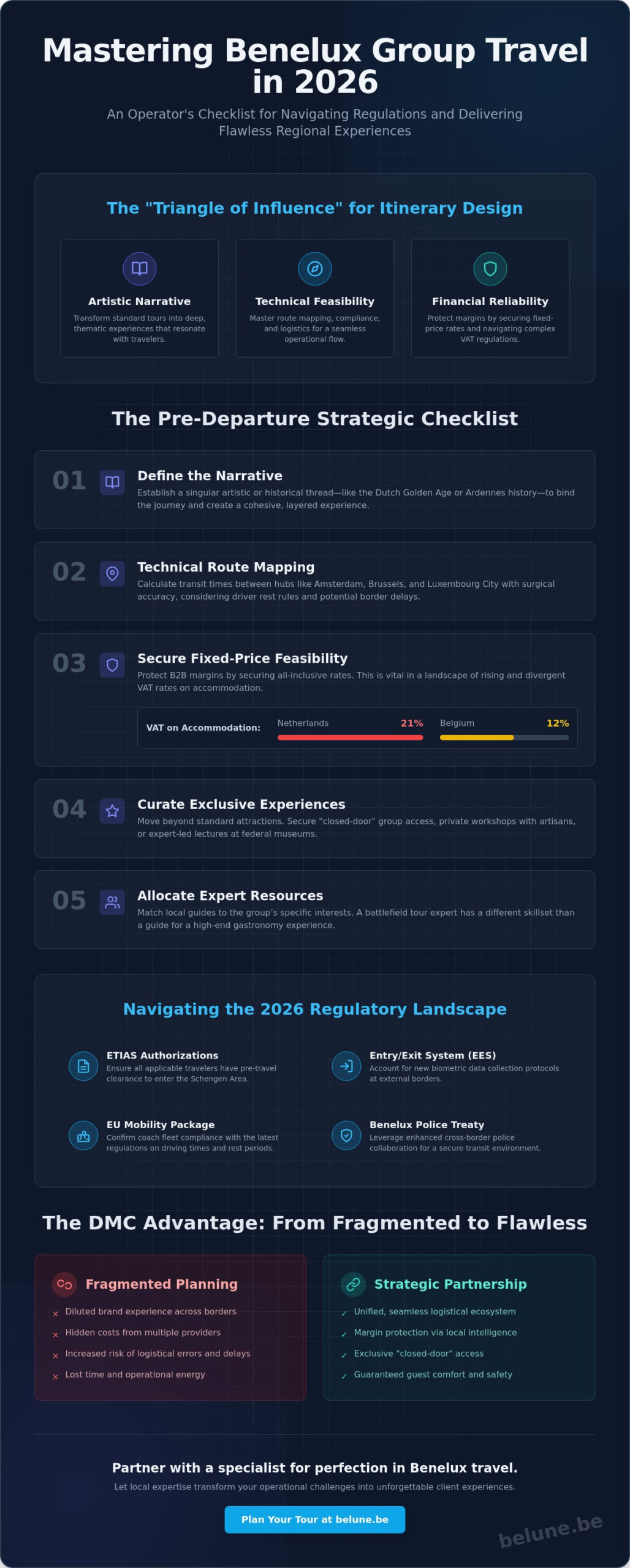
Technical rigor is no longer an optional luxury; it’s the absolute baseline for high-end group travel. As we navigate the operational realities of late 2026, including the implementation of ETIAS authorizations and the Entry/Exit System (EES), the margin for error has vanished. This is why a comprehensive benelux group tour planning checklist for operators is essential. It introduces the “Triangle of Influence” in itinerary design. This concept balances technical feasibility, artistic narrative, and financial reliability to ensure that the beauty of the experience is never compromised by the complexity of the execution.
To better understand this concept, watch this helpful video:
The Problem with Fragmented Planning
Managing separate transport providers and local guides for each territory drains operational energy and dilutes the brand experience. It often creates a logistical chasm between major regional hubs like Amsterdam, Brussels, and Luxembourg City. When communication is fragmented across multiple entities, hidden costs begin to mount. You lose time. You lose the stylistic consistency that high-end clients demand. A slight delay at a crossing or a misunderstanding of local driver rest rules can cascade, turning a bespoke cultural moment into a logistical crisis.
This principle of avoiding fragmented logistics is a global standard for excellence. Just as Benelux requires a unified approach, operators looking for similar reliability in the Americas often partner with Cancun All Tours to ensure their airport transfers and curated excursions are managed with the same level of professional oversight.
The Visionary DMC as a Strategic Ally
True excellence requires moving beyond the transactional provider-client model toward a creative partnership. A specialized benelux incoming tour operator serves as a strategic ally, offering decades of local intelligence. This partnership is what secures “closed-door” group access to private Flemish master collections or exclusive gastronomic experiences. These experts navigate the evolving 2026 regional regulations, such as the VAT increases on overnight stays in the Netherlands and Belgium, ensuring your margins remain protected while the traveler’s imagination remains stimulated.
Phase 1: The Pre-Departure Strategic Checklist
Precision in preparation is the silent engine of excellence. When building your benelux group tour planning checklist for operators, start by defining the artistic or historical thread that binds the journey. Is it the golden age of Dutch painting? Perhaps the somber echoes of the Ardennes? Identifying this narrative early allows for thematic layering that generic tours lack. Step two involves technical route mapping. You must calculate transit times between hubs with surgical accuracy, considering the new Benelux treaty on police collaboration which ensures a secure and regulated environment for cross-border transit.
Next, prioritize fixed-price feasibility. In a 2026 landscape where Dutch VAT on accommodation has reached 21% and Belgian rates have climbed to 12%, securing all-inclusive rates is vital for protecting your B2B margins. Step four introduces exclusive experiences, such as private workshops with local artisans or expert-led lectures at federal museums. Finally, allocate resources by matching local guides to the group’s specific subject interest. A battlefield tour requires a different emotional and technical vocabulary than a gastronomy experience.
Designing Specialized Itineraries
Creating a journey that resonates requires more than a map. It requires themed group travel benelux strategies that blend active and cultural elements seamlessly. For battlefield tourism, verify site availability months in advance, especially for niche remembrance sites that may have restricted access. Integrating gastronomy and beer experiences should feel like a natural extension of the story, not a forced stop. If you need assistance refining these artistic nuances, you might partner with a local expert who understands the region’s specific rhythm.
Securing Fixed-Price Reliability
Hidden fees are the enemy of trust. Multi-country itineraries are particularly susceptible to shifting local taxes and service charges. Single-invoice management simplifies complex group billing, providing a shield against the volatile economic shifts of 2026. This stability allows you to focus on the traveler’s emotional journey rather than the administrative burden of fragmented invoices. Ensure your checklist includes a verification of all-inclusive rates to avoid the “logistical chasm” of unexpected costs at the point of service.
Phase 2: Evaluating Transport and Accommodation Standards
Operational beauty is often found in the hardware of the journey. When your technical standards are high, the travel experience remains fluid and uninterrupted. A robust benelux group tour planning checklist for operators must prioritize the technical specifications of the transport fleet. Euro 6 engines are no longer just an environmental choice; they’re a logistical necessity for entering the increasingly strict low-emission zones of cities like Ghent, Antwerp, and Amsterdam. Beyond emissions, guest comfort hinges on the tactile quality of the cabin, from ergonomic seating to climate control that masters the varied European seasons.
Driver hour compliance is another critical pillar that requires surgical attention. As of July 1, 2026, the EU Mobility Package mandates second-generation smart tachographs for a wider range of international transport vehicles. Navigating the technicalities of these laws, such as the maximum nine-hour driving day and mandatory breaks after 4.5 hours, ensures the safety of the group and the legality of the itinerary. These “invisible logistics” extend to luggage management and shuttle services, where the rhythm of the tour is maintained by the silent efficiency of the ground team.
Mastering the Private Fleet Advantage
There’s a distinct safety and rhythm benefit to utilizing a dedicated coach and driver throughout the cross-border journey. A private fleet ensures that the vehicle remains a consistent “home base” for the traveler, reflecting the high standards of your brand. When verifying transport safety certifications, look for providers who exceed the baseline requirements. A dedicated driver who understands the specific nuances of cross-border movement becomes a vital component of the tour’s success, transforming a simple transit into a secure and fluid transition between cultures.
Sourcing Excellence in Group Hospitality
Finding the balance between historic elegance and logistical accessibility is an art form. Evaluating hotels for group hotel accommodation standards involves looking beyond the aesthetics of the room to the hospitality’s ability to handle complex group dynamics. According to Official Belgian tourism statistics, the demand for high-end, group-friendly spaces in historic centers remains high, requiring operators to secure allotments well in advance. This is especially true when managing special dietary requirements in high-end gastronomy tours, where the kitchen’s ability to adapt is as important as the location’s prestige. In 2026, with VAT rates having shifted to 21% in the Netherlands and 12% in Belgium, sourcing excellence also means ensuring price reliability through long-standing local partnerships.
Phase 3: Operational Mastery and Risk Mitigation
Mastery is the unseen architecture of a successful journey. It’s the ability to maintain a serene atmosphere for the traveler while managing the technical complexities of cross-border movement. Central to this is a real-time communication protocol. This link between the guide, the driver, and the operator ensures that any shift in the environment is met with a coordinated response. While the initial benelux group tour planning checklist for operators provides the structural foundation; operational mastery requires a living, breathing response to the environment.
Risk mitigation isn’t merely a safety net. It’s an art form. Contingency planning for border delays or sudden site closures must be proactive. In 2026, with the Entry/Exit System (EES) and ETIAS protocols fully operational, even minor technical glitches at a crossing can disrupt a schedule. A master operator has already mapped alternative routes or adjusted visit sequences before the traveler even senses a delay. This level of foresight transforms potential friction into a seamless transition. The goal is an “invisible” logistical flow where the traveler remains entirely immersed in the experience.
The Human Element: Guides and Experts
The guide is the emotional anchor of the tour. In the multi-lingual landscape of the Benelux region, selecting a guide who matches the group’s specific cultural or historical focus is paramount. It’s not just about translation; it’s about bridge-building. Whether it’s a deep dive into the Flemish Primitives or an exploration of the Battle of the Bulge, the guide transforms standard sightseeing into a cohesive, deeply felt narrative. They ensure that the technical precision of the itinerary is softened by human connection and local insight. This is why we prioritize guides with specific subject expertise over generalist providers.
Real-Time Logistical Precision
Precision is maintained through daily briefing checklists. Every morning, the driver and tour leader must synchronize on route specifics, regional events, and “last-mile” logistics. In historic centers like Bruges or the old quarters of Luxembourg City, coach access is often restricted. Managing these final steps requires intimate local knowledge and perfect timing. Monitoring regional festivals or sporting events is equally vital, as these can suddenly alter traffic rhythms. Post-tour reporting and guest feedback loops close the circle of excellence, allowing for continuous refinement of the operational masterclass.
If you’re ready to elevate your operational standards and ensure a flawless execution, contact our expert team today to begin co-creating your next project.
Partnering for Perfection: Why a Specialized DMC is the Final Checkmark
The final checkmark on your benelux group tour planning checklist for operators isn’t a task, but a partnership. Engaging a specialized benelux incoming tour operator transforms a list of technical requirements into a seamless operational reality. Local intelligence, built over 20 years in the heart of Europe, provides the nuance that no external research can replicate. It’s the difference between knowing a regulation exists and knowing exactly how it’s applied at a specific crossing in Luxembourg or a historic museum in Brussels. This deep-rooted knowledge ensures that your itineraries aren’t just planned, but crafted with a sense of place and purpose.
A DMC partner acts as the craftsman of light and shadow for your tours. We handle the technical shadows, the smart tachographs, the shifting VAT rates, and the complex cross-border permits, so that the light of the creative narrative can shine. This partnership is the ultimate risk mitigation strategy. It ensures that when the unexpected happens, a solution is already in motion before your clients feel a single ripple in their experience. By unifying the fragmented elements of transport, accommodation, and guiding, we provide the fixed-price reliability essential for protecting your B2B margins in a volatile economic environment.
The BELUNE Commitment to Excellence
Our approach integrates technical rigor with a sharp artistic vision in every itinerary we design. We believe in protecting your professional reputation as much as your margins. By choosing a culture group tours benelux expert, you gain access to a team that views every journey as a unique masterpiece. We manage hotel accommodation and our own fleet of busses with the same precision we apply to curating exclusive gallery visits or gastronomic encounters. Our B2B philosophy is built on collaboration, listening, and an unwavering pursuit of excellence.
Start Your 2026 Planning Today
Initiating a custom itinerary request with our team is the first step toward operational perfection. Our consultation process moves from your initial vision to a finalized masterpiece, ensuring every detail aligns with your brand standards. We provide a clear path through the complexities of the 2026 landscape, from ETIAS compliance to the latest local tax adjustments. Elevate your group strategy with BELUNE and discover how our expertise becomes your strongest competitive advantage in the heart of Europe.
Master the Art of the Cross-Border Journey
Operational excellence in the Benelux region isn’t a destination; it’s a continuous pursuit of technical precision and artistic vision. By integrating this benelux group tour planning checklist for operators into your workflow, you move beyond the fragmented logistics of the past. You’ve seen how the 2026 landscape demands a unified approach to transport, accommodation, and real-time risk mitigation. These elements are the structural components of a journey that feels effortless to the traveler but remains rigorously controlled behind the scenes.
True mastery requires a partner who shares your commitment to excellence. With over 20 years of specialized DMC experience, our team acts as your strategic ally in the heart of Europe. We combine a private fleet of modern Euro 6 coaches with a deep expertise in high-end niche itineraries, from somber battlefield remembrance to exclusive gastronomy tours. We don’t just provide services; we curate experiences that protect your reputation and your margins. It’s time to transform your operational vision into a finalized masterpiece. Partner with BELUNE for your 2026 Benelux Group Tours and secure the future of your regional strategy.
Frequently Asked Questions
What are the main logistical challenges for group tours in the Benelux region?
The primary logistical challenges in the Benelux region stem from fragmented cross-border regulations and the management of diverse transport providers. In 2026, operators must navigate varying VAT rates, such as the 21% rate in the Netherlands and 12% in Belgium. Coordinating these technical details while maintaining a bespoke quality for high-end groups requires a unified logistical framework to avoid service gaps and preserve margins.
How do Euro 6 transport standards affect group tour planning in 2026?
Euro 6 transport standards are essential for entering the strict low-emission zones (LEZ) implemented across major cities like Amsterdam, Ghent, and Antwerp. Planning without compliant vehicles can lead to significant fines or restricted access to historic city centers. Operators should verify that their fleet meets these environmental benchmarks to ensure a fluid itinerary that reaches every landmark without interruption or costly logistical detours.
Why is a fixed-price group package better for tour operators?
A fixed-price group package is superior because it protects B2B margins against volatile economic shifts and hidden fee traps. By securing all-inclusive rates early, you avoid the logistical chasm of unexpected local taxes or service charges. This reliability is a core element of the benelux group tour planning checklist for operators, allowing for more predictable financial planning and stronger client trust.
What should I look for in a Benelux Destination Management Company (DMC)?
Look for a partner with at least 20 years of local intelligence and a private fleet of modern coaches. A specialized DMC acts as a strategic ally, offering “closed-door” access to exclusive cultural sites and expertise in niche themes. They should demonstrate a deep understanding of evolving regional laws, such as the EU Mobility Package, to ensure your group’s safety and compliance throughout the journey.
How can I ensure my group tour itinerary is logistically seamless across three countries?
Ensuring a logistically seamless itinerary across three countries requires a unified communication protocol between the guide, driver, and operator. This “invisible” flow is best achieved by working with a single provider who manages all regional hubs. This approach eliminates the gaps that occur when juggling multiple separate entities and ensures a consistent stylistic narrative throughout the entire cross-border journey.
What role do local guides play in high-end Benelux group tours?
Local guides serve as the emotional anchors of high-end tours, transforming standard sightseeing into a deeply felt, cohesive narrative. In the multi-lingual Benelux region, they provide essential bridge-building through subject-specific expertise. Whether exploring Flemish art or regional gastronomy, their ability to match the group’s focus ensures that technical precision is always softened by human connection and authentic local insight.
How do I manage group hotel bookings in major European regional centers?
Managing group hotel bookings in major regional centers requires securing allotments well in advance to balance historic elegance with logistical accessibility. Operators must evaluate hotels based on their ability to handle complex group dynamics and specific dietary needs. With the 2026 VAT increases, long-standing local partnerships are vital for maintaining price stability in high-demand areas like Brussels, Luxembourg City, or Amsterdam.
What is the best way to plan a specialized battlefield tour for a group?
The best way to plan a specialized battlefield tour is to focus on thematic layering and verify site availability for niche remembrance locations months in advance. This specialized planning is a key component of a professional benelux group tour planning checklist for operators. You should match the group with guides who possess deep subject expertise to ensure the historical narrative is both technically accurate and emotionally resonant.
Leave a Reply