
The complete absence of physical border checkpoints across Belgium, the Netherlands, and Luxembourg creates an alluring, dangerous illusion of legal uniformity. When managing high-stakes group travel, successfully navigating benelux tourism regulations demands looking past open highways to master a fragmented tapestry of municipal and national mandates.
You’ve likely felt this operational friction firsthand. An itinerary flows effortlessly on paper, yet coordinating across three distinct jurisdictions brings immediate logistical pressure. Between disparate municipal tourist taxes, rigorous local guide licensing rules in cultural hubs like Bruges, and unforgiving EU coach rest-time mandates, a single administrative oversight can derail a tour and invite substantial commercial penalties.
Mastering these cross-border hurdles shouldn’t compromise the elegance of your guest experience. In this 2026 compliance guide, you’ll gain the precise legal insight needed to navigate shifting hospitality levies, vehicle access regulations, and accreditation requirements across all three territories. We outline the clear, vetted frameworks necessary to eliminate liability and orchestrate flawless group travel with absolute confidence.
Key Takeaways
- Mastering the nuances of navigating benelux tourism regulations allows planners to harmonize EU coach driving limitations with divergent national transit mandates.
- Decentralized municipal tourist taxes and shifting regional VAT rates require rigorous auditing to avoid unexpected accommodation surcharges.
- Strict city-level guide accreditation standards and group size caps demand verified local credentials to shield operators from immediate administrative fines.
- A proactive compliance schedule establishes crucial lead times for low-emission zone permits, passenger manifests, and urban access clearances.
- Strategic collaboration with an established destination management company absorbs logistical liabilities and guarantees seamless cross-border coordination.
The Regulatory Landscape of Benelux Group Tourism
Borderless transit often masks severe legal fragmentation. While the Schengen framework eliminates internal border checkpoints, commercial group travel remains firmly anchored in sovereign legal systems. Successfully navigating benelux tourism regulations requires recognizing that the historic Benelux Union operates not as a single commercial zone, but as three autonomous legal environments with divergent administrative expectations.
To understand how shared border policies interact with regional movement parameters, watch this breakdown of European cross-border mobility rules:
The Tri-Border Jurisdictional Framework
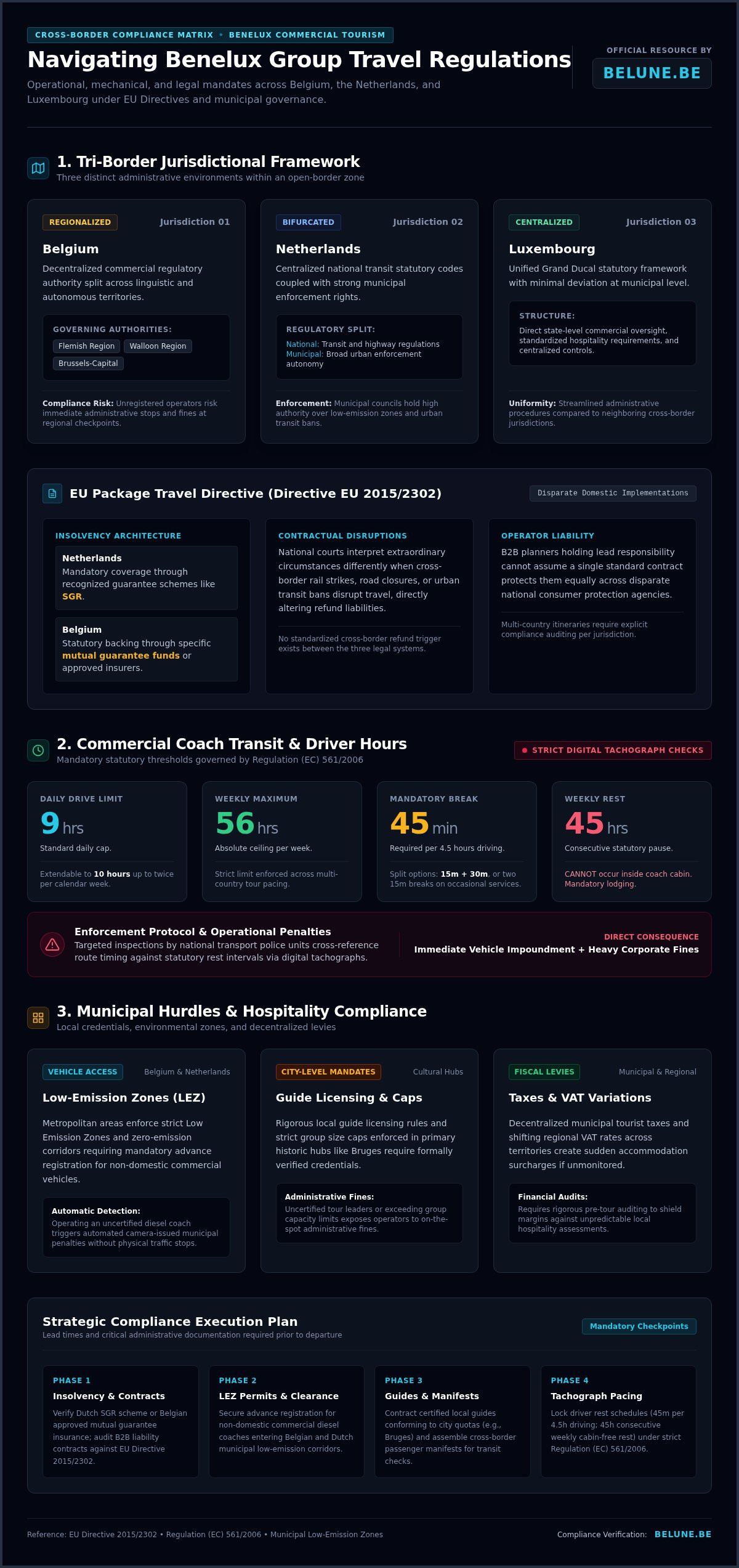
Civil liability and administrative oversight diverge sharply across borders. Belgium distributes commercial regulatory power across linguistic regions, splitting hospitality and guiding governance between Flemish, Walloon, and Brussels-Capital authorities. In contrast, the Netherlands centralizes commercial transit codes while granting municipal councils broad autonomy over urban enforcement. Luxembourg applies a centralized Grand Ducal framework with minimal municipal deviation.
Unlicensed foreign operators face severe exposure. Without recognized regional registration, organizers risk immediate administrative stops, heavy municipal penalties, and immediate operational cancellation at transit checkpoints.
The EU Package Travel Directive in National Law
While Directive (EU) 2015/2302 standardizes passenger protections across Europe, its domestic transposition reveals deep operational divides across the tri-border territory:
- Insolvency Architecture: Dutch organizers must demonstrate formal coverage through recognized guarantee schemes like the SGR, whereas Belgian law mandates insolvency backing through specific mutual guarantee funds or approved insurers.
- Contractual Disruptions: National courts interpret extraordinary circumstances differently when cross-border rail strikes, road closures, or urban transit bans disrupt travel, directly affecting refund liability.
- Operator Liability: B2B planners holding lead responsibility cannot assume a single standard contract shields them against disparate national consumer protection agencies.
Aligning these legal mechanisms before departure is essential when navigating benelux tourism regulations across multi-country itineraries.
Commercial Transport Regulations: Coach Operations and Driver Compliance
Flawless group transit relies entirely on strict mechanical and scheduling precision. Cross-border coach journeys face targeted inspections by national transport police units across all three territories. Officers routinely inspect digital tachographs to cross-reference route timing against statutory rest intervals. Successfully navigating benelux tourism regulations requires aligning technical transit limitations with your daily tour pacing.
EU Driver Hours and Mandatory Rest Protocols
Under Regulation (EC) 561/2006, commercial drivers face strict caps: nine hours of daily driving, extendable to ten hours twice a week, and a maximum of 56 weekly driving hours. Drivers must take a 45-minute pause after 4.5 hours of driving, split into a 15-minute rest followed by a 30-minute block, or two 15-minute breaks on occasional passenger services. Weekly rest demands 45 consecutive hours, which cannot occur inside the coach cabin. Violating these thresholds triggers immediate vehicle impoundment and heavy corporate fines for the operating agency.
Urban Low-Emission Zones and Environmental Registrations
Beyond highway regulations, metropolitan access introduces regional hurdles. Multiple Belgian and Dutch cities enforce rigorous Low Emission Zones (LEZ) and zero-emission corridors requiring advance registration for non-domestic commercial vehicles. Operating an uncertified diesel coach risks automatic camera-issued penalties. Planners must also arrange municipal drop-off access permits near historic landmarks well before arrival, as unauthorized curb idling carries instant administrative sanctions.
Cross-Border Commercial Vehicle Documentation
Border police and road transport agencies conduct random inspections on transit corridors. Every commercial coach crossing internal borders must possess verified documentation adhering to EU Coach and Bus Transport Regulations. Crucial paperwork includes:
- Operator Accreditations: Certified copies of the Community License and official vehicle registration.
- Passenger Manifests: Completed international journey forms and an official passenger manifest detailing each traveler’s full name, date of birth, and gender.
- Technical Verification: Mandatory calibration records for Version 2 smart tachographs and comprehensive cross-border commercial passenger liability insurance.
Partnering with a specialist providing dedicated coach hire with own fleet of busses eliminates these operational risks by absorbing technical permitting and driver compliance into a single standard workflow.
Hospitality Compliance: Tourist Taxes and Guiding Standards
Seamless ground delivery requires balancing fiscal accountability with strict local labor mandates. When moving groups across borders, accommodation invoicing and cultural commentary encounter diverse regional rules. Successfully navigating benelux tourism regulations means preparing for municipal fiscal autonomy while ensuring your field staff holds valid regional credentials.
Municipal Tourist Tax Structuring and Remittance
Unlike centralized national sales levies, tourist taxes remain intensely localized. Amsterdam assesses a 12.5% tax on room rates alongside a standard Dutch accommodation VAT rate of 21%. Conversely, Rotterdam charges 6.5%, and Delft applies a flat nightly rate of €4.50 per guest. Crossing into Belgium introduces per-room formulas, such as Brussels levying €5.00 per unit, while Bruges and Antwerp charge flat per-person rates of €2.00 and €3.20 respectively. Luxembourg City calculates an independent 3% charge on lodging totals.
These divergent mechanisms complicate master billing. Planners must clarify whether local taxes must be settled directly by guests upon arrival or bundled into prepaid B2B disbursements.
Professional Guiding Accreditations and Legal Restrictions
Guiding qualifications vary significantly across borders:
- Regulated Heritage Enclaves: Amsterdam requires official municipal licensing for commercial tour leaders. Bruges enforces strict regulations limiting walking tour groups to 20 participants, requiring licensed organizers and authorized guides.
- Specialized Historical Routes: Battlefield itineraries across the Ypres Salient or Bastogne demand validated local expertise, where municipal site managers actively inspect foreign commentary teams.
- Open Commercial Markets: While broad national legislation in Luxembourg and parts of Belgium permits open guiding, major state museums and protected monuments enforce strict right-to-guide checks at entry points.
Using non-accredited tour escorts for historical commentary can lead to on-site stops, passenger removal, and commercial fines.
Hotel Group Contracting and Civil Liability
Group accommodation contracts reflect stringent statutory covenants. Hotel partners must comply with national interior ministry decrees mandating accurate guest manifest registrations before issuing room keys. Cross-border contracts also require strict alignment on attrition schedules, cancellation windows, and building safety certifications. Relying on an established benelux incoming tour operator provides dedicated hotel accommodation management, standardizing these contracts to keep your programs compliant and protected from fiscal disputes.
A Strategic Compliance Checklist for Cross-Border Tour Planners
Operational precision transforms regulatory complexity into seamless itinerary execution. Managing international groups across multiple borders demands structured administrative timelines rather than reactive problem-solving. When aligning your operations with the standards expected of an elite group travel agency, navigating benelux tourism regulations becomes an orderly, predictable workflow.
Phase 1: Pre-Contracting Due Diligence and Permitting
Preparation begins long before your guests step onto European soil. Establishing structured lead times guarantees uninterrupted coach transit and secured venue access:
- Carrier Licensing (60 to 90 Days Prior): Audit carrier operator licenses to confirm valid EU Community authorization, version 2 smart tachograph calibrations, and comprehensive cross-border fleet insurance.
- Environmental Registrations (30 to 45 Days Prior): Pre-register foreign coaches in regional Low Emission Zone databases to clear municipal transit corridors without camera-issued penalties.
- Heritage Venue Clearances (30 Days Prior): Secure designated group arrival windows and timed museum entry slots to satisfy municipal group density caps.
Phase 2: On-the-Road Operational Controls
Active touring requires relentless field discipline. Planners must monitor driver duty cycles through real-time telematics, ensuring tight daily schedules never compromise statutory rest pauses. Operations teams should maintain synchronized digital and printed passenger lists containing full identification details for routine border and transport checks. Furthermore, coordinators must verify that contracted local guides hold recognized credentials before commencing walking tours in restricted historic cores.
Phase 3: Crisis Management and Incident Protocols
Even meticulous plans require resilient contingency structures. Tour organizers must establish comprehensive emergency medical response protocols compatible with tri-border healthcare conventions. Operational frameworks must also include guaranteed coach replacement logistics to resolve unexpected mechanical delays without stranding guests. Direct communication trees linking tour directors, local dispatchers, and regional emergency services ensure rapid resolution during disruptions.
To eliminate operational liabilities on your next program, partner with BELUNE for end-to-end B2B destination management across the entire region.
Overcoming Regulatory Complexity: The DMC Strategic Advantage
Navigating benelux tourism regulations independently exposes international tour operators to compounding civil, fiscal, and operational liabilities. Managing three divergent national frameworks across a single weeklong itinerary drains internal resources and invites costly missteps. Partnering with an established regional Destination Management Company transforms this administrative friction into an invisible, reliable foundation, protecting your commercial margins while preserving exceptional guest immersion.
Integrated Fleet Management and Route Engineering
Precision transport requires complete harmony between itinerary pacing and statutory driver rest parameters. By utilizing our own modern private coach fleet, we eliminate intermediary carriage risks and ensure direct mechanical oversight. Our operations specialists engineer driving routes that naturally absorb mandatory tachograph rest cycles and low-emission urban clearances. Rather than reacting to unexpected transit inspections or vehicle restrictions, your itineraries proceed with absolute logistical and legal certainty.
Vetted Local Knowledge and Subcontractor Protection
On-the-ground compliance hinges on authentic regional presence. Managing varied hotel accommodation agreements, securing timed landmark slots, and reconciling municipal tourist taxes requires established local relationships. This administrative diligence shields specialized programs such as our culture group tours benelux itineraries from disruptive municipal enforcement. Providing fully accredited local guides guarantees that historical storytelling remains engaging, authentic, and fully compliant with local regulations.
Seamless B2B Partnership and Logistical Excellence
Comprehensive destination management acts as a vital commercial risk shield for outbound travel planners. With over two decades of dedicated group travel experience across the Benelux territory and France, our tailored B2B solutions absorb the complex burdens of regional compliance. International tour operators can engage BELUNE to manage intricate regional logistics with complete confidence, turning the challenge of navigating benelux tourism regulations into an effortless, high-performing travel program.
Elevate Your Regional Group Operations
True borderless travel isn’t born from an absence of rules; it emerges through the mastery of subtle, intersecting jurisdictions. Synchronizing strict coach driver rest intervals, reconciling fragmented municipal lodging taxes, and securing verified local guiding credentials safeguard your commercial viability. Mastering these standards ensures your creative itineraries remain undisturbed by sudden administrative stops. Successfully navigating benelux tourism regulations isn’t merely a compliance exercise; it’s the foundation of an exceptional guest experience.
You don’t have to carry this administrative weight alone. Backed by over 20 years of regional B2B expertise, our private fleet of modern coaches and vetted network of certified local guides and premium hotel partners absorb every operational friction point. Let structural precision elevate your group journeys. Partner with BELUNE to ensure flawless compliance and logistics for your group tours across the entire territory with absolute confidence.
Frequently Asked Questions
What are the primary cross-border regulations affecting group travel across the Benelux?
Primary cross-border regulations center on commercial transport compliance, environmental municipal access, local fiscal reporting, and passenger identity documentation. While Schengen removes routine border stops, tour organizers must still carry official passenger manifests, maintain valid EU Community carriage licenses, and verify driver rest compliance under Regulation (EC) 561/2006. Successfully navigating benelux tourism regulations requires treating each member state as a distinct administrative domain rather than assuming unified commercial standards.
How do EU coach driver resting hour laws impact multi-country Benelux tour schedules?
EU Regulation (EC) 561/2006 strictly limits driving to nine hours daily and requires a mandatory 45-minute pause after 4.5 hours of driving. Because itineraries across the Benelux territory often combine multiple destinations within brief driving windows, heavy urban traffic can quickly trigger legal threshold violations. Digital tachograph inspections by transport police enforce non-negotiable penalties, requiring planners to build substantial buffer periods into every transfer schedule.
Are local tour guide credentials legally recognized interchangeably across Belgium and the Netherlands?
No, guide credentials aren’t universally recognized across borders. While the profession is largely open at the national level in both countries, municipal ordinances create strict local boundaries. Historic destinations like Bruges require formal municipal authorization and enforce strict 20-person group caps. Amsterdam mandates independent city licensing. Uncertified tour leaders attempting commentary within regulated cultural centers or state museums risk immediate ejection and municipal commercial fines.
How do municipal tourist tax structures differ between Belgian and Dutch accommodations?
Dutch municipalities generally apply percentage-based formulas or flat per-person rates, exemplified by Amsterdam’s 12.5% room tax alongside the national 21% accommodation VAT rate. In contrast, Belgian cities frequently assess fixed per-room nightly levies, such as the €5.00 unit charge enforced in Brussels, or flat per-guest amounts in cities like Bruges and Antwerp. These divergent accounting mechanisms mean group invoices must be structured individually per stop rather than standardized.
What environmental permits are required for international touring coaches entering Benelux cities?
Major urban zones throughout Belgium and the Netherlands enforce strict Low Emission Zones (LEZ) and zero-emission logistics rings. Non-domestic touring coaches must pre-register license plates and Euro emission standards in regional municipal databases well before arrival. Failure to secure prior clearance results in automated camera detection and heavy fines. Additionally, accessing historical central drop-off points requires distinct municipal transit permits and scheduled docking time slots.
Does the EU Package Travel Directive apply to foreign operators running Benelux tours?
Yes, the EU Package Travel Directive directly impacts foreign organizers contracting services within the European Union. When combining transport with accommodation or local cultural tours, organizers face strict legal responsibilities. If domestic disruptions occur, national consumer protection bodies hold lead operators liable for refunds and itinerary modifications. Navigating benelux tourism regulations requires maintaining compliant insolvency guarantees and aligning supplier cancellation covenants across all three sovereign jurisdictions.
Why should foreign tour operators partner with a regional destination management company?
Partnering with an established Destination Management Company shields outbound planners from complex administrative liabilities. BELUNE leverages over 20 years of dedicated regional group travel expertise, operating its own modern private coach fleet to absorb technical driver regulations and environmental access permitting. Through vetted local hotel accommodation management and certified regional guides, an experienced B2B partner guarantees complete statutory compliance while elevating overall tour quality.
Leave a Reply