In 2026, the success of a cultural journey through the French capital depends less on the art itself and more on the invisible architecture of its planning. Organizing paris museum group tours has evolved into a high-stakes discipline where curatorial vision must meet rigorous technical precision.
You likely recognize that managing a party of twenty through the Louvre’s Richelieu entrance or securing mandatory timed slots at the Musée d’Orsay requires more than just a passion for history. It’s a delicate balance of timing, regulation, and movement. This guide offers a masterclass in orchestrating these complexities to ensure your guests experience the sublime without the friction of administrative hurdles. We’ll explore the latest 2026 regulations, from the permanent daily admission caps at the world’s most visited museums to the specialized logistics of coach transport and professional guiding standards that define an exceptional itinerary. By bridging the gap between artistic ambition and logistical mastery, we’ll help you transform a standard visit into a seamless, high-impact cultural event.
Key Takeaways
- Master the 2026 regulatory shift by understanding mandatory timed entry protocols and strict group size caps for high-impact paris museum group tours.
- Ensure legal compliance and cultural depth by securing professional local guides who hold the French ‘Droit de Parole’ for major national institutions.
- Optimize group movement across the city with private coach logistics designed to navigate Paris’s evolving parking and drop-off regulations.
- Balance iconic landmarks with boutique venues like the Musée Picasso to maintain a fluid, immersive pace and avoid crowd fatigue.
- Position your operations for success by partnering with a strategic ally who brings over 20 years of logistical expertise to complex cultural itineraries.
The Art of Coordinating Paris Museum Group Tours in 2026
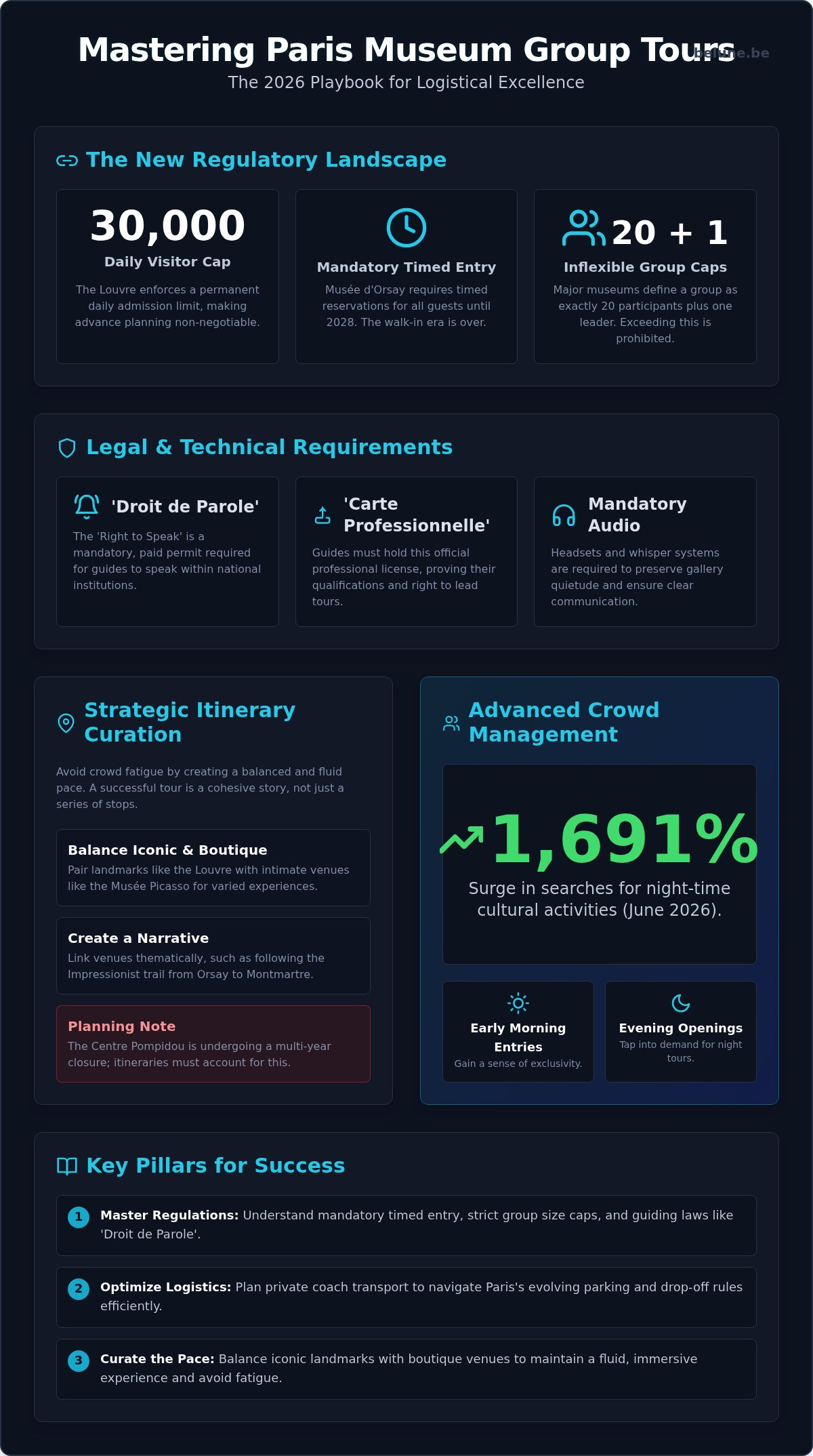
The cultural pulse of Paris has shifted. In 2026, the city operates with a refined logistical rigor that leaves no room for the improvisational tourism of the past. For organizers of paris museum group tours, the challenge isn’t just access; it’s the orchestration of movement. With the Louvre maintaining a permanent daily cap of 30,000 visitors and the Musée d’Orsay requiring timed reservations for every guest until 2028, the walk-in era has effectively ended. These regulations aren’t barriers, but rather the framework for a more sophisticated visitor experience.
Success now requires a strategic ally who understands that a curated itinerary is a living document. It must account for the temporary closure of the Centre Pompidou while integrating exhibitions at the Grand Palais. By consulting a comprehensive list of Parisian museums, planners can find the right balance between the heavyweights and the intimate spaces that offer groups a moment of quiet reflection. This dual approach ensures that the schedule remains diverse, avoiding the exhaustion often associated with back to back visits to major institutions.
To better understand the scale and variety of these cultural institutions, watch this helpful overview:
Defining the Professional Group Experience
A professional tour transcends the simple act of looking at art. It’s about a curatorial vision. We believe that high-impact paris museum group tours should follow a narrative thread, perhaps linking the Impressionist light of the Orsay to the private studios of Montmartre. This thematic consistency transforms a series of stops into a cohesive story. Professional management ensures that the emotional impact of a masterpiece isn’t lost in the stress of a crowded corridor. It’s the difference between seeing a painting and experiencing its history. By prioritizing the human element, we turn logistical requirements into moments of artistic discovery.
Addressing the Challenges of Large-Scale Attendance
Crowds are an inevitable part of the Parisian experience, yet their psychological weight on a group can be managed. We focus on setting realistic expectations while exploiting the city’s operational rhythms. Early morning entries provide a sense of exclusivity; evening openings tap into the growing demand for night tours. In June 2026, searches for night-time cultural activities surged by 1,691%, proving that visitors crave these atmospheric, lower-density windows. By shifting the timeline, we protect the group’s morale and ensure the art remains the focus. This strategic scheduling allows the group to breathe and appreciate the volumes of the space without feeling rushed.
Navigating Regulatory Frameworks and Group Entry Requirements
Organizing paris museum group tours requires more than a simple reservation. It’s a rigorous exercise in adherence to French cultural law. One of the most critical, yet often misunderstood, regulations is the ‘Droit de Parole’. This ‘right to speak’ isn’t granted automatically; it must be secured through specific permits and associated fees. Museums also enforce a strict audio policy. Headsets and whisper systems are mandatory for groups to ensure the quietude of the gallery is preserved while maintaining clear communication between the guide and participants.
Group size limitations are equally inflexible. While some smaller venues might offer slight variations, the major institutions have solidified their caps to manage the post-2024 visitor surge. The Louvre, for example, defines a large group as exactly 20 participants plus one leader. Attempting to navigate these spaces with 22 or 23 people isn’t just difficult; it’s legally prohibited. These caps are designed to protect both the integrity of the art and the visitor flow, making precise participant counting a logistical necessity for every professional operator.
The Legalities of Professional Guiding
A guide in Paris isn’t just an educator. They’re a licensed professional. To speak publicly in a national museum, a guide must hold the ‘Carte Professionnelle’. This credential is the result of rigorous academic and state certification. When we manage your local guide services, we prioritize this legal compliance to eliminate the risk of group exclusion. Budgeting for ‘droit de parole’ fees is essential, as these structural costs vary across the city’s vast cultural network and must be paid in advance to validate your entry time.
Booking Protocols for the 2026 Season
The administrative burden of securing group slots has increased significantly. For the 2026 season, you should anticipate booking windows opening six months or more in advance. The Louvre has already opened its reservation system through January 3, 2027, highlighting the need for early commitment. Managing deposits across multiple venues requires a centralized approach to avoid administrative friction. Consulting official Paris museum tour options early in the planning phase allows you to map out which venues require immediate financial commitment. Seasonal demand during peak months can render even the most flexible itineraries impossible if these narrow windows are missed.
Curating the Itinerary: Strategic Selection for Large Groups
Curating a cultural journey in Paris is an exercise in spatial and intellectual choreography. It isn’t enough to simply select famous sites. One must understand how the volume of a space influences the group’s emotional resonance with the art. For paris museum group tours, the selection process begins with the anchors: the Louvre and the Musée d’Orsay. While the Centre Pompidou remains closed for major renovations through 2030, its spirit lives on in satellite exhibitions at the Grand Palais. We view these shifts not as disruptions, but as opportunities to refine the narrative of your itinerary.
Designing these paths requires a deep understanding of the Culture Group Tours Benelux landscape. A seamless transition from the technical mastery of the Dutch Golden Age to the revolutionary strokes of French Impressionism creates a powerful, unified experience. This strategic alignment between regions is where our expertise as a strategic ally becomes most visible, transforming a standard trip into a curated masterclass.
High-Capacity Venues vs. Intimate Collections
The Louvre offers a unique advantage for large-scale attendance. Its vast halls can absorb significant numbers without compromising the sense of grandeur. Conversely, the Musée d’Orsay, housed in its iconic former railway station, demands much tighter logistical timing due to its more constrained layout and mandatory timed entry requirements. To balance these intensive visits, we often incorporate ’boutique’ museums. The Rodin Museum, for instance, provides a necessary logistical ‘breather’. Its expansive sculpture gardens allow participants to disperse and reflect in a more open environment before moving to the next indoor venue, such as the Musée Picasso.
Designing Thematic Threads
A chronological approach is standard, but a thematic thread is what stays with a traveler. Imagine a journey tracing the evolution of light, beginning with the masters in Benelux and culminating in the vibrant galleries of the Orsay. Our local guides play a pivotal role here. They don’t just recite dates. They weave these disparate cultural connections into a singular story. This method ensures that even in a city as dense as Paris, the group’s experience remains focused, personal, and profoundly impactful. By linking the art to the human experience, we ensure every moment feels intentional and deeply resonant.
Seamless Logistics: Beyond the Gallery Walls
Coordinating dining is another critical structural component. Multi-course meals must be timed with surgical precision to respect strict museum entry slots. We source restaurants that don’t just accommodate large parties; they understand the specific rhythms of a professional itinerary. This ensures that a leisurely lunch doesn’t jeopardize a hard-won reservation at the Louvre or Orsay. It’s about creating a rhythm where every component, from the morning espresso to the final evening toast, feels intentional and harmonious.
Parisian regulations for heavy vehicles are among the strictest in Europe. Modern coaches must meet specific low-emission standards to enter the city’s central zones. We manage these technical requirements transparently, ensuring every vehicle in our fleet is compliant with the latest environmental mandates. Driver hours are synchronized with museum opening times to prevent any delays in the schedule. This level of detail is particularly vital for groups arriving through our Benelux incoming tour operator network, where cross-border transitions must feel invisible. Our team handles the drop-off and parking zones, which are often located far from the museum entrances, allowing guests to arrive at the doorstep of history refreshed.
Accommodation and Group Hospitality
Selecting the right hotel is a strategic decision that influences the entire tour flow. We source accommodations that specialize in group hospitality, prioritizing properties with efficient check-in systems and dedicated luggage storage. Proximity to cultural hubs is essential; it reduces transit time and allows for a more relaxed morning routine. Managing the logistics of a forty-person check-in while the group is still at a museum requires a high degree of coordination. By handling these behind-the-scenes details, we ensure the transition from a day of art to an evening of rest is fluid. If you’re looking to elevate your next itinerary with professional coach hire and logistics, our team is ready to serve as your strategic partner.
Partnering with a Specialized DMC for Parisian Excellence
A Destination Management Company shouldn’t be viewed as a mere service provider. In the complex landscape of 2026, we act as a strategic ally. Our role is to bridge the gap between your vision and the operational realities on the ground. With over 20 years of experience in Benelux and Parisian logistics, we’ve developed a deep intuition for the city’s cultural pulse. This longevity allows us to navigate the shifting sands of museum regulations and timed entry requirements with a serenity that inspires confidence in our partners. We don’t just book slots; we curate environments where art can be appreciated without the noise of administrative friction.
Paris is a city of passion, which occasionally manifests as unexpected strikes or sudden venue closures. Local expertise is the only effective shield against these disruptions. We don’t just react; we anticipate. Having a dedicated team on the ground means we can pivot an entire itinerary in real-time, securing alternative cultural experiences that maintain the high standards of your paris museum group tours. This level of risk management is what separates a standard tour from a masterclass in travel orchestration. It’s about ensuring the narrative remains unbroken, regardless of external challenges.
The BELUNE Difference in Cultural Tourism
Our approach is defined by technical mastery and a commitment to minimalist elegance. We believe that logistics should be invisible, leaving only the emotion of the art for your clients to experience. By integrating our specialized Art & Culture tours with our private coach fleet, we eliminate the friction of third-party transport. This vertical integration ensures that the quality remains consistent from the moment your group leaves the hotel until they return from the gallery. We support tour operators by providing the technical backbone needed to deliver an exceptional end-client experience. It’s a collaboration rooted in listening, excellence, and a shared passion for high-end cultural travel; if you are organizing a specialized event or celebration, you might also check out Laure Diaff Make Up & Hair Artiste for luxury styling services.
Designing a 2026 Paris program requires foresight and a collaborative spirit. We invite you to consult with our experts to transform your concepts into a bespoke cultural program that moves beyond off-the-shelf packages. Whether you’re looking for a seamless transition from the Benelux region or a deep dive into the Parisian avant-garde, our team provides the specialized knowledge required for success. You can request a comprehensive quote for hotel management, transport, and local guide services tailored to your specific needs. Let’s work together to transform the space and experience of your next group journey.
Request Your Custom Benelux and Paris Group Tour Itinerary to begin crafting an exceptional cultural journey with a partner you can trust.
Elevating the Cultural Narrative for 2026
The evolution of Parisian cultural tourism demands a shift from simple coordination to strategic orchestration. Successful paris museum group tours in 2026 require a mastery of rigid timed entry systems and a deep understanding of the city’s complex regulatory framework. By balancing high-capacity icons with intimate boutique collections, you create a journey that feels both grand and personal for every participant.
Technical precision is the foundation of this experience. Our commitment to excellence is backed by 20+ years of DMC expertise, ensuring that every logistical detail is managed with care. From our private modern coach fleet to the coordination of expert local guides who meet the highest French legal standards, we handle the invisible architecture of your tour. We don’t just move people; we transform spaces and narratives to protect the emotional resonance of the art.
We invite you to move beyond standard itineraries and embrace a partnership built on trust and technical mastery. Together, we can design programs that exceed the expectations of discerning travelers while navigating the complexities of the French capital with ease. Partner with BELUNE for Your 2026 Paris Museum Group Tours and let us help you craft an unforgettable cultural legacy.
Frequently Asked Questions
What are the group size limits for the Louvre in 2026?
Large groups at the Louvre are capped at 20 participants plus one leader, totaling 21 people. This limit is strictly enforced at the dedicated Richelieu entrance. For smaller, more intimate sessions, the museum defines a small group as up to six participants plus their guide. Adhering to these caps is essential for maintaining access and ensuring the group isn’t denied entry upon arrival at their reserved time slot.
Do we need to hire a local guide for Paris museum tours?
Hiring a licensed local guide is mandatory if you wish for your group to receive commentary inside French national museums. Only guides holding a state-issued ‘Carte Professionnelle’ are legally permitted to speak in these galleries. Without a qualified professional, your group may only visit the collections in silence. Our local guide services provide experts who not only meet these legal standards but also offer deep curatorial insights that elevate the tour experience.
How far in advance should we book group museum tickets?
We recommend booking your group slots at least six months in advance to secure high-demand timed entries. For paris museum group tours in 2026, the Louvre has already opened reservations through early January 2027. Major venues like the Musée d’Orsay also require significant lead times due to ongoing renovations and high attendance caps. Early commitment is the only way to ensure your itinerary remains seamless and avoids the disappointment of sold-out dates.
Can our coach drop us off directly in front of the Musée d’Orsay?
Direct drop-offs in front of the Musée d’Orsay are prohibited due to strict Parisian traffic and security regulations. Coaches must use designated drop-off zones located a short walk from the museum entrance. Navigating these parking complexities requires a driver who is intimately familiar with the city’s evolving logistics. Our private coach fleet is managed by professionals who coordinate these transfers with precision, ensuring your group arrives as close as legally possible to the venue.
Are headsets mandatory for all group tours in Paris museums?
Headsets are mandatory for almost all group visits in major Parisian museums to preserve the quiet atmosphere of the galleries. These whisper systems allow the guide to communicate clearly without raising their voice, ensuring every participant hears the commentary perfectly. Most institutions require groups of seven or more to use this equipment. We include high-quality audio systems as a standard component of our logistical planning to maintain the sophistication and decorum of the experience.
How do we handle group dining near major museums?
Coordinating group dining near museums like the Louvre or Orsay requires selecting restaurants that specialize in professional group hospitality. These venues must be able to serve multi-course meals within a strict timeframe to align with your museum entry slots. We source and manage these reservations, focusing on establishments that offer both culinary excellence and logistical efficiency. This ensures that the group’s schedule remains harmonious and that no cultural appointments are missed due to service delays.
What is the ‘Droit de Parole’ fee for external guides?
The ‘Droit de Parole’ is a mandatory fee paid to national museums for the right of an external licensed guide to speak to a group. This administrative cost is separate from the individual admission tickets and must be settled during the reservation process. The fee varies depending on the institution and the size of the group. Including these structural costs in your initial budget is vital for a transparent and professionally managed cultural itinerary.
Can we combine a Paris museum tour with a Flanders Fields itinerary?
You can absolutely combine a Parisian cultural program with a Flanders Fields or broader Benelux itinerary. Our 20 years of experience as a specialized DMC allow us to create a seamless transition between these regions using our own modern coach fleet. We handle the cross-border logistics, hotel management, and local guide services for both locations. This integrated approach ensures a unified narrative and consistent quality throughout the entire journey, from the galleries of Paris to the battlefields of Belgium.
Leave a Reply