A Trappist beer tour in Belgium is not a pub crawl. It’s a pilgrimage, one that demands the same quiet reverence as the abbey walls it unfolds beside, and the same logistical precision as a Swiss rail timetable. Yet for many international tour operators, the gap between that vision and a flawlessly executed group itinerary is where ambitions quietly unravel.
You already know the appeal. Centuries of monastic brewing tradition, a handful of certified abbeys scattered across the rolling landscapes of Wallonia and Flanders, and a guest experience that simply cannot be replicated anywhere else on earth. Organizing a trappist beer tour in Belgium, however, means navigating tasting rooms that operate on their own sacred schedule, coordinating private transport across remote rural roads, and preserving the integrity of an Authentic Trappist Product-certified experience from the first abbey gate to the last.
This guide exists to close that gap. Drawing on 20+ years of Benelux expertise and the operational depth of a specialist DMC, we’ll walk you through the artistry and the architecture of a curated group pilgrimage worthy of 2026, covering itinerary design, coach logistics, and the exclusive abbey-adjacent experiences that elevate a good tour into an unforgettable one.
Key Takeaways
- A curated trappist beer tour belgium demands more than enthusiasm — it requires a precise understanding of the Authentic Trappist Product seal and the monastic schedules that govern every abbey visit.
- Belgium’s five official Trappist abbeys each present unique logistical challenges, from Westvleteren’s legendary exclusivity to Westmalle’s iconic café experience — and each requires a tailored approach for group travel.
- Private coach hire is not a luxury on a Trappist itinerary; it is a operational necessity, as rural accessibility and driver-hour coordination can make or break a seamless group experience.
- The finest Trappist pilgrimages extend beyond the glass, weaving regional gastronomy — from Carbonnade Flamande to artisan cheese pairings — into a multi-sensory narrative of Belgian heritage.
- Partnering with a specialist DMC like BELUNE, with 20+ years of Benelux expertise and its own coach fleet, gives international tour operators the strategic and logistical foundation to deliver truly elite group itineraries.
The Essence of the Trappist Beer Tour: A 2026 Perspective
Not all beer is created equal. And not all beer tours are created with equal integrity. Understanding this distinction is the foundation upon which every serious trappist beer tour belgium is built, and it begins with three words stamped on a hexagonal label: Authentic Trappist Product.
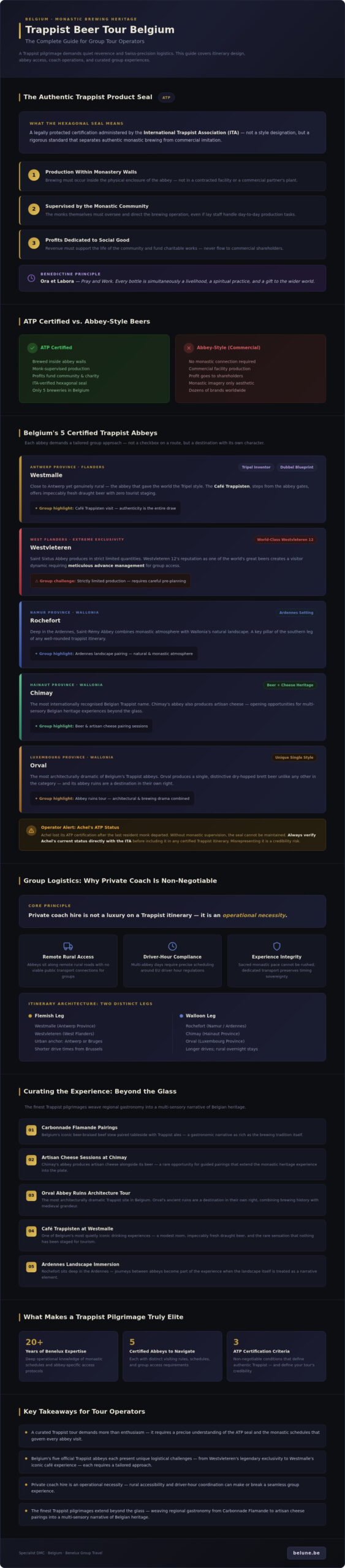
The ATP seal is not a style designation. It’s a legally protected certification administered by the International Trappist Association (ITA), and its criteria are deliberately demanding. A beer earns the right to carry that hexagonal mark only when it satisfies three non-negotiable conditions.
- Production within monastery walls. The brewing must occur inside the physical enclosure of the abbey, not in a contracted facility or a commercial partner’s plant.
- Supervision by the monastic community. The monks themselves must oversee and direct the brewing operation, even if lay staff handle day-to-day production.
- Profits dedicated to social good. Revenue must support the life of the community and fund charitable or social works, never flow to commercial shareholders.
These aren’t bureaucratic checkboxes. They’re the operational expression of the Benedictine principle of Ora et Labora, pray and work. Every bottle produced is simultaneously a livelihood, a spiritual practice, and a gift to the wider world. That philosophy shapes the visitor experience in ways that no commercial brewery can replicate. Silence matters here. Pace matters. The tour operator who understands this designs an itinerary accordingly.
The ATP Seal: The Gold Standard of Brewing
It’s also what separates Trappist beer from the far larger universe of “abbey-style” beers. Dozens of commercial breweries produce beers with monastic imagery, Gothic lettering, and names evoking cloistered tradition. None of them carry the ATP seal. For discerning travellers, that distinction is the entire point of the journey.
The 2026 Trappist Landscape in Belgium
The landscape has shifted in recent years, and tour operators must account for it. Achel, once one of Belgium’s six ATP-certified breweries, lost its certification after the last resident monk departed. Without monastic supervision, the seal cannot be maintained. As of the time of writing, operators should verify Achel’s current status directly with the ITA before including it in any certified Trappist itinerary. Presenting it as an ATP experience when it may no longer qualify isn’t a minor error; it’s a credibility risk that undermines the entire pilgrimage narrative.
Belgium’s remaining certified abbeys, Westvleteren, Westmalle, Rochefort, Chimay, and Orval, each operate on their own terms, their own visiting hours, and their own relationship with outside groups. A professionally curated trappist beer tour belgium respects that sovereignty absolutely, while still delivering the depth and comfort that premium group travellers expect.
Belgium’s Five Official Trappist Abbeys: A Sensory Map
Five abbeys. Five entirely distinct encounters with monastic brewing culture. Any serious trappist beer tour belgium must treat each one not as a checkbox on a route, but as a destination with its own character, its own rhythms, and its own demands on the itinerary architect.
The Flemish Giants: Westmalle and Westvleteren
Westmalle sits in the Antwerp province, close enough to the city to anchor a Flemish leg without excessive coach time, yet tucked far enough into the countryside to feel genuinely removed from urban life. The abbey gave the world the Tripel style as we know it today, and its Dubbel remains the definitive blueprint for every dark abbey ale that followed. The Café Trappisten, a short walk from the abbey gates, is one of Belgium’s most quietly iconic drinking experiences: a modest room, impeccably fresh draught beer, and the rare sensation that nothing here has been staged for tourism. For groups, that authenticity is the entire point.
Westvleteren is a different proposition entirely. Saint Sixtus Abbey produces in strict limited quantities, and the reputation of Westvleteren 12 as one of the world’s great beers has created a visitor dynamic that requires careful management. The In de Vrede café across the road offers the most accessible group experience, but opening hours and group policies shift seasonally. Operators should verify current 2026 access arrangements directly before building it into any confirmed itinerary. Managing guest expectations here is as important as managing the logistics: the experience is quiet, unhurried, and deliberately modest. Groups conditioned to grand tasting rooms will need thoughtful pre-tour briefing.
The Walloon Treasures: Chimay, Rochefort, and Orval
Shifting south into Wallonia transforms the tour’s entire sensory register. The Ardennes landscape, dense forest, river valleys, and stone villages, becomes part of the narrative. A well-designed southern loop connects Chimay, Rochefort, and Orval within a single scenic arc that rewards the journey as much as the destination.
Chimay offers the most structured group experience of the five, anchored by the Espace Chimay visitor centre and deepened by the abbey’s celebrated artisan cheese. Pairing a Chimay Bleue with a wedge of aged Chimay cheese is not a gimmick; it’s a centuries-old tradition that gives gastronomy-focused groups an immediate, tangible connection to monastic life beyond the glass.
Rochefort rewards those who understand complexity. Its three beers, numbered 6, 8, and 10 by original gravity, represent some of the darkest, most layered expressions in the Trappist canon. The abbey itself remains largely closed to visitors, which makes the surrounding Ardennes village the stage for the experience.
Orval stands apart architecturally and biologically. The dramatic ruins of the original 12th-century abbey, partially restored and partially preserved as romantic wreckage, give this stop a visual weight that no other Trappist site can match. The beer’s use of Brettanomyces wild yeast produces a dry, complex character that evolves significantly in bottle, a point that genuinely engages beer-literate travellers.
- Westmalle: Tripel birthplace, iconic café, accessible from Antwerp
- Westvleteren: Strictly limited production, In de Vrede café, requires verified group access for 2026
- Chimay: Espace Chimay, artisan cheese pairing, most group-ready infrastructure
- Rochefort: Deep Ardennes character, three gravity-scaled beers, abbey closed to visitors
- Orval: Cistercian ruins, Brettanomyces yeast, unique architectural and sensory experience
Routing these five abbeys into a coherent multi-day itinerary, one that respects monastic schedules while delivering genuine comfort to premium group travellers, is precisely the kind of complex logistical challenge that a specialist DMC is built to solve. Explore BELUNE’s group gastronomy and beer tour expertise to understand how that architecture comes together in practice.
Mastering Group Logistics: Transport and Accommodation
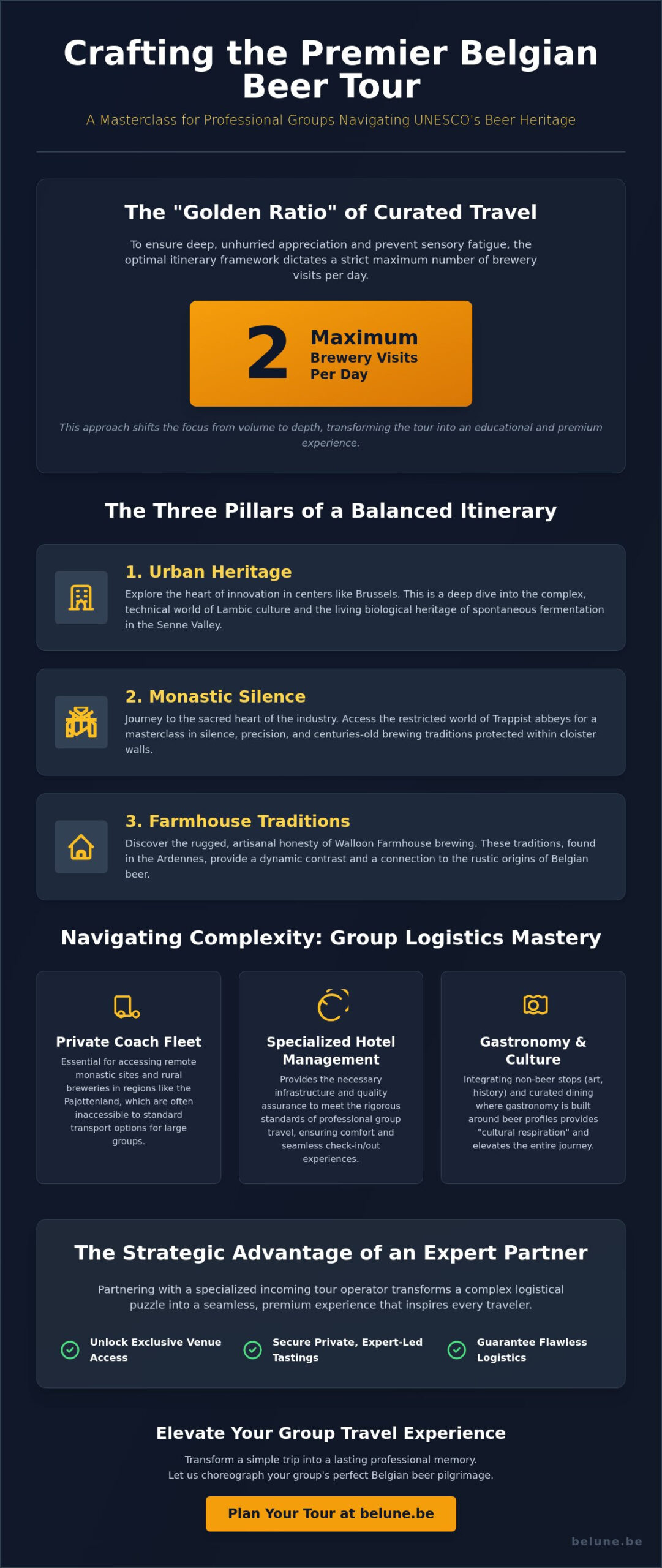
The romantic image of a Trappist pilgrimage dissolves quickly when a group of forty-five travellers is standing at a rural crossroads in the Ardennes with no coach in sight and an abbey tasting window closing in twenty minutes. Logistics, unglamorous as it sounds, is where the quality of a trappist beer tour belgium is ultimately decided.
The train-and-rental-car approach that works for independent travellers simply doesn’t scale. Belgium’s rail network is genuinely excellent between cities, but it doesn’t reach Westvleteren, doesn’t serve Rochefort, and doesn’t accommodate a group with luggage, guide commentary, and a tasting schedule that requires precise arrival windows. For groups of any meaningful size, private coach hire isn’t a premium upgrade. It’s the operational foundation on which everything else rests.
The BELUNE Fleet: Modern Coaches for Rural Routes
Operating in the Ardennes and rural Flanders demands vehicles that are matched to the terrain, not just the passenger count. BELUNE’s own fleet of modern coaches is configured for exactly this environment: capable of navigating the narrower approach roads that lead to abbey gates, while still delivering the on-board comfort that premium group travellers expect between stops. Climate control, reclining seating, and adequate luggage capacity matter on a multi-day itinerary. So does having a local driver who understands Belgian road regulations and can read a rural route without relying on a GPS that hasn’t been updated since 2019.
Driver-hour coordination is a detail that catches operators off guard. Belgian regulations governing professional driver rest periods must be factored into every day’s schedule alongside abbey opening times, tasting durations, and meal stops. A DMC that owns its fleet manages this internally, adjusting timing in real time rather than renegotiating with a third-party hire company when a tasting runs long.
Strategic Hotel Accommodation Management
Accommodation selection on a Trappist itinerary carries its own quiet logic. The best choices balance two competing priorities: proximity to the abbey route, and access to the kind of comfort that sustains a premium group across multiple days.
- Flemish leg: Antwerp and Ghent offer genuine character alongside four-star infrastructure, with manageable coach distances to Westmalle and Westvleteren.
- Walloon leg: Boutique properties in Namur or smaller Ardennes towns place groups within the sensory landscape of the southern abbeys without sacrificing comfort.
- Group booking management: BELUNE coordinates hotel blocks directly, handling rooming lists, dietary requirements at breakfast, and check-in sequencing so that a group of fifty doesn’t arrive to discover three rooms aren’t ready.
Multi-lingual guide services complete the picture. A specialist guide fluent in the history of Cistercian and Benedictine brewing traditions transforms a visit from a pleasant stop into a genuinely educational encounter. For international groups, the ability to deliver that interpretation in English, French, German, or Dutch isn’t a courtesy; it’s a core part of the experience design.
Curating the Experience: Beyond the Glass
Beer is the entry point. Culture, architecture, and gastronomy are what transform a trappist beer tour belgium from a pleasant drinking itinerary into something a traveller genuinely carries home. The most memorable group pilgrimages are built on exactly that layering: a glass of Rochefort 10 is richer when it arrives after a conversation about Cistercian history, and a Chimay Bleue tastes different when the cheese beside it was made by the same hands that brewed the ale.
The Culinary Symphony of Beer and Cheese
Trappist cheesemaking follows the same monastic logic as the brewing: slow, deliberate, and governed by tradition rather than market demand. At Chimay, the process involves washed-rind aging that produces a supple, pungent wheel designed to complement the dark fruit character of the abbey’s stronger ales. For group operators, this pairing offers something rare: a genuinely educational tasting experience that doesn’t require beer expertise to appreciate.
Organising a private tasting workshop for a large group demands more than booking a room. It requires a structured sequence, a knowledgeable facilitator, and enough variety to hold attention across a diverse audience. The framework that works best moves from lighter to more complex expressions, introducing the cheese alongside each beer rather than as an afterthought. Carbonnade Flamande, the slow-braised beef stew made with Belgian ale, extends this logic into a full meal, giving gastronomy-focused groups a culinary anchor that connects the brewing tradition to the broader Belgium gastronomy tour narrative. Belgian dining culture carries its own quiet joy in this, an unforced pleasure in quality ingredients and unhurried meals that guides refer to as a genuine zest for life at the table.
Cultural Context: Abbeys as Historical Landmarks
The French Revolution didn’t just reshape politics. It dismantled centuries of monastic infrastructure across Belgium, forcing communities into exile and scattering brewing knowledge that took generations to recover. Understanding that rupture gives Orval’s restored ruins and Rochefort’s rebuilt cellars a historical weight that purely aesthetic appreciation misses entirely. Weaving this context into a guide’s commentary transforms a scenic stop into a genuinely resonant encounter with European history.
That same depth of context is what connects a Trappist pilgrimage to the wider world of culture group tours in Benelux. The abbeys are not isolated curiosities; they’re living monuments to a tradition that survived revolution, occupation, and commercial pressure. For groups with broader cultural interests, routing a Trappist itinerary through Ghent’s Art Nouveau heritage or Bruges’ medieval streetscape adds an architectural counterpoint that enriches the entire journey.
Seasonally, late spring and early autumn offer the most balanced conditions: mild temperatures for Ardennes walking, abbey cafés operating at full capacity, and the particular quality of light that makes Orval’s ruins genuinely photogenic. Summer brings longer days but heavier tourist footfall at the more accessible sites. Winter visits carry their own austere beauty, though operators must verify reduced opening hours well in advance.
For groups drawn to the tradition but curious about its edges, a handful of Belgian breweries operate outside the ATP framework while honouring the same values of craft, restraint, and community purpose. Including one of these as a complementary stop adds texture without diluting the certified Trappist experience at the heart of the itinerary. Talk to BELUNE about building a gastronomy and culture itinerary that goes beyond the obvious.
Partnering with BELUNE: Your Visionary DMC in Belgium
There’s a meaningful difference between a tour operator who knows Belgium and one who is genuinely embedded in it. BELUNE sits firmly in the second category. As a specialist Benelux incoming tour operator with more than two decades of operational history, the team has built the kind of partner relationships, with abbey-adjacent venues, regional hoteliers, specialist guides, and local suppliers, that simply cannot be replicated by a company working from a distance. That depth of local knowledge is what makes a trappist beer tour belgium logistically achievable rather than aspirationally described.
A Professional Ally for Tour Operators
International tour operators don’t need another supplier. They need a strategic ally who absorbs complexity and returns clarity. BELUNE functions as a single point of contact across the entire Benelux and Paris corridor, handling coach coordination, hotel block management, guide scheduling, and supplier negotiations under one roof. When a tasting runs long at Orval or a group’s arrival window shifts, adjustments happen internally, not through a chain of third-party calls.
The practical architecture of that support looks like this:
- Own fleet management: No subcontracting on rural routes where reliability is non-negotiable.
- Multi-lingual guide services: Specialist guides fluent in Cistercian history and Belgian brewing culture, available in multiple languages.
- Hotel accommodation management: Group rooming lists, dietary coordination, and check-in sequencing handled directly.
- Fixed-price group packages: Transparent pricing structures that give travel agents a clean commercial foundation, with no hidden variables eroding margins after confirmation.
That last point matters more than it’s often given credit for. Pricing transparency isn’t just a convenience; it’s a trust signal. Agents who can quote clients with confidence, knowing the number won’t shift, build stronger commercial relationships and repeat business.
Requesting Your Custom Itinerary
BELUNE’s itinerary design spans the full spectrum of group ambition. A focused three-day express pilgrimage can anchor a Flemish leg around Westmalle and Westvleteren, pairing the abbey visits with Antwerp’s Art Nouveau heritage. A ten-day grand tour unfolds across both Flanders and Wallonia, weaving Chimay, Rochefort, and Orval into a southern arc that connects naturally with battlefield tourism in the Ardennes, a combination that resonates strongly with historically curious international groups.
The design process begins with a conversation, not a catalogue. BELUNE builds around the group’s profile, travel dates, cultural interests, and budget parameters, producing a bespoke proposal rather than a repackaged template. That distinction is exactly what separates a specialist DMC from a retail operator selling fixed departures to individual travellers.
For operators ready to move from concept to confirmed itinerary, the next step is straightforward. Partner with BELUNE for your next group tour and bring the full weight of 20+ years of Benelux expertise to your 2026 programme.
Your 2026 Trappist Pilgrimage Starts Here
A well-executed trappist beer tour belgium is one of the most distinctive group experiences available in Europe right now. It demands genuine local knowledge, precise logistics, and a guide who understands the difference between a tasting stop and a genuinely resonant cultural encounter. Get those elements right, and you deliver something travellers talk about for years.
The architecture is clear: five certified abbeys, each with its own character and access conditions; rural routes that require private transport, not improvisation; and a gastronomic tradition deep enough to sustain a multi-day itinerary with real substance at every stage.
BELUNE brings more than 20 years of Benelux expertise, a private modern coach fleet, and specialised gastronomy and heritage itineraries to every group programme it builds. That combination turns a complex brief into a confirmed, deliverable itinerary.
The 2026 season won’t wait. Design your bespoke Trappist group tour with BELUNE and give your clients a pilgrimage that genuinely earns that name.
Frequently Asked Questions About Trappist Beer Tours in Belgium
Which Belgian abbeys are still officially recognised as Trappist in 2026?
Belgium currently has five abbeys holding the Authentic Trappist Product certification: Westmalle, Westvleteren, Chimay, Rochefort, and Orval. Achel lost its certification after its last resident monk departed, as the ITA requires active monastic supervision for the seal to remain valid. Tour operators should verify Achel’s current status directly with the International Trappist Association before including it in any certified itinerary.
Can groups actually visit the inside of Trappist breweries?
In most cases, no. The brewing facilities themselves are within the monastic enclosure and remain closed to outside visitors as a matter of religious principle. The group experience at each abbey is shaped by what exists outside those walls: dedicated visitor centres like Chimay’s Espace Chimay, abbey-adjacent cafés like Westmalle’s Café Trappisten, and the surrounding landscape. A skilled specialist guide transforms these external spaces into genuinely rich encounters with the brewing tradition.
What is the best way to transport a group between Belgian Trappist abbeys?
Private coach hire is the only practical solution for a trappist beer tour belgium involving groups of any meaningful size. The abbeys are scattered across rural Flanders and the Ardennes, well beyond Belgium’s excellent intercity rail network. A dedicated coach also enables guide commentary between stops, flexible scheduling when tastings run long, and the luggage capacity a multi-day itinerary demands. Working with a DMC that operates its own fleet, rather than subcontracting, gives operators direct control over timing and reliability on remote routes.
How do I secure Westvleteren beer for a large travel group?
Westvleteren’s production is strictly limited, and the abbey doesn’t operate a conventional retail model. The most reliable group access point is the In de Vrede café across from Saint Sixtus Abbey, where the beer is served on-site. Operators should verify 2026 group policies and opening hours directly with the café well in advance, as these shift seasonally. Managing guest expectations is equally important: the experience is deliberately quiet and unhurried, which requires thoughtful pre-tour briefing for groups accustomed to more structured tasting environments.
Are there non-alcoholic options available at Trappist abbeys?
Yes, though the range varies by location. Abbey cafés typically serve soft drinks, water, and coffee alongside the beer. Chimay produces a non-alcoholic version of its beverages, and the abbey’s artisan cheese provides a genuinely engaging experience for non-drinkers. When designing itineraries for mixed groups, it’s worth briefing guides to ensure non-drinking participants feel equally included in the cultural and gastronomic narrative rather than sidelined by the beer-focused structure.
What other Belgian beer styles should be included in a Trappist tour?
Belgian brewing culture extends well beyond the five certified abbeys, and a thoughtfully layered itinerary can include complementary stops without diluting the Trappist experience at its core. Lambic and gueuze producers in the Pajottenland region offer a completely different fermentation tradition, while Ghent and Bruges both have specialist beer bars showcasing the full breadth of Belgian styles. Including one carefully chosen non-Trappist stop adds textural contrast and gives beer-literate travellers a broader frame of reference for what makes the ATP-certified beers so distinctive.
How far in advance should a group Trappist tour be booked?
For 2026 departures, serious planning should begin now. Abbey-adjacent venues operate with limited group capacity, and the most sought-after dates in late spring and early autumn fill quickly. Coach availability, hotel blocks in smaller Ardennes towns, and specialist guide scheduling all require lead time that’s difficult to compress. A specialist DMC can give operators a realistic timeline based on group size and itinerary complexity, but waiting until a few months before departure consistently limits both availability and negotiating position.
Is it possible to combine a beer tour with WWI battlefield visits?
It’s not just possible; it’s a natural pairing that resonates strongly with historically curious international groups, particularly those from the UK, Australia, Canada, and the United States. The Flemish abbeys sit within comfortable coach distance of the Ypres Salient and Passchendaele, while the Walloon Ardennes connects naturally with the Battle of the Bulge sites around Bastogne. BELUNE designs combined battlefield and gastronomy itineraries that give both dimensions the depth they deserve, rather than treating either as a secondary add-on to the other.