Tag: Tour Operator Tips

  • Peace of Mind Group Tour Planning: The Art of Seamless Logistics in 2026

    Peace of Mind Group Tour Planning: The Art of Seamless Logistics in 2026

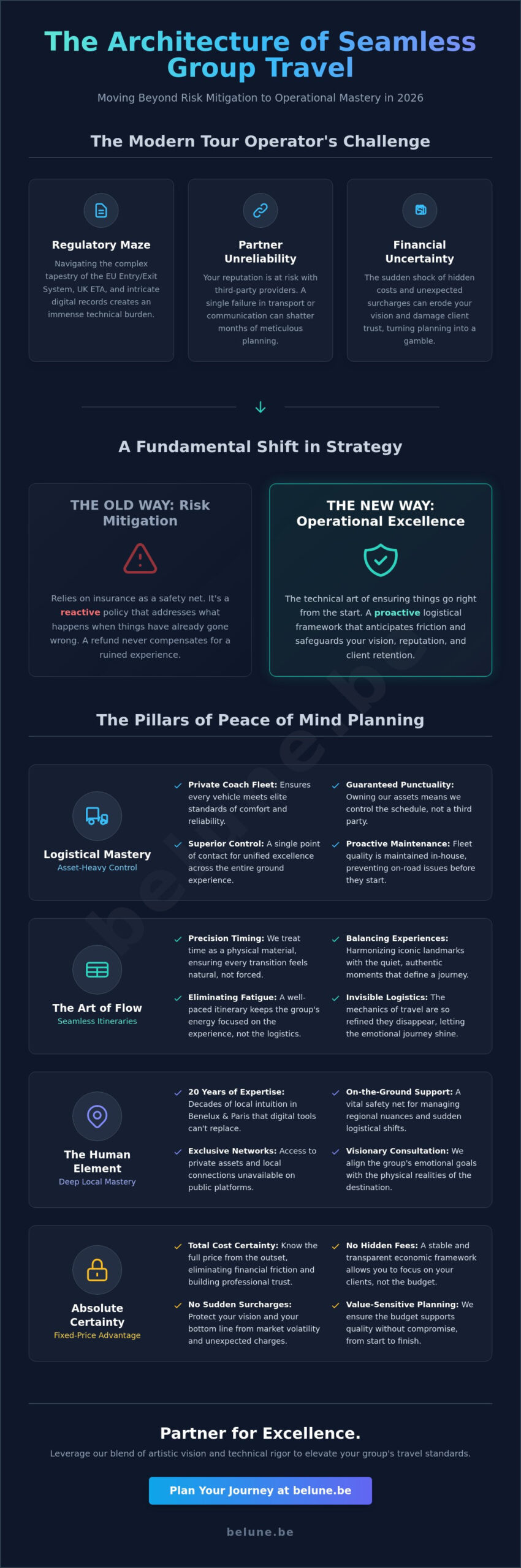
    What if true peace of mind group tour planning isn’t a policy you purchase, but the inevitable result of invisible, masterful orchestration? In 2026, the landscape of travel has transformed into a complex tapestry of digital records and biometric data. With the full implementation of the EU Entry/Exit System and the mandatory UK Electronic Travel Authorization now in effect, the technical burden on professional organizers is immense. You’ve likely felt the weight of these new regulations, perhaps struggling with the friction of unreliable transport partners or the sudden shock of hidden costs that erode your vision.

    It’s a challenge we understand deeply. We believe that sophisticated logistics should be a silent, elegant foundation that allows the beauty of an experience to shine without interruption. This article reveals how merging deep local mastery with a visionary approach to coordination transforms complex itineraries into effortless, high-performance journeys. You’ll learn how to achieve total logistical reliability and fixed-price certainty while gaining access to exclusive cultural narratives. We’ll show you how to move beyond simple coordination to create seamless, impactful travel that reflects your own commitment to excellence and professional rigor.

    Key Takeaways

    • Real security stems from operational reliability rather than just insurance. You’ll learn how a proactive logistical framework safeguards your group’s entire journey.
    • Partnering with an asset-heavy DMC offers superior control. Owning a private coach fleet ensures every transition remains punctual and every vehicle meets elite standards of comfort.
    • Master the architecture of flow. Achieving peace of mind group tour planning requires balancing iconic landmarks with the quiet, authentic moments that define a journey.
    • Digital tools can’t replace decades of local intuition. Discover why professional on-the-ground support is vital for managing regional nuances and sudden logistical shifts.
    • Explore how the BELUNE approach blends artistic vision with technical rigor. Leverage twenty years of expertise in Benelux and Paris to elevate your group’s travel standards.

    Defining Peace of Mind Group Tour Planning in 2026

    True peace of mind group tour planning isn’t a line item on a budget or a clause in a contract. It’s the silent engine that powers a traveler’s sense of wonder. We view this security as a structural achievement rather than a financial product. While many operators rely on insurance as their primary safety net, we believe operational reliability is the only true guardian of your vision. In 2026, the travel landscape has shifted away from the predictable rhythms of mass tourism. Today’s groups seek curated, high-performance experiences where the logistics are so refined they become invisible. When the mechanics of travel are flawless, the emotional journey can begin.

    The stakes for tour operators have reached a critical point. Your reputation is your most valuable asset, yet it’s often placed in the hands of distant third-party providers. A single failure at the ground level, such as an unreliable transport partner or a communication gap with hotel staff, can shatter months of meticulous planning. We understand that protecting your brand requires more than just a backup plan. It requires a proactive logistical framework that anticipates friction before it manifests. In this new era of travel, peace of mind is the inevitable result of total control and local mastery.

    The Difference Between Risk Mitigation and Operational Excellence

    Risk mitigation is often reactive. It’s a flexible policy that addresses what happens when things go wrong. Operational excellence is different. It’s the technical art of ensuring things go right from the first mile. For professional planners, a refund never compensates for a ruined experience or a lost client. We focus on the “invisible” logistics: the precise timing of a coach arrival, the seamless check-in at a boutique hotel, and the presence of a professional tourist guide who can interpret local nuances with ease. This level of precision is what secures client retention and transforms a standard itinerary into a masterpiece of coordination.

    Why Tour Operators are Turning to Specialist DMCs

    Navigating the Benelux region and Paris in 2026 requires a level of technical depth that public booking platforms cannot provide. The complexity of cross-border travel, combined with new digital entry requirements, has made local expertise a necessity. We offer access to exclusive networks and private assets, such as our own fleet of coaches, which ensures a standard of quality that remains within our direct control. Having a single point of contact for multi-country itineraries doesn’t just simplify the process. It creates a unified standard of excellence across the entire journey. This collaborative approach allows you to focus on the creative vision while we manage the rigors of the ground experience.

    The Architecture of a Seamless Group Itinerary

    Designing a group itinerary is an exercise in structural harmony. It requires more than a sequence of destinations; it demands a deep understanding of transitions. When we approach peace of mind group tour planning, we treat time as a physical material. Every minute spent on a coach or in a hotel lobby must serve the larger narrative. Technical precision in timing ensures that the transition from a high-density landmark to a quiet, authentic moment feels natural rather than forced. This balance is what prevents itinerary fatigue and keeps the group’s energy focused on the experience itself.

    We also eliminate the friction of financial uncertainty. The “Fixed-Price” advantage is a cornerstone of our philosophy. By providing total cost certainty from the outset, we allow agents to focus on their clients without the shadow of hidden fees or sudden surcharges. Whether the theme is a solemn journey through battlefield sites or a vibrant exploration of local art, the economic framework remains stable and transparent. This reliability is essential for maintaining professional trust in a market that’s increasingly sensitive to value.

    Step 1: The Visionary Consultation

    Every project begins with a dialogue. We identify the core emotional goal of the group. A pilgrimage to historical sites requires a different tempo than a corporate celebration or a gastronomic pilgrimage. We match the group’s pace to the physical realities of the destination, ensuring the budget supports quality without compromise. This initial alignment is where the vision takes root, transforming a simple request into a tailored strategy.

    Step 2: Technical Mapping and Logistics

    Precision defines our execution. We calculate drive times with the accuracy of our own modern coach fleet, accounting for local traffic patterns and regulatory requirements. Safety remains paramount. We regularly consult U.S. Travel Advisories to ensure our ground operations align with the highest global standards. By securing group-friendly hotel blocks that maintain the tour’s aesthetic, we create a consistent environment for the guests from arrival to departure.

    Step 3: The Refinement of the Guest Experience

    The final layer is sensory. We weave in curated moments, such as belgium gastronomy tours, to provide a taste of local heritage. We build in “breathing room” to allow for spontaneous reflection and personal discovery. This thoughtful layering ensures that every traveler, regardless of age, feels supported and inspired. Achieving peace of mind group tour planning isn’t about luck; it’s about this meticulous architecture of experience. If you’re ready to transform your next project into a masterpiece, consider how our team of experts can elevate your logistical standards.

    Peace of Mind Group Tour Planning: The Art of Seamless Logistics in 2026

    Logistical Mastery: Controlling the Ground Experience

    Control is the foundation of elegance. In high-performance travel, the “Asset-Heavy” DMC model represents the pinnacle of reliability. We don’t just coordinate; we own the infrastructure that defines the guest experience. By maintaining our own fleet of coaches and direct relationships with hospitality partners, we eliminate the variables that often compromise quality. This direct control is the only way to guarantee the standards our partners expect. When you remove the layers of sub-contracting, you remove the potential for communication gaps and hidden costs. This structural integrity is central to peace of mind group tour planning.

    Recent shifts in the global market have underscored the value of professional travel advisors who can navigate complex logistical hurdles. Our role as a strategic ally is to provide a 24/7 support network that acts as an extension of your own team. Whether it’s a sudden shift in local regulations or a necessary adjustment to a schedule, our ground staff provides real-time solutions. This constant presence ensures that group leaders never face a challenge alone, maintaining the flow of the journey without interruption.

    The Modern Coach Fleet: Your Mobile Sanctuary

    A coach is more than a vehicle; it’s a mobile sanctuary. In 2026, modern bus technology has reached a level of sophistication where comfort and punctuality are non-negotiable. Our fleet meets the highest environmental standards, reflecting a commitment to sustainable group transport that our corporate partners prioritize. Beyond the hardware, the professional driver plays a vital role in the group’s emotional journey. They’re the steady hand that ensures every transition is smooth. Their local knowledge and professional rigor transform a simple transfer into a curated movement through the landscape.

    Strategic Hotel Accommodation Management

    Managing group hotel accommodation requires a technical precision that differs significantly from individual bookings. We select properties not just for their aesthetic, but for their ability to handle the specific needs of a group. Proximity to cultural centers and the availability of group-specific amenities are critical factors in our selection process. We manage rooming lists and check-in logistics with a level of detail that removes friction for the group leader. By handling the administrative burden, we ensure guests transition from the coach to their rooms without delay. This mastery of the ground experience is what defines peace of mind group tour planning in an increasingly complex world.

    The Human Element: Local Expertise as a Safety Net

    Algorithms offer data, but they lack the pulse of a destination. Google Maps can’t anticipate the subtle shifts of a local holiday or the narrow cobblestone realities of a medieval city. For peace of mind group tour planning, twenty years of ground-level experience acts as an indispensable safety net. This human element transforms a functional itinerary into a resilient journey. Our guides possess a “fixer” mentality, navigating linguistic transitions and cultural nuances with quiet authority. They don’t just read from a script; they manage the environment to ensure the group’s comfort remains undisturbed.

    True authenticity is a service we provide through deep-rooted intuition. Finding the “hidden” Benelux requires more than a search engine; it requires a network built on decades of trust. Whether it’s a spontaneous detour to avoid a blocked route or a last-minute adjustment to a meal service, the presence of a local expert ensures that the guest experience never falters. This level of support provides a layer of security that digital tools simply cannot replicate. It’s the difference between a trip that survives the unexpected and one that thrives because of it.

    Expert Guidance in Specialized Fields

    Specialized tourism demands a high degree of technical and emotional intelligence. For example, coordinating pilgrimages to flanders fields requires more than a map; it requires a deep respect for historical context and the specific logistics of remembrance. Similarly, we curate art and culture group tours to feel like exclusive invitations rather than standard excursions. Our team’s language mastery bridges the gap between international agents and local providers, ensuring every detail of the vision is understood and respected at every stop.

    Managing Local Partner Networks

    Vetting a local partner network is a continuous process of refinement. We select restaurants not just for their culinary standards, but for their proven ability to accommodate groups with elegance and efficiency. We secure priority access to high-traffic cultural sites, allowing your guests to bypass the friction of crowds and maintain their focus on the narrative. The strength of a benelux incoming tour operator lies in these deep-rooted connections. These relationships allow us to unlock experiences that remain invisible to the casual traveler, providing your clients with a sense of genuine discovery. If you want to leverage our deep-rooted connections for your next project, partner with our local experts today.

    Partnering for Excellence: The BELUNE Approach

    Heritage serves as the ultimate validator of expertise. For over two decades, our team has navigated the intricate cultural and logistical landscapes of the Benelux region and Paris. This longevity isn’t just a measure of time; it’s a testament to a refined methodology that merges artistic vision with technical precision. We don’t see logistics as a hurdle. We see them as a structural component of the design. Every customized itinerary we build is a unique reflection of your brand’s identity, crafted with the same care as a piece of artisanal work. We don’t believe in templates. We believe in bespoke structures that stand the test of real-world travel.

    Our commitment to peace of mind group tour planning is anchored in two pillars: total logistical control and transparent, fixed pricing. By eliminating the volatility of hidden costs and the risks of sub-contracting, we provide a stable platform for your creative vision. This is our signature approach. It’s a sophisticated blend of local mastery and professional rigor that turns complex travel into a seamless, high-performance experience. We ensure that the silent engine of your tour runs perfectly so that your guests can focus on the beauty of the destination.

    Why Professional Agents Choose BELUNE

    The decision to partner with us often stems from the reassurance of asset ownership. When a DMC owns their own coach fleet and manages their own hotel blocks, the margin for error shrinks. We focus exclusively on the success of tour operators and professional agents. Our history includes transforming high-pressure requests, such as last-minute pivots during major festivals or complex multi-border cycling tours, into effortless successes. We act as your strategic on-the-ground ally, protecting your reputation as if it were our own. This B2B focus ensures that our goals are perfectly aligned with your business objectives.

    Starting Your Next Group Project

    The consultation process is designed to be as fluid as the tours we manage. It begins with an initial concept where we identify the emotional and technical goals of your group. From there, we move into a detailed mapping phase, integrating our ground-level insights with your existing workflows. We don’t just deliver a document; we provide a living itinerary that’s been vetted for every physical and regulatory reality of 2026. We handle the technical burden so you can maintain the creative lead. Take the first step toward peace of mind group tour planning by connecting with our visionary team today.

    Elevating the Future of Group Travel

    The landscape of 2026 demands more than just coordination; it requires a visionary approach to movement. We’ve explored how true security isn’t found in a policy, but in the structural integrity of a well-designed itinerary. By merging 20+ years of local expertise with the technical precision of our private fleet of modern coaches, we transform logistical complexity into a silent, elegant foundation for your guests. This is the essence of peace of mind group tour planning: a commitment to fixed-price reliability and unwavering professional support that allows the cultural narrative to remain center stage.

    Your reputation as a tour operator deserves a partner who values excellence as deeply as you do. We invite you to move beyond standard arrangements and embrace a collaboration built on trust and technical rigor. Let us manage the technical burden of the Benelux and Paris regions while you focus on the creative vision that sets your brand apart. Request Your Custom Benelux Group Tour Itinerary and discover how our mastery becomes your strategic advantage. We look forward to crafting your next masterpiece together.

    Frequently Asked Questions

    What is the role of a DMC in peace of mind group tour planning?

    A Destination Management Company acts as the local architect of the travel experience, managing everything from ground transport to hotel blocks. By providing a single point of accountability, a DMC ensures that peace of mind group tour planning becomes a structural reality rather than just a concept. We handle the technical burden of local regulations and vendor management, allowing you to maintain your creative focus while we secure the ground experience.

    How do fixed-price group packages protect tour operators?

    Fixed-price packages eliminate the risk of hidden costs and sudden currency fluctuations that can erode your profit margins. This financial certainty allows you to quote with confidence and maintain professional trust with your clients. By locking in rates for accommodation and transport early in the planning phase, we provide a stable economic framework for even the most complex multi-country itineraries across the Benelux region.

    Why is owning a coach fleet important for group travel logistics?

    Owning a private fleet of modern coaches ensures total control over the quality, punctuality, and maintenance of the vehicles. It removes the uncertainty of sub-contracting to third-party providers who might not meet your brand’s standards. This direct ownership allows us to guarantee that every transition is smooth and that the coach remains a high-performance environment for your guests throughout their journey.

    Can a DMC handle specialized themes like battlefield or culinary tours?

    Our expertise extends to highly specialized themes including battlefield tourism, art and culture tours, and gastronomy experiences. We curate these journeys by matching the group’s pace with local experts who possess deep historical or technical knowledge. This specialized approach transforms a standard visit into an exclusive, narrative-driven event that reflects the specific interests of your travelers and the unique identity of your brand.

    What happens if an itinerary needs to change during the tour?

    Our 24/7 support network acts as a real-time fixer for any unexpected shifts in the schedule. Whether it’s a detour due to local events or a necessary adjustment to a meal service, our ground staff manages the transition invisibly. This constant presence is a core component of peace of mind group tour planning, ensuring that the guest experience remains fluid and undisturbed regardless of external variables.

    How does BELUNE ensure the quality of local guides and hotels?

    We use a rigorous vetting process based on twenty years of local partnerships and direct ground experience. We select hotels not just for their aesthetic, but for their proven ability to manage group check-ins and specific logistical needs with elegance. Our guides are chosen for their linguistic mastery and their ability to interpret cultural heritage, ensuring every interaction meets our high standards of professional rigor and artistic vision.

    What regions does BELUNE specialize in for group travel?

    We specialize in the Benelux region, encompassing Belgium, the Netherlands, and Luxembourg, as well as Paris. These territories are our home, and our deep-rooted connections here allow us to unlock exclusive experiences that are often unavailable through public booking platforms. Our mastery of these specific geographic nuances ensures that we can handle complex cross-border logistics with technical precision and ease for every group.

    Is it more cost-effective to use a DMC than booking directly?

    Using a DMC is typically more cost-effective because of our volume-based relationships with local providers and our ownership of key assets like coaches. Beyond the initial price, we save you the significant costs associated with logistical failures and administrative overhead. The true value lies in the invisible savings of time, reliability, and the preservation of your professional reputation through flawless execution.

  • Cultural Gems of Benelux: A Masterclass in Curated Group Heritage for 2026

    Cultural Gems of Benelux: A Masterclass in Curated Group Heritage for 2026

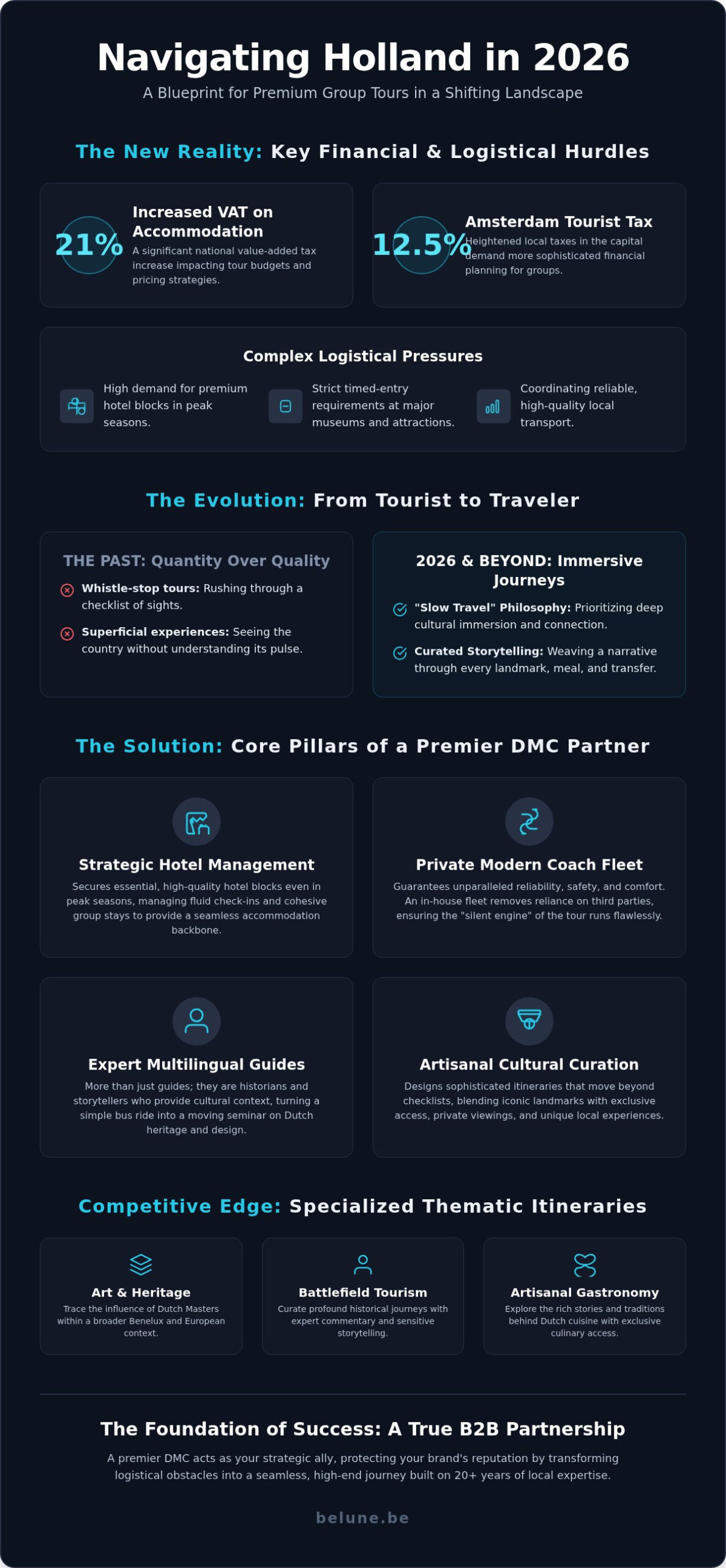
    What if the most profound moments of a journey aren’t found in a crowded square, but in the precise harmony between a quiet Flemish canal and a private gallery opening? As searches for authentic “hidden gems” have surged by over 120% in the last year, it’s clear that travelers are seeking something deeper than the 24 million tourists who recently flooded Amsterdam. Identifying the true cultural gems of benelux requires an artist’s eye for detail and a strategist’s grip on evolving logistics.

    We know that managing a high-end group tour in 2026 feels like solving a complex architectural puzzle. Between the new €20 ETIAS authorization and the Dutch VAT on accommodation rising to 21% on January 1, the technical demands of travel are shifting. This article provides a masterclass in navigating these changes, even as Luxembourg reintroduces public transport fares on April 1, 2026. You’ll learn how to weave together a cohesive itinerary that pairs the gastronomy of Brussels with the medieval grandeur of Ghent, all supported by the reliability of a private coach fleet and expert guides who understand the nuance of every border crossing.

    Key Takeaways

    • Understand the shared Burgundian and Habsburg heritage that transforms the Benelux region into a unified, sophisticated cultural mosaic.
    • Explore the architectural evolution of the Low Countries, from the verticality of Gothic cathedrals to the fluid elegance of Art Nouveau masterpieces.
    • Learn to harmonize complex multi-country logistics by leveraging private coach hire and specialized hotel management for the cultural gems of benelux.
    • Discover the strategic value of remembrance tourism and Golden Age art in creating profound, thematic group experiences that resonate with European identity.
    • Gain professional insights into the “A to Z” approach for designing bespoke itineraries that seamlessly blend high-end gastronomy with exclusive cultural access.

    The Cultural Identity of Benelux: A Sophisticated Mosaic

    Benelux presents a landscape where history isn’t just recorded; it’s felt in the very grain of the architecture. The region operates as a sophisticated mosaic, bound by the shared legacies of the Burgundian and Habsburg dynasties. This isn’t a mere collection of neighboring states. It’s a unified cultural entity where the artistic rigor of the North meets the sensory indulgence of the South. The Burgundian court, in particular, established a standard of luxury and patronage that continues to define the region’s commitment to excellence and aesthetic harmony.

    Positioned as the true crossroads of Europe, these lands serve as the meeting point for Latin and Germanic influences. The Benelux Union represents more than an economic alliance; it reflects a deep-seated synergy that has shaped Western civilization for centuries. For those seeking the cultural gems of benelux, 2026 marks a pivotal moment. With the implementation of the ETIAS authorization and shifting tax regulations, such as the Netherlands’ VAT increase to 21% on January 1, 2026, the need for expert logistical curation has never been more vital.

    To visualize the harmony between these historic landscapes, watch this curated overview:

    The Synergy of Three Nations

    Belgium stands as the artistic and gastronomic heart, offering a sensory depth found in its Flemish Primitives and world-renowned culinary craft. The Netherlands pioneers a different rhythm, blending a rich maritime history with a bold, minimalist approach to modern design. Luxembourg completes the trio. It’s a strategic, fortified gem where European diplomacy resides within ancient stone walls and lush valleys. As the meeting point of Latin and Germanic traditions, these nations offer a balanced travel experience that rewards those who appreciate technical precision and artistic vision.

    Beyond the Tourist Facade

    True heritage exists far beyond the “windmills and chocolate” stereotypes that often dominate travel brochures. Authentic discovery requires moving into the living history of the region. As Amsterdam targets a cap of 20 million hotel stays per year to manage over-tourism, 2026 encourages a shift toward “Slow Travel.” This philosophy prioritizes high-end curation and local guidance to uncover quiet masterpieces and hidden architectural details that the casual observer misses. We see the cultural gems of benelux as a multifaceted cultural landscape that demands professional navigation to truly reveal its sublime harmony.

    Unearthing Regional Treasures: From Medieval Grandeur to Modernism

    Architecture in the Low Countries serves as a tactile narrative of power, resilience, and artistic vision. The region’s skyline offers a living timeline. It stretches from the soaring verticality of Gothic cathedrals to the fluid, organic lines of Art Nouveau masterpieces. While capital cities provide a grand introduction to this heritage, the true cultural gems of benelux often reveal themselves in secondary cities. In these locations, history feels more concentrated and accessible, allowing for a depth of engagement that larger crowds often obscure.

    Architectural Landmarks and Heritage Sites

    The Grand Place in Brussels remains a masterclass in gold-leafed guildhall architecture. It reflects the immense wealth and aesthetic standards of the 17th-century merchant classes. According to the official tourism portal for Belgium, these UNESCO World Heritage sites are active centers of civic life rather than static relics. The Belfries of Flanders and Wallonia stand as symbols of medieval independence, separate from the church’s influence. In Luxembourg, the Casemates du Bock offer a subterranean journey through fortified elegance, carved directly into the cliffs to protect the city’s strategic interests.

    The Hidden Gems Approach

    Discovering the “Venice of the North” in Bruges offers a meticulously preserved medieval atmosphere. However, the vibrant street art and industrial repurposing found in Ghent provide a necessary modern counterpoint. For instance, the Castle of the Counts in Ghent, with its €15 individual entrance fee, offers a stark contrast to the modern hubs of steel and glass in cities like Rotterdam or Brussels. Smaller locations like Dinant, nestled against dramatic cliffs, are essential for sophisticated storytelling. They offer an intimate group experience that capital cities alone cannot replicate.

    Integrating culture group tours benelux into a broader European circuit ensures a perfect balance between iconic landmarks and secluded treasures. This curated approach avoids the friction of overcrowded tourist traps while maintaining a high standard of logistical precision. Whether it’s a private viewing of a Gothic altarpiece or a sunset walk through the fortified walls of Luxembourg, the goal is to transform a simple visit into a sublime experience. Our team specializes in tailoring these journeys to reflect your group’s specific aesthetic and historical interests.

    Thematic Masterclasses: Art, Gastronomy, and Remembrance

    The soul of the Low Countries isn’t found in a single monument, but in the layered experiences that define its heritage. To truly appreciate the cultural gems of benelux, one must look beyond the surface of the landscape. It’s a region where the brushstrokes of the Dutch Masters, the solemn silence of a battlefield, and the complex notes of a Trappist ale converge. These elements aren’t separate attractions; they’re threads in a single, sophisticated tapestry that requires professional curation to fully unravel.

    Artistic Legacies and Museum Curation

    Art serves as the primary language of the region. The Van Gogh Museum and the Rijksmuseum function as anchors for Dutch identity, while Brussels remains the undisputed capital of Art Nouveau. Scholars at the Benelux Association for the Study of Art, Culture, and the Environment emphasize that this creative output is deeply rooted in the region’s unique social fabric. For groups visiting in 2026, timing is everything. Federal museums in Belgium offer free access on the first Wednesday of each month starting at 1:00 PM, a detail that allows for strategic itinerary planning. High-value tours prioritize exclusive access, moving past the standard museum experience to offer private viewings and expert-led discussions on the Flemish Primitives.

    Remembrance and Battlefield Tourism

    Remembrance tourism transcends military interest. It forms a vital pillar of the cultural gems of benelux, offering a profound understanding of the values that define modern Europe. The emotional weight of Flanders Fields and the Menin Gate in Ypres provides a necessary context for understanding the 20th century. Further south, the Bastogne War Museum explores the harrowing reality of the Battle of the Bulge. Managing these pilgrimages requires a delicate touch. Professional DMCs ensure that the logistics of transport and local guidance respect the sensitivity of these sites while providing the historical depth international groups expect.

    Culinary Heritage as Culture

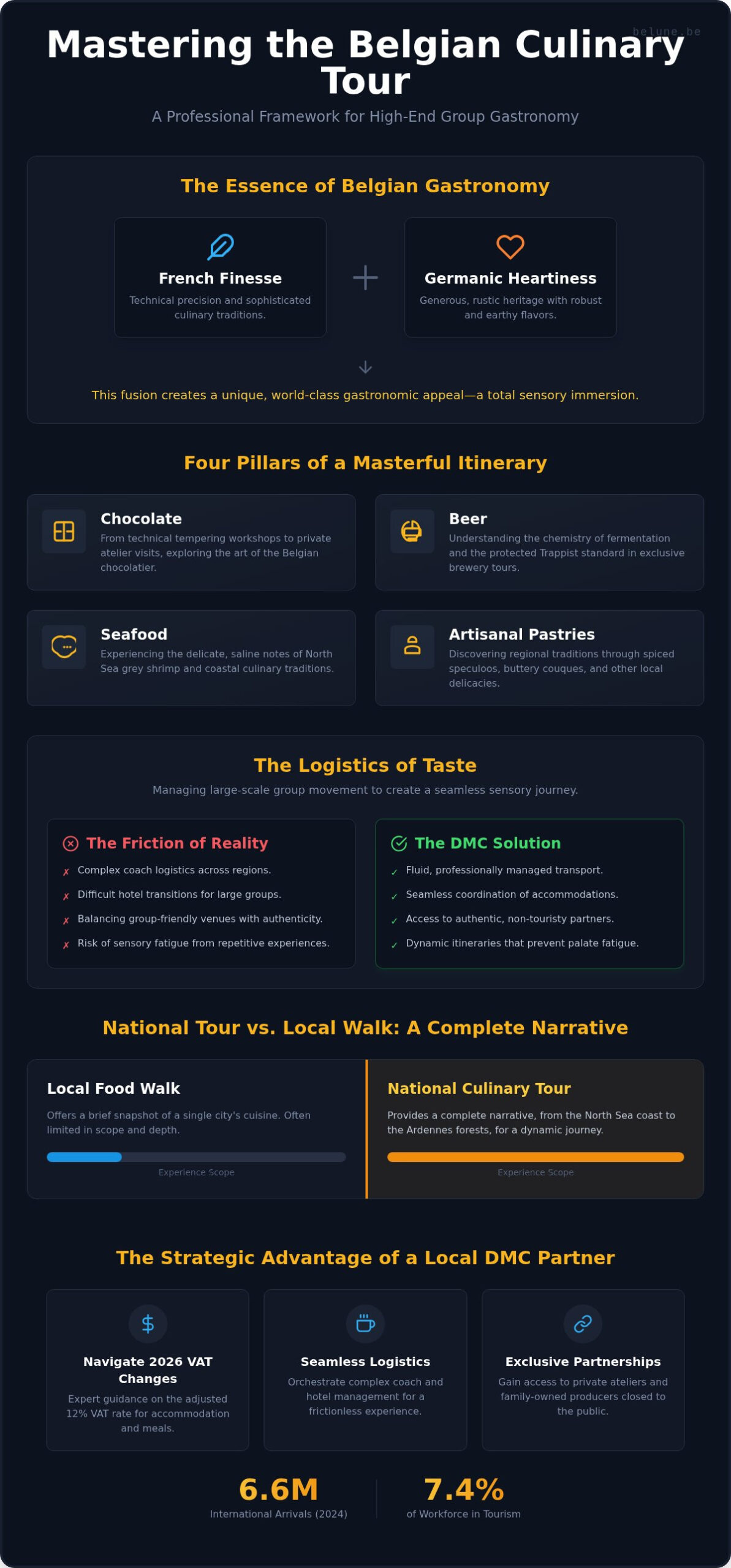
    Gastronomy in Benelux is a sensory art form. In 2016, UNESCO recognized Belgium’s beer culture as an intangible cultural heritage, acknowledging that it’s more than just a drink; it’s a social ritual. From the agrarian roots of Dutch cheese markets to the Michelin-starred innovation in modern Brussels, food is a gateway to history. Integrating Belgium gastronomy tours into an itinerary provides the necessary balance to a day of museum visits. As the Belgian VAT on accommodation increased to 12% on March 1, 2026, and the Netherlands reached 21% earlier that year, focusing on high-quality, themed culinary experiences ensures that every Euro spent contributes to a richer, more authentic cultural narrative.

    Logistics are the invisible architecture of a sublime journey. While individual travelers often rely on the regional rail network, high-end group tours require a more refined level of technical precision. Moving 20 to 50 guests between the cultural gems of benelux demands a strategy that prioritizes comfort, timing, and exclusivity. It’s about transforming the transition between cities into a fluid extension of the cultural experience itself.

    The Private Coach Advantage

    Private coach hire offers a level of door-to-door intimacy that public transport cannot match. Managing large groups with luggage through busy rail hubs like Brussels Midi or Amsterdam Centraal often introduces unnecessary friction. In 2026, our modern fleet standards prioritize both sustainability and passenger wellness. These vehicles allow for total flexibility. They’re capable of reaching secluded treasures like the dramatic cliffs of Dinant or the medieval abbey of Echternach, which remain difficult to access via high-speed rail. This autonomy ensures your schedule remains dictated by the art and history, not by a train timetable.

    Accommodation and Local Expertise

    Managing group accommodation across three nations involves navigating a complex web of local regulations. In Brussels, the tourist tax stands at €5 per night for standard hotels as of January 1, 2026. Amsterdam has implemented a tax of 12.5% of the accommodation price. Balancing these costs while sourcing boutique, heritage-focused hotels requires a deep understanding of the local market. This is where the role of a benelux incoming tour operator becomes indispensable. We act as your strategic ally, ensuring that every stay reflects the aesthetic quality of the tour while managing the administrative nuances of 12% VAT in Belgium and 21% in the Netherlands.

    Success also hinges on the human element. Multi-lingual local guides bridge the gap between sight and story, providing the “living” history that makes a journey memorable. They navigate seasonal closures and local festivals, such as the Brussels Short Film Festival in late April 2026, with effortless grace. By anticipating these variables, we ensure your group avoids the peak crowds at major cultural gems of benelux, maintaining the serenity and exclusivity your clients expect. For those ready to elevate their group heritage experience, we invite you to explore our bespoke logistical solutions for 2026.

    Crafting the Sublime: The BELUNE Approach to Benelux

    Excellence in group travel is never accidental. It’s the result of over 20 years of technical rigor and artistic vision. At BELUNE, we don’t simply manage logistics; we curate the intersection of human emotion and physical space. Our “A to Z” philosophy serves as a promise of complete accompaniment. We handle every nuance, from sophisticated hotel accommodation management to the precise coordination of our own coach fleet. This holistic approach transforms the cultural gems of benelux from a series of stops into a singular, harmonious narrative.

    Bespoke Itinerary Design

    A successful tour begins with a deep understanding of the client’s profile. We collaborate with international tour operators to ensure that every journey is narrative-driven. If your group seeks the quiet contemplation of a Dutch Golden Age gallery, or the vibrant energy of a festival like Tomorrowland, we tailor the experience to match. This customization is our core value. We also prioritize budget transparency through fixed-price group packages. In a year where the Netherlands’ VAT on accommodation has reached 21%, having a partner who provides clear, upfront costs is essential for long-term strategic planning.

    Why Partner with a Specialized DMC?

    The travel environment of 2026 requires a partner who can anticipate change. The new €20 ETIAS authorization and the reintroduction of public transport fares in Luxembourg on April 1, 2026, are small shifts that can create large frictions for unmanaged groups. We act as your local problem-solver. Our private fleet of modern coaches and professional drivers ensures that the transition between sites is as sublime as the sites themselves. We don’t just sell tours. We provide the expertise required to navigate the complex heritage of the Low Countries with grace and precision. We invite you to Partner with BELUNE to elevate your next group cultural tour into a masterclass of heritage and design.

    Elevate Your Group Heritage Vision for 2026

    The journey through the Low Countries is a masterclass in balance. It’s where the technical precision of a modern coach fleet meets the emotional depth of a Flemish masterpiece. By understanding the regional mosaic and the evolving 2026 landscape, you transform a standard itinerary into a narrative of sublime quality. Navigating the cultural gems of benelux requires more than just a map; it demands a strategic ally who understands the nuance of every border and the history behind every facade.

    BELUNE brings over 20 years of DMC experience to your collaboration. We bridge the gap between logistical complexity and cultural immersion. Whether your focus is the solemnity of battlefield tourism, the innovation of Belgian gastronomy, or the timeless legacy of the Dutch Masters, our team provides the expert guidance and private transport necessary for success. We invite you to request your custom Benelux group tour itinerary from the experts at BELUNE today. Let’s design a journey that resonates with historical weight and modern elegance.

    Frequently Asked Questions

    What are the top 3 must-visit cultural gems in Benelux for 2026?

    The Grand Place in Brussels, the Rijksmuseum in Amsterdam, and the Casemates du Bock in Luxembourg stand as the essential pillars for any 2026 itinerary. These locations offer a concentrated look at the region’s shared Burgundian heritage and maritime power. While Amsterdam manages its 20 million annual hotel stay cap, these sites remain accessible through strategic timing and professional group reservations.

    How do I plan a group tour that covers Belgium, the Netherlands, and Luxembourg?

    Effective planning requires a central logistical hub, typically Brussels, and a deep understanding of varying national regulations. You must account for the 12% VAT on Belgian accommodation and the 21% rate in the Netherlands that took effect on January 1, 2026. Partnering with a specialized operator ensures these financial nuances and the new €20 ETIAS requirements are managed seamlessly across all three borders.

    Is it better to use trains or a private coach for a Benelux group tour?

    Private coaches are the superior choice for groups of 20 to 50 people because they eliminate the friction of public transport hubs. While Belgian train fares increased by 2.14% in February 2026, a private fleet offers fixed costs and door-to-door service. Coaches also provide the only reliable way to reach rural cultural gems of benelux like the Ardennes battlefields or secluded Trappist abbeys.

    What is the best time of year to visit the cultural sites of Benelux?

    Late spring and early autumn provide the most sophisticated atmosphere for heritage tours. Visiting between April 22 and May 2, 2026, allows groups to experience the Brussels Short Film Festival while enjoying mild weather. September is equally refined, offering quieter museum galleries after the peak summer crowds have dissipated, ensuring a more intimate connection with the art and architecture.

    Can I include a Paris excursion in a Benelux cultural itinerary?

    Paris is a natural extension of a Benelux circuit and can be integrated through high-speed rail or private coach. Since Brussels is only 1.5 hours from the French capital, it serves as the perfect gateway for an expanded European narrative. We manage these international connections as part of our comprehensive “A to Z” service, maintaining a singular standard of luxury throughout the journey.

    What are the benefits of using a DMC like BELUNE for group travel?

    Partnering with BELUNE provides you with 20 years of technical expertise and access to a private fleet of modern coaches. We act as a strategic ally rather than a simple vendor, managing complex hotel contracts and sourcing multi-lingual local guides. Our focus on the cultural gems of benelux ensures that every logistical detail supports the broader artistic and historical narrative of your tour.

    How does BELUNE handle battlefield tourism logistics for groups?

    We manage battlefield pilgrimages with a balance of technical precision and emotional sensitivity. Our itineraries to Flanders Fields and Bastogne include specialized guides who provide deep historical context for international groups. We coordinate all transport and museum entries, such as the Bastogne War Museum, ensuring that the group’s focus remains entirely on the profound experience of remembrance.

    Are there specific UNESCO sites in Benelux that are group-friendly?

    The Historic Centre of Bruges and the Defense Line of Amsterdam are exceptionally well-equipped to host large cultural groups. Bruges offers dedicated coach terminals and group-specific canal cruises that can accommodate 40 guests simultaneously. These sites provide the expansive physical space and infrastructure necessary to maintain a high-end, comfortable experience without the congestion found in smaller, non-UNESCO locations.

  • The Ultimate Paris Cultural Trip: A Professional Guide for Group Travel

    The Ultimate Paris Cultural Trip: A Professional Guide for Group Travel

    What if the most profound element of a paris cultural trip isn’t the art on the walls, but the invisible rhythm of the logistics? For travel professionals, the difference between a chaotic tour and a masterpiece of movement lies in the technical details. You’ve likely felt the tension of coordinating 25 guests through the restricted transit zones of the 1st Arrondissement, where a 10 minute timing error can cost a group their exclusive after-hours slot. We know that your reputation rests on these seamless transitions and the ability to offer something truly rare.

    This guide serves as your strategic ally. We’ll show you how to curate an itinerary that balances iconic landmarks with the 12% of Parisian heritage sites that remain hidden from the general public. You’ll gain the technical confidence to navigate the 2024 coach parking regulations and secure high-end accommodations that welcome larger parties without sacrificing intimacy. From the nuance of museum booking systems to the harmony of a well-timed private gala, we’re providing the high-authority framework you need to deliver excellence to your clients from start to finish.

    Key Takeaways

    • Learn to evolve from standard sightseeing to immersive cultural storytelling, transforming a simple itinerary into a deep exploration of history and art.
    • Discover how to balance iconic landmarks with “secret museums” to curate a truly bespoke paris cultural trip that avoids the crowds.
    • Master the logistics of high-end group travel by navigating complex urban regulations and utilizing modern, proprietary coach fleets for ultimate reliability.
    • Explore the strategic flow of combining Paris with Benelux destinations to compare and contrast the rich tapestry of French and Flemish artistic heritage.
    • Gain insights into the BELUNE approach, where twenty years of local expertise and a vision for elegance ensure every detail of your group’s journey is flawlessly executed.

    Defining the Paris Cultural Trip for the Modern Group

    The era of the checklist traveler is over. Modern groups, especially those arriving from the discerning markets of the Benelux region, no longer seek to merely “see” landmarks. They demand a narrative. A successful paris cultural trip today functions as an immersive story, where every street corner and limestone facade contributes to a larger artistic dialogue. This shift from passive observation to active engagement requires a sophisticated eye. It’s about finding the harmony between the grand scale of the Louvre and the quiet, sensory nuance of a hidden courtyard in the Marais. We don’t just visit; we curate an experience that resonates with the soul of the traveler.

    Paris remains the global benchmark for heritage because it’s a living archive. With over 2,185 monuments and 130 museums, the city offers a density of history that’s unmatched. However, the secret to a meaningful group journey lies in the “themed” approach. Instead of a generic overview, we focus on specific eras. A group might explore the iron and glass innovation of the Belle Époque, or perhaps the stark, avant-garde lines of Contemporary Paris. This specificity transforms a standard itinerary into a bespoke masterclass. It allows travelers to witness the city not as a museum, but as a continuous evolution of human ambition and aesthetic excellence.

    The Pillars of Parisian Heritage

    Paris is a canvas of architectural evolution. It began with the Roman settlement of Lutetia in 52 BC, but the city’s modern character was truly forged during the 1853 Haussmann renovations. Understanding the history and culture of Paris involves tracing these layers of stone and light. On the Rive Gauche, the literary and philosophical legacy of the 1940s still lingers in the cafes of Saint-Germain-des-Prés. Here, the intellectual weight of Sartre and Beauvoir meets the birthplace of modern culinary arts. The first recognizable restaurant opened its doors in 1765; today, that same spirit of innovation defines the city’s 119 Michelin-starred establishments. This heritage is the foundation upon which every paris cultural trip is built.

    Why Groups Require a Different Perspective

    Seeing a monument is a solitary act; experiencing a culture is a collective one. For a group, the challenge is to bridge the gap between being a tourist and becoming an insider. This is where professional curation becomes essential. A standard itinerary often misses the subtle rhythms of the city. We believe in the power of the local guide as a visionary storyteller. Their role is to provide the technical precision and artistic context that a guidebook cannot offer.

    • Expert Curation: Professional planners add value by securing private access to ateliers or after-hours museum tours.
    • The Insider Lens: Local guides translate the “quartier” lifestyle, explaining the social codes of a Parisian bistro or the history of a specific neighborhood square.
    • Emotional Connection: A curated trip prioritizes the atmosphere. It’s the difference between looking at a painting and understanding the light that inspired the artist.

    The modern group seeks a sublime balance. They want the icons, but they also crave the artisanal and the exclusive. By integrating world-famous institutions with the raw, authentic energy of the 11th or 20th arrondissements, we create a journey that’s both technically rigorous and emotionally profound. This is the new standard for cultural exploration in the City of Light.

    Curating the Itinerary: Beyond the Louvre and Eiffel Tower

    Paris reveals itself in layers. For a successful paris cultural trip, balance is the defining element. While the Louvre, Musée d’Orsay, and Versailles remain essential, managing groups of 15 or more requires tactical precision. Most major institutions require group bookings at least 120 days in advance to secure specific time slots. This prevents the friction of long queues and ensures your party remains cohesive. To master the logistics for these landmarks, consult the Official Paris Tourist Office for real-time availability and group reservation windows.

    Step away from the crowds to find the city’s quiet soul. The Musée Carnavalet, which completed a €58 million renovation in 2021, offers a profound look at Parisian history through immersive period rooms. Nearby, the Petit Palais showcases fine arts under a glass-domed roof that captures the shifting Parisian sky. For a tactile experience, the Musée Rodin provides a serene garden setting where sculpture and nature exist in perfect harmony. These “secret” museums often accommodate groups with more flexibility than the “Big Three.”

    Walking tours should follow a narrative. Explore the 16th Arrondissement to witness Hector Guimard’s Art Nouveau masterpieces, or trace the 1920s Jazz Age through the cafes of Montparnasse. These districts tell stories of innovation and rebellion. End the day with a performance at the Palais Garnier, completed in 1875, where the architecture is as dramatic as the opera itself. Contemporary theatre at the Odéon or the Centquatre provides a modern counterpoint to the city’s classical roots.

    Artistic Immersions and Private Access

    True luxury lies in silence. We recommend organizing after-hours visits to the city’s most iconic galleries. Watching the light fade over the Seine from a private balcony creates a bespoke emotional connection to the art. Expert-led lectures can bridge the gap between Impressionism and the Surrealist movement of the 1920s. In the Marais, workshops with local artisans allow guests to handle raw materials, mirroring the meticulous craftsmanship we value in our own design philosophy. It’s about the touch, the texture, and the human hand behind the creation.

    The Architecture of Light and Shadow

    Paris is defined by its luminosity. A night-time walking tour reveals how light transforms stone into something ethereal. Baron Haussmann’s urban planning, initiated in 1853, created the wide, rhythmic boulevards we see today. These vistas are best appreciated under the warm glow of evening streetlamps, where the interplay of shadow and brilliance creates a cinematic atmosphere. This mastery of light is essential to the paris cultural trip experience.

    Contrast this historical rigor with modernist masterpieces. The Centre Pompidou, opened in 1977, challenged every architectural norm of its time. More recently, Frank Gehry’s Fondation Louis Vuitton, inaugurated in 2014, uses 3,600 glass panels to play with transparency and reflection. This evolution shows how light remains the ultimate building material, shaping our perception of space and time. Each structure tells a story of how we inhabit the world, from the iron lattice of the 19th century to the fluid glass of the 21st.

    The Logistics of Elegance: Managing Group Travel in Paris

    Precision is the hallmark of a successful paris cultural trip. It’s about mastering the friction between ancient, narrow streets and modern urban regulations. Moving a group of 25 or 50 people through the heart of the capital isn’t just a matter of transport; it’s a choreographed exercise in timing and local expertise. Since the implementation of the Zone à Trafic Limité (ZTL) in November 2024, navigating the 1st, 2nd, 3rd, and 4th arrondissements has become a specialized task. Only authorized vehicles can enter this perimeter, making the choice of a partner with a compliant, proprietary fleet essential for seamless access to the city’s historic core.

    The French national museum system operates with a rigor that surprises many organizers. At institutions like the Louvre or the Musée d’Orsay, group reservations often open exactly 90 days in advance. These slots disappear within minutes. We’ve seen that relying on third-party ticket resellers often leads to fragmented schedules. Direct coordination with the Réunion des Musées Nationaux (RMN) ensures your group enters together, maintaining the collective emotional rhythm of the tour. While moving between these landmarks, your group will often find itself along the banks of the Seine, a recognized UNESCO World Heritage Site that serves as the city’s architectural spine. Managing the logistics of this paris cultural trip requires balancing these strict time-slots with the unpredictable flow of Parisian life.

    Coach Transport and Local Mobility

    Private coach hire offers a sanctuary of comfort amidst the city’s energy. It’s not just about the vehicle; it’s about the driver’s mastery of the R3312-45 Labor Code regulations, which dictate precise rest periods. We prioritize Euro 6 compliant coaches or electric alternatives to meet the 2025 sustainability targets set by the City of Paris. This technical foresight prevents fines and ensures your itinerary remains uninterrupted by local environmental restrictions. Local knowledge allows drivers to anticipate the 17:00 traffic peaks, pivoting through secondary routes that larger, less experienced operators often overlook.

    Accommodation and Dining for Large Groups

    Finding a hotel that accommodates 30 guests without losing its boutique soul is a delicate art. We target properties in the 9th or 10th arrondissements, where 19th-century Haussmann architecture meets modern interior design. These hotels offer the “character” required for a cultural immersion while providing the scale necessary for group check-ins. For dining, the “Bouillon” concept remains a masterstroke for groups. Establishments like Bouillon Julien provide an authentic Art Nouveau backdrop with the capacity to serve 200 guests efficiently. They offer a high-end gastronomic feel at a scale that simplifies dietary management. We’ve found that pre-arranging menus 14 days in advance allows chefs to source seasonal ingredients from the Rungis International Market, ensuring that even large-scale meals feel bespoke and refined.

    • ZTL Compliance: Essential for access to the historic center since late 2024.
    • Booking Windows: 12-week lead times for major national museums.
    • Sustainability: Prioritizing Euro 6 and electric fleets for 2025 standards.
    • Scale and Soul: Selecting hotels that balance room count with architectural integrity.

    Expanding the Horizon: Paris as Part of a Benelux Journey

    A paris cultural trip shouldn’t exist in a vacuum. It’s a single, resonant note in a broader European symphony. For groups traveling from the Benelux region, Paris acts as a gateway or a grand finale. The geographical proximity creates a fluid narrative that stretches from the limestone facades of the Haussmann era to the brick gables of Amsterdam. This isn’t just a change of scenery; it’s a transition of light, texture, and historical perspective. Designing a journey that encompasses Paris, Brussels, and Amsterdam allows for a profound study of how European identity was sculpted over centuries.

    Logistics within the Schengen zone facilitate this movement with effortless grace. There are no border checkpoints to stall a group coach. High-speed rail connections have effectively dissolved the distance between these capitals. A coach journey from Paris to Brussels takes approximately 3 hours and 30 minutes, while the Eurostar (formerly Thalys) covers the distance in exactly 82 minutes. This proximity allows planners to conceive itineraries that treat the entire region as a single, interconnected gallery of human achievement.

    The Paris-Brussels Connection

    The dialogue between Paris and Brussels is written in stone and glass. While Paris is the undisputed capital of Art Deco, Brussels serves as the cradle of Art Nouveau. Comparing Victor Horta’s Hôtel Tassel, completed in 1893, with the sleek, geometric lines of the Palais de Chaillot from 1937 offers a masterclass in architectural evolution. It’s a study of how light interacts with different structural philosophies. One city celebrates the organic curve; the other masters the disciplined line.

    Historical layers add depth to this connection. The French-Belgian border has been a site of constant flux since the Battle of Waterloo in 1815 and through the devastating conflicts of 1914. Visiting the battlefields of Northern France before entering Belgium provides a somber, necessary context to the peace and unity found in modern Europe. We see this transition as a way to sublime the travel experience, moving from the weight of history to the airy beauty of contemporary art.

    Multi-Country Cultural Itineraries

    Creating a “Masters of Art” tour is the most effective way to utilize this geography. A group can begin at the Louvre, navigating its 38,000 displayed objects, before moving north to the Royal Museums of Fine Arts in Brussels. The journey culminates at the Rijksmuseum in Amsterdam, which showcases 8,000 objects including the masterpieces of Rembrandt and Vermeer. This sequence allows travelers to trace the shift from the dramatic flair of French Classicism to the intimate, light-drenched realism of the Dutch Golden Age.

    • Gastronomic Nuance: Contrast the 1855 Bordeaux wine classification with the 1,500 distinct beer varieties found in Belgian monastic breweries.
    • Urban Conception: Compare the rigid 19th-century planning of Baron Haussmann with the concentric canal rings of 17th-century Amsterdam.
    • Schengen Ease: Enjoy 0 minutes of passport control between stops, maximizing time spent in museums rather than transit hubs.

    This cross-border approach requires a vision that balances technical logistics with aesthetic harmony. It’s about more than just a schedule; it’s about the emotional resonance of the journey. Every stop should feel like a deliberate choice in a tailor-made collection. To begin designing your sophisticated group itinerary, explore our professional planning resources for a seamless European experience.

    We believe that the best journeys are those that reveal the hidden threads between cultures. By linking a paris cultural trip with the treasures of the Benelux, you offer your group a panoramic view of Western civilization. It’s an invitation to see the world with greater clarity and appreciation for the nuances that define our shared heritage.

    BELUNE: Your Specialist DMC for Paris and Benelux

    Excellence in group travel is never accidental. It’s the result of 22 years of dedicated refinement in the high-end B2B sector. At BELUNE, we don’t just organize transport; we act as architects of the travel experience. Our team operates with a unique philosophy, viewing ourselves as craftsmen of light and shadow. We treat every paris cultural trip as a canvas where technical precision meets emotional resonance. By balancing the logistical “shadows” of transport with the “light” of artistic discovery, we create journeys that feel effortless to the traveler and profitable for the professional partner.

    The BELUNE difference is rooted in total operational control. We maintain a 100% proprietary fleet of modern, eco-friendly coaches. This ownership eliminates the variables and risks associated with outsourcing. Our vehicles serve as mobile sanctuaries, equipped with the latest comforts to ensure the transition from the Benelux region to the heart of France is as inspiring as the destination itself. Because we own the assets, we offer fixed-price packages. This provides tour operators with absolute budget certainty, protecting your margins against the volatile price hikes often found in the European travel market.

    Our Commitment to Professional Partners

    We act as a silent, powerful engine for your brand. Our white-label support ensures that travel agents and tour operators remain the primary point of contact while we handle the intricate machinery behind the scenes. We provide a comprehensive A to Z service philosophy. This includes 24/7 on-the-ground management for every group, ensuring that any local challenge is met with an immediate, professional solution. Our network of expert guides and local curators are selected for their ability to tell a story, not just recite facts. We manage the logistics so you can focus on building client relationships.

    • 22 Years of Expertise: Deep-rooted knowledge of the Paris-Benelux corridor.
    • Proprietary Fleet: Total control over safety, hygiene, and scheduling.
    • Financial Transparency: Fixed pricing with no hidden surcharges for 2024 and 2025 bookings.
    • Local Presence: Real-time support and deep connections with Parisian cultural institutions.

    Request a Bespoke Paris Itinerary

    Transforming a standard visit into a sophisticated cultural experience requires nuance and local intuition. We don’t believe in generic templates. Instead, we engage in a collaborative design process to build itineraries that reflect your specific vision. Whether your group demands private access to a hidden atelier or a curated tour of the Marais, we craft the narrative. We treat timing, space, and atmosphere as our primary materials. This artistic approach ensures that every paris cultural trip we design leaves a lasting impression on the traveler’s soul. It’s about finding the perfect harmony between iconic landmarks and secret corners.

    Our team is ready to translate your requirements into a seamless reality. We bridge the gap between technical requirements and the pursuit of beauty. This is travel designed for those who appreciate the finer details of a well-executed journey. Elevate your portfolio and provide your clients with an experience that transcends the ordinary.

    Partner with BELUNE for your next Paris group tour and discover the impact of true craftsmanship in travel.

    Mastering the Art of the Parisian Group Journey

    Designing an exceptional paris cultural trip requires more than a simple list of landmarks; it demands an architectural approach to itinerary design. Moving beyond the 10 million annual visitors at the Louvre allows your group to discover the hidden nuances of Parisian heritage through curated, off-path experiences. Precision in logistics serves as the foundation of this elegance. By seamlessly integrating the French capital with the Benelux region, you create a sophisticated narrative of European history and modern artistry that resonates with discerning travelers.

    At BELUNE, we act as your strategic ally, bringing 20+ years of DMC expertise to every project. We don’t just plan tours; we design experiences supported by our proprietary fleet of modern coaches and transparent, fixed-price group tour packages. This technical rigor ensures your focus remains on the emotional impact of the journey. Our team provides end-to-end accompaniment, ensuring every detail reflects the high standards your professional partners expect. It’s about transforming a simple visit into a lasting legacy of culture.

    Elevate your group travel offerings with a bespoke Paris cultural itinerary from BELUNE

    The streets of Paris are waiting to tell their story through your unique lens.

    Frequently Asked Questions

    What is the best time of year for a Paris cultural group trip?

    The ideal period for a paris cultural trip is between May and June or September and October. These months offer 13 hours of natural light and stable temperatures averaging 18°C. This lighting enhances the architectural textures of the city’s limestone facades. We recommend avoiding August when 40% of local boutiques and independent galleries close for summer holidays.

    How far in advance should I book group slots for the Louvre or Versailles?

    You should book group slots for the Louvre or Versailles at least 4 to 6 months before your arrival date. The Louvre releases group tickets in quarterly cycles, and 85% of morning slots disappear within 48 hours of release. We manage these reservations to ensure your itinerary remains fluid. Securing a 9:30 AM entry allows your group to experience the Hall of Mirrors before the daily peak of 30,000 visitors.

    Are there specific coach parking zones in central Paris for group tours?

    Central Paris requires coaches to use the Pass Autocar system for designated parking in 45 specific zones. The Carrousel du Louvre offers 80 underground spots, while the Bercy area provides long-term parking for 50 vehicles. It’s essential to pre-book these spaces via the official city portal to avoid a €150 fine. Our logistics team coordinates these drop-off points so guests walk less than 200 meters to reach museum entrances.

    Can BELUNE provide multi-lingual guides specialized in art history?

    Belune provides state-certified guides who are fluent in Dutch, German, and English, each holding a Master’s degree in Art History. These experts don’t just recite dates; they reveal the hidden narratives within the city’s architecture. We select specialists based on your group’s specific interests, whether it’s 17th-century classicism or modern street art. This bespoke approach ensures every conversation adds a layer of depth to your journey.

    How does BELUNE handle group dining for high-end cultural tours?

    We curate group dining by securing private salons in historical landmarks like Le Train Bleu or contemporary venues with views of the Eiffel Tower. These spaces accommodate 15 to 60 guests while maintaining an intimate, high-end atmosphere. Our menus focus on seasonal French gastronomy, paired with wines from the 5 major regions. We handle all dietary requirements 14 days in advance to ensure service is as seamless as the lighting in a gallery.

    Is it possible to combine a Paris trip with a WWI battlefield tour in Belgium?

    You can easily combine a paris cultural trip with a WWI battlefield tour via a 2.5-hour drive or a 1.5-hour TGV journey. Many groups stop at the Somme or Ypres, located 150 kilometers north of the capital, to bridge the gap between French and Belgian history. This extension creates a powerful narrative arc for your journey. We coordinate the transport logistics between the Menin Gate and the Place de la Concorde.

    What are the benefits of using a DMC for a Paris cultural itinerary?

    Using a DMC provides you with a single point of contact and 24-hour logistical oversight for complex itineraries. We leverage local partnerships to secure 10% lower rates at 5-star hotels and exclusive after-hours museum access. Our role is to act as your strategic ally, transforming a standard tour into a refined architectural experience. We manage the unexpected, so your focus remains entirely on the beauty of the destination.

    How does the ZTL (Zone à Trafic Limité) in Paris affect group coaches?

    The ZTL implemented in late 2024 restricts coach access in the 1st, 2nd, 3rd, and 4th arrondissements to specific authorized vehicles. Only coaches with a destination permit or those dropping off at hotels can enter this 5.5 square kilometer zone. We navigate these regulations by planning routes that utilize authorized access points. This precision prevents delays and ensures your group arrives at the heart of the city without legal complications or fines.