Tag: Tour Groups

  • Tour group hotel overbooked? Check terms and get promises in writing

    Tour group hotel overbooked? Check terms and get promises in writing

    An overbooked hotel isn’t always the result of a booking mistake. Knowing what to do if a tour group hotel is overbooked starts with reviewing the group contract, asking the hotel to arrange nearby accommodation of equal or better quality if rooms aren’t available, and getting every commitment in writing. Before anyone is moved, clarify who will cover any difference in room rate, related expenses, and transport.

    It’s reasonable to expect a confirmed group booking to provide a room for every traveller. Hotels may accept more reservations than they have rooms to account for cancellations and no-shows, but that doesn’t make a last-minute change easy to manage. This article explains why overbooking happens, which contract and booking terms to review, and what to document if rooms aren’t available. A clear record helps keep decisions, costs, and arrangements visible while you protect the group’s travel plans.

    Key Takeaways

    • Hotels may accept more bookings than they have rooms to account for cancellations and no-shows; ask what alternative arrangements are available if the group can’t be accommodated.
    • Review the group contract and booking terms to understand how room changes, relocation costs, and bookings made through an intermediary are handled.
    • Record the hotel’s decisions and get promises about replacement accommodation, transport, and expenses in writing.
    • For group itineraries that need coordinated accommodation, transport, or local guidance, BELUNE’s Hotel Accommodation Management can be part of the planning.

    1. Why do hotels overbook in the first place?

    Hotels sometimes accept more reservations than they have rooms because cancellations and no-shows can leave rooms empty. Their aim is to match expected arrivals with capacity and achieve full occupancy. However, unexpected arrivals or fewer cancellations than expected can leave a group without its reserved rooms.

    Reservation data helps staff estimate that risk. Managers can review past cancellations, no-shows, early departures, walk-ins, and seasonal booking patterns before deciding how many extra reservations to accept. Invalid card details, duplicate bookings, and late cancellations can also affect the estimate. The balance is delicate: an overly cautious forecast can leave rooms vacant, while an inaccurate one can result in overbooking.

    Monitoring needs to continue as reservations change. Staff can compare new and canceled bookings with room availability, arrival and departure reports, and in-house reports. Daily reviews can help identify a mismatch before check-in. Training staff to spot duplicate or mistaken reservations and update booking records promptly can also prevent avoidable conflicts between the reservation system and the rooms actually available.

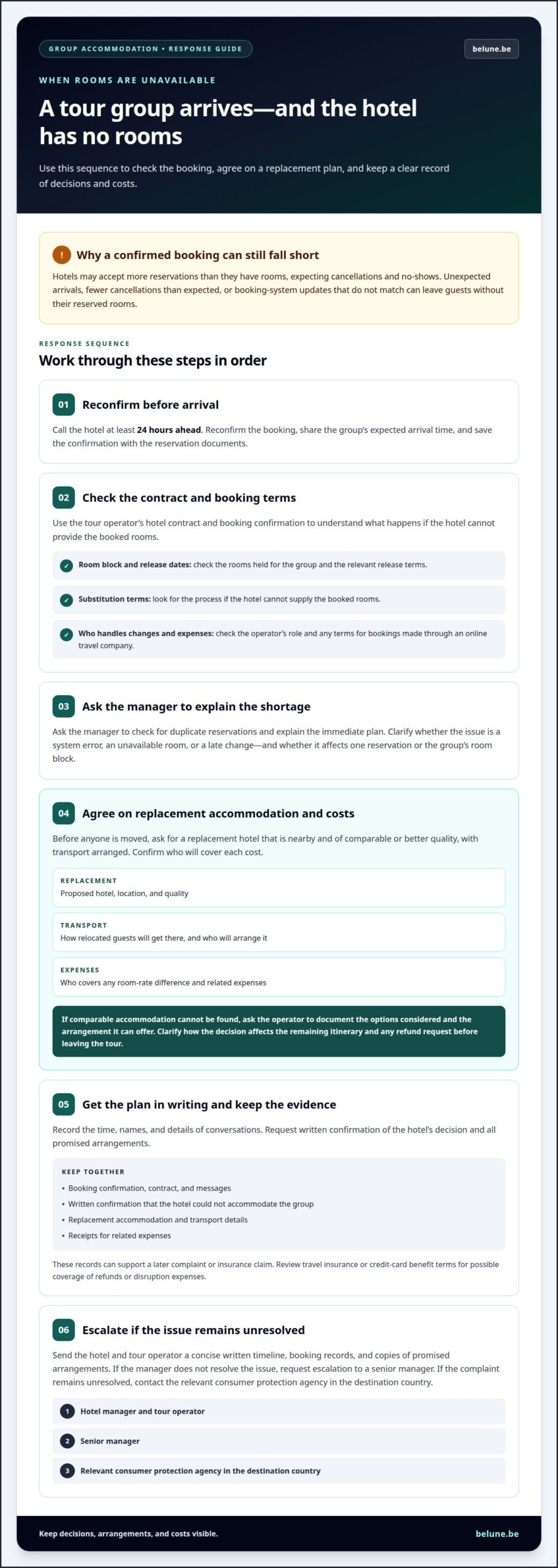
    If the hotel tells your group it has no rooms, ask the manager to check for duplicate reservations and explain the immediate plan. Keep the booking confirmation and record the time, names, and details of each conversation. Ask for the proposed replacement hotel, its location and quality, transport arrangements, and who will cover related expenses. Request written confirmation of the arrangements.

    For relocated guests, the replacement should be nearby and of comparable or better quality, with transport arranged. Keep the replacement confirmation and receipts for any expenses. These records can support a later complaint or insurance claim. A written statement that the hotel couldn’t accommodate the group also clearly documents the disruption.

    To escalate the issue, send the hotel and tour operator a concise written timeline, booking records, and copies of promised arrangements. If the hotel’s manager doesn’t resolve it, request escalation to a senior manager. If the complaint remains unresolved, contact the relevant consumer protection agency in the destination country.

    Before arrival, call the hotel at least 24 hours ahead to reconfirm the booking and share the group’s expected arrival time. Save the confirmation with the reservation documents so staff can quickly see the agreed details.

    2. Checking group contracts and online travel company terms

    Understanding what to do if a tour group hotel is overbooked starts with the tour operator’s hotel contract and booking confirmation. Look for the room block, release dates, substitution terms, and steps to follow if the hotel can’t provide the booked rooms. The terms may explain who arranges alternative accommodation and handles extra expenses, including when an online travel company is involved.

    Don’t assume there is one standard remedy. The contract sets out the operator’s response, which may address relocation or cancellation. If a proposed replacement doesn’t suit the group, explain why and ask the operator to state its next step in writing. Before leaving the tour, clarify how that decision affects the remaining itinerary and any refund request.

    If comparable accommodation can’t be found, ask the operator to document the options considered and the arrangement it can offer. Keep the original booking, messages, and receipts together. If you have travel insurance or a credit-card benefit, review its terms for coverage of refunds or disruption expenses.

    Online or hotel-app check-in may reduce the likelihood of relocation, but it doesn’t guarantee a room. Arriving earlier may also lower the risk of reassignment. Follow the hotel’s check-in instructions, retain the confirmation, and notify the tour operator promptly if the room isn’t available. These steps clarify what to do if a tour group hotel is overbooked without relying on assumptions about the booking terms.

    For group itineraries, clear lodging terms help partners understand who handles changes and guest communication. Tour operators can make accommodation planning part of wider travel arrangements through coordinated group accommodation.
    Tour group hotel overbooked? Check terms and get promises in writing

    3. Why hotels overbook

    A hotel may book beyond its room capacity to balance expected arrivals against cancellations and no-shows. A guest might cancel late, fail to arrive, or leave before the booked departure date. If the hotel held every room for every reservation, these changes could leave rooms empty. Overbooking is a forecast, not proof that a specific guest will cancel.

    Revenue planning also shapes the decision. Hotels consider early checkouts, overstays, and walk-in guests when estimating which rooms will be occupied. An early checkout, for example, can make a room available before another guest arrives, while an overstay can remove it from inventory. These changes can collide when multiple bookings depend on the same expected vacancy.

    Not every overbooking is deliberate. A booking engine, property management system, and channel manager may show different room counts if updates are delayed or entered manually. A room sold through one channel might still appear available elsewhere. Staff can reduce this risk by reconciling inventory across systems and checking the front desk’s arrival list against current room status.

    For a tour group, the mismatch may surface on arrival, with several guests standing together and holding confirmed bookings. Ask the front desk to explain whether the issue came from a system error, an unavailable room, or a late change. That distinction helps the tour operator determine whether the problem affects one reservation or the group’s room block.

    How the hotel responds matters as much as why the shortage happened. A walked guest is someone relocated because the booked room isn’t available. A common response is replacement lodging, transport, and compensation, such as the cost of one night’s stay. Ask the hotel to confirm each arrangement in writing, including who pays for transport and any other covered expenses.

    These causes also explain why confirming the booking before arrival can help uncover discrepancies. It won’t prevent every overbooking, but it gives the hotel time to compare the reservation with its room inventory and correct a mismatch before the group reaches the front desk.

    4. Getting promises documented in writing

    A spoken promise can be hard to rely on after a shift change. Ask the hotel to email every agreed arrangement, including replacement lodging, room category, transport, and responsibility for expenses. If the reservation was confirmed directly by phone or email, keep the original confirmation and related messages together. These records help establish what the hotel committed to provide.

    Be specific. If the front desk offers another property, request its name, address, room details, and arrival instructions in writing. If staff promise transport or compensation, ask them to state what they’ll cover and how they’ll arrange it. For example, “transport to the replacement hotel” is clearer than “we’ll help with the transfer.”

    Keep a dated record of each conversation. Note the staff member’s name, the time, and the specific promise. Then send a short email summarizing the discussion and ask the hotel to correct any inaccurate details. Copy the tour operator when its booking or group contract is involved. This creates a shared record for guests, hotel staff, and travel partners.

    Request written confirmation that the hotel couldn’t accommodate the reservation. An insurer or formal complaint process may require this record. Keep it with the booking confirmation, replacement-hotel documents, receipts, and messages. If a travel policy or credit-card benefit covers disruption expenses, these documents help connect the claim to the overbooking.

    Hotels use revenue management to balance occupancy with cancellations and no-shows. That business practice doesn’t replace clear communication with booked guests. Airline oversales are a separate issue, so don’t assume airline compensation rules apply to a hotel stay. Ask the hotel to state its proposed remedy and the relevant booking terms in writing.

    For tour operators coordinating group stays, plan group hotel accommodation with clear arrangements for rooming and communication.

    BELUNE: Hotel Accommodation Management

    BELUNE provides Hotel Accommodation Management for tour operators and travel agents arranging group stays. When an overbooking disrupts room plans, accommodation management helps keep lodging coordinated with the wider itinerary. It’s a natural fit for organized group travel, where accommodation needs to work alongside transport and planned experiences. BELUNE also offers coach hire with its own fleet of buses, local guide services, and Art & Culture Group Tours to support a broader group program where relevant.

    For future tours, build accommodation planning into the itinerary rather than treating hotel rooms as a separate detail. Contact BELUNE to discuss group accommodation, or visit belune.be.

    Shape a more resilient plan for the next group trip

    A hotel disruption can reveal how a group makes decisions under pressure. Before the next departure, agree who speaks for the group, who communicates changes, and how travellers receive updates. Add those roles to the trip’s operating plan so a last-minute change doesn’t leave guests waiting for direction.

    When deciding what to do if a tour group hotel is overbooked, the immediate response matters, but the next itinerary can benefit from what the team learns. Record which communication channels worked, where coordination slowed, and which decisions need a clear owner. Use those observations to shape a more considered travel plan, rather than assuming disruption can never happen.

    BELUNE can support tour operators planning future group travel. Contact BELUNE about your group travel plans and take a considered step toward a smoother journey, with more room for the people and places that make it memorable.

    Frequently Asked Questions

    Why do hotels overbook in the first place?

    Hotels may accept more reservations than they have rooms because cancellations, no-shows, and early checkouts can leave rooms vacant. They forecast expected occupancy to balance empty rooms against arrivals. Overbooking can also happen unintentionally when booking systems or manual updates don’t match. For a group, cancellations may not resolve a shortage if more guests arrive than the hotel can accommodate.

    What does it mean to get walked from a hotel?

    Being “walked” means the hotel can’t provide your booked room and relocates you to another property. The replacement may be nearby, but its location can affect the group’s meeting point, transport plan, or scheduled activities. Ask how guests will get there and whether the replacement hotel has received the group’s arrival details.

    How can you limit your risk?

    Keep the booking reference, rooming list, and hotel confirmation accessible to the group leader. Before travelling, check that names and arrival dates match the reservation, and tell the hotel about late arrivals or changes through the booking channel. Assign one person to handle hotel communication so guests don’t receive conflicting instructions.

    How do hotels decide which guests to relocate?

    Hotels may weigh booking method, loyalty status, arrival time, length of stay, and guest profile. A group, family, VIP, or guest staying several nights may be prioritized to remain, while a one-night stay may be considered for relocation. These considerations vary by situation, so ask the hotel how its decision affects the group’s room allocation.

    Is a hotel required by law to compensate you?

    In the United States, no federal rule sets compensation for a hotel guest who is denied a reserved room. The hotel’s terms, the booking arrangement, and applicable local consumer protections can affect the available remedy. Keep evidence of the reservation and disruption, then review the terms and any travel insurance or credit-card coverage relevant to your claim.

    Is it legal for hotels to sell more inventory than they have?

    Hotel overbooking is a widely accepted practice, but rules and remedies can depend on the country and booking terms. Selling more rooms than are available doesn’t mean every reservation can be fulfilled as booked. If this happens, distinguish the hotel’s explanation from the remedy it offers, and keep written records in case you need to pursue a complaint.
  • Finding Authentic Local Food for Tour Groups: The Professional DMC Guide to Gastronomic Excellence in 2026

    Finding Authentic Local Food for Tour Groups: The Professional DMC Guide to Gastronomic Excellence in 2026

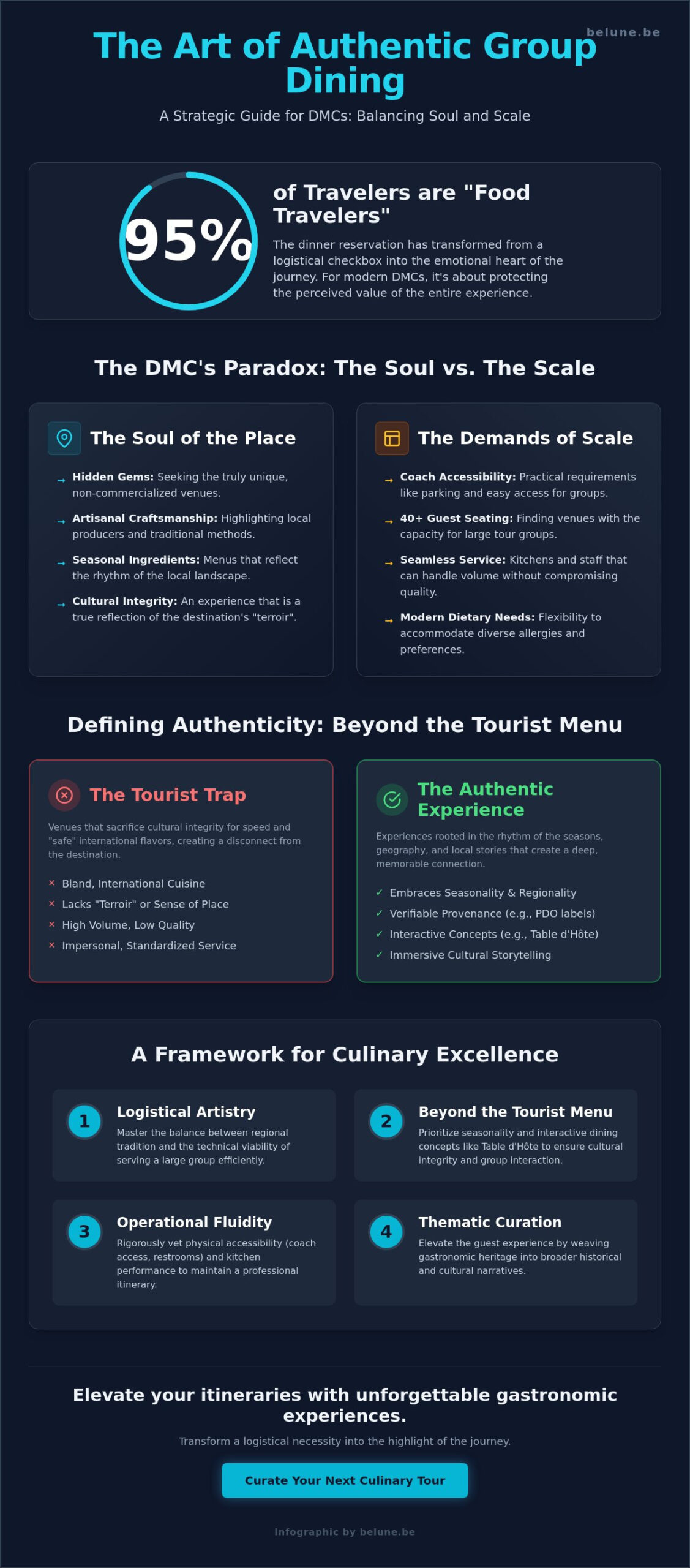
    Did you know that 95% of your travelers now identify as “food travelers”? It’s a staggering figure that transforms the dinner reservation from a mere logistical checkbox into the emotional heart of the journey. For the modern DMC, the art of finding authentic local food for tour groups often feels like a delicate balancing act between soul and scale. You seek the hidden gem, yet you require the precision of coach parking and seamless group seating.

    We recognize the quiet frustration when a curated itinerary is undercut by a lackluster tourist trap or when a traditional kitchen falters under modern dietary demands. It’s about more than just a meal. It’s about protecting the perceived value of the entire experience. This guide provides a professional framework to bridge the gap between complex logistics and intimate, artisanal moments. We will explore how to master local curation and navigate the evolving regulatory landscape of 2026, ensuring your gastronomic programs remain both inspired and impeccably executed.

    Key Takeaways

    • Logistical Artistry. Master the balance between regional tradition and technical viability when finding authentic local food for tour groups.
    • Beyond the Tourist Menu. Prioritize seasonality and interactive dining concepts like Table d’Hôte to ensure cultural integrity and group interaction.
    • Operational Fluidity. Rigorously vet physical accessibility and kitchen performance to maintain the rhythm of a professional itinerary.
    • Thematic Curation. Elevate the guest experience by weaving gastronomic heritage and local beer expertise into broader historical and cultural narratives.

    The Paradox of Scale: Why Finding Authentic Local Food for Tour Groups is a Logistical Art

    Authenticity isn’t a happy accident. It’s a deliberate choice. For the modern DMC, finding authentic local food for tour groups represents a complex intersection of sensory poetry and technical rigor. True excellence in group dining involves more than just a traditional recipe. It requires a balance of regional heritage, high-quality ingredients, and the logistical viability to serve 30 or more guests without losing the soul of the dish.

    The “Tourist Trap” is a common pitfall. Many high-volume venues sacrifice cultural integrity for the sake of speed and “safe” international flavors. This creates a disconnect. Your guests expect the pulse of the destination, not a sanitized version of it. The rise of culinary tourism reflects a deep desire for “terroir”—the unique taste of a specific place that cannot be replicated elsewhere.

    To better understand the nuances of local flavors, watch this helpful video:

    The Evolution of Culinary Expectations in Group Travel

    Travelers in 2026 view food as a primary cultural lens rather than simple sustenance. Research shows that 95% of travelers are now classified as “food travelers.” This shift has rendered the standardized “tourist menu” obsolete. Modern groups demand transparency and ethical sourcing. With new regulations like the FDA Food Traceability Rule in effect as of January 2026, guests are more aware of where their food comes from. They want to know which local farm supplied the vegetables or where the cheese was aged. For the professional operator, this means moving beyond the obvious and curating experiences that highlight artisanal craftsmanship and regional specialties. Just as a chef cares about the origin of their salt, many industries require specialized mineral sourcing, and you can learn more about how high-grade industrial salts are supplied for diverse professional needs.

    The Volume vs. Quality Debate

    Defining Authenticity: Beyond the ‘Tourist Menu’ for Professional Itineraries

    Authenticity is a living pulse, not a static menu. For the professional DMC, it’s rooted in the rhythm of the seasons and the specific geography of the landscape. Finding authentic local food for tour groups requires moving beyond the “tourist menu” to embrace the Table d’Hôte concept. This communal approach, where guests share a meal curated by the host, fosters genuine interaction and provides a deeper connection to the destination’s soul. It’s a departure from the predictable, offering a seat at the local table rather than a spectator’s view.

    When vetting venues, provenance is non-negotiable. A “local” craft beer or an artisanal cheese must be verified. We look for Protected Designation of Origin (PDO) labels as a benchmark for quality and historical accuracy. According to recent culinary tourism market trends, travelers increasingly prioritize these verifiable connections to the land. Cultural storytelling transforms a simple meal into an immersive event. Explaining the history of a dish or why a specific ingredient is harvested at a certain time adds a layer of sophistication that standard tours often miss. This narrative depth is what transforms a dinner into a memory.

    Regionality and the Concept of Terroir

    Geography dictates the traditional plate. In the Ardennes, the forest provides game and smoked meats; on the coast, the North Sea defines the menu. True authenticity often lies in “peasant food” traditions. These rustic, hearty dishes were designed for communal eating and offer a robust flavor profile that resonates with modern groups seeking something real. Identifying these regional nuances is essential for creating an itinerary with narrative depth. It’s about respecting the land’s output and translating it for a sophisticated audience.

    Balancing Tradition with Modern Dietary Requirements

    Adapting centuries-old recipes for vegan or gluten-free guests is a technical challenge. It requires professional communication with traditional kitchens that may not be accustomed to such requests. We negotiate these tweaks carefully. The goal is to preserve the dish’s soul while ensuring every guest feels included. Finding authentic local food for tour groups also means ensuring that rustic settings meet modern hygiene standards. We bridge the gap between traditional charm and the rigorous safety requirements of 2026. Crafting these experiences requires a partner who understands both the art of the meal and the science of the schedule. You can explore how we integrate these elements into our Gastronomy & Beer Experience Tours to see this philosophy in action.

    Finding Authentic Local Food for Tour Groups: The Professional DMC Guide to Gastronomic Excellence in 2026

    Vetting Local Venues: A Strategic Framework for Tour Operators

    Vetting is where the vision meets the pavement. Finding authentic local food for tour groups requires a technical audit that goes far beyond a simple tasting. It’s about ensuring that a venue’s artisanal charm doesn’t collapse under the weight of logistical demands. We look for the “sweet spot” where culinary excellence meets operational precision. This means verifying that a modern coach can park safely within a short walking distance and that the kitchen can maintain a 90-minute service window without sacrificing the integrity of a three-course meal.

    Exclusivity is a key differentiator in 2026. Guests no longer want to feel like part of a crowd. They seek private sections or behind-the-scenes access to the kitchen. Sustainability is equally vital. We prioritize venues that align with green travel initiatives, such as waste reduction and transparent local sourcing records. To bridge the gap between the chef’s passion and the guest’s curiosity, we often rely on specialized training for culinary guides. This ensures the narrative is as professional as the plate.

    The On-Site Inspection Checklist

    Acoustics are often overlooked but critical. If your local guide can’t be heard over the din of a crowded dining room, the cultural value of the meal is lost. We check restroom capacity to ensure a full group can transition quickly upon arrival. The decor must also resonate. If we’re telling a story of medieval heritage, the environment should reflect that aesthetic without feeling like a caricature. It’s about finding harmony between the plate and the place.

    Negotiating the ‘Fixed-Price’ Authentic Experience

    We’ve moved past the era of the “chicken or pasta” choice. Professional curation focuses on tasting experiences that showcase regional diversity. We negotiate all-inclusive pricing that covers local beverages and gratuities, removing any friction for the group leader. This approach requires building long-term partnerships with family-run estates and farm-to-table venues. These relationships allow us to secure the best of the season while ensuring the venue understands the specific needs of a large group. Finding authentic local food for tour groups is ultimately a collaborative effort between the DMC and the producer. It’s a commitment to excellence that respects both the guest’s time and the host’s craft.

    Executing Seamless Gastronomy: Logistics for Large-Scale Culinary Tours

    The transition from the road to the table should be imperceptible. When finding authentic local food for tour groups, the success of the experience often hinges on the invisible choreography between the DMC, the transport team, and the kitchen. It’s a matter of timing and flow. We coordinate coach arrivals to align perfectly with the kitchen’s peak performance, ensuring that “rustic” doesn’t translate to “waiting.” The goal is to arrive when the oven is at its prime and the staff is ready to focus exclusively on your guests.

    Finding authentic local food for tour groups requires a synchronized effort long before the first course is served. Managing the pre-order process is a technical necessity. It allows the chef to prepare fresh, artisanal components in advance without sacrificing the spontaneity of the meal. By 2026, we’ve integrated technology to track guest preferences and complex dietary restrictions long before the group departs. This data ensures that a vegan guest or someone with a gluten allergy receives a dish of equal cultural integrity, rather than a last-minute substitute. This level of preparation protects the rhythm of the itinerary and the reputation of the operator.

    Coach Access and Regional Infrastructure

    Reaching a remote farmhouse or a historic brewery often involves navigating narrow, centuries-old lanes. This is where the quality of the fleet becomes paramount. Our modern coaches are selected not just for comfort, but for their ability to access authentic rural estates that larger, less maneuverable vehicles simply can’t reach. The coordination between our central DMC team and the local transport staff is constant. The coach driver plays a critical role here, managing the transition with a level of professionalism that removes stress from the guests. It’s about ensuring the journey is as refined as the destination.

    The Multi-Lingual Guide as a Culinary Translator

    A menu is more than a list of ingredients; it’s a cultural document. A multi-lingual guide acts as a culinary translator, bridging the gap between a traditional chef and international guests. They explain the nuances of regional fermentation, the history of a specific hop, or the heritage of a local grain. Without this context, the meal remains just food. With it, it becomes an education. You can learn more about how multi-lingual local guides elevate the experience by adding narrative depth to every bite.

    If you are ready to plan an impeccable journey, you can explore our full range of Coach Hire with own fleet of busses to ensure your next tour is handled with technical precision and local soul.

    Elevating the Itinerary: How a DMC Curates Gastronomic Heritage

    Food serves as a bridge between the tangible past and the sensory present. When we discuss finding authentic local food for tour groups, we are curating a living heritage. It’s no longer sufficient to simply provide a seat at a table; the modern itinerary demands a narrative that resonates. We transform the act of dining into a structural component of the historical journey. For example, a morning spent exploring a historic battlefield can culminate in a meal that contrasts “Battlefield Rations” with contemporary regional cuisine. This thematic continuity deepens the emotional connection to the destination.

    The synergy between gastronomy and beer is another area where professional curation outshines random selection. It requires a technical understanding of flavor profiles, fermentation, and regional brewing traditions. A specialized Benelux incoming tour operator is vital for this level of detail. We possess the local roots to source exclusive venues, from private abbey cellars to artisanal hop farms, that remain hidden from standard booking platforms. This expertise allows us to move guests from “eating” to “experiencing” through structured tastings and meet-the-producer sessions.

    Custom Gastronomy Programs for Discerning Groups

    Integrating Belgium gastronomy tours into a broader cultural itinerary requires a delicate balance. It involves creating “exclusive access” moments that guests could not replicate on their own. Imagine a private dinner held within a historical monument where the menu is as significant as the architecture. A group might spend the morning immersed in 18th-century art and the afternoon discovering the exact artisanal techniques used to produce the region’s signature chocolate. This transition from history to discovery ensures the day feels like a single, harmonious story.

    The BELUNE Advantage: 20 Years of Culinary Partnerships

    Our approach is built on two decades of rigorous vetting and mutual trust with local producers. We leverage these deep roots to find venues that prioritize artisanal quality over mass-market volume. This expertise provides our partners with absolute budget transparency. Utilizing fixed-price group tours ensures there are no hidden costs or unexpected surcharges, allowing tour operators to focus entirely on the guest experience. Finding authentic local food for tour groups is a promise of excellence we fulfill through every reservation. Partner with an expert to bring genuine, sophisticated flavor to your next group itinerary.

    Crafting the Future of Gastronomic Group Travel

    Finding authentic local food for tour groups is no longer just a logistical task; it’s a creative intervention that defines the soul of a journey. Success lies in the invisible details, from the technical precision of a 90-minute service window to the narrative depth provided by a specialized guide. By prioritizing seasonal provenance and exclusive venue access, you elevate a simple reservation into a structural component of the traveler’s experience. It’s about moving from simple sustenance to a sophisticated discovery of regional heritage.

    We’ve spent over 20 years cultivating the regional expertise and deep culinary partnerships required to deliver these moments. Our private fleet of modern coaches and specialized gastronomy and heritage programs ensure every transition is seamless and every plate is purposeful. We invite you to Design your custom gastronomic group itinerary with BELUNE and transform your next project into a masterpiece of local flavor. The future of group travel is vibrant, and we’re ready to help you curate it with passion and precision.

    Frequently Asked Questions

    How do I find authentic restaurants that can actually fit a group of 40 people?

    Finding authentic local food for tour groups at this scale requires a technical audit of back-of-house capacity. We look for venues that have successfully transitioned from family kitchens to professional service without losing their artisanal soul. It’s about verifying that the kitchen can maintain a 90-minute service window while seating 40 guests simultaneously. This technical vetting ensures that scale doesn’t compromise the quality of the plate.

    Is it possible to do a farm-to-table experience with a large tour group?

    Large-scale farm-to-table experiences are achieved through strategic partnerships with rural estates that possess the physical space for a modern coach. We utilize the Table d’Hôte concept to create a communal, shared-plate atmosphere. This allows guests to engage directly with the producer while enjoying seasonal ingredients harvested from the surrounding land. It’s an intimate experience scaled with professional precision.

    How do professional tour operators handle dietary restrictions in rural local venues?

    We manage dietary restrictions through a combination of pre-departure technology and on-site communication. By tracking guest needs weeks in advance, we allow traditional chefs time to source authentic alternatives that mirror the original dish’s profile. A multi-lingual guide acts as a vital bridge, ensuring the kitchen understands the nuances of modern allergies without ever compromising the meal’s cultural integrity.

    What is the difference between a tourist menu and a curated regional menu?

    A tourist menu relies on standardized, international flavors designed for speed and low risk. In contrast, a curated regional menu celebrates terroir and seasonality. It features ingredients grown in the immediate vicinity and follows traditional recipes that tell a specific story. This approach prioritizes quality over convenience, offering a sensory connection to the destination that a generic menu simply cannot provide.

    Why should I use a DMC instead of booking local restaurants myself?

    A DMC provides the logistical infrastructure and local relationships required for finding authentic local food for tour groups. We manage coach access through narrow historic lanes and secure exclusive sections in venues that don’t typically host large groups. Our long-term partnerships ensure you receive professional service standards and budget transparency that individual bookings often lack. We act as your strategic ally.

    Can authentic food experiences be included in a fixed-price group package?

    Professional operators integrate these experiences into fixed-price packages by negotiating all-inclusive rates. These agreements cover regional beverages, artisanal courses, and gratuities, removing any financial friction for the group leader. This transparency is a hallmark of high-end DMC services, allowing you to offer a premium gastronomic experience within a predictable budget framework. It’s about providing value without hidden surprises.

    What are the best ways to integrate local food into a battlefield or history tour?

    Integration is achieved through thematic storytelling. You can contrast historical rations with modern regional delicacies or visit breweries that played a role in local conflicts. This creates a narrative thread that connects the morning’s history with the afternoon’s meal. It transforms dining from a break in the itinerary into a continuation of the cultural education, making the history much more tangible.

    How far in advance should a culinary tour for a group be booked?

    For peak 2026 dates, we recommend booking six to twelve months in advance. Authentic venues with the capacity for large groups are rare and often in high demand. Early planning ensures you secure exclusive access to private cellars or historical monuments that define a truly world-class gastronomic program. It’s the only way to guarantee the highest level of exclusivity.