Tag: Sustainable Tourism

  • Eco-Certified Travel Partners in Belgium: 2026 Guide

    Eco-Certified Travel Partners in Belgium: 2026 Guide

    What if the strongest sustainability claim in a travel proposal is the one you verify, not the one that sounds most convincing? A search for “eco-certified travel partners belgium” can surface polished labels and broad promises, but neither proves that a certification is current, independently assessed, or relevant to every service in your group itinerary.

    It’s reasonable to expect clear evidence before choosing a partner. Check who issued the certification, what it covers, and whether it remains valid, then weigh that evidence against your group’s accommodation, transport, guiding, and itinerary needs. Green Key and the EU Ecolabel are relevant to accommodation; Travelife certifies tour operators and travel agencies at different levels.

    This guide explains how to assess those credentials, compare partners against consistent criteria, and request useful documentation instead of relying on vague sustainability language. It also covers practical questions to raise with a Belgian DMC. BELUNE brings more than 20 years of group travel experience, but no specific eco-certification is confirmed here. Discuss your sustainability expectations and request relevant partner evidence before planning.

    Key Takeaways

    • For eco-certified travel partners belgium, check whether each credential is current and covers the specific organization and services you plan to use.
    • Compare certification scope, published criteria, assessment method, and renewal requirements rather than relying on a label alone.
    • Use the same sustainability and operational criteria to compare partners, including accommodation, transport, guiding, and itinerary coordination.
    • Before booking, request current certificates, relevant supplier information, and written details about the practices that matter to your group.
    • BELUNE coordinates group travel services and brings more than 20 years of experience; discuss your sustainability requirements and request relevant partner documentation during planning.

    What Eco-Certified Travel Partners in Belgium Actually Mean

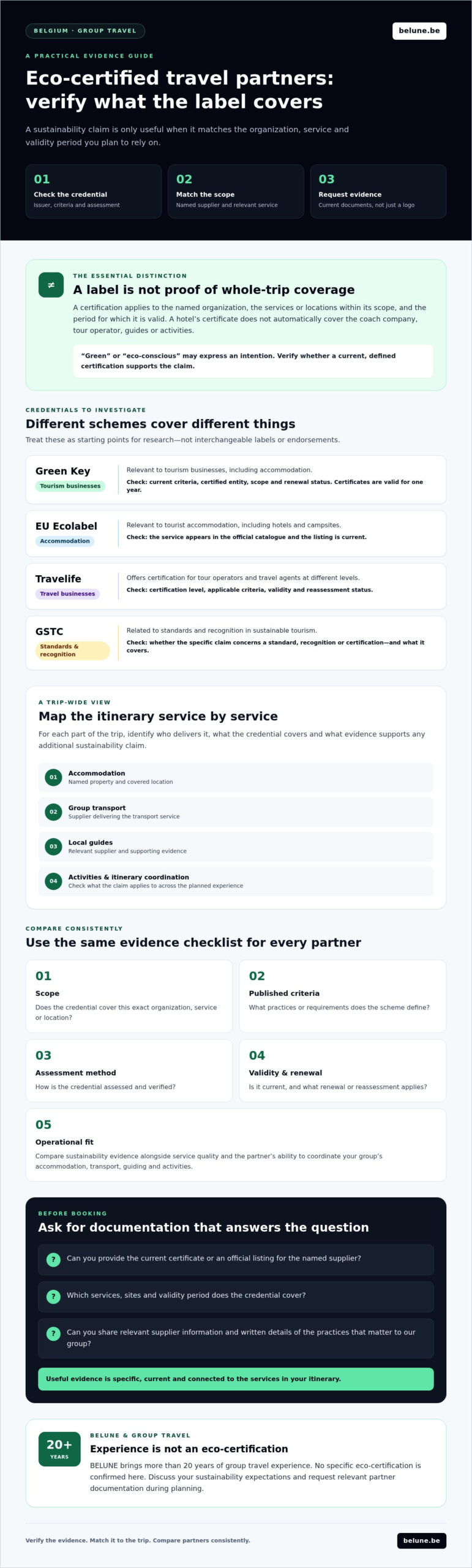
    The phrase eco-certified should point to evidence, not atmosphere. An eco-certified travel partner is an organization that holds a relevant environmental certification issued under defined criteria and verifiable through the certifying body or its records. The credential applies only to the named organization, the services and locations within its scope, and the period for which it remains valid.

    That distinction matters because a hotel’s certificate doesn’t automatically cover the coach company, tour operator, guides, or activities in a group itinerary. A business describing itself as “green” or “eco-conscious” may be sharing an intention, not an independently assessed status. The broader idea of Sustainable tourism also includes social and economic considerations, but individual certifications define their own boundaries.

    What does an eco-certification verify?

    Schemes can assess different practices and types of organization. Green Key and the EU Ecolabel are relevant examples to investigate for tourist accommodation, while Travelife offers certification for tour operators and travel agents. These labels aren’t interchangeable, and you shouldn’t assume they assess identical standards or outcomes.

    Check the scheme’s published criteria and verification process. Look for the certified entity’s exact name, the services or sites covered, the certificate’s validity, and any renewal requirements. A credible claim should be traceable to current documentation or an official listing, not just a logo on a website. Treat each scheme as a starting point for questions, not a substitute for checking whether it fits your trip.

    Which travel services should a group planner assess?

    Map the trip service by service: accommodation, group transport, local guides, activities, and itinerary coordination. For each element, ask which supplier delivers it, whether that supplier’s certification covers the service, and what evidence supports any additional sustainability claims. Choosing certified accommodation may be meaningful, but that certification doesn’t cover the full journey.

    Certified status means a defined organization or service has been assessed against a named scheme’s criteria within a stated scope and validity period. A general green claim is not proof of that assessment.

    For a tour operator, environmental evidence is only one part of a sound decision. Compare it with service quality and practical itinerary fit: can the partner coordinate the accommodation, transport, guiding, and activities your group needs? Shortlist eco-certified travel partners belgium using evidence that matches your actual plans, rather than choosing a reassuring-looking label that covers little of the experience.

    How to Evaluate Eco-Certifications and Sustainability Evidence

    A label is useful only when you know what it verifies. Compare each scheme by its scope, published criteria, assessment method, validity period, and renewal requirements. Then confirm that the certificate covers the supplier and service you’re considering, not just a related business or one part of its operation. When assessing eco-certified travel partners belgium, this makes current certification evidence more useful than a logo or broad sustainability statement.

    The examples below are starting points for research, not endorsements. Criteria and certificate details can change, so verify current information with each scheme before relying on it.

    Scheme Area to investigate Check before relying on it
    Green Key Tourism businesses, including accommodation Current criteria, certified entity, scope, and annual renewal status
    EU Ecolabel Tourist accommodation, including hotels and campsites That the service appears in the official catalogue and the listing is current
    Travelife Tour operators and travel agents Certification level, applicable criteria, validity, and reassessment status
    GSTC Standards and recognition related to sustainable tourism Whether the specific claim concerns a standard, recognition, or certification, and what it covers

    For example, check Green Key certification against the scheme’s current criteria and the named establishment’s status. Green Key certificates are valid for one year, and new criteria took effect on October 1, 2026. Confirm the applicable criteria and current status directly with the scheme for each establishment.

    What should a certificate or listing show?

    Look for the certificate holder’s exact name, covered operations or locations, issue date, and expiry or renewal status. If the scheme provides a certificate number or public directory, use it to cross-check promotional material. A certificate image alone may not show whether the specific service is included. Contact the certifying organization if the scope is unclear.

    How do you assess claims without a certification?

    Ask for written policies, measurable practices, and evidence relevant to the service being supplied. A transport provider, for instance, should be able to explain the practices it claims to follow in its transport operations. Distinguish documented actions from future aims, and ask what records support any stated impact. An absence of certification doesn’t prove poor practice, but it makes clear, service-specific evidence especially important.

    A certification’s scope matters as much as its label: it shows which organization, service, and period the verified claim actually covers. For group itinerary coordination, you can also discuss sustainability requirements and partner documentation with BELUNE as part of planning.
    Eco-Certified Travel Partners in Belgium: 2026 Guide

    How to Compare Certified Travel Partners in Belgium

    A certificate is one part of a group travel decision. The partner must also be able to coordinate the services your itinerary needs, from accommodation management and transport to local guides and activities. Compare every candidate against the same requirements, so one partner isn’t judged on detailed documentation while another is assessed on a broad promise.

    Start with the group’s practical needs. Consider group size, itinerary complexity, accessibility requirements, and how services will be coordinated if plans change. Ask about relevant group experience, communication processes, and contingency planning. If services are subcontracted, find out how suppliers are selected and what documentation is available. A DMC may coordinate several suppliers, but that doesn’t mean it holds or extends each supplier’s certification.

    Which partner criteria matter beyond certification?

    Assess the partner’s experience and service scope alongside its environmental evidence. Check whether it can manage the accommodation, transport, guiding, and itinerary coordination your plans require. Ask which suppliers will deliver each service and whether their relevant credentials or practices can be documented. Match the level of detail to the trip: a multi-part itinerary may need clearer coordination and contingency arrangements than a simpler one.

    How can a buyer compare evidence fairly?

    Use one comparison record for every candidate. Keep environmental evidence separate from operational fit, and mark gaps as “unverified” until you can follow up. Missing documentation is a reason to ask another question, not automatic proof that a partner has poor practices.

    Comparison area What to record Follow-up question
    Certification scope Holder, services, locations, and validity Does the evidence cover the supplier and service in this itinerary?
    Current evidence Certificate or listing checked, with date reviewed Can the certifying body confirm the status?
    Service fit Accommodation, transport, guiding, and coordination needs met Who delivers each part, including subcontracted services?
    Open questions Missing documents or unclear claims, marked unverified What written explanation or supporting record can be provided?

    For a broader framework on operational selection, see The Definitive Guide to Choosing a Group Travel Agency in 2026. Then use the same evidence-and-fit approach for your shortlist of eco-certified travel partners belgium. BELUNE, a DMC with over 20 years of transport and tour operation experience, may be considered for group coordination. Request relevant partner documentation and discuss sustainability requirements directly, without assuming a certification.

    Questions to Ask Before Booking an Eco-Conscious Group Trip

    Good sustainability planning starts before a proposal is finalized. Set out what matters to your group, then ask prospective partners to show how their services and suppliers align with those priorities. A clear sequence helps you compare eco-certified travel partners belgium on evidence, itinerary fit, and practical delivery rather than broad claims alone.

    • 1. Define your priorities. Decide which environmental considerations matter most for the trip, such as certified accommodation or documented practices among transport and activity suppliers. Separate essential requirements from preferences.
    • 2. Map the services. Ask which elements the partner delivers directly and which depend on external suppliers. Request a supplier list relevant to your itinerary, and identify who is responsible for each service.
    • 3. Verify certification claims. For each claimed credential, ask which service or supplier it covers, which certifying body issued it, and whether the certificate is current. Request a copy or public listing, and confirm the scope instead of relying on a logo.
    • 4. Request practice-based evidence. Where a supplier has no relevant certification, ask for written policies and examples of practices related to the service. Find out how subcontractors are screened and what documentation supports environmental claims.
    • 5. Connect choices to the itinerary. Ask how your priorities would influence accommodation, transport, guiding, and activities. Discuss any trade-offs involving group logistics, accessibility, comfort, and operational feasibility.
    • 6. Confirm the agreement. Before booking, record the agreed sustainability requirements, each party’s responsibilities, and when supporting evidence will be provided. This gives both sides a clear reference during planning and delivery.

    How should sustainability requirements enter the brief?

    Include your evidence requirements in the initial brief, before comparing proposals. Specify what certification scope is acceptable, which suppliers need to be identified, and what written explanations or reporting you expect. This makes responses easier to assess consistently. Leave room for practical discussion too: a preferred option must work for the group’s schedule, service needs, and itinerary.

    For a coordinated group trip, BELUNE can discuss itinerary planning, accommodation management, coach hire, and local guide services alongside your sustainability requirements. No specific eco-certification for BELUNE is confirmed here, so ask directly about relevant supplier documentation and practices before planning. Discuss your group travel requirements with BELUNE.

    Working with BELUNE on Group Travel in Belgium

    BELUNE is a Destination Management Company with over 20 years of experience in transport and tour operations. Its group travel capabilities include accommodation management, coach hire using its own fleet, local guide services, and itinerary coordination. These services can provide a practical foundation for planning a group journey, while sustainability requirements remain a separate point to discuss and document.

    BELUNE’s eco-certification is not confirmed in the supplied business information. This guide therefore doesn’t present the company as eco-certified or environmentally verified. Buyers considering eco-certified travel partners belgium should assess BELUNE on its confirmed services and ask for current evidence relating to any specific environmental claims or suppliers included in a proposed itinerary.

    Where can a DMC support sustainability-focused planning?

    A DMC can coordinate different parts of a group itinerary, including accommodation, transport, guides, and other planned services. That coordination can help buyers identify who provides each service and what information is available for review, but it doesn’t certify those suppliers. Ask which services BELUNE delivers directly, which involve external partners, and whether relevant certificates or written practice documentation can be provided for each supplier. Verify credentials for the specific organization and service they cover.

    Keep the distinction clear: coordination can make supplier information easier to gather, but it isn’t a guarantee of environmental outcomes or a certified supply chain. Discuss your criteria, evidence needs, and priorities before itinerary decisions are finalized.

    What should you share when requesting a proposal?

    A focused brief helps a DMC assess operational fit and respond to your sustainability expectations. Include:

    • Your group profile and travel dates.
    • Required services, such as accommodation management, coach hire, local guides, and itinerary coordination.
    • Any accessibility, comfort, or scheduling needs that affect the itinerary.
    • Your environmental priorities and any labels or certification schemes you require.
    • The certificate scope you’ll accept, plus expectations for supplier lists, current documentation, and written explanations of relevant practices.

    If gastronomy is part of your plans, include it in the brief so it can be considered as an itinerary element; BELUNE offers gastronomy and beer experience tours. Once a proposal identifies relevant suppliers, check their documentation against your criteria and clarify any gaps before deciding. A shared understanding of responsibilities and evidence supports a more dependable planning process.

    For a tailored discussion of group services and sustainability requirements, discuss a tailored group travel proposal with BELUNE.

    Plan Your Belgium Group Trip with Clarity

    Choosing among eco-certified travel partners belgium starts with evidence: confirm a certificate’s current status, scope, and coverage of the specific supplier and service. Then compare that information with the partner’s ability to coordinate your group’s accommodation, transport, guiding, and itinerary needs. A clear brief makes sustainability expectations easier to discuss and verify.

    BELUNE brings more than 20 years of experience in transport and tour operations, with accommodation management, coach hire, local guides, and itinerary coordination among its confirmed capabilities. Its eco-certification is not confirmed, so request relevant supplier documentation and discuss your criteria before deciding. Transparency is a stronger foundation than an unsupported claim.

    Discuss your group travel requirements with BELUNE and take the next step toward a thoughtfully planned itinerary. With clear priorities and the right questions, your group can make informed choices while keeping the experience cohesive and rewarding.

    Frequently Asked Questions

    Is an eco-certified travel partner automatically sustainable across every service?

    No. A certification has a defined holder, scope, and validity period, and it may cover only certain operations. Check whether the certificate applies to the accommodation, transport, or planning service you intend to use. Assess other suppliers separately, too. One credential isn’t proof that every part of a group trip meets the same environmental standard, even if the certified supplier plays a central role in the itinerary.

    How can I verify whether a travel partner’s eco-certification is current?

    Ask for a copy of the certificate or a public listing, then check the certificate holder, covered services, issuing body, and validity period. Where possible, confirm those details directly with the certifying organization. If a supplier can’t provide evidence, record the claim as unverified rather than treating it as confirmed. Ask what other written documentation supports its environmental practices before relying on the claim in procurement.

    What certifications should I look for when choosing travel partners in Belgium?

    There isn’t one label that fits every travel service. Green Key and the EU Ecolabel are examples to investigate for tourist accommodation; Travelife is relevant to tour operators and travel agents. GSTC relates to recognized sustainable tourism standards, so clarify exactly what a GSTC-related claim refers to. Criteria and scope differ. Check current requirements and verify that the specific organization or service holds a valid credential. No single label covers a whole itinerary by default.

    Can a tour operator be eco-certified if some suppliers are not?

    Yes, a tour operator may hold a certification without that credential extending to its accommodation, transport, guides, or other suppliers. Ask what the operator’s certificate covers and how external providers are selected or assessed. If your group requires certified services, request current evidence from the relevant suppliers. Confirm in writing which itinerary elements meet your criteria and which don’t have verified certification, so the distinction is clear before booking.

    What should I ask an eco-certified travel partner before booking a group trip?

    Ask which certification applies, who issued it, which organization and services it covers, and when it expires or needs renewal. Request evidence for subcontracted services and ask how the partner will reflect your environmental priorities in the itinerary. Also clarify group capacity, service responsibilities, and how agreed sustainability criteria will appear in the proposal. Comparing eco-certified travel partners belgium against the same questions helps keep your assessment consistent.

    Does BELUNE hold an eco-certification for group travel in Belgium?

    The business information available for this guide doesn’t confirm that BELUNE holds an eco-certification, so the company shouldn’t be described as certified. BELUNE is a Destination Management Company with over 20 years of transport and tour operation experience, offering accommodation management, coach hire, local guides, and itinerary coordination. Prospective clients can discuss their sustainability requirements and request relevant documentation for proposed suppliers, then verify any certification claim directly before relying on it.
  • How to Offer Carbon-Neutral Tours in the Netherlands: A Practical Guide

    How to Offer Carbon-Neutral Tours in the Netherlands: A Practical Guide

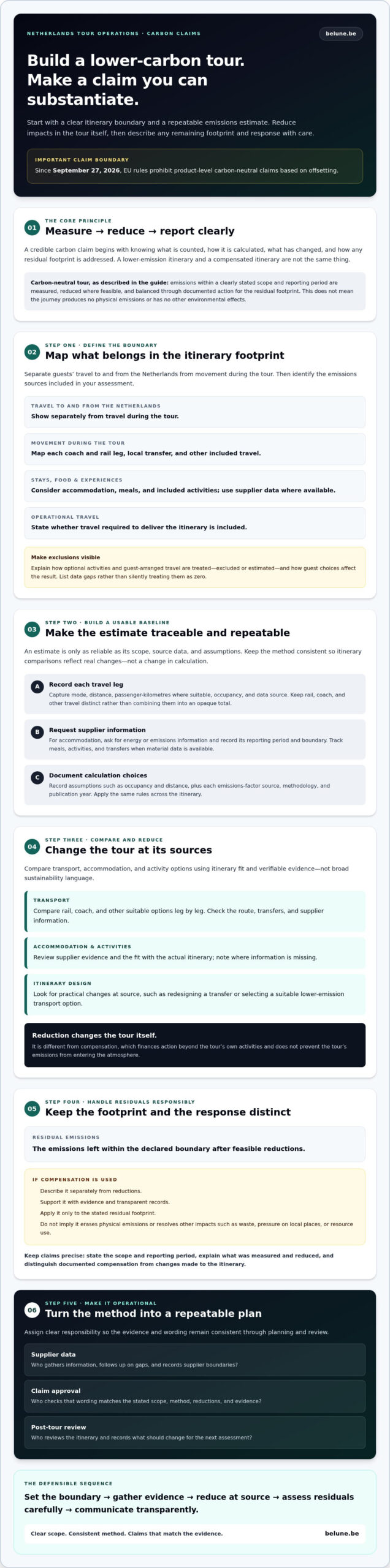
    A tour can be carefully offset and still fall short of a credible carbon claim. For operators asking how to offer carbon-neutral tours in the Netherlands, the stronger starting point is to measure emissions across the itinerary, then reduce them wherever practical. The distinction matters: since September 27, 2026, EU rules prohibit product-level carbon-neutral claims based on offsetting.

    The choices can be complex. Transport, accommodation and activities each involve different data and supplier considerations, while vague environmental language can undermine trust. A defensible plan begins with consistent measurement and changes at source, not a credit purchase used to make a tour sound impact-free.

    This guide explains how to map a group tour’s emissions, compare travel and supplier options, and identify reductions you can substantiate. It also covers how to treat residual emissions responsibly, assess compensation evidence and describe progress transparently. The aim is a lower-carbon Netherlands itinerary supported by clear decisions and claims that stand up to scrutiny.

    Key Takeaways

    • Set a clear itinerary boundary so your emissions assessment accounts for relevant travel, stays, activities and transfers.
    • Build a usable baseline by gathering activity data, applying suitable emissions factors and documenting assumptions for each transport leg.
    • Compare rail, coach and other options alongside accommodation and activity suppliers. Use itinerary fit and verifiable evidence rather than broad sustainability language.
    • Learn how to offer carbon-neutral tours in netherlands by prioritising measurable reductions and assessing any compensation against clear evidence and transparent records.
    • Turn your findings into an operating plan by assigning responsibility for supplier data, claim approval and post-tour review.

    What Does a Carbon-Neutral Tour in the Netherlands Actually Mean?

    A credible carbon claim starts with a boundary, not a label. Before describing a tour as carbon-neutral, an operator needs to know which emissions are counted, how they’re calculated, what reductions have been made and how any remaining impact is addressed. A lower-emission itinerary and a compensated itinerary are not the same thing.

    A carbon-neutral tour is one whose emissions within a clearly stated scope and reporting period have been measured, reduced where feasible and balanced through documented action for the residual footprint. That definition depends on transparent evidence. It doesn’t mean the journey produces no physical emissions or has no other environmental effects. The wider principles of Sustainable tourism also encompass economic and social considerations.

    For context, watch this video on carbon-neutral travel experiences:

    Which emissions belong in a Netherlands tour footprint?

    Set the itinerary boundary before gathering data. Show guests’ travel to and from the Netherlands separately from travel during the tour. Then map the included journey: coach and rail legs, local transfers, accommodation, meals and activities. Use supplier data where it’s available. Operational travel required to deliver the itinerary may also belong in the assessment, so state whether it’s included.

    Be explicit about what sits outside the calculation. For optional activities, explain whether they’re excluded or estimated and how guest choices affect the result. Record assumptions such as occupancy and distance, along with the emissions-factor source, its methodology and publication year. A Netherlands-specific assessment reflects the actual route, transport mix, stays and activities, rather than applying a generic sustainability label to every itinerary.

    Carbon reduction, carbon neutrality and compensation

    Reduction changes the tour itself, for example by redesigning a transfer or choosing a suitable lower-emission transport option. Compensation is different. It finances action beyond the tour’s own activities and doesn’t prevent the tour’s emissions from entering the atmosphere.

    Residual emissions are those left within the declared boundary after feasible reductions. If you use compensation, describe it separately, support it with evidence and apply it only to that stated residual footprint. Don’t imply it erases the tour’s physical emissions or resolves impacts such as waste, pressure on local places or resource use. For operators learning how to offer carbon-neutral tours in netherlands, precise scope and wording are part of the work, not an afterthought.

    How to Measure Tour Emissions Before Promising Carbon Neutrality

    A useful emissions estimate starts with a defined itinerary and a repeatable method. For operators considering how to offer carbon-neutral tours in netherlands, the aim isn’t to produce a single impressive number. It’s to build a transparent account of what was measured, what was estimated and what remains outside the calculation.

    An emissions estimate is only as reliable as its scope, source data and assumptions. Keep these visible so you can compare itinerary versions without mistaking a change in calculation for a real reduction.

    Build a consistent Netherlands itinerary inventory

    Map each leg separately, including travel to and from the Netherlands and movement within the tour. Record distance and passenger-kilometres where suitable, along with the mode, occupancy and data source. Don’t combine rail, coach and other travel into one opaque total. Separate figures make it easier to identify where itinerary changes could matter.

    Request accommodation energy or emissions information, including its reporting period and boundary. Track meals, included activities and transfers when material data is available, and list gaps rather than silently treating them as zero. Decide how to handle optional activities, guest-arranged travel and supplier operations, then apply the same rule across the itinerary.

    Make estimates transparent and repeatable

    Use this workflow for each tour version:

    1. Define the tour. Set the reporting period and itinerary boundary, and identify the guests and relevant operational activity included.
    2. Collect activity data. Gather distances, passenger-kilometres, accommodation information and supplier details for each itinerary component.
    3. Apply suitable emissions factors. Select factors that fit the activity and geography. Record the source, publication year, units and system boundary.
    4. Review and document. Note conversion factors, occupancy and allocation assumptions, estimates, missing data and exclusions. Keep the calculation so it can be repeated.

    Use consistent factors when comparing suppliers or redesigning an itinerary. If one coach leg is measured using actual distance and another relies on an estimate, flag the difference. Don’t present the comparison as more precise than the data supports. GHG Protocol guidance can serve as a reference framework, but check that the selected approach and boundary fit the tour calculation.

    Report a total per tour when the full group and included activities are clearly defined. A per-traveller figure also needs a transparent allocation method, including the group size used and how shared transport or accommodation emissions are divided. If those inputs change, the result may change too.

    A destination management company can help coordinate itinerary details and supplier information for a consistent assessment. Operators shaping custom group itineraries can set data requirements alongside the route plan, then check each factor and claim against their own evidence.

    How to Offer Carbon-Neutral Tours in the Netherlands: A Practical Guide

    Which Netherlands Tour Choices Reduce Emissions Most?

    No single transport mode or supplier choice makes every itinerary lower-carbon. The result depends on the full journey, including distance, occupancy, transfers, route and the quality of the emissions data. Compare alternatives using the same itinerary boundary, then make changes where the evidence points to a meaningful opportunity.

    Compare like-for-like itinerary options using consistent boundaries and current evidence. Rail may suit one route, while a well-used coach may better connect a group to accommodation or activities elsewhere. Avoid basing claims on vehicle labels alone.

    Compare transport and itinerary design

    Assess rail for suitable journeys, including door-to-door logistics and transfers to and from stations. For coach travel, use actual route distance and occupancy assumptions. Check whether transfers or detours add distance without giving guests meaningful value. Comfort needn’t be an afterthought: compare the complete journey, including connections, waiting, luggage and how smoothly the group moves together.

    Choice Decision factors Evidence to request Trade-off to check
    Rail Route suitability, stations and onward connections Distance, travel mode and relevant emissions-factor source Transfers may affect total distance, time and group logistics
    Coach Occupancy, route and transfer requirements Actual itinerary distance and the assumptions used for passenger allocation A low-occupancy journey can change the per-traveller comparison
    Accommodation Location, operational practices and available data Dated energy or emissions information, including scope and reporting period Supplier figures may use boundaries that don’t match the tour calculation
    Meals and activities Relevance to the itinerary and supplier practices Available environmental data and an explanation of what it covers Local sourcing or plant-forward choices may be options, not guaranteed savings

    Assess stays, food and activities with evidence

    Ask accommodation providers for dated, scoped information, and record gaps rather than assuming a sustainability label proves lower emissions. Local sourcing and plant-forward meals can be considered as part of itinerary design, but don’t claim a carbon benefit without supporting data. Choose activities for their quality and relevance, then ask suppliers what their environmental information measures.

    For operators exploring how to offer carbon-neutral tours in netherlands, consistent comparison turns supplier conversations into practical planning. A destination management company can coordinate itinerary choices and information requests across accommodation, coach travel and local guidance. The strongest option fits the group, works as a complete journey and has evidence to support a fair comparison.

    How to Address Residual Emissions and Make Responsible Claims

    Consider compensation only after measuring the itinerary and making feasible reductions. It can support climate action beyond the tour, but it doesn’t remove the tour’s physical emissions or make its wider environmental effects disappear. Treat compensation as a distinct response to a defined residual footprint, not a substitute for redesigning the itinerary.

    Evidence matters more than a project’s marketing language. Before relying on credits, review the project type and claimed outcome, independent verification, evidence of additionality, and how permanence risks are managed. Ask for records showing that credits have been retired for the stated purpose, so they can’t be claimed again. No single document guarantees that every claim is appropriate; assess the evidence against the purpose and scope you’re communicating.

    Choose and document any carbon compensation

    Keep the emissions calculation, supplier records, factor sources, project documentation, verification details, retirement evidence and claim approvals together. Confirm that the volume of compensation corresponds to the tour’s declared residual emissions, not a wider or vaguely defined footprint. If project evidence is incomplete, disclose that limitation or don’t rely on the credit for a public claim.

    Communicate the claim without overstating it

    Be specific about the tour boundary, calculation period, reduction measures and treatment of residual emissions. For example, if each detail is documented, state that you measured emissions from specified itinerary elements for a stated period, changed identified travel arrangements, and separately funded a named type of climate project for the calculated remainder. State exclusions clearly. Avoid broad labels such as “green” or “zero-impact” when the evidence doesn’t support them.

    There’s also an important regulatory distinction. As of 27 September 2026, EU rules under Directive (EU) 2024/825 prohibit product-level carbon-neutrality claims based on offsetting. A tour shouldn’t be marketed as “carbon-neutral” if that claim depends on purchased credits. Check current European Commission and Netherlands Authority for Consumers and Markets (ACM) guidance before approving environmental advertising. Requirements can depend on the precise claim and context, so have qualified advisers review the wording; this section isn’t legal advice.

    For operators considering how to offer carbon-neutral tours in netherlands, transparent reporting is stronger than an absolute promise. Keep the evidence trail current, revisit claims when the itinerary or calculation changes, and distinguish direct reductions from separately financed climate action.

    To coordinate itinerary planning and supplier information around your sustainability criteria, discuss your group itinerary needs with BELUNE.

    How a Tour Operator Can Put a Lower-Carbon Netherlands Tour into Practice

    Turn the method into a repeatable operating process. Start with a pilot itinerary to test supplier responses, data quality and group logistics before applying the approach to more departures. Treat it as a learning exercise, not a promise that the tour is carbon-neutral.

    Use a repeatable planning and review checklist

    Before contacting suppliers, agree on the intended audience, itinerary boundary and evidence you’ll accept. Then assign an owner to each step:

    • Set the scope: confirm which travel, stays, activities and operational elements the assessment includes.
    • Establish a baseline: record the planned itinerary, available activity data, calculation method and known gaps.
    • Redesign: compare feasible itinerary changes using consistent assumptions, and note the expected reductions.
    • Confirm suppliers: request comparable, dated information and follow up if the boundary or source is unclear.
    • Calculate and disclose: assess the delivered itinerary, identify residual emissions and approve precise, evidence-based wording.
    • Review after the tour: compare actual travel and supplier data with the plan, then update assumptions for future departures.

    Assign responsibility for data collection, supplier follow-up, emissions calculations, claim approval and post-tour review. Record decision owners, planned changes and remaining uncertainty. If actual occupancy or routing differs from the plan, document the change rather than presenting the original estimate as a measured result.

    Coordinate suppliers and specialist planning support

    Ask each partner for the source, reporting period and scope behind environmental figures. A destination management company can coordinate custom itinerary planning, accommodation management, coach logistics and local guidance, while the operator remains responsible for verifying evidence and approving claims. A partner’s involvement alone doesn’t establish that a tour or service is carbon-neutral.

    For a partner assessment, read this guide to choosing an incoming tour operator. Broader criteria for evaluating group-travel partners are covered in the group travel agency selection guide.

    Learning how to offer carbon-neutral tours in netherlands starts with a process your team can repeat and improve, not a label applied before the evidence is ready. For professional operators, a conversation about itinerary needs and sustainability criteria can help identify where coordination and supplier information fit into the planning process.

    Make Your Next Netherlands Itinerary More Measurable

    A credible lower-carbon tour starts with a clear scope, consistent emissions data and practical changes to the itinerary. Measure transport, stays and activities using stated assumptions, then compare supplier options on a like-for-like basis. Prioritise reductions and describe any remaining impact carefully, with supporting evidence.

    For operators exploring how to offer carbon-neutral tours in netherlands, the essential step is a repeatable plan, from baseline to post-tour review. Precise communication matters as much as the calculation: say what you measured, what you changed and what remains uncertain. Avoid claims that suggest a tour is impact-free.

    BELUNE brings more than 20 years of group-travel and transport-industry experience, with custom itinerary planning, accommodation management, its own coach fleet and local guide services. These capabilities can help coordinate itinerary details and supplier information without implying that any tour or service is carbon-neutral. Discuss a tailored group itinerary with BELUNE and explore how your sustainability criteria can inform the planning process.

    Each well-documented decision helps make tours more thoughtful, transparent and ready to improve over time.

    Frequently Asked Questions

    How can a tour operator make a Netherlands tour carbon-neutral?

    Start by measuring the tour’s emissions within a clearly defined boundary, then reduce them through practical itinerary and supplier choices. Document the calculation method, reporting period, data sources and exclusions. Any compensation should relate only to measured residual emissions and be described separately. As of September 27, 2026, EU rules prohibit product-level carbon-neutrality claims based on offsetting. When considering how to offer carbon-neutral tours in netherlands, prioritise documented reductions and check current guidance before making public claims.

    What should be included when calculating a tour’s carbon footprint?

    Include relevant guest and operational travel, accommodation, transfers, meals and included activities where suitable data is available. Separate travel to and from the Netherlands from transport within the itinerary, and record each mode and distance. State how you handle optional activities, guest-arranged travel and supplier operations. Document emissions-factor sources, reporting year, group-size assumptions and exclusions so readers can understand what the total represents and comparisons remain consistent.

    Is carbon offsetting enough to call a tour carbon-neutral?

    No. Purchasing credits doesn’t reduce the tour’s own physical emissions, and EU rules in effect from September 27, 2026, prohibit product-level carbon-neutrality claims when they rely on offsetting. Measure the itinerary and reduce emissions at source first. If you support climate projects, disclose that action separately, explain the residual footprint it relates to, and retain evidence. Don’t suggest that compensation makes a tour impact-free or erases its wider environmental effects.

    Which transport is lower-carbon for a group tour in the Netherlands?

    There’s no single answer for every itinerary. Compare rail, coach and other options using the complete journey, including distance, occupancy, transfers and available emissions data. Rail may suit a route with convenient connections; a coach may work well for a group when occupancy and routing are considered. Calculate options using the same boundary and current factors, and include door-to-door logistics rather than relying on a vehicle label alone.

    How can I check whether a carbon-credit project is credible?

    Request documentation describing the project, its claimed climate outcome and the method used to quantify it. Check whether independent verification is available, how additionality and permanence are addressed, and whether there’s evidence that the credits were retired for the stated purpose. Confirm that the project type matches the compensation claim. Keep records with your tour calculation, and disclose gaps rather than treating a credit purchase as proof that emissions have been eliminated.

    What environmental claims should a tour operator avoid?

    Avoid broad, unqualified phrases such as “green,” “zero-impact” or “carbon-neutral” unless the specific claim is supported and appropriate under current guidance. Don’t imply that one sustainable feature makes the entire tour environmentally friendly, or that compensation removes physical emissions. Explain the claim’s scope, calculation period, reduction measures, exclusions and evidence. Environmental marketing rules can change, so check current ACM and EU guidance and seek qualified advice before publishing claims.

    Can a destination management company help plan lower-carbon group tours?

    Yes. A destination management company can coordinate itinerary logistics and gather information from accommodation, transport and local activity suppliers, helping an operator compare options across a group tour. BELUNE has more than 20 years of group-travel and transport-industry experience, with custom itinerary planning, accommodation management, its own coach fleet and local guide services. Its coordination can support planning, but it doesn’t by itself establish that a tour or supplier is carbon-neutral.

  • Sustainable Group Travel Practices in the Benelux: A Practical Guide

    Sustainable Group Travel Practices in the Benelux: A Practical Guide

    The most sustainable choice for a group depends on the journey. A train, coach or combination of both may suit different routes, schedules and accessibility needs. The practical starting point for sustainable group travel practices Benelux organisers can use is to compare those factors together, rather than looking for one perfect option.

    Environmental claims can be difficult to compare, and a lower-impact option still needs to suit the group’s budget, timetable and mobility requirements. This guide sets out how to assess transport, accommodation and activities, and what to ask suppliers before booking. It also explains how coordinating the different elements can create a coherent itinerary. The aim isn’t perfection, but a considered trip shaped around evidence and the group’s needs.

    Key Takeaways

    • Start with the group’s size, mobility needs, interests and itinerary constraints before comparing options.
    • Assess each transport leg by route, capacity, accessibility and timing. Ask for emissions information where available.
    • For sustainable group travel practices benelux organisers can apply, distinguish documented policies and measurable evidence from broad environmental marketing claims.
    • Ask accommodation providers how they manage resources and what arrangements they can make for your group.
    • A local DMC can bring transport, accommodation, guides and activities into one planning conversation. Check each supplier’s sustainability claims separately.

    Sustainable group travel in the Benelux in practice

    A responsible group itinerary depends on connected decisions: how people arrive and travel between activities, where they stay, what they eat and how they visit the places on the itinerary. No single choice defines the whole trip. Group size alone doesn’t demonstrate lower impact. A group may share transport, for example, but the route, vehicle capacity, accommodation and activities still matter. Assess each choice in the context of this group and itinerary, and ask what evidence supports the assessment.

    Which parts of a group trip should organisers assess?

    Map the journey from arrival to departure, including transfers. Then assess its components separately, since each calls for different questions:

    • Transport: Which routes and transfers are needed? What information can the provider share about the proposed option?
    • Accommodation and meals: What resource-management practices are documented? How does the group’s choice support local businesses or workers?
    • Activities: How might the group’s timing and presence affect the visit? Can participants take part comfortably?

    These are different considerations, not interchangeable measures. Resource use relates to environmental performance; local benefit concerns where spending and work go; visitor pressure concerns how and when a group experiences a place. Organisers can set priorities, choose dates and ask questions, but suppliers control many operational details. Request information about the services included in your booking rather than assuming a general claim applies to them.

    What does responsible travel mean for a group?

    Responsible group travel means choosing transport, stays and activities with attention to environmental evidence, local value, accessibility and the group’s experience. This reflects the broader idea of Sustainable tourism, which considers environmental, social and economic dimensions together.

    In practice, priorities can compete. A route with fewer changes may better suit travellers with mobility needs, while an activity scheduled at a different time may affect the rest of the itinerary. Neither choice is automatically sustainable. Compare the available evidence with the group’s actual needs: who can participate, what the supplier can substantiate and how the option fits the journey.

    There may be no perfect itinerary. Aim for deliberate trade-offs, clear questions and a plan that respects participants and the places they visit. Setting priorities in advance makes decisions easier to explain and review.

    How to assess transport, accommodation and activities across the Benelux

    Compare the itinerary as a whole, while assessing each supplier on the part they control. Asking the same questions of each provider helps reveal practical differences without treating a label, vehicle type or promise as proof of environmental performance. For wider policy context, the EU strategy for sustainable tourism offers a broader framework for considering tourism’s impacts.

    How should organisers compare coach, rail and mixed-mode travel?

    Start with the door-to-door journey, not just its main transport leg. Compare routes, passenger capacity, transfers, timetable fit and accessibility. Rail may work well for one section and a coach for another. A mixed-mode itinerary can also be practical, provided connections and transfers are manageable for the group.

    If emissions information is available, check that comparisons use current data and state their sources and assumptions, including route, occupancy and vehicle type. If the information isn’t comparable, don’t present one option as definitively lower impact. Record what’s known, what’s uncertain and how well each option fits the group.

    What should you ask accommodation and activity providers?

    For activities, ask how visits are organised to respect cultural or heritage sites and the communities connected to them. Confirm that the format, timing and access arrangements suit your participants. These questions help distinguish documented practices from marketing language while keeping the visitor experience in view.

    Use the same questions across providers to make comparisons fair. A simple record can capture:

    • Evidence: What current data, policy or specific example supports the claim?
    • Practicality: Does the option fit the route, schedule and group arrangements?
    • Access and experience: Can participants take part comfortably, and is the visit appropriate for the setting?

    Environmental information is only one part of the assessment. Accessibility, local context and the flow of the journey matter too. BELUNE arranges group itineraries, coach transport, accommodation and local guide services, bringing those logistics into one planning conversation. Organisers considering group itinerary coordination can use that conversation to raise informed questions with suppliers, then check each claim against its own evidence.

    Sustainable Group Travel Practices in the Benelux: A Practical Guide

    How to compare sustainable group travel choices without greenwashing

    A persuasive label isn’t a comparison. Use the same criteria for each supplier and assess the complete journey, from arrival and transfers to accommodation and activities. An isolated rail leg or hotel policy may tell only part of the story. The goal is to understand what’s supported by evidence, what suits the group and where trade-offs remain.

    Which evidence makes a sustainability claim more credible?

    Ask what a claim covers, when the information was collected and how it was assessed. A documented policy explains a provider’s stated approach, but it isn’t the same as measured results. Data for one service or activity shouldn’t be assumed to represent the whole itinerary. If information is missing or options use different methods, mark it as “unknown” rather than treating confident wording as proof.

    Use a consistent framework for each proposed option:

    • Impact evidence: Record the measured data, its source and scope, or note that evidence isn’t available.
    • Practicality: Compare routes, transfers, timing and operational fit across the journey.
    • Accessibility: Note whether the option accommodates the group’s mobility and participation needs.
    • Group experience: Consider comfort, itinerary flow and the quality of the visit for participants.

    Keep evidence types distinct. A measured result has a source and method; a documented policy describes an approach; an unsubstantiated claim lacks enough detail or scope to verify. This distinction helps organisers weigh each type appropriately.

    How can organisers weigh sustainability against group needs?

    Rank the group’s priorities before reviewing supplier proposals. Accessibility or a reliable connection may be essential, while other preferences can remain flexible. Then assess each option against those priorities and the environmental information available. The best fit depends on the route, participants and evidence, not on a transport mode or label by itself.

    Record why you chose an option and what compromises remain. One itinerary may have clearer supporting evidence, while another better meets the group’s accessibility needs or timing. Be open about that tension. Thoughtful planning means making choices that are transparent and proportionate, then reviewing them if the itinerary changes.

    A practical planning checklist for a more responsible Benelux group trip

    A clear brief makes proposals easier to compare. Before planning the itinerary, agree on the group’s needs and what responsible travel means for this trip. Use the steps below to turn priorities into supplier questions, then apply what you learn to future plans.

    What should be settled before requesting proposals?

    1. Describe the group. Record its size, mobility and accessibility needs, interests, preferred pace and other participation requirements.
    2. Set the travel framework. Confirm dates, starting and ending points, route constraints, available time and accommodation needs.
    3. Rank sustainability criteria. Separate essentials from preferences. Documented supplier practices might be a priority, while a particular activity theme could be flexible.
    4. Share one consistent brief. Give each prospective partner the same route, accommodation, activity and accessibility requirements so responses are easier to compare.
    5. Review the proposed journey. Check connections and allow realistic time for transfers, arrivals and transitions between activities. Consider experiences that connect with local culture and context without crowding the schedule.
    6. Check supplier information. Ask what evidence supports environmental claims, which services it covers, and how accessibility and group-specific arrangements will be handled. Note unanswered questions instead of filling gaps with assumptions.

    This process turns sustainable group travel practices Benelux organisers can use into a repeatable routine: prepare a brief, apply consistent checks and record the reasoning behind each choice. Keep it practical. A concise planning document is more useful than a long list of criteria no one can verify.

    How can organisers review the trip after it happens?

    After the journey, ask participants about comfort, access, timing and the quality of their experiences. Compare supplier commitments with what was communicated or delivered, and note any changes to transport, accommodation or activities. Use the feedback to improve the next itinerary, not to claim environmental results that weren’t measured.

    Close the file with a short decision record: the options selected, the reasons for choosing them, the evidence sources consulted and any remaining uncertainties. This makes future comparisons more transparent and gives the next planning team a useful starting point.

    Planning a coordinated group itinerary across the Benelux? Discuss your group itinerary requirements with BELUNE.

    How a Benelux DMC can coordinate more considered group travel

    Group travel decisions are connected. A change to a transfer can affect arrival times, accommodation arrangements and the pace of an activity. A destination management company (DMC) can bring these moving parts into one planning conversation, helping organisers consider how transport, stays, local guides and experiences fit together. That coordination makes it easier to compare options with the group’s priorities, but it doesn’t prove that an itinerary has lower environmental impact.

    What can BELUNE coordinate for group organisers?

    BELUNE is a Benelux-focused DMC with more than 20 years of experience in transport and tour operations. Its group services include customized itinerary planning, hotel accommodation management, local guide services and coach transport using its own modern fleet. Group activities can include art and culture tours or gastronomy and beer experiences, shaped around the interests and practical requirements in the brief.

    Bringing these elements together can help organisers spot issues with connections, schedules or accessibility arrangements. Coaches are one option to assess against the route, passenger capacity and group needs, not an automatic environmental solution. Ask for sustainability information from suppliers and assess it on its own merits. BELUNE’s logistical experience can support that evaluation, but it isn’t proof of environmental superiority or supplier credentials.

    What information should a group brief include?

    A useful brief gives a DMC and prospective suppliers a clear picture of the group’s needs and priorities. Include:

    • Group profile: Size, interests, mobility and accessibility requirements.
    • Travel requirements: Dates, route, arrival and departure plans, timing constraints and accommodation needs.
    • Experience themes: Preferred activities, pace and cultural or local interests.
    • Sustainability priorities: Essential criteria, flexible preferences and the evidence you expect suppliers to provide.

    Specific priorities make it easier to build an itinerary around the group rather than broad claims or assumptions. For organisers exploring sustainable group travel practices benelux, a coordination partner can connect the planning details and help raise informed questions. Each claim still needs to be verified with its source.

    If you’re shaping a group trip and have an initial brief, you can discuss a tailored group itinerary with BELUNE and share the priorities you’d like the plan to reflect.

    Turn thoughtful choices into a cohesive group journey

    Responsible group travel isn’t defined by one transport mode or sustainability label. It comes from comparing the full itinerary, checking what suppliers can substantiate and balancing environmental considerations with accessibility, timing and the group’s experience. These sustainable group travel practices Benelux organisers can apply make decisions clearer, including when evidence is incomplete and trade-offs need to be recorded.

    Coordination brings the details together. BELUNE has more than 20 years of experience in transport and tour operations, along with group accommodation management and its own modern coach fleet. These capabilities support itinerary planning, while each transport option and supplier claim should still be assessed for the group and route.

    Ready to shape a considered itinerary around your group’s needs and priorities? Discuss a tailored group itinerary with BELUNE. Start with a clear brief and the priorities you want the plan to reflect.

    Frequently Asked Questions

    What are sustainable group travel practices?

    Sustainable group travel practices are considered choices across a trip, from transport and accommodation to meals, activities and transfers. Organisers weigh environmental evidence alongside local benefit, accessibility and participant experience. Practical steps include comparing complete routes, asking suppliers for specific documentation and choosing activities that respect communities and cultural sites. The aim isn’t to claim a perfect trip, but to make informed decisions and be clear about what’s known and what remains uncertain.

    Is group travel more sustainable than individual travel?

    Not automatically. A group may share transport or coordinate an itinerary, but group size alone doesn’t prove lower impact. The outcome depends on factors such as route, capacity, transfers, accommodation and activities, as well as participants’ needs. Compare options using consistent, relevant information. If you use emissions data, check that its source and assumptions are clear and comparable rather than treating shared travel as proof of environmental benefit.

    How can a tour operator make a group trip more sustainable?

    A tour operator can start by understanding the group’s size, interests, accessibility needs and schedule, then coordinate transport, accommodation, guides and activities around those priorities. It can ask suppliers for current evidence, allow realistic transfer times and consider local context when shaping the itinerary. A Benelux DMC such as BELUNE can coordinate group logistics, including accommodation management, coach transport and local guide services. Coordination itself isn’t proof of environmental performance.

    Are coaches or trains more sustainable for group travel?

    There isn’t a universal answer. Compare the complete journey, including passenger capacity, route, transfers, timetable, accessibility and how well each option fits the group. For an emissions comparison, use current data from a reputable source and check that the methods and assumptions match, including occupancy and vehicle type where available. A mixed-mode itinerary may also be worth assessing. Choose based on the group’s needs and the evidence, not the transport mode’s label alone.

    How can I tell whether a travel provider’s sustainability claims are credible?

    Ask for the claim’s scope, supporting evidence, source and date. Check whether it describes measured results, a documented policy or broad marketing language, and whether it covers the whole service or only one part. If a provider names a certification, verify its criteria and independent oversight rather than assuming the label is meaningful. Record missing or incomparable information as unknown. Confident wording isn’t evidence of environmental performance.

  • Organizing Belgian Chocolate Tours for Groups: The Professional DMC Guide for 2026

    Organizing Belgian Chocolate Tours for Groups: The Professional DMC Guide for 2026

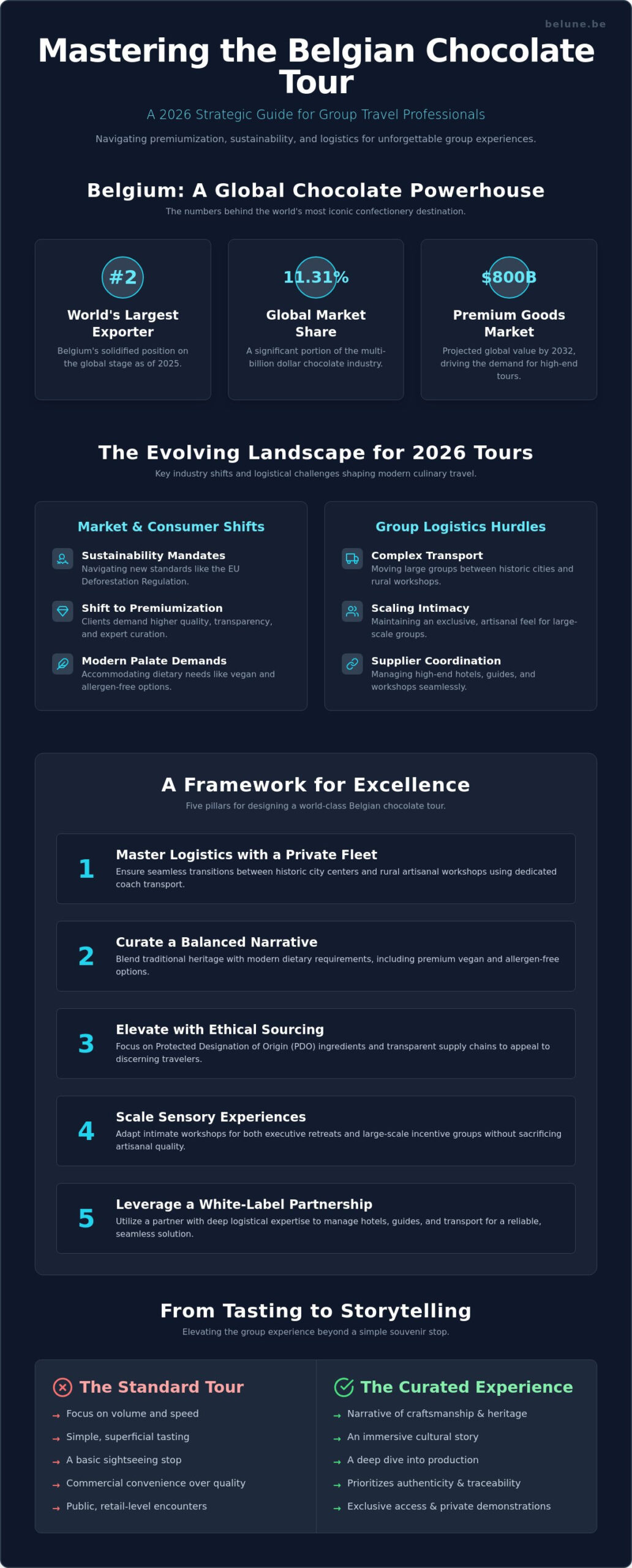
    In 2025, Belgium solidified its position as the world’s second-largest chocolate exporter, capturing an 11.31% share of a global market now worth billions. For travel professionals, organizing a belgian chocolate tour for groups in 2026 isn’t just about tasting. It’s about navigating an industry shaped by the new EU Deforestation Regulation and a profound shift toward premiumization. As these standards evolve, the gap between a standard excursion and a masterfully curated artisanal experience continues to widen.

    We recognize that the logistics of moving large groups through historic cobblestone streets while maintaining the intimacy of a private workshop can be a significant challenge. You want to provide your clients with more than just a souvenir. You want to offer them a sensory journey that honors Belgium’s 2026 commitment to sustainability and craftsmanship. This guide will provide you with the strategic framework to master these complexities, from securing reliable coach transport to managing high-end hotel stays. We’ll explore how to leverage local B2B partnerships to create seamless, white-label itineraries that transform a simple trip into a definitive cultural event.

    Key Takeaways

    • Discover how to optimize national routes using a private coach fleet to ensure seamless transitions between historic city centers and rural artisanal workshops.
    • Learn to curate a belgian chocolate tour for groups that balances traditional heritage with modern dietary requirements like vegan and allergen-free options.
    • Understand the strategic importance of PDO ingredients and ethical sourcing in elevating your culinary itineraries for the discerning 2026 market.
    • Master the art of scaling sensory experiences from intimate executive retreats to large-scale incentive groups without sacrificing consistent artisanal quality.
    • Leverage a 20-year legacy of logistical expertise to provide your clients with a reliable, white-label partnership that manages everything from hotel bookings to local guides.

    The Strategic Value of Belgian Chocolate in Group Itineraries

    Chocolate defines the Belgian identity with a precision that mirrors the country’s architectural and artistic history. It’s more than a confection; it’s a cultural pillar. For travel professionals in 2026, a belgian chocolate tour for groups serves as a strategic cornerstone for any high-end itinerary. The global demand for premium products, projected to reach nearly $800 billion by 2032, has transformed these tours. They’re no longer simple sightseeing stops. They’ve become deep dives into the history and production of Belgian chocolate. Clients today seek transparency and expertise. They want to understand the social and environmental impact of their consumption while enjoying world-class flavors.

    To better understand the atmosphere of these culinary explorations, observe this perspective on the capital’s offerings:

    Beyond the Tasting: Artisanal Storytelling

    Commercial tours often focus on volume and speed. We believe in a different approach. A curated journey transforms a simple tasting into a narrative about craftsmanship and national heritage. By selecting master chocolatiers who prioritize traceability and traditional techniques, you offer your clients a window into the soul of Flanders and Wallonia. This approach aligns perfectly with broader trends in themed group travel in Benelux. The focus has shifted from “seeing” to “understanding.” It’s the difference between a quick snack and an immersive cultural story that stays with the traveler long after they return home.

    This focus on impactful narratives is a principle shared by experts in communication; for example, Good Times Media builds digital stories that stick with the target audience, ensuring that every message leaves a lasting impression.

    The Organizer’s Perspective: Why Curation Matters

    High-end international groups expect more than access; they expect exclusivity. Curation ensures that every stop on the itinerary meets rigorous standards of quality and professionalism. For a travel agent, the challenge lies in managing the logistics of transport and timing without losing the artisanal feel. Moving forty people through a historic workshop requires more than a map. It requires a private coach fleet and local guides who understand the rhythm of the city. Professional local guidance provides the “key to the city,” allowing groups to enter private spaces that are closed to the public. Establishing a professional belgian chocolate tour for groups requires this level of detail to define successful Belgium gastronomy tours. It builds a framework of trust and excellence that elevates the entire travel experience.

    Curating the Ultimate National Chocolate Narrative

    Building a narrative requires more than a list of addresses. It demands an understanding of provenance. In Belgium, the distinction between industrial production and artisanal mastery is sharp. For a professional belgian chocolate tour for groups, we look toward the historic centers of Brussels and Bruges, but we also venture into rural Wallonia where family-run ateliers preserve century-old secrets. These locations offer a backdrop that transforms a simple visit into an educational journey. Every stop must reflect the national identity, highlighting the technical precision that makes Belgian confectionery world-renowned.

    The role of the master chocolatier is central to this experience. For large groups, a standard retail encounter is insufficient. We prioritize partners who offer group-exclusive demonstrations. Here, the technical mastery of tempering and molding becomes a visual performance. This level of access ensures that the tour meets the high-end expectations of international travelers who seek authenticity over commercial convenience. By sourcing ingredients with Protected Designation of Origin (PDO) status, these artisans guarantee a level of quality that resonates with the sophisticated traveler of 2026.

    The Heritage of the Praline

    Jean Neuhaus invented the praline in 1912, changing the global confectionery landscape forever. Since then, the evolution of Belgian chocolate has become a structural theme for high-end tourism. Finding workshops that accommodate professional group sizes without compromising the artisanal atmosphere is a logistical art. It involves vetting producers who maintain traditional techniques while operating at a scale that respects group dynamics. We select workshops where the history of the praline is told through the hands of the makers, ensuring every guest understands the craftsmanship behind the shell.

    Liquid Gold and Cocoa: Creative Pairings

    Integrating chocolate with other national pillars, such as beer, creates a multi-sensory experience that defines modern luxury travel. This isn’t just about tasting; it’s about the technical science of flavor profiles. Organizing these workshops requires a deep knowledge of official culinary tourism standards. We balance the complex bitterness of a Trappist ale with the subtle acidity of high-cocoa dark chocolate to stimulate the palate. These sessions are designed to be educational, offering a technical look at how different fermentation processes in both beer and cocoa can complement one another. If you’re looking to elevate your next itinerary, consider how a strategic local partner can provide the exclusive access and logistical precision your clients deserve.

    Organizing Belgian Chocolate Tours for Groups: The Professional DMC Guide for 2026

    Mastering the Logistics of Large-Scale Culinary Tours

    Precision in logistics is the silent partner of artisanal excellence. While the sensory appeal of a belgian chocolate tour for groups captures the imagination, it’s the invisible framework of operational steps that ensures a flawless experience. Successfully moving forty or fifty guests between historic workshops and high-end hotels requires more than a schedule; it demands a technical mastery of the Belgian landscape. By 2026, the expectations for seamless travel have reached new heights, where every minute of transit must be optimized to deepen the guest’s appreciation of Belgium’s chocolate heritage.

    Executing a national itinerary involves five critical logistical pillars:

    • Step 1: Defining the group profile: Distinguishing between corporate incentive groups requiring high-speed efficiency and cultural societies seeking a slower, more educational pace.
    • Step 2: Designing national routes: Mapping paths that connect the chocolate hubs of Brussels, Bruges, and Antwerp while minimizing time spent on highways.
    • Step 3: Coordinating private transport: Deploying a dedicated fleet to maintain a “bubble” of comfort and exclusivity throughout the journey.
    • Step 4: Managing gastronomic accommodation: Securing hotels that aren’t just beds, but extensions of the culinary narrative, located within walking distance of key tasting rooms.
    • Step 5: Implementing on-the-ground support: Providing local guides who can make real-time adjustments for traffic or weather without disrupting the guest experience.

    The Advantage of a Private Coach Fleet

    Punctuality is a component of luxury. When a master chocolatier has timed a tempering demonstration to the minute, a delay in transport can compromise the entire session. Operating our own fleet of modern coaches allows us to guarantee a level of reliability that third-party hires often lack. These vehicles serve as mobile lounges where guests can relax between stops, enjoying the Belgian countryside through panoramic windows. Dedicated drivers who understand the nuances of group movement in historic, narrow streets are essential for maintaining a high-end feel and ensuring that the transition from a rural workshop to a city center hotel is effortless.

    Strategic Hotel Accommodation Management

    The choice of hotel dictates the rhythm of the evening. We prioritize properties that align with a gastronomy theme, often leveraging our deep-rooted relationships as a benelux incoming tour operator to secure exclusive group rates and room blocks. Management extends beyond the booking; it includes the technical coordination of check-ins and luggage flow. By handling these details behind the scenes, we prevent the “lobby bottleneck” that often plagues large groups. This allows guests to move directly from their coach to a tasting or a dinner, keeping the focus entirely on the indulgence and education that define the tour.

    Personalization for Modern Palates and Corporate Standards

    The 2026 traveler doesn’t just consume; they curate. Organizing a belgian chocolate tour for groups now requires an acute awareness of global dietary shifts and evolving corporate expectations. We’re seeing a significant rise in the “bean-to-bar” movement, where guests demand to see every stage of production, from the raw cocoa bean to the finished praline. This technical curiosity reflects a broader desire for transparency and ethical sourcing. It’s no longer enough to offer a standard assortment. Every itinerary must be a reflection of the group’s specific values and palate.

    Managing Dietary Diversity in Groups

    Dietary requirements aren’t hurdles; they’re opportunities for innovation. We ensure our workshop and restaurant partners maintain the same artisanal standards for vegan and allergen-free options as they do for traditional recipes. Modern Belgian Gastronomy is a blend of technique and local sourcing. This means a plant-based truffle must exhibit the same “snap” and velvet texture as its dairy-based counterpart. By vetting partners who use high-quality cocoa butter and natural infusions, we preserve the high-end experience for every guest, regardless of their health-conscious choices. We don’t believe in “compromise” when it comes to the sensory experience of a professional tour.

    Seasonality also plays a structural role in our planning. While winter offers the classic charm of Belgian Christmas markets, the logistical heat management of a summer tour is a technical challenge we solve through our climate-controlled coach fleet. Cocoa is a sensitive medium. Maintaining its structural integrity during transit is vital for a premium experience. We monitor these environmental factors closely to ensure that the chocolate remains in peak condition from the workshop to the hotel.

    Corporate and Incentive Customization

    For corporate clients, the focus shifts toward engagement and team-building. We design workshops that center on cocoa craftsmanship, allowing executives to step into the role of the artisan. This hands-on approach fosters collaboration while providing a sophisticated educational component. Balancing these structured sessions with leisure time is essential to avoid “itinerary fatigue.” Whether you’re scaling an experience for a ten-person executive retreat or a two-hundred-person incentive group, the precision of the planning remains the same. For more insights on selecting the right partner for these complex events, consult our definitive guide to choosing a group travel agency in 2026.

    If you’re ready to design a bespoke experience that meets these rigorous standards, contact our team of strategic travel planners today to begin your consultation.

    The BELUNE Advantage: 20 Years of Gastronomic Logistics

    Success in the high-end travel sector is built on the foundation of experience. At BELUNE, we’ve spent over 20 years refining the technical and artistic requirements of the belgian chocolate tour for groups. We position ourselves not as a simple service provider, but as a premier Destination Management Company (DMC) that acts as a strategic ally for travel agents and tour operators. This legacy provides our partners with a rare commodity: absolute peace of mind. We understand that in the professional travel world, a single logistical oversight can tarnish a brand’s reputation. Our tenure in the industry is a testament to our ability to prevent those oversights before they occur.

    One of the primary advantages of partnering with us is our ownership of a private coach fleet. This structural independence allows us to bypass the inconsistencies of third-party transport providers. We control the maintenance, the scheduling, and the training of our drivers. Furthermore, this logistical control enables us to offer fixed-price group tour packages. In a market where costs can be volatile, we provide our partners with budget certainty. You receive a comprehensive, costed program that remains stable, allowing you to manage your margins with confidence and precision.

    White-Label Support for Professional Partners

    We operate as an invisible extension of your team. Our white-label approach ensures that your brand remains the primary point of contact for the end client. Our local guides are more than just experts in belgian chocolate tour for groups logistics; they are trained to embody the B2B mindset. They understand the nuances of corporate etiquette and the high standards of international incentive travel. From the moment we receive your initial brief to the final departure of the group, our intervention is seamless. We handle the technical complexities of hotel management and workshop coordination so you can focus on the relationship with your client.

    Requesting Your Custom National Itinerary

    Transforming a creative concept into a fully costed, operational program requires deep local roots. We leverage our two decades of industry relationships to find the hidden gastronomic gems that remain inaccessible to the general public. These are the private ateliers where master chocolatiers work away from the tourist crowds, providing an exclusive atmosphere that defines luxury travel in 2026. The process is collaborative and rigorous. We listen to your group’s specific profile and build a narrative that connects the dots between Belgium’s historic cities and its most innovative workshops. If you’re ready to elevate your culinary offerings, Partner with BELUNE for your next Belgian chocolate tour and experience the difference that 20 years of expertise brings to the table.

    Elevating the Standard of Culinary Group Travel

    Organizing a belgian chocolate tour for groups in 2026 is an exercise in balancing heritage with logistical precision. You’ve seen how the synergy between private transport and curated storytelling transforms a standard trip into a strategic cultural event. Success lies in the details. It’s the technical mastery of moving large groups through historic streets while meeting modern dietary standards without losing the soul of the craft. We’ve explored the necessity of expert local guidance and the peace of mind provided by a dedicated, high-end infrastructure.

    We bring over 20 years of Benelux travel expertise to your projects. With our own private modern coach fleet and a focus on sophisticated B2B group travel solutions, we eliminate the friction of complex national itineraries. We act as your visionary partner on the ground, ensuring every tasting reflects your brand’s commitment to quality. Request Your Custom Belgian Group Tour Itinerary from BELUNE today. We’re ready to help you create a journey that captures the imagination and sets a new benchmark for excellence in Belgian tourism.

    Frequently Asked Questions

    How do I begin organizing a Belgian chocolate tour for a large group?

    Defining the specific group profile and core objectives is the first technical step in organizing a belgian chocolate tour for groups. We recommend an initial consultation to map out national routes and artisanal priorities across the Benelux region. This collaborative process allows us to align logistical requirements with the desired level of exclusivity, moving from a creative concept to a fully costed, professional itinerary.

    What is the ideal group size for an artisanal chocolate workshop?

    Intimacy is a component of luxury, so we typically recommend sessions of 15 to 25 guests for a high-end experience. For larger incentive groups, we utilize professional ateliers that are technically equipped to handle higher volumes without sacrificing the artisanal atmosphere. Staggered sessions are another effective strategy, allowing half the group to enjoy a guided city walk while the others engage in the workshop.

    Can a DMC manage dietary restrictions across multiple national stops?

    Managing complex dietary needs is a structural part of our service as a specialized DMC. We vet every workshop and restaurant partner to ensure vegan, gluten-free, and allergen-free options meet the same high-end standards as traditional recipes. By 2026, these requirements have become a standard part of modern Belgian gastronomy, and we ensure every guest enjoys a consistent sensory experience regardless of their dietary profile.

    Why is a private coach fleet necessary for a Belgian culinary tour?

    Owning a private coach fleet allows for total control over the transit environment and ensures absolute punctuality. When a master chocolatier has timed a live demonstration to the minute, relying on third-party transport is a significant risk. Our modern coaches serve as mobile lounges, providing a consistent “bubble” of comfort and exclusivity as guests move between historic city centers and rural artisanal workshops.

    What is included in a fixed-price group gastronomy package?

    Our fixed-price packages provide budget certainty by covering hotel accommodation management, private coach hire, and local guide services. These comprehensive programs also include curated tasting sessions and workshop access. This structure is designed to give travel agents a reliable framework, allowing them to manage their margins with confidence while we handle the technical complexities of the belgian chocolate tour for groups.

    How far in advance should a professional chocolate tour be booked?

    We recommend initiating the booking process at least six to nine months in advance for the 2026 season. This lead time is essential to secure exclusive workshops with master chocolatiers and to guarantee preferred hotel room blocks. Early planning also allows for deeper personalization of the itinerary, ensuring that every cultural and gastronomic stop aligns perfectly with the group’s specific interests and standards.

    Does BELUNE offer white-label services for international tour operators?

    We act as a silent partner, providing full white-label support for international agencies and tour operators. Our guides and logistical staff operate as an extension of your team, ensuring your brand remains the primary point of contact for the end client. This approach allows you to leverage our 20 years of local expertise while maintaining a seamless brand identity throughout the entire Belgian journey.

    How are hotel accommodations selected for culinary-themed group tours?

    We select properties based on their proximity to gastronomic hubs and their technical ability to manage large group check-ins. Every hotel must reflect the sophisticated aesthetic of the overall tour and offer high-end service standards. We prioritize properties that understand the rhythm of culinary itineraries, ensuring that the transition from a day of tasting to an evening of rest is effortless for every guest.