Tag: Executive Travel

  • Peace of mind when managing VIP group travel plans

    Peace of mind when managing VIP group travel plans

    Peace of mind when managing VIP group travel starts with a clear, reconfirmed plan. Verify flight times, seat assignments, passport details and hotel inclusions, then record each traveller’s preferences and communication needs. Consider the destination and individual support requirements, and agree on the group’s purpose, decision-making process and expectations before departure. A coordinated plan gives everyone a shared point of reference.

    That preparation matters because a VIP group trip brings individual needs into a shared itinerary. Meal, accommodation, transport and downtime preferences can shape the experience, while disruption or uncertainty can unsettle even a carefully arranged schedule. Calm coordination is not about controlling every moment. It means knowing what matters and making sensible decisions when plans change.

    This guide explains how to reconfirm an itinerary, coordinate traveller preferences, assess the level of VIP support a trip needs and align expectations across the group. It also covers practical ways to monitor potential disruptions and preserve flexibility, so the journey feels considered from departure through the final shared experience.

    Key Takeaways

    • Reconfirm essential itinerary details before departure, then keep an eye on disruptions that could affect the group’s plans.
    • Build traveler profiles around preferences, practical needs, and each person’s preferred way to communicate.
    • Assess support needs by considering both the trip’s risks and the travelers’ circumstances, not job titles alone.
    • Agree on the trip’s purpose, decision-making approach, and balance of scheduled activities and free time before setting off.

    1. Pre-departure itinerary reconfirmation

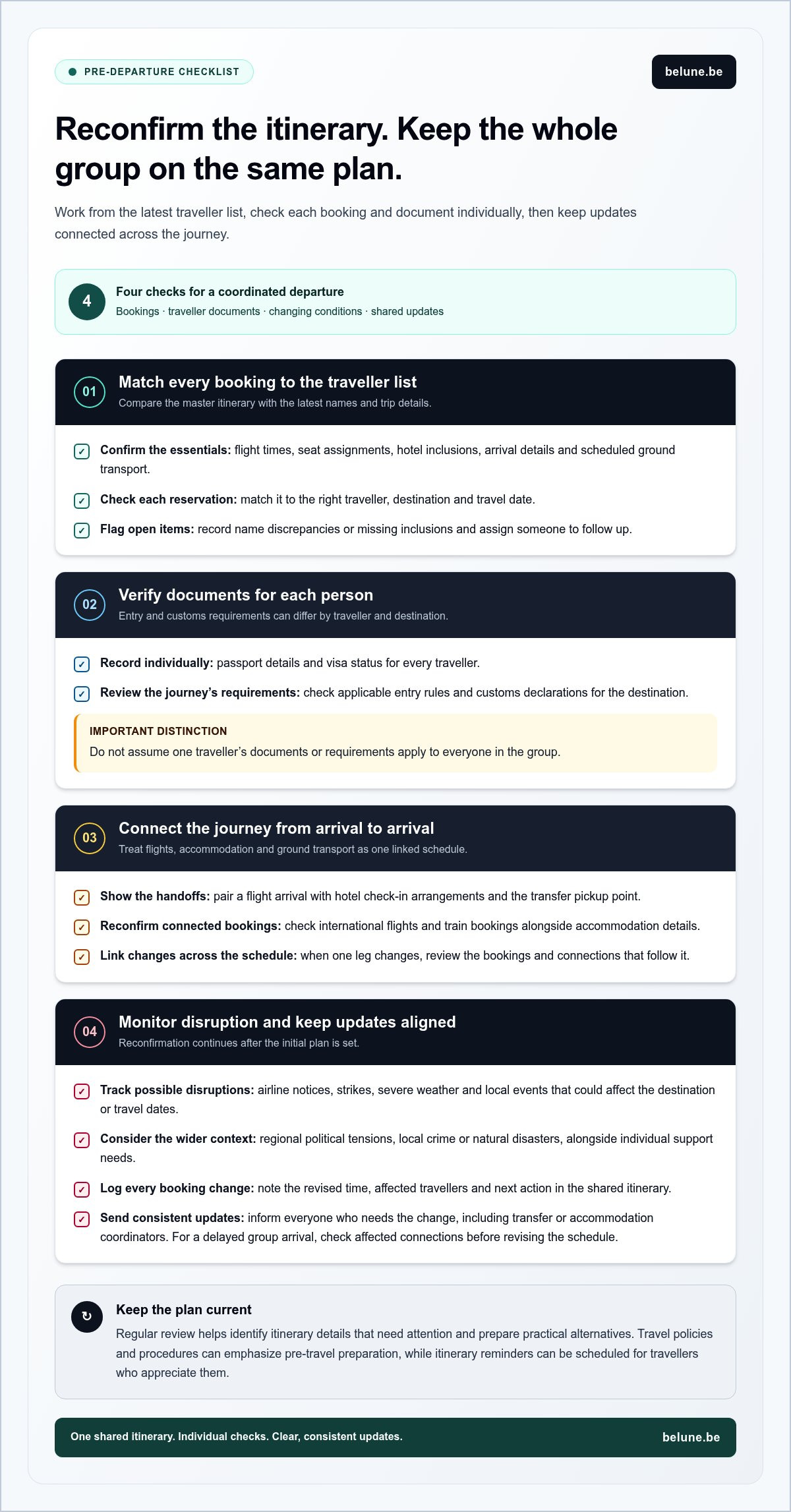
    Start with the master itinerary and compare every booking with the latest traveller list. Confirm flight times, seat assignments, hotel inclusions, arrival details and scheduled ground transport. Match each reservation to the right traveller, destination and travel date. A name discrepancy or missing hotel inclusion can affect the group’s arrival, so record unresolved items and assign someone to follow up.

    Entry, visa and customs requirements depend on each traveller’s passport and destination. Record passport details and visa status individually, then review the applicable entry rules and customs declarations for the journey. Do not assume one traveller’s documents or requirements apply to everyone in the group.

    Coordinate flights, hotels and ground transport in a shared itinerary that shows how each arrival connects to the next booking. For example, pair a flight arrival time with the hotel’s check-in arrangements and the transfer pickup point, whether coordinating standard group shuttles or booking elite fleet services through specialists such as Delta Rentals Dubai for executive travellers in the UAE. Reconfirm international flight and train bookings alongside accommodation details, so a change to one leg can be reflected in the full schedule.

    Monitoring should continue after the initial confirmation. Track airline notices, strikes, severe weather and local events that could affect the destination or travel dates. Consider regional risks, such as political tensions, local crime or natural disasters, alongside individual factors that may affect a traveller’s support needs. Regular review helps the organizer identify itinerary details that need attention and prepare practical alternatives.

    When a booking changes, record the revised time, affected travellers and next action in the shared itinerary. Send the same update to everyone who needs it, including whoever coordinates transfers or accommodation. For a group-level change, such as a delayed arrival, identify affected connections before revising the schedule. A clear record keeps everyone working from the same plan and makes further reconfirmation more precise.

    Travel risk management means identifying, assessing, preventing and mitigating potential security issues associated with VIP travel. Monitor flight disruptions, strikes, weather patterns and local events that could affect the itinerary.

    Travel arrangers can schedule itinerary reminders automatically for travelers who appreciate them. VIP travel plans should include a travel policy and procedures, with emphasis on pre-travel preparations.

    Traveler-specific preferences and trip coordination

    Create a profile for each traveller and use it to guide practical choices across the group itinerary. Record seat preferences, preferred airlines and hotels, loyalty memberships, dietary needs and passport details relevant to specific destinations. Include useful specifics, such as an aisle seat or a vegetarian meal, rather than relying on broad labels. Keep profiles current so arrangements reflect each person’s needs, not assumptions.

    Before the trip, ask travellers for the name they want used on bookings, seat and airline preferences, hotel preferences, loyalty numbers, dietary requirements, destination-related passport details and any relevant timing needs. These details help organizers match individual requests to the journey and identify preferences that could affect group coordination.

    Communication needs the same personal attention. Ask each traveller whether they prefer updates by phone, text or email, then use that channel for itinerary changes and essential reminders. For example, text a changed meeting point to someone who prefers texts, while emailing a detailed schedule to a traveller who prefers email. Keep essential updates consistent across the group to avoid conflicting versions.

    Planning around preferences still requires a clear view of the shared schedule. Compare requests with the destination, travel program and existing bookings, then present suitable options that fit the plan. A preferred hotel may be impractical if it separates one traveller from the group, while a preferred airline may complicate arrival coordination. Explain the trade-offs clearly and record the agreed choice in the traveller’s profile.

    Loyalty details can inform bookings without becoming the only decision factor. Keep travellers’ loyalty numbers on file and help them enrol in suitable loyalty programmes. Depending on supplier relationships, faster confirmations, upgrades or more personalized service may be possible. If a traveller arrives early after a red-eye flight, consider arranging early hotel check-in, then record the decision and communication preference in their profile. Each detail should support both the traveller’s experience and the group itinerary.
    Peace of mind when managing VIP group travel plans

    3. Which travelers and trips may need VIP support

    VIP support can suit any traveller or trip that needs added coordination, not only C-suite executives. Consider the itinerary, destination risks, traveller circumstances and consequences of disruption. A complex schedule with several connections may need priority coordination, while a straightforward journey may not. Assessing these factors helps determine whether additional coordination would be useful.

    A managed travel program can bring flight bookings, accommodation, local guidance and response procedures into one coordinated plan. VIP travel management may also include traveller profiles, risk assessment, disruption planning and clear incident-reporting channels. Specialist booking support helps align individual needs with group arrangements, including when a flight change affects a hotel arrival or onward transport. Coordinating these details can support peace of mind when managing VIP group travel.

    Support plans should identify how travelers report incidents at any time, day or night. A crisis plan can set out communication channels, response steps, escalation contacts, and coordination with local authorities when needed. Security and privacy planning can limit itinerary access to people who need it, use agreed reporting channels, and prepare responses to medical emergencies, crime, natural disasters, or other destination risks.

    Choose a VIP group travel planner by looking for a clear scope, a coordinated booking process, destination knowledge and documented disruption and incident procedures. When considering insurance, compare policy coverage with the destination, planned activities, medical needs and possible trip interruptions. Review exclusions and existing coverage before deciding. No single policy suits every group.

    Self-managed planning keeps decisions directly with the organizer, while managed support coordinates bookings and traveller needs across the trip. If a flight is delayed, identify affected connections, communicate the change through agreed channels and revise the shared itinerary. A calm response, clear priorities and practical alternatives help the group act on the same information, supporting peace of mind when managing VIP group travel.

    The company decides which travelers or trips benefit from added coordination; VIP travel is not limited to C-suite executives. VIPs and traveling parties need clear incident-reporting instructions and access to support 24/7.

    Risk management can help organizations meet duty-of-care obligations by preparing for emergencies.

    4. Agreeing on the purpose and expectations of a group trip

    Agree on the trip’s purpose first: a client event, cultural visit or executive retreat. A shared aim helps organizers choose activities, transport and pacing that serve the same outcome. Ask travellers to identify likely friction points before departure, such as different energy levels or competing priorities. Addressing them early turns assumptions into clear expectations.

    Set a decision-making approach before the group travels. Clarify who can approve itinerary changes, how the group will weigh alternatives and where urgent updates will appear. For example, executives attending a sporting event may need a designated organizer to communicate schedule changes, while travellers can share preferences through an agreed group channel.

    Shape the schedule around shared experiences and individual breathing room. A five-day group trip can leave two days for downtime or unscheduled activities, giving travellers time to rest, explore independently or handle personal commitments. Show free time in the itinerary rather than treating it as a gap that needs filling.

    Discuss group dynamics honestly. Agree on respectful conduct, punctuality, and how travelers will raise concerns. If romantic tension or disagreement emerges, address it directly and privately instead of allowing awkwardness to build. A clear process for resolving conflict protects the group experience without making every difference a formal issue.

    VIP trip planning should also define what success looks like. A cultural itinerary may prioritize meaningful shared visits, while an executive retreat may value focused discussion and flexible transitions. Set expectations for participation, meals, transport and optional activities. These decisions give the organizer a practical standard for evaluating choices during the trip.

    After returning, invite specific feedback about timing, activities, communication and group decisions. Compare comments with the original purpose, then update travel policies and planning notes when recurring issues arise. For example, feedback about rushed transitions can inform future schedules, while requests for more independent time can shape the next itinerary.

    For a shared cultural itinerary, explore Art & Culture Group Tours as a way to build the trip around a common interest.

    BELUNE: Hotel Accommodation Management

    BELUNE provides Hotel Accommodation Management as part of the wider design of group itineraries, helping tour operators and travel agents coordinate accommodation with the journey’s purpose and schedule. When hotel arrangements need to align with group transport, local experiences or cultural visits, a connected plan can make transitions clearer for organizers and travellers.

    For group trips, BELUNE can also bring together Coach Hire with its own fleet of buses, Local Guide Services and Art & Culture Group Tours. These services suit itineraries that call for coordinated travel between stops and guided cultural experiences alongside accommodation management.

    Tour operators and travel agents planning a group journey can visit belune.be to explore how BELUNE’s services fit their plans.

    Shape your next group journey with intention

    The next step is to turn a travel brief into a shared experience, with each practical choice serving the group’s purpose. The support needed depends on the journey. BELUNE offers Hotel Accommodation Management, Coach Hire with its own fleet of buses and Local Guide Services for group itineraries that bring these elements together. Thoughtful coordination can create peace of mind when managing VIP group travel while leaving room for the destination’s distinctive character.

    If you’re planning a group journey and want to explore how these services could fit your itinerary, contact BELUNE about VIP travel. A clear conversation about your priorities is a considered first step toward a trip designed around the people taking it. Build from a strong plan, and give the group room to enjoy the journey.

    Frequently Asked Questions

    What risks should VIP group travel organizers plan for?

    Assess destination threats, individual vulnerabilities, medical emergencies and disruptions that could interrupt travel. A practical risk register can name each concern, its potential effect and who is responsible for responding. For example, note who will coordinate if a traveller becomes ill during an event and how the rest of the group will receive clear instructions without exposing sensitive personal details.

    What are the entry, visa, and customs requirements for VIP group travel?

    Entry, visa and customs requirements depend on each traveller’s passport and destination. Record passport details and visa status individually, review the applicable rules and customs declarations, and use VIP program assistance with visas and paperwork if needed.
  • Mastering Benelux Corporate Travel: The Strategic 2026 Guide

    Mastering Benelux Corporate Travel: The Strategic 2026 Guide

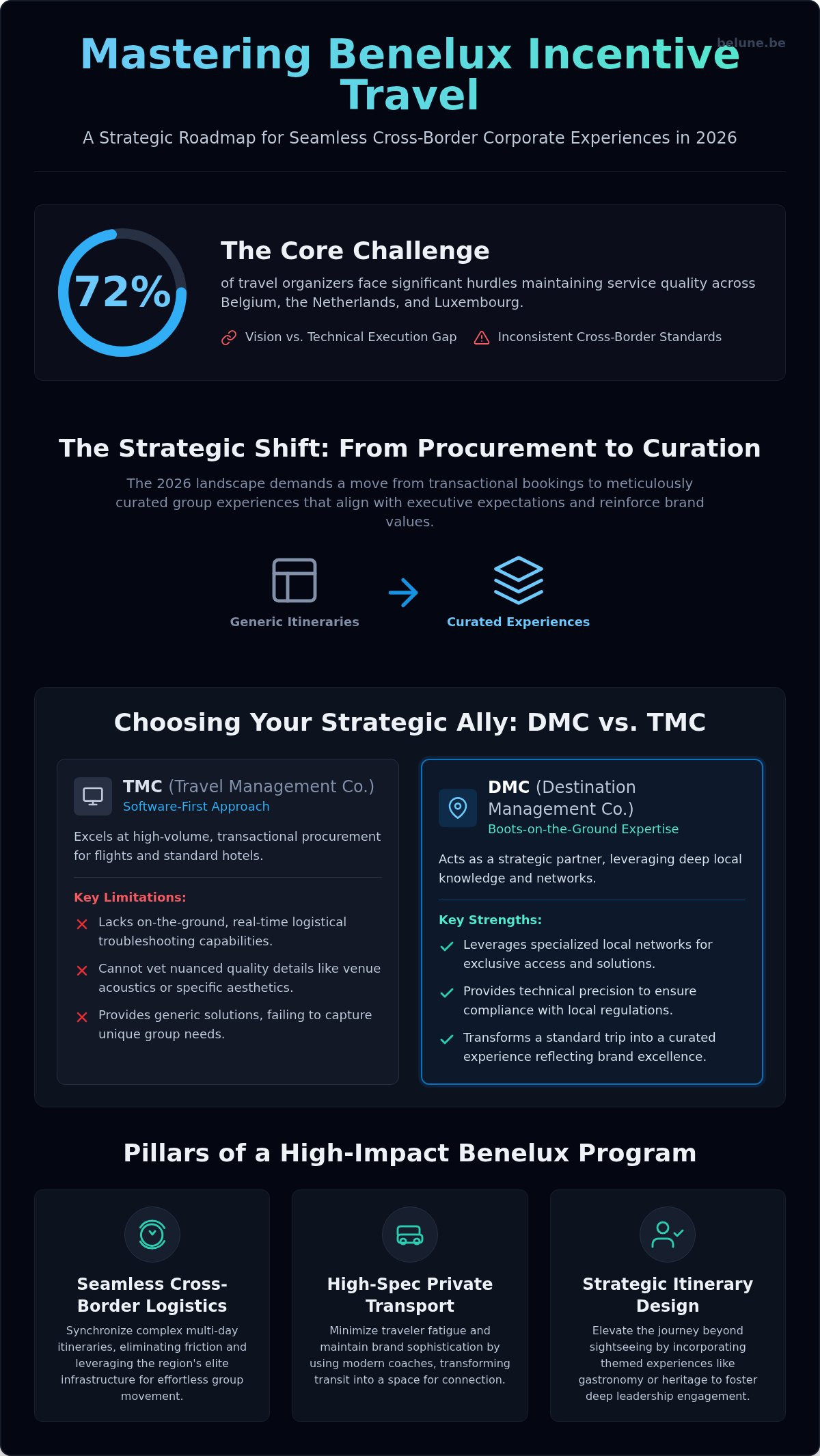
    Recent data reveals that 72% of travel organizers face significant challenges in maintaining service quality across the borders of Belgium, the Netherlands, and Luxembourg. It’s a staggering figure that highlights a common pain point: the gap between a visionary concept and its technical execution. You understand that for high-level executives, a generic itinerary isn’t just a missed opportunity; it’s a dilution of your brand’s values. Mastering benelux incentive travel requires more than just bookings; it demands a sophisticated logistical choreography where every transition feels intentional and every detail remains impeccable.

    This guide promises to transform your approach to regional logistics into a seamless, high-impact experience. We’ll show you how to eliminate the friction of multi-country transportation and source group-friendly accommodation that meets the highest corporate standards. By the end of this article, you’ll have a strategic roadmap for 2026. You’ll discover how to synchronize complex multi-day itineraries while leveraging modern, high-spec transport to ensure your guests remain inspired rather than fatigued. We’ll explore how to blend technical precision with artistic curation to create an unforgettable journey.

    Key Takeaways

    • Understand the critical shift from transactional bookings to curated group experiences that align with your brand’s core values and executive expectations.
    • Learn why specialized regional expertise and local partner networks outperform generic software solutions when navigating the complex multi-national logistics of the Benelux region.
    • Discover how integrating high-spec, private coach transport minimizes traveler fatigue and maintains a perfectly synchronized rhythm throughout the journey.
    • Explore how to elevate your benelux incentive travel by incorporating themed experiences, such as gastronomy or heritage, to foster deeper leadership engagement.
    • Gain a strategic roadmap for 2026 that balances visionary creative concepts with the technical precision required for seamless cross-border execution.

    The Evolution of Corporate Travel in the Benelux Region

    Corporate travel across Belgium, the Netherlands, and Luxembourg has matured into a sophisticated logistical choreography. It’s no longer enough to simply secure rooms and flights. The 2026 shift marks a definitive move away from transactional procurement toward highly curated group experiences. For those planning benelux incentive travel, the challenge lies in harmonizing three sovereign nations into one seamless narrative. While the Benelux Union provides a political and economic foundation, the practical execution of a multi-country itinerary reveals hidden friction points. Inconsistent accommodation standards and complex border transitions often disrupt the flow of high-level programs.

    To better understand why this region is uniquely suited for sophisticated corporate events, watch this helpful video:

    Understanding the 2026 Corporate Landscape

    Modern executives demand environments that reflect their brand’s sophistication even during transit. We see a rising preference for high-spec, private environments where the journey becomes a space for connection rather than just a transfer. Generic sightseeing has lost its luster. Instead, themed engagement centered on heritage or gastronomy provides the emotional core that drives leadership growth. Standard travel platforms frequently struggle with these nuances. They lack the technical precision required to manage the specific needs of large groups across three different regulatory environments. Discovering how benelux incentive travel has evolved means looking beyond the booking screen to the actual human experience on the ground.

    The Strategic Value of the Benelux Hub

    The region’s primary strength is its compact geography. Key economic centers sit in close proximity, allowing for rapid, synchronized group movement. Elite road infrastructure supports this efficiency, making multi-national programs feel effortless and productive. Benelux corporate travel is a meticulous blend of logistical rigor and profound cultural depth. This unique combination allows organizers to maximize time while delivering an experience that feels expansive yet intimate. It’s an artisanal approach to travel that transforms a simple business trip into a structural component of your corporate strategy.

    DMC vs. TMC: Why Specialized Regional Expertise Matters

    Choosing between a Travel Management Company (TMC) and a Destination Management Company (DMC) isn’t just a matter of scale. It’s a choice between a software-first approach and a boots-on-the-ground reality. TMCs excel at transactional efficiency and high-volume procurement. They provide the digital infrastructure for flights and standard hotels. However, for a high-impact project like benelux incentive travel, these platforms often fail to capture the human element. They can’t vet the acoustic quality of a conference room or the specific aesthetic of a boutique hotel in a neighboring country. They are vendors; a DMC is a strategic ally.

    According to European tourism statistics, business travel in this corridor is characterized by high frequency and strict quality requirements. A specialized partner leverages local networks to secure exclusive access that generic systems can’t reach. Working with a Benelux incoming tour operator provides the technical assurance that every local regulation is met without administrative friction. This expertise transforms a standard trip into a curated experience that reinforces your brand’s commitment to excellence.

    The Limitations of Generic Booking Platforms

    Standard automated systems lack the capacity for real-time logistical troubleshooting. If a cross-border train is delayed or a modern coach fleet faces a sudden detour, an algorithm won’t negotiate a solution. Platforms often struggle to vet group-friendly accommodation for corporate-grade quality. This lead to hidden gaps in multi-national itineraries. Without local oversight, the risk of logistical friction during border transitions increases. You need an expert who knows which hotels truly understand the needs of a high-level corporate group.

    The DMC Advantage: Technical Precision and Local Nuance

    The DMC advantage lies in the intersection of technical precision and local nuance. Expert local guide services bridge the gap between simple sightseeing and meaningful corporate storytelling. This artisanal approach ensures that your brand values are reflected in every interaction. Financial transparency is equally critical. Fixed-price group packages provide budget certainty for procurement teams. This eliminates the volatility often seen on booking sites. Drawing on over 20 years of industry experience allows for the avoidance of regional pitfalls during peak seasons. If you’re looking for an ally to manage your next project, you can explore our specialized group services for a tailored approach.

    Mastering Benelux Corporate Travel: The Strategic 2026 Guide

    The Logistics of Seamless Cross-Border Group Movement

    The success of any multi-national program depends on the invisible thread that connects each destination. Private transport serves as the pulse of the journey, maintaining a consistent rhythm that public infrastructure simply cannot match. For high-impact benelux incentive travel, the transition between Belgium, the Netherlands, and Luxembourg must be entirely frictionless. We manage this through our in-house fleet of modern coaches, ensuring that technical consistency and brand alignment are never compromised. Owning the assets allows for a level of precision that third-party vendors can’t guarantee. It’s about creating a structural component of the trip where the environment remains as sophisticated as the destinations themselves. This technical mastery ensures that your team moves with purpose, never losing momentum between borders.

    Elevating the Transport Experience

    In 2026, a coach is no longer just a vehicle; it’s a mobile executive lounge. High-spec technical features like ergonomic leather seating, high-speed connectivity, and climate-controlled micro-environments transform transit time into productive engagement. We’ve integrated these moments into the corporate agenda through mobile briefings and networking sessions. This approach reduces traveler fatigue, ensuring executives arrive at each site inspired and ready to engage. By maintaining direct control over our fleet, we eliminate the variability in quality that often plagues multi-country logistics. It’s a commitment to excellence that reflects your brand’s own standards for quality and innovation. Every mile traveled becomes an opportunity for connection rather than a logistical hurdle.

    Mastering Hotel Accommodation Management

    Sourcing the right stay requires a delicate balance between luxury and logistical capacity. Large groups need centralized room-block management to reduce administrative drag and ensure a unified guest experience across borders. According to official Belgian tourism statistics, the demand for high-end group stays continues to rise, making early procurement essential for 2026. We focus on properties that understand the specific cadence of corporate programs, prioritizing those with private check-in areas and high-capacity dining. This technical rigor ensures that your benelux incentive travel remains an exercise in excellence from the first check-in to the final departure. For more on how to vet these partners, see The Definitive Guide to Choosing a Group Travel Agency in 2026. By centralizing this management, we eliminate the friction of fragmented bookings and provide a seamless sanctuary for your guests.

    Strategic Itinerary Design: Integrating Heritage and Gastronomy

    Designing a high-impact program is an act of curation that extends far beyond simple scheduling. It’s about identifying the emotional core of the journey and moving your guests from passive observation to active participation. For sophisticated benelux incentive travel, this transformation requires a narrative that resonates with your corporate identity. We believe that every site visited and every meal shared should serve as a structural component of your broader strategic goals. When heritage and gastronomy are integrated with technical precision, the itinerary becomes a powerful tool for leadership development and brand alignment.

    Curating Themed Corporate Journeys

    Themed journeys provide a unique lens through which executives can explore complex corporate concepts. Battlefield tourism, for instance, offers profound lessons in leadership, resilience, and strategic planning. It’s a somber yet inspiring environment that encourages deep reflection on organizational strength. In contrast, Belgium gastronomy tours serve as a premium networking asset. These sensory experiences facilitate executive bonding in a relaxed, sophisticated atmosphere, turning a simple dinner into a masterclass in cross-cultural appreciation. Similarly, culture group tours in Benelux foster a shared vision by connecting your team with the region’s commitment to innovation and artistic heritage. These aren’t just activities; they’re catalysts for shared inspiration.

    Bespoke Itinerary Planning: The BELUNE Methodology

    Our approach marks a definitive transition from a fragmented list of sites to a cohesive narrative arc. We begin the planning phase by balancing technical logistical requirements with artistic inspiration. This ensures that the rhythm of the trip remains fluid while the content remains engaging. We don’t settle for generic paths. Instead, we look for the exclusive access and hidden nuances that define a truly premium experience. Bespoke planning is the sublimation of logistical complexity into a seamless experience. It’s the silent work that allows the beauty of the region and the strength of your team to take center stage without distraction. This artisanal level of detail is what separates a standard corporate trip from a transformative event.

    Ready to transform your vision into a curated reality? Partner with our expert team to design your 2026 program.

    Executing Your 2026 Vision with BELUNE’s Technical Precision

    Executing a visionary program requires more than just logistical competence. It demands an expert who understands the intersection of technical rigor and artistic inspiration. BELUNE acts as a trusted advisor. We transform the complex multi-national geography of the region into a cohesive, brand-aligned experience. Our team serves as the silent architect of your success. We ensure that every transition feels intentional. Every detail, impeccable. This commitment to quality is the foundation of every benelux incentive travel project we undertake. Strategic benelux incentive travel requires a partner who can bridge the gap between creative ambition and logistical reality. By choosing a partner with over 20 years of specialized experience, you’re securing a strategic ally. We elevate your corporate narrative through technical mastery and creative vision. Every mile traveled becomes a structural component of your brand’s story.

    The Partnership Model for Travel Professionals

    We’ve built our reputation on supporting travel agents and tour operators who demand DMC-level excellence for their high-end clients. Our 20-year presence in the Benelux and Paris markets provides the deep-rooted local networks necessary for exclusive regional access. We understand the specific pressures of corporate procurement and the need for absolute transparency. That’s why our design process centers on customized, fixed-price proposals that eliminate budget volatility. This approach provides the certainty needed in the early planning stages while maintaining the flexibility for artisanal curation. We handle the technical complexities of hotel accommodation management and private coach hire. You focus on the human and emotional goals of the trip. It’s a collaborative model designed to maximize impact without increasing administrative drag.

    Defining the Next Era of Your Benelux Vision

    The next era of corporate travel is defined by a commitment to innovation and aesthetic excellence. We don’t believe in generic itineraries or transactional bookings. Every program we design is a reflection of your brand’s unique values, executed with a level of precision that eliminates friction before it occurs. Our vision for 2026 is one of minimalist elegance. We believe in the power of a perfectly synchronized logistical plan to inspire and engage high-level executives. It’s time to transform your fragmented logistical challenges into a seamless, high-impact success story. Partner with BELUNE for your 2026 corporate group travel and discover the difference that professional expertise makes. Let’s design a journey that resonates long after the final departure.

    Shaping the Future of Regional Corporate Excellence

    Mastering the nuances of the Benelux region requires a delicate balance between technical rigor and creative vision. You’ve seen how the shift toward curated group experiences demands more than just a booking platform; it requires a strategic ally on the ground. By prioritizing private transport through a modern coach fleet and sourcing accommodation with artisanal care, you eliminate the friction that often disrupts multi-national programs. These structural choices ensure your brand’s values remain the focal point of every journey. Whether you’re planning a leadership retreat or a high-impact benelux incentive travel program, the goal is always a perfectly synchronized narrative.

    With over 20 years of regional expertise and the certainty of fixed-price transparency, BELUNE is ready to transform your logistical challenges into an effortless reality. It’s time to move beyond generic itineraries and embrace a vision of minimalist elegance. Request Your Custom 2026 Benelux Corporate Itinerary today and let’s begin the collaborative process of designing your next masterpiece. The region is waiting to be explored with the precision and sophistication your brand deserves.

    Frequently Asked Questions

    What is the difference between a TMC and a DMC for corporate travel in Benelux?

    A TMC typically focuses on automated, transactional bookings for flights and standard hotels via digital platforms. In contrast, a DMC like BELUNE provides specialized, boots-on-the-ground expertise for complex benelux incentive travel. We act as a strategic ally, managing local partner networks and securing exclusive access that generic software cannot reach. This artisanal approach ensures your program’s logistical rigor matches its creative ambition, providing quality control essential for high-level executive groups.

    How does BELUNE manage cross-border logistics between Belgium, the Netherlands, and Luxembourg?

    We manage cross-border logistics by treating the region as a single, synchronized corridor. Our approach utilizes an in-house fleet of modern coaches to maintain technical consistency across the three nations. By controlling the entire transport chain and leveraging 20 years of regional experience, we eliminate friction points often found at border transitions. This centralized management ensures your multi-national itinerary flows seamlessly, reducing traveler fatigue and maintaining a professional rhythm throughout the journey.

    Can BELUNE handle large corporate groups with specialized accommodation needs?

    BELUNE specializes in sourcing and managing hotel accommodation for large corporate groups with exacting standards. We prioritize properties that offer the right balance of high-spec amenities and group logistical capacity, such as private check-in areas and dedicated dining spaces. Our centralized room-block management reduces administrative drag for planners. This technical precision ensures even the most complex accommodation needs are met with the minimalist elegance and professional reliability your brand requires.

    What types of themed experiences are best suited for corporate team building in Benelux?

    Themed experiences such as battlefield tourism or gastronomy tours are exceptionally well-suited for corporate engagement. Battlefield visits provide a profound lens for exploring leadership and strategic resilience in a somber, inspiring setting. Gastronomy and beer experience tours serve as premium networking assets, facilitating executive bonding through shared sensory appreciation. These curated culture group tours move beyond passive observation, fostering a shared vision and lasting inspiration among your team members during their benelux incentive travel.

    Does BELUNE provide its own transportation fleet for corporate tours?

    Yes, we operate our own private fleet of modern coaches to ensure absolute quality control for every project. Owning the fleet allows us to guarantee technical specifications that meet 2026 corporate standards for comfort and connectivity. This direct management eliminates the variability in service quality often associated with third-party transport vendors. Our professional drivers are an integral part of the experience, contributing to a seamless and brand-aligned journey that reflects your company’s commitment to excellence.

    Why is fixed-price packaging important for corporate travel procurement?

    Fixed-price packaging is critical for corporate procurement because it provides absolute budget certainty from the early planning stages. Unlike individual bookings that fluctuate with market volatility, our comprehensive packages include all logistics, activities, and local management at a transparent rate. This financial clarity allows travel professionals to present proposals with confidence. It eliminates hidden costs and administrative friction, ensuring the focus remains on the quality of the experience rather than shifting line items.

    How far in advance should we begin planning a 2026 corporate group trip?

    We recommend beginning the planning process at least 12 to 14 months in advance for 2026 programs. This lead time is essential to secure the most prestigious group-friendly accommodations and high-spec transport assets during peak seasons. Early engagement allows us to meticulously design a narrative arc that aligns with your strategic goals. Starting early ensures your vision is realized with the technical precision and artisanal detail that define a truly successful multi-national corporate event.

    What local guiding services are available for multi-lingual corporate groups?

    We provide expert local guide services tailored to the specific linguistic needs of international corporate groups. Our guides do more than translate; they bridge the gap between historical context and corporate storytelling. By offering services in multiple languages, we ensure every guest feels secure and fully engaged with the regional culture. This personalized approach is a marker of our commitment to excellence, transforming standard sightseeing into a structural component of your group’s collective experience.

  • The Art of Corporate Group Travel in Benelux: A 2026 Strategic Guide

    The Art of Corporate Group Travel in Benelux: A 2026 Strategic Guide

    What if your next cross-border meeting felt less like a logistical puzzle and more like a curated gallery opening? You’ve likely felt the exhaustion of managing fifty executives across three countries in forty-eight hours, only to find that generic itineraries and aging coaches dim the brilliance of your objectives. It’s a common struggle. Industry reports from 2024 indicate that 62% of luxury travel planners cite multi-national accommodation as their most significant source of friction. Our guide to corporate group travel benelux in 2026 shows you how to transcend these hurdles and illuminate the path to a seamless experience.

    We’ll help you master the nuance of cross-border logistics and bespoke itinerary curation to create a sense of harmony throughout your journey. You’ll learn how to secure exclusive cultural access and modern, high-spec coach transport that mirrors the sophistication of your brand. We’re going to detail a strategic path to perfectly synchronized multi-day experiences that feel effortless for your guests, ensuring every detail of your vision is realized with technical precision and artistic flair.

    Key Takeaways

    • Discover how to navigate the complex cross-border logistics of corporate group travel benelux to ensure seamless transitions between Belgium, the Netherlands, and Luxembourg.
    • Learn why partnering with a specialized regional expert transforms standard itineraries into masterfully curated journeys that generic agencies cannot replicate.
    • Understand the profound impact that high-end private transport has on the group’s emotional well-being and the overall rhythm of the corporate experience.
    • Explore how to weave historical heritage and gastronomy into a cohesive narrative that aligns perfectly with your modern corporate values.
    • Master the collaborative design process required to build bespoke 2026 journeys that balance technical precision with artistic inspiration.

    Understanding the Dynamics of Corporate Group Travel in Benelux

    The landscape of corporate group travel benelux in 2026 reflects a sophisticated fusion of three distinct nations into one seamless professional stage. It’s no longer enough to offer a standard itinerary. Today’s delegations demand a narrative. The Benelux Union, established as a pioneer of European integration, provides a unique framework where borders feel like mere nuances. This proximity allows a group to breakfast in Brussels, hold a symposium in Luxembourg City, and conclude with a canal-side dinner in Amsterdam, all within a single day. The region doesn’t just host events; it sublimates the professional experience through its geographical density.

    The region serves as a premier hub because it balances high-density economic activity with an unparalleled density of heritage sites. In 2026, the shift toward curated, thematic experiences has replaced traditional sightseeing. Modern itineraries focus on the “why” behind the journey. Managing these multi-national logistics requires a mastery of cultural expectations. The Dutch preference for directness meets the Belgian appreciation for culinary excellence and the Luxembourgish demand for financial discretion. Each transition must be handled with a precision that ensures the group’s focus remains on their strategic objectives rather than the mechanics of the move.

    The Strategic Value of the Benelux Region

    The proximity of national borders acts as a catalyst for diverse, high-impact itineraries. With over 3,000 kilometers of high-speed rail connecting the major hubs, the region offers an efficiency that few other global territories can match. For B2B partners, this integration represents more than convenience; it’s a strategic asset. The historic heritage of cities like Ghent or Delft provides a timeless backdrop for modern infrastructure. This creates an environment where innovation and tradition exist in perfect harmony, allowing corporate group travel benelux to feel both grounded and visionary.

    Evolving Expectations for 2026 Corporate Tours

    By 2026, “Art & Culture” has emerged as the primary motivator for 68% of corporate delegations. It’s about the emotional resonance of the space. Companies now seek all-inclusive, fixed-price transparency to ensure financial predictability without sacrificing the bespoke nature of the trip. This demand for clarity extends to logistics. Sustainability isn’t a luxury anymore; it’s the standard. The 2026 market sees a 40% increase in the use of electric coach transport. This reflects a deep commitment to environmental responsibility that aligns with the core values of global leaders. Our approach ensures every nuance of the journey is considered, from the quality of the light in the meeting rooms to the carbon footprint of the transport.

    The Essential Role of a Specialized Benelux Incoming Tour Operator

    Mastery in logistics isn’t accidental; it’s the result of precise, local coordination. For high-stakes corporate group travel benelux, the difference between a generic global agency and a regional expert is the difference between a standard trip and a curated experience. While a generalist might understand the mechanics of a booking, they often lack the nuanced grasp of the “Golden Triangle” dynamics. A specialized operator functions as an architect of time and space, ensuring that every transition between Brussels, Amsterdam, and Luxembourg City feels effortless.

    Professional travel agents rely on local DMCs because they provide a safety net that software cannot replicate. This expertise is grounded in data. According to Eurostat tourism statistics, the Benelux region remains one of the most densely traveled corridors in Europe, with residents from these three nations accounting for a significant portion of intra-EU tourism. This high density requires an operator who understands how to bypass congestion and secure exclusive access to venues that aren’t listed on public platforms.

    The Expertise of a Benelux Incoming Tour Operator

    Navigating the regulatory landscape of three distinct nations requires more than just a map. Each country has its own transport laws, VAT structures, and site access requirements. By leveraging benelux incoming tour operator expertise, firms avoid the friction of cross-border logistics. We focus on seamless transitions; whether it’s a private canal dinner in Utrecht or a boardroom session in the heart of Luxembourg’s financial district, the flow remains uninterrupted.

    Experience acts as the ultimate risk mitigation tool. With 20 years of industry presence, an expert operator anticipates disruptions before they occur. It’s about knowing which cobblestone streets in Bruges are inaccessible to coaches or which days the European Parliament sessions will impact traffic in Brussels. This foresight transforms a potential crisis into a footnote.

    Bespoke Itinerary Planning for Professional Groups

    Corporate goals dictate the rhythm of the journey. An incentive program for top performers requires a different “light” than a technical educational tour for engineers. We balance high-density logistics with what we call moments of reflection. These are the pauses in the itinerary that allow for genuine connection and creative thought. Every program is a custom build, designed to reflect the brand’s identity through the lens of Benelux culture.

    • Customization: Programs tailored to specific KPIs, from team building to executive retreats.
    • Predictability: Fixed-price group packages provide budget security, eliminating the hidden fees often found in fragmented bookings.
    • Management: Full “A to Z” oversight, covering everything from sourcing 5-star boutique hotels to providing multilingual guides who specialize in corporate etiquette.

    True luxury in travel is found in the absence of worry. When you partner with a team that views travel as an art form, you ensure your project is executed with technical rigor and aesthetic grace. To begin crafting your next regional experience, you can discover our approach to bespoke event design and see how we elevate the standard of professional gatherings.

    Logistics as an Art Form: Elevating the Group Experience

    Logistics represents more than simple movement; it functions as the silent rhythm of a successful journey. For corporate group travel benelux, every transition must feel intentional and fluid. Private transport serves as the essential backbone of this experience. It eliminates the friction of public schedules, allowing the group to maintain its collective momentum. The quality of a coach directly influences the emotional state of the team. A cramped, noisy environment breeds fatigue. Conversely, a serene, high-end cabin preserves mental energy for the strategic work ahead.

    Synchronizing these movements with local guide services creates a fluid narrative. When the transport arrives exactly as a tour concludes, the story of the city remains unbroken. Many firms struggle with the choice between maintaining an in-house fleet or outsourcing to third-party specialists. While in-house management offers perceived control, professional outsourcing provides 100% scalability and access to the latest vehicle technologies without the burden of maintenance. Recent analysis of Benelux travel trends indicates that corporate clients now prioritize personalized, agile logistics over static, pre-packaged itineraries.

    The BELUNE Private Coach Advantage

    By 2026, the standard for professional transport has shifted toward total environmental and digital integration. Our recommended fleets utilize Euro VII engines or electric drivetrains to meet strict corporate ESG mandates. These vehicles aren’t just buses; they’re mobile workspaces. Features include:

    • Ergonomic seating with 110cm of legroom for maximum physical recovery.
    • Integrated 5G mesh networks ensuring constant connectivity between Brussels and Amsterdam.
    • On-board presentation screens for mid-transit briefings.

    Drivers act as ambassadors of your brand. They possess the technical skill to navigate medieval city centers and the social nuance to provide a sophisticated, discreet service.

    Seamless Multi-National Logistics

    Coordinating arrivals across national transit hubs like Schiphol, Brussels Airport, and Findel requires a master’s touch. The role of a specialized group travel agency is to act as the central architect of these moving parts. They manage hotel blocks across three different legal jurisdictions, ensuring that rooming lists and check-in procedures are synchronized. Strategies for minimizing friction involve pre-cleared security protocols and dedicated luggage transfer services that move bags directly from the tarmac to the hotel suite. This level of precision allows travelers to focus on the landscape of the Benelux region rather than the mechanics of the trip.

    Curating Themed Experiences: Culture, Gastronomy, and Heritage

    Successful corporate group travel benelux relies on a narrative thread that binds every activity together. It’s not enough to move a team from a meeting room to a restaurant; we must treat the itinerary as a curated exhibition where every stop serves a specific purpose. By 2026, data from regional tourism boards suggests a 22% increase in demand for “meaningful travel,” where corporate values like sustainability and innovation are mirrored in the historical sites visited. We design these journeys to balance educational depth with aesthetic pleasure, ensuring that the storyline of the trip resonates long after the group returns home.

    The sensory impact of a well-chosen theme creates a shared memory that strengthens group cohesion. When a team explores the technical mastery of a 17th-century Dutch canal system or the architectural precision of a Belgian Art Nouveau townhouse, they aren’t just sightseeing. They’re observing excellence. This alignment between historical heritage and modern corporate ambition creates a powerful psychological anchor for the participants.

    Art and Culture: The Emotional Core of the Trip

    Utilizing the culture group tours benelux framework for 2026 allows us to treat an itinerary like a bespoke architectural project. We focus on exclusive access, such as private viewings at the Royal Museum of Fine Arts Antwerp or after-hours tours of the Grand Ducal Palace in Luxembourg. These moments of quiet reflection allow the group to absorb the nuance of their surroundings without the distraction of crowds.

    The role of multi-lingual local guides is essential in sublimating this experience. A guide isn’t just a source of facts; they’re a storyteller who translates complex history into relatable insights. In 2026, we prioritize guides who specialize in “architectural storytelling,” bridging the gap between historical heritage and contemporary design. This approach ensures that every gallery visit or landmark tour feels like a personal discovery rather than a standard excursion.

    Gastronomy and Heritage as Strategic Assets

    Integrating belgium gastronomy tours into high-end incentive programs transforms a simple meal into a sensory dialogue. We use culinary excellence as a strategic asset to foster communication. Whether it’s a private workshop with a master chocolatier in Bruges or a farm-to-table dinner in the Ardennes, the focus remains on the harmony of flavors and the heritage of the ingredients.

    • Battlefield Tourism: For commemorative groups, visiting sites like Flanders Fields or the Bastogne War Museum provides a profound lesson in resilience and cooperation.
    • Culinary Context: We pair 19th-century industrial heritage sites with modern Michelin-starred dining to showcase the region’s evolution.
    • Layered Itineraries: Every day includes a mix of high-energy exploration and moments of serene appreciation.

    Blending these elements requires a rigourous technical approach to planning. It’s about the rhythm of the day. We ensure that the transition from a somber historical site to a vibrant gastronomic experience is fluid and respectful. This mastery of pace and atmosphere is what defines a truly premium corporate journey in the Benelux region.

    Partnering for Excellence: Designing Your 2026 Corporate Journey

    Achieving excellence in corporate group travel benelux requires more than a booking; it demands a shared vision. We don’t just organize trips. We compose experiences. Our collaboration with travel agents and operators functions as a masterclass in synergy. We act as the local lens, translating global objectives into tangible, high-end realities across Belgium, the Netherlands, and Luxembourg. This partnership ensures that every technical detail serves the overarching creative goal, providing a seamless bridge between your vision and the region’s unique offerings.

    The BELUNE Methodology: From Vision to Execution

    Our process begins with an initial consultation to identify the “soul” of your project. We listen to the rhythm of your brand to understand the emotional impact you want to achieve. Once the creative vision is set, our technical planning phase aligns logistics with that aesthetic. This isn’t just about bus schedules; it’s about the harmony of movement. We treat logistics as a material to be sculpted, ensuring that transport, dining, and meetings flow into one another without friction.

    Quality control remains our primary focus throughout the travel lifecycle. Our 24/7 on-the-ground management team acts as the invisible hand that maintains perfection. If a flight is delayed or a venue needs a last-minute adjustment, our team handles it with quiet, professional precision. We’re not just suppliers; we’re your strategic allies in the field, dedicated to protecting the integrity of your program from arrival to departure.

    Securing Your 2026 Group Travel Program

    The 2026 calendar is already filling with global events and high-level summits. High-demand venues in Amsterdam, Brussels, and Luxembourg City often require bookings 12 to 18 months in advance. Securing your corporate group travel benelux early guarantees access to exclusive hotel room blocks and private transport slots that often vanish by mid-2025. This proactive approach allows us to lock in the most evocative spaces before they reach capacity.

    To begin, you can request a comprehensive, fixed-price proposal. This document provides clarity and financial security, honoring your budget while maintaining our signature quality. Use this final checklist to ensure your 2026 program is ready for execution:

    • Define core objectives: Distinguish between incentive-based rewards and strategic meeting requirements.
    • Confirm logistics: Validate guest counts and specific dietary or accessibility nuances.
    • Sustainability audit: Ensure all vendors meet 2026 environmental compliance standards.
    • Technical review: Finalize the timeline for all high-touch transitions and private events.

    We invite you to start this dialogue today. Together, we’ll transform your corporate objectives into a sophisticated, professional journey that leaves a lasting impact on every participant. Our commitment is to provide a partnership where excellence is the only standard.

    Defining the Next Era of Your Benelux Vision

    The landscape of corporate group travel benelux in 2026 demands more than just logistics; it requires a vision that blends regional heritage with modern precision. Success lies in the delicate balance between technical excellence and sensory storytelling. From the seamless flow of a private fleet to the curation of exclusive gastronomic encounters, every detail must serve a greater purpose. It’s about transforming a simple gathering into a landmark event that resonates long after the journey ends.

    At Belune, we bring over 20 years of specialized regional experience to your projects. We don’t just move people; we craft atmospheres. Our private fleet of modern, professional coaches ensures reliability, while our Red Dot-level attention to aesthetic and technical detail guarantees a flawless execution. We act as your strategic ally, ensuring that every nuance of your Benelux experience is bespoke and impactful. Partner with BELUNE for your next corporate group travel experience in Benelux. Let’s design a journey that reflects your commitment to excellence and inspires your team to reach new heights.

    Frequently Asked Questions

    What are the primary benefits of using a DMC for Benelux corporate travel?

    A Destination Management Company provides deep local knowledge and boots-on-the-ground support that’s impossible to replicate remotely. For corporate group travel benelux, this expertise translates to a 25% reduction in administrative overhead for your internal planners. We manage complex vendor contracts across three different legal jurisdictions. Our team secures exclusive access to high-end venues like private canal houses in Amsterdam or historic architectural cellars in Luxembourg City.

    How does BELUNE manage cross-border logistics between Belgium, Netherlands, and Luxembourg?

    We coordinate cross-border logistics through a centralized digital hub that syncs transportation and hotel bookings across all three nations. Our team utilizes a network of 15 regional transport partners to ensure zero-delay transitions. We monitor real-time traffic data at 12 key border crossing points. This precision allows for fluid movement between Brussels and The Hague within a predictable 150-minute window, keeping your schedule perfectly intact.

    Can itineraries be fully customized for specific corporate industries?

    We tailor every itinerary to reflect the specific technical or creative requirements of your particular industry. A 2026 fintech summit might focus on Amsterdam’s financial district, while a chemical engineering group visits the Port of Antwerp. Over 90% of our programs include site visits to industry-specific innovation hubs. We transform a standard trip into a strategic learning expedition that resonates with your professional goals.

    What kind of transport fleet is available for large corporate groups?

    Our fleet includes executive sedans, 16-seater luxury sprinters, and 50-passenger premium coaches equipped with high-speed Wi-Fi and ergonomic workspaces. Every vehicle meets Euro 6 emission standards to comply with 2026 environmental regulations in Benelux city centers. We maintain a ratio of one dedicated coordinator for every 20 guests during transit. It ensures boarding and luggage handling take less than 10 minutes per stop.

    How are local guides selected for high-end cultural tours?

    We select local guides based on a rigorous 5-point certification process that prioritizes academic background and linguistic fluency. Each guide holds a minimum of 10 years experience in cultural storytelling or architectural history. We match guides to your specific corporate culture. If your group values innovation, we assign experts specializing in modern urban development and 21st-century design to provide a more relevant perspective.

    What is included in a fixed-price corporate group travel package?

    A fixed-price package for corporate group travel benelux covers 4-star or 5-star accommodation, private ground transportation, and curated dining experiences. It also includes 24/7 on-site coordination and all entrance fees for scheduled cultural visits. By bundling these services, we eliminate hidden costs and currency fluctuation risks. This transparency allows for precise budget forecasting 12 months in advance of your departure date.

    How does BELUNE handle dietary requirements and accessibility during tours?

    We manage dietary requirements through a detailed guest profiling system implemented 45 days before arrival. Our team coordinates with 100% of our partner restaurants to ensure allergen-free and culturally appropriate menus. For accessibility, we audit every venue and transport route for step-free access. We provide specialized mobility equipment within 2 hours if an unexpected need arises during the tour, ensuring no guest is left behind.

    What is the lead time required for planning a multi-day corporate tour?

    Planning a multi-day corporate tour requires a minimum lead time of 6 months to secure premium hotel blocks and high-demand venues. For groups exceeding 100 participants, we recommend starting the design process 9 months before the event. This timeline allows for three rounds of itinerary refinement. It ensures we can curate a bespoke experience that aligns perfectly with your brand’s strategic objectives for the 2026 season.