
Tag: DMC ROI

  • Measuring ROI of a DMC Partnership: A Strategic Guide for Tour Operators in 2026

    Measuring ROI of a DMC Partnership: A Strategic Guide for Tour Operators in 2026

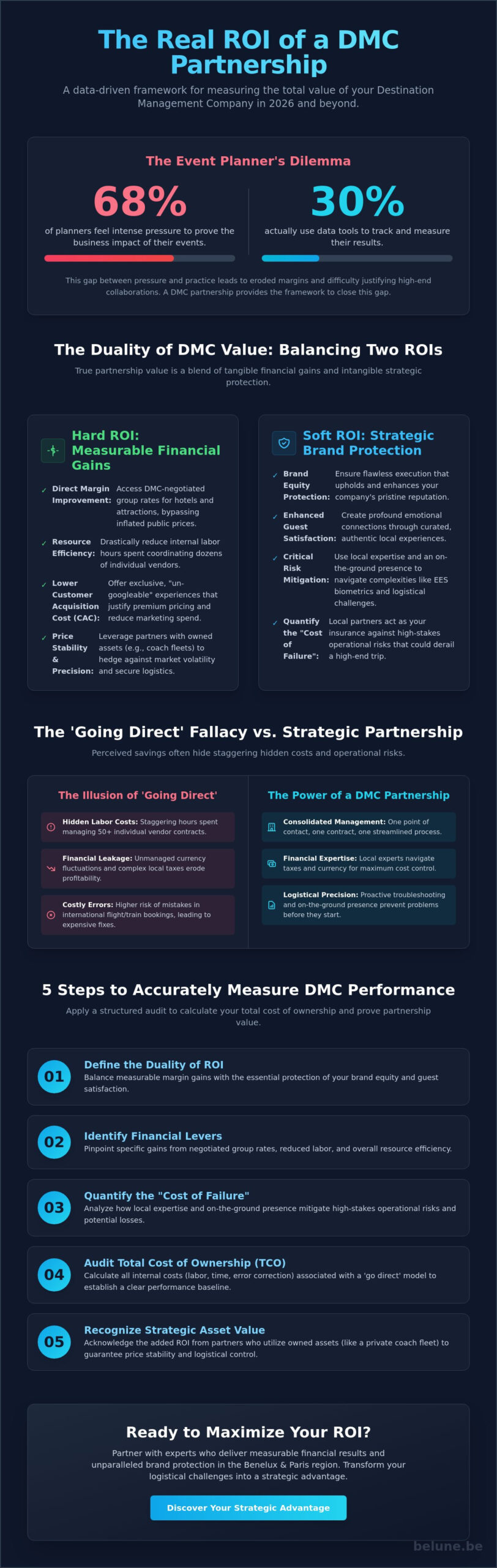
    While 68% of event planners feel intense pressure to prove business impact in 2026, only 30% actually use data tools to track their results. You’ve likely felt this gap when trying to justify the cost of high-end collaborations. It’s easy to see the beauty of a curated gallery tour or a perfectly timed river cruise excursion, but it’s much harder to quantify the “peace of mind” that comes from local expertise. Between rising logistics costs in Western Europe and the new complexities of the EES biometric systems, the hidden overhead of managing dozens of individual vendors is quietly eroding your margins.

    This article provides a clear framework for measuring roi of a dmc partnership by focusing on tangible financial and operational metrics. You’ll discover how to transform intangible service quality into a strategic asset that maximizes both profitability and guest satisfaction. We’ll explore how consolidating everything from coach hire to art history guides creates a measurable hedge against the logistical volatility of the modern travel landscape. By the end of this guide, you’ll have the data-driven confidence to validate the DMC model for even your most demanding high-end group projects.

    Key Takeaways

    • Define the duality of ROI by balancing measurable margin gains with the essential protection of your brand’s equity and guest satisfaction.
    • Identify the specific financial levers, from negotiated group rates to resource efficiency, used for measuring roi of a dmc partnership.
    • Quantify the “Cost of Failure” to understand how local expertise and on-the-ground presence mitigate high-stakes operational risks.
    • Apply a structured five-step audit to calculate your total cost of ownership and establish clear performance baselines for your logistics.
    • Recognize the strategic value of partnering with experts who utilize owned assets, such as a private coach fleet, to secure price stability and logistical precision.

    What is the Real ROI of a DMC Partnership in 2026?

    Value in high-end travel isn’t merely a line item on a ledger. It’s a structural harmony between artistic vision and technical precision. When tour operators approach the task of measuring roi of a dmc partnership, they must look beyond simple commission percentages. Real ROI is the cumulative result of direct cost savings and the invisible, yet vital, operational efficiencies that keep a brand’s reputation pristine. A Destination Management Company (DMC) acts as a strategic ally, transforming logistical complexity into a seamless extension of your own team.

    True partnership value is split between Hard ROI and Soft ROI. Hard ROI consists of measurable dollars: the direct margin improvements gained through professional hotel accommodation management and the price stability of an owned coach fleet. Soft ROI is more ethereal but equally critical. It’s the brand equity built through flawless gastronomy and beer tours; it’s the guest’s profound emotional connection during a curated battlefield visit. Without this local expertise, your brand is exposed to the friction of the unknown.

    To better understand how these financial components translate into a digital framework, watch this helpful video:

    Beyond the Spreadsheet: The Evolution of Partnership Value

    Travel markets in 2026 no longer reward generic, transactional booking services. High-end travelers seek authenticity that can’t be found via a search engine. A benelux incoming tour operator provides the technical mastery needed to unlock exclusive experiences, such as private art and culture group tours that bypass standard tourist paths. This specialized local knowledge doesn’t just improve the itinerary; it justifies a premium price point. By leveraging deep-rooted connections, a DMC creates high-margin opportunities that are impossible to replicate from a distant head office.

    The True Cost of ‘Going Direct’

    Direct booking models often present a seductive illusion of savings. However, they hide the staggering internal labor hours required to manage 50 or more individual vendor contracts. Every hour your staff spends coordinating local guide services or troubleshooting uncoordinated transport is an hour stolen from business development. There’s also the risk of financial leakage. Currency fluctuations and the labyrinth of local tax complexities in Western Europe can quickly turn a profitable trip into a deficit. Managing international flight and train bookings in-house frequently leads to error-rectification costs that far exceed the price of a professional partnership. Measuring roi of a dmc partnership means accounting for these “secret” costs of doing it yourself.

    Quantifying Hard ROI: Revenue, Margins, and Resource Efficiency

    Fiscal clarity is the foundation of any high-end travel operation. While the emotional resonance of a journey matters, the financial architecture must be equally robust. When measuring roi of a dmc partnership, the most immediate impact is found in direct margin improvement. By leveraging DMC-negotiated group rates for hotels and local attractions, you bypass the inflated prices of public booking platforms. These preferential rates don’t just save money; they provide the necessary breathing room to scale your offerings without compromising on quality.

    Profitability also stems from a significant reduction in Customer Acquisition Cost (CAC). In an era where travelers can replicate basic itineraries with a few clicks, offering “un-googleable” experiences becomes your greatest competitive advantage. When you provide exclusive access to private estates or hidden culinary workshops, your product stands alone. This exclusivity drives higher conversion rates and reduces the need for aggressive, expensive marketing campaigns. Speed is another critical factor. Partnering with an expert allows you to reduce the “time-to-market” for new products from months to weeks, ensuring you capture emerging trends before the window of opportunity closes.

    Administrative burden is a silent profit killer. Managing fifty separate vendors means fifty separate invoices, bank fees, and potential payment errors. Consolidating these into a single, streamlined payment process provides a level of financial control that direct booking models simply cannot match. You can refine your own operational financial strategy by letting a local expert handle the technical minutiae of regional VAT and vendor settlements.

    Revenue Attribution and Conversion Rates

    Sophisticated culture group tours benelux act as a powerful magnet for discerning travelers. These programs increase booking conversions because they offer a level of depth that standard itineraries lack. You should also track the “upsell” potential inherent in these partnerships. Adding a private beer tasting or after-hours museum access isn’t just an itinerary enhancement; it’s a high-margin revenue driver. Finally, measure the repeat business generated by flawless execution. A guest who experiences a perfectly choreographed tour is far more likely to book their next journey with you, dramatically increasing their lifetime value.

    Operational Efficiency Gains

    The math of outsourcing is compelling. A single strategic partnership often replaces the need for three full-time operations staff members, allowing you to reallocate those resources toward sales and brand vision. Beyond headcount, expert route planning reduces “dead mileage” and logistical waste, ensuring that every Euro spent on transport contributes directly to the guest experience. Resource Efficiency is the ratio of operational output to internal man-hours. By optimizing this ratio, you transform your business from a labor-intensive agency into a lean, scalable travel brand.
    Measuring ROI of a DMC Partnership: A Strategic Guide for Tour Operators in 2026

    The ‘Soft’ ROI: Risk Mitigation and Brand Protection

    Quantifying the intangible is the hallmark of a visionary operator. While margins provide the necessary foundation, the true strength of a partnership lies in its ability to shield your brand from the unexpected. When measuring roi of a dmc partnership, you must account for the “Cost of Failure.” Consider the impact of a single stranded coach in the Belgian countryside. The immediate financial hit includes refunds and emergency transport, but the long-term damage is far more severe. Eroded trust and negative digital reviews linger for years. 24/7 on-the-ground support isn’t just a service; it’s a high-value insurance policy for your reputation.

    Technical mastery of a destination ensures compliance with a labyrinth of ever-changing regional regulations. In 2026, navigating the complexities of the European Union Entry/Exit System (EES) and ETIAS requirements demands constant vigilance. A local partner manages these logistical hurdles, ensuring your guests move seamlessly across borders. This precision transforms your agency into a provider of “flawless” experiences. Your brand becomes synonymous with reliability, allowing you to command a premium in a crowded market.

    Logistical Reliability as a Financial Asset

    Reliability has a specific price tag. A DMC that manages its own fleet of buses provides a level of certainty that third-party brokers simply cannot match. During peak festival seasons or major sporting events like F1 Francorchamps, guaranteed availability is the difference between a successful tour and a logistical nightmare. This proactive problem-solving prevents the “refund spiral.” By resolving issues before a guest even notices a delay, you preserve the integrity of the journey. Choosing the right group travel agency also acts as a safeguard against local vendor bankruptcy, ensuring your guests’ experiences remain secure despite market fluctuations.

    Expert Guidance and Customer Lifetime Value (CLV)

    The human element of travel drives long-term growth. High Net Promoter Scores (NPS) are directly correlated with the quality of local guide services. When guests experience deep cultural immersion through gastronomy or art history, they don’t just leave satisfied; they become brand advocates. This emotional connection leads to higher referral rates and a significantly higher Customer Lifetime Value (CLV). In the luxury and educational segments, “insider access” is the ultimate currency. Measuring roi of a dmc partnership means recognizing that these exclusive moments are what turn a one-time traveler into a lifelong client. Your investment in local expertise is an investment in the future stability of your booking pipeline.

    5 Steps to Accurately Measure Your DMC Partnership Performance

    Technical rigor is the only way to move beyond intuition. To truly master the art of measuring roi of a dmc partnership, you need a structured process that captures both the financial pulse and the operational heartbeat of your business. It isn’t enough to feel that a partnership is working; you must prove it through a series of calculated evaluations that reflect the complexity of 2026 travel logistics. This technical audit transforms a simple vendor relationship into a high-performance strategic asset.

    The evaluation begins with five distinct steps:

    • Establish Baseline KPIs: Document your current margins, complaint rates, and itinerary turnaround times before the collaboration starts.
    • Conduct a TCO Audit: Analyze the Total Cost of Ownership by comparing the DMC fee against the hidden costs of managing 50+ vendors in-house.
    • Isolate the Feedback Loop: Use post-tour surveys to separate guest satisfaction with the destination from the technical performance of the DMC.
    • Quantify Time-Savings: Track the reduction in man-hours for your sales and product teams when they’re relieved of logistical coordination.
    • Analyze Resolution Ratios: Measure the “Incident-to-Resolution” time for on-the-ground hurdles, such as sudden road closures or guide illness.

    By following this framework, you can audit your partnership strategy to ensure every Euro spent contributes to a more resilient and profitable operation.

    Setting Baseline KPIs for Tour Operators

    Defining success requires a clear vision of your primary objectives. Is your goal to achieve higher margins, lower complaint rates, or perhaps a faster turnaround for complex international flight and train bookings? Create a weighted scorecard that balances these quantitative goals with qualitative metrics like innovation in itinerary design and responsiveness to last-minute changes. Tour operators should verify if their internal CRM systems are configured to track and attribute revenue specifically sourced through partner-led itineraries to ensure data integrity.

    Auditing the Total Cost of Partnership

    True value often lies beneath the surface of a “net rate.” A comprehensive audit must account for the full spectrum of included services, from hotel accommodation management to the logistical precision of a private coach fleet. Compare the transparent DMC fee against the cumulative weight of international bank fees, individual vendor deposits, and the administrative burden of local tax compliance. The most telling metric is often the “Opportunity Cost.” Calculate what your team could achieve in terms of brand growth and sales if they weren’t occupied with the technical minutiae of booking hotels and transport. This shift in focus is where the most significant ROI is often realized.

    Strategic Alignment: Why BELUNE Delivers Superior ROI in Benelux & Paris

    True partnership is a structural alignment where technical mastery meets an uncompromising vision for excellence. For over 20 years, BELUNE has acted as a silent architect for tour operators, providing the error-free execution required to sustain high-end travel brands. Our expertise isn’t merely in booking services; it resides in the seamless choreography of cross-border logistics between Belgium, the Netherlands, Luxembourg, and Paris. When measuring roi of a dmc partnership, the depth of this regional history becomes a foundational asset that eliminates the costly friction of logistical trial and error.

    The resilience of your margins depends on the reliability of your partners. By choosing an ally with deep-rooted local connections and a commitment to artisanal service, you transform your operational model. We don’t just provide solutions; we provide a technical framework that supports your brand’s promise of exclusivity and precision in every environment we touch.

    Leveraging Owned Assets for Price Stability

    Logistical volatility is a significant threat to profitability in Western Europe. BELUNE addresses this by maintaining a modern, private fleet of buses, effectively eliminating the middleman markup on transportation. This ownership provides a unique financial benefit: price stability. While other agencies struggle with fluctuating third-party rental costs during peak seasons, our partners enjoy guaranteed coach availability. Whether you’re coordinating transport for major sport events like F1 Francorchamps or high-demand festivals like Tomorrowland, owning the assets ensures that quality standards remain consistent. This control protects your brand from the service failures often associated with sub-contracted logistics.

    Customization as a Profit Driver

    Standardized, “cookie-cutter” tours are increasingly difficult to monetize in a discerning market. High-value themed group travel benelux allows operators to move away from price-sensitive products toward high-margin experiences. By designing specialized itineraries, such as belgium gastronomy tours, you create a product that justifies a premium price through sheer exclusivity.

    The ROI of specialized niches like Battlefield Tourism is equally compelling. Expert-led historical tours command higher margins because they offer a level of intellectual and emotional depth that generic sightseeing cannot replicate. This level of customization ensures that every element, from local guide services to river cruise excursions, is a component of a larger, harmonious whole. To secure your margins and enhance your guest’s journey, it is time to move beyond transactional vendor management. Partner with BELUNE to elevate your group travel ROI today and experience the difference that technical mastery brings to your portfolio.

    Transforming Logistical Precision into Strategic Growth

    The evolution of the travel landscape in 2026 demands a shift from transactional booking to strategic alliance. By implementing a rigorous framework for measuring roi of a dmc partnership, you move beyond guesswork and into a realm of technical certainty. You’ve seen how direct margin improvements, risk mitigation, and operational efficiencies create a compound effect on your bottom line. Now, it’s time to apply these insights to your own portfolio. Transitioning from vendor management to a technical partnership allows for greater scalability and creative freedom.

    True profitability is born from the harmony of local expertise and logistical control. With over 20 years of Benelux logistics mastery and a private fleet of modern coaches, we provide the stability your brand needs to thrive. Whether you’re exploring high-margin Battlefield history or the artisanal depths of Gastronomy tours, the right partnership transforms your operational overhead into a competitive edge. It’s about more than just moving people; it’s about magnifying the value of every guest interaction through flawless execution.

    Request Your Custom Benelux Group Tour Itinerary and ROI Analysis

    Step into a future where every journey is a masterpiece of precision and profit. We’re ready to help you redefine what success looks like in the heart of Europe.

    Frequently Asked Questions

    What is the most important metric for measuring DMC partnership ROI?

    Net margin improvement per passenger is the primary metric, but it must be viewed alongside your customer retention rate. A successful partnership reduces the cost of goods sold while simultaneously increasing the lifetime value of the guest. You should focus on the total cost of delivery rather than isolated booking fees to see the true financial impact.

    How long should I wait before evaluating the ROI of a new DMC partner?

    A full twelve month cycle is necessary to account for seasonal variations and the complete guest feedback loop. While you’ll notice initial operational efficiencies within the first 90 days, the financial impact of repeat bookings and reduced customer acquisition costs requires a longer observation period. This duration allows for a technical audit of both peak and off-peak performance.

    Can a DMC partnership actually save me money if they charge a service fee?

    Yes, because a professional partner offsets their fee through negotiated group rates and the total elimination of internal labor costs. By consolidating hotel accommodation management and transport, you avoid the heavy administrative burden of managing dozens of individual vendor contracts. The savings in internal staff hours alone often exceeds the service fee itself.

    How do I calculate the ‘Soft ROI’ of a DMC’s local expertise?

    Use the Net Promoter Score (NPS) and guest referral rates to quantify the value of local expertise. High quality local guide services and exclusive itineraries directly correlate with higher guest satisfaction. When measuring roi of a dmc partnership, track how these deep cultural immersions reduce your future marketing spend through organic brand advocacy and lower churn.

    What are the hidden costs of managing Benelux logistics in-house?

    Hidden costs include international bank fees, currency exchange risks, and the labor required for regional tax compliance. In-house teams also face the financial drain of “dead mileage” in logistics and the high price of error rectification. These invisible leakages quietly erode the profit margins that a dedicated local expert is trained to protect through technical precision.

    Should I prioritize Hard ROI or Soft ROI when choosing a DMC?

    Balance is essential, yet Soft ROI often provides the most sustainable competitive edge. While Hard ROI secures immediate profitability, Soft ROI builds the brand equity that allows you to command premium prices. A partner who ensures flawless execution protects you from the catastrophic “Cost of Failure” during complex group tours in unfamiliar territories.

    How does owning a coach fleet impact the ROI for the tour operator?

    Owned assets eliminate the middleman markup and provide absolute price stability for your programs. When a partner utilizes their own fleet of modern coaches, you gain guaranteed availability during high demand peak seasons. This control prevents the sudden price surges common in third party rentals and ensures a consistent quality of service that protects your brand promise.

    What if my DMC partner doesn’t want to share detailed cost data?

    Focus on the “net-to-net” comparison of the total itinerary cost rather than individual line item margins. A transparent partner provides enough data to validate the overall value proposition. When measuring roi of a dmc partnership, evaluate the final package price against the total cost of assembling those same components in-house, including labor and risk.

  • How to Justify DMC Costs to Management: The Strategic ROI of Destination Management in 2026

    How to Justify DMC Costs to Management: The Strategic ROI of Destination Management in 2026

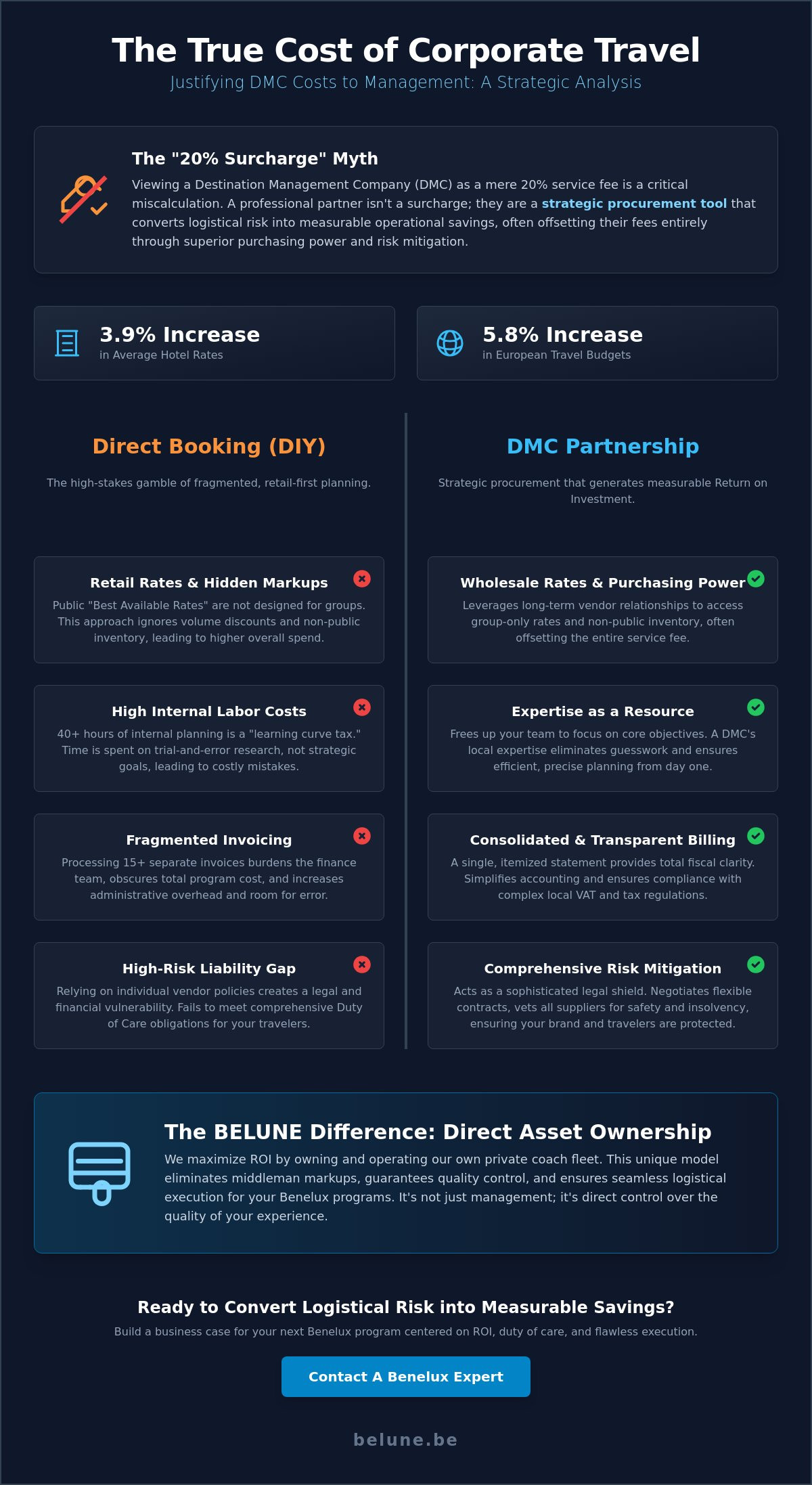
    Booking every element of your travel program direct isn’t a cost-saving strategy; it’s a high-stakes gamble with your company’s operational budget. While a spreadsheet might suggest that bypassing a partner saves a 20% service fee, the hidden costs of logistical friction and vendor mismanagement tell a far more expensive story. To successfully justify dmc costs to management, you must reframe the conversation. A professional partner isn’t a surcharge. They’re a strategic procurement tool that converts logistical risk into measurable operational savings.

    We recognize the pressure to defend every line item as hotel rates rise by 3.9% and European travel budgets face a 5.8% increase. It’s often difficult to quantify the value of local nuance or the security of a private coach fleet when the board focuses solely on the immediate price tag. This guide provides the financial data and risk-mitigation arguments you need to prove that destination management is a cost-saving asset rather than a luxury. You’ll learn how to build a business case centered on ROI, duty of care, and the technical precision required to execute a high-quality Benelux program that resonates with every stakeholder.

    Key Takeaways

    • Learn how to move beyond the “20% surcharge” myth by leveraging a DMC’s localized purchasing power to secure rates unavailable to the general public.
    • Master the specific financial and operational arguments needed to justify dmc costs to management by auditing the hidden drain of internal labor and logistical friction.
    • Protect your organization by understanding the legal nuances of Duty of Care and why relying on individual vendor policies creates a high-risk liability gap.
    • Identify the critical risk points in any travel itinerary using a professional framework that converts potential logistical failures into measurable savings.
    • Discover how direct asset ownership, such as a private coach fleet, eliminates middleman markups and ensures a seamless, high-quality execution for your Benelux programs.

    The Paradox of Choice: Why “DIY” Logistics Often Cost More

    The digital marketplace offers a seductive illusion of control. For a procurement manager, the ability to book a hotel or a coach in Amsterdam with a few clicks feels like a victory for the budget. However, this retail-first approach ignores the corporate logistical reality. When you need to justify dmc costs to management, the conversation must shift from “what we pay” to “what we lose” through fragmentation. Online prices are designed for the solitary traveler, not for the intricate harmony required by a corporate group program.

    A professional Destination Management Company acts as a strategic architect, bridging the gap between a simple booking and a flawlessly executed experience. In the Benelux market, this expertise is vital. Cross-border regulations, multi-lingual requirements, and local tax nuances create a landscape where a single error can derail an entire budget. We recognize that management requires absolute fiscal transparency, and that transparency begins with understanding the true cost of choice.

    To better understand how these costs translate into value, watch this helpful video:

    The Hidden Costs of Internal Planning

    Internal resources are expensive. When a junior planner spends 40 hours researching an itinerary, the company pays a high “learning curve tax.” This time isn’t spent on strategy; it’s spent on trial and error. First-time bookings in a new region often lead to costly mistakes, such as choosing hotels with poor coach access or overlooking local holidays. The administrative overhead is equally taxing. Processing 15 separate invoices from various vendors is a burden on the finance team. A consolidated statement from a partner provides the clarity management craves.

    Retail vs. Wholesale: The Procurement Advantage

    The “Best Available Rate” on a travel site is rarely the best value for a group of 40+. As a benelux incoming tour operator, we provide access to non-public inventory and group-only rates that aren’t visible to the public. These preferential terms are the result of decades of relationship building. They often offset the service fee entirely, turning the DMC into a procurement tool rather than an expense. Professional partners secure terms that protect the organization, ensuring that volume translates into value rather than just a higher bill.

    Quantifying the ROI: 5 Key Areas of DMC Value Creation

    To effectively justify dmc costs to management, we must translate abstract “local expertise” into concrete financial outcomes. Precision is the silent language of excellence. It isn’t enough to promise a smooth trip; we must demonstrate how a partnership creates a tangible return on investment. This value manifests through a blend of purchasing power, risk insulation, and the mastery of movement. When logistical friction is removed, the true purpose of the travel program can finally shine.

    A professional partner leverages deep rooted networks to secure volume discounts that are simply inaccessible to the public. This isn’t just about lower room rates. It’s about effective risk management that shields your organization from vendor insolvency or service failures. We vet every supplier with a rigour that protects your brand reputation, ensuring that every touchpoint reflects your company’s commitment to quality.

    Financial Protection and Contract Negotiation

    DMCs act as a sophisticated shield during the negotiation phase. We secure flexible attrition and cancellation clauses that allow for group size fluctuations without triggering punitive fees. In the Benelux region, navigating VAT and local tax compliance is a complex architectural task; a partner ensures you avoid the heavy fines associated with incorrect cross-border filings. Force Majeure protection in destination management ensures that your investment remains secure when extraordinary, unforeseeable events render the original itinerary impossible to execute. By managing these nuances, we transform a potential liability into a controlled variable.

    Logistical Precision and Time Savings

    The role of a group travel agency is to manage disruptions in real time before they reach the traveler. Expert routing and local knowledge don’t just provide comfort; they eliminate “dead time,” often saving 15-20% of on-the-road duration. Consider the cost of a missed high-speed train connection for a group of 50 compared to the cost of a DMC guide who anticipated the delay and adjusted the transfer. The difference is often measured in thousands of euros in rebooking fees and lost productivity. If you are looking to elevate your next project with this level of technical precision, our team is ready to assist.

    • Purchasing Power: Accessing non-public inventory through long-term local relationships.
    • Risk Mitigation: Comprehensive vetting of suppliers to prevent operational failure.
    • Operational Efficiency: Reducing internal labor costs by consolidating vendor management.
    • Quality Assurance: Maintaining brand standards through on-site supervision.
    • Financial Compliance: Expert handling of complex European tax and VAT regulations.

    How to Justify DMC Costs to Management: The Strategic ROI of Destination Management in 2026

    Addressing the CFO’s #1 Concern: Risk and Liability

    Financial oversight often focuses on the visible fee, yet the true cost of risk remains hidden until a crisis occurs. For a Chief Financial Officer, the primary concern isn’t just the 15% to 25% management fee; it’s the potential for uncapped liability. When you justify dmc costs to management, you’re presenting a strategy for risk insulation. Duty of Care isn’t a buzzword. It’s a legal obligation to ensure traveler safety, and in 2026, the complexity of this mandate has reached a new peak with the tightening of European safety and sustainability regulations.

    Relying on individual vendor policies is a high-risk gamble. While a standard one-day event insurance policy might only cost between $75 and $350, it rarely covers the logistical fallout of a vendor bankruptcy or a service failure in a foreign jurisdiction. A professional partner provides a unified layer of protection. We ensure every supplier meets rigorous international safety protocols, providing the 24/7 support that has become a standard expectation for corporate programs. This proactive stance is essential when building your business case for professional oversight.

    The Price of a Reputation Crisis

    Reputation is a fragile asset. A single poor hotel experience or a stranded group doesn’t just ruin a trip; it damages long-term client retention and brand authority. Local guides provide an invisible value by pivoting instantly during strikes or unexpected closures. This mastery of the “pivot” is why themed group travel benelux requires specialized oversight. We don’t just book tours; we safeguard the emotional and professional investment of every attendee. The cost of a DMC is a fraction of the cost of a public relations crisis or a lost corporate contract.

    Regulatory Compliance in Benelux

    The regulatory landscape in 2026 is unforgiving. Navigating the strict coach driver hour regulations in Europe is essential to avoid heavy fines that can reach thousands of euros. Furthermore, new documentation requirements under the Corporate Sustainability Reporting Directive (CSRD) mean that event planners must now provide detailed sustainability reporting. We manage these technicalities, from securing local permits for heritage sites to ensuring all data processing complies with the latest GDPR standards. Our team also monitors the increased scrutiny on worker classification, shielding your organization from the legal and financial penalties of misclassifying temporary event staff.

    • Duty of Care: Legal and moral fulfillment of traveler safety obligations.
    • Liability Gap: Closing the holes left by fragmented vendor insurance policies.
    • Emergency Response: Instant logistical support for stranded groups.
    • Regulatory Mastery: Compliance with EU driver hours and 2026 sustainability mandates.

    A Framework for Justification: Building Your Business Case

    Presenting a business case to leadership is an exercise in clarity. To effectively justify dmc costs to management, you must move beyond the emotional appeal of “better experiences” and focus on the cold reality of the balance sheet. Management doesn’t see the charm of a local guide; they see a line item that appears to increase the budget. Your role is to demonstrate how this investment actually contracts the total cost of ownership by eliminating waste and mitigating expensive operational risks.

    A successful justification follows a logical progression. It begins with a rigorous audit of “DIY” costs. This includes not just the retail price of hotels and transport, but the internal labor hours consumed by staff who lack local procurement networks. Once these baseline costs are established, you must identify the “Critical Risk Points” in your itinerary, such as tight transfers or complex group dining requirements. By requesting a transparent fee structure, whether a flat fee or a percentage, you can present a “Net Cost” where the DMC fee is offset by realized savings and the removal of the “learning curve tax” mentioned earlier.

    The final pillar of your case is “Opportunity Gain.” When your internal team is freed from the burden of chasing bus drivers or verifying rooming lists, they can focus on high-value tasks like sales and strategic growth. This shift in focus often generates more revenue than the DMC fee itself. If you’re ready to transform your logistics into a strategic advantage, request a tailored procurement analysis from our team.

    Comparative Analysis: DMC vs. Internal

    Creating a side-by-side spreadsheet is the most effective way to visualize value. Your analysis should include “Soft Costs” like the 40+ hours of research time typically required for a complex Benelux program. Highlighting “Value-Add” items, such as non-public museum access or private fleet priority, demonstrates what is lost when booking direct. To align with a CFO’s perspective, always present the “Management Fee” as a “Procurement Investment” designed to secure superior terms and ironclad contract protection. This simple reframing shifts the fee from an expense to a tool for financial optimization.

    Success Metrics for Management

    Leadership values what it can measure. Define clear Key Performance Indicators (KPIs) such as client satisfaction scores, logistical punctuality, and strict budget adherence. The ultimate “Zero-Disruption” goal ensures that management never hears about a problem because it was solved before it manifested. Utilizing testimonials from other corporate partners can provide the social proof needed to validate long-term ROI. When these metrics are met, the DMC partnership ceases to be a question of cost and becomes a cornerstone of operational excellence.

    • Audit DIY Costs: Factor in retail price variances and internal labor hours.
    • Risk Mapping: Quantify the financial impact of potential logistical failures.
    • Net Cost Calculation: Subtract realized savings from the management fee.
    • Opportunity Gain: Value the time returned to your core team for revenue-generating activities.

    The BELUNE Difference: Maximizing ROI Through Direct Assets

    True value isn’t found in a simple list of services. It resides in the mastery of the supply chain. When you seek to justify dmc costs to management, the most compelling argument is the elimination of unnecessary layers. Most agencies operate as mere brokers, stacking markups on top of third-party vendors. We approach destination management with the precision of an architect, controlling the essential elements of the experience through direct asset ownership. This vertical integration ensures that every euro spent contributes to the quality of the program rather than a middleman’s commission.

    Our philosophy centers on a seamless harmony between logistical rigour and sophisticated execution. By combining accommodation management, private transport, and expert guiding into a single, high-value package, we provide a clarity that fragmented bookings cannot match. This integrated approach allows your organization to maintain its high-end brand standards while benefiting from the institutional knowledge we’ve cultivated over 20 years. We don’t just prevent costly logistical errors; we sublimely execute your vision.

    Eliminating the Middleman in Transport

    The financial benefit of working with a partner that operates its own modern coach fleet is immediate and measurable. Direct fleet ownership removes the second-tier markup typically found in the industry, providing a significant procurement advantage. Beyond the balance sheet, this ownership grants us real-time flexibility. We can adjust routes or accommodate last-minute schedule shifts without waiting for third-party approval or incurring additional brokerage fees. This control ensures consistent quality and punctuality across the entire Benelux and Paris region, protecting your itinerary from the unpredictability of sub-contracted services.

    Your Strategic Partner in Benelux

    We act as more than a supplier. We are a visionary consultant for your travel brand. Our “A to Z” promise means that management enjoys absolute peace of mind from the initial conception to the final invoice. We handle the technical nuances of European travel, allowing your team to focus on the human and emotional experience of your guests. This partnership transforms destination management from a line-item expense into a strategic material for building exceptional projects. You can elevate your group travel programs with BELUNE’s expert management and secure a partnership rooted in excellence and transparency.

    • Direct Assets: Own fleet of coaches to eliminate middleman markups.
    • Institutional Knowledge: Over two decades of experience navigating European logistics.
    • Integrated Packages: Unified management of transport, hotels, and tours.
    • Brand Alignment: Sophisticated execution that mirrors your organization’s high standards.
    • Financial Transparency: Clear, consolidated billing that simplifies corporate accounting.

    Mastering the Architecture of Exceptional Travel

    A travel program is more than a series of bookings; it’s a technical and emotional landscape that requires a master’s touch. We’ve explored how shifting the narrative from “surcharge” to “procurement optimization” allows you to effectively justify dmc costs to management. By auditing internal labor and recognizing the financial shield of Duty of Care, you transform logistics into a measurable asset. The true ROI lies in the harmony between risk mitigation and the seamless execution of your brand’s vision. When logistical friction vanishes, the quality of the experience can truly shine.

    Excellence isn’t accidental. It’s the result of 20+ years of local expertise and the tactical advantage of a private fleet of modern coaches. Whether you’re navigating complex battlefield tours or curated cultural experiences, the right partner ensures every detail is a material of construction for your success. It’s time to move beyond the friction of fragmented planning and embrace a vision of effortless precision. Partner with BELUNE to streamline your Benelux logistics and witness how technical rigour can sublimely elevate your corporate programs. Your next project deserves a foundation built on trust and artisanal mastery.

    Frequently Asked Questions

    Is a DMC really cheaper than booking hotels directly on travel sites?

    A DMC is frequently more cost-effective because we access non-public inventory and wholesale rates. Retail travel sites are designed for individuals and include significant markups. By leveraging professional procurement, you secure better terms and avoid the hidden fees that often plague direct group bookings. This ensures your budget is spent on quality rather than digital commissions.

    How do I explain the “Management Fee” to a CFO who only sees the bottom line?

    You should present the fee as a strategic investment in procurement and risk management. This helps you justify dmc costs to management by highlighting the 40+ internal labor hours saved and the protection against vendor failure. It’s about reducing the total cost of ownership through expert oversight. The fee isn’t an extra cost; it’s a tool for financial optimization.

    Can a DMC help reduce the financial risk of a group cancellation?

    DMCs reduce risk by negotiating superior attrition and cancellation clauses that you can’t get alone. We use our local volume and long-term relationships to secure flexible terms. This protects your organization from punitive fees if group numbers fluctuate. In the event of a full cancellation, our mastery of local contracts ensures you have the strongest possible legal and financial defense.

    What is the average cost of a DMC in the Benelux region in 2026?

    Management fees in 2026 generally fall between 15% and 25% of the total event budget. In the Netherlands, corporate meeting packages typically range from €200 to €400 per person. Incentive programs often require a higher investment, ranging from €500 to €1,200 per person. These rates reflect the technical complexity and the high-end exclusivity of the services provided in this region.

    Does using a DMC mean I lose control over my itinerary design?

    On the contrary, you gain a technical partner who enhances your vision with local nuance. You remain the architect of the experience while the DMC provides the specialized tools and access to execute it flawlessly. We act as an extension of your team, providing the local insight needed to transform a standard itinerary into a sophisticated, high-value program.

    What happens if a vendor fails during the trip when using a DMC?

    The DMC provides an immediate logistical pivot to ensure the program continues without interruption. Because we vet all suppliers and often own direct assets like coach fleets, we replace failing services before the travelers notice a disruption. This 24/7 support is a standard expectation in 2026, protecting both the guest experience and your company’s reputation.

    Is it worth hiring a DMC for a small group of 15-20 people?

    Yes, because small groups are often more sensitive to logistical friction and retail price spikes. For 15 to 20 people, the cost of a single error or a missed transfer far outweighs the management fee. A DMC ensures that even smaller programs receive the same technical precision and procurement advantages as large-scale events, maximizing the impact of your investment.

    How does a DMC handle VAT and tax compliance for international clients?

    We act as your local fiscal representative to ensure absolute compliance with European tax laws. Navigating VAT in the Benelux region requires technical precision. We handle all cross-border filings and documentation, shielding your organization from the financial penalties of incorrect tax declarations. This expertise is vital for maintaining fiscal integrity in an increasingly complex regulatory landscape.