Tag: DMC Netherlands

  • Organizing Group Tours in The Hague: A Practical Planning Guide

    Organizing Group Tours in The Hague: A Practical Planning Guide

    What if the best group itinerary isn’t the one with the most stops, but the one where each experience fits naturally into the day? Organizing group tours in The Hague means balancing different interests and mobility needs while coordinating transport, timings and bookings. Without a joined-up plan, even excellent experiences can feel rushed or disconnected.

    Start with the people travelling: what they enjoy, how much time they have and what pace feels comfortable. Then bring cultural visits, gastronomy and heritage experiences together with practical details such as coach travel, accommodation and guided visits. BELUNE is a specialist destination management company (DMC) with more than 20 years of experience in group travel. Its itinerary planning connects experiences with the logistics needed to make a group journey flow.

    This guide explains how to build an itinerary around your group’s priorities, allow breathing room between experiences and coordinate the details that keep each day on track. The aim is a memorable visit that feels like one coherent experience, not a collection of separate bookings.

    Key Takeaways

    • For organizing group tours in the hague, define the group’s purpose and available time before deciding whether to plan one activity, a half-day or a multi-day programme.
    • Give the itinerary a clear narrative: select a theme and anchor experience, then add supporting stops and a fitting finish.
    • Match transport to the route and group’s pace, and build in arrival buffers, clear meeting points and time to regroup.
    • Use a practical checklist for access needs, meal preferences, pace and weather alternatives so a change of plan doesn’t break the day’s flow.
    • A tailored DMC plan can connect itinerary design with coach travel, accommodation and local guides, keeping the programme aligned with the organiser’s objectives.

    Organizing Group Tours in The Hague: Start With the Group’s Purpose

    A group tour is more than an activity shared by several people. It’s a coordinated programme shaped around common interests, available time and practical needs. A single guided visit may suit a short stop, while a half-day itinerary can connect an anchor experience with a meal or a second activity. A multi-day programme needs a wider thread, with each day contributing to the group’s overall purpose.

    Let that purpose guide both the activities and the way the group moves. Educational, corporate, cultural, culinary and special-interest groups may need different content, pacing and transport arrangements. For background when shaping a theme, the The Hague Wikipedia page offers an overview of the city’s history, government, culture and attractions.

    For a broader perspective on themed experiences, this video considers the role an organised tour can play in a group trip.

    Set objectives before selecting activities

    Begin with three decisions: why the group is travelling, how quickly it wants to move and how much time is available. A school group might value a clear learning focus; a corporate group may need space for conversation; culinary travellers may prefer a programme built around shared tastings and meals. These objectives help distinguish essential experiences from optional additions.

    Next, map the group’s practical needs. Consider mobility, preferred language, meal requirements and how much walking feels appropriate. Use these details to shape the route and transport choices before bookings are made, rather than relying on last-minute adjustments. Keep the plan focused: one strong central experience often gives a short visit more meaning than several loosely connected stops.

    Choose a tour format that fits the group

    A guided walk can suit a compact visit when the group wants to explore on foot and hear local context along the way. Cycling can cover more ground for travellers comfortable with an active pace. A boat experience offers a different perspective and can work as a distinct activity within a wider programme. For groups with varied needs or a longer schedule, combining formats can balance movement with time to pause.

    Match the format to the itinerary, not the other way around. A short visit may call for one activity with a simple arrival and finish; a half-day or multi-day plan can connect cultural heritage, gastronomy and leisure into a more developed narrative. BELUNE’s culture group tours guide offers broader inspiration for themed planning. BELUNE designs customised programmes around organisers’ objectives, with coach transport and local guidance considered as part of the itinerary.

    Design a The Hague Group Itinerary With a Clear Narrative

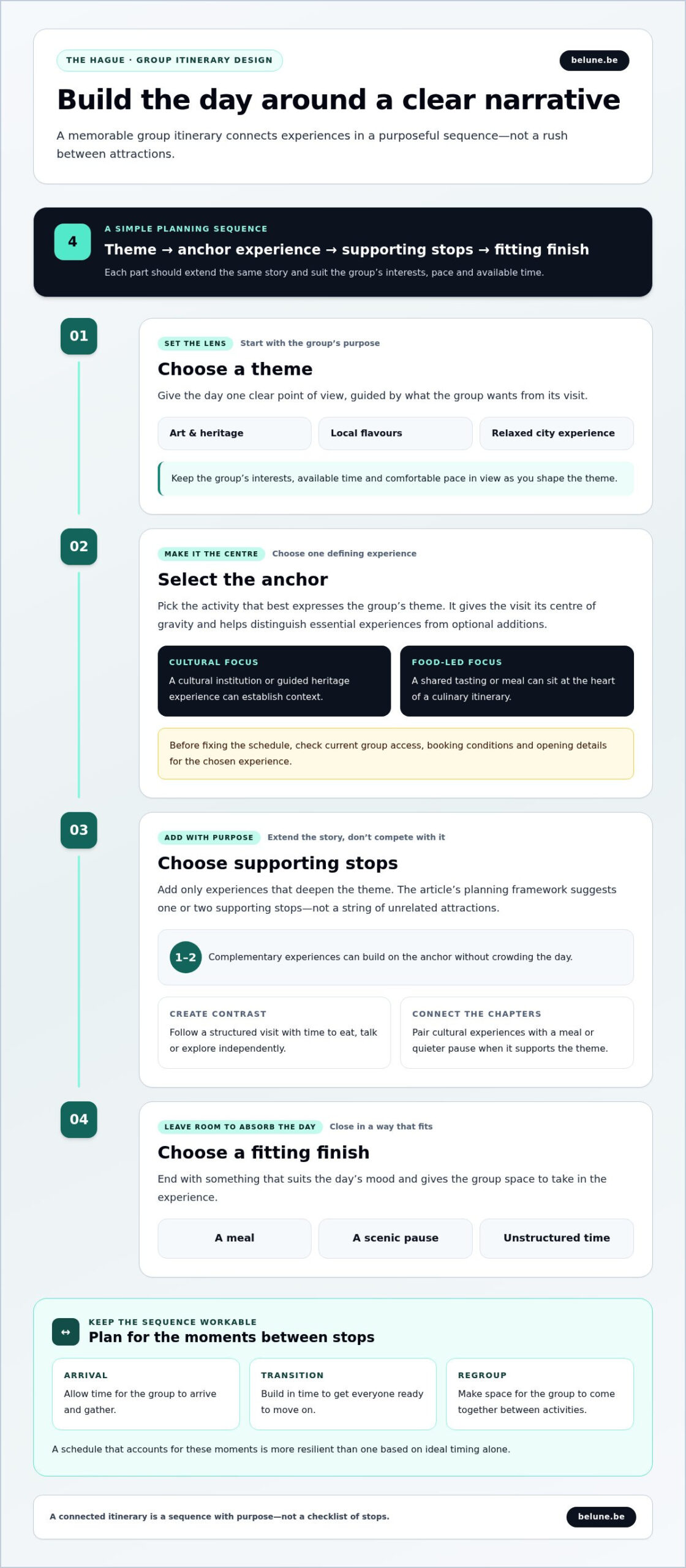
    A memorable itinerary has a through-line. Rather than stacking attractions, arrange experiences so each one adds meaning to the next: choose a theme, select an anchor experience, add only complementary stops, then finish on a note that suits the day. A well-paced itinerary is a connected sequence, not a checklist.

    This approach gives tour operators a practical way to turn organizing group tours in the hague into a programme with shape and purpose. A cultural visit might build towards an art or heritage experience; a food-led day can use a shared tasting as its centre; a leisure itinerary may balance a guided activity with room to explore at an unhurried pace.

    Build the day around an anchor experience

    Choose one experience to define the visit. It could be a cultural institution or another activity that reflects the group’s interests. Treat the anchor as the day’s centre of gravity, then add a complementary stop only if it deepens the theme. Before fixing the schedule, review current group access, booking conditions and opening details for each attraction.

    From that centre, sketch the day in four steps:

    • Theme: Set the lens, such as art and heritage, local flavours or a relaxed city experience.
    • Anchor: Choose the activity that best expresses it.
    • Supporting stops: Add one or two experiences that extend the story, rather than competing with it.
    • Finish: Close with a meal, a scenic pause or unstructured time that leaves the group room to absorb the day.

    For a heritage-led programme, a guided cultural visit can establish context, with a meal or quieter pause giving the group time to reflect. A culinary theme might place a food experience at the heart of the itinerary and use cultural stops as supporting chapters. The Official website of The Hague can help organisers review current visitor information, events and practical details as the plan takes shape.

    Create variety without overloading the schedule

    Contrast matters. Follow a structured visit with time to eat, talk or explore independently. This gives the day a more natural rhythm than a continuous run of guided activities. Build transition time around each stop, including arrival, gathering the group and getting everyone ready to move on. A schedule that accounts for these moments is more resilient than one based on ideal timing alone.

    Food can provide both variety and a shared point of connection. A gastronomy-led programme may pair a tasting or meal with a cultural experience, while leaving enough breathing space for the group to enjoy each element. For inspiration beyond the destination, BELUNE’s gastronomy tours guide explores food-led group themes. BELUNE can also shape a tailored group itinerary that connects experiences into a considered programme.
    Organizing Group Tours in The Hague: A Practical Planning Guide

    Coordinate Group Transport, Guides and Timings Across The Hague

    Transport is part of the itinerary’s design, not a detail to add after activities are booked. Compare each mode against the distance between stops, the group’s pace, mobility needs and the experience itself. For a group tour, check how people will arrive, move together and reassemble, rather than relying on a route that looks simple on a map.

    Use this comparison to make an initial choice, then verify current access arrangements and restrictions for the specific stops and transport involved. Don’t assume a coach can approach every entrance or that a walking connection will suit every participant.

    • Walking: Suits compact itineraries where stops are close enough for a comfortable walk. Consider the group’s mobility and the length of each leg.
    • Cycling: Can connect a wider set of experiences for groups who want an active outing and are comfortable travelling by bike. Make the pace and riding requirements part of the decision.
    • Boat: Works as an experience in its own right or as a distinctive change of perspective. Check the boarding arrangements and how the departure point fits the day’s other stops.
    • Coach: Useful when an itinerary links separate locations or when the group needs to travel together between activities. Plan around appropriate pick-up and drop-off points, and verify access for the intended vehicle.

    Match transport to the route and group profile

    Start with the actual sequence of stops. A short, concentrated programme may need little transport between activities, while a broader itinerary can benefit from coach travel that connects distinct locations without asking everyone to cover the distance on foot. Include cycling or a boat experience when it suits both the group’s interests and abilities, not simply to add another mode. Check relevant access details during planning, since routes, entry points and operating arrangements can affect the schedule.

    Make transitions and guidance part of the plan

    Every movement needs a clear handover. Give participants a specific meeting point and time, and allow room for arrival, boarding, headcounts and regrouping before the next activity. Add a buffer between scheduled experiences so a small delay doesn’t unsettle the rest of the day. Where guides change, agree who welcomes the group, shares practical instructions and introduces the next stop.

    A guide can do more than interpret a place. Clear narration during transitions helps participants understand how one experience connects to another, while concise directions keep movement orderly. For a day that includes a guided visit and coach transfer, align the end of the visit, the group’s walk to the vehicle and the next activity’s start time as one sequence.

    BELUNE’s own modern coach fleet and local guide services can be incorporated into itinerary planning, connecting transport and on-the-ground context rather than treating them as separate bookings. The team brings more than 20 years of experience in transport and tour operations to coordinating these elements around the programme’s needs.

    Choose Group Activities With Access, Pace and Contingencies in Mind

    An activity can suit the theme yet still be wrong for the group if the route, pace or practical arrangements create barriers. Assess each experience alongside its transitions: who can take part, how long the group can comfortably stay active and what happens if weather or timing changes.

    Build a concise planning checklist before finalising the programme:

    • Access: Note mobility requirements, walking distances, steps or other barriers, and how participants will move between activities.
    • Meals: Record dietary needs, meal preferences and suitable timing so food breaks support the day rather than interrupt it.
    • Pace: Consider how long the group can comfortably walk, cycle or remain engaged in a guided activity. Allow different participants time to regroup.
    • Weather: Pair outdoor or weather-sensitive plans with an indoor alternative that preserves the itinerary’s theme.
    • Communication: Make sure participants know meeting points, timings and what to do if separated from the group.

    Realistic buffers reduce pressure by giving the group room to arrive, use facilities, regroup and transition between activities without compressing the next booking. A schedule with breathing space is easier to adapt if one stop runs late.

    Plan for different needs without fragmenting the group

    Ask the group organiser to gather mobility, dietary and language needs while the itinerary is still taking shape. Use that information to select experiences and connections the group can share at a comfortable pace. If some participants need a gentler option, keep it close to the main activity where practical, with a clear meeting point and a simple plan to rejoin. The aim is flexibility without turning one shared tour into separate itineraries.

    For example, if a walking segment is too demanding for part of the group, consider shortening the route or adjusting the transition rather than removing the shared experience altogether. Communicate the plan in advance so participants understand what to expect.

    Prepare for changes before the tour begins

    Choose a weather alternative that still serves the itinerary’s purpose. If an outdoor activity is affected, a cultural visit or another suitable indoor experience may preserve the day’s focus. Decide in advance who communicates a change, how the group will regroup and what happens if a connection or scheduled start is missed.

    Separate stable planning information from details that can change. Keep confirmed bookings, agreed meeting points and transport arrangements in the working itinerary; verify current opening times, group-booking conditions, attraction access and coach arrangements before publication and again during operational planning. Don’t present an unverified route or access detail as settled fact. This distinction gives organisers a reliable plan while leaving room to respond to current conditions.

    For a programme that brings access needs, transport and contingencies into one plan, work with BELUNE on a tailored group itinerary.

    Bring the Group Tour Together With a Tailored DMC Plan

    A compelling group tour depends on more than a strong activity list. The itinerary, transport, accommodation and local guidance need to work as one programme, with each element supporting the organiser’s purpose. A destination management company (DMC) helps connect these workstreams, bringing creative planning and practical coordination into the same conversation.

    That joined-up approach matters especially when a programme includes several days, different experience types or participants arriving with varied needs. A cultural visit, culinary experience and heritage stop can each be valuable on their own; considered together, they can form a coherent journey with a clear pace and character. The focus stays on the group, not on fitting people around disconnected bookings.

    What a joined-up planning partnership can coordinate

    Itinerary design informs the logistics, and logistics shape what is realistic. BELUNE can develop a programme around the organiser’s objectives, then coordinate supporting details through its own coach fleet, hotel accommodation management and local guide services. Transport choices can be considered alongside the sequence of activities, while local guidance adds context and helps each experience feel connected.

    Themes can range from art and culture to gastronomy, beer or heritage. The right combination depends on what the group wants to take away, how much time is available and which practical requirements need to shape the plan. BELUNE brings more than 20 years of experience in transport and tour operations, including the relationship between itinerary design and delivery.

    Move from initial idea to a workable programme

    Start with a short planning brief. Share the group’s purpose, preferred dates, interests, available time and practical requirements, including mobility, language and meal considerations. These priorities help shape the proposed itinerary: which experiences belong at its centre, how the group will move between them, and whether accommodation or local guidance should be integrated. The plan can then be refined around the group’s priorities rather than beginning with a fixed template.

    For tour operators and travel agents, this creates a clear basis for discussing the programme with travellers and partners. It also makes trade-offs easier to see. If time is limited, the plan can protect the defining experience; if the group has several days, the itinerary can develop a broader cultural, culinary or heritage thread without crowding every day.

    A tailored DMC plan brings those decisions together, from the first outline to the practical structure of the journey. If you’re exploring a group programme, share your objectives with BELUNE to begin shaping an itinerary around your travellers.

    Shape Your Next Group Programme With Confidence

    The most effective next step is to turn the group’s broad interests into a concise working brief: what should travellers remember, what is fixed, and where can the itinerary breathe? That clarity gives the planning conversation a useful starting point and helps keep decisions focused as details develop.

    For tour operators and travel agents organizing group tours in the hague, the opportunity is to create a visit with a distinct point of view, not merely fill the available hours. Start with one defining experience, then let the surrounding choices reinforce it. As priorities become clearer, the programme can take shape around the travellers rather than a generic template. A clear brief also makes it easier to weigh optional additions without losing the programme’s central thread.

    BELUNE can translate that brief into a tailored group programme, connecting itinerary design with practical arrangements such as coach transport, accommodation and local guidance. Share your objectives and preferred travel themes to shape a programme that feels cohesive from arrival through the final experience.

    Explore a tailored group tour with BELUNE and take the first step towards a thoughtful, well-connected group visit.

    Frequently Asked Questions

    How do you organise a group tour in The Hague?

    Start by turning the group’s purpose into a short planning brief, then use it to guide the itinerary and logistics. Include the visit’s main objective, preferred themes, available time, participant needs and any fixed commitments. For organizing group tours in the hague, this brief also helps you compare options consistently: does each proposed experience serve the group’s aim, and can it fit the practical schedule? Refine the plan before confirming individual arrangements.

    What activities can you include in a group tour in The Hague?

    You can combine cultural visits, heritage experiences, guided exploration, cycling, river activities and food-focused experiences, depending on the group’s interests and capabilities. For example, a group interested in local history might pair a guided visit with time for discussion, while a culinary theme could centre on a shared food experience. Keep the programme focused by choosing activities that contribute to the same overall idea, rather than adding stops simply to fill the day.

    How long should a group tour in The Hague last?

    Set the duration according to the group’s available time, travel purpose and preferred pace; there’s no single ideal length. A brief visit may centre on one defining experience, while a longer stay allows more variety and unstructured time. Consider the context too: a group arriving between other commitments may need a self-contained programme, while travellers with an open schedule can explore a broader theme. Leave room for meals and transitions instead of scheduling activity continuously.

    How can group organisers keep a tour itinerary on schedule?

    Give one person responsibility for coordinating the live schedule and sharing updates with guides, drivers and activity contacts. Prepare a single itinerary with current meeting points, start times and contact details, then distribute the same version to everyone involved. Set a clear regrouping procedure and decide how the group will respond if a visit overruns. A brief check before each transition can catch confusion early, without relying on participants to interpret separate booking confirmations.

    Is a coach necessary for a group tour in The Hague?

    No. A coach may be useful when the programme connects separate stops or when keeping the group together between locations is a priority. For a compact itinerary, walking or another activity-based mode may suit the plan better. Consider the route, participant mobility, luggage and where the group needs to arrive, then verify vehicle access and suitable pick-up points for the specific schedule. The best choice is the one that supports the experience without adding unnecessary transfers.

    How do you make a group tour suitable for different interests and mobility needs?

    Ask the group organiser to gather access, dietary and language needs before activities are selected. Build the shared programme around experiences most participants can enjoy together, then offer nearby optional choices where they won’t split the group for long. For instance, a shorter route or a seated pause can give participants different ways to take part while preserving a common meeting point. Communicate the plan clearly so everyone knows what to expect.

    What does a destination management company do when organising group tours?

    A destination management company (DMC) helps tour operators and travel agents develop a group programme and coordinate its practical components. Depending on the brief, that work can connect accommodation, transport, local guidance, activities and the itinerary into one operational plan. For organizing group tours in the hague, a DMC can help translate a group’s objectives into a coherent schedule, giving the organiser a central planning framework instead of requiring them to manage each element in isolation.
  • Netherlands Group Travel Specialist Guide 2026

    Netherlands Group Travel Specialist Guide 2026

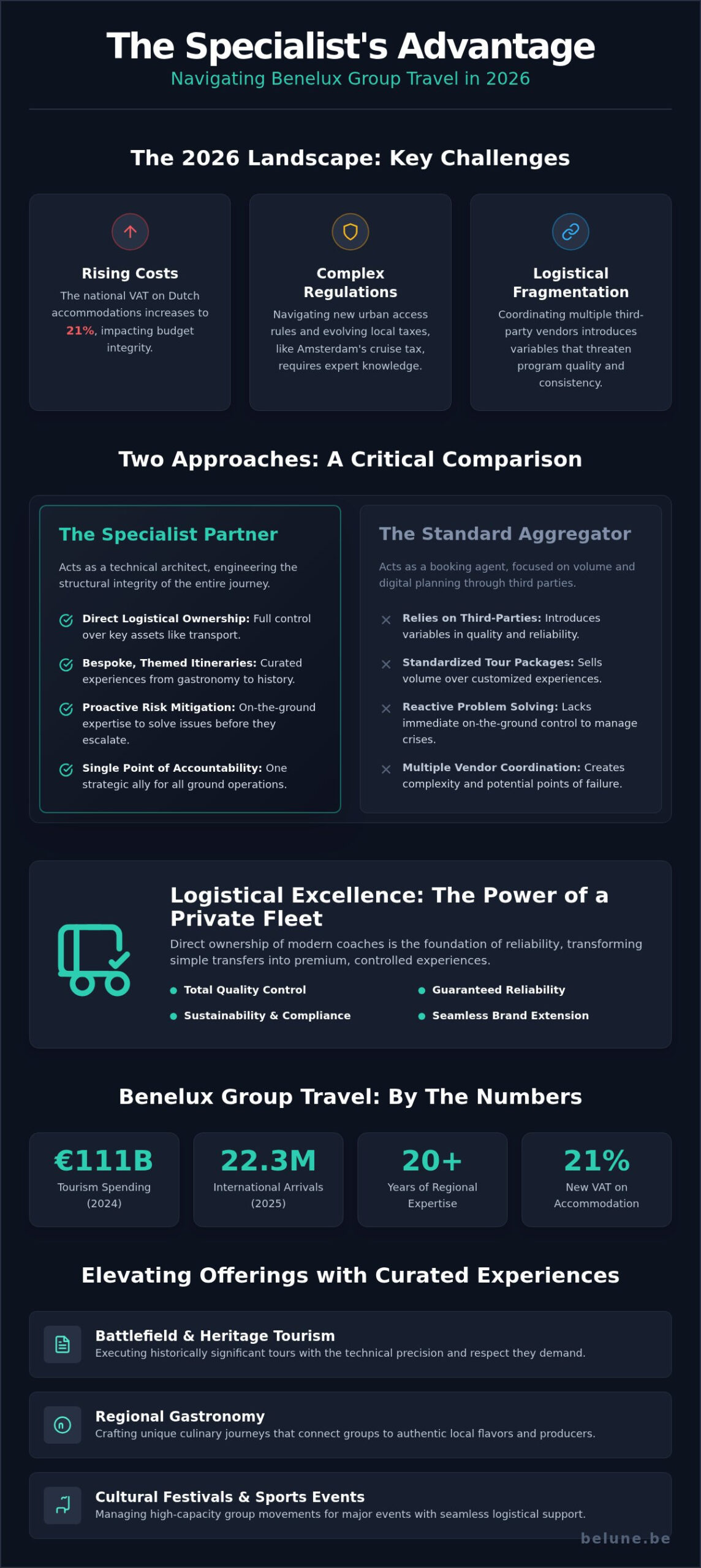
    The 2026 travel landscape is defined by rising costs and tightening regulations. In this environment, the difference between a standard tour and a masterpiece lies in the hands of the architect behind the scenes. You’ve likely felt the strain of managing fragmented logistics, from the 21 percent VAT increase on Dutch accommodations to the intricate dance of coordinating reliable transport. It’s a delicate balance. As a dedicated Netherlands group travel specialist, we bridge the gap between complex operational demands and the high-end, seamless experiences your B2B clients expect.

    We believe true luxury isn’t just about the destination; it’s about the rhythm of the journey. This guide reveals how direct logistical ownership, a private fleet of modern coaches, and expertly curated themes like Battlefield tourism or gastronomy can transform your offerings. You’ll discover a strategic partnership built on fixed-price reliability and artistic curation, ensuring every group movement across the Benelux region is executed with technical precision. We’ll outline the essential shifts for 2026, from navigating new Amsterdam cruise taxes to mastering the art of high-capacity hotel management.

    Key Takeaways

    • Master the complexities of the 2026 regulatory environment, including the national VAT increase to 21 percent, by aligning with a specialized local partner.
    • Secure the logistical integrity of your programs through a netherlands group travel specialist that operates its own modern fleet of coaches for total quality control.
    • Elevate your B2B offerings from standardized packages to bespoke, themed itineraries that capture the artistic and historical essence of the Benelux region.
    • Build enduring professional trust by replacing fragmented coordination with a single, strategic ally capable of managing both high-end accommodation and complex transport.
    • Gain a competitive advantage through technical precision and artisanal curation in high-stakes sectors such as Battlefield tourism and regional gastronomy.

    Understanding the Role of a Netherlands Group Travel Specialist

    The 2026 travel market requires more than a booking agent; it demands a technical partner. A true netherlands group travel specialist acts as a bridge between high-level vision and granular execution. With international arrivals having reached 22.3 million in 2025, the complexity of the region’s infrastructure requires a local expert to handle the shift to 21 percent VAT on accommodation and evolving local taxes. This role is fundamentally different from a travel aggregator. While aggregators sell volume, a specialist manages the structural integrity of the journey. For a broader perspective on the market, this Netherlands tourism overview highlights the scale of the industry we manage daily.

    Direct local presence is the ultimate risk mitigation tool. When an international travel agent partners with an on-the-ground operator, they gain more than just local knowledge. They secure a guarantee of operational continuity. If a transport provider fails or a regulation changes overnight, the specialist is already implementing the solution. This level of oversight turns potential crises into managed transitions.

    To better understand how these landscapes translate into itinerary potential, watch this helpful video:

    The Evolution of B2B Group Travel in the Region

    The shift toward high-value group experiences is undeniable. Tour operators look for more than just a bed and a bus; they seek a narrative. Our team uses two decades of regional expertise to craft these stories. This deep-rooted knowledge allows us to anticipate logistical hurdles before they impact the guest experience. It’s about transforming a series of bookings into a cohesive, high-end travel program. Industry professionals now prioritize direct partnerships with a Destination Management Company (DMC) that possesses 20 years of experience to ensure this level of reliability.

    Core Competencies of a Leading Travel Specialist

    A specialist’s core strength lies in technical mastery. We manage every touchpoint, from international train bookings to gastronomy tours. This level of control ensures that every group, whether attending a sports event or a cultural festival, experiences a level of service that reflects the agent’s own reputation. A leading netherlands group travel specialist doesn’t just suggest routes; they engineer them. The synergy between our own fleet of modern coaches and local guide services creates a professional atmosphere that aggregators simply cannot replicate.

    Logistical Excellence: The Foundation of Seamless Group Travel

    Logistical excellence isn’t a luxury; it’s the baseline for professional B2B operations. While aggregators focus on the digital planning phase, a true netherlands group travel specialist focuses on the physical reality of the road. We understand that a meticulously planned itinerary is only as strong as the transport providing its movement. In a region where tourism spending reached 111 billion Euros in 2024, the demand for high-specification execution is higher than ever. Technical precision in group movement is what protects your reputation as a tour operator.

    Private Fleet Management for Group Tours

    Ownership defines our approach to reliability. By operating our own fleet of modern coaches, we eliminate the variables introduced by third-party providers. This direct control allows us to guarantee the standard of maintenance, cleanliness, and comfort that high-end clients demand. For 2026, sustainability has moved from a preference to a requirement. Our modern fleet meets the latest efficiency standards, ensuring that group movement aligns with evolving regional environmental goals and urban access regulations.

    This technical mastery transforms a simple transfer into a premium experience. When you partner with a dedicated operator, you gain a strategic ally who manages every detail of the bus hire. From navigating the strict 2026 train luggage regulations to managing coach access in historic districts, our logistical ownership provides the serenity your partners expect. We don’t just book transport; we engineer the flow of the entire journey.

    Expert Guidance and Local Knowledge

    The narrative of a journey is carried by the people who lead it. Our multi-lingual guides don’t just recite facts; they translate the cultural soul of the Benelux region for your guests. They possess the deep regional expertise required to turn a standard sightseeing stop into a profound cultural immersion. This level of curation is supported by publications like National Geographic’s Guide to the Netherlands, which emphasizes the value of unique, local perspectives in modern travel.

    Professional guides also act as the final layer of logistical security. They navigate the nuances of an increasingly cashless society and manage the specific needs of large groups with technical precision. Whether coordinating a battlefield tour or a gastronomy experience, their presence ensures the itinerary flows with an effortless grace. This combination of physical assets and human expertise is what separates a logistical operator from a simple travel agent. It’s about turning a series of stops into a harmonious, high-end travel narrative.

    Netherlands Group Travel Specialist Guide 2026

    Comparing Custom Itineraries vs. Standardized Tour Packages

    Standardized tour packages often function as commodities; they provide efficiency but lack the distinct identity required by high-end tour operators. In a market where international overnight stays grew by 5 percent in 2025, the demand for differentiation has never been higher. A netherlands group travel specialist moves beyond the “one size fits all” model to create assets that reflect your specific brand vision. While aggregators offer thousands of fixed-departure tours, they often struggle to accommodate the technical nuances of niche B2B requirements. Customization allows for a balance between fixed-price reliability and the bespoke flexibility that modern groups demand.

    The Customization Process for Travel Agents

    Designing a tailor-made national travel program is a collaborative exercise in technical precision. We don’t just provide a list of destinations; we engineer a narrative that aligns with your clients’ expectations. This involves identifying exclusive access points and unique local experiences that are unavailable through standard booking channels. The strategic role of a benelux incoming tour operator is to act as your local architect. We translate your conceptual goals into a viable logistical reality, ensuring that every cultural stop and transport link feels intentional rather than accidental. This process ensures that your offering remains competitive and deeply personal.

    Strategic Accommodation Management

    One of the most significant challenges for 2026 is the national VAT increase on hotel accommodation from 9 percent to 21 percent. This fiscal shift makes professional lodging management a critical component of any group program. We bridge the gap between agents and hotels by sourcing group-friendly properties that maintain high standards of service without compromising your budget. Our role involves negotiating fixed-price contracts that protect your margins against seasonal fluctuations and tax changes. This level of financial and operational oversight is often missing from standardized packages.

    Effective accommodation management also considers the group profile. We source hotels that understand the specific needs of large parties, from streamlined check-in processes to high-quality group dining. This attention to detail ensures that the sanctuary of the hotel matches the sophistication of the daily itinerary. By managing these relationships directly, we provide a level of stability and quality control that aggregators simply cannot match. It’s about securing the foundation of the trip so the artistic elements of the tour can shine. Professional lodging management isn’t just about beds; it’s about safeguarding the group’s overall satisfaction and your reputation as a provider.

    Curating Themed Experiences: From Heritage to Gastronomy

    The modern group travel market has evolved beyond the era of generic sightseeing. Travelers now demand a narrative that resonates with their personal interests and values. As a premier netherlands group travel specialist, we understand that designing these experiences requires a blend of artistic vision and logistical rigour. Whether exploring the echoes of history or the nuances of regional flavors, our approach ensures that every themed journey is a structural masterpiece. We don’t just provide access; we provide context and technical mastery.

    Battlefield Tourism and Historical Remembrance

    Historical sites require a level of sensitivity that standard tour packages often fail to provide. We coordinate visits to significant locations with a meticulous focus on accuracy and emotional resonance. Our specialized guides translate complex historical events into compelling stories, ensuring a profound experience for every guest. Integrating these themes into a broader culture group tours benelux program allows for a balanced exploration of the region’s past and present. It’s about honoring the legacy of the land through technical precision and human connection.

    Culinary Artistry and Gastronomy Tours

    Gastronomy is the sensory heart of the Benelux region. We curate belgium gastronomy tours and Dutch culinary highlights that connect travelers with local artisans and time-honored traditions. Managing large groups in exclusive dining environments is a logistical challenge we solve through direct relationships and precise timing. From artisanal beer tastings to high-end regional cuisine, we ensure that the culinary narrative is as sophisticated as the landscape itself. This level of curation transforms a simple meal into a structural component of the travel experience.

    Active and Themed Travel Options

    The Netherlands’ world-famous cycling infrastructure offers a unique canvas for themed group travel benelux. Choosing a netherlands group travel specialist with direct logistical ownership ensures these active programs remain safe and reliable. We provide the support necessary for seamless tours, including professional equipment management and support vehicles. Our expertise extends to high-stakes events such as international sports tournaments and major music festivals. We also manage local excursions for river cruises, ensuring that even short stays are defined by high-quality execution. If you’re ready to elevate your portfolio, consult with our expert team to design your next exclusive program.

    Partnering with a Netherlands Group Travel Specialist for 2026

    The year 2026 marks a pivotal moment for international tour operators. As the industry settles into a new era of high demand, the complexity of local regulations and fiscal shifts requires more than just a vendor. It requires a strategic alliance. Choosing a netherlands group travel specialist ensures that your brand is represented with the same level of excellence you promise your clients. This partnership is built on 20 years of industry experience, providing a foundation of trust that allows you to focus on growth while we handle the technical execution on the ground.

    Selecting a professional group travel agency offers significant reputational benefits. When your guests experience the seamless integration of our private coach fleet and hand-picked accommodations, that quality reflects directly on your brand. We operate as a dedicated extension of your team, providing the logistical backbone for projects of exception across the Benelux region. Our commitment to excellence isn’t just a commercial claim; it’s a structural component of how we approach every itinerary.

    The B2B Partnership Framework

    Success in group travel is a product of clear, streamlined communication. We provide dedicated account management to ensure that every detail of your itinerary is understood and executed with technical precision. Our framework includes transparent pricing structures, which are vital for maintaining your margins in a market currently navigating significant tax adjustments. By offering white-label logistical solutions, we allow your brand to take center stage. We handle the intricacies of international train bookings, local guide services, and event coordination, all while remaining a silent, reliable partner in the background.

    Preparing for the Future of Group Travel

    The future of travel is defined by a blend of digital innovation and human artistry. We’re committed to evolving our logistical coordination to meet the needs of a modern audience without sacrificing the sophisticated tone that defines a high-end experience. Meticulous planning is our signature. We transform the technical aspects of transport and lodging into a structural component of the guest’s emotional journey, ensuring that every touchpoint feels intentional and refined.

    Initiating a collaboration with a netherlands group travel specialist is a step toward future-proofing your business. We invite you to share your vision with our team. Together, we can create bespoke programs that stimulate the imagination and set new standards for excellence in the European travel market. Our goal is to turn every logistical challenge into a seamless, artistic realization of your strategic goals.

    Elevating the Art of Group Movement in 2026

    Mastering group travel in 2026 requires a fusion of technical precision and artistic vision. We’ve explored how direct logistical ownership and bespoke itinerary design serve as the pillars of a successful B2B partnership. By prioritizing a netherlands group travel specialist with over 20 years of specialized DMC experience, you secure a strategic ally capable of transforming complex regional requirements into effortless guest experiences. Our private fleet of modern coaches and comprehensive coverage across the Benelux region and Paris provide the stability your brand demands.

    The future of your portfolio lies in these curated, high-value programs. Whether you’re designing a meticulous battlefield remembrance or a sophisticated gastronomy tour, the right partnership ensures every detail reflects your commitment to excellence. We invite you to bring your vision to life through our technical mastery and artisanal approach. Ready to redefine your offerings? Request Your Custom Benelux Group Tour Itinerary with BELUNE and discover the power of a truly integrated travel partnership. We look forward to magnifying your next project together.

    Frequently Asked Questions

    What are the benefits of hiring a specialized DMC for group travel in the Netherlands?

    Hiring a specialized Destination Management Company (DMC) provides a strategic advantage through direct local mastery. We act as your technical architect, managing the shift to 21 percent VAT on accommodation and complex regional regulations. This partnership replaces fragmented logistics with a single, reliable point of contact. By aligning with a netherlands group travel specialist, you ensure your B2B programs maintain a sophisticated, professional standard that aggregators cannot replicate.

    How does private coach fleet ownership improve group travel logistics?

    Owning a private coach fleet eliminates the unpredictability of third-party transport providers. It allows us to guarantee the maintenance, cleanliness, and modern specification of every vehicle used for your groups. This direct control is essential for ensuring safety and comfort across the Benelux region. We manage every detail of the bus hire, from professional driver coordination to navigating specific luggage regulations, providing total quality control for your itinerary.

    Can a group travel specialist handle niche themes like WWI battlefield tours?

    Yes, we provide a meticulous approach to historical remembrance through dedicated battlefield tourism services. This specialized niche requires guides who possess deep regional expertise and an ability to translate complex history into compelling narratives. We coordinate visits to significant sites with technical precision, ensuring a respectful and profound experience. These themes are seamlessly integrated into broader cultural programs to provide a comprehensive view of the region’s heritage.

    What is included in a typical fixed-price group travel package for tour operators?

    Typical fixed-price packages for tour operators include comprehensive multi-day itineraries that cover logistical and operational essentials. This includes hotel accommodation management, coach hire with our own fleet, and professional local guide services. We also incorporate specific activities like gastronomy tours or cultural site visits. These packages provide financial reliability for agents, shielding your margins from seasonal price fluctuations while ensuring a high-end, seamless experience for every group.

    How does a specialist manage hotel accommodations for large groups?

    We manage hotel accommodations by acting as a strategic negotiator between tour operators and group-friendly properties. Our team sources hotels that meet high standards of service while understanding the technical needs of large parties. We handle the complexities of the 2026 fiscal environment, ensuring VAT and local taxes are managed correctly. This professional oversight ensures that the lodging foundation of your trip remains stable, high-quality, and within your specified budget.

    Why is local expertise critical for navigating Benelux and Paris itineraries?

    Local expertise is the foundation of any successful cross-border itinerary involving the Benelux region and Paris. Navigating the nuances of different national regulations, transport laws, and cultural expectations requires a partner with deep-rooted regional knowledge. We use our 20 years of experience to anticipate logistical hurdles before they impact your guests. This insider perspective turns a standard travel program into a harmonious, high-end journey that flows with technical grace.

    Is it possible to customize itineraries for specific interest groups like art or cycling?

    It is entirely possible to design fully customized programs for specific interest groups. We engineer tailor-made itineraries for cycling tours, art deep-dives, or gastronomy experiences based on your agent brand vision. This includes providing technical support for active travel or securing exclusive access to cultural heritage sites. As a netherlands group travel specialist, we focus on transforming your conceptual goals into a viable logistical reality that stimulates the imagination of your clients.

    What should a tour operator look for when selecting a travel partner for 2026?

    When selecting a partner for 2026, tour operators should prioritize direct asset ownership and long-term industry experience. Look for a DMC that operates its own coach fleet and specializes exclusively in B2B partnerships. This ensures a level of accountability and professional focus that general travel agencies lack. A strategic ally with over 20 years of expertise provides the technical precision and artistic curation necessary to execute projects of exception in a complex market.

  • The Definitive Guide to Selecting a Destination Management Company in the Netherlands for 2026

    The Definitive Guide to Selecting a Destination Management Company in the Netherlands for 2026

    What if the success of your 2026 Dutch incentive program depends less on the iconic canals themselves and more on the invisible architecture of your logistics? You understand that high-end travel isn’t just a sequence of bookings; it’s the art of composing an atmosphere. Finding the right destination management company netherlands means choosing a partner who values harmony over convenience. You’re likely tired of the 30% markup often hidden in a la carte pricing or the friction caused when a third-party transport provider fails to meet your standards.

    We’ve designed this guide to help you master the nuances of B2B group travel procurement through a rigorous strategic framework. You’ll learn how to secure fixed-price certainty and gain access to historical insights that 85% of generic tours simply overlook. We’ll examine how to build a seamless, white-label experience that protects your brand’s integrity while mastering the complexities of modern Dutch tourism with the precision of a master craftsman.

    Key Takeaways

    • Understand why a premier destination management company netherlands acts as a logistical architect, transforming group travel into a seamless, orchestrated experience.
    • Learn to identify “artisan” partners who treat itineraries as poetic masterpieces, blending deep cultural nuance with technical precision.
    • Discover the strategic value of private fleet ownership in eliminating middleman risks and ensuring flawless group transport logistics.
    • Master the 2026 evaluation framework by vetting potential partners against the 20-year industry experience benchmark and multi-lingual local expertise.
    • Uncover how to fuse technical rigor with an artistic vision to deliver high-end Benelux experiences that resonate with sophisticated B2B clients.

    Understanding the Strategic Role of a Destination Management Company in the Netherlands

    Precision is paramount. As we approach 2026, the role of a destination management company netherlands has evolved from simple logistics into a form of architectural orchestration. It’s about designing a seamless journey where every technical detail serves a larger aesthetic and emotional purpose. A professional What is a Destination Management Company? acts as a strategic ally, ensuring that international partners can deliver an unbranded, high-quality experience that reflects their own brand values. This white-label reliability is the foundation of high-value B2B relationships.

    National-level expertise now outweighs city-specific knowledge. While Amsterdam remains a vital hub, the demand for sophisticated group travel in 2026 spans the entire country. A modern DMC operates as a logistical architect, balancing the technical constraints of local infrastructure with the creative vision of the client. It’s a partnership built on trust, where the DMC remains the silent hand that ensures perfection from the first transfer to the final dinner.

    The Evolution of Incoming Tourism

    The Dutch market is shedding its reliance on traditional tourist circuits. By 2026, sophisticated travelers demand niche experiences that explore national heritage beyond the canal ring. This shift requires a deeper understanding of the entire country. For instance, 30 Dutch cities have committed to implementing zero-emission zones by early 2025; a modern DMC must master these logistical nuances to ensure smooth group movements. We’ve moved toward high-capacity, sustainable transport solutions that respect both the environment and the traveler’s comfort. Success in 2026 depends on navigating these regulations while maintaining an air of effortless luxury.

    DMC vs. Travel Agency: The B2B Distinction

    A travel agency often focuses on individual transactions. In contrast, a benelux incoming tour operator manages the entire value chain for professional partners. This involves expert itinerary design where professional service fees reflect the complexity of the work. Choosing the right destination management company netherlands means securing a partner who understands that every minute of a group’s time is an asset to be protected. We’re not just booking hotels; we’re subliming a standard schedule into a coherent narrative. Local guidance ensures that every element, from private gallery openings in The Hague to architectural tours in Rotterdam, fits into a vision of excellence. It’s a technical mastery that transforms a trip into a legacy.

    The Anatomy of an Elite Partner: Curation, Nuance, and Harmony

    An elite destination management company netherlands treats each itinerary as both a technical and poetic masterpiece. We don’t view logistics as a simple checklist; we view them as a canvas. By 2026, the currency of Dutch travel has evolved. It’s no longer about seeing; it’s about feeling. This “Artisan” approach requires a deep understanding of how art, gastronomy, and history intertwine to create a singular experience. We seek a perfect harmony between logistical efficiency and emotional resonance. Every movement must be fluid. Every transition must be silent. This requires a dedicated “A to Z” accompaniment for complex multi-day programs, ensuring the vision remains intact from the first arrival to the final departure.

    Thematic Expertise as a Differentiator

    Designing culture group tours benelux involves more than selecting popular destinations. It requires weaving a national narrative. In 2026, data suggests that 78% of luxury travelers prefer itineraries that feature specialized niche knowledge, such as art history or battlefield tourism. We don’t just book a guide; we select a storyteller. By integrating heritage with modern gastronomy, we create a sensory experience that transcends traditional tourism. This level of curation ensures that the group doesn’t just visit the Netherlands, but understands its soul through its nuances.

    Bespoke Itinerary Planning

    Technical rigor is the foundation of high-capacity group management. We apply a philosophy of “minimalist elegance” to scheduling. This approach ensures comprehensive activity coverage without the exhaustion of over-programming. Following industry best practices allows us to reduce friction for the primary tour operator. Every detail is calculated to provide a seamless flow. This precision eliminates the logistical noise that often disrupts the traveler’s journey. If you’re ready to sublime your Dutch itinerary, the focus must remain on the subtle nuances of the guest experience.

    • Artisan Curation: Treating the schedule as a technical and poetic masterpiece.
    • Cultural Depth: Using art and gastronomy as the primary currency of the trip.
    • Logistical Harmony: Balancing rigid efficiency with the emotional needs of the traveler.
    • Total Accompaniment: A dedicated presence from arrival to departure for complex programs.

    The Strategic Value of Private Logistics and Fleet Ownership

    In the delicate choreography of high-end travel, transport serves as the silent foundation of every successful itinerary. A premium destination management company netherlands distinguishes itself through asset ownership rather than mere brokerage. When a DMC owns its coach fleet, it removes the layers of uncertainty that define third-party rentals. It’s about control. It’s about the nuance of a journey where every detail remains under one roof, ensuring that the vision for the trip isn’t diluted by external vendors.

    Asset ownership represents a profound commitment to the client’s peace of mind. Academic perspectives on the economic impact of DMCs suggest that infrastructure-led models create more resilient local tourism ecosystems. This structural strength translates directly to client security; there’s no “middleman risk” where a sub-contractor might cancel at the last minute or provide a vehicle that doesn’t meet the promised aesthetic standards.

    By 2026, Dutch urban centers like Amsterdam, Rotterdam, and Utrecht will enforce strict Zero Emission Zones for commercial transport. High-comfort, late-model coaches aren’t just a luxury; they’re a logistical necessity for legal access to historic hearts. A fleet consisting of 2024 or 2025 electric or hydrogen models ensures compliance with these 100% emission-free requirements, avoiding the fines or access denials that older fleets will face.

    Reliability and On-the-Ground Control

    Professionalism isn’t a vague concept. It’s the driver who understands the cadence of a high-profile group. Ownership allows for real-time adjustments. If a museum tour runs 25 minutes late, the internal dispatch syncs the fleet instantly. There’s no waiting for a third-party vendor to approve a schedule shift. This transparency extends to pricing too. Managing a destination management company netherlands with its own fleet eliminates hidden surcharges, providing clear per-kilometer or daily rates that reflect the true cost of excellence.

    Seamless Integration with Accommodation

    Logistics and hospitality must exist in perfect harmony to preserve the guest’s energy. We see this most clearly in themed group travel benelux, where heritage sites and boutique hotels require synchronized timing. Integrating transport with stay reduces transition times by an average of 18% compared to fragmented services. This efficiency allows guests more moments of genuine discovery. The synergy between the coach and the hotel concierge ensures that luggage is already in the room before the guest even steps off the vehicle, creating a flow that feels effortless and bespoke.

    Evaluating Your Dutch DMC: A 2026 Buying Guide

    Selecting a destination management company netherlands is a decision that shapes the architectural flow of your entire event. By 2026, the 20-year benchmark serves as the ultimate filter for reliability. This longevity signifies a firm that has refined its partner networks through multiple economic cycles, including the 2020 global disruption. Such experience ensures access to exclusive venues that aren’t available to the general market. You need a team that offers multi-lingual guide services with native-level fluency in at least four languages. This depth ensures that every nuance of the Dutch heritage is communicated with the precision your guests deserve. It’s about finding a partner that acts as an artisan of space and logistics.

    The Fixed-Price Advantage

    Budget predictability is essential for B2B success. All-inclusive rates are superior because they eliminate the volatility of fluctuating local costs. Data from 2025 indicates that “low-cost” a la carte proposals often hide administrative surcharges that inflate final invoices by 15% to 22%. By choosing a destination management company netherlands that offers comprehensive logistical bundling, you secure a fixed financial landscape. This transparency allows you to focus on the emotional impact of the journey rather than the spreadsheet. It’s about the harmony between cost and value, ensuring no technical detail, from canal permits to city taxes, disrupts the creative vision.

    Experience and Heritage Focus

    Authenticity requires a deep historical lens. When you select a group travel agency, you’re buying their ability to curate the soul of a place. Vet your DMC for their commitment to cultural accuracy. They should be able to articulate the subtle differences between the industrial aesthetics of Rotterdam and the neoclassical elegance of The Hague with technical rigour. A professional brand voice in their communication is a litmus test for their attention to detail. Test their responsiveness; a vision-driven team will deliver a structured, creative proposal within 48 hours. This speed reflects a mastery of their craft and a respect for your strategic timelines.

    • Verify the 20-year industry presence to ensure network stability.
    • Analyze the ratio of fixed-price bundles to hidden surcharges.
    • Assess the responsiveness of the planning team during the first 48 hours of contact.
    • Confirm the depth of multi-lingual support for diverse international delegations.

    Elevate your corporate vision with a partner who masters the art of Dutch hospitality.

    BELUNE: Orchestrating Sophisticated Dutch and Benelux Experiences

    BELUNE transforms the concept of travel into a curated masterpiece. Since 2004, we’ve applied a craftsman’s precision to the travel industry, moving beyond the standard logistics of a destination management company netherlands. We don’t just move people; we curate atmospheres. Our 22 years of expertise allows us to navigate the complexities of 2026 travel trends with a blend of technical rigor and artistic vision. We see the Netherlands as a canvas where light, water, and architecture intersect to create an unparalleled group experience.

    Our infrastructure supports this vision. We operate a private fleet of 15 Mercedes-Benz executive vehicles, ensuring that every transfer feels like a seamless extension of the luxury experience. Our guides aren’t merely facilitators. They’re subject matter experts with backgrounds in art history and urban design who bring the narrative of the Low Countries to life. By linking the Netherlands with the cultural hubs of Belgium and Paris, we offer a fluid narrative across the Benelux region, maintaining the same high standards from the canals of Amsterdam to the boulevards of France.

    A Visionary Approach to the Netherlands

    Our philosophy treats every itinerary as a bespoke commission. We prioritize Art and Culture because these elements define the Dutch identity. In 2025 alone, we facilitated private, after-hours access to three major national museums for our partners, ensuring an intimate connection with the masters. This commitment to professional excellence ensures that every strategic partnership we form is built on a foundation of trust and exclusivity. We’ve replaced generic tours with deep-dive explorations that resonate with sophisticated travelers who demand nuance and harmony in their surroundings.

    Your Invitation to Collaborate

    We invite tour operators and corporate planners to experience a different caliber of service. Every proposal we deliver is a custom, fixed-price itinerary, eliminating the uncertainty of fluctuating costs. You’ll benefit from a single point of contact for the entire Benelux region, streamlining communication and ensuring consistency across borders. If you’re seeking a destination management company netherlands that acts as a visionary ally rather than a simple vendor, BELUNE is your definitive choice for 2026. Let’s design something extraordinary together.

    Crafting the Future of Dutch Travel Excellence

    Success in 2026 demands a partner who views logistics as an art form and local knowledge as a strategic asset. Your choice of a destination management company netherlands determines whether a tour is merely functional or truly sublime. We’ve discussed the necessity of total logistical control through private fleet ownership and the irreplaceable value of deep thematic expertise in Art and Battlefield history. These aren’t just services. They’re the building blocks of a sophisticated guest experience where every detail resonates with harmony.

    BELUNE draws upon over 20 years of specialized experience in the Benelux region to transform your vision into reality. We manage our own fleet of modern, high-comfort coaches to ensure every transition is seamless and secure. Our team acts as a visionary ally, bringing a sense of nuance to high-concept itineraries that demand technical perfection and artistic flair. We don’t just plan trips; we curate moments that define the standard of luxury travel. Let’s design a journey that reflects the excellence your clients expect.

    Partner with BELUNE for your next Dutch group tour and experience the intersection of technical rigor and creative passion. We look forward to building something extraordinary together.

    Frequently Asked Questions

    What exactly does a destination management company in the Netherlands do for B2B clients?

    A destination management company netherlands acts as your strategic architect on the ground, orchestrating every technical and creative layer of a professional program. We manage high-stakes logistics like the 15 minute precision transfers required for Amsterdam’s Schiphol airport or securing exclusive access to the Rijksmuseum for private evening viewings. By handling 100% of vendor negotiations and local compliance, we transform complex operational requirements into a seamless, high-end experience for your corporate delegates.

    How does a DMC help manage over-tourism in the Netherlands?

    We mitigate over-tourism by implementing a 70/30 dispersion strategy that directs groups away from saturated zones like the Amsterdam canal belt during peak hours. In 2026, this involves curated itineraries to second cities like Utrecht or the architectural hubs of Rotterdam. By scheduling visits to iconic sites like Keukenhof during the quieter 8:00 AM window, we preserve the site’s integrity while ensuring your clients enjoy a tranquil, exclusive atmosphere.

    What are the benefits of a DMC that owns its own coach fleet?

    Owning a fleet of Euro 6 compliant coaches ensures total control over the aesthetic and mechanical quality of every journey. You eliminate the 15% markup typically added by third-party transport providers and gain the flexibility to make last-minute schedule adjustments. Our drivers are trained in-house to meet specific hospitality standards; this ensures that the transition between locations is as refined as the destination itself.

    How is pricing typically structured for group tours in the Netherlands?

    Pricing follows a tiered structure based on a minimum of 20 participants, with clear breakdowns for transport, accommodation, and curated activities. We provide a transparent net-rate model that includes a 10% to 15% management fee, covering all on-site coordination and 24/7 emergency support. This approach removes hidden costs, allowing tour operators to maintain a predictable 25% margin on their retail packages for the 2026 season.

    Can a Dutch DMC handle travel across the entire Benelux region?

    A premier destination management company netherlands provides seamless cross-border coordination across Belgium, the Netherlands, and Luxembourg through a unified operational hub. We manage the logistical nuances of the 3-country region, such as the specific permit requirements for entering Brussels’ Low Emission Zones or coordinating multi-city rail transfers. This centralized management ensures a consistent level of service quality and a single point of financial accountability for your entire European itinerary.

    What should I look for in a local guide for a cultural group tour?

    Prioritize guides certified by Guidor, the national association for professional guides in the Netherlands, which requires 2 years of rigorous historical and logistical training. Your guide should possess a minimum of 5 years of experience in specialized storytelling, moving beyond dates to provide architectural or culinary insights. We select experts who speak C2-level English and hold valid first-aid certifications to ensure both safety and sophisticated communication.

    Why is fixed-price packaging better for tour operators than a la carte booking?

    Fixed-price packaging offers budget immunity against the 4% to 6% annual inflation rates projected for the Dutch hospitality sector in 2026. It simplifies your sales process by providing a single, all-inclusive price point that covers everything from city taxes to driver gratuities. This model allows you to lock in 2024 rates for future tours, protecting your profit margins while offering your clients a clear, no-surprises financial commitment.

    How far in advance should I partner with a DMC for a 2026 group tour?

    You should initiate your partnership 14 to 18 months before the tour’s departure date to secure prime hotel allotments and museum time slots. Amsterdam’s most sought-after boutique hotels often reach 90% occupancy for the 2026 spring season by mid-2025. Early engagement allows us to craft a bespoke narrative for your itinerary and ensures your group receives priority status during high-demand events like the Tulip Festival.