Tag: Cross-Border Travel

  • Coach Hire Safety and Liability Insurance Regulations in the Benelux

    Coach Hire Safety and Liability Insurance Regulations in the Benelux

    What if a coach looks ready for the road, but the paperwork behind the journey tells a different story? Searching for “coach hire safety regulations benelux” can quickly reveal why the answer isn’t always simple: EU rules provide a shared framework, while national requirements and cross-border details still matter. A polished itinerary is only part of the picture.

    It’s right to ask whether the vehicle and operator meet applicable safety requirements, and what insurance protects passengers, third parties and the coach itself. These are related checks, but they aren’t interchangeable. Regulatory compliance concerns whether an operation meets relevant rules; insurance concerns financial protection if something goes wrong.

    This guide sets out practical questions to ask a coach provider before booking travel through Belgium, the Netherlands and Luxembourg. We’ll explore which vehicle and operator documents to request, how to discuss insurance evidence, and why route details should be checked across borders. The aim is clarity before departure, with responsibilities considered as carefully as the journey itself.

    Key Takeaways

    • Use a structured approach to coach hire safety regulations benelux, checking the operator, vehicle, driver arrangements and itinerary rather than relying on appearance alone.
    • Ask what vehicle roadworthiness, maintenance and passenger safety information the provider can share, and confirm which documents apply to your journey.
    • Separate regulatory compliance from insurance protection, then review policy scope, exclusions and limits instead of relying on a general statement that the coach is insured.
    • Before confirming a cross-border booking, record who is responsible for each check and how the route’s requirements will be addressed.
    • See how transport coordination can fit into a wider group itinerary, including BELUNE’s own modern coach fleet and more than 20 years of group travel experience.

    What coach hire safety regulations mean for Benelux group travel

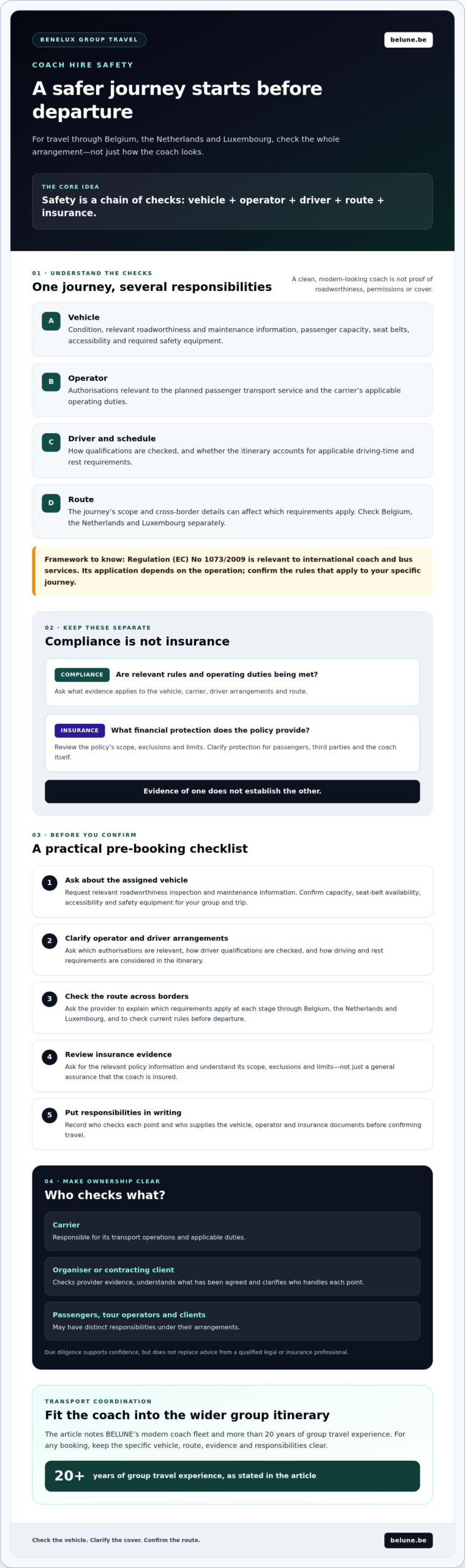
    Coach safety compliance is a chain of responsibilities, not a single certificate or visual check. It can involve the vehicle’s condition and equipment, the carrier’s operating arrangements, the driver’s qualifications and working time, and the details of the journey. For group organisers, coach hire safety regulations benelux means considering how those elements fit together across the planned route.

    A clean, modern-looking coach may be reassuring, but appearance alone can’t confirm roadworthiness, operator permissions or insurance terms. EU frameworks create shared rules in areas such as road transport, while member states also apply national requirements. The EU’s role is outlined in this overview of EU policies for the transport sector.

    For a visual reminder that passenger safety also involves clear onboard guidance, watch this coach safety video:

    Compliance and insurance serve different purposes. Compliance concerns whether the relevant safety and operating rules are met. Insurance responds to specified losses under the wording, limits and exclusions of a policy. Evidence of one doesn’t establish the other.

    Which rules can apply to an international coach journey?

    Regulation (EC) No 1073/2009 is an EU framework relevant to international coach and bus services, but its application depends on the transport operation and should be checked against the journey’s scope. Other EU rules address matters such as driving and rest times. National implementation and route details can also affect what applies. Confirm requirements separately for Belgium, the Netherlands and Luxembourg, and check current rules before departure.

    Who is responsible for checking safety and cover?

    The carrier is responsible for its transport operations and applicable duties. The organiser or contracting client has a different role: checking the provider’s evidence, understanding what has been agreed and clarifying who handles each point. Passengers, tour operators and clients may have distinct responsibilities under their arrangements. Put those responsibilities in writing before confirming travel, including who supplies vehicle, operator and insurance documents. This practical due diligence supports confidence, but it doesn’t replace advice from a qualified legal or insurance professional.

    The vehicle, operator and driver checks behind safe coach hire

    A useful safety review starts with the specific coach and journey, not a generic assurance that a fleet is modern or well maintained. Requirements can depend on the vehicle, the transport service and the route, so ask the carrier which documents and checks apply to the coach assigned to your group.

    A modern-looking coach is not the same as documented safety assurance. Evidence helps you understand what has been checked and whether the arrangements suit your itinerary.

    What vehicle documents and safety features should organisers ask about?

    Request the relevant roadworthiness inspection and maintenance information for the booked vehicle, and ask how the operator confirms it is fit for the planned service. Then match the vehicle to the group’s needs. Confirm passenger capacity, seat-belt availability and accessibility arrangements, including whether these meet any specific requirements your travellers have.

    Ask which safety equipment is carried and how the operator verifies it against current rules for the vehicle and route. Avoid assuming that one standard checklist covers every coach or journey. A cross-border itinerary may call for the provider to confirm which national requirements apply at each stage.

    How do driver and operator obligations affect the journey?

    Ask the carrier to identify the authorisations relevant to the planned passenger transport service and explain how it checks driver qualifications. Scheduling matters too: request confirmation that the itinerary accounts for applicable driving-time and rest requirements, including any driver changes or long travel days.

    Regulation (EC) No 561/2006 and Directive 2003/59/EC are useful references when discussing driving times and professional driver qualifications, but their application and current national implementation should be verified for the service. Treat them as prompts for a current, route-specific check, not as a substitute for the operator’s confirmation.

    Keep the responses together before booking. A practical evidence checklist can include:

    • Vehicle inspection and maintenance documents relevant to the assigned coach.
    • Confirmation of capacity, seat belts, accessibility and required safety equipment.
    • Details of the carrier’s relevant operating authorisation.
    • An explanation of how driver qualifications, working time and rest are managed for the itinerary.

    Passenger rights and carrier liability are also distinct from proof of vehicle condition. The EU passenger rights and carrier liability overview explains protections under Regulation (EU) No 181/2011; it doesn’t confirm the scope or limits of a specific insurance policy. For group travel planning that brings coach transport into a wider itinerary, explore BELUNE’s coach hire and group travel planning, and request the relevant vehicle and operator documents for your journey.
    Coach Hire Safety and Liability Insurance Regulations in the Benelux

    Coach liability insurance versus safety compliance: what to compare

    Insurance is a separate layer of assurance from the checks on the coach and its operation. A provider saying “we’re insured” doesn’t show which vehicle, activities, passengers or territories a policy covers. For groups comparing coach hire safety regulations benelux, request written evidence and review the actual scope, exclusions, limits and validity period. Applicable legal minima and insurance terminology can vary, so verify them for the operator, vehicle and route.

    Cover category What to clarify
    Compulsory motor insurance Ask for confirmation that the vehicle is insured for the intended passenger transport use, and clarify the relevant territorial scope. Verify current legal requirements and minimum cover with a qualified source.
    Carrier liability Ask what liability protection applies to the carrier’s passenger transport activities, and how the policy relates to claims such as passenger injury or loss or damage to belongings. The wording and applicable law matter.
    Optional additional cover Ask whether any additional cover is in place, what losses it addresses and which exclusions or limits apply. Don’t assume extra protection is included or that it fills every gap.

    These categories can overlap in how a claim is handled, but they aren’t interchangeable. Insurance also doesn’t make an unsafe vehicle compliant. It can’t replace maintenance, appropriately qualified drivers or a schedule that accounts for applicable working-time and rest requirements.

    What insurance evidence should a group organiser request?

    Request written confirmation of motor insurance for the vehicle and intended passenger use, along with details of relevant carrier liability cover, policy period, exclusions and limits. If transport is subcontracted, ask which company operates the coach and which provider will supply the documents. Make sure the evidence relates to the service actually booked, not only to a contracting intermediary.

    How should buyers compare insurance documents?

    Check the named insured parties, covered activities, territorial scope and policy validity against your itinerary. Ask who receives incident reports, manages claims and serves as the contact if an incident occurs. If a clause is unclear, or the evidence doesn’t clearly match the service, seek clarification in writing from the insurer or a qualified adviser before confirming the booking.

    A pre-booking checklist for cross-border Benelux coach journeys

    Turn due diligence into a short, written sequence before confirming the booking. For coach hire safety regulations benelux, the key is matching the evidence to the actual itinerary, operator and vehicle, then keeping track of who supplied each document. If the route, coach or provider changes, revisit the checks rather than assuming the original paperwork still applies.

    • Itinerary: Record every country, travel date, passenger needs and planned stops. Ask the carrier which permits and operating documents apply to that specific route.
    • Carrier: Confirm which company will operate the coach and whether any part of the transport is subcontracted.
    • Vehicle: Identify the coach assigned to the group and request the relevant roadworthiness, maintenance and passenger-safety evidence.
    • Driver arrangements: Ask how qualifications, scheduling and rest arrangements are managed for the itinerary.
    • Insurance: Check that the documents relate to the intended passenger service and that the territorial scope covers every country on the route.

    Keep a simple record of each response, the document received, its date and the person or company responsible for providing it. That gives the organiser a clear reference if details change or a question arises later. The same emphasis on verified licensing and reputable service applies when arranging private transfers elsewhere in Europe; travellers organising itineraries in southern Italy can discover NCC Bardi for professional local chauffeur services.

    Ask who operates the coach, whether transport will be subcontracted, and who will provide the relevant vehicle and insurance documents. Have the agreement identify the route, dates, passenger requirements and each provider’s responsibilities. Clarify how cancellations, breakdowns, replacement vehicles and incident reporting are handled, including who will communicate changes to the group.

    What should organisers confirm for multi-country itineraries?

    Request written confirmation of the permits and operating documents considered relevant to the planned route, and verify that insurance territory includes every country listed. If the route, travel dates, vehicle or operator changes, ask for updated confirmation and evidence before relying on the original file. Broader supplier coordination can also be explored in this Benelux incoming tour operator guide.

    A clear checklist supports a more considered booking, but it doesn’t replace current professional advice on legal or insurance questions. For help coordinating coach hire within a group itinerary, discuss coach transport with BELUNE.

    How BELUNE can coordinate coach transport within a group itinerary

    Coach transport works best when it’s planned as part of the journey, not treated as an isolated transfer. Accommodation, activities, passenger needs and travel between countries all shape the itinerary. As a Benelux-focused Destination Management Company, BELUNE coordinates group travel logistics and offers coach hire through its own modern fleet. The team brings more than 20 years of group travel and transport industry experience.

    That planning context can help organisers raise the practical questions early, while keeping the distinction clear: coordination doesn’t replace the need to review the provider’s current vehicle, operator and insurance information. For an overview of choosing a planning partner, see this group travel agency selection guide.

    What a DMC can clarify during group transport planning

    Share the outline of the trip while plans are taking shape. Passenger numbers, luggage, accessibility needs, dates and cross-border routing can all affect the coach arrangements to discuss. Keeping these details alongside accommodation and activities makes it easier to identify questions or dependencies before confirming suppliers.

    • Which route and travel dates should transport planning cover?
    • What passenger, luggage or accessibility needs should be considered?
    • Who will confirm the vehicle, operating company and any subcontracting?
    • Which documents and insurance details will be provided for the planned service?

    What to request from a coach provider before confirming

    Ask for current documentation relevant to the vehicle, operator and planned passenger service. Request written insurance confirmation and clarification of its scope, exclusions and validity. If another company may operate the coach, establish which provider will supply the evidence and how changes will be communicated. These checks give the group a clearer basis for discussing coach hire safety regulations benelux without assuming that any particular certificate or coverage is in place.

    Before the booking is confirmed, record the answers and note who provided each document. If the itinerary, assigned vehicle or transport provider changes, ask whether the evidence still applies and request updated information where needed. This keeps the transport plan connected to the journey as it is actually arranged.

    For a tailored discussion about coach hire and group travel planning, contact BELUNE about your itinerary. We can consider the transport requirements alongside the wider group plan, while you verify the relevant vehicle, operator and insurance documentation for your specific trip.

    Plan your next group journey with confidence

    Strong coach hire safety regulations benelux checks bring together three distinct questions: is the vehicle and operation appropriately documented, are responsibilities clear for every leg of the route, and does the insurance evidence match the service being booked? Compliance and insurance serve different purposes, so review each on its own terms and request current information for the specific journey.

    Good planning also connects transport with the wider itinerary. BELUNE brings more than 20 years of group travel and transport industry experience, operates its own modern coach fleet, and coordinates customised group itineraries and travel logistics. As with any provider, ask for the relevant vehicle, operator and insurance documents, and clarify their scope before confirming arrangements.

    Shape a considered itinerary around your group’s needs. Discuss your group transport requirements with BELUNE, including the route, passenger needs and documentation you’d like to review. With clear questions and careful coordination in place, your group can look ahead to the journey with greater confidence.

    Frequently Asked Questions

    What safety regulations apply to coach hire in the Benelux?

    Coach hire safety regulations benelux involve EU frameworks and national requirements that depend on the vehicle, service and route. Rules on international passenger transport, vehicle condition, driver qualifications and driving and rest times may be relevant. Regulation (EC) No 1073/2009 and Regulation (EC) No 561/2006 are useful references, but don’t assume every provision applies to every booking. Confirm current requirements with the carrier or a qualified adviser for the planned journey.

    Is coach liability insurance the same as motor insurance?

    No. Motor insurance relates to the vehicle and legally required motor cover, while carrier liability insurance concerns the carrier’s potential responsibility for specified losses arising from passenger transport. The policies may address different risks and can have different conditions, exclusions and limits. Ask the operator to explain which policy applies to each type of claim. A general statement that the coach is insured doesn’t establish what protection passengers or organisers have.

    What insurance documents should I ask a coach hire company for?

    Ask for written confirmation of motor insurance for the vehicle’s intended passenger use, plus details of relevant carrier liability cover. Check the insured parties, covered activities, territorial scope, policy period, exclusions and limits. If transport is subcontracted, ask which company operates the coach and whose documents apply. Keep the evidence with your booking records. If wording is unclear, seek clarification from the insurer or a qualified insurance adviser before confirming.

    Do coach safety rules change when travelling across Belgium, the Netherlands and Luxembourg?

    Some requirements are shared through EU frameworks, but national implementation and route-specific rules can differ. A cross-border itinerary may also make the operator’s documents, driver arrangements or vehicle requirements relevant to more than one jurisdiction. Ask the carrier to confirm what applies in each country on the route, including any transit countries. Recheck the details if the itinerary, vehicle or operating company changes, and verify current requirements before travel.

    How can I check whether a coach operator is compliant?

    Request current, journey-relevant evidence rather than relying on appearance or a broad assurance. Ask about the carrier’s applicable authorisations, the assigned vehicle’s roadworthiness and maintenance records, passenger safety features, and how driver qualifications and rest arrangements are managed. Confirm who will provide each document, especially if transport is subcontracted. Requirements depend on the operation, so use the evidence to raise specific questions and consult a qualified source if compliance remains unclear.

    Does liability insurance guarantee compensation after a coach incident?

    No. Insurance doesn’t guarantee that every claim will be accepted or paid. The outcome can depend on the circumstances, applicable law, policy wording, exclusions, limits and whether liability is established. Ask the provider who handles incident reporting and claims, and keep the relevant policy details accessible. Passengers may also have legal rights that are separate from an insurer’s decision. For a specific incident or disputed claim, seek qualified legal or insurance advice.
  • Ensuring Tour Group Safety in Benelux: The Complete Operator Checklist for 2026

    Ensuring Tour Group Safety in Benelux: The Complete Operator Checklist for 2026

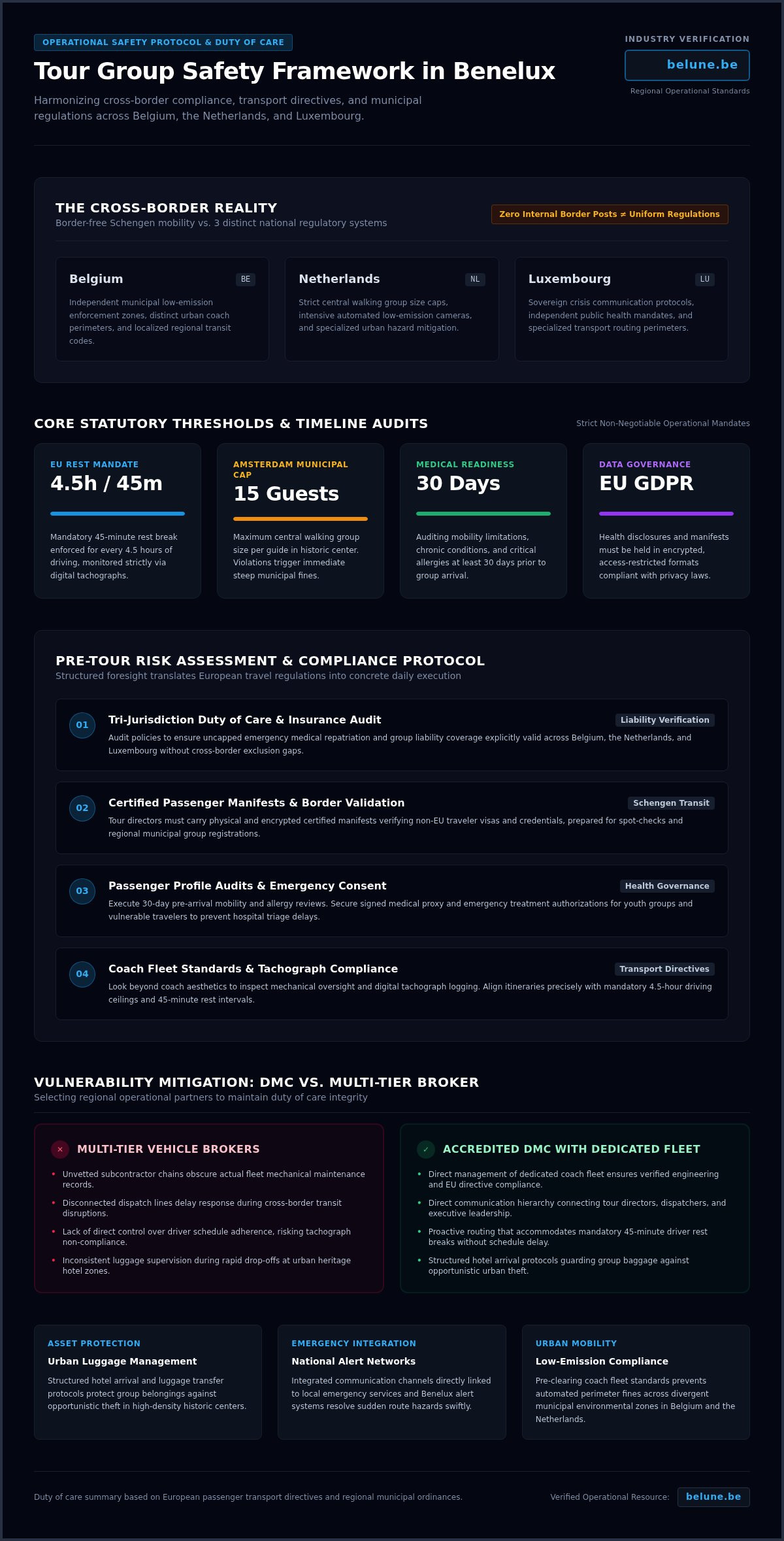
    A seamless border crossing often creates the illusion of uniform regulations. In practice, orchestrating smooth group journeys across Belgium, the Netherlands, and Luxembourg demands uncompromising vigilance beneath the surface. Navigating divergent municipal coach perimeters, automated low-emission enforcement, and distinct national emergency networks proves that ensuring tour group safety in Benelux requires proactive operational alignment across transport, accommodation, and ground management.

    You already know that safeguarding international travelers while preserving the cadence of an ambitious multi-country itinerary is a demanding craft. You shouldn’t have to compromise between clockwork punctuality and non-negotiable guest protection. In this guide, discover the essential operational protocols, transport standards, and vetting procedures to ensure uncompromising safety for tour groups across the Benelux. We provide an exhaustive operational safety checklist spanning pre-departure fleet verification, cross-border transit compliance, and expert on-site coordination to satisfy the highest European duty of care standards.

    Key Takeaways

    • Establish proactive duty of care frameworks that seamlessly harmonize divergent municipal access rules and safety regulations across Belgium, the Netherlands, and Luxembourg.
    • Maintain uncompromised compliance with European driver rest mandates and smart fleet standards, which remain foundational to ensuring tour group safety in Benelux.
    • Implement structured hotel arrival and luggage management protocols to protect group assets against opportunistic urban theft in high-density heritage centers.
    • Build resilient on-the-ground communication channels integrated with local emergency networks and national alert systems to resolve unexpected disruptions swiftly.
    • Mitigate operational vulnerabilities by partnering with an accredited regional DMC that manages its own dedicated coach fleet rather than relying on multi-tier vehicle brokers.

    The Benelux Group Safety Framework: Pre-Tour Risk Assessment Checklist

    Flawless group operations depend on structured foresight. While diplomatic advisories provide general regional alerts, professional organizers require an operational risk checklist built around legal liability, logistical synchronization, and group dynamics. Successfully ensuring tour group safety in Benelux starts months before departure, translating European travel regulations into concrete daily procedures. Established through decades of regional integration within the Benelux Union, the absence of physical border posts can obscure the fact that Belgium, the Netherlands, and Luxembourg maintain independent public health mandates, municipal vehicle codes, and crisis protocols.

    Preparation demands a rigorous Duty of Care baseline. Operators must audit policy documents to confirm uncapped emergency medical repatriation and group liability coverage that explicitly functions across all three sovereign jurisdictions. Establish clear communication hierarchies linking tour directors, motor coach dispatchers, and executive leadership. Partnering early with an experienced benelux incoming tour operator provides direct access to vetted regional contingency networks, turning complex compliance standards into smooth on-the-road execution.

    To better understand regional street dynamics and urban group awareness, watch this helpful video on local safety considerations:

    Cross-Border Regulatory Compliance and Documentation

    Internal Schengen mobility simplifies transit, yet passport validity and visa requirements remain non-negotiable. Tour leaders must carry certified passenger manifests verifying non-EU guest credentials at every stage. For student groups or corporate delegations, regional administrative registrations may apply. Historic city centers enforce strict municipal group thresholds. Amsterdam, for instance, caps central walking groups at 15 participants per guide. Aligning your group numbers with local ordinances prevents steep fines and preserves your operational timeline.

    Passenger Profile Audits and Special Requirements

    Vigilance extends to individual passenger welfare. Robust data protocols are vital for ensuring tour group safety in Benelux across varied demographics:

    • Medical Readiness: Audit mobility limitations, chronic conditions, and critical allergies at least 30 days prior to arrival.
    • Data Governance: Manage all traveler health disclosures under strict European GDPR privacy standards, ensuring digital files are encrypted and access-restricted.
    • Legal Authorizations: Secure signed medical proxy and emergency treatment consents for youth groups and vulnerable travelers to avoid delays during hospital triage.

    Transportation Safety Protocols: Coach Fleet Standards and EU Directives

    Precision on the road defines passenger protection. While generic travel advice centers on individual public transport awareness, managing forty guests across motorways requires rigorous mechanical oversight and statutory compliance. Transportation forms the mechanical backbone of any cross-border circuit. When ensuring tour group safety in Benelux, tour organizers must look beyond vehicle aesthetics and verify the precise engineering and operational standards governing commercial coach transit.

    EU Driver Hours and Digital Tachograph Regulations

    Legal compliance protects lives and schedules alike. Cross-border passenger transport across Belgium, the Netherlands, and Luxembourg operates under strict EU driving time and rest period regulations. Professional drivers must adhere to mandatory driving limits, including a non-negotiable 45-minute rest break for every 4.5 hours behind the wheel. Drivers must also produce tachograph records covering the current day and the preceding 56 days during roadside audits.

    Carefully calibrated itineraries actively prevent driver fatigue. When scheduling extensive cultural excursions or full-day battlefield memorial circuits, build mandatory rest periods directly into museum visits and guided meals. When transfers exceed standard single-driver shift thresholds, dispatching a secondary relay driver guarantees uninterrupted progress without violating European labor laws.

    Fleet Maintenance and Technical Onboard Security

    Mechanical audits require verifiable paper trails rather than informal assurances. Before any multi-country transfer begins, verified vehicle checks must assess critical onboard safety architecture:

    • Restraint and Structural Systems: Confirm functional three-point seat belts at every seat, calibrated electronic stability controls, and unimpeded emergency roof and window exits.
    • Advanced Driver Assistance: Deploy vehicles equipped with mandatory General Safety Regulation technologies, including blind spot sensors, lane monitoring, and automated emergency braking.
    • Emergency Preparedness: Inspect onboard commercial medical kits, certified multi-class fire extinguishers, and high-visibility road safety markers.

    Subcontracting transfers to fragmented third-party booking brokers introduces unpredictable fleet age and maintenance gaps. Partnering with a dedicated specialist offering charter coach hire with a privately owned fleet provides direct control over vehicle servicing schedules, seasoned bilingual drivers, and full digital tachograph tracking, providing peace of mind from departure to arrival. Maintaining complete visibility over vehicle maintenance and driver shifts remains the most reliable strategy for ensuring tour group safety in Benelux.

    Ensuring Tour Group Safety in Benelux: The Complete Operator Checklist for 2026

    Accommodation and Public Site Security: Mitigating Crowds and Urban Hazards

    Static locations present operational risks just as dynamic transit corridors do. Historic European quarters charm travelers with winding cobblestone lanes and grand civic squares, yet these picturesque environments also concentrate crowd pressure and create vulnerabilities for large parties. Successfully ensuring tour group safety in Benelux demands meticulous site-level auditing, extending protective oversight directly into hotel lobbies, museum foyers, and bustling pedestrian networks.

    Hotel Safety Standards and Group Room Allocation

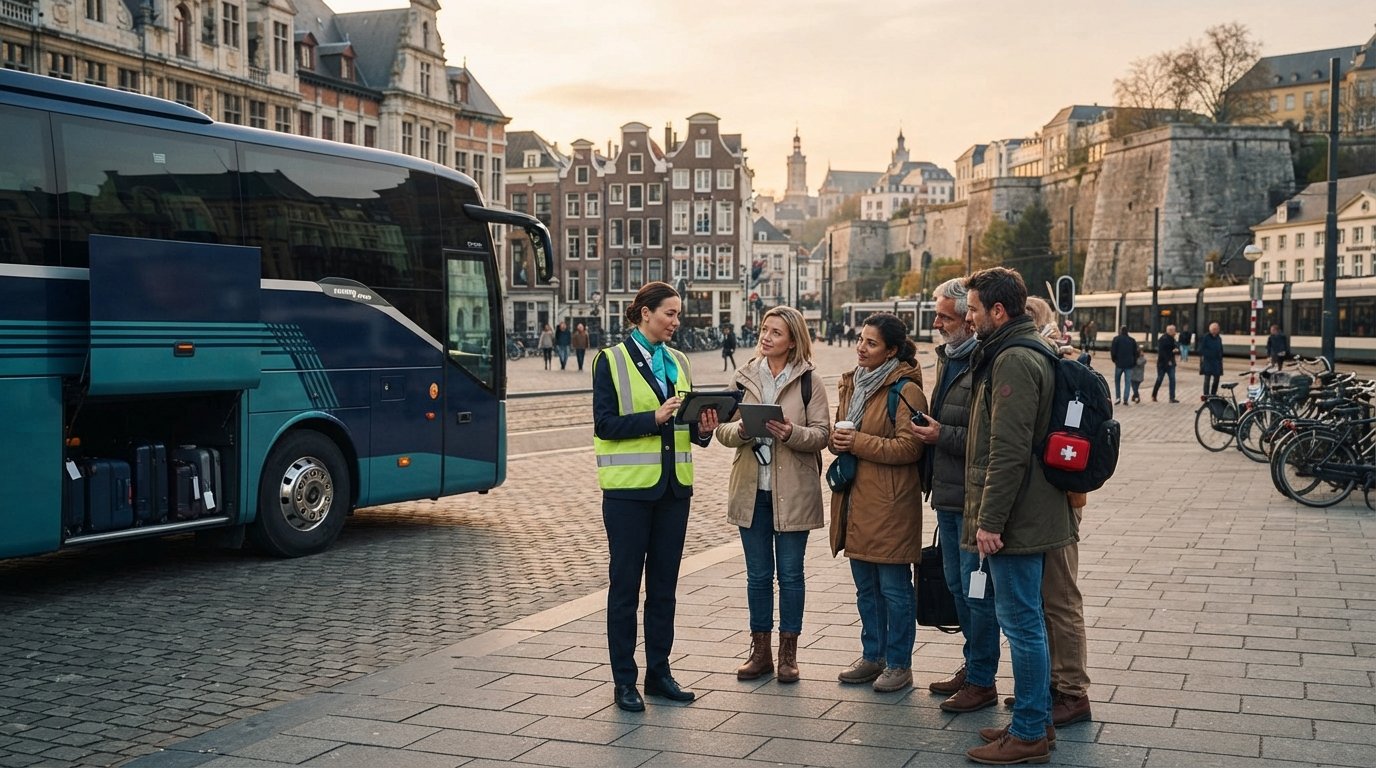
    Lobby arrival marks a critical window of vulnerability. When forty weary guests alight simultaneously, opportunistic baggage theft peaks. Tour managers should enforce a “sterile check-in” protocol: luggage remains locked inside coach cargo bays until the group clears reception, or bags are transferred directly into a private, locked holding salon monitored by dedicated staff.

    Accommodations must undergo comprehensive safety vetting before bookings are finalized:

    • Evacuation Readiness: Verify clear primary and secondary stairwell egress routes, illuminated multilingual signage, and active municipal fire certification.
    • Strategic Room Clustered Allocation: Concentrate group rooms across continuous corridors on lower levels. This layout simplifies headcounts, restricts unauthorized corridor access, and expedites swift evacuation during nighttime fire alarms.
    • Transit Synchronization: Coordinate check-in timeframes strictly with coach drop-off slots, ensuring logistics align smoothly with regional transport schedules and EU driving time and rest period regulations to avoid curbside congestion.

    Crowd Management at High-Density Heritage Sites

    Dense heritage spaces demand active spatial management. Drawing from operational methodologies perfected across high-footfall culture group tours benelux, professional tour leaders use precise choreography rather than reactive herding. In crowded plazas like Brussels’ Grand-Place or along Amsterdam’s canal rings, guides maintain steady pacing to keep groups cohesive without obstructing local bicycle paths.

    Mitigating urban pickpocketing requires layered structural deterrence. Prior to disembarking, tour leaders brief guests on local diversion tactics, such as staged petitions or artificial street squabbles. Each traveler carries a discreet emergency pocket card with hotel addresses and guide contact numbers. Guides establish distinct secondary muster points outside crowded squares, so anyone briefly separated rejoins the party within minutes. Proactive spatial awareness keeps guests secure, relaxed, and fully immersed in the cultural narrative, achieving total peace of mind while ensuring tour group safety in Benelux.

    On-the-Ground Incident Response and Crisis Management Protocols

    Operational resilience is tested when the unexpected strikes. Even the most polished itinerary encounters sudden disruptions, from acute illnesses to misplaced passports in bustling train stations. Managing these friction points separates seasoned group organizers from unprepared operators. Swift resolution relies on an established escalation chain connecting field leaders, motor coach drivers, and operations control. When ensuring tour group safety in Benelux, having structured protocols eliminates panic and ensures coordinated action within minutes.

    Every field manager must understand regional emergency mechanics. While the universal European number 112 routes calls across Belgium, the Netherlands, and Luxembourg, national infrastructure varies. Belgium maintains 101 as a direct line for police dispatch, while cell-broadcast emergency networks like NL-Alert and LU-Alert broadcast geo-targeted warnings directly to mobile phones. Certified multilingual local guides provide invaluable human support during crises. By communicating fluently in Dutch, French, or German, they eliminate linguistic friction with local paramedics, clinic administrators, and police officers.

    Medical Emergency Procedures and Hospital Coordination

    Pre-mapping healthcare infrastructure prevents chaotic scrambling during acute medical events. Field staff must carry route-specific directories of university clinics and emergency medical centers across Brussels, Antwerp, Amsterdam, and Luxembourg City. If a passenger requires hospital triage, the local guide stays on-site to assist with translation, intake paperwork, and insurance authorizations. Meanwhile, dispatch maintains direct liaison lines with sending agencies and family contacts, keeping all stakeholders informed without disrupting the broader group schedule. When a recovering traveler needs professional assistance to travel home safely after medical evaluation, resources like rnmedflights.com coordinate airline flight accompaniment to ensure continuous care throughout transit.

    Crowded historic districts occasionally separate travelers from their cohort. A structured response protocol preserves group momentum while resolving the issue:

    • The 15-Minute Rule: If a traveler misses an appointed muster, the guide conducts a focused perimeter check around designated secondary meeting points before notifying attraction security and local authorities.
    • Digital Document Vault: Secure, encrypted cloud copies of passenger passports allow rapid identity verification and expedite consular appointments for emergency travel certificates.
    • Real-Time Broadcasts: Mobile messaging groups provide immediate instructions to guests during transit hiccups, keeping travelers informed and preventing independent wandering.

    To back your itineraries with certified multilingual guides and seasoned regional support, partner with our experienced ground management team. Ground-level expertise remains the decisive factor in ensuring tour group safety in Benelux when unexpected crises arise.

    Partnering for Safety: Selecting an Accredited Benelux DMC

    Strategic risk mitigation begins with choosing the right regional partner. While outbound travel organizers can map high-level transit corridors and draft contingency outlines, ground reality requires immediate local command. Entrusting guest security to an unverified third party introduces structural blind spots that no remote dispatch desk can resolve. Reviewing the definitive guide to choosing a group travel agency in 2026 provides a clear procurement roadmap, demonstrating that regional competence is ultimately an exercise in proactive risk management.

    Essential Vetting Criteria for Incoming Tour Operators

    Auditing prospective Destination Management Companies demands rigorous verification of their operational baseline. When evaluating local partners, prioritize verifiable legal and logistical infrastructure:

    • Licensing and Insurance Protections: Request current certificates of comprehensive professional group liability insurance, official corporate registrations, and recognition from national travel trade associations across Belgium, the Netherlands, and Luxembourg.
    • Specialized Operational Track Record: Review the DMC’s demonstrated experience orchestrating sensitive programs, such as specialized educational journeys, complex event logistics, or commemorative pilgrimages across flanders fields.
    • Contractual Service Level Agreements: Insist on clear clauses establishing guaranteed driver relief timelines, vehicle replacement windows, and transparent supplier vetting criteria.

    The Operational Safety Advantage of BELUNE

    BELUNE transforms cross-border complexity into effortless travel experiences. Backed by over 20 years of dedicated experience in European group logistics, our team coordinates multi-country itineraries with technical precision and care. Rather than functioning as a digital intermediary, we maintain direct control over key journey components, fundamentally reinforcing our capacity for ensuring tour group safety in Benelux.

    Our privately owned modern coach fleet represents a critical safety advantage. Booking through decentralized transport brokers leaves vehicle condition, maintenance records, and driver compliance to chance. BELUNE manages its own vehicles under rigorous European Union technical standards. Every bus receives continuous mechanical monitoring, features advanced driver assistance systems, and is operated by experienced, certified drivers trained in defensive maneuvering.

    Complementing our fleet is an established network of audited hotel partners and licensed local multilingual guides. Dedicated project coordinators manage movements proactively, resolving urban restrictions and scheduling nuances before they impact passenger comfort. To safeguard your travelers with proven operational excellence, request your customized Benelux group tour itinerary and build your next journey upon an unyielding foundation of safety.

    Mastering Operational Excellence and Traveler Safety in Benelux

    Exceptional journeys rest upon quiet, uncompromising preparation. Truly ensuring tour group safety in Benelux requires harmonizing cross-border transit logistics, maintaining rigorous motor coach fleet standards, and deploying proactive crowd and crisis protocols before travelers ever arrive. When you eliminate operational friction behind the scenes, your guests remain free to experience the region’s rich cultural tapestry with complete serenity.

    You don’t have to navigate these intricate regulatory landscapes alone. Backed by over 20 years of regional group travel expertise, a privately owned fleet of modern coaches compliant with strict EU safety directives, and an established network of vetted hotels and certified multilingual guides, we transform duty of care into an art form. Partner with BELUNE for secure, expertly managed group itineraries in Benelux and deliver an extraordinary European journey where traveler well-being and elevated hospitality move hand in hand.

    Frequently Asked Questions

    What is the universal emergency number for tour groups traveling within the Benelux?

    112 is the universal emergency telephone number across Belgium, the Netherlands, and Luxembourg. Calling 112 connects group leaders immediately to local emergency dispatchers for medical, fire, or police assistance. In Belgium, travelers can also reach police authorities directly via 101. Operators should remind tour directors to verify that guest mobile devices have active roaming and support regional alert broadcasts like NL-Alert and LU-Alert for real-time safety advisories.

    How do European driver hours regulations affect multi-day Benelux tour itineraries?

    European driver hours legally mandate maximum driving periods and strict rest intervals, directly governing daily itinerary feasibility. Under EU rules, professional coach drivers must take at least 45 minutes of rest for every 4.5 hours of driving. Tour planners must synchronize transfer legs with extended sightseeing stops or deploy secondary relay drivers for longer routes. Respecting these statutory cycles avoids costly fines and fatigue, which is essential to ensuring tour group safety in Benelux.

    What security precautions should tour leaders take against pickpocketing in major Benelux cities?

    Tour leaders should provide concise situational briefings and maintain tight group awareness in crowded historic centers. Advise guests on common street distractions, such as staged petitions or aggressive street sellers, before disembarking from the coach. Equip travelers with pocket cards containing hotel details and local guide contacts, mandate secure cross-body bags, and establish clear secondary muster points so separated travelers can reunite with the group without delay.

    Are hotels in the Benelux region strictly required to meet European fire safety codes?

    Yes, all commercial lodging properties across Belgium, the Netherlands, and Luxembourg must comply with strict municipal and European fire protection standards. These legal frameworks mandate illuminated evacuation signage, automatic smoke detection systems, and unobstructed stairwells. Organizers should still verify safety compliance with properties beforehand, requesting clustered room assignments on lower levels to facilitate swift, orderly group evacuations during nighttime emergency drills.

    What role does a Destination Management Company play in managing group emergencies on the ground?

    A Destination Management Company serves as the essential operational safety net when unexpected disruptions arise on the ground. An established regional partner coordinates immediately with local authorities, arranges medical translation via licensed local guides, and organizes backup transportation if technical issues occur. Their regional supplier relationships and logistical oversight ensure that minor disruptions don’t compromise passenger security or derail carefully scheduled travel days.

    How should group organizers handle passenger medical needs across multiple Benelux borders?

    Organizers must collect passenger health histories, mobility constraints, and severe allergy profiles well before departure while verifying comprehensive cross-border medical insurance. Store traveler medical disclosures in encrypted formats compliant with European GDPR standards so tour leaders can access them quickly during emergencies. Having multilingual local guides on hand bridges communication gaps at local clinics, a vital element in ensuring tour group safety in Benelux during unexpected medical consultations.

    Why is an owned coach fleet considered safer than brokered charter transportation for group travel?

    An owned coach fleet guarantees direct operational control over vehicle condition, maintenance schedules, and driver employment standards. Charter brokers frequently outsource transfers to third-party sub-haulers with variable safety records and inconsistent rest-hour oversight. Operating a private, modern fleet ensures that every motor coach meets rigorous European Union safety criteria, undergoes systematic mechanical inspections, and is operated by dedicated drivers trained in defensive road safety.

  • Mastering the Seamless Group Travel Experience in Benelux for 2026

    Mastering the Seamless Group Travel Experience in Benelux for 2026

    The most captivating multi-country itineraries often fail not for a lack of beauty, but for a lack of invisible precision. According to 2024 reports from the European Tourism Association, 68% of travel planners cite cross-border logistics as their primary operational hurdle when coordinating group movements. Achieving a seamless group travel experience benelux in 2026 isn’t just about selecting the right destinations; it’s about the silent harmony of every moving part. You’ve likely felt the tension of managing varying hotel standards or the sudden sting of hidden costs that erode your B2B margins. It’s a delicate balance that demands a visionary approach to tour conception and a rigorous attention to detail.

    We understand that your reputation rests on the flawless execution of these moments. This article reveals the logistical secrets and expert strategies required to orchestrate sophisticated group itineraries across Belgium, the Netherlands, and Luxembourg. You’ll discover how to navigate complex transport regulations and secure reliable, multilingual guides who act as true ambassadors of your brand. We’ll explore how to transform these logistical challenges into a refined journey that ensures high client satisfaction and fixed-price certainty for your 2026 season.

    Key Takeaways

    • Master the art of cross-border coordination by understanding the nuanced logistical requirements for Belgium, the Netherlands, and Luxembourg in the 2026 landscape.
    • Ensure a seamless group travel experience benelux by utilizing private, modern coach fleets to navigate the intricate “last mile” challenges of historic European city centers.
    • Learn to design sophisticated, theme-based itineraries that harmonize historical depth, such as WWI pilgrimages, with contemporary luxury and technical precision.
    • Prepare for the evolving 2026 travel environment by mastering essential lead times and navigating new regulatory requirements like ETIAS for flawless execution.
    • Discover how partnering with a specialized local DMC transforms complex logistics into a refined, visionary journey that safeguards your brand’s reputation and excellence.

    Defining the Seamless Group Travel Experience in Benelux

    Precision defines the modern journey. For professional tour operators, a seamless group travel experience benelux in 2026 isn’t a luxury; it’s a technical requirement. It represents the invisible orchestration of movement, where the transition between the Dutch polders and the Belgian Ardennes feels entirely natural. This fluidity requires more than a fleet of vehicles. It demands a visionary approach to logistics that treats the entire region as a single, harmonious canvas. We don’t just move people; we curate their path through a complex landscape.

    While the Benelux Union has provided a framework for economic and political cooperation since its formal inception in 1944, the practical reality of moving 40 travelers across three borders involves navigating distinct municipal regulations and cultural expectations. A unified logistical approach is the only way to bypass the fragmentation that often plagues cross-border itineraries. It’s about moving beyond basic transport. We focus on all-inclusive group management where every detail, from parking permits in historic centers to precise timing for museum entries, is mastered before the engine starts.

    The Three Pillars of Fluidity

    Administrative ease centers on the digital horizon. By 2026, the ETIAS system will be a standard gatekeeper for international arrivals. Managing these clearances for large groups requires a meticulous, proactive strategy to avoid delays at the first point of entry. Physical comfort relies on the architecture of the vehicle. We prioritize modern coach fleets that serve as mobile sanctuaries, offering ergonomic serenity and high-speed connectivity between destinations. Intellectual depth remains the soul of the trip. Local guides act as the bridge, transforming a simple view into a profound insight through their mastery of local nuance.

    B2B Benefits of Integrated Logistics

    Integrated logistics remove the hidden friction that occurs when multiple providers fail to align. This synergy allows for fixed-price certainty, an essential tool for financial forecasting in a market where operational costs can be volatile. Consistency is the final hallmark. Whether a group is in the heart of Amsterdam or the heights of Luxembourg City, the quality of service must remain unyielding. By eliminating the gaps between different national territories, we provide a seamless group travel experience benelux that protects the reputation of our professional partners. It’s a commitment to excellence that ensures the traveler’s only task is to appreciate the beauty of the surroundings.

    The Logistical Architecture of a Flawless Cross-Border Tour

    Excellence in travel isn’t an accident. It’s the result of rigorous technical mastery and a deep understanding of the terrain. To create a seamless group travel experience benelux, one must treat logistics as a form of art where every movement between Brussels, Antwerp, and Amsterdam is part of a silent, powerful infrastructure. This invisible architecture ensures that the guest only feels the emotion of the journey, never the friction of the transition.

    Private Transport as a Strategic Asset

    Owning a private, modern coach fleet is the foundation of reliability. It allows for absolute control over maintenance schedules and driver training. In 2026, navigating the Benelux region requires more than just a vehicle; it demands a commitment to sustainability. Modern Euro VI coaches, which reduce nitrogen oxide emissions by approximately 80% compared to older generations, are now the standard for entering the Low Emission Zones (LEZ) of cities like Ghent or Rotterdam.

    Precision timing is another pillar of this asset. Drivers strictly adhere to EC Regulation 561/2006, which mandates a 45-minute rest period for every 4.5 hours of driving. We calculate these intervals into the itinerary to ensure safety without sacrificing the pace of the tour. When coordinating entry into the country, professionals often rely on the U.S. Department of State travel information for Belgium to stay updated on the latest safety protocols and entry requirements. This level of foresight transforms a simple transfer into a strategic maneuver.

    Accommodation Management for Large Groups

    Vetting a hotel for a large group involves more than counting beds. It’s about the flow of the space. We prioritize properties that offer dedicated group check-in desks and 24-hour luggage handling to eliminate bottlenecks. The challenge often lies in the “last mile” of historic European centers. A hotel might be aesthetically perfect, but if a 14-meter coach can’t access the entrance, the experience is compromised.

    • Accessibility: Ensuring hotels have designated coach bays or nearby parking logistics.
    • Dining: Vetting kitchens for their ability to serve high-quality, simultaneous group meals.
    • Digital Accuracy: Managing rooming lists with 0% error margins to ensure specific requirements are met upon arrival.

    The “Invisible Hand” of on-the-ground support is what truly defines a seamless group travel experience benelux. If a sudden street closure occurs in Bruges, real-time coordination redirects the coach before the group even notices a change in the route. This proactive stance turns potential disruptions into mere footnotes. At Belune, we believe that technical precision is the only way to achieve true elegance in motion, ensuring every project is handled with a visionary touch.

    Curating Themed Itineraries: From Battlefield Pilgrimages to Culinary Arts

    Travel is a narrative. To design a seamless group travel experience benelux in 2026, planners must move beyond generic sightseeing toward structured storytelling. Themed itineraries don’t just fill a schedule; they provide a cohesive lens through which a group can interpret the landscape, history, and soul of a region. By sculpting these niche experiences, we transform a standard trip into a bespoke journey that reflects the specific intellectual curiosities of the travelers.

    The art of the culinary tour has evolved into a sophisticated exploration of craft. It’s no longer sufficient to offer basic tastings; modern groups seek the story behind the plate. In 2024, Belgium celebrated 153 Michelin-starred establishments, a number expected to grow by 2026 as sustainability becomes a core culinary pillar. Our belgium gastronomy tours prioritize private access to artisan workshops and farm-to-table estates where the harmony between raw ingredients and refined technique is on full display. This level of intentionality ensures every meal feels like a curated event rather than a logistical necessity.

    Battlefield Tourism and Remembrance

    Remembrance requires a delicate touch and technical precision. Designing educational itineraries for flanders fields involves balancing the gravity of historical sites with the comfort required for group reflection. We coordinate directly with local museums and commemorative organizations to facilitate private ceremonies or expert-led tours. These guides don’t just recount the 600,000 casualties of the Ypres Salient; they weave human stories into the physical geography, providing a profound connection to the past that resonates long after the tour ends.

    Art and Culture Across Borders

    The Benelux region serves as a living gallery where architectural movements and canvas masterpieces intersect. Developing culture group tours benelux allows us to bridge the 17th-century Dutch Golden Age with the 19th-century Belgian Art Nouveau movement. We secure group bookings for high-demand institutions like the Rijksmuseum or the Horta Museum months in advance, bypassing the typical 45-minute wait times. These themed group travel benelux options cater to niche interests, from structural architecture to oil painting techniques, ensuring a seamless group travel experience benelux that feels both effortless and intellectually stimulating. By integrating these cultural threads, we create a rhythmic flow between cities that highlights the shared heritage of the Low Countries.

    Strategic Planning: A Tour Operator’s Checklist for 2026

    Achieving a seamless group travel experience benelux requires more than just logistical coordination; it demands a visionary approach to timing and precision. By 2026, the European travel landscape will have shifted significantly with the full implementation of the ETIAS (European Travel Information and Authorisation System). This digital mandate, scheduled to be mandatory by mid-2025, adds a layer of pre-departure verification that tour operators must integrate into their initial client briefings. Precision in documentation is no longer an option. It is the foundation of a successful journey.

    The 12-Month Planning Cycle

    Mastery over an itinerary begins exactly 365 days before the first guest arrives. This timeline ensures that the harmony of the tour remains undisturbed by availability constraints. We view this cycle as a three-phase architectural build.

    • Phase 1: Concept and fixed-price quotation. Between month 12 and 10, define the aesthetic of the trip. In a fluctuating economy, locking in rates early protects your margins and builds client trust.
    • Phase 2: Securing logistical anchors. From month 9 to 6, focus on transport and hotels. Prime hotel inventory in Amsterdam and Brussels for 2026 is expected to reach 85% occupancy for peak spring dates by late 2025.
    • Phase 3: Finalizing local guide services and site access. In the final five months, secure the human element. Exclusive entries to locations like the Mauritshuis or the Grand Place require early reservations to avoid the crowds that disrupt the group’s flow.

    Vetting Your DMC Partner

    Selecting a benelux incoming tour operator is a strategic decision that influences every touchpoint of the traveler’s journey. A partner shouldn’t just provide services. They should act as an extension of your brand’s commitment to excellence. 2026 demands partners who own their local infrastructure or maintain decades-long relationships with transport providers to mitigate the risks of sudden logistical shifts. Verify that your partner offers 24/7 multi-lingual support, ensuring that any unforeseen deviation is handled with quiet efficiency rather than panic.

    Risk management in Western Europe has evolved. Beyond standard insurance, operators now prioritize partners who demonstrate a deep understanding of urban mobility shifts, such as the new low-emission zones in Ghent and Antwerp. Reliability is measured in references and the ability to create bespoke, creative itineraries that transcend the typical tourist path. Expertise is the light that guides your clients through the complexities of the Benelux region. We look for partners who treat every itinerary as a unique piece of art, balancing technical rigor with sensory appeal.

    To ensure your next project meets these exacting standards, consult with our expert travel designers for a tailored partnership approach.

    Elevating Your Portfolio with a Specialized Benelux DMC

    Twenty years of operational history isn’t just a milestone. It’s the ultimate safeguard for your brand reputation. Since 2005, BELUNE has refined the art of the seamless group travel experience benelux, ensuring that every logistical nuance aligns with your clients’ expectations. We don’t just move people; we curate environments. Our approach balances the technical precision of a logistics firm with the artistic vision of a local historian. This mastery allows us to transform a standard itinerary into a collection of meaningful moments.

    Standardized tours often fail to capture the soul of a destination. In 2026, travelers demand more than a checklist of monuments. They seek the hidden breweries of the Ardennes or the private art collections in Ghent. We provide the architecture where customization thrives. By finding the right balance between proven itineraries and niche interests, we help you secure a competitive edge. It’s about creating a program that feels handcrafted rather than mass-produced.

    The BELUNE Difference

    Our private fleet represents the heart of our service. These modern coaches are designed for comfort and efficiency, serving as mobile sanctuaries between destinations. We prioritize the silence of the ride and the clarity of the view. Our team consists of multilingual experts who specialize in the cultural pillars of the region: art, history, and gastronomy. We act as a dedicated extension of your own brand, providing a seamless A-to-Z partnership that removes the burden of ground management from your shoulders.

    • Modern Fleet: Low-emission, high-comfort vehicles that meet 2026 sustainability standards.
    • Expert Guides: Specialists who translate complex history into engaging narratives.
    • Total Coordination: From hotel blocks to restaurant reservations, we manage every detail.

    Next Steps for Tour Operators

    Building a successful 2026 program requires early intervention and strategic planning. You can start by requesting a custom quote tailored to a specific group profile, whether they’re luxury seekers or academic explorers. We also offer specialized consulting for niche theme development. If you’re looking to integrate high-end cycling routes through Limburg or exclusive beer tastings in Westvleteren, we have the local connections to make it happen.

    Now is the time to begin finalizing your 2026 brochure with a group travel agency partner that understands the nuances of the Benelux region. We invite you to collaborate with us to create a seamless group travel experience benelux that resonates with your audience. Let’s design a journey that reflects the excellence of your brand and the timeless beauty of our home.

    Designing Your 2026 Benelux Vision

    Success in the 2026 travel season hinges on the delicate balance between logistical precision and emotional resonance. By integrating strategic cross-border architecture with specialized themed itineraries, operators transform a standard tour into a masterpiece of movement. It’s about finding the perfect harmony between historical depth and modern comfort. Our team leverages over 20 years of expertise in Benelux logistics to ensure every detail remains flawless. With a private fleet of modern coaches and a dedicated approach to specialized themed tour design, we provide the technical foundation for your creative vision. Achieving a seamless group travel experience benelux demands this level of artisanal care and local mastery. We’re here to act as your strategic ally, guiding your projects from initial conception to final realization. Let’s elevate your portfolio with a partnership built on excellence and trust. We’ll handle the technical nuances while you focus on the inspiration.

    Request your custom Benelux group travel proposal for 2026

    The path to an exceptional 2026 season starts with a single, inspired step toward collaboration.

    Frequently Asked Questions

    What is the role of a DMC in the Benelux region?

    A Destination Management Company acts as the local architect of your journey, orchestrating logistics, venue selection, and cultural immersion across Belgium, the Netherlands, and Luxembourg. We provide the technical precision and creative vision needed to design a seamless group travel experience benelux. Our team manages 100% of ground operations to ensure every detail aligns with the high standards expected by international tour operators.

    How does the ETIAS impact group travel in 2026?

    The European Travel Information and Authorisation System becomes a mandatory requirement for visa-exempt travelers entering the Schengen Area starting in mid-2025. By the 2026 season, every visitor must possess this 7-euro authorization before arrival. We monitor these regulatory shifts to ensure your group meets all entry protocols for the 30 participating European countries without any technical delays at the border.

    Can you provide private coaches for cross-border tours into France and Paris?

    We operate a dedicated fleet of premium coaches licensed for international transit between Benelux and French territories. Our logistics network includes 50-seater executive vehicles that facilitate direct transfers to Paris or the northern French regions. This cross-border capability allows for a fluid transition between cultures while maintaining the same level of comfort and reliability throughout the entire itinerary.

    Do you offer fixed-price packages for tour operators?

    Our pricing structure for tour operators is built on a transparent net-rate model that provides cost certainty for the 2026 season. We deliver comprehensive quotes that include all local taxes, driver fees, and guided services to prevent budget fluctuations. This fixed-rate approach allows partners to market their tours with confidence, knowing the financial foundation of the project is secure and clearly defined.

    What languages do your local guides speak?

    Our network of professional guides offers fluency in 12 major languages, including English, French, Dutch, German, and Spanish. Each guide is selected for their ability to articulate the historical and architectural nuances of the region with passion and precision. We match your group with a specialist who speaks your native tongue to ensure every cultural detail is communicated with absolute clarity.

    How do you handle dietary restrictions in group gastronomy tours?

    We manage dietary requirements by coordinating directly with our culinary partners 30 days before the group arrives. Our team audits every menu to accommodate 100% of specific needs, including vegan, gluten-free, or religious restrictions. We treat gastronomy as a sensory experience where no guest is left behind, ensuring the harmony of the meal remains intact for every participant in the group.

    What is the typical group size for your Benelux itineraries?

    Our itineraries are optimized for groups ranging from 15 to 45 participants to maintain an intimate and high-quality atmosphere. This specific size range allows us to secure exclusive access to boutique venues and historical sites that can’t accommodate larger crowds. By limiting group numbers, we ensure a seamless group travel experience benelux where movement is fluid and every guest receives personal attention.

    How far in advance should we book for the 2026 season?

    We recommend finalizing bookings at least 12 to 18 months in advance to secure the most prestigious accommodations and expert guides for 2026. High-demand periods, such as the April tulip season or summer festivals, often reach 90% capacity a full year ahead of time. Early planning allows us to refine every technical detail and craft a bespoke journey that meets our standards of excellence.

  • Mastering Group Travel Logistics in Benelux: A Strategic Guide for 2026

    Mastering Group Travel Logistics in Benelux: A Strategic Guide for 2026

    The true measure of a luxury journey isn’t found in the destination, but in the invisible harmony of its movement. For many planners, the reality of managing group travel logistics benelux often feels like a fragmented puzzle of varying languages and conflicting transport standards. According to a 2025 industry report by Global Group Insights, 72% of travel organizers struggle to maintain a consistent quality of service when crossing the borders of Belgium, the Netherlands, and Luxembourg. It’s a delicate balance that requires more than just a map; it demands a visionary approach to coordination.

    We understand that you seek a cohesive narrative for your clients, not a series of disconnected transfers. You’ll discover how to navigate the intricate cross-border requirements of 2026 to deliver a seamless, high-end experience that feels curated from start to finish. This guide provides a strategic blueprint for securing premium private coach transport and establishing a single point of contact for every detail. We’ll examine the technical nuances of local regulations and the art of bespoke itinerary design to ensure your next group voyage is a masterpiece of efficiency.

    Key Takeaways

    • Learn how to synchronize cross-border movements across Belgium, the Netherlands, and Luxembourg to ensure a fluid, uninterrupted travel experience.
    • Master the complexities of group travel logistics benelux by adopting a managed mobility model that prioritizes group harmony over simple transport.
    • Discover why specialized local knowledge is the ultimate safeguard against regional pitfalls, road closures, and seasonal disruptions.
    • Implement a strategic logistical audit to verify route feasibility and maintain the sophisticated rhythm of high-end group itineraries.
    • Explore how direct control over premium assets and a private fleet can elevate a standard tour into a bespoke, seamless journey.

    The Complexity of Group Travel Logistics in the Benelux Region

    Belgium, the Netherlands, and Luxembourg represent far more than a collection of neighboring states; they function as a unified, high-velocity travel corridor. This territory, historically defined by the Benelux Union, presents a logistical puzzle that demands both technical rigor and creative vision. By 2026, the primary challenge for international operators has shifted toward total cross-border synchronization. Mastering group travel logistics benelux involves weaving together three distinct national infrastructures into a single, fluid narrative. It’s a task that requires an intimate understanding of how these nations breathe together.

    Precision is our silent language. We believe that a well-executed itinerary is like a perfectly lit gallery; the mechanics should remain invisible while the subject shines. A Destination Management Company (DMC) serves as the artisan of this experience, illuminating the complexities of regional transit. Without this technical mastery, the emotional resonance of a journey fades under the weight of administrative friction. When every connection is secure and every transition is anticipated, the traveler’s spirit is free to engage with the destination’s soul. Logistical excellence isn’t just a goal; it’s the foundation of wonder.

    Navigating the Schengen Advantage

    Moving groups across these borders feels effortless because of the Schengen Agreement, yet the underlying reality is technically demanding. Operators must meticulously plan around the 2026 updates to the EU Mobility Package, which dictates specific driver rest cycles and tachograph regulations. Managing these 9-hour daily driving limits while crossing from the port of Antwerp to the forests of Luxembourg requires surgical timing. Cross-border efficiency is the core pulse that keeps Benelux travel vibrant and viable.

    The Challenge of Multilingual Logistics

    The region’s linguistic profile is a sophisticated tapestry that requires a nuanced touch. With Dutch, French, and German serving as official languages, plus an English proficiency rate exceeding 80% in major hubs, communication is a multi-layered craft. We prioritize guides who function as cultural bridges rather than mere navigators. In 2026, data suggests that linguistic comfort is a primary driver of traveler security. This harmony ensures that every guest feels anchored, allowing the subtle beauty of the local heritage to take center stage without the distraction of a language barrier.

    • Unified Corridor: Treating the three nations as a single logistical entity to maximize time.
    • Regulatory Rigor: Adhering to the 2026 transport mandates to ensure uninterrupted movement.
    • Cultural Bridge: Using multilingual expertise to enhance the guest’s sense of immersion.

    The Essential Pillars of a Seamless Benelux Itinerary

    Crafting a 2026 itinerary requires more than a map; it demands an architectural approach to movement. We view group travel logistics benelux as a delicate balance between technical precision and the human experience. A successful journey isn’t just about reaching a destination. It’s about the rhythm of the transition. High-level planning relies on four structural pillars: integrated mobility, curated stays, narrative depth, and financial transparency. According to EU tourism statistics, intra-European travel continues to evolve, with recent data showing a 12% increase in demand for sustainable, well-organized collective experiences across Western Europe. This shift underscores the need for a logistics partner who acts as a visionary consultant rather than a simple service provider.

    Modern Coach Transport: The Mobile Hub

    The journey is the canvas. In 2026, the standard isn’t just a bus; it’s a sophisticated mobile environment. Partners must provide Euro 6 or zero-emission fleets to navigate the tightening Low Emission Zones in cities like Antwerp, Brussels, and Amsterdam. Reliability stems from direct fleet ownership. When a partner controls their 50-seat executive coaches, they eliminate the uncertainty of sub-contracting. High-speed Wi-Fi, ergonomic seating, and climate-controlled zones aren’t luxuries. They’re the technical requirements for a premium group atmosphere. This approach transforms transit time into a period of relaxation or professional briefing, ensuring the group arrives refreshed and inspired.

    Group-Friendly Accommodation Management

    Selecting a hotel is an exercise in spatial harmony. We look for properties that manage the choreography of 40 guests arriving simultaneously without disrupting the quiet luxury of the lobby. Precision matters here. This involves pre-arranged key cards, dedicated porterage teams, and dining spaces that offer intimacy despite the scale. By 2026, 85% of top-tier Benelux hotels will prioritize long-term partnerships for group block availability. These established relationships ensure your margins remain protected while your guests enjoy a seamless transition from the coach to their suite. It’s about finding hotels that understand the nuance of group dynamics, where every guest feels like an individual rather than a number.

    The narrative layer transforms a simple transfer into a cultural story. Local guides shouldn’t just recite dates; they should illuminate the landscape, acting as artisans of history. Finally, fixed-price reliability is your safety net. Comprehensive logistical packages eliminate the hidden fees that often plague complex cross-border trips in the group travel logistics benelux sector. If you seek to elevate your project’s atmosphere through bespoke design and light, you’ll recognize that the same principles of precision and elegance apply to every detail of a masterfully planned journey.

    Why Local Expertise Outperforms Global Templates

    Global travel templates often view the map as a flat surface. They ignore the textures, the sudden shifts in light, and the rhythmic pulse of a region. Entrusting your group travel logistics benelux to a generic operator risks a friction-heavy experience. In contrast, a specialized Benelux incoming tour operator acts as an artisan of movement. They understand that a three-mile stretch in central Brussels during the 2026 European Summit differs fundamentally from the same distance in the rural Ardennes. Local mastery transforms a rigid itinerary into a fluid, living journey.

    Local knowledge serves as a shield against logistical erosion. While global platforms might miss a 48-hour canal closure in Utrecht or a seasonal festival in Ghent, a local partner anticipates these nuances months in advance. They access a hidden layer of travel: private openings at the Mauritshuis after hours or exclusive vineyard access in Limburg that never appears on public booking sites. This expertise also addresses the primary objection regarding cost. A local DMC isn’t an added expense; it’s a financial guardian. By leveraging deep-rooted relationships, local partners often secure rates 18% to 22% lower than standard retail prices, while preventing the heavy fines associated with improper coach permits in historic zones.

    The Value of Real-Time Problem Solving

    In the spring of 2024, sudden rail strikes across Belgium threatened to derail dozens of high-profile corporate tours. While global call centers left groups stranded, local teams rerouted transport within 20 minutes by activating private coach networks. This agility is the hallmark of a 24/7 support structure. Our local presence translates to client peace of mind because we solve problems before the group leader even perceives a disruption. Cross-border transitions remain seamless because we harmonize local traffic patterns with broader Schengen Area travel regulations, ensuring that every border crossing is an invisible transition rather than a checkpoint delay.

    Curating Thematic Logistics

    Logistics should never overshadow the narrative of a tour. Whether it’s the somber precision required for Battlefield tourism in Bastogne or the delicate timing of a Gastronomy tour in Zeeland, the schedule must serve the story. A specialized group travel agency crafts this harmony. We ensure the coach arrives at the precise moment the morning light hits the stained glass of a cathedral, not a moment later.

    • Battlefield Tours: Coordination with local historians for timed access to restricted memorial sites.
    • Culinary Expeditions: Managing temperature-controlled transport for artisanal hauls.
    • Artistic Retreats: Aligning transport with low-crowd windows at major 2026 exhibitions.

    By treating logistics as a material to be sculpted, we create an environment where the traveler’s only task is to remain inspired.

    Strategic Planning Checklist for Benelux Group Tours

    Precision is the foundation of every successful journey. To master group travel logistics benelux, planners must treat the itinerary as a living structure where every element serves a singular vision. Start by establishing thematic priorities. Whether the focus is the 15th-century Flemish masters or the 2026 European Green Capital initiatives, a clear objective prevents the itinerary from becoming a fragmented collection of stops. We recommend conducting a logistical audit of every route 14 months before departure. This timeline allows for the 12-month advance booking window required for premium coach operators and boutique hotels in high-demand hubs like Bruges or Luxembourg City.

    • Thematic Integrity: Align every site visit with the core group objective to ensure a harmonious narrative.
    • Advance Procurement: Secure 2026 allocations by Q1 2025 to avoid the 20% price surges typical of late-stage bookings.
    • Linguistic Precision: Verify that guides possess C1-level proficiency in the group’s native tongue plus local dialects for seamless site access.
    • Single Accountability: Designate one logistical lead to manage the Master Itinerary, ensuring no data silos exist between transport and hospitality partners.

    Feasibility and Route Optimization

    Data drives the flow of movement. Planners should utilize tools like the 2024 TomTom Traffic Index to visualize congestion patterns in Antwerp and Brussels. A realistic schedule includes a 15% time buffer for driver rest requirements under EU Regulation 561/2006. It’s not just about the distance; it’s about the rhythm of the day. Calculating travel times between Ghent and Rotterdam requires accounting for peak-hour bridge openings and urban low-emission zones that affect heavy vehicle access. This technical rigor ensures group travel logistics benelux remain fluid and stress-free.

    Securing the Narrative Layer

    The soul of a tour lies in its expertise. We prioritize booking local historians for specialized sites, such as the Bastogne War Museum or the Mauritshuis, at least 9 months ahead. Culinary experiences must also align with the logistical flow. A three-course lunch in a historic cellar is only “group-friendly” if the venue accommodates 40+ guests without compromising the 90-minute service window. Every stop undergoes a verification process to ensure the atmosphere reflects the group’s expectations. For those seeking to elevate their professional projects through meticulous design and light, our strategic approach provides the necessary clarity.

    Elevating Experiences through BELUNE’s Logistical Mastery

    Two decades of refining the art of movement across Western Europe has taught us that excellence lies in the details others overlook. We don’t view transportation as a mere utility. Instead, it’s the invisible architecture of a successful journey. Our approach to group travel logistics benelux transcends simple coordination; it’s about creating a seamless rhythm where every transition feels intentional and every mile reflects your brand’s commitment to quality. By merging 22 years of technical expertise with a visionary’s eye for detail, we transform the complex mechanics of travel into a transcendental experience for your clients.

    Sophistication in logistics requires more than just a plan; it demands a deep, unwavering control over every variable. This is why we’ve chosen a path of total integration. From the initial conceptualization of a route to the final drop-off, our team acts as a silent partner, ensuring that the technical aspects of the journey never overshadow the emotional impact of the destination.

    Our Private Fleet and Expert Drivers

    Owning our fleet is the cornerstone of the BELUNE difference. We maintain a curated selection of 15 premium coaches, including the latest Euro 6 compliant Mercedes-Benz Tourismo models. These vehicles aren’t standard transport; they’re mobile lounges designed for discerning groups. Each coach features ergonomic leather seating, high-speed Wi-Fi, and climate-controlled environments that ensure comfort regardless of the season. Direct ownership means we guarantee a 100% maintenance success rate, eliminating the risks associated with third-party subcontractors.

    • Multilingual Expertise: Our drivers are ambassadors who speak a minimum of three languages, typically English, French, and Dutch.
    • Rigorous Training: Every team member completes 120 hours of specialized hospitality and safety training annually.
    • Precision Control: Real-time GPS tracking and dedicated dispatchers allow us to bypass 95% of predictable traffic delays in urban centers like Brussels or Amsterdam.

    Bespoke Itinerary Design

    We don’t believe in off-the-shelf solutions. Our team collaborates with you to build a unique narrative for every group. By leveraging deep local connections established over 20 years, we grant your clients access to the soul of the Benelux region. Whether it’s a private after-hours tour of a Flemish master’s studio or a curated tasting in a hidden boutique vineyard, we handle the intricate group travel logistics benelux professionals need to deliver high-impact results. We’re not just a supplier; we’re your strategic ally in the pursuit of architectural and experiential perfection.

    Design your custom Benelux itinerary with BELUNE today.

    Defining the New Standard for 2026 Group Journeys

    Navigating the intricate geography of Belgium, the Netherlands, and Luxembourg requires more than a map; it demands a vision that balances technical precision with human experience. As we look toward 2026, the success of your itinerary hinges on moving beyond generic templates to embrace local mastery. Superior group travel logistics benelux isn’t just about moving people from one point to another. It’s about the seamless harmony between a modern in-house coach fleet and the nuanced knowledge of a multilingual support team. Efficiency becomes an art form when you leverage 20+ years of industry expertise to anticipate challenges before they arise. Every turn in an ancient city or transfer to a modern hub should feel effortless. You’ve seen how strategic planning and local insight transform a standard tour into a masterpiece of movement. Now, it’s time to bring that precision to your own projects. Partner with BELUNE for your next Benelux group tour and let’s craft an experience where every detail reflects excellence. Your 2026 vision deserves nothing less than total logistical mastery.

    Frequently Asked Questions

    What are the benefits of using a DMC for Benelux group travel?

    A DMC provides an essential layer of local intelligence and risk mitigation for complex itineraries. We offer a 24/7 response team and direct access to a network of 150 vetted local suppliers across the region. This partnership transforms a standard trip into a seamless, bespoke experience where every detail aligns with your strategic vision. It’s about having a visionary ally on the ground to handle the unexpected.

    How do driver rest periods affect group travel itineraries in Europe?

    EU Regulation (EC) 561/2006 mandates a 45-minute break after 4.5 hours of driving and 11 hours of daily rest for all coach operators. These legal requirements dictate the rhythm of your journey. We design schedules that respect these pauses, turning them into opportunities for curated stops at scenic viewpoints or historical landmarks. It’s about finding harmony between safety compliance and guest satisfaction without sacrificing the flow of the tour.

    Can one coach fleet easily navigate between Belgium, the Netherlands, and Luxembourg?

    A single coach fleet can move effortlessly across Belgium, the Netherlands, and Luxembourg without any border delays. The Schengen Agreement ensures zero checkpoints, allowing our group travel logistics benelux strategies to remain fluid and efficient. We utilize Euro 6 compliant vehicles that meet the strict low-emission zone requirements of 12 major cities including Amsterdam and Antwerp, ensuring uninterrupted access to historic centers.

    What should I look for in a group-friendly hotel in the Benelux region?

    Prioritize hotels that offer a dedicated group check-in desk and at least 40 identical twin rooms to ensure group equity. You should also verify coach parking availability within a 500-meter radius of the entrance. We look for properties that guarantee a 15-minute luggage delivery window. This ensures your guests transition from transit to relaxation without any unnecessary friction or delay.

    How far in advance should I book group travel logistics for 2026?

    You should finalize your group travel logistics benelux at least 14 months before departure to secure premium inventory. High-profile events like the Rotterdam Architecture Month and the Brussels 2026 European Capital of Culture initiatives will tighten availability across the region. Booking early secures the most prestigious venues and the highest-rated transport partners, protecting your budget from the 15% price surges typical of last-minute procurement.

    Are your guides multilingual and specialized in specific themes like history or art?

    Our guides are elite professionals fluent in English, French, Dutch, and German, often holding specialized degrees in Art History or Urban Planning. They don’t just recite facts; they weave a narrative that brings the 15th-century Flemish Primitives or modern Dutch design to life. This intellectual depth ensures every site visit is a profound encounter with the region’s cultural soul, tailored to your group’s specific interests.

    Does BELUNE handle logistics for trips extending to Paris?

    BELUNE expertly handles all logistics for extensions to Paris, leveraging the 85-minute high-speed rail connection from Brussels. We coordinate the seamless transfer of luggage and guests between the Benelux region and the French capital. Whether you choose a private coach or the Thalys train, our team ensures the transition is as elegant and stress-free as the rest of your journey, maintaining a consistent standard of excellence.

    How do you ensure the safety and comfort of large groups during long transits?

    We prioritize safety by utilizing a fleet of premium coaches with 5-star EuroNCAP safety ratings and integrated HEPA air filtration systems. Every vehicle features ergonomic seating with 35 inches of legroom to ensure comfort during longer transits between cities. Our real-time GPS tracking allows our operations center to monitor every kilometer, providing a secure and serene environment for your guests throughout their entire travels.