Tag: benelux tours

  • How to define a selling proposition for Benelux tours

    How to define a selling proposition for Benelux tours

    A memorable Benelux tour proposition isn’t a list of destinations; it’s a clear reason a particular traveller should choose your experience. Creating a unique selling proposition for Benelux tours means identifying a defined audience, the benefit they value most, and a strength competitors can’t easily reproduce. The clearest proposition puts that answer first.

    You may know what makes a tour distinctive, but customers’ priorities may differ from what an operator assumes they value. This guide shows how to research your audience, understand its needs and motivations, and shape a concise proposition around meaningful benefits. It also explains how to distinguish lasting advantages from features that are easy to imitate, so your message sells a compelling experience rather than competing on price alone.

    Key Takeaways

    • Define the audience whose needs your Benelux tour is designed to meet, rather than trying to appeal to everyone.
    • Use interviews, surveys, and customer records to uncover what travellers value and what motivates their choices.
    • Separate durable advantages, such as distinctive expertise or a carefully designed experience, from features competitors can easily copy.
    • Shape your findings into a concise proposition that makes the customer benefit and your difference immediately clear.

    1. How to determine your Unique Value Proposition?

    Start with a specific traveller, not a catalogue of Benelux destinations. A strong value proposition connects a defined audience’s needs with a clear benefit and a credible distinction. Identify what your business does distinctively, then show how that shapes the trip. For example, a food-focused itinerary can promise close encounters with local gastronomy, not simply list restaurants. Values such as cultural curiosity or thoughtful pacing should be evident in the experience, not just stated in a slogan.

    Research your audience before settling on that promise. Use interviews, surveys, and focus groups to learn what travellers want, which frustrations influence their choices, and what emotional outcome matters to them. Review customer records for recurring interests, then compare those patterns with feedback from prospective clients. Segment groups by motivation, such as heritage, nature, or food, rather than assuming one message will appeal to everyone. This gives you a clearer picture of whom the tour serves and why.

    Tour operator rules and licensing requirements should be reviewed country by country, because the relevant obligations depend on the business activity and trip structure. Map requirements for Belgium, the Netherlands, and Luxembourg separately before making operational promises. For accommodation costs in the Netherlands, Dutch national VAT on accommodation will rise to 21% in 2026, according to the Dutch Tax and Customs Administration. Keep such destination-specific factors distinct from the tour’s core customer benefit.

    Build a shortlist of destinations and experiences you can bring together meaningfully. Consider Amsterdam’s canals, Brussels’ cultural institutions, Luxembourg’s historic setting, or regional nature. Pair places with a clear theme, such as art and culture, gastronomy and beer, or battlefield heritage. These are examples, not a ranking of the region’s most popular experiences. A distinctive route earns its value through the perspective it offers, the audience it serves, and the details that connect each stop.

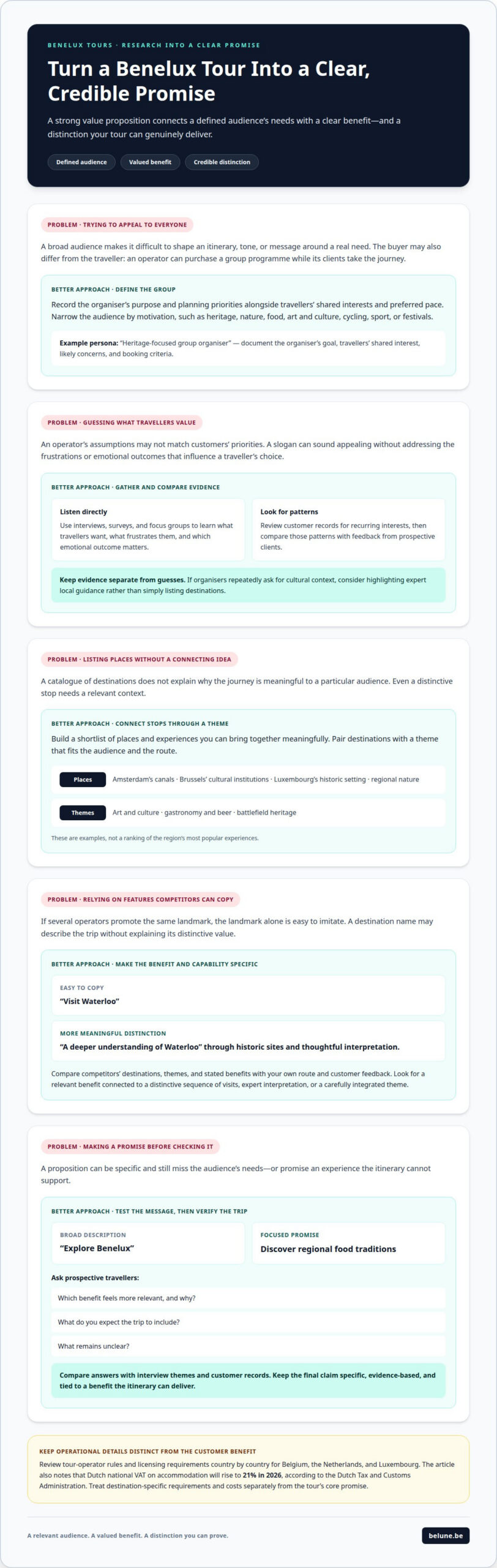
    Validate a proposed USP through audience research and simple message tests. Present two concise descriptions to prospective travellers and ask which benefit feels relevant and why. Compare their answers with interview themes and customer records. A disciplined approach to creating a unique selling proposition for Benelux tours avoids common pitfalls: targeting everyone, repeating destination features competitors can copy, or making promises the itinerary cannot support. Keep the final claim specific, evidence-based, and tied to a benefit travellers can recognize.

    2. Defining and researching a target market

    A useful target market is specific enough to guide the itinerary, tone, and message. Start by distinguishing the buyer from the traveller: a tour operator may purchase a group programme, while its clients experience the journey. Record each group’s travel purpose, preferred pace, interests, and planning priorities. Then identify which needs your tour can meet especially well. A cultural group may value interpretation and heritage; an event-focused group may prioritize access and smooth coordination.

    No single customer segment defines tours across Belgium, the Netherlands, and Luxembourg. Practical segments include art and culture travellers, gastronomy enthusiasts, cycling groups, and visitors drawn to sport or festivals. These are interest-based ways to organise an audience, not a ranking of popularity. Narrow your target by asking which motivation best fits the route, the season, and the experience you can credibly provide.

    Build a persona from patterns, not assumptions. Give it a working label, such as “heritage-focused group organiser,” then document the organiser’s goal, the travellers’ shared interest, likely concerns, and booking criteria. Review customer records for recurring themes, and research what prospective clients value in comparable travel experiences. Keep evidence separate from guesses. If organisers repeatedly ask for cultural context, for example, consider highlighting expert local guidance rather than simply listing destinations.

    Refine the audience by testing whether one clear message speaks to a real need. Compare a broad line such as “Explore Benelux” with a focused promise about discovering regional food traditions. Ask prospective organisers which feels more relevant, what they expect the trip to include, and what remains unclear. Use their language to sharpen the message, then check whether the itinerary can deliver the promised benefit. A disciplined group tour approach can help translate a defined audience’s interests into a coherent experience, without trying to attract every traveller with the same proposition.
    How to define a selling proposition for Benelux tours

    3. Focusing on benefits competitors cannot easily imitate

    An effective tour company USP makes a relevant promise and explains why the operator can deliver it. It names a benefit the ideal customer values and connects it to a distinctive capability. “A deeper understanding of Waterloo” is more meaningful than simply naming a destination, especially when the experience links historic sites with thoughtful interpretation. Specificity gives the offering shape; evidence makes the claim credible.

    Compare direct competitors by examining the experience, not just the itinerary. Note the destinations they feature, the themes they emphasize, and the benefits they describe. Then compare those details with your own route and customer feedback. If several operators promote the same landmark, the landmark alone is easy to copy. A distinctive sequence of visits, expert interpretation, or a carefully integrated theme may create greater value for travellers.

    A SWOT analysis can reveal where your distinction might emerge. Record competitors’ strengths, such as strong destination recognition, and weaknesses, such as a broad message that lacks focus. Consider opportunities in changing travel trends, including demand for more immersive historical context. Identify threats such as familiar attractions becoming interchangeable. Use these observations to improve your own offering, not to make unsupported claims about another operator.

    Next, separate visible features from benefits that are harder to reproduce. A tour’s route can be copied; regional knowledge, local relationships, and a distinctive way of interpreting a place take longer to build. For a Waterloo-focused experience, the benefit might be understanding how the landscape and historical accounts illuminate the same event. Describe what the ideal customer gains, then identify the expertise or design choices that make that result credible.

    Finally, test the differentiator with three questions: Does it matter to the target customer? Can your team deliver it consistently? Would a competitor need more than a quick itinerary change to imitate it? If not, refine the benefit or strengthen the capability behind it. This discipline keeps the proposition rooted in real strengths and helps the operator stand apart without relying on price or broad claims about quality.

    4. Defining a unique selling proposition

    Turn your research into a statement that connects a specific traveller, a meaningful benefit, and a credible distinction. Define what clients gain, not simply the places included. For example: “Discover Belgium’s artistic heritage through carefully curated visits and expert local interpretation.” This names an audience interest, an outcome, and a delivery approach. Each part should reflect the actual itinerary and the values guiding its design.

    Keep the proposition concise. A travel agency’s USP can fit within one to four sentences, giving enough room to express the promise without burying it in detail. Begin with the ideal customer’s need, state the experience that meets it, then identify the supporting strength. Replace broad claims such as “exceptional tours” with tangible language about cultural insight, thoughtful pacing, or a distinctive theme. Readers should understand the benefit on the first read.

    Choose three to five values that shape the promise, such as curiosity, craftsmanship, or personal attention. Connect each value to a visible choice: curiosity might come through locally informed interpretation, while craftsmanship could shape the sequence of visits. This makes values more than decorative words. It also gives staff a shared reference when communicating with organisers, preparing proposals, or describing the tour to prospective clients.

    Test the wording against the experience. Does the itinerary support every claim? Does the benefit matter to the intended audience? Is the distinction clear without explanation? Remove language that could describe any operator. Once refined, use the proposition consistently across marketing messages, sales conversations, and customer proposals. Repetition helps people remember the promise; consistent delivery gives it substance.

    For a Benelux group concept, connect the audience benefit to a carefully designed cultural or thematic experience. Develop a distinctive group-tour proposition grounded in a clear customer outcome and a coherent itinerary.

    BELUNE

    BELUNE helps tour operators translate a distinctive idea into a coherent group journey across the Benelux. When a proposition depends on more than a theme, the itinerary, movement between stops, accommodation, and interpretation should reinforce the same promise. Hotel Accommodation Management, coach hire with its own fleet of buses, Local Guide Services, and Art & Culture Group Tours can support that joined-up experience. The result is a practical foundation for communicating what makes a tour meaningful to its intended audience, while keeping the journey aligned with its central idea. For professional partners ready to shape a group concept around a clear customer benefit, contact BELUNE.

    Put your proposition into motion

    A proposition becomes valuable when it guides real decisions. Let it shape how you describe a tour, which details you prioritize in a proposal, and the experience you design for your audience. When creating a unique selling proposition for Benelux tours, treat the wording as a working tool, not a tagline set in stone. Customer conversations and organisers’ questions can reveal where your message is clear and where it needs greater precision.

    Choose one upcoming tour concept and apply the proposition to its description. Does the central benefit come through quickly? Do the itinerary and delivery support the promise? Use those answers to refine the concept before carrying the message into future proposals and marketing. A considered discussion can help connect your audience, experience, and operational choices into a coherent direction. Discuss your tour concept with BELUNE and take the next step toward a proposition with a distinct point of view.

    Frequently Asked Questions

    How to determine your Unique Value Proposition?

    Draft a sentence that completes this thought: “For this kind of group, our tour makes it easier to…” Then test each phrase against the actual experience. A cultural itinerary, for example, might help an organiser create a cohesive programme around shared artistic interests. Remove claims that describe only the destination, and keep the customer outcome your route and delivery genuinely support.

    The Value Proposition: Why would anyone buy your tour?

    People choose a tour when its experience meets a need they cannot meet as easily on their own. A group organiser may value one coordinated programme that brings a shared interest to life, rather than separate visits without a connecting idea. Make that benefit tangible in your description: show what participants will explore, how the theme holds the journey together, and why it suits their group.

    What Is a USP?

    A unique selling proposition, or USP, is a concise statement of the distinctive benefit a business offers a specific audience. Unlike a general value proposition, it emphasizes why the experience stands apart. For a tour operator, the USP should connect the traveller’s reason for choosing the trip with a strength the itinerary can demonstrate, rather than relying on an unsupported claim of being the best.

    How do Benelux tour operators differentiate their itineraries, guides, and services?

    A tour can give a familiar destination a distinct point of view through its theme, interpretation, and the way practical elements fit together. For example, an art-focused group tour could connect visits through a clear creative narrative, supported by Local Guide Services. Hotel Accommodation Management and coach hire with an own fleet of buses can also contribute to a coordinated group experience when those elements serve the itinerary’s purpose.

    What local culture, language, and seasonal factors should shape a Benelux tour USP?

    Build the promise around the group’s cultural interests and language needs, then reflect them in the itinerary. A programme focused on local heritage needs context that helps visitors understand the places they encounter. Seasonal timing can also shape the experience: outdoor cycling and indoor cultural visits create different expectations. Describe the tour in terms that match its actual setting, schedule, and audience.
  • Co-Marketing a Benelux Tour to Reach Target Travelers

    Co-Marketing a Benelux Tour to Reach Target Travelers

    Reach the right travelers by giving every partner one clear audience, one compelling tour story, and a coordinated campaign. The practical answer to how to effectively co-market a Benelux tour is to match channels to traveler interests, then align timing, messaging, and the next step across each partner’s communications.

    Coordination matters: a tour spanning Belgium, the Netherlands, and Luxembourg can appeal to travelers drawn to different experiences, from art and culture to gastronomy and heritage. A broad message can blur those distinctions; a focused campaign makes the journey easier to picture and gives each partner a meaningful role. This guide explains how to define your target travelers, select suitable channels, shape a shared campaign, and measure whether it is generating useful interest. You’ll come away with a clear framework for presenting a multi-country itinerary as one coherent experience while making its distinctive themes visible to the travelers most likely to value them.

    Key Takeaways

    • Shape a Benelux itinerary around a clear theme, then make the connections between its three countries easy for travelers to picture.
    • Choose campaign channels according to your audience and each partner’s strengths, with consistent messaging across every touchpoint.
    • Agree in advance on how partners will handle campaign responsibilities, shared costs, incoming leads, and revenue.
    • For tours with a battlefield heritage focus, BELUNE can bring together Battlefield Tourism, local guide services, coach hire, and hotel accommodation management.

    Tour packages combining Belgium, the Netherlands, and Luxembourg

    A compelling package connects three countries through a clear theme while giving each place room to feel distinct. The itinerary and campaign should show travelers why the journey works as one experience.

    Three-Country Package Design

    Build the package around a theme such as art, food, or wartime heritage, then choose stops that bring it to life. A guided itinerary might pair Brussels and Bruges with Luxembourg City and Amsterdam, while a dinner or local tasting offers an authentic pause between visits. Explain what each stop adds, and make the package’s defining feature clear in every partner’s campaign.

    Route and Itinerary Planning

    Map the route through Belgium, Luxembourg, and the Netherlands in a sensible sequence, grouping nearby experiences and allowing time for transfers. A driver, local transport, and guided visits each serve different parts of the journey; choose them to suit the stops rather than forcing every transfer into one mode. Explain travel times clearly, and build flexibility around connections and border crossings.

    Present tour inclusions, terms, and promotional claims clearly. Collect and share campaign data in line with applicable privacy and consumer-protection rules in each market. Keep partner messaging consistent with the package travelers will actually receive.

    Potential partners include local tour operators, hotels, attractions, and tourism boards across the three countries. Partners connected to Bruges, Utrecht, or Luxembourg City, for example, can give a shared itinerary a stronger local character.

    Address language and cultural differences with localized materials for Dutch-, French-, German-, and Luxembourgish-speaking audiences. Adapt examples, imagery, and tone to each audience while keeping the itinerary’s core promise consistent.

    Give the campaign a sense of discovery through places beyond headline stops: Utrecht’s canals, Dinant’s cliffs, or Echternach’s lake and abbey. At Luxembourg American Cemetery, according to American Battle Monuments Commission, sloping away from the terrace is the cemetery where 5,070 service members lie, many of whom lost their lives in the Battle of the Bulge and in the advance to the Rhine River.

    Benelux countries and multi-country itineraries

    Belgium, the Netherlands, and Luxembourg can form one destination story, but each itinerary needs its own rhythm. Choose its length based on the experiences travelers value, then make the route and shared campaign reflect that choice.

    Co-marketing risks include inconsistent promises, uneven partner participation, and confusion about who handles leads. Reduce friction with agreed messaging, a shared campaign calendar, clear lead ownership, and a process for updating partners when itinerary details change.

    Multi-Country Itinerary Options

    A seven-day itinerary should focus on a compact route and a few defining experiences, such as medieval architecture in Ghent and canals in Amsterdam. A ten-day tour can allow more time across the three countries, while a two-week itinerary can include slower stays or secondary destinations. For each option, explain the trade-off between travel time and time at each stop.

    Build personalized itineraries by offering a clear choice of themes, not a crowded list of destinations. One route might pair a visit to Amsterdam’s Rijksmuseum with historic streets in Belgium and Luxembourg City; another could emphasize cultural experiences across all three countries. Local guide services can add context and help connect the stops.

    Partner Roles and Resource Sharing

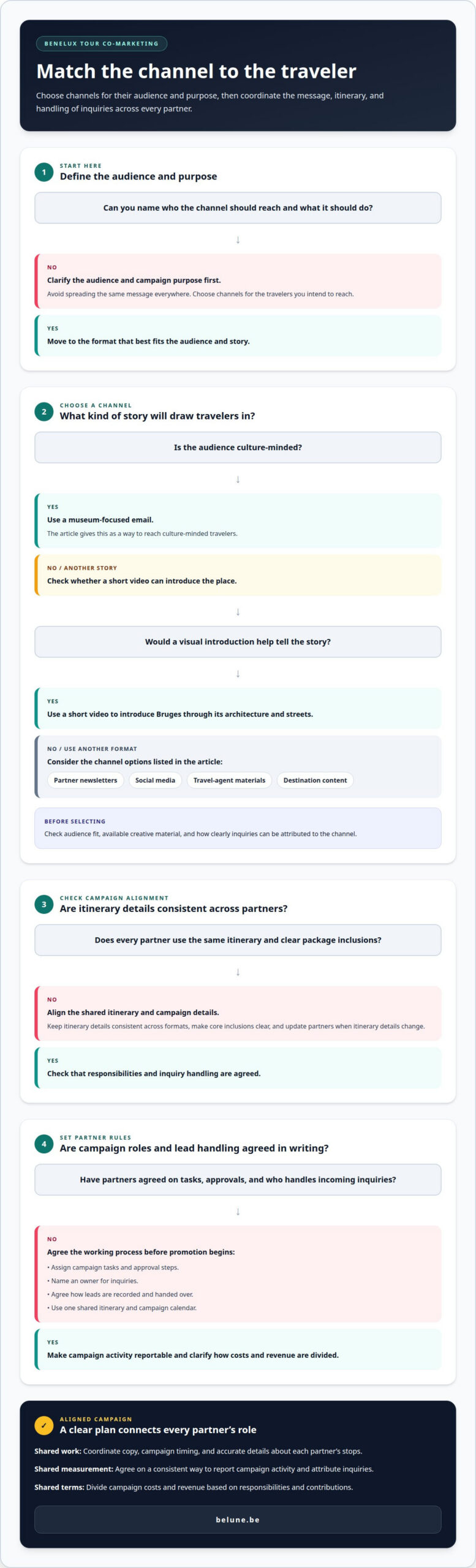
    Before promotion begins, partners should agree in writing on campaign tasks, approval steps, and lead handling. One partner, for example, can coordinate shared copy while each destination partner supplies accurate details about its own stops. Agree how campaign costs and revenue will be divided based on responsibilities and contributions, rather than leaving assumptions unresolved.

    Use one shared itinerary and campaign calendar as the working reference. Assign a named owner for inquiries, agree how leads are recorded and handed over, and establish a consistent way to report campaign activity. These practical steps help protect the traveler experience and keep every partner’s messaging aligned.

    Think of every itinerary as a sequence: select destinations, balance travel with time on site, then match campaign messages to the route. A guide can bring local knowledge to museums, medieval quarters, and other stops. Explore local guide services as part of shaping that on-the-ground experience.

    Co-Marketing a Benelux Tour to Reach Target Travelers

    Choosing marketing channels and planning campaigns

    Choose channels based on the audience, partner strengths, and the story each format can tell. A clear plan connects campaign activity to one tour departure and gives every partner a consistent role. To effectively co-market a Benelux tour, select channels that reach the intended travelers rather than spreading the same message everywhere.

    Marketing Channel Selection

    Match each channel to a specific audience and purpose. A museum-focused email can reach culture-minded travelers, while a short video can introduce people to Bruges through its architecture and streets. Partner newsletters, social media, travel-agent materials, and destination content each offer different ways to present the tour. Choose channels based on audience fit, available creative material, and how clearly inquiries can be attributed.

    Keep itinerary details consistent across formats. A cruise extension or a day among historic cities can provide a distinctive campaign angle while keeping the package’s core inclusions clear. Effective Benelux tour co-marketing also means using each partner’s channels to extend the story without fragmenting it.

    Campaign Planning

    Start with the departure date and plan campaign milestones backward. Agree on a shared message, approve copy and images, assign publishing dates, and prepare one destination page with itinerary and booking details. Give partners defined tasks, such as supplying destination information or distributing campaign content, so promotion feels coordinated rather than duplicated.

    Use a shared calendar to schedule launch, follow-up content, and reminders. Consumers take around 30 touch points to decide to buy a holiday. Plan varied content that helps create those interactions, such as a route overview, a culture feature, and a practical departure reminder.

    Track inquiries, qualified leads, and completed bookings by channel or partner. Use consistent campaign tags and shared reporting to identify which activities contributed to results. Compare attributed booking revenue with campaign spending to assess return on investment. Review the findings together, then refine the next campaign based on which content generated meaningful interest and bookings.

    How should partners divide marketing costs, revenue, leads, and responsibilities for a Benelux tour?

    Begin with a written agreement covering campaign spending, booking revenue, inquiry ownership, and delivery tasks across Belgium, the Netherlands, and Luxembourg. A shared framework gives every partner the same expectations before promotion begins.

    Allocate marketing costs using a method partners understand, such as agreed contributions or each partner’s share of the campaign. Record who pays for photography, translated copy, advertising, and booking materials. If one partner funds destination imagery while another promotes it, document the contribution and how shared assets may be used. Set approval steps for unexpected expenses, too.

    Define revenue distribution separately from campaign spending. Partners can agree whether revenue follows the services each provides, a negotiated share, or another written arrangement. Specify which bookings count, how cancellations or changes are handled, and when partners receive reports. Clear records prevent a campaign contribution from being mistaken for a booking entitlement.

    Define lead ownership precisely. Decide which partner receives each inquiry, how referrals are recorded, and who follows up with travelers interested in the full three-country route. For example, a request about Amsterdam that also includes Brussels and Luxembourg should have one named lead owner, with relevant partners receiving the information they need to respond. Use consistent records to avoid duplicate follow-ups.

    Match responsibilities to each partner’s role. One partner might maintain the campaign calendar, another supply current destination details, and another coordinate booking questions. Agree who approves shared copy, updates itinerary information, and reports campaign results. Name a backup contact for each task so work can continue if the primary contact is unavailable.

    Schedule regular reviews around campaign milestones and the tour departure. Compare recorded inquiries and bookings with agreed spending, then discuss which partner actions contributed to results. Update the agreement when the itinerary or campaign changes, and keep decisions in one shared record. To put a coordinated Benelux tour plan into practice, discuss your group travel requirements.

    BELUNE: Battlefield Tourism

    BELUNE helps tour operators and travel agents shape group itineraries around battlefield tourism across the Benelux region. Turn to BELUNE when battlefield heritage is central to the tour and the journey needs to connect meaningful sites with practical travel arrangements.

    Hotel Accommodation Management, Coach Hire with own fleet of busses, and Local Guide Services can support the itinerary’s structure. Local guidance adds historical context at each stop, while coordinated transport and accommodation help bring the route together for a group. The result is a considered travel experience, not simply a sequence of visits.

    For a group tour built around battlefield heritage, contact BELUNE to discuss your itinerary.

    Turn a shared campaign into a lasting partnership

    Treat your Benelux tour as a partnership that can evolve with each departure. Use the first campaign to learn which stories resonate, where traveler interest begins, and how partners can refine their collaboration for the next itinerary. This ongoing approach is central to effectively co-marketing a Benelux tour: build a relationship that grows alongside the experience.

    For tour operators and travel agents developing a battlefield-focused group journey, BELUNE can bring the practical elements together through Battlefield Tourism, Hotel Accommodation Management, Coach Hire with own fleet of busses, and Local Guide Services. These services connect the tour’s historical purpose with its on-the-ground delivery and give partners a clear starting point for shaping the campaign.

    Contact BELUNE to plan your campaign, and take the next step toward a more distinctive Benelux journey.

    Frequently Asked Questions

    How will you reach your target customers?

    Reach target travelers by matching each audience to a reason to travel, then placing that message where they already seek inspiration. For example, present a cultural itinerary through arts-focused content, while a battlefield heritage journey can foreground historical sites and guided interpretation. Use partner communications to give travelers a consistent picture of the experience and make the next step clear.

    What does co-marketing a Benelux tour involve?

    Co-marketing a Benelux tour means two or more organizations work together to promote the same travel experience, bringing their distinct expertise or audiences. A hotel partner might share destination imagery, while a tour operator presents the itinerary and booking details. The collaboration works best when every partner can describe the experience accurately and explain their role without creating separate or conflicting versions of the offer.

    Which audiences and travel segments are most likely to book a Benelux tour?

    Travelers interested in cultural heritage, gastronomy, battlefield history, cycling, festivals, or sporting events may find a themed Benelux journey especially relevant. Tour operators, travel agents, and group travel organizers are also natural professional audiences for packaged itineraries. Rather than target everyone with one message, connect each theme to a defined interest, such as guided heritage experiences or group cultural travel.

    Which channels and campaigns best promote a multi-country Benelux tour?

    The strongest channel depends on the audience and the tour’s defining theme. Use partner email newsletters for itinerary-led information, social media for visual scenes from places such as Bruges, and travel trade materials for agents assessing group programs. A campaign can build interest with a destination story, then provide practical itinerary details and a clear way to inquire. Keep the core promise consistent across formats.

    Which local tour operators, hotels, attractions, and tourism boards are potential co-marketing partners in Belgium, the Netherlands, and Luxembourg?

    Potential partners include local tour operators, hotels, attractions, and tourism boards across Belgium, the Netherlands, and Luxembourg. Partners connected to Bruges, Utrecht, or Luxembourg City can contribute local details to a shared itinerary.

  • Selling Benelux Tours to American Clients: A Guide

    Selling Benelux Tours to American Clients: A Guide

    A Benelux tour doesn’t become compelling simply by crossing three borders. American clients need a clear reason to choose the journey and confidence that each transition will feel effortless. Knowing how to sell benelux tours to american clients starts with turning Belgium, the Netherlands, and Luxembourg into one memorable travel story, not a list of stops.

    The challenge is to choose experiences that resonate, make the itinerary easy to picture, and ensure the practical details support the promise. Art and culture, gastronomy, history, and active experiences can each add depth when shaped around a strong theme and paced with care.

    This guide explains how to position Benelux group tours for American travelers, structure an itinerary whose value is easy to communicate, and coordinate the services that support the sales message. We’ll look at accommodation, coach transport, local guides, and connected experiences. BELUNE works with tour operators and travel agents to bring customized programs to life through coordinated local operations, drawing on more than 20 years of experience in group travel.

    Key Takeaways

    • Present Belgium, the Netherlands, and Luxembourg as one connected journey, with any extension chosen for a clear reason.
    • To understand how to sell benelux tours to american clients, start with the audience, build around a strong theme, then define the trip scope and inclusions.
    • Compare culture-led, culinary, battlefield, and active tour concepts by audience fit, itinerary coherence, and operational complexity.
    • Build trust with a polished itinerary overview, a sample day, clear inclusions, and timely pre-departure communication.
    • Support the customer-facing promise with coordinated itinerary planning, accommodation management, coach transport, and local guides.

    Why Benelux tours can stand out to American clients

    For a U.S. tour operator, the first challenge is turning the unfamiliar regional name “Benelux” into a trip clients can picture and explain to someone else. Belgium, the Netherlands, and Luxembourg can form a natural, connected journey when the itinerary has a clear theme and a sensible pace. An extension beyond Benelux can broaden the story when it fits the group’s interests and schedule, rather than simply adding another destination.

    The journey can balance historic places and art with food and beer traditions, landscapes explored at a gentler pace, or experiences that bring history into focus. The Benelux Union overview provides background on the region. For selling, the key is translating that regional context into experiences that matter to a specific group.

    A Benelux group tour is a guided journey through neighboring countries, designed for travelers who want varied cultural experiences without managing every transition themselves.

    Which American traveler segments might respond to Benelux?

    Think in audience profiles, not assumptions about American travelers as a whole. Escorted group travelers may value several complementary experiences in one organized journey. Affinity groups can give the itinerary a sharper focus: art-focused travelers might prioritize collections and architecture, while history groups may want interpretation of significant events and sites.

    Food and beer enthusiasts, as well as groups drawn to cycling or other active experiences, offer different starting points. Define the group’s shared interest first, then decide how much variety to include around that central theme. This makes it easier to explain who the trip is for without suggesting that one itinerary suits everyone.

    How to make the regional story easy to picture

    Lead with an idea, not a roll call of countries and landmarks. “Art, architecture, and everyday life across three neighboring countries” gives travelers a lens through which to understand the trip. A simple route overview can then show the sequence through Belgium, the Netherlands, and Luxembourg. Consider an extension beyond Benelux only when it supports the theme and fits the travel time.

    Balance atmosphere with practical clarity. Pair an evocative description, such as exploring art and food traditions with local guides, with information about how the group moves between stops and where overnight stays fit. Travelers can then imagine the experience, while tour sellers have a clear framework for explaining the itinerary.

    That clarity is central to how to sell benelux tours to american clients: present the region as a coherent answer to a particular group’s interests, not as a checklist of destinations. The strongest concept makes its audience, central theme, and journey easy to grasp at a glance.

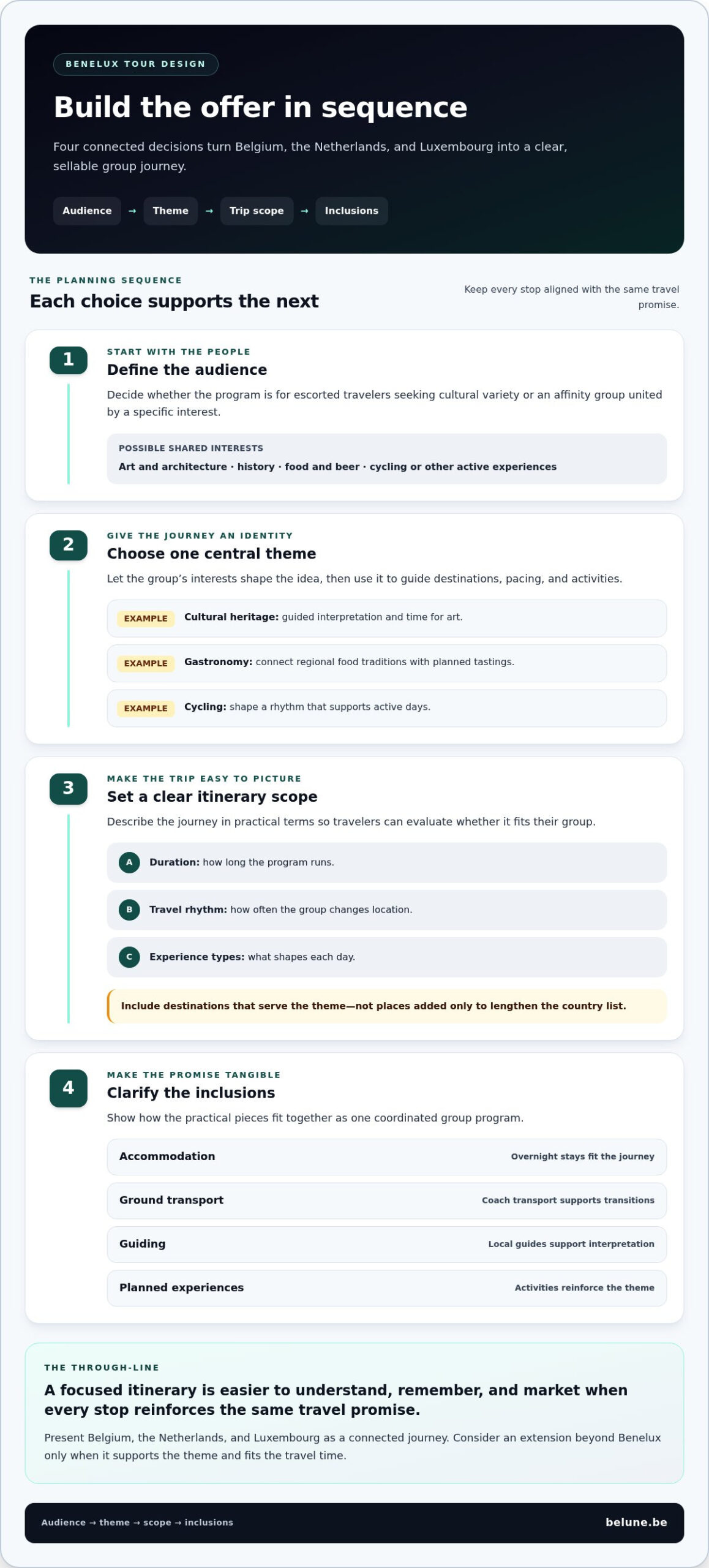
    How to shape a Benelux tour into a clear, sellable offer

    A strong tour concept is more than a route. It gives travelers a reason to choose the journey and gives your sales team a concise way to explain what makes it distinct. Build the offer in sequence so each decision supports the next.

    • 1. Define the audience. Decide whether the program is for escorted travelers seeking cultural variety or an affinity group united by a specific interest.
    • 2. Choose the theme. Let the audience’s interests shape the central idea, such as battlefield history, cultural heritage, gastronomy, or cycling.
    • 3. Set the trip scope. Establish the duration, travel rhythm, and main experience types. Include destinations that serve the theme, not places added only to lengthen the country list.
    • 4. Shape the inclusions. Explain how accommodation, ground transport, guiding, and planned experiences are coordinated as part of the group program.

    A focused itinerary is easier to understand, remember, and market because every stop reinforces the same travel promise. It also gives clients a clearer basis for deciding whether the program fits their group.

    Choose one theme that gives the tour its identity

    A theme is a practical design tool, not just a label. A cultural heritage journey might prioritize guided interpretation and time for art. A cycling program needs a rhythm that supports active days. A gastronomy-led tour can connect regional food traditions with planned tastings. If food is the central thread, BELUNE’s Belgium gastronomy tours offer a related example. Let the theme guide destination choices, pacing, and activities from the first planning decision.

    Set an itinerary scope clients can readily evaluate

    Describe the journey in terms a traveler can picture: how long it runs, how often the group changes location, and what kinds of experiences shape each day. Avoid unsupported promises or overly precise operational details. Instead, show how accommodation, coach transport, local guiding, and planned activities fit together as one coordinated group program. For a broader explanation of the local operating role, the Benelux incoming tour operator guide offers useful DMC context.

    Then present the concept in a compact overview: audience, theme, route, travel rhythm, and inclusions. A history-focused program, for example, can explain how guided interpretation and related cultural experiences support its central subject, without crowding the itinerary with unrelated stops. This makes how to sell benelux tours to american clients less about presenting a list of options and more about communicating a well-shaped experience.

    For tour operators and travel agents developing a regional group program, BELUNE’s customized itinerary planning can help translate an audience and theme into a coordinated journey.

    Selling Benelux Tours to American Clients: A Guide

    How to position Benelux tour options against other European trips

    Positioning works best when you compare the experience a group wants, not simply the number of countries on the itinerary. Present a Benelux program through its thematic focus and the way its destinations connect. Use the same four criteria for each concept: audience fit, strength of the theme, itinerary coherence, and the coordination needed to deliver it.

    Tour concept Audience fit Thematic strength Planning consideration
    Culture-led Travelers interested in museums, architecture, and local interpretation Connects cultural visits through a shared heritage story Balance guided visits with time to experience each place
    Culinary Groups drawn to regional food traditions and tastings Uses gastronomy to reveal local character Coordinate planned food experiences with the route and schedule
    Battlefield History-focused groups seeking context and memorial visits Gives the journey a clear historical focus Allow room for thoughtful interpretation, not just site stops
    Active Groups interested in cycling and experiencing landscapes at a more active pace Links movement through the region with outdoor discovery Shape daily activity and transport around the group’s chosen rhythm

    Which tour concept fits each audience?

    Start with the group’s central interest, then test whether the route and planned experiences strengthen it. Cultural heritage suits travelers who want museums, architecture, and local context. Gastronomy tours give food-focused groups a way to explore regional traditions through tastings. Battlefield tourism serves history groups seeking guided context and memorial visits. Active programs, including cycling, offer another clear lens. Ideas in this themed group travel guide can help broaden the concept without diluting its identity.

    Operational complexity is a planning consideration, not a judgment of quality. Map how accommodation, coach transport, guides, and activities must align, then ask whether each element adds meaning for the group. A focused route through Belgium, the Netherlands, and Luxembourg can keep the narrative tight. An extension beyond Benelux changes the route and program scope, so include one when it deepens the travel story, not simply to add another destination.

    How to explain the value without relying on discounts

    Make value tangible through the experience and the coordination behind it. Describe what travelers will encounter, what the group program includes, and how local guides, accommodation, transport, and activities fit together. A concise itinerary summary lets clients assess the offer without guessing what the journey involves.

    That’s a practical way to approach how to sell benelux tours to american clients: differentiate the trip through a distinctive theme, coherent routing, and clear inclusions rather than an unsupported claim of better value. The result is an offer that’s easier for a group leader to present and for travelers to evaluate.

    How to build a sales process American clients can trust

    Trust grows through a sequence of clear decisions, not a single polished brochure. Guide prospective clients from initial interest to itinerary review, booking decision, and pre-departure communication. At each step, answer the questions they’re likely to have: Is this trip for me? What will the journey feel like? What does the group program coordinate? What happens next?

    Keep the sales materials consistent from the first overview to the final itinerary. Use a concise description of the audience and theme, a route summary that explains why the stops belong together, and a sample day that gives the experience a human scale. An illustrative day might combine a guided cultural visit, time for a planned meal or tasting, and another experience connected to the tour’s theme. Label examples clearly so travelers can picture the rhythm without mistaking a sample for a guaranteed schedule.

    What information should the sales materials make clear?

    State who the tour is designed for, what holds it together, and how the route supports that idea. Then explain the group program in plain language: accommodation management, ground transport, local guiding, and planned experiences. A readable itinerary outline, concise descriptions, and helpful visuals make the offer easier to assess. Distinguish confirmed inclusions from general destination inspiration, and give interested clients a clear next step, such as reviewing the itinerary or discussing the program with their tour operator.

    Keep the sales journey easy to follow. After initial interest, share the overview and itinerary for review. Make the booking decision stage clear, then provide pre-departure communication that reiterates the travel plan and coordinated elements. A reliable handoff between seller and local operator helps keep those details aligned.

    • Audience and theme: Who the group is for and what defines the journey.
    • Route and rhythm: The sequence of stops and the intended balance of travel and experiences.
    • Program inclusions: The accommodation, coach transport, guiding, and activities coordinated for the group.
    • Next step and handoff: What the client should review or decide, and which program details need to carry forward to local operations.

    How does local operating support strengthen the promise?

    A compelling itinerary depends on practical delivery. BELUNE coordinates accommodation management, coach hire through its own fleet, and local guide services as part of customized group programs. Connecting these elements helps turn a seller’s theme into a workable ground plan. Transport, stays, and local interpretation then support the experience described in the sales materials.

    That operational clarity is central to how to sell benelux tours to american clients: the promise feels dependable when the seller can explain both what travelers will experience and how the group program is coordinated. BELUNE works with tour operators and travel agents to shape tailored itineraries, drawing on more than 20 years of experience in transport and tour operations. Explore BELUNE’s group-travel support to see how local coordination can support your sales promise.

    How BELUNE helps turn a Benelux sales concept into a delivered group tour

    A tour operator may have a clear audience and a compelling theme, but turning those ideas into a group program calls for local planning. BELUNE works with tour operators and travel agents to shape customized itineraries, then support delivery through accommodation management, coach hire, and local guide services. This connects the promise presented to travelers with the practical elements that bring the journey to life.

    What a DMC partnership can bring to the sales offer

    Local planning gives the concept operational shape. BELUNE’s own coach fleet supports group transport planning, while accommodation management and local guides help connect overnight stays, movement, and interpretation in a considered itinerary. The seller’s chosen theme can inform the route and experiences, whether the group is drawn to culture, gastronomy, battlefield history, or active travel. BELUNE brings more than 20 years of experience in transport and tour operations to the planning process.

    This partnership is business-to-business: BELUNE supports travel trade professionals developing group programs, rather than individual B2C travel bookings. The seller brings knowledge of its audience and the sales promise; the local operating partner helps translate that promise into a tailored program with coordinated ground services.

    How to move from a concept to a partner conversation

    A conversation is more productive when the seller can describe the intended group experience and its practical boundaries. A finished itinerary isn’t necessary at the outset. Bring the essentials, then use them to shape a workable planning brief together.

    • Target audience: Describe the group’s shared interests and travel style.
    • Preferred theme: Identify the idea that should guide the experience, from cultural heritage to cycling.
    • Travel window: Share the anticipated travel period so planning can be framed around it.
    • Broad itinerary ambitions: Outline the countries or experience types under consideration, and whether the concept might extend beyond Benelux.
    • Ground support: Note where accommodation management, coach transport, local guides, and itinerary planning fit the seller’s needs.

    This brief gives the conversation a useful starting point: the audience sets the perspective, the theme guides choices, and the operational needs show how the concept must work on the ground. BELUNE can develop a customized group itinerary with the seller, connecting the intended experience to coordinated transport, stays, and local guidance.

    For sellers considering how to sell benelux tours to american clients, a dependable local operating relationship can make the customer-facing promise more credible. Bring your audience, theme, travel window, and broad route ambitions into the next planning step. Develop a Benelux tour with BELUNE.

    Give your Benelux tour concept its next shape

    A promising group-tour idea often begins with a simple question: what should travelers remember most when they return home? Use the answer as a creative compass. It can help refine the audience, choose the defining experience, and keep planning decisions aligned with the feeling you want the journey to leave behind.

    That’s a useful starting point for how to sell benelux tours to american clients. You don’t need every itinerary detail settled before bringing the core concept into focus: who the trip serves, what makes it distinctive, and what kind of experience you want to create. From there, a conversation with a local operating partner can help turn the idea into a practical direction for development.

    To take the next step, start shaping your Benelux group-tour concept with BELUNE. A thoughtful concept can become the beginning of a journey that feels clear to sell and rewarding to experience.

    Frequently Asked Questions

    How do I market a Benelux tour to American travelers?

    Market the trip around a specific traveler interest and make the experience easy to imagine. Use a clear title, a short description of the journey’s central idea, and sample moments that help readers picture the days. For example, a culture-focused program can foreground guided interpretation and time to explore, rather than leading with a string of unfamiliar place names. Keep the route and inclusions easy to find in your sales materials.

    What makes Benelux a good destination for a group tour?

    Benelux can suit groups that value a connected journey with several cultural perspectives. Coordinated transport and group accommodation management help organize travel between countries, while local guides bring context to the experiences. This structure can help tour leaders manage varied interests: the group follows a shared itinerary, while its theme gives each stop a reason to belong. Choose a pace and program that fit the group.

    Which Benelux tour themes may appeal to American clients?

    Possible themes include art and culture, gastronomy and beer, battlefield history, and cycling. Refine the offer by choosing one as the main focus and using another as a complementary experience. A cultural itinerary might include a regional food experience, while a cycling program could add guided heritage interpretation. The secondary element should enrich the trip without making its purpose difficult to explain.

    Should a Benelux tour include an extension beyond the region?

    Include an extension when it serves the group’s interests and strengthens the overall itinerary, not simply because travelers recognize the destination. Consider whether it leaves enough room for the Benelux experiences that define the program and whether the added travel fits the intended pace. For a group focused on a regional theme, a tighter Benelux route may be more coherent. A broader Europe concept may benefit from an additional chapter.

    How can a U.S. tour operator work with a Benelux DMC?

    A U.S. tour operator can work with a DMC by sharing its audience, theme, travel window, and broad route ideas, then collaborating on the local program. BELUNE works with tour operators and travel agents on customized group itineraries and ground logistics, including accommodation management, coach transport, and local guides. The operator develops the customer-facing offer; the DMC helps shape its local delivery. BELUNE serves travel trade partners, not individual B2C bookings.

    What should a Benelux group tour itinerary include?

    A useful itinerary makes the sequence and daily rhythm understandable, rather than just naming places. Include planned experiences, how the group moves between them, where accommodation fits, and which guiding or activities are part of the program. A sample day can clarify the balance between organized visits and time between them. Identify transitions and optional extensions plainly so group leaders can present the plan accurately to prospective travelers.

  • Netherlands Group Travel Specialist Guide 2026

    Netherlands Group Travel Specialist Guide 2026

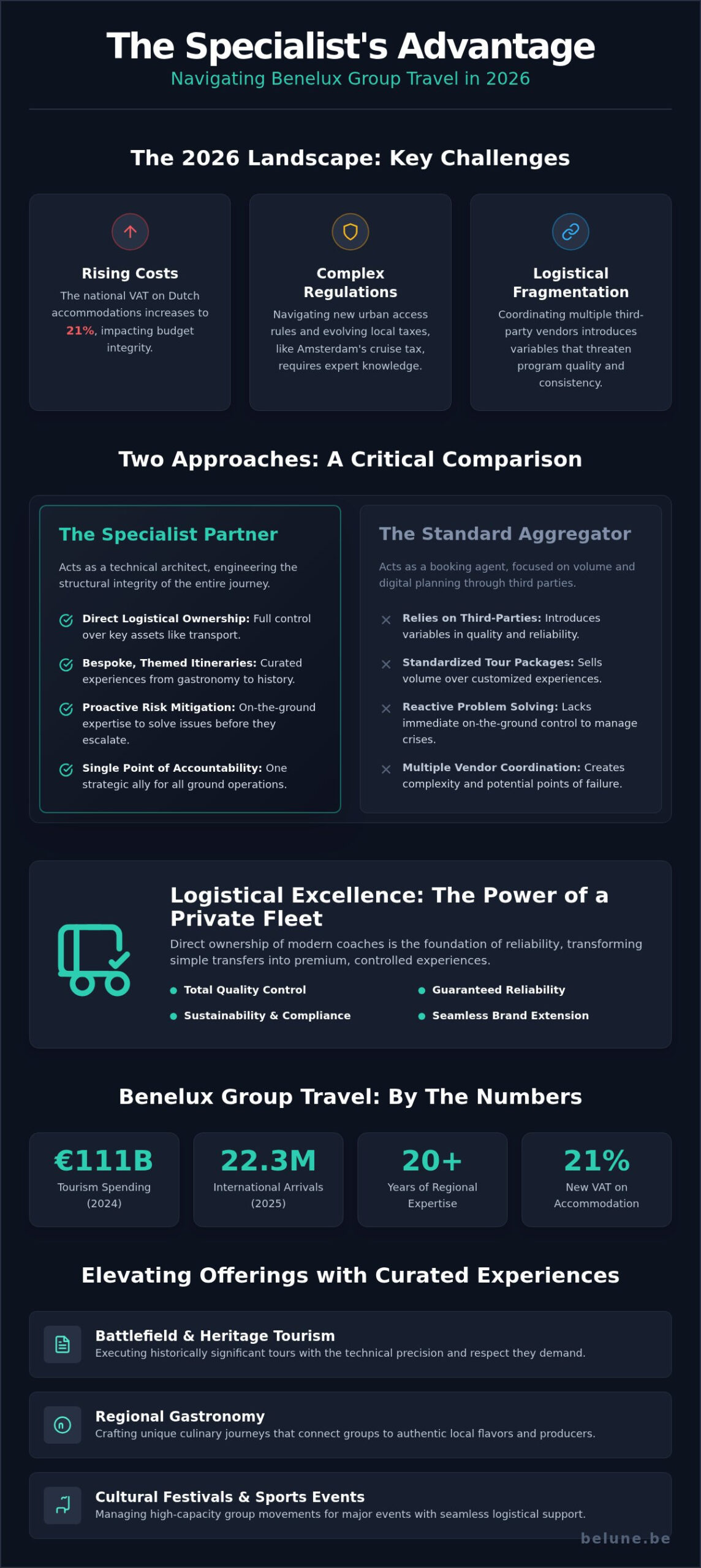
    The 2026 travel landscape is defined by rising costs and tightening regulations. In this environment, the difference between a standard tour and a masterpiece lies in the hands of the architect behind the scenes. You’ve likely felt the strain of managing fragmented logistics, from the 21 percent VAT increase on Dutch accommodations to the intricate dance of coordinating reliable transport. It’s a delicate balance. As a dedicated Netherlands group travel specialist, we bridge the gap between complex operational demands and the high-end, seamless experiences your B2B clients expect.

    We believe true luxury isn’t just about the destination; it’s about the rhythm of the journey. This guide reveals how direct logistical ownership, a private fleet of modern coaches, and expertly curated themes like Battlefield tourism or gastronomy can transform your offerings. You’ll discover a strategic partnership built on fixed-price reliability and artistic curation, ensuring every group movement across the Benelux region is executed with technical precision. We’ll outline the essential shifts for 2026, from navigating new Amsterdam cruise taxes to mastering the art of high-capacity hotel management.

    Key Takeaways

    • Master the complexities of the 2026 regulatory environment, including the national VAT increase to 21 percent, by aligning with a specialized local partner.
    • Secure the logistical integrity of your programs through a netherlands group travel specialist that operates its own modern fleet of coaches for total quality control.
    • Elevate your B2B offerings from standardized packages to bespoke, themed itineraries that capture the artistic and historical essence of the Benelux region.
    • Build enduring professional trust by replacing fragmented coordination with a single, strategic ally capable of managing both high-end accommodation and complex transport.
    • Gain a competitive advantage through technical precision and artisanal curation in high-stakes sectors such as Battlefield tourism and regional gastronomy.

    Understanding the Role of a Netherlands Group Travel Specialist

    The 2026 travel market requires more than a booking agent; it demands a technical partner. A true netherlands group travel specialist acts as a bridge between high-level vision and granular execution. With international arrivals having reached 22.3 million in 2025, the complexity of the region’s infrastructure requires a local expert to handle the shift to 21 percent VAT on accommodation and evolving local taxes. This role is fundamentally different from a travel aggregator. While aggregators sell volume, a specialist manages the structural integrity of the journey. For a broader perspective on the market, this Netherlands tourism overview highlights the scale of the industry we manage daily.

    Direct local presence is the ultimate risk mitigation tool. When an international travel agent partners with an on-the-ground operator, they gain more than just local knowledge. They secure a guarantee of operational continuity. If a transport provider fails or a regulation changes overnight, the specialist is already implementing the solution. This level of oversight turns potential crises into managed transitions.

    To better understand how these landscapes translate into itinerary potential, watch this helpful video:

    The Evolution of B2B Group Travel in the Region

    The shift toward high-value group experiences is undeniable. Tour operators look for more than just a bed and a bus; they seek a narrative. Our team uses two decades of regional expertise to craft these stories. This deep-rooted knowledge allows us to anticipate logistical hurdles before they impact the guest experience. It’s about transforming a series of bookings into a cohesive, high-end travel program. Industry professionals now prioritize direct partnerships with a Destination Management Company (DMC) that possesses 20 years of experience to ensure this level of reliability.

    Core Competencies of a Leading Travel Specialist

    A specialist’s core strength lies in technical mastery. We manage every touchpoint, from international train bookings to gastronomy tours. This level of control ensures that every group, whether attending a sports event or a cultural festival, experiences a level of service that reflects the agent’s own reputation. A leading netherlands group travel specialist doesn’t just suggest routes; they engineer them. The synergy between our own fleet of modern coaches and local guide services creates a professional atmosphere that aggregators simply cannot replicate.

    Logistical Excellence: The Foundation of Seamless Group Travel

    Logistical excellence isn’t a luxury; it’s the baseline for professional B2B operations. While aggregators focus on the digital planning phase, a true netherlands group travel specialist focuses on the physical reality of the road. We understand that a meticulously planned itinerary is only as strong as the transport providing its movement. In a region where tourism spending reached 111 billion Euros in 2024, the demand for high-specification execution is higher than ever. Technical precision in group movement is what protects your reputation as a tour operator.

    Private Fleet Management for Group Tours

    Ownership defines our approach to reliability. By operating our own fleet of modern coaches, we eliminate the variables introduced by third-party providers. This direct control allows us to guarantee the standard of maintenance, cleanliness, and comfort that high-end clients demand. For 2026, sustainability has moved from a preference to a requirement. Our modern fleet meets the latest efficiency standards, ensuring that group movement aligns with evolving regional environmental goals and urban access regulations.

    This technical mastery transforms a simple transfer into a premium experience. When you partner with a dedicated operator, you gain a strategic ally who manages every detail of the bus hire. From navigating the strict 2026 train luggage regulations to managing coach access in historic districts, our logistical ownership provides the serenity your partners expect. We don’t just book transport; we engineer the flow of the entire journey.

    Expert Guidance and Local Knowledge

    The narrative of a journey is carried by the people who lead it. Our multi-lingual guides don’t just recite facts; they translate the cultural soul of the Benelux region for your guests. They possess the deep regional expertise required to turn a standard sightseeing stop into a profound cultural immersion. This level of curation is supported by publications like National Geographic’s Guide to the Netherlands, which emphasizes the value of unique, local perspectives in modern travel.

    Professional guides also act as the final layer of logistical security. They navigate the nuances of an increasingly cashless society and manage the specific needs of large groups with technical precision. Whether coordinating a battlefield tour or a gastronomy experience, their presence ensures the itinerary flows with an effortless grace. This combination of physical assets and human expertise is what separates a logistical operator from a simple travel agent. It’s about turning a series of stops into a harmonious, high-end travel narrative.

    Netherlands Group Travel Specialist Guide 2026

    Comparing Custom Itineraries vs. Standardized Tour Packages

    Standardized tour packages often function as commodities; they provide efficiency but lack the distinct identity required by high-end tour operators. In a market where international overnight stays grew by 5 percent in 2025, the demand for differentiation has never been higher. A netherlands group travel specialist moves beyond the “one size fits all” model to create assets that reflect your specific brand vision. While aggregators offer thousands of fixed-departure tours, they often struggle to accommodate the technical nuances of niche B2B requirements. Customization allows for a balance between fixed-price reliability and the bespoke flexibility that modern groups demand.

    The Customization Process for Travel Agents

    Designing a tailor-made national travel program is a collaborative exercise in technical precision. We don’t just provide a list of destinations; we engineer a narrative that aligns with your clients’ expectations. This involves identifying exclusive access points and unique local experiences that are unavailable through standard booking channels. The strategic role of a benelux incoming tour operator is to act as your local architect. We translate your conceptual goals into a viable logistical reality, ensuring that every cultural stop and transport link feels intentional rather than accidental. This process ensures that your offering remains competitive and deeply personal.

    Strategic Accommodation Management

    One of the most significant challenges for 2026 is the national VAT increase on hotel accommodation from 9 percent to 21 percent. This fiscal shift makes professional lodging management a critical component of any group program. We bridge the gap between agents and hotels by sourcing group-friendly properties that maintain high standards of service without compromising your budget. Our role involves negotiating fixed-price contracts that protect your margins against seasonal fluctuations and tax changes. This level of financial and operational oversight is often missing from standardized packages.

    Effective accommodation management also considers the group profile. We source hotels that understand the specific needs of large parties, from streamlined check-in processes to high-quality group dining. This attention to detail ensures that the sanctuary of the hotel matches the sophistication of the daily itinerary. By managing these relationships directly, we provide a level of stability and quality control that aggregators simply cannot match. It’s about securing the foundation of the trip so the artistic elements of the tour can shine. Professional lodging management isn’t just about beds; it’s about safeguarding the group’s overall satisfaction and your reputation as a provider.

    Curating Themed Experiences: From Heritage to Gastronomy

    The modern group travel market has evolved beyond the era of generic sightseeing. Travelers now demand a narrative that resonates with their personal interests and values. As a premier netherlands group travel specialist, we understand that designing these experiences requires a blend of artistic vision and logistical rigour. Whether exploring the echoes of history or the nuances of regional flavors, our approach ensures that every themed journey is a structural masterpiece. We don’t just provide access; we provide context and technical mastery.

    Battlefield Tourism and Historical Remembrance

    Historical sites require a level of sensitivity that standard tour packages often fail to provide. We coordinate visits to significant locations with a meticulous focus on accuracy and emotional resonance. Our specialized guides translate complex historical events into compelling stories, ensuring a profound experience for every guest. Integrating these themes into a broader culture group tours benelux program allows for a balanced exploration of the region’s past and present. It’s about honoring the legacy of the land through technical precision and human connection.

    Culinary Artistry and Gastronomy Tours

    Gastronomy is the sensory heart of the Benelux region. We curate belgium gastronomy tours and Dutch culinary highlights that connect travelers with local artisans and time-honored traditions. Managing large groups in exclusive dining environments is a logistical challenge we solve through direct relationships and precise timing. From artisanal beer tastings to high-end regional cuisine, we ensure that the culinary narrative is as sophisticated as the landscape itself. This level of curation transforms a simple meal into a structural component of the travel experience.

    Active and Themed Travel Options

    The Netherlands’ world-famous cycling infrastructure offers a unique canvas for themed group travel benelux. Choosing a netherlands group travel specialist with direct logistical ownership ensures these active programs remain safe and reliable. We provide the support necessary for seamless tours, including professional equipment management and support vehicles. Our expertise extends to high-stakes events such as international sports tournaments and major music festivals. We also manage local excursions for river cruises, ensuring that even short stays are defined by high-quality execution. If you’re ready to elevate your portfolio, consult with our expert team to design your next exclusive program.

    Partnering with a Netherlands Group Travel Specialist for 2026

    The year 2026 marks a pivotal moment for international tour operators. As the industry settles into a new era of high demand, the complexity of local regulations and fiscal shifts requires more than just a vendor. It requires a strategic alliance. Choosing a netherlands group travel specialist ensures that your brand is represented with the same level of excellence you promise your clients. This partnership is built on 20 years of industry experience, providing a foundation of trust that allows you to focus on growth while we handle the technical execution on the ground.

    Selecting a professional group travel agency offers significant reputational benefits. When your guests experience the seamless integration of our private coach fleet and hand-picked accommodations, that quality reflects directly on your brand. We operate as a dedicated extension of your team, providing the logistical backbone for projects of exception across the Benelux region. Our commitment to excellence isn’t just a commercial claim; it’s a structural component of how we approach every itinerary.

    The B2B Partnership Framework

    Success in group travel is a product of clear, streamlined communication. We provide dedicated account management to ensure that every detail of your itinerary is understood and executed with technical precision. Our framework includes transparent pricing structures, which are vital for maintaining your margins in a market currently navigating significant tax adjustments. By offering white-label logistical solutions, we allow your brand to take center stage. We handle the intricacies of international train bookings, local guide services, and event coordination, all while remaining a silent, reliable partner in the background.

    Preparing for the Future of Group Travel

    The future of travel is defined by a blend of digital innovation and human artistry. We’re committed to evolving our logistical coordination to meet the needs of a modern audience without sacrificing the sophisticated tone that defines a high-end experience. Meticulous planning is our signature. We transform the technical aspects of transport and lodging into a structural component of the guest’s emotional journey, ensuring that every touchpoint feels intentional and refined.

    Initiating a collaboration with a netherlands group travel specialist is a step toward future-proofing your business. We invite you to share your vision with our team. Together, we can create bespoke programs that stimulate the imagination and set new standards for excellence in the European travel market. Our goal is to turn every logistical challenge into a seamless, artistic realization of your strategic goals.

    Elevating the Art of Group Movement in 2026

    Mastering group travel in 2026 requires a fusion of technical precision and artistic vision. We’ve explored how direct logistical ownership and bespoke itinerary design serve as the pillars of a successful B2B partnership. By prioritizing a netherlands group travel specialist with over 20 years of specialized DMC experience, you secure a strategic ally capable of transforming complex regional requirements into effortless guest experiences. Our private fleet of modern coaches and comprehensive coverage across the Benelux region and Paris provide the stability your brand demands.

    The future of your portfolio lies in these curated, high-value programs. Whether you’re designing a meticulous battlefield remembrance or a sophisticated gastronomy tour, the right partnership ensures every detail reflects your commitment to excellence. We invite you to bring your vision to life through our technical mastery and artisanal approach. Ready to redefine your offerings? Request Your Custom Benelux Group Tour Itinerary with BELUNE and discover the power of a truly integrated travel partnership. We look forward to magnifying your next project together.

    Frequently Asked Questions

    What are the benefits of hiring a specialized DMC for group travel in the Netherlands?

    Hiring a specialized Destination Management Company (DMC) provides a strategic advantage through direct local mastery. We act as your technical architect, managing the shift to 21 percent VAT on accommodation and complex regional regulations. This partnership replaces fragmented logistics with a single, reliable point of contact. By aligning with a netherlands group travel specialist, you ensure your B2B programs maintain a sophisticated, professional standard that aggregators cannot replicate.

    How does private coach fleet ownership improve group travel logistics?

    Owning a private coach fleet eliminates the unpredictability of third-party transport providers. It allows us to guarantee the maintenance, cleanliness, and modern specification of every vehicle used for your groups. This direct control is essential for ensuring safety and comfort across the Benelux region. We manage every detail of the bus hire, from professional driver coordination to navigating specific luggage regulations, providing total quality control for your itinerary.

    Can a group travel specialist handle niche themes like WWI battlefield tours?

    Yes, we provide a meticulous approach to historical remembrance through dedicated battlefield tourism services. This specialized niche requires guides who possess deep regional expertise and an ability to translate complex history into compelling narratives. We coordinate visits to significant sites with technical precision, ensuring a respectful and profound experience. These themes are seamlessly integrated into broader cultural programs to provide a comprehensive view of the region’s heritage.

    What is included in a typical fixed-price group travel package for tour operators?

    Typical fixed-price packages for tour operators include comprehensive multi-day itineraries that cover logistical and operational essentials. This includes hotel accommodation management, coach hire with our own fleet, and professional local guide services. We also incorporate specific activities like gastronomy tours or cultural site visits. These packages provide financial reliability for agents, shielding your margins from seasonal price fluctuations while ensuring a high-end, seamless experience for every group.

    How does a specialist manage hotel accommodations for large groups?

    We manage hotel accommodations by acting as a strategic negotiator between tour operators and group-friendly properties. Our team sources hotels that meet high standards of service while understanding the technical needs of large parties. We handle the complexities of the 2026 fiscal environment, ensuring VAT and local taxes are managed correctly. This professional oversight ensures that the lodging foundation of your trip remains stable, high-quality, and within your specified budget.

    Why is local expertise critical for navigating Benelux and Paris itineraries?

    Local expertise is the foundation of any successful cross-border itinerary involving the Benelux region and Paris. Navigating the nuances of different national regulations, transport laws, and cultural expectations requires a partner with deep-rooted regional knowledge. We use our 20 years of experience to anticipate logistical hurdles before they impact your guests. This insider perspective turns a standard travel program into a harmonious, high-end journey that flows with technical grace.

    Is it possible to customize itineraries for specific interest groups like art or cycling?

    It is entirely possible to design fully customized programs for specific interest groups. We engineer tailor-made itineraries for cycling tours, art deep-dives, or gastronomy experiences based on your agent brand vision. This includes providing technical support for active travel or securing exclusive access to cultural heritage sites. As a netherlands group travel specialist, we focus on transforming your conceptual goals into a viable logistical reality that stimulates the imagination of your clients.

    What should a tour operator look for when selecting a travel partner for 2026?

    When selecting a partner for 2026, tour operators should prioritize direct asset ownership and long-term industry experience. Look for a DMC that operates its own coach fleet and specializes exclusively in B2B partnerships. This ensures a level of accountability and professional focus that general travel agencies lack. A strategic ally with over 20 years of expertise provides the technical precision and artistic curation necessary to execute projects of exception in a complex market.

  • The Definitive Guide to Selecting an Incoming Tour Operator in Belgium for 2026

    The Definitive Guide to Selecting an Incoming Tour Operator in Belgium for 2026

    Could a single logistical oversight dismantle months of meticulous planning for a 2026 Benelux program? Last year, 42% of travel professionals cited third-party transport failures as their primary cause of group dissatisfaction. It’s a sobering reality. In an industry where the gap between a vision and its execution often lies in the hands of an external vendor, selecting the right incoming tour operator belgium is no longer just about booking hotels. It’s about securing a partner who owns their fleet and their narrative.

    You understand that true luxury isn’t found in a cookie-cutter itinerary, but in the harmony of a seamless, all-inclusive experience. We’ll show you how to move beyond basic logistics to find a receptive partner that offers direct access to modern coach fleets and artfully curated programs. This guide explores the essential criteria for 2026, from eliminating hidden costs to mastering the nuances of local culture. It ensures your next group project is a masterpiece of precision and soul.

    Key Takeaways

    • Understand the shift from simple receptive agents to strategic B2B partners who master the cultural and linguistic nuances of the Benelux region.
    • Identify high-end partners by applying the 20-year industry benchmark and evaluating their capacity for bespoke, visionary itinerary design.
    • Discover the critical importance of logistical sovereignty and how choosing an incoming tour operator belgium with its own private fleet secures service excellence.
    • Learn to curate sophisticated experiences that bridge historical precision in battlefield tourism with the refined aesthetics of Flemish art and culture.
    • Explore how technical rigour and minimalist elegance can elevate group travel into a seamless, emotionally resonant journey across Belgium.

    The Evolution of the Incoming Tour Operator in Belgium

    The role of an incoming tour operator belgium has fundamentally shifted. By 2026, the traditional receptive agent who merely booked hotel blocks and coordinated bus transfers has been replaced by a strategic B2B partner. This professional acts as an architect of experiences. We see local expertise as the essential material of construction for any successful tour. It’s no longer enough to provide access; an operator must provide insight, nuance, and a deep understanding of the territory’s shifting dynamics.

    Belgium is a complex landscape. According to historical data on Tourism in Belgium, the industry supports over 200,000 jobs across three distinct linguistic regions. Navigating the cultural borders between Flanders, Wallonia, and Brussels requires a sophisticated touch. A modern operator understands that a group visiting the 14th-century Belfry of Bruges expects a different emotional resonance than one exploring the high-tech innovation hubs of Antwerp or the political heartbeat of the European Quarter. By 2026, the market has moved decisively toward experiential and themed travel. Travelers now seek a harmony between historical heritage and contemporary life, demanding itineraries that feel artisanal rather than mass-produced.

    Bridging the Gap Between Vision and Execution

    A visionary operator transforms a standard itinerary into an emotional journey. We balance technical precision with sensory experiences. It’s about the specific quality of light in a Flemish painting or the precise timing of a private chocolate tasting in a Sablon atelier. This “nous” approach ensures we are partners in the creative process. We don’t just deliver a service; we co-create a vision. Our role involves:

    • Designing bespoke paths that avoid the 15% increase in peak-hour congestion predicted for major heritage sites by 2026.
    • Sublimating standard tours with exclusive access to private art collections or architectural gems.
    • Ensuring technical rigor in logistics so the guest’s imagination remains undisturbed.

    Professional partnerships thrive on this balance of high-end expertise and creative stimulation.

    The Benelux Context: A Regional Powerhouse

    Belgium is the geographic and strategic heart of the Benelux region. A premier incoming tour operator belgium must master the entire territory to remain relevant. In the 2026 travel market, approximately 42% of international group tours are multi-country experiences. Integrating Paris, Luxembourg, or the Dutch polders into a seamless flow is now a standard requirement. We act as a single point of contact, eliminating the friction of multiple vendors. This centralized mastery allows for a fluid narrative throughout the trip. Whether it is a high-speed rail connection to the Gare du Nord or a private coach journey through the Ardennes, the logistical precision must be invisible. The goal is a perfect composition where every border crossing feels like a natural transition in a well-conceived symphony.

    Criteria for Selecting a High-End Receptive Partner

    The architecture of a premium journey begins with a foundation of trust. Selecting an incoming tour operator belgium requires a discerning eye for detail and a commitment to longevity. A 20-year benchmark isn’t just a number. It represents two decades of navigating shifting regulations, evolving hospitality standards, and the intricate logistics of the Benelux region. This historical depth ensures your B2B reputation remains protected through robust financial stability and comprehensive insurance coverage. In 2026, professional liability isn’t a luxury; it’s the baseline for any secure partnership.

    Beyond the spreadsheets, the human element defines the experience. Language is the bridge to emotion. True harmony between international guests and local guides requires more than literal translation. It demands cultural nuance in French, Dutch, German, and English. When a guide can pivot seamlessly between languages while maintaining the poetic narrative of a site, the travel program moves from a simple itinerary to a lived experience. This multilingual mastery is essential for high-end groups where communication must be as fluid as the light in a Flemish painting.

    The Art of Bespoke Itinerary Design

    To “sublimer” a travel program means looking beyond the obvious. It involves moving from off-the-shelf packages to a “sur-mesure” philosophy. While a standard tour might visit the Grand Place, a curated immersion places guests in a private 17th-century workshop with a master lace-maker. This level of detail requires an operator who understands the Official Belgian Tourism Information and knows how to transcend it through exclusive access. It’s about the difference between seeing a destination and feeling its pulse.

    Communication and Response Fluidity

    Efficiency is the rhythm of success. We look for a response fluidity where speed matches the depth of expertise. A dedicated project manager who handles a file from A to Z prevents the fragmentation of the creative vision. This single point of contact ensures that the original intent of the program remains intact from the first draft to the final departure. For more insights on operational standards, consider our thoughts on choosing a group travel agency to ensure your partners align with your brand’s excellence.

    Just as precision in lighting transforms a cold space into an inviting sanctuary, the right partner transforms a logistical challenge into a masterpiece. You can explore how Belune approaches the art of atmosphere and design to understand our commitment to aesthetic perfection. Every detail matters when the goal is to create something truly unforgettable.

    Logistical Sovereignty: The Private Coach Fleet Advantage

    The “Middleman Myth” often obscures a critical vulnerability in group travel. When an incoming tour operator belgium relies entirely on outsourced transport, they surrender control over the most tactile part of the guest journey. Logistical sovereignty means owning the assets. It transforms a simple transfer into a curated experience. By 2026, the distinction between a broker and a true operator will depend on this ownership. A fleet of private coaches ensures that every aesthetic detail reflects a commitment to elegance. It isn’t just about moving people; it’s about maintaining a sanctuary of comfort. Direct control over maintenance schedules and rigorous 50-point safety inspections guarantees reliability that a third-party contract cannot match.

    Modernity in 2026 isn’t just a buzzword. It’s a technical requirement. High-end coaches featuring minimalist interiors and panoramic glass roofs change how guests perceive the Belgian landscape. When an operator owns these vehicles, they ensure a uniform standard of excellence. There’s no risk of a “substitute” bus arriving with outdated upholstery or failing air conditioning. This level of sovereignty allows the operator to act as an artisan of movement, where the vehicle becomes a seamless extension of the hotel or the museum visit.

    The Impact of Owned Assets on Pricing and Flexibility

    Direct ownership eliminates the 15% to 25% markups typically added by sub-contractors. This transparency benefits B2B clients who demand value without compromising quality. Beyond costs, flexibility becomes a tangible asset. If a group wishes to linger at the Royal Museums of Fine Arts for an extra 45 minutes, the decision happens instantly. There’s no third-party friction or “overtime” negotiation with an external dispatcher. As highlighted in the OECD Tourism Trends and Policies, sustainable transitions are becoming central to European travel. By 2026, premium operators in Belgium will utilize Euro 6 or fully electric fleets to meet strict low-emission zone requirements in cities like Brussels and Antwerp, ensuring uninterrupted access to historic centers.

    The Professional Driver as a Brand Ambassador

    The coach is the mobile sanctuary of the group experience. It’s where guests reflect, rest, and reconnect. A professional driver isn’t just a technician at the wheel; they’re a brand ambassador. The synergy between a local guide and a driver who knows the vehicle’s every nuance creates a serene atmosphere. This coordination ensures that logistical transitions feel invisible. Expert drivers undergo 40 hours of specialized hospitality training annually to ensure they complement the high-touch service of the guide. This partnership turns a 12-meter vehicle into a space of harmony and precision, where the driver’s mastery of the road allows the guests to focus entirely on the beauty of the destination.

    Curating the Belgian Experience: From Heritage to Gastronomy

    Belgium isn’t a destination you simply visit; it’s a landscape you decode. A premier incoming tour operator belgium acts as a master curator, stripping away the predictable to reveal the sublime. For 2026, the focus shifts from high-volume sightseeing to high-intent immersion. This involves a delicate balance between the technical precision of logistics and the poetic resonance of the Belgian atmosphere. Whether it’s the quiet gravity of a memorial or the vibrant pulse of a Brussels atelier, every itinerary must feel like a bespoke masterpiece.

    The Specialized World of Remembrance Tourism

    Remembrance tourism requires a level of sensitivity that goes beyond standard guiding. It’s about the emotional weight of history. Since the daily Last Post ceremony began at the Menin Gate in 1928, Flanders Fields has become a site of deep personal pilgrimage. A sophisticated DMC adds nuance to these visits by connecting groups with specialized historians who provide context rather than just dates. For those planning complex group movements, our Guide to WWI Battlefield Tours offers a blueprint for navigating these hallowed grounds with the respect they demand. In the Ardennes, the 1944 Battle of the Bulge sites require similar expertise to coordinate visits to foxholes and private museums that remain hidden from the average traveler.

    Culinary Artistry for Groups

    Gastronomy in Belgium is a sensory dialogue between tradition and innovation. With over 1,500 distinct beer varieties and a chocolate heritage dating back to the 17th century, the options are vast. We don’t just book tables; we curate environments. This means organizing private tastings in Trappist monasteries or chocolate workshops led by award-winning chocolatiers who treat cocoa as a medium for art. Integrating these flavors requires a strategic eye. You might pair a morning exploring Art Nouveau architecture with a lunch that mirrors that same aesthetic through seasonal, local ingredients. To explore these possibilities further, view our insights on Belgium Gastronomy Tours where we detail how to blend fine dining with cultural heritage.

    Beyond the plate and the past, Belgium’s future is green. The country now boasts over 12,000 kilometers of numbered cycling nodes, allowing for seamless, active exploration of the countryside. From the Flemish Masters’ canvases in Ghent to the 20th-century glasswork of Val Saint Lambert, the cultural wealth is immense. A professional incoming tour operator belgium harmonizes these diverse elements, ensuring that every transition is fluid and every moment is purposeful.

    Experience the harmony of a perfectly planned journey. Design your bespoke Belgian itinerary with our experts today.

    Partnering with BELUNE: Your Visionary DMC in Belgium

    Selecting the right incoming tour operator belgium for your 2026 season requires more than a standard vendor checklist. It demands a partner who views travel as a sophisticated architectural composition. BELUNE brings over 20 years of specialized expertise to the Benelux region, operating with a philosophy rooted in minimalist elegance. We don’t simply book services; we curate environments where every detail serves a specific purpose and every moment creates a lasting emotional resonance. This commitment to technical excellence ensures that your high-end group programs operate with surgical precision and artistic flair.

    Our operational foundation rests on total reliability. Unlike many agencies that rely on unpredictable third-party transport, we manage our own private, modern coach fleet. This ownership eliminates external risks and guarantees a consistent standard of luxury. Our vehicles represent the pinnacle of comfort and safety, featuring the latest Euro 6 environmental standards and professional drivers who act as ambassadors of Belgian hospitality. Having this level of control allows us to pivot quickly and maintain the seamless flow of your itinerary, regardless of local logistics or schedule shifts.

    We believe that true luxury lies in the absence of friction. As a dedicated incoming tour operator belgium, we focus on the harmony between logistics and experience. We strip away the unnecessary noise of traditional tourism to reveal the authentic, sublime soul of the destination. Whether we are coordinating a private dinner in a Flemish Master’s former studio or managing a complex multi-city transfer, our team applies a rigorous technical standard to ensure your brand’s reputation remains flawless.

    The BELUNE Methodology: A to Z Accompaniment

    We act as your strategic ally in Western Europe, providing a comprehensive support system that spans from the initial creative concept to final on-the-ground management. Our team handles the intricate nuances of local regulations, site permits, and supplier negotiations so you can focus on your client relationships. This holistic approach is why we are recognized as a premier Benelux Incoming Tour Operator Guide for professionals who demand depth. We bridge the gap between your creative vision and the operational realities of the Belgian landscape.

    Elevating Your Professional Portfolio

    Tour operators choose BELUNE to transform their Belgian offerings from standard packages into sophisticated, inspiring journeys. We help you refine your portfolio by providing exclusive access to venues and experiences that remain hidden from the mass market. It’s a partnership built on trust, innovation, and a shared pursuit of aesthetic perfection. To begin the process of crafting a superior 2026 travel program, request your custom itinerary today and discover how we can sublimate your clients’ experience through our mastery of light, space, and logistics.

    Crafting the Future of Belgian Travel

    Travel in 2026 requires a shift from standard logistics to a form of curated artistry. Success rests on three vital pillars: absolute logistical sovereignty through a private fleet of modern coaches, a 21 year legacy of industry expertise, and a footprint that spans the Benelux and Paris. It’s no longer enough to simply move people. You must move their spirits through a harmony of heritage and gastronomy. This technical rigor ensures every movement is fluid and every moment is intentional.

    Selecting a premier incoming tour operator belgium is the most critical decision for any professional seeking to elevate their European offerings. We act as your visionary ally, blending deep knowledge of the travel landscape with a sophisticated approach to service. Our team manages every detail from A to Z; this allows you to focus on the broader vision while we handle the intricate nuances of the ground experience. It’s time to transform your next project into a profound sensory journey that sets a new standard for excellence.

    Partner with a visionary incoming tour operator in Belgium

    Frequently Asked Questions

    What services does an incoming tour operator in Belgium typically provide?

    An incoming tour operator in Belgium provides a full suite of ground services including hotel procurement, multi-lingual guiding, and seamless logistics. They manage 100% of the local operations from airport arrival to final departure. For the 2026 season, these services extend to curated culinary experiences and private access to historical sites. It’s about transforming a simple visit into a structured, high-end journey through Belgian heritage.

    How does a DMC differ from a standard travel agency for group travel?

    A Destination Management Company (DMC) operates as a local expert with direct supplier contracts, whereas a travel agency often acts as a middleman. DMCs handle 95% of on-site problem-solving and offer deep technical knowledge of the terrain. They don’t just book rooms; they design the entire local ecosystem. This ensures a level of precision and quality control that international agencies cannot match from a distance.

    Why is it important for an incoming operator to have their own coach fleet?

    Owning a coach fleet guarantees 100% control over vehicle quality and driver reliability. It eliminates the risk of third-party cancellations during peak seasons like the 2026 flower carpet events. Operators with their own fleet ensure Euro 6 emission standards are met, providing both luxury and sustainability. This direct management results in a 20% increase in logistical flexibility for last-minute itinerary adjustments.

    Can an incoming tour operator in Belgium handle multi-country Benelux tours?

    Most operators manage comprehensive Benelux itineraries that link Brussels, Amsterdam, and Luxembourg City within a 10-day framework. They utilize Belgium’s central location to coordinate cross-border logistics seamlessly. An incoming tour operator in Belgium provides a single point of contact for the entire region. This unified approach simplifies 100% of the administrative burden for international partners looking for a cohesive European experience.

    What are the most popular themes for group travel in Belgium for 2026?

    Art Nouveau and sustainable gastronomy are the leading themes for the 2026 season. We see a 35% increase in requests for “Slow Travel” itineraries focusing on the Flemish Masters and rural Wallonia. Groups are moving away from generic sightseeing toward 4-day immersive workshops and private gallery viewings. These themes allow travelers to touch the soul of the country through curated, sensory-driven experiences.

    How far in advance should a tour operator book group travel in Belgium?

    You should secure group bookings at least 12 to 18 months in advance for the 2026 season. High-demand periods, such as the Ghent Floralies or major Brussels summits, see 90% hotel occupancy a year ahead. Early planning ensures access to the most exclusive 5-star properties and expert guides. It’s the only way to guarantee the harmony and precision required for a high-end group experience.

    What should I look for in a Belgian DMC for high-end cultural tours?

    Look for a partner with a minimum of 15 years of local expertise and a portfolio of bespoke cultural projects. They must demonstrate a capacity to open doors to private collections or “after-hours” museum tours. A true artisan of travel will prioritize the nuance of the itinerary over standard tourist routes. Verify their financial licenses and professional liability insurance to ensure a secure, sophisticated partnership.

    Does BELUNE offer customized itineraries for active or themed groups?

    BELUNE designs 100% bespoke itineraries tailored to the specific emotional and technical needs of each group. Whether it’s a cycling tour through the Ardennes or a technical architectural study in Antwerp, we craft every detail with surgical precision. We don’t believe in templates. Each project is a unique composition, blending our passion for Belgian heritage with the highest standards of professional service.