Tag: 2026 Travel

  • Exploring the ‘Venice of the North’: A Masterclass in European Canal Cities for 2026

    Exploring the ‘Venice of the North’: A Masterclass in European Canal Cities for 2026

    What if the most profound encounter with European water culture doesn’t involve the sweltering crowds of St. Mark’s Square? For many travel professionals, the search for an authentic, fluid group experience leads away from the Mediterranean toward the sophisticated engineering of Northern Europe. You’ve likely felt the frustration of navigating over-tourism or the logistical headache of maneuvering a coach through narrow, ancient streets. It’s a challenge that requires more than just a map; it demands a vision of how urban spaces breathe and move.

    The title venice of the north is claimed by several cities, yet it represents a singular standard of architectural and cultural excellence that defines the Benelux soul. This article provides the expert knowledge you need to curate an impeccable group itinerary for 2026, balancing historical depth with modern logistical precision. We’ll explore the architectural splendor of these iconic waterways, reveal the secrets of seamless access for large groups, and provide a practical framework for experiences that resonate on a deeply human level. Discover how to transform a standard tour into a masterclass of European heritage through the lens of an expert partner who understands the rhythm of the water.

    Key Takeaways

    • Understand the historical and cultural criteria that define a true venice of the north to better articulate the value of these destinations to your clients.
    • Compare the logistical and atmospheric differences between Amsterdam’s Golden Age engineering and the medieval preservation of Bruges to select the perfect fit for your itinerary.
    • Identify hidden gems like Giethoorn and Amiens to offer authentic, tranquil alternatives that avoid the overcrowding of more traditional canal routes.
    • Learn how the unique “waterfront” aesthetic influences local architecture and gastronomy, providing a sensory framework for immersive group experiences.
    • Master the logistical complexities of canal-heavy cities by leveraging modern coach fleets and strategic hotel sourcing tailored for large professional groups.

    What Defines a ‘Venice of the North’? The Origin of the Title

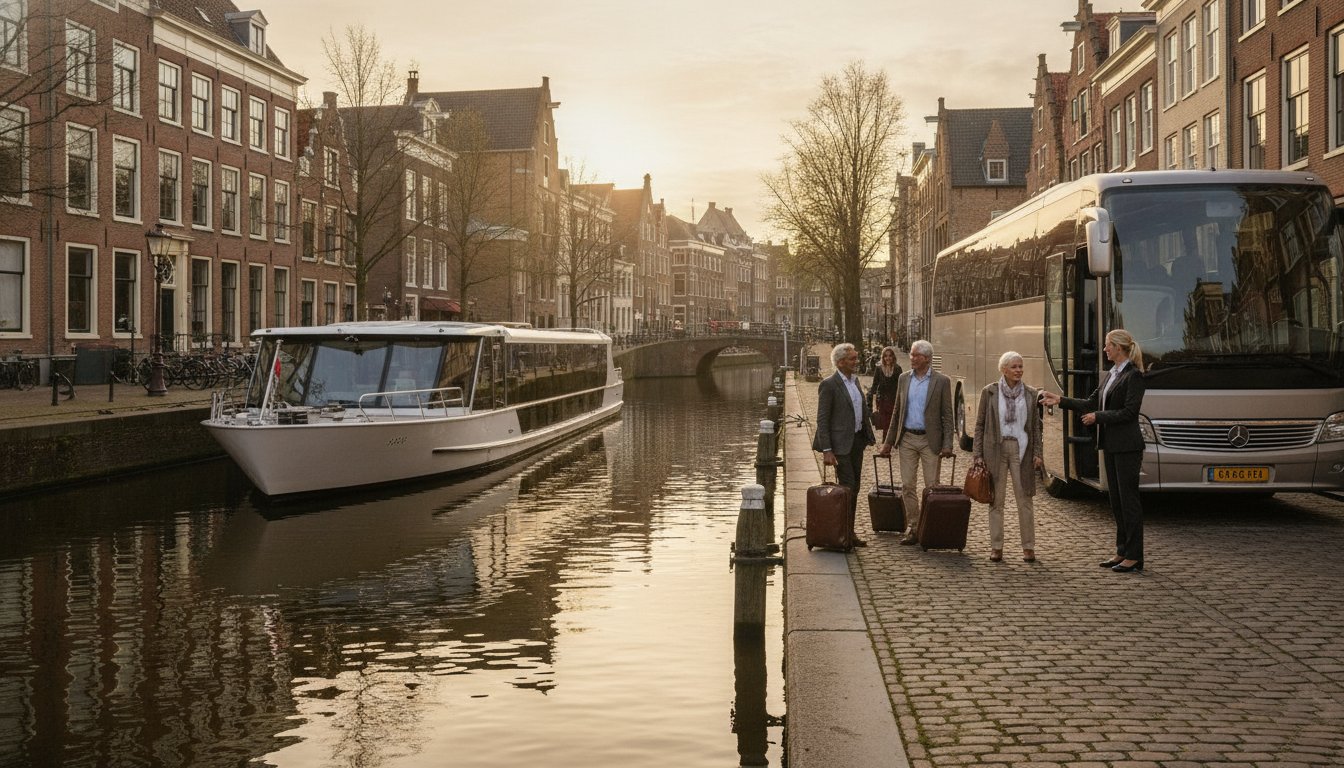
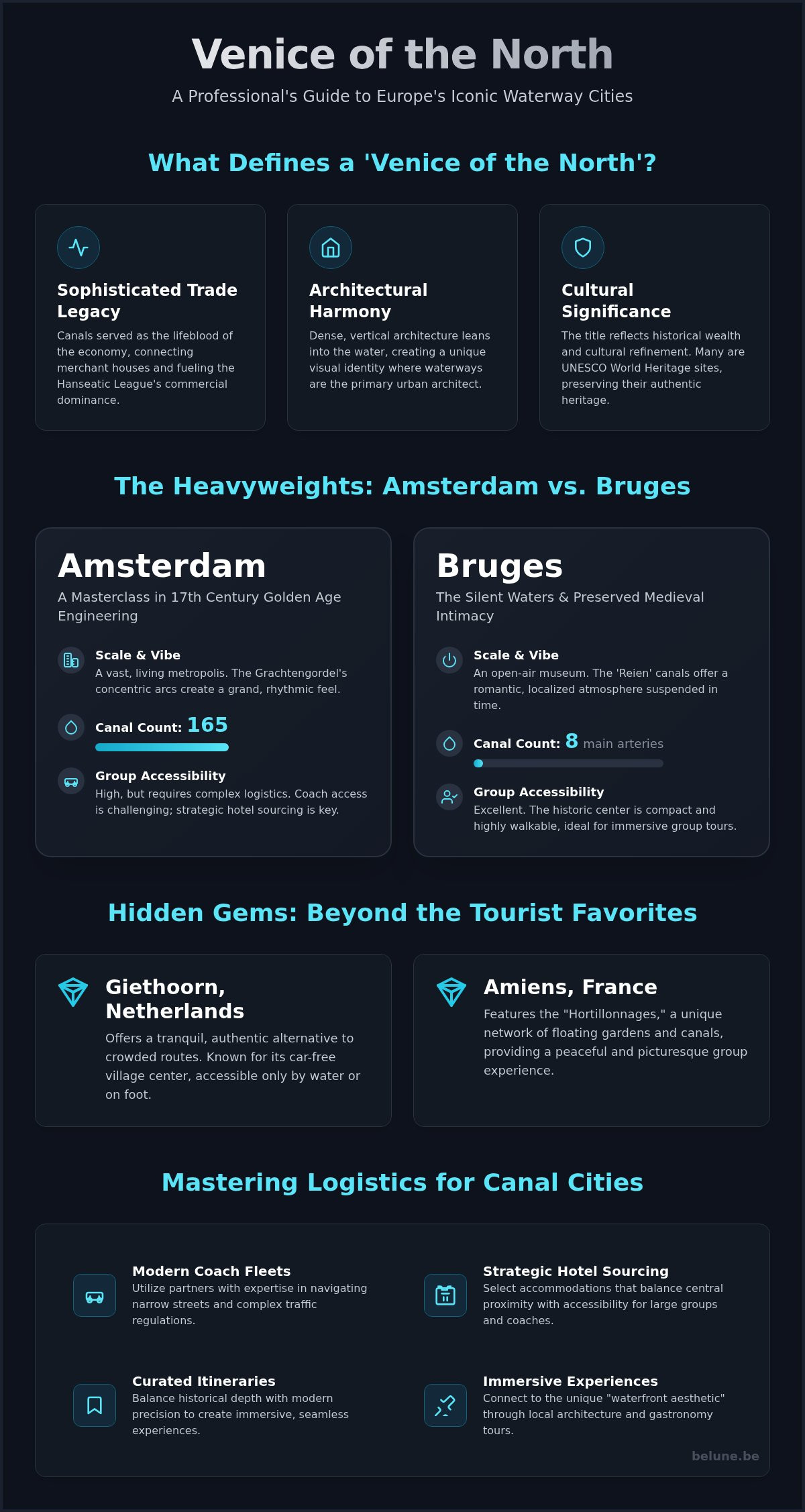
    The term venice of the north isn’t merely a flattering comparison; it’s a testament to a specific urban DNA where water dictates the rhythm of existence. Historically, cities across Northern Europe adopted this label to align themselves with the prestige of the Venetian Republic. They sought to mirror its status as a maritime superpower and a beacon of cultural refinement. Ultimately, the venice of the north serves as a designation for cities where waterways are the primary architect of urban life.

    True candidacy for this title requires more than a few scenic streams. It demands a sophisticated trade legacy, where the canal was the lifeblood of the economy, and an architectural harmony that reflects a city’s historical wealth. As we look toward 2026, these cities are evolving into something even more significant. They’re no longer just frozen relics of a Golden Age; they’ve become laboratories for sustainable urbanism and vibrant cultural hubs where historic waterways meet modern ecological innovation.

    The Hanseatic Influence on Water-Centric Urbanism

    During the Middle Ages, the Hanseatic League transformed the Benelux region into a commercial powerhouse. Canals served as the essential highways of the era, facilitating the movement of wool, grain, and spices directly to the doorsteps of merchant houses. This infrastructure blended defensive moats with commercial arteries and residential aesthetics. The resulting landscape is one of dense, vertical architecture that leans into the water, creating a unique visual harmony that defines the Northern European identity. For the travel professional, understanding this technical mastery is key to explaining why these cities look and feel so distinct from their land-locked neighbors.

    Marketing Gimmick or Cultural Heritage?

    While many towns claim the nickname for tourism appeal, only a handful possess the historical depth to sustain it. UNESCO World Heritage status often separates the self-promoted from the historically significant, ensuring that the intricate systems of locks and quays are preserved with technical rigour. Modern travelers increasingly look past the marketing labels in search of authentic heritage. In an era where traditional Venice faces significant environmental and social pressure, these Northern counterparts offer a more breathable, yet equally profound, connection to maritime history. They provide a space where the heritage is lived daily, not just staged for the passing visitor.

    The Heavyweights: Amsterdam vs. Bruges

    Amsterdam and Bruges represent two distinct interpretations of the venice of the north archetype. While Amsterdam impresses with its grand, rhythmic engineering, Bruges captures the imagination through its silent, preserved medieval intimacy. Choosing between them isn’t about quality; it’s about the specific emotional and logistical needs of your group. Amsterdam offers a vast, interconnected network that feels like a living metropolis, whereas Bruges provides a concentrated dose of Flemish history that feels suspended in time.

    Feature Amsterdam Bruges
    Canal Count 165 canals 8 main arteries (Reien)
    UNESCO Status Canal Ring (Since 2010) Historic Centre (Since 2000)
    Group Accessibility High (Complex logistics) Excellent (Compact, walkable)

    Amsterdam’s Canal Ring: A Masterclass in Engineering

    The Grachtengordel, or 17th-century canal ring, is a marvel of urban planning. Its concentric arcs were designed to manage water and facilitate global trade during the Dutch Golden Age. For groups, this means a dense concentration of cultural landmarks like the Rijksmuseum and the Anne Frank House within a single district. However, the sheer scale presents challenges for coach access. Success often depends on sourcing group hotel accommodation that provides central proximity without the noise of the main tourist arteries. Navigating this labyrinth requires a partner who understands the technical nuances of Dutch traffic regulations.

    Bruges: The Silent Waters of Flanders

    In contrast, the ‘Reien’ canals of Bruges offer a more localized, romantic atmosphere. This city feels like an open-air museum where the water reflects centuries of Flemish craftsmanship. It’s an ideal anchor for culture group tours benelux itineraries, especially for luxury clients seeking a slower pace. The city’s compact nature makes it exceptionally walkable; it’s a significant advantage for groups that prefer intimate exploration. Integrating a canal cruise here provides a different perspective, focusing on the hidden gardens and stone bridges that a coach cannot reach. To ensure your clients experience these cities without the stress of logistics, consider how a modern private coach fleet can bridge the gap between these iconic waterways.
    Exploring the 'Venice of the North': A Masterclass in European Canal Cities for 2026

    Hidden Gems: Beyond the Tourist Favorites

    While Amsterdam and Bruges are the definitive anchors, the true venice of the north experience often reveals itself in the quieter, more exclusive corners of the continent. Moving beyond the primary hubs allows for a more intimate connection with European water culture. Incorporating these hidden gems into a themed group travel benelux program elevates the itinerary from standard to exceptional. It provides that sought-after sense of discovery that modern clients demand, particularly those who’ve already visited the major capitals.

    Giethoorn: The Car-Free Wonder

    Giethoorn represents the most literal interpretation of a venice of the north, where the absence of roads forces a slower, more intentional pace. For professional organizers, managing a coach group here requires precise coordination. The village is famous for its 18th-century thatched-roof cottages and over 170 small wooden bridges. Groups typically transition from their modern coach to whisper-quiet electric boats or traditional punters. It’s a logistical shift that rewards travelers with a silence rarely found in urban centers. Planning a day trip from Amsterdam or Utrecht is straightforward, provided you’ve secured parking and boat slots in advance to avoid the mid-day peak.

    Amiens and the French Connection

    Further south, Amiens offers a French interpretation of the canal city through its “Hortillonnages.” This 300-hectare network of floating gardens has been cultivated since the Middle Ages. It’s an ideal stop for itineraries bridging the gap between the Benelux region and Paris, areas where we maintain deep operational expertise. Beyond the boat tours, the Saint-Leu district provides a vibrant backdrop for gastronomy experiences. Integrating local Picardy specialties adds a layer of sensory depth to the cultural exploration, ensuring the group’s journey is as flavorful as it is scenic.

    Finally, Strasbourg’s “Petite France” district offers a Franco-German hybrid that shouldn’t be overlooked. The timber-framed houses reflect in the Ill river, creating a dense architectural tapestry. It’s a masterclass in how water management can define a city’s historical and aesthetic identity, providing a perfect conclusion to a multi-city canal tour.

    Water as a Canvas: Architecture and Gastronomy

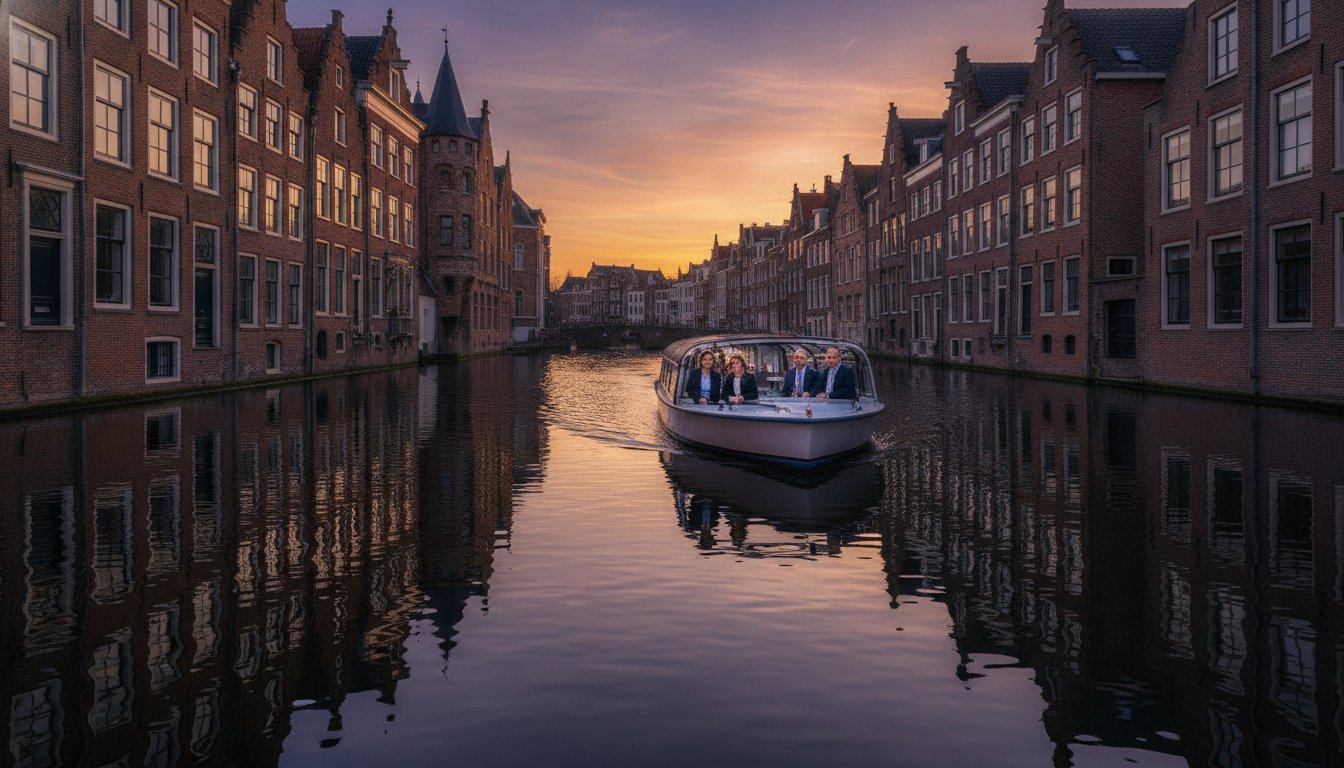
    The venice of the north isn’t just a geographic label; it’s a visual dialogue between stone and reflection. In these cities, the water acts as a canvas that magnifies the architectural ambition of the merchant class. Strategic water management transformed Benelux cities from utilitarian defensive forts into fluid, artistic masterpieces where every facade tells a story of maritime wealth. During the twilight hours, the role of light becomes paramount. Reflections on the rippling surface soften the rigid lines of brick and mortar, creating a luminous atmosphere that defines the nocturnal beauty of Northern Europe.

    Architectural Evolution on the Water’s Edge

    The transition from the austere Hanseatic brick gothic to the ornate Dutch Baroque is nowhere more evident than along the canal banks. In Amsterdam, the slender, deep merchant houses were designed to maximize waterfront frontage, resulting in the iconic gabled rooftops that lean slightly forward. Meanwhile, the belfries of Flanders stand as vertical sentinels over the medieval waterways, symbolizing civic pride and commercial success. Organizing expert-led architectural walks for specialized groups allows travelers to decode these stylistic shifts. It turns a simple stroll into a technical appreciation of how these cities were literally reclaimed from the sea, one pile and one brick at a time.

    The Gastronomy of the Waterways

    The relationship between the water and the palate is equally profound. A culinary journey through these cities moves seamlessly from the North Sea’s fresh seafood to the historical canal-side breweries that once used these waters for production. Elevating the group experience often involves integrating belgium gastronomy tours that utilize the unique setting of the ‘Reien’ or ‘Grachten’. Imagine a private canal cruise featuring a curated beer or chocolate tasting, where the surroundings enhance the sensory experience. It’s an immersive way to connect with local culture while avoiding the static environment of a traditional restaurant.

    Success in these complex environments relies on the deep local knowledge of a benelux incoming tour operator. We understand that a meal isn’t just about the menu; it’s about the harmony of the location and the ease of access. From sourcing the perfect terrace for a sunset aperitif to coordinating logistical support for large groups, our team ensures every detail is polished. To begin crafting your own bespoke cultural and culinary itinerary, contact our expert planning team today.

    Professional Logistics: Planning the Perfect Canal City Tour

    Organizing a tour through a venice of the north requires more than an eye for beauty; it demands technical precision. The very features that make these cities enchanting, such as narrow cobblestone streets and intricate canal networks, represent significant hurdles for group movement. Success lies in the invisible architecture of the tour: the logistics. A seamless experience is the result of balancing aesthetic desire with the cold reality of urban restrictions.

    Timing is a critical component of our strategy. Managing seasonal crowds is essential for maintaining a high-quality experience for your clients. We often suggest off-peak hours or hidden access points for the most iconic waterways. This ensures the group feels the city’s soul rather than the crowd’s weight. Sourcing central hotels is a similar exercise in balance. We prioritize properties that offer the quintessential canal-side atmosphere while remaining accessible for group arrivals and departures.

    Coach Travel and Accessibility

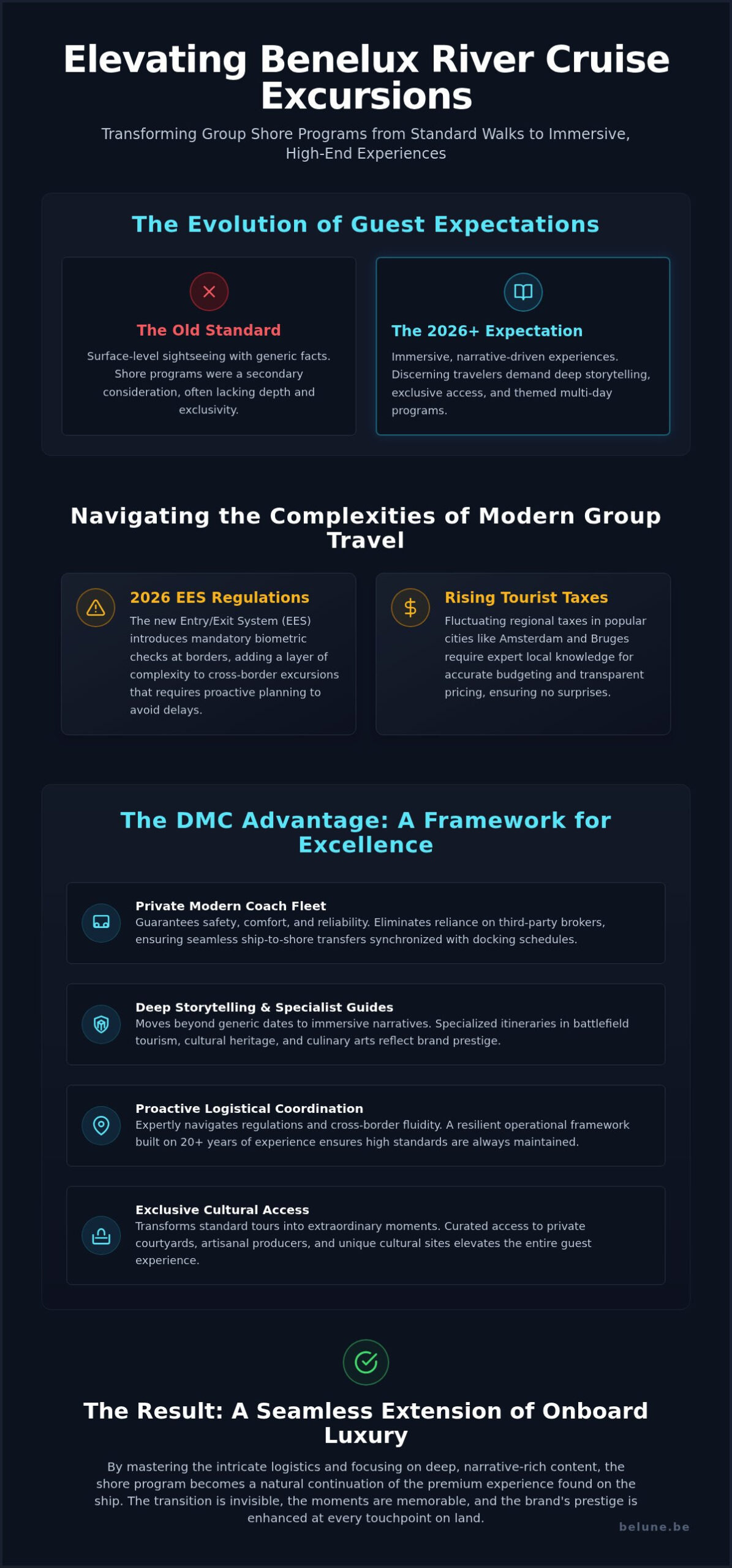
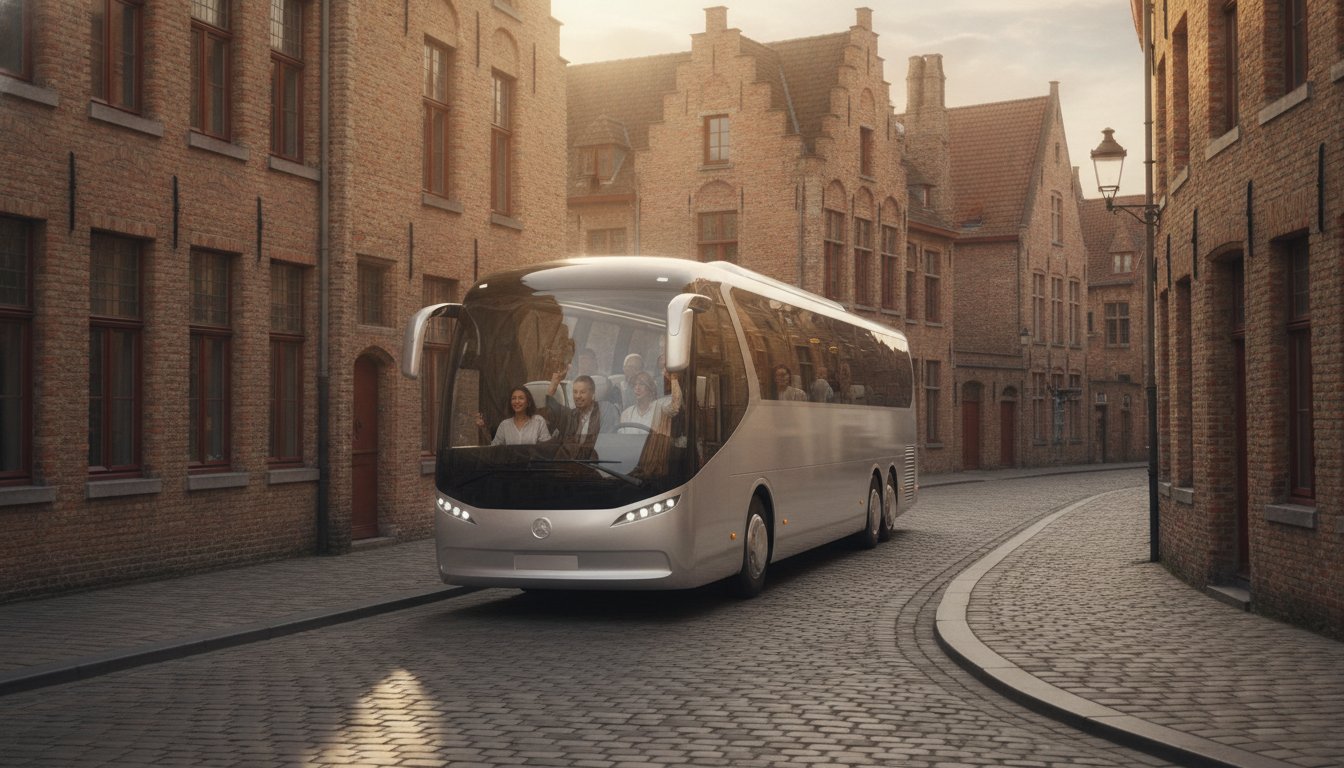
    Amsterdam and Bruges have implemented strict Low Emission Zones and restricted access areas to preserve their heritage. Navigating these requires up-to-date knowledge and modern equipment. Our private fleet of modern coaches is specifically curated for these environments. We coordinate strategic drop-off points that minimize walking distances for clients while respecting local regulations. It’s about the rhythm of the city. Our drivers act as logistical partners who understand the nuances of tight city schedules and the technical demands of European traffic laws. We turn the challenge of narrow streets into a non-issue through rigorous planning and superior fleet management.

    Curating the Custom Itinerary

    A sophisticated itinerary balances the “must-see” landmarks with silent, off-the-beaten-path water experiences. We believe that local guide services are indispensable for authentic storytelling. These experts decode the history of the gabled houses and the secrets of the locks, adding a layer of intellectual depth to the visual spectacle. Our role as a DMC is to act as the conductor for a multi-modal journey. Transitioning from a coach to a private canal boat, and then to an expert-led walking tour, should feel effortless. BELUNE transforms a standard city visit into a sophisticated cultural immersion, leveraging 20 years of industry experience to ensure every transition is polished and every moment is meaningful.

    Mastering the Waterways of 2026

    Curating a high-end group experience in a venice of the north requires a delicate balance of artistic vision and technical mastery. We’ve explored how the rhythmic canals of Amsterdam and the silent streets of Bruges offer distinct cultural narratives, each demanding its own logistical approach. Success in these environments isn’t just about the destinations; it’s about the precision of the execution. By integrating hidden gems like Amiens and leveraging the sensory depth of local gastronomy, you can offer your clients a journey that feels both exclusive and deeply authentic.

    Navigating the evolving regulations and architectural labyrinths of these cities is a task for a trusted strategist. With over 20 years of dedicated industry experience, our team provides the deep local knowledge and private fleet of modern coaches necessary for seamless movement. We don’t just provide transport; we offer a structural component to your creative project. Partner with BELUNE to design your next masterpiece group itinerary in the Benelux region and ensure your 2026 programs are as fluid as the waterways they celebrate. Let’s transform your vision into an unforgettable reality.

    Frequently Asked Questions

    Which city is officially known as the Venice of the North?

    Amsterdam and Bruges are the most prominent cities associated with the title venice of the north. While many cities across the region use this nickname to highlight their beauty, these two are recognized for their historical maritime influence and preserved canal systems. The designation reflects a specific urban DNA where waterways served as primary trade routes. Choosing the “official” one depends on whether you prioritize Amsterdam’s Golden Age engineering or the medieval intimacy of Bruges.

    Is Amsterdam or Bruges better for a group tour?

    The choice between Amsterdam and Bruges depends entirely on your group’s specific goals and size. Amsterdam offers a vast scale with world-class museums and a rhythmic metropolis feel, making it ideal for larger cultural tours. Bruges provides a more concentrated, romantic atmosphere that is exceptionally walkable for luxury groups. We often recommend integrating both into a single itinerary to provide a comprehensive view of the region’s diverse water-centric heritage; it’s the best way to satisfy varied interests.

    How do coaches access the historic centers of canal cities?

    Coaches access these historic centers through a series of strategic drop-off points designed to respect local Low Emission Zones and traffic regulations. Navigating these narrow streets requires modern equipment and deep technical knowledge of city-specific access permits. We utilize our private fleet of modern coaches to ensure seamless transitions between major landmarks. This approach minimizes walking distances for clients while ensuring the group remains compliant with the evolving environmental standards of European canal cities.

    What is the best time of year to visit the Venice of the North cities?

    Late spring and early autumn are the ideal times to visit these iconic waterways to balance favorable weather with manageable crowd levels. Visiting during these periods allows groups to experience the architectural splendor and canal-side dining without the peak summer congestion. April and May are particularly vibrant due to the floral displays in the Netherlands. Conversely, September provides a softer light and a more serene atmosphere that is perfect for professional architectural walks and cultural immersion.

    Can you visit Giethoorn with a large tour group?

    You can certainly visit Giethoorn with a large group, provided the logistics are coordinated with technical precision. Since the village is car-free, groups must transition from their coach to private electric boats or traditional punters at specific entry points. We manage these transfers to ensure the group moves smoothly from the parking areas into the heart of the village. Advance booking for boat slots is essential to maintain the schedule and avoid the mid-day tourist peak.

    What are the best group activities in a canal-based city?

    The most impactful activities involve engaging directly with the water through private canal cruises or themed walking tours. Gastronomy and beer experience tours are particularly effective, allowing groups to sample local craftsmanship while enjoying the waterfront aesthetic. Architectural walks led by local experts also provide deep intellectual value, decoding the history of gabled merchant houses. For more active groups, cycling along the canal paths offers a dynamic perspective of the urban landscape and its natural surroundings.

    How does a DMC help with canal city logistics?

    A DMC acts as a strategic ally by coordinating the complex multi-modal transport required in water-centric environments. We manage everything from sourcing hotels with coach access to securing private local guides who understand the rhythm of the city. Our 20 years of experience allow us to navigate the technical nuances of local regulations and hidden logistical hurdles. This comprehensive support transforms a standard visit into a polished, high-quality experience that inspires confidence in your professional partners.

    Are there any ‘Venice of the North’ cities in France?

    Amiens is frequently cited as a French venice of the north due to its stunning “Hortillonnages” or floating gardens. Strasbourg also offers a unique Franco-German interpretation through its historic “Petite France” district, where timber-framed houses line the Ill river. These destinations provide an excellent bridge for itineraries moving between the Benelux region and Paris. They offer a distinct sensory experience that complements the more traditional canal cities while adding a layer of exclusivity to your travel programs.
  • 2026 Flanders Group Tour: Professional Itinerary Guide

    2026 Flanders Group Tour: Professional Itinerary Guide

    What if the true success of a 2026 flanders group tour itinerary isn’t measured by the number of sites visited, but by the seamless flow between them? Designing a journey through this historic landscape requires more than just a list of monuments; it demands an artistic approach to logistics and a deep understanding of the region’s evolving infrastructure. You likely feel the pressure of rising costs, such as the 12% VAT on accommodation, and the challenge of balancing the somber weight of WWI history with the light, sensory joy of Belgian gastronomy.

    We understand that as a professional, you’re looking for more than a simple route. You need a strategic alliance that transforms complex travel requirements into a fluid, high-end experience for your clients. This guide offers a turn-key framework to help you master the unique landscape of the coming year, from managing coach movements during the busy April cycling season to securing elite stays in historic centers. We’ll detail reliable transport solutions, exclusive cultural touchpoints, and the technical secrets to a friction-free Belgian experience.

    Key Takeaways

    • Learn why it’s the density of UNESCO sites that makes Flanders ideal for 2026’s shift toward slow travel and cultural immersion.
    • Access a professional 5-day flanders group tour itinerary that balances the depth of art history with technical logistical demands.
    • Discover why a dedicated coach fleet is the critical factor in managing group flow through narrow historic centers and rural battlefields.
    • Master the art of balancing remembrance tourism at WWI sites with lighter, sensory experiences like Flemish gastronomy and beer tours.
    • Understand how a DMC’s two decades of local relationships help you navigate capacity shifts and unexpected logistical hurdles.

    Why Flanders Remains a Premier Choice for Group Tours in 2026

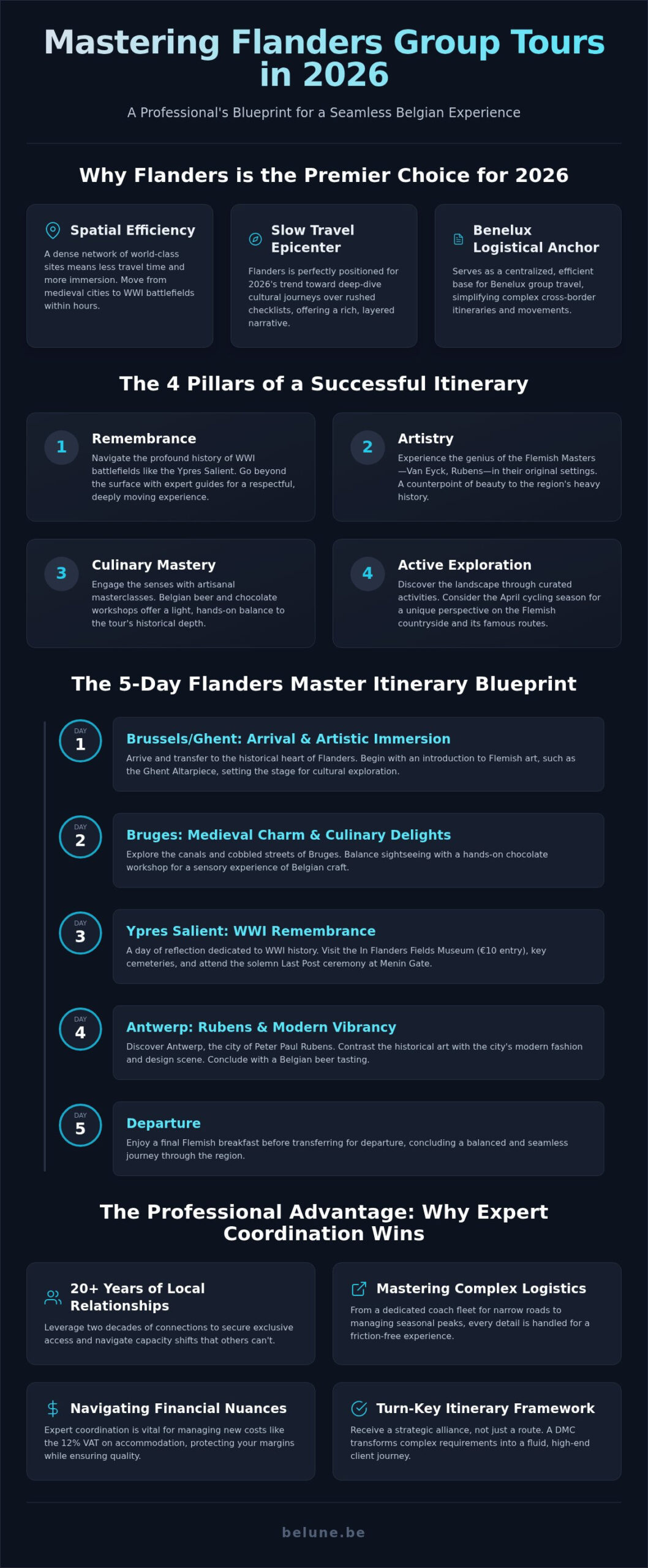
    Flanders is a masterclass in spatial efficiency. Within a few hours of driving, your groups can transition from the medieval spires of Ghent to the solemn ridges of the Ypres Salient. This proximity is the backbone of a successful flanders group tour itinerary, allowing for a richness of experience without the fatigue of long transit times. In 2026, the region is positioning itself as the epicenter of slow travel. Travelers no longer want a mere checklist; they want a narrative. They seek deep-dive cultural immersion that connects the landscape to the soul.

    When researching About Flanders, one discovers a region that has perfected the art of the multi-layered journey. Flanders serves as the primary logistical anchor for Benelux group travel, offering a centralized base that simplifies cross-border movement.

    To better understand this concept of immersive travel, watch this helpful video:

    The Triple Threat: History, Art, and Gastronomy

    Remembrance tourism remains a core driver for international bookings. It’s a profound experience that requires delicate handling. Moving beyond the Last Post Ceremony at Menin Gate, groups now look for technical depth at sites like the In Flanders Fields Museum in Ypres. The standard €10 entrance fee is a small price for such a visceral connection to the past. Our experts recommend scheduling these visits early to allow for quiet reflection.

    The Flemish Masters provide a necessary counterpoint of beauty. The enduring appeal of Van Eyck or Rubens in their original settings creates an emotional resonance that a textbook can’t match. To lighten the atmosphere, integrate Belgian beer and chocolate workshops. These aren’t just snacks; they’re artisanal masterclasses. They offer a hands-on engagement that balances the heavy history of the battlefields, ensuring your clients leave with a well-rounded perspective.

    Infrastructure Readiness for 2026

    The region has prepared for the 2026 season with significant facility modernizations. Many museums have updated their layouts to handle larger group flows without sacrificing the intimacy of the viewing experience. This technical foresight ensures your clients don’t feel like they’re part of a crowd. It’s about maintaining that high-end, exclusive atmosphere even in popular destinations.

    Sustainability is no longer optional. The Green Travel initiative is a major pillar of Flemish tourism. This focus on eco-friendly logistics aligns with the values of modern travelers and simplifies the narrative for your marketing. Digital integration has also matured; it’s now easier to manage complex group bookings at major sites through streamlined portals. Keep in mind that planning for 2026 requires accounting for the new 12% VAT on accommodation. This change makes early, professional coordination even more vital for protecting your margins while delivering excellence.

    The Core Pillars of a Successful Flanders Group Itinerary

    A professional flanders group tour itinerary is built on four distinct pillars: remembrance, artistry, culinary mastery, and active exploration. It’s not enough to simply drive between cities. You must curate a rhythm that respects the gravity of history while celebrating the vibrancy of modern Flemish life. This balance ensures that your clients remain engaged, moving from the quiet reflection of a cemetery to the sensory joy of a chocolate workshop without feeling a sense of tonal whiplash.

    Battlefield Tourism: A Professional Approach

    The Ypres Salient and Flanders Fields represent a pilgrimage for many. For a large group, the logistics of these sites require precision. Maneuvering a coach through narrow rural roads to reach specific cemeteries or bunkers demands a fleet that’s both modern and agile. We recommend prioritizing specialized local guides who can breathe life into the silence of the trenches. For deeper technical insights into planning these visits, consult our Flanders Fields: The Definitive Guide to WWI Remembrance.

    Curating the ‘Flemish Masters’ Experience

    Integrating the ‘Big Three’ art cities requires strategic timing. To avoid peak crowds at the Ghent Altarpiece or Antwerp’s Royal Museum of Fine Arts, we suggest mid-week morning slots. This allows your clients to appreciate the meticulous detail of the Flemish Masters in a serene environment. Don’t overlook the contemporary art scenes emerging in industrial spaces; they provide a fresh contrast to the medieval romance of the city centers. You can find more on this in The Ultimate Guide to Culture Group Tours in Benelux.

    Gastronomy should move beyond the hotel dining room. Immersive beer and chocolate workshops offer a tactile connection to the region’s artisanal roots. Meanwhile, the ‘active’ layer is no longer a niche. Cycling tours are becoming a staple, even for traditional groups. When planning for 2026, be mindful of the “We Ride Flanders” amateur ride on April 4th and the professional race on April 5th. These events transform the region into a cycling cathedral, impacting road access and hotel availability. For the most up-to-date planning resources, the Official Flanders Tourism site remains an essential reference.

    To ensure these pillars are supported by flawless logistics, consider how a local expert partner can streamline your next project.

    2026 Flanders Group Tour: Professional Itinerary Guide

    Logistics form the invisible architecture of a successful flanders group tour itinerary. Without a technical mastery of movement, the most inspired cultural program can quickly dissolve into traveler fatigue. While public rail might suit a solo explorer, it’s often impractical for professional groups of 30 or more who carry luggage and follow a strict schedule. A private coach offers more than just transport; it provides a sanctuary of continuity and a mobile base where the narrative of the journey remains uninterrupted.

    The Role of a Modern Coach Fleet

    In 2026, the technical requirements for group transport have reached a new peak of sophistication. A dedicated fleet must meet Euro 6 environmental standards to navigate the increasingly strict low-emission zones in cities like Antwerp and Ghent. Safety is paramount, but so is the intuitive expertise of the driver. Navigating the cobblestone arteries of a medieval center requires a professional who understands the specific weight and clearance limits of historic bridges. This level of precision ensures that your clients spend their time admiring the architecture rather than worrying about the route.

    Comfort features are no longer optional. High-speed Wi-Fi, climate control, and ergonomic seating are the baseline for maintaining group energy across a multi-day trip. As highlighted in the National Geographic Belgium Guide, the region’s compact geography is its greatest asset, provided your transport is as agile as your itinerary. By utilizing a private coach, you eliminate the 4.2% indexed increase in public transport fares while gaining total control over your group’s environmental footprint and daily flow.

    Hotel Accommodation Management

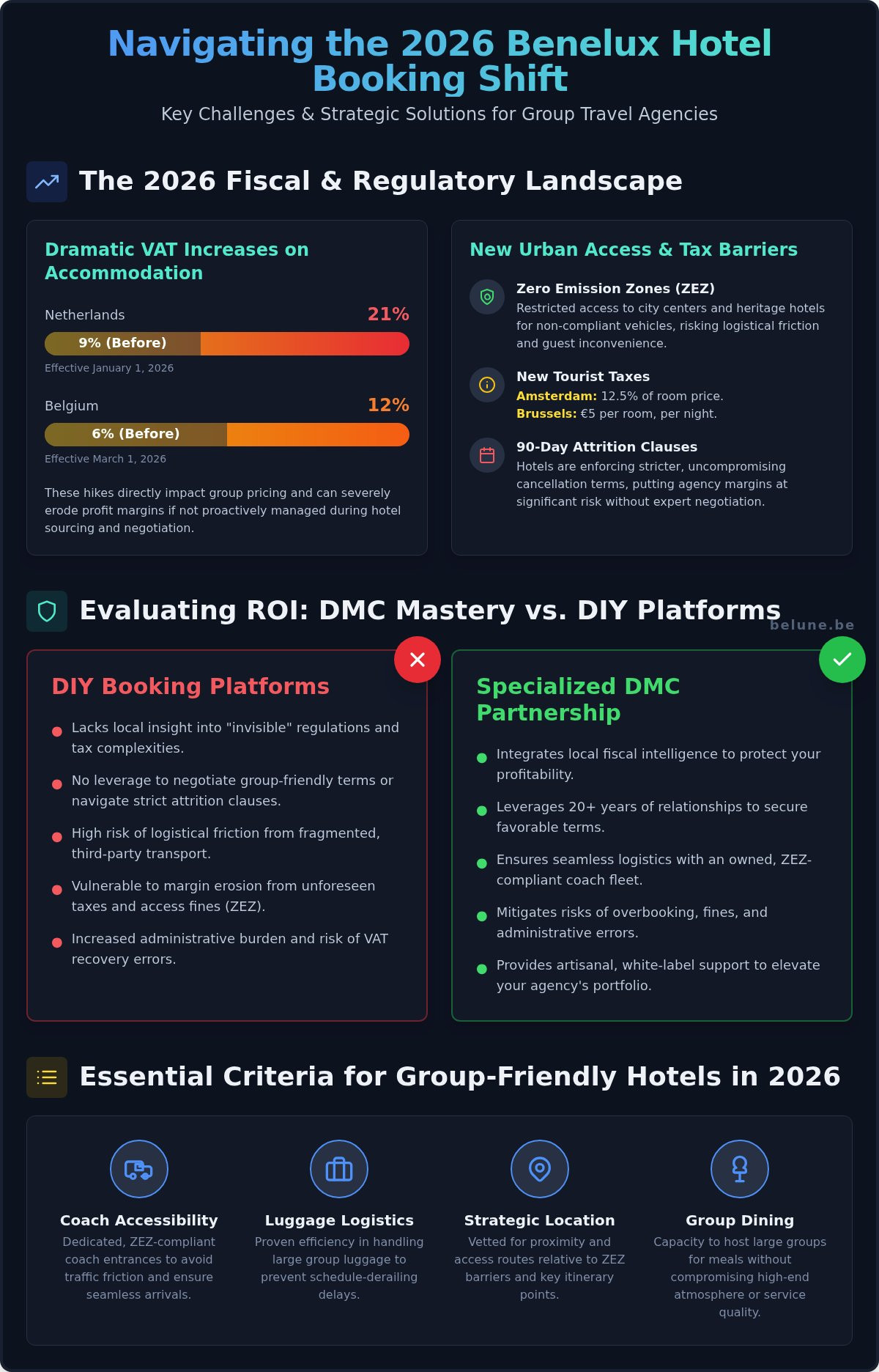
    There’s a critical distinction between a hotel that is ‘group-friendly’ and one that is truly ‘group-ready.’ A group-ready establishment understands the nuances of block bookings, from the necessity of rapid check-in processes to the specific catering requirements of an international clientele. In 2026, tour operators must account for the 12% VAT on accommodation services and the €5 per person nightly tourist tax in Brussels. These financial shifts make early, professional negotiation essential for protecting your margins.

    Sourcing the right stay involves more than just counting beds. You must evaluate coach parking proximity, the quality of group dining spaces, and the hotel’s ability to maintain a high-end atmosphere despite the volume of guests. Managing these relationships requires a deep local network. To understand how these partnerships function at the highest level, see The Definitive Guide to Choosing a Benelux Incoming Tour Operator. Securing a reliable local ally ensures that your accommodation choices reflect the same level of excellence as your cultural program.

    The 5-Day Flanders Master Itinerary: A Professional Blueprint

    A successful flanders group tour itinerary is more than a sequence of stops; it’s a logistical loop that maximizes cultural exposure while minimizing transit friction. This blueprint connects the medieval romance of the art cities with the hallowed grounds of the West, creating a narrative that feels both expansive and intimate. For 2026, we’ve refined this route to account for shifting museum capacities and the evolving landscape of Flemish hospitality, ensuring every movement serves the group’s experience.

    Day-by-Day Tactical Breakdown

    Day 1-2: The Art City Axis. Begin with arrival and a seamless transfer to Bruges. The first 48 hours focus on the “Big Three” cities, balancing the canal-side charm of Bruges with the architectural power of Ghent. Professional coach transfers are essential here to navigate low-emission zones and secure drop-offs near historic centers. This phase prioritizes the Flemish Masters, ensuring your group experiences the Ghent Altarpiece before the midday crowds arrive.

    Day 3: The Path of Remembrance. Move westward to the Ypres Salient. This structured visit includes the In Flanders Fields Museum and a focused exploration of the surrounding battlefields. The day concludes with the Menin Gate Last Post Ceremony. Given the emotional weight of this day, we schedule lighter evening activities to allow for quiet reflection and group cohesion.

    Day 4: Sensory Mastery. Transition to Antwerp or Leuven for a deep dive into the region’s culinary soul. This is where Belgium Gastronomy Tours: A Masterclass in Culinary Artistry come into play, offering immersive beer and chocolate experiences that engage the group’s senses after the historical intensity of the previous days. It’s a day designed for artisanal discovery and high-end engagement.

    Day 5: Modern Flanders and Departure. The final morning is dedicated to the contemporary side of the region, perhaps a visit to a modern design hub or a final artisanal market. Departure logistics are handled with precision. We ensure groups reach Brussels Airport or the Eurostar terminal with ample time, accounting for the 2026 tourist tax protocols and final hotel check-out efficiencies.

    Customization Options for Special Interest Groups

    This framework is designed for flexibility. For cycling enthusiasts, the route can be adapted to include the iconic “bergs” of the Tour of Flanders, particularly around the peak April race dates. If your clients seek a more niche focus, consider Themed Group Travel in Benelux: A Masterclass to integrate garden tours or festival-focused stops like Tomorrowland. This level of customization transforms a standard trip into a bespoke event that resonates with specific client passions.

    Ready to build your next masterpiece? Consult with our logistics experts to finalize your 2026 planning and secure your preferred dates.

    Partnering with a DMC: Why Professional Coordination Wins

    A Destination Management Company (DMC) serves as the strategic ally for travel agents, bridging the gap between a conceptual vision and a flawlessly executed reality. In the intricate landscape of a flanders group tour itinerary, professional coordination is the difference between a standard trip and an elite experience. Navigating the nuances of 2026 requires more than just a booking engine. It demands two decades of local relationships, a deep understanding of regional logistics, and a commitment to protecting the margins of international tour operators.

    Risk management is a core pillar of this partnership. Whether it’s a sudden shift in museum capacity or a logistical detour caused by a local cycling event, a professional DMC provides real-time solutions that keep the group’s narrative intact. This technical foresight ensures that the unexpected never becomes a burden for your clients. By utilizing fixed-price group packages, you secure financial stability in a market where accommodation VAT has reached 12% and city taxes are rising. We don’t just book; we architect.

    Custom Itinerary Planning and Logistics

    The journey from initial concept to on-the-ground management requires a delicate touch. We focus on transforming your requirements into a fluid, high-impact program. A major component of this is our local guide services. These professionals offer more than just facts; they provide authentic storytelling that connects travelers to the soul of Flanders. This level of depth is essential for creating lasting memories. For a deeper look at selecting the right partner for your next project, see The Definitive Guide to Choosing a Group Travel Agency.

    The BELUNE Difference in Flanders

    Our approach is defined by the seamless integration of transport and hospitality. By operating our own fleet of modern coaches, we eliminate the friction often found with third-party providers. We combine this logistical control with expert accommodation management, ensuring that every hotel stay aligns with our standards of sophisticated, minimalist elegance. This is not a simple supply chain; it’s a vision of excellence designed to reassure our partners and inspire their clients. We take pride in our ability to transform an environment through technical mastery and artistic sensibility.

    Refine your 2026 Flanders group program with a partner who understands the art of the journey. Contact BELUNE today to begin co-creating your next masterpiece.

    Elevating the Art of the Flemish Journey

    Designing a high-impact flanders group tour itinerary for 2026 requires more than a deep knowledge of history; it demands a technical mastery of the region’s evolving infrastructure. Success lies in the delicate balance between the somber reflection of the Ypres Salient and the artisanal vibrancy of the Flemish art cities. By prioritizing a seamless flow between transport, accommodation, and cultural immersion, you transform a standard visit into a profound human experience that resonates with your clients long after they depart.

    As a strategic ally for travel agents, BELUNE offers the precision and vision needed to navigate these complexities. With over 20 years of DMC expertise, we provide a private fleet of modern coaches and specialized guides who are masters of battlefield and gastronomy narratives. We invite you to Request Your Custom Flanders Group Itinerary from BELUNE to ensure your next program is executed with flawless professional rigor. Let’s co-create a journey that captures the true soul of Flanders through technical excellence and creative passion.

    Frequently Asked Questions

    What is the best time of year for a Flanders group tour?

    The ideal windows for a flanders group tour itinerary are spring (April to June) and early autumn (September to October). These months offer mild weather and the full reopening of seasonal heritage sites. You should be aware that the first weekend of April 2026 hosts major cycling events, including the professional Tour of Flanders on April 5th. These dates significantly impact hotel availability and road access across the region.

    How many days should a group spend in Flanders Fields?

    A professional group typically requires one to two days to experience the Ypres Salient with the necessary depth. A single day allows for a structured visit to the In Flanders Fields Museum and the evening Menin Gate ceremony. Extending to a second day provides the opportunity to explore specific national cemeteries or combine the visit with the nearby Somme battlefields, ensuring a comprehensive narrative of remembrance for your clients.

    Is Flanders suitable for school group travel?

    Flanders is exceptionally well-suited for educational groups, particularly those focusing on modern history, art history, and international relations. The region’s dense concentration of WWI sites and UNESCO-listed medieval centers provides a visceral classroom environment. Our specialized guides excel at adapting technical historical data into engaging narratives for younger audiences. We manage the specific safety and catering logistics required to maintain high standards for student delegations.

    Can a Flanders itinerary be combined with a Paris tour?

    Yes, combining these regions is a logical logistical step for many international operators. As a DMC specializing in the Benelux region and Paris, we facilitate seamless transitions between the Flemish art cities and the French capital. Our private coach fleet allows for comfortable cross-border transfers that avoid the complexities of group rail bookings. This combination offers a sophisticated balance between the intimate charm of Flanders and the grand scale of Paris.

    What are the coach parking regulations in major Flemish cities?

    Flemish cities enforce strict regulations to protect their historic centers, including Low Emission Zones (LEZ) that require Euro 6 standard vehicles. Most centers utilize dedicated coach drop-off points located on the city periphery to maintain a fluid environment for pedestrians. Our drivers possess the technical expertise to navigate these zones efficiently. We ensure your flanders group tour itinerary accounts for these movements, preventing delays and ensuring proximity to key cultural sites.

    Do I need a specialized guide for WWI battlefield sites?

    A specialized guide is essential for providing the authentic storytelling and technical context that these hallowed grounds demand. Battlefield tourism is about more than visiting coordinates; it’s about understanding the human and structural transformation of the landscape. Our local experts offer a professional depth that standard guides cannot match. They ensure your group receives a nuanced perspective on the Ypres Salient while managing the specific etiquette required at remembrance sites.

    How do I manage dietary requirements for a large group in Belgium?

    Managing diverse dietary needs requires early coordination between your DMC and our network of group-ready hotels and restaurants. We handle the technical details of menu planning to ensure that vegan, gluten-free, or religious dietary requirements are met without compromising the quality of the Flemish gastronomic experience. By centralizing these requirements during the planning phase, we guarantee a seamless dining flow that respects the artisanal standards of Belgian cuisine.

    What are the benefits of a fixed-price group package?

    Fixed-price packages provide essential financial stability and protect your margins against regional cost fluctuations. In 2026, tour operators must navigate a 12% VAT on accommodation and rising tourist taxes, such as the €5 nightly fee in Brussels. A comprehensive package locks in your costs for transport, guiding, and lodging. This transparency allows you to market your tour with confidence, knowing the logistical architecture and pricing are secured by a reliable local partner.

  • Benelux Group Travel Logistics: 2026 Strategic Guide

    Benelux Group Travel Logistics: 2026 Strategic Guide

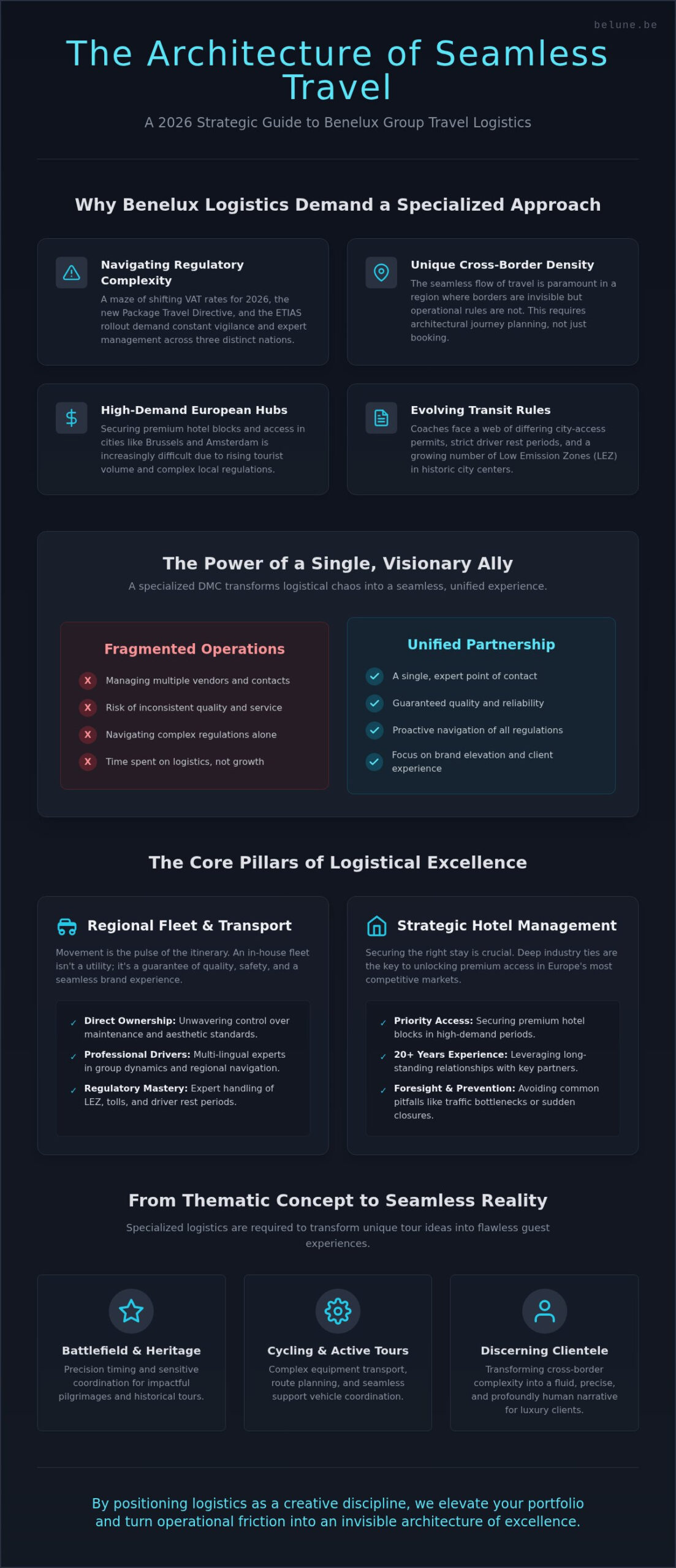
    Can a logistical framework be as evocative as a Dutch Master’s painting? In the 2026 travel landscape, true luxury is found in the absence of friction. You know the weight of managing shifting VAT rates and the intricate dance of securing hotel blocks in high-demand hubs like Brussels or Amsterdam. It’s a delicate balance where the smallest operational delay can disrupt a guest’s immersion. This strategic guide explores how sophisticated Benelux group travel logistics act as the invisible architecture of an exceptional journey.

    We’ll show you how a single point of professional contact and a dedicated, modern coach fleet turn regulatory challenges like the new Package Travel Directive into opportunities for excellence. You’ll discover a blueprint for curated itineraries that reflect your brand’s prestige while navigating the technical realities of the ETIAS rollout and rising tourist taxes. We’re moving beyond simple transport to a vision of movement that is fluid, precise, and profoundly human. By positioning logistics as a creative discipline, we help you transform cross-border complexity into a seamless narrative for your most discerning clients.

    Key Takeaways

    • Understand how the unique cross-border density of the region demands a more sophisticated, architectural approach to journey planning.
    • Discover the strategic advantages of utilizing a private, modern coach fleet to maintain uncompromising quality and reliability for international groups.
    • Learn how expert hotel accommodation management secures premium stays in high-demand European hubs, even amidst shifting 2026 regulations.
    • Explore the specialized logistical coordination required to transform thematic concepts, such as battlefield pilgrimages or cycling tours, into seamless guest experiences.
    • See how a single, visionary ally for Benelux group travel logistics simplifies complex operations, allowing your agency to focus on growth and brand elevation.

    The Architecture of Seamless Benelux Group Travel Logistics

    Logistics is the silent skeleton of a journey. Without it, the most inspired itinerary collapses under the weight of its own complexity. When we discuss Benelux group travel logistics, we aren’t just talking about buses and beds; we’re defining the strategic integration of transport, stay, and timing. It’s a technical discipline that requires a creator’s eye to ensure that the transition between a morning in a Brussels gallery and an evening in an Amsterdam canal house feels effortless rather than exhausting.

    The Benelux region presents a unique challenge of density. Borders are often invisible, yet the regulations governing them are not. This is why mastering Benelux group travel logistics requires more than a map; it requires a visionary ally. A true partner doesn’t just book services; they secure the structural integrity of your tour. By eliminating the friction of multi-country coordination, professional logistics management allows the guest’s emotion to remain the focus of the experience.

    Why Benelux Logistics Demand a Specialized DMC

    Coordinating the distinct fiscal and transit regulations between Belgium, the Netherlands, and Luxembourg is an intricate task. While the Benelux Union fosters economic cooperation, tour operators still face differing VAT structures for 2026 and varying city-access permits for coaches. A specialized DMC acts as a centralized hub, managing these Western European intricacies from a single point of authority. Benelux Logistics is the artistic orchestration of regional travel.

    The Role of Experience in Navigating Regional Intricacies

    Expertise isn’t just about knowing the roads; it’s about the relationships built over 20+ years. These deep industry ties allow us to secure priority access and manage hotel blocks in high-demand periods that others might find inaccessible. Local knowledge prevents the common pitfalls that ruin a day’s flow, such as sudden traffic bottlenecks in Antwerp or unannounced site closures in the Ardennes. For a deeper look at selecting the right partner, consult the definitive guide to choosing a Benelux incoming tour operator in 2026. This level of foresight ensures that the logistical framework remains invisible, leaving only the beauty of the destination for your groups to enjoy.

    Orchestrating Regional Fleet and Transport Logistics

    Movement is the pulse of any itinerary. It’s the transition between a quiet morning in the Ardennes and the vibrant energy of a Dutch city. In 2026, the quality of this movement defines the group’s perception of luxury. When we manage Benelux group travel logistics, we treat the coach not as a utility, but as a structural component of the guest experience. Owning a private fleet allows us to maintain a standard of excellence that sub-contracted services simply can’t replicate. By centralizing Benelux group travel logistics through a single owner-operator, you eliminate the risk of fragmented service and ensure the journey remains fluid and unhurried.

    The Advantage of an In-House Coach Fleet

    Direct ownership means direct responsibility. We don’t rely on third-party schedules or varying maintenance standards. Our modern coaches are kept to a rigorous technical and aesthetic baseline, reflecting the sophisticated image our B2B partners wish to project. This creates a seamless synergy between the driver, the guide, and the tour operator. The driver isn’t just a pilot; they’re a multi-lingual professional who understands the nuances of international group dynamics. This integration ensures that the ‘minimalist elegance’ we promise is felt in every mile. It’s about reliability that inspires confidence.

    Navigating Cross-Border Transport Regulations

    Cross-border travel involves a complex web of technicalities. From strict driver rest periods to the evolving Low Emission Zones (LEZ) in historic city centers, the logistical burden is significant. Professional management handles the intricacies of regional parking laws and tolls across the Benelux and into Paris. According to European tourism statistics, the rise in regional travel demands even greater precision in transit timing to avoid bottlenecks. We navigate these regulations so the coach remains a mobile sanctuary, a place where guests can reflect on their journey in total comfort.

    High-end group travel in 2026 requires a specific technical baseline to meet guest expectations:

    • Ergonomic seating with premium materials for long-distance comfort.
    • Advanced climate control systems for optimal air quality and temperature precision.
    • Integrated connectivity and power solutions for the modern, connected traveler.
    • Sustainable engine technology to ensure access to restricted city centers.

    If you’re looking to elevate your next itinerary, consider our bespoke coach hire solutions as your strategic foundation. This level of foresight transforms a simple transfer into an essential part of the story you’re telling.

    Benelux Group Travel Logistics: 2026 Strategic Guide

    Strategic Hotel Accommodation and Partner Management

    If transport is the pulse of a journey, accommodation is its anchor. In the high-demand hubs of Western Europe, securing a hotel is more than a transaction; it’s a strategic maneuver. Within the framework of Benelux group travel logistics, our Hotel Accommodation Management service acts as a core pillar of success. We don’t just book rooms. We orchestrate the entire stay to ensure it aligns with the rhythmic flow of the itinerary. This involves managing centralized billing and booking for complex multi-stay tours, which reduces the administrative burden on our B2B partners.

    High-demand periods across the region require foresight and established relationships. According to official Belgian tourism statistics, the volume of overnight stays in professional accommodations continues to demand rigorous planning to ensure availability for larger groups. We select partners who meet uncompromising B2B standards, focusing on properties that understand the specific needs of international tour operators. This centralized approach guarantees that every partner in the chain reflects your brand’s commitment to quality.

    Sourcing Group-Friendly Stays

    Evaluating a property requires a technical eye. We prioritize hotel accessibility for large coaches, ensuring that arrivals and departures are discreet and efficient. The balance between a central location and logistical ease is delicate. A hotel must offer more than aesthetic appeal; it must provide the physical space required for group movements without friction. For more insights on this process, see our guide on sourcing group-friendly hotels in Brussels & Amsterdam.

    Vetting Local Partners and Guides

    The final component of a logistical plan is the human element. Our local guides are selected through a rigorous process that prioritizes multi-lingual expertise and a deep, poetic understanding of their city. These partners act as extensions of our commitment to excellence. They aren’t just narrators; they’re logistical problem-solvers on the ground. By vetting every guide and local service provider, we ensure that the visionary quality of the tour remains consistent from the first welcome to the final farewell. This meticulous selection process is what transforms a standard tour into a signature brand experience.

    Thematic Logistical Execution: From Heritage to Gastronomy

    Every itinerary possesses a unique rhythm. A cultural journey through the silent galleries of a museum requires a stationary logistical approach, focusing on proximity and unhurried transitions. Conversely, an active cycling tour across the windswept polders demands a mobile architecture of support vehicles and invisible luggage transfers. Mastering Benelux group travel logistics means adapting the technical skeleton of a tour to its emotional soul. We don’t believe in templates; we believe in the surgical precision of movement that serves the story you’re telling.

    Logistics for Battlefield and Remembrance Tourism

    Remembrance tourism requires a specific sensitivity. Coordinating a pilgrimage to sites like Flanders Fields isn’t merely about transit timing; it’s about respecting the cadence of memory. These itineraries demand expert guides who specialize in military history and the ability to navigate complex site access during peak commemorative periods. We manage the delicate synchronization between the coach arrival and the start of local ceremonies, ensuring your group remains immersed in the moment rather than the mechanics of the day. For a deeper exploration of these specialized journeys, consult our guide on Flanders Fields: The Definitive Guide to WWI Remembrance and Group Pilgrimages in 2026.

    Gastronomy and Active Travel Coordination

    High-end gastronomy and beer tours rely on absolute reservation precision. Whether it’s a private workshop with a master chocolatier or a behind-the-scenes brewery visit, the logistical flow must be flawless. We treat these appointments as fixed points around which the day’s movement is elegantly draped. For active groups, the requirements shift toward technical support. Cycling tours across the Benelux landscape require dedicated support vehicles and gear management that happens entirely out of the guest’s sight. This level of coordination is detailed in our masterclass on Belgium Gastronomy Tours: A Masterclass in Culinary Artistry for Groups.

    Thematic execution is where our technical mastery meets your creative vision. By tailoring the logistical framework to the specific needs of the theme, we ensure that the guest’s experience remains pure and uninterrupted. If you’re ready to design a journey that transcends the ordinary, start your bespoke itinerary planning today with an ally who understands the art of the detail.

    Elevating Your Portfolio through Professional DMC Partnership

    The true value of a partnership isn’t found in a simple list of services. It’s found in the liberation of your team’s creative and commercial energy. By entrusting your Benelux group travel logistics to a specialized ally, you shift from the granular management of multiple local vendors to the strategic expansion of your own portfolio. This transition allows you to focus on high-value sales and brand growth while we handle the technical orchestration of movement, accommodation, and timing. With 24/7 on-the-ground support and direct control over our private coach fleet, we provide the security required to deliver projects of exception across Belgium, the Netherlands, Luxembourg, and into Paris.

    The Seamless B2B Collaboration Model

    Our collaboration model is built on a foundation of transparency and technical rigour. We develop fully customized, fixed-price group packages that eliminate the financial ambiguity often associated with multi-country itineraries. This reliability in service delivery is the result of 20 years of industry trust and refined expertise. You don’t just get a vendor; you gain a structural component of your own business. We act as your eyes and ears in the region, ensuring that every detail, from hotel check-ins to precise driver schedules, reflects your brand’s uncompromising quality. This centralized approach to Benelux group travel logistics simplifies your billing and operations, creating a more efficient path to success.

    Starting Your Custom Benelux Journey

    The process begins with a collaborative consultation where your vision meets our technical expertise. We listen to your goals and translate them into a feasible, artistic itinerary that leverages our deep regional knowledge. During this design phase, we identify potential bottlenecks and optimize the flow of the journey before the first guest even arrives. By leveraging our technical vision, you can offer your clients experiences that are as seamless as they are memorable. We invite you to move beyond the ordinary and embrace a partnership that values excellence as much as you do.

    When you’re ready to transform your regional offerings, we’re here to provide the architectural foundation. Partner with BELUNE to realize your next group travel project and discover the power of sophisticated logistical coordination.

    Architecting the Future of Regional Travel

    The 2026 travel landscape demands more than simple coordination; it requires a vision where every transfer and stay feels like a structural element of a larger story. We’ve explored how a private fleet and strategic accommodation management eliminate the friction of cross-border movement. By centralizing your Benelux group travel logistics, you secure a foundation of reliability that protects your brand’s reputation. Our 20+ years of regional expertise and dedicated B2B support ensure that your itineraries remain as precise as they are inspiring. It’s about moving beyond the role of a vendor to become a visionary ally in your success.

    Our directly owned fleet of modern coaches provides the flexibility needed for projects of exception, from battlefield pilgrimages to culinary masterclasses. Let’s transform technical complexity into a seamless narrative for your groups. We’re ready to provide the architectural precision your portfolio deserves. Request Your Custom Benelux Group Tour Itinerary and let’s begin designing your next masterpiece together.

    Frequently Asked Questions

    What are the primary benefits of using a DMC for Benelux group travel logistics?

    A DMC provides a single point of contact and deep regional expertise. By centralizing Benelux group travel logistics, you eliminate the friction of managing multiple local vendors across borders. Partners benefit from fixed-price packages and 24/7 on-the-ground support. This professional oversight ensures that the technical aspects of a tour, such as transit timing and site access, remain invisible to the guest while reflecting the tour operator’s brand quality.

    How does owning a private coach fleet improve the group travel experience?

    Owning a private fleet ensures uncompromising reliability and flexibility. When a DMC manages its own modern coaches, they have direct control over maintenance, cleanliness, and driver training. This eliminates the uncertainty of sub-contracted services. It allows for seamless scheduling changes and ensures that the vehicle acts as a consistent mobile sanctuary. The integration between the driver and the logistical hub means transitions are fluid and unhurried throughout the journey.

    Can a DMC manage group travel logistics across multiple countries including France?

    Yes, professional DMCs like BELUNE specialize in cross-border coordination across Belgium, the Netherlands, Luxembourg, and into Paris. Managing Benelux group travel logistics often requires extending services into neighboring regions to create a cohesive Western European narrative. This includes handling differing transit regulations, tolls, and parking laws across international lines. A centralized approach ensures that the guest experience remains high-end and consistent regardless of the number of border crossings.

    What is included in professional hotel accommodation management for groups?

    Professional management includes sourcing, vetting, and securing group-friendly hotels that meet strict B2B standards. It goes beyond simple booking by managing centralized billing and ensuring accessibility for large coaches. Experts evaluate properties based on their capacity to handle group movements without friction. This service provides tour operators with peace of mind, knowing that every stay is strategically integrated into the itinerary’s rhythm and adheres to 2026 regulatory requirements.

    How do local guide services integrate with the overall logistical plan?

    Local guides are the human element that brings the logistical skeleton to life. They’re vetted for multi-lingual expertise and deep thematic knowledge, acting as on-the-ground problem solvers. By integrating guides into the broader plan, the DMC ensures that the storytelling is perfectly synchronized with transport arrivals and site reservations. This synergy prevents timing bottlenecks and ensures that the guest’s immersion in cultural or heritage sites is never interrupted by technical delays.

    Why is the Benelux region considered a complex logistical environment for groups?

    The complexity arises from the region’s high density and the invisible but significant regulatory differences between three distinct nations. While the Benelux Union facilitates cooperation, tour operators must still navigate varying VAT structures, city-access permits, and strict Low Emission Zone requirements. High demand in major regional hubs requires long-term industry relationships to secure priority access. Professional management is essential to transform this technical density into a seamless travel experience.

    What should tour operators look for when vetting a Benelux incoming tour operator?

    Priority should be given to partners with at least 20 years of industry experience and a directly owned fleet of coaches. Look for a DMC that offers comprehensive B2B support, including hotel management and specialized thematic expertise. Transparency in pricing and a single point of contact for the entire region are critical indicators of professional reliability. An ideal partner acts as a visionary ally, focusing on the architectural integrity of the tour.

  • Luxembourg Cultural Tour: 2026 Group Planning Guide

    Luxembourg Cultural Tour: 2026 Group Planning Guide

    Luxembourg is often dismissed as a mere transit point between European giants, yet it holds a dense, sophisticated tapestry of history that demands more than a cursory glance. Planning a luxembourg cultural tour for groups requires a mastery of both space and time, as the country’s small footprint belies a deep complexity. You’ve likely felt the pressure of balancing authentic heritage with the modern, high-end comforts that sophisticated travelers demand. It’s a delicate dance between the ancient Bock Casemates and the contemporary glass of the MUDAM.

    This guide helps you master that balance to curate a logistically seamless journey through the Grand Duchy in 2026. We’ll outline the essential cultural pillars, provide strategies for securing premium group-friendly accommodation, and show you how to leverage private coach fleets for effortless movement. By the end, you’ll have the structured understanding needed to transform a complex itinerary into a fluid, artistic experience that resonates with every guest.

    Key Takeaways

    • Uncover the strategic importance of Luxembourg’s unique heritage, from its fortress history to its status as the world’s last Grand Duchy.
    • Gain insights into curating an artistic narrative that bridges the gap between UNESCO-listed photography exhibits and cutting-edge contemporary museums.
    • Expand your itinerary beyond the capital to include the industrial heritage of the Red Lands and the scenic cultural landscapes of the Mullerthal.
    • Master the logistics of a luxembourg cultural tour for groups by coordinating private modern coaches and professional hotel management for a seamless flow.
    • Learn how a dedicated DMC partner translates technical complexity into an elegant, high-end experience for professional travel operators.

    The Grand Duchy: Why Luxembourg is the Essential Benelux Group Destination

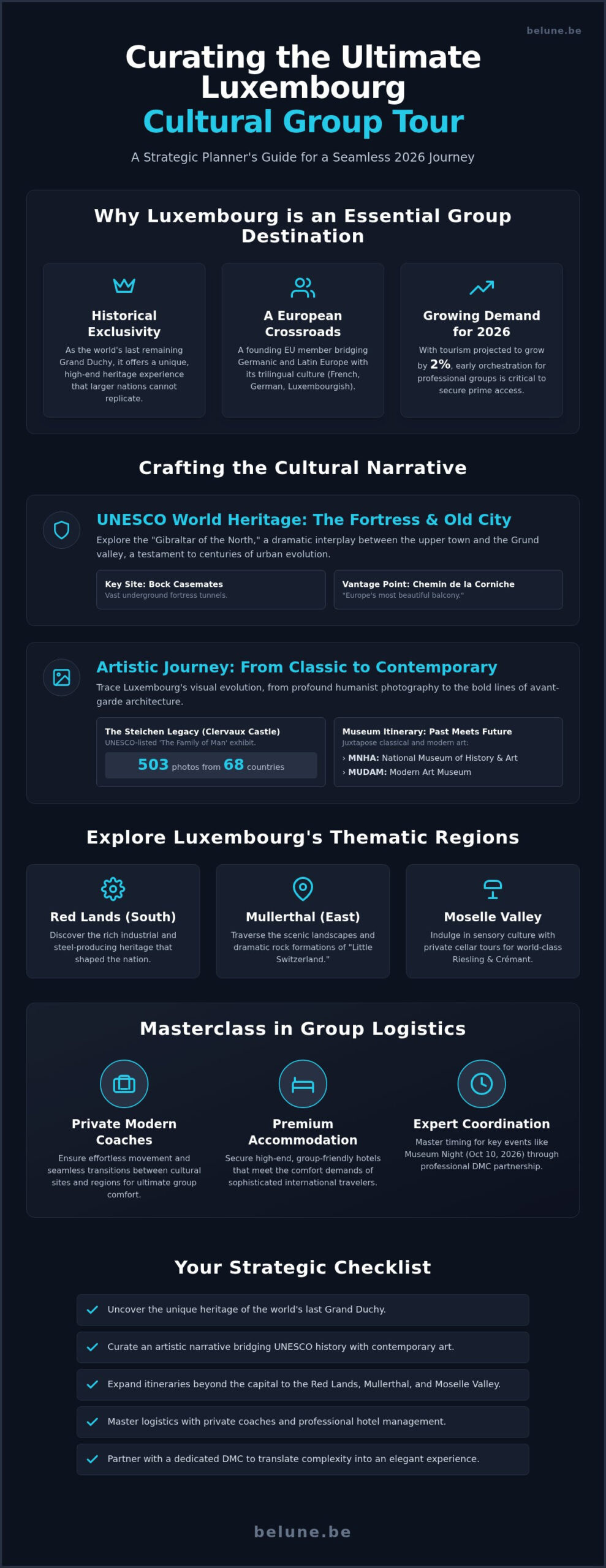
    Many travelers view Luxembourg through the lens of a transit zone. This is a strategic oversight. As the world’s only remaining Grand Duchy, it offers a level of historical exclusivity that larger neighbors cannot replicate. For those planning a luxembourg cultural tour for groups in 2026, the calendar is already filling with high-value events like Museum Night on October 10. This isn’t a four-hour detour; it’s a multi-day immersion into a nation that has balanced its “Gibraltar of the North” military legacy with a future-facing European identity. With tourism numbers projected to grow by 2% in 2026, securing space for professional groups requires early orchestration.

    To better understand the vibrant atmosphere awaiting your guests, watch this helpful travel guide:

    A Crossroads of European Identity

    The Culture of Luxembourg is defined by its linguistic fluidity. Conversations shift effortlessly between Luxembourgish, French, and German. This trilingual harmony makes the country an ideal base for international groups seeking a bridge between Germanic and Latin Europe. Beyond the heritage, its role as a founding pillar of the European Union adds a layer of modern diplomatic weight. The Grand Duchy serves as a living testament to European history, where the rugged stones of a medieval fortress harmonize with the refined architecture of modern diplomacy.

    UNESCO World Heritage: The Fortress and Old City

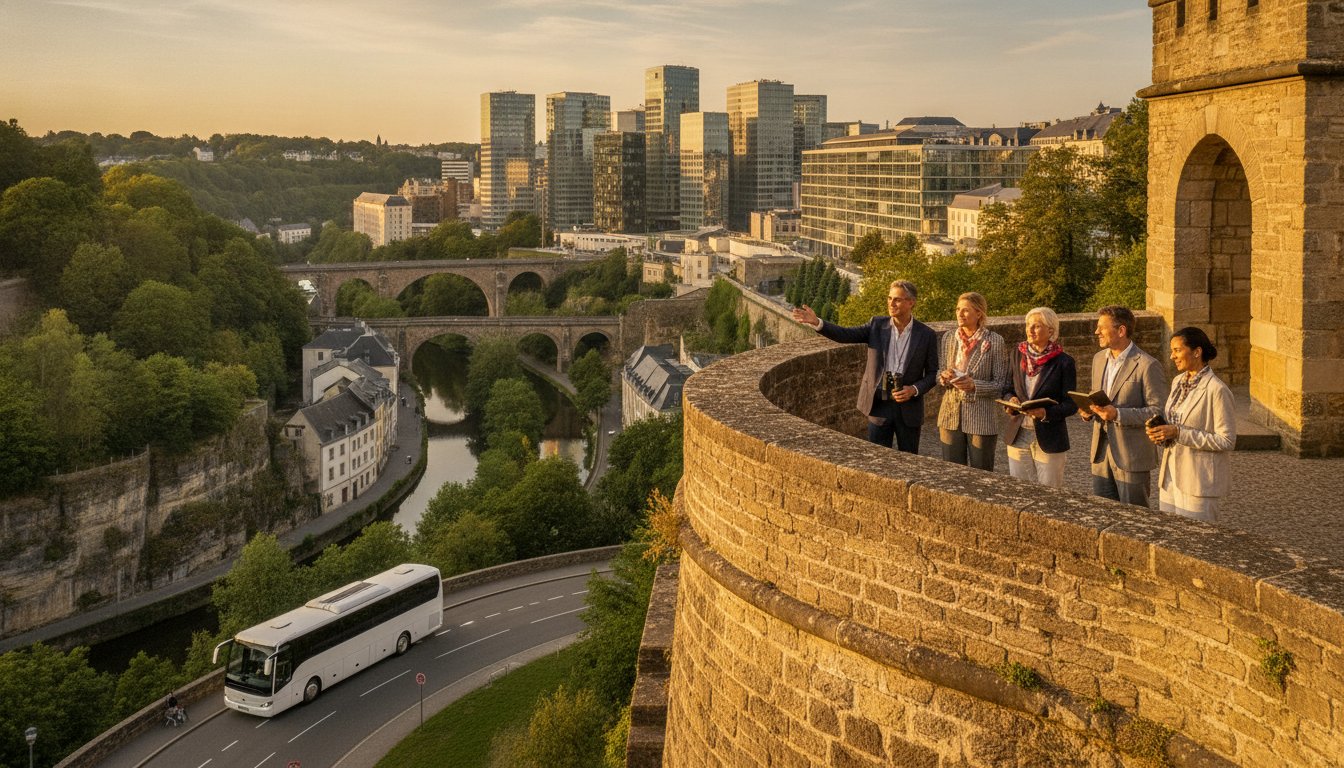
    The city’s UNESCO status centers on the dramatic interplay between the upper town and the lower valley of the Grund. Navigating the Casemates du Bock on a luxembourg cultural tour for groups requires precise timing and professional expertise. For 2026, guided tours for up to 20 people start from €100, plus admission, and remain the gold standard for maintaining group flow. We recommend starting at the Chemin de la Corniche, often called “Europe’s most beautiful balcony.” It provides the perfect vantage point for group photography, framing the architectural dialogue between the ancient stone walls and the modern skyline. Moving through these layers isn’t just a walk; it’s a curated study of urban evolution.

    Unlocking the Layers: History, Language, and the Artistic Narrative

    Luxembourg’s identity is a living composition. It isn’t found in a single monument but in the seamless transition between centuries. A luxembourg cultural tour for groups should reflect this fluidity, moving from the medieval echoes of the Old City to the avant-garde lines of the Kirchberg plateau. This narrative is best understood through the lens of those who shaped it, from ancient folklorists to modern visionaries. Moving from the classical National Museum of History and Art (MNHA) to the contemporary glass of Mudam illustrates a nation that honors its past while embracing a bold future.

    The Steichen Legacy and Visual Culture

    The heart of Luxembourg’s visual heritage lies in Clervaux Castle. Here, the UNESCO-listed Family of Man photographic collection offers a profound humanist experience. Curated by Edward Steichen, this exhibit features 503 photographs from 68 countries, creating a universal dialogue that transcends borders. For professional groups, a visit to Clervaux provides a moment of reflection and deep historical context. It’s a cornerstone of any serious cultural itinerary. The Official Luxembourg Tourism Guide highlights this as a must-see for those seeking the country’s intellectual soul. Integrating these visual arts with a visit to the MNHA allows guests to trace the nation’s evolution from its archaeological beginnings to 20th-century mastery.

    Culinary Heritage as a Group Experience

    Culture is also a sensory experience. In the Moselle Valley, the landscape itself is a work of art, carved by centuries of viticulture. Private wine cellar tours offer groups an exclusive look at the production of world-class Rieslings and Crémants. There’s a natural synergy here with Belgium Gastronomy Tours; both regions celebrate a blend of rustic tradition and refined innovation. The Luxembourgish table is a place where Michelin-starred techniques meet hearty, folkloric roots from the Ardennes. Incorporating these tastings into a schedule isn’t just about dining. It’s about understanding the terroir that has sustained this nation through its most turbulent eras. Our team ensures these moments are logistically effortless, allowing your guests to focus on the poetry of the experience. For a truly curated approach to these sensory layers, consider partnering with a specialized local expert who understands the nuances of group flow.

    The rugged Ardennes region further enriches the narrative. Its dense forests and winding valleys aren’t just scenic; they’re the birthplace of local myths. From the legend of Melusina to the industrial heritage of the south, every region adds a distinct chapter to the story. We help you weave these threads into a cohesive, sophisticated journey that resonates long after the tour ends.

    Luxembourg Cultural Tour: 2026 Group Planning Guide

    Beyond the Capital: Exploring the Thematic Regions of Luxembourg

    Luxembourg City serves as a sophisticated anchor, but the nation’s soul is distributed across five distinct regions. A luxembourg cultural tour for groups shouldn’t stop at the capital’s edge. Each territory offers a specific narrative, from the feudal heights of the north to the industrial steel-scapes of the south. Understanding these nuances allows you to tailor the journey to your guests’ specific intellectual curiosities. Whether your group seeks the quiet contemplation of ancient abbeys or the raw power of industrial heritage, the Grand Duchy provides a diverse canvas within a very compact radius.

    The Mullerthal and Medieval Echternach

    Often called “Little Switzerland,” the Mullerthal region blends dramatic sandstone formations with medieval order. Echternach, the country’s oldest town, is a primary cultural stop. It’s home to the Dancing Procession of Echternach, a unique UNESCO intangible heritage event that draws thousands every Whit Tuesday. For groups, balancing this history with light hiking through the Wolfsschlucht is refreshing. It offers a physical connection to the landscape that shaped local folklore. However, logistics are paramount in this region. The narrow valleys and winding roads require precise coach navigation. We utilize our private fleet of modern busses to ensure seamless access to sites where larger, less-experienced vehicles often struggle with height and turn radius constraints.

    The Ardennes: Feudal History and Remembrance

    The north is defined by the Ardennes, a land of high plateaus and deep forests. Vianden Castle stands as the region’s crown jewel. It’s a masterclass in feudal architecture, meticulously restored to its former glory and offering an immersive look at the lives of the Counts of Vianden. For groups interested in military history, this region provides a poignant connection to the Battle of the Bulge. This narrative often complements a broader Benelux journey, linking naturally to Flanders Fields for a comprehensive look at the world wars and European resilience. While the capital is recognized as a UNESCO World Heritage Site, the Ardennes offers the raw, emotional depth of 20th-century history that history groups find unparalleled.

    In the south, the Red Lands (Terres Rouges) provide a starkly different experience. This is a landscape of urban transformation where former steel works in Belval now host the University of Luxembourg. It’s a striking blend of industrial grit and modern academic elegance. It’s the perfect addition for groups interested in urban planning, social history, and the evolution of European industry. Choosing the right region isn’t just about the sites; it’s about matching the rhythmic flow of the tour to the specific character of your group.

    Masterclass in Logistics: Transport, Accommodation, and Group Flow

    Logistics represent the invisible architecture of any exceptional travel experience. In a country as compact yet dense as the Grand Duchy, the difference between a successful journey and a frustrated one lies in technical precision. Orchestrating a luxembourg cultural tour for groups demands a deep understanding of local flow, from the timing of the Casemates to the nuances of hotel check-ins. One unique advantage of the region is that all public transportation throughout Luxembourg is free of charge for tourists as of September 2026. This policy empowers groups with effortless mobility during leisure hours, allowing guests to explore the ‘Museumsmile’ or the Grund at their own pace without the friction of ticketing.

    Coach Logistics and Fleet Excellence

    Navigating the winding roads of the Mullerthal or the narrow streets of the Old City requires vehicles designed for the task. Our private fleet of modern coaches ensures that cross-border travel from Belgium or France remains seamless and comfortable. Maintaining a private fleet is the only way to guarantee the uncompromising quality control and technical reliability required for Luxembourg’s varied terrain. Beyond the hardware, coordinating driver hours with complex cultural itineraries is a technical art form. We manage these details behind the scenes, ensuring the coach is always a sanctuary rather than a source of delay.

    Strategic Accommodation Management

    Luxembourg’s hotel market is prestigious but limited in volume. With 2026 bookings already outpacing 2025 figures, early orchestration of rooming blocks is no longer a suggestion; it’s a necessity. Securing preferred rates and availability for large groups requires the strategic leverage of established Benelux incoming tour operators. We select properties that don’t just offer luxury, but also solve the practical problems of coach parking and central access. Our role as a DMC involves managing every rooming list and group check-in with a meticulous eye, removing the administrative burden from your shoulders. For a logistics plan that transforms technical complexity into an elegant, stress-free reality, partner with our expert team today.

    The final layer of the logistical masterclass is the guide. A professional local guide is essential for any luxembourg cultural tour for groups because they don’t just deliver facts; they provide an immersion into the Luxembourgish soul. They bridge the gap between a standard tour and a meaningful cultural dialogue, ensuring your guests leave with a structured understanding of the Grand Duchy’s pillars. This level of expertise is what transforms a trip into a legacy.

    Elevating the Experience: Why BELUNE is Your Strategic Luxembourg Partner

    Selecting a partner for a luxembourg cultural tour for groups involves more than checking boxes on a logistical list. It requires finding an ally who respects the weight of your brand’s reputation and shares your commitment to excellence. With over 20 years of experience as a specialized DMC, we’ve refined the process of translating complex cultural visions into seamless technical realities. Our approach is defined by a sophisticated, minimalist elegance. We prioritize the emotional resonance of the journey, ensuring that every intervention, from the choice of a guide to the route of the coach, serves the overarching narrative of the tour.

    We position ourselves not as a mere supplier, but as a visionary advisor. Our team understands that professional travel groups demand a balance of historical depth and modern comfort. We achieve this through rigorous quality control, particularly through our private fleet of modern coaches and our expert hotel accommodation management. This hands-on control allows us to resolve potential frictions before they even reach the awareness of your guests. It’s this dedication to the invisible architecture of travel that provides our partners with absolute peace of mind.

    Your Ally in the Benelux Region

    Our support is a continuous thread that runs from the initial inquiry to the final departure. We navigate the unique challenges of the Grand Duchy, such as its compact but high-demand hotel market, with a precision born of local mastery. Our extensive network grants your groups access to exclusive sites and private artisanal experiences that are otherwise inaccessible. By leveraging our Culture Group Tours Benelux expertise, we provide a holistic regional perspective. This ensures that your Luxembourg itinerary flows naturally into neighboring regions, maintaining a consistent level of high-end service across borders.

    Next Steps: Curating Your 2026 Itinerary

    The journey toward an exceptional tour begins with a deep consultation. We work closely with you to define specific themes, whether they focus on the linguistic harmony of the capital or the wartime remembrance of the Ardennes. This collaborative process ensures that the final itinerary reflects your brand’s unique voice and artistic vision. We provide fixed-price group tour packages, offering the financial clarity needed for professional planning without compromising on the artisanal quality of the experience. When you are ready to elevate your offering, partner with BELUNE for your next Luxembourg cultural tour. Let us transform your vision into a landmark experience.

    Shaping the Future of Cultural Travel in Luxembourg

    Luxembourg is no longer a mere footnote in European itineraries. It’s a premier destination where 2026 presents a unique opportunity for deep, thematic immersion. By mastering the logistical flow from the capital’s UNESCO core to the rugged Ardennes, you offer your guests a journey of rare sophistication. Success lies in the technical precision of your planning, from securing limited hotel blocks to navigating narrow valleys with a private modern coach fleet. These elements form the invisible architecture that supports your artistic vision.

    Organizing a luxembourg cultural tour for groups demands a partner who balances creative ambition with a 20-year legacy of technical mastery. We provide the structural support needed to ensure every detail is managed with a minimalist’s eye for perfection. Our expert local guide services translate the Grand Duchy’s complex history into a resonant human experience, turning a standard trip into a strategic success for your brand.

    We invite you to Request your custom Luxembourg group tour itinerary from BELUNE and discover the peace of mind that comes from a dedicated Benelux specialist. The Grand Duchy is waiting to be rediscovered. Let’s create an exceptional journey that stays with your travelers long after they return home.

    Frequently Asked Questions

    Is Luxembourg suitable for a multi-day group tour?

    Luxembourg is an ideal destination for multi-day immersion. While often viewed as a brief stopover, the country’s five distinct regions provide enough historical and artistic depth for a comprehensive 3 to 5 day itinerary. A luxembourg cultural tour for groups can transition from the medieval fortifications of the capital to the industrial heritage of the south and the feudal castles of the Ardennes, ensuring a diverse experience.

    How does free public transport in Luxembourg affect group tours?

    All public transportation in Luxembourg is free for both residents and visitors as of September 2026. This policy offers a significant advantage for group leisure time. While the primary itinerary is managed via private coach, guests can explore the capital’s ‘Museumsmile’ or the Grund independently during downtime without the friction of purchasing tickets. It adds a layer of effortless mobility that enhances the overall guest experience.

    What is the best time of year for a cultural group trip to Luxembourg?

    Spring and autumn are the most favorable seasons for cultural exploration. May and June offer vibrant landscapes in the Mullerthal, while October is particularly significant for art enthusiasts. Museum Night is scheduled for October 10, 2026, providing an exceptional opportunity for groups to experience the capital’s galleries after hours. These shoulder seasons balance pleasant weather with a rich calendar of cultural festivals and seasonal highlights.

    Can a Luxembourg tour be combined with Belgium or France itineraries?

    Luxembourg’s central location makes it a natural anchor for broader Benelux or French itineraries. Cross-border travel is seamless, especially when utilizing a private fleet of modern coaches to maintain quality control. Many operators combine the Grand Duchy’s military history with battlefield sites in Belgium or the vineyards of the Moselle with French wine regions. We manage these multi-country logistics to ensure a fluid, cohesive journey for every guest.

    Are Luxembourg’s historical sites accessible for large coach groups?

    Most major historical sites are accessible, though the country’s varied terrain requires technical expertise. Narrow valleys in the Mullerthal and the winding streets of the Old City demand precise coach navigation. We utilize our own fleet of modern busses specifically chosen for their ability to handle these logistical constraints. Early coordination is essential to manage site-specific parking requirements and group flow at popular locations like the northern castles.

    What languages do local guides in Luxembourg typically speak?

    Local guides are typically trilingual, reflecting the country’s linguistic harmony. Most professional guides are fluent in Luxembourgish, French, and German, with high proficiency in English. This linguistic versatility is a cornerstone of a luxembourg cultural tour for groups, as it allows for a deeper dialogue with the local heritage. We provide expert guide services that bridge the gap between simple sightseeing and a true cultural immersion.

    What are the UNESCO World Heritage sites in Luxembourg for groups?

    The primary UNESCO World Heritage site is the City of Luxembourg’s Old Quarters and Fortifications. This site is a masterclass in military architecture and urban evolution. Additionally, the Family of Man photography collection in Clervaux is listed on the UNESCO Memory of the World Register. These sites form the intellectual pillars of a cultural itinerary, offering groups a structured understanding of European history and humanist values.

    How can a DMC help with group hotel bookings in Luxembourg?

    A DMC acts as a strategic ally in a compact hotel market. We manage the entire accommodation process, from securing preferred rates to handling complex rooming lists and group check-ins. With 2026 bookings projected to grow, our 20 years of industry experience allows us to navigate availability challenges effectively. We select properties that balance high-end comfort with the practical requirements of coach access and central proximity.

  • Ghent Cultural Group Tour: Curated Heritage 2026

    Ghent Cultural Group Tour: Curated Heritage 2026

    A masterpiece of medieval architecture isn’t just a backdrop; it’s a living environment that demands respect and meticulous planning. Most tour operators view the city’s car-free center as a logistical hurdle, but we see it as a canvas for an uncompromisingly elegant ghent cultural tour for groups. You know the difficulty of balancing high-end expectations with the rigid constraints of historic preservation. It’s a delicate dance between sourcing luxury accommodation that meets modern standards and ensuring your guests don’t lose the rhythm of their journey to the friction of group movement.

    This article reveals how to orchestrate a sophisticated cultural experience in Ghent for 2026, blending the city’s rebellious heritage with surgical logistical precision. You’ll discover how to secure vital access to the Ghent Altarpiece visitor center and integrate reliable coach transport without sacrificing the intimacy of the experience. We’ll examine the specific strategies needed to craft a unique narrative that differentiates your offering from generic tours. By the end, you’ll have a blueprint for a perfectly timed itinerary that marries local expertise with the highest professional standards.

    Key Takeaways

    • Recognize Ghent as the authentic soul of Flanders, providing a sophisticated alternative to mainstream hubs for travelers seeking deep cultural resonance.
    • Discover the precise coordination needed to secure group slots for the Van Eyck masterpiece and the value of expert guides in unfolding its complex history.
    • Learn how to navigate the logistical challenges of a medieval center to deliver a seamless ghent cultural tour for groups without compromising on comfort.
    • Understand why integrated accommodation and transport management are the pillars of a reliable, high-end itinerary in the Benelux region.
    • Explore a curated daily structure that balances world-class art with the refined gastronomy of the historic Patershol district.

    Why Ghent is the Essential Cultural Anchor for Benelux Group Itineraries

    Ghent isn’t a museum frozen in time. It’s a dynamic metropolis that anchors the Flemish region with a quiet, undeniable authority. While other cities might feel like stage sets for mass tourism, Ghent retains its grit and its glory in equal measure. This raw authenticity makes it the ideal centerpiece for a ghent cultural tour for groups that demands more than just a surface-level visit. Ghent’s rich history serves as the bedrock for an experience that feels earned, not just observed, bridging the gap between medieval power and contemporary Flemish life.

    To better understand why this city captivates those who look beneath the surface, watch this helpful video:

    The Strategic Advantage for Tour Operators

    Positioning is everything in high-end travel. Located precisely between Brussels and the North Sea coast, Ghent acts as a natural pivot point for any culture group tours benelux itinerary. It allows for efficient routing that minimizes dead time on the road, ensuring your guests spend more time in discovery and less in transit. From a B2B perspective, the city is far more group-friendly than its more saturated peers. It offers a superior balance of luxury infrastructure and genuine local interaction. By designing a ghent cultural tour for groups around this central axis, you’re not just adding a stop; you’re adding a strategic asset that enhances the entire travel flow of a Belgian program.

    A Narrative of Rebellion and Wealth

    The city’s identity was forged in the fires of the medieval wool trade. This was once one of the largest and wealthiest cities in Europe, and that prosperity brought architectural grandeur that still dominates the skyline. The guild houses lining the Graslei and Korenlei aren’t just facades; they’re monuments to a time when Ghent’s merchants held the purse strings of empires. This wealth also bred a fierce spirit of independence, epitomized by the “Stroppendragers” or Noose-bearers, who famously defied Emperor Charles V. This legacy of resistance and artistry creates a compelling narrative arc for any cultural program. Ghent’s cultural significance lies in its seamless blend of 15th-century mastery and 21st-century vibrancy.

    The Artistic Pillars: Curating the Group Experience of the Van Eyck Legacy

    Ghent’s artistic identity is inseparable from the Van Eyck brothers. For a ghent cultural tour for groups, the challenge lies not just in viewing the art, but in choreographing the encounter itself. It requires a purposeful transition from the bustling city streets into the hallowed silence of Saint Bavo’s Cathedral. This isn’t merely a stop on a circuit; it’s a profound engagement with the foundations of Western art history that demands expert orchestration to truly resonate with a sophisticated audience.

    Mastering the Adoration of the Mystic Lamb

    Managing group movement within the cathedral has evolved significantly. The visitor center now utilizes augmented reality to prepare visitors before they see the original panels. For groups of 15 or more, admission is €12.50 per person, a rate that includes this immersive AR experience. Logistics in 2026 require particular foresight. With the final restoration phase scheduled for completion in Spring 2027, certain panels are currently represented by high-quality reproductions. Professional multi-lingual guides are essential here. They bridge the gap between the technical mastery of the Flemish Primitives and the complex theological narrative of the work. Securing specific time slots is mandatory to avoid the friction of overcrowding, ensuring the moment of revelation remains intimate and undisturbed.

    Architectural Grandeur: From Romanesque to Gothic

    Beyond the cathedral, the city serves as an open-air gallery where every facade tells a story of mercantile power. The Graslei and Korenlei offer a visual rhythm of stepped gables that reflect centuries of wealth. It’s arguably the most evocative group photo opportunity in the Benelux. For a more tactile historical experience, the Gravensteen (Castle of the Counts) provides a stark Romanesque contrast. At a group rate of €13 per person, it offers a dramatic setting for storytelling and engagement. The Belfry, standing tall as a symbol of civic autonomy, provides the panoramic perspective necessary to understand the city’s medieval layout.

    For those seeking a quieter dimension, Saint Peter’s Abbey and its Mediterranean-style vineyards offer a serene counterpoint to the busy medieval core. Balancing these heavy-hitting sites with hidden sanctuaries is what defines a truly curated experience. You can explore how we refine these delicate balances through our bespoke cultural itineraries. For more practical details on site accessibility and seasonal events, the official Ghent tourism portal remains an indispensable resource for professional planners.

    Ghent Cultural Group Tour: Curated Heritage 2026

    Precision in movement is the invisible foundation of any successful ghent cultural tour for groups. While the city’s car-free heart preserves its 15th-century atmosphere, it presents significant hurdles for the uninitiated. Managing a large party requires more than a map; it requires a deep understanding of local regulations and the physical layout of the historic fabric. This is where technical mastery meets the guest experience. Even the study of Van Eyck’s Ghent Altarpiece can be overshadowed if the logistical arrival is fraught with delay.

    Local expertise is the only defense against the unpredictable. Whether it’s sudden construction in the Sint-Pietersnieuwstraat or a seasonal festival redirecting traffic, we anticipate these shifts. We don’t just react; we orchestrate alternative routes that maintain the itinerary’s integrity. This foresight differentiates a professional operation from a generic tour, ensuring that the narrative of the city remains the focus rather than the friction of getting there.

    Coach and Transport Logistics

    In 2026, Ghent’s Low Emission Zone (LEZ) and permit requirements have become more stringent for heavy vehicles. Operating our own modern coach fleet allows us to bypass the inconsistencies of third-party providers. We focus on strategic drop-off points that minimize walking distances for guests. This is particularly vital for less mobile travelers who still wish to experience the grandeur of the medieval core without the fatigue of long treks from distant parking hubs.

    Centrality shouldn’t come at the cost of accessibility. Professional hotel accommodation management is the only way to ensure large groups remain together in high-standard properties near the historic center. We navigate the complexities of room blocks and the city’s €4.40 per person nightly tourist tax, ensuring a frictionless check-in process that respects the guest’s time and energy.

    Group-Friendly Gastronomy

    Finding a venue that balances authentic Flemish flavors with the capacity for 40+ guests is an art in itself. The Patershol district offers incredible “slow food” experiences, like the traditional creamy “Waterzooi” stew or local “Ghent Gruut” beer. However, these historic spaces are often intimate. We source and vet venues that maintain their artisanal charm while possessing the operational scale to serve large parties efficiently. Whether it’s a tasting at the legendary Dulle Griet or a formal dinner, the goal is a seamless transition from cultural discovery to culinary appreciation.

    Designing the Perfect Day: A Sample Cultural Itinerary for Tour Operators

    A successful ghent cultural tour for groups is a study in rhythm. It begins at the break of day, before the cobblestones of the Sint-Baafsplein become crowded. The morning is dedicated to the spiritual and civic heart. We start with the Cathedral and its AR-enhanced journey, followed by a climb or lift to the Belfry for a panoramic orientation. This sequence ensures guests encounter the city’s most dense cultural assets while their energy is at its peak. It’s about more than seeing; it’s about experiencing the silence of the stone before the city fully awakes.

    The transition from the religious core to the secular power centers must be seamless. By structuring the morning around the “Three Towers” skyline, we provide a narrative foundation that makes the subsequent visits more meaningful. This isn’t a rushed checklist but a choreographed movement through history, allowing for moments of reflection in the presence of world-class art and architecture. Precision in timing here is what separates a professional itinerary from a standard excursion.

    The Patershol Experience

    By midday, the focus shifts to the Patershol district. This medieval enclave, once the home of leather workers and later the elite, is now the culinary soul of the city. Its narrow, winding alleys require professional guiding techniques to keep a group cohesive without disrupting the neighborhood’s quiet charm. It’s here that we integrate artisanal workshops. Guests can engage with the craft of local mustard making or the intricate patterns of Flemish lace, providing a tactile connection to Ghent’s mercantile past. Lunch here isn’t just a meal; it’s a sensory immersion into a preserved urban fabric that feels remarkably untouched by time.

    Ghent by Water: A Logistics Win

    The afternoon explores secular power at the Gravensteen, contrasted sharply by the bold, modern lines of the City Pavilion. This juxtaposition of the 12th and 21st centuries illustrates Ghent’s continuous evolution. To manage the physical demands of a full day, we transition to the water. Private boat charters serve a dual purpose: they provide a restful vantage point and a unique narrative perspective on the city’s defensive and trade history. As dusk falls, the Ghent Lighting Plan takes over. This award-winning initiative isn’t just about visibility; it’s a curated aesthetic experience that emphasizes architectural volumes and shadows. The evening illumination transforms the Graslei into a living museum where light sculpts the stone and water reflects a thousand years of history. It is a high-impact conclusion that requires no entry fees but leaves a lasting emotional mark on every traveler.

    We handle the complexities of these transitions so you can focus on the guest experience. Let us help you refine your 2026 group program with our local expertise and private fleet.

    The BELUNE Advantage: Elevating Ghent Group Travel

    Reliability is not a promise; it is a record. For over 20 years, BELUNE has operated as a premier benelux incoming tour operator, transforming complex logistical challenges into invisible successes. We act as the single strategic interlocutor for your entire program. By unifying hotel accommodation management, private coach transport, and expert guiding under one roof, we eliminate the fragmentation that often plagues high-stakes group travel. This integrated approach ensures that every ghent cultural tour for groups we manage maintains a consistent level of excellence from the first arrival to the final departure.

    Our role is to be your visionary ally on the ground. We understand that a sophisticated itinerary requires more than just access; it requires an artistic and technical mastery of the environment. Whether we are navigating the specific permit requirements of the 2026 Low Emission Zone or securing exclusive after-hours access to a private guild house, our focus remains on the elevation of the guest experience. Experience is often silent. It speaks most clearly through the absence of errors and the fluidity of the journey.

    Bespoke Itinerary Design

    Ghent’s narrative is multifaceted. We don’t believe in the “standard” excursion. Instead, we adapt the city’s story to fit the specific intellectual or sensory focus of your party. Academic groups might delve into the technical restoration of the Mystic Lamb, while culinary tours explore the artisanal heritage of the Patershol. We handle the unseen logistics, specifically the timing of permits, the choreography of coach movements, and 24/7 emergency support, so your team can focus on client relationships. Our local, multi-lingual guide network is selected for their ability to translate complex history into compelling human stories that resonate with a global audience.

    Partnering for Success

    Tour operators trust us with their most demanding international clients because we share their commitment to perfection. We position ourselves not as a vendor, but as a strategic extension of your own agency. This partnership allows for a seamless Benelux expansion, leveraging our deep regional knowledge to ensure every project is an exceptional realization of your vision. The complexity of the 2026 travel landscape requires a partner who combines artistic sensitivity with surgical technical precision. Consult with our Benelux travel experts to design your 2026 Ghent itinerary and ensure your next cultural program is truly world-class.

    Defining the Standard for 2026 Flemish Heritage

    Ghent is more than a destination; it’s a structural masterpiece that rewards those who navigate its complexities with foresight. We’ve explored how balancing world-class art like the Van Eyck Altarpiece with the technical demands of a pedestrianized core creates a truly resonant experience. A successful ghent cultural tour for groups in 2026 will depend on this marriage of artistic vision and logistical mastery. It’s about ensuring every transition is as seamless as the brushstrokes on a Flemish masterpiece, allowing the city’s rebellious spirit and industrial wealth to take center stage.

    Realizing this vision requires an ally who understands the weight of your reputation. With 20+ years of DMC expertise and our own private modern coach fleet, we transform the theoretical into the exceptional. We specialize in cultural itinerary design that moves beyond the generic, offering your clients a narrative that is as precise as it is inspiring. Partner with BELUNE for your next Ghent group cultural tour to ensure your program reflects the highest standards of professional excellence. The city’s rich history is waiting to be told; let’s tell it with the precision and passion it deserves.

    Frequently Asked Questions

    Is Ghent suitable for large groups with limited mobility?

    Ghent’s medieval core is largely pedestrianized and features historic cobblestones, but it remains accessible with professional planning. Many primary sites, including St. Bavo’s Cathedral and the Belfry, are equipped with modern elevators. We design specific routes that utilize our private coach fleet for strategic drop-offs, significantly reducing walking distances. This ensures that every ghent cultural tour for groups remains inclusive and comfortable for all participants regardless of their physical requirements.

    What are the coach parking regulations in Ghent for 2026?

    In 2026, Ghent maintains a strict Low Emission Zone (LEZ) that requires all coaches to meet specific Euro standards or register for permits before entry. Long-term parking is prohibited in the historic center and restricted to designated coach parks at the city’s periphery. We manage all necessary registrations and permits for our fleet. This allows your group to enjoy efficient arrivals at authorized drop-off points without the risk of administrative fines or delays.

    How far in advance should we book group tickets for the Ghent Altarpiece?

    We recommend securing group slots at least six months in advance for 2026 departures. The visitor center at St. Bavo’s Cathedral operates with limited capacity, especially for the immersive Augmented Reality tour experience. For groups of 15 or more, the admission rate is €12.50 per person. Early coordination is vital to guarantee specific time windows, particularly as the final restoration phase of the panels approaches its scheduled completion in spring 2027.

    Can BELUNE handle hotel bookings for groups of 50+ in central Ghent?

    Yes, hotel accommodation management for large parties is a core component of our service offering. We utilize our 20 years of industry experience to negotiate room blocks in premium central properties that meet international luxury standards. Our team handles the administrative complexity of the 12% VAT on accommodation and the city’s €4.40 per person nightly tourist tax. This provides you with a single, reliable point of contact for the entire group stay.

    What is the best time of year for a cultural group tour in Ghent?

    The shoulder seasons of late spring and early autumn offer the most refined experience for a ghent cultural tour for groups. While August represents the peak tourist season, May and September provide milder weather and more intimate access to major cultural sites. The city’s award winning lighting plan ensures that evening excursions are impactful year round, though the vibrant festival calendar in the shoulder months adds a unique layer of contemporary Flemish atmosphere.

    Do you provide multi-lingual guides for non-English speaking groups?

    We maintain an extensive network of professional local guides fluent in English, French, German, Spanish, and other major languages. These experts are specifically selected for their ability to articulate the complexities of the Van Eyck legacy and Flemish history. Having a guide who speaks the group’s native language is essential for a deep intellectual engagement with the city’s heritage, ensuring that no nuance of the cultural narrative is lost in translation.

    How does a DMC like BELUNE help travel agents with Ghent logistics?

    We serve as your technical and artistic ally on the ground, managing the logistical details that are difficult to coordinate from a distance. This includes everything from operating our own private coach fleet to sourcing exclusive venues for dining and workshops. Our 20 plus years of expertise as a specialized DMC ensures that your itinerary is executed with surgical precision. We handle the friction of local regulations so you can focus on client satisfaction.

    What are the best group-friendly dining options in the medieval center?

    The historic Patershol district and the Graslei waterfront offer several high capacity venues that specialize in authentic Flemish gastronomy. We vet these locations for their ability to serve traditional dishes like Waterzooi to 40 plus guests without sacrificing artisanal quality. Our partnerships with historic cellars and breweries also allow for private beer tasting experiences. These sessions are designed to balance the region’s rich culinary traditions with the logistical efficiency required for a group schedule.

  • Mastering the Dutch Masters: Curating Group Museum Tours in the Benelux for 2026

    Mastering the Dutch Masters: Curating Group Museum Tours in the Benelux for 2026

    A true encounter with a Vermeer isn’t found in a crowded gallery; it’s found in the quiet moments of a perfectly timed itinerary. Orchestrating a Dutch masters museum tour for groups in 2026 requires more than a simple booking. It demands a delicate choreography where professional precision allows artistic emotion to take center stage. You understand that managing twenty art enthusiasts through the Rijksmuseum or the Mauritshuis is an exercise in both cultural curation and logistical mastery. The challenge isn’t just seeing the art, it’s preserving the atmosphere that makes the art resonate.

    This article provides the blueprint for creating seamless, high-level group experiences that blend the legacy of the Golden Age with flawless execution. We’ll examine how to navigate the latest timed-entry protocols and new 2026 ETIAS requirements without breaking the narrative flow. From securing expert guides who transcend generic scripts to managing a private coach fleet across the Benelux, you’ll discover how to transform complex travel requirements into a refined journey. We’ll preview the essential strategies for hotel management and itinerary pacing that satisfy even the most demanding collectors.

    Key Takeaways

    • Master the complexities of 2026 museum entry protocols and ETIAS requirements to ensure a seamless dutch masters museum tour for groups.
    • Learn how to weave a compelling narrative across the Benelux that connects major national collections into a single, immersive story of the Golden Age.
    • Gain insights into the role of specialized local guides in transforming standard museum visits into high-end cultural experiences for discerning collectors.
    • Understand the strategic advantages of the DMC model, including fixed-price certainty and the efficiency of a private, modern coach fleet.
    • Discover how professional logistics and deep art-historical expertise collaborate to eliminate common group travel bottlenecks in high-traffic institutions.

    The Legacy of the Dutch Masters: A Narrative for Modern Groups

    The 17th century remains a cornerstone of European culture. A Dutch Golden Age painting isn’t just a static object; it’s a window into a world of commerce, science, and domesticity. For a dutch masters museum tour for groups, this era provides a rich, cohesive narrative that resonates with modern sensibilities. The play of light in a Vermeer or the raw humanity in a Rembrandt portrait speaks across centuries. In 2026, the demand for these experiences remains exceptionally high. The Rijksmuseum continues to attract over 2 million annual visitors, while the Mauritshuis recently welcomed over 520,000 guests in a single year. These numbers reflect a deep, global fascination with a period that redefined the visual language of the West.

    Light is the protagonist here. Rembrandt mastered the shadow, while Vermeer captured the impossible stillness of a sunlit room. This evolution of light isn’t just a technical achievement. It’s an emotional one. Modern travelers find a strange comfort in these domestic scenes and honest portraits. They offer a sense of grounding in a fast-paced world. For the tour operator, the goal is to harness this emotional resonance. You aren’t just showing paintings; you’re facilitating a connection with the human condition.

    The Enduring Appeal of the Golden Age

    International groups are moving away from hurried sightseeing. They’re seeking “slow art” experiences where the quality of the encounter matters more than the quantity of galleries visited. Professional travel agents prioritize these itineraries because they offer depth and reliability. The 17th-century masters provide a unique blend of technical brilliance and emotional accessibility. This makes them the perfect anchor for high-end cultural pilgrimages. In an era of digital saturation, the tactile reality of oil on canvas provides a profound sensory experience that travelers crave. It’s a heritage-rich journey that justifies the investment of time and resources.

    Curating the Artistic Narrative

    Successful tour operators don’t just book tickets. They build bridges between the art and the physical landscape of the Benelux. A dutch masters museum tour for groups should explore the thematic connections that bind these artists together. It’s about seeing how the flat, watery horizon of the Low Countries influenced landscape painting. It’s about understanding how the wealth of the merchant class funded a new kind of secular art. Linking these masterpieces to the broader historical context adds layers of value to the tour. It transforms a simple museum visit into a visionary exploration of identity. This approach ensures that the itinerary feels like a curated journey rather than a series of disconnected stops.

    Choreographing Group Logistics for High-Traffic Art Institutions

    Managing a dutch masters museum tour for groups in 2026 requires a high degree of technical foresight. With major institutions like the Rijksmuseum requiring strictly timed online bookings for their 2 million annual visitors, the margin for error is non-existent. A successful tour doesn’t just happen; it’s engineered. You must account for the Mauritshuis closure from August 24 to September 20, 2026, and the new Belgian federal museum rates effective May 1, 2026. These aren’t just dates; they’re the structural constraints of your masterpiece. Organizers must also navigate the 2026 ETIAS protocols and the recent VAT increase in the Netherlands, which impacts accommodation and service costs across the region.

    Curating the content within these slots is equally vital. Beyond the titans, modern collectors appreciate narratives like the Women Artists of the Dutch Golden Age, which adds a sophisticated layer to the traditional gallery experience. Balancing this depth with the logistical reality of group size is a delicate art. In cities like Bruges, where walking tour limits are now capped at 20 people, the organization must be airtight. Every movement must be calculated to preserve the group’s focus on the canvas rather than the crowd.

    Mastering Time and Motion

    Securing entry for 20 or more art enthusiasts begins six to nine months before the first brushstroke of the journey. It involves a systematic coordination with national curators to ensure that entry protocols are met without dampening the group’s excitement. The transition from the vehicle to the gallery should be invisible to the client. The DMC Advantage in group entry logistics lies in the ability to transform rigid institutional requirements into a seamless, prestigious arrival experience. This proactive management allows your guests to enter the museum with the serenity required for true artistic appreciation.

    Professional Transport Integration

    A private coach fleet acts as the steady rhythm of the itinerary. It eliminates the unpredictability of public transit and ensures that groups arrive exactly when their timed slots begin. Professional drivers manage their hours with surgical precision, aligning rest periods with museum visits so the vehicle is always ready for the next move. Modern amenities, from climate control to refined seating, ensure that the transition between artistic eras is as comfortable as the galleries themselves. For organizers seeking this level of operational excellence, partnering with a visionary Benelux partner ensures every detail is handled with artistic care. This synergy between transport and culture is what defines a premium travel experience.

    Mastering the Dutch Masters: Curating Group Museum Tours in the Benelux for 2026

    A National Perspective: The Broader Canvas of the Dutch Masters

    The legacy of the 17th century extends far beyond the canals of a single capital. A truly comprehensive dutch masters museum tour for groups must embrace the national landscape of the Benelux to capture the movement’s full complexity. While the Rijksmuseum remains the undisputed epicenter for masterpieces like The Night Watch, a visionary itinerary looks further. It connects the civic pride found in regional Dutch centers with the courtly elegance of The Hague and the baroque energy of the Southern Netherlands. This multi-city perspective allows travelers to witness how local context shaped artistic vision. It transforms a gallery visit into a geographical exploration of heritage.

    Strategic planning in 2026 requires balancing these high-profile anchors with smaller, specialized institutions across the Benelux. These off-the-beaten-path locations offer groups a more intimate encounter with the art, away from the high-density crowds of major hubs. By curating a journey that spans national borders, you provide a narrative that competitors often overlook. The region offers the world’s highest density of art history; however, this richness is only accessible if the itinerary is choreographed to avoid the fatigue of repetitive collections. It’s about finding the unique strength of each national collection to build a diverse, multi-day experience.

    The Multi-City Art Itinerary

    Structuring a tour across several national heritage sites demands a regional approach. It’s about maximizing viewing time by reducing transit friction between different provinces. A well-designed route might start in the northern Netherlands and flow southward into Belgium, tracing the evolution of Northern Renaissance techniques into the Golden Age. Integrating specialized local guide services at each stop bridges the gap between different collections. These experts don’t just recite facts; they weave a continuous story that connects a landscape in one region to a portrait in another. This method ensures that every day adds a new chapter to the group’s understanding of the era.

    Choosing the Right Cultural Anchor

    Not every institution is suited for the specific dynamics of large groups. When evaluating anchors, consider facilities like dedicated group entrances and the quality of natural lighting, which is essential for appreciating 17th-century palettes. Major Belgian institutions provide a powerful counterpoint to the Dutch collections, offering a different perspective on the era’s wealth and influence. With the new standardized rates for Belgian Federal Museums taking effect in May 2026, the financial planning of these tours becomes more predictable for operators. Selecting the right anchors ensures that the logistical framework supports, rather than distracts from, the artistic experience.

    Strategic Planning for Tour Operators: The DMC Framework

    Organizing a dutch masters museum tour for groups requires a strategic partner who understands that logistics are the canvas for the art itself. A specialized DMC doesn’t just book tickets; they act as a visionary advisor. They anticipate the friction points of high-season tourism and provide the budget certainty of fixed-price group tour packages. This is crucial in 2026. Operators must navigate the Netherlands’ VAT increase on accommodations and services. By securing rates early, you protect your margins and ensure a premium experience for your clients. Risk mitigation is about foresight. It’s about knowing which galleries will be under renovation and which hidden gems offer a quieter alternative.

    The B2B Partnership Model

    Trust is the currency of high-level tourism. Professional operators often consult the definitive guide to choosing a group travel agency in 2026 to find partners with the right local depth. With over 20 years of experience in the Benelux region, a partner like BELUNE provides more than just access; they provide insight. We customize every dutch masters museum tour for groups to match the specific artistic level of the participants. This bespoke approach leverages a deep local network to secure exclusive viewing windows. These are the moments that define a tour’s value. It’s about the difference between seeing art and experiencing it.

    Accommodation and Gastronomy Integration

    The art experience doesn’t end at the museum exit. It continues in the hotels and restaurants that host the group. Managing hotel bookings that reflect the sophistication of the Golden Age requires a discerning eye for volume and atmosphere. We integrate Belgium gastronomy tours into the art itinerary to create a holistic sensory journey. There’s a profound interplay between the visual feast of a Rubens and the culinary excellence of a curated Belgian dinner. This balance of art, food, and comfort ensures that the group remains inspired rather than exhausted. To begin crafting your next masterpiece, you can discuss your 2026 art tour strategy with our expert team today.

    The BELUNE Excellence: Elevating Art Tours Through Expertise

    A dutch masters museum tour for groups is more than a sequence of gallery visits; it’s a structural component of a larger cultural vision. We believe that professional precision should serve as the invisible framework for artistic emotion. As a premier benelux incoming tour operator, we bring over 20 years of industry mastery to the realization of these complex itineraries. Our role is to act as a visionary advisor and a trusted partner for B2B clients, ensuring that every technical detail is handled with a sophistication that reflects the art itself. We don’t just provide services. We provide a strategic alliance dedicated to excellence.

    The true power of our approach lies in the synergy between our private, modern coach fleet and our network of expert local guides. Most providers treat transport and guiding as separate, outsourced commodities. We treat them as a single, integrated experience. By owning our fleet, we maintain total control over the group’s rhythm and comfort. Our guides are selected for their genuine expertise rather than their ability to follow a generic script. This combination transforms a standard museum visit into a cultural masterpiece, where the logistics are so seamless they become part of the aesthetic pleasure of the journey.

    Visionary Logistics and Artistry

    Our commitment to an elegant, minimalist approach to travel ensures that our culture group tours in Benelux set a new industry benchmark. We focus on the transformation of space and time through creative intervention. This means we don’t just move groups from point A to point B; we curate the entire environment of the tour. As your advisory partner, we specialize in the realization of d’exception projects that satisfy even the most discerning art collectors. Every route is calculated, and every timing is perfected to preserve the serene atmosphere required for high-level art appreciation.

    Contacting Your Benelux Art Experts

    Orchestrating a successful dutch masters museum tour for groups in 2026 requires early and detailed planning. The process for submitting a custom itinerary request is designed to be as professional and efficient as the tours themselves. During a BELUNE consultation, we’ll discuss your specific goals, the artistic level of your group, and the logistical constraints of the 2026 season. You can expect a deep listening process followed by a bespoke proposal that includes fixed-price certainty. This ensures your project is protected from regional economic fluctuations while maintaining the highest standards of quality. Reach out today to begin the realization of your next exceptional art journey.

    Crafting the Future of Cultural Heritage in the Benelux

    The evolution of high-end travel in 2026 demands a shift from simple sightseeing to deep, narrative-driven exploration. We’ve explored how logistical precision, from navigating timed-entry slots to managing cross-border protocols, provides the essential structure for artistic immersion. A successful dutch masters museum tour for groups is no longer just about the destination; it’s about the seamless choreography of transport, expert guidance, and cultural context. By embracing a regional perspective that spans the Benelux, you offer your clients a richer, more authentic connection to the Golden Age legacy.

    The realization of these projects requires a partner who shares your commitment to excellence. With 20+ Years of Benelux Expertise and our own Private Modern Coach Fleet, we provide the sophisticated B2B advisory needed to transform complex requirements into a refined reality. We invite you to Partner with BELUNE for your 2026 Art Group Itinerary and experience the difference that visionary planning makes. Let’s collaborate to ensure your next group tour is a masterpiece of both logistics and artistry.

    Frequently Asked Questions

    How far in advance should I book a group tour for major art museums?

    Professional organizers should initiate bookings at least six to nine months in advance. High-traffic institutions like the Rijksmuseum require strictly timed entry slots that fill up rapidly for the 2026 season. Early coordination is essential to secure the specific narrative flow of your itinerary. This lead time also allows us to align your schedule with the specialized availability of our expert local guides and secure hotel blocks before high-season demand peaks.

    Can BELUNE provide expert guides specialized in the Dutch Golden Age?

    We provide local guide services that feature profound expertise in 17th-century art history. Our guides transcend generic scripts to offer the technical and emotional insights that discerning collectors expect. They are trained to articulate the sophisticated nuances of a dutch masters museum tour for groups, bridging the gap between the canvas and the historical landscape. This level of expertise ensures that every gallery visit becomes a deeply resonant cultural encounter.

    How does BELUNE manage coach transportation for large groups in historic areas?

    We utilize our own fleet of modern coaches to ensure surgical precision in group movement. Our drivers possess the technical skill to navigate the logistical constraints of historic national centers while adhering to strict museum entry protocols. By maintaining an in-house fleet, we guarantee that vehicle amenities and scheduling are perfectly synchronized with your itinerary. This integrated approach eliminates the unpredictability of external transport and maintains the group’s serene atmosphere.

    What are the benefits of a fixed-price group tour package for art tours?

    Fixed-price group tour packages offer essential budget certainty for tour operators. With the 2026 VAT increase in the Netherlands and the new Belgian federal museum rates, early price locks protect your margins from regional economic shifts. This model allows for transparent financial planning without sacrificing the quality of the experience. It provides a stable framework that allows you to focus on the artistic vision rather than fluctuating logistical costs.

    Do you offer multi-day itineraries covering multiple art museums in the Benelux?

    We specialize in comprehensive itineraries that connect major national collections across the entire Benelux region. Our 20 years of experience allow us to choreograph travel between heritage sites to maximize viewing time and minimize transit friction. These multi-day journeys are designed to offer a complete perspective on the era’s legacy. We weave together high-profile anchors with hidden gems to create a diverse and intellectually stimulating experience for your guests.

    Can a group tour be customized to focus on specific masters like Vermeer or Rembrandt?

    Customization is a cornerstone of our B2B advisory model. We can refine a dutch masters museum tour for groups to focus on specific artists or thematic elements like the mastery of light. Our team works closely with you to select the museums and guides that best support your chosen narrative. This bespoke approach ensures that the itinerary reflects the specific interests and artistic level of your group, creating a truly prestigious journey.

    What happens if a museum time slot is unavailable for our group?

    Our role as a visionary DMC is to provide proactive solutions when primary slots are restricted. We leverage our deep local network to identify alternative viewing windows or pivot to regional collections that offer equivalent artistic value. We monitor institutional availability daily and provide strategic advice to ensure the tour’s narrative remains intact. Our goal is to transform logistical challenges into opportunities for exclusive, off-the-beaten-path encounters that enhance the overall experience.

    How does BELUNE handle accommodation management for high-end art groups?

    Our hotel accommodation management focuses on properties that mirror the sophistication of the art on display. We source and manage bookings for groups of 20 or more, ensuring that the environment reflects the refined nature of the tour. By handling every technical detail of the stay, we allow the group to remain immersed in the cultural experience. This comprehensive service provides a seamless transition from the gallery to the hotel, maintaining a consistent level of excellence.

  • The Ultimate Benelux UNESCO Sites Tour for Groups: A 2026 Masterclass in Heritage

    The Ultimate Benelux UNESCO Sites Tour for Groups: A 2026 Masterclass in Heritage

    A masterpiece of heritage is only as good as the frame that holds it. In 2026, orchestrating a benelux unesco sites tour for groups has evolved from a standard itinerary into a high-stakes logistical ballet where historical beauty meets rigorous new regulations. You understand the pressure of coordinating seamless movement across three borders while maintaining the aura of exclusivity your clients expect. Finding the right balance between the charm of a medieval belfry and the technical precision of modern group management is a challenge that requires more than just a map.

    This guide promises to reveal the secrets of curating a seamless, high-end experience across Belgium, the Netherlands, and Luxembourg. We’ll explore how to navigate the new ETIAS and EES requirements, manage the 21% VAT increase on Dutch accommodations, and respect the strict 20-person group size limits in cities like Bruges. From the luxury of a private coach fleet to the depth of expert local guidance, you’ll discover how to transform complex logistics into a fluid, inspiring journey. We’ll detail the essential steps to securing elite hotel management and artisanal cultural experiences that define a true masterclass in heritage.

    Key Takeaways

    • Identify the pivotal 2026 shifts in heritage tourism, including new digital integration and accessibility standards across major cultural sites.
    • Explore the architectural and engineering marvels of the region, from Belgium’s medieval belfries to the Dutch water management legacy.
    • Learn to navigate the strategic fortifications of Luxembourg City and the fluid logistical transitions between cross-border historical zones.
    • Solve the “last mile” transport challenge for a benelux unesco sites tour for groups by leveraging private coach hire designed for restricted historic centers.
    • Gain insights into professional hotel accommodation management and fixed-price packages that ensure both heritage proximity and financial predictability.

    The Grand Tour of Benelux UNESCO Sites: A 2026 Perspective for Groups

    A benelux unesco sites tour for groups is a curated circuit that weaves together the cultural and natural legacies of Belgium, the Netherlands, and Luxembourg. It’s an exploration of human achievement and resilience. In 2026, this journey takes on a fresh perspective. Major heritage sites have embraced new accessibility standards and seamless digital integration. These advancements allow professional groups to engage with history through augmented reality and enhanced physical access, even within sensitive medieval structures. UNESCO status isn’t just a label; it’s a tangible marker of quality that adds immense value to a professional itinerary, ensuring every stop meets the highest standards of preservation and significance.

    The strategic advantage of the Benelux region remains its remarkable density. Short travel distances between world-class sites mean your group spends less time in transit and more time immersed in the experience. This proximity allows for a fluid narrative, where the transition from a Dutch water management site to a Belgian belfry feels like a natural progression rather than a disjointed leap. It’s a logistical dream for tour operators who value efficiency without sacrificing the depth of the cultural encounter.

    To better understand this concept, watch this helpful video:

    Defining the Benelux Heritage Landscape

    This landscape sits at the vibrant intersection of medieval trade, religious devotion, and modern technical innovation. It functions as the cultural crossroads of Western Europe, where diverse influences have distilled into a unique regional identity. The role of a benelux incoming tour operator is essential here. We provide the technical expertise and local insight needed to contextualize these sites within a broader historical frame. For instance, the Belfries of Belgium and France offer a window into the rise of civic independence, standing as symbols of power that defined the medieval skyline and continue to command respect today.

    The Evolution of Group Travel in the Region

    We’ve witnessed a significant shift from traditional sightseeing to immersive heritage experiences. Professional groups don’t want to just look; they want to understand the artisanal and structural soul of a place. This evolution requires the presence of multilingual, expert local guides who can navigate the nuances of each site with precision. A truly successful benelux unesco sites tour for groups also recognizes the importance of sensory balance. Integrating Belgium gastronomy tours into the schedule provides a holistic view of the culture, allowing the palate to explore the same heritage the eyes have just witnessed.

    Signature UNESCO Sites for Group Itineraries: Belgium and the Netherlands

    The architectural dialogue between Belgium and the Netherlands forms the structural heart of any benelux unesco sites tour for groups. It’s a journey that moves from the vertical ambition of medieval stone to the horizontal mastery of reclaimed land. These locations aren’t merely static monuments; they’re living environments where historical significance intersects with the daily rhythms of modern European life. To appreciate the full scope of these achievements, planners should consult the Official UNESCO World Heritage List, which highlights the universal value of the region’s landmarks and provides a baseline for professional itinerary standards.

    Belgium’s Medieval and Artistic Brilliance

    Belgium’s heritage is defined by a fierce spirit of civic independence. The belfries, once the primary symbols of municipal power, offer a striking visual narrative of the rise of the middle class. In Bruges, where the adult entry to the belfry is €16.00 in 2026, it’s vital for organizers to remember that all organized walking tours are now limited to 20 participants. This regulation, effective from March 1, 2026, ensures the preservation of the historic atmosphere. Transitioning from the medieval to the 20th century, the Major Town Houses of Victor Horta in Brussels showcase the intricate beauty of Art Nouveau. These sites are perfect additions to culture group tours benelux, providing a sophisticated contrast to the gothic structures found elsewhere.

    The Netherlands: A Masterclass in Engineering and Art

    The Dutch landscape is a triumph of human ingenuity over nature. Sites like Kinderdijk and the Beemster Polder illustrate the “polder model,” a centuries-old system of water management that remains a global benchmark. International groups often find the technical precision of these windmills and pumping stations as inspiring as any cathedral. In Amsterdam, the 17th-century Canal Ring Area serves as a model for urban planning. A 30-minute canal boat tour, costing €14.00 per adult in 2026, provides an essential vantage point for this architectural ensemble. When visiting the Rijksmuseum to see the works of the Dutch Masters, keep in mind that 2026 tickets cost €25 and require a pre-booked timed entry slot.

    Integrating these sites into a cohesive narrative requires a deep understanding of local constraints and evolving regulations. Whether you’re coordinating access to sensitive historical zones or looking for the perfect perspective on a canal tour, partnering with a regional expert ensures every detail is handled with professional precision and aesthetic care.

    The Ultimate Benelux UNESCO Sites Tour for Groups: A 2026 Masterclass in Heritage

    The Luxembourg Connection: Integrating Fortifications and Cross-Border Heritage

    Luxembourg City acts as the strategic anchor for a benelux unesco sites tour for groups. Its central position within the Benelux geography provides a natural pivot point for itineraries moving between the maritime heritage of the north and the forested valleys of the south. The transition from the Belgian Ardennes into the Luxembourgish landscape is visually stunning and logistically efficient. It offers a moment of reflection on the shared history that defines this region. Integrating this site into a broader circuit requires a deep understanding of how these three nations have historically protected their borders while fostering modern cooperation.

    The ‘Gibraltar of the North’: Military History for Groups

    The Old Quarters and Fortifications of Luxembourg City represent a marvel of military engineering. Known as the “Gibraltar of the North,” these defenses evolved over centuries of European conflict. For groups, the experience is centered on the Bock Casemates, a vast underground network of tunnels carved into the solid rock. Navigating these spaces with professional guides brings the technical mastery of Vauban and other military architects to life. In 2026, a guided group tour of this UNESCO site starts from €150 for up to 20 people for a 2-3 hour session. These visits are ideal for themed group travel benelux itineraries that focus on the architectural evolution of peace through strength. It’s a poignant stop that resonates deeply within the context of European unity.

    Cross-Border Logistics: The DMC Advantage

    Managing the flow of a multi-country circuit requires more than just a schedule; it demands a unified transport solution. Moving a group across borders involves aligning with different regional regulations and timing constraints. With the implementation of the EES and ETIAS systems in late 2026, the complexity of entry and exit registration at external borders has increased. A specialized partner ensures that all group documentation is prepared in advance. This prevents delays at the transition points between Belgium and Luxembourg. Our expertise lies in transforming these logistical hurdles into a seamless transition. We provide a private fleet of modern coaches that remain consistent across the entire circuit. This consistency ensures group comfort and eliminates the friction of switching vehicles or providers mid-tour. Local guidance remains the thread that connects these diverse sites, ensuring your benelux unesco sites tour for groups maintains its narrative momentum from start to finish.

    Logistics of Scale: Transport and Accommodation for UNESCO Group Travel

    Executing a benelux unesco sites tour for groups requires solving the “last mile” challenge. Medieval centers, designed for horse-drawn carriages, now host sophisticated modern travelers. Navigating these restricted zones requires technical precision and an intimate knowledge of local Low Emission Zone (LEZ) requirements. In 2026, the logistical puzzle is more complex than ever. It involves balancing the desire for heritage proximity with the rigid requirements of large-scale movement. Precision is non-negotiable. Whether it’s managing the 21% VAT increase on Dutch accommodations or ensuring a coach can physically reach a hotel in a pedestrianized zone, every detail must be pre-planned to maintain the tour’s fluid rhythm.

    Coach Hire: The Backbone of the Benelux Tour

    Private coach hire serves as the structural foundation of a successful itinerary. Unlike the rigid schedules of public rail, a private fleet offers the flexibility to pivot based on group needs or site-specific timing. BELUNE manages its own fleet of modern coaches, ensuring total quality control and reliability across the circuit. These 2026-spec vehicles prioritize sustainability and comfort, featuring advanced climate control and group-specific amenities. The professional driver is more than just a navigator; they are an essential part of the logistical team. They understand the nuances of driver hours and the technical constraints of historic city centers, ensuring safety and compliance without sacrificing the group’s experience. This internal management of transport eliminates the friction often found when outsourcing to third-party providers.

    Group-Friendly Accommodation Management

    Sourcing the right hotel is a balancing act between aesthetic appeal and technical capacity. A property must offer more than just a high-end room; it must accommodate the specific needs of a professional group. This includes efficient porterage services, synchronized dining capacity for large numbers, and dedicated coach parking. Centralizing these requirements through a specialized group travel agency ensures that these criteria are met across every stop in Belgium, the Netherlands, and Luxembourg. We focus on properties that maintain a connection to the local heritage while providing the modern infrastructure necessary for seamless arrivals and departures. This approach allows for a predictable budget through fixed-price group packages, shielding operators from the volatility of individual booking rates. For a technical deep-dive into how we can elevate your next itinerary, contact our logistics team to discuss your specific group requirements.

    Designing Your Bespoke Itinerary with BELUNE’s DMC Expertise

    Designing a benelux unesco sites tour for groups is an exercise in both artistic vision and technical rigor. It’s about more than just checking boxes on a list of monuments. It requires a deep understanding of how space, time, and history intersect across three distinct nations. At BELUNE, we view every itinerary as a structural masterpiece. We transform the complex logistical requirements of 2026 into a fluid, human experience. Our approach is rooted in an elegance that prioritizes the emotional connection your clients feel with the heritage they encounter. We don’t just provide transport; we curate the environment in which history is experienced.

    The Customization Workflow

    The journey begins with a conceptual consultation. We explore the themes that define your group’s identity, whether that involves the profound silence of flanders fields, the intricate beauty of Art Nouveau, or the sensory depth of regional gastronomy. Once the theme is set, we build the logistical framework from the ground up. This involves a meticulous alignment of our private coach hire, expert local guide services, and hotel accommodation management. We refine every detail until it fits our “Fixed-price” model. This predictability is essential for professional tour operators who need to manage budgets without sacrificing the high-end quality of the tour.

    Why BELUNE is the Strategic Choice for 2026

    With over 20 years of experience, we provide a level of regional insight that is indispensable for a benelux unesco sites tour for groups. We’ve developed a network of partnerships that others simply can’t match. We aren’t a distant booking platform; we’re a local DMC with our own fleet of modern coaches. This allows us to maintain absolute quality control from the moment your group arrives until their final departure. Our expertise in Art & Culture and Battlefield tourism ensures that every site visit is handled with the appropriate level of sensitivity and technical depth. We act as your strategic ally, handling the evolving regulations of 2026 so you can focus on your clients.

    Initiating a custom itinerary request for 2026 is a straightforward process. Our team is ready to translate your vision into a comprehensive, bespoke heritage proposal. By collaborating with us, you gain access to a level of precision and artistic sensibility that defines the modern masterclass in heritage tourism. Reach out to our advisors today to begin sculpting an exceptional journey that honors the past while embracing the logistical excellence of the future. We look forward to transforming your next group tour into an unforgettable cultural achievement.

    Mastering the Art of Heritage Logistics

    A successful benelux unesco sites tour for groups is a testament to the power of precision. We’ve explored how the architectural dialogue of Belgium, the engineering marvels of the Netherlands, and the strategic fortifications of Luxembourg create a narrative of European resilience. In 2026, navigating this landscape requires more than just appreciation. It demands a rigorous understanding of evolving regulations. From managing group size limits in historic centers to navigating new digital entry systems, the logistics serve as the invisible structure that allows the cultural experience to shine. Excellence is found in the details.

    True success in travel sits at the intersection of local insight and operational reliability. BELUNE offers 20+ years of DMC expertise in Benelux and Paris, providing the stability your professional group requires. With our private fleet of modern, group-ready coaches and comprehensive Hotel Accommodation Management, we ensure every transition is as fluid as the history it traverses. We invite you to Request Your Custom Benelux UNESCO Group Itinerary from BELUNE and transform your vision into a structural reality. Let’s build a journey that honors the past through the mastery of the present.

    Frequently Asked Questions

    What are the most group-friendly UNESCO sites in the Benelux region?

    Sites with dedicated coach parking and large-scale entry management are essential for a benelux unesco sites tour for groups. The iconic windmills and historic fortifications across the region offer excellent infrastructure for large arrivals. Belfries and central heritage zones are manageable when coordinated with timed entries. These locations offer a balance of monumental scale and technical accessibility, making them ideal choices for professional tour operators seeking a seamless and inspiring experience for their clients.

    How do I manage coach access to historic city centers during a group tour?

    Managing coach access requires navigating complex Low Emission Zones and pedestrianized perimeters in historic centers. We utilize our own fleet of modern coaches designed to meet 2026 sustainability standards. This allows for closer drop-off points near sensitive heritage zones. Success depends on pre-registering vehicles and coordinating with authorities to ensure the final leg of the journey is as seamless as the open road. Precision in timing is the key to avoiding logistical friction for groups.

    Can BELUNE provide multilingual guides for specialized UNESCO themes?

    Yes, we provide expert local guide services fluent in major European languages. These professionals specialize in specific UNESCO themes, such as architectural history or medieval defense systems. Their role is to bridge the gap between technical history and the human experience. By providing deep context in the group’s native language, they transform a standard visit into a sophisticated cultural masterclass. This expertise ensures that every participant engages deeply with the rich regional heritage.

    What is included in a fixed-price group tour package for Benelux?

    Our fixed-price group tour packages offer budget predictability for professional partners. These comprehensive programs include logistical coordination, site bookings, and local management throughout the circuit. We cover the technical details of the itinerary, including our own coach hire and hotel accommodation management. This model shields tour operators from price volatility, providing a clear per-person rate that encompasses the entire multi-day heritage experience across the various national borders of the region.

    How does BELUNE manage hotel accommodations for large groups across borders?

    We manage hotel accommodations by selecting properties that meet strict professional criteria. This includes verifying coach parking availability, synchronized dining capacity, and efficient porterage services. Our team coordinates these bookings across borders to ensure a consistent standard of luxury and functionality. By centralizing this process, we eliminate the complexity of managing multiple vendors. This ensures that the group’s transition between different countries remains fluid and comfortable throughout the entire travel program.

    Is it possible to combine UNESCO sites with battlefield or gastronomy themes?

    Combining cultural heritage with specialized themes is a core part of our design process. You can seamlessly integrate battlefield tourism or gastronomy and beer experience tours into a benelux unesco sites tour for groups. For example, a visit to historical monuments can be paired with a technical exploration of regional brewing traditions. This multi-layered approach provides a more holistic view of the culture, engaging both the intellect and the senses of the travelers.

    What makes BELUNE different from a standard travel agency for group tours?

    BELUNE operates as a specialized DMC with over 20 years of technical experience. Unlike standard agencies that outsource logistics, we manage our own private fleet of coaches and provide direct hotel accommodation management. We focus exclusively on professional B2B partnerships rather than individual B2C bookings. This specialization allows us to act as a strategic ally, offering a level of quality control and regional expertise that is unattainable through traditional travel intermediaries or standard agencies.

  • 2026 Professional Trappist Brewery Tour Belgium for Groups

    2026 Professional Trappist Brewery Tour Belgium for Groups

    The world’s most prestigious beers aren’t found in high-volume retail centers; they’re crafted in the silence of Belgian abbeys, where production follows the rhythm of prayer rather than the demands of the market. For travel professionals, organizing a sophisticated trappist brewery tour belgium for groups in 2026 requires more than just a passion for ale. It demands a deep respect for monastic boundaries and a mastery of logistical precision. You likely already know that securing a group tasting at sites like Westvleteren or Chimay is a complex undertaking that often leaves organizers hitting dead ends.

    This article provides the blueprint for executing a seamless, high-end pilgrimage through Belgium’s brewing heartland. You’ll discover how to navigate the strict booking windows for the 2026 open days at Orval and Westmalle while ensuring your guests enjoy the comfort of professional coach transport and luxury rural lodging. We’ll outline the exact steps to guarantee exclusive access and manage the intricate timing required to move a group between remote monasteries without sacrificing the serenity of the experience. From technical transit details to the nuances of monastic etiquette, we’ve refined the process into an art form.

    Key Takeaways

    • Understand the rigorous “Authentic Trappist Product” criteria to ensure your itinerary reflects the true spiritual and artisanal heritage of Belgian monastic brewing.
    • Master the distinction between closed brewing facilities and accessible visitor centers to curate a successful trappist brewery tour belgium for groups without logistical friction.
    • Identify the critical role of private coach hire for navigating the narrow, rural roads of Flanders and Wallonia while maintaining a sophisticated, timely schedule.
    • Elevate the travel experience by integrating regional gastronomic pairings and nearby cultural landmarks, from Cistercian architecture to historical battlefields.
    • Learn how a specialized DMC partner manages complex group bookings and provides guaranteed access to exclusive tasting rooms for professional travel operators.

    The Allure of the Belgian Trappist Brewery Tour for Groups in 2026

    2026 represents a pivotal moment for professional travel. Groups no longer seek mere consumption; they demand provenance. A trappist brewery tour belgium for groups offers exactly this. It’s a journey through the silent corridors of history, spanning the linguistic divide from the lush forests of Wallonia to the windswept fields of Flanders. These aren’t just breweries. They’re living Cistercian monuments where time moves at a different pace. For the sophisticated traveler, the appeal lies in this rare access to a world that remains largely hidden behind abbey walls.

    To better understand this concept, watch this helpful video:

    What Makes a Beer ‘Trappist’?

    The distinction is both legal and spiritual. While “Abbey beer” is a broad commercial category, Trappist beer must carry the “Authentic Trappist Product” (ATP) label. This certification is governed by three unwavering rules. The beer must be brewed within the monastery walls. Monks must oversee the daily operations. Finally, profits must support the monastic community or social charities. For a professional group, this transparency creates an allure that commercial brands cannot replicate. It transforms a simple beverage into a vessel of social and cultural responsibility. Knowing these rules is essential for any trappist brewery tour belgium for groups, as it sets the expectation for the exclusivity and quality your guests will experience.

    The Cultural Landscape of Belgian Monastic Brewing

    The “Ora et Labora” philosophy guides every drop. This balance of prayer and work ensures that brewing remains a secondary pursuit to spiritual life; this explains the chronic scarcity of these ales. In 2026, the global trend toward slow travel perfectly aligns with this monastic rhythm. International groups are moving away from rushed itineraries, choosing instead to appreciate the artisanal precision of the 21st-century monk. These men aren’t relics of the past. They’re expert administrators and brewers who maintain ancient traditions through modern technical mastery. This intersection of the sacred and the technical is what makes a Belgian pilgrimage so compelling. It’s an invitation to pause and reflect, making it the pinnacle of heritage travel in Western Europe.

    Success for a trappist brewery tour belgium for groups relies on managing expectations with professional grace. Most abbeys maintain strict cloistered silence; the actual brewing floors are rarely seen by the public to preserve the monks’ contemplative life. Instead, the experience centers on the “Abbey Cafe” or dedicated visitor centers. This cultural tapestry is so significant that it’s recognized as part of the UNESCO Intangible Cultural Heritage of humanity. Selecting the right combination of sites depends entirely on your group’s size and gastronomic focus.

    The Wallonian Trio: Chimay, Orval, and Rochefort

    Chimay is the most logistically accessible for large parties. The “Chimay Experience” interactive museum accommodates groups between 20 and 50 people with guided sessions that provide a technical deep dive into their production. A standard group entry is €5.50 per person and includes a 25cl Chimay on tap, making it an excellent value for high-volume tours. Orval offers a more aesthetic, architectural journey. While the brewery remains closed except for the annual open days on September 18 and 19, 2026, for which registration opens on May 12, the medieval ruins and museum are open to groups of 20 or more. It’s here that guests can sample “Petit Orval,” the lower-alcohol “green” beer usually reserved for the monks’ own table. Rochefort remains the most enigmatic. There’s no visitor center at Saint-Remy, so professional itineraries focus on nearby regional bistros that specialize in Rochefort-infused cuisine and artisanal cheese pairings.

    The Flemish Icons: Westmalle and Westvleteren

    In the north, Westmalle serves as a premier lunch stop. “Cafe Trappisten,” located directly across from the abbey, is designed for high-end group hospitality. Their cheese pairings are legendary, showcasing the artisanal output of the monastery’s own dairy. For those planning a trappist brewery tour belgium for groups on September 25 or 26, 2026, the brewery opens its doors for a rare public tour, with tickets going on sale on June 25. Westvleteren remains the “holy grail” of Belgian brewing. Tours of the brewery are non-existent, but “In de Vrede” provides the only legal outlet to taste the XII, VIII, and Blond varieties in a controlled environment. For the 2026 season, group tastings at “In de Vrede” do not follow a fixed public window and must be secured through direct, early coordination to ensure availability in this high-demand venue.

    Expert coordination makes these remote, sacred locations accessible. You can partner with a specialized DMC to handle these delicate monastic bookings and transport logistics.

    2026 Professional Trappist Brewery Tour Belgium for Groups

    Masterful Logistics: Planning Transport and Accommodation for Large Groups

    Executing a trappist brewery tour belgium for groups requires more than a map; it demands technical foresight. Belgian abbeys, by their very nature, are secluded. Navigating the winding, narrow lanes of the Ardennes or the rural polders of Flanders in a large vehicle is a specialist’s task. Professional coach hire is non-negotiable. It ensures the group travels in a unified, climate-controlled environment, allowing guests to indulge in tastings without the liability of driving. This logistical choice transforms a potentially stressful road trip into a fluid, curated experience where the journey becomes as sophisticated as the destination.

    Timing is the silent architect of a successful tour. Coordinating driver hours with extended monastic lunches and multi-hour tasting sessions requires a rigorous, pre-calculated schedule. A delay at Westvleteren can ripple through the entire afternoon, potentially compromising a scheduled visit elsewhere. Additionally, the “Beer Luggage” phenomenon is a significant logistical hurdle for professional travel agents to consider. Groups often purchase heavy crates of XII and fragile artisanal glassware. Our modern fleet provides the necessary reinforced undercarriage storage to protect these heavy, high-value acquisitions until the final drop-off, a detail often overlooked by standard transport providers.

    The DMC Advantage in Benelux Logistics

    Managing the cultural and linguistic transition between the Dutch-speaking north and French-speaking south is where a dedicated DMC excels. Using a private fleet of coaches instead of third-party rentals guarantees vehicle quality and driver familiarity with specific abbey access points. Our multi-lingual local guides act as vital intermediaries. They understand the quiet etiquette required when speaking with monastic staff, ensuring that your group is welcomed with the respect these sacred sites command. This linguistic fluidity is essential for a seamless trappist brewery tour belgium for groups, as it bridges the gap between the different regional identities found across the country.

    Accommodation Management for Beer Tours

    Sourcing hotels that can accommodate 20 or more rooms in the “Beer Belt” is a specific challenge. The ideal property balances rural charm with modern logistical capacity. We prioritize hotels that offer dedicated tasting rooms for evening de-briefs. This allows the group to compare the day’s acquisitions in a private, professional setting without the noise of a public bar. Integrating group hotel accommodation into the early planning phase ensures that your itinerary remains compact and efficient, minimizing transit times between the abbey gates and the hotel lobby. This strategic approach to lodging ensures that the “slow travel” philosophy of 2026 is maintained from the first morning espresso to the final nightcap.

    Beyond the Glass: Curating a Gastronomic and Cultural Itinerary

    A trappist brewery tour belgium for groups reaches its full potential when the liquid in the glass is treated as a central component of a larger cultural mosaic. In 2026, professional travel groups expect more than a simple sequence of tastings; they seek a narrative that connects the senses to the soil. We don’t just organize visits. We curate sensory journeys that engage the palate and the mind simultaneously, ensuring each stop offers a new layer of discovery. By weaving together the threads of history, art, and gastronomy, we transform a brewery visit into a sophisticated pilgrimage that avoids the common pitfall of “tasting fatigue.”

    The Art of the Pairing

    Trappist cheeses are the silent partners of the Belgian brewing world. Most abbeys, such as Westmalle and Orval, produce artisanal dairy that mirrors the technical complexity of their ales. Integrating a belgian beer tour into a broader culinary program allows for a sophisticated “farm-to-monastery” dialogue. This approach highlights local provenance, where the terroir of the hops meets the lush pastures of the abbey’s own herds. Seasonal menus in 2026 increasingly emphasize this connection, offering groups high-end dining experiences where a Rochefort 10 might be paired with a dark, single-origin chocolate or a pungent, washed-rind cheese. These masterclasses in flavor profile ensure that the beer is understood as a gastronomic masterpiece rather than just a beverage.

    Cultural Synergy: Art, History, and Abbeys

    The architectural evolution of these sacred sites offers a visual narrative of Belgian resilience and creative vision. While Orval showcases a striking 20th-century reconstruction with Art Deco influences, the nearby ruins of Villers-la-Ville provide a haunting, skeletal contrast of Cistercian grandeur. Connecting culture group tours benelux with these liquid heritage sites creates a perfectly balanced itinerary. It allows for moments of reflection among historic cloisters or visits to nearby WWI memorial sites between tasting sessions. This synergy between history and brewing ensures the group remains intellectually stimulated throughout the journey. The transition from the silent, stone halls of a monastery to the vibrant local culture of the surrounding villages provides a rhythm that keeps the experience fresh and inspiring.

    To elevate your next professional journey, you can request a bespoke gastronomic and cultural itinerary tailored to your group’s specific interests.

    Designing Your Custom Trappist Pilgrimage with BELUNE

    Crafting a trappist brewery tour belgium for groups is an exercise in both architectural and logistical balance. It requires a partner who understands that the soul of the experience lies in the details; the silent respect of the abbey gates, the precise temperature of a poured chalice, and the seamless transit between remote rural sites. BELUNE brings over 20 years of industry experience to this delicate task. We don’t just book rooms; we design environments where your clients can connect with Belgium’s liquid heritage without the friction of travel logistics. Our philosophy centers on “Expertise in the Extraordinary,” turning complex multi-site pilgrimages into fluid, high-end narratives that resonate with professional travelers.

    Why Tour Operators Partner with BELUNE

    Professional travel agents and tour operators require more than a vendor; they need a strategic ally. As a specialized benelux incoming tour operator, we provide a level of control that third-party rentals cannot match. Our private fleet of modern coaches is a cornerstone of this reliability. It allows us to manage every mile of the journey, ensuring that your group’s schedule remains as disciplined as the monastic life they’ve come to witness. For our international partners, we offer a comprehensive “White Label” service. This allows you to present a sophisticated, locally-managed Belgian experience under your own brand, backed by our technical mastery and local guide networks. We handle the complexity so you can focus on the client relationship.

    Your Next Steps for 2026

    The timeline for a successful 2026 trappist brewery tour belgium for groups begins now. Securing exclusive abbey tasting rooms and luxury rural lodging requires early intervention, particularly for peak dates surrounding the open brewery days in September. We provide fixed-price group packages that eliminate budgetary uncertainty, allowing you to market your tours with confidence and precision. Whether your theme is purely gastronomic or a blend of art and history, we customize every itinerary to meet the specific profile of your clientele. There’s no room for guesswork when managing the expectations of high-end groups.

    To initiate the planning process, we invite you to request a custom quote. Our team will collaborate with you to define the volumes, the tempo, and the creative vision of your project. Let’s transform your 2026 Belgian program into an exceptional reality through a dedicated professional partnership. Your vision, supported by our logistical expertise, creates a journey that is truly without equal.

    Elevating the Monastic Experience for 2026

    A successful trappist brewery tour belgium for groups is a masterclass in coordination. It requires a deep understanding of the “Authentic Trappist Product” label and the technical foresight to navigate rural Wallonia and Flanders without friction. By integrating sophisticated gastronomic pairings and Cistercian history, you transform a simple visit into a profound cultural pilgrimage. The future of professional travel in 2026 lies in these high-provenance, slow-travel experiences that respect both the traveler’s palate and the monk’s silence. Rushing through the Beer Belt is no longer enough; groups now demand a narrative of craftsmanship and heritage.

    With 20+ years of group travel expertise, we provide the structural support needed for these ambitious projects. Our private modern coach fleet and multilingual local guides ensure every transition is seamless and every monastic interaction is handled with grace. We’re ready to help you curate a journey that exceeds expectations. Request Your Custom Trappist Group Itinerary from BELUNE today. Let’s create something truly extraordinary together.

    Frequently Asked Questions

    Can groups actually go inside the Trappist breweries in Belgium?

    Generally no, as most brewing facilities are closed to the public to preserve monastic silence. However, groups can experience this heritage through visitor centers like the Chimay Experience or the ruins at Orval. For a trappist brewery tour belgium for groups, the focus is on the abbey cafes and museums where the beers are tasted in their authentic context. Rare open days in September 2026 offer limited internal access to specific brewing floors.

    What is the best time of year for a group Trappist tour in Belgium?

    Late summer and early autumn offer the most exclusive opportunities for professional travel groups. In 2026, the Orval brewery open days fall on September 18 and 19, followed by Westmalle on September 25 and 26. Planning your itinerary around these specific windows ensures your group sees more than just the visitor centers. The weather during this period is also ideal for exploring the rural landscapes and Cistercian architecture that define these historic sites.

    Is it possible to visit all Belgian Trappist abbeys in one week?

    It’s technically possible but requires precise logistical management to be successful. A one-week itinerary can comfortably cover the five main sites across Flanders and Wallonia. we recommend a “slow travel” approach to avoid tasting fatigue and allow for cultural depth. Using professional transport is essential to bridge the geographic gap between the northern and southern abbeys efficiently. This ensures your group spends more time enjoying the heritage and less time in transit.

    How do we handle transport for a group of 30 people to remote monasteries?

    Private coach hire is the only viable solution for navigating the narrow, rural roads leading to these secluded abbeys. Our own fleet of modern coaches provides the reliability and comfort high-end groups expect. Professional drivers manage the specific hours required for extended monastic lunches and tastings. This centralized transport model also solves the “beer luggage” issue; it provides secure, temperature-controlled storage for the heavy crates and glassware guests often purchase.

    Are there non-alcoholic options available for group members at Trappist sites?

    There are increasingly sophisticated options for non-drinkers within the Belgian beer landscape. The market saw a 32% increase in alcohol-free beer consumption in 2025, and many abbey cafes now offer high-quality non-alcoholic alternatives. Additionally, the monasteries often produce their own artisanal cheeses, chocolates, and fruit syrups. These provide a rich gastronomic experience for every member of the group, ensuring the cultural and culinary journey remains inclusive regardless of alcohol consumption preferences.

    Do we need to book group tastings at abbeys in advance for 2026?

    Absolutely. Securing a trappist brewery tour belgium for groups requires early coordination, often months in advance. For example, guided tours of the Chimay Experience require a minimum of 20 people and must be reserved via email. Orval ruins and museum visits for groups also demand at least 15 days’ notice. Professional DMCs handle these delicate monastic bookings to ensure guaranteed access to tasting rooms that are often closed to the general public.

    What is the typical group size for a professional Trappist tour?

    Professional tours typically range from 15 to 50 participants. This range aligns perfectly with the requirements of most Belgian abbeys. Chimay requires at least 15 for a group rate, while Orval’s guided tours are designed for groups of 20 or more. Staying within these numbers ensures your party qualifies for specialized local guides and exclusive tasting sessions. It also allows for a more intimate, sophisticated atmosphere that respects the quietude of the monastic environments.

    Can we combine a Trappist tour with WWI battlefield visits?

    This is a very popular and naturally synergistic combination for international groups. Many of the abbeys are located in regions with significant historical importance. Our expertise in battlefield tourism allows us to weave together the somber history of the Great War with the resilient heritage of monastic brewing. This creates a balanced itinerary that offers both intellectual depth and gastronomic pleasure. It’s an excellent way to provide a comprehensive cultural overview of the region.

  • Curating the Extraordinary: Benelux River Cruise Excursions for Groups in 2026

    Curating the Extraordinary: Benelux River Cruise Excursions for Groups in 2026

    What if the most profound moments of a voyage aren’t found on the water, but in the whispered history of a private courtyard or the first taste of an artisanal vintage? You understand that for discerning travelers, the transition from the ship’s deck to the cobblestones of Ghent or Rotterdam must be invisible. Coordinating benelux river cruise excursions for groups is often a delicate dance between logistical precision and creative storytelling. It’s about moving fifty guests across borders without them ever feeling the friction of the new 2026 EES biometric checks or the weight of rising tourist taxes in cities like Amsterdam and Bruges.

    In this guide, you’ll discover how to elevate shore programs from standard walks into immersive, high-end experiences that reflect your brand’s prestige. We’ll explore the strategic advantage of partnering with a DMC that owns its modern coach fleet and employs specialist guides who prioritize deep narrative over generic dates. We’ll examine how bespoke logistics and exclusive cultural access create a seamless journey that lingers in the mind long after the ship has docked, ensuring every land program feels like a natural extension of the luxury found on board.

    Key Takeaways

    • Master the intricate logistical dance of benelux river cruise excursions for groups by leveraging a DMC with a private coach fleet for frictionless ship-to-shore movements.
    • Transition from surface-level sightseeing to deep storytelling with specialized itineraries in battlefield tourism and cultural heritage that reflect your brand’s prestige.
    • Navigate the complexities of 2026 travel regulations and fluctuating regional tourist taxes through proactive coordination and expert local knowledge.
    • Build a resilient operational framework using a partner with over 20 years of experience to ensure high-end service standards are maintained across every border.
    • Elevate the guest experience by curating exclusive access to cultural sites, transforming a standard land program into a series of extraordinary, immersive moments.

    The Evolution of Benelux River Cruise Excursions for Groups

    The journey from the riverbank to the heart of a city has transformed. Historically, shore programs were often secondary to the vessel’s amenities. As we look toward 2026, the shore has become the stage for the main event. High-end travelers now demand a narrative that connects them to the soul of a destination. They’re seeking benelux river cruise excursions for groups that offer more than a cursory glance at a town square. This evolution reflects a broader shift in the River cruise industry, where the quality of the land program defines the prestige of the brand.

    To better understand how these journeys come to life on the ground, watch this helpful video showing the depth of exploration available in the region:

    The 2026 Landscape of Group Travel

    Expectations have sharpened. Discerning groups no longer settle for generic facts; they hunger for exclusive access and private moments. In 2026, the trend leans heavily toward multi-day, themed programs that allow for a deeper dive into specific subjects like contemporary architecture or local culinary heritage. Sustainability isn’t just a buzzword. It’s a structural requirement. Groups are prioritizing itineraries that minimize their footprint while maximizing their positive impact on local communities. This requires a level of orchestration that only a specialized Destination Management Company can provide.

    Why Benelux is the Heart of European River Cruising

    The geography of the Benelux region is its greatest asset. The Rhine, Meuse, and Scheldt rivers form a natural tapestry that connects some of Europe’s most significant cultural sites. Connecting these points requires a sophisticated touch. We see three primary pillars of appeal for 2026:

    • Cross-border fluidity: Moving between Belgium, the Netherlands, and Luxembourg is practically seamless, allowing for diverse cultural experiences within a single morning.
    • Logistical density: The proximity of historic centers to modern ports means less time in transit and more time in immersion.
    • Innovation hub: From the avant-garde spirit of Rotterdam to the medieval preservation of Bruges, the region offers a contrast that fuels innovative tour design.

    The complexity of coordinating these elements across multiple borders is significant. It’s why the role of a DMC has evolved from a simple provider to a strategic ally. By managing everything from private coach fleets to specialized guide services, we ensure that the transition from ship to shore remains invisible to the guest. This mastery of volume and space allows the brand’s prestige to remain intact throughout the entire journey.

    Mastering the Logistics of Group Shore Excursions

    The success of a land program rests on the invisible choreography that occurs between the gangway and the destination. For cruise operators, the logistical burden of moving fifty or more guests simultaneously is significant. It’s not merely about transport; it’s about maintaining the ship’s internal atmosphere of luxury throughout the entire day. When planning benelux river cruise excursions for groups, the transition must be silent and swift. This requires a logistical backbone that understands the specific ebb and flow of river traffic and the strict docking windows of 2026.

    The Anatomy of a Seamless Transfer

    Reliability begins with ownership. Relying on third-party transport brokers introduces variables that high-end programs can’t afford. We believe that a private, modern fleet of coaches is the only way to guarantee the required standard of safety and comfort. By synchronizing coach arrivals with precise ship docking schedules, we eliminate the friction of waiting on a pier. Modern buses equipped with high-spec amenities ensure the guest’s sensory experience remains consistent. Whether it’s a short transfer or a full-day journey across the Benelux region, the vehicle becomes a mobile lounge where the narrative of the day continues without interruption.

    Professional Guide Services: Beyond the Script

    A guide is the bridge between a guest and the local culture. In the narrow, historic centers of cities like Bruges or Ghent, managing large groups requires more than just a loud voice; it demands spatial awareness and tactical movement. Sourcing guides with deep expertise in history or art is essential for 2026. These specialists don’t just recite dates. They weave stories that resonate with the brand’s prestige. Multilingual support is equally vital, ensuring that every guest feels seen and heard regardless of their native tongue. This human element, combined with technical precision, transforms a simple walk into a curated experience.

    Managing the extended journey is also part of our core expertise. Many groups now request pre- or post-cruise stays to explore the region more deeply. Coordinating high-quality hotel accommodation for large numbers is increasingly complex. Belgian tourism statistics highlight a growing trend in overnight stays, which puts pressure on the availability of premium rooms. Our role is to secure these spaces early, ensuring the group’s transition to land-based life is as effortless as their time on the water. If you’re looking to refine your shore-side operations, partnering with a strategic logistical ally can make the difference between a standard tour and an extraordinary voyage.

    Curating the Extraordinary: Benelux River Cruise Excursions for Groups in 2026

    Themed Excursions: Creating Value Through Storytelling

    The modern traveler’s appetite for depth has rendered the “one-size-fits-all” excursion obsolete. In 2026, guests on high-end vessels expect their time on land to mirror the sophistication of their time on board. They aren’t looking for a checklist of landmarks; they’re seeking intellectual and emotional resonance. Curating successful benelux river cruise excursions for groups requires a transition from passive sightseeing to active storytelling. This shift ensures that every stop serves a larger narrative, transforming a standard day trip into a profound cultural encounter.

    Remembrance and History: Battlefield Tours

    Battlefield tourism represents the pinnacle of narrative-driven travel. Designing itineraries for WWI and WWII remembrance requires a delicate balance of technical precision and emotional intelligence. For many guests, these excursions are pilgrimages. We focus on providing deep historical context through guides who specialize in military history rather than general facts. Visiting sensitive historical sites like the Menin Gate or the Ardennes demands rigorous logistical foresight, particularly when coordinating large group movements during significant anniversaries. For a comprehensive look at how we structure these meaningful journeys, consult our guide on Flanders Fields: The Definitive Guide to WWI Remembrance and Group Pilgrimages in 2026.

    The Art of the Palate: Culinary Excursions

    Authenticity is the primary currency of modern gastronomy. Moving beyond the “tourist menu” is essential for maintaining a cruise brand’s prestige. We curate beer and chocolate experiences that offer genuine artisan insight, providing private access to family-run breweries and masterclasses with renowned chocolatiers. Managing group bookings for high-end dining and private tastings requires a strategic approach to local partnerships. It’s about securing the most sought-after tables and creating exclusive environments where the group can engage directly with the creators. You can explore the depth of these programs in our Belgium Gastronomy Tours: A Masterclass in Culinary Artistry for Groups.

    The Benelux region remains a living museum where the masterpieces of the Flemish Primitives and the Dutch Masters are within reach. Accessing these cultural treasures shouldn’t feel like a logistical chore. We prioritize exclusive hours and private viewings to ensure groups experience art in the stillness it deserves. This level of curation ensures that benelux river cruise excursions for groups are remembered as transformative experiences rather than mere stops on a map. By weaving together history, art, and gastronomy, we create a tapestry of experiences that satisfy the most discerning international travelers.

    A Strategic Framework for Planning Group Excursions

    Planning benelux river cruise excursions for groups requires more than a contact list; it demands a structural alliance built on transparency and foresight. We prioritize clear communication channels that bridge the gap between the ship’s bridge and the local streets. This framework ensures every variable, from fluctuating regional fuel costs to the 2026 ETIAS requirements, is managed long before guests arrive. Fixed-price group packages provide the budget predictability essential for tour operators, shielding them from the volatility of the modern travel market while maintaining high-end service standards.

    Risk management is the silent backbone of a successful program. We don’t just plan for the ideal scenario; we architect contingencies for land logistics. Whether it’s a sudden bridge closure or a shift in docking priority, our team maintains real-time coordination with the vessel. This proactive stance allows us to pivot without the guest ever sensing a disruption. It’s a level of technical rigor that transforms a simple supplier relationship into a true strategic partnership.

    The DMC Selection Criteria

    Choosing a partner is a strategic decision that defines the guest experience. It’s about verifying the depth of local expertise and the tangible ownership of assets. A partner who owns their fleet offers a level of accountability that brokers simply cannot match. We believe that 20 years of presence in the Benelux market isn’t just a statistic; it’s a reservoir of contingency plans and established relationships. For a deeper dive into this vetting process, see The Definitive Guide to Choosing a Benelux Incoming Tour Operator in 2026. Verifying the maintenance standards of transport assets is equally critical, ensuring that safety and environmental compliance are never compromised.

    Customizing the Itinerary

    A successful itinerary balances the expected with the extraordinary. We blend iconic landmarks with “hidden gems” to ensure the cruise product remains distinct. Timing is the silent architect of guest satisfaction. Groups shouldn’t feel rushed through a cathedral or idle at a bus stop. We also incorporate active elements, such as cycling tours through the flat landscapes of the Netherlands or walking tours in Luxembourg’s fortress city, to cater to the increasingly active demographic of 2026 travelers. This customization ensures the land program feels like a bespoke creation rather than a recycled itinerary.

    Our modern coach fleet reflects our commitment to excellence, meeting the highest safety and environmental standards. By prioritizing Euro 6 engines and rigorous maintenance, we align our operations with the sustainability goals of the world’s leading cruise lines. If you’re ready to build a resilient and inspiring program for 2026, connect with our strategic planning team today.

    BELUNE: Elevating Benelux Group Experiences

    With over 20 years of presence in the region, we’ve become the logistical backbone for the world’s most prestigious river cruise lines. Our approach to benelux river cruise excursions for groups is rooted in the belief that every moment on land should be as refined as the experience on board. We don’t just provide transport; we offer a vision of the Benelux region that is both technically flawless and artistically inspired. By maintaining a private fleet of modern coaches and a network of expert guides, we ensure that every transition is seamless and every story is told with profound depth.

    Our Expertise in Action

    Our history is defined by the successful management of complex, large-scale group movements across Belgium, the Netherlands, and Luxembourg. We’ve transformed standard city walks into “Masterclasses in Curated Experiences” by providing exclusive access to sites that are often closed to the general public. Whether it’s a private viewing of a Flemish masterpiece or a customized battlefield pilgrimage through the Ardennes, our intervention adds a layer of sophistication that travelers can feel. We focus on the emotional resonance of the journey, ensuring that professional logistics never feel heavy or intrusive for the guest.

    Partnering for Success in 2026

    Looking toward 2026, the value of a long-term strategic alliance with a local expert cannot be overstated. The introduction of the EES biometric checks and shifting tourist taxes in cities like Amsterdam and Bruges require a partner who already understands the nuances of the territory. We provide more than just a service; we offer a protective layer of expertise that allows tour operators to focus on their guests while we handle the complexities of the ground. To understand the criteria for selecting the right partner, we invite you to read The Definitive Guide to Choosing a Group Travel Agency in 2026.

    Our commitment to your success is reflected in our artisanal approach to itinerary design. From Art Nouveau tours in Brussels to technical visits of the Delta Works, we create programs that match your brand’s prestige. For cruise lines and tour operators ready to elevate their 2026 offerings, the next step is a conversation about how we can transform your vision into a logistical reality. Let’s build a program that doesn’t just meet expectations but redefines what benelux river cruise excursions for groups can be through technical mastery and creative passion.

    Architecting the Future of Shore-Side Excellence

    The travel landscape of 2026 demands a seamless fusion of technical precision and creative storytelling. Success in this region relies on a logistical backbone that anticipates regulatory shifts while valuing deep, local knowledge. We’ve explored how owning a private, modern coach fleet and employing specialist guides transforms standard travel into a significant brand asset. It’s about ensuring every transition from ship to shore is invisible and every narrative is profound. High-end benelux river cruise excursions for groups are no longer just an add-on; they’re the structural components of a truly memorable voyage.

    Choosing a partner with 20+ years of industry experience provides the stability required in a complex, evolving market. Our team of specialized battlefield and gastronomy experts stands ready to translate your brand’s prestige into extraordinary land programs. By prioritizing safety, comfort, and artisanal curation, we help you navigate the future with absolute confidence. Partner with BELUNE for your 2026 Benelux group excursions and discover the power of a truly strategic DMC alliance. Let’s create something exceptional together.

    Frequently Asked Questions

    How does a DMC manage large group excursions from a river cruise ship?

    A specialized DMC manages large group movements by acting as the logistical bridge between the vessel and the land. We synchronize every detail, from the precise moment the gangway lowers to the arrival of our private coaches. This requires real-time communication with the cruise director to adjust for river traffic or docking changes. By overseeing the entire flow, we ensure guests experience a frictionless transition that maintains the high service standards expected of a luxury voyage.

    What are the benefits of using a DMC with its own coach fleet?

    Ownership of a private coach fleet provides a level of accountability and quality control that brokers cannot match. It ensures that every vehicle meets rigorous safety and environmental standards, such as Euro 6 engine compliance, which is critical for 2026 operations. For benelux river cruise excursions for groups, having a dedicated fleet means we guarantee vehicle availability and driver professionalism, eliminating the risks associated with third-party transport variables and inconsistent maintenance.

    Can river cruise excursions be customized for specific themes like Battlefield Tourism?

    Customization is a core component of sophisticated group travel. We design specialized itineraries that focus on deep narrative themes, such as battlefield tourism or artisanal gastronomy. These programs go beyond surface-level sightseeing by providing expert guides who offer deep historical or culinary insights. Whether it’s a pilgrimage to WWI sites or a private masterclass with a master chocolatier, we tailor the experience to reflect the specific interests and prestige of the cruise brand.

    What should tour operators look for in a Benelux incoming partner?

    Tour operators should prioritize partners with extensive local tenure and a proven B2B focus. A partner with over 20 years of experience brings a reservoir of contingency plans and established local relationships. It’s essential to verify whether the DMC owns its transport assets and employs its own specialist guides. This combination of technical asset ownership and sector-specific expertise in areas like art, history, and gastronomy ensures a resilient and high-quality service delivery.

    How is the timing of shore excursions coordinated with cruise docking?

    We coordinate timing through a strategic framework that integrates the ship’s docking schedule with our ground logistics. Our team maintains constant contact with the vessel to account for any changes in river conditions or lock timings. This synchronization ensures that coaches are positioned and ready the moment guests are cleared for shore. By managing these invisible details, we eliminate idle time on the pier, allowing groups to maximize their immersion in the destination.

    Are multi-lingual guide services available for international groups in Benelux?

    Yes, we provide expert multi-lingual guide services tailored to the needs of international groups. Our guides are selected for their ability to deliver deep storytelling and technical expertise in the group’s native language. This ensures that the cultural nuances of the Benelux region are communicated clearly and engagingly. By offering specialized knowledge in fields like military history or Flemish art, our guides transform a standard tour into a sophisticated and inclusive learning experience.

    What security and safety standards should group coaches meet in 2026?

    In 2026, group coaches must adhere to the highest safety and environmental standards to operate within the Benelux region. This includes the use of modern vehicles equipped with Euro 6 engines to minimize environmental impact and meet urban low-emission zone requirements. We maintain our private fleet to rigorous high-spec standards, ensuring that every bus offers the latest in passenger safety technology and onboard comfort. This commitment to technical excellence reflects the premium nature of the excursions.

    How far in advance should group river cruise excursions be planned?

    Planning for benelux river cruise excursions for groups should ideally begin 12 to 18 months in advance. The high demand for river cruising in 2026, combined with the complexities of new travel regulations like ETIAS and biometric EES checks, makes early coordination essential. Securing premium hotel accommodation and exclusive site access requires proactive booking. Early engagement allows us to architect a bespoke program that perfectly aligns with your brand’s operational requirements and guest expectations.

  • DMC Strategic Role: Benelux Hotel Booking Guide 2026

    DMC Strategic Role: Benelux Hotel Booking Guide 2026

    In 2026, a standard room block in Amsterdam or Brussels is no longer a simple reservation; it’s a high-stakes architectural feat of fiscal and logistical precision. Selecting the right DMC for hotel booking Benelux has become the critical pivot point for agencies facing the Netherlands’ 21% VAT hike and Belgium’s 12% increase. You’re likely feeling the strain of uncompromising 90-day attrition clauses and the looming shadow of Zero Emission Zone fines that threaten to erode your carefully managed margins.

    This strategic partnership is the shift required to transform these regulatory frictions into a seamless, elevated experience. We understand that you need more than a vendor; you require a visionary ally who masters the technical rigueur of 2026 compliance while maintaining an eye for the aesthetic soul of a heritage hotel. This mastery ensures your group’s journey remains fluid and your profitability stays protected against the rising tide of local taxes and registration mandates.

    This guide provides a definitive roadmap for navigating the new Benelux terrain. We’ll detail how to bypass the complexities of the 2026 regulatory shift, secure exclusive group-friendly accommodations, and execute logistics with the quiet authority that only decades of local expertise can provide.

    Key Takeaways

    • Master the 2026 fiscal landscape by understanding how the 21% VAT in the Netherlands and 12% in Belgium impact your group pricing and profit margins.
    • Secure high-end accommodations by evaluating hotels through a lens of logistical architecture and managing the tightening 90-day attrition clauses.
    • Synchronize your group’s rhythm by leveraging a private coach fleet to eliminate third-party friction and align driver rest hours with hotel check-in protocols.
    • Discover why partnering with a specialized DMC for hotel booking Benelux offers superior ROI by mitigating the risks of overbooking and administrative VAT recovery errors.
    • Elevate your agency’s portfolio through artisanal white-label support that blends twenty years of regional heritage with technical excellence in thematic tour management.

    The 2026 fiscal landscape across the Benelux region isn’t merely evolving; it’s being fundamentally reconstructed. For tour operators and agencies, the transition into 2026 marks a shift from predictable overheads to a complex web of varying tax rates and urban restrictions. Relying on fragmented DIY booking models in this environment is a gamble. These platforms often lack the granular local insight required to manage the “invisible architecture” of regional regulations. Instead, a specialized Destination Management Company (DMC) becomes an essential strategic partner. By integrating local fiscal intelligence with logistical mastery, a professional DMC for hotel booking Benelux ensures that your group’s stay remains both compliant and profitable.

    Fiscal Pressure and VAT Navigation

    The most immediate challenge lies in the significant VAT increases scheduled for early 2026. On January 1, the Netherlands will raise the VAT on short-stay accommodation from 9% to 21%. Shortly after, on March 1, Belgium will double its rate from 6% to 12%. These jumps can decimate profit margins on fixed-price group packages if they aren’t factored into the initial sourcing phase. Beyond VAT, cities are increasingly turning to flat-rate tourist taxes to manage overtourism. In Brussels, the rate is now €5 per room, per night as of January 2026. In Amsterdam, the tourist tax is a substantial 12.5% of the room price. Managing these cross-border technicalities requires a level of rigor that transcends simple transactions. It’s about protecting your margins through early negotiation and precise tax reconciliation.

    Urban Access and the ZEZ Barrier

    Zero Emission Zones (ZEZ) have emerged as the new silent barriers to the region’s historic hearts. These zones restrict access to city centers for any vehicle that doesn’t meet strict environmental standards. Many of the most exclusive heritage hotels are located deep within these restricted areas. If your transport provider isn’t equipped with a compliant fleet, the seamless experience you’ve promised is at risk. Guests shouldn’t have to navigate the final mile of their journey with luggage in hand because a coach couldn’t reach the hotel door. We solve this through direct ownership of a modern coach fleet, ensuring that the “exclusivity bubble” remains intact from the airport to the hotel lobby. In this new era, selecting a strategic DMC for hotel booking Benelux isn’t just about finding rooms; it’s about ensuring those rooms remain accessible through artisanal logistical planning.

    Strategic Criteria for Sourcing Group-Friendly Hotels in Western Europe

    Sourcing the ideal property in 2026 requires a pivot from aesthetic appreciation to technical evaluation. Star ratings tell only half the story. A hotel might look stunning on a public platform but fail the group-friendly stress test. In a market shaped by EU tourism policy and local sustainability mandates, selection is an exercise in logistical architecture. Partnering with a specialized DMC for hotel booking Benelux ensures every room block is vetted for its structural compatibility with complex itineraries.

    The Architecture of a Group-Friendly Stay

    A group-ready hotel must facilitate a seamless flow of people and luggage. We prioritize properties with dedicated coach-accessible entrances. This avoids the friction of unloading guests in heavy urban traffic. Luggage handling efficiency is a non-negotiable criterion. For a 40-person group, a fifteen-minute delay in bag delivery ripples through the whole schedule. As Zero Emission Zones tighten their grip, we evaluate proximity to these barriers to ensure your coach reaches the doorstep. Our gastronomy tours require hotels with dining capacities that accommodate large groups without losing the high-end atmosphere.

    Securing Exclusive Access and Favorable Terms

    The 2026 market is defined by tightening 90-day hotel attrition clauses. This shift puts immense pressure on agency margins. Navigating these rigid contracts demands more than a digital interface; it requires long-standing human relationships. With over 20 years of heritage, we bypass public booking limits to access room blocks that never reach OTAs. This trust lets us negotiate flexible terms in high-demand hubs like Amsterdam.

    Our white-label coordination ensures your brand remains the sole point of contact. We manage the silent choreography, securing after-hours proximity to heritage sites so your guests enjoy quiet beauty after day-trippers depart. Entrusting your hotel accommodation management to a visionary partner protects your brand from overbooking risks. Using a dedicated DMC for hotel booking Benelux isn’t just about beds. It’s about the structural foundation of an exceptional journey.

    DMC Strategic Role: Benelux Hotel Booking Guide 2026

    The Silent Choreography: Synchronizing Hotel Stays with Private Coach Logistics

    A journey’s soul often resides in the transitions. It’s the space between the heritage site and the hotel lobby where the true quality of a tour is felt. This “silent choreography” requires a level of synchronization that digital platforms simply cannot provide. By choosing a specialized DMC for hotel booking Benelux that also manages its own fleet, you eliminate the friction inherent in third-party logistics. Every arrival is timed. Every departure is anticipated. The movement becomes a structural component of the experience itself.

    Fleet Ownership as a Strategic Asset

    Direct ownership of a modern coach fleet is the only way to guarantee 2026 ZEZ compliance. Sub-contracted providers often juggle multiple clients, leading to uncertainty regarding vehicle age or emission standards. We maintain a technical standard that ensures uninterrupted access to restricted historic centers across Belgium and the Netherlands. This control transforms transport from a mere utility into a strategic asset. You aren’t just booking a seat; you’re securing a guarantee that your group won’t be halted by a silent barrier at the city’s edge. Our fleet is the bridge that connects high-end accommodation with the region’s most delicate cultural treasures.

    Managing the Logistics of Movement and Stay

    The rhythm of a successful tour depends on the alignment of driver rest hours with hotel check-in and check-out cycles. It’s a delicate balance. Our drivers act as facilitators of this daily rhythm, coordinating directly with hotel porters to ensure luggage is handled before the group even steps off the coach. This synchronization prevents the awkward bottlenecks that often plague large-scale group arrivals. It ensures the “exclusivity bubble” remains un-popped by logistical delays.

    Real-time agility is equally vital. Whether it’s a sudden road closure in Amsterdam or a delay at a culinary site, our team manages these shifts on the ground. We integrate our local guide services directly into this transport-accommodation loop. This creates a unified experience where the guide, the driver, and the hotel staff function as a single, cohesive unit. This level of artisanal coordination is why a dedicated DMC for hotel booking Benelux is indispensable for protecting the integrity of your itineraries. It’s about more than movement. It’s about the seamless transformation of an environment to suit your guests’ needs.

    Evaluating the ROI: Why DMC Mastery Outperforms DIY Booking Platforms

    The allure of DIY booking platforms often fades when confronted with the technical realities of 2026. While these interfaces offer the illusion of control, they frequently mask a growing web of administrative friction and financial risk. For a professional tour operator, the true cost of a reservation isn’t the rate displayed on a screen. It’s the silent tally of hours spent managing cross-border compliance and the potential for margin erosion. Partnering with a specialized DMC for hotel booking Benelux replaces this uncertainty with a structural guarantee of precision.

    Financial and Administrative ROI

    Precision is a currency in its own right. The 2026 market leaves no room for error in tourist tax calculations or VAT recovery. Navigating these technicalities across three national systems is a significant drain on internal resources. We consolidate this complexity, managing everything from multi-lingual guide payments to local partner fees through a single point of contact. This technical rigor ensures that fixed-price group tours remain profitable, even as regional regulations shift. By offloading these burdens, your agency can scale its portfolio and increase its market presence without the overhead of additional headcount. You gain the freedom to focus on client acquisition while we handle the technical soul of the journey.

    Brand Protection and Crisis Management

    Distance creates liability. When a hotel overbooks or a logistical emergency occurs, a remote booking platform offers little more than a generic support ticket. In contrast, a benelux incoming tour operator acts as your local custodian on the ground. We provide the immediate, physical presence required to maintain your brand prestige during high-stakes situations. This white-label execution ensures your clients experience nothing but the seamless flow of their itinerary. Our role as a DMC for hotel booking Benelux is to absorb these risks, securing your room blocks through decades of established trust and anticipating overbooking trends before they impact your guests. This level of mastery is what transforms a simple stay into a resilient travel product.

    Protect your margins and your reputation by choosing a partner who understands the technical soul of the region. Discuss your 2026 accommodation strategy with our team.

    Elevating Your Portfolio with BELUNE’s Artisanal DMC Services

    Experience is the silent engine of excellence. With over twenty years of heritage in Western Europe and Paris, we’ve refined the art of the journey into a technical and aesthetic discipline. Choosing a specialized DMC for hotel booking Benelux means you aren’t just securing beds; you’re partnering with a visionary creator who views every itinerary as a masterpiece. We transform the friction of 2026 regulations into a fluid, elevated experience that protects your margins and stimulates the imagination of your guests. Our team provides a complete and deeply personalized accompaniment, ensuring that your brand’s vision is executed with a level of sophistication that digital platforms cannot replicate.

    The BELUNE Signature: Technical Rigor and Artistic Vision

    Our expertise extends deep into the thematic soul of the region. Whether it’s the somber, precise coordination required for battlefield tourism or the sensory indulgence of belgium gastronomy tours, we apply artisanal precision to every detail. We specialize in culture group tours benelux that grant your clients exclusive access to heritage sites, bypassing the standard tourist paths. This commitment to technical rigor and artistic vision ensures that every environment we curate feels both exclusive and effortless. We understand that for high-end groups, the environment is a structural component of the story being told, and we master the volumes of these spaces with a rigour that inspires confidence.

    Partnering for Regional Dominance

    We position ourselves as a structural extension of your tour operator brand. Our white-label support allows you to scale your portfolio across the Benelux region without the burden of increasing internal headcount or overhead. As your primary DMC for hotel booking Benelux, we handle the silent mechanics of contract negotiation and ZEZ-compliant transport so you can focus entirely on the client relationship. We don’t just provide services; we collaborate on exclusive projects that push the boundaries of traditional tourism. By leveraging our local intelligence and modern coach fleet, you can dominate the 2026 market with a partner who is as invested in your success as you are.

    The landscape of Western European travel is changing. It’s time to move beyond fragmented booking models and embrace a partnership built on twenty years of trust and technical excellence. Our team is ready to help you transform logistical complexity into your next visionary travel product. Request your custom itinerary for our 2026 regional programs today and discover how we can elevate your travel products together.

    Mastering the 2026 Benelux Frontier

    The 2026 travel landscape demands a fusion of technical precision and creative vision. Navigating the substantial VAT increases in the Netherlands and Belgium, alongside tightening urban access rules, is no longer a task for fragmented booking platforms. True success lies in the silent choreography of logistics where high-end accommodations and private transport move as one. By selecting a specialized DMC for hotel booking Benelux, you secure more than just rooms; you gain a structural ally dedicated to protecting your margins and your brand prestige.

    With over 20 years of local expertise and a private fleet of modern, ZEZ-compliant coaches, we provide the deeply personalized white-label support your agency needs to scale. We transform the complexities of regional regulations into the fluid, invisible architecture of a visionary tour. It’s time to elevate your portfolio with a partner who understands the technical soul of Western Europe. Request Your Custom Benelux Group Tour Itinerary today. Let’s create an exceptional journey that resonates with your clients and stands the test of a changing market.

    Frequently Asked Questions

    What is the primary difference between a DMC and a standard travel agent for hotel bookings?

    A DMC acts as a local architect of the entire journey, whereas a travel agent typically focuses on transactional bookings. A specialized DMC for hotel booking Benelux leverages deep-rooted local relationships and technical mastery of regional regulations to secure exclusive room blocks. We don’t just book rooms; we synchronize them with transport, guides, and cultural experiences to ensure a seamless, high-end group flow that standard agents cannot replicate.

    How does the 2026 VAT increase in the Netherlands and Belgium affect group rates?

    The substantial VAT hikes, reaching 21% in the Netherlands and 12% in Belgium, directly inflate the cost of room blocks. Since these changes are legally mandated for 2026, they can erode profit margins on fixed-price packages if not factored into early negotiations. We mitigate this by providing precise fiscal reconciliation and leveraging our volume to negotiate base rates that help absorb these regulatory pressures for our partners.

    Can a DMC help my agency comply with Zero Emission Zone regulations in Benelux?

    We ensure total compliance with Zero Emission Zones by utilizing our modern, eco-friendly coach fleet. As historic city centers in the Benelux tighten access for non-compliant vehicles, we manage the permits and vehicle standards required to reach your hotel’s doorstep. This technical foresight prevents fines and ensures your guests aren’t forced into long walks with luggage, maintaining the exclusivity and comfort of the travel experience throughout the stay.

    Why is fleet ownership important when choosing a DMC for hotel logistics?

    Direct fleet ownership eliminates the uncertainty of third-party sub-contracting. It allows us to guarantee vehicle quality, ZEZ compliance, and driver availability. In hotel logistics, this ownership is vital for synchronizing coach arrivals with porterage and check-in times. It creates a unified communication loop between the driver, the hotel, and the DMC for hotel booking Benelux, ensuring that every transition in the itinerary is executed with artisanal precision.

    How far in advance should I book group hotel blocks for 2026 tours?

    Securing high-end group blocks for 2026 requires a lead time of at least 12 to 18 months. The Benelux market is increasingly competitive, especially for heritage properties and during peak festival seasons. Early booking is essential to navigate the tightening 90-day attrition clauses and to lock in rates before the full impact of the 2026 VAT increases is reflected in standard market pricing across the region.

    Does BELUNE offer white-label services for international tour operators?

    We provide comprehensive white-label support designed to act as a structural extension of your own brand. Our guides, drivers, and logistical staff represent your agency with the highest level of professionalism and sophistication. This allows you to scale your operations across the Benelux and Paris without increasing internal headcount, while we handle the technical rigour and local coordination under your corporate identity to ensure brand consistency.

    How does a DMC handle logistical emergencies like road closures or overbooking?

    Our local presence allows for immediate, on-the-ground intervention during logistical emergencies. Whether it’s a sudden road closure or a hotel overbooking issue, our team utilizes 20 years of regional trust to find rapid, high-quality solutions. Unlike remote booking platforms, we provide physical support and real-time agility to resolve conflicts, ensuring that the guest experience remains uninterrupted and your brand reputation stays protected from potential service failures.

    What specialized themes does BELUNE cover for group travel in Benelux?

    Our expertise spans a diverse range of high-end thematic experiences. We curate specialized tours focused on battlefield history, culinary artistry, and art and culture. From gastronomy and beer experiences to cycling tours and major sporting events like F1 Francorchamps, we apply technical mastery to every niche. Each program is designed to stimulate the imagination of the guest while maintaining a rigorous standard of logistical excellence and artistic vision.