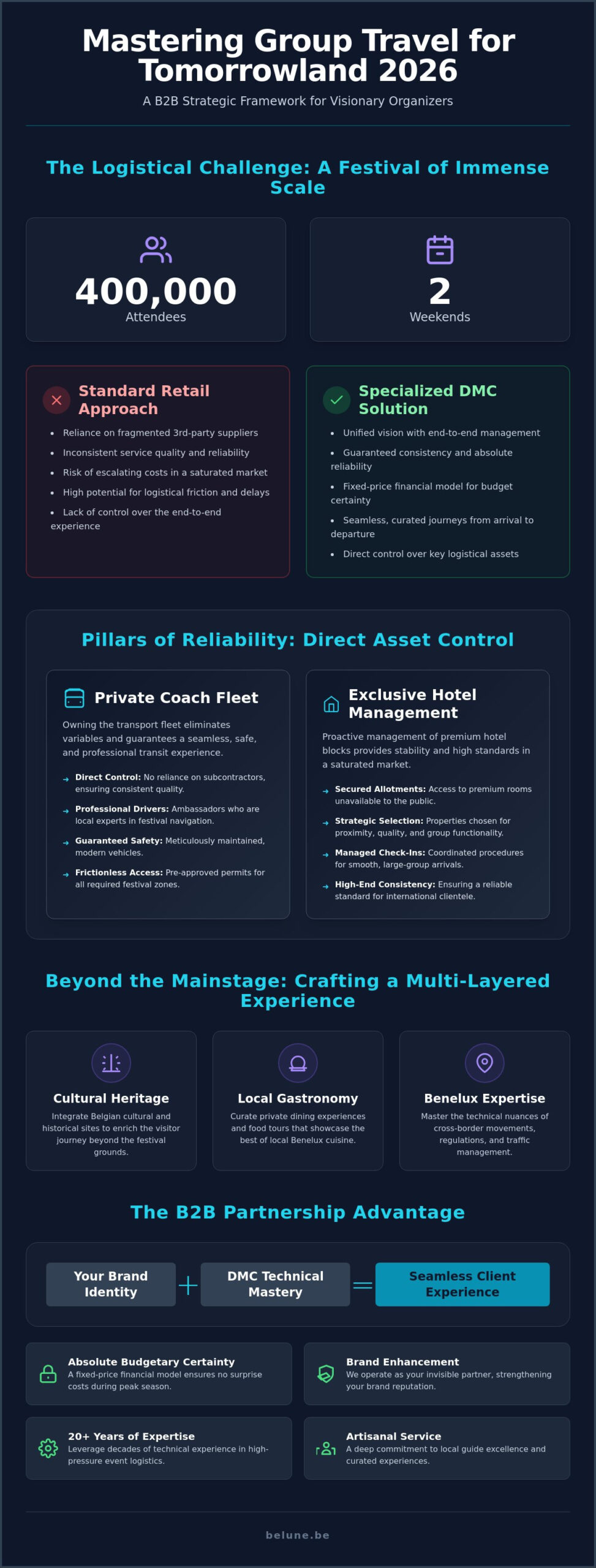
A successful tulip tour is a logistical masterpiece that requires a professional Benelux framework to execute beyond the standard tourist clichés. You’ve likely felt the pressure of the 2026 landscape, where Amsterdam’s “bed stop” and the VAT increase to 21% on Dutch accommodation have turned hotel procurement into a high-stakes puzzle. Designing group tours keukenhof gardens for the 2026 season demands more than just a booking; it requires a vision for movement and timing.
You’ll learn how to execute sophisticated, high-capacity itineraries that blend Dutch floral heritage with seamless logistics. We’ll outline how to leverage private coach fleets and expert local guidance to bypass the common friction of peak season. From securing exclusive access to managing the technicalities of the bloom, this guide provides the blueprint for a seamless multi-day experience that elevates the standard travel model into an art form.
Key Takeaways
- Master the 2026 bloom window by understanding why the weeks surrounding the official Keukenhof opening offer distinct advantages for high-capacity groups.
- Discover how to expand your itinerary beyond the Bollenstreek to the vast fields of Flevoland, ensuring exclusive views away from the standard tourist paths.
- Navigate the complexities of peak season by securing private coach transport and professional hotel management for your group tours keukenhof gardens.
- Learn to integrate the Dutch floral season into a cohesive Benelux narrative that connects Amsterdam, Brussels, and Paris through seamless private transport.
- Understand the strategic value of a DMC partner with local assets and decades of experience to mitigate the risks of high-season travel in 2026.
The Art of Timing: Navigating the 2026 Tulip Season in the Netherlands
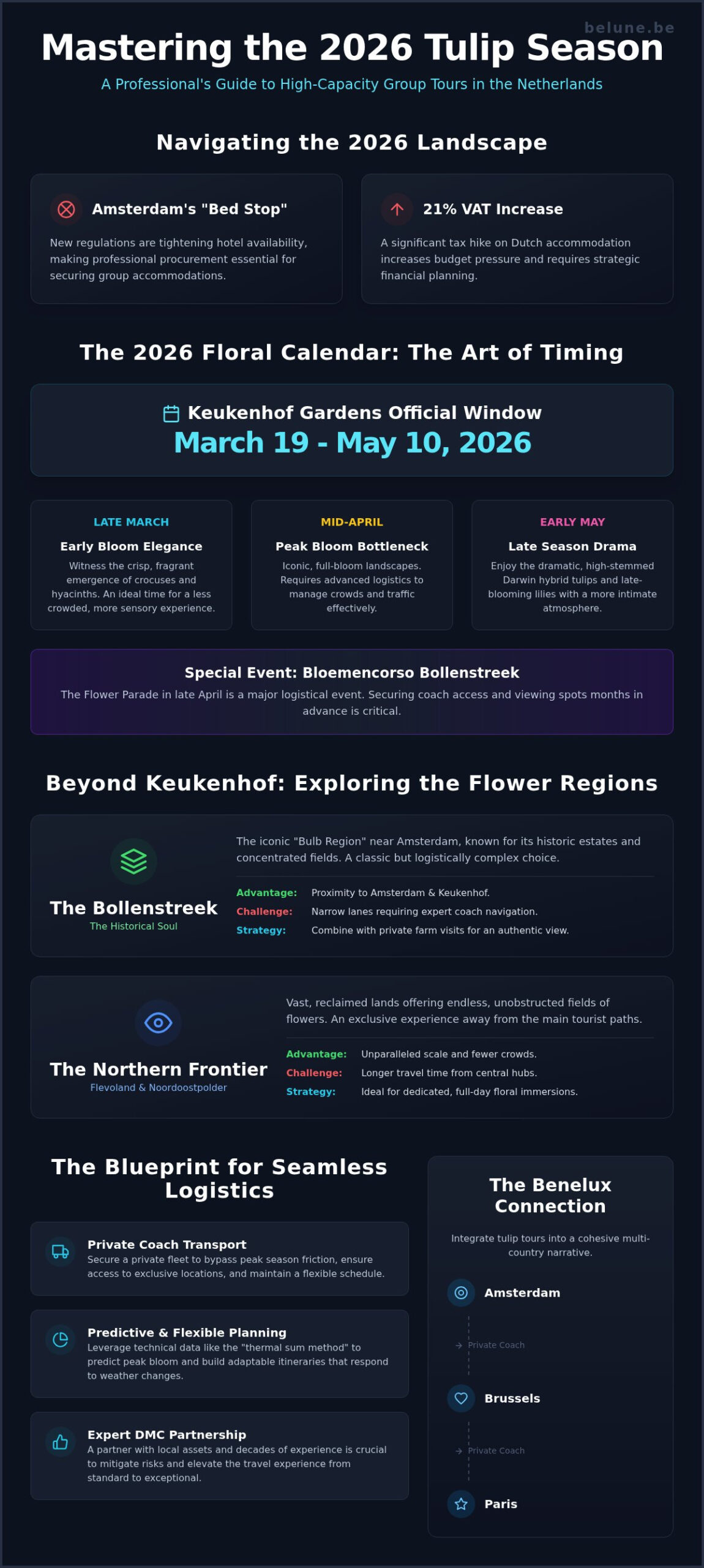
The 2026 tulip season isn’t a fixed event but a living, breathing transition of color. For international operators, the window is clearly defined. From March 19 to May 10, 2026, the Keukenhof gardens will welcome visitors into a landscape of seven million hand-planted bulbs. While many travelers obsess over the mid-April peak, professional planners recognize that the “Peak Bloom” is often a logistical bottleneck rather than a botanical necessity. Early season visitors in late March witness the crisp elegance of crocuses and hyacinths, while those arriving in May enjoy the dramatic, high-stemmed Darwin hybrids and late-blooming lilies. Organizing group tours keukenhof gardens requires a deep understanding of this botanical clock to ensure every guest experiences the Dutch floral heritage at its most vibrant.
To better understand the scale and flow of these environments, watch this helpful video:
The 2026 Floral Calendar: Key Dates for Planners
Precision is the foundation of excellence. The 2026 calendar revolves around the Keukenhof window, but the Bloemencorso Bollenstreek Flower Parade in late April adds a layer of complexity to the schedule. Integrating this massive event into group tours keukenhof gardens requires securing coach access months in advance. Beyond the parade, we look toward the “Quiet Season” as a strategic alternative. Late March offers a sensory palette dominated by the heavy scent of hyacinths, while the final weeks of the season provide a more intimate experience among the enduring tulip varieties that withstand the late spring sun.
Predictive Planning for International Groups
Managing international arrivals means balancing rigid flight schedules with the fluid nature of Dutch weather. Farmers in the Low Countries rely on the thermal sum method, which calculates accumulated heat units to predict exactly when the bulbs will reach their full aesthetic potential. We use this technical data to advise our partners on expectations. If a group arrives during a cold snap, the fields may be tight and green; a sudden warm front can accelerate the opening of millions of petals overnight. Transparency regarding these variables isn’t just professional; it’s essential for maintaining the trust of the high-end traveler who values authenticity over a curated postcard image. Flexibility in the daily itinerary allows us to pivot toward the most vibrant fields on any given day.
Beyond Keukenhof: Exploring the Diverse Flower Regions of the Low Countries
True mastery of the Dutch floral landscape extends far beyond the manicured borders of Lisse. While group tours keukenhof gardens offer a concentrated display of botanical artistry, the surrounding provinces reveal the sheer scale of the nation’s floriculture. For the professional planner, the choice of region dictates the atmosphere of the entire journey. We look past the standard tourist routes to identify landscapes that offer both visual impact and logistical feasibility for high-capacity groups. Each area possesses a distinct character, from historical intimacy to reclaimed vastness.
The Bollenstreek: Iconic Landscapes and Logistics
The Bollenstreek remains the historical soul of the industry. Its proximity to Amsterdam makes it the default choice for many, yet its narrow lanes present a unique challenge for large-scale operations. Success in this region depends on the precision of your transport. Modern coaches must navigate tight turns between historical estates and active bulb fields. We often combine a morning at Keukenhof with a private visit to a local farm, allowing guests to step into the soil where the bulbs are actually raised. This dual approach manages the group flow effectively while providing a deeper, more artisanal perspective on the tulip’s journey.
The Northern Frontier: Noordoostpolder and Beyond
For those seeking an unobstructed horizon, the reclaimed lands of Flevoland and the Noordoostpolder offer an industrial-scale beauty. This is where the Netherlands literally grew out of the sea. The roads here are wider; the parking is effortless. These technical advantages make the region a favorite for high-capacity group management. The fields are vast, often stretching to the horizon in perfect geometric lines. Integrating a specialized Benelux route allows us to weave in cultural milestones like Schokland, a UNESCO World Heritage site that stands as a former island in what was once the Zuiderzee. It provides a stark, beautiful contrast to the vibrant colors of the nearby tulip fields.
Further north, the Kop van Noord-Holland stands as the world’s largest contiguous flower bulb area. Located between the North Sea and the IJsselmeer, this region benefits from a unique maritime climate that often extends the bloom. Identifying off-the-beaten-track farms here is essential. We focus on locations that can accommodate a 50-seat coach without compromising the intimate feel of a private tour. It’s about finding that balance between technical accessibility and the feeling of discovery that high-end clients expect. By diversifying the regions your groups visit, you don’t just see the tulips; you understand the geography that makes them possible.
Logistics of Scale: Managing Group Transport and Accommodations
Executing large scale floral itineraries requires a shift from artistic vision to technical precision. While a solo traveler might navigate the Bollenstreek with ease, group tours keukenhof gardens succeed or fail based on the invisible infrastructure of transport and bed management. The 2026 season presents specific hurdles, notably the Dutch government’s planned VAT increase on hotel accommodation from 9% to 21%. For international operators, this makes the role of a local partner not just helpful, but financially critical. We focus on absorbing these complexities so that your clients experience only the seamless beauty of the bloom.
Coach Hire and Regional Navigation
Movement is the heartbeat of a successful tour. Relying on a private coach fleet ensures that your group isn’t subject to the unpredictability of third party scheduling. In the rural Dutch countryside, driver expertise is a specialized skill. Navigating a 50 seat vehicle through the flower fields requires an intimate knowledge of seasonal road closures and coach restricted zones. As a dedicated benelux incoming tour operator, we prioritize modern, eco-friendly vehicles that meet the strict emission standards of European city centers. This technical reliability allows your guides to focus on the narrative of the landscape rather than the stress of the route.
Strategic Hotel Accommodation Management
The 2026 landscape is defined by scarcity. Amsterdam’s “bed stop” policy has capped hotel development, making early procurement essential for large groups. We recommend securing hotel blocks 12 to 18 months in advance to guarantee both availability and rate stability. Our strategy often involves balancing field proximity with evening amenities. While staying in the heart of the flower region is evocative, choosing high quality hotels in nearby hubs like Leiden or Haarlem can offer better value and more diverse dining options for guests. We maintain rigorous standards to ensure that every property aligns with the expectations of international travel partners.
Guest experience is elevated when logistics feel effortless. We balance structured floral viewing with meaningful free time, allowing guests to absorb the atmosphere at their own pace. Multi-lingual local guides act as the bridge between the technical aspects of Dutch horticulture and the emotional impact of the scenery. They don’t just provide facts; they curate the moment. By managing the heavy lifting of transport and housing, we create the space for that curation to thrive, ensuring your group tours remain an industry benchmark for excellence.
The Benelux Connection: Integrating Tulip Tours into Multi-Country Itineraries
The traditional approach to spring travel often treats the Netherlands as a self-contained floral island. For the visionary operator, group tours keukenhof gardens are merely the opening act of a broader European narrative. With international tourism in the Netherlands projected to reach 23 million guests in 2026, the demand for sophisticated, multi-country experiences is rising. We view the tulip season not as an isolated event, but as a gateway to the cultural and gastronomic riches of the Benelux region and France. Connecting these destinations requires more than a map; it requires a logistical arc that maintains the same high standard of service across three distinct national borders.
The Floral and Cultural Arc: Holland to Belgium
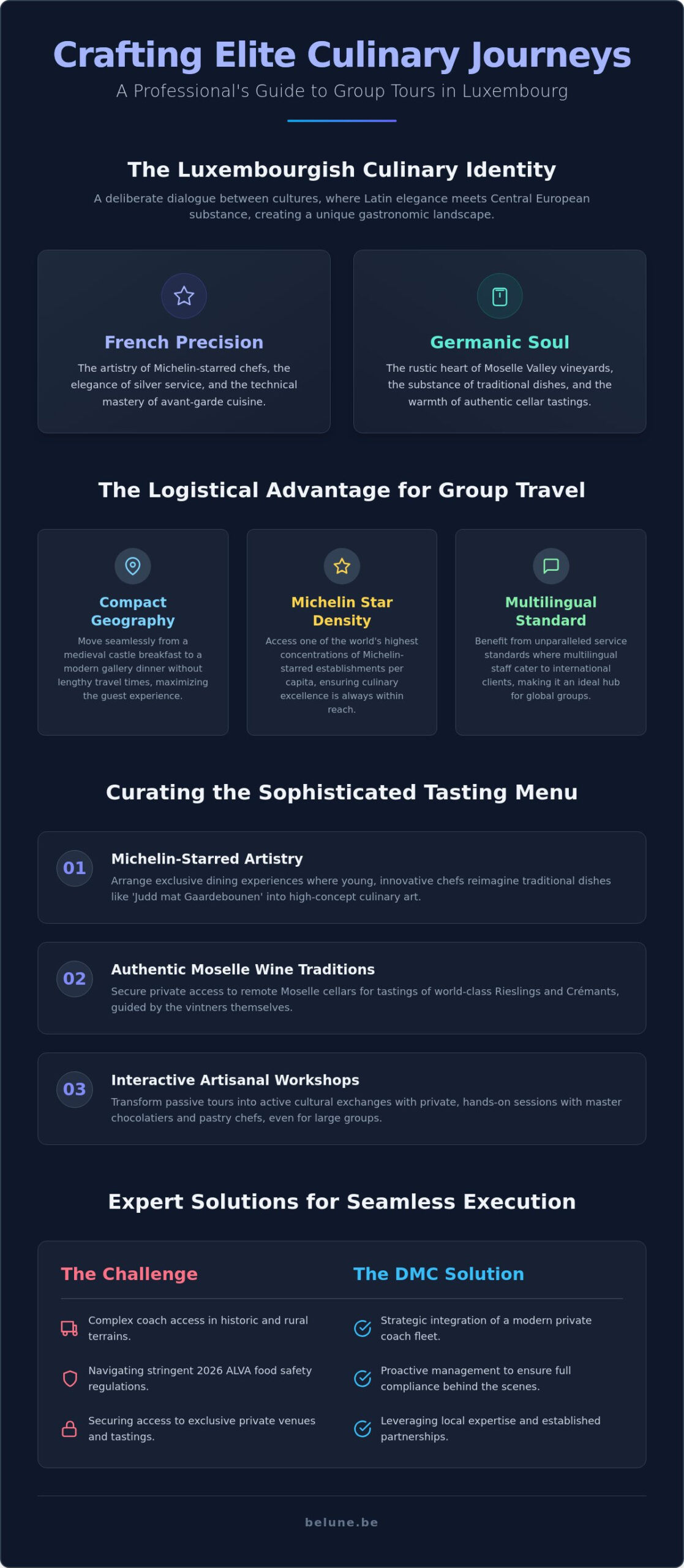
The transition from the Dutch fields to the Belgian capital offers a profound study in contrasts. While the Keukenhof represents the pinnacle of outdoor floral design, the Royal Greenhouses of Laeken in Brussels provide a rare glimpse into 19th-century glass architecture and exotic botany. These greenhouses are typically open to the public for only three weeks each spring, making them an exclusive addition to any 2026 itinerary. By integrating culture group tours benelux, we allow guests to trace the historical influence of the Low Countries on European art and architecture. The journey is further enriched by incorporating belgium gastronomy tours, where the sensory experience of the flowers is mirrored by the technical mastery of Belgian chocolatiers and brewers. This layering of experiences ensures that the itinerary remains dynamic and engaging for even the most well-traveled guests.
Extending the Journey to Paris
The final movement of a premier 2026 tour often leads south toward the City of Light. Moving a large group from the Dutch polders to the heart of Paris requires a partner who understands the technicalities of cross-border coach travel. We manage the high-speed logistics of the A1 motorway, ensuring that the transition is seamless and that the quality of transport never wavers. This connection allows tour operators to market a comprehensive “Spring in Europe” package that captures the three most iconic capitals of the north. The reliability of a private coach fleet is paramount here; it provides the flexibility to pivot between a morning in a Flemish village and an afternoon at a Parisian landmark without the constraints of public rail schedules. Our role is to act as the strategic thread that binds these diverse regions into a single, harmonious journey.
A successful multi-country itinerary is a balance of movement and rest. We focus on the fine details of the transition, from the timing of rest stops to the pre-registration of hotel blocks in Paris, where the market remains as competitive as Amsterdam. If you are ready to elevate your offerings for the upcoming season, you can design your 2026 Benelux itinerary with our expert team today.
Partnering with an Expert DMC: Why BELUNE is the Choice for 2026
Trust is the silent foundation of every successful high-capacity itinerary. When organizing group tours keukenhof gardens, the difference between a standard excursion and an exceptional journey lies in the institutional capacity of your partner. With over 20 years of experience in the Benelux market, we’ve refined the art of floral logistics into a technical discipline. We don’t just act as a middleman; we provide the physical and intellectual infrastructure required to navigate the complexities of the Dutch spring. This long term expertise allows us to anticipate market shifts, from regulatory changes to the nuances of seasonal bloom patterns, providing our partners with a level of security that off the shelf providers cannot match.
The BELUNE Difference: Assets and Expertise
Reliability is born from control. By operating our own fleet of modern, high specification coaches, we eliminate the risks associated with third party transport providers. This ownership guarantees that every vehicle meets our rigorous standards for comfort and environmental compliance, which is critical for accessing restricted floral zones. Our deep local roots make us the essential partner for themed group travel benelux, where we blend botanical interests with art, history, and gastronomy. We provide 24/7 on-the-ground support to operators, ensuring that any logistical shifts are managed with immediate, professional intervention. This constant presence allows tour leaders to focus entirely on the guest experience while we handle the technical execution behind the scenes.
Designing Your 2026 Floral Program
Bespoke travel is a collaborative process. We move beyond generic templates to co-create itineraries that reflect the specific brand identity of our partners. Whether your focus is on technical horticulture or luxury leisure, our team works to integrate group tours keukenhof gardens into a wider, cohesive narrative. This tailored approach significantly reduces the administrative burden for travel agents. We manage the intricate details of hotel procurement, site bookings, and multi-lingual guide coordination, presenting you with a polished, ready to market product. Our fixed price group packages provide the financial transparency necessary for accurate forecasting in a season defined by fluctuating costs.
The 2026 season is approaching, and the window for securing the best assets is already narrowing. By choosing a partner with a proven track record and local assets, you ensure that your floral program is as resilient as it is beautiful. We invite you to leverage our two decades of expertise to build something truly remarkable for your clients. Our team is ready to transform your vision into a logistical masterpiece. Contact us today to begin the co-creation of your 2026 floral itinerary and secure your place in the heart of the Dutch spring.
Elevating the Floral Experience for 2026
The 2026 season demands a departure from the ordinary. We’ve explored how a technical approach to timing and a strategic expansion into the northern polders can transform a standard visit into an exclusive discovery. Mastering group tours keukenhof gardens requires more than just entry; it necessitates a partner who controls the infrastructure of the journey. With our private fleet of modern coaches and over 20 years of industry expertise, we specialize in bridging the gap between artistic vision and logistical reality for our B2B partners.
The complexities of the coming year, from hotel caps to Dutch VAT adjustments, are best managed through a collaboration rooted in local knowledge and dedicated assets. We invite you to move beyond off-the-shelf solutions and co-create an itinerary that resonates with the high standards of your international clientele. Each route we design is a reflection of our commitment to excellence and technical precision.
Request your custom 2026 Benelux group tour itinerary from BELUNE and ensure your program stands as a benchmark of quality in the Low Countries. We look forward to realizing your vision for an unforgettable spring.
Frequently Asked Questions
When is the best time to book a group tulip tour for 2026?
You should initiate bookings 12 to 18 months in advance to secure the most prestigious assets. The 2026 season is particularly competitive due to Amsterdam’s hotel cap and the upcoming VAT increase on Dutch accommodation from 9% to 21%. Early commitment guarantees rate stability and availability for large groups during the peak bloom window. This window is narrow, and the highest quality hotel blocks are often claimed by institutional partners well before the spring season begins.
Can large coaches access the private tulip fields in the Netherlands?
Access is possible when utilizing a partner with a private, modern coach fleet and local navigational expertise. While many narrow lanes in the Bollenstreek have restrictions, our drivers understand the technical requirements for navigating these rural zones. Choosing the wider roads of the Noordoostpolder or the Kop van Noord-Holland allows high-capacity vehicles to reach the heart of the fields without compromising safety or local regulations. Professional planning ensures your group reaches the best views safely.
What is the difference between Keukenhof and private flower fields for groups?
Keukenhof is a 32-hectare curated landscape featuring seven million hand-planted bulbs in artistic arrangements. In contrast, private flower fields are active agricultural sites where tulips are grown for bulb production on an industrial scale. Both elements are vital for group tours keukenhof gardens. The park provides botanical artistry and structured paths, while the fields offer the sheer, geometric scale that defines the Dutch polder landscape and provides an authentic agricultural perspective.
How do we handle hotel bookings for large groups during the tulip season?
We manage hotel procurement by diversifying stay locations and leveraging long-term industry relationships. With the 2026 VAT rise, professional management is essential to maintain budget transparency for international agents. We often recommend high-quality properties in regional hubs like Leiden or Haarlem. These locations provide easier coach access and better value than the saturated Amsterdam market while remaining close to the primary floral zones, ensuring a seamless logistical flow for your guests.
Is it possible to combine a Dutch tulip tour with a trip to Belgium and Paris?
Seamless cross-border integration is one of our core specialties for international operators. Our private coach fleet facilitates a smooth logistical flow from the tulip fields of Lisse to the cultural landmarks of Brussels and the grand boulevards of Paris. We handle the technicalities of three different national regulations. This allows your guests to focus on the elegant transition from Dutch floral heritage to Belgian gastronomy and French art history without the stress of public transport schedules.
What happens if the tulips bloom earlier or later than expected?
We mitigate the unpredictability of nature through flexible itinerary design and real-time data analysis. Farmers use the thermal sum method to predict bloom dates, and we use this technical insight to adjust our routes accordingly. If the south blooms early, we pivot toward the maritime climate of the north to find the best color. This agility ensures that your group always experiences the most vibrant fields regardless of the specific seasonal weather variations encountered during their stay.
Do you provide multi-lingual guides for international travel groups?
Yes, we provide professional, multi-lingual local guide services tailored to the specific needs of international groups. Our guides act as cultural bridges, translating the technical aspects of Dutch horticulture into an engaging human narrative. They possess the deep local knowledge required to navigate the crowds at Keukenhof and the expertise to explain the unique geography of the reclaimed polder lands. This personal touch elevates the technical logistics into a truly sophisticated guest experience.
Are there specific floral events in 2026 we should include in our itinerary?
The 2026 calendar features several essential milestones, starting with the Keukenhof opening from March 19 to May 10. The Bloemencorso Bollenstreek Flower Parade in late April is a technical masterpiece that requires advanced coach parking reservations months in advance. We also recommend including the Royal Greenhouses of Laeken in Brussels. These greenhouses offer a rare architectural and botanical experience that perfectly complements the Dutch tulip season, creating a more comprehensive Benelux narrative for your group.