Tag: Travel Professionals

  • Organising Group Tours: A Guide for Travel Professionals

    Organising Group Tours: A Guide for Travel Professionals

    When organising group tours in bruges, the smoothest programme isn’t necessarily the one with the fullest schedule. It’s the one where each detail supports the next. Travel professionals know that a memorable group tour depends on more than compelling experiences: transport, accommodation, guiding and realistic pacing all need to work together, while allowing for different interests and practical needs.

    Coordinating those elements takes careful planning. Supplier bookings and travel times matter, but so do rest breaks, accessibility needs and the transitions between activities. Build these considerations into the itinerary from the start, rather than trying to fit them around a schedule that is already full.

    This guide explains how to develop a coherent group tour, from shaping a balanced programme to coordinating coaches, accommodation and local guides. It offers practical ways to match the itinerary to travellers’ interests and pace, and to keep the logistics clear as plans take shape.

    With more than 20 years of experience in group travel, BELUNE brings itinerary design and on-the-ground coordination together through tailored programmes, its own coach fleet, accommodation management and expert local guidance. A considered plan helps every part of the journey work together.

    Key Takeaways

    • Start with the group’s profile, purpose, interests and practical needs to guide itinerary decisions.
    • Build a connected programme by choosing a theme, mapping experiences, testing the pace and coordinating logistics.
    • Align coach movements, accommodation, local guiding and booked experiences so each element supports the traveller experience.
    • Plan for comfort: explain meeting arrangements clearly, allow time for transitions and leave room to adapt.
    • Tailored planning and coordinated delivery can turn a group brief into a more cohesive tour.

    What Does Organising a Group Tour Actually Involve?

    A group tour is more than a sequence of appealing stops. It’s a coordinated programme that brings together travellers, transport, accommodation, guiding and experiences, shaped around the group’s purpose, interests and practical needs. A well-designed itinerary gives the trip a clear character; careful coordination makes its moving parts work together.

    Group-tour planning combines the design of a meaningful journey with the coordination needed to deliver it. A package tour offers a useful starting point for understanding how travel components can be combined. Organised group travel also requires attention to how those elements connect in practice. A booking list can show what’s planned, but not necessarily whether the day will flow comfortably from one activity to the next.

    For a visual sense of what a guided experience can add, watch this video:

    What does a group travel organiser coordinate?

    Planning starts with the group’s brief and continues through itinerary design, booking coordination and on-the-ground delivery. Accommodation choices affect where the day begins and ends. Coach movements shape how experiences connect, while guiding and activities need to fit the programme’s timing and tone. Because a change to one element can affect others, treat them as connected workstreams rather than separate tasks.

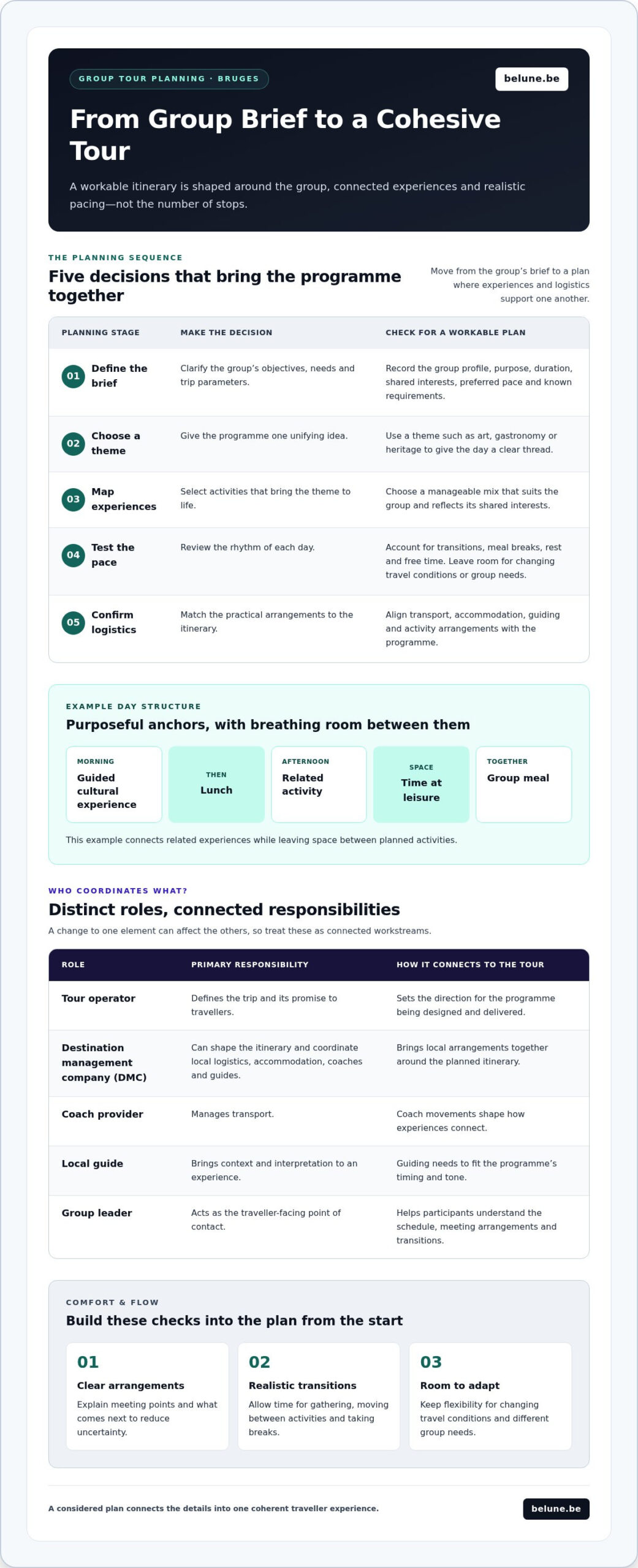
    The roles are distinct. The tour operator defines the trip and its promise to travellers. A destination management company (DMC) can shape the itinerary and coordinate local logistics, accommodation, coaches and guides. The coach provider manages transport, while the local guide brings context and interpretation to an experience. The group leader is the traveller-facing point of contact, helping participants understand the schedule, meeting arrangements and transitions.

    Why does a joined-up itinerary matter to travellers?

    A clear programme reduces uncertainty about what comes next and makes room for the experiences that matter. That clarity comes from choices based on shared interests, individual needs and a comfortable pace, not simply on how many attractions can fit into a day. Realistic transitions and breathing room support a more considered experience, while exact timings depend on the programme and conditions on the ground.

    In practice, organising group tours in bruges means looking beyond the headline attractions. The quality of the experience also depends on how thoughtfully the details fit together.

    How to Build a Cohesive Group-Tour Itinerary

    A strong itinerary starts with the group, not a checklist of attractions. For professionals organising group tours in bruges, the same principle applies: first understand who is travelling and why, then shape a programme whose experiences, transitions and pace serve that purpose.

    Itinerary quality depends on fit and flow, not the number of stops. A cultural programme might pair a guided heritage experience with time to reflect on what the group has seen. A food-focused tour could balance tastings with a relaxed meal. The aim is to create a clear thread through the day, rather than fill every available space.

    How should organisers turn a group brief into a programme?

    Translate the brief into practical decisions. Record the group profile, trip purpose, duration, shared interests, preferred pace and known requirements. Then choose a central theme and a manageable mix of experiences that supports it. For further inspiration on cultural programming, explore this cultural group-tour design guide. Group Tour Magazine can also offer ideas for professional group travel planning.

    Use this five-step sequence to move from concept to workable plan:

    • Define the brief: Clarify the group’s objectives, needs and trip parameters.
    • Choose a theme: Give the programme a unifying idea, such as art, gastronomy or heritage.
    • Map experiences: Select activities that bring the theme to life and suit the group.
    • Test the pace: Review transitions, meal breaks, rest and free time across each day.
    • Confirm logistics: Align transport, accommodation, guiding and activity arrangements with the itinerary.

    How can organisers balance highlights with breathing room?

    Where possible, sequence experiences by location or theme so the programme feels connected and avoids unnecessary movement. Build each day around a few purposeful anchors instead of filling every gap. For example, a morning guided cultural experience could lead into lunch, followed by a related afternoon activity, time at leisure and a group meal. This creates a clear structure while leaving space between planned activities.

    Plan transitions as part of the experience. Allow time for the group to gather, move between activities and take breaks. Keep some flexibility for changing travel conditions or group needs. Clear decisions about pace can make a programme more inclusive and enjoyable for travellers with different interests and energy levels.

    For tour operators developing a tailored programme, BELUNE’s group-tour planning brings itinerary design together with accommodation management, coach transport and local guidance.
    Organising Group Tours: A Guide for Travel Professionals

    How to Coordinate Transport, Accommodation, Guides and Experiences

    A coherent itinerary depends on operational details working together. Coach movements, overnight stays, local guidance and booked experiences each have a distinct role, yet travellers experience them as parts of one programme. For professionals organising group tours in bruges, treating these as connected workstreams helps keep plans aligned and reduces avoidable handoffs.

    Use this overview to clarify each element’s purpose and the organiser’s planning task:

    Planning element Purpose Organiser’s task Group benefit
    Coach transport Links accommodation with scheduled programme elements. Coordinate departures, boarding arrangements and luggage considerations with the itinerary. A clearer movement plan between activities.
    Accommodation Shapes the tour’s overnight rhythm. Align accommodation management with the group’s needs and programme structure. A stay considered as part of the overall journey.
    Local guidance Adds interpretation and context to experiences. Connect the guide’s role to the itinerary and group interests. More context for the experiences on the programme.
    Booked experiences Bring the itinerary’s theme to life. Sequence activities in relation to transport, meals and group pace. A programme that feels connected rather than pieced together.

    How does coach transport support a group itinerary?

    Coach movements connect accommodation, activities and other planned stops, so departure arrangements should fit the day’s sequence. Set out where the group boards, how boarding will be coordinated and how luggage fits into movements between programme points. BELUNE’s own modern coach fleet supports group transport, with arrangements tailored to the itinerary. When organising group tours in bruges, plan transport as part of the wider programme rather than as a separate booking.

    What makes accommodation and local guidance part of one plan?

    Accommodation management shapes the tour’s overnight rhythm and works best when considered alongside arrivals, departures and the wider programme. Local guides bring expert context to experiences and help travellers engage with the itinerary as it unfolds. For professionals organising group tours in bruges, aligning these elements can reduce avoidable handoffs and help each part of the programme feel connected.

    Consider how changes may ripple across the plan. A revised departure time could affect a coach movement, an activity arrival, a guide’s schedule or a later transition. Review connected arrangements together and communicate meaningful updates clearly to the group leader. BELUNE brings tailored itineraries, accommodation management, its own coach fleet and local guidance together for professional travel partners.

    How to Keep Group Tours Comfortable, Inclusive and on Schedule

    A full timetable can look impressive on paper and feel exhausting in practice. A considered programme leaves room for meals, rest and transitions, helping the day feel coherent rather than hurried. For professionals organising group tours in bruges, comfort and inclusion start with planning around the people taking part, not just the attractions on the schedule.

    How can organisers make a group programme easier to follow?

    Set expectations before travel and keep key information consistent throughout the programme. A clear itinerary explains the sequence of activities, meeting points, transitions and what travellers need to know at each stage. During the tour, the group leader can share updates and help coordinate headcounts before departures and at agreed meeting points.

    Build a simple communication checklist into planning:

    • Before travel: Share the itinerary, meeting instructions and a clear way to receive updates.
    • At each transition: State the next destination or activity, the meeting point and the planned departure arrangement.
    • As the group moves: Agree how headcounts will be handled and who will communicate schedule changes.
    • During planning: Invite relevant information about access, mobility, dietary needs and preferred ways to participate, then use it to shape programme decisions.

    Ask about practical needs early enough to consider them alongside the itinerary. A dietary requirement may affect meal planning; mobility information may influence the pace or sequence of activities. Treat these details thoughtfully and communicate relevant arrangements clearly, without assuming one solution suits every traveller.

    What should a group-tour contingency plan cover?

    Preparation can’t prevent disruption, but it can help organisers respond if travel times or other conditions change. Identify possible alternatives for key activities, consider how a delay could affect later transitions, and agree how the group leader will receive meaningful updates.

    Keep revised instructions concise: explain what’s changing, what the group should do next and where to meet. Review connected arrangements before sharing an update, since a change to one activity may affect transport or subsequent plans. This gives the group a clear reference point while the organiser manages the wider programme.

    Thoughtful coordination brings practical planning and traveller care into the same itinerary. BELUNE’s tailored group-travel support brings these elements together in programmes shaped around a group’s needs and pace.

    How BELUNE Turns a Group-Tour Brief into a Tailored Experience

    A successful group programme starts with listening. BELUNE works with professional travel partners to understand what a group wants from its journey, then shapes an itinerary and coordinates the practical details that support it. With more than 20 years of group-travel industry experience, we bring programme design and logistics into one considered process.

    What does a tailored group-tour planning process look like?

    First, we build a picture of the group: its purpose, interests, travel requirements and the experience the operator wants to create. An art and culture group may need a different rhythm from travellers drawn to gastronomy or heritage. These priorities guide the itinerary, rather than forcing the group into a preset format.

    From there, we shape the programme and coordinate the relevant elements, including accommodation management, coach transport through our own fleet, and local guidance. Each component is planned in relation to the others, so the itinerary reflects the group’s objectives as well as the practical flow of its travel. The details are tailored to the brief.

    For a broader perspective on working with a travel partner, read our group travel agency guide. It offers additional context for professional operators considering the planning and coordination behind a group programme.

    What should travel professionals prepare for an initial discussion?

    A clear brief helps turn an early conversation into useful planning decisions. Gather the information you already have, and note where the programme still needs shaping:

    • Group profile: Group size and any known practical requirements.
    • Travel outline: Preferred dates and trip duration.
    • Purpose and interests: The reason for the trip and the experiences travellers value.
    • Desired coordination: The elements you want brought together, such as itinerary planning, accommodation management, coaches and local guidance.

    You don’t need every detail resolved before discussing the programme. A clear sense of the intended experience gives us a useful starting point, while open questions can be developed as the itinerary takes shape. This is especially useful when a group has several interests or when the operator wants practical logistics coordinated alongside programme design.

    Share your group brief with BELUNE to discuss a tailored programme and the coordination it calls for. Discuss your group programme.

    Shape Your Next Group Tour with Confidence

    A memorable group programme is built on more than an appealing list of stops. A clear theme, realistic pace and thoughtful coordination connect the itinerary with travellers’ interests and practical needs. For professionals organising group tours in bruges, keeping transport, accommodation, local guidance and experiences aligned is central to creating a coherent journey.

    BELUNE brings more than 20 years of experience in transport and tour operations to tailored group travel. Our own modern coach fleet, accommodation management and expert local guidance support itineraries designed around each group’s objectives. By considering practical details as part of the programme, travel professionals can shape an experience that feels purposeful from beginning to end.

    Start with your group’s interests, preferred pace and travel requirements. Discuss a tailored group-tour programme with BELUNE.

    Frequently Asked Questions

    Can one itinerary work for travellers with different interests?

    Yes. A group itinerary can bring varied interests together through a shared theme, a mix of experiences, meals and time for personal choice. Start by identifying common priorities, then avoid letting one interest dominate the entire programme. For example, a cultural focus could include guided visits alongside relaxed meals and independent time. Explain which activities are shared and where travellers can choose how to spend their time.

    How do you organise transport for a group tour?

    Begin by mapping the group’s movements between accommodation, activities and other planned elements. Set out departure points, allow realistic time for boarding and transitions, and make clear who communicates updates to travellers. Coordinate transport with the itinerary so a change in one part can be considered alongside the rest. BELUNE coordinates group transport through its own modern coach fleet as part of tailored travel programmes.

    What should a group-tour itinerary include?

    A useful itinerary shows the sequence of experiences and the practical details travellers need to follow it. Include transport movements, accommodation arrangements, meals or breaks, meeting instructions, guided activities and time for rest or independent exploration. Make clear when the group is together and when travellers have personal time. The programme should prepare people for the journey while leaving room to respond to changing needs or conditions.

    How much time should organisers allow between group activities?

    Allow enough time for travellers to finish one activity, move to the next meeting point and regroup before continuing. The right buffer depends on the group, transport arrangements and programme details, so don’t base the schedule on ideal travel times alone. Consider the group’s pace and practical requirements, and protect time for meals and rest. A thoughtfully paced itinerary also leaves room to adjust if plans take longer than expected.

    What happens if a group-tour schedule changes?

    Communicate the change clearly, explain how it affects the next programme element and share revised meeting or departure instructions. A contingency plan should identify which parts of the itinerary might be adapted while keeping the group’s main objectives in view. Keep the group leader informed so they can relay relevant details to travellers. Preparation helps organisers respond thoughtfully, but it can’t guarantee that disruptions will be avoided or every activity rescheduled.

    Is a destination management company useful for group tours?

    Yes, a destination management company can connect itinerary planning with local logistics, including accommodation management, coach transport and local guidance. This gives travel professionals one partner to coordinate related parts of a group programme. BELUNE works with tour operators and travel agents to develop tailored itineraries and coordinate group-travel arrangements. The programme can be shaped around the group’s interests, travel objectives and practical requirements rather than a fixed format.

    What information should I prepare before planning a group tour?

    Prepare the approximate group size, preferred dates, trip duration, travel purpose, shared interests and known practical requirements. It also helps to consider the pace travellers would enjoy and what you want them to take away from the experience. You don’t need every programme detail decided. A clear brief gives the planning process a useful starting point and helps shape an itinerary that connects the group’s priorities with its logistics.

    Ready to plan a cohesive group programme? Share your brief with BELUNE to discuss tailored itinerary planning, accommodation management, coach transport and local guidance.
  • Crafting the Ultimate Custom Luxembourg Itinerary for Groups in 2026

    Crafting the Ultimate Custom Luxembourg Itinerary for Groups in 2026

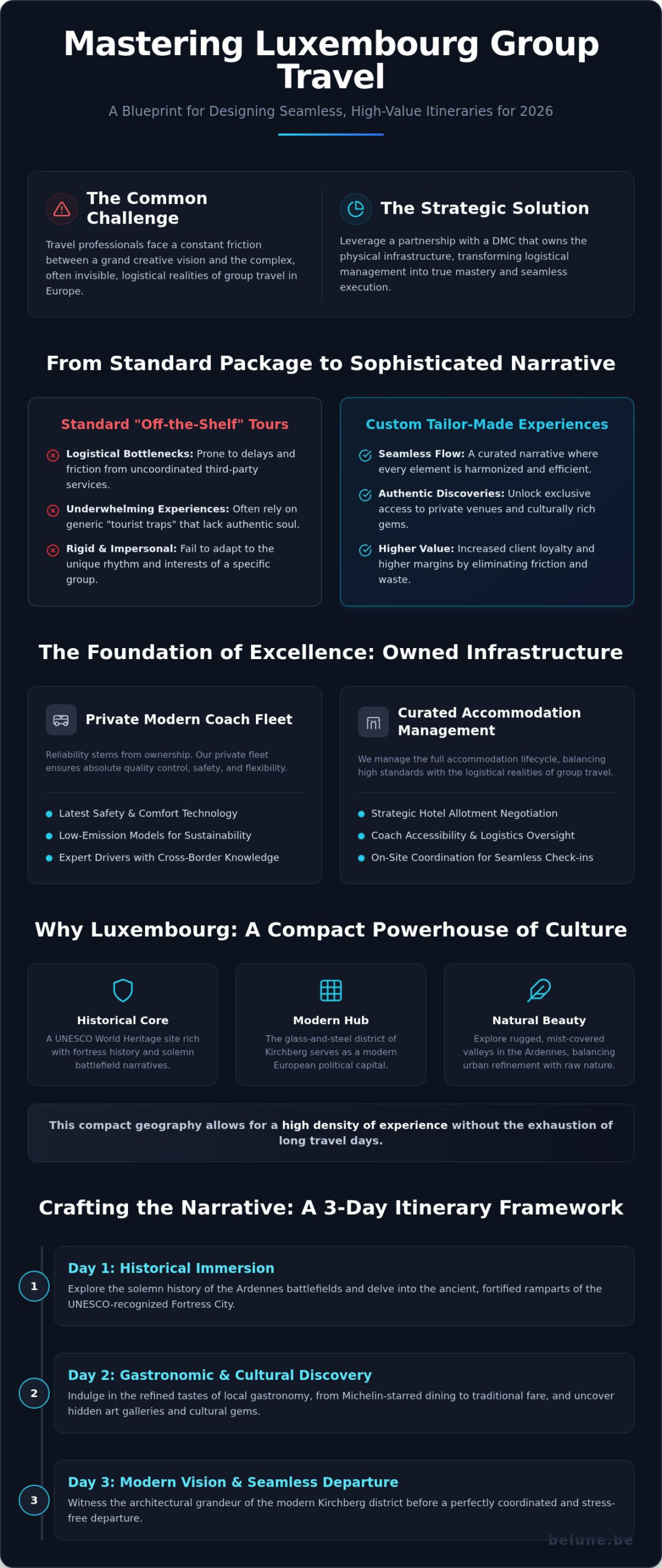
    An exceptional travel experience is a dialogue between architectural grandeur and invisible precision. For travel professionals, the challenge of designing a custom luxembourg itinerary for groups often lies in the friction between a bold vision and the technical reality of the terrain. You understand that your clients demand more than just a visit. They seek a curated narrative that flows without interruption. Yet, the logistical weight of coordinating cross-border arrivals, securing high-standard hotels, and managing transport through narrow European corridors can often overshadow the creative potential of the journey itself.

    It’s time to shift the focus from simple management to true mastery. You’ll discover how to design a logistically seamless and culturally rich Luxembourg group experience by leveraging the expertise of a partner who owns the physical infrastructure. We’ll explore the strategic advantages of utilizing a private, modern coach fleet and professional accommodation management to create a white-label service that feels entirely effortless. This guide provides a sophisticated blueprint for 2026. It details how to blend battlefield history, gastronomic excellence, and hidden cultural gems into a single, harmonious itinerary that elevates your brand and inspires your travelers.

    Key Takeaways

    • Learn how a strategic DMC partnership transforms a standard trip into a sophisticated narrative that avoids the pitfalls of “off-the-shelf” group tours.
    • Master the art of designing a custom luxembourg itinerary for groups by integrating private coach fleet reliability with expert hotel accommodation management.
    • Discover how to weave diverse narrative arcs, from the solemn history of battlefield tourism to the refined tastes of local gastronomy and art.
    • Gain a framework for a perfectly paced 3-day journey that eliminates travel fatigue while maximizing the cultural impact of the Fortress City.
    • Understand the competitive advantage of working with a partner who possesses 20 years of technical expertise and a visionary approach to group travel logistics.

    The Strategic Value of a Tailor-Made Luxembourg Group Experience

    In an era defined by hyper-personalization, the traditional “off-the-shelf” tour feels increasingly obsolete. Sophisticated travelers in 2026 expect a narrative that mirrors their own values: exclusivity, precision, and cultural depth. Designing a custom luxembourg itinerary for groups requires more than a map and a list of hotels. It demands a technical mastery of the local environment. Standard packages fail because they ignore the unique rhythm of a specific group, often leading to logistical bottlenecks or underwhelming “tourist traps” that lack authentic soul.

    A Destination Management Company (DMC) today acts as a guardian of the guest experience. We don’t just provide services; we manage the invisible threads of logistics that keep a project from unraveling. By moving away from standardized packages, travel agents unlock higher margins and deeper client loyalty. The economic benefit is clear. It’s about reduced waste, optimized timing, and the elimination of middle-man friction. A custom-built itinerary ensures every minute spent in the destination adds value to the traveler’s journey.

    The DMC Advantage for Tour Operators

    Operational risk is the silent enemy of group travel. A dedicated DMC provides the ground support necessary to pivot when the unexpected happens, ensuring the itinerary remains fluid and professional. We secure hotel allotments that aren’t available on public platforms and open doors to private venues that define “exclusive.” Essentially, the DMC serves as a strategic architectural partner for travel agents, providing the structural integrity upon which a creative travel vision is built. Our local expertise transforms a series of bookings into a cohesive, high-performance operation.

    Luxembourg: A Compact Powerhouse of Culture

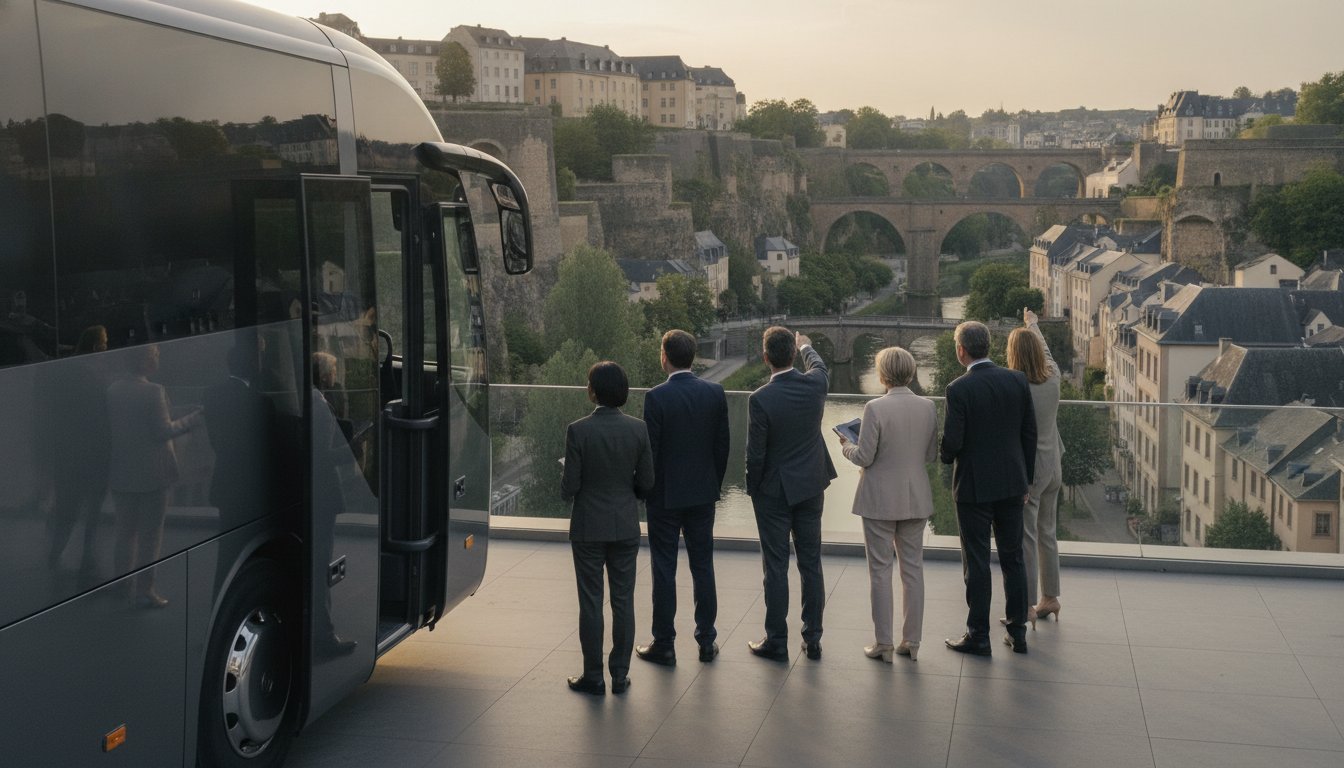
    Luxembourg is often underestimated. It sits at the cross-sections of European history, serving as both a UNESCO World Heritage site and a modern political capital. This duality makes it an ideal hub for multi-country itineraries. A morning spent in the glass-and-steel district of Kirchberg can easily transition into an afternoon exploring the rugged, mist-covered valleys of the Ardennes. This compact geography allows for a high density of experience without the exhaustion of long travel days. It’s the sophisticated heart of the Benelux region, offering a balance of urban refinement and raw, natural beauty that satisfies the most discerning group profiles.

    Logistical Excellence: Masterful Transport and Accommodation Management

    Technical precision defines the success of any high-end group experience. In the Grand Duchy, geography presents a unique set of challenges, from the winding elevation of the Ardennes to the pedestrian-heavy arteries of the capital. Managing these variables requires more than just a booking agent. It necessitates a partner who controls the physical infrastructure of the journey. A custom luxembourg itinerary for groups is only as strong as the logistics supporting it. We focus on the invisible details that allow the traveler’s narrative to remain uninterrupted.

    The BELUNE Fleet: A Commitment to Modernity

    Reliability stems from ownership. Unlike agencies that rely on third-party rentals, we operate our own private fleet of modern coaches. This allows for absolute quality control. For a custom luxembourg itinerary for groups in 2026, we prioritize vehicles equipped with the latest safety technology and ergonomic interiors. Our drivers aren’t just operators; they’re local experts who understand the nuances of cross-border travel into Belgium, France, and the Netherlands. This internal control ensures that schedules remain rigid where they must be, yet flexible enough to accommodate the creative flow of the day. We focus on low-emission, high-comfort models that align with the sustainability expectations of modern travelers.

    Curated Hotel Management

    Sourcing group-friendly hotels is a delicate balancing act. A property must offer high standards across various star ratings while remaining accessible to large coaches. Many central locations in Luxembourg City present logistical hurdles for transport, making professional oversight essential. We manage the entire accommodation lifecycle, from initial allotment negotiation to on-site coordination. This ensures that your guests experience the urban sophistication of the city without the friction of difficult arrivals. We prioritize properties that understand the unique needs of large groups, such as streamlined check-ins and dedicated dining spaces.

    Our approach integrates seamlessly with the wider region. As a specialized Benelux incoming tour operator, we understand how to transition groups across borders without a single break in narrative flow. Whether it’s a 4-star boutique in the capital or a heritage property in the countryside, every choice is made with logistical fluidity in mind. If you’re looking for a partner to handle the technical weight of your next project, you can explore our transport solutions to see how we elevate the standard of group travel.

    Crafting the Ultimate Custom Luxembourg Itinerary for Groups in 2026

    Exploring the Diverse Narrative Arcs of Luxembourg

    Luxembourg isn’t a single experience. It’s a collection of narratives waiting to be unspooled. When you design a custom luxembourg itinerary for groups, you’re essentially acting as a curator of these stories. The Grand Duchy offers a density of themes that few other regions can match, from the stark reminders of 20th-century conflict to the delicate notes of a Moselle Riesling. Designing a custom luxembourg itinerary for groups that incorporates these diverse arcs requires a deep understanding of the local terrain and a vision for how they connect.

    The capital’s fortifications, a UNESCO World Heritage site, serve as the structural anchor for many tours. Known as the “Gibraltar of the North,” these ancient walls and casemates tell a thousand-year story of European power struggles. Walking through the Grund or looking out from the Chemin de la Corniche provides a visceral sense of history. It’s a masterclass in urban defense and architectural evolution. Key sites include:

    • The Bock Casemates: An intricate labyrinth of subterranean tunnels carved into the rock.
    • The Chemin de la Corniche: Often called “Europe’s most beautiful balcony,” offering panoramic views of the Alzette valley.
    • The Grund: A tranquil, historic district nestled at the foot of the massive fortress walls.

    Battle of the Bulge: A Pilgrimage of Remembrance

    The Ardennes forest holds a somber significance. For groups seeking to honor the past, the sites of the Battle of the Bulge offer a profound experience. We focus on key locations like the General Patton Memorial Museum in Ettelbruck and the National Museum of Military History in Diekirch. Expert local guides are essential here. They provide the historical context that turns a silent forest into a living testament to bravery. For those planning a broader commemorative journey, our Flanders Fields guide provides the necessary cross-border context for WWI and WWII remembrance tours.

    Gastronomy and the Moselle Valley

    The Moselle Valley is where the landscape softens into rolling vineyards. Here, we curate wine tasting experiences that accommodate large groups without losing the sense of intimacy. The region’s culinary identity is a fascinating intersection of French elegance and German tradition. Luxembourgish fine dining is a sensory artistry that balances Michelin-starred precision with the rustic, authentic flavors of the terroir. Whether it’s a private dinner in a vaulted cellar or a lunch overlooking the river, the focus remains on the quality of the craft; those interested in extending such elegance to the water can learn more about NuVia Travel and their luxury river cruise offerings.

    Beyond the cities and vineyards lies the “Green Heart” of Europe. The Mullerthal region, often called “Little Switzerland,” offers rugged rock formations and dense forests perfect for active group travel. It’s a refreshing contrast to the urban sophistication of the capital, providing a natural breath between cultural deep dives. This balance ensures that the group remains engaged and inspired throughout their stay.

    Framework for an Exceptional 3-Day Group Itinerary

    A masterfully designed custom luxembourg itinerary for groups isn’t just a list of destinations. It’s a study in pacing. Travel fatigue is the silent killer of group morale. By concentrating on a 3-day window, we create a high-density experience that respects the physical limits of the traveler while maximizing cultural impact. This framework balances technical logistics with the artistic flow of a narrative that moves from ancient stone to modern glass. It ensures your guests remain inspired rather than exhausted.

    Day 1: Architectural and Political Grandeur

    The journey begins in the heart of the capital. We start with the Casemates du Bock, exploring the subterranean history of the Old Quarter. By midday, the group shifts to the Kirchberg plateau. This area represents the evolution of Europe, housing the European Court of Justice and the Philharmonie. It’s a striking contrast of volumes and eras. For dining, we recommend historic settings in the Grund, where the architecture itself becomes a component of the meal. This transition from historical depth to modern political power sets a sophisticated tone for the trip.

    Day 2: Medieval Splendor and the Ardennes

    On the second day, we head north. Vianden Castle stands as one of the most majestic feudal residences of the Romanesque and Gothic periods. Managing coach access to such rural heritage sites requires precision. Our professional drivers navigate the winding roads of the Ardennes with ease, ensuring a smooth arrival. We then continue to the “Little Switzerland” of the Mullerthal region. A short, guided walk through these crags provides a necessary natural counterpoint to the city’s urban density. It’s a day of textures: rough stone, mossy forests, and panoramic views.

    Day 3: Viticulture and International Diplomacy

    The final day focuses on the Moselle Valley. Here, the narrative turns to the sensory and the symbolic. A private river cruise offers a unique perspective on the vineyards before a tasting session in a local cellar. We conclude at Schengen. While a small village, its symbolic importance for international diplomacy is immense. It provides a perfect closing chapter on the theme of European unity. For those looking to expand this narrative across borders, our insights on culture group tours Benelux offer a broader perspective on the region’s shared heritage.

    Designing a custom luxembourg itinerary for groups of this caliber requires a partner who understands both the vision and the infrastructure. You can contact our logistics team to begin refining your own bespoke group program for 2026.

    Elevating Group Travel: Why Professionals Choose BELUNE as their DMC

    Success in the high-end travel sector depends on the strength of your alliances. For over 20 years, we’ve refined our role as a premier Destination Management Company by blending logistical rigour with artistic vision. Our expertise isn’t just theoretical. It’s grounded in the daily operation of our own modern coach fleet and a deep network of local relationships. When you build a custom luxembourg itinerary for groups with us, you’re accessing a level of technical precision that few can match. We provide the structural integrity your vision requires.

    Budget certainty is a cornerstone of professional trust. We offer fixed-price group tour packages that eliminate the volatility often associated with international travel. This allows you to present clear, reliable proposals to your clients without the fear of hidden costs or currency fluctuations. Our comprehensive support spans the entire project lifecycle. We move from initial conceptualization to final on-the-ground execution with a focus on excellence. We handle the technical weight so you can focus on the guest experience.

    A Strategic Ally for Your Brand

    We operate as a white-label extension of your team. Your brand identity remains the primary focus. Every detail of the guest experience is tailored to reflect the standards your clients expect. Our 24/7 logistical support provides the peace of mind that allows you to focus on client relationships while we handle the technical complexities of the journey. We don’t just execute tours; we protect your reputation through flawless delivery. This professional synergy ensures that every project is an exceptional reflection of your brand’s commitment to quality.

    Ready to Design Your 2026 Itinerary?

    Collaboration is at the heart of our process. When you’re ready to design a custom luxembourg itinerary for groups, our Benelux travel experts are here to provide a vision-driven approach. Requesting a custom quote is a streamlined, professional experience designed for busy travel agents. If you’re still evaluating your options, we encourage you to read our group travel agency selection guide to understand what sets a truly professional partner apart. Let’s transform your creative concepts into an exceptional reality for 2026. Your vision deserves the technical mastery that only two decades of experience can provide.

    Shaping the Future of Group Travel in Luxembourg

    Designing a custom luxembourg itinerary for groups is an exercise in both logistical rigour and creative vision. We’ve explored how a strategic DMC partnership transforms complex challenges into a seamless narrative flow. By owning our private fleet of modern coaches and leveraging over 20 years of sector expertise, we eliminate the friction of third-party dependencies. This technical mastery ensures that every cultural encounter, from the Ardennes to the Moselle Valley, remains uninterrupted and impactful.

    True excellence in group travel isn’t found in a brochure; it’s built through dedicated B2B support and a commitment to professional excellence. You don’t have to manage these complexities alone. As your strategic ally, we provide the infrastructure and local insight needed to elevate your brand’s offerings in 2026. This partnership allows you to focus on the human and emotional experience of your guests while we handle the structural integrity of the journey.

    Partner with BELUNE for your next custom Luxembourg group itinerary and discover the difference that visionary ground support makes. Let’s create something extraordinary together.

    Frequently Asked Questions

    How do you handle large group transport in the narrow streets of Luxembourg?

    We utilize a diverse fleet of modern coaches specifically chosen for their maneuverability in historical European centers. Our drivers possess extensive local route knowledge, allowing them to navigate the narrow arteries of the Old Quarter with precision. By coordinating specific drop-off points and precise timing, we ensure that your group’s movement remains fluid and dignified without compromising the schedule or the guest experience.

    Can you provide multi-lingual guides for specialized cultural tours?

    Our network includes highly qualified local guides who offer deep expertise in multiple languages, including English, French, German, and Dutch. These professionals are curators of the local narrative, often specialized in fields like art history or political science. They provide the intellectual depth required for a sophisticated custom luxembourg itinerary for groups, ensuring every guest feels a personal and profound connection to the destination’s heritage.

    Is it possible to combine a Luxembourg itinerary with a Paris or Brussels tour?

    Luxembourg’s central position makes it a natural hub for multi-country journeys across Western Europe. We frequently design programs that link the Grand Duchy with major capitals like Paris or Brussels. Our logistics team manages these cross-border transitions seamlessly, utilizing our private coach fleet for the entire duration. This integrated approach ensures a consistent quality of service and a unified narrative across different national borders.

    How does BELUNE manage hotel allotments for large groups during peak seasons?

    We maintain strong, long-term partnerships with premier hotel properties across the Grand Duchy. These relationships allow us to secure allotments for large groups even during peak seasons or major international summits. Our team manages the entire accommodation lifecycle, from negotiation to check-in. We provide the technical stability needed to avoid the risks of overbooking, ensuring that star ratings and accessibility meet your specific standards.

    Do you offer specialized itineraries for battlefield tourism in Luxembourg?

    Battlefield tourism is one of our primary specializations, particularly regarding the Battle of the Bulge. We craft deeply researched itineraries that visit significant 20th-century conflict sites across the Ardennes region. These tours are led by guides with specific military history backgrounds. They transform silent memorials into vivid lessons in strategy and courage, providing a somber yet inspiring pilgrimage for groups seeking true historical depth.

    What makes Luxembourg a suitable destination for corporate or MICE groups in 2026?

    Luxembourg is an ideal destination due to its status as a global financial and political center. In 2026, its focus on sustainable urban mobility and ultra-modern venues on the Kirchberg plateau offers a sophisticated backdrop for corporate events. The compact nature of the capital allows for efficient transitions between meetings and high-end social programs, maximizing productivity while offering guests a refined, cosmopolitan atmosphere.

    How far in advance should a tour operator book a custom Luxembourg itinerary?

    For a truly bespoke experience, we recommend initiating the planning process at least six to twelve months in advance. This lead time is critical for securing preferred hotel allotments and specialized guides, especially for larger groups during the summer months. While we can accommodate shorter timelines, early collaboration allows us to refine every technical detail and ensure the highest level of customization for your vision.

    What safety protocols are in place for your private coach fleet?

    Safety is the foundation of our transport services. Our private fleet of coaches undergoes rigorous, scheduled maintenance and is equipped with the latest safety technologies, including advanced braking systems and lane-keeping assistance. Our drivers are professionals with clean safety records who receive regular training on defensive driving. This commitment to technical excellence ensures a secure environment for every traveler throughout their custom luxembourg itinerary for groups.

  • Mastering Museum Logistics for Large Groups: A Professional Guide for 2026

    Mastering Museum Logistics for Large Groups: A Professional Guide for 2026

    The difference between a chaotic tour and a masterpiece of coordination lies in the choreography of the silence before the doors even open. For the modern travel professional, mastering museum logistics for large groups isn’t just an administrative task; it’s the high-stakes art of managing time, space, and human emotion. You’ve likely felt the tension of a coach circling a Parisian boulevard with no parking in sight, or the frustration of a timed-entry window closing while a local guide navigates a new security protocol. It’s a delicate balance that can easily tip from inspiration to exhaustion without a vision for the technical details.

    This guide provides a technical and artistic roadmap to managing seamless large-scale visits across Western Europe in 2026. We’ll show you how to navigate the shift toward digital integration and strict accreditation, such as the new Vatican guide requirements or the precise booking windows at the Obama Foundation Museum. You’ll discover how to orchestrate a fluid transition from coach arrival to gallery entry, ensuring your clients enjoy an exclusive atmosphere regardless of the crowd size. We’re moving beyond simple sightseeing to create a structured, effortless experience that values both the heritage of the site and the precious time of your guests.

    Key Takeaways

    • Redefining the Large Group Paradigm: Move beyond traditional standards to balance cultural preservation with seamless accessibility for high-capacity tours.
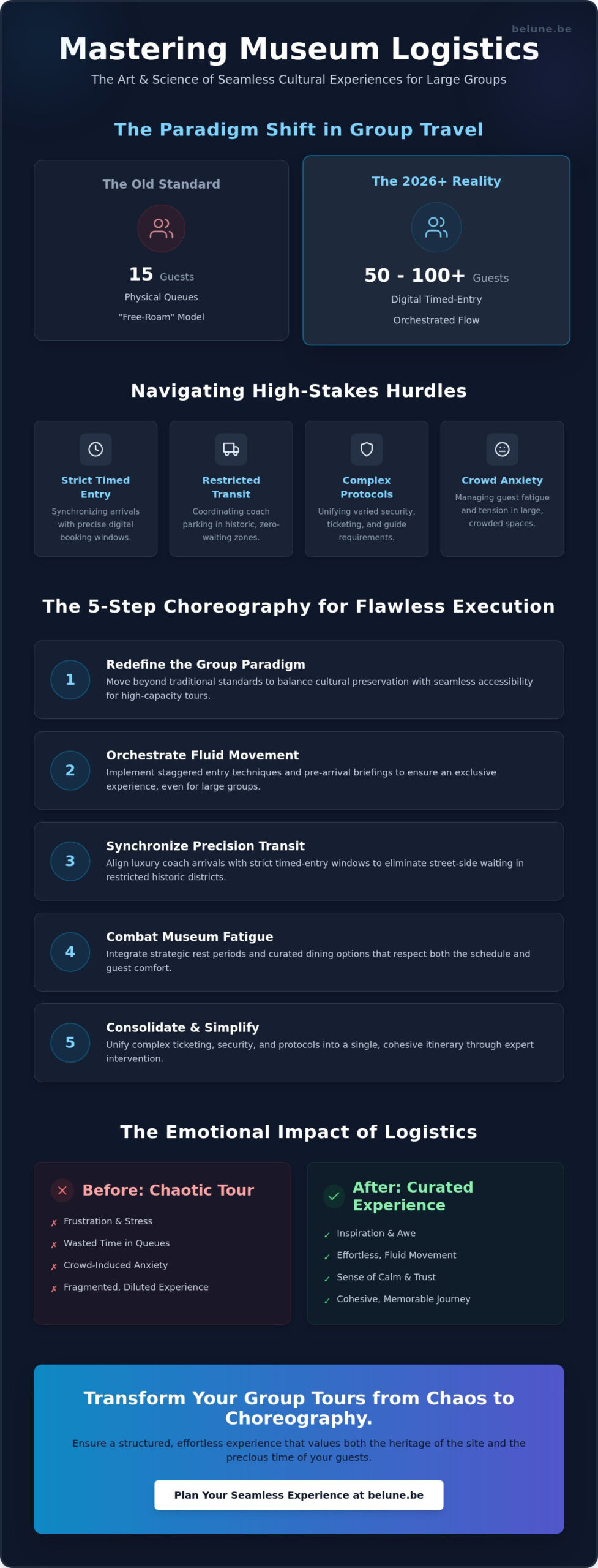
    • The Art of Fluid Movement: Implement staggered entry techniques and pre-arrival briefings to ensure an exclusive experience, even for groups exceeding 50 guests.
    • Precision in Transit: Synchronize luxury coach arrivals with strict timed-entry windows to eliminate street-side waiting in restricted historic districts.
    • Combating Museum Fatigue: Integrate strategic rest periods and curated dining options that respect both the schedule and the guest’s physical comfort.
    • Strategic Consolidation: Discover how expert intervention simplifies museum logistics for large groups by unifying complex ticketing and security protocols into a single, cohesive itinerary.

    The Fundamentals of High-Capacity Cultural Logistics

    In 2026, the definition of a “large group” has undergone a significant transformation. While 15 guests once served as the industry benchmark, modern museum logistics for large groups now frequently involve managing parties of 30, 50, or even 100 individuals. This shift requires a technical mastery that balances the delicate preservation of historic spaces with the logistical demand for accessibility. It’s no longer just about purchasing tickets; it’s about the artisanal orchestration of movement within a restricted volume to ensure the art remains the primary focus.

    The traditional “free-roam” model, where guests are left to navigate galleries independently, often collapses under the weight of high-end expectations. For international groups, this lack of structure leads to fragmented experiences, lost time, and a diluted emotional impact. We act as a strategic ally, bridging the gap between rigid museum administrations and the fluid needs of tour operators. By applying professional crowd management principles, we transform a potentially chaotic entry into a serene, curated arrival that honors the venue’s heritage.

    To better understand how cultural institutions view these partnerships, watch this helpful video:

    The Evolution of Museum Entry Systems

    Museums have transitioned from physical queues to sophisticated digital timed-entry systems that demand absolute precision. Understanding the technical nuances between “Travel Trade” portals and “General Public” booking pathways is essential for any professional operator. Trade pathways often offer the stability and advance windows needed for complex itineraries, whereas public systems can be volatile and subject to immediate sell-outs. The modern timed-entry protocol serves as a sophisticated tool to guarantee guest satisfaction by eliminating unpredictable waiting times and ensuring a smooth transition into the cultural space.

    The Emotional Impact of Group Logistics

    Logistics isn’t merely a series of data points; it’s a direct influence on the human psyche. High-end travelers often experience “crowd anxiety” when faced with the scale of major European institutions. A sophisticated arrival sequence reduces this tension, allowing the beauty of the collection to resonate immediately. When a group moves effortlessly from coach to gallery, it builds an immediate sense of trust in the tour operator’s expertise. The role of a specialized partner in managing museum logistics for large groups is to turn administrative hurdles into invisible, elegant infrastructure. Consolidating these variables into a single, cohesive plan is why choosing a fixed-price group package through a specialized agency is the most reliable path to excellence.

    The Choreography of Movement: Managing Capacity and Flow

    Mastering the physical flow of a large group requires a proactive stance. Waiting until you reach the museum steps is too late. The rehearsal begins on the coach. This is where we define the success of museum logistics for large groups. A precise pre-arrival briefing ensures guests understand the sequence of security, cloakroom access, and the transition into the galleries. When guests know exactly where to go and what to expect, the collective anxiety of the group dissolves, replaced by a sense of calm anticipation.

    To maintain an atmosphere of quiet reverence, we employ whispering systems. These digital headsets allow guides to speak at a conversational volume while guests explore freely within a specific radius. This technical approach aligns with a broader introduction to museum logistics, where the primary goal is to minimize the group’s footprint on the cultural environment. It’s about being present without being intrusive. We focus on four critical pillars of movement:

    • Pre-arrival briefings: Clarifying the entry sequence before the group leaves the coach.
    • Staggered entry: Splitting 50+ guests into smaller cohorts to avoid overwhelming security checkpoints.
    • Whispering systems: Ensuring high-fidelity guiding that doesn’t disrupt other visitors.
    • Bottleneck management: Proactive handling of cloakrooms and gift shops to maintain a steady pace.

    Bottlenecks are the enemies of elegance. Security and cloakrooms often represent the most significant friction points in any itinerary. We manage these by timing the arrival of smaller cohorts. If you have 60 guests, splitting them into three groups of 20 with 10-minute intervals prevents the “huddle” effect. While one group clears security, the next receives a curated introduction to the museum’s architecture or history outside the main gates.

    Advanced Timing Strategies for 2026

    We calculate “dwell time”—the period spent engaging with masterpieces—against “transit time” between halls. In 2026, we’ve refined the “First-In, Last-Out” method for group rotations across multi-museum regional tours. This ensures that while Group A is finishing at one site, Group B is just beginning at the next, avoiding overlap in narrow corridors or popular galleries. If you’re looking for a partner to orchestrate these complex movements, our team can streamline your regional itinerary with technical precision.

    Local Guides: The Human Element of Logistics

    The technical plan only succeeds with a skilled human interface. Utilizing professional local guide services benelux is essential for navigating the internal, often unwritten, protocols of European institutions. These guides act as logistical liaisons. They know which elevator is faster and which gallery entrance is less congested on a Tuesday morning. We brief our guides on the specific pace and interests of your guests, ensuring the narrative remains fluid and the group never feels rushed or stagnant.

    Mastering Museum Logistics for Large Groups: A Professional Guide for 2026

    Integrating Luxury Transport with Museum Arrivals

    The arrival at a cultural monument is the first physical movement of a curated performance. For travel professionals, the transition from the vehicle to the gallery represents one of the most complex phases of museum logistics for large groups. Historic districts in cities like Amsterdam, Brussels, or Bruges present a unique “Drop-off/Pick-up” dilemma. Restricted access zones and narrow cobblestone streets mean that a coach cannot simply idle at the entrance. It requires a synchronized ballet where the driver, guide, and museum security act in total unison to ensure guests never spend a single minute waiting on a sidewalk.

    Precision is the only currency that matters here. We synchronize coach arrival with the exact start of a timed-entry window. This prevents the “street-side huddle,” an experience that immediately diminishes the prestige of a high-end tour. During the visit, driver management becomes a silent but vital component. A professional driver doesn’t just park; they manage their hours and hospitality protocols to ensure the coach remains a pristine, climate-controlled sanctuary the moment the group emerges from the museum’s exit. This level of coordination is especially critical for regional tours where guests visit multiple sites in a single day.

    The Technical Side of Coach Hire

    In 2026, access is increasingly tied to the environmental footprint of the transport provider. Having an own fleet of modern coaches is a logistical game-changer. It allows for absolute control over the vehicle’s technical specifications, ensuring every bus meets the latest Low-Emission Zone (LEZ) standards required to enter the heart of European cultural hubs. Real-time communication between the driver and the tour leader allows for instant adjustments. If a group finishes a gallery tour five minutes early, the coach is already moving toward the designated pick-up point before the guests even reach the gift shop.

    Arrival Etiquette and Professionalism

    Professionalism extends to the “deboarding” process. We train our teams to manage this transition with minimal public disruption, treating the sidewalk as an extension of the museum’s lobby. The driver’s role in the logistical chain is to facilitate an effortless exit and reentry. By maintaining the coach as a mobile sanctuary, equipped with the necessary comforts and a calm atmosphere, we ensure the emotional energy of the museum visit isn’t lost during the transit to the next destination. It’s about preserving the continuity of the experience from one masterpiece to the next.

    Addressing the Challenges of Group Dining and Rest Periods

    The transition from a gallery’s silent reverence to a dining room’s social energy is a critical pivot in any itinerary. We recognize that “Museum Fatigue” isn’t just a fatigue of the body; it’s a saturation of the senses. Planning strategic breaks is a core component of effective museum logistics for large groups. It’s the difference between a guest feeling inspired and a guest feeling overwhelmed. Moving 50 or more people from a masterpiece to a table in under 15 minutes requires a technical choreography that starts long before the appetizer is served.

    Choosing between in-museum catering and an external restaurant depends on the narrative of the day. While in-museum dining offers convenience, an external venue provides a change of atmosphere that resets the group’s focus. We manage dietary requirements at scale by coordinating with chefs weeks in advance. This ensures that even the most complex needs don’t delay the group’s flow. Our goal is to make the meal a continuation of the day’s elegance rather than a logistical hurdle.

    The Gastronomic Transition

    We believe a cultural journey should be mirrored by a culinary one. Integrating belgium gastronomy tours into a museum day transforms a simple lunch into a sensory extension of the art. We source restaurants that reflect a minimalist elegance, avoiding the noise of typical group venues. By utilizing pre-ordered menus, we ensure the group is seated and served with a precision that respects the afternoon’s schedule. If you want to elevate your group’s dining experience, you can book a curated culinary sequence with our specialists.

    Rest and Reflection: The Hidden Logistics

    Structured days must breathe. We identify “quiet zones” within or near museums for senior travelers who may need a moment of stillness. Managing “early leavers”, those who wish to return to the hotel before the main group, is a logistical necessity that we handle without disrupting the collective experience. It’s about providing a mobile sanctuary for every guest, regardless of their pace. This flexible approach ensures that high-capacity logistics remain invisible, leaving only the memory of an exceptional day.

    Why a Specialized DMC is Essential for High-End Group Itineraries

    Twenty years of immersion in the Benelux landscape has taught us that excellence isn’t found in a brochure; it’s forged in the quiet resolution of complexity. For the international tour operator, the challenge of museum logistics for large groups often lies in the invisible friction of administrative fragmentation. Coordinating separate contracts for transport, guiding, and entry for a party of 50 is a high-stakes endeavor where a single delay ripples through the entire itinerary. We act as a strategic ally, consolidating these disparate elements into a single, cohesive fixed-price group package that provides both financial clarity and operational certainty.

    Real-world expertise is most visible when the unexpected occurs. On-the-ground crisis management is a pillar of our service. Whether it’s a sudden museum closure due to a private event or a last-minute change in security protocols, our local presence allows us to pivot instantly. We don’t just solve problems; we anticipate them. This proactive stance enables us to customize itineraries to include niche cultural heritage, those hidden gems and private collections often missed by generic operators, ensuring your guests experience the authentic soul of Western Europe.

    The BELUNE Difference: Technical Excellence

    Our methodology treats every component of the journey as a structural element of the final experience. This includes a sophisticated approach to hotel accommodation management, where we prioritize properties in immediate proximity to cultural hubs to minimize transit fatigue. There’s a vital synergy between our private coach fleet, our accredited guides, and our direct relationships with museum administrators. A single point of contact for every complex logistical variable offers the profound peace of mind needed to focus entirely on your guests’ emotional engagement with the art.

    Building Lasting Partnerships with Tour Operators

    We don’t view ourselves as a mere supplier. We act as your local office in Western Europe, a visionary partner dedicated to the realization of exceptional projects. This transition from “provider” to “strategic ally” means we’re as invested in the project’s success as you are. Our team is currently designing bespoke programs for the upcoming season, blending technical precision with artistic flair. If you’re ready to redefine what’s possible for your clients, we invite you to request a custom itinerary for 2026 and discover the power of professional museum logistics for large groups handled with artisanal care.

    Orchestrating the Future of Cultural Touring

    The successful execution of high-capacity visits depends on the silent harmony between movement, transport, and timing. We’ve seen how technical precision in arrival sequences and the human touch of specialized guiding transform a daunting itinerary into a fluid, emotional journey. Mastering museum logistics for large groups in 2026 requires a shift from reactive management to a proactive, artistic mastery of cultural spaces. It’s about ensuring the logistics remain invisible so the art can take center stage.

    Our team brings over 20 years of DMC expertise to the table, supported by a private fleet of modern luxury coaches specifically maintained for the restricted zones of the Benelux region and Paris. This deep specialization allows us to turn logistical friction into a seamless, high-end experience for your most discerning guests. We invite you to partner with BELUNE for your 2026 group museum logistics and experience the difference of a truly integrated approach. Let’s work together to ensure that while the world watches the art, your operations remain a masterpiece of invisible excellence. Your vision deserves a partner who values precision as much as you do.

    Frequently Asked Questions

    How do we manage group entry if the museum has strict timed-entry slots?

    We manage strict windows by dividing large groups into smaller cohorts and staggering their arrival. For a party of 60, we typically secure three consecutive slots of 20 guests at 10 or 15 minute intervals. This technical approach prevents a bottleneck at security and ensures a fluid transition from the coach to the gallery without the group ever feeling rushed or stagnant.

    What is the ideal group size for a guided museum tour in 2026?

    The ideal ratio for a high-end experience is 15 to 20 guests per local guide. While we frequently handle museum logistics for large groups exceeding 50 people, we always fragment them into smaller, manageable units. This preservation of scale ensures that the acoustic quality remains high and the movement through narrow gallery corridors doesn’t disrupt the museum’s serene atmosphere.

    Can coaches park directly at major museums in the Benelux region?

    Direct parking at museum gates is increasingly rare in historic European centers due to Low-Emission Zone regulations. We utilize designated drop-off and pick-up points located at the nearest authorized perimeter. Our drivers coordinate with the tour leader in real time to ensure the coach arrives exactly as the group exits, maintaining a seamless flow between the institution and their mobile sanctuary.

    How does BELUNE handle last-minute museum closures or strikes?

    We provide immediate on-the-ground crisis management through our established local network. If a site closes unexpectedly, our team pivots to a pre-verified alternative of equal cultural prestige. Because we maintain direct relationships with museum administrations, we often receive early warnings of potential disruptions, allowing us to adjust the itinerary’s architecture before the guests even become aware of a conflict.

    Are whispering systems provided for large group tours?

    Yes, digital whispering systems are a foundational component of our logistical infrastructure. These headsets allow guides to speak at a conversational volume, ensuring every guest receives the narrative with high-fidelity clarity. It’s a non-disruptive solution that respects the museum’s environment while allowing guests the freedom to linger at a masterpiece without losing the thread of the story.

    Is it possible to arrange private, after-hours museum visits for large groups?

    Private, after-hours access is one of the most prestigious options we coordinate for our partners. We work with curators to open galleries during “off-peak” hours, providing an exclusive silence that is impossible to find during public opening times. These sessions require significant lead time but offer an unparalleled level of emotional engagement and exclusivity for high-capacity international groups.

    How far in advance should we book museum logistics for a group of 50+?

    We recommend starting the planning process six to nine months before the intended travel date. Many institutions open their 2026 travel trade portals early, and the most desirable timed-entry windows for museum logistics for large groups fill up rapidly. Securing your slots early also guarantees the availability of our private luxury coach fleet and the most experienced local guides.

    Do children and seniors count towards the total group capacity for bookings?

    Every individual counts as a full visitor toward the museum’s total capacity regardless of their age. Museums base their entry limits on strict fire safety and preservation protocols, which means a child or senior occupies a space just as an adult does. We factor these demographics into our planning to ensure the pace of the tour and the proximity of rest areas are perfectly calibrated.