
What if confidence comes not from knowing everything about a destination, but from knowing what matters to the buyer and how the experience can be delivered? Building confidence to sell a new destination can feel daunting: you’re expected to make it compelling, answer detailed questions and avoid promising more than the programme can support.
That pressure is understandable. Buyers don’t need an encyclopedia of facts. They need a clear reason the destination suits their group, backed by practical details they can trust. Build knowledge with a purpose, then connect each proposed experience to the client’s priorities.
This article offers a repeatable framework for doing that. You’ll learn how to focus your research, shape relevant experiences into a group offer, and speak clearly about logistics and expectations. Bringing accommodation management, coach transport, local guidance and activities together helps turn destination knowledge into a coherent programme. BELUNE supports professional travel partners with tailor-made itineraries and on-the-ground logistics, drawing on more than 20 years of tourism experience.
Key Takeaways
- Use a focused research sequence to identify the details that matter to the buyer, rather than collecting facts without a clear purpose.
- Compare destination concepts against the brief using audience fit, experience relevance, logistical coherence and delivery evidence.
- Build confidence to sell a new destination by linking each experience to the buyer’s objectives and explaining how the programme is organised.
- Structure sales conversations around the buyer’s goal, a tailored concept, relevant evidence, logistics and a clear next step.
- A DMC can bring experiences, accommodation, transport and local guidance together in a coherent group programme.
Why selling a new destination requires more than a confident pitch
A polished presentation can create interest, but it can’t resolve a buyer’s unanswered questions. A destination may look compelling in a brochure and still feel like a risky recommendation if you can’t explain who it suits, what the group will experience and how the programme could work in practice. Confidence comes from connecting those elements, not from speaking with extra force.
Destination-selling confidence is the ability to express a destination’s value for a specific audience and support that value with credible delivery details. It brings together knowledge, relevance and practical understanding. This aligns with broader principles of Sales effectiveness, where useful knowledge and relevant messages help make sales conversations more effective.
What makes a new destination difficult to sell?
When a destination is unfamiliar, it’s easy to gather plenty of information and still miss what the buyer needs. A list of attractions, cultural highlights or food experiences doesn’t explain which ones suit the group or how they fit together. The challenge is selection: identify the details that make the destination meaningful to this audience.
Practical questions matter just as much. How will the group move between experiences? Does the proposed sequence make sense? How do accommodation, transport and local guidance fit into the programme? If these parts remain vague, the destination story can feel fragile, even when the experiences are appealing. Buyers need both a reason to choose the destination and a credible picture of how the programme could unfold.
What destination confidence should sound like
Use specific, measured language. Instead of calling an experience “unforgettable” or “perfect for every group,” explain what it involves and why it fits the brief. A cultural visit, culinary workshop or guided experience becomes more persuasive when its connection to the audience is clear. Precision leaves room for imagination without relying on unsupported superlatives.
Be clear about what is defined and what can be shaped around the group. Explain the proposed programme elements, then distinguish them from choices that depend on the buyer’s priorities or itinerary design. This isn’t a lack of confidence. It shows that you understand the difference between a considered proposal and a promise made too early.
Before presenting experiences, ask focused questions: What should the group take away from the trip? Is the priority culture, gastronomy, shared discovery or a particular event? Which practical considerations will shape the programme? Listen to the answers, then frame destination details around them. Building confidence to sell a new destination starts with this discipline: understand the brief, make the value visible and speak only as strongly as the proposed delivery supports.
Build destination knowledge around the buyer’s needs
Research becomes useful when it answers a buyer’s real questions. Rather than collecting disconnected facts, start with the group’s purpose and work towards the experiences and practical details that make the programme credible. This keeps preparation focused and creates a clear line from audience need to destination value.
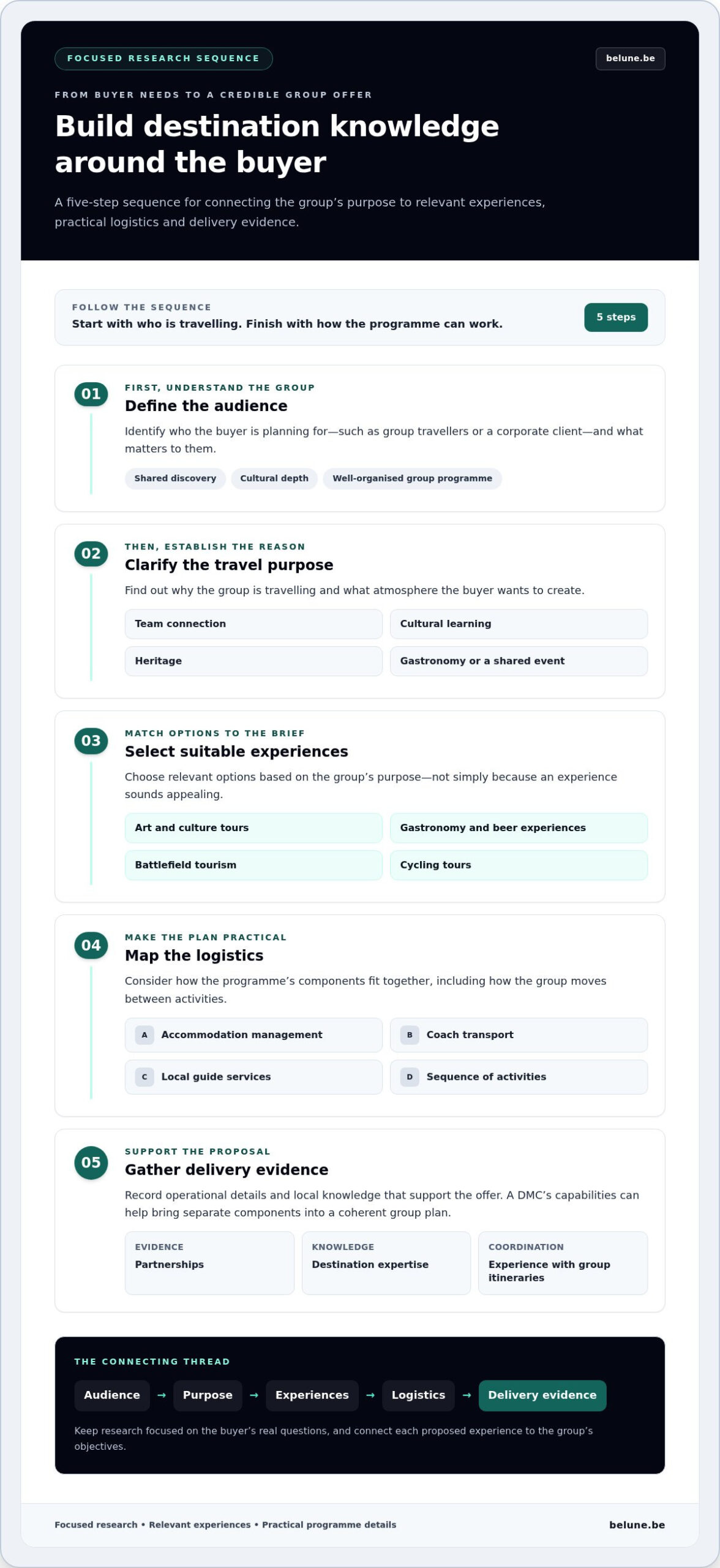
Focused destination research turns local knowledge into value a buyer can recognise, assess and present to their group. Use this sequence to build that connection:
- Define the audience. Identify whether the buyer is planning for group travellers, a corporate client or another audience described in the brief. Note what matters to them, such as shared discovery, cultural depth or a well-organised group programme.
- Clarify the travel purpose. Establish why the group is travelling and what atmosphere the buyer wants to create. Is the priority team connection, cultural learning, heritage, gastronomy or a shared event experience?
- Select suitable experiences. Match the purpose to relevant options. Art and culture tours, gastronomy and beer experiences, battlefield tourism and cycling tours each suggest a different kind of programme. Choose based on the brief, not simply because an experience sounds appealing.
- Map the logistics. Consider how accommodation management, coach transport, local guide services and the sequence of activities fit together. Identify practical questions the buyer will need answered, such as how the group moves between programme elements.
- Gather delivery evidence. Record the operational details and local knowledge that support the proposal. A DMC’s partnerships, destination expertise and experience coordinating group itineraries can help bring separate components into a coherent plan.
Start with the audience and reason for travel
Open questions reveal which details deserve attention. Ask what the group should experience together, what the buyer wants participants to remember and which practical priorities will shape the programme. A corporate group seeking a shared cultural experience may value a different itinerary from a group focused on culinary discovery. Connect each proposed experience to an objective so the recommendation feels considered rather than generic.
Preparation also benefits from practice. PPAI’s advice on boosting sales confidence includes practising sales conversations, which can help make buyer-focused questions and explanations feel natural.
Create a concise destination evidence file
Keep a working record of proposed experiences, accommodation management, transport, local guidance and itinerary logistics. Separate established programme elements from details that can be tailored to the group. This distinction helps you speak precisely while leaving appropriate room for customization. For further context on what buyers may consider, see this group travel agency selection guide.
For tour operators, travel agents, group organizers and corporate clients, building confidence to sell a new destination means knowing not only what it offers, but how its experiences can serve the brief. BELUNE’s tailored group travel planning brings itinerary design and on-the-ground logistics into the same conversation.
Compare destination options through a buyer-focused framework
A comparison is useful when it tests ideas against the buyer’s brief, not when it declares one destination universally “best.” Assess each concept against the same criteria, then identify where it fits strongly and where it may need adjustment. This makes the reasoning visible and helps the buyer compare cultural, culinary or heritage-led concepts on practical value, not promotional language alone.
Use a simple framework to make the trade-offs clear:
| Criterion | What to assess | Buyer-focused question |
|---|---|---|
| Audience fit | Connection between the group’s interests and the concept’s central theme | Does this reflect what the group wants from the trip? |
| Experience relevance | How well activities support the stated purpose | Will each experience add something meaningful? |
| Logistical coherence | How accommodation, transport, guidance and activities work together | Can the programme be presented as a clear, joined-up plan? |
| Delivery evidence | Relevant local knowledge, partnerships and operational support | What grounds the proposal in credible delivery? |
Assess fit, experience, and practical coherence
Apply the same questions to every concept. A gastronomy-led programme may suit a group seeking shared culinary discovery, while art and culture tours may better serve a brief centred on creative or heritage experiences. Then consider how the activities connect with coach transport, accommodation management and local guide services. A distinctive element strengthens a proposal when it follows from the buyer’s priorities and fits the wider programme.
For example, gastronomy tours illustrate how a clear theme can become a group-travel proposition. The selling point isn’t a long inventory of food-related attractions. It’s the opportunity to shape a coherent experience around gastronomy, selecting programme components to serve the group’s interests.
Choose the strongest proposition, not the longest itinerary
More activities don’t automatically make a concept more valuable. A focused cultural, culinary or battlefield-tourism theme can be easier to explain than a crowded itinerary that competes for attention. Identify the central idea first, then select supporting experiences that reinforce it. Tailoring can reflect the buyer’s requirements, while a clear comparison shows whether the concept’s appeal comes with additional logistical complexity or a narrower audience fit.
Keep the framework qualitative unless you have a sound basis for scoring. It’s a tool for discussing alignment, not ranking destinations through unsupported claims. Building confidence to sell a new destination becomes easier when every recommendation has a visible rationale: who it serves, what makes the experience relevant and how the plan holds together.
Turn destination knowledge into a credible sales conversation
A strong conversation doesn’t begin with a destination overview. It begins with the buyer’s objective, then builds a tailored idea around it. Keep the discussion focused and move through five steps:
- Buyer objective: Restate what the group or corporate client wants from the trip.
- Tailored concept: Introduce the experience theme that best answers that objective.
- Supporting evidence: Explain why the proposed experiences suit the audience, using relevant local knowledge and programme capabilities.
- Logistics: Show how accommodation, transport, local guidance and activities connect in the itinerary.
- Next step: Agree what to develop or refine together based on the buyer’s response.
A destination proposal earns trust when its story is matched by clear, credible details about how the experience can be delivered. Confidence grows from that alignment, not from claiming every detail is settled or every outcome assured.
Present the destination as a tailored experience
Use the buyer’s stated purpose as the opening line. For a group interested in cultural discovery, explain how art and culture experiences could shape the programme. For a client drawn to culinary experiences, connect gastronomy to the group’s interests. Then describe how accommodation management, coach transport, local guidance and itinerary logistics support the idea. BELUNE creates tailor-made itineraries to meet client needs, bringing the experience and its practical structure into one proposal.
Keep the language concise and specific. Rather than listing everything a destination could offer, explain why the selected experiences belong together. A well-shaped proposal lets the buyer picture the group’s experience while understanding the planning behind it. Specialist travel designers like Luxe Adventures adopt a similar philosophy by focusing on curated, personally vetted experiences rather than generic itineraries.
Respond to skepticism with evidence and clarity
A skeptical question is useful information. Listen for whether the buyer is concerned about audience fit, the distinctiveness of an experience or how the programme will work on the ground. Answer directly with relevant capabilities, such as local guide services, accommodation management, coach hire with BELUNE’s own fleet or local partnerships. Avoid broad promises and unsupported figures. The incoming tour operator guide offers further context on destination-management support and joined-up delivery.
If an itinerary element can be tailored, say so plainly and explain how the buyer’s preferences can shape it. If the proposal is designed around a particular theme, show how that theme guides the experience choices. This balance of clarity and flexibility is central to building confidence to sell a new destination: it reassures without overstating.
BELUNE brings more than 20 years of tourism experience to tailor-made itineraries and on-the-ground logistics for professional travel partners. Learn about BELUNE’s tailored group itineraries to see how destination knowledge and practical planning can come together in a proposal.
Make a new destination easier to sell with BELUNE
A destination proposal becomes easier to present when its promise is supported by a practical plan. As a destination management company, BELUNE works with tour operators, travel agents, group organizers and corporate clients to shape tailored itineraries, coordinate on-the-ground logistics and bring group experiences together. The aim is a programme that works as both a story for the buyer and a plan for delivery.
How integrated support strengthens partner confidence
Itinerary planning works best when it starts with the buyer’s brief. The group’s purpose and priorities guide the choice of experiences, while transport, accommodation management and local guidance are considered as connected parts of the programme. BELUNE’s own fleet of modern, comfortable coaches, hotel accommodation management and local guide services support this joined-up approach.
Local partnerships and destination knowledge help bring character to the experience. Depending on the group’s interests, a programme may draw on art and culture tours, gastronomy and beer experiences, battlefield tourism or cycling tours. BELUNE also offers access to behind-the-scenes visits and local culinary workshops. These experiences can give a programme a distinctive focus, shaped around the buyer’s brief rather than added as disconnected highlights.
That coordination matters to the partner presenting the destination. If the group’s central interest is culture, for instance, the itinerary can be developed around relevant experiences, with accommodation, coach transport and local guidance considered as part of the same proposal. BELUNE brings more than 20 years of tourism experience to this work, with a no-nonsense approach and fair pricing. A clear rationale and practical structure make inflated language unnecessary.
Move from a destination idea to a tailored proposal
To develop an idea into a proposal, outline the intended audience, the reason for travel and the priorities that should shape the programme. That context gives BELUNE a foundation for tailoring the itinerary, selecting relevant group experiences and considering how the operational elements fit together. The result is a programme shaped in collaboration with the travel professional, rather than an off-the-shelf promise.
For buyers, this support makes a destination easier to explain with confidence: the experience has a clear purpose, and its delivery has been considered. For partners, building confidence to sell a new destination means having both a compelling concept and a grounded account of how its elements work together. BELUNE’s local partnerships, destination knowledge and operational experience help connect those two sides.
Share your audience, travel purpose and programme priorities with BELUNE, and we can shape the next steps together. Let’s create something extraordinary together.
Give your next destination idea a clear direction
A new destination can become more than another option in a catalogue. It can give a group a distinctive reason to travel, shaped around what its members want to experience and what the organiser wants the programme to achieve. That possibility starts with a well-considered brief and a partner who can help turn the idea into a grounded proposal.
Building confidence to sell a new destination doesn’t mean having every answer before the conversation begins. It means asking the right questions, making the value clear and building a programme that supports the story you’re presenting. Each proposal is an opportunity to create a stronger connection between the destination and the people it’s designed for.
Bring your next group-travel concept into focus with BELUNE. Shape your next tailored programme with BELUNE, and take the first step towards an experience your clients can present with confidence.
Frequently Asked Questions
How do you build confidence when selling a destination you have never visited?
Build confidence through reliable information and a clear understanding of how the proposed programme fits together, rather than implying you’ve visited personally. Keep a concise evidence file that distinguishes established details from elements still being shaped. Note the group’s priorities alongside the proposed experiences and the operational arrangements that support them. This gives you a sound basis for answering questions honestly and identifying which parts of the proposal need more detail.
What should a travel agent know before selling a new destination?
Know what the client wants the trip to achieve and which experiences suit that purpose. Understand how the proposed activities relate to the programme’s practical structure, including accommodation management, transport and local guidance. Prepare a short explanation of why the concept fits, along with the questions that need discussion. A buyer-ready brief is more useful than memorising a long list of attractions or destination facts.
How can you sell a destination without sounding pushy?
Make the conversation collaborative: ask what matters to the buyer, then explain how the proposed experience responds. Give the buyer room to weigh options instead of presenting every feature as essential. For instance, outline the central theme and explain which programme elements support it, then invite feedback on priorities. Clear, measured language helps buyers make an informed decision. Avoid inflated adjectives or urgency that the proposal doesn’t support.
How do you answer a buyer who doubts an unfamiliar destination?
First, identify the source of the doubt. Is the buyer unsure whether the concept suits the group, or concerned about how it would work in practice? Address that specific point with relevant details, such as the proposed experience or the role of local guidance and transport. If part of the programme can be tailored, explain how the buyer’s priorities can shape it. A focused answer is more reassuring than a general claim.
Can a destination be sold confidently without personal first-hand experience?
Yes. Personal visits can add perspective, but they aren’t the only basis for a credible proposal. Be clear about the basis of your knowledge, use dependable programme information and avoid presenting assumptions as personal observations. Building confidence to sell a new destination also means understanding the support behind the offer, including local knowledge and practical arrangements. This lets you discuss the experience accurately while being transparent about what you know firsthand.
How can a DMC help travel professionals sell a new destination?
A destination management company can help translate a travel professional’s brief into a tailored group programme and coordinate its practical components. BELUNE brings together itinerary planning, on-the-ground logistics, accommodation management, coach transport and local guide services. Local partnerships and access to experiences such as behind-the-scenes visits and local culinary workshops can add distinctive character. This joined-up support gives the travel professional a clearer way to explain both the experience and its organisation.