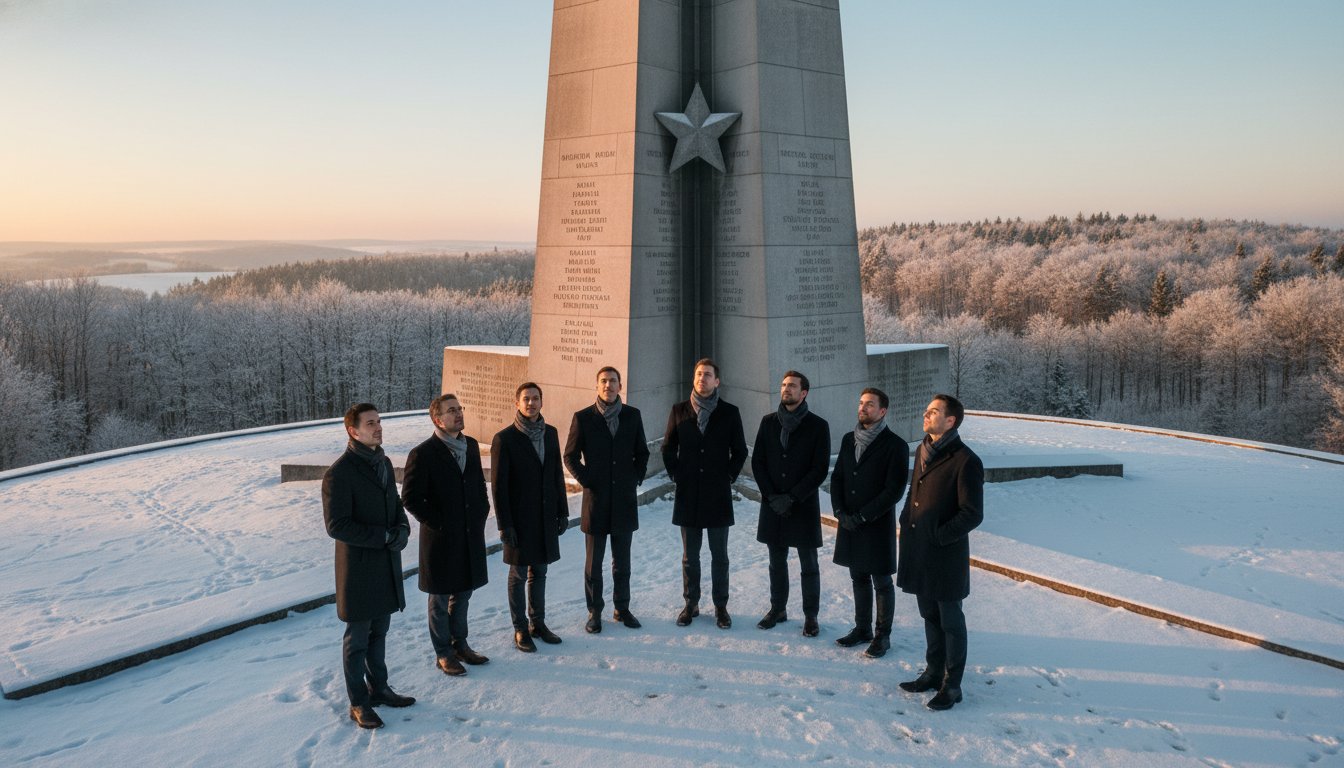
Tag: Military History

  • The Definitive Guide to Battle of the Bulge Group Tours in 2026

    The Definitive Guide to Battle of the Bulge Group Tours in 2026

    The success of a historical pilgrimage isn’t measured by the depth of the archives alone, but by the precision of the logistics that bring those stories to life. When planning battle of the bulge group tours for 2026, the challenge lies in transforming a complex military history into a fluid, immersive experience. It’s about more than just dates and locations; it’s about the rhythm of the journey itself.

    We know that coordinating transport through the rugged Ardennes, especially during the peak commemorative winter season, presents a unique set of hurdles. Finding group-friendly hotels and managing coaches across remote sites like Bastogne or Malmedy can feel as daunting as the terrain itself. You want a journey that respects the gravity of the past without sacrificing the comfort of the present. This guide reveals how to orchestrate a seamless, historically profound journey using expert DMC insights and curated itineraries. We’ll explore the essential components of a high-quality tour, from securing reliable coach fleets to partnering with local guides who turn cold facts into resonant human stories.

    Key Takeaways

    • Discover how a strategic DMC partnership ensures battle of the bulge group tours remain seamless, even when navigating the complex terrain of the Ardennes.
    • Identify the critical logistical hubs and historical sites, from Bastogne to the northern shoulder, that form the foundation of a profound itinerary.
    • Learn to mitigate operational risks by choosing partners who manage their own coach fleets and hotel relationships directly.
    • Master the art of balancing historical depth with group comfort through a structured two-step planning process.
    • Explore how 20 years of local expertise transforms a standard battlefield visit into a sophisticated cultural and historical pilgrimage.

    What is a Battle of the Bulge Group Tour?

    The Battle of the Bulge stands as one of the most significant and harrowing chapters of World War II. It’s a story of endurance, tactical surprise, and ultimate resilience. Organizing battle of the bulge group tours in 2026 requires more than just a map and a timeline. It demands a sophisticated understanding of how large numbers of visitors move through a landscape that was once a frozen, impenetrable battlefield. Today, these tours range from intimate gatherings of descendants to expansive educational delegations, each seeking a connection to the past. The challenge for modern organizers is balancing this historical gravity with the high expectations of 21st-century travelers.

    To better understand the atmosphere and scale of these historic sites, watch this helpful video:

    The Significance of the Ardennes Offensive

    The Battle of the Bulge was a pivotal German counter-attack that began on December 16, 1944, aiming to split the Allied forces. The geography of the Ardennes, with its narrow winding roads and dense forests, remains as challenging for modern coaches as it was for armored divisions decades ago. For groups traveling in 2026, the focus has shifted toward deep cultural immersion. As the generation that lived through the conflict passes, the need for high-quality, immersive storytelling becomes paramount. It’s no longer just about seeing a monument. It’s about understanding the strategic weight of the terrain and the human cost of the conflict. The 2026 season represents a critical window for remembrance, blending the solemnity of the anniversary with the rigorous logistical requirements of international group travel.

    Why Groups Choose Professional DMC Management

    Moving a group through the Ardennes isn’t a simple task. The region’s natural beauty is matched by its logistical complexity. Professional management transforms a series of disconnected stops into a cohesive, artistic narrative. It’s the difference between a guide who simply recites facts and a strategic partner who orchestrates a complete experience. When a tour operator manages their own fleet of modern coaches, they control the reliability of every mile. They ensure that the transition from a boutique hotel in Bastogne to a remote foxhole in the Bois Jacques is effortless. Reliability is the silent foundation of a successful pilgrimage. Our 20 years of destination management expertise allow us to mitigate risks like sudden winter road closures or hotel overbookings. This ensures that the group’s focus remains entirely on the historical journey. Battle of the bulge group tours thrive when the technical details are handled with the same precision and passion as the historical research itself.

    Key Sites and Logistical Frameworks for 2026 Tours

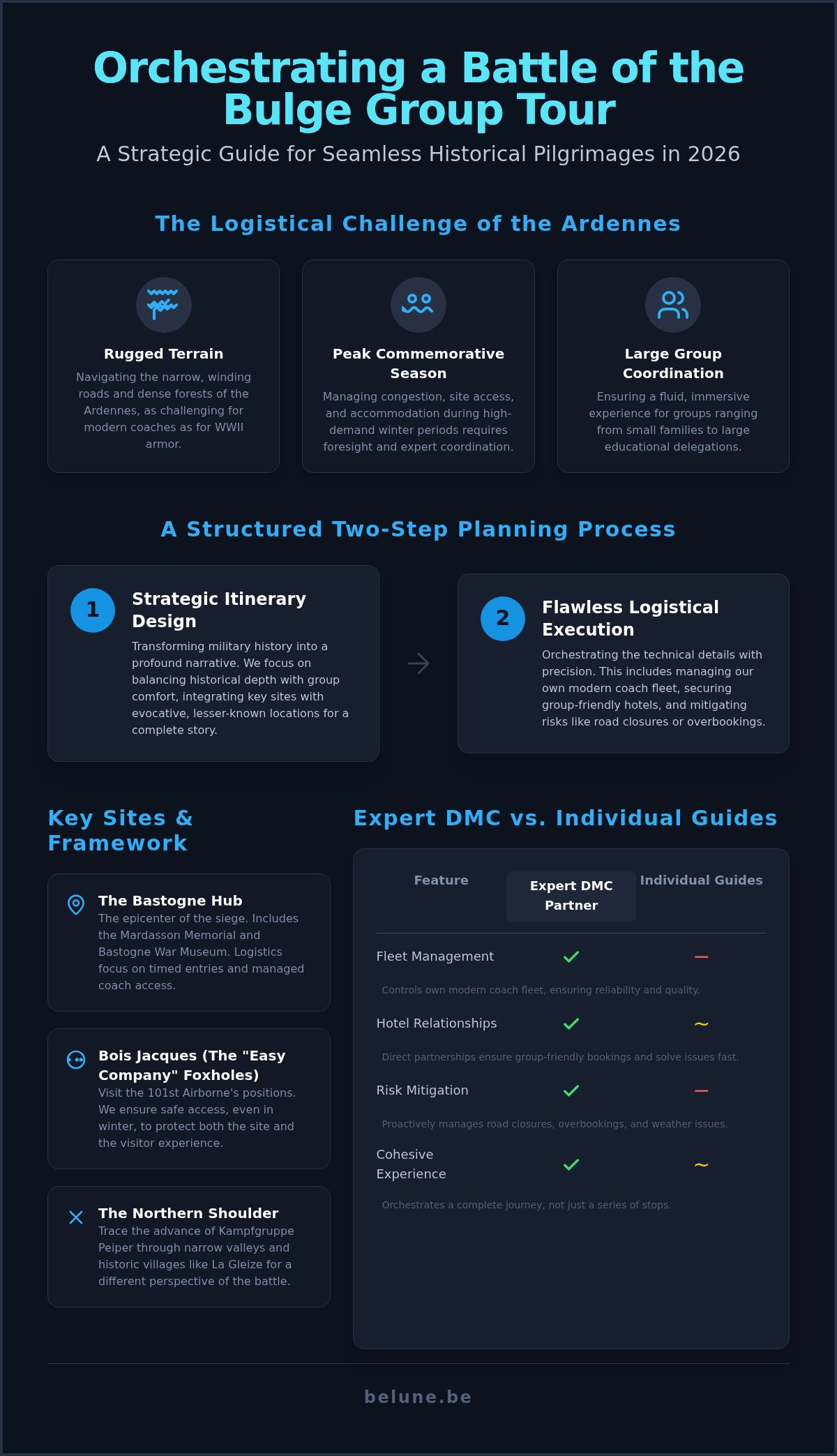
    Designing battle of the bulge group tours is an exercise in spatial choreography. The Ardennes landscape, while breathtaking, demands a rigorous framework to ensure safety and historical clarity. Success hinges on selecting strategic hubs that allow for efficient movement between high-traffic monuments and the quiet, evocative foxholes hidden in the woods. According to the U.S. Army official history, the battle spanned a massive front, making it impossible to see everything without a disciplined itinerary. We focus on a structure that integrates indoor museum context with the raw, outdoor reality of the terrain.

    The Bastogne Hub: Epicentre of the Siege

    The town of Bastogne serves as the natural anchor for most pilgrimages. The Mardasson Memorial and the Bastogne War Museum offer essential context, but their popularity creates logistical pressure. Managing coach access requires foresight. We prioritize timed entries and dedicated parking strategies to avoid the congestion that often plagues peak commemorative seasons. In the nearby Bois Jacques, the challenge is accessibility. We ensure groups can visit the 101st Airborne’s foxholes safely, even in the unpredictable snows of December. It’s about protecting the site while providing a profound experience for every visitor.

    The Northern Shoulder and Peiper’s Route

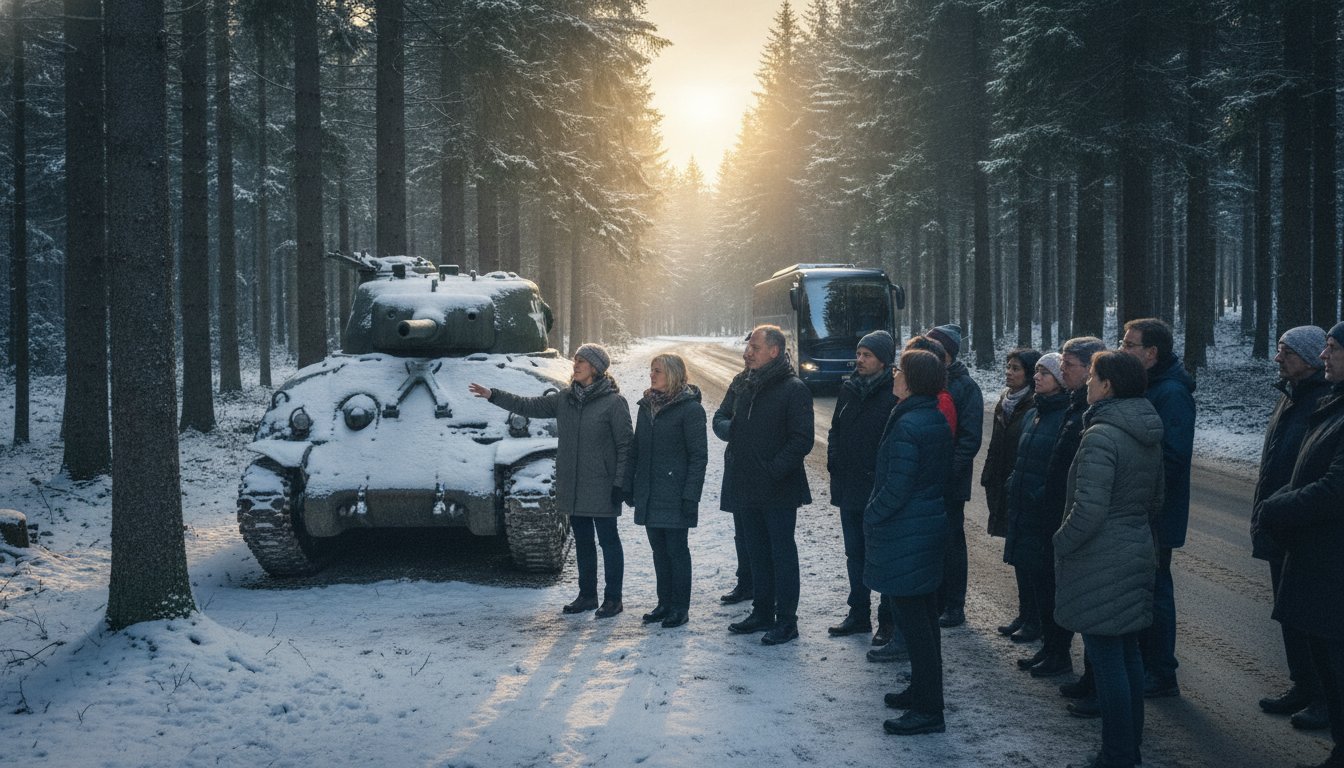
    Tracing the path of Kampfgruppe Peiper offers a different perspective, leading groups through narrow valleys and grey stone villages like La Gleize. Here, the technical demands of battle of the bulge group tours become apparent. Winding roads aren’t built for standard tourism. Our drivers utilize a modern fleet specifically chosen for these technical routes. Seeing the King Tiger tank at La Gleize or the memorial at Malmedy requires a driver who understands the terrain’s limits. We ensure the journey through these tight valleys is as smooth as the narrative provided by the guides.

    Winter in the Ardennes is beautiful but unforgiving. Managing group safety means having real-time weather monitoring and flexible dining arrangements that can accommodate large numbers in small villages. It’s about creating a seamless experience where the history remains the focus. If you’re looking for a partner to handle these sophisticated group logistics, local expertise is your greatest asset. We bridge the gap between the rugged reality of the battlefield and the refined comfort your clients expect. Our approach ensures that every logistical detail serves the greater purpose of remembrance.
    The Definitive Guide to Battle of the Bulge Group Tours in 2026

    DMC Expertise vs. Individual Guides: A Strategic Comparison

    An individual guide is a storyteller; a Destination Management Company is an architect. While a solo expert can recount the harrowing details found in archives like the National WWII Museum, they often lack the structural support required for battle of the bulge group tours. Logistics in the Ardennes are unforgiving. When a coach fails on a snowy ridge or a hotel overbooks during a peak anniversary weekend, a solo guide has limited recourse. A strategic DMC partner provides a safety net of operational redundancy. We don’t just provide information; we manage risk.

    Scalability is a core requirement for professional tour operators. Handling multiple delegations simultaneously during the winter commemorative season requires a level of coordination that transcends historical expertise. We offer B2B partners the security of a fixed-price package. This transparency is vital for budgeting, ensuring that your margins remain protected regardless of local fluctuations. It’s about moving from a simple sightseeing trip to a managed professional project.

    The Advantage of an Owned Coach Fleet

    Reliability isn’t accidental. By maintaining our own fleet of modern coaches, we eliminate the variables of third-party rentals. Our drivers aren’t just navigating roads. They’re specialists in battlefield geography and group etiquette. They understand the silence required at a cemetery and the technical precision needed for narrow village lanes. Modern amenities like climate control and high-quality audio systems aren’t luxuries. They’re essential tools for maintaining group comfort during long days of field exploration. We control the maintenance, the scheduling, and the execution.

    Accommodation Management and Local Partnerships

    Securing group-friendly hotels in the Ardennes is an art form we’ve refined over 20 years. These aren’t just rooms; they’re hubs where international visitors can reflect on the day’s discoveries. We manage the delicate balance of gastronomy and dietary requirements, ensuring that local flavors meet international standards. Our deep-rooted local relationships allow us to leverage exclusive site access that individual guides simply can’t provide. This level of integration transforms a standard itinerary into a seamless, high-end pilgrimage. We bridge the gap between technical rigor and the human experience of history.

    Planning an exceptional itinerary is an act of curation. For 2026, the inherent complexity of battle of the bulge group tours demands a four-step methodology that prioritizes both narrative depth and operational fluidity. We believe a successful journey begins long before the first coach arrives in the Ardennes. It starts with a clear vision and a disciplined logistical spine.

    • Step 1: Define the Narrative Focus. Whether your group seeks the “Easy Company” trail of the 101st Airborne or a broader strategic view of the German perspective, clarity of purpose dictates every subsequent choice.
    • Step 2: Map the Logistical Spine. Identify your arrival and departure gateways (Brussels, Luxembourg, or Paris) and establish central hubs. This minimizes unnecessary travel time and maximizes reflection.
    • Step 3: Secure Accommodation Early. For the 2026 season, group-friendly hotel blocks must be secured at least 12 months in advance. The Ardennes has limited high-capacity lodging, and demand is relentless.
    • Step 4: Layer the Experience. A profound itinerary balances the weight of the battlefield with moments of cultural and culinary lightness.

    Balancing History with Culture and Gastronomy

    History is best understood when paired with the living culture of the region. Integrating Belgium gastronomy tours into a military itinerary isn’t a distraction; it’s essential for group morale. We believe in a sophisticated pace that allows for quiet reflection at a memorial followed by a communal experience at a local abbey or brewery. This rhythm prevents “battlefield fatigue” and ensures the emotional impact of the sites remains sharp. It’s about creating an environment where the technical precision of the tour supports the human experience of the journey.

    Technical Considerations for Tour Operators

    Managing international arrivals requires a partner who understands the nuances of cross-border travel. Whether your group arrives via Brussels or Paris, the transition to the Ardennes must be seamless. This includes coordinating multi-lingual guides who can bridge the gap between diverse backgrounds and local history. Behind the scenes, we manage the rigid compliance of EU coach driving regulations. We ensure that driver hours and vehicle standards never compromise the safety or the flow of the itinerary. If you’re ready to move from concept to execution, we invite you to consult with our planning experts to secure your 2026 dates.

    BELUNE: Your Visionary Partner for Battlefield Excellence

    BELUNE views the battlefield not just as a destination, but as a space to be magnified through expert intervention. Our philosophy centers on transforming the weight of history into a seamless group journey. As a benelux incoming tour operator with over 20 years of legacy, we understand that the technical rigor of logistics is what allows the emotional resonance of the past to shine. We don’t just provide services; we curate the volumes and rhythms of your group’s experience. This is the art of travel, where every movement is intentional and every transition is fluid.

    Success in battle of the bulge group tours requires more than knowledge. It requires control. By managing our own fleet of coaches and maintaining direct hotel partnerships, we remove the friction often found in complex itineraries. This vertical integration makes us the strategic choice for partners who value reliability as much as historical depth. We handle the structure so that you can focus on the story.

    Customization at the Heart of Every Tour

    Every pilgrimage has a unique heartbeat. We specialize in tailoring itineraries to meet the specific needs of our partners, whether they’re managing educational student groups or high-end bespoke military tours. Our team excels at tracing the specific paths of divisions, regiments, or even individual family histories across the Ardennes. BELUNE acts as a strategic ally for tour operators in 2026, providing the technical foundation upon which profound historical narratives are built. We listen to your vision and translate it into a structured, executable reality that respects both the history and the participants.

    A Commitment to Professionalism and Emotion

    The bridge between the past and the present is built by our local guides. They bring an inspiring and professional tone to every site, ensuring that the narrative remains both accurate and evocative. Handling the delicate balance between remembrance and education is an artisanal process. We believe that a well-timed moment of silence at a memorial is as important as a detailed tactical briefing. This sensitivity, combined with our technical mastery, ensures a journey that is both intellectually stimulating and emotionally profound. We invite you to request a custom group tour itinerary and discover how we can elevate your 2026 program. Our expertise is your greatest asset in realizing battle of the bulge group tours of true exception.

    Orchestrating Your Historical Legacy in 2026

    The journey through the Ardennes is more than a visit to a map; it’s an immersion into a landscape of profound memory. Orchestrating successful battle of the bulge group tours requires a delicate harmony between technical precision and emotional depth. We’ve explored how the right logistical framework, from securing hotel blocks early to managing the technical navigation of narrow valley roads, transforms a complex itinerary into a seamless experience. It’s about moving beyond simple sightseeing to create a curated pilgrimage that resonates with every participant.

    With over 20 years of DMC expertise in the Benelux region, we provide the structural security your project demands. Our owned fleet of modern, high-comfort coaches ensures reliability in the most challenging terrain. Beyond the battlefield, our specialization in culture group tours benelux allows us to weave local gastronomy and heritage into the military narrative, maintaining group morale and inspiration. Every detail is handled with an artistic vision that respects the gravity of the past.

    Partner with BELUNE for your 2026 Battle of the Bulge group tour to secure a strategic ally dedicated to excellence. Let’s transform your vision into a profound, flawlessly executed reality.

    Frequently Asked Questions

    What is the best time of year for a Battle of the Bulge group tour?

    December offers the most authentic atmosphere, coinciding with the anniversary events and the “Nuts Weekend” in Bastogne. However, the period from May to September provides milder weather and better visibility for exploring remote foxholes and forest trails. For the 2026 season, we recommend planning December visits at least 12 to 18 months in advance due to the high demand for commemorative ceremonies.

    How long does a comprehensive Battle of the Bulge tour typically take?

    A comprehensive itinerary usually spans 4 to 7 days. This duration allows groups to cover the major hubs like Bastogne and the northern shoulder while leaving space for reflection at cemeteries and visits to specialized museums. Shorter 2 or 3-day programs are possible but often require a narrower focus on specific sectors of the battlefield to avoid logistical fatigue.

    Can we customize a tour to follow a specific relative’s footsteps?

    Customization is a central part of our expertise. We can adapt battle of the bulge group tours to follow the specific path of a particular regiment, division, or individual soldier. By combining archival research with our deep knowledge of the Ardennes terrain, we transform a general historical overview into a deeply personal family pilgrimage.

    What kind of accommodation is available for large groups in the Ardennes?

    Large groups are typically accommodated in strategic hubs like Bastogne, Houffalize, or Clervaux. These locations offer hotels with the capacity to manage groups of 30 to 50 people while maintaining high standards of comfort. Because high-capacity lodging is limited in this rural region, we leverage our long-standing local partnerships to secure blocks of rooms well ahead of the peak season.

    Do we need a specialized guide, or is a general tour leader sufficient?

    We strongly recommend a specialized military historian for these journeys. While a general tour leader manages the daily flow, a specialized guide provides the tactical depth and human context that brings the landscape to life. Our local experts are skilled at bridging the gap between technical military history and the emotional resonance of the sites you visit.

    How do we manage transport for groups larger than 30 people?

    Managing large groups requires the technical precision of a modern, owned coach fleet. For groups exceeding 30 participants, we utilize high-capacity coaches driven by professionals who are specifically trained in navigating the narrow, winding roads of the Ardennes. This ensures that the entire group travels together in a cohesive, comfortable environment, regardless of the terrain’s complexity.

    Are these tours suitable for student or educational groups?

    These tours are exceptionally well-suited for educational delegations. We adapt the narrative to focus on themes of citizenship, peace education, and the strategic realities of the conflict. Our logistical framework ensures a safe, structured environment where students can engage with history in a way that is both intellectually stimulating and profoundly moving.

    What other sites can we combine with a Battle of the Bulge itinerary?

    Many battle of the bulge group tours are enhanced by adding visits to the Waterloo battlefield, the Siegfried Line in Germany, or the National Museum of Military History in Diekirch. For a more varied experience, we often integrate cultural extensions such as local abbey visits or gastronomy and beer tours, which provide a balanced perspective on the region’s resilient heritage.
  • Expert-Led WWI History Tours: The Definitive Guide for Group Travel in 2026

    Expert-Led WWI History Tours: The Definitive Guide for Group Travel in 2026

    What if the most profound way to honor the 110th anniversary of the Somme in 2026 isn’t just to stand at a memorial, but to understand the tactical heartbeat of the ground beneath your feet? For professional organizers, the challenge is rarely finding a destination; it’s securing expert-led ww1 history tours that capture the soul of the story without the friction of logistical failures. You’ve likely felt the frustration of oversimplified narratives or the logistical strain that often plagues large group bookings. We believe a commemorative journey requires more than just a seat on a bus. It demands an intentional blend of academic rigour and refined, technical execution.

    This guide reveals how to curate profound commemorations that balance historian-led depth with the seamless management of transport and accommodation. We’ll explore the essential shift toward exclusive site access and the mastery required to navigate the 2026 landscape. From the ceremonies at Thiepval on July 1 to managing the impact of site closures like Fort Vaux, we provide the blueprint for a sophisticated group experience that respects both the weight of history and your participants’ expectations.

    Key Takeaways

    • Learn how to distinguish between general sightseeing and truly expert-led ww1 history tours that leverage the deep academic insights of dedicated researchers and storytellers.
    • Master the complexities of group logistics by integrating a private coach fleet with specialized hotel accommodation management near key Western Front sites.
    • Discover the art of structuring a commemorative program that balances solemn battlefield visits with local gastronomy and refined cultural experiences.
    • Understand the strategic advantage of partnering with a Benelux-based DMC to navigate local logistics and secure exclusive access to historical landmarks.

    The Evolution of Expert-Led WWI History Tours

    The landscape of remembrance has undergone a profound transformation. We no longer settle for the surface-level anecdotes that once defined battlefield visits. A look into the history of war tourism reveals a shift from simple curiosity toward a deep, intellectual necessity for connection. Today, expert-led ww1 history tours represent a sophisticated bridge between archival data and the physical reality of the Western Front. This evolution reflects a modern audience that prizes technical accuracy as much as emotional resonance.

    To better understand how deep-dive historical analysis enriches the travel experience, watch this session with a leading historian:

    From Sightseeing to Scholarly Pilgrimage

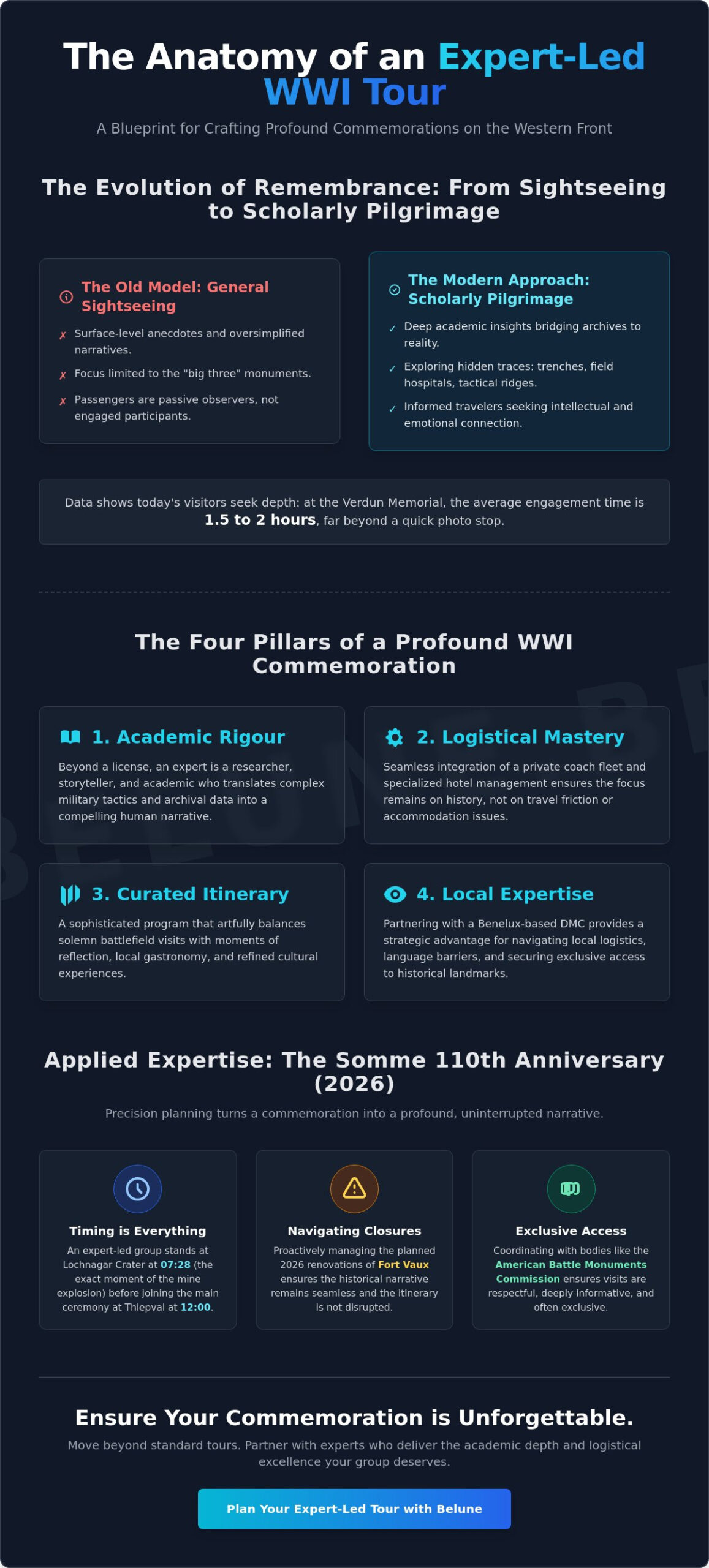
    Digital archives and genealogy platforms have empowered travelers. They don’t just arrive at a cemetery; they arrive with a map, a service record, and a specific coordinate. This informed perspective has pushed expert-led ww1 history tours to move beyond the “big three” monuments. While the Thiepval Memorial remains essential, modern groups seek the hidden traces of the front line. They look for the specific ridge where a diversionary attack failed or the cellar where a field hospital once stood. Data from the Verdun Memorial shows that visitors now spend an average of 1.5 to 2 hours engaging with exhibits, seeking a depth of context that a standard tour simply cannot provide. We focus on this granular detail, turning a journey into a scholarly pilgrimage.

    The Value of Academic Rigour in 2026

    As we approach the 110th anniversary of the Battle of the Somme in 2026, the “centenary effect” continues to elevate expectations. Accuracy isn’t optional; it’s an ethical responsibility. An expert in this field isn’t just a guide with a license. They’re a researcher who can interpret the landscape through the lens of 1916 tactics. For example, on July 1, 2026, while many will gather for the 12:00 ceremony at Thiepval, an expert-led group will have already stood at Lochnagar Crater at precisely 07:28 to mark the mine’s explosion. This level of precision requires navigating complex logistics, such as the scheduled 2026 closure of Fort Vaux for renovations. We manage these technical shifts so the historical narrative remains uninterrupted and the group’s engagement stays focused on the profound human story.

    Defining the Expert: Historians, Researchers, and Storytellers

    The success of expert-led ww1 history tours hinges on a specific type of alchemy. It’s the ability to synthesize cold military data with the warmth of human narrative. Expertise isn’t a monolith; it exists in tiers. A general guide might know the dates, but a specialist researcher understands why a specific battalion was positioned in a certain wood. This distinction is vital for groups seeking a profound connection to the past. We believe that true mastery requires a guide who can navigate both the complexity of a battle map and the delicate emotions of a commemorative service.

    What Makes a WWI Historian-Guide?

    Identifying the right lead means looking beyond a title. Academic credentials provide the foundation, but field experience builds the structure. A true expert translates complex maneuvers into relatable experiences. They don’t just talk about the creeping barrage at the Somme; they explain the sensory overload of the men waiting for the whistle. The Historian-Guide is a dual-role academic and logistical lead who maintains the intellectual integrity of the tour while anticipating the physical needs of the group. This includes coordinating with organizations like the American Battle Monuments Commission to ensure visits to sites like the Meuse-Argonne American Cemetery are both respectful and deeply informative.

    The Importance of Local Language Expertise

    Authentic research often lives in the margins of local archives. In the Benelux region, the most compelling stories are frequently tucked away in French or Dutch municipal records. Local guides bring a layer of nuance that international experts might overlook. They understand the regional folklore and the specific civilian impact of the occupation. This linguistic bridge is a cornerstone of high-quality expert-led ww1 history tours, turning a standard itinerary into a bespoke investigation of the territory. It allows for a richer exploration of the landscape that feels both intimate and authoritative.

    Managing these delicate layers of storytelling requires a partner who understands the rhythm of the Western Front. Our local guide services ensure your group isn’t just seeing the sites, but experiencing them through the eyes of those who have dedicated their lives to preserving these stories.

    Experts also serve as facilitators of emotion. They know when to speak and when to allow for the heavy silence of a cemetery to take hold. This emotional intelligence is what separates a lecture from a pilgrimage. It ensures that every participant leaves with more than just facts. They leave with a transformed perspective on the cost of conflict and the value of remembrance.

    Expert-Led WWI History Tours: The Definitive Guide for Group Travel in 2026

    The Logistics of Remembrance: Navigating the Western Front

    Navigating the Western Front requires more than a map; it demands a technical mastery of geography and group movement. The physical landscape of the Somme and Verdun is often rural and restrictive. Large vehicles face challenges that standard itineraries frequently overlook. We approach these hurdles with a vision that prioritizes the group’s comfort and the historian’s narrative flow. A seamless journey is the canvas upon which the history is painted. Without logistical precision, the most profound academic insights can be lost to the fatigue of travel.

    Modern Coach Hire and Specialized Transport

    Our fleet is not just a means of transport; it’s a mobile lecture theatre. We utilize a private fleet of busses designed to navigate the narrow lanes of the Meuse or the ridges of the Ypres Salient. A battlefield driver is a specialist who understands the specific rhythm of these sites. They know exactly where to drop a group to minimize walking distances while ensuring the coach remains accessible at all times. On-board amenities support the academic depth of expert-led ww1 history tours, allowing for briefings between sites that maximize every minute of the day. This technical coordination ensures that the transition from the coach to the trench remains fluid and respectful.

    Strategic Accommodation Management

    Selecting the right base for a large group is a delicate art. We focus on hotel accommodation management that places guests near the heart of the historical action. Staying in Arras, Ypres, or Verdun reduces transit times, allowing for more contemplative visits and less time on the road. This proximity is essential for avoiding tour fatigue, a common pitfall in over-scheduled programs. We manage these complex logistics through fixed-price group packages that eliminate hidden costs. This provides a reliable structure for our international partners. Understanding WWI battlefield tourism as a cultural phenomenon helps us design itineraries that respect the sanctity of the sites while meeting high modern travel standards.

    Accessibility is a structural component of our planning, not an afterthought. We ensure that groups with varied physical requirements can experience the same depth of insight. This involves pre-vetting paths at sites like Lochnagar Crater and ensuring our coaches are equipped for all participants. By removing logistical friction, we allow the group to focus entirely on the profound history of the Great War. It’s about the technical precision of being in the right place at the right time, especially when managing the 1.5 to 2 hours typically required for a meaningful visit to the Verdun Memorial.

    Designing a Meaningful Itinerary for Group Commemoration

    Creating a truly impactful itinerary is an exercise in narrative architecture. It isn’t enough to simply list destinations; one must compose a journey that breathes. For expert-led ww1 history tours, the structure of a 3-to-5 day program must respect the emotional weight of the subject matter while maintaining a logical, technical flow. We see the itinerary as a structural component of the experience, where every stop serves a specific purpose in the broader story of the Great War. A well-designed path allows for moments of intense academic discovery followed by the necessary space for quiet reflection.

    The Architecture of a Great Battlefield Tour

    Every successful commemoration begins with a clear objective. Is the group tracing the footsteps of a specific regiment, or exploring the evolution of medical care on the front? Defining this “why” early allows for a thematic flow that keeps participants engaged. We often structure these journeys chronologically, starting with the initial movements of 1914 before moving into the static trauma of the trenches. Customization is the hallmark of excellence. We can pivot the focus toward medical history, aviation milestones, or the literary legacy of the war poets. Planning for downtime is equally vital. Groups need room to process the history they’ve just witnessed, ensuring that the experience remains profound rather than overwhelming.

    Beyond the Trenches: Culture and Gastronomy

    A journey through the Western Front is also a journey through modern European identity. To provide a complete perspective, we integrate belgium gastronomy tours into our historical programs. This isn’t a distraction; it’s a sensory bridge. A meal in a historic Flemish square or a local brewery visit provides a moment of communal reflection that military sites alone cannot offer. Our art and culture group tours complement the battlefield visits by highlighting how the war transformed the creative landscape of the 20th century. This holistic approach ensures that participants understand not just how the war was fought, but what was at stake for the civilization that survived it.

    Incorporating specific ceremonies, such as the Last Post at the Menin Gate in Ypres, adds a layer of solemnity that defines the trip. We also facilitate private remembrance moments at smaller, less-frequented cemeteries, providing an exclusive experience away from the crowds of the major memorials. Balancing these heavy moments with the refined pleasures of local hospitality creates a rhythm that sustains the group’s energy and focus. To begin crafting your own bespoke battlefield itinerary, consider how these technical and emotional layers can be woven into a single, seamless narrative.

    Partnering with a Benelux DMC for Unrivalled Battlefield Experiences

    For international travel agents and professional organizers, the Western Front represents more than a historical site. It’s a logistical puzzle requiring absolute precision. Partnering with a local expert transforms this complexity into a strategic advantage. We provide the technical backbone that allows your brand to lead with authority. By consolidating specialized transport, expert guides, and hotel management, we eliminate the friction that often erodes both profit margins and client trust. A local Destination Management Company (DMC) isn’t just a supplier. It’s a visionary partner in the art of remembrance.

    Professional service fees for itinerary planning are an investment in certainty. They save hundreds of hours in coordination and prevent the costly errors associated with poor site timing or restricted vehicle access. We leverage over 20 years of local transport and hotel relationships to secure the most refined assets for your group. This deep-rooted network acts as the ultimate safeguard. It ensures that even when technical shifts occur, such as the 2026 closure of Fort Vaux for renovations, your program remains fluid and impactful. We manage the variables so you can focus on the narrative.

    White-Label Solutions for Tour Operators

    Our role as a benelux incoming tour operator is to act as your invisible ally. We provide white-label solutions that ensure absolute brand consistency across every logistical touchpoint. From the moment your group boards our private coach to the final commemorative dinner, the experience reflects your high standards. Fixed-price certainty is a cornerstone of our B2B partnership. It allows you to market expert-led ww1 history tours with total confidence, knowing that hidden costs won’t emerge in the rural reaches of the Somme or the Meuse.

    The BELUNE Difference: Sophistication and Expertise

    We don’t just supply services; we curate environments. Our approach combines a visionary creative lens with a rigorous technical execution. This balance is critical for expert-led ww1 history tours, where the emotional depth of the history must be supported by flawless logistics. With two decades of experience, we’ve mastered the art of group travel within the Benelux region. We understand the rhythm of the landscape and the expectations of a sophisticated audience. It’s time to elevate your offering through a partnership built on excellence and trust. Request a custom itinerary today and discover how we can transform your next commemorative project into an exceptional journey.

    Mastering the Art of Historical Commemoration

    The journey across the Western Front is a delicate balance of academic depth and logistical precision. We’ve explored how the shift toward scholarly pilgrimages requires a guide who is both a researcher and a storyteller. True expert-led ww1 history tours don’t just happen. They are curated through a deep understanding of the landscape and a commitment to historical accuracy. This technical mastery ensures that the emotional weight of the story remains the group’s primary focus throughout the journey.

    BELUNE provides the structural integrity needed for these profound experiences. With over 20 years of Benelux logistics expertise and a private fleet of modern, high-specification coaches, we ensure every detail is managed with technical rigour. Our specialized DMC services allow tour operators to deliver sophisticated, seamless itineraries that honor the past while meeting the highest modern standards. Partner with BELUNE for your next expert-led group tour to transform your vision into a landmark commemorative event. Let’s create a legacy of remembrance that resonates for generations.

    Frequently Asked Questions

    What is the difference between a battlefield guide and a military historian?

    A military historian provides deep academic context and archival research, while a battlefield guide often focuses on site-specific anecdotes and general navigation. Our expert-led ww1 history tours utilize historians who bridge this gap. They translate complex tactical data into human narratives, ensuring that every location is understood within the broader structural evolution of the conflict. This academic rigour transforms a simple visit into a profound intellectual pilgrimage.

    How large can a group be for an expert-led WWI tour?

    Group sizes typically range from small private delegations of 10 to full coach parties of 50 participants. We manage these variations by scaling our logistical support and guide-to-guest ratios. For larger groups, we often deploy multiple historians to maintain the intimacy and depth of the narrative. This ensures that every individual can engage with the expert and the landscape without the dilution of the experience often found in mass tourism.

    Can WWI history tours be customized for specific regiments or family histories?

    Yes, bespoke itineraries can be designed to trace the specific path of a regiment or a family member’s service record. We utilize archival research to pinpoint exact locations, such as specific trench sectors or field hospital sites. This technical precision allows groups to hold private commemorations at the very spot where their ancestors stood. It’s a deeply personal way to experience history, moving beyond the general narrative to find a unique, structural connection to the past.

    What are the essential sites to include in a first-time WWI group tour?

    A foundational journey should include the Ypres Salient, the Somme battlefields, and the Verdun Memorial. Key landmarks like the Menin Gate, Thiepval Memorial, and the Lochnagar Crater provide the essential framework for understanding the war’s scale. We also recommend including the Verdun Memorial, where visitors typically spend 1.5 to 2 hours exploring the technical and human aspects of the battle. These sites offer a comprehensive introduction to the Western Front’s diverse history.

    How far in advance should we book group accommodation for battlefield sites?

    We recommend booking group accommodation at least 12 to 18 months in advance, especially for anniversary years like 2026. High-quality, group-friendly hotels near key sites like Arras or Ypres are limited and in high demand. Early booking ensures your group stays close to the historical action, reducing transit times and preventing tour fatigue. Our hotel accommodation management services focus on securing these prime locations to safeguard the integrity of your itinerary.

    Are WWI battlefield tours suitable for students and educational groups?

    Battlefield tours are highly effective for educational groups, provided they are led by historians who can adapt the narrative for different learning levels. These journeys turn abstract history into a tangible reality. We structure student programs to focus on the technical evolution of warfare and its lasting impact on European identity. By standing on the actual ground where history was made, students gain a perspective that no textbook can replicate.

    What logistical support is provided for coach transport on rural battlefield roads?

    We provide a private fleet of modern coaches specifically chosen for their ability to navigate the narrow, rural roads of the Western Front. Our battlefield drivers are specialists who understand the unique constraints of these historical areas. They coordinate closely with our historians to ensure seamless drop-offs and pick-ups at every site. This technical mastery of local geography is a core component of our coach hire services, ensuring safety and efficiency.

    How do expert-led tours handle the emotional sensitivity of remembrance sites?

    Our experts are trained to facilitate moments of reflection with the necessary gravity and silence. They understand that a cemetery visit is not just a history lesson; it’s an experience of profound remembrance. We carefully pace our expert-led ww1 history tours to allow for quiet contemplation. By balancing academic insights with the space for personal emotion, we ensure that the sanctity of these sites is always respected and preserved.

  • The Definitive Battle of the Bulge Tour for History Groups in 2026

    The Definitive Battle of the Bulge Tour for History Groups in 2026

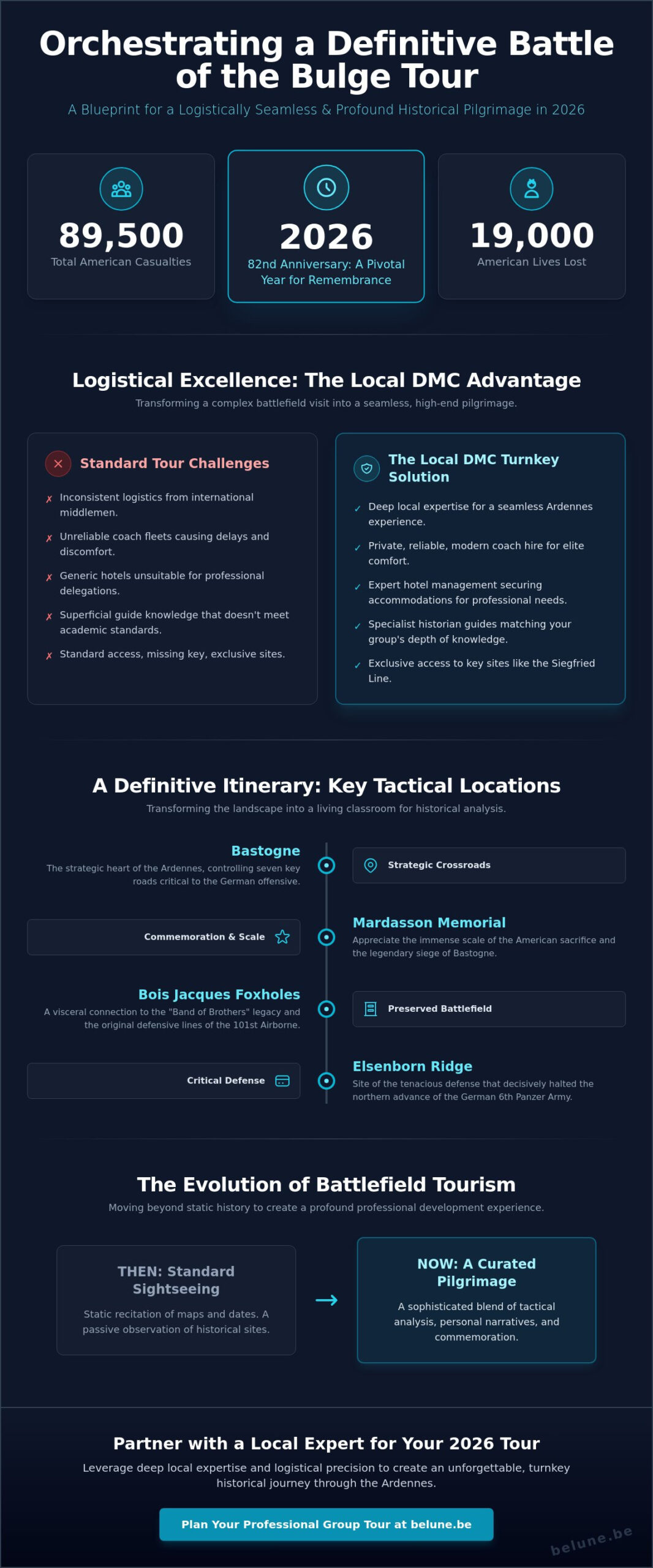
    Can a landscape defined by 89,500 casualties and the dense, unforgiving terrain of the Ardennes ever be truly “managed” for a professional delegation? Organizing a battle of the bulge tour for history groups requires more than a map and a timeline; it demands a synthesis of deep historical reverence and modern logistical precision. You likely understand that the difference between a standard sightseeing trip and a profound historical pilgrimage lies in the invisible details. Managing large group logistics in rural Belgium, finding hotels that accommodate professional needs, and ensuring guide expertise matches your group’s depth of knowledge are challenges that can’t be left to chance.

    This article provides a blueprint to orchestrate a logistically seamless journey through the Ardennes in 2026. You’ll discover how to leverage local expertise to secure a turnkey solution for travel, from private coach hire to exclusive access at sites like the Mardasson Memorial and the Siegfried Line. We will explore the essential coordination of transport, lodging, and site visits required to create an unforgettable commemorative experience that honors the 19,000 American lives lost while providing your group with elite comfort and insight.

    Key Takeaways

    • Grasp the enduring legacy of the Ardennes Counteroffensive and why 2026 represents a defining chapter for professional historical remembrance.
    • Uncover the strategic significance of Bastogne and Elsenborn Ridge when designing a definitive battle of the bulge tour for history groups.
    • Recognize the operational superiority of a local DMC over international middlemen, specifically regarding coach fleet reliability and expert hotel management.
    • Learn how to synthesize complex historical narratives with seamless logistics to create customized, high-end itineraries for diverse professional audiences.
    • Gain insights into the turnkey approach that transforms a standard battlefield visit into a profound, expertly coordinated pilgrimage.

    The Significance of the Battle of the Bulge for History Groups in 2026

    The Battle of the Bulge wasn’t just a military engagement; it was a test of American endurance. It remains the largest and bloodiest single battle fought by the United States. For those organizing a battle of the bulge tour for history groups, the weight of these statistics becomes tangible in the quiet forests of the Ardennes. A comprehensive overview of the Battle of the Bulge reveals a front line that stretched for miles, where 89,500 American casualties were recorded between December 1944 and January 1945. This historical event represents a peak in tactical complexity and human sacrifice.

    To better understand the scale and intensity of this conflict, watch this helpful video summary of the offensive:

    By 2026, the legacy of the Ardennes has matured into a deep historical archive. We aren’t just looking at dates on a timeline; we’re witnessing the closing of a living chapter. This 82nd anniversary year serves as a pivotal moment for history groups to document the terrain before the physical landscape changes further. It’s a transition from simple sightseeing to a curated historical pilgrimage where the emotional weight of 19,000 lives lost is met with rigorous academic study. This evolution reflects a growing desire for professional groups to find meaning beyond the museum glass.

    Why Historical Groups Prioritize the Ardennes

    The geography of the 1944 winter dictated every tactical decision. History groups find immense value in analyzing how the dense forests and narrow ridges of the Ardennes neutralized Allied air superiority. Military academies and historical societies prioritize this region because it offers a rare, preserved laboratory of war. You can still find the foxholes of the 101st Airborne and the original defensive lines carved into the earth. It’s a place where theory meets reality. The preservation of these sites allows for a technical assessment of infantry tactics that is impossible to replicate in a classroom.

    The Evolution of Battlefield Tourism

    Modern tours have evolved significantly. We’ve moved beyond the static recitation of maps to a more nuanced tactical analysis. A battle of the bulge tour for history groups in 2026 utilizes personal narratives to breathe life into the cold statistics. We define a “battlefield pilgrimage” as a sophisticated blend of education and commemoration, where the technical mastery of the military historian meets the quiet respect of the memorial site. This approach transforms a trip into an enduring professional development experience that honors the past while educating the future.

    Essential Sites for a Comprehensive Group Itinerary

    A successful battle of the bulge tour for history groups begins with a spatial understanding of the front. It isn’t enough to visit a museum; one must stand where the lines held. The U.S. Army’s official Battle of the Bulge overview underscores the sheer fortitude required to maintain these positions under extreme winter conditions. We prioritize sites that allow for tactical group analysis, transforming the landscape into a living classroom for academic and professional delegations. By focusing on the intersection of topography and decision-making, the tour moves beyond simple observation into active historical investigation.

    Bastogne and the Siege Legacy

    Bastogne remains the strategic heart of the Ardennes. Its significance stems from the seven key roads that converged on the town, making it a logistical necessity for the German offensive. Groups can stand at the Mardasson Memorial to appreciate the scale of the siege before exploring the Bastogne War Museum. This facility integrates modern, multi-sensory experiences that help visualize the 1944 frontlines with precision. A short drive away, the foxholes of Bois Jacques offer a visceral connection to the “Band of Brothers” legacy, where the original defensive lines remain etched into the forest floor, silent witnesses to the 101st Airborne’s resilience.

    The Eastern Front and Tactical Analysis

    Analyzing the Northern Shoulder at Elsenborn Ridge reveals how the defense successfully funneled German forces into narrow, vulnerable corridors. This area contrasts sharply with the narrative of Kampfgruppe Peiper. Navigating the difficult history of the Malmedy Massacre requires a guide who can balance tactical movements with the profound human tragedy of the event. At Parker’s Crossroads, history groups can engage in a focused case study of how a scratch force held a vital intersection against overwhelming odds, a perfect example of small-unit leadership changing the course of a campaign.

    The Eastern Front offers a deeper look into the logistics of the German advance. St. Vith highlights the importance of rail hubs, while the bridges over the Amblève illustrate the geographical barriers that ultimately slowed the Panzer divisions. A visit to the Henri-Chapelle American Cemetery, containing 7,992 graves, or the Luxembourg American Cemetery provides a moment of necessary reflection for the group. These sites are best reached through carefully managed transport solutions that handle the narrow, winding roads of the High Fens with professional ease. Coordinating these diverse locations into a single, cohesive battle of the bulge tour for history groups ensures that no tactical detail or commemorative moment is overlooked.

    The Definitive Battle of the Bulge Tour for History Groups in 2026

    Logistical Excellence: The DMC Advantage for History Groups

    Organizing a battle of the bulge tour for history groups requires more than deep historical knowledge; it requires operational mastery. International travel agents often act as middlemen, lacking the ground-level connections needed for the Ardennes. A local Benelux DMC provides a direct link to the region’s specific requirements. We understand that a fifty-person group can’t simply arrive at a remote memorial without pre-arranged access. This local expertise ensures every museum visit, site stop, and lunch break is timed with surgical precision. It’s about removing the friction of travel so the history can take center stage.

    The terrain of the Ardennes remains notoriously difficult. As highlighted in the U.S. Army Battle of the Bulge Overview, the narrow ridges and dense forests that challenged the 1944 offensive still present obstacles for modern travel. Navigating these rural roads requires a fleet that balances capacity with maneuverability. It’s about ensuring the journey is as seamless as the destination. We prioritize reliability, using our own fleet to maintain standards that third-party contractors simply can’t guarantee.

    Private Coach Hire and Transport Logistics

    Drivers in this region aren’t just operators; they’re logistical partners. They must understand the nuances of battlefield accessibility, knowing exactly where a coach can safely stop near preserved foxholes or narrow village monuments. High-end coaches feature on-board amenities like audio-visual systems for historical lectures during transit. This allows the group’s historian to provide context while moving between sites, maximizing every minute of the itinerary. Precise coordination of drop-offs at sensitive memorials ensures the group maintains a focused, respectful atmosphere without the distraction of parking delays.

    Hotel Accommodation Management for Large Groups

    Large history groups have unique requirements that standard tourist hotels often overlook. We source accommodations that offer private lecture spaces for evening debriefs and understand the necessity of early starts for dense itineraries. Managing room blocks and complex dietary needs for international delegations requires a meticulous, professional approach. Our custom Benelux itineraries integrate these logistical components into a single, fluid experience. This turnkey solution allows the group’s leadership to focus on the historical narrative while we manage the underlying structure. It’s a partnership built on trust and technical excellence.

    Customizing Itineraries for Diverse Historical Interests

    A battle of the bulge tour for history groups shouldn’t be a rigid, one-size-fits-all experience. Precision in planning allows for a transformation of the traveler’s perspective, ensuring the itinerary mirrors the specific intellectual or emotional goals of the delegation. We don’t believe in static schedules. Whether you’re coordinating a university seminar or a veteran-affiliated pilgrimage, the flow of the journey must adapt to the group’s depth of expertise. This flexibility ensures that every stop provides fresh insight rather than redundant observation. It’s about creating a dialogue between the participants and the landscape.

    Educational and Academic Customization

    Educational groups often prioritize primary source analysis over general narratives. We facilitate this by incorporating expert lectures and access to specialized historical consultants who can detail specific unit movements with technical mastery. For military academies, the focus shifts toward tactical decision-making and leadership under pressure. By aligning the visit with a specific curriculum, the Ardennes becomes a tangible extension of the classroom. We provide the structural support needed for these deep-dive investigations, ensuring that logistics never interfere with the academic process. It’s a sophisticated approach to learning that honors the complexity of the conflict.

    Thematic Extensions: Beyond the Battlefield

    Broadening the scope often leads to a more profound understanding of the European experience. Many groups choose to connect the dots between conflicts by visiting Flanders Fields, creating a comprehensive narrative of the World Wars. This thematic extension provides a stark contrast between the static trench warfare of 1914 and the mobile, mechanized chaos of 1944. Pairing these historical deep-dives with Belgium gastronomy tours offers a necessary cultural balance. Sensory history is found in the local food and the quiet atmosphere of a village tavern as much as in the silence of a forest foxhole. It’s a way to celebrate the culture that survived while respecting the gravity of the past.

    Ensuring every member can participate is a core professional standard. We meticulously plan for accessibility, identifying which forest paths or museum floors are suitable for all mobility levels. This technical foresight allows every participant to experience the sites without physical barriers. This level of detail is what separates a standard trip from a truly inclusive pilgrimage. If you’re ready to design a bespoke journey for your delegation, you can start planning your professional group tour with our expert team today. We’re here to ensure your vision for 2026 is realized with both elegance and precision.

    Partnering with BELUNE for Your 2026 History Tour

    A 20-year legacy in the Benelux region has taught us that excellence is never accidental. It’s the result of technical rigor and a passion for the narratives that shaped our landscape. When you choose to partner with us for a battle of the bulge tour for history groups, you’re engaging with a team that views logistics as a structural art form. We don’t simply provide transport and beds; we provide a foundation of reliability that allows the historical weight of the Ardennes to resonate. Our approach remains sober and professional, ensuring that every partner feels the security of our decades-long expertise.

    Control is the cornerstone of our service. Unlike agencies that rely on third-party contractors, we utilize our own fleet of modern coaches. This ownership allows us to maintain uncompromising professional standards, from the mechanical precision of our vehicles to the expertise of our drivers. They understand the specific demands of battlefield tourism, where navigating narrow rural roads requires both skill and local intuition. This internal coordination ensures that your itinerary remains on schedule, regardless of the complexities of the terrain or the size of your delegation.

    A Visionary Approach to Group Travel

    We transform a standard trip into a strategic historical event. Every group is assigned a dedicated project manager who serves as a single point of contact, ensuring that the conceptual vision of your tour is translated into flawless execution. This personal accompaniment is a marker of our identity. It allows for a level of customization and responsiveness that larger, impersonal firms cannot match. You can explore our methodology and request a quote for a fixed-price group tour package to see how we balance transparency with high-end service.

    Your Strategic Partner in Benelux

    Our expertise extends across the borders of Belgium, Luxembourg, and the Netherlands. This regional mastery is vital for a battle of the bulge tour for history groups, as the offensive’s narrative spans multiple jurisdictions and diverse landscapes. We manage the intricate details of hotel check-ins, museum entries, and local guide services with a focus on seamless transitions. Our local guides aren’t just historians; they’re experts in group dynamics who can tailor their delivery to the specific knowledge level of your participants. This synergy between technical mastery and human experience is what defines the BELUNE standard. We invite you to contact our team to begin designing your custom 2026 itinerary, ensuring your next historical pilgrimage is executed with the excellence it deserves.

    Orchestrating a Journey of Remembrance in 2026

    The Ardennes landscape offers a profound connection to the past; however, the bridge between academic study and a successful pilgrimage is built on technical excellence. You’ve seen how the convergence of strategic site selection and flawless logistical coordination defines a professional experience. By prioritizing local expertise and a modern fleet of private coaches, your delegation can move beyond the surface of the conflict to uncover its deeper tactical and human truths. This synthesis of historical reverence and operational precision is what transforms a trip into an enduring commemorative event.

    A definitive battle of the bulge tour for history groups requires a partner who understands that every detail, from hotel management to expert-led battlefield analysis, is a structural component of the experience. With over 20 years of Benelux DMC experience and a dedicated team of heritage tourism specialists, we ensure your 2026 itinerary is executed with sophistication and rigor. Our private fleet of high-standard coaches provides the reliability your professional group demands in this challenging terrain.

    The path to a transformative historical event starts with a single conversation. Request your custom Battle of the Bulge group itinerary from our experts today and let’s transform your vision into a seamless reality. We look forward to honoring this enduring legacy alongside your group.

    Frequently Asked Questions

    What is the best time of year for a Battle of the Bulge group tour?

    Late spring and early autumn provide the most favorable weather for walking tours, while December offers the most authentic atmospheric conditions. Many history groups choose the winter months to coincide with the “Nuts Weekend” commemorations in Bastogne. This timing allows participants to experience the biting cold that defined the 1944 offensive, adding a visceral layer of understanding to the tactical challenges faced by soldiers on both sides.

    How many days are needed for a comprehensive history group tour of the Ardennes?

    A comprehensive tour of the Ardennes usually spans three to five days. This timeframe allows your group to move beyond the major monuments and explore the tactical nuances of the High Fens and the Northern Shoulder. It ensures enough time for deep-dive analysis at sites like Parker’s Crossroads without rushing the commemorative moments at the American cemeteries. Shorter durations often sacrifice the depth required for a professional historical pilgrimage.

    Can BELUNE provide specialized guides for military history groups?

    We collaborate exclusively with local guides who possess deep expertise in military history and tactical analysis. These professionals are adept at managing the specific dynamics of a battle of the bulge tour for history groups, ensuring the narrative matches the audience’s knowledge level. Whether your delegation consists of academic historians or military veterans, our guides provide a level of technical insight that goes far beyond standard tourist scripts.

    Are the Battle of the Bulge sites accessible for groups with limited mobility?

    Major museums and memorials in the region are fully accessible, but rural sites like the foxholes in Bois Jacques require specialized logistical planning. We conduct detailed audits of every stop to ensure group members with limited mobility can participate safely. By utilizing our private fleet of coaches, we can coordinate drop-offs as close as possible to sensitive historical sites, minimizing physical strain while maximizing the experience.

    Does BELUNE manage hotel bookings for large history societies?

    We provide comprehensive hotel accommodation management for large history societies and professional delegations. Our team sources venues that understand the unique needs of these groups, such as the requirement for private lecture halls and efficient group dining. By managing these block bookings directly, we ensure your group stays in high-demand historical zones without the logistical friction of individual reservations or fragmented lodging.

    What types of coaches are available for battlefield tours in the Ardennes?

    Our private fleet includes a variety of modern, high-standard vehicles tailored to the Ardennes terrain. We typically deploy executive minibuses for smaller delegations and full-sized touring coaches for larger societies. Each vehicle is equipped with audio-visual systems, allowing for historical lectures during transit. These coaches are specifically chosen for their ability to navigate the narrow, winding ridges of the region while maintaining elite passenger comfort.

    Can we combine a Battle of the Bulge tour with other Benelux historical sites?

    Integrating the Ardennes with other Benelux historical sites is a core part of our service. You can easily combine your battle of the bulge tour for history groups with visits to Flanders Fields or the liberation routes in the Netherlands. This broader perspective allows for a more complete understanding of 20th-century European conflict, linking the static trench warfare of the Great War with the mechanized mobility of World War II.

    How far in advance should we book a group tour for the 2026 season?

    Securing a tour for the 2026 season should ideally happen nine to twelve months in advance. The 82nd anniversary year is expected to see high demand for specialized military historians and group-friendly accommodations in Bastogne. Early booking ensures that we can secure the best hotel blocks and coordinate the most sought-after local guides, providing your group with a seamless and highly curated historical experience.