A masterpiece of heritage is only as good as the frame that holds it. In 2026, orchestrating a benelux unesco sites tour for groups has evolved from a standard itinerary into a high-stakes logistical ballet where historical beauty meets rigorous new regulations. You understand the pressure of coordinating seamless movement across three borders while maintaining the aura of exclusivity your clients expect. Finding the right balance between the charm of a medieval belfry and the technical precision of modern group management is a challenge that requires more than just a map.
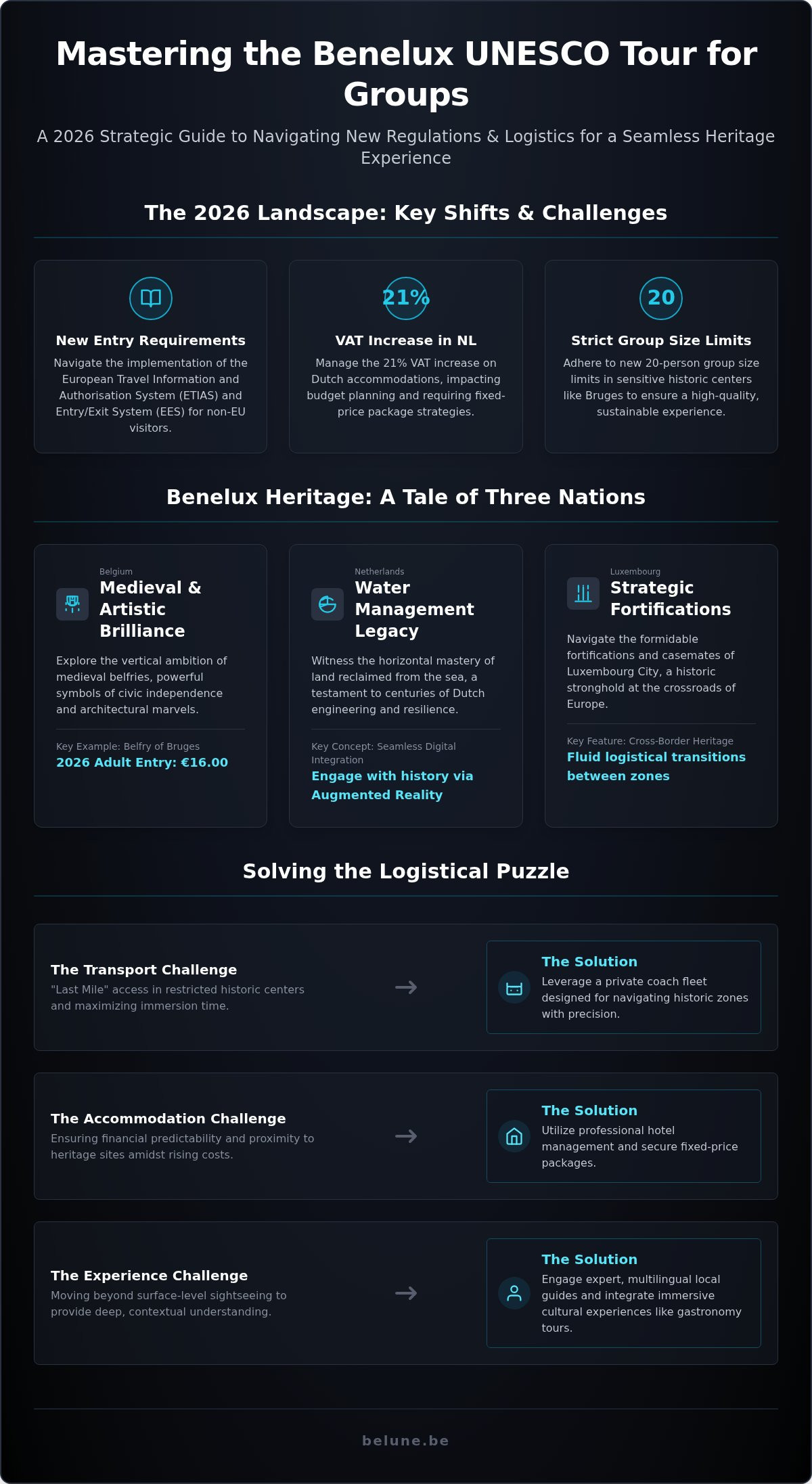
This guide promises to reveal the secrets of curating a seamless, high-end experience across Belgium, the Netherlands, and Luxembourg. We’ll explore how to navigate the new ETIAS and EES requirements, manage the 21% VAT increase on Dutch accommodations, and respect the strict 20-person group size limits in cities like Bruges. From the luxury of a private coach fleet to the depth of expert local guidance, you’ll discover how to transform complex logistics into a fluid, inspiring journey. We’ll detail the essential steps to securing elite hotel management and artisanal cultural experiences that define a true masterclass in heritage.
Key Takeaways
- Identify the pivotal 2026 shifts in heritage tourism, including new digital integration and accessibility standards across major cultural sites.
- Explore the architectural and engineering marvels of the region, from Belgium’s medieval belfries to the Dutch water management legacy.
- Learn to navigate the strategic fortifications of Luxembourg City and the fluid logistical transitions between cross-border historical zones.
- Solve the “last mile” transport challenge for a benelux unesco sites tour for groups by leveraging private coach hire designed for restricted historic centers.
- Gain insights into professional hotel accommodation management and fixed-price packages that ensure both heritage proximity and financial predictability.
The Grand Tour of Benelux UNESCO Sites: A 2026 Perspective for Groups
A benelux unesco sites tour for groups is a curated circuit that weaves together the cultural and natural legacies of Belgium, the Netherlands, and Luxembourg. It’s an exploration of human achievement and resilience. In 2026, this journey takes on a fresh perspective. Major heritage sites have embraced new accessibility standards and seamless digital integration. These advancements allow professional groups to engage with history through augmented reality and enhanced physical access, even within sensitive medieval structures. UNESCO status isn’t just a label; it’s a tangible marker of quality that adds immense value to a professional itinerary, ensuring every stop meets the highest standards of preservation and significance.
The strategic advantage of the Benelux region remains its remarkable density. Short travel distances between world-class sites mean your group spends less time in transit and more time immersed in the experience. This proximity allows for a fluid narrative, where the transition from a Dutch water management site to a Belgian belfry feels like a natural progression rather than a disjointed leap. It’s a logistical dream for tour operators who value efficiency without sacrificing the depth of the cultural encounter.
To better understand this concept, watch this helpful video:
Defining the Benelux Heritage Landscape
This landscape sits at the vibrant intersection of medieval trade, religious devotion, and modern technical innovation. It functions as the cultural crossroads of Western Europe, where diverse influences have distilled into a unique regional identity. The role of a benelux incoming tour operator is essential here. We provide the technical expertise and local insight needed to contextualize these sites within a broader historical frame. For instance, the Belfries of Belgium and France offer a window into the rise of civic independence, standing as symbols of power that defined the medieval skyline and continue to command respect today.
The Evolution of Group Travel in the Region
We’ve witnessed a significant shift from traditional sightseeing to immersive heritage experiences. Professional groups don’t want to just look; they want to understand the artisanal and structural soul of a place. This evolution requires the presence of multilingual, expert local guides who can navigate the nuances of each site with precision. A truly successful benelux unesco sites tour for groups also recognizes the importance of sensory balance. Integrating Belgium gastronomy tours into the schedule provides a holistic view of the culture, allowing the palate to explore the same heritage the eyes have just witnessed.
Signature UNESCO Sites for Group Itineraries: Belgium and the Netherlands
The architectural dialogue between Belgium and the Netherlands forms the structural heart of any benelux unesco sites tour for groups. It’s a journey that moves from the vertical ambition of medieval stone to the horizontal mastery of reclaimed land. These locations aren’t merely static monuments; they’re living environments where historical significance intersects with the daily rhythms of modern European life. To appreciate the full scope of these achievements, planners should consult the Official UNESCO World Heritage List, which highlights the universal value of the region’s landmarks and provides a baseline for professional itinerary standards.
Belgium’s Medieval and Artistic Brilliance
Belgium’s heritage is defined by a fierce spirit of civic independence. The belfries, once the primary symbols of municipal power, offer a striking visual narrative of the rise of the middle class. In Bruges, where the adult entry to the belfry is €16.00 in 2026, it’s vital for organizers to remember that all organized walking tours are now limited to 20 participants. This regulation, effective from March 1, 2026, ensures the preservation of the historic atmosphere. Transitioning from the medieval to the 20th century, the Major Town Houses of Victor Horta in Brussels showcase the intricate beauty of Art Nouveau. These sites are perfect additions to culture group tours benelux, providing a sophisticated contrast to the gothic structures found elsewhere.
The Netherlands: A Masterclass in Engineering and Art
The Dutch landscape is a triumph of human ingenuity over nature. Sites like Kinderdijk and the Beemster Polder illustrate the “polder model,” a centuries-old system of water management that remains a global benchmark. International groups often find the technical precision of these windmills and pumping stations as inspiring as any cathedral. In Amsterdam, the 17th-century Canal Ring Area serves as a model for urban planning. A 30-minute canal boat tour, costing €14.00 per adult in 2026, provides an essential vantage point for this architectural ensemble. When visiting the Rijksmuseum to see the works of the Dutch Masters, keep in mind that 2026 tickets cost €25 and require a pre-booked timed entry slot.
Integrating these sites into a cohesive narrative requires a deep understanding of local constraints and evolving regulations. Whether you’re coordinating access to sensitive historical zones or looking for the perfect perspective on a canal tour, partnering with a regional expert ensures every detail is handled with professional precision and aesthetic care.
The Luxembourg Connection: Integrating Fortifications and Cross-Border Heritage
Luxembourg City acts as the strategic anchor for a benelux unesco sites tour for groups. Its central position within the Benelux geography provides a natural pivot point for itineraries moving between the maritime heritage of the north and the forested valleys of the south. The transition from the Belgian Ardennes into the Luxembourgish landscape is visually stunning and logistically efficient. It offers a moment of reflection on the shared history that defines this region. Integrating this site into a broader circuit requires a deep understanding of how these three nations have historically protected their borders while fostering modern cooperation.
The ‘Gibraltar of the North’: Military History for Groups
The Old Quarters and Fortifications of Luxembourg City represent a marvel of military engineering. Known as the “Gibraltar of the North,” these defenses evolved over centuries of European conflict. For groups, the experience is centered on the Bock Casemates, a vast underground network of tunnels carved into the solid rock. Navigating these spaces with professional guides brings the technical mastery of Vauban and other military architects to life. In 2026, a guided group tour of this UNESCO site starts from €150 for up to 20 people for a 2-3 hour session. These visits are ideal for themed group travel benelux itineraries that focus on the architectural evolution of peace through strength. It’s a poignant stop that resonates deeply within the context of European unity.
Cross-Border Logistics: The DMC Advantage
Managing the flow of a multi-country circuit requires more than just a schedule; it demands a unified transport solution. Moving a group across borders involves aligning with different regional regulations and timing constraints. With the implementation of the EES and ETIAS systems in late 2026, the complexity of entry and exit registration at external borders has increased. A specialized partner ensures that all group documentation is prepared in advance. This prevents delays at the transition points between Belgium and Luxembourg. Our expertise lies in transforming these logistical hurdles into a seamless transition. We provide a private fleet of modern coaches that remain consistent across the entire circuit. This consistency ensures group comfort and eliminates the friction of switching vehicles or providers mid-tour. Local guidance remains the thread that connects these diverse sites, ensuring your benelux unesco sites tour for groups maintains its narrative momentum from start to finish.
Logistics of Scale: Transport and Accommodation for UNESCO Group Travel
Executing a benelux unesco sites tour for groups requires solving the “last mile” challenge. Medieval centers, designed for horse-drawn carriages, now host sophisticated modern travelers. Navigating these restricted zones requires technical precision and an intimate knowledge of local Low Emission Zone (LEZ) requirements. In 2026, the logistical puzzle is more complex than ever. It involves balancing the desire for heritage proximity with the rigid requirements of large-scale movement. Precision is non-negotiable. Whether it’s managing the 21% VAT increase on Dutch accommodations or ensuring a coach can physically reach a hotel in a pedestrianized zone, every detail must be pre-planned to maintain the tour’s fluid rhythm.
Coach Hire: The Backbone of the Benelux Tour
Private coach hire serves as the structural foundation of a successful itinerary. Unlike the rigid schedules of public rail, a private fleet offers the flexibility to pivot based on group needs or site-specific timing. BELUNE manages its own fleet of modern coaches, ensuring total quality control and reliability across the circuit. These 2026-spec vehicles prioritize sustainability and comfort, featuring advanced climate control and group-specific amenities. The professional driver is more than just a navigator; they are an essential part of the logistical team. They understand the nuances of driver hours and the technical constraints of historic city centers, ensuring safety and compliance without sacrificing the group’s experience. This internal management of transport eliminates the friction often found when outsourcing to third-party providers.
Group-Friendly Accommodation Management
Sourcing the right hotel is a balancing act between aesthetic appeal and technical capacity. A property must offer more than just a high-end room; it must accommodate the specific needs of a professional group. This includes efficient porterage services, synchronized dining capacity for large numbers, and dedicated coach parking. Centralizing these requirements through a specialized group travel agency ensures that these criteria are met across every stop in Belgium, the Netherlands, and Luxembourg. We focus on properties that maintain a connection to the local heritage while providing the modern infrastructure necessary for seamless arrivals and departures. This approach allows for a predictable budget through fixed-price group packages, shielding operators from the volatility of individual booking rates. For a technical deep-dive into how we can elevate your next itinerary, contact our logistics team to discuss your specific group requirements.
Designing Your Bespoke Itinerary with BELUNE’s DMC Expertise
Designing a benelux unesco sites tour for groups is an exercise in both artistic vision and technical rigor. It’s about more than just checking boxes on a list of monuments. It requires a deep understanding of how space, time, and history intersect across three distinct nations. At BELUNE, we view every itinerary as a structural masterpiece. We transform the complex logistical requirements of 2026 into a fluid, human experience. Our approach is rooted in an elegance that prioritizes the emotional connection your clients feel with the heritage they encounter. We don’t just provide transport; we curate the environment in which history is experienced.
The Customization Workflow
The journey begins with a conceptual consultation. We explore the themes that define your group’s identity, whether that involves the profound silence of flanders fields, the intricate beauty of Art Nouveau, or the sensory depth of regional gastronomy. Once the theme is set, we build the logistical framework from the ground up. This involves a meticulous alignment of our private coach hire, expert local guide services, and hotel accommodation management. We refine every detail until it fits our “Fixed-price” model. This predictability is essential for professional tour operators who need to manage budgets without sacrificing the high-end quality of the tour.
Why BELUNE is the Strategic Choice for 2026
With over 20 years of experience, we provide a level of regional insight that is indispensable for a benelux unesco sites tour for groups. We’ve developed a network of partnerships that others simply can’t match. We aren’t a distant booking platform; we’re a local DMC with our own fleet of modern coaches. This allows us to maintain absolute quality control from the moment your group arrives until their final departure. Our expertise in Art & Culture and Battlefield tourism ensures that every site visit is handled with the appropriate level of sensitivity and technical depth. We act as your strategic ally, handling the evolving regulations of 2026 so you can focus on your clients.
Initiating a custom itinerary request for 2026 is a straightforward process. Our team is ready to translate your vision into a comprehensive, bespoke heritage proposal. By collaborating with us, you gain access to a level of precision and artistic sensibility that defines the modern masterclass in heritage tourism. Reach out to our advisors today to begin sculpting an exceptional journey that honors the past while embracing the logistical excellence of the future. We look forward to transforming your next group tour into an unforgettable cultural achievement.
Mastering the Art of Heritage Logistics
A successful benelux unesco sites tour for groups is a testament to the power of precision. We’ve explored how the architectural dialogue of Belgium, the engineering marvels of the Netherlands, and the strategic fortifications of Luxembourg create a narrative of European resilience. In 2026, navigating this landscape requires more than just appreciation. It demands a rigorous understanding of evolving regulations. From managing group size limits in historic centers to navigating new digital entry systems, the logistics serve as the invisible structure that allows the cultural experience to shine. Excellence is found in the details.
True success in travel sits at the intersection of local insight and operational reliability. BELUNE offers 20+ years of DMC expertise in Benelux and Paris, providing the stability your professional group requires. With our private fleet of modern, group-ready coaches and comprehensive Hotel Accommodation Management, we ensure every transition is as fluid as the history it traverses. We invite you to Request Your Custom Benelux UNESCO Group Itinerary from BELUNE and transform your vision into a structural reality. Let’s build a journey that honors the past through the mastery of the present.
Frequently Asked Questions
What are the most group-friendly UNESCO sites in the Benelux region?
Sites with dedicated coach parking and large-scale entry management are essential for a benelux unesco sites tour for groups. The iconic windmills and historic fortifications across the region offer excellent infrastructure for large arrivals. Belfries and central heritage zones are manageable when coordinated with timed entries. These locations offer a balance of monumental scale and technical accessibility, making them ideal choices for professional tour operators seeking a seamless and inspiring experience for their clients.
How do I manage coach access to historic city centers during a group tour?
Managing coach access requires navigating complex Low Emission Zones and pedestrianized perimeters in historic centers. We utilize our own fleet of modern coaches designed to meet 2026 sustainability standards. This allows for closer drop-off points near sensitive heritage zones. Success depends on pre-registering vehicles and coordinating with authorities to ensure the final leg of the journey is as seamless as the open road. Precision in timing is the key to avoiding logistical friction for groups.
Can BELUNE provide multilingual guides for specialized UNESCO themes?
Yes, we provide expert local guide services fluent in major European languages. These professionals specialize in specific UNESCO themes, such as architectural history or medieval defense systems. Their role is to bridge the gap between technical history and the human experience. By providing deep context in the group’s native language, they transform a standard visit into a sophisticated cultural masterclass. This expertise ensures that every participant engages deeply with the rich regional heritage.
What is included in a fixed-price group tour package for Benelux?
Our fixed-price group tour packages offer budget predictability for professional partners. These comprehensive programs include logistical coordination, site bookings, and local management throughout the circuit. We cover the technical details of the itinerary, including our own coach hire and hotel accommodation management. This model shields tour operators from price volatility, providing a clear per-person rate that encompasses the entire multi-day heritage experience across the various national borders of the region.
How does BELUNE manage hotel accommodations for large groups across borders?
We manage hotel accommodations by selecting properties that meet strict professional criteria. This includes verifying coach parking availability, synchronized dining capacity, and efficient porterage services. Our team coordinates these bookings across borders to ensure a consistent standard of luxury and functionality. By centralizing this process, we eliminate the complexity of managing multiple vendors. This ensures that the group’s transition between different countries remains fluid and comfortable throughout the entire travel program.
Is it possible to combine UNESCO sites with battlefield or gastronomy themes?
Combining cultural heritage with specialized themes is a core part of our design process. You can seamlessly integrate battlefield tourism or gastronomy and beer experience tours into a benelux unesco sites tour for groups. For example, a visit to historical monuments can be paired with a technical exploration of regional brewing traditions. This multi-layered approach provides a more holistic view of the culture, engaging both the intellect and the senses of the travelers.
What makes BELUNE different from a standard travel agency for group tours?
BELUNE operates as a specialized DMC with over 20 years of technical experience. Unlike standard agencies that outsource logistics, we manage our own private fleet of coaches and provide direct hotel accommodation management. We focus exclusively on professional B2B partnerships rather than individual B2C bookings. This specialization allows us to act as a strategic ally, offering a level of quality control and regional expertise that is unattainable through traditional travel intermediaries or standard agencies.