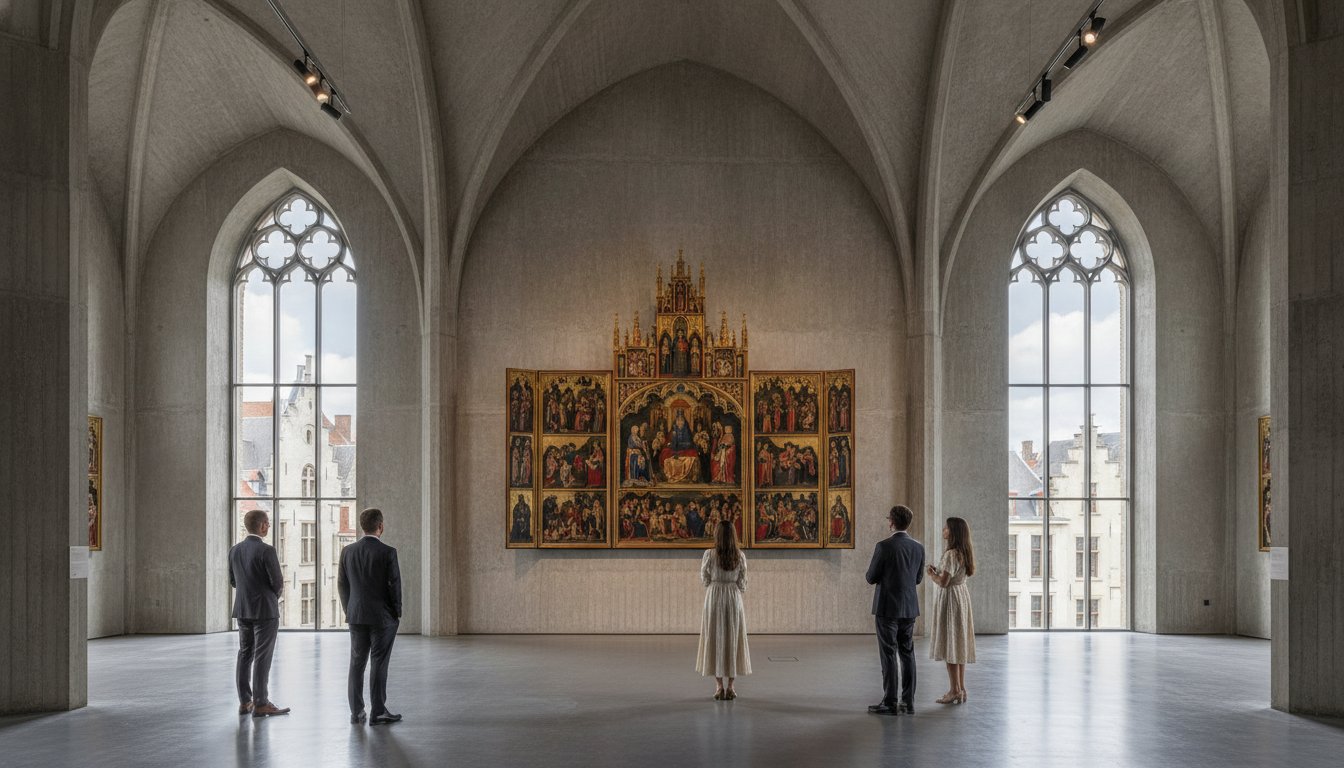
A world-class art tour is only as transcendent as the logistics that support it. When curating the flemish primitives art trail belgium for 2026, the challenge lies in bridging the gap between 15th-century spirituality and 21st-century group travel expectations. We understand that managing a sophisticated group across Bruges, Ghent, and Antwerp requires more than just a passion for Jan van Eyck. It demands a technical precision that mirrors the fine brushwork of the masters themselves.
You recognize that fragmented museum booking systems and transport synchronization often disrupt the emotional flow of a cultural journey. This guide offers a visionary approach to these logistical hurdles. We provide the expert B2B insights needed to transform a standard itinerary into a seamless, high-end pilgrimage. From securing 16 Euro augmented reality entries for the Ghent Altarpiece to coordinating a private coach fleet between cities, we detail how to master the art of the movement as much as the art on the walls.
Key Takeaways
- Explore the revolutionary oil techniques and symbolic realism that defined the Flemish Primitives as the visionary innovators of the 15th century.
- Map a sophisticated flemish primitives art trail belgium that seamlessly connects the monumental Ghent Altarpiece with the intimate masterpieces of Bruges.
- Learn why securing group museum slots 6 to 12 months in advance is essential for maintaining the narrative flow of a 2026 cultural itinerary.
- Understand the logistical advantages of private coach hire and specialized hotel management in ensuring a tranquil and professional group experience.
- Discover how to leverage B2B expertise to tailor exclusive art pilgrimages for academic, religious, or high-end luxury travel groups.
The Flemish Primitives: A Revolutionary Legacy in 2026
The 15th century in the Low Countries wasn’t just a period of artistic production; it was a technical explosion. Often referred to as the Early Netherlandish painting movement, these masters redefined how we perceive light, texture, and the human soul. They moved away from the flat tempera of the past toward a revolutionary use of oil glazes. This wasn’t merely a change in medium. It was an innovation that allowed for a luminosity and hyper-realistic detail that still feels contemporary. Organizing a flemish primitives art trail belgium in 2026 allows groups to witness these works in their most pristine state following years of meticulous restoration projects across the region.
To truly grasp the depth of these works, one must see them in the context of their creation. This national heritage journey spans from the bustling commerce of Bruges and Antwerp to the spiritual heart of Ghent and the royal collections of Brussels. It’s a curated path through history that connects the secular and the divine. By 2026, the completion of several major restoration phases ensures that visitors see the same vibrant, jewel-like colors that the 15th-century elite once admired.
To better understand the technical mystery behind these works, watch this helpful video:
Who Were the Masters of the Northern Renaissance?
The trail is defined by three titans. Jan van Eyck stands as the pioneer. His mastery of oil allowed for a “microscopic” gaze, where every jewel and fold of fabric possesses its own light. Rogier van der Weyden brought a different intensity. He was the master of human emotion, capturing grief and devotion with a psychological depth that was centuries ahead of its time. Hans Memling acted as the bridge. His work reflects the intersection of Bruges’ commercial wealth and quiet, spiritual contemplation. Together, they formed an artistic language that remains the cornerstone of Belgian identity.
Why an Art Trail is Essential for Modern Cultural Groups
The modern traveler’s expectations have shifted. It’s no longer enough to simply view art in a sterile gallery. Today’s cultural groups seek to experience the artist’s environment. They want to see the Ghent Altarpiece in the very cathedral it was designed for. They want to walk the streets of Bruges that Memling walked. 2026 represents a pivotal year for these renewed cultural pilgrimages. With major restoration phases reaching completion, the clarity of the original colors and the precision of the details are more accessible than ever.
Modern cultural groups also benefit from digital integration. For example, the 16 Euro augmented reality experiences at St. Bavo’s Cathedral allow visitors to peel back the layers of history before standing in front of the physical masterpiece. This trail isn’t just a series of museum visits; it’s a structural transformation of how we interact with history. It requires a strategic ally to manage the logistical complexity of these high-traffic religious and secular sites, ensuring the emotional impact remains undisturbed for the final client.
Mapping the Masterpieces: The Ultimate Flemish Art Trail Route
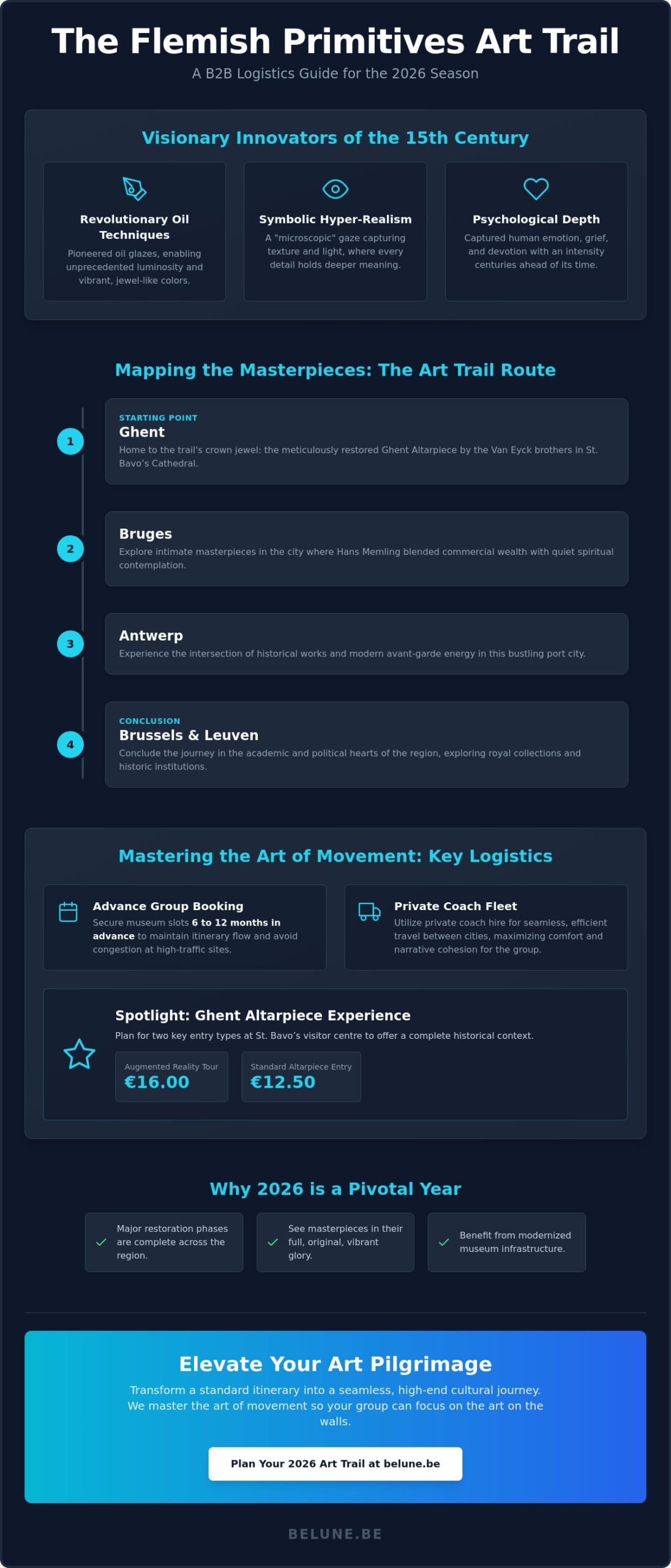
A successful flemish primitives art trail belgium follows a logical, circular geography. It begins in Ghent, sweeps through the medieval canals of Bruges, touches the avant-garde energy of Antwerp, and concludes in the academic and political hubs of Leuven and Brussels. This route maximizes coach efficiency while allowing the narrative of the 15th century to unfold chronologically. By 2026, the physical journey is as refined as the artworks themselves, supported by high-speed connections and modernized museum infrastructure.
The Ghent Altarpiece: The Crown Jewel of the Trail
St. Bavo’s Cathedral remains the essential starting point. By 2026, the final phase of the Ghent Altarpiece restoration is complete, revealing the panels in their full, original glory. Navigating the visitor centre requires technical precision. Tickets for the augmented reality tour cost €16, while the standard entry to see the altarpiece is €12.50. We recommend securing timed entry slots months in advance to avoid the congestion that often plagues this high-demand site. This ensures the group’s emotional connection to the “Adoration of the Mystic Lamb” remains undisturbed.
Bruges and Antwerp: Commerce Meets Devotion
Bruges offers a spiritual homecoming. At the Groeningemuseum, where adult tickets are €15, the collection spans from Van Eyck to the terrifying visions of Bosch. Nearby, St. John’s Hospital provides the rare opportunity to see Hans Memling’s shrines in the very ward they were commissioned for. Antwerp’s Royal Museum of Fine Arts (KMSKA) serves as a modern counterpoint. Following its massive, innovative renovation, the adult ticket price is €20. It’s an ideal location to integrate Belgium gastronomy tours, pairing high art with the city’s refined culinary scene and artisanal beer culture.
Brussels and Leuven: The Political and Academic Masters
In Leuven, St. Peter’s Church houses Dieric Bouts’ “Last Supper,” a masterpiece that still resides in its original architectural setting. Brussels then provides the political and royal context. The Royal Museums of Fine Arts of Belgium showcase how the Primitives paved the way for the later genius of Bruegel. For those developing culture group tours benelux, these cities offer white-label possibilities that balance academic depth with luxury logistics. This comprehensive flemish primitives art trail belgium provides the ultimate survey of the Northern Renaissance. Planning such a detailed route requires a strategic partner. Our team at BELUNE ensures every stop is perfectly timed for your group’s arrival.
The Technical Genius of the Early Netherlandish Masters
The shift from tempera to oil was the defining moment of the 15th century. By layering thin, translucent glazes of pigment, artists like Van Eyck achieved a depth of color that had never been seen before. It’s a technique that captures the play of light on silk, the cold sheen of armor, and the soft texture of skin with startling accuracy. This technical mastery is the heartbeat of any flemish primitives art trail belgium. It transforms a simple painting into a luminous window into another reality, where light seems to emanate from within the panel itself.
These masters were also pioneers of direct observation. They abandoned the symbolic, flat gold backgrounds of the Gothic tradition for a meticulous study of the natural world. For the first time, we see the atmospheric perspective of the Belgian countryside. The sky isn’t just blue; it’s a gradient of light that suggests distance and moisture. This shift toward realism wasn’t just aesthetic. It was a philosophical statement about the holiness of the physical world, where every grain of sand and blade of grass was worthy of the artist’s brush.
Reading the Symbols: A Guide for Tour Leaders
Tour leaders must help their groups look beyond the surface, as every object in a Flemish Primitive painting carries weight. A single candle burning in daylight might signify the divine presence, while a convex mirror acts as a silent witness to a secular contract. We believe that the role of local guide services is essential here. They act as the bridge, decanting these complex iconographies into a narrative that guests can connect with emotionally. Briefing your group on this “hidden language” before they enter the gallery ensures they don’t just see the art; they understand it.
- Lilies: Symbolizing purity and often found in Annunciation scenes.
- Windows: Representing the threshold between the earthly realm and the spiritual world.
- Dogs: A common motif for fidelity and domestic trust in portraiture.
The Restoration Science of 2026
The experience of these works in 2026 is fundamentally different from what it was a decade ago. Modern technology, including infrared reflectography and macro-XRF scanning, has allowed conservators to remove centuries of yellowed varnish and overpainting. This process has revealed the original, vibrant brushwork of the masters that was long obscured. The Ghent Altarpiece restoration of 2026 represents the pinnacle of modern conservation science. It allows visitors to see the panels with a clarity that hasn’t existed since the 15th century, ensuring the flemish primitives art trail belgium remains a cutting-edge cultural experience for the modern academic or luxury traveler.
Designing a Seamless Art Trail Itinerary for Large Groups
Organizing a flemish primitives art trail belgium for a large group isn’t merely about booking tickets; it’s about choreographing a sequence of emotional moments. Success depends on a technical timeline that begins at least 6 to 12 months before arrival. Popular sites like the Groeningemuseum or St. Bavo’s Cathedral operate on strict capacity limits. For groups of 30 or more, this requires a fragmented entry strategy where visitors are staggered to maintain the serenity of the viewing experience. We don’t just plan stops; we manage the flow of the entire journey.
Transport logistics play a structural role in this narrative. While Belgium’s rail network is efficient, it often fails to bridge the “last mile” to historical city centres. Private coach hire remains the superior choice for art trails. It provides a controlled environment for pre-arrival briefings and ensures that the group arrives at the museum’s doorstep, avoiding the fatigue of navigating cobblestone streets with heavy luggage. This allows the focus to remain entirely on the 15th-century masterpieces rather than the stress of the transition.
Managing Group Logistics in Historical Art Cities
The medieval hearts of Bruges and Ghent are increasingly becoming coach-free zones. This creates a technical challenge for hotel accommodation management and daily drop-offs. It’s vital to synchronize hotel check-ins with museum timed-entry tickets to avoid wasted hours. Leveraging a benelux incoming tour operator provides the on-the-ground support needed to navigate these pedestrianized districts. We ensure your coach drops off passengers at designated points and that luggage transfers are handled with professional precision.
Expert Local Guides: The Difference Between a Walk and a Tour
A specialized guide doesn’t just list dates; they decode the artistic vision of the masters. For high-end groups, sourcing multi-lingual local guide services with genuine art-historical expertise is non-negotiable. In quiet cathedral environments, we utilize modern whisper systems. These allow the guide to speak at a conversational volume while every guest hears the technical nuances of the brushwork clearly. This customization transforms a standard visit into a profound cultural pilgrimage, tailored to the specific interests of academic or religious groups.
The art experience shouldn’t end at the gallery doors. We believe in a multisensory approach that pairs the visual brilliance of the Primitives with Belgium’s culinary heritage. Imagine a day that begins with Van Eyck’s luminosity and concludes with a gastronomy and beer experience tour in a vaulted 15th-century cellar. This pairing deepens the group’s connection to the era. If you’re ready to design an exceptional itinerary, contact our strategic logistics team today to begin your 2026 planning.
Elevating the Art Experience: BELUNE’s Expertise in Cultural Travel
Refining a flemish primitives art trail belgium requires more than local knowledge. It demands a sophisticated understanding of how cultural narratives intersect with high-end logistics. With over 20 years of experience in the Benelux region, our team has mastered this delicate balance. We don’t just book hotels or hire coaches; we curate environments where the brilliance of the 15th century can be fully absorbed without the friction of logistical delays. Our role is that of a strategic ally, ensuring that the technical execution of the tour remains as flawless as the masterpieces on display.
Our approach is deeply personal and professionally rigorous. An academic group studying the technical glazes of the Early Netherlandish masters has different spatial requirements than a luxury religious pilgrimage. We tailor every itinerary to match these specific identities. Whether it involves securing private access to collections or coordinating a historic stay in a converted Bruges convent, we ensure every detail reflects the group’s purpose. This bespoke method transforms a standard trip into a profound human and emotional experience.
Bespoke Art Itineraries for Tour Operators
We provide a structural foundation for international tour operators seeking excellence. By building fixed-price packages that encompass museum fees, local guide services, and specialized gastronomy tours, we eliminate the complexity of multi-currency budgeting. You benefit from a single point of contact for the entire Benelux region. Our white-label services allow you to offer these refined experiences under your own brand, backed by our invisible yet flawless execution on the ground. We handle the technicalities so you can focus on the client relationship.
- Fixed-Price Security: Comprehensive packages including all logistical costs.
- Single Point of Contact: Streamlined communication for Bruges, Ghent, Antwerp, and Brussels.
- White-Label Excellence: Flawless on-the-ground delivery under your company’s identity.
Logistics and Reliability in 2026
Reliability is the cornerstone of a successful cultural pilgrimage. Our private fleet of modern coaches ensures that the transition between “Art Cities” is as comfortable as the stay itself. In 2026, as Belgian cities implement more restricted traffic zones, having a dedicated transport partner with an owned fleet is a strategic advantage. We anticipate group needs before they arise. This includes everything from arranging specific drop-off points near pedestrianized museum entrances to managing complex hotel accommodation management for large parties. Partner with the premier group travel agency for your 2026 flemish primitives art trail belgium and experience the difference that professional vision brings to cultural travel.
Master the Art of the Journey in 2026
The 2026 art season in Belgium represents a rare alignment of history and technology. By understanding the technical genius of the masters and the logistical demands of modern historical cities, you can provide an experience that resonates deeply with your clients. A successful flemish primitives art trail belgium requires a vision that balances the emotional impact of the works with a structural commitment to precision. It’s about ensuring the transition between masterpieces is as luminous as the art itself.
We invite you to leverage our 20 plus years of DMC expertise to transform these insights into a reality. Our private fleet of modern coaches and fixed-price group tour packages provide the reliability and transparency your business demands. We don’t just facilitate travel; we act as your strategic ally in the Benelux region. Request Your Custom 2026 Art Trail Itinerary from BELUNE and secure your place in this cultural revival. The masterpieces of the 15th century are waiting to be rediscovered through your professional curation.
Frequently Asked Questions
What is the best time of year to organize a Flemish Primitives art trail in Belgium?
Spring and Autumn offer the most balanced experience for a flemish primitives art trail belgium. These months avoid the summer tourist peak while providing pleasant light for viewing the architectural contexts of the artworks. Winter tours are also possible for groups seeking a quieter, more contemplative atmosphere in the galleries.
How far in advance should a tour operator book group tickets for the Ghent Altarpiece?
Large groups should secure their slots at least 6 to 12 months in advance. The visitor centre at St. Bavo’s Cathedral operates on strict capacity limits for the augmented reality experience and the viewing of the altarpiece itself. Early booking ensures your group maintains its preferred schedule without splitting the party across multiple days.
Can large groups (40+ people) be accommodated in the smaller museums of Bruges?
Groups of 40 or more require a fragmented entry strategy in Bruges. Most historical sites, such as the St. John’s Hospital, have limited interior space that cannot accommodate 40 people simultaneously. We coordinate staggered entries or split the group between different nearby sites to ensure everyone enjoys an intimate encounter with the art.
Is the Flemish Primitives art trail accessible for travellers with limited mobility?
Most major museums on the flemish primitives art trail belgium are now fully accessible following recent renovations. Sites like the KMSKA in Antwerp and the new visitor centre in Ghent feature modern elevators and ramps. However, the medieval cobblestones of Bruges and Ghent still pose challenges. We curate specific routes and utilize our private coach fleet to minimize difficult walking distances.
What are the must-see museums for a 3-day art-themed group tour?
A condensed 3-day itinerary should prioritize the “Big Three” cities. Start with the Ghent Altarpiece at St. Bavo’s Cathedral, continue to the Groeningemuseum in Bruges for its comprehensive collection, and conclude at the KMSKA in Antwerp. This route provides a technical and emotional survey of the movement’s evolution within a manageable timeframe.
How does a DMC like BELUNE help with museum booking complexities?
We act as your strategic logistical partner by navigating the fragmented booking systems of various Belgian institutions. Our team handles the technicalities of timed entries, group size regulations, and multi-city transport. This allows tour operators to focus on their clients while we ensure the back-end execution remains flawless and professional.
Are there specific dress codes for groups visiting cathedrals on the art trail?
Modest attire is required when visiting active religious sites like St. Bavo’s Cathedral or St. Peter’s Church in Leuven. Guests should ensure their shoulders and knees are covered as a sign of respect. While many secular museums don’t have dress codes, we recommend smart-casual attire that matches the sophisticated tone of the art trail.
Can the art trail be combined with a Paris or Amsterdam extension?
Combining the Belgian trail with Paris or Amsterdam is highly efficient due to Belgium’s central location. High-speed rail connections or our own private coach fleet make these extensions seamless for international groups. We manage the transition across borders, providing a consistent level of luxury and expertise throughout the entire Benelux region.