Tag: European Travel

  • Exploring the ‘Venice of the North’: A Masterclass in European Canal Cities for 2026

    Exploring the ‘Venice of the North’: A Masterclass in European Canal Cities for 2026

    What if the most profound encounter with European water culture doesn’t involve the sweltering crowds of St. Mark’s Square? For many travel professionals, the search for an authentic, fluid group experience leads away from the Mediterranean toward the sophisticated engineering of Northern Europe. You’ve likely felt the frustration of navigating over-tourism or the logistical headache of maneuvering a coach through narrow, ancient streets. It’s a challenge that requires more than just a map; it demands a vision of how urban spaces breathe and move.

    The title venice of the north is claimed by several cities, yet it represents a singular standard of architectural and cultural excellence that defines the Benelux soul. This article provides the expert knowledge you need to curate an impeccable group itinerary for 2026, balancing historical depth with modern logistical precision. We’ll explore the architectural splendor of these iconic waterways, reveal the secrets of seamless access for large groups, and provide a practical framework for experiences that resonate on a deeply human level. Discover how to transform a standard tour into a masterclass of European heritage through the lens of an expert partner who understands the rhythm of the water.

    Key Takeaways

    • Understand the historical and cultural criteria that define a true venice of the north to better articulate the value of these destinations to your clients.
    • Compare the logistical and atmospheric differences between Amsterdam’s Golden Age engineering and the medieval preservation of Bruges to select the perfect fit for your itinerary.
    • Identify hidden gems like Giethoorn and Amiens to offer authentic, tranquil alternatives that avoid the overcrowding of more traditional canal routes.
    • Learn how the unique “waterfront” aesthetic influences local architecture and gastronomy, providing a sensory framework for immersive group experiences.
    • Master the logistical complexities of canal-heavy cities by leveraging modern coach fleets and strategic hotel sourcing tailored for large professional groups.

    What Defines a ‘Venice of the North’? The Origin of the Title

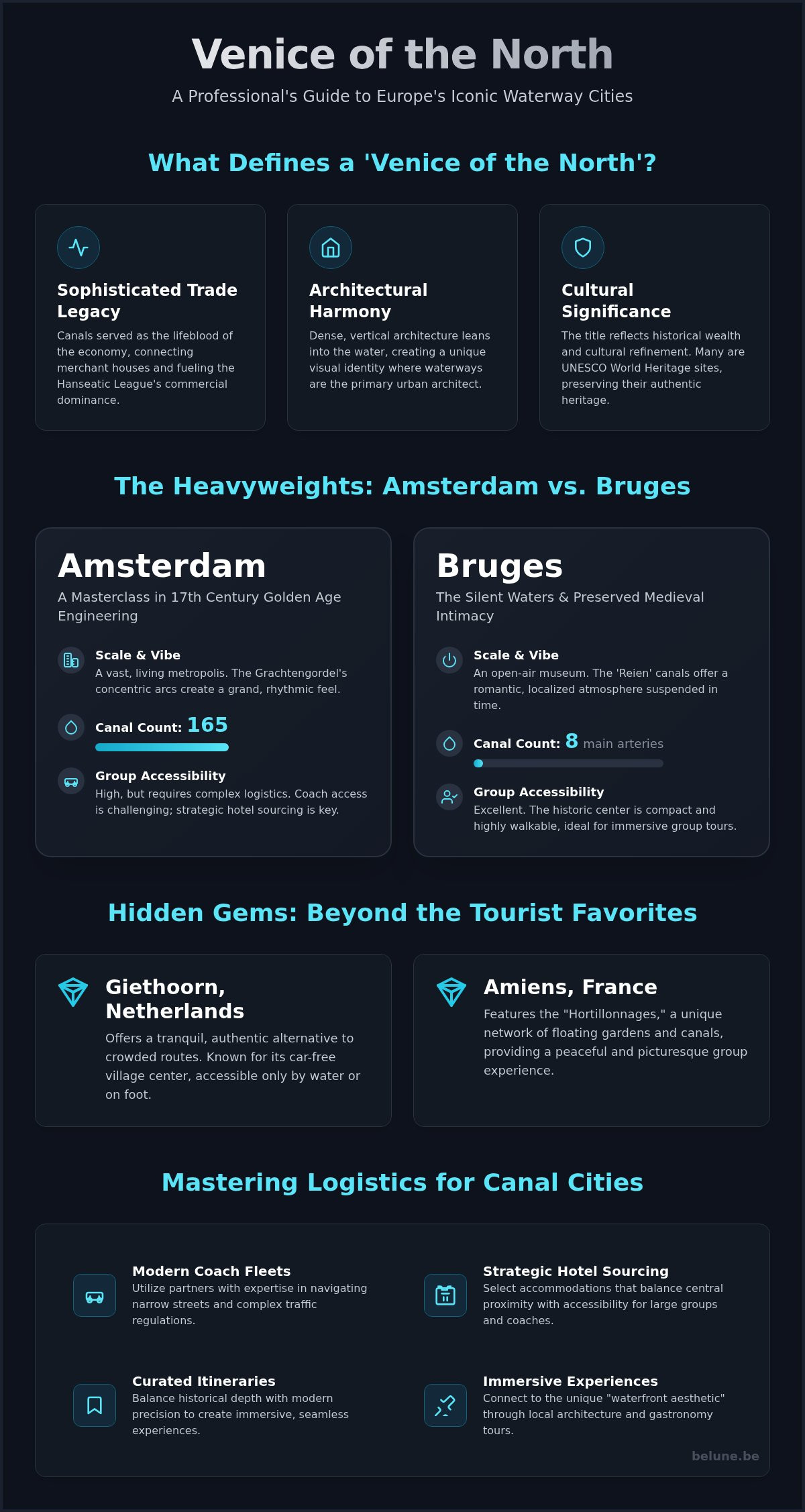
    The term venice of the north isn’t merely a flattering comparison; it’s a testament to a specific urban DNA where water dictates the rhythm of existence. Historically, cities across Northern Europe adopted this label to align themselves with the prestige of the Venetian Republic. They sought to mirror its status as a maritime superpower and a beacon of cultural refinement. Ultimately, the venice of the north serves as a designation for cities where waterways are the primary architect of urban life.

    True candidacy for this title requires more than a few scenic streams. It demands a sophisticated trade legacy, where the canal was the lifeblood of the economy, and an architectural harmony that reflects a city’s historical wealth. As we look toward 2026, these cities are evolving into something even more significant. They’re no longer just frozen relics of a Golden Age; they’ve become laboratories for sustainable urbanism and vibrant cultural hubs where historic waterways meet modern ecological innovation.

    The Hanseatic Influence on Water-Centric Urbanism

    During the Middle Ages, the Hanseatic League transformed the Benelux region into a commercial powerhouse. Canals served as the essential highways of the era, facilitating the movement of wool, grain, and spices directly to the doorsteps of merchant houses. This infrastructure blended defensive moats with commercial arteries and residential aesthetics. The resulting landscape is one of dense, vertical architecture that leans into the water, creating a unique visual harmony that defines the Northern European identity. For the travel professional, understanding this technical mastery is key to explaining why these cities look and feel so distinct from their land-locked neighbors.

    Marketing Gimmick or Cultural Heritage?

    While many towns claim the nickname for tourism appeal, only a handful possess the historical depth to sustain it. UNESCO World Heritage status often separates the self-promoted from the historically significant, ensuring that the intricate systems of locks and quays are preserved with technical rigour. Modern travelers increasingly look past the marketing labels in search of authentic heritage. In an era where traditional Venice faces significant environmental and social pressure, these Northern counterparts offer a more breathable, yet equally profound, connection to maritime history. They provide a space where the heritage is lived daily, not just staged for the passing visitor.

    The Heavyweights: Amsterdam vs. Bruges

    Amsterdam and Bruges represent two distinct interpretations of the venice of the north archetype. While Amsterdam impresses with its grand, rhythmic engineering, Bruges captures the imagination through its silent, preserved medieval intimacy. Choosing between them isn’t about quality; it’s about the specific emotional and logistical needs of your group. Amsterdam offers a vast, interconnected network that feels like a living metropolis, whereas Bruges provides a concentrated dose of Flemish history that feels suspended in time.

    Feature Amsterdam Bruges
    Canal Count 165 canals 8 main arteries (Reien)
    UNESCO Status Canal Ring (Since 2010) Historic Centre (Since 2000)
    Group Accessibility High (Complex logistics) Excellent (Compact, walkable)

    Amsterdam’s Canal Ring: A Masterclass in Engineering

    The Grachtengordel, or 17th-century canal ring, is a marvel of urban planning. Its concentric arcs were designed to manage water and facilitate global trade during the Dutch Golden Age. For groups, this means a dense concentration of cultural landmarks like the Rijksmuseum and the Anne Frank House within a single district. However, the sheer scale presents challenges for coach access. Success often depends on sourcing group hotel accommodation that provides central proximity without the noise of the main tourist arteries. Navigating this labyrinth requires a partner who understands the technical nuances of Dutch traffic regulations.

    Bruges: The Silent Waters of Flanders

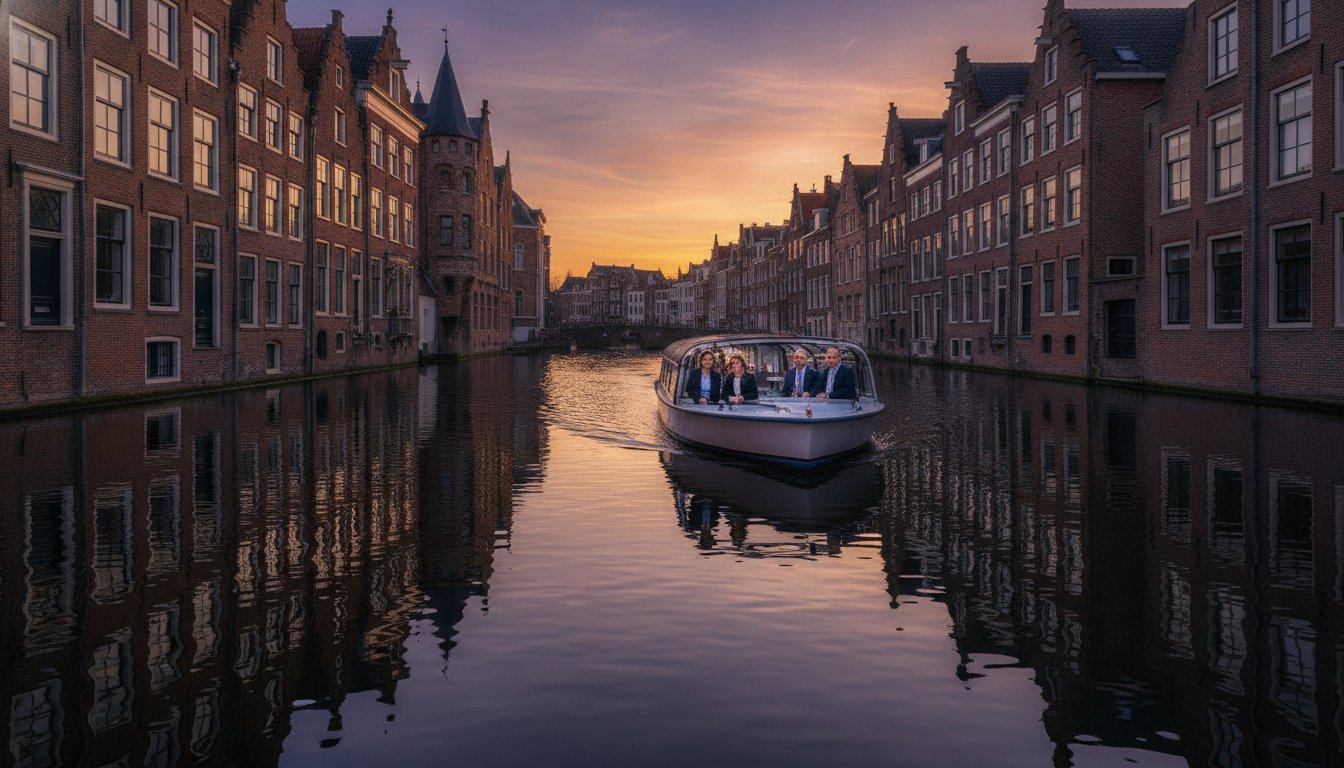
    In contrast, the ‘Reien’ canals of Bruges offer a more localized, romantic atmosphere. This city feels like an open-air museum where the water reflects centuries of Flemish craftsmanship. It’s an ideal anchor for culture group tours benelux itineraries, especially for luxury clients seeking a slower pace. The city’s compact nature makes it exceptionally walkable; it’s a significant advantage for groups that prefer intimate exploration. Integrating a canal cruise here provides a different perspective, focusing on the hidden gardens and stone bridges that a coach cannot reach. To ensure your clients experience these cities without the stress of logistics, consider how a modern private coach fleet can bridge the gap between these iconic waterways.
    Exploring the 'Venice of the North': A Masterclass in European Canal Cities for 2026

    Hidden Gems: Beyond the Tourist Favorites

    While Amsterdam and Bruges are the definitive anchors, the true venice of the north experience often reveals itself in the quieter, more exclusive corners of the continent. Moving beyond the primary hubs allows for a more intimate connection with European water culture. Incorporating these hidden gems into a themed group travel benelux program elevates the itinerary from standard to exceptional. It provides that sought-after sense of discovery that modern clients demand, particularly those who’ve already visited the major capitals.

    Giethoorn: The Car-Free Wonder

    Giethoorn represents the most literal interpretation of a venice of the north, where the absence of roads forces a slower, more intentional pace. For professional organizers, managing a coach group here requires precise coordination. The village is famous for its 18th-century thatched-roof cottages and over 170 small wooden bridges. Groups typically transition from their modern coach to whisper-quiet electric boats or traditional punters. It’s a logistical shift that rewards travelers with a silence rarely found in urban centers. Planning a day trip from Amsterdam or Utrecht is straightforward, provided you’ve secured parking and boat slots in advance to avoid the mid-day peak.

    Amiens and the French Connection

    Further south, Amiens offers a French interpretation of the canal city through its “Hortillonnages.” This 300-hectare network of floating gardens has been cultivated since the Middle Ages. It’s an ideal stop for itineraries bridging the gap between the Benelux region and Paris, areas where we maintain deep operational expertise. Beyond the boat tours, the Saint-Leu district provides a vibrant backdrop for gastronomy experiences. Integrating local Picardy specialties adds a layer of sensory depth to the cultural exploration, ensuring the group’s journey is as flavorful as it is scenic.

    Finally, Strasbourg’s “Petite France” district offers a Franco-German hybrid that shouldn’t be overlooked. The timber-framed houses reflect in the Ill river, creating a dense architectural tapestry. It’s a masterclass in how water management can define a city’s historical and aesthetic identity, providing a perfect conclusion to a multi-city canal tour.

    Water as a Canvas: Architecture and Gastronomy

    The venice of the north isn’t just a geographic label; it’s a visual dialogue between stone and reflection. In these cities, the water acts as a canvas that magnifies the architectural ambition of the merchant class. Strategic water management transformed Benelux cities from utilitarian defensive forts into fluid, artistic masterpieces where every facade tells a story of maritime wealth. During the twilight hours, the role of light becomes paramount. Reflections on the rippling surface soften the rigid lines of brick and mortar, creating a luminous atmosphere that defines the nocturnal beauty of Northern Europe.

    Architectural Evolution on the Water’s Edge

    The transition from the austere Hanseatic brick gothic to the ornate Dutch Baroque is nowhere more evident than along the canal banks. In Amsterdam, the slender, deep merchant houses were designed to maximize waterfront frontage, resulting in the iconic gabled rooftops that lean slightly forward. Meanwhile, the belfries of Flanders stand as vertical sentinels over the medieval waterways, symbolizing civic pride and commercial success. Organizing expert-led architectural walks for specialized groups allows travelers to decode these stylistic shifts. It turns a simple stroll into a technical appreciation of how these cities were literally reclaimed from the sea, one pile and one brick at a time.

    The Gastronomy of the Waterways

    The relationship between the water and the palate is equally profound. A culinary journey through these cities moves seamlessly from the North Sea’s fresh seafood to the historical canal-side breweries that once used these waters for production. Elevating the group experience often involves integrating belgium gastronomy tours that utilize the unique setting of the ‘Reien’ or ‘Grachten’. Imagine a private canal cruise featuring a curated beer or chocolate tasting, where the surroundings enhance the sensory experience. It’s an immersive way to connect with local culture while avoiding the static environment of a traditional restaurant.

    Success in these complex environments relies on the deep local knowledge of a benelux incoming tour operator. We understand that a meal isn’t just about the menu; it’s about the harmony of the location and the ease of access. From sourcing the perfect terrace for a sunset aperitif to coordinating logistical support for large groups, our team ensures every detail is polished. To begin crafting your own bespoke cultural and culinary itinerary, contact our expert planning team today.

    Professional Logistics: Planning the Perfect Canal City Tour

    Organizing a tour through a venice of the north requires more than an eye for beauty; it demands technical precision. The very features that make these cities enchanting, such as narrow cobblestone streets and intricate canal networks, represent significant hurdles for group movement. Success lies in the invisible architecture of the tour: the logistics. A seamless experience is the result of balancing aesthetic desire with the cold reality of urban restrictions.

    Timing is a critical component of our strategy. Managing seasonal crowds is essential for maintaining a high-quality experience for your clients. We often suggest off-peak hours or hidden access points for the most iconic waterways. This ensures the group feels the city’s soul rather than the crowd’s weight. Sourcing central hotels is a similar exercise in balance. We prioritize properties that offer the quintessential canal-side atmosphere while remaining accessible for group arrivals and departures.

    Coach Travel and Accessibility

    Amsterdam and Bruges have implemented strict Low Emission Zones and restricted access areas to preserve their heritage. Navigating these requires up-to-date knowledge and modern equipment. Our private fleet of modern coaches is specifically curated for these environments. We coordinate strategic drop-off points that minimize walking distances for clients while respecting local regulations. It’s about the rhythm of the city. Our drivers act as logistical partners who understand the nuances of tight city schedules and the technical demands of European traffic laws. We turn the challenge of narrow streets into a non-issue through rigorous planning and superior fleet management.

    Curating the Custom Itinerary

    A sophisticated itinerary balances the “must-see” landmarks with silent, off-the-beaten-path water experiences. We believe that local guide services are indispensable for authentic storytelling. These experts decode the history of the gabled houses and the secrets of the locks, adding a layer of intellectual depth to the visual spectacle. Our role as a DMC is to act as the conductor for a multi-modal journey. Transitioning from a coach to a private canal boat, and then to an expert-led walking tour, should feel effortless. BELUNE transforms a standard city visit into a sophisticated cultural immersion, leveraging 20 years of industry experience to ensure every transition is polished and every moment is meaningful.

    Mastering the Waterways of 2026

    Curating a high-end group experience in a venice of the north requires a delicate balance of artistic vision and technical mastery. We’ve explored how the rhythmic canals of Amsterdam and the silent streets of Bruges offer distinct cultural narratives, each demanding its own logistical approach. Success in these environments isn’t just about the destinations; it’s about the precision of the execution. By integrating hidden gems like Amiens and leveraging the sensory depth of local gastronomy, you can offer your clients a journey that feels both exclusive and deeply authentic.

    Navigating the evolving regulations and architectural labyrinths of these cities is a task for a trusted strategist. With over 20 years of dedicated industry experience, our team provides the deep local knowledge and private fleet of modern coaches necessary for seamless movement. We don’t just provide transport; we offer a structural component to your creative project. Partner with BELUNE to design your next masterpiece group itinerary in the Benelux region and ensure your 2026 programs are as fluid as the waterways they celebrate. Let’s transform your vision into an unforgettable reality.

    Frequently Asked Questions

    Which city is officially known as the Venice of the North?

    Amsterdam and Bruges are the most prominent cities associated with the title venice of the north. While many cities across the region use this nickname to highlight their beauty, these two are recognized for their historical maritime influence and preserved canal systems. The designation reflects a specific urban DNA where waterways served as primary trade routes. Choosing the “official” one depends on whether you prioritize Amsterdam’s Golden Age engineering or the medieval intimacy of Bruges.

    Is Amsterdam or Bruges better for a group tour?

    The choice between Amsterdam and Bruges depends entirely on your group’s specific goals and size. Amsterdam offers a vast scale with world-class museums and a rhythmic metropolis feel, making it ideal for larger cultural tours. Bruges provides a more concentrated, romantic atmosphere that is exceptionally walkable for luxury groups. We often recommend integrating both into a single itinerary to provide a comprehensive view of the region’s diverse water-centric heritage; it’s the best way to satisfy varied interests.

    How do coaches access the historic centers of canal cities?

    Coaches access these historic centers through a series of strategic drop-off points designed to respect local Low Emission Zones and traffic regulations. Navigating these narrow streets requires modern equipment and deep technical knowledge of city-specific access permits. We utilize our private fleet of modern coaches to ensure seamless transitions between major landmarks. This approach minimizes walking distances for clients while ensuring the group remains compliant with the evolving environmental standards of European canal cities.

    What is the best time of year to visit the Venice of the North cities?

    Late spring and early autumn are the ideal times to visit these iconic waterways to balance favorable weather with manageable crowd levels. Visiting during these periods allows groups to experience the architectural splendor and canal-side dining without the peak summer congestion. April and May are particularly vibrant due to the floral displays in the Netherlands. Conversely, September provides a softer light and a more serene atmosphere that is perfect for professional architectural walks and cultural immersion.

    Can you visit Giethoorn with a large tour group?

    You can certainly visit Giethoorn with a large group, provided the logistics are coordinated with technical precision. Since the village is car-free, groups must transition from their coach to private electric boats or traditional punters at specific entry points. We manage these transfers to ensure the group moves smoothly from the parking areas into the heart of the village. Advance booking for boat slots is essential to maintain the schedule and avoid the mid-day tourist peak.

    What are the best group activities in a canal-based city?

    The most impactful activities involve engaging directly with the water through private canal cruises or themed walking tours. Gastronomy and beer experience tours are particularly effective, allowing groups to sample local craftsmanship while enjoying the waterfront aesthetic. Architectural walks led by local experts also provide deep intellectual value, decoding the history of gabled merchant houses. For more active groups, cycling along the canal paths offers a dynamic perspective of the urban landscape and its natural surroundings.

    How does a DMC help with canal city logistics?

    A DMC acts as a strategic ally by coordinating the complex multi-modal transport required in water-centric environments. We manage everything from sourcing hotels with coach access to securing private local guides who understand the rhythm of the city. Our 20 years of experience allow us to navigate the technical nuances of local regulations and hidden logistical hurdles. This comprehensive support transforms a standard visit into a polished, high-quality experience that inspires confidence in your professional partners.

    Are there any ‘Venice of the North’ cities in France?

    Amiens is frequently cited as a French venice of the north due to its stunning “Hortillonnages” or floating gardens. Strasbourg also offers a unique Franco-German interpretation through its historic “Petite France” district, where timber-framed houses line the Ill river. These destinations provide an excellent bridge for itineraries moving between the Benelux region and Paris. They offer a distinct sensory experience that complements the more traditional canal cities while adding a layer of exclusivity to your travel programs.
  • Benelux Group Travel Logistics: 2026 Strategic Guide

    Benelux Group Travel Logistics: 2026 Strategic Guide

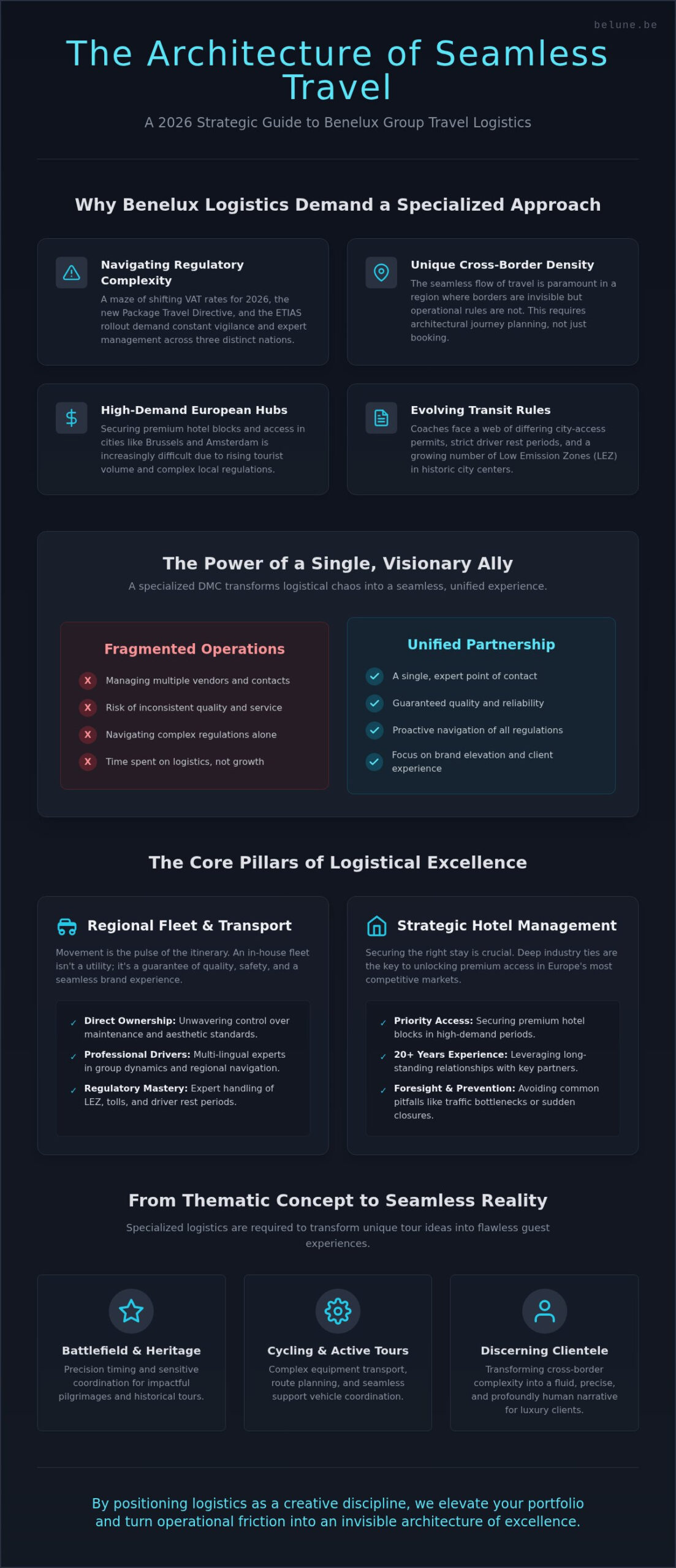
    Can a logistical framework be as evocative as a Dutch Master’s painting? In the 2026 travel landscape, true luxury is found in the absence of friction. You know the weight of managing shifting VAT rates and the intricate dance of securing hotel blocks in high-demand hubs like Brussels or Amsterdam. It’s a delicate balance where the smallest operational delay can disrupt a guest’s immersion. This strategic guide explores how sophisticated Benelux group travel logistics act as the invisible architecture of an exceptional journey.

    We’ll show you how a single point of professional contact and a dedicated, modern coach fleet turn regulatory challenges like the new Package Travel Directive into opportunities for excellence. You’ll discover a blueprint for curated itineraries that reflect your brand’s prestige while navigating the technical realities of the ETIAS rollout and rising tourist taxes. We’re moving beyond simple transport to a vision of movement that is fluid, precise, and profoundly human. By positioning logistics as a creative discipline, we help you transform cross-border complexity into a seamless narrative for your most discerning clients.

    Key Takeaways

    • Understand how the unique cross-border density of the region demands a more sophisticated, architectural approach to journey planning.
    • Discover the strategic advantages of utilizing a private, modern coach fleet to maintain uncompromising quality and reliability for international groups.
    • Learn how expert hotel accommodation management secures premium stays in high-demand European hubs, even amidst shifting 2026 regulations.
    • Explore the specialized logistical coordination required to transform thematic concepts, such as battlefield pilgrimages or cycling tours, into seamless guest experiences.
    • See how a single, visionary ally for Benelux group travel logistics simplifies complex operations, allowing your agency to focus on growth and brand elevation.

    The Architecture of Seamless Benelux Group Travel Logistics

    Logistics is the silent skeleton of a journey. Without it, the most inspired itinerary collapses under the weight of its own complexity. When we discuss Benelux group travel logistics, we aren’t just talking about buses and beds; we’re defining the strategic integration of transport, stay, and timing. It’s a technical discipline that requires a creator’s eye to ensure that the transition between a morning in a Brussels gallery and an evening in an Amsterdam canal house feels effortless rather than exhausting.

    The Benelux region presents a unique challenge of density. Borders are often invisible, yet the regulations governing them are not. This is why mastering Benelux group travel logistics requires more than a map; it requires a visionary ally. A true partner doesn’t just book services; they secure the structural integrity of your tour. By eliminating the friction of multi-country coordination, professional logistics management allows the guest’s emotion to remain the focus of the experience.

    Why Benelux Logistics Demand a Specialized DMC

    Coordinating the distinct fiscal and transit regulations between Belgium, the Netherlands, and Luxembourg is an intricate task. While the Benelux Union fosters economic cooperation, tour operators still face differing VAT structures for 2026 and varying city-access permits for coaches. A specialized DMC acts as a centralized hub, managing these Western European intricacies from a single point of authority. Benelux Logistics is the artistic orchestration of regional travel.

    The Role of Experience in Navigating Regional Intricacies

    Expertise isn’t just about knowing the roads; it’s about the relationships built over 20+ years. These deep industry ties allow us to secure priority access and manage hotel blocks in high-demand periods that others might find inaccessible. Local knowledge prevents the common pitfalls that ruin a day’s flow, such as sudden traffic bottlenecks in Antwerp or unannounced site closures in the Ardennes. For a deeper look at selecting the right partner, consult the definitive guide to choosing a Benelux incoming tour operator in 2026. This level of foresight ensures that the logistical framework remains invisible, leaving only the beauty of the destination for your groups to enjoy.

    Orchestrating Regional Fleet and Transport Logistics

    Movement is the pulse of any itinerary. It’s the transition between a quiet morning in the Ardennes and the vibrant energy of a Dutch city. In 2026, the quality of this movement defines the group’s perception of luxury. When we manage Benelux group travel logistics, we treat the coach not as a utility, but as a structural component of the guest experience. Owning a private fleet allows us to maintain a standard of excellence that sub-contracted services simply can’t replicate. By centralizing Benelux group travel logistics through a single owner-operator, you eliminate the risk of fragmented service and ensure the journey remains fluid and unhurried.

    The Advantage of an In-House Coach Fleet

    Direct ownership means direct responsibility. We don’t rely on third-party schedules or varying maintenance standards. Our modern coaches are kept to a rigorous technical and aesthetic baseline, reflecting the sophisticated image our B2B partners wish to project. This creates a seamless synergy between the driver, the guide, and the tour operator. The driver isn’t just a pilot; they’re a multi-lingual professional who understands the nuances of international group dynamics. This integration ensures that the ‘minimalist elegance’ we promise is felt in every mile. It’s about reliability that inspires confidence.

    Navigating Cross-Border Transport Regulations

    Cross-border travel involves a complex web of technicalities. From strict driver rest periods to the evolving Low Emission Zones (LEZ) in historic city centers, the logistical burden is significant. Professional management handles the intricacies of regional parking laws and tolls across the Benelux and into Paris. According to European tourism statistics, the rise in regional travel demands even greater precision in transit timing to avoid bottlenecks. We navigate these regulations so the coach remains a mobile sanctuary, a place where guests can reflect on their journey in total comfort.

    High-end group travel in 2026 requires a specific technical baseline to meet guest expectations:

    • Ergonomic seating with premium materials for long-distance comfort.
    • Advanced climate control systems for optimal air quality and temperature precision.
    • Integrated connectivity and power solutions for the modern, connected traveler.
    • Sustainable engine technology to ensure access to restricted city centers.

    If you’re looking to elevate your next itinerary, consider our bespoke coach hire solutions as your strategic foundation. This level of foresight transforms a simple transfer into an essential part of the story you’re telling.

    Benelux Group Travel Logistics: 2026 Strategic Guide

    Strategic Hotel Accommodation and Partner Management

    If transport is the pulse of a journey, accommodation is its anchor. In the high-demand hubs of Western Europe, securing a hotel is more than a transaction; it’s a strategic maneuver. Within the framework of Benelux group travel logistics, our Hotel Accommodation Management service acts as a core pillar of success. We don’t just book rooms. We orchestrate the entire stay to ensure it aligns with the rhythmic flow of the itinerary. This involves managing centralized billing and booking for complex multi-stay tours, which reduces the administrative burden on our B2B partners.

    High-demand periods across the region require foresight and established relationships. According to official Belgian tourism statistics, the volume of overnight stays in professional accommodations continues to demand rigorous planning to ensure availability for larger groups. We select partners who meet uncompromising B2B standards, focusing on properties that understand the specific needs of international tour operators. This centralized approach guarantees that every partner in the chain reflects your brand’s commitment to quality.

    Sourcing Group-Friendly Stays

    Evaluating a property requires a technical eye. We prioritize hotel accessibility for large coaches, ensuring that arrivals and departures are discreet and efficient. The balance between a central location and logistical ease is delicate. A hotel must offer more than aesthetic appeal; it must provide the physical space required for group movements without friction. For more insights on this process, see our guide on sourcing group-friendly hotels in Brussels & Amsterdam.

    Vetting Local Partners and Guides

    The final component of a logistical plan is the human element. Our local guides are selected through a rigorous process that prioritizes multi-lingual expertise and a deep, poetic understanding of their city. These partners act as extensions of our commitment to excellence. They aren’t just narrators; they’re logistical problem-solvers on the ground. By vetting every guide and local service provider, we ensure that the visionary quality of the tour remains consistent from the first welcome to the final farewell. This meticulous selection process is what transforms a standard tour into a signature brand experience.

    Thematic Logistical Execution: From Heritage to Gastronomy

    Every itinerary possesses a unique rhythm. A cultural journey through the silent galleries of a museum requires a stationary logistical approach, focusing on proximity and unhurried transitions. Conversely, an active cycling tour across the windswept polders demands a mobile architecture of support vehicles and invisible luggage transfers. Mastering Benelux group travel logistics means adapting the technical skeleton of a tour to its emotional soul. We don’t believe in templates; we believe in the surgical precision of movement that serves the story you’re telling.

    Logistics for Battlefield and Remembrance Tourism

    Remembrance tourism requires a specific sensitivity. Coordinating a pilgrimage to sites like Flanders Fields isn’t merely about transit timing; it’s about respecting the cadence of memory. These itineraries demand expert guides who specialize in military history and the ability to navigate complex site access during peak commemorative periods. We manage the delicate synchronization between the coach arrival and the start of local ceremonies, ensuring your group remains immersed in the moment rather than the mechanics of the day. For a deeper exploration of these specialized journeys, consult our guide on Flanders Fields: The Definitive Guide to WWI Remembrance and Group Pilgrimages in 2026.

    Gastronomy and Active Travel Coordination

    High-end gastronomy and beer tours rely on absolute reservation precision. Whether it’s a private workshop with a master chocolatier or a behind-the-scenes brewery visit, the logistical flow must be flawless. We treat these appointments as fixed points around which the day’s movement is elegantly draped. For active groups, the requirements shift toward technical support. Cycling tours across the Benelux landscape require dedicated support vehicles and gear management that happens entirely out of the guest’s sight. This level of coordination is detailed in our masterclass on Belgium Gastronomy Tours: A Masterclass in Culinary Artistry for Groups.

    Thematic execution is where our technical mastery meets your creative vision. By tailoring the logistical framework to the specific needs of the theme, we ensure that the guest’s experience remains pure and uninterrupted. If you’re ready to design a journey that transcends the ordinary, start your bespoke itinerary planning today with an ally who understands the art of the detail.

    Elevating Your Portfolio through Professional DMC Partnership

    The true value of a partnership isn’t found in a simple list of services. It’s found in the liberation of your team’s creative and commercial energy. By entrusting your Benelux group travel logistics to a specialized ally, you shift from the granular management of multiple local vendors to the strategic expansion of your own portfolio. This transition allows you to focus on high-value sales and brand growth while we handle the technical orchestration of movement, accommodation, and timing. With 24/7 on-the-ground support and direct control over our private coach fleet, we provide the security required to deliver projects of exception across Belgium, the Netherlands, Luxembourg, and into Paris.

    The Seamless B2B Collaboration Model

    Our collaboration model is built on a foundation of transparency and technical rigour. We develop fully customized, fixed-price group packages that eliminate the financial ambiguity often associated with multi-country itineraries. This reliability in service delivery is the result of 20 years of industry trust and refined expertise. You don’t just get a vendor; you gain a structural component of your own business. We act as your eyes and ears in the region, ensuring that every detail, from hotel check-ins to precise driver schedules, reflects your brand’s uncompromising quality. This centralized approach to Benelux group travel logistics simplifies your billing and operations, creating a more efficient path to success.

    Starting Your Custom Benelux Journey

    The process begins with a collaborative consultation where your vision meets our technical expertise. We listen to your goals and translate them into a feasible, artistic itinerary that leverages our deep regional knowledge. During this design phase, we identify potential bottlenecks and optimize the flow of the journey before the first guest even arrives. By leveraging our technical vision, you can offer your clients experiences that are as seamless as they are memorable. We invite you to move beyond the ordinary and embrace a partnership that values excellence as much as you do.

    When you’re ready to transform your regional offerings, we’re here to provide the architectural foundation. Partner with BELUNE to realize your next group travel project and discover the power of sophisticated logistical coordination.

    Architecting the Future of Regional Travel

    The 2026 travel landscape demands more than simple coordination; it requires a vision where every transfer and stay feels like a structural element of a larger story. We’ve explored how a private fleet and strategic accommodation management eliminate the friction of cross-border movement. By centralizing your Benelux group travel logistics, you secure a foundation of reliability that protects your brand’s reputation. Our 20+ years of regional expertise and dedicated B2B support ensure that your itineraries remain as precise as they are inspiring. It’s about moving beyond the role of a vendor to become a visionary ally in your success.

    Our directly owned fleet of modern coaches provides the flexibility needed for projects of exception, from battlefield pilgrimages to culinary masterclasses. Let’s transform technical complexity into a seamless narrative for your groups. We’re ready to provide the architectural precision your portfolio deserves. Request Your Custom Benelux Group Tour Itinerary and let’s begin designing your next masterpiece together.

    Frequently Asked Questions

    What are the primary benefits of using a DMC for Benelux group travel logistics?

    A DMC provides a single point of contact and deep regional expertise. By centralizing Benelux group travel logistics, you eliminate the friction of managing multiple local vendors across borders. Partners benefit from fixed-price packages and 24/7 on-the-ground support. This professional oversight ensures that the technical aspects of a tour, such as transit timing and site access, remain invisible to the guest while reflecting the tour operator’s brand quality.

    How does owning a private coach fleet improve the group travel experience?

    Owning a private fleet ensures uncompromising reliability and flexibility. When a DMC manages its own modern coaches, they have direct control over maintenance, cleanliness, and driver training. This eliminates the uncertainty of sub-contracted services. It allows for seamless scheduling changes and ensures that the vehicle acts as a consistent mobile sanctuary. The integration between the driver and the logistical hub means transitions are fluid and unhurried throughout the journey.

    Can a DMC manage group travel logistics across multiple countries including France?

    Yes, professional DMCs like BELUNE specialize in cross-border coordination across Belgium, the Netherlands, Luxembourg, and into Paris. Managing Benelux group travel logistics often requires extending services into neighboring regions to create a cohesive Western European narrative. This includes handling differing transit regulations, tolls, and parking laws across international lines. A centralized approach ensures that the guest experience remains high-end and consistent regardless of the number of border crossings.

    What is included in professional hotel accommodation management for groups?

    Professional management includes sourcing, vetting, and securing group-friendly hotels that meet strict B2B standards. It goes beyond simple booking by managing centralized billing and ensuring accessibility for large coaches. Experts evaluate properties based on their capacity to handle group movements without friction. This service provides tour operators with peace of mind, knowing that every stay is strategically integrated into the itinerary’s rhythm and adheres to 2026 regulatory requirements.

    How do local guide services integrate with the overall logistical plan?

    Local guides are the human element that brings the logistical skeleton to life. They’re vetted for multi-lingual expertise and deep thematic knowledge, acting as on-the-ground problem solvers. By integrating guides into the broader plan, the DMC ensures that the storytelling is perfectly synchronized with transport arrivals and site reservations. This synergy prevents timing bottlenecks and ensures that the guest’s immersion in cultural or heritage sites is never interrupted by technical delays.

    Why is the Benelux region considered a complex logistical environment for groups?

    The complexity arises from the region’s high density and the invisible but significant regulatory differences between three distinct nations. While the Benelux Union facilitates cooperation, tour operators must still navigate varying VAT structures, city-access permits, and strict Low Emission Zone requirements. High demand in major regional hubs requires long-term industry relationships to secure priority access. Professional management is essential to transform this technical density into a seamless travel experience.

    What should tour operators look for when vetting a Benelux incoming tour operator?

    Priority should be given to partners with at least 20 years of industry experience and a directly owned fleet of coaches. Look for a DMC that offers comprehensive B2B support, including hotel management and specialized thematic expertise. Transparency in pricing and a single point of contact for the entire region are critical indicators of professional reliability. An ideal partner acts as a visionary ally, focusing on the architectural integrity of the tour.

  • Mastering Museum Logistics for Large Groups: A Professional Guide for 2026

    Mastering Museum Logistics for Large Groups: A Professional Guide for 2026

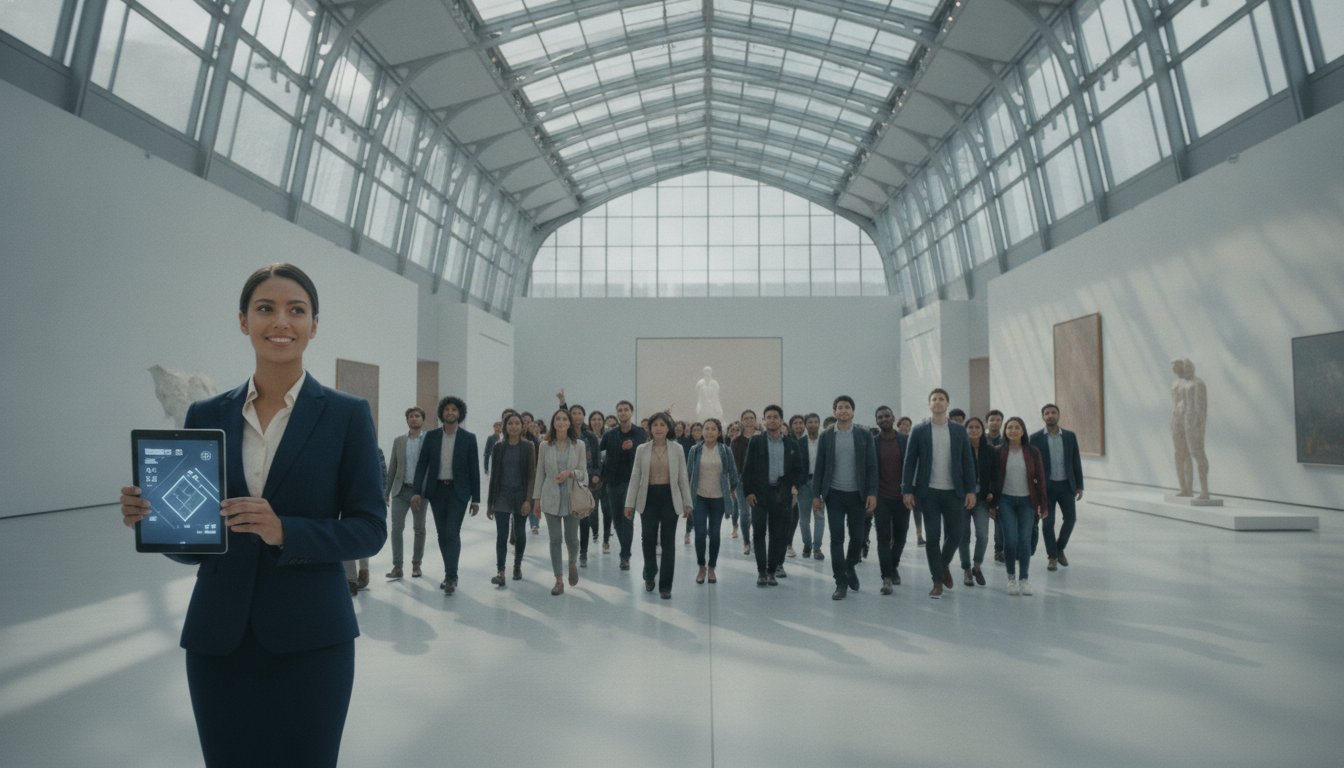
    The difference between a chaotic tour and a masterpiece of coordination lies in the choreography of the silence before the doors even open. For the modern travel professional, mastering museum logistics for large groups isn’t just an administrative task; it’s the high-stakes art of managing time, space, and human emotion. You’ve likely felt the tension of a coach circling a Parisian boulevard with no parking in sight, or the frustration of a timed-entry window closing while a local guide navigates a new security protocol. It’s a delicate balance that can easily tip from inspiration to exhaustion without a vision for the technical details.

    This guide provides a technical and artistic roadmap to managing seamless large-scale visits across Western Europe in 2026. We’ll show you how to navigate the shift toward digital integration and strict accreditation, such as the new Vatican guide requirements or the precise booking windows at the Obama Foundation Museum. You’ll discover how to orchestrate a fluid transition from coach arrival to gallery entry, ensuring your clients enjoy an exclusive atmosphere regardless of the crowd size. We’re moving beyond simple sightseeing to create a structured, effortless experience that values both the heritage of the site and the precious time of your guests.

    Key Takeaways

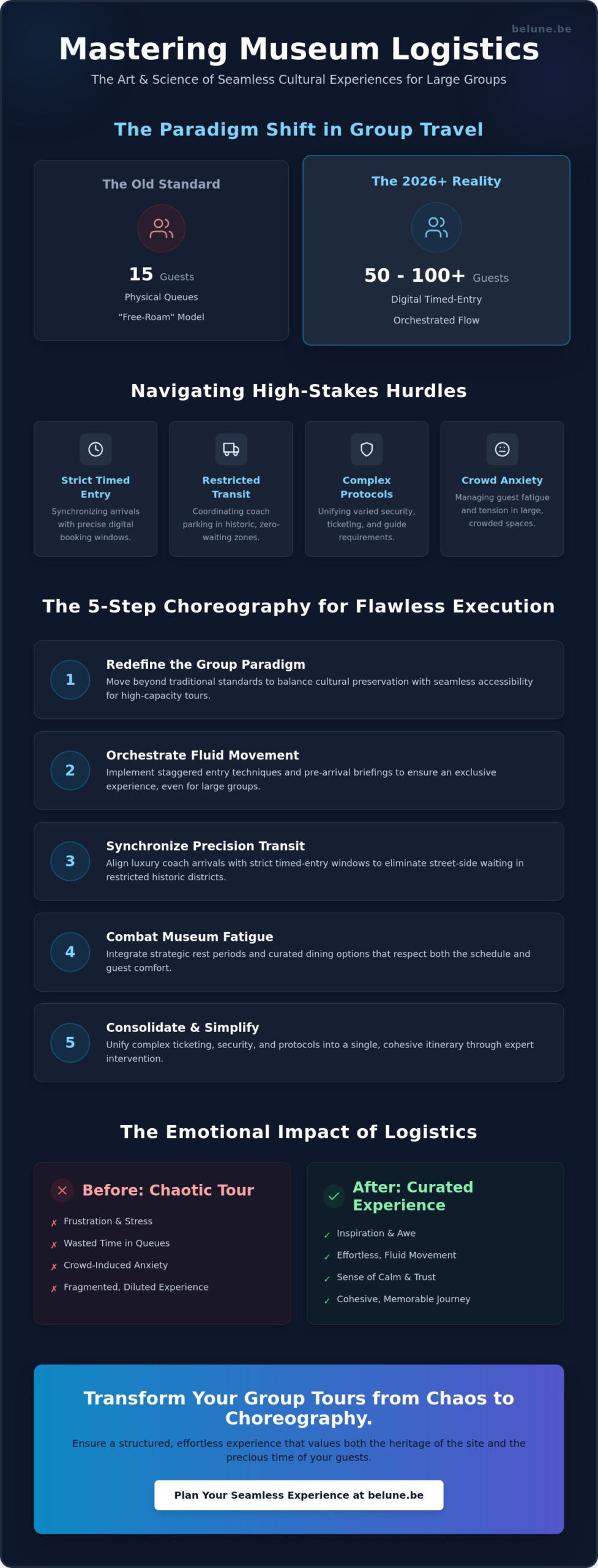
    • Redefining the Large Group Paradigm: Move beyond traditional standards to balance cultural preservation with seamless accessibility for high-capacity tours.
    • The Art of Fluid Movement: Implement staggered entry techniques and pre-arrival briefings to ensure an exclusive experience, even for groups exceeding 50 guests.
    • Precision in Transit: Synchronize luxury coach arrivals with strict timed-entry windows to eliminate street-side waiting in restricted historic districts.
    • Combating Museum Fatigue: Integrate strategic rest periods and curated dining options that respect both the schedule and the guest’s physical comfort.
    • Strategic Consolidation: Discover how expert intervention simplifies museum logistics for large groups by unifying complex ticketing and security protocols into a single, cohesive itinerary.

    The Fundamentals of High-Capacity Cultural Logistics

    In 2026, the definition of a “large group” has undergone a significant transformation. While 15 guests once served as the industry benchmark, modern museum logistics for large groups now frequently involve managing parties of 30, 50, or even 100 individuals. This shift requires a technical mastery that balances the delicate preservation of historic spaces with the logistical demand for accessibility. It’s no longer just about purchasing tickets; it’s about the artisanal orchestration of movement within a restricted volume to ensure the art remains the primary focus.

    The traditional “free-roam” model, where guests are left to navigate galleries independently, often collapses under the weight of high-end expectations. For international groups, this lack of structure leads to fragmented experiences, lost time, and a diluted emotional impact. We act as a strategic ally, bridging the gap between rigid museum administrations and the fluid needs of tour operators. By applying professional crowd management principles, we transform a potentially chaotic entry into a serene, curated arrival that honors the venue’s heritage.

    To better understand how cultural institutions view these partnerships, watch this helpful video:

    The Evolution of Museum Entry Systems

    Museums have transitioned from physical queues to sophisticated digital timed-entry systems that demand absolute precision. Understanding the technical nuances between “Travel Trade” portals and “General Public” booking pathways is essential for any professional operator. Trade pathways often offer the stability and advance windows needed for complex itineraries, whereas public systems can be volatile and subject to immediate sell-outs. The modern timed-entry protocol serves as a sophisticated tool to guarantee guest satisfaction by eliminating unpredictable waiting times and ensuring a smooth transition into the cultural space.

    The Emotional Impact of Group Logistics

    Logistics isn’t merely a series of data points; it’s a direct influence on the human psyche. High-end travelers often experience “crowd anxiety” when faced with the scale of major European institutions. A sophisticated arrival sequence reduces this tension, allowing the beauty of the collection to resonate immediately. When a group moves effortlessly from coach to gallery, it builds an immediate sense of trust in the tour operator’s expertise. The role of a specialized partner in managing museum logistics for large groups is to turn administrative hurdles into invisible, elegant infrastructure. Consolidating these variables into a single, cohesive plan is why choosing a fixed-price group package through a specialized agency is the most reliable path to excellence.

    The Choreography of Movement: Managing Capacity and Flow

    Mastering the physical flow of a large group requires a proactive stance. Waiting until you reach the museum steps is too late. The rehearsal begins on the coach. This is where we define the success of museum logistics for large groups. A precise pre-arrival briefing ensures guests understand the sequence of security, cloakroom access, and the transition into the galleries. When guests know exactly where to go and what to expect, the collective anxiety of the group dissolves, replaced by a sense of calm anticipation.

    To maintain an atmosphere of quiet reverence, we employ whispering systems. These digital headsets allow guides to speak at a conversational volume while guests explore freely within a specific radius. This technical approach aligns with a broader introduction to museum logistics, where the primary goal is to minimize the group’s footprint on the cultural environment. It’s about being present without being intrusive. We focus on four critical pillars of movement:

    • Pre-arrival briefings: Clarifying the entry sequence before the group leaves the coach.
    • Staggered entry: Splitting 50+ guests into smaller cohorts to avoid overwhelming security checkpoints.
    • Whispering systems: Ensuring high-fidelity guiding that doesn’t disrupt other visitors.
    • Bottleneck management: Proactive handling of cloakrooms and gift shops to maintain a steady pace.

    Bottlenecks are the enemies of elegance. Security and cloakrooms often represent the most significant friction points in any itinerary. We manage these by timing the arrival of smaller cohorts. If you have 60 guests, splitting them into three groups of 20 with 10-minute intervals prevents the “huddle” effect. While one group clears security, the next receives a curated introduction to the museum’s architecture or history outside the main gates.

    Advanced Timing Strategies for 2026

    We calculate “dwell time”—the period spent engaging with masterpieces—against “transit time” between halls. In 2026, we’ve refined the “First-In, Last-Out” method for group rotations across multi-museum regional tours. This ensures that while Group A is finishing at one site, Group B is just beginning at the next, avoiding overlap in narrow corridors or popular galleries. If you’re looking for a partner to orchestrate these complex movements, our team can streamline your regional itinerary with technical precision.

    Local Guides: The Human Element of Logistics

    The technical plan only succeeds with a skilled human interface. Utilizing professional local guide services benelux is essential for navigating the internal, often unwritten, protocols of European institutions. These guides act as logistical liaisons. They know which elevator is faster and which gallery entrance is less congested on a Tuesday morning. We brief our guides on the specific pace and interests of your guests, ensuring the narrative remains fluid and the group never feels rushed or stagnant.

    Mastering Museum Logistics for Large Groups: A Professional Guide for 2026

    Integrating Luxury Transport with Museum Arrivals

    The arrival at a cultural monument is the first physical movement of a curated performance. For travel professionals, the transition from the vehicle to the gallery represents one of the most complex phases of museum logistics for large groups. Historic districts in cities like Amsterdam, Brussels, or Bruges present a unique “Drop-off/Pick-up” dilemma. Restricted access zones and narrow cobblestone streets mean that a coach cannot simply idle at the entrance. It requires a synchronized ballet where the driver, guide, and museum security act in total unison to ensure guests never spend a single minute waiting on a sidewalk.

    Precision is the only currency that matters here. We synchronize coach arrival with the exact start of a timed-entry window. This prevents the “street-side huddle,” an experience that immediately diminishes the prestige of a high-end tour. During the visit, driver management becomes a silent but vital component. A professional driver doesn’t just park; they manage their hours and hospitality protocols to ensure the coach remains a pristine, climate-controlled sanctuary the moment the group emerges from the museum’s exit. This level of coordination is especially critical for regional tours where guests visit multiple sites in a single day.

    The Technical Side of Coach Hire

    In 2026, access is increasingly tied to the environmental footprint of the transport provider. Having an own fleet of modern coaches is a logistical game-changer. It allows for absolute control over the vehicle’s technical specifications, ensuring every bus meets the latest Low-Emission Zone (LEZ) standards required to enter the heart of European cultural hubs. Real-time communication between the driver and the tour leader allows for instant adjustments. If a group finishes a gallery tour five minutes early, the coach is already moving toward the designated pick-up point before the guests even reach the gift shop.

    Arrival Etiquette and Professionalism

    Professionalism extends to the “deboarding” process. We train our teams to manage this transition with minimal public disruption, treating the sidewalk as an extension of the museum’s lobby. The driver’s role in the logistical chain is to facilitate an effortless exit and reentry. By maintaining the coach as a mobile sanctuary, equipped with the necessary comforts and a calm atmosphere, we ensure the emotional energy of the museum visit isn’t lost during the transit to the next destination. It’s about preserving the continuity of the experience from one masterpiece to the next.

    Addressing the Challenges of Group Dining and Rest Periods

    The transition from a gallery’s silent reverence to a dining room’s social energy is a critical pivot in any itinerary. We recognize that “Museum Fatigue” isn’t just a fatigue of the body; it’s a saturation of the senses. Planning strategic breaks is a core component of effective museum logistics for large groups. It’s the difference between a guest feeling inspired and a guest feeling overwhelmed. Moving 50 or more people from a masterpiece to a table in under 15 minutes requires a technical choreography that starts long before the appetizer is served.

    Choosing between in-museum catering and an external restaurant depends on the narrative of the day. While in-museum dining offers convenience, an external venue provides a change of atmosphere that resets the group’s focus. We manage dietary requirements at scale by coordinating with chefs weeks in advance. This ensures that even the most complex needs don’t delay the group’s flow. Our goal is to make the meal a continuation of the day’s elegance rather than a logistical hurdle.

    The Gastronomic Transition

    We believe a cultural journey should be mirrored by a culinary one. Integrating belgium gastronomy tours into a museum day transforms a simple lunch into a sensory extension of the art. We source restaurants that reflect a minimalist elegance, avoiding the noise of typical group venues. By utilizing pre-ordered menus, we ensure the group is seated and served with a precision that respects the afternoon’s schedule. If you want to elevate your group’s dining experience, you can book a curated culinary sequence with our specialists.

    Rest and Reflection: The Hidden Logistics

    Structured days must breathe. We identify “quiet zones” within or near museums for senior travelers who may need a moment of stillness. Managing “early leavers”, those who wish to return to the hotel before the main group, is a logistical necessity that we handle without disrupting the collective experience. It’s about providing a mobile sanctuary for every guest, regardless of their pace. This flexible approach ensures that high-capacity logistics remain invisible, leaving only the memory of an exceptional day.

    Why a Specialized DMC is Essential for High-End Group Itineraries

    Twenty years of immersion in the Benelux landscape has taught us that excellence isn’t found in a brochure; it’s forged in the quiet resolution of complexity. For the international tour operator, the challenge of museum logistics for large groups often lies in the invisible friction of administrative fragmentation. Coordinating separate contracts for transport, guiding, and entry for a party of 50 is a high-stakes endeavor where a single delay ripples through the entire itinerary. We act as a strategic ally, consolidating these disparate elements into a single, cohesive fixed-price group package that provides both financial clarity and operational certainty.

    Real-world expertise is most visible when the unexpected occurs. On-the-ground crisis management is a pillar of our service. Whether it’s a sudden museum closure due to a private event or a last-minute change in security protocols, our local presence allows us to pivot instantly. We don’t just solve problems; we anticipate them. This proactive stance enables us to customize itineraries to include niche cultural heritage, those hidden gems and private collections often missed by generic operators, ensuring your guests experience the authentic soul of Western Europe.

    The BELUNE Difference: Technical Excellence

    Our methodology treats every component of the journey as a structural element of the final experience. This includes a sophisticated approach to hotel accommodation management, where we prioritize properties in immediate proximity to cultural hubs to minimize transit fatigue. There’s a vital synergy between our private coach fleet, our accredited guides, and our direct relationships with museum administrators. A single point of contact for every complex logistical variable offers the profound peace of mind needed to focus entirely on your guests’ emotional engagement with the art.

    Building Lasting Partnerships with Tour Operators

    We don’t view ourselves as a mere supplier. We act as your local office in Western Europe, a visionary partner dedicated to the realization of exceptional projects. This transition from “provider” to “strategic ally” means we’re as invested in the project’s success as you are. Our team is currently designing bespoke programs for the upcoming season, blending technical precision with artistic flair. If you’re ready to redefine what’s possible for your clients, we invite you to request a custom itinerary for 2026 and discover the power of professional museum logistics for large groups handled with artisanal care.

    Orchestrating the Future of Cultural Touring

    The successful execution of high-capacity visits depends on the silent harmony between movement, transport, and timing. We’ve seen how technical precision in arrival sequences and the human touch of specialized guiding transform a daunting itinerary into a fluid, emotional journey. Mastering museum logistics for large groups in 2026 requires a shift from reactive management to a proactive, artistic mastery of cultural spaces. It’s about ensuring the logistics remain invisible so the art can take center stage.

    Our team brings over 20 years of DMC expertise to the table, supported by a private fleet of modern luxury coaches specifically maintained for the restricted zones of the Benelux region and Paris. This deep specialization allows us to turn logistical friction into a seamless, high-end experience for your most discerning guests. We invite you to partner with BELUNE for your 2026 group museum logistics and experience the difference of a truly integrated approach. Let’s work together to ensure that while the world watches the art, your operations remain a masterpiece of invisible excellence. Your vision deserves a partner who values precision as much as you do.

    Frequently Asked Questions

    How do we manage group entry if the museum has strict timed-entry slots?

    We manage strict windows by dividing large groups into smaller cohorts and staggering their arrival. For a party of 60, we typically secure three consecutive slots of 20 guests at 10 or 15 minute intervals. This technical approach prevents a bottleneck at security and ensures a fluid transition from the coach to the gallery without the group ever feeling rushed or stagnant.

    What is the ideal group size for a guided museum tour in 2026?

    The ideal ratio for a high-end experience is 15 to 20 guests per local guide. While we frequently handle museum logistics for large groups exceeding 50 people, we always fragment them into smaller, manageable units. This preservation of scale ensures that the acoustic quality remains high and the movement through narrow gallery corridors doesn’t disrupt the museum’s serene atmosphere.

    Can coaches park directly at major museums in the Benelux region?

    Direct parking at museum gates is increasingly rare in historic European centers due to Low-Emission Zone regulations. We utilize designated drop-off and pick-up points located at the nearest authorized perimeter. Our drivers coordinate with the tour leader in real time to ensure the coach arrives exactly as the group exits, maintaining a seamless flow between the institution and their mobile sanctuary.

    How does BELUNE handle last-minute museum closures or strikes?

    We provide immediate on-the-ground crisis management through our established local network. If a site closes unexpectedly, our team pivots to a pre-verified alternative of equal cultural prestige. Because we maintain direct relationships with museum administrations, we often receive early warnings of potential disruptions, allowing us to adjust the itinerary’s architecture before the guests even become aware of a conflict.

    Are whispering systems provided for large group tours?

    Yes, digital whispering systems are a foundational component of our logistical infrastructure. These headsets allow guides to speak at a conversational volume, ensuring every guest receives the narrative with high-fidelity clarity. It’s a non-disruptive solution that respects the museum’s environment while allowing guests the freedom to linger at a masterpiece without losing the thread of the story.

    Is it possible to arrange private, after-hours museum visits for large groups?

    Private, after-hours access is one of the most prestigious options we coordinate for our partners. We work with curators to open galleries during “off-peak” hours, providing an exclusive silence that is impossible to find during public opening times. These sessions require significant lead time but offer an unparalleled level of emotional engagement and exclusivity for high-capacity international groups.

    How far in advance should we book museum logistics for a group of 50+?

    We recommend starting the planning process six to nine months before the intended travel date. Many institutions open their 2026 travel trade portals early, and the most desirable timed-entry windows for museum logistics for large groups fill up rapidly. Securing your slots early also guarantees the availability of our private luxury coach fleet and the most experienced local guides.

    Do children and seniors count towards the total group capacity for bookings?

    Every individual counts as a full visitor toward the museum’s total capacity regardless of their age. Museums base their entry limits on strict fire safety and preservation protocols, which means a child or senior occupies a space just as an adult does. We factor these demographics into our planning to ensure the pace of the tour and the proximity of rest areas are perfectly calibrated.

  • Authentic Benelux Cultural Tours: The 2026 Guide for Tour Operators

    Authentic Benelux Cultural Tours: The 2026 Guide for Tour Operators

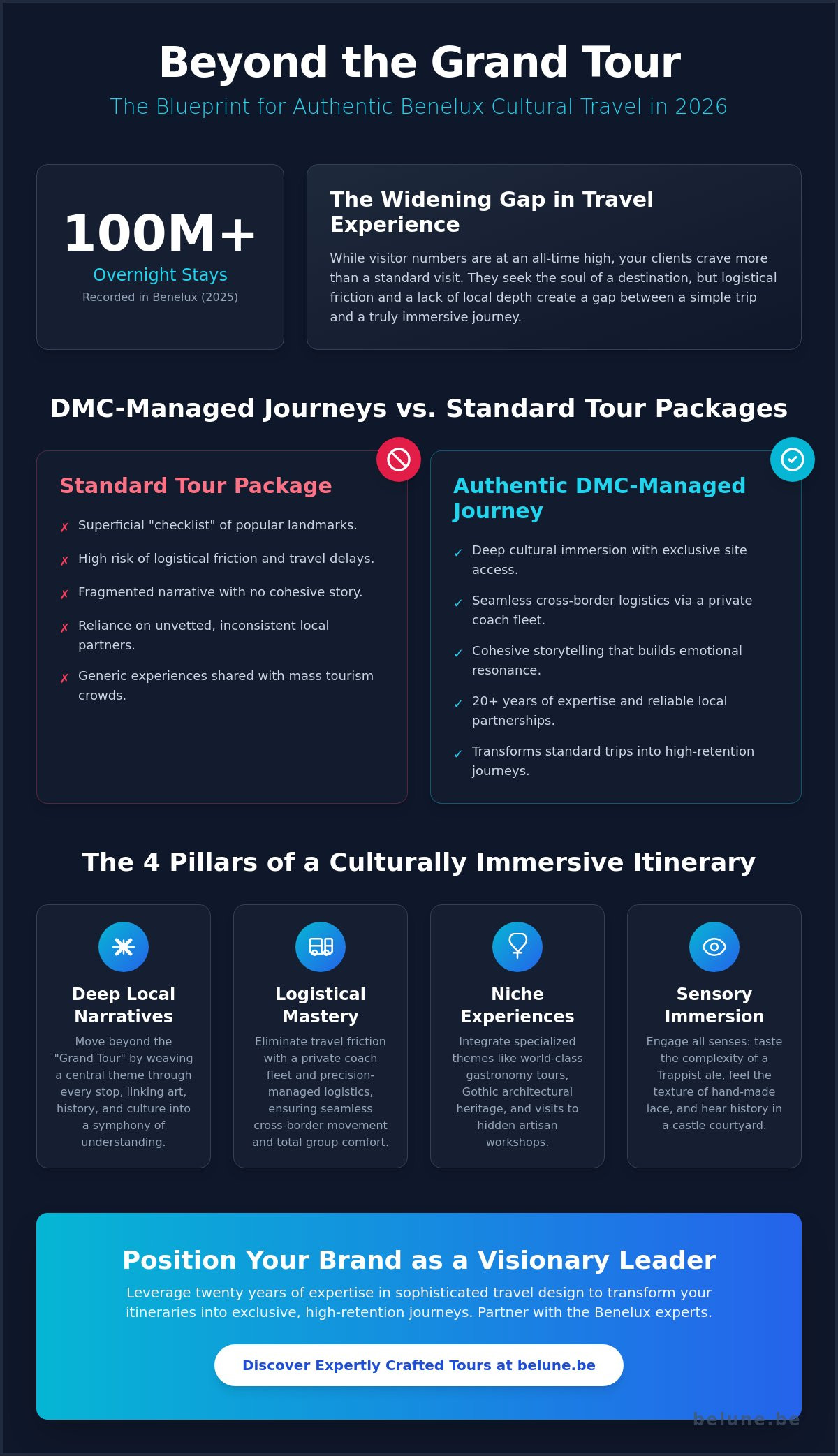
    In 2026, cultural authenticity is no longer a marketing buzzword; it’s a direct result of logistical mastery. With over 100 million overnight stays recorded across Belgium, the Netherlands, and Luxembourg in 2025, the region is more popular than ever, yet the gap between a standard visit and a truly immersive journey is widening. You understand that your clients crave more than just a view of the Grand Place or a stroll through the Rijksmuseum. They seek the soul of a destination, yet managing complex cross-border group logistics and finding reliable local partners remains a constant friction point. This guide reveals how to curate authentic benelux cultural tours that blend deep heritage storytelling with a level of operational precision that eliminates travel friction.

    We’ll explore how to leverage exclusive site access, reliable private coach fleets, and expert local narratives to transform standard itineraries into seamless, high-retention experiences. From navigating the implications of the new EU Package Travel Directive to mastering the art of gastronomy and beer tours, you’ll discover how to position your brand as a visionary leader in European travel. We’ll show you how to bridge the gap between historic heritage and flawless execution, ensuring your partners feel the security of expert management while your guests experience the poetry of a well-told story.

    Key Takeaways

    • Move beyond the “Grand Tour” by integrating deep local narratives and sensory experiences that reveal the region’s true soul.
    • Discover the logistical blueprint for authentic benelux cultural tours that ensure seamless cross-border movement and total group comfort.
    • Master the integration of niche experiences, from Gothic architectural heritage to the artisanal mastery of world-class gastronomy and beer.
    • Eliminate the hidden risks of uncoordinated travel by leveraging a private coach fleet and the precision of DMC-managed logistics.
    • Learn how twenty years of expertise in sophisticated travel design can transform standard itineraries into exclusive, high-retention journeys.

    Defining Authenticity in Benelux Cultural Travel

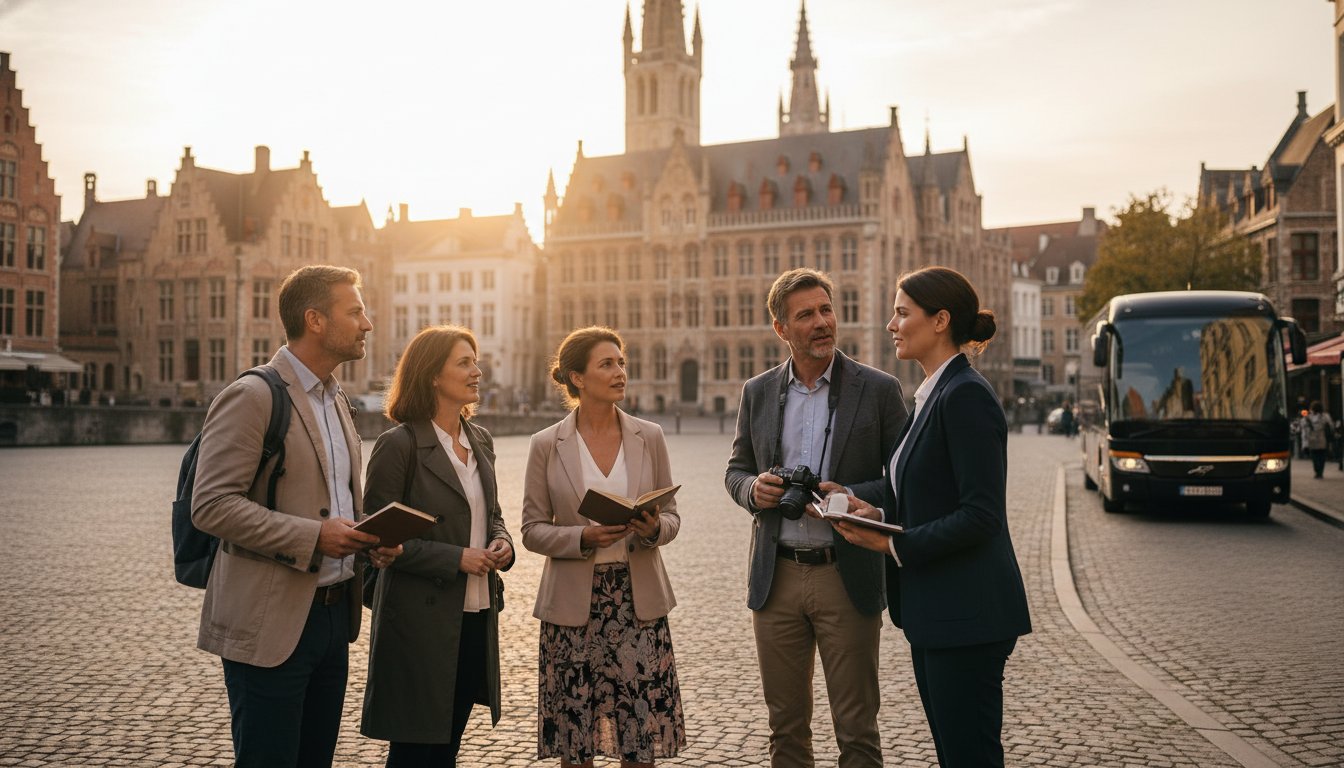
    Authenticity isn’t a museum exhibit behind glass. It’s the scent of damp cobblestones in Bruges after a rainstorm. It’s the silent weight of history in a Luxembourgish valley. In 2026, sophisticated travelers reject the superficial “Grand Tour” approach. They want a dialogue with the past. They crave emotional resonance. To deliver authentic benelux cultural tours, operators must look past the obvious landmarks. The Benelux Union offers a unique laboratory where medieval traditions and avant-garde European politics coexist. This complexity is why expert storytelling isn’t an optional extra; it’s the core of the traveler’s experience.

    To better understand how these landscapes hold secret stories, watch this helpful video:

    The 2026 traveler demands more than a checklist of monuments. They seek a sensory journey. They want to feel the texture of hand-made lace, taste the complexity of a Trappist ale, and hear the echoes of history in a castle courtyard. This shift toward “slow travel” requires a move away from cookie-cutter itineraries. It demands an artisanal approach to travel design where the logistics are invisible, but the emotional impact is profound.

    The Cultural Tapestry of Belgium, Netherlands, and Luxembourg

    Every kilometer in this region reveals a new layer of identity. Belgium’s linguistic diversity and the Netherlands’ hydraulic mastery aren’t just facts; they’re the foundations of daily life. Crafting authentic benelux cultural tours requires an intimate knowledge of these regional nuances. We identify sites that avoid the fatigue of mass tourism. Instead of a crowded square, we might favor a private garden in a Dutch manor or a hidden artisan workshop in the Ardennes. This selection process requires a visionary eye. It’s about finding the soul of a place through its people and their crafts.

    Why Tour Operators Must Prioritize Narrative Cohesion

    A successful itinerary works like a well-composed symphony. Every destination acts as a movement that builds toward a final emotional crescendo. Linking these disparate sites through a central theme, such as the evolution of Flemish art or the history of European peace, creates a sense of purpose. Working with a dedicated benelux incoming tour operator allows you to bridge the gap between logistical necessity and creative vision. We ensure every stop adds value to the cultural thesis. Your clients don’t just see the Benelux; they understand it. This narrative depth is what transforms a simple trip into a lifelong memory.

    The Pillars of a Culturally Immersive Itinerary

    A truly immersive journey is built on structural pillars that balance intellectual depth with sensory delight. Designing authentic benelux cultural tours requires a multi-dimensional approach that honors the region’s complex history while embracing its modern vitality. It’s not enough to simply visit a city; the itinerary must breathe life into the stones and stories that define it. This transformation of space through narrative is what separates a standard trip from a profound cultural encounter.

    Architecture serves as the most visible pillar of this experience. The region boasts an extraordinary density of historical monuments, including the diverse UNESCO World Heritage sites that dot the Belgian landscape. From the soaring Gothic spires of Antwerp to the whimsical ironwork of Art Nouveau townhouses in Brussels, every structure tells a story of economic power and artistic rebellion. Following the footsteps of the Dutch and Flemish Masters, such as Rubens, Rembrandt, and Vermeer, adds a layer of artistic legacy that connects the Golden Age to the contemporary gallery scene. These connections provide the “why” behind the “what,” giving guests a reason to care about the beauty they see.

    Specialized Themes: Battlefield and Gastronomy

    The emotional core of many journeys lies in specialized themes. Crafting a respectful flanders fields pilgrimage requires more than a map; it demands a deep understanding of the human cost of history. These tours provide a space for quiet reflection and education, far removed from the noise of typical tourism. Conversely, the technical side of belgium gastronomy tours for groups focuses on sensory mastery. It’s about the artisanal precision of a master chocolatier or the centuries-old fermentation techniques of Trappist monks. Balancing these heavy historical narratives with light, sensory experiences ensures an itinerary that is both profound and restorative.

    Art and Design: A Journey Through Time

    Modern cultural tours must also look forward. While the past provides the foundation, the present offers the pulse. Accessing exclusive private collections in the Netherlands or exploring the cutting-edge fashion districts of Antwerp provides a complete picture of the region’s creative spirit. We believe that the most successful journeys are those that find harmony between these eras. By integrating active culture, such as cycling through the historic Limburg landscapes, you allow guests to engage physically with the environment. For those seeking a partner to execute these complex visions, exploring our tailored group services ensures every detail is handled with professional elegance.

    Authentic Benelux Cultural Tours: The 2026 Guide for Tour Operators

    DMC-Managed Journeys vs. Standard Tour Packages

    A standard tour package is often a fragmented mosaic. It presents a list of sights without the connective tissue of logistical precision. For the professional tour operator, this fragmentation is a liability. In contrast, authentic benelux cultural tours managed by a dedicated Destination Management Company (DMC) offer a cohesive, high-definition experience. The difference lies in the transition from a supplier relationship to a strategic partnership. Precision. Resilience. Artistry. These are the markers of a journey designed for the 2026 market.

    The hidden risks of uncoordinated logistics are many: missed connections, mismatched guide quality, or hotels that don’t understand the specific needs of a group. In 2026, the global shift toward experience-led travel demands a higher standard of execution. Clients no longer accept friction as part of the adventure. They expect a seamless flow that allows them to focus entirely on the cultural narrative. This level of service requires logistical resilience. Whether it’s a sudden change in border regulations or a local transport strike, a DMC provides the ground-level agility that a remote operator simply cannot replicate.

    Fixed-price group packages further enhance this professional relationship by providing total budget transparency. There are no hidden fees or unexpected surcharges. This allows you to scale your offerings with confidence, knowing the financial foundation is secure while the creative vision is handled by experts on the ground.

    Professional Itinerary Planning: The DMC Advantage

    Leveraging over 20 years of local expertise allows us to open doors that remain closed to others. We don’t just supply services; we act as a strategic ally in your brand’s growth. Crafting sophisticated culture group tours benelux requires more than a map. It requires an intimate knowledge of private collection access, the best times for crowd-free viewing, and the subtle rhythms of each city. This level of technical planning transforms a sequence of stops into a coherent cultural thesis that resonates with your specific client demographics.

    Quality Control and Accommodation Management

    Vetting group-friendly hotels is a technical discipline that requires constant presence. We manage room blocks across Belgium, the Netherlands, and Luxembourg with a focus on consistent quality. It’s about finding accommodations that reflect the cultural standards of the tour while meeting the logistical requirements of a large group. We ensure that the transition between countries is seamless, maintaining a high standard of service from the first arrival to the final departure. This rigorous quality control is what builds long-term client retention and trust.

    Logistical Excellence: The Foundation of Authenticity

    Logistics are the invisible architecture of a meaningful journey. Without operational precision, the most evocative narrative loses its power. In the context of authentic benelux cultural tours, logistical excellence means that the transition between a Rembrandt masterpiece in Amsterdam and a medieval cellar in Luxembourg is entirely fluid. When travel friction disappears, the guest’s capacity for cultural immersion expands. This technical mastery of movement isn’t just about efficiency; it’s about protecting the emotional integrity of the travel experience.

    In 2026, the standards for group transport have evolved beyond simple comfort. Safety and sustainability are now structural requirements. Navigating the diverse urban landscapes of Belgium, the Netherlands, and Luxembourg, alongside the essential Paris connection, requires a deep understanding of local regulations and low-emission zones. We view the coach not merely as a vehicle, but as a mobile sanctuary where the day’s cultural themes are processed and discussed. This level of care ensures that the logistics support, rather than distract from, the artistic and historical thesis of the tour.

    The Silent Driver of Tour Quality: Transport

    Owning a modern, private coach fleet is a critical differentiator for a professional DMC. It allows for absolute control over the guest experience. Technical specifications matter. From ergonomic seating to advanced climate control and low-emission Euro 6 engines, every detail contributes to the perceived value of the brand. By reducing the physical toll of travel, we maximize the time guests spend engaged with the heritage sites. Professional transport is the silent partner that ensures every arrival is punctual and every departure is effortless. To ensure your next group moves with this level of precision, you can explore our private coach hire and fleet management services.

    Expert Local Guidance and Multi-Lingual Support

    The guide is the bridge between the international guest and the local soul. In a region defined by its linguistic complexity, multi-lingual support is a functional necessity. However, technical fluency is only the beginning. Our guides are trained to deliver sophisticated, non-generic narratives that challenge the traveler’s perspective. They don’t just recite dates; they interpret the cultural volumes of a city. This expertise allows them to adapt to diverse group profiles, ensuring that a group of art historians receives a different depth of information than a group of gastronomy enthusiasts. This personalized approach to storytelling is what makes a journey feel artisanal rather than industrial.

    • Seamless Border Coordination: Expert management of cross-border group logistics across the Benelux and France.
    • Narrative Mastery: Guides who act as cultural advisors rather than simple narrators.
    • Sustainability Focus: Utilizing modern fleets that meet the strict 2026 environmental standards of European city centers.

    Partnering with BELUNE for Benelux Group Excellence

    Success in the high-end travel market depends on the strength of your local alliances. BELUNE brings a 20-year legacy as a premier DMC for the Benelux region and Paris. We don’t just facilitate trips; we propose a vision. Our commitment to sophisticated, minimalist elegance ensures that every journey is a curated masterpiece. By owning our own fleet of modern coaches and maintaining direct hotel partnerships, we eliminate the middleman and the uncertainty. This allows us to empower tour operators to deliver “masterclass” experiences that resonate with the most discerning clients.

    Choosing a partner is a strategic decision. It’s about finding an expert who understands that authentic benelux cultural tours require both an artistic eye and a rigorous technical foundation. We act as an extension of your brand. Our team provides the local mastery needed to transform a standard itinerary into an exclusive event. From river cruises with bespoke local excursions to high-profile sport event tours, our operational range is designed to support your highest ambitions for the 2026 season. We prioritize quality, innovation, and aesthetics in every project we undertake.

    Curating Your Next Signature Tour

    Collaboration is at the heart of our process. We work closely with you to design bespoke itineraries that reflect your brand’s unique vision and values. Whether you’re looking to integrate themed group travel benelux into your portfolio or want to explore niche markets like battlefield tourism or cycling routes, we provide the structural support. Our step-by-step partnership process for 2026 focuses on clarity and creativity. We start with your conceptual thesis and build a logistical framework that makes it possible. This artisanal approach ensures that no two tours are ever the same.

    A Visionary Approach to Group Travel

    We believe that group travel should be an emotional and artistic journey. It’s about the transformation of space through our intervention. Our technical planning is rigorous; our logistical execution is flawless. We manage everything from international flight and train bookings to the smallest detail of local guide services. This comprehensive management allows you to focus on client satisfaction while we handle the complexities of multi-country logistics. Your vision deserves a partner who values excellence as much as you do. Contact our team today to begin designing your custom 2026 itinerary and elevate your cultural offerings to a new standard of sophistication.

    Elevating the Vision for 2026 Group Travel

    The evolution of the travel industry in 2026 places a premium on depth and operational precision. We’ve seen that the most successful authentic benelux cultural tours are those where the logistics act as a silent, supportive structure for a profound human experience. Whether it’s the somber resonance of a battlefield pilgrimage or the sensory mastery of a gastronomy tour, the difference lies in the artisanal details. This is about more than just supply; it’s about a visionary partnership that values excellence and aesthetic quality.

    With over 20 years of DMC expertise and our own private fleet of modern luxury coaches, we specialize in bridging the gap between artistic vision and technical execution. We invite you to transform your portfolio by integrating itineraries that celebrate the Dutch and Flemish Masters, the heritage of the Ardennes, and the sophisticated urban landscapes of Luxembourg. Let’s create a legacy of travel that honors the past while embracing the innovation of the future.

    Request Your Custom Benelux Group Tour Itinerary from BELUNE and begin crafting a journey that truly inspires.

    Frequently Asked Questions

    What makes a Benelux tour ‘authentic’ for international groups?

    Authenticity is the intersection of historical depth, local narrative, and sensory experiences that go beyond standard landmarks. It’s found in exclusive site access and expert storytelling that connects medieval heritage with modern identity. We focus on revealing the soul of a destination through artisanal details, such as private gallery viewings or heritage workshops that typical tourists never see.

    How does a DMC differ from a standard travel agency for group tours?

    A Destination Management Company acts as a strategic on-the-ground partner rather than a simple booking agent. We provide logistical resilience, local mastery, and direct control over essential assets like coach fleets and hotel room blocks. This technical presence ensures seamless execution and the ability to handle unexpected changes with an agility that remote agencies cannot match.

    Can BELUNE handle multi-country itineraries including Paris?

    Yes, our 20-year legacy includes comprehensive management across Belgium, the Netherlands, Luxembourg, and Paris. We specialize in seamless border coordination, ensuring that the transition between these culturally distinct regions is logistically effortless. Our team manages the complex regulatory requirements of each country, allowing your group to focus entirely on the cultural narrative of the journey.

    What types of themed tours are most popular in the Benelux region?

    Art and culture tours focusing on the Flemish and Dutch Masters remain highly sought after, alongside specialized gastronomy and beer experiences. Battlefield tourism in Flanders and the Ardennes, as well as cycling tours through historic landscapes, are also leading trends for 2026. We help you integrate these themes into a cohesive itinerary that resonates with sophisticated international travelers.

    How does owning a coach fleet improve the group travel experience?

    Owning a private fleet allows for total quality control over safety, comfort, and punctuality. It ensures that the vehicle serves as a mobile sanctuary with modern technical specifications, such as low-emission engines and ergonomic seating. This direct control significantly enhances the perceived value of authentic benelux cultural tours by ensuring every arrival is punctual and every transfer is comfortable.

    What logistical support does BELUNE provide for tour operators?

    We offer end-to-end management, including hotel accommodation, private coach hire, and local guide services. Our team also handles international flight and train bookings, river cruise excursions, and complex logistics for major events like F1 Francorchamps or Tomorrowland. This comprehensive support allows tour operators to delegate the technical complexities of the trip to a trusted local expert.

    Are the cultural tours customizable for specific group interests?

    Every itinerary is fully customizable to reflect your brand’s vision and your clients’ specific demographics. We collaborate with you to design bespoke authentic benelux cultural tours that integrate niche interests, whether your group focuses on Art Nouveau architecture, medieval history, or high-end fashion. This artisanal approach ensures that each journey is unique and tailored to the group’s intellectual curiosities.

    What are the benefits of fixed-price group tour packages?

    Fixed-price packages provide total budget transparency and financial security for tour operators. By eliminating hidden costs and unexpected surcharges, you can scale your offerings with confidence. This pricing structure ensures that the financial foundation of the tour is as solid as the logistical planning, allowing for a professional and stress-free collaboration from start to finish.

  • Mastering the Challenges of Multi-Country Group Travel: A 2026 Logistical Blueprint

    Mastering the Challenges of Multi-Country Group Travel: A 2026 Logistical Blueprint

    In 2026, the true measure of a luxury European tour isn’t the distance traveled, but the absolute invisibility of the borders crossed. You understand that managing the challenges of multi-country group travel requires more than a map; it demands a master’s touch. Every logistical detail, from the 2026 EES (Entry/Exit System) requirements to the specific coach dimensions allowed in historic Italian centers, represents a potential fracture in a client’s experience. You’ve likely felt the tension of balancing a rigid schedule with the fluid, emotional depth your guests crave.

    This blueprint provides the technical and artistic framework to turn these complex hurdles into a frictionless journey of discovery. We’ll show you how to navigate the 2026 regulatory landscape and secure elite accommodations that maintain a sublime standard of harmony across different cultures. By the end, you’ll have the tools to design itineraries where every transition feels as natural and evocative as a shift in light. It’s about moving beyond simple logistics to create a tailor-made experience that resonates with precision and grace.

    Key Takeaways

    • Master the complex challenges of multi-country group travel by navigating non-negotiable EU driver regulations and cross-border transport permits.
    • Discover how to bridge the “Friction Gap” by balancing ambitious itineraries with the meaningful cultural depth of the slow travel movement.
    • Learn to implement a “Logistical Stress Test” to ensure every mile of your journey aligns with strict city access and operational constraints.
    • Eliminate vendor fragmentation by establishing a single point of regional accountability for seamless cross-border coordination.
    • Understand how artisanal expertise and a private fleet serve as the ultimate risk-mitigators for sophisticated European group experiences.

    Beyond the Border: The Hidden Complexity of European Group Itineraries

    The allure of the European Grand Tour persists in 2026. It remains a sophisticated tapestry of history and modernity, representing a quest for harmony between legendary landmarks and hidden narratives. Travelers no longer want to just tick off boxes; they crave a deep, sensory connection with the space they inhabit. This shift in expectation creates a unique pressure on the logistical backbone of the journey. The challenges of multi-country group travel center on the Friction Gap. This is the disconnect between the fluid movement of a solo traveler and the heavy-duty requirements of a large group. While an individual might pivot on a whim, a group of forty requires a pre-orchestrated sequence of permissions and timing.

    By 2026, the movement toward “experiencing it deeply” means itineraries must allow for breath and reflection. However, the technical reality of moving between nations like France, Belgium, and the Netherlands is becoming more data-intensive. Modern travelers often seek the security of a package tour while demanding the intimacy of a private excursion. Achieving this balance is the hallmark of a visionary travel designer.

    The Illusion of the Borderless Europe

    While the Schengen Agreement suggests a seamless continent, the reality for commercial transport is far more nuanced. By 2026, the full implementation of the Entry/Exit System (EES) has added layers of digital oversight that require precise data management long before the coach reaches the frontier. The Logistical Border is the point where local regulations override general EU travel ease. In the Benelux region and Paris, this manifests through complex Low Emission Zones (LEZ) and strict urban access permits that vary by city. A coach that glides through the Belgian countryside might face a 500-euro fine if its registration isn’t updated for a specific Parisian arrondissement. These regional variations in infrastructure and group-access policies create a hidden labyrinth that can stifle the rhythm of a tour if not managed with technical rigor.

    Why Group Size Multiplies Complexity

    Efficiency in group travel relies on managing the Accordion Effect. A five-minute delay during a city entrance or a hotel check-in expands exponentially across a large group, creating a ripple that can jeopardize a carefully timed dinner reservation or a private museum opening. Managing these transitions requires more than just a schedule; it requires an understanding of shifting cultural norms and languages that change every few hundred kilometers. This is where the expertise of a benelux incoming tour operator becomes essential. They act as the master of these nuances, bridging the gap between local constraints and the desire for a seamless experience. The challenges of multi-country group travel are best met when the technical mastery of the route allows the traveler to focus entirely on the emotion of the destination. We believe that true luxury in travel isn’t just the destination, but the invisible precision that makes the journey feel effortless.

    • Precision Timing: Accounting for the 15-20% extra time needed for group embarkation at border-adjacent stops.
    • Regulatory Compliance: Navigating the 2026 ETIAS requirements for non-EU group members.
    • Urban Access: Coordinating with local municipalities for “drop-and-go” zones in high-density areas like Paris and Amsterdam.

    The Logistical Labyrinth: Regulatory and Operational Hurdles

    The beauty of a multi-country itinerary often masks a rigid framework of European mandates. One of the primary challenges of multi-country group travel involves the strict adherence to EU Driver Hours under Regulation (EC) No 561/2006. A driver’s day isn’t flexible. They require a 45-minute break every 4.5 hours and a minimum of 11 hours of daily rest. These aren’t guidelines; they’re digital records etched into a tachograph. Violations result in heavy fines or vehicle impoundment, instantly halting a tour’s momentum.

    Cabotage rules add another layer of complexity. Under Regulation (EC) No 1072/2009, a carrier from one EU state can only perform three domestic transport operations in another country within seven days of an international delivery. Using a single coach for extensive local touring across three different nations is a legal minefield. Planners should consult a comprehensive International Travel Checklist to ensure all cross-border documentation and passenger manifests meet 2026 standards before the wheels even turn.

    Urban access is the next hurdle. Cities like Paris and Brussels have expanded Low Emission Zones (LEZ) and “Plan de Circulation” restrictions. In Paris, the post-2024 Olympic legacy has left a permanent footprint on coach access, requiring specific digital permits and Euro VI engine compliance. VAT is equally demanding. Each country applies different tax rates to the portion of the journey traveled on its soil. This requires a sophisticated approach to administrative billing that many operators overlook until the audit arrives.

    Transport Regulations You Cannot Ignore

    The tachograph is the silent arbiter of your schedule. If a group is ten minutes late returning to the bus in Amsterdam, the driver might hit their legal limit before reaching the hotel in Ghent. It’s a domino effect. Parking in historic centers like Utrecht or Bruges is increasingly restricted to peripheral hubs. Success relies on a modern, compliant coach hire fleet that meets the highest environmental standards while providing the comfort your guests expect. We view these constraints not as barriers, but as the technical parameters within which we design a seamless experience.

    Cross-Border Service Synchronization

    A seamless transition between nations requires more than just a map. It demands a harmony of local expertise. A guide licensed for the Flemish Primitives in Bruges cannot legally lead a group through the Louvre. Every handoff must be precise. This is why culture group tours benelux succeed only when a unified logistical thread connects every hotel check-in and luggage transfer for 40+ travelers. Managing the challenges of multi-country group travel means anticipating the friction of border crossings before they occur. For a journey that feels effortless, you can partner with experts who understand the nuance of European movement and the poetry of a well-timed arrival.

    The ‘Box-Ticking’ Dilemma: Balancing Breadth with Cultural Depth

    Modern group travel often falls into the trap of the “Reddit Critique,” a phenomenon where travelers vent about itineraries that prioritize quantity over quality. When a schedule demands visiting five countries in ten days, the result isn’t a collection of memories; it’s a blur of bus windows and hotel lobbies. This exhaustion, or “transit fatigue,” is more than a physical toll. Data from 2025 travel sentiment analysis shows that group satisfaction scores drop by an average of 18% when transit time exceeds four hours for three consecutive days. One of the primary challenges of multi-country group travel is preventing this burnout while still delivering the variety clients crave.

    We believe in finding the “Sublime Middle.” This approach treats travel as a composition of light and shadow, where movement and stillness balance each other. Instead of rushing through a region, we integrate sensory-rich experiences like belgium gastronomy tours. These aren’t just meals. They’re three-hour deep dives into local craftsmanship that force a group to slow down, engage, and truly taste the terroir of a place. It’s about transforming a logistics-heavy day into a curated cultural event that lingers in the mind long after the plates are cleared.

    Designing Itineraries with ‘Breathability’

    Logistical elegance requires space to breathe. We apply the 3-2-1 Rule: three countries at most, two major cultural themes, and one deep-dive experience that defines the trip. To minimize the friction of constant packing, the “Hub and Spoke” model is essential. By basing a group in a central location like Brussels for four nights, you can explore Ghent, Antwerp, and Bruges without changing hotels. When movement is necessary, use “Technical Stops” as artistic interludes. A stop in Dinant between Brussels and Paris isn’t just a break; it’s a chance to witness the vertical majesty of the Meuse Valley, turning a transit corridor into a highlight.

    Thematic Continuity Across Borders

    A well-designed journey should feel like a narrative arc rather than a series of disconnected stops. We maintain continuity by linking history through geography. A poignant example is the flanders fields narrative, which seamlessly connects the remembrance sites of Belgium with those of Northern France. This thematic thread ensures that crossing a border feels like a natural chapter change. Whether it’s tracing the evolution of Dutch Masters into Parisian Art Nouveau or following a specific historical pilgrimage, these threads provide the intellectual glue that holds a complex itinerary together. This method turns the challenges of multi-country group travel into a cohesive, sophisticated story that respects both the destination and the traveler’s perspective.

    A Professional Framework for Seamless Cross-Border Coordination

    Mastering the challenges of multi-country group travel requires a methodology that balances artistic vision with technical rigor. It’s not enough to simply book transport; one must compose a logistical symphony. To achieve this, we employ a five-step framework designed for the complexities of 2026 European transit.

    • Step 1: The Logistical Stress Test. We map every mile against the 2026 EU Mobility Package regulations. This ensures driver hours and mandatory rest periods align perfectly with city access permits in restricted zones like Paris or Ghent.
    • Step 2: Centralized Accountability. We eliminate vendor fragmentation by securing a single point of contact. This prevents the “information silos” that often occur when local guides and coach operators don’t share a unified communication channel.
    • Step 3: Pre-Vetted Infrastructure. We select group-friendly accommodations that demonstrate a 95% or higher efficiency rating in handling international tour operators’ specific check-in requirements.
    • Step 4: Real-Time Tactical Support. Our 24/7 monitoring centers manage the minor crises that occur in 8% of all cross-border transits, from sudden road closures to unexpected border delays.
    • Step 5: Post-Tour Analysis. Every route undergoes a “Harmony Review” to refine timing and vendor performance for future iterations.

    The Power of Local Expertise

    A Destination Management Company (DMC) provides the technical nuance that digital tools lack. While Google Maps provides the shortest route, it fails to account for the 3.5-meter height restrictions common in historic European centers. Our multi-lingual support teams navigate local authorities and site managers with a level of cultural fluency that ensures every themed group travel benelux experience remains authentic and undisturbed. This local intelligence is the difference between a tour that feels like a commute and one that feels like a discovery.

    Mitigating Risk with Integrated Logistics

    The “Single Contract” model reduces administrative overhead by 22% on average by bundling coach services, hotels, and guides into one cohesive agreement. This integration is vital for emergency protocols. When a coach breaks down in a foreign country, a fragmented system stalls; an integrated one activates a pre-vetted local replacement within two hours. We define Logistical Resilience as the ability to adapt an itinerary in real-time without the group noticing. This invisible mastery ensures the challenges of multi-country group travel never overshadow the traveler’s experience. Explore our vision for architectural travel excellence at belune.be.

    BELUNE: Orchestrating Sophisticated Multi-Country Experiences

    Expertise acts as the ultimate safeguard against the inherent challenges of multi-country group travel. For 20 years, BELUNE has refined an artisanal approach within the Benelux-Paris corridor. We don’t simply move people; we orchestrate experiences. Our private fleet of modern coaches serves as the foundation of this operation. By maintaining total control over our logistics, we eliminate the variables that often derail complex itineraries. This technical precision allows us to transform the logistical into the emotional.

    We serve as the invisible ally for tour operators and group travel agencies. Our 20-year history in the region means we’ve navigated every regulatory shift and infrastructure update since 2004. We handle the permit requirements, driver rest periods, and local parking restrictions that often complicate European transit. This allows your team to remain the face of the experience while we manage the mechanics silently in the background.

    Bespoke Solutions for Discerning Planners

    We design itineraries that act as a physical extension of your brand’s vision. Mass-market operators often rely on predictable, high-traffic routes. We choose a different path. Our planners provide access to private estates and local experts who offer perspectives rarely found in standard guidebooks. Transparency remains a cornerstone of our service. We provide fixed-price quotes and comprehensive package management. This eliminates the financial uncertainty that often plagues international logistics. You receive a clear, predictable framework for even the most ambitious 2026 tour. Our commitment to meticulous planning ensures your brand’s aesthetic is reflected in every mile traveled.

    Your Strategic Partner in Western Europe

    Managing the heavy lifting of logistics across borders requires more than a map. It requires deep local intuition. Whether we’re coordinating somber battlefield tours in Flanders or curated gastronomy circuits in Paris, our team absorbs the friction. We resolve the technical hurdles so you can focus entirely on your guests. The BELUNE promise centers on a harmonious journey. We ensure a seamless transition from the first mile to the last. Our role is to provide the quiet confidence you need to deliver excellence. We transform the complex challenges of multi-country group travel into a fluid, elegant narrative for your clients.

    Orchestrating Your 2026 European Journey with Precision

    Navigating the challenges of multi-country group travel requires more than a simple map; it demands a fusion of logistical rigor and sensory intuition. Success in 2026 hinges on mastering fluid regulatory shifts across borders and balancing rapid transit with the nuance of local immersion. It’s about turning a complex itinerary into a seamless narrative where every transition feels intentional. A truly sophisticated journey relies on the harmony between technical excellence and the human experience.

    With over 20 years of cross-border expertise, we transform these logistical hurdles into effortless, bespoke experiences. Our private fleet of modern, eco-compliant coaches ensures your group moves with grace through the specific regulatory landscapes of the Benelux region and Paris. We don’t just provide transport; we act as your strategic ally. We ensure every detail from local permits to technical coordination is handled with sophisticated care. This professional framework allows you to focus on the moments that matter while we manage the intricate architecture of the road.

    Design your flawless multi-country itinerary with BELUNE today

    The future of travel belongs to those who value quality over mere breadth. Let’s create an experience that resonates long after the journey ends.

    Frequently Asked Questions

    What are the most common logistical mistakes in multi-country group travel?

    The most common logistical mistakes include ignoring the reality of traffic congestion and over-scheduling daily itineraries. Statistics from 2024 European transport reports show 35% of group delays occur because planners fail to account for urban “last-mile” navigation. These errors amplify the challenges of multi-country group travel, leading to missed reservations or exhausted passengers. Precision in timing ensures a fluid transition between borders, preserving the elegance of the journey.

    How do EU driver rest hour regulations affect our group tour itinerary?

    EU Regulation (EC) No 561/2006 dictates that drivers must take an 11-hour daily rest period and a 45-minute break every 4.5 hours of driving. These legal mandates directly shape your itinerary by limiting total daily travel distance to approximately 600 kilometers depending on road conditions. We design schedules around these pauses, turning mandatory breaks into curated moments of discovery rather than mere technical stops.

    Is it better to hire a local coach for each country or one for the entire tour?

    Hiring one coach for the entire tour ensures aesthetic and logistical continuity throughout the European circuit. This approach eliminates the 15% time loss associated with transferring luggage between different vehicles at every border. While local coaches can navigate specific restricted zones more easily, a single dedicated vehicle creates a mobile sanctuary for guests. It fosters a sense of refined familiarity as the landscape evolves through the window.

    What city-specific access permits are required for coaches in Paris and Amsterdam?

    Paris requires the “PASS Autocar” for all tourist vehicles, with rates determined by the coach’s Euro 6 emission standards as of 2026. In Amsterdam, coaches must adhere to the “S-route” and obtain specific entry permits for the city center’s low-emission zones. We handle these technical filings months in advance to avoid the 135 Euro fines frequently issued for non-compliance. These details ensure a seamless arrival at every architectural landmark.

    How can we ensure cultural depth when visiting multiple countries in a short timeframe?

    Depth is achieved by dedicating at least 72 hours to primary cultural hubs rather than brief afternoon stops. By focusing on three distinct regions over ten days, we allow the nuances of local heritage to surface through curated sensory experiences. This strategy mitigates the common challenges of multi-country group travel where breadth often sacrifices meaning. We select specific “anchor” cities to serve as canvases for deeper artistic and historical exploration.

    Why should a tour operator use a DMC instead of booking hotels and transport directly?

    Using a Destination Management Company (DMC) provides access to a refined network of local artisans and technical experts that direct booking can’t reach. DMCs resolve 90% of local logistical frictions before they impact the guest experience, acting as a strategic ally on the ground. They navigate complex regional regulations and language barriers with professional grace. This partnership transforms a standard tour into a bespoke architectural and cultural masterpiece.

    What happens if a group member requires assistance while crossing borders?

    If a group member requires assistance, the tour leader initiates immediate contact with the relevant embassy using pre-arranged 24-hour consular protocols. With the 2025 implementation of ETIAS, digital verification has streamlined most checks, yet individual documentation issues can still arise. Our team maintains a digital vault of all guest credentials to resolve discrepancies within minutes. We ensure no guest feels isolated during these technical transitions, maintaining the group’s collective harmony.

  • How to Choose a Benelux DMC Partner: The Definitive 2026 Guide for Tour Operators

    How to Choose a Benelux DMC Partner: The Definitive 2026 Guide for Tour Operators

    The most expensive mistake a tour operator can make in 2026 isn’t a marketing failure; it’s a logistical breakdown at the border of Breda or Bastogne. While many providers claim regional mastery, industry data suggests that 22% of European itineraries suffer from delays or unexpected costs when a middleman outsources your group to a third-party coach company. Understanding how to choose a Benelux DMC partner requires moving beyond glossy brochures to find a strategic ally who treats travel as a high-precision art form, where every transition is as fluid as a brushstroke.

    You know that a single missed connection between Amsterdam’s canals and the Ardennes forest can shatter a guest’s carefully curated experience. We believe that logistical excellence should be invisible, providing a seamless canvas where your clients can engage deeply with local nuance. This guide will help you master the selection process, ensuring you secure a partner with local assets and fixed-price reliability for the upcoming season. We’ll examine how to verify niche expertise in art history and battlefield tours while guaranteeing smooth, sophisticated cross-border transitions across all three nations.

    Key Takeaways

    • Understand why a unified logistical approach across Belgium, the Netherlands, and Luxembourg is vital for crafting seamless, high-end European gateway experiences.
    • Discover the essential metrics for how to choose a benelux dmc partner, prioritizing long-standing local tenure and the thematic depth required to curate authentic regional narratives.
    • Learn to distinguish between broker-style agencies and asset-heavy partners who own their fleet to ensure uncompromising standards of safety, punctuality, and guest comfort.
    • Master a professional 5-step vetting process to verify physical assets and local presence, ensuring your partner acts as a true strategic architect of travel.
    • Explore how twenty years of bespoke mastery and a private, modern coach fleet can transform standard group itineraries into sophisticated, artisanal travel experiences.

    What is a Benelux DMC and Why Does Regional Specialization Matter?

    A Benelux DMC is far more than a local coordinator. It is a strategic architect of travel. These specialists design and execute complex itineraries across Belgium, the Netherlands, and Luxembourg, transforming three distinct nations into a seamless journey. For a tour operator, understanding the core functions of a Destination Management Company (DMC) is the first step in delivering excellence. In 2026, this region remains the ultimate “Gateway to Europe,” offering a dense concentration of culture, commerce, and history within a remarkably small geographic footprint.

    The challenge lies in the density itself. While the distances are short, the logistical layers are thick. You’re managing three different legal frameworks, varied transport standards, and a linguistic tapestry that changes every hundred kilometers. Knowing how to choose a benelux dmc partner means finding an ally who views these complexities as opportunities for precision rather than hurdles. They act as the bridge between your vision and the intricate reality of European ground operations.

    The Three Pillars of the Benelux Region

    The region thrives on subtle nuances. Belgium alone balances three official languages, while the Netherlands operates with a distinct, high-velocity urban efficiency. Luxembourg adds a layer of sophisticated, high-end exclusivity. While the Schengen Agreement makes physical borders invisible, local regulations remain varied. In 2026, municipal coach access rules in cities like Amsterdam or Brussels require up-to-the-minute knowledge to avoid heavy fines or delays.

    • Linguistic Fluidity: A specialized partner moves effortlessly between French, Dutch, German, and English, ensuring no detail is lost in translation.
    • Logistical Harmony: Mastering the high-speed rail connections and private transfer protocols that link the 29 million residents of this tri-state area.
    • Operational Unity: A single point of contact reduces friction. It eliminates the need to manage multiple local vendors, providing a consistent aesthetic and service level across the entire trip.

    The Role of a DMC in 2026

    The modern Benelux incoming tour operator has transcended the role of a simple booking agent. They’re now curators of experience and masters of risk management. In a landscape where travelers demand emotional resonance and sustainable practices, the DMC ensures every touchpoint is sublime. They provide the “on-the-ground” heartbeat that your agency cannot maintain from a distance.

    Reliability is the new luxury. Your partner must offer 24/7 support, acting as a visionary protector of your brand reputation. They handle the unexpected, from sudden rail strikes to private gallery openings, with a rigour that inspires confidence. When you evaluate how to choose a benelux dmc partner, look for this blend of artistic vision and technical faultlessness. They don’t just fill a schedule; they craft a narrative that reflects your agency’s commitment to quality and innovation.

    Core Selection Criteria for a Reliable Benelux Partner

    Choosing the right ally requires a blend of intuition and rigorous technical evaluation. When you determine how to choose a benelux dmc partner, look beyond the digital storefront. Focus on the depth of their roots. A partner with a 20 year legacy possesses a network that a startup cannot replicate. This tenure translates into “impossible” dinner reservations at Michelin starred venues in Brussels or exclusive after hours access to the Mauritshuis in The Hague. These relationships are the silent architecture of a successful tour.

    Professionalism is verified through alignment with global benchmarks. Adhering to industry standards for DMCs ensures your partner follows strict protocols for risk management and financial transparency. In the complex logistics of 2026, this structural integrity is non negotiable. It provides the serenity needed to handle high stakes group travel without compromise.

    Tenure and Local Network Strength

    Longevity builds trust with local stakeholders. A DMC with over two decades of operation often holds preferred status with 5 star hotel chains and boutique heritage properties. This status frequently yields 15% to 20% better group rates than generic booking platforms. Verify their standing by checking active memberships with national tourism boards like Visit Flanders or the Netherlands Board of Tourism & Conventions (NBTC). Genuine local strength means having the direct contact of museum directors and head chefs. It’s about access, not just availability.

    Thematic Mastery: Art, Culture, and History

    The Benelux region is a dense tapestry of history. A reliable partner avoids the generic. They offer specialized culture group tours benelux led by licensed scholars, not just seasonal guides. Whether it’s a deep dive into the 1432 Ghent Altarpiece or a technical tour of the Delta Works, expertise must be profound. This mastery allows you to market themed group travel benelux as a distinct competitive advantage for your brand. Precision in storytelling creates the emotional resonance your clients seek. Every itinerary should feel like a custom piece of art.

    Communication serves as the bridge for these experiences. Your partner must demonstrate absolute fluency in English, French, Dutch, and German. This linguistic versatility ensures that every nuance of the itinerary is understood by local suppliers and international guests alike. If you seek to elevate your next project, consider how a bespoke vision of space can transform your client’s perception of a destination. Excellence is found in the details of the execution.

    Logistical Excellence: The Asset-Heavy Advantage

    Mastery of an environment requires more than a vision; it demands direct control over the elements that define it. In the Benelux travel sector, a sharp divide exists between broker DMCs and asset-heavy partners. Brokers act as intermediaries, outsourcing every transfer and tour to a fragmented network of third-party suppliers. This model often leads to a diluted experience where the original intent is lost in a chain of sub-contracts. An asset-heavy partner operates with a different philosophy. They own the infrastructure, from the vehicles to the technology that tracks them. This ownership transforms a simple service into a choreographed movement.

    When you evaluate how to choose a benelux dmc partner, you must look beyond the aesthetic of the itinerary. You are choosing the architect of your group’s safety and comfort. An asset-heavy model ensures that the quality you promise your clients is the quality they receive on the ground. It eliminates the “middleman margin” and replaces it with direct accountability. This logistical depth allows the group travel agency to function as a technical ally, ensuring that the rhythm of the tour remains uninterrupted by external failures.

    The Private Fleet Difference

    Control over the transport chain is the most effective way to prevent delays in the densely populated corridors of Brussels, Antwerp, and Amsterdam. A private fleet allows for total oversight of maintenance and cleanliness standards. By 2026, European environmental mandates like the “Fit for 55” package will require stricter adherence to low-emission zones. A partner who owns a modern fleet of Euro 6 or electric coaches ensures your groups have seamless access to historic city centers without the risk of fines or diversions. Driver expertise is the final layer of this excellence. When drivers are permanent team members rather than seasonal hires, they possess an intimate knowledge of local nuances, contributing to a sense of calm and professional precision throughout the journey.

    Pricing Integrity and Value

    Transparency is the cornerstone of a sophisticated partnership. A professional proposal should be a definitive document, not a starting point for hidden surcharges. Asset-heavy DMCs provide fixed-price models because they control their own costs. This protects your margins as a tour operator from the volatility of sub-contractor pricing or unexpected fuel levies.

    • All-Inclusive Quotes: Every fee, from driver permits to city tolls, is accounted for upfront.
    • Risk Mitigation: Eliminating multi-layered sub-contracting reduces the chance of service failures.
    • Margin Protection: Fixed costs allow for accurate retail pricing and long-term financial stability.

    Choosing a partner with physical assets is a strategic decision. It reflects a commitment to reliability that “paper DMCs” simply cannot match. It’s the difference between hoping for a successful tour and engineering one through technical mastery. This logistical foundation is essential for any operator seeking to master how to choose a benelux dmc partner in a competitive 2026 landscape.

    A 5-Step Checklist for Vetting Your Potential DMC

    Precision defines excellence in the travel industry. When you’re refining your strategy on how to choose a benelux dmc partner, you’re looking for more than a vendor. You’re seeking a local architect of experiences who mirrors your brand’s commitment to quality. This vetting process isn’t a formality; it’s a vital safeguard for your reputation. Use this five-step checklist to ensure your chosen partner possesses the technical rigor and creative soul necessary for high-end group travel.

    The Communication Test

    First impressions in 2026 are measured by the “quality of inquiry” response. A generic, automated template is an immediate red flag. You need a partner who treats your initial brief as a creative challenge rather than a data entry task. A professional DMC should provide a considered response within 24 hours, offering nuanced suggestions that show true local insight. This initial dialogue reveals if they’re a “cookie-cutter” shop or a “sur-mesure” atelier. Demand a dedicated account manager from the start. Complex group travel requires a single point of contact who understands the harmony of your specific project from conception to execution.

    • Response Depth: Does the proposal address your specific pain points or just list popular sites?
    • Local Authority: Can they explain why a specific venue in Ghent or Luxembourg City works better for your group’s size?
    • Bespoke Elements: Look for unique access or private experiences that aren’t available on public booking platforms.

    Vetting the ‘Invisible’ Details

    The most critical elements of a partnership are often the ones your clients never see. Financial health and legal compliance form the foundation of trust. Ensure your partner holds a minimum of €5 million in public liability insurance; this is the industry standard for 2026. Verify their physical presence with a local office in the Benelux region. A partner operating solely from a remote “virtual office” lacks the boots-on-the-ground capability to handle real-time disruptions.

    Don’t hesitate to ask the “What If” questions. Request their formal crisis management protocols for flight delays, medical emergencies, or sudden strikes. A visionary partner is always prepared for the shadows. Finally, request three references from international B2B clients served within the last 18 months. Speaking with a peer who has navigated a complex project with the DMC provides the ultimate clarity on how to choose a benelux dmc partner that actually delivers on its promises.

    True partnership is built on transparency and shared excellence. If you’re ready to elevate your Benelux offerings with a partner who values precision as much as you do, explore our bespoke travel solutions today.

    Why BELUNE is the Strategic Choice for Benelux Mastery

    For over 20 years, BELUNE has refined the art of group travel across Belgium, the Netherlands, Luxembourg, and Paris. We don’t just book hotel rooms or schedule museum entries. We architect experiences. Our foundation rests on a rare advantage in the modern travel industry: a private, modern coach fleet paired with professional driver-guides. This asset-based model ensures total control over the guest experience from the moment they arrive. It eliminates the unpredictability of third-party transport providers, allowing for a level of reliability that few can match.

    When considering how to choose a benelux dmc partner, the decision often rests on the balance between creative vision and operational control. At BELUNE, we provide both. Our “Artisan” approach to travel blends technical rigor with a deep passion for storytelling. We treat every itinerary as a unique commission, designed to reflect the specific identity of your brand and the high expectations of your clients. This seamless, all-inclusive approach simplifies your operations while elevating the final product.

    • Direct Asset Ownership: Our private fleet ensures safety, punctuality, and a consistent level of luxury.
    • Two Decades of Expertise: 20 years of boots-on-the-ground experience in the Benelux region and France.
    • Professional Driver-Guides: Multi-lingual experts who serve as the face of your brand on the road.
    • Creative Design: Custom itineraries that move beyond the “standard” to find the hidden soul of a destination.

    The BELUNE Philosophy: Precision and Passion

    We view logistics as the necessary shadow that allows the light of a travel experience to shine. Our philosophy focuses on high-quality, fully customized B2B partnerships. We don’t believe in one-size-fits-all solutions. Instead, we use our regional presence in Belgium, the Netherlands, Luxembourg, and France to source exclusive experiences that standard operators miss. This mastery of the local landscape allows us to transform standard logistics into an art form. We provide the harmony and nuance your clients expect from a premium European tour.

    Ready to Elevate Your Group Offerings?

    Planning for the 2026 season requires a partner who acts as a visionary creator and a trusted advisor. A long-term, asset-based partnership with BELUNE provides the stability your business needs to grow. We encourage a consultative approach to planning, ensuring that every detail of your next season aligns with your strategic goals. Don’t settle for a simple supplier when you can have a strategic ally who understands the rhythm of the region.

    Success in the Benelux market starts with the right foundation. Request your bespoke Benelux group itinerary from BELUNE today.

    Mastering the Art of the Benelux Journey

    Selecting a partner is about more than just logistics; it’s about finding a visionary who understands the nuance of a region. You’ve seen that logistical excellence relies on tangible assets and that regional specialization transforms a simple trip into a sensory masterpiece. Understanding how to choose a benelux dmc partner requires looking beyond the surface to find a collaborator who manages every detail from A to Z with surgical precision. It’s the difference between a standard tour and a curated experience that lingers in the mind.

    At BELUNE, we bring 20+ years of specialized industry experience to every collaboration. We don’t just plan tours; we craft bespoke itineraries ranging from somber Battlefield commemorations to vibrant Art and Gastronomy explorations. Our private fleet of modern, high-comfort coaches ensures your groups move with the same elegance we bring to our strategic planning. We act as your trusted advisor, ensuring every moment is defined by harmony and technical rigor. Partner with BELUNE for your next Benelux group tour and let’s create something exceptional together. Your vision deserves a partner who values excellence as much as you do.

    Frequently Asked Questions

    What exactly does a Benelux DMC handle for tour operators?

    A Benelux DMC orchestrates every logistical layer, from securing luxury canal cruises in Amsterdam to managing private gallery openings in Brussels. They act as your local architect; they design the flow of transport, hotel room blocks, and multilingual guides. By 2026, 85% of high-end operators rely on DMCs for hyper-local access that isn’t available through global booking portals.

    Why should I use a DMC instead of booking hotels and transport directly?

    Using a DMC provides a single point of accountability and access to negotiated rates that are typically 15% lower than public listings. Direct booking leaves you vulnerable to local disruptions like the 2024 transport strikes in Belgium. A partner ensures seamless transitions and manages the intricate nuances of local regulations that a remote operator might miss.

    What is the difference between an incoming tour operator and a DMC?

    A Destination Management Company focuses on bespoke, event-driven experiences while an incoming tour operator typically handles high-volume, standardized packages. Learning how to choose a benelux dmc partner depends on your need for creative customization versus simple logistics. DMCs act as strategic consultants, whereas operators function as wholesalers of pre-existing inventory.

    How do I know if a DMC actually owns its transport fleet?

    You can verify fleet ownership by requesting the Eurovignette compliance certificates or specific insurance documents for the vehicles. Only 22% of DMCs in the Netherlands own their coaches, with most subcontracting to specialized providers. Ask for the registration numbers of their 40-seater buses to ensure they aren’t just a middleman without operational control.

    Can a Benelux DMC also handle group tours to Paris or Northern France?

    Most established Benelux DMCs manage cross-border itineraries extending into Paris or Lille due to the high-speed Thalys connections. The 1.5-hour train journey from Brussels to Paris makes this a standard request for 65% of regional itineraries. These partners maintain satellite networks or trusted sub-contractors to ensure the same level of sophistication in Northern France as in the Low Countries.

    What are the common red flags when choosing a travel partner in Belgium or the Netherlands?

    A lack of a valid IATA or ANVR membership is a primary red flag that signals a lack of financial protection. Slow response times exceeding 24 hours often indicate a team that’s stretched too thin to handle the 2026 travel surge. If their proposal lacks a detailed breakdown of VAT, which is 6% or 21% in the region, they likely lack the technical rigor required for professional partnerships.

    How far in advance should I start working with a DMC for a large group tour?

    You should initiate contact at least 12 to 18 months before the departure date for groups exceeding 30 people. This timeline is critical for securing prime hotel inventory in cities like Bruges, where boutique space is finite. Understanding how to choose a benelux dmc partner early allows for the meticulous refinement of the itinerary, ensuring every detail aligns with your brand’s vision.

    Is it more expensive to work with a DMC than booking individually?

    Working with a DMC is often more cost-effective because they eliminate the hidden costs of logistical errors and provide access to net rates. While they charge a management fee, their ability to bundle services reduces the total package price compared to piecemeal bookings. Industry data shows that professional coordination saves an average of 40 hours in administrative labor for the tour operator.